Turkey Professional Acne Medication Market By Acne Type (Inflammatory Acne, Non-Inflammatory Acne), By Formulation (Topical Medications, Combination Treatments and Others), By Acne Severity (Mild, Moderate, Severe, Post-Inflammatory Hyperpigmentation), By Distribution Channel (Dermatologist & Aesthetician, Pharmacies & Drug Stores and Others), By End User (Dermatology Clinics, Hospitals & Healthcare Facilities and Others) – Analysis & Forecast, 2025–2035
Industry: Retail and Consumer | Latest Edition: May 6, 2026 | No of Pages: 199 | No. of Tables: 85 | No. of Figures: 74 | Format: PDF | Report Code: RC4544
Industry Outlook
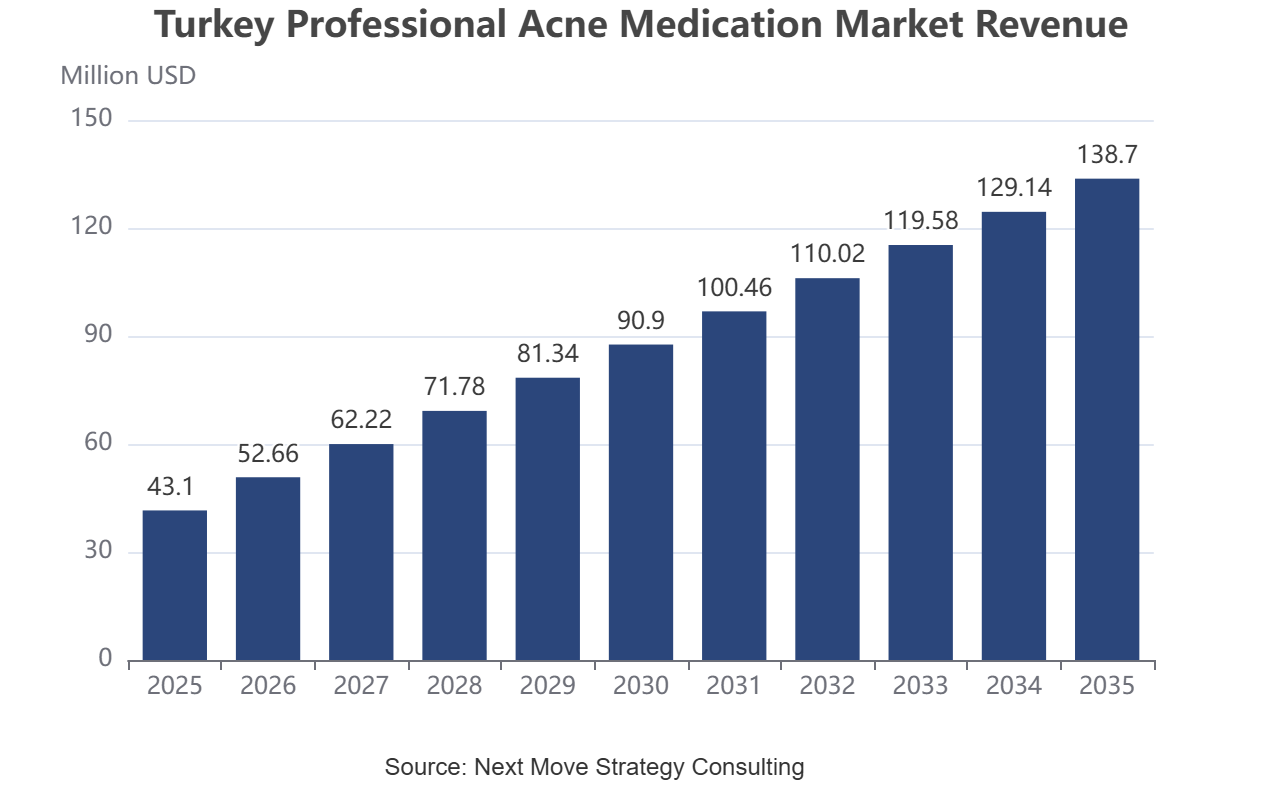
The Turkey Professional Acne Medication Market size was valued at USD 42.39 million in 2025 and is expected to reach USD 48.23 million by 2026. Looking ahead, the industry is projected to expand rapidly, reaching USD 101.74 million by 2035, registering a CAGR of 8.65% from 2026 to 2035.
Turkey professional acne medication market sits between high patient demand and cautious clinical escalation. Acne prevalence is widespread across adolescents and young adults, but professional treatment adoption varies by income level and urban access. Dermatology clinics in major cities drive prescription use, particularly for persistent and scarring-prone acne cases. Patients transition to professional medications after extensive OTC use, making dermatologist intervention a corrective step rather than an initial choice. Economic volatility and pricing sensitivity influence treatment duration and brand selection, encouraging pragmatic prescribing. Despite these constraints, rising aesthetic awareness and a strong private clinic network support steady demand growth. Turkey’s market is characterised by volume potential tempered by affordability considerations, with professional acne medication increasingly recognized as necessary for long-term control rather than short-term symptom relief.
Urban Growth and Rising Appearance Awareness Drives Turkey Professional Acne Medication Market Demand
The professional acne medication market in Turkey is increasingly shaped by rapid urban momentum and growing appearance awareness across younger and working-age populations. Expanding metropolitan areas, lifestyle stress, dietary shifts, and pollution exposure have contributed to a noticeable rise in persistent acne cases beyond adolescence. In Turkey, personal appearance carries strong social and professional significance, particularly in service, hospitality, and media-influenced sectors. Acne is progressively being viewed as a condition that affect confidence, employability, and social interaction. This perception is encouraging individuals to move away from short-term cosmetic fixes toward dermatologist-guided medical treatments. As awareness grows around acne scarring and uneven skin tone, demand for professional acne medications is strengthening, especially in large cities where lifestyle pressures and image sensitivity are highest.
Expanding Private Healthcare and Dermatology Accessibility Drives Turkey Professional Acne Medication Market Growth
Growth in private healthcare infrastructure is a key driver supporting Turkey’s professional acne medication market. Private hospitals, dermatology clinics, and aesthetic centres have expanded significantly, offering faster access to specialists and modern treatment protocols. These facilities provide structured acne management plans that include prescription medications, regular monitoring, and patient education. Dermatologists play an important role in improving treatment adherence by setting realistic expectations and emphasising long-term outcomes. In addition, Turkey’s role as a regional hub for medical tourism increases exposure to advanced dermatological practices and prescription therapies for skin. This expanding specialist-led ecosystem is improving diagnosis rates and reinforcing trust in professional acne care, contributing to steady prescription growth across urban and semi-urban regions.
Economic Sensitivity and Interrupted Treatment Cycles Limits Market Growth
Economic sensitivity remains a notable restraint in Turkey professional acne medication market. Fluctuations in household income and rising healthcare costs influence patient decisions regarding treatment initiation and continuity. Professional acne care requires follow-up visits and extended medication use, which are perceived as financially burdensome for some consumers. As a result, patients discontinue therapy once visible improvement is achieved or delay dermatologist consultations altogether. Price-conscious behaviour, combined with the availability of lower-cost over-the-counter products, limit long-term adherence. These interrupted treatment cycles reduce repeat prescriptions and slow broader market penetration despite increasing awareness and access to dermatology services.
Affordable, Maintenance-Oriented Treatment Models Creates Turkey Professional Acne Medication Market Opportunities
Turkey presents strong opportunities for professional acne medications aligned with affordability and long-term maintenance. Development of cost-effective formulations and simplified treatment regimens improve access across diverse income groups. There is also growing scope for maintenance-dose therapies that focus on preventing recurrence rather than aggressive short-term correction. Educational initiatives led by dermatologists and clinics further strengthen adherence by highlighting the benefits of consistency and early intervention. As patients increasingly seek sustainable and manageable treatment options, professional acne medications that balance efficacy, tolerability, and cost are well positioned to support long-term market growth in Turkey.
Competitive Landscape
The Turkey professional acne medication industry comprises various market players, such as Axis-Y Co., Ltd., Bioderma, AbbVie Inc., Kenvue Inc., Bayer AG, Pierre Fabre Laboratories, Teva Pharmaceutical Industries Ltd., GlaxoSmithKline group of companies, La Roche-Posay, Viatris Inc., Pfizer Inc., F. Hoffmann-La Roche Ltd., Cosrx, Galderma S.A., BEIERSDORF and others.
Turkey Professional Acne Medication Market Key Segments
By Acne Type
-
Inflammatory Acne
-
Papules & Pustules
-
Nodules
-
Cystic Acne
-
-
Non-Inflammatory Acne
-
Open Comedones
-
Closed Comedones
-
By Formulation
-
Topical Medications
-
Gels
-
Creams
-
Lotions
-
Other Tropical Medications
-
-
Combination Treatments
-
Laser and Light-Based Treatments
-
Blue Light Therapy
-
Intense Pulsed Light
-
Photodynamic Therapy
-
-
Oral Medications
-
Tablets
-
Capsules
-
Oral Suspensions
-
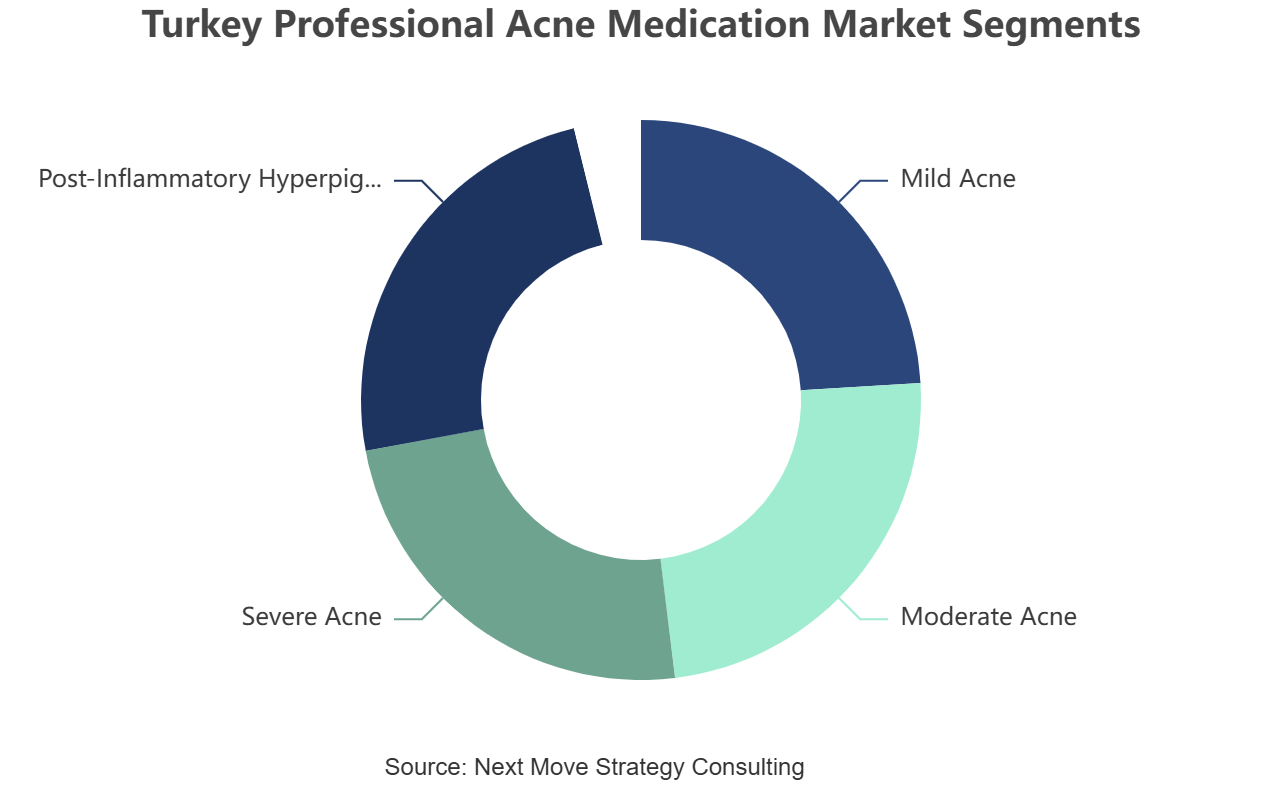
By Acne Severity
-
Mild Acne
-
Moderate Acne
-
Severe Acne
-
Post-Inflammatory Hyperpigmentation (Pih)
By Skin Type
-
Normal/Combination Skin
-
Dry Skin
-
Oily Skin
-
Sensitive Skin
By Age Group
-
Pediatric Patients (≤12 years)
-
Teenagers and Young Adults (13-30 years)
-
Adults (31 years and Above)
By Therapeutic Class
-
Retinoids
-
Antibiotics
-
Salicylic Acid
-
Benzoyl Peroxide
-
Others
By Price Tier
-
Low Price Tier
-
Mid Price Tier
-
High Price Tier
By Treatment Setting
-
In-Clinic / In-Office Treatment
-
At-Home Treatment
-
Hybrid Treatment Model
By Application
-
Facial Acne Treatment
-
Body Acne Treatment
-
Scalp Acne Treatment
By Distribution Channel
-
Dermatologist & Aesthetician
-
Pharmacies & drug store
-
E-Commerce
-
Others
By End User
-
Dermatology Clinics
-
Hospitals & Healthcare Facilities
-
Medical Spas
-
Cosmetic Surgeons
-
Pharmacies / Chemists
-
Teledermatology Services
-
Other End Users
Key Players
-
Axis-Y Co., Ltd.
-
Bioderma
-
AbbVie Inc.
-
Kenvue Inc.
-
Bayer AG
-
Pierre Fabre Laboratories
-
Teva Pharmaceutical Industries Ltd.
-
GlaxoSmithKline group of companies
-
La Roche-Posay
-
Viatris Inc.
-
Pfizer Inc
-
F. Hoffmann-La Roche Ltd
-
cosrx
-
Galderma S.A.
-
BEIERSDORF
Report Scope and Segmentation:
|
Parameters |
Details |
|
Market Size in 2026 |
USD 48.23 Million |
|
Revenue Forecast in 2035 |
USD 101.74 Million |
|
Growth Rate |
CAGR of 8.65% from 2026 to 2035 |
|
Analysis Period |
2025–2035 |
|
Base Year Considered |
2025 |
|
Forecast Period |
2026–2035 |
|
Market Size Estimation |
Million (USD) |
|
Growth Factors |
|
|
Companies Profiled |
15 |
|
Market Share |
Available for 10 companies |
|
Customization Scope |
Free customization (equivalent to up to 80 analyst-working hours) after purchase. Addition or alteration to country, regional & segment scope. |
|
Pricing and Purchase Options |
Avail customized purchase options to meet your exact research needs. |
|
Approach |
In-depth primary and secondary research; proprietary databases; rigorous quality control and validation measures. |
|
Analytical Tools |
Porter's Five Forces, SWOT, value chain, and Harvey ball analysis to assess competitive intensity, stakeholder roles, and relative impact of key factors. |
About the Author
 Saista Faiyaz
— Saista Faiyaz is Research Associate at Next Move Strategy Consulting, where she has covered consumer markets and healthcare technologies for 3 years. Her work includes primary interview review, secondary-source validation, market sizing, and structured analysis of company and industry data. She supports research by comparing evidence across sources, organizing findings into market narratives, and documenting assumptions used in analysis. Her scope includes cross-market benchmarking, and reports.
Saista Faiyaz
— Saista Faiyaz is Research Associate at Next Move Strategy Consulting, where she has covered consumer markets and healthcare technologies for 3 years. Her work includes primary interview review, secondary-source validation, market sizing, and structured analysis of company and industry data. She supports research by comparing evidence across sources, organizing findings into market narratives, and documenting assumptions used in analysis. Her scope includes cross-market benchmarking, and reports.
About the Reviewer
 Supradip Baul
— Supradip Baul is an accomplished business consultant and strategist with over a decade of rich experience in market intelligence, strategy, technology, and business transformation. His work has included rigorous qualitative and quantitative analysis across multiple industries, helping clients shape investment decisions and long-term roadmaps. Earlier in his career, he was associated with Gartner, where he contributed to industry-leading reports and market share analyses. He has worked with leading global companies and holds an MBA with a dual specialization in Marketing and Finance.
Supradip Baul
— Supradip Baul is an accomplished business consultant and strategist with over a decade of rich experience in market intelligence, strategy, technology, and business transformation. His work has included rigorous qualitative and quantitative analysis across multiple industries, helping clients shape investment decisions and long-term roadmaps. Earlier in his career, he was associated with Gartner, where he contributed to industry-leading reports and market share analyses. He has worked with leading global companies and holds an MBA with a dual specialization in Marketing and Finance.
At Next Move Strategy Consulting, we understand that insightful market research is the cornerstone of successful business decisions. That's why we employ a robust and multifaceted approach, combining various methodologies to deliver the most accurate and actionable data for our clients.

Research Landscape
We navigate the world of research with two primary approaches:
Qualitative Approach
Our qualitative research methodologies involve immersive techniques such as in-depth interviews, focus groups, and observational studies. By engaging directly with individuals and stakeholders, we uncover valuable insights that quantitative data alone may overlook.

Quantitative Research
In tandem with qualitative methodologies, NMSC leverages the power of Quantitative Research to provide a robust foundation of numerical insights. Through systematic data collection and analysis, we quantify patterns, preferences, and market trends, offering a comprehensive view of the business landscape.
Our quantitative research approach employs diverse tools, including surveys, experiments, and statistical modelling. These methodologies enable us to gather data from a large and representative sample, ensuring the statistical significance of our findings. By employing structured questionnaires and standardized data collection methods, we guarantee the reliability and validity of the information we present to our clients.
Quantitative research is particularly effective in measuring the prevalence of trends, assessing market size, and gauging the impact of various factors on consumer behavior. The numerical precision attained through this approach equips our clients with actionable insights, facilitating data-driven decision-making and strategy formulation.


Our Specialized Toolbox for Industry-Specific Market Research
We deploy a specialized arsenal of techniques tailored to meet your unique requirements. Here's a glimpse into our comprehensive toolbox:

Information Procurement
The stage entails acquiring market data or relevant information through various sources and methodologies.


Market Research Approach
We utilize both top-down and bottom-up approaches in market research analysis to achieve a comprehensive understanding of the market dynamics, leveraging the broad perspective of industry trends and macroeconomic factors alongside detailed insights from specific segments and individual companies.

Porters Five Forces Analysis
We conduct Porter's Five Forces analysis to evaluate the competitive landscape of an industry, providing us with insights into factors that affect profitability and strategic positioning.

SWOT Analysis

Forecasting
We utilize a forecasting model to predict future consumption by considering parameters like population, economics, regulations, market competition, drivers, constraints, technology, and pricing. We also employ statistical techniques such as multilinear regression, exponential smoothing, moving average, ARIMA, and Monte Carlo simulations for accurate predictions. In econometric forecasting, we analyzed short-term and long-term event impacts, attributing values based on regulatory frameworks, economic factors, and market events.





 Speak to Our Analyst