Vegan and Cruelty-Free Cosmetics Market Global Industry Analysis and Forecast (2026–2035)

The global Vegan and Cruelty-Free Cosmetics Market size was valued at USD 8,500.0 million in 2025 and is estimated at USD 9,550.0 million in 2026, forecast to reach USD 24,600.0 million by 2035, expanding at an 11.1% CAGR between 2026 and 2035. Europe leads with approximately 36% share, while Skin Care dominates all other product categories with approximately 38% share.

Download Free Sample PDF
Base Year (2025)
$8,500.0 Million
Forecast (2035)
$24,600.0 Million
CAGR (2026-2035)
11.1%
Top Region
Europe

What Is the Vegan and Cruelty-Free Cosmetics Market Size?

The global vegan and cruelty-free cosmetics market size was valued at USD 8,500.0 Million in 2025 and is estimated at USD 9,550.0 Million in 2026, forecast to reach USD 24,600.0 Million by 2035, expanding at an 11.1% CAGR between 2026 and 2035. Europe leads with approximately 36% share, while skin care dominates all other product categories with approximately 38% share.

We observed that growth is broadening across certification tiers and distribution channels, with third-party vegan certification and direct-to-consumer online sales driving the fastest structural gains through 2035.

Vegan and Cruelty-Free Cosmetics Market Global Industry Analysis and Forecast (2026–2035) Revenue Forecast

Values in USD Million

2025 $8,500.0 Million
2025
2026 $9,550.0 Million
2026
2027 $10,610.1 Million
2027
2028 $11,787.8 Million
2028
2029 $13,096.2 Million
2029
2030 $14,549.9 Million
2030
2031 $16,164.9 Million
2031
2032 $17,959.2 Million
2032
2033 $19,952.7 Million
2033
2034 $22,167.5 Million
2034
2035 $24,600.0 Million
2035

Key Takeaways

By Product Category: Skin Care held the largest share of approximately 38% (USD 3,230.0 Million) in 2025; Fragrance is the fastest-growing sub-segment at 14.0% CAGR from 2026–2035.

By Certification: Leaping Bunny held the largest share of approximately 34% (USD 2,890.0 Million) in 2025; Vegan Society is the fastest-growing sub-segment at 15.4% CAGR from 2026–2035.

By Price Tier: Mass held the largest share of approximately 42% (USD 3,570.0 Million) in 2025; Luxury is the fastest-growing sub-segment at approximately 14.5% CAGR from 2026–2035.

By Distribution Channel: Speciality Beauty held the largest share of approximately 28% (USD 2,380.0 Million) in 2025; Marketplaces is the fastest-growing sub-segment at 15.9% CAGR from 2026–2035.

By End User: Women held the largest share of approximately 82% (USD 6,970.0 Million) in 2025; Men is the fastest-growing sub-segment at approximately 15.2% CAGR from 2026–2035.

Dominant Region: Europe dominated with approximately 36% revenue share (USD 3,060.0 Million) in 2025.

Fastest-Growing Region: Asia-Pacific is expected to register the highest CAGR of 16.2% during 2026–2035.

Dominant Country: U.S. led with approximately USD 2,400.0 Million in 2025.

Fastest-Growing Country: China is the fastest-growing country at approximately 18.5% CAGR from 2026–2035.

What Does the Vegan and Cruelty-Free Cosmetics Market Encompass?

The vegan and cruelty-free cosmetics market encompasses makeup, skin care, hair care, fragrance, and accessory products formulated without animal-derived ingredients and manufactured without animal testing at any production stage. Our assessment indicates that the scope spans mass, masstige, premium, luxury, and professional price tiers distributed through direct-to-consumer, marketplace, speciality beauty, and mass retail channels. The category has evolved from a niche ethical-beauty segment into a mainstream formulation standard, with major retailers now dedicating shelf space specifically to certified vegan and cruelty-free product lines.

Regulatory frameworks such as the European Union's cosmetics animal-testing ban and various U.S. state-level cruelty-free legislation shape formulation and marketing-claim standards across the industry. We observed that technology adoption is shifting toward plant-based biotechnology ingredients and blockchain-verified supply-chain traceability for certification claims. Next Move Strategy Consulting's analysis indicates that this structural shift, combined with rising integration of organic personal care ingredients sourcing, is redefining formulation standards across the vegan and cruelty-free cosmetics market.

Consumer Behavior Analysis of the Vegan and Cruelty-Free Cosmetics Market

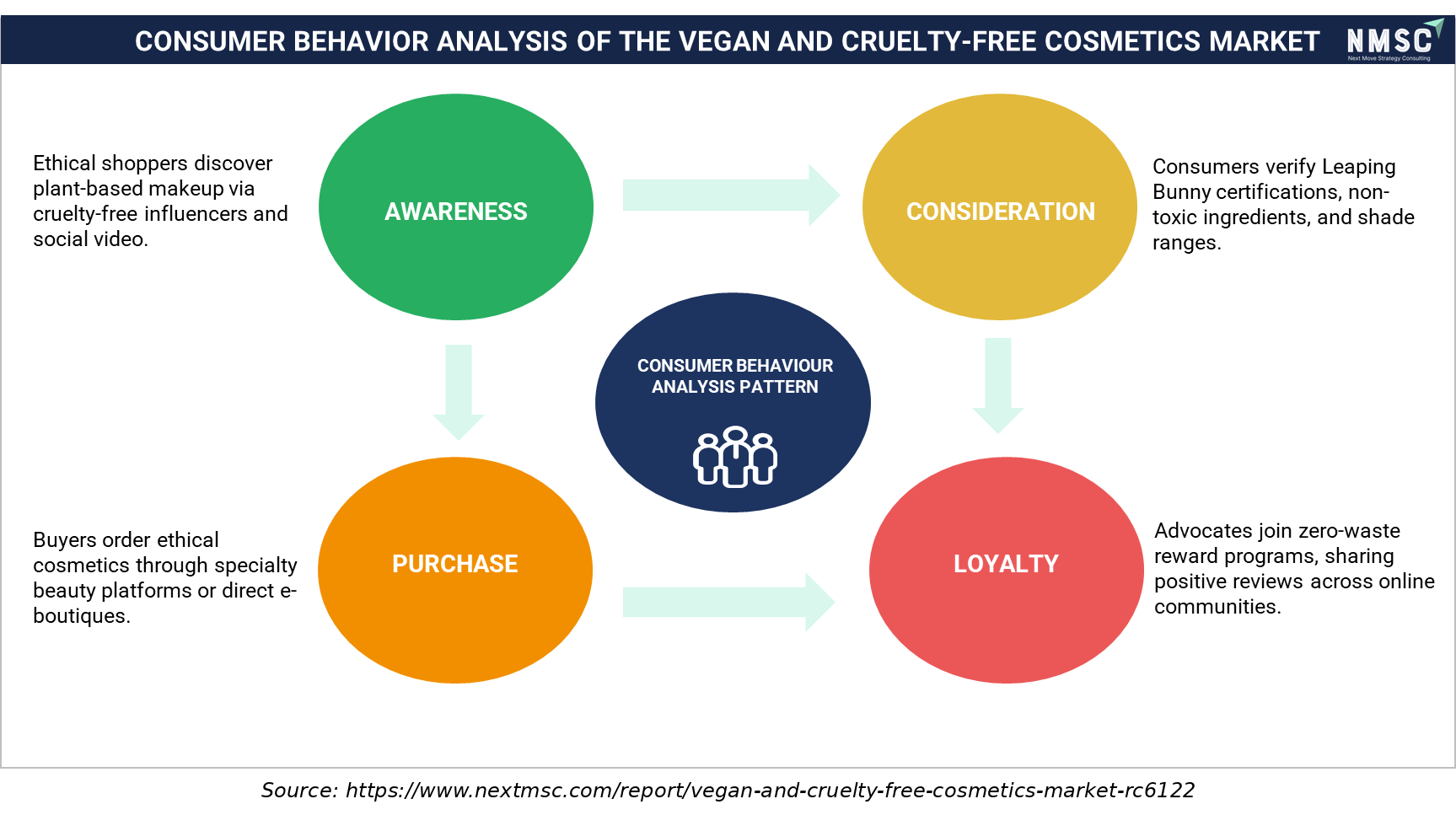
Consumer Behavior Analysis of the Vegan and Cruelty-Free Cosmetics Market

In our observation, purchasing journey in the Vegan and Cruelty-Free Cosmetics Market begins as ethical shoppers discover plant-based makeup through influencers and videos. Consequently, consumers verify Leaping Bunny certifications, non-toxic ingredients, and shade ranges during consideration. Orders are placed via specialty platforms or e-boutiques, while long-term loyalty is sustained as advocates join zero-waste reward programs and share positive reviews across online communities.

Market Drivers & Dynamics

Interactive Dataset
Rising consumer demand for ethical and sustainable beauty driver +3.2% Global 2026–2035
Expansion of third-party vegan and cruelty-free certification driver +2.6% Europe, North America 2026–2033
Growth of direct-to-consumer digital distribution driver +2.1% Global 2026–2032
Regulatory bans on cosmetic animal testing driver +1.7% Europe, Asia-Pacific 2026–2031
Rising men's grooming category adoption driver +1.2% North America, Europe 2027–2035
Higher formulation costs for plant-based actives restraint −1.6% Global 2026–2030
Consumer confusion over uncertified vegan claims restraint −1.1% North America, Asia-Pacific 2026–2029
Limited retail shelf space versus conventional brands restraint −0.8% Global 2026–2031
Source: Next Move Strategy Consulting

Growth Drivers

What Is the Primary Growth Driver of the Vegan and Cruelty-Free Cosmetics Market?

Rising consumer demand for ethical and sustainable beauty products represents the primary growth driver, expanding the addressable customer base beyond niche ethical-consumer segments into mainstream beauty retail. Data from national consumer-protection agencies indicates sustained growth in ethical-claim product registrations across major markets through 2025. This expanding demand is prompting brands to scale certified product lines to capture rising mainstream interest.

How Is Certification Expansion Driving the Market Growth?

Growing availability of third-party vegan and cruelty-free certification is driving market growth, as verified labeling reduces consumer skepticism toward self-declared claims. Regulatory data from the European Union's cosmetics animal-testing ban confirms sustained compliance-driven formulation shifts across the region through 2025. Brands are responding by pursuing Leaping Bunny and Vegan Society certification to differentiate from uncertified competitors.

Growth Inhibitors

What Is Restraining the Vegan and Cruelty-Free Cosmetics Market Growth?

Higher formulation costs for plant-based and biotechnology-derived active ingredients restrain market growth by compressing margins relative to conventional animal-derived formulations. Government trade data has documented elevated input costs for specialty botanical extracts across recent reporting periods. These conditions are prompting brands to pursue vertically integrated ingredient sourcing to reduce dependency on volatile specialty-ingredient supply chains.

Segmentation Analysis

2025 (USD Million)
2035 (USD Million)
Makeup 2025: $2,890.0 Million | 2035: $8,610.0 Million
Makeup
Skin Care 2025: $3,230.0 Million | 2035: $9,102.0 Million
Skin Care
Hair Care 2025: $1,360.0 Million | 2035: $3,690.0 Million
Hair Care
Fragrance 2025: $680.0 Million | 2035: $2,214.0 Million
Fragrance
Accessories 2025: $340.0 Million | 2035: $984.0 Million
Accessories
Makeup $2,890.0 Million $8,610.0 Million 12.9%
Skin Care $3,230.0 Million $9,102.0 Million 12.2%
Hair Care $1,360.0 Million $3,690.0 Million 11.7%
Fragrance $680.0 Million $2,214.0 Million 14.0%
Accessories $340.0 Million $984.0 Million 12.5%

Which Product Category Dominates the Vegan and Cruelty-Free Cosmetics Market?

Product category segmentation divides the market into makeup, skin care, hair care, fragrance, and accessories. Skin care holds the dominant position, supported by strong consumer association between plant-based formulation and skin-health benefits across face and body care lines. Fragrance is the fastest-growing sub-segment, driven by expanding vegan fine-fragrance and body-mist launches from independent brands entering a historically underrepresented product category.

2025 (USD Million)
2035 (USD Million)
None
PETA
Leaping Bunn
Vegan Societ
Other Certif
Segment Item 2025 (USD Million) 2035 (USD Million) CAGR
None $10.0 USD Million $40.0 USD Million 25.0%
PETA $17.1 USD Million $51.1 USD Million 11.0%
Leaping Bunny $24.2 USD Million $62.2 USD Million 25.0%
Vegan Society $31.3 USD Million $73.3 USD Million 11.0%
Other Certification $38.4 USD Million $84.4 USD Million 16.0%

Segment-wise data is locked

Unlock complete segment-wise numbers for By Certification.

Unlock Full Data

Which Certification Leads the Vegan and Cruelty-Free Cosmetics Market?

Certification segmentation spans none, PETA, Leaping Bunny, Vegan Society, and other certification schemes. Leaping Bunny holds the dominant position, reflecting its broad global brand recognition and rigorous cruelty-free supply-chain audit standard. Vegan Society certification is the fastest-growing category, supported by rising consumer preference for ingredient-level vegan verification beyond cruelty-free testing claims alone, particularly across skin care and hair care formulations.

2025 (USD Million)
2035 (USD Million)
Mass
Masstige
Premium
Luxury
Professional
Segment Item 2025 (USD Million) 2035 (USD Million) CAGR
Mass $10.0 USD Million $40.0 USD Million 27.0%
Masstige $17.1 USD Million $51.1 USD Million 9.0%
Premium $24.2 USD Million $62.2 USD Million 19.0%
Luxury $31.3 USD Million $73.3 USD Million 17.0%
Professional $38.4 USD Million $84.4 USD Million 18.0%

Segment-wise data is locked

Unlock complete segment-wise numbers for By Price Tier.

Unlock Full Data
2025 (USD Million)
2035 (USD Million)
DTC
Marketplaces
Speciality B
Mass Retail
Pharmacy And
Segment Item 2025 (USD Million) 2035 (USD Million) CAGR
DTC $10.0 USD Million $40.0 USD Million 14.0%
Marketplaces $17.1 USD Million $51.1 USD Million 24.0%
Speciality Beauty $24.2 USD Million $62.2 USD Million 22.0%
Mass Retail $31.3 USD Million $73.3 USD Million 12.0%
Pharmacy And Drugstore $38.4 USD Million $84.4 USD Million 27.0%

Segment-wise data is locked

Unlock complete segment-wise numbers for By Distribution Channel.

Unlock Full Data

Which Distribution Channel Leads Vegan and Cruelty-Free Cosmetics Sales?

Distribution channel segmentation covers DTC, marketplaces, speciality beauty, mass retail, pharmacy and drugstore, department store, salon and spa, and travel retail. Speciality beauty retail dominates the segment, reflecting curated vegan and cruelty-free assortments at dedicated beauty retailers. Marketplaces represent the fastest-growing channel, supported by expanding third-party seller ecosystems and algorithmic discovery tools that connect independent certified brands directly with search-driven consumers.

2025 (USD Million)
2035 (USD Million)
Men
Women
Segment Item 2025 (USD Million) 2035 (USD Million) CAGR
Men $10.0 USD Million $40.0 USD Million 24.0%
Women $17.1 USD Million $51.1 USD Million 22.0%

Segment-wise data is locked

Unlock complete segment-wise numbers for By End User.

Unlock Full Data
2025 (USD Million)
2035 (USD Million)
North Americ
Canada
Mexico
Europe: UK
Germany
Segment Item 2025 (USD Million) 2035 (USD Million) CAGR
North America: U.S. $10.0 USD Million $40.0 USD Million 23.0%
Canada $17.1 USD Million $51.1 USD Million 9.0%
Mexico $24.2 USD Million $62.2 USD Million 19.0%
Europe: UK $31.3 USD Million $73.3 USD Million 13.0%
Germany $38.4 USD Million $84.4 USD Million 10.0%

Segment-wise data is locked

Unlock complete segment-wise numbers for By Region.

Unlock Full Data

Growth Opportunities

Beyond current demand drivers, three forward-looking whitespace opportunities are positioned to reshape competitive positioning through 2035.

How Can Brands Capture Men's Grooming Category Demand?

Brands can capture rising male-consumer interest by developing gender-neutral vegan grooming and skin care lines marketed without traditional gendered packaging. Skin care and hair care segment participants stand to benefit most, as men's grooming represents a comparatively underpenetrated demographic within the broader certified vegan category.

What Opportunity Exists in Certification-Verified Marketplace Storefronts?

Expanding certification-verified storefronts within major online marketplaces presents a scalable growth mechanism as consumers increasingly filter searches by verified vegan and cruelty-free badges. Independent certified brands benefit directly, gaining discovery visibility against larger uncertified competitors through marketplace certification-based search filtering tools.

How Can Fragrance Expansion Diversify Brand Portfolios?

Expanding vegan fine-fragrance and body-mist product lines creates a durable opportunity in a historically underrepresented category relative to makeup and skin care. Fragrance-focused independent brands benefit most, capturing premium pricing power in a category where certified vegan alternatives remain comparatively scarce against conventional fragrance offerings.

Regional Outlook

2025 (USD Million)
2035 (USD Million)
Europe
North Americ
Asia-Pacific
Middle East
Latin Americ
Region 2025 (USD Million) 2035 (USD Million) CAGR (%)
Europe $10.0 USD Million $40.0 USD Million 9.0%
North America $17.1 USD Million $51.1 USD Million 27.0%
Asia-Pacific $24.2 USD Million $62.2 USD Million 25.0%
Middle East & Africa $31.3 USD Million $73.3 USD Million 23.0%
Latin America $38.4 USD Million $84.4 USD Million 12.0%

Regional data is locked

Unlock complete regional numbers for this market.

Unlock Full Data

PESTEL Analysis of the Vegan and Cruelty-Free Cosmetics Market

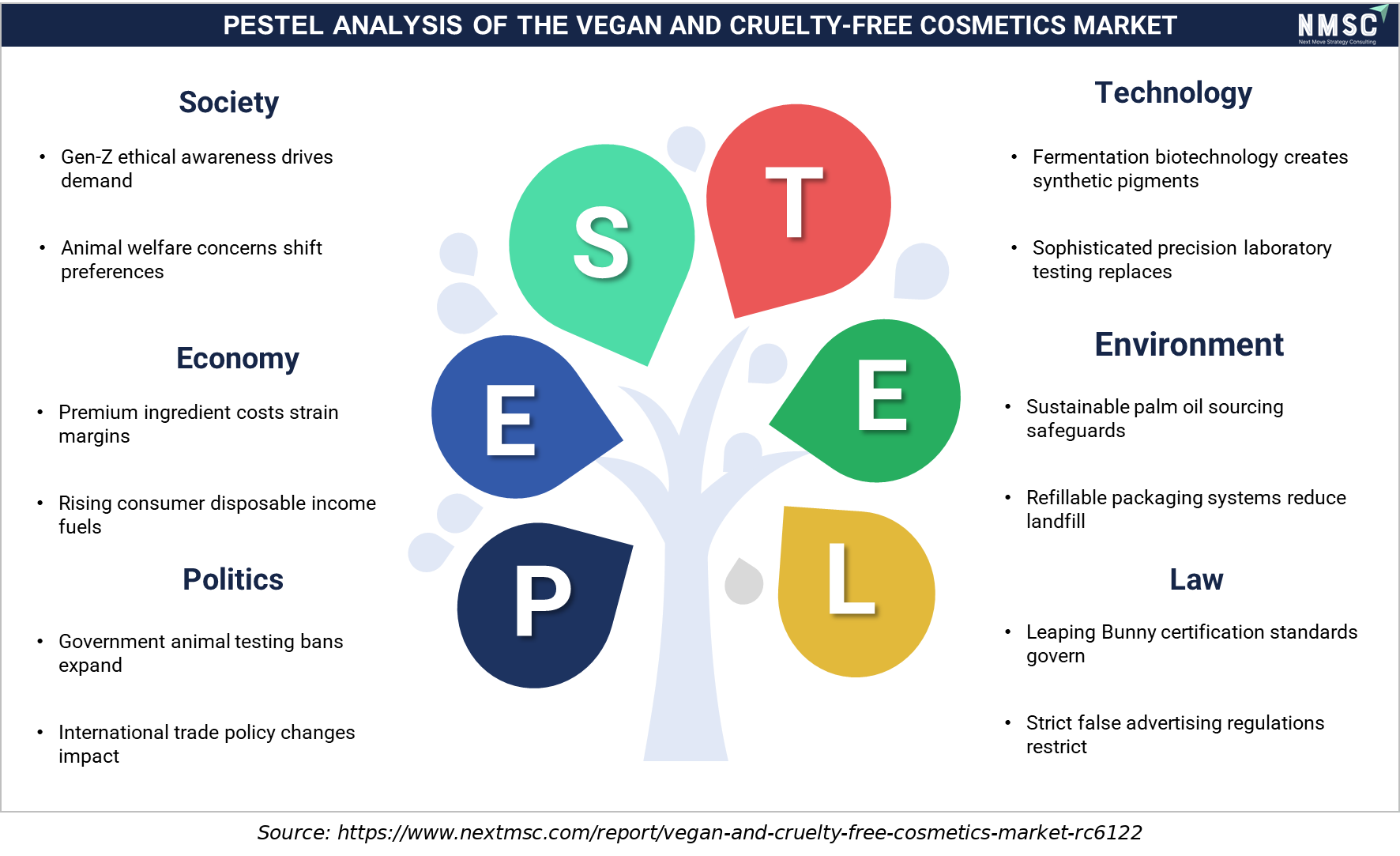
PESTEL Analysis of the Vegan and Cruelty-Free Cosmetics Market
NMSC's analysis indicates that Gen-Z ethical awareness and expanding animal testing bans drive adoption in the Vegan and Cruelty-Free Cosmetics Market. Furthermore, fermentation biotechnology creates synthetic pigments, while precision lab testing replaces animal trials. Concurrently, high ingredient costs impact margins, whereas sustainable palm oil sourcing, refillable packaging, and strict Leaping Bunny certification standards govern legal compliance and eco-friendly brand integrity worldwide.

Competitive Landscape

We observed that the competitive landscape is fragmented, with independent certified brands and select multi-brand beauty groups accounting for the largest share of global certified vegan cosmetics supply.

Dimension Description
Dimension Assessment
Market Structure Fragmented, led by independent certified brands and select multi-brand beauty groups.
Innovation Focus Plant-based biotechnology ingredients, blockchain traceability, and gender-neutral formulation lines.
M&A Activity Selective acquisitions of independent certified brands by larger multi-brand beauty portfolios.

How Do Companies Compete in the Vegan and Cruelty-Free Cosmetics Market?

Companies compete primarily on certification credibility, formulation innovation, and direct-to-consumer brand storytelling rather than on price alone. Third-party certification depth and ingredient transparency are key differentiators for independent brands, while larger multi-brand groups compete on distribution breadth and retail-shelf presence. Industry participants are increasingly investing in supply-chain traceability technology to strengthen certification credibility with skeptical consumers.

Which Competitive Archetypes Dominate the Vegan and Cruelty-Free Cosmetics Market?

Two archetypes dominate the industry: independent founder-led certified brands with deep formulation and certification expertise, and diversified beauty groups incorporating vegan lines within broader multi-brand portfolios. The independent archetype benefits from authentic certification storytelling and community-driven marketing, while diversified groups differentiate through distribution scale and retail relationships. This dual structure explains why market share remains distributed across both small certified brands and larger beauty conglomerates.

What Innovation and Differentiation Strategies Are Companies Pursuing?

Companies are pursuing plant-based biotechnology ingredient development, blockchain-verified traceability, and gender-neutral formulation lines as core differentiation strategies. e.l.f. Beauty's continued expansion of its accessible vegan-certified product range, scaled through 2025, illustrates a strategy of combining mass-tier pricing with verified cruelty-free credentials. Brands across the industry are prioritizing ingredient-level transparency to strengthen certification-conscious consumer trust.

Key Market Players

We found that the competitive set below reflects the validated group of companies most active in shaping global vegan and cruelty-free cosmetics supply as of 2026.

e.l.f. Beauty, Inc. Lush Ltd Rare Beauty, LLC Milk Makeup LLC Pacifica Beauty LLC KVD Beauty MERIT Beauty Tower 28 Beauty, LLC OSEA International, LLC INIKA Organic Pty Ltd Juice Beauty, Inc. Herbivore Botanicals Axiology Beauty LLC Ere Perez Pty Ltd Lily Lolo Ltd PHB Ethical Beauty Ltd ZAO Make-Up Elate Beauty Ltd. Au Naturale Cosmetics, LLC NCLA Beauty

Latest Developments

Our analysis shows that recent company activity reflects continued certification investment and product-line expansion across the brand base.

Date Event
May 2026 Lush launched 'Lush Events' on its official app, integrating its digital loyalty program, Lush Club, with physical store locations. The new feature enables customers to discover, book, and attend in-store consultations, workshops, and brand experiences directly through the mobile application.
April 2026 e.l.f. Beauty announced that rhode would expand into Sephora Europe, with availability planned online and in most Sephora stores across Europe beginning September 2026. The rollout expands rhode’s physical retail presence across multiple European markets.
May 2025 e.l.f. Beauty entered into a definitive agreement to acquire rhode, a fast-growing lifestyle beauty brand, for up to USD 1,000 million (USD 800 million at closing plus up to USD 200 million earnout). The transaction expands e.l.f.'s portfolio into prestige skin-focused vegan cosmetics.

Investment Opportunities

What Capital Inflows Are Shaping the Vegan and Cruelty-Free Cosmetics Market?

Capital inflows are concentrating on independent certified-brand acquisitions and direct-to-consumer platform development. Strategic beauty conglomerates and private equity investors are directing sustained capital toward vegan formulation research and owned e-commerce infrastructure. This inflow pattern is enabling brands to accelerate certification pipelines while diversifying revenue between wholesale retail and direct-to-consumer income streams through 2035.

How Is Infrastructure Investment Supporting Market Expansion?

Infrastructure investment in plant-based ingredient processing and certified supply-chain traceability systems is directly supporting vegan and cruelty-free cosmetics expansion. Private-sector investment in botanical extraction facilities across North America and Europe is expanding capacity for verified plant-based active ingredients, complementing broader vegan leather material innovation investment. This infrastructure buildout is reinforcing supply-chain reliability for certified formulation manufacturers across newly expanded production facilities.

What ESG Considerations Are Influencing Investment Decisions?

Environmental, Social, and Governance considerations are increasingly shaping investment decisions, with investors favoring brands demonstrating verified cruelty-free sourcing and sustainable packaging practices. Third-party certification transparency and recyclable-packaging commitments are gaining preference among institutional investors evaluating long-term beauty-sector assets. This ESG-linked capital allocation is reinforcing demand for certified vegan formulations across mass and premium price tiers.

Key Benefits for Stakeholders

How Does This Report Benefit Industry Leaders?

Industry leaders gain a validated view of segment-level revenue distribution, competitive positioning, and regional growth trajectories that inform product-development and certification investment decisions. The report's segmentation and regional analysis clarify where demand is concentrating, enabling brand executives to prioritize capital allocation toward the highest-growth product categories and certification tiers through 2035.

How Does This Report Benefit Investors and Financial Analysts?

Investors and financial analysts gain access to consistent market-sizing figures, CAGR forecasts, and competitive-landscape assessment that support valuation and portfolio-allocation decisions across independent and diversified beauty-sector assets. The report's regional and segmental breakdowns provide a defensible basis for evaluating growth-adjusted investment opportunities across the vegan and cruelty-free cosmetics value chain through the 2026–2035 forecast period.

How Does This Report Benefit Technology and Product Vendors?

Technology and product vendors supplying plant-based ingredient processing, traceability software, and e-commerce personalization platforms gain insight into which product categories and channels are expanding fastest. This analysis helps vendors prioritize product roadmaps toward the highest-growth integration points, including certification-verification technology and direct-to-consumer platform tools favored by the dominant segments identified in this report.

Key Market Segments Evaluated

By Product Category

  • Makeup
  • Skin Care
  • Hair Care
  • Fragrance
  • Accessories

By Certification

  • None
  • PETA
  • Leaping Bunny
  • Vegan Society
  • Other Certification

By Price Tier

  • Mass
  • Masstige
  • Premium
  • Luxury
  • Professional

By Distribution Channel

  • DTC
  • Marketplaces
  • Speciality Beauty
  • Mass Retail
  • Pharmacy And Drugstore
  • Department Store
  • Salon And Spa
  • Travel Retail

By End User

  • Men
  • Women

By Region

  • North America: U.S.
  • Canada
  • Mexico
  • Europe: UK
  • Germany
  • France
  • Italy
  • Spain
  • Sweden
  • Denmark
  • Finland
  • Netherlands
  • Rest of Europe
  • Asia-Pacific: China
  • India
  • Japan
  • South Korea
  • Taiwan
  • Indonesia
  • Vietnam
  • Australia
  • Philippines
  • Malaysia
  • Rest of APAC
  • Middle East & Africa: Saudi Arabia
  • UAE
  • Egypt
  • Israel
  • Turkey
  • Nigeria
  • South Africa
  • Rest of MEA
  • Latin America: Brazil
  • Argentina
  • Chile
  • Colombia
  • Rest of LATAM

Conclusion & Recommendations

The long-term outlook remains strongly positive, with the market expanding from USD 9,550.0 Million in 2026 to USD 24,600.0 Million by 2035 at an 11.1% CAGR. Sustained ethical-consumer demand, expanding third-party certification adoption, and rising direct-to-consumer distribution collectively support continued growth across the fastest-expanding regions and product categories through the full forecast period.

What Strategic Positioning Should Brands Pursue?

Brands should prioritize third-party certification depth, direct-to-consumer platform investment, and gender-neutral formulation lines to strengthen competitive positioning. Independent certified brands are advised to expand marketplace visibility, while larger diversified beauty groups should scale certified product-line acquisitions to capture recurring demand across both established and emerging affluent consumer segments.

How Attractive Is the Vegan and Cruelty-Free Cosmetics Market for Investment?

The market presents strong investment attractiveness, supported by an absolute dollar opportunity of USD 15,050.0 Million between 2026 and 2035. Asia-Pacific offers the highest growth-adjusted returns given its 16.2% regional CAGR, while established European and North American markets provide stable, lower-volatility exposure to certified skin care and makeup assets.

What Market Shifts and Key Risks Should Stakeholders Monitor?

Stakeholders should monitor higher formulation costs for plant-based active ingredients, consumer confusion over uncertified vegan claims, and limited retail shelf space relative to conventional beauty brands. Additionally, tightening certification-verification expectations require continuous supply-chain transparency investment, as brands unable to substantiate claims risk losing share to rigorously certified competitors.

What Are the Key Growth Pathways Through 2035?

Key growth pathways include expanding third-party certification adoption, scaling direct-to-consumer and marketplace distribution, and deepening men's grooming and fragrance category penetration across emerging regional markets. Brands pursuing coordinated expansion across these three pathways, supported by continued formulation-transparency investment, are best positioned to capture disproportionate share of the USD 15,050.0 Million incremental opportunity through 2035.

FAQs

About the Author

Saista Faiyaz

Saista Faiyaz

Saista Faiyaz is Research Associate at Next Move Strategy Consulting, where she has covered consumer markets and healthcare technologies for 3 years. Her work includes primary interview review, secondary-source validation, market sizing, and structured analysis of company and industry data. She supports research by comparing evidence across sources, organizing findings into market narratives, and documenting assumptions used in analysis. Her scope includes cross-market benchmarking, and reports.

About the Reviewer

Supradip Baul

Supradip Baul

Supradip Baul is an accomplished business consultant and strategist with over a decade of rich experience in market intelligence, strategy, technology, and business transformation. His work has included rigorous qualitative and quantitative analysis across multiple industries, helping clients shape investment decisions and long-term roadmaps. Earlier in his career, he was associated with Gartner, where he contributed to industry-leading reports and market share analyses. He has worked with leading global companies and holds an MBA with a dual specialization in Marketing and Finance.

Download Free Sample

Gaurav Jaiswal

GAURAV JAISWAL

Founder & CEO

Yano Charge Private Limited

The EV Charging market research report provided by the NextMSC was exceptionally detailed and insightful. It offered a comprehensive analysis that proved to be a game-changer for our strategic planning. Truly a testament to the NextMSC’s expertise and thoroughness in EV market landscape & analysis.

Semih Kavaklioglu

SEMIH KAVAKLIOGLU

Co-Founder & Sales Manager

Decortie

I work a lot in the marketing industry and I know that research is an essential part of any campaign. I have used Market research reports for my own products and I found them to be very informative and well-researched. The team here produces insightful reports for a good price

Robert Sean Trevino

ROBERT SEAN TREVINO

Sr. Director, Head of Strategic Insights & Analytics

Foundation Medicine

I realized that it was a reliable source of information. These days, there are many people who are looking for authentic data, and this is one of the only sources that can offer them with what they need;

Pratyush Kumar Das

PRATYUSH KUMAR DAS

Assistant Manager

Polycab India Limited

We would like to express our appreciation for the data and insights provided by nextmsc. We are very pleased with the quality and depth of the information, which has proven to be highly valuable and beneficial for our business decision-making.

Nishant Awate

NISHANT AWATE

Business Development Global Sales

Zehnder Group Deutschland GmbH

Our experience working with Next Move Strategy Consulting was positive. The team was responsive, professional, and open to incorporating our specific requirements throughout the project. The India AHU market study was comprehensive and well structured, covering market value and volume forecasts, product and application segments, and key industry trends. The inclusion of both AHU and residential MVHR market insights made the study particularly relevant for our strategic market assessment. Overall, the report provides a solid foundation for evaluating market potential, identifying priority segments, and supporting business-development decisions in India.

Custom Market Research Services

We will customize the research for you if the listed report does not fully match your requirements.

Get 30% Free Customization

Select License

This website uses cookies to ensure you get the best experience on our website. Learn more

✖