Veterinary Imaging Market by Offering (Equipment, Software & Digital Services, Services, Consumables & Reagents), by Animal Type (Small Companion Animals, Equine, Production Animals, Exotic and Zoological Species, and Other Species), by Sales Channel (Direct Sales, Distributors and Dealers, Online and Marketplaces, Third-Party Service Operators, and Tender and Institutional Procurement), and Others – Global Opportunity Analysis and Industry Forecast 2024–2030
Industry: Healthcare | Publishing Date: August 22, 2025 | Last Updated: September 30, 2026 | No of Pages: N/A | No. of Tables: N/A | No. of Figures: N/A | Format: PDF | Report Code: HC2669
Veterinary Imaging Market Overview
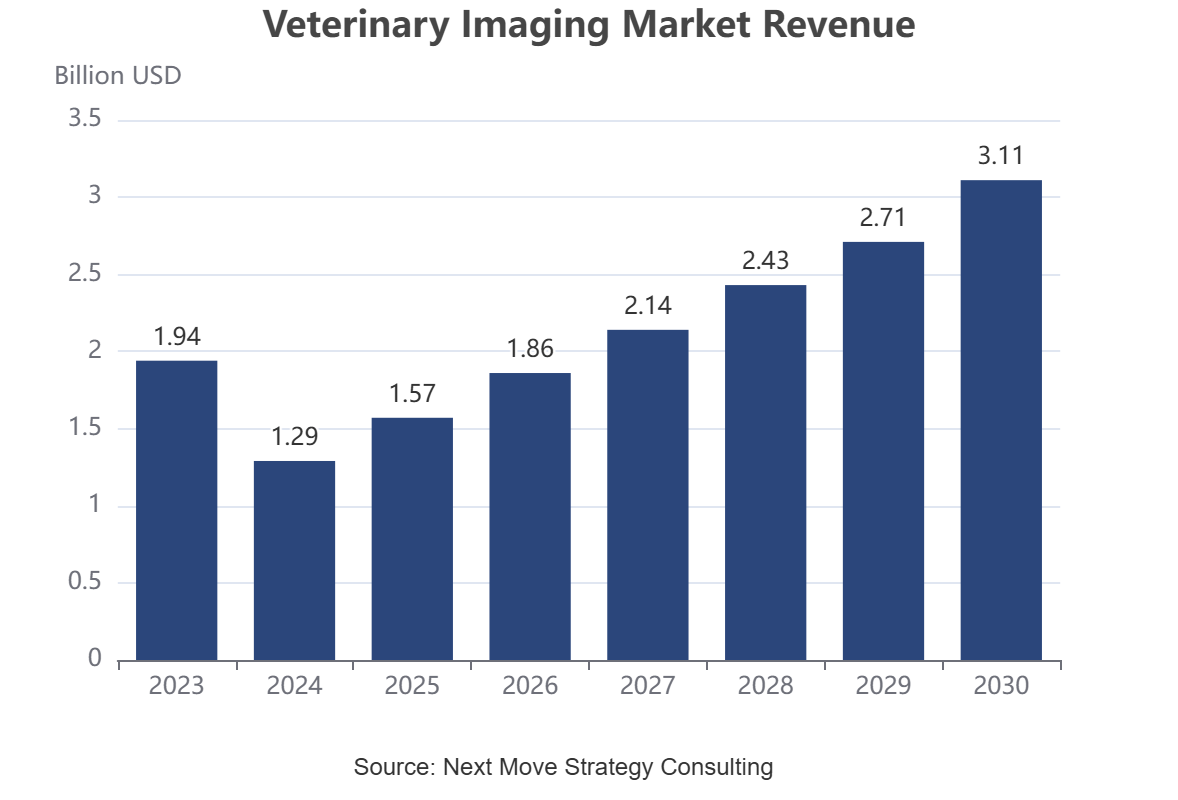
The global Veterinary Imaging Market size was valued at USD 1.94 billion in 2023 and is predicted to reach USD 3.11 billion by 2030 with a CAGR of 7.0% from 2024-2030The veterinary imaging market or animal radiology market comprises the development, production, and application of technologies used in veterinary health monitoring. Technologies in this process includes x-ray, ultrasound, computed tomography, and endoscopy utilized to diagnose and monitor animal health conditions.
This market support animal practitioners in providing appropriate diagnostics, treatment planning, and monitoring of various animal health conditions and also includes devices, software, and associated services used in imaging processes. This comprehensive approach not only benefits animals by minimizing invasive procedures but also ensures precise diagnoses, leading to tailored treatment plans and improved outcomes.
Market Dynamics and Trends
The surge in number of pet ownership globally is significantly driving the demand for advanced veterinary imaging technologies, as pet owners seek better healthcare for their companion. World Animal Foundation reports that, in 2023, globally there were approximately 900 million dogs, and over 471 million of them were being kept as pets. Such rise in pet ownership reflects a significant shift towards concentrating on well-being of animal companions as they are increasingly regarded as indispensable family members.
Moreover, rising advancements in imaging technologies worldwide, such as CT scans and ultrasounds, are fueling the growth of the market by significantly enabling veterinarians to detect and address health issues in animals more effectively. For instance, in May 2024, Esaote launched advanced veterinary ultrasound technology, MyLab FOX. The technology features multi-faceted adaptable design, seamless data management and connectivity and is designed to offer improved imaging quality and flexibility, making it easier for veterinarians to perform detailed examinations and diagnose a range of animal health issues.
Furthermore, the veterinary imaging industry is being propelled by a rising awareness among pet owners about the crucial role that regular health check-ups and early diagnosis play in maintaining their animal’s well-being. As more people recognize the importance of detecting potential health issues early, there has been a growing demand for advanced imaging technologies in veterinary practices. These technologies, that include X-rays, ultrasounds, and MRI, enable veterinarians to accurately diagnose and treat a wide range of conditions in animals, enhancing the overall quality of care.
This shift in pet owner attitudes towards active health management is significantly contributing to the expansion of the industry. However, high costs associated with purchasing and maintaining advanced imaging technologies restraints the veterinary imaging market growth.
On the contrary, ongoing advancements in imaging technologies, such as integration of artificial intelligence (AI), the development of 3D imaging solutions, and the introduction of portable devices may create ample opportunities of the veterinary imaging market expansion in forthcoming years.
These innovations will likely improve diagnostic capabilities and make advanced imaging technologies more widely available. For instance, in November 2022, Konica Minolta launched veterinary digital X-ray imaging system. The AI powered technology optimize imaging techniques based on the patient's size and the type of examination, thereby improving diagnostic efficiency.
Market Segmentations and Scope of the Study
The veterinary imaging market report is segmented on the basis of offering, animal type, sales channel, and end user. On the basis of offering, the market is divided into equipment, software & digital services, services, and consumables & reagents. Equipment is further segmented into X-ray and radiography systems, ultrasound systems, CT systems, MRI systems, nuclear and molecular imaging, endoscopy systems, and other imaging equipment. X-ray and radiography systems are further categorised into digital radiography systems, computed radiography systems, dental radiography systems, and fluoroscopy systems. Ultrasound systems are further segmented into cart-based ultrasound, portable ultrasound, and handheld ultrasound. Endoscopy systems are further divided into rigid endoscopes, flexible endoscopes, and video towers and camera systems. Software & digital services include image management software (PACS), radiology information systems (RIS), AI & advanced analytics, telemedicine platforms, and other software. Services are segmented into installation & training, maintenance & repair, professional services, managed services, and teleradiology reading services. Consumables & reagents include contrast media and reagents, disposable imaging supplies, replacement components, and service consumables.
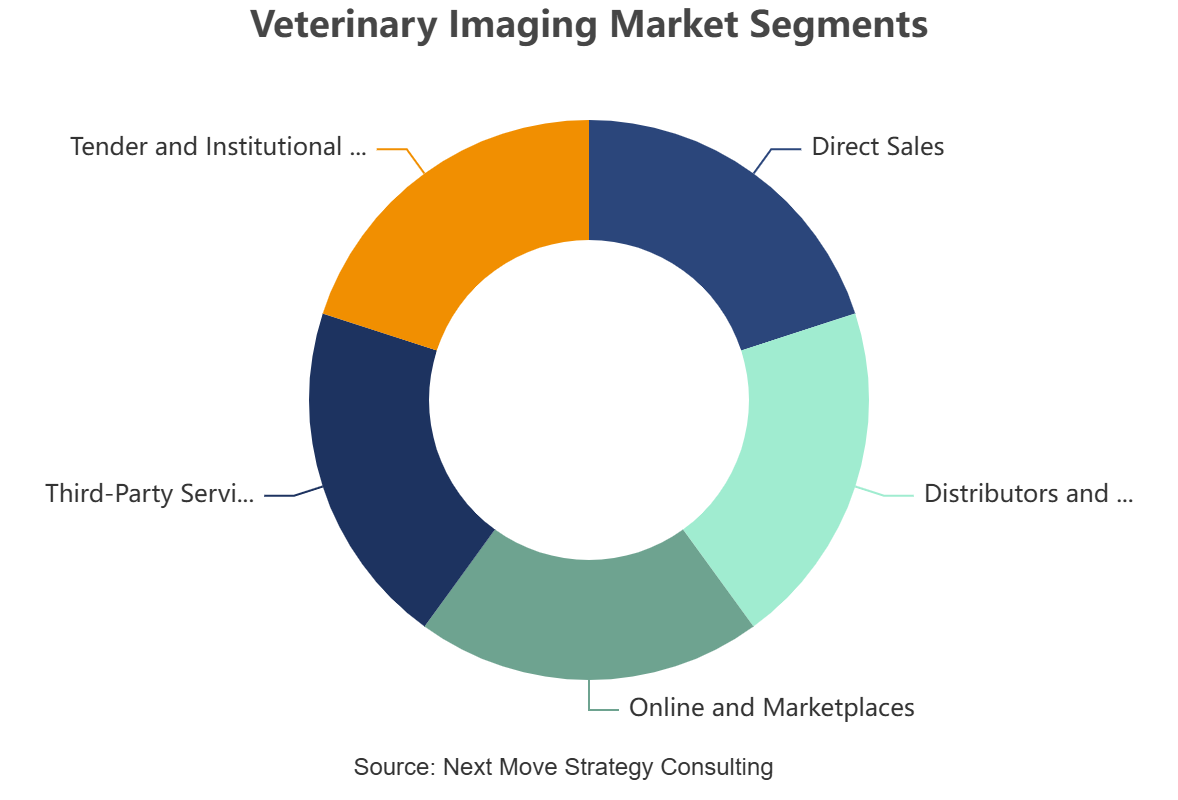
Based on animal type, the market is categorised into small companion animals, equine, production animals, exotic and zoological species, and other species. On the basis of sales channel, the market is bifurcated into direct sales, distributors and dealers, online and marketplaces, third-party service operators, and tender and institutional procurement. On the basis of end user, the market is segmented into general veterinary practice, specialty hospitals, academic and research institutions, emergency and urgent care centers, mobile imaging service providers, farm and production facilities, and diagnostic imaging centers. Regional breakdown and analysis of each of the aforesaid segments includes North America, Europe, Asia-Pacific, and Rest of the World (RoW).
Geographical Analysis
North America region dominates the veterinary imaging market share during the forecast period, due to the surge in pet ownership in this region. According to the World Animal Foundation report of 2023, 86.9 million households in the US owned a pet, reflecting a notable rise in pet ownership.
This figure represents 66% of households, up from 62% in 2022. This rise in pet ownership increases demand for advanced imaging technologies to enable efficient monitoring of animal health. Moreover, the presence of major key players such as GE Healthcare and Clarius Mobile Health drives the market growth through continuous innovation, launching new products to meet evolving consumer demands.
For instance, in January 2022 Clarius Mobile Health launched Clarius HD3 Vet ultra-portable wireless smartphone ultrasound scanners. These third-generation scanners are 30% lighter and more compact and features AI-powered imaging, offering faster frame rates and improved resolution and the app also includes advanced imaging tools and customizable options for veterinarians.
On the other hand, Asia-Pacific is expected to show a steady rise in the veterinary imaging market due to the surge in livestock animal populations across the region, creating a greater demand for advanced diagnostic imaging solutions.
As per Ministry of Fisheries, Animal Husbandry & Dairying, in India, as of 2023, there were approximately 303.76 million bovines, including cattle, buffalo, and yak; 74.26 million sheep; 148.88 million goats and about 9.06 million pigs. This substantial livestock population highlights the increasing need for advanced imaging technology to support animal health and management.
Moreover, ongoing technological advancements in imaging systems in this region is driving the growth of the animal radiology market by enhancing diagnostic capabilities and efficiency. For instance, in June 2024, SK Telecom (SKT), a Korean-based technology company launched AI-powered veterinary X-ray diagnostic service, X Caliber, in Australia. This advanced system uses artificial intelligence to analyze X-ray images of dogs and cats within approximately 15 seconds, leveraging cloud storage to streamline data access and management.
Competitive Landscape
Various key market players operating in the veterinary imaging industry are GE HealthCare Technologies Inc., Siemens Healthcare GmbH, FUJIFILM Corporation, Canon Medical Systems Corporation, Shenzhen Mindray Animal Medical Technology Co., Ltd., IDEXX Laboratories, Inc., Esaote S.p.A., Carestream Health, Inc., Samsung Electronics Co., Ltd., Agfa-Gevaert N.V., Konica Minolta, Inc., SEDECAL S.A., SonoScape Medical Corp., IMV Technologies, Hallmarq Veterinary Imaging Ltd., Clarius Mobile Health Corp., E.I. Medical Imaging, Inc., MinXray, Inc., DRAMIŃSKI S.A., KARL STORZ SE & Co. KG and others.
These market players are adopting various strategies such as collaboration and product launches to remain dominant in the market. For instance, in July 2025, GE HealthCare Technologies Inc. advanced its veterinary imaging portfolio by integrating AI-powered enhancement features into its ultrasound and digital radiography systems. These upgrades improved image reconstruction quality, reduced diagnostic time, and enabled cloud-based sharing of veterinary imaging data across clinics. The enhancements were designed to support companion animal diagnostics, equine imaging, and emergency veterinary care with greater workflow efficiency and accuracy.
Moreover, in June 2025, Siemens Healthcare GmbH strengthened its veterinary-adapted CT and MRI imaging solutions by introducing AI-assisted diagnostic tools and faster scanning protocols. These improvements focused on enhancing soft tissue visualization and improving orthopedic and oncology imaging outcomes in animals. The company also expanded its advanced post-processing software to support more precise interpretation of complex veterinary cases.
Furthermore, in May 2025, FUJIFILM Corporation upgraded its veterinary imaging systems by launching enhanced digital radiography and portable ultrasound solutions tailored for mobile veterinary practices. The new systems offer improved image clarity, lower radiation exposure, and enhanced portability, enabling veterinarians to perform high-quality diagnostics in field conditions, including livestock farms and equine facilities.
Key Benefits
-
The report provides quantitative analysis and estimations of the veterinary imaging market from 2024 to 2030, which assists in identifying the prevailing industry opportunities.
-
The study comprises a deep-dive analysis of the current and future veterinary imaging market trends to depict prevalent investment pockets in the industry.
-
Information related to key drivers, restraints, and opportunities and their impact on the veterinary imaging market is provided in the report.
-
Competitive analysis of the key players, along with their market share is provided in the report.
-
SWOT analysis and Porters Five Forces model is elaborated on the study.
-
Value chain analysis in the market study provides a clear picture of roles of stakeholders.
Veterinary Imaging Market Key Segments
By Offering
-
Equipment
-
X-ray and Radiography Systems
-
Digital Radiography Systems
-
Computed Radiography Systems
-
Dental Radiography Systems
-
Fluoroscopy Systems
-
-
Ultrasound Systems
-
Cart-Based Ultrasound
-
Portable Ultrasound
-
Handheld Ultrasound
-
-
CT Systems
-
MRI Systems
-
Nuclear and Molecular Imaging
-
Endoscopy Systems
-
Rigid Endoscopes
-
Flexible Endoscopes
-
Video Towers and Camera Systems
-
-
Other Imaging Equipment
-
-
Software & Digital Services
-
Image Management Software (PACS)
-
Radiology Information Systems (RIS)
-
AI & Advanced Analytics
-
Telemedicine Platforms
-
Other Software
-
-
Services
-
Installation & Training
-
Maintenance & Repair
-
Professional Services
-
Managed Services
-
Teleradiology Reading Services
-
-
Consumables & Reagents
-
Contrast Media and Reagents
-
Disposable Imaging Supplies
-
Replacement Components
-
Service Consumables
-
By Animal Type
-
Small Companion Animals
-
Equine
-
Production Animals
-
Exotic and Zoological Species
-
Other Species
By Sales Channel
-
Direct Sales
-
Distributors and Dealers
-
Online and Marketplaces
-
Third-Party Service Operators
-
Tender and Institutional Procurement
By End User
-
General Veterinary Practice
-
Specialty Hospital
-
Academic and Research Institutions
-
Emergency and Urgent Care Centers
-
Mobile Imaging Service Providers
-
Farm and Production Facility
-
Diagnostic Imaging Center
By Region
-
North America
-
The U.S.
-
Canada
-
Mexico
-
-
Europe
-
The U.K.
-
Germany
-
France
-
Italy
-
Spain
-
Denmark
-
Netherlands
-
Finland
-
Sweden
-
Norway
-
Russia
-
Rest of Europe
-
-
Asia-Pacific
-
China
-
Japan
-
India
-
South Korea
-
Australia
-
Indonesia
-
Singapore
-
Taiwan
-
Thailand
-
Rest of Asia-Pacific
-
-
Rest of the World (RoW)
-
Latin America
-
Middle East
-
Africa
-
Key Players
-
GE HealthCare Technologies Inc.
-
Siemens Healthcare GmbH
-
FUJIFILM Corporation
-
Canon Medical Systems Corporation
-
Shenzhen Mindray Animal Medical Technology Co., Ltd.
-
IDEXX Laboratories, Inc.
-
Esaote S.p.A.
-
Carestream Health, Inc.
-
Samsung Electronics Co., Ltd.
-
Agfa-Gevaert N.V.
-
Konica Minolta, Inc.
-
SEDECAL S.A.
-
SonoScape Medical Corp.
-
IMV Technologies
-
Hallmarq Veterinary Imaging Ltd.
-
Clarius Mobile Health Corp.
-
E.I. Medical Imaging, Inc.
-
MinXray, Inc.
-
DRAMIŃSKI S.A.
-
KARL STORZ SE & Co. KG
Report Scope and Segmentation:
|
Parameters |
Details |
|
Market Size in 2023 |
USD 1.94 billion |
|
Revenue Forecast in 2030 |
USD 3.11 billion |
|
Growth Rate |
CAGR of 7.0% 2024 to 2030 |
|
Analysis Period |
2023–2030 |
|
Base Year Considered |
2023 |
|
Forecast Period |
2024–2030 |
|
Market Size Estimation |
Billion (USD) |
|
Growth Factors |
|
|
Countries Covered |
28 |
|
Companies Profiled |
10 |
|
Market Share |
Available for 10 companies |
|
Customization Scope |
Free customization (equivalent to up to 80 working hours of analysts) after purchase. Addition or alteration to country, regional, and segment scope. |
|
Pricing and Purchase Options |
Avail customized purchase options to meet your exact research needs. |
About the Author
 Sikha Haritwal
— Sikha Haritwal is an assistant manager with strong expertise in market research, data analysis, and cross-functional coordination. She plays a key role in leading complex research initiatives, strengthening analytical rigor, and enabling data-driven decision-making across teams. Known for her leadership mindset and structured problem-solving approach, she supports process improvement, enhances operational efficiency, and contributes to building scalable frameworks that drive long-term strategic outcomes and organizational effectiveness.
Sikha Haritwal
— Sikha Haritwal is an assistant manager with strong expertise in market research, data analysis, and cross-functional coordination. She plays a key role in leading complex research initiatives, strengthening analytical rigor, and enabling data-driven decision-making across teams. Known for her leadership mindset and structured problem-solving approach, she supports process improvement, enhances operational efficiency, and contributes to building scalable frameworks that drive long-term strategic outcomes and organizational effectiveness.
About the Reviewer
 Supradip Baul
— Supradip Baul is an accomplished business consultant and strategist with over a decade of rich experience in market intelligence, strategy, technology, and business transformation. His work has included rigorous qualitative and quantitative analysis across multiple industries, helping clients shape investment decisions and long-term roadmaps. Earlier in his career, he was associated with Gartner, where he contributed to industry-leading reports and market share analyses. He has worked with leading global companies and holds an MBA with a dual specialization in Marketing and Finance.
Supradip Baul
— Supradip Baul is an accomplished business consultant and strategist with over a decade of rich experience in market intelligence, strategy, technology, and business transformation. His work has included rigorous qualitative and quantitative analysis across multiple industries, helping clients shape investment decisions and long-term roadmaps. Earlier in his career, he was associated with Gartner, where he contributed to industry-leading reports and market share analyses. He has worked with leading global companies and holds an MBA with a dual specialization in Marketing and Finance.
At Next Move Strategy Consulting, we understand that insightful market research is the cornerstone of successful business decisions. That's why we employ a robust and multifaceted approach, combining various methodologies to deliver the most accurate and actionable data for our clients.

Research Landscape
We navigate the world of research with two primary approaches:
Qualitative Approach
Our qualitative research methodologies involve immersive techniques such as in-depth interviews, focus groups, and observational studies. By engaging directly with individuals and stakeholders, we uncover valuable insights that quantitative data alone may overlook.

Quantitative Research
In tandem with qualitative methodologies, NMSC leverages the power of Quantitative Research to provide a robust foundation of numerical insights. Through systematic data collection and analysis, we quantify patterns, preferences, and market trends, offering a comprehensive view of the business landscape.
Our quantitative research approach employs diverse tools, including surveys, experiments, and statistical modelling. These methodologies enable us to gather data from a large and representative sample, ensuring the statistical significance of our findings. By employing structured questionnaires and standardized data collection methods, we guarantee the reliability and validity of the information we present to our clients.
Quantitative research is particularly effective in measuring the prevalence of trends, assessing market size, and gauging the impact of various factors on consumer behavior. The numerical precision attained through this approach equips our clients with actionable insights, facilitating data-driven decision-making and strategy formulation.


Our Specialized Toolbox for Industry-Specific Market Research
We deploy a specialized arsenal of techniques tailored to meet your unique requirements. Here's a glimpse into our comprehensive toolbox:

Information Procurement
The stage entails acquiring market data or relevant information through various sources and methodologies.


Market Research Approach
We utilize both top-down and bottom-up approaches in market research analysis to achieve a comprehensive understanding of the market dynamics, leveraging the broad perspective of industry trends and macroeconomic factors alongside detailed insights from specific segments and individual companies.

Porters Five Forces Analysis
We conduct Porter's Five Forces analysis to evaluate the competitive landscape of an industry, providing us with insights into factors that affect profitability and strategic positioning.

SWOT Analysis

Forecasting
We utilize a forecasting model to predict future consumption by considering parameters like population, economics, regulations, market competition, drivers, constraints, technology, and pricing. We also employ statistical techniques such as multilinear regression, exponential smoothing, moving average, ARIMA, and Monte Carlo simulations for accurate predictions. In econometric forecasting, we analyzed short-term and long-term event impacts, attributing values based on regulatory frameworks, economic factors, and market events.





 Speak to Our Analyst