Virtual Fitting Room Software Market Global Industry Analysis and Forecast (2026–2035)

Virtual Fitting Room Software Market size was USD 3.25 billion in 2025, projected to reach USD 12.00 billion by 2035, growing at a CAGR of 14.49% from 2026 to 2035. Key drivers include fit-aware commerce, generative visualization and cloud adoption, with North America leading the market.

Download Free Sample PDF
Base Year (2025)
$3.25 Billion
Forecast (2035)
$12.00 Billion
CAGR (2026-2035)
14.5%
Top Region
North America

What Is the Virtual Fitting Room Software Market Size?

The global Virtual Fitting Room Software Market is estimated at USD 3.25 billion in 2025 and USD 3.55 billion in 2026, reaching USD 12.00 billion by 2035 at a 14.49% CAGR from 2026 to 2035. North America leads with an estimated 35% share in 2025. Apparel accounts for 76% by application, while size and fit recommendation is the largest core functionality at 45%.

We observed that the most important structural distinction is between visual try-on and fit prediction: an image can show how a garment may appear without proving that its cut, fabric behavior or selected size will fit the shopper. The market estimate therefore includes software that supports either function, but excludes unrelated beauty try-on and hardware revenue.

The absolute opportunity between 2026 and 2035 is estimated at USD 8.45 billion. For investors, this is the potential provider-revenue pool created by software adoption and monetization, not the gross value of apparel transactions.

According to NMSC analysis, the strongest strategic position belongs to platforms that connect garment-level product data with shopper-level fit history and retailer workflow. Image-generation quality may attract attention, but repeatable size guidance, integration reliability and privacy-safe data access are more durable sources of enterprise value.

Virtual Fitting Room Software Market Global Industry Analysis and Forecast (2026–2035) Revenue Forecast

Values in USD Billion

2025 $3.25 Billion
2025
2026 $3.55 Billion
2026
2027 $4.06 Billion
2027
2028 $4.65 Billion
2028
2029 $5.33 Billion
2029
2030 $6.10 Billion
2030
2031 $6.98 Billion
2031
2032 $8.00 Billion
2032
2033 $9.15 Billion
2033
2034 $10.48 Billion
2034
2035 $12.00 Billion
2035

Key Takeaways

By Component: Software held the largest 2025 share at 86.0%, expanding from USD 2.79B to USD 10.56B; Software is fastest-growing at 14.75% CAGR.

By Deployment: Cloud held the largest 2025 share at 68.0%, expanding from USD 2.21B to USD 10.08B; Cloud is fastest-growing at 16.91% CAGR.

By Core Functionality: Size and Fit Recommendation held the largest 2025 share at 45.0%, expanding from USD 1.46B to USD 4.92B; Visual Try-On is fastest-growing at 16.09% CAGR.

By Application: Apparel held the largest 2025 share at 76.0%, expanding from USD 2.47B to USD 8.16B; Fashion Accessories is fastest-growing at 20.31% CAGR.

By Customer Type: Online Retailers and Marketplaces held the largest 2025 share at 44.0%, expanding from USD 1.43B to USD 5.76B; Manufacturers and Uniform Providers is fastest-growing at 16.58% CAGR.

By Revenue Model: Recurring Subscription held the largest 2025 share at 58.0%, expanding from USD 1.89B to USD 7.56B; Recurring Subscription is fastest-growing at 15.44% CAGR.

By Region: North America held the largest 2025 share at 35.0%, growing from USD 1.14B to USD 3.72B; Asia-Pacific is fastest-growing at 18.01% CAGR.

North America held an estimated 35.0% in 2025, increasing from USD 1.14B to USD 3.72B by 2035.

Asia-Pacific is projected to grow fastest at 18.01% CAGR, from USD 0.81B to USD 4.08B.

The U.S. is the largest country market, estimated at USD 0.75B in 2025 and USD 2.60B in 2035.

India is the fastest-growing covered country in the allocation, at 23.80% CAGR from USD 0.12B in 2026 to USD 0.82B in 2035.

Ecosystem Analysis of the Virtual Fitting Room Software Industry

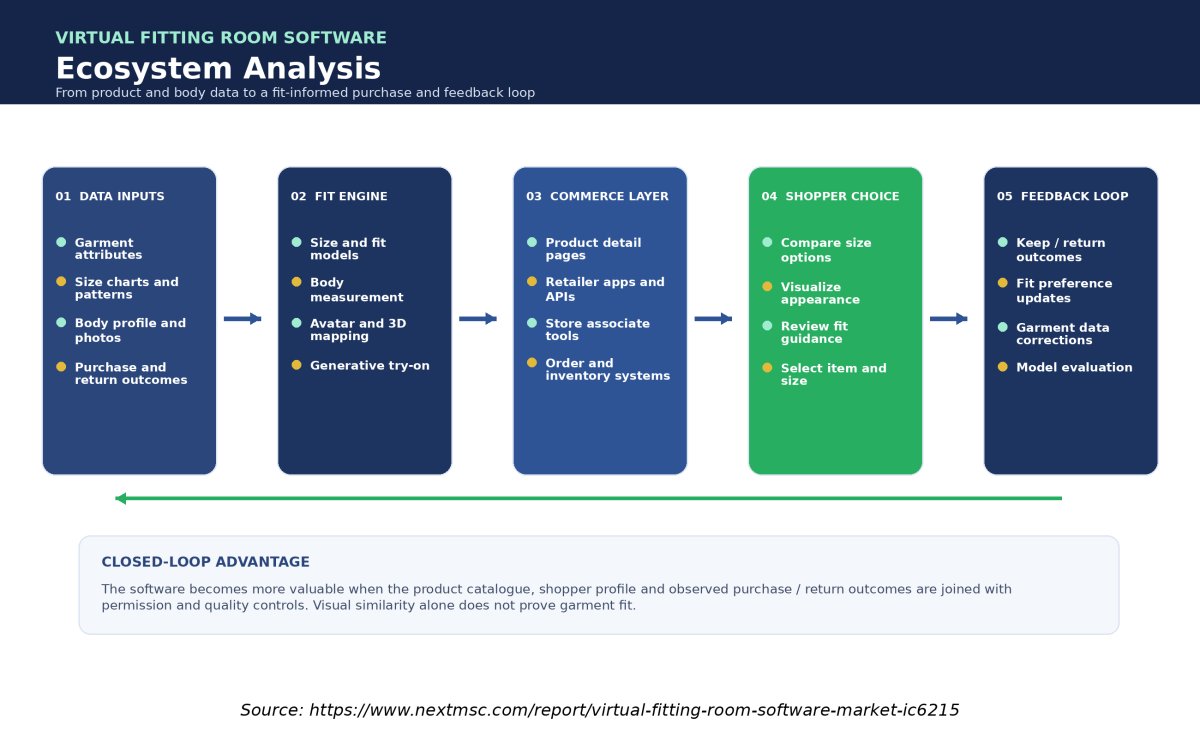
Figure 1. Virtual fitting room software ecosystem and feedback loop.

The above infographic links the market’s commercial value to the connections among garment attributes, shopper measurements, visualization models and purchase outcomes. For software vendors, a large image library is not enough: product data must be normalized and recommendation results must be measurable. Retailers should evaluate both visual quality and fit accuracy, while investors should track recurring usage, integration depth and the availability of compliant training data.

What Does the Virtual Fitting Room Software Market Encompass?

The market covers software that creates an online or in-store digital fitting experience for apparel, footwear and fashion accessories. The software may recommend a size from shopper and product attributes, estimate body measurements, create a body avatar, or render a garment on an uploaded image. Revenue includes software subscriptions, licenses, API or usage fees, and implementation and support services that are directly attributable to those capabilities.

The market has shifted from static size charts and isolated body-measurement tools toward connected fit intelligence and generative visualization. Commerce integrations now connect product detail pages, retailer apps and store tools with product catalogues and shopper histories. Privacy, transparency and data governance shape deployment choices, while digital product information can improve catalogue consistency without becoming a direct virtual-fitting mandate.

Conclusion & Recommendations

The market is positioned for growth as retailers combine product visualization, size guidance and shopper data in digital commerce. The base case estimates an increase from USD 3.55 billion in 2026 to USD 12.00 billion in 2035, a 14.49% CAGR. The outlook depends on software vendors proving reliable garment-level fit outcomes and sustaining retailer integration, rather than relying on one-time visual novelty.

What Strategic Positioning Recommendations Does NMSC Offer?

NMSC recommends prioritizing one measurable fit problem, such as size recommendation for apparel or visualization for footwear, before extending into adjacent categories. Providers should preserve a distinction between appearance rendering and size prediction, build integrations around standardized product attributes, and establish privacy controls before collecting shopper imagery. Retailers should use pilot cohorts and garment-specific accuracy measures to decide whether broader deployment is justified.

How Attractive Is the Virtual Fitting Room Software Market for Investment?

The market offers software revenue opportunities through recurring subscriptions, usage-based APIs and enterprise licensing. The base case estimates USD 8.45 billion of additional market revenue between 2026 and 2035. Investors should not treat this as a verified addressable spend total; they should assess customer retention, recurring usage, integration costs, data rights and the proportion of vendor revenue attributable to the defined software market.

What Are the Key Market Shifts and Risks in the Virtual Fitting Room Software Market?

The market is shifting toward integrated fit intelligence, generative visualization and conversational shopping, while data governance and output reliability remain important risks. The software must work across garment types, body profiles and commerce systems. Inaccurate size guidance can undermine trust even when a rendered image is visually persuasive. Providers should disclose limitations, monitor model performance and avoid retaining personal imagery longer than necessary.

What Are the Primary Growth Pathways Through 2035?

The main pathways are wider adoption of cloud software, deeper use of fit intelligence within shopping agents, expansion into footwear and accessories, and improved data from purchase and return outcomes. Asia-Pacific is forecast to grow fastest among the five regions at 18.01% CAGR. Growth will depend on localized product catalogues, privacy-safe data access and measurable retailer economics across categories.

Market Drivers & Dynamics

Interactive Dataset
Fit intelligence integrated with shopping agents driver +2.0 pp North America, Europe, Asia-Pacific 2026–2030
Generative apparel and footwear visualization driver +2.4 pp Global; strongest in digital commerce 2026–2032
Cloud APIs and retailer platform integration driver +1.6 pp Global 2026–2035
Omnichannel and store-associate deployment driver +1.2 pp North America, Europe, East Asia 2027–2035
Personal-image privacy and consent burden restraint −1.8 pp Europe; global privacy regimes 2026–2035
Catalogue normalization and integration costs restraint −1.2 pp Global 2026–2030
Visual realism mistaken for fit accuracy restraint −1.0 pp Global 2026–2035
Source: Next Move Strategy Consulting

Growth Drivers

Why is fit intelligence becoming a core commerce conversion layer?

The principal demand driver is the cost of fit uncertainty in online apparel and footwear. Eurostat reports that 78% of EU residents bought goods or services online in 2025, and clothes, shoes and accessories were the leading online purchase category in its 2024 three-month measure. As more fashion transactions move online, size guidance becomes a practical tool for shopper confidence, conversion and return prevention.

How does generative visualization expand software adoption?

Generative try-on makes product visualization available through APIs and retailer interfaces without requiring every retailer to build a proprietary computer-vision stack. The U.S. Census Bureau reported USD 340.2 billion in retail e-commerce sales in the second quarter of 2026, equal to 17.1% of total retail sales. That broad digital channel base supports software integration opportunities, although it is not a direct measure of apparel software demand.

Growth Inhibitors

What is the most material restraint for software providers?

The main restraint is the difficulty of turning inconsistent garment data and personal images into reliable recommendations at scale. Brand size labels, product measurements, fabric stretch and shopper body profiles may be incomplete or inconsistent. Image-based generation can also create a persuasive appearance without measuring real-world fit. Vendors must therefore prove model accuracy by garment category and protect personal data, increasing integration, testing and governance costs.

What Are the Growth Opportunities?

Can fit-aware shopping agents create a new software layer?

Retailers can embed fit recommendations into conversational product discovery so shoppers receive visual and sizing guidance in one experience. The True Fit and Glance collaboration illustrates this integration path, with initial experiences planned for the 2026 holiday season and broader merchant availability planned for 2027. Adoption depends on retailer access to normalized product data, permissioned shopper history and measurable fit outcomes.

Where can category-specific APIs unlock incremental demand?

Outerwear, footwear and accessories create distinct model requirements that can expand software usage beyond basic apparel try-on. Perfect Corp’s 2026 API release introduced a dedicated outerwear category, while Virtusize’s refreshed product experience spans apparel, shoes and bags. Providers can monetize category coverage through usage-based APIs, provided that output quality is tested across garment construction and varied shopper profiles.

How can fit data improve omnichannel and made-to-measure workflows?

Measurement and avatar tools can support store consultations, uniform ordering and repeat purchasing when shopper profiles are updated with permission. 3DLOOK describes body-data extraction for apparel and uniform use cases, while StyleMe offers virtual fitting integrations for digital retail. The opportunity depends on retailer workflow integration, consistent measurement standards and safeguards for employee or customer imagery.

Segmentation Analysis

2025 (USD Billion)
2035 (USD Billion)
Software
Services
Segment Item 2025 (USD Billion) 2035 (USD Billion) CAGR
Software $10.0 USD Billion $40.0 USD Billion 14.0%
Services $17.1 USD Billion $51.1 USD Billion 8.0%

Segment-wise data not detailed in this view

Unlock complete segment-wise numbers for By Component.

Unlock Full Data
2025 (USD Billion)
2035 (USD Billion)
Cloud
On-Premises
Segment Item 2025 (USD Billion) 2035 (USD Billion) CAGR
Cloud $10.0 USD Billion $40.0 USD Billion 25.0%
On-Premises $17.1 USD Billion $51.1 USD Billion 11.0%

Segment-wise data is locked

Unlock complete segment-wise numbers for By Deployment.

Unlock Full Data
2025 (USD Billion)
2035 (USD Billion)
Size and Fit
Visual Try-O
Body Measure
Segment Item 2025 (USD Billion) 2035 (USD Billion) CAGR
Size and Fit Recommendation $10.0 USD Billion $40.0 USD Billion 27.0%
Visual Try-On $17.1 USD Billion $51.1 USD Billion 9.0%
Body Measurement and Avatar $24.2 USD Billion $62.2 USD Billion 19.0%

Segment-wise data is locked

Unlock complete segment-wise numbers for By Core Functionality.

Unlock Full Data

Segment Sizing: Core Functionality

Size and Fit Recommendation was the largest functionality in 2025 because sizing guidance can be deployed across product catalogues without requiring a full visual rendering experience. Visual Try-On is forecast to grow faster as generative APIs reduce the barriers to product visualization and broaden usage to outerwear and footwear. Providers that combine both functions can distinguish visual appeal from fit confidence and avoid unsupported accuracy claims.

2025 (USD Billion)
2035 (USD Billion)
Apparel
Footwear
Fashion Acce
Segment Item 2025 (USD Billion) 2035 (USD Billion) CAGR
Apparel $10.0 USD Billion $40.0 USD Billion 14.0%
Footwear $17.1 USD Billion $51.1 USD Billion 24.0%
Fashion Accessories $24.2 USD Billion $62.2 USD Billion 22.0%

Segment-wise data is locked

Unlock complete segment-wise numbers for By Application.

Unlock Full Data

Segment Sizing: Application

Apparel remains the largest application because the product category has many fit-sensitive attributes, including silhouette, garment construction and brand-specific sizing. Fashion Accessories has the fastest projected growth from a smaller base as virtual visualization extends to bags, hats and other wearable products. Software vendors should avoid treating all accessories as equivalent; each category needs its own product geometry and visualization controls.

2025 (USD Billion)
2035 (USD Billion)
Online Retai
Apparel and
Physical Ret
Manufacturer
Segment Item 2025 (USD Billion) 2035 (USD Billion) CAGR
Online Retailers and Marketplaces $10.0 USD Billion $40.0 USD Billion 24.0%
Apparel and Footwear Brands $17.1 USD Billion $51.1 USD Billion 22.0%
Physical Retailers $24.2 USD Billion $62.2 USD Billion 20.0%
Manufacturers and Uniform Providers $31.3 USD Billion $73.3 USD Billion 22.0%

Segment-wise data is locked

Unlock complete segment-wise numbers for By Customer Type.

Unlock Full Data

Segment Sizing: Customer Type

Online Retailers and Marketplaces form the largest customer group because the software can be embedded directly into product pages and checkout journeys. Manufacturers and Uniform Providers are expected to grow more quickly from a smaller base as measurement capture can support made-to-measure workflows and repeat workforce procurement. Brands and physical retailers remain important where product-level fit data and in-store assistance are available.

2025 (USD Billion)
2035 (USD Billion)
Recurring Su
Usage and AP
Perpetual an
Segment Item 2025 (USD Billion) 2035 (USD Billion) CAGR
Recurring Subscription $10.0 USD Billion $40.0 USD Billion 23.0%
Usage and API-Based $17.1 USD Billion $51.1 USD Billion 9.0%
Perpetual and Enterprise License $24.2 USD Billion $62.2 USD Billion 19.0%

Segment-wise data is locked

Unlock complete segment-wise numbers for By Revenue Model.

Unlock Full Data
2025 (USD Billion)
2035 (USD Billion)
North Americ
U.S.
Canada
Mexico
Europe
Segment Item 2025 (USD Billion) 2035 (USD Billion) CAGR
North America $10.0 USD Billion $40.0 USD Billion 21.0%
U.S. $17.1 USD Billion $51.1 USD Billion 23.0%
Canada $24.2 USD Billion $62.2 USD Billion 25.0%
Mexico $31.3 USD Billion $73.3 USD Billion 15.0%
Europe $38.4 USD Billion $84.4 USD Billion 16.0%

Segment-wise data is locked

Unlock complete segment-wise numbers for By Region.

Unlock Full Data

Regulatory Framework Impacting the Virtual Fitting Room Software Industry

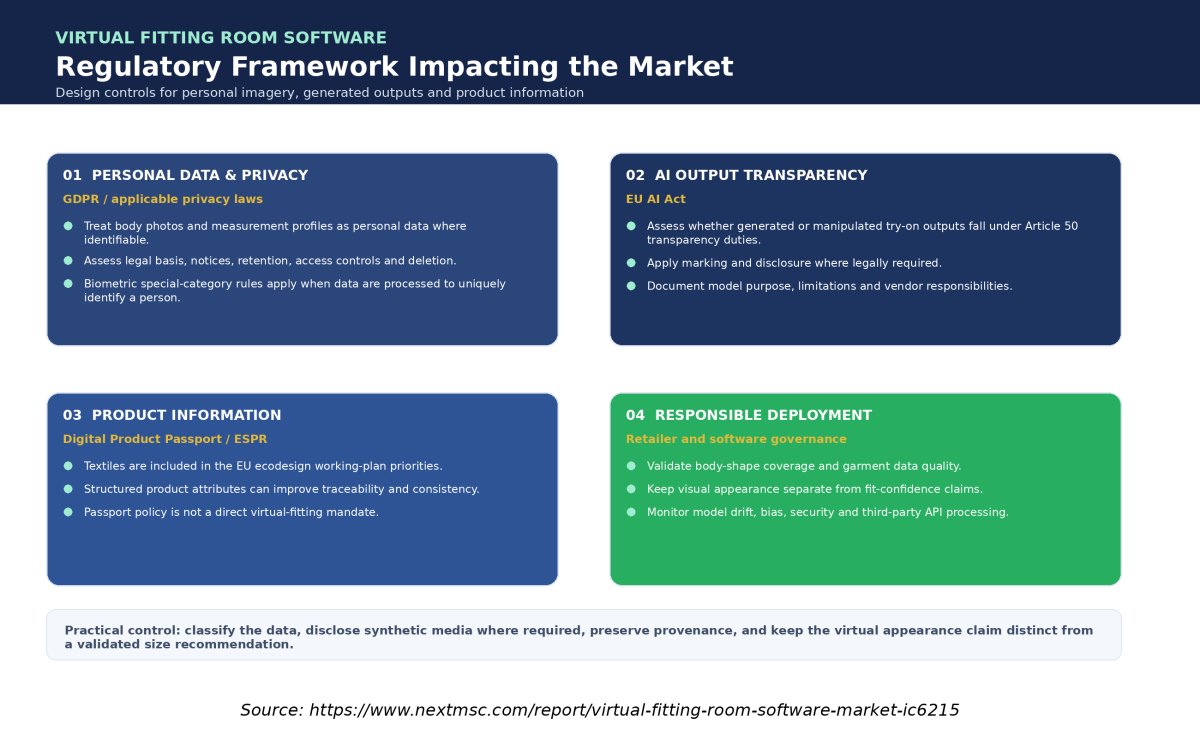
The above infographic shows why privacy, transparency and product-data governance are commercial design requirements rather than a final compliance check. Body photos and measurements can be personal data when they identify a shopper, while biometric special-category treatment depends on the purpose and processing. The EU AI Act’s transparency provisions apply from August 2026, subject to transition rules, and the digital product passport policy is a separate product-information framework, not a virtual-fitting mandate.

Growth Opportunities

Three opportunities stand out where fit intelligence, visualization and retailer operations converge.

Can fit-aware shopping agents create a new software layer?

Retailers can embed fit recommendations into conversational product discovery so shoppers receive visual and sizing guidance in one experience. The True Fit and Glance collaboration illustrates this integration path, with initial experiences planned for the 2026 holiday season and broader merchant availability planned for 2027. Adoption depends on retailer access to normalized product data, permissioned shopper history and measurable fit outcomes.

Where can category-specific APIs unlock incremental demand?

Outerwear, footwear and accessories create distinct model requirements that can expand software usage beyond basic apparel try-on. Perfect Corp’s 2026 API release introduced a dedicated outerwear category, while Virtusize’s refreshed product experience spans apparel, shoes and bags. Providers can monetize category coverage through usage-based APIs, provided that output quality is tested across garment construction and varied shopper profiles.

How can fit data improve omnichannel and made-to-measure workflows?

Measurement and avatar tools can support store consultations, uniform ordering and repeat purchasing when shopper profiles are updated with permission. 3DLOOK describes body-data extraction for apparel and uniform use cases, while StyleMe offers virtual fitting integrations for digital retail. The opportunity depends on retailer workflow integration, consistent measurement standards and safeguards for employee or customer imagery.

Regional Outlook

2025 (USD Billion)
2035 (USD Billion)
North Americ
Europe
Asia-Pacific
Middle East
Latin Americ
Region 2025 (USD Billion) 2035 (USD Billion) CAGR (%)
North America $10.0 USD Billion $40.0 USD Billion 9.0%
Europe $17.1 USD Billion $51.1 USD Billion 27.0%
Asia-Pacific $24.2 USD Billion $62.2 USD Billion 25.0%
Middle East & Africa $31.3 USD Billion $73.3 USD Billion 23.0%
Latin America $38.4 USD Billion $84.4 USD Billion 12.0%

Regional data is locked

Unlock complete regional numbers for this market.

Unlock Full Data

Competitive Landscape

NMSC’s analysis indicates that competition is distributed across fit recommendation, body measurement, generative visualization and retailer integration. Companies may compete in more than one capability, but market revenue is classified by the primary billed function to avoid counting the same software contract twice.

Dimension Description
Market Structure Fragmented specialist and platform market; provider-level software revenue is not publicly comparable.
Innovation Focus Fit-data integration, generative try-on, body measurement, avatar realism and category coverage.
M&A Activity Ownership transfers and product integrations affect capability portfolios; only market-relevant verified events are included in the developments table.

How do companies compete for retailer contracts?

Vendors compete on fit recommendation quality, ease of deployment, catalogue coverage, integration options and measurable retail outcomes. Some platforms specialize in sizing and body measurement, while others emphasize generative visual try-on or API-based image rendering. Buyers compare software licensing, consumption-based charges and support requirements. Retailers should request validation by garment category, device type and shopper cohort instead of relying on a single demonstration image.

Which competitive archetypes shape the market?

The market includes fit-intelligence specialists that use product and transaction outcomes, computer-vision providers that infer body measurements, and generative visualization platforms that render garments on shopper images. Retail commerce platforms and agencies can also integrate third-party services, but they are not counted as standalone market players unless they sell an own-brand qualifying product. Specialist providers retain an advantage when their models address a narrow fit problem with measurable data.

How are innovation and differentiation strategies changing?

Differentiation is moving toward combined fit and visual experiences, wider garment categories and better onboarding. True Fit and Glance connect fit intelligence with a conversational shopping surface, while Virtusize refreshed its avatars and profile setup. Perfect Corp added outerwear support to its API. These examples indicate a shift from single-purpose widgets toward modular software that can be integrated into more shopping moments, subject to data quality and output validation.

What role do partnerships and corporate transactions play?

Partnerships can combine complementary capabilities more quickly than a retailer building every layer internally. True Fit’s collaboration with Glance pairs conversational discovery and generative try-on with fit guidance. MySize’s 2025 integrated solution combined sizing recommendations and virtual try-on technology. Such arrangements can expand distribution and feature coverage, but buyers should review data ownership, model responsibility, service levels and continuity if a supplier or underlying technology changes.

Key Market Players

Based on official product disclosures and company-reported operating reach, the following qualifying software providers are ranked indicatively by evidence of market-specific scale and breadth of worldwide operations. The order is not a market-share ranking; individual market revenues are not publicly disclosed on a comparable basis.

True Fit Corporation Fit Analytics Innovation GmbH Virtusize Co., Ltd. Perfect Corp. MySize, Inc. 3DLOOK Inc. Reactive Reality AG StyleMe Limited FXGear, Inc. Zugara, Inc. ELSE Corp. S.r.l. Futurenext S.r.l.

Latest Developments

We found that recent market-relevant launches are focused on fit intelligence, expanded garment coverage and refreshed shopper interfaces. The entries below are dated announcements from official company sources.

Date Event
September 28, 2026 Virtusize announced a refreshed online fitting experience with redesigned body silhouettes, new onboarding and profile editing, and a more unified size recommendation and fit visualization experience.
September 22, 2026 True Fit and Glance announced a collaboration integrating True Fit’s fit-intelligence layer into Glance’s agentic shopping experience alongside conversational discovery and generative virtual try-on.
September 16, 2026 Perfect Corp released AI Clothes Try-On API v4 with a dedicated outerwear category for jackets, coats and vests, extending its existing API workflow.
February 17, 2026 True Fit launched an AI Shopping Agent for fashion retail, using shopper profiles and purchase and return outcomes to provide real-time size and fit guidance.
December 11, 2025 Google introduced studio-quality digital try-on from a selfie, extending generative apparel visualization in Google Shopping.
January 23, 2025 MySize announced an integrated virtual try-on solution combining Naiz Fit size recommendations with Aiuta virtual try-on capabilities.

Expert Insights

Jessica Murphy

Jessica Murphy

Co-Founder and CEO | True Fit

"Fit is deeply personal. It’s shaped by body shape, proportions, fabric, construction, brand sizing, and personal preference. Our shopping agent evolves from static to dynamic guidance that answers your size and fit questions, considers your preferences, and learns from past behavior."

Analyst Interpretation

We observed that the commercial value of fit data comes from connecting garment attributes to individual preference and realized purchase outcomes. Retailers can use that connection to refine size guidance and improve the shopping journey, while software providers can differentiate through data breadth and the quality of their feedback loop. Decision makers should monitor model accuracy by category, consent practices, coverage of body shapes and the share of transactions that produce usable feedback.

Investment Opportunities

Where is capital most likely to concentrate?

Investment interest is most relevant to software that makes fit and visualization interoperable across product pages, apps and shopping agents. The True Fit and Glance collaboration demonstrates strategic demand for fit intelligence as a separate layer inside a broader agentic experience. NMSC views providers with recurring SaaS revenue, retailer integrations and outcome-rich data as more defensible than one-off rendering tools, provided customer concentration and data rights are controlled.

How can infrastructure investment shape market capacity?

Cloud APIs, data normalization pipelines and category-specific model infrastructure determine how efficiently a provider can support large catalogues and seasonal product turnover. Perfect Corp’s API versioning and added outerwear category illustrate the use of a shared software service to extend coverage. Capital should focus on integration reliability, privacy controls and model evaluation rather than expensive fitting-room hardware that is outside this market’s revenue scope.

How do ESG and circularity considerations affect investment?

Fit recommendation software may support better size selection and reduce avoidable returns, but the environmental benefit must be measured rather than assumed. Apparel product passports and traceable product attributes may improve information quality, while the EU Ecodesign for Sustainable Products Regulation establishes a wider framework for digital product passports. Investors should test whether deployments reduce repeat shipments, unsold inventory or disposal, and distinguish those outcomes from marketing claims.

Key Benefits for Stakeholders

What value can apparel brands and retailers capture?

Brands and retailers can use size guidance and try-on software to improve product discovery, increase confidence at the point of purchase and identify fit-related product issues. Apparel remains the largest application in the base allocation, at USD 2.47 billion in 2025 and USD 8.16 billion by 2035. Retailers should evaluate incremental conversion, return reasons, customer consent and implementation cost in controlled tests before scaling.

How can software vendors build more durable businesses?

Technology vendors can strengthen recurring revenue by combining size recommendation, body measurement and visualization through modular APIs and commerce integrations. Visual Try-On is the fastest-growing core functionality in the base allocation, at 16.09% CAGR, while cloud deployment is forecast to expand at 16.91%. Vendors should invest in model monitoring, security and fit-data quality to defend retention and reduce service burden.

What benefits and protections matter to shoppers?

Shoppers can compare size options and visualize products before ordering, but the interface should distinguish estimated appearance from a validated fit recommendation. Clear consent, secure image handling and straightforward profile deletion build trust. A shopper-facing interface should explain what data are required, whether images are retained and how recommendations are generated, while avoiding claims that a simulated image guarantees garment comfort or exact dimensions.

Key Market Segments Evaluated

By Component

  • Software
  • Services

By Deployment

  • Cloud
  • On-Premises

By Core Functionality

  • Size and Fit Recommendation
  • Visual Try-On
  • Body Measurement and Avatar

By Application

  • Apparel
  • Footwear
  • Fashion Accessories

By Customer Type

  • Online Retailers and Marketplaces
  • Apparel and Footwear Brands
  • Physical Retailers
  • Manufacturers and Uniform Providers

By Revenue Model

  • Recurring Subscription
  • Usage and API-Based
  • Perpetual and Enterprise License

By Region

  • North America
  • U.S.
  • Canada
  • Mexico
  • Europe
  • UK
  • Germany
  • France
  • Italy
  • Spain
  • Sweden
  • Denmark
  • Finland
  • Netherlands
  • Rest of Europe
  • Asia-Pacific
  • China
  • India
  • Japan
  • South Korea
  • Taiwan
  • Indonesia
  • Vietnam
  • Australia
  • Philippines
  • Malaysia
  • Rest of APAC
  • Middle East & Africa
  • Saudi Arabia
  • UAE
  • Egypt
  • Israel
  • Turkey
  • Nigeria
  • South Africa
  • Rest of MEA
  • Latin America
  • Brazil
  • Argentina
  • Chile
  • Colombia
  • Rest of LATAM

FAQs

Sources & References

1.

Eurostat 2026 Digitalization

ec.europa.eu
2.

Eurostat online purchases dataset

ec.europa.eu
3.

U.S. Census Bureau e-commerce Q2 2026

census.gov
4.

China National Bureau of Statistics 2025

stats.gov.cn
5.

Japan METI FY2024 e-commerce survey

meti.go.jp
6.

European Commission Digital Product Passport FAQ

single-market-economy.ec.europa.eu
7.

EU AI Act Service Desk enforcement timetable

ai-act-service-desk.ec.europa.eu
8.

EU General Data Protection Regulation

eur-lex.europa.eu/eli/reg/2016/679
9.

Google apparel virtual try-on India

blog.google
10.

Google studio-quality digital try-on

blog.google
11.

MySize integrated virtual try-on launch

mysizeid.com
12.

True Fit AI Shopping Agent launch

truefit.com
13.

True Fit and Glance partnership

truefit.com
14.

True Fit company profile

truefit.com/about
15.

True Fit legal entity terms

truefit.com/terms-of-use
16.

3DLOOK legal entity terms

3dlook.ai
17.

Perfect Corp legal entity filing

sec.gov
18.

Virtusize fitting experience update

virtusize.com
19.

Virtusize company profile

virtusize.com/about-us
20.

Fit Analytics company profile

fitanalytics.com/who-we-are
21.

Fit Analytics technologies

fitanalytics.com/our-technologies
22.

3DLOOK company profile

3dlook.ai/about-us
23.

3DLOOK technology

3dlook.ai/technology
24.

Perfect Corp AI Clothes Try-On API v4

perfectcorp.com
25.

Perfect Corp Fashion API

yce.perfectcorp.com
26.

StyleMe virtual fitting

style.me/virtual-fitting
27.

StyleMe FAQ

style.me/faq
28.

FXGear VR Fashion

fxgear.net/vr-fashion
29.

Zugara virtual dressing room

zugara.com
30.

ELSE Corp virtual retail

else-corp.com/virtual-retail
31.

Futurenext Zakeke legal information

zakeke.com
32.

Reactive Reality PICTOFiT documentation

docs.pictofit.com
33.

MySize company products

mysizeid.com/mysizeid-app

About the Author

Debashree Dey

Debashree Dey

Debashree Dey is Assistant Manager at Next Move Strategy Consulting, where she supports cross-vertical market content and communications across diverse industries for 6 years. Her professional background includes senior content writing, communications, and published manuscript authorship, with experience developing audience-focused business narratives and maintaining clear, consistent messaging. Her role supports research-led content development and editorial quality across NextMSC publications.

About the Reviewer

Supradip Baul

Supradip Baul

Supradip Baul is an accomplished business consultant and strategist with over a decade of rich experience in market intelligence, strategy, technology, and business transformation. His work has included rigorous qualitative and quantitative analysis across multiple industries, helping clients shape investment decisions and long-term roadmaps. Earlier in his career, he was associated with Gartner, where he contributed to industry-leading reports and market share analyses. He has worked with leading global companies and holds an MBA with a dual specialization in Marketing and Finance.

Download Free Sample

Kishu Kanda

KISHU KANDA

Strategy Analyst

Accenture

We purchased the AI Consumer Market Report from this company. Not only did they customize the report to meet our specific requirements, but they also showed great flexibility in accommodating our budget. The report we received fully met our expectations. Additionally, they provided prompt and thorough responses to both our pre-purchase and follow-up questions. We look forward to working with this company again in the future.

Gustaf Hummel Burstrom

GUSTAF HUMMEL BURSTROM

Founder

Revline Tools AB

Joseph and the team at Next Move Strategy Consulting have been excellent to work with, in supplying us with relevant market data and forecasts for our specific category. We had some special requirements and they were able to do a custom package to suit our needs. We would definitely recommend them to any other company needing market data and forecasts

Henri Knyphausen

HENRI KNYPHAUSEN

Partner at Singulier [Ex-BCG]

Singulier

I recently engaged NEXTMSC.com for a commercial due diligence project within the intralogistics sector, and I am pleased to provide a reference based on my experience. In utilizing NEXTMSC.com's services, I found their report to offer valuable insights into market dynamics and key industry players. The initial report provided a solid foundation for our analysis. However, as we were investigating a smaller target in the market, and I had specific customization requests requiring additional research. These requests included detailed information on product portfolios of various players and sub-market sizes, both inclusive and exclusive of certain product categories. NEXTMSC.com demonstrated commendable responsiveness and agility in accommodating these customization requests. Within a timeframe of 1-2 weeks, they delivered a revised report that met our specific needs. Furthermore, they were receptive to my follow-up inquiries, ensuring clarity and understanding of the data provided. The final deliverable significantly contributed to our due diligence efforts. One of NEXTMSC.com's notable strengths lies in their qualitative research capabilities. However, for future engagements, I would recommend the inclusion of a quantified market model in Excel format. Such a model would offer the ability to conduct in-depth analyses and explore various market segments, including country-specific data and subcomponent breakdowns. Based on my positive experience, I would not hesitate to work with NEXTMSC.com again. Their responsiveness, willingness to accommodate customization requests, and commitment to delivering actionable insights make them a reliable partner for commercial research projects.

Ross J Mckenzie

ROSS J MCKENZIE

Business Insight Manager

Staysure Group

“Next MSC have been incredibly helpful in providing detailed & robust information on our market, alongside quantifying growth by different segments. The process to procure was simple and easy, with sample reports and regular contact to ensure we had what we needed. Succinct detail on their sources & methodologies is also greatly received, allowing transparency in this respect helps build trust in the detail you pay for. Joseph in particular was fantastic, and helped ensure efficient provision of the insight pack – thank you NMSC!”.

Kevin Coker

KEVIN COKER

Founder, CEO and Board Diector

Proxima Clinical Research

I have been using Next MSC reports for product positioning in a new geography for a long time. They have by far the best reports I have found and the price is reasonable too!

Custom Market Research Services

We will customize the research for you if the listed report does not fully match your requirements.

Get 30% Free Customization

Select License

This website uses cookies to ensure you get the best experience on our website. Learn more

✖