Warehouse Control System Market

Warehouse Control System Market size was USD 5.92 Billion in 2025, projected to reach USD 17.72 Billion by 2035, growing at a CAGR of 10.70% from 2026 to 2035. Key drivers include rising e-commerce fulfilment demand, and mixed-vendor automation adoption, with North America leading the market and Latin America registering the fastest growth.

Download Free Sample PDF
Base Year (2025)
$5.92 Billion
Forecast (2035)
$17.72 Billion
CAGR (2026-2035)
10.7%
Top Country
North America

What Is the Warehouse Control System Market Size?

The global warehouse control system market size was valued at USD 5.92 Billion in 2025 and is estimated to grow from USD 7.10 Billion in 2026 to USD 17.72 Billion by 2035, expanding at a CAGR of 10.70% between 2026 and 2035. North America led the warehouse control system market with an approximate 38% revenue share in 2025, while Storage Control remained the dominant control-system segment with an approximate 28% share of global revenue.

We observed that the warehouse control system market's momentum is best captured through a concise set of indicators before deeper analysis follows.

Warehouse Control System Market Revenue Forecast

Values in USD Billion

2025 $5.92 Billion
2025
2026 $6.55 Billion
2026
2027 $7.25 Billion
2027
2028 $8.03 Billion
2028
2029 $8.89 Billion
2029
2030 $9.84 Billion
2030
2031 $10.89 Billion
2031
2032 $12.06 Billion
2032
2033 $13.35 Billion
2033
2034 $14.78 Billion
2034
2035 $17.72 Billion
2035

Key Takeaways

By Offering: Software held the largest share of approximately USD 3.67 billion in 2025 and is projected to reach USD 10.28 billion by 2035; Services is the fastest-growing offering at a 12.72% CAGR from 2026–2035.

By Control System: Storage Control held the largest share of approximately USD 1.66 billion in 2025 and is projected to reach USD 4.25 billion by 2035; Mobile Automation is the fastest-growing control system at a 14.29% CAGR from 2026–2035.

By Deployment: On-Premises held the largest share of approximately USD 2.66 billion in 2025 and is projected to reach USD 4.96 billion by 2035; Cloud is the fastest-growing deployment at a 15.68% CAGR from 2026–2035.

Dominant Region: North America dominated with approximately USD 2.24 billion in 2025 and is projected to reach USD 5.32 billion by 2035.

Fastest-Growing Region: Latin America is expected to register the highest CAGR of 17.85 % during 2026–2035.

Dominant Country: U.S. led as the largest single national contributor within North America in 2025.

The warehouse control system market is projected to generate an incremental revenue opportunity of approximately USD 10.62 Billion between 2026 and 2035, reflecting the absolute dollar gap between the 2035 forecast and the 2026 base value a signal of accelerating investment in real-time equipment orchestration software as warehouses add more automated subsystems.

According to NMSC analysis, cloud-deployed control platforms are increasingly displacing on-premises installations specifically for multi-site operators managing distributed automation fleets, a dynamic distinct from single-site deployment economics captured in aggregate revenue figures.

What does the Warehouse Control System Market Encompass?

The warehouse control system market encompasses software and services that orchestrate real-time equipment-level operation of automated storage, conveyor, sortation, mobile robotics, and packaging systems within a warehouse. Our assessment indicates that a warehouse control system, or WCS, sits below warehouse management and execution software in the technology stack, translating order and inventory instructions into direct machine-level commands, distinguishing it from WMS platforms that manage inventory records and WES platforms that coordinate broader task orchestration, and from standalone PLCs that control individual pieces of equipment without cross-system coordination.

Structurally, the market has evolved from single-vendor, equipment-specific control software toward vendor-agnostic platforms capable of orchestrating mixed-vendor automation fleets within one facility. We found that regulatory environments administered by workplace safety authorities continue to shape human-robot interaction protocols embedded within control logic, while technology adoption trends in cloud deployment and API-based integration are reshaping how control platforms connect with upstream warehouse management systems.

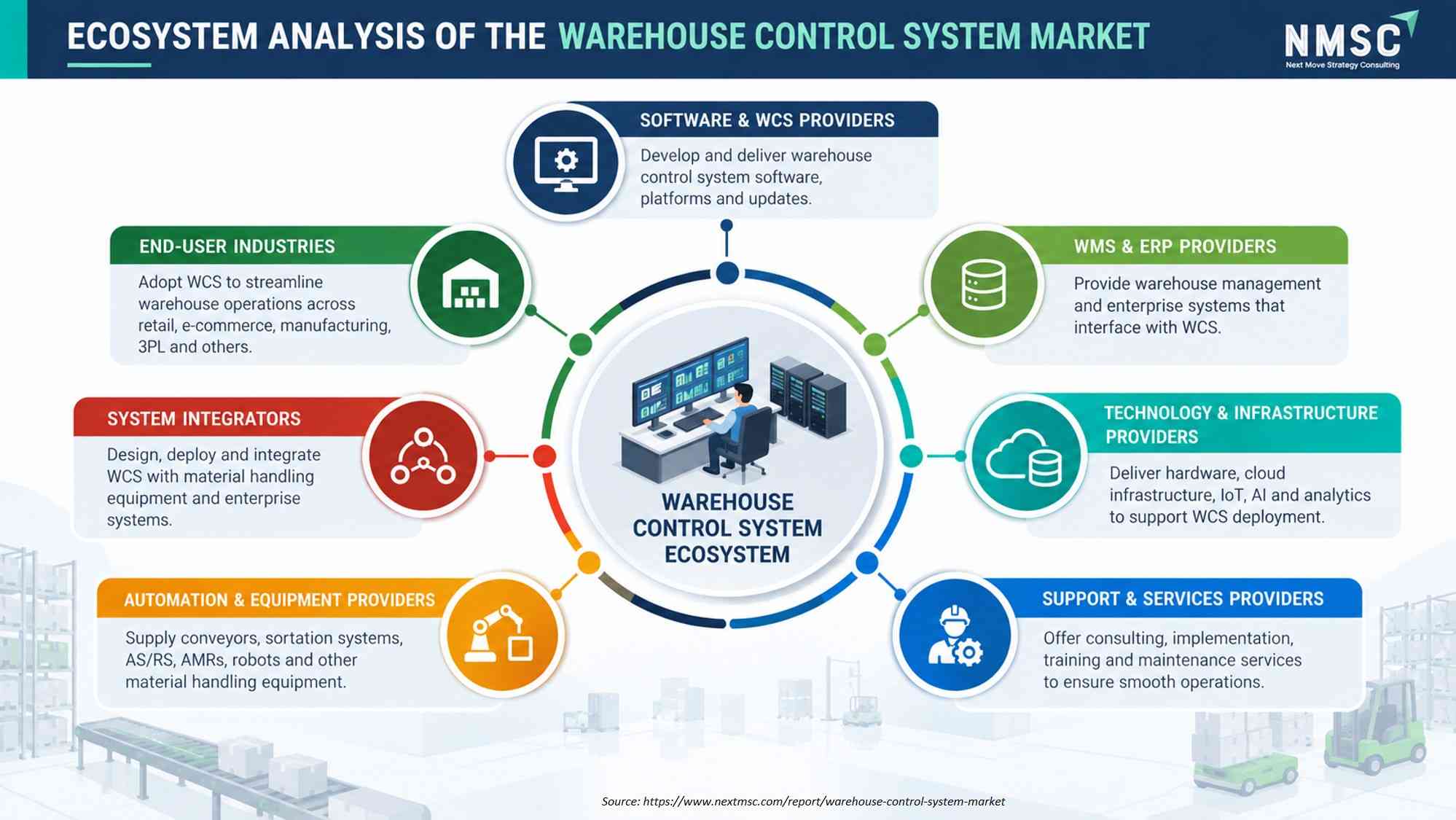
Ecosystem Analysis of the Warehouse Control System (WCS) market

The infographic presents the Warehouse Control System (WCS) market ecosystem, highlighting the key stakeholders supporting warehouse automation and operations. It covers software and WCS providers, WMS and ERP providers, automation and equipment manufacturers, system integrators, technology and infrastructure providers, support and services providers, and end-user industries. The interconnected structure illustrates how these participants collaborate to enable efficient, automated, and technology-driven warehouse operations.

Market Drivers & Dynamics

Interactive Dataset
Rising e-commerce order volume requiring automated fulfillment driver +2.8% North America, Europe, Asia-Pacific 2026–2035
Expanding mixed-vendor automation deployments requiring orchestration driver +2.1% North America, Europe 2026–2033
Warehouse labor shortages accelerating automation investment driver +1.6% North America, Europe 2026–2035
Growing cloud deployment adoption among multi-site operators driver +1.2% Global 2027–2035
Rising third-party logistics facility automation investment driver +0.9% Asia-Pacific, Latin America 2026–2033
High integration complexity for brownfield facility retrofits restraint −0.9% North America, Europe 2026–2032
Significant upfront capital cost limiting SME adoption restraint −0.7% Asia-Pacific, Latin America, MEA 2026–2035
Cybersecurity risk associated with cloud-connected control systems restraint −0.5% North America, Europe 2026–2030
Source: Next Move Strategy Consulting

Growth Drivers

What Is the Primary Growth Driver for the Warehouse Control System Market?

Rising e-commerce order volume requiring automated fulfillment is the primary growth driver, as retailers and logistics providers invest in automation requiring real-time control orchestration to meet compressed delivery windows. The U.S. Census Bureau reports that e-commerce sales have continued to represent a growing share of total U.S. retail sales, underscoring the scale of order-fulfillment volume driving warehouse automation and associated control system investment.

How Is Warehouse Labor Availability Driving the Market Growth?

Persistent warehouse labor shortages are driving growth by pushing operators toward automated storage, conveyor, and mobile robotics systems that require control software to function. Company analysis indicates that facility operators are prioritizing control platform investment alongside physical automation to maximize equipment utilization given constrained available labor. Based on research conducted by NMSC, we found that this shift is most pronounced across North American and European distribution networks.

Growth Inhibitors

What Is Restraining the Warehouse Control System Market?

High integration complexity for brownfield facility retrofits is restraining adoption, as legacy facilities require extensive control system reconfiguration to integrate new automation alongside existing equipment. We observed that this restraint is most pronounced among mid-sized operators lacking dedicated systems integration teams, extending implementation timelines and delaying revenue realization for control software providers serving retrofit projects.

What Are the Growth Opportunities?

Can Vendor-Agnostic Orchestration Unlock Brownfield Retrofit Demand?

Control platforms designed specifically for mixed-vendor brownfield retrofits, rather than greenfield single-vendor deployments, can unlock a large addressable base of existing facilities seeking incremental automation. This mechanism primarily benefits system integrators and control software providers serving conveyor system upgrade projects in older distribution facilities.

Will Managed Services Models Expand SME Automation Access?

Subscription-based managed control services, bundling software licensing with ongoing monitoring and support, can lower the upfront capital barrier that currently limits SME automation adoption. Control software providers with established managed services delivery capability stand to benefit most from this expanding SME-accessible pricing model.

Can Predictive Diagnostics Bundling Expand Service Revenue Per Facility?

Bundling predictive equipment diagnostics with core control software offers providers a mechanism to capture recurring service revenue beyond initial implementation. Maintenance and support service providers with established diagnostic data infrastructure are best positioned to capture this opportunity as facility operators prioritize uptime over reactive maintenance models.

Segmentation Analysis

2025 (USD Billion)
2035 (USD Billion)
Software 2025: $3.67 Billion | 2035: $10.28 Billion
Software
Services 2025: $2.25 Billion | 2035: $7.44 Billion
Services
Software $3.67 Billion $10.28 Billion 10.83%
Services $2.25 Billion $7.44 Billion 12.72%

Which Offering Dominates the Warehouse Control System Market?

Software dominates offering segmentation with an estimated USD 3.67 Billion in 2025, rising to USD 10.28 Billion by 2035, reflecting control logic licensing as the core product category. Services is the fastest-growing segment at a 12.72% CAGR, reflecting rising demand for implementation, integration, and managed services as facilities deploy increasingly complex mixed-vendor automation fleets.

2025 (USD Billion)
2035 (USD Billion)
Storage Control 2025: $1.66 Billion | 2035: $4.25 Billion
Storage Cont
Conveyor and Sortation 2025: $1.42 Billion | 2035: $3.54 Billion
Conveyor and
Mobile Automation 2025: $1.30 Billion | 2035: $4.96 Billion
Mobile Autom
Robotic Handling 2025: $0.83 Billion | 2035: $3.01 Billion
Robotic Hand
Packaging and Identification 2025: $0.47 Billion | 2035: $1.42 Billion
Packaging an
Other Material Handling Control 2025: $0.24 Billion | 2035: $0.54 Billion
Other Materi
Storage Control $1.66 Billion $4.25 Billion 9.90%
Conveyor and Sortation $1.42 Billion $3.54 Billion 9.60%
Mobile Automation $1.30 Billion $4.96 Billion 14.29%
Robotic Handling $0.83 Billion $3.01 Billion 13.75%
Packaging and Identification $0.47 Billion $1.42 Billion 11.68%
Other Material Handling Control $0.24 Billion $0.54 Billion 8.44%

Which Control System Segment Is Gaining the Most Ground?

Storage Control leads control-system segmentation with USD 1.66 Billion in 2025 revenue, reflecting the central role of AS/RS and shuttle system coordination in high-density automated facilities. Mobile Automation is growing fastest at a 14.29% CAGR as autonomous mobile robot and AGV fleets expand across distribution centers requiring dynamic, real-time traffic and task coordination.

2025 (USD Billion)
2035 (USD Billion)
On-Premises 2025: $2.66 Billion | 2035: $4.96 Billion
On-Premises
Cloud 2025: $2.25 Billion | 2035: $9.21 Billion
Cloud
Hybrid 2025: $1.01 Billion | 2035: $3.55 Billion
Hybrid
On-Premises $2.66 Billion $4.96 Billion 6.42%
Cloud $2.25 Billion $9.21 Billion 15.68%
Hybrid $1.01 Billion $3.55 Billion 13.36%

Which Deployment Model Leads and Which Is Growing Fastest?

On-Premises deployment leads with USD 2.66 Billion in 2025 revenue, reflecting continued preference for local infrastructure among single-site operators prioritizing latency-sensitive real-time control. Cloud deployment is the fastest-growing model at a 15.68% CAGR, driven by multi-site operators seeking centralized fleet visibility and reduced on-site infrastructure management burden.

2025 (USD Billion)
2035 (USD Billion)
Material flo
Equipment or
Monitoring a
Exception ma
Simulation a
Segment Item 2025 (USD Billion) 2035 (USD Billion) CAGR
Material flow control $10.0 USD Billion $40.0 USD Billion 27.0%
Equipment orchestration $17.1 USD Billion $51.1 USD Billion 9.0%
Monitoring and diagnostics $24.2 USD Billion $62.2 USD Billion 19.0%
Exception management $31.3 USD Billion $73.3 USD Billion 17.0%
Simulation and testing $38.4 USD Billion $84.4 USD Billion 18.0%

Segment-wise data not detailed in this view

Unlock complete segment-wise numbers for By Control Function.

Unlock Full Data
2025 (USD Billion)
2035 (USD Billion)
Large enterp
SME's
Segment Item 2025 (USD Billion) 2035 (USD Billion) CAGR
Large enterprise $10.0 USD Billion $40.0 USD Billion 24.0%
SME's $17.1 USD Billion $51.1 USD Billion 22.0%

Segment-wise data not detailed in this view

Unlock complete segment-wise numbers for By Enterprise Size.

Unlock Full Data
2025 (USD Billion)
2035 (USD Billion)
Conveyors an
Automated st
Mobile autom
Robotic hand
Packaging an
Segment Item 2025 (USD Billion) 2035 (USD Billion) CAGR
Conveyors and sorters $10.0 USD Billion $40.0 USD Billion 23.0%
Automated storage and retrieval $17.1 USD Billion $51.1 USD Billion 9.0%
Mobile automation $24.2 USD Billion $62.2 USD Billion 19.0%
Robotic handling $31.3 USD Billion $73.3 USD Billion 13.0%
Packaging and identification $38.4 USD Billion $84.4 USD Billion 10.0%

Segment-wise data not detailed in this view

Unlock complete segment-wise numbers for By Automation Type.

Unlock Full Data
2025 (USD Billion)
2035 (USD Billion)
Direct sales
System integ
Partner and
Other channe
Segment Item 2025 (USD Billion) 2035 (USD Billion) CAGR
Direct sales $10.0 USD Billion $40.0 USD Billion 21.0%
System integrator channel $17.1 USD Billion $51.1 USD Billion 23.0%
Partner and reseller $24.2 USD Billion $62.2 USD Billion 25.0%
Other channels $31.3 USD Billion $73.3 USD Billion 15.0%

Segment-wise data not detailed in this view

Unlock complete segment-wise numbers for By Sales Channel.

Unlock Full Data
2025 (USD Billion)
2035 (USD Billion)
Retail and c
Food and bev
Pharmaceutic
Industrial m
Third-party
Segment Item 2025 (USD Billion) 2035 (USD Billion) CAGR
Retail and consumer goods $10.0 USD Billion $40.0 USD Billion 9.0%
Food and beverage $17.1 USD Billion $51.1 USD Billion 23.0%
Pharmaceutical and healthcare $24.2 USD Billion $62.2 USD Billion 9.0%
Industrial manufacturing $31.3 USD Billion $73.3 USD Billion 23.0%
Third-party logistics $38.4 USD Billion $84.4 USD Billion 8.0%

Segment-wise data not detailed in this view

Unlock complete segment-wise numbers for By End-User Industry.

Unlock Full Data

Growth Opportunities

Beyond current demand drivers, three whitespace opportunities stand out as forward-looking mechanisms for revenue expansion through 2035.

Can Vendor-Agnostic Orchestration Unlock Brownfield Retrofit Demand?

Control platforms designed specifically for mixed-vendor brownfield retrofits, rather than greenfield single-vendor deployments, can unlock a large addressable base of existing facilities seeking incremental automation. This mechanism primarily benefits system integrators and control software providers serving conveyor system upgrade projects in older distribution facilities.

Will Managed Services Models Expand SME Automation Access?

Subscription-based managed control services, bundling software licensing with ongoing monitoring and support, can lower the upfront capital barrier that currently limits SME automation adoption. Control software providers with established managed services delivery capability stand to benefit most from this expanding SME-accessible pricing model.

Can Predictive Diagnostics Bundling Expand Service Revenue Per Facility?

Bundling predictive equipment diagnostics with core control software offers providers a mechanism to capture recurring service revenue beyond initial implementation. Maintenance and support service providers with established diagnostic data infrastructure are best positioned to capture this opportunity as facility operators prioritize uptime over reactive maintenance models.

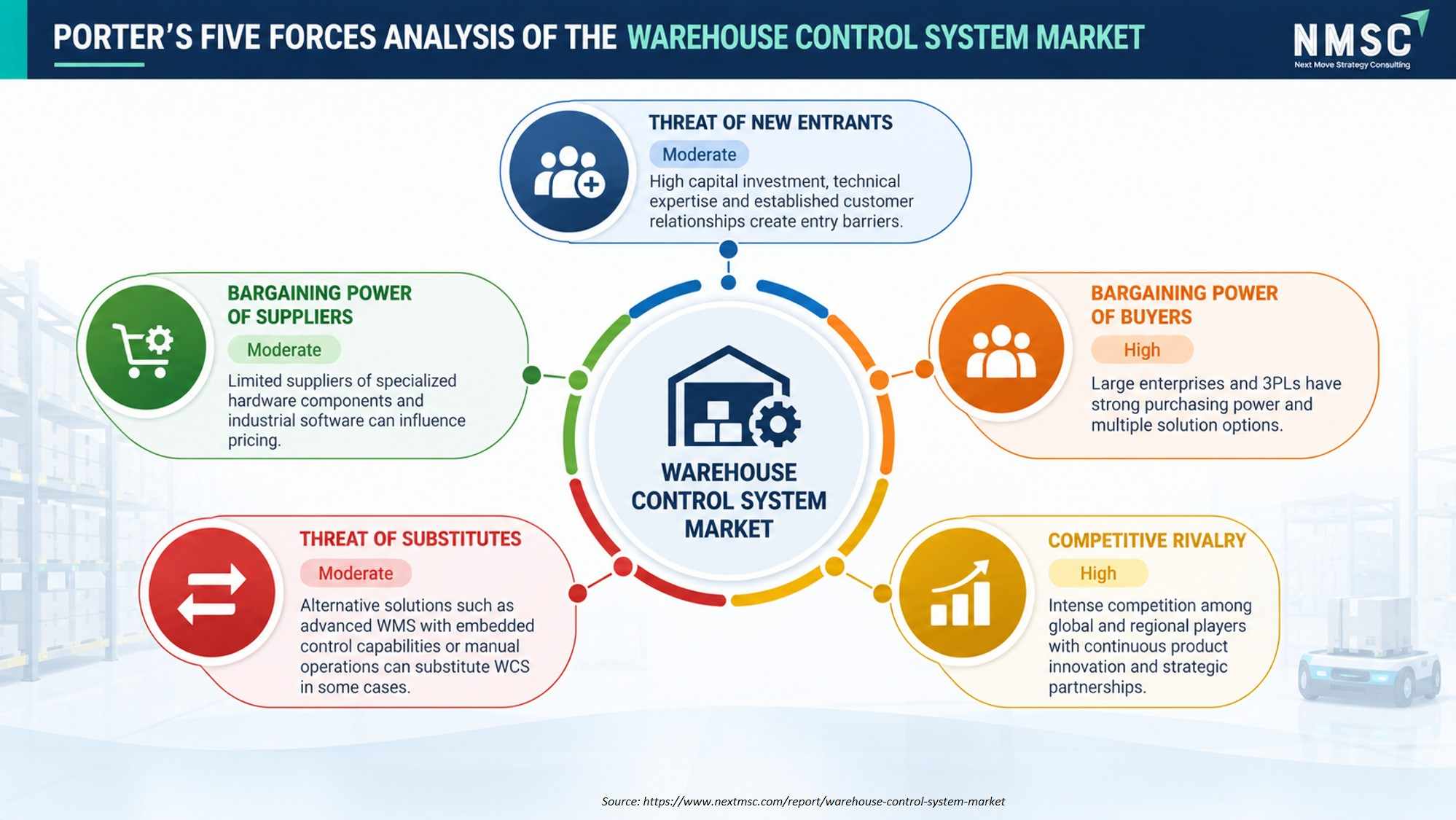
Porter’s Five Forces Analysis of the Warehouse Control System Market

The infographic presents a Porter’s Five Forces analysis of the Warehouse Control System Market, assessing the competitive dynamics shaping the industry. It highlights a moderate threat of new entrants due to technical expertise, capital requirements, and established relationships. Supplier power is moderate, while buyer power and competitive rivalry are high. The threat of substitutes is moderate, driven by alternative warehouse management solutions and manual processes that can replace WCS capabilities in certain applications.

Regional Outlook

2025 (USD Billion)
2035 (USD Billion)
North Americ
Europe
Asia-Pacific
Middle East
Latin Americ
Region 2025 (USD Billion) 2035 (USD Billion) CAGR (%)
North America $2.24 Billion $5.32 Billion 8.99%
Europe $1.54 Billion $3.90 Billion 9.77%
Asia-Pacific $1.66 Billion $6.20 Billion 14.03%
Middle East & Africa $0.24 Billion $1.06 Billion 15.94%
Latin America $0.24 Billion $1.24 Billion 17.85%

Competitive Landscape

Our findings suggest that the competitive landscape spans diversified material handling automation majors and specialized control software developers, each pursuing distinct differentiation strategies across the warehouse control system value chain. Dimension | Assessment Market Structure | Moderately consolidated; diversified automation majors bundle control software with physical equipment while specialized providers compete on vendor-agnostic orchestration Innovation Focus | Vendor-agnostic orchestration, cloud deployment, predictive diagnostics, mobile robotics integration M&A Activity | Moderate; diversified majors acquire specialized control software developers to strengthen orchestration and integration capability Source: www.nextmsc.com

How Do Companies Compete in the Warehouse Control System Market?

Companies compete primarily on orchestration breadth across mixed-vendor automation fleets, implementation service capability, and depth of integration with upstream warehouse management systems. Our analysis shows that providers combining vendor-agnostic control software with strong systems integration services sustain larger multi-site customer relationships than single-vendor, equipment-locked competitors.

Which Competitive Archetypes Dominate the Warehouse Control System Industry?

Two archetypes dominate: diversified material handling automation majors that bundle proprietary control software with physical equipment sales, and independent control software developers offering vendor-agnostic orchestration platforms. We observed that the differentiation between these archetypes is narrowing as diversified majors open their control platforms to third-party equipment integration.

What Innovation and Differentiation Strategies Are Companies Pursuing?

Company analysis indicates that leading firms are differentiating through open-architecture, vendor-agnostic control platforms, cloud-native deployment options, and embedded predictive diagnostics capability. Investment in mobile robotics orchestration continues, alongside expanded managed services offerings targeting SME operators previously priced out of full-scale control system deployment.

How Active Is M&A in the Warehouse Control System Industry?

M&A activity remains moderate as diversified automation majors acquire specialized control software developers to strengthen vendor-agnostic orchestration capability. Based on research conducted by NMSC, we found that acquisition targets increasingly include cloud-native control platform developers, reflecting strategic pivots toward the fastest-growing deployment category.

Key Market Players

Our assessment indicates that the following companies represent the validated set of key players shaping competitive dynamics across storage, conveyor, mobile, and robotic control categories within the warehouse control system market.

Dematic GmbH Daifuku Co., Ltd. Vanderlande Industries B.V. Swisslog Holding AG SSI SCHAEFER AG KNAPP AG TGW Logistics Group GmbH BEUMER Group GmbH & Co. KG FORTNA Inc. WITRON Logistik + Informatik GmbH Interroll Mecalux , S.A. Murata Machinery, Ltd. Fives SAS Jungheinrich AG Kardex Holding AG SAVOYE SAS Ehrhardt Partner GmbH & Co. KG Körber Supply Chain GmbH Trew, LLC Numina Group, Inc.

Latest Developments

We observed that recent developments across the industry reflect continued investment in cloud-native control platforms and mobile robotics orchestration capability.

Date Event
November 2025 Dematic was selected by Maria Middelares to implement the first AutoStore system for the Belgian healthcare industry, serving two hospitals and two medical centers. The high-density automated storage solution is expected to improve operational efficiency by roughly 30%, while increasing inventory capacity within a smaller footprint and supporting potential future expansion.
October 2025 Kardex Mlog was commissioned by groninger to construct an automated logistics center combining a high-bay warehouse with more than 3,000 pallet storage spaces and an integrated bin-shuttle storage system. Groninger manufactures filling and sealing machines for the pharmaceutical, consumer healthcare, and cosmetics industries, and the facility supports its production and spare-parts logistics.

Investment Opportunities

Where Is Capital Flowing Within the Warehouse Control System Market?

Capital inflows are concentrated in vendor-agnostic control software development and cloud-native platform acquisitions by diversified material handling automation majors. We found that strategic capital is also flowing into managed services platforms targeting SME operators, signaling growing institutional interest in subscription-based control system delivery models.

How Significant Is Infrastructure Investment in This Market?

Infrastructure investment is substantial, with control software providers expanding cloud hosting capacity and regional implementation service teams to support growing Asia-Pacific and Latin America deployment demand. Our assessment indicates that continued investment in API-based integration infrastructure is becoming a prerequisite for competing in mixed-vendor orchestration categories.

What ESG Considerations Are Relevant to This Market?

ESG considerations center on workplace safety in human-robot interaction protocols embedded within control logic, energy efficiency of orchestrated automation equipment, and reduced facility footprint enabled by higher-density automated storage coordination. We observed that providers increasingly disclose safety compliance and energy-efficiency metrics in annual sustainability reporting.

Key Benefits for Stakeholders

How Does This Report Benefit Industry Leaders?

Industry and enterprise leaders gain a structured view of offering, control-system, and regional revenue distribution, supporting prioritization decisions across product development and implementation service investment. Our analysis shows that this structured segmentation clarifies where competitive intensity is rising fastest ahead of resource-allocation decisions.

How Does This Report Benefit Investors and Financial Analysts?

Investors and financial analysts gain reconciled market-size, CAGR, and regional-growth data supporting valuation and portfolio-allocation decisions. Company analysis indicates that segment-level growth differentials, particularly around mobile automation and cloud deployment categories, are material inputs for evaluating provider growth durability.

How Does This Report Benefit Technology Vendors and Product Teams?

Technology vendors and product teams gain visibility into control-system and deployment trends shaping orchestration platform and integration infrastructure demand. We found that this analysis supports prioritization of engineering investment toward the fastest-growing delivery mechanisms identified across the forecast period.

Key Market Segments Evaluated

By Offering

  • Software
  • Services

By Control System

  • Storage Control
  • Conveyor and Sortation
  • Mobile Automation
  • Robotic Handling
  • Packaging and Identification
  • Other Material Handling Control

By Deployment

  • On-Premises
  • Cloud
  • Hybrid

By Control Function

  • Material flow control
  • Equipment orchestration
  • Monitoring and diagnostics
  • Exception management
  • Simulation and testing
  • Other control functions

By Enterprise Size

  • Large enterprise
  • SME's

By Automation Type

  • Conveyors and sorters
  • Automated storage and retrieval
  • Mobile automation
  • Robotic handling
  • Packaging and identification
  • Other automation

By Sales Channel

  • Direct sales
  • System integrator channel
  • Partner and reseller
  • Other channels

By End-User Industry

  • Retail and consumer goods
  • Food and beverage
  • Pharmaceutical and healthcare
  • Industrial manufacturing
  • Third-party logistics
  • Parcel and express
  • Other industries

Conclusion & Recommendations

The long-term outlook remains firmly expansionary, with revenue projected to more than double from USD 7.10 Billion in 2026 to USD 17.72 Billion by 2035 at a 10.70% CAGR. Our analysis shows that this trajectory is underpinned by structural demand for mixed-vendor automation orchestration rather than single-facility automation buildouts alone.

What Strategic Positioning Should Companies Pursue?

Companies should prioritize vendor-agnostic orchestration capability over closed, single-vendor control architectures. We found that providers combining open integration capability with strong implementation services sustain more resilient multi-site customer relationships than competitors reliant on equipment-locked control software.

How Attractive Is the Market for Investment?

Investment attractiveness is high given double-digit growth in mobile automation and cloud deployment categories alongside a large, expanding base of e-commerce-driven automation investment. Our assessment indicates that capital allocators should weight exposure toward providers with proven vendor-agnostic orchestration platforms over closed-architecture competitors.

What Market Shifts and Key Risks Should Stakeholders Monitor?

Key risks include high integration complexity for brownfield retrofits, significant upfront capital costs limiting SME adoption, and cybersecurity risk associated with cloud-connected control systems. We observed that integration complexity poses the most immediate risk to adoption timelines across facilities with established legacy automation infrastructure.

What Are the Primary Growth Pathways Through 2035?

Primary growth pathways include vendor-agnostic orchestration platforms for brownfield retrofits, managed services models expanding SME access, and predictive diagnostics bundling for recurring service revenue. Our findings suggest that companies combining all three pathways will outpace single-lever competitors through the forecast period.

FAQs

About the Author

Liza Phukan

Liza Phukan

Liza Phukan is Research Associate at Next Move Strategy Consulting, where she has covered emerging industries and market research across sectors for 3.5 years. Her work includes analyzing industry developments, validating market data, and developing structured business content from research findings. She uses secondary research and data-validation practices to turn complex market information into clear decision-useful market analysis for business audiences and support report development and B2B.

About the Reviewer

Supradip Baul

Supradip Baul

Supradip Baul is an accomplished business consultant and strategist with over a decade of rich experience in market intelligence, strategy, technology, and business transformation. His work has included rigorous qualitative and quantitative analysis across multiple industries, helping clients shape investment decisions and long-term roadmaps. Earlier in his career, he was associated with Gartner, where he contributed to industry-leading reports and market share analyses. He has worked with leading global companies and holds an MBA with a dual specialization in Marketing and Finance.

Download Free Sample

Ross J Mckenzie

ROSS J MCKENZIE

Business Insight Manager

Staysure Group

“Next MSC have been incredibly helpful in providing detailed & robust information on our market, alongside quantifying growth by different segments. The process to procure was simple and easy, with sample reports and regular contact to ensure we had what we needed. Succinct detail on their sources & methodologies is also greatly received, allowing transparency in this respect helps build trust in the detail you pay for. Joseph in particular was fantastic, and helped ensure efficient provision of the insight pack – thank you NMSC!”.

Kishu Kanda

KISHU KANDA

Strategy Analyst

Accenture

We purchased the AI Consumer Market Report from this company. Not only did they customize the report to meet our specific requirements, but they also showed great flexibility in accommodating our budget. The report we received fully met our expectations. Additionally, they provided prompt and thorough responses to both our pre-purchase and follow-up questions. We look forward to working with this company again in the future.

Kevin Coker

KEVIN COKER

Founder, CEO and Board Diector

Proxima Clinical Research

I have been using Next MSC reports for product positioning in a new geography for a long time. They have by far the best reports I have found and the price is reasonable too!

Henri Knyphausen

HENRI KNYPHAUSEN

Partner at Singulier [Ex-BCG]

Singulier

I recently engaged NEXTMSC.com for a commercial due diligence project within the intralogistics sector, and I am pleased to provide a reference based on my experience. In utilizing NEXTMSC.com's services, I found their report to offer valuable insights into market dynamics and key industry players. The initial report provided a solid foundation for our analysis. However, as we were investigating a smaller target in the market, and I had specific customization requests requiring additional research. These requests included detailed information on product portfolios of various players and sub-market sizes, both inclusive and exclusive of certain product categories. NEXTMSC.com demonstrated commendable responsiveness and agility in accommodating these customization requests. Within a timeframe of 1-2 weeks, they delivered a revised report that met our specific needs. Furthermore, they were receptive to my follow-up inquiries, ensuring clarity and understanding of the data provided. The final deliverable significantly contributed to our due diligence efforts. One of NEXTMSC.com's notable strengths lies in their qualitative research capabilities. However, for future engagements, I would recommend the inclusion of a quantified market model in Excel format. Such a model would offer the ability to conduct in-depth analyses and explore various market segments, including country-specific data and subcomponent breakdowns. Based on my positive experience, I would not hesitate to work with NEXTMSC.com again. Their responsiveness, willingness to accommodate customization requests, and commitment to delivering actionable insights make them a reliable partner for commercial research projects.

Melanie Samko

MELANIE SAMKO

Director of Marketing

TOSOH BIOSCIENCE, INC.

The information provided by NMSC is incredibly valuable, thank you so much for such a excellent work. I really appreciate it. I will make sure to reference all of it, in my summary document.

Custom Market Research Services

We will customize the research for you if the listed report does not fully match your requirements.

Get 30% Free Customization

Select License

This website uses cookies to ensure you get the best experience on our website. Learn more

✖