
Data Warehouse Market Size, Share, Growth & Forecast 2025–2035, By Commercial Form (Cloud Warehouse, Warehouse Software, Warehouse Appliance, Warehouse Services), Architecture (Columnar MPP, In-Memory, HTAP, Streaming, Lakehouse, Row Store), End Use Industry (BFSI, Retail Ecommerce, Healthcare Life Sciences, Manufacturing, Telecom Media), Sales Channel (Direct, Partner, Marketplace, OEM), and Region — Global Analysis 2025–2035
Industry: ICT & Media | Publishing Date: June 12, 2026 | Last Updated: September 30, 2026 | No of Pages: N/A | No. of Tables: N/A | No. of Figures: N/A | Format: PDF | Report Code: IC4655
What Is the Data Warehouse Market Size?
The global Data Warehouse Market size was valued at USD 32.8 billion in 2025 and is projected to reach USD 37.1 billion in 2026, expanding further to USD 113.4 billion by 2035, at a compound annual growth rate (CAGR) of 13.2% from 2026 to 2035. This robust growth trajectory is underpinned by accelerating enterprise cloud migration initiatives, the widespread adoption of AI-driven analytics, escalating demand for real-time data processing, and the growing proliferation of hybrid and multi-cloud deployment architectures across large enterprises and mid-market organizations worldwide.
|
Parameters |
Details |
|
Market Size in 2026 |
USD 37.1 Billion |
|
Revenue Forecast in 2035 |
USD 113.4 Billion |
|
Growth Rate |
CAGR of 13.2% from 2026 to 2035 |
|
Analysis Period |
2025–2035 |
|
Base Year Considered |
2025 |
|
Forecast Period |
2026–2035 |
|
Market Size Estimation |
USD Billion |
|
Companies Profiled |
20 |
|
Countries Covered |
33 |
|
Market Share |
Top 10 |
Industry Outlook
What Is the Data Warehouse Market, and How Has It Structurally Evolved?
A data warehouse is a centralized, analytically optimized repository that integrates structured, semi-structured, and increasingly unstructured data from disparate operational sources to enable business intelligence, historical analytics, and AI-driven decision-making. Structurally, the market has evolved from traditional on-premises appliances and relational row-store architectures to massively parallel columnar cloud platforms, lakehouse paradigms, and real-time streaming warehouses. This architectural transformation has redefined vendor positioning, licensing economics, and enterprise adoption patterns throughout the forecast period.
What Regulatory and Standards Environment Shapes the Data Warehouse Market?
The data warehouse market operates within an increasingly complex regulatory landscape. Frameworks including the European Union General Data Protection Regulation (GDPR), the California Consumer Privacy Act (CCPA), the Health Insurance Portability and Accountability Act (HIPAA) in the United States, and sector-specific mandates in financial services under frameworks such as Basel III and Dodd-Frank impose stringent data residency, lineage, encryption, and access-control requirements. These regulations are actively shaping cloud deployment choices, architecture decisions, and sovereign cloud adoption patterns among enterprises in regulated industries.
How Is Technology Adoption Reshaping the Data Warehouse Market?
NMSC's analysis indicates that cloud-native data warehousing now accounts for the majority of net-new deployments globally, driven by consumption-based pricing models, elastic scalability, and native integration with machine learning runtimes. The emergence of the lakehouse architecture, which merges data lake storage flexibility with data warehouse governance and performance, is redefining how enterprises approach analytical infrastructure investments. Simultaneously, in-memory processing and HTAP (Hybrid Transactional/Analytical Processing) capabilities are converging operational and analytical workloads, reducing data latency and enabling sub-second analytics at enterprise scale.
Key Takeaways
|
Key Insight |
|
Cloud Warehouse dominates the Data Warehouse Market by commercial form, accounting for an estimated USD 17.2 billion in 2025, driven by multi-tenant public cloud deployments from hyperscale providers. Warehouse Services represents the fastest-growing sub-segment, propelled by migration, implementation, and managed operations demand as enterprises accelerate cloud transitions from legacy on-premises systems. |
|
Columnar MPP architecture holds the largest revenue share across the Architecture segment, reflecting its adoption by dominant cloud platforms for large-scale analytical workloads. The Lakehouse architecture is the fastest-growing sub-type, with enterprises increasingly adopting unified storage-compute paradigms that eliminate data duplication between data lakes and analytical warehouses. |
|
Consumption-based revenue streams now represent the single largest and fastest-growing monetization model in the Data Warehouse Market, displacing traditional perpetual license revenues. Subscription-based models hold the second position, reflecting term-licensing adoption by mid-market and SMB customer segments seeking cost predictability. |
|
Enterprise customers generate approximately 58% of total Data Warehouse Market revenue in 2025, reflecting their disproportionate consumption of premium multi-cloud, sovereign, and HTAP-enabled platforms. The Mid-Market segment is the fastest-growing customer size cohort, benefiting from democratized access to cloud-native warehousing via self-service and marketplace distribution channels. |
|
Data Engineering teams represent the largest buyer cohort by decision-making influence within the Data Warehouse Market. The AI/ML buyer segment is expanding at the fastest pace, reflecting the growing deployment of data warehouses as foundational infrastructure for machine learning feature stores, model training pipelines, and inference data repositories. |
|
BFSI remains the leading end-use vertical in the Data Warehouse Market, valued at approximately USD 7.4 billion in 2025, driven by regulatory reporting, risk analytics, and real-time fraud detection requirements. Healthcare and Life Sciences is the fastest-growing vertical, reflecting increasing electronic health record analytics, clinical data integration, and population health management workloads. |
|
North America leads the global Data Warehouse Market with an estimated USD 14.1 billion in 2025, driven by hyperscale cloud investment and enterprise digital transformation programs. |
|
The United States accounts for the single largest national market share, estimated at approximately USD 11.6 billion in 2025, reflecting the concentration of Fortune 500 enterprises and hyperscale cloud infrastructure. |
|
Asia Pacific is the fastest-growing region, with China and India jointly contributing the largest incremental demand expansion over the forecast period. |
|
India is the fastest-growing country market, driven by expanding digital economy initiatives, cloud-first enterprise adoption, and a rapidly scaling technology services sector. |
Ecosystem Analysis of the Data Warehouse Market
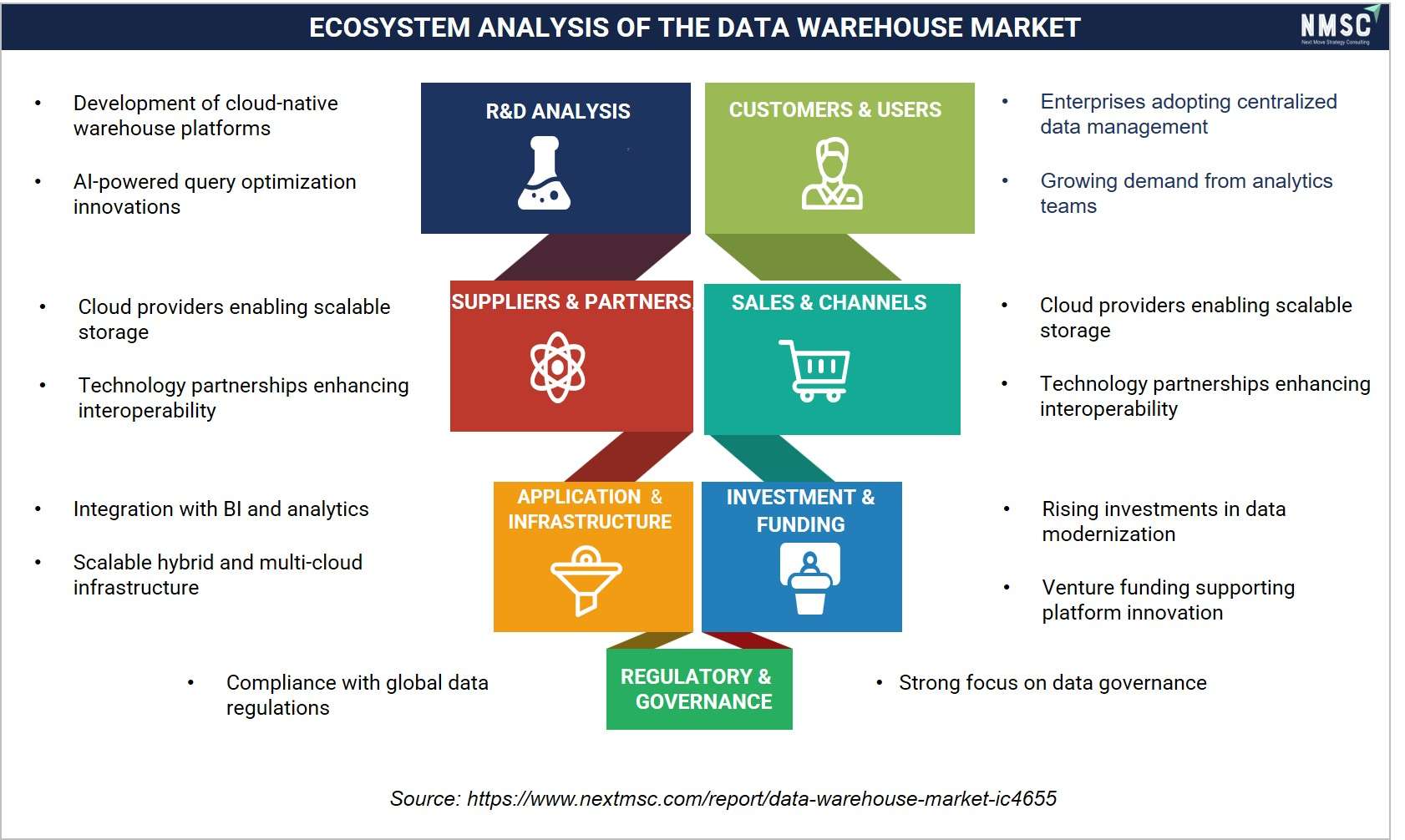
The above infographic maps the data warehouse market ecosystem, highlighting enterprise and analytics team adoption as key customer drivers. It includes R&D analysis, supplier and partner relationships, sales channels, application infrastructure, investment and funding trends, plus regulatory and governance factors shaping centralized data management and cloud-based warehouse deployments.
Key Emerging Trends in the Data Warehouse Market
How Is the Lakehouse Architecture Redefining Enterprise Data Infrastructure?
From our research, we found that the convergence of data lake and data warehouse paradigms into the lakehouse architecture is fundamentally restructuring enterprise data platforms. Organizations are replacing siloed lake and warehouse deployments with unified environments supporting both ML workloads and SQL analytics on a single copy of data. Databricks and open-source projects like Apache Iceberg and Delta Lake are accelerating adoption. This trend reduces data duplication, cuts infrastructure costs, and improves data freshness for analytics and AI applications across BFSI, healthcare, and technology sectors.
How Is AI and Machine Learning Integration Transforming the Data Warehouse Market?
Through our market assessment, we observed that leading data warehouse platforms are embedding native AI/ML capabilities directly within the query engine, eliminating the need for separate analytical infrastructure. Snowflake's Cortex AI, Google BigQuery ML, and Amazon Redshift ML are examples of this embedded intelligence trend. Enterprises are leveraging these capabilities for predictive analytics, anomaly detection, and automated insight generation. This convergence is increasing average contract values, extending platform stickiness, and expanding the addressable use cases within the existing data warehouse install base.
How Is Real-Time Streaming Changing Analytical Architecture Decisions?
Based on NMSC's research, we found that demand for sub-second query latency is driving rapid adoption of streaming-enabled data warehouse architectures. Platforms integrating Apache Kafka, Apache Flink, and native streaming ingestion engines are enabling use cases such as real-time fraud detection in BFSI, dynamic pricing in retail, and IoT telemetry analytics in manufacturing and energy sectors. The distinction between batch ETL and streaming pipelines is progressively dissolving, and streaming-native warehouses are capturing incremental market share from legacy batch-oriented environments.
How Is the Rise of Sovereign Cloud Reshaping Data Warehouse Deployment?
Our findings suggest that geopolitical risk, data sovereignty regulation, and national security requirements are compelling organizations in Europe, the Middle East, and Asia Pacific to adopt sovereign cloud configurations for their data warehouse deployments. Sovereign cloud variants from hyperscalers, along with regional providers such as Alibaba Cloud and Huawei Cloud, are addressing data residency mandates in the EU, GCC countries, and Southeast Asian markets. This trend is generating new revenue opportunities for both global and regional vendors offering dedicated, air-gapped data warehouse environments.
What Are the Key Market Drivers, Breakthroughs, and Investment Opportunities That Will Shape the Data Warehouse Industry in the Next Decade?
Growth Catalyst & Risk Assessment Matrix
|
Drivers / Trends / Restraints |
(+/−) % Impact on CAGR Forecast |
Geographic Relevance |
Impact Timeline |
|
Cloud Migration Acceleration |
+2.8% |
North America, Europe, APAC |
2025–2028 |
|
AI/ML Workload Integration |
+2.1% |
Global |
2026–2035 |
|
Real-Time Streaming Demand |
+1.4% |
North America, Europe |
2025–2030 |
|
Sovereign Cloud Adoption |
+0.9% |
Europe, MEA, APAC |
2026–2032 |
|
Consumption Pricing Shift |
+1.2% |
Global |
2025–2035 |
|
Data Governance & Compliance |
+0.7% |
Europe, North America |
2025–2030 |
|
Security & Privacy Concerns |
−1.1% |
Global |
2025–2035 |
|
Data Integration Complexity |
−0.9% |
Mid-Market, SMB |
2025–2030 |
|
Skill Shortage in Data Engineering |
−0.6% |
LATAM, MEA |
2025–2032 |
|
Open-Source Commoditization |
−0.5% |
Global |
2026–2035 |
|
Edge Analytics Expansion |
+0.8% |
Manufacturing, Energy |
2027–2035 |
|
Public Sector Digitalization |
+0.6% |
MEA, APAC, LATAM |
2026–2035 |
What Are the Growth Drivers of the Data Warehouse Market?
How Is Cloud Migration Driving Sustained Demand for Data Warehouse Solutions?
The ongoing shift of enterprise workloads to cloud infrastructure represents the most powerful structural demand driver in the data warehouse market. According to the U.S. Bureau of Labor Statistics and NIST's cloud computing guidelines, cloud-first policies across federal and state agencies are amplifying institutional demand for scalable data warehouse infrastructure. Enterprises migrating from legacy on-premises environments to hyperscale cloud platforms are simultaneously upgrading their analytical infrastructure to cloud-native warehouses, driving both net-new license revenue and professional services demand for migration and implementation projects.
How Are AI and Advanced Analytics Requirements Accelerating Data Warehouse Investments?
The proliferation of enterprise AI and machine learning programs is creating systematic demand for high-performance, governed data repositories that serve as the foundation for model training, feature engineering, and inference pipelines. Based on our market evaluation, we noticed that enterprises allocating capital toward AI transformation programs are consistently increasing their data warehouse budgets in parallel, as data quality and accessibility remain prerequisite conditions for successful AI deployments. This co-investment pattern is expanding average deal sizes and extending the strategic relevance of data warehouse platforms beyond traditional BI and reporting use cases.
How Is the Rise of Real-Time Decision-Making Fueling Streaming Warehouse Adoption?
Modern enterprises across BFSI, telecommunications, retail, and manufacturing verticals require real-time analytical processing to support dynamic pricing, fraud detection, network optimization, and supply chain management decisions. Our analysis shows that the increasing prevalence of IoT devices, digital commerce transactions, and connected enterprise systems is exponentially growing streaming data volumes, necessitating warehouse architectures capable of ingesting and querying real-time data streams. This driver is expanding the addressable market into operational intelligence use cases that were previously served by separate real-time processing platforms.
What Are the Growth Inhibitors of the Data Warehouse Market?
How Do Security Vulnerabilities and Data Privacy Concerns Constrain in the Data Warehouse Market Growth?
Despite strong structural growth drivers, security and data privacy concerns represent a persistent restraint on data warehouse market expansion, particularly among SMB and mid-market customers in regulated industries. High-profile cloud data breaches and evolving regulatory penalties under GDPR and CCPA create risk aversion among conservative IT decision-makers. According to the Cybersecurity and Infrastructure Security Agency (CISA), cloud environments remain high-value targets for sophisticated threat actors, and the concentration of sensitive enterprise data within centralized data warehouse platforms amplifies the potential impact of a successful breach.
How Does Data Integration Complexity Hinder Full Adoption of Cloud Data Warehouses?
Organizations migrating from heterogeneous legacy data environments face significant integration complexity that delays project timelines and inflates total cost of ownership. The proliferation of diverse source systems, data formats, and ETL tool ecosystems creates interoperability challenges that require specialized engineering expertise. Based on our engagements with enterprise IT decision-makers, data engineering talent shortages in emerging markets compound this challenge, slowing adoption rates in LATAM, MEA, and certain Southeast Asian markets where the talent supply chain has not kept pace with technology demand.
What Are the Growth Opportunities in the Data Warehouse Market?
How Is Public Sector Digitalization Creating New Revenue Streams in the Data Warehouse Market?
Government agencies across North America, Europe, and Asia Pacific are accelerating digital government programs that require enterprise-grade data warehouse infrastructure for citizen services analytics, tax administration, healthcare delivery, and infrastructure monitoring. The U.S. Federal Data Strategy published by the Office of Management and Budget (OMB) explicitly identifies data warehouse modernization as a priority investment area for federal agencies. This institutionalized demand is creating a structurally growing public sector revenue stream that supplements commercial enterprise deployments.
How Does the Expansion of Edge Analytics Open New Addressable Markets for Data Warehouse Vendors?
The convergence of edge computing and centralized data warehousing is creating hybrid architectures where edge nodes perform local pre-processing before aggregating data into centralized cloud warehouses. Manufacturing, energy, and transportation industries are investing in edge-integrated data infrastructure to support autonomous systems, predictive maintenance, and real-time logistics optimization. Through NMSC's assessment, we found that vendors offering seamless edge-to-warehouse integration pipelines are capturing incremental revenue from operational technology (OT) environments that were previously disconnected from enterprise analytics ecosystems.
How Is the Open-Source Lakehouse Ecosystem Creating New Commercialization Opportunities?
The rapid maturation of open-source projects such as Apache Iceberg, Apache Hudi, Delta Lake, and Trino is creating commercial integration and support opportunities for data warehouse vendors. Organizations adopting open table formats are seeking enterprise-grade governance, security, and performance optimization layers that open-source projects alone do not provide. Our findings suggest that vendors who successfully embed open lakehouse standards into their commercial platforms are capturing growing mid-market and developer-led enterprise segments that prioritize interoperability and vendor-neutral architectures.
How Is the Data Warehouse Market Segmented in This Report, and What Are the Key Insights from the Segmentation Analysis?
How Do Cloud Warehouse, Software, Appliance, and Services Segments Differ in Revenue Contribution?
|
Segment |
2025 (USD Bn) |
2035 (USD Bn) |
CAGR (%) |
|
Cloud Warehouse |
17.2 |
62.8 |
13.8% |
|
Warehouse Software |
7.6 |
22.4 |
11.4% |
|
Warehouse Appliance |
3.8 |
9.4 |
9.6% |
|
Warehouse Services |
4.2 |
18.8 |
16.2% |
The cloud warehouse segment leads the commercial form dimension of the data warehouse market, driven primarily by multi-tenant public cloud deployments from hyperscale vendors. Single-tenant and BYOC (Bring Your Own Cloud) variants are gaining traction among financial services and healthcare enterprises with strict data isolation requirements, while Sovereign Cloud configurations are emerging as the fastest-growing sub-type within cloud warehouse, reflecting European and GCC data residency mandates. Warehouse Software maintains relevance for organizations with legacy on-premises investments or hybrid-deployable requirements. Warehouse Appliance revenue is declining in relative share as enterprises phase out integrated appliances, though engineered systems continue to serve high-performance, latency-sensitive workloads. Warehouse Services is the fastest-growing commercial form segment, with migration and managed operations sub-categories commanding premium pricing as organizations accelerate legacy-to-cloud transitions.
Which Data Warehouse Architecture Dominates Enterprise Deployments Today?
|
Segment |
2025 (USD Bn) |
2035 (USD Bn) |
CAGR (%) |
|
Columnar MPP |
13.4 |
44.6 |
12.8% |
|
In-Memory |
5.2 |
16.8 |
12.4% |
|
HTAP |
3.6 |
14.2 |
14.8% |
|
Streaming |
3.1 |
13.6 |
15.9% |
|
Lakehouse |
4.8 |
17.4 |
13.6% |
|
Row Store |
1.9 |
4.4 |
8.7% |
|
Other |
0.8 |
2.4 |
11.6% |
Columnar MPP (Massively Parallel Processing) architecture dominates the data warehouse market's architectural dimension, underpinning the core query engines of Snowflake, Amazon Redshift, Google BigQuery, and Microsoft Synapse Analytics. Its performance superiority for aggregate analytical queries on large data sets entrenches its position across enterprise deployments. In-Memory architecture serves latency-critical SAP HANA and Oracle Exadata workloads in manufacturing and BFSI. HTAP is emerging rapidly, enabling simultaneous transactional and analytical queries without ETL overhead, with strong adoption in telecommunications and financial trading environments. The Streaming architecture is the fastest-growing sub-type, driven by IoT and real-time operational analytics. Lakehouse architecture is experiencing the highest investor interest and fastest platform development pace, with Databricks and Apache Iceberg-based implementations gaining enterprise adoption across technology and retail sectors.
How Is the Shift to Consumption-Based Pricing Reshaping Revenue Stream Dynamics?
|
Segment |
2025 (USD Bn) |
2035 (USD Bn) |
CAGR (%) |
|
Subscription |
9.4 |
30.6 |
12.5% |
|
Consumption Based |
11.8 |
46.2 |
14.6% |
|
License |
4.2 |
8.2 |
6.9% |
|
Maintenance |
2.8 |
5.4 |
6.8% |
|
Services |
3.4 |
14.8 |
15.8% |
|
OEM Embedded |
1.2 |
8.2 |
21.1% |
Consumption-based revenue is now the dominant and fastest-growing monetization model in the data warehouse market, reflecting the Snowflake credit model and similar usage-aligned pricing structures adopted by AWS, Google Cloud, and Databricks. This model aligns vendor revenue with customer value realization, reducing upfront procurement barriers and accelerating adoption among mid-market and digital-native enterprises. Subscription revenue remains substantial, reflecting term-licensed deployments in enterprise and government segments. Traditional perpetual license and maintenance streams are in secular decline as on-premises appliance renewal cycles wind down. OEM embedded revenue is the fastest-growing stream, driven by independent software vendors (ISVs) embedding cloud warehouse query engines within their application platforms, representing a high-multiplier, low-churn revenue category for leading platform vendors.
How Do Enterprise, Mid-Market, SMB, and Public Sector Customers Differ in Data Warehouse Adoption?
|
Segment |
2025 (USD Bn) |
2035 (USD Bn) |
CAGR (%) |
|
Enterprise |
19.0 |
62.4 |
12.6% |
|
Mid-Market |
7.8 |
29.2 |
14.1% |
|
SMB |
2.8 |
10.4 |
14.0% |
|
Public Sector |
3.2 |
11.4 |
13.6% |
Enterprise customers dominate the data warehouse market by spending volume, generating approximately USD 19.0 billion in 2025, driven by their complex multi-cloud deployments, large-scale analytical workloads, and premium platform requirements including sovereign cloud, HTAP, and embedded AI capabilities. Mid-Market and SMB segments represent the fastest-growing customer cohorts, enabled by self-service onboarding, consumption pricing, and marketplace distribution channels that eliminate traditional procurement complexity. The Public Sector is a structurally growing segment, with government digital transformation programs driving material budget allocations toward cloud-native data warehouse infrastructure, particularly in North America, the UK, Australia, and Singapore.
Who Are the Key Decision Makers Driving Data Warehouse Procurement?
|
Segment |
2025 (USD Bn) |
2035 (USD Bn) |
CAGR (%) |
|
CIO IT |
8.4 |
26.2 |
12.1% |
|
Data Engineering |
9.2 |
30.4 |
12.7% |
|
Analytics BI |
6.4 |
20.2 |
12.2% |
|
AI ML |
3.8 |
18.6 |
17.2% |
|
Business Unit |
3.2 |
12.4 |
14.6% |
|
Public Sector |
1.8 |
5.6 |
12.0% |
Data Engineering teams represent the largest buyer cohort in the data warehouse market by procurement influence, reflecting the technical complexity of platform evaluation and integration. CIO/IT executives retain final budget authority and vendor selection approval in large enterprise accounts. The AI/ML buyer segment is expanding at the fastest rate as data science teams formalize data warehouse requirements for feature stores, training data pipelines, and model evaluation infrastructure. Business Unit buyers are gaining procurement authority in mid-market organizations where low-code, self-service analytics platforms reduce dependence on centralized IT. Public Sector procurement follows distinct government acquisition processes with longer sales cycles but highly predictable renewal patterns.
Which Industries Are the Largest Consumers of Data Warehouse Solutions?
|
Segment |
2025 (USD Bn) |
2035 (USD Bn) |
CAGR (%) |
|
BFSI |
7.4 |
24.6 |
12.8% |
|
Retail Ecommerce |
4.8 |
17.2 |
13.6% |
|
Healthcare Life Sciences |
3.6 |
14.8 |
15.2% |
|
Manufacturing |
3.2 |
10.4 |
12.5% |
|
Telecom Media |
2.8 |
9.2 |
12.6% |
|
Technology IT Services |
4.4 |
16.8 |
14.3% |
|
Energy Utilities |
2.0 |
6.8 |
13.0% |
|
Government |
1.8 |
6.4 |
13.6% |
|
Education |
0.8 |
2.8 |
13.3% |
|
Transportation Logistics |
1.2 |
4.4 |
13.9% |
|
Hospitality Travel |
0.6 |
2.2 |
13.9% |
|
Other |
0.2 |
1.8 |
24.6% |
BFSI is the largest end-use vertical in the data warehouse market, driven by regulatory reporting obligations under Basel III, Dodd-Frank, and IFRS 9, alongside fraud analytics and customer intelligence workloads requiring high-performance columnar query engines. Healthcare and Life Sciences is the fastest-growing vertical, reflecting EHR analytics, clinical trial data management, and population health programs. Technology and IT Services companies are significant self-consumers of data warehouse infrastructure, building analytics products and internal data platforms. Retail and e-commerce demand is driven by recommendation engines, inventory optimization, and customer journey analytics. Manufacturing and Energy sectors are increasingly deploying warehouse infrastructure for IoT telemetry analytics and predictive maintenance programs, while Government and Education are emerging as structurally growing segments driven by digital government initiatives.
How Is Marketplace Distribution Disrupting Traditional Data Warehouse Sales Channels?
|
Segment |
2025 (USD Bn) |
2035 (USD Bn) |
CAGR (%) |
|
Direct |
12.4 |
38.4 |
12.0% |
|
Partner |
14.8 |
50.2 |
13.0% |
|
Marketplace |
4.2 |
20.6 |
17.2% |
|
OEM |
1.4 |
4.2 |
11.6% |
Partner channel distribution leads the data warehouse market's sales channel dimension, reflecting the extensive system integrator, value-added reseller, and managed service provider ecosystems built around hyperscale cloud platform providers. Direct sales dominate in large enterprise accounts where account management intensity and custom commercial structures are required. Cloud marketplace distribution is the fastest-growing sales channel, with AWS Marketplace, Azure Marketplace, and Google Cloud Marketplace enabling frictionless procurement that bypasses traditional procurement cycles, particularly in mid-market and SMB segments. OEM embedded distribution is a high-growth niche, as ISVs embed warehouse engines to deliver analytics-as-a-feature within vertical SaaS operations across healthcare, fintech, and logistics.
Regional Outlook
Geographic Performance Snapshot
|
Region |
2025 Market Size (USD Bn) |
2035 Forecast (USD Bn) |
CAGR 2026–2035 (%) |
Key Driver |
|
North America |
14.1 |
47.4 |
13.0% |
Hyperscale cloud investment, enterprise AI adoption |
|
Europe |
7.8 |
26.2 |
12.9% |
GDPR compliance, sovereign cloud demand |
|
Asia Pacific |
7.2 |
26.6 |
14.0% |
Digital economy expansion, cloud-first mandates |
|
Middle East & Africa |
1.9 |
7.2 |
14.3% |
Smart city programs, Vision 2030 investments |
|
Latin America |
1.8 |
6.0 |
12.8% |
Banking digitalization, retail analytics |
North America Data Warehouse Market
North America dominates the global data warehouse market with an estimated USD 14.1 billion in 2025, supported by the highest concentration of Fortune 500 enterprises, hyperscale data centers, and advanced analytical technology ecosystems. Based on our engagements with enterprise procurement teams, the U.S. federal government's cloud-first mandate and the comprehensive NIST cloud computing framework have established a strong institutional foundation for data warehouse investment at both federal and state levels. Regulatory requirements from the SEC, FDIC, and CMS drive sustained demand in financial services and healthcare verticals.
United States Data Warehouse Market
Through our analysis, the United States data warehouse market accounts for approximately USD 11.6 billion in 2025, representing the single largest national market globally. Technology adoption maturity is exceptionally high, with cloud-native warehousing commanding over 60% of active deployments. Regulatory drivers including HIPAA, SOX, and CCPA reinforce sustained investment in governed data infrastructure. Competitive intensity is the most elevated globally, with all twenty profiled vendors maintaining active U.S. enterprise sales operations. The U.S. federal cloud marketplace procurement channel (GSA eBuy, AWS GovCloud) is creating accelerated public sector adoption pathways for certified data warehouse vendors.
Canada Data Warehouse Market
From our assessment, Canada's data warehouse market reached approximately USD 1.6 billion in 2025, driven by BFSI digitalization, healthcare analytics transformation, and government digital service modernization programs. The Office of the Privacy Commissioner of Canada's PIPEDA enforcement and provincial privacy legislation are influencing deployment architecture choices, with hybrid and private cloud configurations gaining preference in regulated industries. Major Canadian banks and telecommunications providers are investing in real-time streaming warehouse infrastructure to support digital customer experience programs.
Mexico Data Warehouse Market
According to our evaluation, Mexico's data warehouse market is valued at approximately USD 0.9 billion in 2025, with manufacturing, banking, and retail representing the primary demand segments. The Mexican government's digital transformation agenda and IMSS healthcare digitalization initiatives are creating public sector demand. Cloud adoption rates are accelerating, supported by AWS and Microsoft Azure regional infrastructure investments in Mexico City. Regulatory compliance for the CNBV financial regulator is driving governance and audit trail requirements within banking sector data warehouse deployments.
Europe Data Warehouse Market
Europe's data warehouse market is projected at USD 7.8 billion in 2025, shaped profoundly by the EU General Data Protection Regulation, the proposed EU Data Act, and national data sovereignty frameworks. Based on our market evaluation, we noticed that GDPR compliance requirements are driving enterprises toward sovereign cloud and private cloud warehouse deployments, creating premium revenue opportunities for vendors offering EU-resident data processing guarantees. The European Commission's digital single market strategy and Horizon Europe funding program are accelerating analytical infrastructure investment across member states.
United Kingdom Data Warehouse Market
Through our analysis, the United Kingdom data warehouse market reached approximately USD 1.8 billion in 2025. Post-Brexit UK GDPR and the Data Protection Act 2018 maintain stringent data governance requirements that sustain enterprise investment in compliant warehouse infrastructure. Financial services firms regulated by the FCA and PRA are significant consumers of high-performance data warehouse platforms for risk analytics and regulatory reporting. London's position as a global fintech hub drives advanced analytical capability investment, with real-time warehouse architectures supporting algorithmic trading and fraud detection workloads.
Germany Data Warehouse Market
From our assessment, Germany's data warehouse market is estimated at USD 1.4 billion in 2025. German industrial manufacturers (Siemens, BASF, Continental) are deploying data warehouse infrastructure for IoT telemetry analytics, predictive maintenance, and supply chain optimization. The Bundesamt für Sicherheit in der Informationstechnik (BSI) cloud security framework influences architecture choices, with private and hybrid cloud configurations preferred in critical infrastructure sectors. SAP SE's HANA-based warehouse ecosystem maintains strong incumbency across German enterprise accounts due to ERP integration advantages.
France Data Warehouse Market
Based on our engagements, France's data warehouse market reached approximately USD 1.1 billion in 2025. The French government's cloud de confiance program, promoting sovereign cloud services meeting ANSSI SecNumCloud certification, is driving sovereign cloud warehouse adoption among government agencies and critical infrastructure operators. Retail, luxury goods, and aerospace sectors represent key commercial demand drivers. Capgemini and Atos as domestic SI partners are channeling significant data warehouse deployment project revenue through partner sales channels for hyperscale platforms.
Italy Data Warehouse Market
Through NMSC's assessment, Italy's data warehouse market is valued at approximately USD 0.6 billion in 2025. Banking and insurance verticals, regulated by the Banca d'Italia and IVASS, are primary demand drivers for governed data warehouse infrastructure supporting regulatory reporting and risk management. The Italian government's PNRR (National Recovery and Resilience Plan) digital investment program is allocating funding toward public administration analytics modernization, creating incremental public sector demand.
Spain Data Warehouse Market
Our analysis shows that Spain's data warehouse market reached approximately USD 0.52 billion in 2025. Telecommunications giants, retail banks, and energy companies are the dominant data warehouse consumers. The AEPD (Agencia Española de Protección de Datos) enforces GDPR provisions, reinforcing data governance investment. Madrid and Barcelona emerging as Southern European technology hubs are attracting hyperscale infrastructure investment that supports regional cloud warehouse availability, reducing latency barriers for mid-market adoption.
Sweden Data Warehouse Market
According to our evaluation, the market in Sweden is estimated at approximately USD 0.38 billion in 2025. Sweden's advanced digital economy, high enterprise cloud penetration, and strong telecommunications and financial services sectors drive the data warehouse market demand. Swedish regulatory alignment with EU data governance frameworks supports cloud-native deployment models. Ericsson's enterprise analytics infrastructure and Spotify's data platform investments represent flagship examples of domestic technology-sector data warehouse adoption.
Denmark Data Warehouse Market
From our assessment, Denmark's data warehouse market is valued at approximately USD 0.28 billion in 2025. Denmark's healthcare sector, driven by the comprehensive national health data registry and e-health digitalization programs, is a significant data warehouse consumer. Financial services firms and shipping conglomerates such as Maersk are investing in advanced analytics infrastructure to support supply chain visibility and operational intelligence.
Finland Data Warehouse Market
Based on our market evaluation, Finland's data warehouse market reached approximately USD 0.22 billion in 2025. Finland's telecom sector (Nokia ecosystem), logistics, and public sector health analytics programs drive market demand. The Finnish government's digital government program and population health registry management initiatives represent key public sector investment drivers. High internet penetration and enterprise cloud readiness support accelerating cloud warehouse adoption.
Netherlands Data Warehouse Market
Through our analysis, the Netherlands data warehouse market is valued at approximately USD 0.46 billion in 2025. Amsterdam's position as a major European cloud hub (AWS, Azure, Google Cloud all have significant presence) reduces infrastructure latency and accelerates cloud warehouse adoption. Financial services, logistics (Port of Rotterdam analytics), and retail sectors drive enterprise demand. Dutch compliance with GDPR through the Autoriteit Persoonsgegevens influences deployment architecture decisions.
Rest of Europe Data Warehouse Market
According to our evaluation, the Rest of Europe segment, encompassing markets including Poland, Belgium, Austria, Switzerland, and the Nordic and Benelux countries not individually profiled, collectively represents approximately USD 1.04 billion in 2025. Central and Eastern European markets are experiencing accelerating data warehouse adoption driven by nearshoring of technology operations, EU digital cohesion funding, and banking sector modernization programs. Switzerland's financial services sector and Austria's industrial manufacturing base represent additional demand anchors within this grouping.
Asia Pacific Data Warehouse Market
Asia Pacific is the fastest-growing regional market in the data warehouse market, projected to expand from USD 7.2 billion in 2025 to USD 26.6 billion by 2035, at a CAGR of 14.0%. NMSC's analysis indicates that the combination of large-scale digital economy expansion, government cloud-first policies in Singapore, Australia, India, and South Korea, and the massive market scale of China and India creates a structurally favorable growth environment. Hyperscale providers including Alibaba Cloud, Tencent Cloud, and Huawei Cloud are developing regionally competitive data warehouse offerings that are capturing domestic demand previously served by global vendors.
China Data Warehouse Market
Through our analysis, China's data warehouse market is estimated at USD 2.4 billion in 2025. China's digitalization programs, including the new data infrastructure (新基建) policy, and the growth of domestic cloud giants Alibaba Cloud, Tencent Cloud, and Huawei Cloud are the primary growth engines. The Cybersecurity Law of the People's Republic of China and Data Security Law mandate data localization, creating a protected market environment for domestic vendors. BFSI, retail, and manufacturing represent the dominant demand verticals. International vendors face regulatory barriers, reinforcing domestic vendor market share concentration.
India Data Warehouse Market
From our assessment, India's data warehouse market reached approximately USD 1.2 billion in 2025 and is the fastest-growing national market in the region. The Digital India program, rapid growth of the UPI payments ecosystem generating massive transaction data volumes, and expansion of BFSI analytics requirements are primary demand drivers. The Personal Data Protection Bill's implementation trajectory is influencing architecture choices. India's large base of technology services companies serves as a catalyst for both domestic consumption and export of data engineering services. AWS and Microsoft Azure are expanding India data center capacity to support growing demand.
Japan Data Warehouse Market
According to our evaluation, Japan's data warehouse market is valued at approximately USD 1.4 billion in 2025. Japan's digital transformation policy (DX推進), led by the Ministry of Economy, Trade and Industry, is driving enterprise modernization investment. Manufacturing (Toyota, Sony ecosystem), financial services, and telecommunications are primary sectors. The Japanese government's Society 5.0 initiative and data-driven manufacturing programs are allocating institutional investment toward analytical infrastructure. Local vendors including Fujitsu and NTT Data serve as key system integrator partners for global warehouse platform deployments.
South Korea Data Warehouse Market
Based on our engagements, South Korea's data warehouse market is estimated at USD 0.82 billion in 2025. The government's Digital New Deal policy and extensive 5G infrastructure deployment are creating high-volume data generation environments requiring analytical warehouse capabilities. Samsung, LG, and SK Group's internal analytics infrastructure investments represent flagship enterprise consumption. The Korea Internet and Security Agency (KISA) data security guidelines influence cloud architecture decisions for regulated industries.
Taiwan Data Warehouse Market
Through NMSC's assessment, Taiwan's data warehouse market reached approximately USD 0.38 billion in 2025. Taiwan's semiconductor and electronics manufacturing ecosystem (TSMC, ASE Group) represents the primary demand vertical, deploying data warehouse infrastructure for supply chain analytics, yield optimization, and quality management. The National Development Council's digital economy programs are accelerating public sector analytics investment. Cloud adoption is growing, supported by expanded regional infrastructure from hyperscale providers.
Indonesia Data Warehouse Market
Our analysis shows that Indonesia's data warehouse market is valued at approximately USD 0.34 billion in 2025. Indonesia's rapidly expanding digital economy, driven by large e-commerce platforms (Tokopedia, Bukalapak) and digital banking adoption, is generating high-volume transactional data sets requiring warehouse infrastructure. Government Regulation No. 71 of 2019 on Electronic System Organizers influences data localization requirements. The Ministry of Communication and Information Technology's digital transformation programs are creating public sector demand.
Vietnam Data Warehouse Market
From our assessment, Vietnam's data warehouse market is estimated at approximately USD 0.18 billion in 2025. The Vietnamese government's National Digital Transformation Program to 2025 with a vision to 2030 is allocating investment toward government data management and analytics infrastructure. Manufacturing, banking, and telecommunications represent the primary commercial demand drivers. Increasing penetration of cloud services from AWS (Singapore-based) and domestic providers is reducing adoption barriers.
Australia Data Warehouse Market
According to our evaluation, Australia's data warehouse market reached approximately USD 0.72 billion in 2025. Australia's mature enterprise cloud market, strong financial services sector, and government cloud strategy (Digital Transformation Agency's cloud-first policy) support robust data warehouse demand. The Australian Government's Data Availability and Transparency Act 2022 is influencing public sector data management investments. Healthcare analytics, driven by the national My Health Record system, represents a growing demand vertical.
Philippines Data Warehouse Market
Based on our engagements, the Philippines data warehouse market is valued at approximately USD 0.18 billion in 2025. Business process outsourcing (BPO) analytics infrastructure, banking sector digitalization under BSP's Digital Payments Transformation Roadmap, and government digitalization programs are key demand drivers. Cloud adoption is accelerating, supported by expanded AWS and Microsoft Azure data center presence in Metro Manila.
Malaysia Data Warehouse Market
Through our analysis, Malaysia's data warehouse market is estimated at approximately USD 0.26 billion in 2025. Malaysia Digital Economy Corporation (MDEC) initiatives and the government's MyDigital blueprint are driving enterprise and public sector data analytics investment. Financial services under BNM supervision and telecommunications represent primary demand verticals. Malaysia's strategic positioning as a regional digital hub is attracting hyperscale data center investment that expands cloud warehouse service availability.
Rest of APAC Data Warehouse Market
Our findings suggest that the Rest of APAC segment, encompassing Thailand, New Zealand, Bangladesh, Sri Lanka, and other markets, collectively represents approximately USD 0.32 billion in 2025. Regional growth is driven by fintech expansion, telecom analytics, and government e-services modernization programs. Cloud infrastructure expansion from hyperscale providers is progressively reducing service delivery barriers in these markets.
Middle East & Africa (MEA) Data Warehouse Market
The Middle East and Africa data warehouse market is projected at USD 1.9 billion in 2025 and represents one of the fastest-growing regional markets, driven by transformative national vision programs including Saudi Arabia Vision 2030, UAE Centennial 2071, and Smart Dubai 2021. Based on NMSC's research, we found that government-led data infrastructure investment, combined with BFSI digitalization and telecom analytics programs, is creating substantial demand for enterprise data warehouse platforms. Sovereign cloud requirements are particularly pronounced in this region, given data sovereignty laws across Gulf Cooperation Council (GCC) member states.
Saudi Arabia Data Warehouse Market
Through our analysis, Saudi Arabia's data warehouse market is valued at approximately USD 0.52 billion in 2025. Vision 2030's digital economy pillar and NEOM smart city initiative are allocating significant institutional capital toward data analytics infrastructure. Saudi Data and Artificial Intelligence Authority (SDAIA) regulations on data localization influence platform architecture decisions. BFSI, government, and energy (Saudi Aramco's digital twin and operational analytics programs) represent dominant demand verticals.
UAE Data Warehouse Market
From our assessment, the UAE data warehouse market reached approximately USD 0.44 billion in 2025. Dubai and Abu Dhabi's smart government initiatives, including the Dubai Data Strategy and Abu Dhabi government's digital transformation programs, are primary institutional demand drivers. The UAE's position as a regional fintech and cloud hub attracts hyperscale investment, improving service availability. DIFC (Dubai International Financial Centre) data protection regulations influence financial sector architecture preferences.
Egypt Data Warehouse Market
Based on our market evaluation, Egypt's data warehouse market is estimated at approximately USD 0.18 billion in 2025. Egypt's Vision 2030 digital economy strategy and banking sector modernization under the Central Bank of Egypt's financial inclusion programs are key demand drivers. Government e-services digitalization and telecom sector analytics investments are supplementing commercial demand. Cloud adoption is growing, supported by AWS, Microsoft, and Google regional infrastructure expansions.
Israel Data Warehouse Market
According to our evaluation, Israel's data warehouse market is valued at approximately USD 0.22 billion in 2025. Israel's globally renowned technology ecosystem and significant cybersecurity industry generate domestic demand for advanced analytical infrastructure. The Israel Innovation Authority supports technology sector R&D investment that includes data analytics infrastructure. Financial services and defense technology sectors are primary consumers of high-performance, security-certified data warehouse platforms.
Turkey Data Warehouse Market
Through NMSC's assessment, Turkey's data warehouse market reached approximately USD 0.18 billion in 2025. BFSI, telecommunications, and retail represent primary demand verticals. Turkey's Personal Data Protection Law (KVKK) imposes data residency requirements that influence cloud deployment architecture. The Turkish government's Digital Turkey 2023 program has established institutional foundations for public sector data infrastructure investment.
Nigeria Data Warehouse Market
Based on our engagements, Nigeria's data warehouse market is estimated at approximately USD 0.14 billion in 2025. Nigeria's expanding fintech ecosystem (Flutterwave, Paystack ecosystems), banking sector under CBN oversight, and telecommunications companies are primary demand drivers. Cloud adoption is accelerating with AWS and Azure establishing regional presence. Regulatory frameworks for the Nigeria Data Protection Regulation (NDPR) are influencing enterprise data governance investments.
South Africa Data Warehouse Market
Our analysis shows that South Africa's data warehouse market is valued at approximately USD 0.18 billion in 2025. South Africa's advanced banking sector, JSE-listed enterprises, and telecommunications companies represent the core demand base. The Protection of Personal Information Act (POPIA) imposes data governance obligations that drive warehouse governance investment. Johannesburg is the primary enterprise technology hub, with cloud infrastructure from AWS, Azure, and Google supporting growing cloud warehouse adoption.
Rest of MEA Data Warehouse Market
From our assessment, the Rest of MEA segment, including Qatar, Kuwait, Bahrain, Oman, Morocco, Kenya, and other emerging markets, collectively accounts for approximately USD 0.14 billion in 2025. Qatar's World Cup digital legacy infrastructure investments and Bahrain's fintech hub status create pockets of advanced demand within this grouping. East African markets, particularly Kenya's M-Pesa-driven fintech analytics ecosystem, represent emerging demand frontiers.
Latin America Data Warehouse Market
Latin America's data warehouse market is estimated at USD 1.8 billion in 2025, driven by Brazil's outsized digital banking ecosystem, regional e-commerce growth, and improving hyperscale cloud infrastructure availability. Through our market assessment, we observed that Brazil's LGPD (Lei Geral de Proteção de Dados) has accelerated enterprise investment in data governance infrastructure, while Mexico's expanding manufacturing and retail analytics demand is the second-largest sub-regional growth driver. Consumption-based cloud pricing is democratizing access for mid-market organizations in Colombia, Argentina, and Chile.
Brazil Data Warehouse Market
Based on our engagements, Brazil's data warehouse market is the largest in Latin America at approximately USD 0.88 billion in 2025. The LGPD data protection law drives enterprise compliance investment in governed warehouse infrastructure. Brazil's large BFSI sector (Itaú, Bradesco, BTG Pactual) and rapidly growing fintech ecosystem (Nubank) generate high-volume analytical workloads. AWS São Paulo region and Microsoft Azure Brazil South provide low-latency cloud infrastructure supporting accelerating cloud warehouse adoption.
Argentina Data Warehouse Market
Through our analysis, Argentina's data warehouse market reached approximately USD 0.28 billion in 2025. Despite macroeconomic challenges, Argentina's strong technology sector, including a significant developer community and emerging fintech ecosystem, drives sustained data analytics demand. The National Directorate for Personal Data Protection oversees data compliance obligations. Cloud adoption has accelerated among digital-native enterprises, supported by regional AWS infrastructure access.
Chile Data Warehouse Market
From our assessment, Chile's data warehouse market is valued at approximately USD 0.22 billion in 2025. Chile's Ley Marco de Ciberseguridad and data protection legislation are influencing enterprise architecture decisions. Mining analytics (copper extraction optimization), financial services, and retail represent primary demand drivers. Chile's advanced digital economy infrastructure relative to regional peers supports higher cloud warehouse penetration rates.
Colombia Data Warehouse Market
According to our evaluation, Colombia's data warehouse market reached approximately USD 0.24 billion in 2025. Colombia's expanding fintech ecosystem, retail sector digitalization, and government digital transformation programs (Government Digital Policy) are primary demand drivers. The Superintendencia de Industria y Comercio enforces data protection obligations that reinforce enterprise governance investment. Cloud adoption is growing, with AWS and Azure both operating regional infrastructure in Bogotá.
Rest of LATAM Data Warehouse Market
Based on our market evaluation, the Rest of LATAM segment, encompassing Ecuador, Peru, Uruguay, Central American markets, and Caribbean nations, collectively represents approximately USD 0.18 billion in 2025. Banking digitalization, retail analytics, and government e-services programs represent primary demand drivers across this grouping. Cloud infrastructure accessibility is improving with regional colocation and peering investments, supporting mid-market adoption acceleration.
Strategic Framework Analysis of the Data Warehouse Market
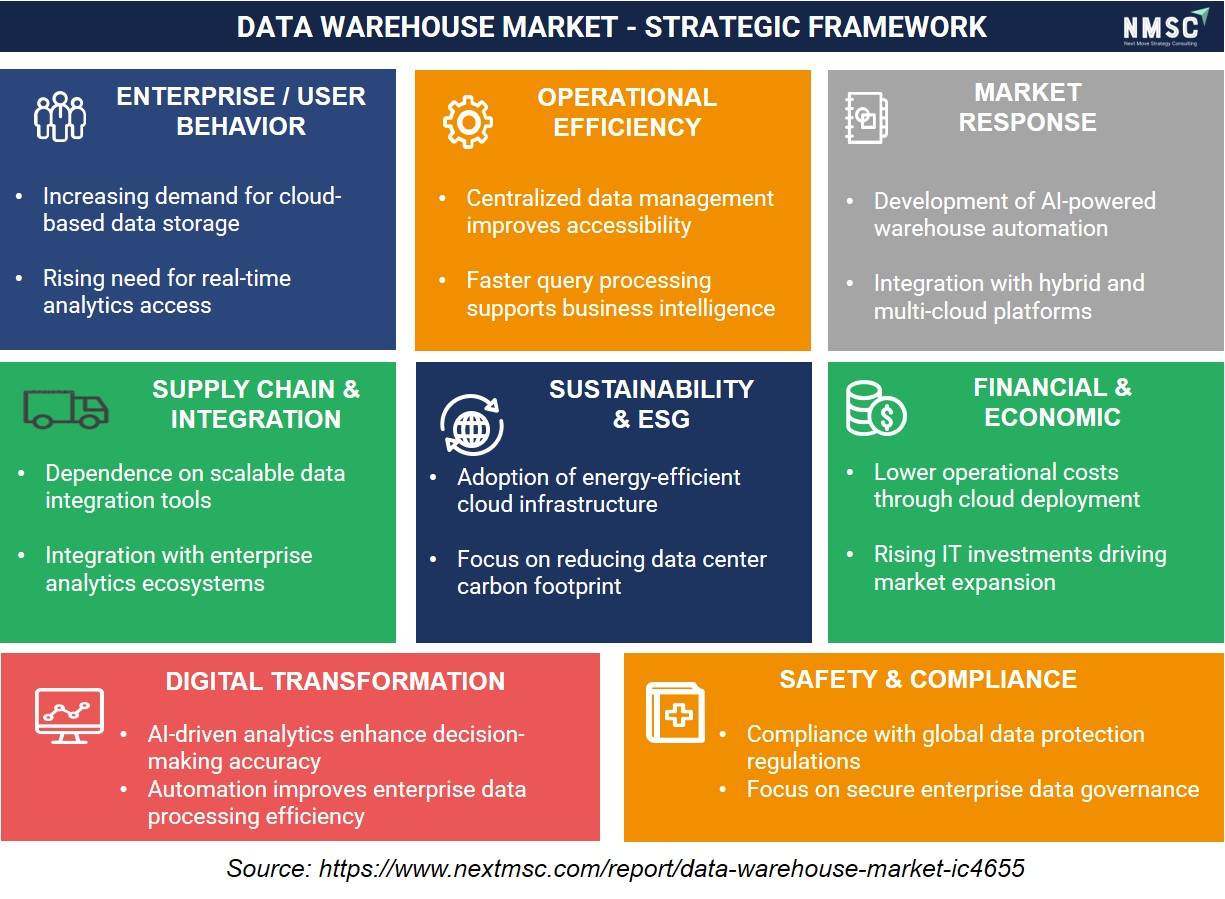
The above infographic outlines key drivers across eight dimensions. It highlights enterprise demand for cloud-based storage and real-time analytics, operational efficiency through centralized data management and faster query processing, and market response via AI-powered automation and hybrid cloud integration. It also covers supply chain dependence on integration tools, sustainability via energy-efficient infrastructure, financial benefits of lower cloud deployment costs, digital transformation through AI-driven analytics, and strong emphasis on compliance and secure data governance.
Competitive Landscape
Competitive Dynamics and M&A Landscape
|
Key Takeaways |
Details |
|
Market Structure |
The Data Warehouse Market features strong competition among hyperscale cloud providers, enterprise database vendors, and specialized analytical database companies. Competition is centered on cloud-native scalability, query performance, workload optimization, hybrid-cloud deployment, and AI-enabled analytics capabilities. Large vendors leverage integrated cloud ecosystems and enterprise customer bases, while niche providers focus on high-speed analytics, real-time processing, and cost-efficient data warehouse architectures. |
|
Innovation Focus |
Innovation in the Data Warehouse Market is driven by AI-assisted query optimization, autonomous database management, real-time analytics, intelligent workload orchestration, and cloud-native modernization. Vendors are expanding automated performance tuning, scalable storage-compute separation, and unified analytics environments to improve operational efficiency, analytical speed, and enterprise data accessibility across distributed and multi-cloud infrastructures. |
|
M&A Activity |
M&A activity in the Data Warehouse Market is focused on expanding cloud analytics capabilities, strengthening database modernization portfolios, and enhancing AI-driven data management solutions. Vendors are pursuing acquisitions, strategic partnerships, and ecosystem collaborations to improve interoperability, broaden enterprise reach, and support increasingly complex analytical workloads. Industry consolidation is also enabling greater geographic expansion and deeper integration across enterprise data and analytics environments. |
How Do Companies Compete in the Data Warehouse Market?
The data warehouse market is characterized by competition among cloud-native data warehouse providers, enterprise database vendors, and analytics platform companies. Leading players such as Snowflake, Amazon Web Services, Microsoft, Google Cloud, Oracle, IBM, SAP, and Teradata compete through scalability, performance optimization, security capabilities, and seamless integration with broader cloud ecosystems. Vendors increasingly differentiate themselves through workload efficiency, real-time analytics, hybrid and multi-cloud support, and AI-powered data management capabilities.
Which Kind of Companies Dominate the Data Warehouse Market?
Our market analysis suggests that the competitive landscape is shaped by a combination of large cloud technology providers and specialized analytical database vendors. Established companies benefit from extensive enterprise customer bases, global infrastructure, and integrated analytics offerings. Meanwhile, providers such as ClickHouse, SingleStore, Firebolt, Exasol, Ocient, and Yellowbrick Data focus on high-performance analytics, low-latency query execution, and cost-efficient data processing. Specialization in analytical workloads and advanced performance optimization remains a key differentiator across the market.
AI-Driven Analytics and Cloud-Native Architectures Drive Market Success in the Data Warehouse Market
Innovation in the data warehouse market is increasingly focused on AI-assisted query optimization, automated workload management, real-time analytics, and cloud-native scalability. Vendors are investing in autonomous database capabilities, intelligent resource allocation, and unified data platforms to enhance performance and operational efficiency. As enterprise data volumes continue to grow, success increasingly depends on delivering faster insights, flexible deployment options, and seamless integration across distributed and hybrid data environments.
Market Players to Opt for Merger and Acquisition Strategies to Expand Their Presence in the Data Warehouse Market
Strategic acquisitions, partnerships, and ecosystem expansion initiatives remain important competitive strategies within the data warehouse market. Companies are enhancing capabilities in cloud analytics, AI-enabled data management, database modernization, and enterprise data integration to strengthen their market positions. Industry consolidation is also supporting geographic expansion, improved interoperability, and broader platform capabilities, enabling vendors to address evolving enterprise analytics and business intelligence requirements more effectively.
Who Are the Key Market Players in the Data Warehouse Market?
-
Snowflake, Inc.
-
Amazon.com, Inc.
-
Microsoft Corporation
-
Alphabet Inc. (Google Cloud)
-
Oracle Corporation
-
Databricks, Inc.
-
SAP SE
-
International Business Machines Corporation (IBM)
-
Teradata Corporation
-
Cloudera, Inc.
-
Alibaba Group Holding Limited (Alibaba Cloud)
-
Tencent Holdings Limited (Tencent Cloud)
-
Huawei Technologies Co., Ltd. (Huawei Cloud)
-
ClickHouse, Inc.
-
SingleStore, Inc.
-
Rocket Software, Inc.
-
Firebolt, Inc.
-
Yellowbrick Data, Inc.
-
Exasol AG
-
Ocient, Inc.
What Are the Latest Developments in the Data Warehouse Market Industry?
|
Date |
Event |
|
June 2025 |
Snowflake launched Standard Warehouse Generation 2 and Adaptive Compute at Snowflake Summit 2025, improving warehouse performance, workload optimization, and price-performance efficiency |
|
June 2025 |
Snowflake introduced Cortex AISQL and SnowConvert AI to modernize enterprise analytics and accelerate migration from legacy data warehouse platforms |
Expert Insights
 “AI should not be a Big Bang. It should be a series of little projects that show value every step of the way”
— Sridhar Ramaswamy, Chief Executive Officer of Snowflake
Statement made during a discussion on enterprise AI adoption, data infrastructure readiness, and analytics modernization within cloud data environments.
Market Interpretation
The statement highlights the growing importance of data warehouse platforms as foundational infrastructure for enterprise AI deployment. Our analysis indicates that organizations are increasingly prioritizing governed data environments, scalable analytics architectures, and centralized data management before expanding AI investments. This reflects a broader market shift toward modern cloud data warehouses that support trusted data accessibility, analytical performance, and AI-ready enterprise decision-making frameworks.
What Are the Investment Opportunities in the Data Warehouse Market?
How Is Venture Capital and Private Equity Investment Shaping the Data Warehouse Market?
The data warehouse market has attracted sustained PE/VC investment, with prominent transactions including KKR and Clayton, Dubilier & Rice's privatization of Cloudera at approximately USD 5.3 billion, Databricks' Series H fundraise valuing the company at USD 43 billion, and Snowflake's landmark IPO in 2020 that established cloud data warehouse as an institutional investment category. Ongoing VC activity is concentrated in specialized sub-segments including real-time streaming warehouses, open-source lakehouse platforms, and AI-native analytical engines, reflecting investor conviction in architectural transition opportunities.
How Are Hyperscale Infrastructure Investments Expanding the Data Warehouse Market's Addressable Geography?
Hyperscale cloud providers are collectively committing hundreds of billions of dollars to global infrastructure expansion, including data center buildout in MEA, Southeast Asia, and Latin America. According to Microsoft's official investor filings, the company committed to USD 80 billion in data center infrastructure investment in fiscal year 2025, a material portion of which supports Azure Synapse Analytics and Microsoft Fabric warehouse capabilities. This infrastructure investment is expanding the addressable geography of premium cloud warehouse services and reducing latency barriers in emerging markets, creating new addressable revenue pools in GCC, India, and Southeast Asia.
How Are ESG and Sustainability Considerations Influencing Data Warehouse Market Investment?
Environmental sustainability requirements are becoming investment-relevant in data warehouse procurement decisions. Hyperscale data center operators are increasingly required to report against environmental metrics including power usage effectiveness (PUE) and renewable energy percentage under frameworks such as the EU Corporate Sustainability Reporting Directive (CSRD) and SEC climate disclosure rules. Organizations are preferring cloud warehouse vendors with credible net-zero commitments and renewable energy procurement programs, creating differentiation opportunities for hyperscalers with advanced sustainability credentials. Serverless and elastic warehouse architectures offer inherent efficiency advantages over always-on on-premises appliances by consuming compute resources only during active query processing.
How Is the Digital Transformation Wave Creating Capital Deployment Opportunities in Emerging Markets?
Emerging markets in APAC, MEA, and LATAM present compelling capital deployment opportunities driven by government-led digital transformation programs. India's Digital India initiative, Saudi Arabia Vision 2030, Nigeria's digital economy policy, and Indonesia's national digital transformation roadmap are allocating material public capital toward data analytics infrastructure. From our research, we found that PE and growth equity investors are increasingly targeting regional technology integration and managed services firms positioned to capture professional services revenue from these government-mandated data infrastructure modernization programs, representing an indirect investment pathway into the data warehouse market's growth trajectory.
Key Benefits for Stakeholders
For Technology Vendors and Solution Providers
Vendors receive detailed competitive positioning analysis, emerging segment opportunity identification, and go-to-market channel strategy insights. The report's granular segmentation across commercial form, architecture, revenue stream, and buyer type enables precise product roadmap alignment with market demand evolution. Competitive landscape mapping highlights white space opportunities and consolidation risk areas within the rapidly evolving platform vendor ecosystem.
For Enterprise Technology Buyers
CIOs, Data Engineering leaders, and Analytics BI teams can leverage this report's segmentation analysis and regional outlook to benchmark platform selection decisions against peer adoption patterns, evaluate total cost of ownership implications of consumption versus subscription models, and align architectural choices with long-term market trajectory toward lakehouse and AI-native warehouse paradigms.
For Investors and Financial Analysts
PE/VC investors and equity analysts gain market sizing, CAGR projections, M&A activity mapping, and investment opportunity assessments across the data warehouse market's fastest-growing sub-segments including Warehouse Services, Streaming architecture, Consumption-based revenue, and AI/ML buyer-driven demand. Regional growth differential analysis supports geographic investment allocation decisions.
For Government and Regulatory Bodies
Policymakers receive market maturity assessment, sovereign cloud and data residency regulatory impact analysis, and public sector technology adoption benchmarking. The report supports evidence-based policy formulation for national digital infrastructure investment programs and regulatory framework development in data governance and cloud security.
Data Warehouse Market Key Segments
By Commercial Form
-
Cloud Warehouse
-
Multi-Tenant
-
Single-Tenant
-
Sovereign Cloud
-
BYOC
-
-
Warehouse Software
-
On-Premises
-
Private Cloud
-
Hybrid Deployable
-
-
Warehouse Appliance
-
Integrated Appliance
-
Engineered System
-
-
Warehouse Services
-
Migration
-
Implementation
-
Managed Operations
-
Support
-
By Architecture
-
Columnar MPP
-
In-Memory
-
HTAP
-
Streaming
-
Lakehouse
-
Row Store
-
Other
By Revenue Stream
-
Subscription
-
Consumption Based
-
License
-
Maintenance
-
Services
-
OEM Embedded
By Customer Size
-
Enterprise
-
Mid-Market
-
SMB
-
Public Sector
By Buyer Type
-
CIO IT
-
Data Engineering
-
Analytics BI
-
AI ML
-
Business Unit
-
Public Sector
By Sales Channel
-
Direct
-
Partner
-
Marketplace
-
OEM
By End Use Industry
-
BFSI
-
Retail Ecommerce
-
Healthcare Life Sciences
-
Manufacturing
-
Telecom Media
-
Technology IT Services
-
Energy Utilities
-
Government
-
Education
-
Transportation Logistics
-
Hospitality Travel
-
Other
By Region
-
North America: U.S., Canada, Mexico
-
Europe: UK, Germany, France, Italy, Spain, Sweden, Denmark, Finland, Netherlands, Rest of Europe
-
Asia Pacific: China, India, Japan, South Korea, Taiwan, Indonesia, Vietnam, Australia, Philippines, Malaysia, Rest of APAC
-
Middle East & Africa: Saudi Arabia, UAE, Egypt, Israel, Turkey, Nigeria, South Africa, Rest of MEA
-
Latin America: Brazil, Argentina, Chile, Colombia, Rest of LATAM
Conclusion & Recommendations
Long-Term Outlook and Strategic Positioning
The data warehouse market is positioned for sustained high-growth expansion through 2035, underpinned by the irreversible enterprise transition to cloud-native analytical infrastructure, the integration of AI/ML capabilities into warehouse platforms, and the proliferation of real-time data processing requirements across every major industry vertical. NMSC's assessment indicates that the market will evolve from a differentiated analytical platform market toward a commoditized cloud infrastructure layer for basic workloads, while premium value migrates toward AI-native capabilities, governance automation, and real-time streaming intelligence. Vendors that execute the AI platform convergence strategy most effectively will capture disproportionate revenue growth.
Investment Attractiveness
The data warehouse market presents high investment attractiveness across multiple vectors. Cloud-native independent vendors (Snowflake, Databricks) offer high-growth equity exposure with expanding total addressable market narratives. Managed services and migration sub-segments offer lower-volatility revenue growth with strong demand visibility. Emerging market infrastructure investments in APAC, MEA, and LATAM provide geographic diversification within the sector. The OEM embedded revenue stream represents a high-multiple, low-churn growth category with accelerating momentum as ISVs embed warehouse capabilities within vertical SaaS applications.
Key Risks to Monitor
Primary market risks include intensifying commoditization pressure from open-source lakehouse ecosystems (Apache Iceberg, Trino) that may compress premium vendor pricing power over the medium term. Macroeconomic headwinds affecting enterprise IT budget cycles represent a near-term consumption growth risk for consumption-priced platforms. Regulatory fragmentation across data residency jurisdictions increases compliance costs for globally operating vendors. Vendor concentration risk in the hyperscale layer creates strategic dependency risks for enterprises without multi-cloud portability strategies.
Growth Pathways and Recommended Actions
Enterprise technology buyers should prioritize vendor selection based on long-term architectural alignment with open lakehouse standards and AI-native analytics capabilities rather than near-term feature parity. Procurement teams should negotiate contractual multi-cloud portability provisions to preserve strategic flexibility as the market evolves. Technology vendors should accelerate ecosystem partnerships with AI/ML platform providers, open-source community engagement, and vertical industry solution development to deepen customer stickiness and expand addressable use cases. Investors should monitor consumption growth rate trends in leading cloud warehouse vendors as a leading indicator of enterprise AI investment momentum and broader digital transformation velocity.


About the Author
 Mayurima Roy
— Mayurima Roy is Research Analyst at Next Move Strategy Consulting, where she has spent 4 years working across the firm's full industry coverage rather than a single fixed vertical. Her work centers on structured research, ongoing trend tracking, competitive assessment, and insight-led content development, translating complex market data into clear, decision-ready narratives that support informed client decision-making across diverse global industries, market sectors, and world regions every day.
Mayurima Roy
— Mayurima Roy is Research Analyst at Next Move Strategy Consulting, where she has spent 4 years working across the firm's full industry coverage rather than a single fixed vertical. Her work centers on structured research, ongoing trend tracking, competitive assessment, and insight-led content development, translating complex market data into clear, decision-ready narratives that support informed client decision-making across diverse global industries, market sectors, and world regions every day.
About the Reviewer
 Supradip Baul
— Supradip Baul is an accomplished business consultant and strategist with over a decade of rich experience in market intelligence, strategy, technology, and business transformation. His work has included rigorous qualitative and quantitative analysis across multiple industries, helping clients shape investment decisions and long-term roadmaps. Earlier in his career, he was associated with Gartner, where he contributed to industry-leading reports and market share analyses. He has worked with leading global companies and holds an MBA with a dual specialization in Marketing and Finance.
Supradip Baul
— Supradip Baul is an accomplished business consultant and strategist with over a decade of rich experience in market intelligence, strategy, technology, and business transformation. His work has included rigorous qualitative and quantitative analysis across multiple industries, helping clients shape investment decisions and long-term roadmaps. Earlier in his career, he was associated with Gartner, where he contributed to industry-leading reports and market share analyses. He has worked with leading global companies and holds an MBA with a dual specialization in Marketing and Finance.
At Next Move Strategy Consulting, we understand that insightful market research is the cornerstone of successful business decisions. That's why we employ a robust and multifaceted approach, combining various methodologies to deliver the most accurate and actionable data for our clients.

Research Landscape
We navigate the world of research with two primary approaches:
Qualitative Approach
Our qualitative research methodologies involve immersive techniques such as in-depth interviews, focus groups, and observational studies. By engaging directly with individuals and stakeholders, we uncover valuable insights that quantitative data alone may overlook.

Quantitative Research
In tandem with qualitative methodologies, NMSC leverages the power of Quantitative Research to provide a robust foundation of numerical insights. Through systematic data collection and analysis, we quantify patterns, preferences, and market trends, offering a comprehensive view of the business landscape.
Our quantitative research approach employs diverse tools, including surveys, experiments, and statistical modelling. These methodologies enable us to gather data from a large and representative sample, ensuring the statistical significance of our findings. By employing structured questionnaires and standardized data collection methods, we guarantee the reliability and validity of the information we present to our clients.
Quantitative research is particularly effective in measuring the prevalence of trends, assessing market size, and gauging the impact of various factors on consumer behavior. The numerical precision attained through this approach equips our clients with actionable insights, facilitating data-driven decision-making and strategy formulation.


Our Specialized Toolbox for Industry-Specific Market Research
We deploy a specialized arsenal of techniques tailored to meet your unique requirements. Here's a glimpse into our comprehensive toolbox:

Information Procurement
The stage entails acquiring market data or relevant information through various sources and methodologies.


Market Research Approach
We utilize both top-down and bottom-up approaches in market research analysis to achieve a comprehensive understanding of the market dynamics, leveraging the broad perspective of industry trends and macroeconomic factors alongside detailed insights from specific segments and individual companies.

Porters Five Forces Analysis
We conduct Porter's Five Forces analysis to evaluate the competitive landscape of an industry, providing us with insights into factors that affect profitability and strategic positioning.

SWOT Analysis

Forecasting
We utilize a forecasting model to predict future consumption by considering parameters like population, economics, regulations, market competition, drivers, constraints, technology, and pricing. We also employ statistical techniques such as multilinear regression, exponential smoothing, moving average, ARIMA, and Monte Carlo simulations for accurate predictions. In econometric forecasting, we analyzed short-term and long-term event impacts, attributing values based on regulatory frameworks, economic factors, and market events.





 Speak to Our Analyst