AI Border Control Market Size, Share, Growth & Forecast by Offering (Platforms: Identity Verification, Document Verification, Travel Authorization, Traveler Risk, Border Management, Surveillance Intelligence; Systems: ABC Gates, Self-Service Kiosks, Document Verification Devices, Mobile & Surveillance Systems; Services), Checkpoint Type (Airport, Land Border, Seaport, Consulate), Customer Type, Sales Channel, Deployment Mode, Revenue Stream — Global Analysis 2025–2035
Industry: ICT & Media | Publishing Date: July 6, 2026 | Last Updated: September 30, 2026 | No of Pages: N/A | No. of Tables: N/A | No. of Figures: N/A | Format: PDF | Report Code: EP4974
What Is the AI Border Control Market Size?
The global AI Border Control Market was valued at USD 4.2 billion in 2025 and is expected to reach USD 4.9 billion in 2026. Accelerating government investment in national security infrastructure, rising international passenger traffic, and mandatory biometric identity verification mandates are projected to propel the market to USD 20.3 billion by 2035, advancing at a CAGR of 17.1% from 2026 to 2035. Key growth drivers include the global deployment of automated border control gates equipped with facial recognition and liveness detection, the integration of AI-powered advance passenger information analytics, the expansion of smart border corridors at major international airports, and growing adoption of cloud-native and edge-deployed border management platforms across emerging markets.
|
Parameters |
Details |
|
Market Size in 2025 |
USD 4.2 Billion |
|
Market Size in 2026 |
USD 4.9 Billion |
|
Revenue Forecast in 2035 |
USD 20.3 Billion |
|
Growth Rate |
CAGR of 17.1% from 2026 to 2035 |
|
Analysis Period |
2025–2035 |
|
Base Year Considered |
2025 |
|
Forecast Period |
2026–2035 |
|
Market Size Estimation |
Billion USD |
|
Companies Profiled |
20 |
|
Countries Covered |
33 |
|
Market Share |
Top 10 |
AI Border Control Market Overview
What Is the AI Border Control Market?
The AI Border Control Market encompasses the integrated ecosystem of AI-powered platforms, hardware systems, and professional services deployed by governments, airport operators, port authorities, and supranational entities to automate, accelerate, and secure the identification, screening, and processing of travelers at international borders. Solutions span biometric identity verification platforms, automated border control gates, document authentication systems, traveler risk analytics, and perimeter surveillance intelligence. NMSC's analysis indicates that the market serves as a critical component of national security and immigration infrastructure, enabling high-throughput passenger processing while simultaneously strengthening threat detection capabilities.
How Has the AI Border Control Market Evolved?
From our research, we found that the AI Border Control Market has evolved through three distinct technology phases over the past two decades. The first phase centered on the deployment of biometric passport standards defined by the International Civil Aviation Organization (ICAO) and initial fingerprint-based identity verification at land and air borders. The second phase introduced facial recognition algorithms into automated eGate systems and integrated Advance Passenger Information (API) data analytics. The current third phase is characterized by multimodal biometric fusion, AI-driven behavioral analytics, cloud-native interoperability platforms, and edge-deployed intelligence at remote border crossings, fundamentally transforming the market structure and competitive dynamics.
How Do Regulations Influence the AI Border Control Market?
Regulatory frameworks are a primary structural driver of the AI Border Control Market. The International Civil Aviation Organization's ICAO Doc 9303 standards for machine-readable travel documents mandate biometric chip integration across 193 member states, creating consistent global demand for passport readers, ePassport validators, and facial recognition enrollment systems. The European Union's Entry/Exit System (EES) and European Travel Information and Authorization System (ETIAS), coupled with the Schengen Borders Code, are compelling EU member states to undertake substantial border technology modernization programs. Through NMSC's assessment, we found that analogous mandates in the United States, Australia, Singapore, and Gulf Cooperation Council countries are creating sustained multi-year procurement cycles.
How Is Technology Adoption Expanding Across the AI Border Control Market?
Technology adoption across the AI Border Control Market is accelerating as national border agencies transition from document-centric to biometric-centric traveler processing architectures. NMSC's analysis indicates that cloud-native interoperability platforms are reducing the time required to implement cross-agency data sharing from years to months. Edge computing deployments are enabling AI-powered biometric verification at remote land border posts lacking reliable high-bandwidth connectivity. Additionally, subscription-based software-as-a-service delivery models introduced by leading vendors are lowering capital expenditure barriers for mid-sized airport operators and emerging market border agencies, broadening the addressable market significantly.
|
Key Takeaways |
|
By Offering, Platforms accounted for the largest share of the AI Border Control Market at USD 1.8 billion in 2025, driven by increasing adoption of AI-powered identity verification, traveler risk assessment, biometric orchestration, and border management software solutions. Platforms also represent the fastest-growing offering segment, advancing at a CAGR of 19.2% from 2026 to 2035, supported by continued investments in digital border transformation initiatives and intelligent decision-support systems. |
|
By Checkpoint Type, Airport Border Control accounted for the largest market share at USD 1.9 billion in 2025, supported by rising international passenger traffic and increasing investments in automated passenger processing infrastructure. Consulate and Visa Centers represent the fastest-growing checkpoint segment, advancing at a CAGR of 22.9% from 2026 to 2035, driven by increasing adoption of AI-enabled visa screening, digital identity verification, and remote application processing technologies. |
|
By Customer Type, Government Border Agencies generated the highest revenue contribution at USD 2.4 billion in 2025, reflecting extensive investments in national security, immigration modernization, and border management programs. Supranational Entities represent the fastest-growing customer segment, projected to expand at a CAGR of 22.5% from 2026 to 2035, supported by growing cross-border security initiatives, regional mobility frameworks, and collaborative identity management programs. |
|
By Deployment Mode, Cloud-Based AI Border Control Solutions held the largest market share at USD 0.9 billion in 2025, driven by increasing demand for centralized analytics, scalable infrastructure, and real-time border intelligence capabilities. Cloud Deployment is also the fastest-growing deployment model, advancing at a CAGR of 22.5% from 2026 to 2035, supported by expanding government cloud adoption and AI-driven border security modernization programs. |
|
North America held the largest regional share in the AI Border Control Market at USD 1.6 billion in 2025, supported by extensive investments in biometric border security systems, advanced traveler screening platforms, and next-generation immigration technology infrastructure. |
|
Middle East & Africa is the fastest-growing region in the AI Border Control Market, projected to expand at a CAGR of 22.0% from 2026 to 2035, driven by smart border initiatives, airport modernization projects, digital identity programs, and increasing investments in AI-enabled national security infrastructure. |
|
The United States is the largest country market in the AI Border Control Market, supported by large-scale deployment of biometric screening technologies, advanced border surveillance systems, AI-powered traveler risk assessment platforms, and ongoing investments in homeland security modernization. |
|
Saudi Arabia is the fastest-growing country market within the Middle East & Africa AI Border Control Market, driven by Vision 2030 smart border initiatives, deployment of advanced biometric verification systems, airport and land-border modernization programs, digital identity infrastructure expansion, and increasing investment in AI-enabled national security technologies. |
Key Emerging Trends in the AI Border Control Market
How Is Multimodal Biometric Fusion Transforming Traveler Verification in the AI Border Control Market?
Multimodal biometric fusion, combining facial recognition, fingerprint, iris, and voice modalities within a single AI-adjudicated identity verification decision, is rapidly displacing single-modality systems across high-throughput airport corridors. Our analysis indicates that vendors such as IDEMIA and Thales have commercially deployed Multimodal Biometric Platforms that achieve false-match rates below 0.001% at transaction speeds under three seconds per traveler. This transformation is particularly impactful for governments managing large-scale identity verification at border checkpoints, enabling seamless traveler processing while materially raising the barrier against fraudulent identity presentation and lookalike impostor attempts.
How Is the Integration of Advance Passenger Information Analytics Reshaping Pre-Border Risk Assessment?
Pre-border risk intelligence derived from API and PNR analytics platforms is emerging as a structurally important trend in the AI Border Control Market, enabling border agencies to shift threat detection from the physical checkpoint to the pre-departure stage. Based on research conducted by NMSC, we found that the European Union's adoption of the PNR Directive (EU 2016/681) has created mandatory demand for AI-powered Passenger Name Record analytics platforms across all 27 EU member states. These platforms apply machine-learning risk-scoring models to historical travel patterns, booking anomalies, and watchlist cross-reference data to generate targeted inspection recommendations hours before a flight departs.
How Is the Deployment of Self-Service Border Processing Kiosks Evolving Across Checkpoint Infrastructure?
Self-service border processing kiosks equipped with AI-driven document verification, facial recognition, and liveness detection are transforming the physical infrastructure of airport arrivals halls and land border crossing facilities. Through our market assessment, we observed that airports including Changi International Airport in Singapore and Dubai International Airport have deployed multi-function biometric kiosks that process passport reading, face capture, and eVisa validation within a single interaction lasting under 60 seconds. This deployment trend is reducing dwell times, lowering staffing requirements, and enabling border agencies to direct officer resources toward complex secondary inspection cases.
How Is Edge AI Enabling Border Intelligence at Remote and Low-Connectivity Crossings?
Edge AI deployment is enabling sophisticated biometric identity verification and document authentication at remote land border posts and mobile inspection units that lack reliable high-bandwidth network connectivity. NMSC's analysis indicates that vendors including NEC Corporation and secunet Security Networks AG have commercially deployed portable biometric systems with on-device AI inference capabilities, enabling facial recognition and fingerprint matching against local watchlist subsets without cloud connectivity. This technical advancement is strategically important for securing extended land borders in Africa, Southeast Asia, and Latin America where infrastructure investment lags behind air border deployments.
Ecosystem Analysis of the AI Border Control Market
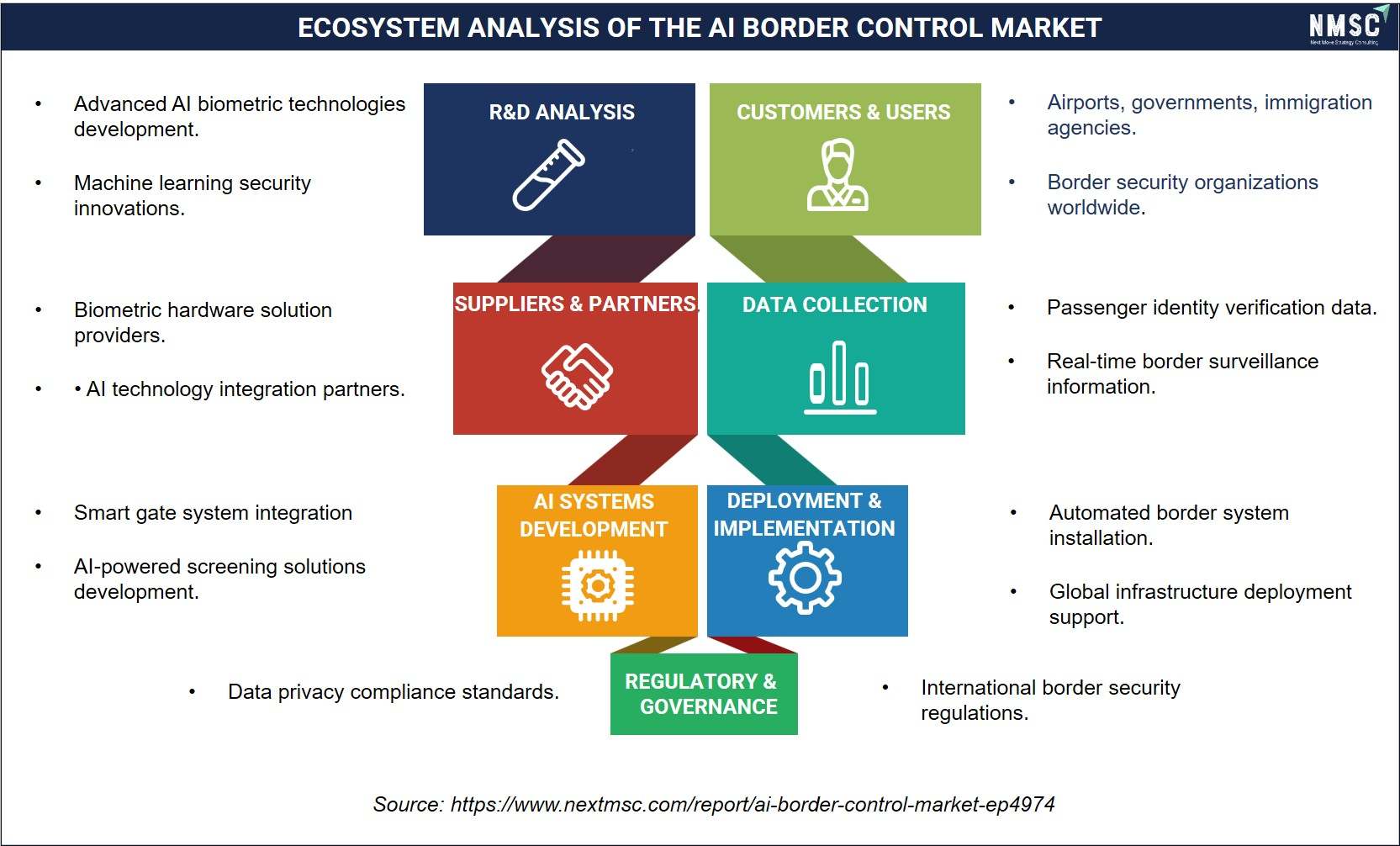
Based on our ecosystem assessment, we identified a collaborative value chain connecting AI technology developers, biometric solution providers, data analytics vendors, system integrators, and government agencies. R&D activities focus on computer vision, facial recognition, and threat detection algorithms. Data collection and processing support intelligent border monitoring, while deployment partners integrate solutions across airports, border checkpoints, and immigration systems under strict regulatory oversight.
What Are the Key Market Drivers, Breakthroughs, and Investment Opportunities that will Shape the AI Border Control Industry in the Next Decade?
|
Drivers / Trends / Restraints |
(+/-) % Impact on CAGR Forecast |
Geographic Relevance |
Impact Timeline |
|
Global Biometric Entry/Exit System Mandates |
+2.9% |
North America, Europe, Asia-Pacific |
2025–2030 |
|
EU Entry/Exit System (EES) and ETIAS Deployment |
+2.4% |
Europe (27 EU Member States) |
2025–2028 |
|
Advance Passenger Information & PNR Analytics Adoption |
+1.8% |
Global |
2025–2030 |
|
Cloud-Native and Edge Border Platform Adoption |
+1.6% |
Asia-Pacific, MEA, Latin America |
2026–2035 |
|
GCC Smart Border Infrastructure Programs |
+1.4% |
Middle East & Africa |
2025–2032 |
|
High Capital Expenditure and Procurement Complexity |
-1.3% |
Emerging Markets (Africa, LATAM) |
Ongoing |
|
Data Privacy and Biometric Data Sovereignty Concerns |
-1.0% |
Europe, North America, Asia-Pacific |
Ongoing |
|
Interoperability Fragmentation Across National Systems |
-0.7% |
All Regions |
Ongoing |
|
Digital Visa and Pre-Travel Authorization Platforms |
+1.5% |
Global |
2026–2035 |
|
AI-Powered Behavioral and Surveillance Analytics Growth |
+1.2% |
North America, Europe, APAC |
2025–2030 |
What Are the Growth Drivers of the AI Border Control Market?
How Are Global Biometric Entry/Exit System Mandates Driving Demand in the AI Border Control Market?
Government-mandated biometric entry/exit recording programs represent the most powerful structural driver of the AI Border Control Market. The United States Customs and Border Protection (CBP) Biometric Entry-Exit Program, authorized under the Consolidated Appropriations Act, requires biometric processing of all foreign nationals departing U.S. international airports, generating sustained procurement of facial recognition eGates and kiosk systems across all major U.S. air exit points. Based on NMSC's research, we found that CBP's biometric programs have processed over 470 million travelers to date, with deployment expanding to 238 airports, 328 land crossings, and 111 seaports as published in CBP operational data. These sovereign mandates create non-discretionary government procurement cycles that directly sustain market revenue.
How Is the European Union's Entry/Exit System Driving AI Border Control Market Growth Across Europe?
The EU Entry/Exit System (EES) and the European Travel Information and Authorization System (ETIAS) represent the largest coordinated border technology upgrade program in European history, creating substantial and measurable demand across the AI Border Control Market. The European Border and Coast Guard Agency Frontex has published procurement frameworks that require all 27 EU member states to deploy automated biometric border crossings aligned with the EES Regulation (EU) 2017/2226. Our assessment indicates that the EES will register biometric data including facial images and fingerprints of approximately 1.5 billion non-EU travelers annually upon full implementation, requiring large-scale deployment of document verification devices, ePassport readers, and AI-adjudicated identity platforms at all Schengen external borders.
How Is Rising International Passenger Volume Sustaining Long-Term Growth in the AI Border Control Market?
The secular recovery and expansion of international air travel is a durable demand driver for the AI Border Control Market. The International Air Transport Association (IATA) projects that global air passenger numbers will reach 7.8 billion by 2036, nearly doubling the 4.5 billion recorded in 2019. This volume growth imposes substantial operational pressure on border agencies to process travelers faster without increasing officer headcount, making AI-powered automated processing systems economically essential. Our findings suggest that airports exceeding 20 million international passengers annually are the primary institutional buyers driving procurement of high-capacity full-height eGates, self-service kiosks, and AI-orchestrated border management workflow platforms.
What Are the Growth Inhibitors of the AI Border Control Market?
How Do Data Privacy Regulations and Biometric Data Sovereignty Concerns Constrain AI Border Control Market Expansion?
Biometric data privacy legislation is introducing structural procurement and deployment complexity across the AI Border Control Market. The EU's General Data Protection Regulation (GDPR) Article 9 classifies biometric data as special category personal data subject to strict processing limitations and explicit consent requirements that intersect with coercive border control processing contexts. The EU AI Act, adopted in 2024, places biometric identification systems at borders within the high-risk AI category, imposing mandatory conformity assessments, transparency obligations, and human oversight requirements on vendors and deploying agencies alike. Our assessment indicates that navigating these frameworks extends procurement and system approval timelines by an average of 12 to 18 months for solutions deployed across multiple EU member states.
How Does High Capital Expenditure and Procurement Complexity Limit AI Border Control Market Penetration in Emerging Economies?
The capital-intensive nature of deploying comprehensive biometric border control infrastructure remains a significant inhibitor for emerging economy governments in Africa, Latin America, and parts of Southeast Asia. Full-scale implementation of an integrated AI border management system at a major international airport, inclusive of eGates, document verification devices, API analytics platforms, and command-and-control infrastructure, typically requires multi-year capital commitments that compete with other national infrastructure priorities. The U.S. Government Accountability Office has documented analogous budget pressure dynamics in federal technology procurement contexts, noting that systems integration costs frequently exceed initial budget estimates. This cost and complexity barrier delays deployment timelines and constrains near-term market penetration in price-sensitive sovereign markets.
What Are the Growth Opportunities in the AI Border Control Market?
How Does the Expansion of Digital Visa and Pre-Travel Authorization Platforms Create Growth Opportunities in the AI Border Control Market?
The global transition from physical visa issuance to digital eVisa and electronic travel authorization (ETA) platforms is creating a structurally significant opportunity layer within the AI Border Control Market. Australia's Electronic Travel Authority, the U.S. Electronic System for Travel Authorization (ESTA), and the EU's forthcoming ETIAS framework each generate substantial and recurring demand for AI-powered pre-travel authorization platforms, API analytics integration, and real-time risk-scoring engines. Based on NMSC's research, the U.S. Department of Homeland Security processed 36 million ESTA applications in 2023 alone as published in DHS annual data, demonstrating the enormous digital transaction volume that AI-enabled pre-clearance platforms must manage reliably and securely at scale.
How Does Smart Border Infrastructure Investment in the Gulf Cooperation Council Create AI Border Control Market Opportunities?
Saudi Arabia, the UAE, Qatar, and other GCC member states are investing heavily in smart border infrastructure as part of broader national Vision programs, creating concentrated and high-value procurement opportunities in the AI Border Control Market. The UAE's Federal Authority for Identity, Citizenship, Customs and Ports Security (ICP) has publicly disclosed plans to implement fully automated AI-powered borders across all UAE air, land, and sea entry points as part of the UAE National Strategy for Digital Government. Our assessment indicates that the Saudi Arabian government's Vision 2030 program includes dedicated investment in smart borders and integrated national identity platforms, representing multi-year procurement programs that benefit identity verification platform vendors and eGate system suppliers.
How Does the Growing Adoption of AI-Powered Surveillance Intelligence Platforms Expand the AI Border Control Market?
Surveillance Intelligence Platforms incorporating AI-powered video analytics, behavioral anomaly detection, and perimeter intrusion detection are emerging as a high-growth adjacent segment within the AI Border Control Market. National border agencies across North America, Europe, and the Asia-Pacific region are increasingly investing in smart camera systems and sensor fusion platforms that apply computer vision algorithms to flag suspicious behaviors, unauthorized crossing attempts, and vehicle anomalies without requiring continuous human monitoring. Through NMSC's assessment, we found that the U.S. CBP has deployed autonomous AI-powered surveillance towers along border sections as documented in CBP operational publications, demonstrating the operational validation of AI-native perimeter monitoring at national scale.
How Is the AI Border Control Market Segmented in This Report, and What Are the Key Insights from the Segmentation Analysis?
How Do Different Offering Categories Define the Revenue Structure of the AI Border Control Market?
|
Offering Segment |
2025 (USD Bn) |
2035 (USD Bn) |
CAGR (%) |
|
Platforms |
1.80 |
8.65 |
19.2% |
|
Systems |
1.60 |
7.10 |
16.1% |
|
Services |
0.80 |
4.55 |
19.1% |
Based on NMSC's research, we found that the AI Border Control Market is segmented by offering into Platforms, Systems, and Services, with Systems commanding the largest revenue share at USD 1.6 billion in 2025 due to sustained government procurement of automated border control gates and document verification hardware. The Platforms segment, spanning Identity Verification, Document Verification, Travel Authorization, Traveler Risk, Border Management, Surveillance Intelligence, and other AI-powered software platforms, is the fastest-growing offering at a CAGR of 19.2%, driven by the shift toward cloud-native and subscription-based border management software. Services, including consulting, integration, deployment, managed, maintenance, and training services, are also advancing rapidly as border agencies require end-to-end implementation support for complex multi-vendor AI deployments.
How Do Different Border Checkpoint Categories Define Adoption Patterns in the AI Border Control Market?
|
Checkpoint Type |
2025 (USD Bn) |
2035 (USD Bn) |
CAGR (%) |
|
Airport |
1.90 |
8.20 |
15.7% |
|
Land Border |
1.20 |
5.40 |
16.2% |
|
Seaport and Ferry Terminal |
0.70 |
3.55 |
17.8% |
|
Consulate and Visa Center |
0.40 |
3.15 |
22.9% |
Based on our market evaluation, we noticed that the AI Border Control Market is segmented by checkpoint type into Airport, Land Border, Seaport and Ferry Terminal, and Consulate and Visa Center categories. The Airport segment dominates at USD 1.9 billion in 2025, reflecting the advanced technology readiness of international airport operators, the mandatory biometric processing requirements of aviation security frameworks including ICAO Annex 9, and the concentrated investment by large hub airports in automated eGate and self-service kiosk deployments. Consulate and Visa Center is the fastest-growing checkpoint type at a CAGR of 22.9%, driven by the global digital visa transformation movement and AI-powered pre-travel assessment platforms replacing paper-based visa processing. Land Border checkpoints represent the second-largest category, with demand concentrated along high-traffic corridors in North America, Southeast Asia, and the EU's eastern external borders.
Which Customer Categories Are Driving Procurement Patterns in the AI Border Control Market?
|
Customer Type |
2025 (USD Bn) |
2035 (USD Bn) |
CAGR (%) |
|
Government Border and Immigration Agency |
2.40 |
10.60 |
16.0% |
|
Airport Operator |
0.80 |
3.80 |
18.9% |
|
Port Operator |
0.50 |
2.40 |
17.0% |
|
System Integrator |
0.30 |
2.00 |
21.0% |
|
Supranational Entity |
0.20 |
1.50 |
22.5% |
Our findings suggest that the AI Border Control Market is segmented by customer type into Government Border and Immigration Agencies, Airport Operators, Port Operators, System Integrators, and Supranational Entities. Government Border and Immigration Agencies command the largest share at USD 2.4 billion in 2025, accounting for over 57% of global market revenue, as national procurement programs for biometric entry/exit systems, document verification infrastructure, and border management platforms remain centrally government-funded. Supranational Entities, including INTERPOL, Frontex, and regional security organizations, represent the fastest-growing customer segment at a CAGR of 22.5%, as cross-border intelligence sharing and interoperability platform investment accelerates. Airport Operators are the second-largest and second-fastest-growing customer type, investing in self-service processing lanes and AI-powered passenger flow analytics to manage rising international traffic volumes.
How Are Sales Channels Shaping Go-to-Market Strategies in the AI Border Control Market?
|
Sales Channel |
2025 (USD Bn) |
2035 (USD Bn) |
CAGR (%) |
|
Direct Sales |
2.00 |
9.40 |
17.0% |
|
System Integrator and Prime Contractor |
1.40 |
6.80 |
17.3% |
|
Reseller and Distributor |
0.80 |
4.10 |
17.8% |
NMSC's analysis indicates that the AI Border Control Market is served through three primary sales channels: Direct Sales, System Integrator and Prime Contractor channels, and Reseller and Distributor networks. Direct Sales dominates at USD 2.0 billion in 2025, reflecting the strategic account management relationships that leading vendors such as Thales, NEC, and IDEMIA maintain with national border and immigration agencies for long-term sole-source and framework contracts. System Integrator and Prime Contractor channels represent the second-largest and fastest-growing route to market at a CAGR of 17.3%, as large defense and government IT integrators such as Leidos and CACI International bundle AI border control platforms within broader national security modernization programs. Reseller and Distributor networks are gaining traction in emerging markets where regional distributors provide local compliance and support capabilities that multinational vendors cannot independently sustain.
How Is the Transition Toward Cloud and Hybrid Deployment Reshaping the AI Border Control Market?
|
Deployment Mode |
2025 (USD Bn) |
2035 (USD Bn) |
CAGR (%) |
|
On-Premises |
2.20 |
8.40 |
14.4% |
|
Cloud |
0.90 |
5.60 |
22.5% |
|
Hybrid |
0.70 |
4.20 |
22.0% |
|
Edge |
0.40 |
2.10 |
20.2% |
From our assessment, we found that the AI Border Control Market is segmented by deployment mode into On-Premises, Cloud, Hybrid, and Edge categories. On-Premises remains the dominant deployment model at USD 2.2 billion in 2025, driven by sovereign data requirements, classified system protocols, and established government IT procurement preferences that favor dedicated border agency infrastructure. Cloud deployments are the fastest-growing segment at a CAGR of 22.5% from 2026 to 2035, as non-classified workloads including API/PNR analytics, eVisa processing, and watchlist management migrate to sovereign-compliant cloud environments offered by national and hyperscaler cloud providers. Hybrid deployments are advancing strongly at a CAGR of 22.0%, enabling agencies to maintain sensitive biometric databases on-premises while processing high-volume analytics workloads in cloud environments. Edge deployments are gaining importance at a CAGR of 20.2% for remote border infrastructure.
How Are Recurring Revenue Models Transforming the Financial Structure of the AI Border Control Market?
|
Revenue Stream |
2025 (USD Bn) |
2035 (USD Bn) |
CAGR (%) |
|
New Build |
1.60 |
7.20 |
16.2% |
|
Expansion and Upgrade |
1.20 |
6.10 |
17.8% |
|
Subscription |
0.80 |
4.80 |
19.7% |
|
Support and Maintenance |
0.60 |
2.20 |
13.8% |
Our analysis shows that the AI Border Control Market generates revenue across four primary streams: New Build, Expansion and Upgrade, Subscription, and Support and Maintenance. New Build programs represent the largest revenue stream at USD 1.6 billion in 2025, driven by greenfield border checkpoint construction and new eGate deployments at expanding airport terminals. The Subscription revenue stream is the fastest-growing at a CAGR of 19.7%, reflecting the accelerating adoption of software-as-a-service delivery models for AI-powered analytics platforms, watchlist management, and cloud-hosted border management software. Expansion and Upgrade programs represent the second-largest revenue stream at a CAGR of 17.8%, as governments upgrade legacy biometric systems to AI-enhanced multimodal platforms and expand eGate capacity at high-throughput crossing points. Support and Maintenance remains a stable recurring revenue base for hardware-intensive system integrators.
Regional Outlook
Geographic Performance Snapshot
|
Region |
2025 (USD Bn) |
2035 (USD Bn) |
CAGR (%) |
Key Driver |
|
North America |
1.60 |
6.90 |
17.6% |
CBP Biometric Entry/Exit, DHS procurement |
|
Europe |
1.30 |
5.60 |
15.7% |
EU EES/ETIAS, Schengen border modernization |
|
Asia-Pacific |
0.80 |
4.20 |
18.0% |
Airport expansion, national biometric programs |
|
Middle East & Africa |
0.30 |
2.20 |
22.0% |
GCC Vision programs, smart border investment |
|
Latin America |
0.20 |
1.40 |
21.5% |
Digital border modernization, rising traveler volumes |
North America AI Border Control Market
North America is the global leader in the AI Border Control Market, generating USD 1.6 billion in 2025 and forecast to reach USD 6.9 billion by 2035 at a CAGR of 17.6%. The region benefits from the world's largest national border security budget centered on the U.S. Department of Homeland Security, mature federal procurement frameworks supporting multi-year AI border technology contracts, and a highly developed domestic supplier ecosystem encompassing Leidos, CACI International, and HID Global. Regulatory mandates under the Intelligence Reform and Terrorism Prevention Act and the 9/11 Commission recommendations continue to drive sustained capital allocation toward biometric border modernization programs.
U.S. AI Border Control Market
Based on our engagements with industry stakeholders and analysis of public CBP operational data, the United States represents approximately 75% of North American AI Border Control Market revenue at USD 1.2 billion in 2025. The CBP Biometric Entry-Exit Program at air, land, and sea ports of entry, the TSA Biometric Pathway expansion for domestic aviation security, and the U.S. Visitor and Immigrant Status Indicator Technology (US-VISIT) successor programs represent the primary federal procurement channels driving sustained market demand. The U.S. market features the highest competitive intensity globally, with Leidos, CACI International, Thales, NEC, and IDEMIA all competing across enterprise-scale border technology programs.
Canada AI Border Control Market
From our assessment, Canada is an advanced and stable AI Border Control Market with particular strength in biometric traveler pre-clearance and cross-border land traffic management systems. The Canada Border Services Agency (CBSA) has publicly committed to digital modernization through the CBSA Assessment and Revenue Management (CARM) program and biometric pre-screening investments documented in CBSA annual reports. The U.S.-Canada pre-clearance framework enables Canadian airports to operate U.S. Customs processing facilities on Canadian soil, creating bilateral procurement demand for interoperable biometric systems. Canada's privacy legislation under PIPEDA also influences the technical architecture of deployed identity verification platforms.
Mexico AI Border Control Market
Through our analysis, Mexico represents a developing but high-potential segment of the North American AI Border Control Market, with primary demand concentrated at major international airports including Mexico City's Benito Juarez International Airport and Felipe Angeles International Airport, and along the high-traffic U.S.-Mexico land border crossing points. The Instituto Nacional de Migración (INM) has been investing in biometric enrollment and digital visa processing modernization in alignment with Mexico's National Development Plan. The high volume of cross-border traffic between Mexico and the United States, with over 100 million legal crossings documented annually by the Bureau of Transportation Statistics, underpins the long-term growth case for AI-powered border control infrastructure deployment.
Europe AI Border Control Market
Europe is the second-largest regional market for AI Border Control at USD 1.3 billion in 2025, forecast to advance to USD 5.6 billion by 2035 at a CAGR of 15.7%. The regulatory environment created by the European Union's Entry/Exit System, ETIAS, Schengen Borders Code, and EU PNR Directive generates the most comprehensive and binding set of biometric border technology requirements of any regional jurisdiction globally. The European Border and Coast Guard Agency Frontex serves as both a regulatory standard-setter and a co-funder of member state border control modernization, creating structured multi-year procurement frameworks that European vendors including Thales, IDEMIA, secunet, Indra, and Veridos are competitively positioned to serve.
UK AI Border Control Market
Based on our engagements, the United Kingdom is among Europe's most advanced and independently regulated AI Border Control Markets, with investment concentrated in the UK Border Force's eGate expansion program and the Home Office's Electronic Travel Authorisation (ETA) scheme. The UK's departure from the EU Single Market has increased demand for automated processing solutions managing the higher volume of passport control checks applied to EU nationals. UK Visas and Immigration's digital transformation program is driving investment in AI-powered document fraud detection, cloud-hosted casework management, and API analytics platforms. The UK's operational experience with one of the world's largest eGate networks positions British border technology deployments as reference cases for vendor ecosystem development.
Germany AI Border Control Market
Through our analysis, Germany is a central node of European AI Border Control demand, combining advanced airport infrastructure at Frankfurt, Munich, and Berlin with Schengen external border responsibilities that require EU EES-compliant biometric processing deployments. The Federal Police (Bundespolizei) oversees German border management and has issued multiple procurement frameworks for AI-powered eGates, document verification systems, and API analytics platforms. Secunet Security Networks AG, headquartered in Essen, Germany, serves as both a national champion and an EU reference implementation partner for ICAO-compliant border systems. Germany's role as host of ICAO Doc 9303 implementing partners and major aviation technology suppliers strengthens the domestic innovation ecosystem.
France AI Border Control Market
From our assessment, France occupies a structurally important position in the European AI Border Control Market, driven by its role as a Schengen zone leader, operator of one of the world's busiest airport systems in Paris Charles de Gaulle, and host to IDEMIA France SAS, the global identity technology leader headquartered in France. The French Ministry of the Interior's Direction centrale de la Police aux Frontières (DCPAF) manages a comprehensive biometric border program including the PARAFE eGate system deployed across major French international airports. France's EES implementation commitments under EU Regulation 2017/2226 and ETIAS participation are creating structured government investment in biometric capture, facial verification, and Schengen border management platform upgrades.
Italy AI Border Control Market
According to evaluation of Italian immigration and border security frameworks, Italy represents a significant and growing segment of the European AI Border Control Market, with investment driven by its position as a major entry point for both legal migration and irregular crossings along its extensive Mediterranean coastline. The Italian Border Police Polizia di Frontiera and the Ministry of the Interior oversee biometric border programs aligned with EU EES implementation requirements. Italy's participation in the Frontex joint border operation framework and its major international airports in Rome and Milan create demand for eGate deployments, AI-powered surveillance at maritime borders, and integrated border management platform solutions across multiple checkpoint modalities.
Spain AI Border Control Market
Based on our engagements with regional industry participants, Spain is an advanced AI Border Control Market with particular demand concentrated at its major international airports in Madrid and Barcelona and its land border posts with France and Portugal. The Spanish National Police Corps coordinates biometric identity verification, document authentication, and API analytics under Spanish border security frameworks aligned with EU Schengen obligations. Spain's unique position as an EU member state with non-Schengen territory in Ceuta and Melilla on the African continent creates additional demand for integrated land border surveillance and mobile inspection systems deploying AI-powered perimeter monitoring and biometric processing capabilities.
Sweden AI Border Control Market
Through our analysis, Sweden is a technically advanced AI Border Control Market, supported by a sophisticated government IT procurement culture and active participation in EU border security cooperation frameworks. The Swedish Police Authority and the Swedish Migration Agency collectively manage border control programs at Stockholm Arlanda International Airport and Sweden's Schengen land borders. Sweden's investment in data-driven border management aligns with the Swedish Government's national digitalization strategy and EU EES implementation obligations, creating demand for cloud-native border management platforms, document verification systems, and AI-powered traveler risk analytics solutions from both domestic and European vendors.
Denmark AI Border Control Market
From our assessment, Denmark maintains a well-structured AI Border Control Market anchored by Copenhagen Airport, one of Scandinavia's busiest international aviation hubs, and Denmark's land border with Germany, which carries significant EU internal movement alongside a proportion of Schengen external arrivals. The Danish Immigration Service and Danish National Police coordinate border management investment programs consistent with EU EES requirements and ETIAS enrollment obligations. Denmark's progressive adoption of digital government services and its public data infrastructure investments support the integration of AI-powered identity verification and risk analytics into national border operations.
Finland AI Border Control Market
According to evaluation of Finnish border security frameworks, Finland represents a strategically important AI Border Control Market due to its extended land border with Russia, the longest EU external land border with a non-EU state, and its role as a major Schengen entry point for Asia-Pacific transit passengers at Helsinki Vantaa Airport. The Finnish Border Guard manages a technologically advanced border control program that includes AI-powered surveillance along the eastern land border and automated eGate deployment at Helsinki airport. Finland's EU EES implementation and its requirement to manage an externally sensitive border creates specialized demand for edge AI surveillance, mobile inspection, and interoperability platforms aligned with EU border agency standards.
Netherlands AI Border Control Market
Based on our engagements with European border technology ecosystem participants, the Netherlands is a high-value AI Border Control Market anchored by Amsterdam Schiphol Airport, one of the world's top five international aviation hubs by passenger volume, and the Netherlands' role as a major Schengen external border entry point for intercontinental travelers. The Royal Netherlands Marechaussee operates biometric border control programs that rank among Europe's most advanced, with AI-powered eGates, facial recognition systems, and API analytics platforms deployed at Schiphol. The Netherlands' hosting of major international organizations and its advanced digital government infrastructure create procurement frameworks that attract leading AI border technology vendors from across Europe and North America.
Rest of Europe AI Border Control Market
Through our market assessment, we observed that the Rest of Europe segment encompasses AI Border Control investments across EU member states including Poland, Belgium, Austria, Greece, Portugal, Czech Republic, Hungary, and the Baltic states, as well as non-EU European nations including Switzerland and Norway, which participate in the Schengen Agreement. Poland's eastern land border with Ukraine, Belarus, and Russia represents a high-priority security perimeter that has received significant EU co-funding for AI-powered surveillance and biometric border system deployments. Switzerland's advanced biometric eGate program at Zurich and Geneva airports further reflects the depth of technology adoption across the broader European region.
Asia-Pacific AI Border Control Market
Asia-Pacific is the third-largest region in the AI Border Control Market at USD 0.8 billion in 2025, advancing to USD 4.2 billion by 2035 at a CAGR of 18.0%. The region is characterized by the highest concentration of new international airport construction projects globally, combined with national biometric identity programs that provide sovereign biometric databases applicable to border processing. China, India, Japan, South Korea, Singapore, and Australia collectively represent the primary technology procurement markets, while Indonesia, Vietnam, Philippines, Malaysia, and Taiwan represent fast-growing emerging deployment environments. Our analysis indicates that government-driven biometric identity infrastructure investment is the primary demand driver across all major Asia-Pacific AI border control markets.
China AI Border Control Market
Based on our engagements, China operates one of the world's most extensive AI Border Control deployments, integrating facial recognition, document verification, and behavioral analytics across its network of international airports, land border crossings, and major seaports. The National Immigration Administration manages a national biometric border system that processes international travelers at over 300 authorized entry/exit points as documented in official National Immigration Administration publications. China's domestic AI and biometric technology industry, including Hikvision, Dahua, and SenseTime, supplies a substantial proportion of surveillance infrastructure at border checkpoints, while international vendors compete for specialized identity verification and document authentication system contracts.
India AI Border Control Market
Through our analysis, India is the fastest-growing national market in the Asia-Pacific AI Border Control Market at a CAGR of 22.5% from 2026 to 2035, propelled by the integration of the Unique Identification Authority of India (UIDAI) Aadhaar biometric database with the Bureau of Immigration's border management systems, the Digi Yatra biometric boarding program at major airports, and the Smart Border Management Program expansion under India's national digital infrastructure initiatives. The Ministry of Civil Aviation and the Bureau of Immigration are co-investing in AI-powered eGate deployments at major international airports including Indira Gandhi International Airport in New Delhi, Chhatrapati Shivaji Maharaj International Airport in Mumbai, and the newly opened Noida International Airport.
Japan AI Border Control Market
According to evaluation of Japanese immigration and border security investment programs, Japan is an advanced AI Border Control Market, with biometric eGate deployments at Tokyo Narita, Tokyo Haneda, Kansai International Airport, and other major international airports operated by the Immigration Services Agency. Japan's Vision for Smart Border implemented through the Digital Agency and the Ministry of Justice has accelerated the transition from manual passport stamping to AI-powered biometric processing. NEC Corporation, headquartered in Tokyo, serves as a primary domestic technology supplier for Japan's facial recognition and biometric identity infrastructure, leveraging its globally recognized NeoFace facial recognition platform across domestic border deployments and international export contracts.
South Korea AI Border Control Market
From our assessment, South Korea is a technologically advanced AI Border Control Market, anchored by Incheon International Airport, one of Asia's busiest and most sophisticated aviation hubs. The Korea Immigration Service has deployed AI-powered automated immigration clearance lanes for registered frequent travelers and invested in facial recognition, iris recognition, and AI-powered document verification systems across major immigration checkpoints. South Korea's active participation in Asia-Pacific border security cooperation frameworks and its advanced domestic technology industry, including Samsung SDS and LG CNS, support both domestic border technology deployment and export-oriented border control system development for regional markets.
Taiwan AI Border Control Market
Based on our engagements, Taiwan operates a sophisticated AI Border Control Market centered on Taoyuan International Airport and its international seaports. The National Immigration Agency oversees biometric border control programs that incorporate facial recognition, fingerprint verification, and AI-powered document authentication. Taiwan's border security investment is shaped by its unique geopolitical position and the requirement to maintain internationally compliant travel document standards recognized by its major partner economies. Taiwan's advanced semiconductor and electronics manufacturing industry provides a domestic technology foundation that supports both the procurement and local integration of advanced border control systems.
Indonesia AI Border Control Market
Through our analysis, Indonesia is an emerging but rapidly growing AI Border Control Market driven by the archipelago nation's expanding aviation network, rising international tourist arrivals, and government investment in modernizing border processing at Soekarno-Hatta International Airport in Jakarta and Ngurah Rai International Airport in Bali. The Directorate General of Immigration is executing a multi-year border technology modernization program that includes automated document verification, biometric enrollment for repeat traveler programs, and eVisa platform upgrades. Indonesia's large population, extensive coastline, and high number of entry/exit points create a broad addressable market for mobile border control systems and decentralized AI-powered verification solutions.
Vietnam AI Border Control Market
According to evaluation of Vietnamese border management investment trends, Vietnam is a fast-developing AI Border Control Market experiencing strong demand growth at its international airports in Ho Chi Minh City and Hanoi, and at land border crossings with China, Laos, and Cambodia. The Vietnam Immigration Department has been investing in biometric border systems and AI-powered document authentication as part of the national e-Government and digital transformation program. Vietnam's rapidly growing international tourism sector, with pre-pandemic arrivals exceeding 18 million annually as documented in Vietnam Tourism Board reports, creates sustained demand for high-throughput automated border processing solutions at major international air and land entry points.
Australia AI Border Control Market
Based on our engagements, Australia operates one of the world's most advanced AI Border Control Market ecosystems, underpinned by the Australian Border Force's SmartGate program, the Outward Passenger Processing System, and the Incoming Passenger Card Replacement Program transitioning toward biometric digital declarations. The Department of Home Affairs has published strategic plans committing to expanded biometric integration across air and seaport checkpoints and enhanced Passenger Name Record analytics for pre-departure risk assessment. Australia's electronic travel authorization system (ETA) processes millions of applications annually, and the system's ongoing digital transformation creates sustained demand for AI-powered risk scoring and identity verification platforms.
Philippines AI Border Control Market
From our assessment, the Philippines is an emerging AI Border Control Market with growing demand concentrated at Ninoy Aquino International Airport in Manila and at key seaport immigration processing facilities. The Bureau of Immigration has implemented biometric document verification systems at major international arrival points and is advancing a national biometric enrollment program aligned with the Philippine Identification System Act. The Philippines' significant overseas worker population and high inbound international tourism volumes create operational pressure for faster and more accurate border processing, supporting the business case for AI-powered automated verification systems. Regional integration in Southeast Asia through ASEAN travel facilitation frameworks further motivates border technology investment.
Malaysia AI Border Control Market
Through our market assessment, we observed that Malaysia is an advanced AI Border Control Market within Southeast Asia, anchored by Kuala Lumpur International Airport and the Malaysia Airports Holdings Berhad's ongoing terminal expansion program. The Immigration Department of Malaysia has deployed biometric entry/exit recording systems and automated processing lanes for international travelers. Malaysia's land borders with Thailand and Singapore, which rank among the world's highest-volume land crossing points, create specialized demand for AI-powered high-throughput processing solutions and mobile inspection systems. The Malaysian government's National Foresight 2050 digital infrastructure strategy and Vision 2030 economic transformation program both include border technology modernization as a strategic investment priority.
Rest of Asia-Pacific AI Border Control Market
Based on our engagements, the Rest of Asia-Pacific segment encompasses AI Border Control investments across Singapore, Thailand, New Zealand, Bangladesh, Sri Lanka, Pakistan, and other emerging markets in the region. Singapore's Immigration and Checkpoints Authority operates arguably the world's most advanced integrated smart border management ecosystem, with AI-powered eGates at Changi Airport, automated vehicle processing at land crossing points, and real-time risk analytics platforms that process hundreds of thousands of daily travelers. Thailand and New Zealand are also investing materially in biometric eGate deployments and digital pre-clearance systems aligned with international best practice standards established by ICAO and the International Air Transport Association.
Middle East and Africa AI Border Control Market
The Middle East and Africa is the fastest-growing region in the AI Border Control Market at a CAGR of 22.0% from 2026 to 2035, advancing from USD 0.3 billion in 2025 to USD 2.2 billion by 2035. GCC Vision program investments in digital borders, the UAE's AI-first government strategy, and Saudi Arabia's Neom and Vision 2030 infrastructure commitments are generating concentrated and high-value procurement for AI border platforms and systems. African markets are at an earlier adoption stage but are receiving international development funding and commercial investment for biometric border modernization programs, particularly through the International Organization for Migration (IOM) and the African Union's border governance frameworks.
Saudi Arabia AI Border Control Market
Based on our engagements, Saudi Arabia is the largest and fastest-growing AI Border Control Market in the GCC, driven by Vision 2030 digitalization programs, the annual Hajj and Umrah pilgrimage operations managing over 10 million visitors, and the Kingdom's rapidly expanding international tourism ambitions targeting 150 million visitors by 2030 as documented in Saudi Tourism Authority strategy publications. The General Directorate of Passports has been implementing AI-powered biometric border control systems at King Abdulaziz International Airport in Jeddah, King Khalid International Airport in Riyadh, and multiple land and seaport crossings. Demand for advanced surveillance platforms along Saudi Arabia's extensive borders with Yemen and Iraq further supports AI border technology investment.
UAE AI Border Control Market
Through our analysis, the UAE is among the most technically advanced AI Border Control Markets globally, with the Federal Authority for Identity, Citizenship, Customs and Ports Security (ICP) having publicly committed to fully automated AI-powered borders across all air, land, and sea entry points. Dubai International Airport and Abu Dhabi International Airport have already deployed biometric eGates, facial recognition, and AI-powered passenger flow analytics, establishing the UAE as a global reference implementation site for frictionless AI border processing. The UAE's National Artificial Intelligence Strategy 2031 includes smart borders as a designated application domain, securing long-term government commitment to sustained AI border technology investment and procurement.
Egypt AI Border Control Market
According to evaluation of Egyptian border management priorities, Egypt is an important AI Border Control Market driven by its role as one of Africa's busiest international aviation hubs at Cairo International Airport, its position as a major Mediterranean and Red Sea maritime crossroads, and its land borders with Libya, Sudan, and Israel requiring surveillance investment. The Egyptian Ministry of the Interior and National Security has been investing in biometric border processing modernization at major international entry points, with a focus on document authentication, automated traveler processing, and AI-powered threat detection at sensitive border perimeters. Egypt's strategic position as an African and Middle Eastern gateway creates sustained procurement demand for integrated border management platforms.
Israel AI Border Control Market
From our assessment, Israel operates a highly sophisticated AI Border Control Market given its national security requirements, advanced domestic technology industry, and unique geopolitical environment. Ben Gurion International Airport near Tel Aviv deploys multi-layered biometric screening, behavioral analytics, and advanced document verification as part of Israel's internationally recognized security model. Israel's domestic AI and biometric technology industry, encompassing Elbit Systems, Rafael Advanced Defense Systems, and a dense ecosystem of cybersecurity and AI startups, supplies both national border security infrastructure and international export markets. Elbit Systems is listed among key market participants, reflecting Israeli defense technology companies' active participation in the global AI border control market.
Turkey AI Border Control Market
Based on our engagements, Turkey is a significant and strategically positioned AI Border Control Market at the intersection of Europe, Asia, and the Middle East. Istanbul Airport, one of the world's highest-capacity aviation hubs, and Turkey's extensive land borders with eight neighboring countries create broad demand for automated biometric processing, document verification, and AI-powered risk analytics platforms. The Directorate General of Migration Management and the General Directorate of Security have been implementing biometric border programs aligned with EU pre-accession frameworks and Turkey's own national security priorities. Turkey's position as a major transit country for international migration flows also drives investment in advanced risk-scoring and watchlist screening capabilities.
Nigeria AI Border Control Market
Through our market assessment, we observed that Nigeria is the largest AI Border Control Market in sub-Saharan Africa, driven by Murtala Muhammed International Airport in Lagos, which is Africa's second-busiest airport by international passenger volume, and the Nigerian Immigration Service's national biometric modernization program. The National Identity Management Commission (NIMC) manages biometric enrollment programs integrated with Nigerian immigration processing systems, with the National Identity Number serving as the foundational biometric credential for border control interactions. Nigeria's participation in ECOWAS free movement protocols and its role as West Africa's economic hub create demand for both inbound traveler management and cross-border trade facilitation systems incorporating AI-powered verification capabilities.
South Africa AI Border Control Market
According to evaluation of South African border management investment trends, South Africa is the most technically advanced AI Border Control Market in sub-Saharan Africa, anchored by OR Tambo International Airport in Johannesburg and the Department of Home Affairs' biometric border management programs. The Smart Systems Project initiated by the Department of Home Affairs has included biometric capture and AI-powered document verification at major international ports of entry as documented in Department of Home Affairs annual reports. South Africa's extensive land borders with six neighboring countries and its role as the Southern African Development Community's largest economy create strategic demand for mobile border control systems and integrated land border management platforms.
Rest of MEA AI Border Control Market
From our assessment, the Rest of MEA segment encompasses AI Border Control investments across Qatar, Kuwait, Bahrain, Oman, Jordan, Morocco, Kenya, Ethiopia, Tanzania, Ghana, and other African and Middle Eastern nations. Qatar's successful hosting of the FIFA World Cup 2022 demonstrated the operational capacity of AI-powered border processing systems at scale, with the General Directorate of Passports deploying biometric eGates and AI-powered crowd management analytics to process unprecedented visitor volumes. Morocco's proximity to EU borders and the African Union's Digital Identity and Border Management initiative are driving biometric investment across North and East African member states, with Kenya, Ethiopia, and Ghana emerging as primary recipients of multilateral border technology modernization support.
Latin America AI Border Control Market
Latin America is the second-fastest-growing region in the AI Border Control Market at a CAGR of 21.5% from 2026 to 2035, advancing from USD 0.2 billion in 2025 to USD 1.4 billion by 2035. Growing international tourism and commerce-driven passenger volumes, rising government investment in digital public infrastructure, and the availability of multilateral development financing from the Inter-American Development Bank are supporting AI border technology modernization across the region. Brazil, Colombia, Chile, and Argentina represent the primary procurement markets, while regional integration frameworks including MERCOSUR and the Pacific Alliance create demand for interoperable cross-border identity verification platforms.
Brazil AI Border Control Market
Based on our engagements, Brazil is the largest AI Border Control Market in Latin America, driven by the Policia Federal's biometric border management programs at Guarulhos International Airport in Sao Paulo, Galeao International Airport in Rio de Janeiro, and Brazil's extensive land borders with ten neighboring countries. Brazil's Lei Geral de Proteção de Dados (LGPD) and national digital identity infrastructure under the Serpro-managed Documento Nacional de Identidade (DNI) program provide foundational biometric infrastructure that border agencies are integrating with immigration processing systems. Brazil's anticipated hosting of major international events and its role as Latin America's largest aviation market create sustained demand for high-throughput AI border processing solutions.
Argentina AI Border Control Market
Through our analysis, Argentina is an advancing AI Border Control Market centered on Ezeiza International Airport in Buenos Aires and Argentina's land borders with Brazil, Chile, Uruguay, Paraguay, and Bolivia. The Dirección Nacional de Migraciones has been implementing digital immigration record management and biometric verification at major crossing points as part of Argentina's broader public administration modernization program. Argentina's MERCOSUR participation creates demand for interoperable border identity systems compatible with partner nation databases, while its substantial international tourism inflows from neighboring South American markets and intercontinental visitors justify investment in automated processing solutions that reduce waiting times at high-traffic checkpoints.
Chile AI Border Control Market
According to evaluation of Chilean border security investment, Chile is an advanced and well-governed AI Border Control Market for its regional context, driven by the Policía de Investigaciones de Chile (PDI) border management programs at Arturo Merino Benítez International Airport in Santiago and Chile's land border crossings with Argentina, Peru, and Bolivia. Chile's Pacific Alliance membership and its high trade-to-GDP ratio create demand for efficient border processing solutions that facilitate commerce without compromising security. The Chilean government's digital transformation agenda has included investment in biometric document verification and AI-powered risk analytics for international traveler screening, positioning Chile as a regional technology reference market.
Colombia AI Border Control Market
From our assessment, Colombia is a fast-growing AI Border Control Market, reflecting the country's sustained economic expansion, growing international tourism industry, and the Migración Colombia agency's active investment in border modernization. El Dorado International Airport in Bogotá, Colombia's primary international aviation hub, has been the focal point of biometric eGate and automated document verification deployment programs. Colombia's borders with Venezuela, Ecuador, Peru, and Brazil present complex migration management challenges that have driven investment in mobile biometric systems, watchlist screening platforms, and AI-powered risk-scoring tools for irregular migration identification. The Inter-American Development Bank has co-financed several Colombian border technology modernization programs.
Rest of Latin America AI Border Control Market
Based on our engagements, the Rest of Latin America segment encompasses AI Border Control investments across Mexico (discussed in North America), Peru, Venezuela, Ecuador, Paraguay, Uruguay, Panama, Costa Rica, and other Central American and Caribbean nations. Panama Tocumen International Airport serves as Latin America's primary hub-and-spoke aviation nexus and has invested in biometric processing and AI-powered document verification for transit passenger management. Costa Rica and Uruguay represent advanced governance environments where biometric border investment aligns with broader digital government programs, while Peru's growing international tourism driven by Machu Picchu and other cultural heritage destinations creates demand for capacity-optimized automated border processing at Lima's Jorge Chavez International Airport.
Regulatory Framework Impacting the AI Border Control Market
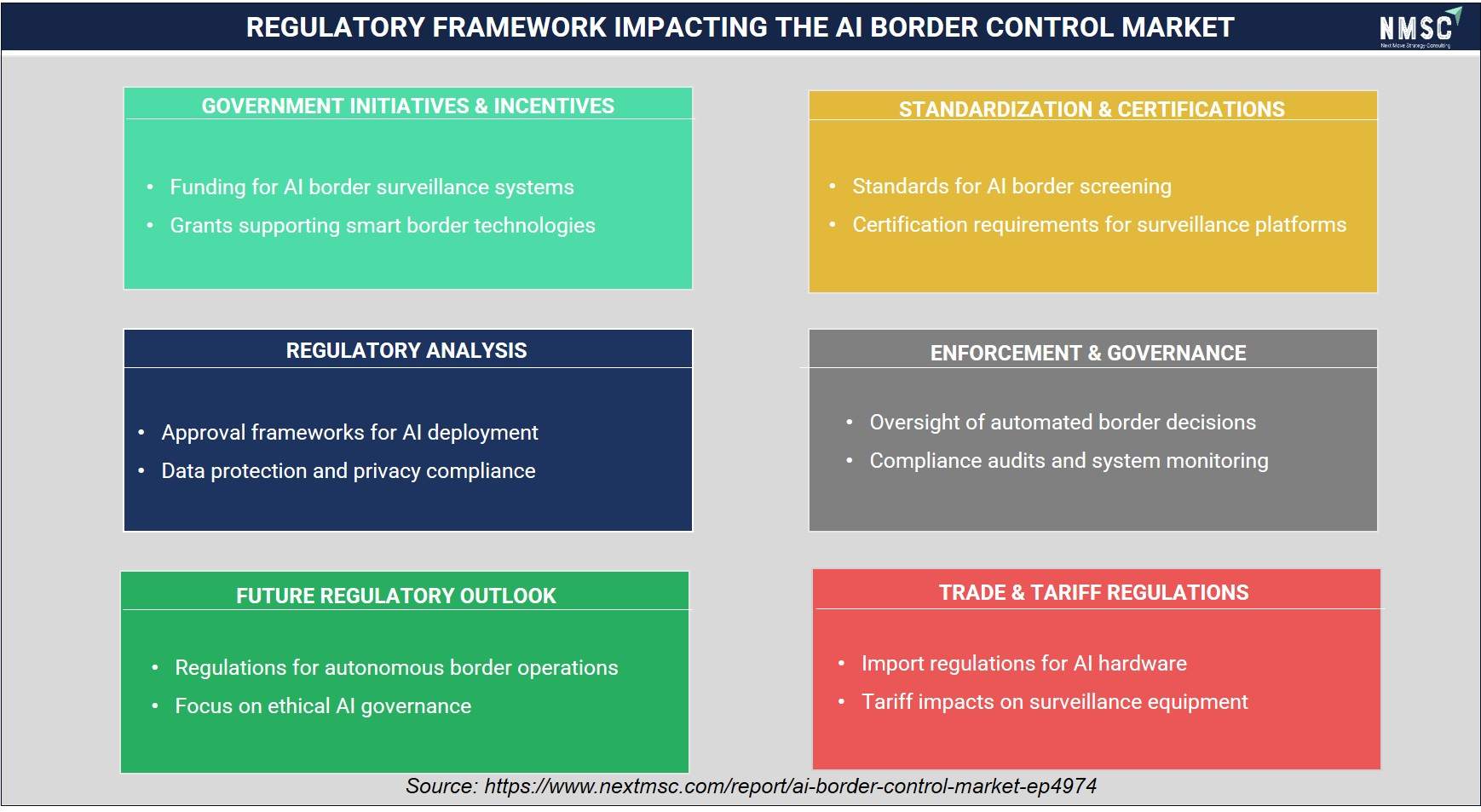
Based on our comprehensive assessment, we found that the AI border control market operates within a stringent regulatory environment emphasizing security, privacy, and ethical AI deployment. Governments support adoption through funding programs and smart border initiatives, while certification standards govern system reliability and biometric accuracy. Regulatory authorities enforce compliance audits and oversight mechanisms. Future regulations increasingly focus on autonomous border operations, transparency, accountability, and responsible AI governance.
Competitive Landscape
Competitive Dynamics and M&A Landscape
|
Key Takeaways |
Details |
|
Market Structure |
The AI Border Control Market features three competitive tiers: global identity technology leaders including Thales and IDEMIA competing on integrated platform breadth; specialized government IT system integrators including Leidos and CACI International competing on program management capability and federal procurement relationships; and niche technology innovators including iProov and Cognitec competing on AI algorithm accuracy and emerging modality specialization. |
|
Innovation Focus |
Innovation in the AI Border Control Market centers on AI-native multimodal biometric fusion, liveness detection anti-spoofing capabilities, cloud-native and edge-deployable border management platform architectures, behavioral analytics integration, and open-standard interoperability frameworks aligned with ICAO and W3C Decentralized Identity specifications that reduce proprietary lock-in for sovereign buyers. |
|
M&A Activity |
Market consolidation is advancing through strategic acquisitions targeting biometric algorithm capability, cloud platform integration, and government program capture. Thales's acquisition of IDEMIA's government business assets, NEC Corporation's international border technology portfolio expansion, and private equity-backed growth programs at iProov and Securiport reflect the ongoing industry consolidation trend driven by the need for integrated multi-modal AI border control platform capability. |
How Do Companies Compete in the AI Border Control Market?
The AI Border Control Market is characterized by multi-tier competitive dynamics that reward vendors able to demonstrate sovereign government-grade security certifications, long-standing border agency reference deployments, and the integration depth required for complex national border management programs. Global identity technology leaders including Thales and IDEMIA compete on comprehensive platform portfolios spanning identity verification, document authentication, eGate hardware, and integrated border management software. Government system integrators including Leidos, CACI International, and Indra compete on program management capability, security clearance holding, and established prime contractor relationships with national border agencies. Niche AI innovators including iProov and Cognitec compete by delivering superior biometric algorithm accuracy and liveness detection performance metrics that they license to platform integrators.
Which Kind of Companies Dominate the AI Border Control Market?
Three distinct categories of companies dominate the AI Border Control Market. First, global identity and security technology leaders including Thales, IDEMIA, NEC Corporation, and Veridos design and supply end-to-end biometric platform, eGate, and document verification solutions deployed under multi-year government framework contracts across all major regional markets. Second, government IT and defense system integrators including Leidos Holdings, CACI International, Leonardo, and Elbit Systems compete as prime contractors for national border modernization programs, bundling AI border platforms with program management, training, and lifecycle support services. Third, specialized AI and biometric technology companies including iProov, Cognitec Systems, Aware, and DERMALOG compete on the performance and compliance credentials of their underlying biometric and document verification algorithms.
AI-Native Differentiation and Open Standards Drive Market Success in the AI Border Control Market
Innovation leadership in the AI Border Control Market is determined by three converging capability dimensions. The first is AI algorithm performance, particularly facial recognition accuracy, liveness detection precision, and multimodal fusion adjudication speed under operationally challenging conditions including varying lighting, mask wearing, and aging differences between enrollment and verification images. The second is platform openness and interoperability, with vendors adopting ICAO standards, W3C Verifiable Credential specifications, and Open ID Connect protocols to reduce sovereign buyer lock-in concerns. The third is cloud and edge deployment flexibility, with vendors who can deploy identical AI logic across on-premises, sovereign cloud, and edge environments gaining significant competitive advantage in complex multi-site border agency programs.
Market Players to Opt for Merger and Acquisition Strategies to Expand Their Presence in the AI Border Control Market
Strategic consolidation is reshaping the AI Border Control Market as leading vendors pursue acquisitions to close capability gaps in AI algorithm performance, cloud platform architecture, and geographic coverage. Thales's global identity and security division has historically pursued acquisition-led expansion strategies, including acquisitions of Gemalto and complementary biometric technology companies, to build a comprehensive AI border control portfolio. NEC Corporation has expanded its APAC-focused border technology business through organic investment in its NeoFace facial recognition platform and selective technology licensing partnerships. SITA's acquisition strategy targets air border processing platform capabilities that complement its airline IT network infrastructure, creating integrated end-to-end traveler processing solutions. Consolidation around liveness detection specialists and behavioral analytics vendors is expected through 2027.
Who Are the Key Market Players in the AI Border Control Market?
-
Thales S.A.
-
NEC Corporation
-
IDEMIA France SAS
-
Amadeus IT Group, S.A.
-
Société Internationale de Télécommunications Aéronautiques (SITA)
-
Veridos GmbH
-
secunet Security Networks AG
-
Indra Sistemas, S.A.
-
HID Global Corporation
-
DERMALOG Identification Systems GmbH
-
Atos SE
-
Entrust Corporation
-
Leonardo S.p.A.
-
Elbit Systems Ltd.
-
Leidos Holdings, Inc.
-
CACI International Inc.
-
iProov Limited
-
Cognitec Systems GmbH
-
Aware, Inc.
-
Securiport LLC
What Are the Latest Developments in the AI Border Control Industry?
|
Date |
Event |
|
January 2026 |
As part of a USD 3 billion modernization project, Ninoy Aquino International Airport (NAIA) began rolling out 78 Amadeus-powered biometric eGates. This technology leverages the Amadeus Seamless Journey Platform to automate immigration, allowing passengers to complete identity verification in under 20 seconds and significantly reducing long-standing terminal bottlenecks. |
|
January 2026 |
ITA partnered with Jorge Chávez International Airport in Lima, Peru, to introduce a fully automated immigration system in its new terminal. The implementation includes 19 automated border control (ABC) eGates and 21 self-service kiosks, utilizing AI to verify passenger identity and manage entry/exit protocols, significantly increasing terminal throughput. |
Expert Insights
 “At the same time, biometrics and AI tech are simplifying the travel experience, helping the industry meet growing demand, and build resilience for the future.”
— David Lavorel, CEO, SITA
Statement made while discussing the increasing adoption of digital technologies across the aviation ecosystem and the role of AI and biometrics in improving passenger processing and operational efficiency.
Market Interpretation
The comment highlights the growing integration of artificial intelligence and biometric technologies in border management systems to address rising international travel volumes while maintaining security and operational efficiency. AI-powered border control solutions are increasingly being deployed to automate identity verification, accelerate passenger screening, and strengthen threat detection capabilities. As governments and airport authorities continue investing in digital border infrastructure, the adoption of AI-enabled biometric systems is expanding to improve throughput, enhance traveler experiences, and support more resilient and secure border operations.
What Are the Investment Opportunities in the AI Border Control Market?
Capital Inflows and Venture Activity
The AI Border Control Market is attracting growing volumes of private equity, venture capital, and strategic corporate investment, reflecting its status as a high-growth, government-backed sector with long contract cycles and high switching costs. iProov Limited has secured multiple funding rounds from investors including GV (formerly Google Ventures) and Permira, reflecting investor confidence in the commercial potential of AI-powered liveness detection technology within government identity programs. The U.S. Department of Homeland Security Science and Technology Directorate regularly publishes SBIR and STIR funding opportunities for AI border security technology development, providing non-dilutive capital pathways for early-stage border technology innovators. Our assessment indicates that investor activity is particularly concentrated in AI algorithm performance, digital identity interoperability, and cloud-native border management platform categories.
Infrastructure Investment
Public infrastructure investment in AI border control is occurring at historically elevated levels globally, creating durable and non-cyclical demand for the AI Border Control Market. The U.S. CBP's multi-year capital program for biometric exit deployment at air, land, and sea ports of entry is documented in annual DHS budget justifications submitted to the U.S. Congress, confirming hundreds of millions of dollars in annual appropriations. The European Union's EU Internal Security Fund and Border Management instrument allocate multi-year co-financing to member state border technology modernization programs. The African Development Bank and Inter-American Development Bank have both included border digitalization within regional digital infrastructure financing frameworks, extending government-backed procurement into developing market contexts where private investment alone is insufficient.
ESG Considerations
Environmental, Social, and Governance considerations are increasingly influencing procurement criteria within the AI Border Control Market. On the environmental dimension, border agencies and airport operators are specifying energy-efficient eGate designs and low-power-consumption surveillance systems within new procurement frameworks. Socially, the deployment of biometric border systems raises important considerations around algorithmic fairness, demographic accuracy parity, and privacy-by-design compliance that are now incorporated into GDPR's Article 22 requirements and NIST's AI Risk Management Framework guidelines. Through our market assessment, we observed that vendors who proactively address AI fairness certification, transparent algorithm auditing, and individual rights compliance frameworks within their product documentation are achieving material procurement advantages in EU member state and UK government contract competitions.
Digital Transformation and Emerging Market Opportunities
Digital transformation programs funded by international development organizations are creating new AI Border Control Market opportunities in emerging economies across Africa, Southeast Asia, and Latin America. The International Organization for Migration, the United Nations Development Programme, and the World Bank have collectively funded biometric border modernization projects in over 40 developing countries as documented in IOM and UNDP program registries. These programs typically create initial demand for entry-level biometric enrollment systems, document verification devices, and mobile border inspection solutions, followed by technology upgrade cycles that generate recurring revenue opportunities for vendors who establish early-stage deployment relationships. The long-term digital transformation potential of these markets represents a structurally significant growth opportunity for AI border control vendors with modular, cost-scalable platform architectures.
PE/VC Activity and Consolidation Dynamics
Private equity interest in the AI Border Control Market is intensifying as the sector's combination of government contract backlog visibility, high renewal rates, and growing AI software revenue creates attractive financial characteristics for buyout and growth equity strategies. Vista Equity Partners, Permira, and Apax Partners have each historically held positions in adjacent government identity technology businesses, and the AI border control sector represents a natural extension of their government technology investment theses. NMSC's analysis indicates that platform consolidation through PE-backed roll-up strategies targeting mid-market AI border technology vendors, particularly in the behavioral analytics, eVisa processing, and cloud border management segments, is a likely trend over the 2025 to 2028 period as market fragmentation creates actionable consolidation opportunities for financial sponsors with government sector expertise.
Key Benefits for Stakeholders
For Investors and Private Equity Firms
Investors, private equity sponsors, venture capital firms, and financial institutions gain access to a structured assessment of the AI Border Control Market’s growth trajectory, competitive landscape, and long-term revenue opportunities through 2035. Detailed market sizing, CAGR forecasts, segment-level analysis, and regional outlooks support investment screening, valuation modeling, and portfolio development activities. Competitive intelligence and technology trend analysis further provide visibility into emerging market leaders, acquisition opportunities, and high-growth segments across biometric identification, facial recognition, behavioral analytics, and automated border management systems.
For Existing Market Participants
Existing market participants benefit from comprehensive intelligence regarding competitive positioning, market share dynamics, technology adoption trends, and regional growth opportunities within the AI Border Control Market. The report supports strategic decision-making by identifying emerging demand patterns, procurement priorities, and evolving customer requirements across government agencies, airports, seaports, and land border checkpoints. Detailed analysis of market developments and competitive activity further assists organizations in refining go-to-market strategies, prioritizing expansion initiatives, and identifying opportunities for partnerships, acquisitions, and capability enhancement.
For New Entrants and Startups
New entrants and startup companies gain valuable insights into market structure, technology adoption trends, customer purchasing behavior, and competitive barriers across the AI Border Control Market. The report highlights high-growth technology categories, emerging application areas, and underserved market segments, enabling organizations to prioritize product development investments and market entry strategies. Regional analysis further supports the identification of attractive geographic opportunities and evolving procurement requirements across border security modernization programs.
For Government Border Agencies
Government border agencies, immigration authorities, customs organizations, and homeland security departments gain a structured understanding of global technology adoption patterns, regulatory influences, and best practices shaping the AI Border Control Market. The report provides detailed insights into biometric verification systems, automated border control solutions, risk assessment technologies, and traveler identity management platforms, supporting evidence-based procurement planning and border modernization initiatives. Comparative regional analysis further assists agencies in benchmarking technology deployment strategies and evaluating future investment priorities.
For Airport and Port Operators
Airport operators, seaport authorities, and transportation infrastructure organizations benefit from detailed analysis of deployment trends, operational use cases, and technology investment patterns across the AI Border Control Market. The report provides visibility into automation adoption rates, passenger processing technologies, and infrastructure modernization initiatives that support operational efficiency and traveler experience improvement. These insights help operators evaluate investment opportunities, benchmark technology adoption against industry peers, and develop long-term border processing modernization strategies.
For Technology Providers and System Integrators
Technology vendors, system integrators, and security solution providers gain actionable intelligence regarding procurement trends, customer demand dynamics, technology integration requirements, and regional growth opportunities within the AI Border Control Market. Detailed segmentation analysis enables organizations to identify high-potential customer segments, emerging solution requirements, and evolving platform integration opportunities. Regional and customer-type analysis further supports strategic planning, partnership development, and expansion into next-generation border management programs worldwide.
Key Market Segments
By Offering
-
Platforms
-
Identity Verification Platforms
-
Facial Recognition Platforms
-
Fingerprint Recognition Platforms
-
Iris Recognition Platforms
-
Multimodal Biometric Platforms
-
Liveness Detection Platforms
-
-
Document Verification Platforms
-
Passport Validation Platforms
-
ePassport Chip Validation Platforms
-
Document Fraud Detection Platforms
-
-
Travel Authorization Platforms
-
eVisa Platforms
-
ETA Platforms
-
Preclearance Platforms
-
-
Traveler Risk Platforms
-
API Analytics Platforms
-
PNR Analytics Platforms
-
Risk Scoring Platforms
-
Threat Detection Platforms
-
-
Border Management Platforms
-
Entry Exit Management Platforms
-
Watchlist Screening Platforms
-
Case Management Platforms
-
Workflow Orchestration Platforms
-
Interoperability Platforms
-
-
Surveillance Intelligence Platforms
-
Video Analytics Platforms
-
Perimeter Monitoring Platforms
-
Behavioral Analytics Platforms
-
Intrusion Detection Platforms
-
-
Other Platforms
-
-
Systems
-
Automated Border Control Gates
-
Full Height eGates
-
Half Height eGates
-
Accessible eGates
-
-
Self Service Border Kiosks
-
Enrollment Kiosks
-
Verification Kiosks
-
Multi-Function Kiosks
-
-
Document Verification Devices
-
Passport Readers
-
ePassport Readers
-
ID Scanners
-
-
Mobile Border Control Systems
-
Portable Biometric Systems
-
Mobile Inspection Systems
-
Remote Verification Devices
-
-
Border Surveillance Systems
-
Smart Camera Systems
-
Sensor Fusion Systems
-
Command and Control Systems
-
-
Other Systems
-
-
Services
-
Consulting Services
-
System Integration Services
-
Deployment Services
-
Managed Services
-
Maintenance Services
-
Training Services
-
Other Services
-
By Checkpoint Type
-
Airport
-
Land Border
-
Seaport and Ferry Terminal
-
Consulate and Visa Center
By Customer Type
-
Government Border and Immigration Agency
-
Airport Operator
-
Port Operator
-
System Integrator
-
Supranational Entity
By Sales Channel
-
Direct Sales
-
System Integrator and Prime Contractor
-
Reseller and Distributor
By Deployment Mode
-
On Premises
-
Cloud
-
Hybrid
-
Edge
By Revenue Stream
-
New Build
-
Expansion and Upgrade
-
Subscription
-
Support and Maintenance
By Region
-
North America: U.S., Canada, Mexico
-
Europe: UK, Germany, France, Italy, Spain, Sweden, Denmark, Finland, the Netherlands, Rest of Europe
-
Asia-Pacific: China, India, Japan, South Korea, Taiwan, Indonesia, Vietnam, Australia, Philippines, Malaysia, Rest of APAC
-
Middle East and Africa: Saudi Arabia, UAE, Egypt, Israel, Turkey, Nigeria, South Africa, Rest of MEA
-
Latin America: Brazil, Argentina, Chile, Colombia, Rest of LATAM
Conclusion and Recommendations
Long-Term Outlook
The AI Border Control Market is positioned for sustained and structurally supported long-term growth, driven by irreversible government investment in national security infrastructure, the global proliferation of biometric travel document standards, and the continued maturation of AI algorithm performance. NMSC's analysis indicates that the market will reach USD 20.3 billion by 2035, advancing at a CAGR of 17.1%, with software platform revenue growing proportionally faster than hardware as cloud-native border management and AI-powered risk analytics drive a shift in revenue composition toward higher-margin recurring subscription income streams.
Strategic Positioning
Vendors that successfully establish multimodal biometric platform breadth, sovereign cloud deployment capability, and certified interoperability with ICAO Doc 9303 and EU EES technical standards are best positioned to capture the market's highest-value government framework contracts. From our research, we found that AI algorithm accuracy, particularly in liveness detection and demographic parity performance, is increasingly becoming a contractual requirement in EU, U.S., and GCC border agency procurement specifications, creating a durable technology moat for vendors that invest in AI model quality ahead of competitive convergence at commodity performance levels.
Investment Attractiveness
The AI Border Control Market demonstrates strong investment attractiveness characteristics including long government contract cycles of five to ten years, high renewal rates due to switching costs in nationally deployed biometric infrastructure, growing software content within hardware-led programs creating margin expansion opportunity, and a regulatory tailwind from global biometric border mandates that creates non-discretionary demand. Our assessment indicates that the market's combination of government contract backlog visibility, geographic diversification across five regional growth markets, and increasing recurring revenue from subscription-based AI platforms supports premium valuation multiples relative to broader government IT market benchmarks.
Market Shifts and Key Risks
Three structural market shifts warrant strategic attention. First, the transition from on-premises to cloud and edge deployment is redistributing revenue from hardware-intensive system suppliers toward cloud platform software vendors. Second, the growing regulatory focus on AI fairness, liveness detection certification, and biometric data privacy compliance under the EU AI Act is increasing product development and certification costs for vendors serving European markets. Third, geopolitical fragmentation in technology procurement is creating market bifurcation between Western alliance country programs and non-aligned or Chinese-supplier-preferred procurement markets in parts of Africa and Southeast Asia.
Growth Pathways
Primary growth pathways for AI Border Control Market participants over the 2026 to 2035 forecast period include geographic expansion into GCC smart border programs and African biometric modernization markets, product portfolio extension from hardware to SaaS-based AI analytics and subscription-model border management platforms, strategic consolidation through the acquisition of specialized liveness detection, behavioral analytics, or cloud border management platform vendors, and the development of open-standard interoperability frameworks that reduce sovereign buyer lock-in concerns and accelerate procurement approval timelines across multiple national markets simultaneously.
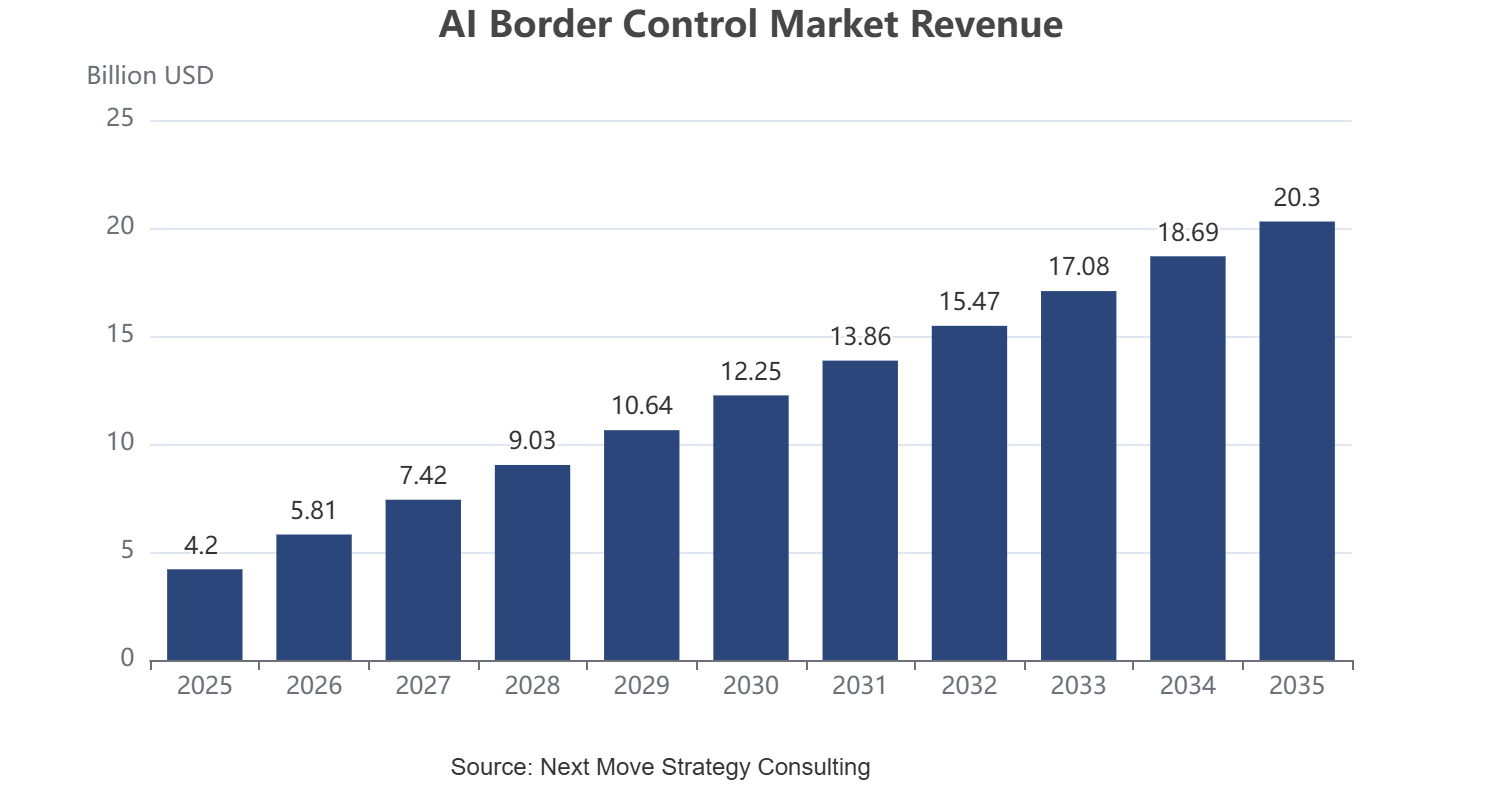
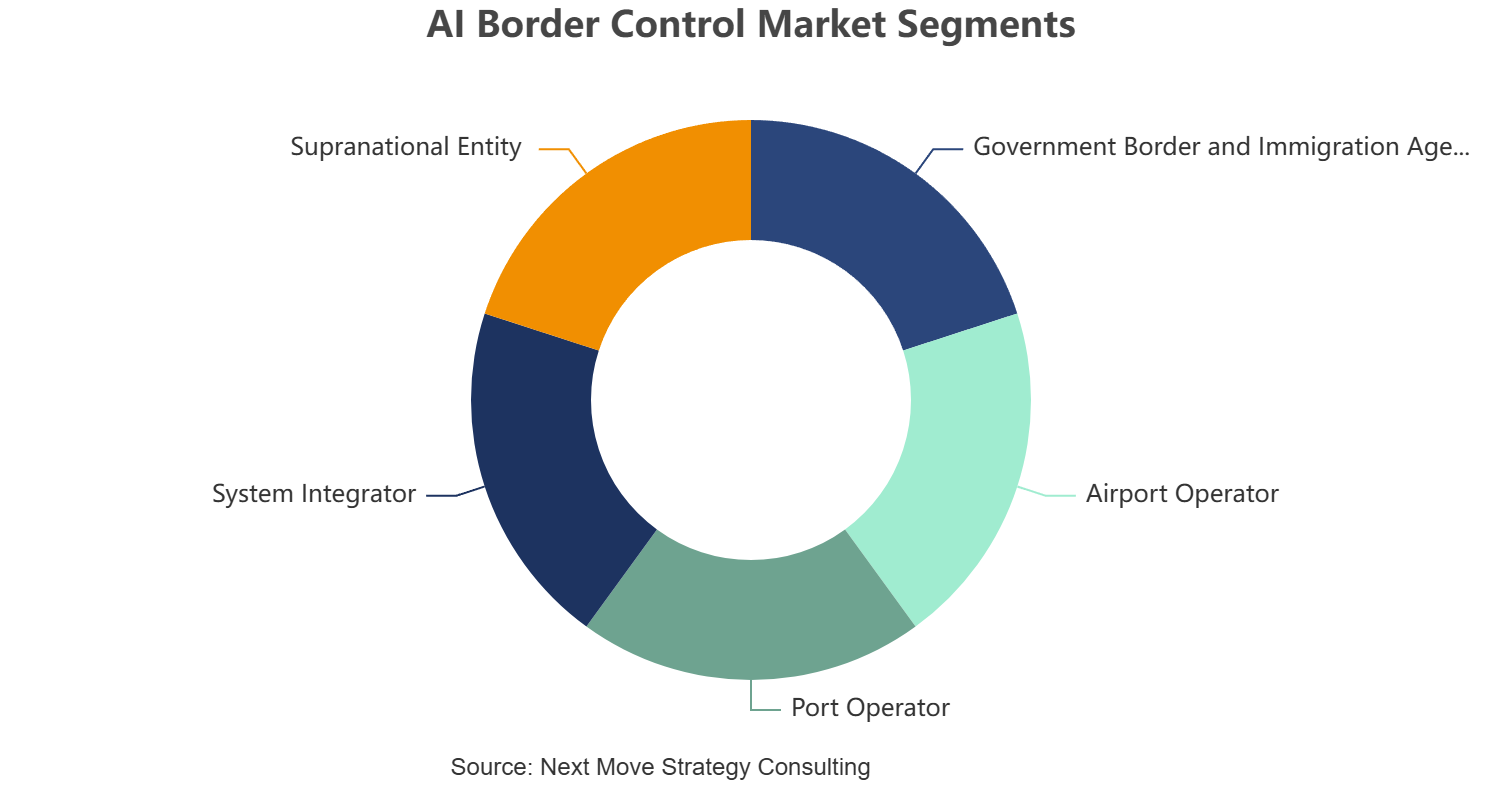
About the Author
 Mayurima Roy
— Mayurima Roy is Research Analyst at Next Move Strategy Consulting, where she has spent 4 years working across the firm's full industry coverage rather than a single fixed vertical. Her work centers on structured research, ongoing trend tracking, competitive assessment, and insight-led content development, translating complex market data into clear, decision-ready narratives that support informed client decision-making across diverse global industries, market sectors, and world regions every day.
Mayurima Roy
— Mayurima Roy is Research Analyst at Next Move Strategy Consulting, where she has spent 4 years working across the firm's full industry coverage rather than a single fixed vertical. Her work centers on structured research, ongoing trend tracking, competitive assessment, and insight-led content development, translating complex market data into clear, decision-ready narratives that support informed client decision-making across diverse global industries, market sectors, and world regions every day.
About the Reviewer
 Supradip Baul
— Supradip Baul is an accomplished business consultant and strategist with over a decade of rich experience in market intelligence, strategy, technology, and business transformation. His work has included rigorous qualitative and quantitative analysis across multiple industries, helping clients shape investment decisions and long-term roadmaps. Earlier in his career, he was associated with Gartner, where he contributed to industry-leading reports and market share analyses. He has worked with leading global companies and holds an MBA with a dual specialization in Marketing and Finance.
Supradip Baul
— Supradip Baul is an accomplished business consultant and strategist with over a decade of rich experience in market intelligence, strategy, technology, and business transformation. His work has included rigorous qualitative and quantitative analysis across multiple industries, helping clients shape investment decisions and long-term roadmaps. Earlier in his career, he was associated with Gartner, where he contributed to industry-leading reports and market share analyses. He has worked with leading global companies and holds an MBA with a dual specialization in Marketing and Finance.
At Next Move Strategy Consulting, we understand that insightful market research is the cornerstone of successful business decisions. That's why we employ a robust and multifaceted approach, combining various methodologies to deliver the most accurate and actionable data for our clients.

Research Landscape
We navigate the world of research with two primary approaches:
Qualitative Approach
Our qualitative research methodologies involve immersive techniques such as in-depth interviews, focus groups, and observational studies. By engaging directly with individuals and stakeholders, we uncover valuable insights that quantitative data alone may overlook.

Quantitative Research
In tandem with qualitative methodologies, NMSC leverages the power of Quantitative Research to provide a robust foundation of numerical insights. Through systematic data collection and analysis, we quantify patterns, preferences, and market trends, offering a comprehensive view of the business landscape.
Our quantitative research approach employs diverse tools, including surveys, experiments, and statistical modelling. These methodologies enable us to gather data from a large and representative sample, ensuring the statistical significance of our findings. By employing structured questionnaires and standardized data collection methods, we guarantee the reliability and validity of the information we present to our clients.
Quantitative research is particularly effective in measuring the prevalence of trends, assessing market size, and gauging the impact of various factors on consumer behavior. The numerical precision attained through this approach equips our clients with actionable insights, facilitating data-driven decision-making and strategy formulation.


Our Specialized Toolbox for Industry-Specific Market Research
We deploy a specialized arsenal of techniques tailored to meet your unique requirements. Here's a glimpse into our comprehensive toolbox:

Information Procurement
The stage entails acquiring market data or relevant information through various sources and methodologies.


Market Research Approach
We utilize both top-down and bottom-up approaches in market research analysis to achieve a comprehensive understanding of the market dynamics, leveraging the broad perspective of industry trends and macroeconomic factors alongside detailed insights from specific segments and individual companies.

Porters Five Forces Analysis
We conduct Porter's Five Forces analysis to evaluate the competitive landscape of an industry, providing us with insights into factors that affect profitability and strategic positioning.

SWOT Analysis

Forecasting
We utilize a forecasting model to predict future consumption by considering parameters like population, economics, regulations, market competition, drivers, constraints, technology, and pricing. We also employ statistical techniques such as multilinear regression, exponential smoothing, moving average, ARIMA, and Monte Carlo simulations for accurate predictions. In econometric forecasting, we analyzed short-term and long-term event impacts, attributing values based on regulatory frameworks, economic factors, and market events.





 Speak to Our Analyst