Version Control Market Size, Share, Trends and Growth Analysis, By Product Type (DVCS, CVCS, Hybrid VCS), By Deployment Model (Cloud, On-Premises, Hybrid), By Revenue Model, By Repository Visibility, By Repository Architecture, By Distribution Channel, By Organization Size, By End User (IT, BFSI, Healthcare, Government, Manufacturing, Telecommunications, Retail, Media, Education, Energy, Automotive, Other), and Global Forecast, 2026-2035
Industry: ICT & Media | Publishing Date: July 13, 2026 | Last Updated: September 30, 2026 | No of Pages: N/A | No. of Tables: N/A | No. of Figures: N/A | Format: PDF | Report Code: IC5116
What Is the Version Control Market Size?
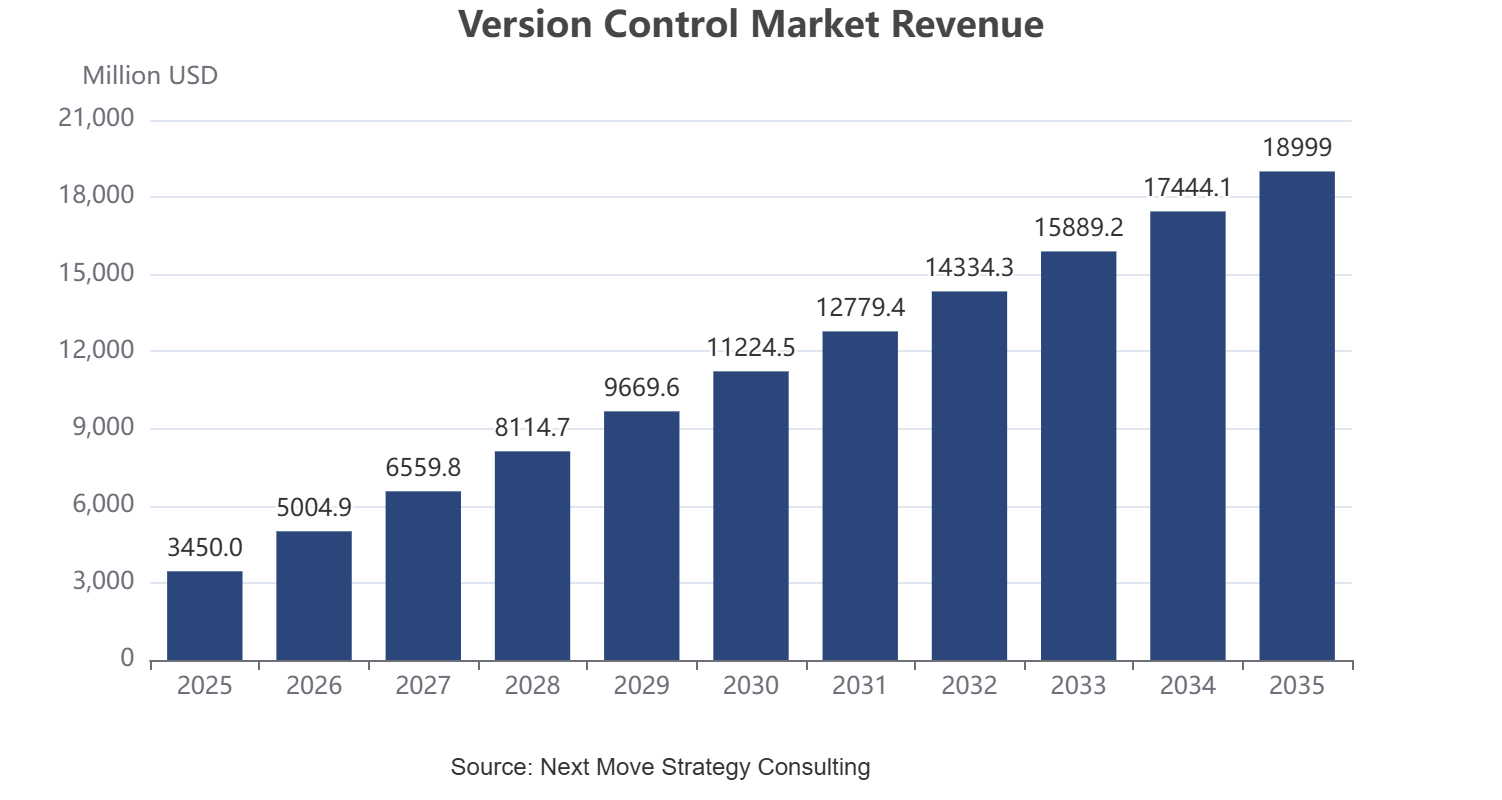
The Version Control Market encompasses software platforms and services that track, manage, and coordinate changes to source code and digital assets across distributed and centralized repositories. The Version Control Market size reached USD 3,450.0 Million in 2025 and USD 4,090.0 Million in 2026, and is projected to advance to USD 18,999 Million by 2035, registering a CAGR of 18.6% from 2026 to 2035. Growth is driven by rising DevOps adoption, cloud-native software delivery, AI-assisted coding workflows, and enterprise modernization of legacy repositories.
|
Parameter |
Details |
|
Market Size in 2025 |
USD 3.45 Billion |
|
Market Size in 2026 |
USD 4.09 Billion |
|
Revenue Forecast in 2035 |
USD 19.00 Billion |
|
Growth Rate |
CAGR of 18.6% from 2026 to 2035 |
|
Analysis Period |
2025–2035 |
|
Base Year Considered |
2025 |
|
Forecast Period |
2026–2035 |
|
Market Size Estimation |
USD Million |
|
Companies Profiled |
20 |
|
Countries Covered |
38 |
|
Market Share |
Available for Top 10 Companies |
Version Control Market Overview
The Version Control Market comprises software platforms and related services that manage, track, and audit changes to source code, configuration files, and digital assets across centralized and distributed development environments. The market has evolved from traditional centralized repositories to Git-based, cloud-native platforms integrating code hosting, collaboration, issue tracking, security, and CI/CD capabilities to support modern DevOps workflows. Regulatory frameworks such as the European Union's General Data Protection Regulation (GDPR), data sovereignty regulations, and industry-specific compliance requirements in sectors including BFSI, healthcare, and government continue to influence market growth by driving demand for secure repositories, audit trails, access controls, and regional data hosting.
|
Key Takeaways |
|
By product type, DVCS – Git-Based – Cloud-Hosted held the largest share of the Version Control Market at USD 1.17 billion in 2025 and is projected to reach USD 9.69 billion by 2035, driven by its widespread adoption for collaborative software development and cloud-native DevOps workflows. DVCS – Git-Based – Cloud-Hosted is also the fastest-growing segment, expanding at a CAGR of 23.5% from 2026 to 2035. |
|
By deployment model, Cloud – Public Cloud dominated the market with USD 1.45 billion in 2025 and is forecast to reach USD 10.52 billion by 2035, supported by enterprise migration to cloud-based development environments and scalable repository management. Cloud – Public Cloud is also the fastest-growing deployment model, registering a CAGR of 21.9% during 2026–2035. |
|
By revenue model, Subscription – SaaS accounted for the largest revenue at USD 1.31 billion in 2025 and is expected to reach USD 11.18 billion by 2035, reflecting strong enterprise preference for recurring cloud-based software delivery. Marketplace is the fastest-growing revenue model, expanding at a CAGR of 24.8% from 2026 to 2035. |
|
By repository visibility, Private repositories led the market with USD 2.17 billion in 2025 and are projected to reach USD 11.01 billion by 2035, driven by increasing enterprise demand for secure source code management and intellectual property protection. Mixed repository visibility is the fastest-growing segment, registering a CAGR of 22.2% during 2026–2035. |
|
By repository architecture, Multi-Repository accounted for the largest market share at USD 1.55 billion in 2025 and is anticipated to reach USD 7.93 billion by 2035, supported by its flexibility in managing distributed software projects. Monorepository is the fastest-growing architecture, expanding at a CAGR of 25.0% from 2026 to 2035. |
|
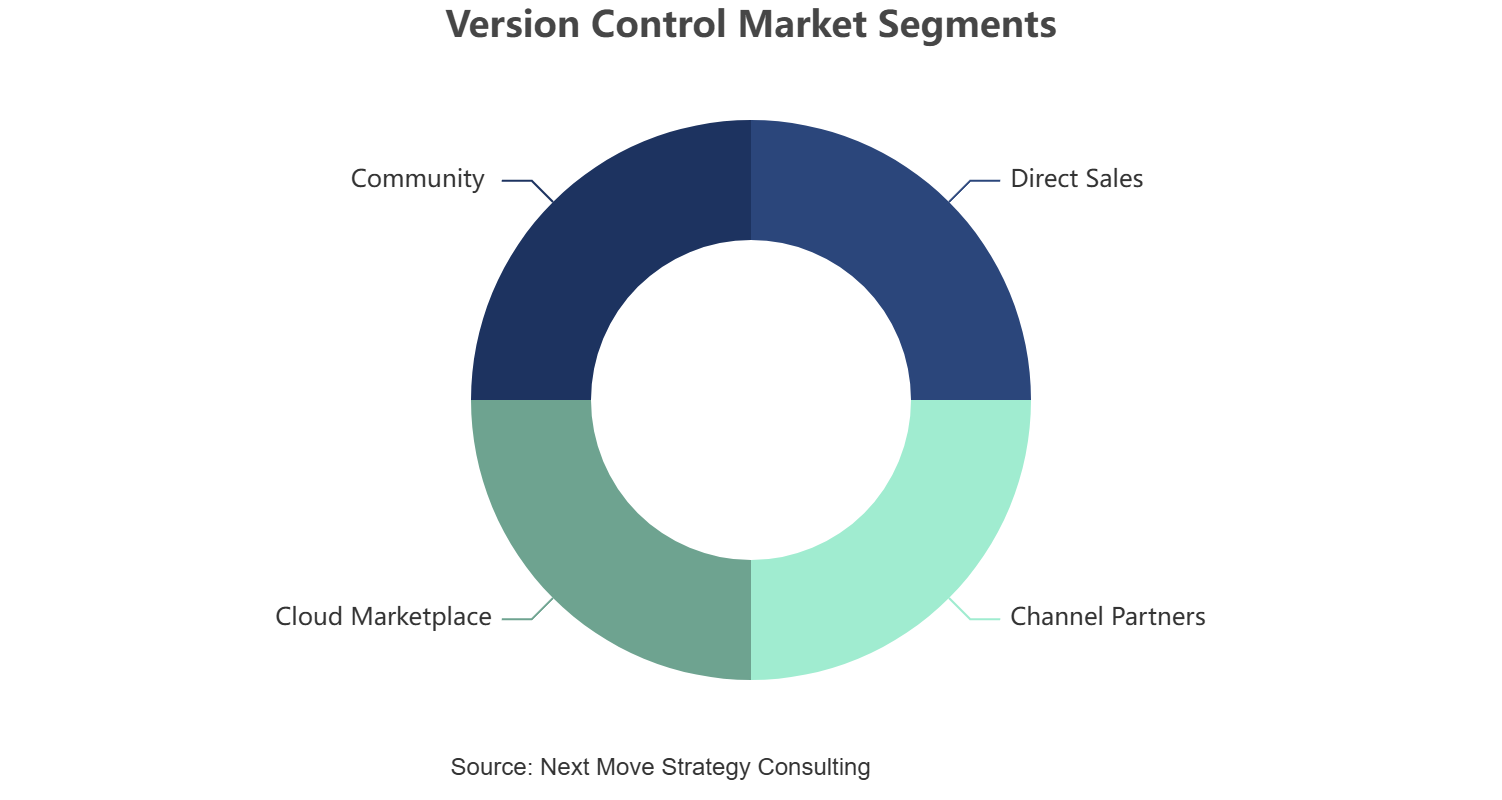
By distribution channel, Direct Sales generated the highest revenue of USD 1.52 billion in 2025 and is projected to reach USD 6.49 billion by 2035, supported by enterprise licensing agreements and strategic vendor partnerships. Cloud Marketplace is the fastest-growing distribution channel, registering a CAGR of 25.7% during 2026–2035. |
|
By organization size, Large Enterprise dominated the market with USD 1.66 billion in 2025 and is forecast to reach USD 7.13 billion by 2035, driven by large-scale software development initiatives and DevOps adoption. Small Enterprise is the fastest-growing organization segment, expanding at a CAGR of 23.0% from 2026 to 2035. |
|
By end user, the IT sector held the largest share at USD 0.83 billion in 2025 and is projected to reach USD 4.94 billion by 2035, supported by increasing software development activity and continuous integration practices. Automotive is the fastest-growing end-user segment, registering a CAGR of 23.3% during 2026–2035. |
|
North America held the largest regional share at USD 1.31 billion in 2025 and is projected to reach USD 6.02 billion by 2035, driven by the presence of leading software vendors, mature DevOps adoption, and strong cloud infrastructure. |
|
Asia-Pacific is expected to be the fastest-growing region, registering a CAGR of 23.7% from 2026 to 2035, supported by rapid digital transformation, expanding developer communities, and increasing enterprise investments in cloud-native software development. |
|
The United States dominated the market in 2025, generating USD 0.92 billion and is projected to reach USD 3.80 billion by 2035, supported by the strong presence of global software companies, widespread Git adoption, and continued investment in DevOps platforms. |
|
India is projected to be the fastest-growing country, expanding at a CAGR of 27.6% from 2026 to 2035, driven by a rapidly growing software developer base, increasing cloud adoption, and expanding digital transformation initiatives across enterprises. |
Key Emerging Trends in the Version Control Market
How Is AI Transforming Code Review and Merge Workflows?
AI-assisted merge-conflict resolution and automated code review are being embedded directly into cloud-hosted version control platforms. GitLab and Microsoft-owned GitHub have both introduced AI-driven review assistants within their official product lines, reducing manual reconciliation effort for distributed engineering teams and shortening release cycles across enterprise DevOps pipelines.
Why Are Monorepositories Gaining Enterprise Traction in the Version Control Market?
Based on NMSC's research, we found that large technology firms are consolidating multiple codebases into a single monorepository to simplify dependency management and enforce consistent build tooling. This shift is measurable in rising demand for scalable repository indexing and search capabilities among organizations exceeding ten thousand active developer seats.
How Is Regulatory Pressure Changing Deployment Choices?
Data sovereignty requirements are pushing regulated BFSI, healthcare, and government buyers toward private cloud and on-premises version control deployment, even as broader market volume shifts to public cloud. Vendors, including Perforce and OpenText, have expanded dedicated-cloud and self-managed offerings in direct response to this regulatory pressure.
What Are the Key Market Drivers, Breakthroughs, and Investment Opportunities that will Shape the Version Control Market in the Next Decade?
|
Driver / Trend / Restraint |
(+/-) % Impact on CAGR Forecast |
Geographic Relevance |
Impact Timeline |
|
Accelerating Enterprise Cloud Migration Driving Adoption of Managed Version Control Platforms |
+2.7% |
Global (led by North America and Europe) |
2025–2033 |
|
AI Integration Enhancing Platform Capabilities and Subscription Value |
+2.3% |
North America, Europe, Asia-Pacific |
2025–2035 |
|
High Cost and Operational Complexity of Migrating Legacy Version Control Systems |
−1.3% |
Global (particularly large enterprises) |
2025–2031 |
|
Expanding Developer Ecosystems Across Emerging Markets Creating New Customer Demand |
+1.8% |
Asia-Pacific, Latin America, Africa |
2026–2035 |
What Are the Growth Drivers of the Version Control Market?
How Does Cloud Migration Support Growth in the Version Control Market?
Enterprises migrating development infrastructure to public and private cloud environments are replacing self-hosted repository servers with managed, subscription-based version control platforms. This migration reduces internal infrastructure overhead while improving scalability, directly supporting recurring subscription revenue growth across the forecast period.
How Does AI Integration Expand the Addressable Market?
Embedding AI-assisted review, automated testing hooks, and intelligent conflict resolution into version control platforms is expanding vendor revenue per seat and encouraging upgrade cycles among organizations still operating legacy systems, reinforcing the market's premium subscription and marketplace revenue models.
What Are the Growth Inhibitors of the Version Control Market?
Why Does Legacy Migration Cost Restrain Growth?
Organizations operating deeply embedded mainframe and enterprise CVCS systems face substantial cost and operational risk in migrating decades of version history and integrated tooling to modern platforms, slowing the displacement of legacy systems even as newer platforms gain share of new deployments.
What Are the Growth Opportunities in the Version Control Market?
What Opportunity Exists in Emerging Developer Hubs?
Our findings suggest that expanding developer workforces in India, Vietnam, Indonesia, Brazil, and Nigeria represent a substantial untapped opportunity for cloud-hosted version control vendors, particularly through channel partnerships and localized cloud marketplace distribution suited to fast-growing outsourced software development sectors.
How Is the Version Control Market Segmented in This Report, and What Are the Key Insights from the Segmentation Analysis?
Which Segment Leads the Deployment Model Market?
|
Segment |
2025 (USD) |
2035 (USD) |
CAGR% (2026-2035) |
|
Cloud |
2.21 |
14.51 |
20.7% |
|
On-Premises |
0.76 |
1.47 |
6.8% |
|
Hybrid |
0.48 |
3.02 |
20.1% |
Our analysis indicates that the Cloud segment leads the Deployment Model market, accounting for USD 2,208.0 Million in 2025, driven by widespread enterprise migration to cloud-based development environments and increasing adoption of Software-as-a-Service (SaaS) version control platforms. The Cloud segment is also projected to register the fastest growth, expanding at a 20.7% CAGR from 2026 to 2035, supported by continued cloud transformation initiatives, growing distributed development teams, and increasing demand for scalable, AI-enabled repository management solutions.
Which Segment Leads the Revenue Model Market?
|
Segment |
2025 (USD) |
2035 (USD) |
CAGR% (2026-2035) |
|
Subscription |
1.79 |
13.24 |
22.1% |
|
Perpetual License |
0.41 |
0.59 |
3.6% |
|
Maintenance |
0.38 |
0.71 |
6.4% |
|
Professional Services |
0.72 |
3.20 |
16.0% |
|
Marketplace |
0.14 |
1.27 |
24.8% |
From our research, we found that the subscription segment leads the Revenue Model in the Version Control market, accounting for USD 1,794.0 Million in 2025, supported by the widespread adoption of recurring subscription-based licensing, particularly across cloud-hosted version control platforms. The Subscription segment is also projected to register the fastest growth among the major revenue models, expanding at a 22.1% CAGR from 2026 to 2035, driven by increasing enterprise preference for scalable, continuously updated software offerings and predictable operating expenditure models.
Which Segment Leads By End User in the Version Control Market?
|
Segment |
2025 (USD) |
2035 (USD) |
CAGR% (2026-2035) |
|
IT |
0.83 |
4.94 |
19.6% |
|
BFSI |
0.45 |
1.81 |
14.9% |
|
Healthcare |
0.28 |
2.07 |
22.3% |
|
Government |
0.24 |
0.83 |
13.1% |
|
Manufacturing |
0.31 |
1.59 |
17.7% |
|
Telecommunications |
0.28 |
1.20 |
15.9% |
|
Retail |
0.28 |
1.78 |
20.5% |
|
Media |
0.21 |
1.44 |
21.4% |
|
Education |
0.17 |
0.95 |
18.6% |
|
Energy |
0.17 |
0.64 |
14.0% |
|
Automotive |
0.17 |
1.40 |
23.3% |
|
Other |
0.07 |
0.35 |
17.7% |
Through NMSC's assessment, we found that IT segment leads the End User market, accounting for USD 828.0 Million in 2025, driven by the widespread adoption of version control platforms across software development, DevOps, and cloud engineering teams. However, the Automotive segment is projected to register the fastest growth, expanding at a 23.3% CAGR from 2026 to 2035, supported by increasing software-defined vehicle development, embedded systems engineering, and growing reliance on collaborative code management throughout automotive product lifecycles.
Porter’s Five Forces Analysis of the Version Control Market
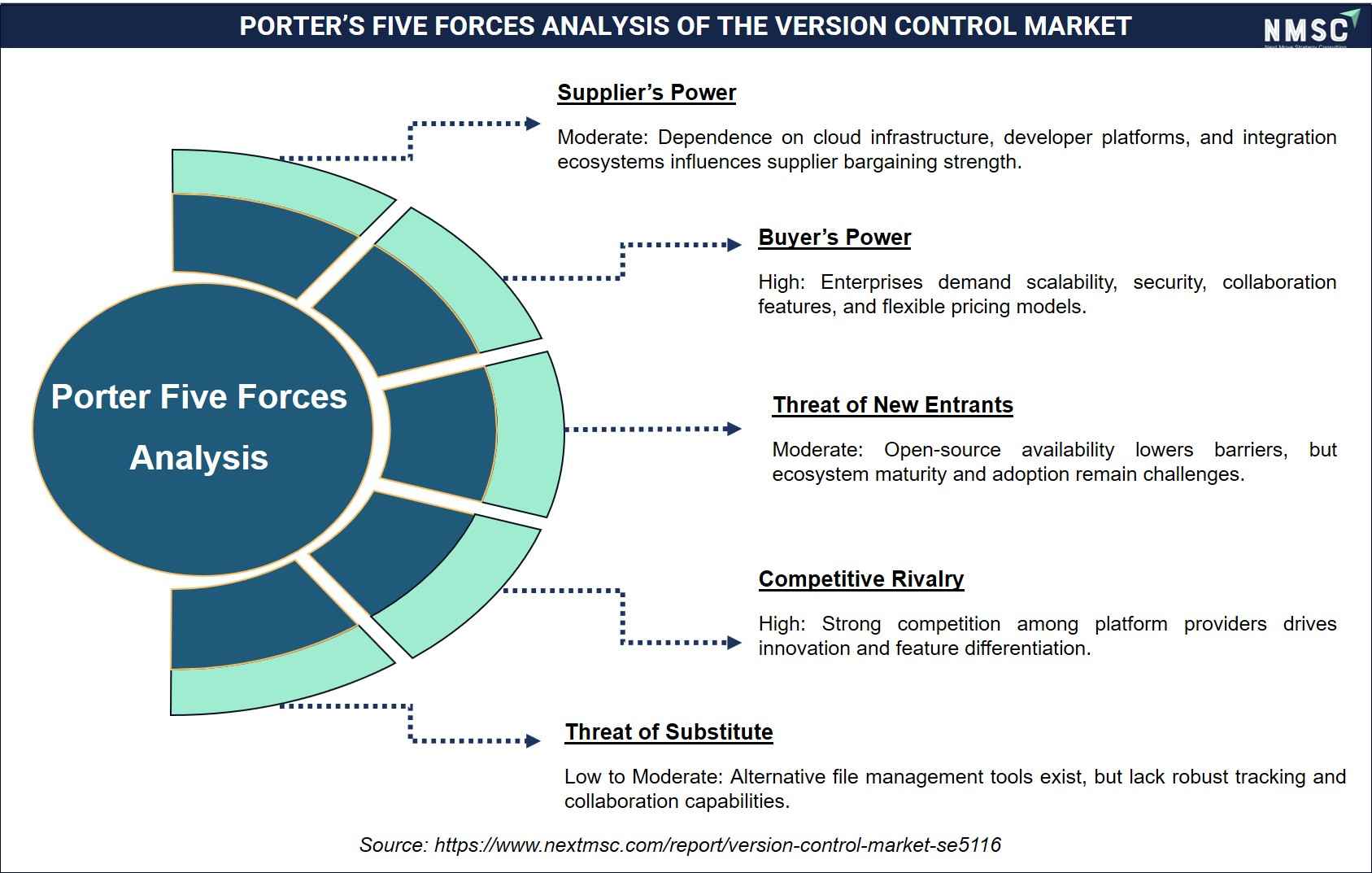
The Porter's Five Forces analysis of the version control market above maps the key competitive forces, such as the threat of new entrants, the bargaining power of suppliers, the bargaining power of buyers, the threat of substitutes, and industry rivalry, shaping the version control tools market. From our analysis, we observed that the threat of substitutes is notably high, as open-source alternatives and emerging collaborative platforms offer cost-effective solutions, compelling established players to continuously innovate and strengthen their ecosystem integrations to retain their user base and maintain competitive differentiation.
Regional Outlook
|
Region |
2025 (USD) |
2035 (USD) |
CAGR% (2026-2035) |
Key Driver |
|
North America |
1.31 |
6.02 |
16.5% |
Enterprise DevOps and hyperscaler concentration |
|
Europe |
0.90 |
3.52 |
14.7% |
Regulatory-driven sovereign cloud demand |
|
Asia-Pacific |
0.83 |
6.96 |
23.7% |
Expanding developer workforce and government digitization |
|
Middle East & Africa |
0.21 |
1.39 |
21.0% |
National digital transformation programs |
|
Latin America |
0.21 |
1.11 |
18.3% |
Nearshore software delivery growth |
North America
North America is the most mature version control market, anchored by a dense concentration of hyperscale cloud providers, established DevOps practices, and enterprise-grade compliance tooling. Regulatory clarity and deep venture-capital funding for developer tools support steady adoption, while strategic outlook favors continued consolidation of point tools into unified developer platforms.
U.S.
Based on our engagements, the U.S. held approximately USD 917.7 Million of the Version Control Market in 2025, projected to reach USD 3,800.3 Million by 2035 at a 15.3% CAGR. Demand is shaped by deep hyperscaler and enterprise DevOps concentration, with adoption levels, regulatory influence on data handling, and technology penetration all supporting a consistent strategic outlook toward cloud-hosted and hybrid deployment models through the forecast period amid rising competitive intensity among global and regional vendors.
Canada
Through our analysis, Canada held approximately USD 183.5 Million of the Version Control Market in 2025, projected to reach USD 888.0 Million by 2035 at a 17.1% CAGR. Demand is shaped by federal cloud-first procurement policy, with adoption levels, regulatory influence on data handling, and technology penetration all supporting a consistent strategic outlook toward cloud-hosted and hybrid deployment models through the forecast period amid rising competitive intensity among global and regional vendors.
Europe
Europe's version control market is shaped by GDPR-driven data residency requirements that favor private cloud and sovereign hosting options. Regulatory maturity is high, technology adoption is steady rather than explosive, and strategic outlook favors vendors able to demonstrate compliant regional data handling across public-sector and BFSI accounts.
UK
Based on our engagements, the UK held approximately USD 179.4 Million of the Version Control Market in 2025, projected to reach USD 657.4 Million by 2035 at a 13.9% CAGR. Demand is shaped by fintech and public-sector digitization, with adoption levels, regulatory influence on data handling, and technology penetration all supporting a consistent strategic outlook toward cloud-hosted and hybrid deployment models through the forecast period amid rising competitive intensity among global and regional vendors.
Germany
Through our analysis, Germany held approximately USD 152.5 Million of the Version Control Market in 2025, projected to reach USD 516.2 Million by 2035 at a 13% CAGR. Demand is shaped by Mittelstand ERP and manufacturing software integration, with adoption levels, regulatory influence on data handling, and technology penetration all supporting a consistent strategic outlook toward cloud-hosted and hybrid deployment models through the forecast period amid rising competitive intensity among global and regional vendors.
France
From our assessment, France held approximately USD 98.7 Million of the Version Control Market in 2025, projected to reach USD 361.6 Million by 2035 at a 13.9% CAGR. Demand is shaped by state-backed sovereign cloud initiatives, with adoption levels, regulatory influence on data handling, and technology penetration all supporting a consistent strategic outlook toward cloud-hosted and hybrid deployment models through the forecast period amid rising competitive intensity among global and regional vendors.
Asia-Pacific
Asia-Pacific is the fastest-growing version control region, driven by expanding developer workforces in India, China, and Southeast Asia alongside aggressive government digitization spending. Regulatory environments vary widely by country, and strategic outlook favors vendors offering flexible deployment models suited to both hyperscale and cost-sensitive buyers.
China
From our assessment, China held approximately USD 198.7 Million of the Version Control Market in 2025, projected to reach USD 1,700.9 Million by 2035 at a 23.9% CAGR. Demand is shaped by domestic cloud platform substitution, with adoption levels, regulatory influence on data handling, and technology penetration all supporting a consistent strategic outlook toward cloud-hosted and hybrid deployment models through the forecast period amid rising competitive intensity among global and regional vendors.
India
According to our evaluation, India held approximately USD 165.6 Million of the Version Control Market in 2025, projected to reach USD 1,895.9 Million by 2035 at a 27.6% CAGR. Demand is shaped by large IT services developer workforce, with adoption levels, regulatory influence on data handling, and technology penetration all supporting a consistent strategic outlook toward cloud-hosted and hybrid deployment models through the forecast period amid rising competitive intensity among global and regional vendors.
Japan
Based on our engagements, Japan held approximately USD 115.9 Million of the Version Control Market in 2025, projected to reach USD 630.9 Million by 2035 at a 18.5% CAGR. Demand is shaped by legacy mainframe modernization programs, with adoption levels, regulatory influence on data handling, and technology penetration all supporting a consistent strategic outlook toward cloud-hosted and hybrid deployment models through the forecast period amid rising competitive intensity among global and regional vendors.
South Korea
Through our analysis, South Korea held approximately USD 66.2 Million of the Version Control Market in 2025, projected to reach USD 488.6 Million by 2035 at a 22.1% CAGR. Demand is shaped by government digital-government initiatives, with adoption levels, regulatory influence on data handling, and technology penetration all supporting a consistent strategic outlook toward cloud-hosted and hybrid deployment models through the forecast period amid rising competitive intensity among global and regional vendors.
Middle East & Africa
Middle East & Africa version control adoption is accelerating from a smaller base, propelled by national digital transformation programs in Saudi Arabia and the UAE and a growing cybersecurity and fintech developer base in Israel. Strategic outlook favors vendors partnering directly with government digitization initiatives.
Saudi Arabia
Through our analysis, Saudi Arabia held approximately USD 45.5 Million of the Version Control Market in 2025, projected to reach USD 383.2 Million by 2035 at a 23.7% CAGR. Demand is shaped by Vision 2030 digital transformation spending, with adoption levels, regulatory influence on data handling, and technology penetration all supporting a consistent strategic outlook toward cloud-hosted and hybrid deployment models through the forecast period amid rising competitive intensity among global and regional vendors.
UAE
From our assessment, UAE held approximately USD 41.4 Million of the Version Control Market in 2025, projected to reach USD 300.9 Million by 2035 at a 21.9% CAGR. Demand is shaped by government cloud-first mandates, with adoption levels, regulatory influence on data handling, and technology penetration all supporting a consistent strategic outlook toward cloud-hosted and hybrid deployment models through the forecast period amid rising competitive intensity among global and regional vendors.
South Africa
According to our evaluation, South Africa held approximately USD 14.5 Million of the Version Control Market in 2025, projected to reach USD 78.0 Million by 2035 at a 18.3% CAGR. Demand is shaped by regional financial-services IT hub, with adoption levels, regulatory influence on data handling, and technology penetration all supporting a consistent strategic outlook toward cloud-hosted and hybrid deployment models through the forecast period amid rising competitive intensity among global and regional vendors.
Latin America
Latin America's version control market benefits from nearshore software delivery growth serving North American enterprises, with Brazil anchoring regional demand. Regulatory environments are generally cloud-friendly, technology adoption is rising steadily, and strategic outlook favors vendors expanding channel partnerships across the region's outsourced development sector.
Brazil
Through our analysis, Brazil held approximately USD 78.7 Million of the Version Control Market in 2025, projected to reach USD 436.2 Million by 2035 at a 18.7% CAGR. Demand is shaped by largest regional fintech and e-commerce developer base, with adoption levels, regulatory influence on data handling, and technology penetration all supporting a consistent strategic outlook toward cloud-hosted and hybrid deployment models through the forecast period amid rising competitive intensity among global and regional vendors.
Argentina
From our assessment, Argentina held approximately USD 33.1 Million of the Version Control Market in 2025, projected to reach USD 170.3 Million by 2035 at a 17.8% CAGR. Demand is shaped by established outsourced software talent pool, with adoption levels, regulatory influence on data handling, and technology penetration all supporting a consistent strategic outlook toward cloud-hosted and hybrid deployment models through the forecast period amid rising competitive intensity among global and regional vendors.
Competitive Landscape
|
Category |
Key Takeaways |
|
Market Structure |
The version control market is moderately consolidated, with cloud-hosted DVCS platforms led by GitLab, Microsoft-owned GitHub, and Atlassian competing alongside enterprise CVCS specialists such as Perforce and Broadcom. |
|
Innovation Focus |
Vendors are concentrating investment on AI-assisted code review, monorepository scalability, and agentic developer workflows integrated directly into repository platforms. |
|
M&A Activity |
Consolidation continues around DevOps platform bundling, with larger vendors acquiring point-tool capabilities in security scanning, CI/CD, and AI code assistance. |
How Do Companies Compete in the Version Control Market?
Based on NMSC's research, we found that vendors compete primarily on platform breadth, bundling repository hosting with CI/CD pipelines, issue tracking, and AI-assisted review rather than competing purely on core version control functionality, which has become table stakes across the industry's leading platforms.
What Innovation and Differentiation Strategies Explain Dominance?
Dominant vendors differentiate through integrated AI code review, unified developer platform experiences spanning planning through deployment, and enterprise-grade access controls. GitLab and GitHub have both prioritized native AI integration as a primary differentiator against smaller, single-purpose repository vendors.
How Active Is M&A in the Version Control Market?
M&A activity centers on acquiring adjacent DevOps capabilities rather than direct version control assets, as most core version control technology is now mature. Vendors continue to expand geographically through channel partnerships and cloud marketplace listings to reach emerging developer hubs.
Key Market Players of the Version Control Market
-
Atlassian Corporation
-
Microsoft Corporation
-
Perforce Software, Inc.
-
Amazon Web Services, Inc.
-
Broadcom Inc.
-
OpenText Corporation
-
CloudBees, Inc.
-
Canonical Ltd.
-
JetBrains s.r.o.
-
Alibaba Cloud Computing Ltd.
-
RhodeCode Inc.
-
Assembla, Inc.
-
SourceGear, LLC
-
Codice Software S.L.
-
Dynamsoft Corporation
-
WANdisco plc
-
SmartBear Software Inc.
What Are the Latest Developments in the Version Control Market?
|
Date |
Event |
|
May 2025 |
GitLab introduced GitLab Duo Code Review in beta, enabling AI-powered reviews directly within merge requests. The feature automatically analyzes code changes, identifies potential issues, and provides contextual recommendations to improve code quality and streamline repository collaboration, reducing manual review effort across software development teams. |
Consumer Behavior Analysis of the Version Control Market
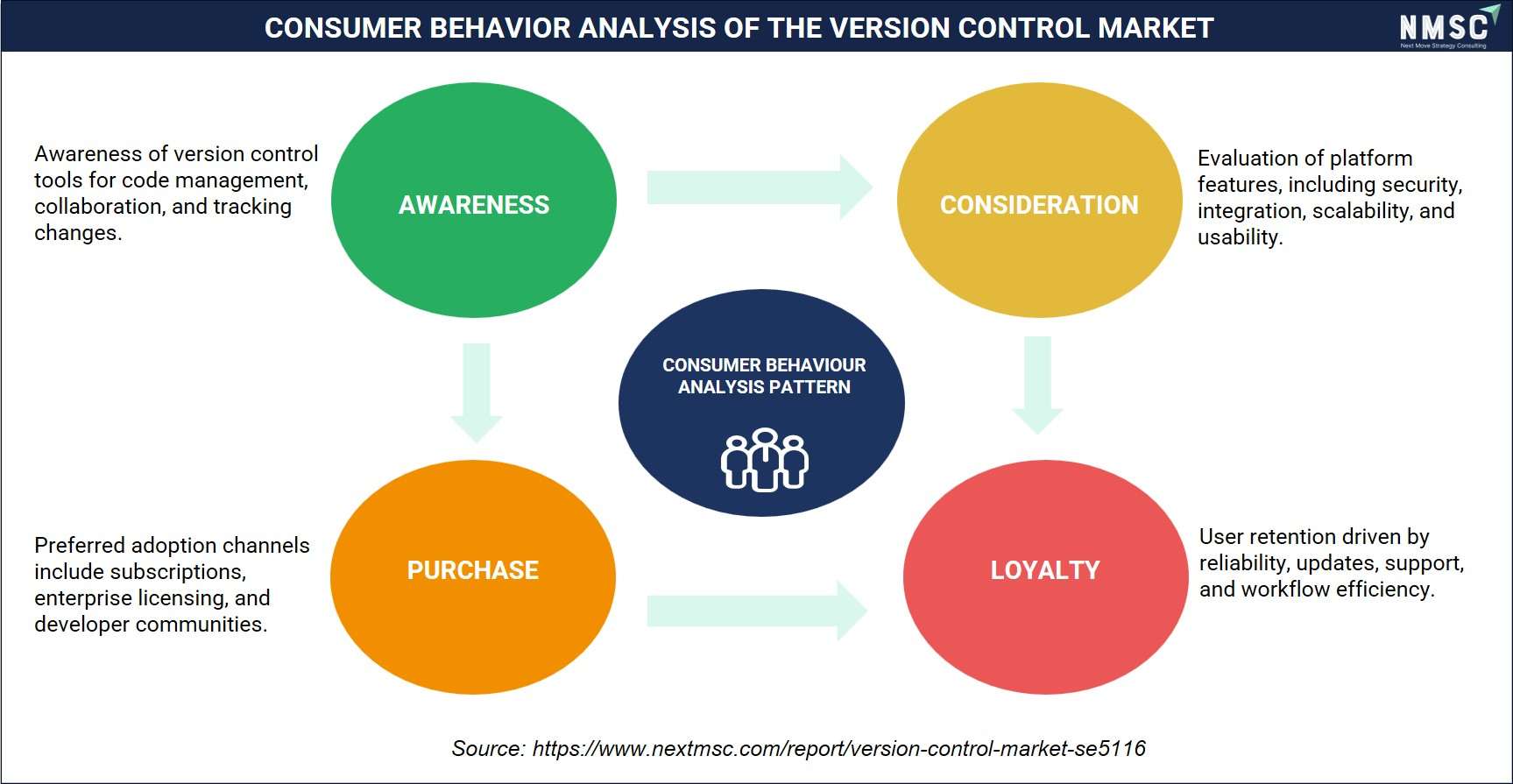
The above consumer behavior analysis maps the key stages, such as awareness, purchase, consideration, and loyalty, shaping the version control tools market. From our analysis, we observed that loyalty hinges on workflow efficiency and continuous updates rather than initial feature richness, prompting providers to prioritize seamless integrations and responsive support to retain developer communities and enterprise clients over the long term.
Investment Opportunities
The Version Control Market is attracting robust investment driven by growing demand for AI-native developer platforms, cloud-based code management solutions, and modern software delivery infrastructure. Venture capital continues to flow into next-generation repository and developer tooling providers, while sustained hyperscale cloud investments by major platform operators are strengthening the infrastructure supporting version control services. At the same time, ESG considerations are influencing enterprise procurement, with organizations increasingly evaluating vendors based on data-center energy efficiency, sustainability practices, and open-source governance transparency. Public-sector digital transformation initiatives across major economies, together with continued venture funding and strategic acquisitions focused on AI-assisted development and software security capabilities, are creating attractive long-term investment opportunities across the Version Control Market.
Key Benefits for Stakeholders
The Version Control Market report provides actionable insights for software vendors, enterprise technology leaders, DevOps teams, investors, financial analysts, and cloud service providers by delivering comprehensive market sizing, growth forecasts, competitive benchmarking, and technology adoption trends through 2035. It supports strategic investment planning, product development, platform selection, and market expansion by analyzing product types, deployment models, repository architectures, organization sizes, revenue models, end-user industries, and regional adoption patterns. Country-level intelligence, competitive landscape assessment, technology evolution, and detailed market segmentation further enable informed decision-making, resource optimization, risk evaluation, and sustainable growth across the evolving version control and collaborative software development ecosystem.
Key Market Segments
By Product Type
-
DVCS
-
Git-Based
-
Cloud-Hosted
-
Self-Hosted
-
Embedded
-
-
Non-Git
-
Mercurial
-
Bazaar
-
Fossil
-
Darcs
-
Pijul
-
-
-
CVCS
-
Enterprise
-
Perforce
-
Subversion
-
ClearCase
-
TFVC
-
-
Mainframe
-
Endevor
-
Panvalet
-
ChangeMan
-
-
Legacy
-
Vault
-
SourceAnywhere
-
PVCS Version Manager
-
-
-
Hybrid VCS
-
Dual-Mode
-
Multi-Repositor
-
By Deployment Model
-
Cloud
-
Public Cloud
-
Private Cloud
-
Dedicated Cloud
-
-
On-Premises
-
Self-Managed
-
Managed Appliance
-
-
Hybrid
By Revenue Model
-
Subscription
-
SaaS
-
Self-Managed
-
-
Perpetual License
-
Maintenance
-
Professional Services
-
Consulting
-
Implementation
-
Migration
-
Training
-
-
Marketplace
By Repository Visibility
-
Public
-
Private
-
Mixed
Repository Architecture
-
Single Repository
-
Multi-Repository
-
Monorepository
By Distribution Channel
-
Direct Sales
-
Channel Partners
-
Cloud Marketplace
-
Community
By Organization Size
-
Large Enterprise
-
Medium Enterprise
-
Small Enterprise
-
Individual
By End User
-
IT
-
BFSI
-
Healthcare
-
Government
-
Manufacturing
-
Telecommunications
-
Retail
-
Media
-
Education
-
Energy
-
Automotive
-
Other
Conclusion & Recommendations
The Version Control Market is expected to witness robust growth through 2035, driven by AI-assisted software development, accelerating cloud migration, expanding developer ecosystems, and increasing enterprise demand for collaborative and secure code management. Vendors should prioritize AI-powered development capabilities, scalable monorepository architectures, flexible cloud and self-managed deployment models, and regional compliance to strengthen their competitive position. Organizations can maximize long-term value by adopting phased modernization strategies that transition from legacy version control systems to AI-native, cloud-based platforms with advanced automation, security, and collaboration features, enabling efficient software delivery and supporting future digital transformation initiatives.
About the Author
 Mayurima Roy
— Mayurima Roy is Research Analyst at Next Move Strategy Consulting, where she has spent 4 years working across the firm's full industry coverage rather than a single fixed vertical. Her work centers on structured research, ongoing trend tracking, competitive assessment, and insight-led content development, translating complex market data into clear, decision-ready narratives that support informed client decision-making across diverse global industries, market sectors, and world regions every day.
Mayurima Roy
— Mayurima Roy is Research Analyst at Next Move Strategy Consulting, where she has spent 4 years working across the firm's full industry coverage rather than a single fixed vertical. Her work centers on structured research, ongoing trend tracking, competitive assessment, and insight-led content development, translating complex market data into clear, decision-ready narratives that support informed client decision-making across diverse global industries, market sectors, and world regions every day.
About the Reviewer
 Supradip Baul
— Supradip Baul is an accomplished business consultant and strategist with over a decade of rich experience in market intelligence, strategy, technology, and business transformation. His work has included rigorous qualitative and quantitative analysis across multiple industries, helping clients shape investment decisions and long-term roadmaps. Earlier in his career, he was associated with Gartner, where he contributed to industry-leading reports and market share analyses. He has worked with leading global companies and holds an MBA with a dual specialization in Marketing and Finance.
Supradip Baul
— Supradip Baul is an accomplished business consultant and strategist with over a decade of rich experience in market intelligence, strategy, technology, and business transformation. His work has included rigorous qualitative and quantitative analysis across multiple industries, helping clients shape investment decisions and long-term roadmaps. Earlier in his career, he was associated with Gartner, where he contributed to industry-leading reports and market share analyses. He has worked with leading global companies and holds an MBA with a dual specialization in Marketing and Finance.
At Next Move Strategy Consulting, we understand that insightful market research is the cornerstone of successful business decisions. That's why we employ a robust and multifaceted approach, combining various methodologies to deliver the most accurate and actionable data for our clients.

Research Landscape
We navigate the world of research with two primary approaches:
Qualitative Approach
Our qualitative research methodologies involve immersive techniques such as in-depth interviews, focus groups, and observational studies. By engaging directly with individuals and stakeholders, we uncover valuable insights that quantitative data alone may overlook.

Quantitative Research
In tandem with qualitative methodologies, NMSC leverages the power of Quantitative Research to provide a robust foundation of numerical insights. Through systematic data collection and analysis, we quantify patterns, preferences, and market trends, offering a comprehensive view of the business landscape.
Our quantitative research approach employs diverse tools, including surveys, experiments, and statistical modelling. These methodologies enable us to gather data from a large and representative sample, ensuring the statistical significance of our findings. By employing structured questionnaires and standardized data collection methods, we guarantee the reliability and validity of the information we present to our clients.
Quantitative research is particularly effective in measuring the prevalence of trends, assessing market size, and gauging the impact of various factors on consumer behavior. The numerical precision attained through this approach equips our clients with actionable insights, facilitating data-driven decision-making and strategy formulation.


Our Specialized Toolbox for Industry-Specific Market Research
We deploy a specialized arsenal of techniques tailored to meet your unique requirements. Here's a glimpse into our comprehensive toolbox:

Information Procurement
The stage entails acquiring market data or relevant information through various sources and methodologies.


Market Research Approach
We utilize both top-down and bottom-up approaches in market research analysis to achieve a comprehensive understanding of the market dynamics, leveraging the broad perspective of industry trends and macroeconomic factors alongside detailed insights from specific segments and individual companies.

Porters Five Forces Analysis
We conduct Porter's Five Forces analysis to evaluate the competitive landscape of an industry, providing us with insights into factors that affect profitability and strategic positioning.

SWOT Analysis

Forecasting
We utilize a forecasting model to predict future consumption by considering parameters like population, economics, regulations, market competition, drivers, constraints, technology, and pricing. We also employ statistical techniques such as multilinear regression, exponential smoothing, moving average, ARIMA, and Monte Carlo simulations for accurate predictions. In econometric forecasting, we analyzed short-term and long-term event impacts, attributing values based on regulatory frameworks, economic factors, and market events.





 Speak to Our Analyst