Are Molecular Diagnostics Transforming the Future of Transplant Care in 2025?

Organ transplantation has always required a delicate balance between speed and certainty. In 2025, the transplant diagnostic market is moving decisively toward precision-driven decision-making, reshaping how clinicians assess compatibility, monitor rejection, and personalize care. Recent updates from MedCity News and Insight Molecular Diagnostics Inc. (iMDx) show that innovation is no longer theoretical. It is operational, commercial, and clinically embedded. This shift is not only about technology. It is about improving outcomes in a system that continues to face mounting pressure.
Transplant Demand Is Rising Faster Than Supply
A new patient is added to the list every 10 minutes. Although the number of transplants performed reached a record high of more than 46,000 in 2023, the gap between supply and demand persists. Seventeen people die each day while waiting for an organ. Even when transplantation is successful, the clinical journey is not complete. MedCity News reports that between 10% and 15% of kidney transplant recipients experience rejection in the first year. For heart transplant recipients, rejection rates can rise to as high as 40% within the first year.
Pre-Transplant Diagnostics Are Becoming More Precise
The Transplant Diagnostic Market is advancing beyond traditional compatibility checks toward high-resolution immune assessment. Pre-transplant screening typically includes blood group testing, human leukocyte antigen (HLA) typing, and HLA antibody testing. HLA proteins regulate immune recognition and determine whether the body identifies transplanted tissue as self or non-self.
Recent innovation in next-generation sequencing has significantly improved HLA typing accuracy, providing clinicians with high-resolution data for donor-recipient matching. At the same time, improvements in HLA antibody testing enable more reliable identification of pre-formed antibodies that could trigger rejection. Another important development is the adoption of virtual crossmatching. Unlike traditional physical crossmatching, which requires mixing donor cells with recipient serum, virtual crossmatching relies on complete HLA typing and highly accurate antibody profiling. This process can be completed in minutes. Because donor organs must be transplanted within hours to remain viable, reducing compatibility assessment time can significantly improve transplant logistics and outcomes.
Post-Transplant Monitoring Is Shifting Toward Non-Invasive Testing
Historically, invasive biopsies have been used to detect rejection. However, biopsies can cause patient discomfort, anxiety, and logistical challenges. In addition, blood-based donor-derived cell-free DNA (dd-cfDNA) testing offers a less invasive alternative to biopsy-based monitoring. This molecular biomarker approach provides actionable information without the need for surgical tissue sampling. These innovations also expand access to care. Samples can be collected at local clinics rather than specialized transplant centers, potentially reducing travel and financial burdens. Future models may support remote collection, further enhancing accessibility.
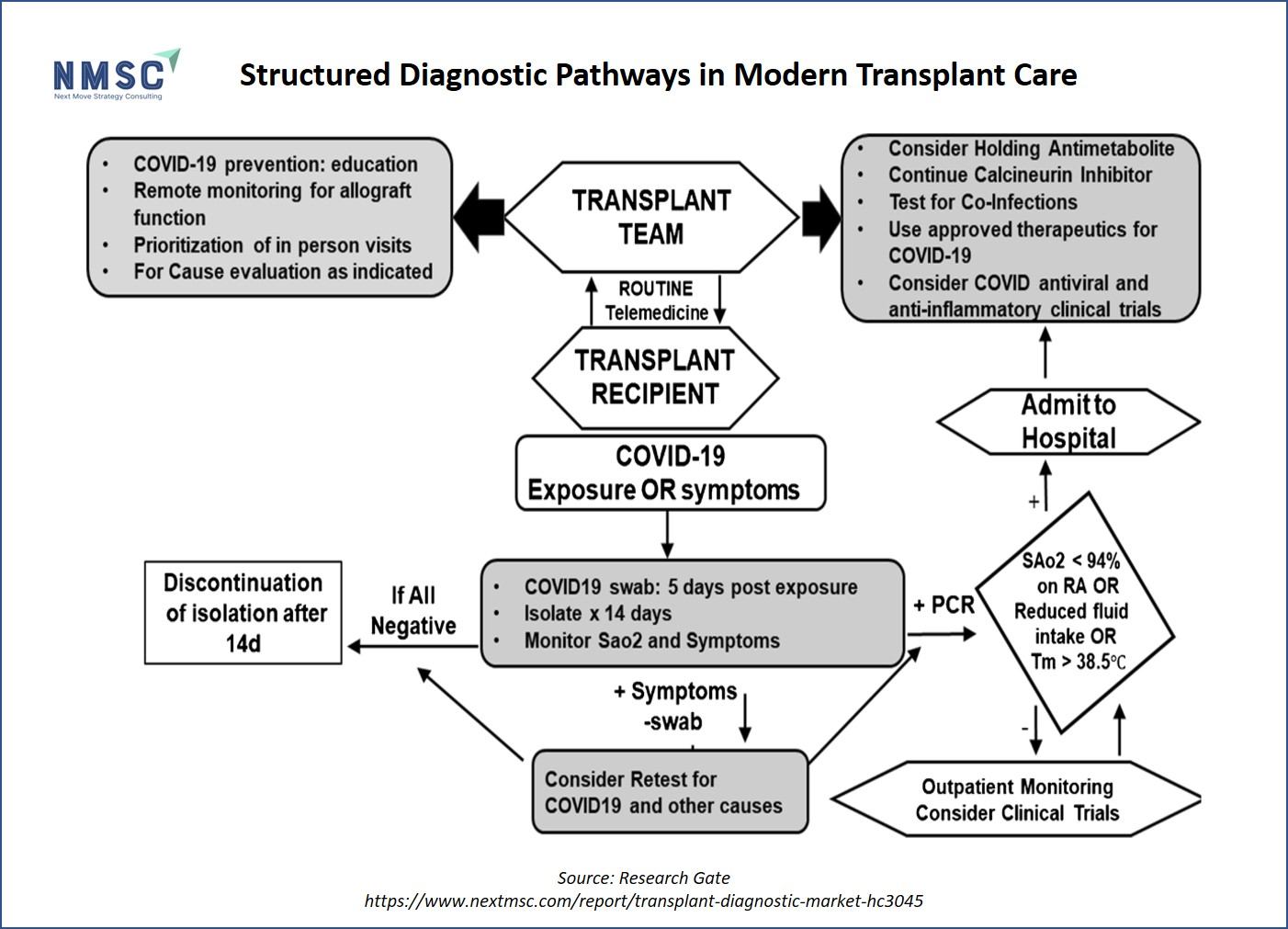
Coordinated Immune Monitoring in Transplant Management
This pathway reflects the growing reliance on precise diagnostic tools to guide timely and informed clinical decisions. Innovative transplant diagnostics provide clearer insights into a recipient’s immune status before and after surgery. With rejection affecting 10%–15% of kidney transplant recipients and up to 40% of heart transplant recipients in the first year, accurate monitoring is essential. The central process in the visual shows testing, isolation, and symptom evaluation before escalation. This aligns with advancements such as high-resolution human leukocyte antigen typing and virtual crossmatching, which enable faster and more reliable compatibility assessments. These innovations reduce delays and support rapid clinical decisions when time-sensitive interventions are required. When severity increases, the pathway shifts toward hospital evaluation and treatment adjustment.
Commercialization Momentum Is Accelerating in 2025
The company announced its rebranding and relocation of its principal executive office to Nashville, Tennessee. The rebranding reflects an expanded strategic focus that includes transplant medicine in addition to oncology. The company states that it aims to deliver a clinically available molecular diagnostic kit for kidney transplant patients and anticipates unlocking value in an estimated $1 billion addressable market for transplant rejection testing. Its flagship technology quantifies donor-derived cell-free DNA, a biomarker that has become increasingly recognized in transplant monitoring. GraftAssureCore is a lab-developed test performed in its CLIA-certified laboratory in Nashville and is reimbursed by the Centers for Medicare and Medicaid Services. GraftAssureIQ is a research-use-only kit designed for non-clinical applications. GraftAssureDx is an in vitro diagnostic kit currently in development and intended for submission to the United States Food and Drug Administration for authorization.
Leading Companies Driving Innovation in Transplant Diagnostics
Key players shaping the transplant diagnostic landscape include Abbott Laboratories, Thermo Fisher Scientific, Qiagen N.V., Adaptive Biotechnologies Corporation, Hologic Inc., NanoString Technologies, Inc., Horiba, Ltd., Arquer Diagnostics Ltd., Eurofins Viracor Inc., CareDx Inc., Becton, Dickinson and Company, Bio-Rad Laboratories, Inc., F. Hoffmann-La Roche Ltd, Illumina, Inc., and Takara Bio Inc., among others. These organizations are strengthening their competitive positions through strategic initiatives such as new product introductions, technological advancements, partnerships, and collaborative agreements aimed at expanding their diagnostic capabilities and market presence.
Next Move Strategy Consulting View
From a strategic consulting perspective, the transplant diagnostic market is entering a structured scale-up phase between 2025 and 2027. The first defining factor is regulatory progression. Lab-developed tests are evolving into formal in vitro diagnostic kits, and Food and Drug Administration authorization will likely represent a key commercialization milestone. The existing reimbursement of GraftAssureCore by the Centers for Medicare and Medicaid Services provides early validation. Broader payer alignment will determine adoption velocity across transplant centers. The combination of CLIA-certified laboratories, research-use kits, and potential remote sampling models suggests that molecular transplant monitoring may become more distributed rather than confined to specialized academic centers. Biomarker standardization will influence competitive positioning. dd-cfDNA is increasingly positioned as a trusted biomarker of rejection, creating platform scalability potential for companies that can integrate testing into clinical workflows efficiently. The transplant diagnostic market is therefore transitioning from innovation-driven development to infrastructure-driven expansion.
Next Steps for Stakeholders
Diagnostic companies should prioritize regulatory clarity and payer engagement to accelerate adoption. Policymakers and payors should assess the economic implications of early rejection detection compared with the cost of late-stage graft failure. Research institutions may consider participation in pilot programs such as GraftAssureIQ to contribute to evidence generation. Finally, investors should closely monitor regulatory submissions and commercialization milestones in transplant-focused diagnostic portfolios.
-
Evaluate the integration of donor-derived cell-free DNA testing into routine post-transplant monitoring protocols to support earlier detection of rejection risk.
-
Assess the regulatory pathway of emerging in vitro diagnostic kits, particularly those progressing toward United States Food and Drug Administration authorization.
-
Review reimbursement alignment, including Centers for Medicare and Medicaid Services coverage, before scaling adoption across transplant centers.
-
Optimize pre-transplant workflows by incorporating high-resolution human leukocyte antigen typing and validated virtual crossmatching protocols.
-
Explore research collaborations or pilot programs, such as research-use-only diagnostic initiatives, to generate real-world evidence and strengthen clinical validation.
Conclusion
The transplant diagnostic market in 2025 is characterized by precision, speed, and molecular intelligence. High-resolution HLA typing and virtual crossmatching are improving donor assessment. Non-invasive dd-cfDNA and urine-based biomarker tests are redefining post-transplant monitoring. Corporate rebranding and commercialization initiatives, such as those announced by iMDx, signal that the market is advancing beyond experimentation and into scalable deployment. If the current trajectory continues, transplant diagnostics will increasingly shift the clinical paradigm from reactive rejection management to proactive immune surveillance, with measurable implications for patient outcomes and healthcare economics.
About the Author
 Sanyukta Deb
— Sanyukta Deb is Digital Marketing Team Lead at Next Move Strategy Consulting, where she has led content strategy and technical SEO for the firm's B2B market research publications for over 2 years. Her editorial process translates NextMSC's primary and secondary research — spanning technology, industrial, and consumer sectors — into commercial narratives, backed by search-intent, keyword, and competitive analysis. She brings 5 years of overall experience in digital marketing and content strategy.
Sanyukta Deb
— Sanyukta Deb is Digital Marketing Team Lead at Next Move Strategy Consulting, where she has led content strategy and technical SEO for the firm's B2B market research publications for over 2 years. Her editorial process translates NextMSC's primary and secondary research — spanning technology, industrial, and consumer sectors — into commercial narratives, backed by search-intent, keyword, and competitive analysis. She brings 5 years of overall experience in digital marketing and content strategy.
About the Reviewer
 Debashree Dey
— Debashree Dey is Assistant Manager at Next Move Strategy Consulting, where she supports cross-vertical market content and communications across diverse industries for 6 years. Her professional background includes senior content writing, communications, and published manuscript authorship, with experience developing audience-focused business narratives and maintaining clear, consistent messaging. Her role supports research-led content development and editorial quality across NextMSC publications.
Debashree Dey
— Debashree Dey is Assistant Manager at Next Move Strategy Consulting, where she supports cross-vertical market content and communications across diverse industries for 6 years. Her professional background includes senior content writing, communications, and published manuscript authorship, with experience developing audience-focused business narratives and maintaining clear, consistent messaging. Her role supports research-led content development and editorial quality across NextMSC publications.
















Add Comment