How Are Drone Countermeasures Evolving in Modern Warfare?
Why Drone Countermeasures Matter More Than Ever?
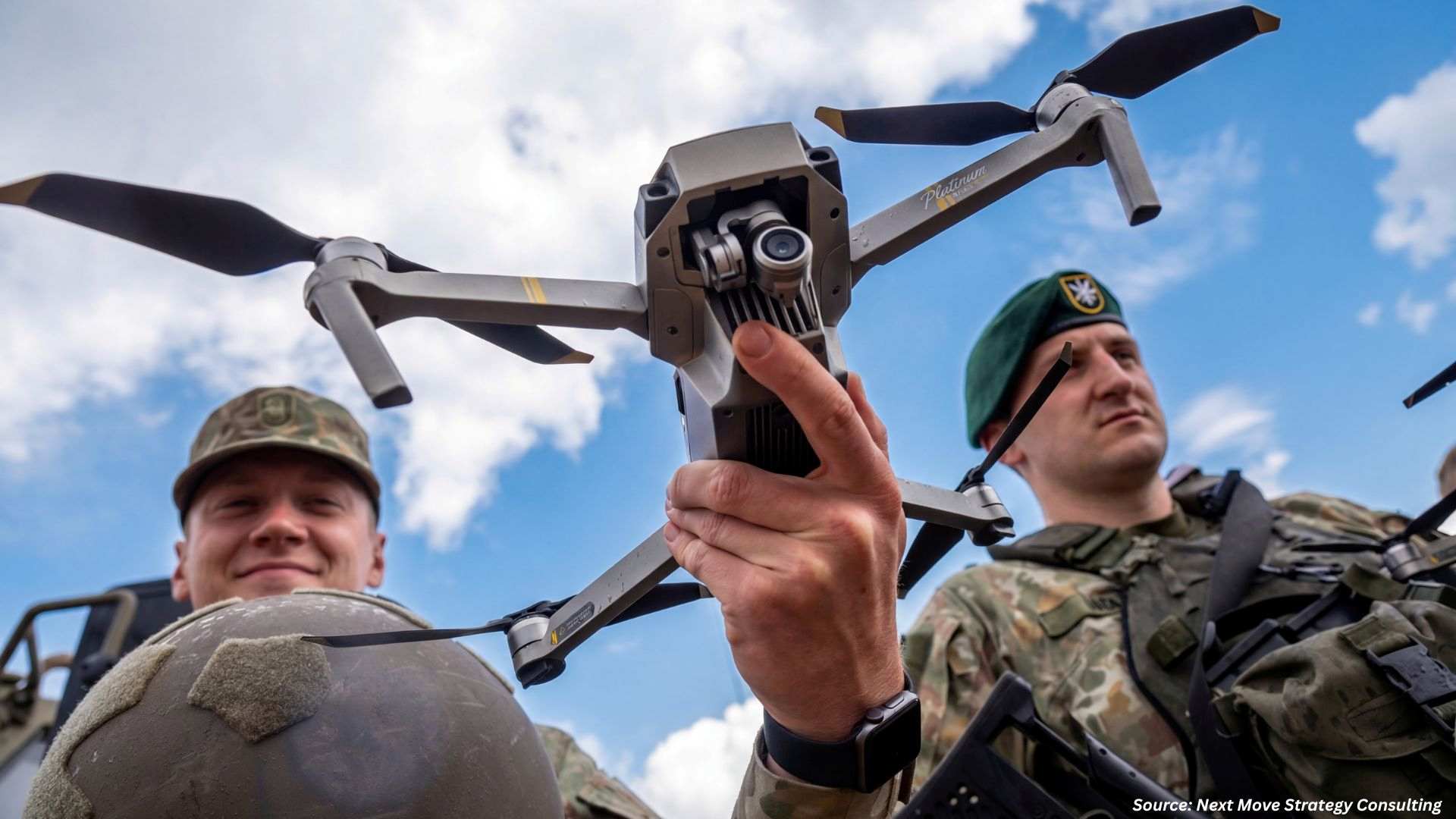
The rapid expansion of drone usage across military and civilian environments has fundamentally changed modern security dynamics. From low-cost attack drones to surveillance platforms, these systems are now widely deployed, making countermeasures a strategic necessity rather than an optional capability.
Recent developments between 2024 and 2026 reveal a clear acceleration in anti-drone innovation. However, understanding these advancements requires distinguishing between publicly visible data and the largely hidden nature of military technologies.
How Is Innovation Shaping Drone Countermeasures?
Rising Patent Activity Reflects Growing Demand
A 2025 report by Mathys & Squire highlights a 27% increase in counter-drone patent applications, rising from 99 to 126 filings within a year.
China leads with 82 applications, followed by the United States with 22, while South Korea ranks next. This increase indicates a strong global push to develop systems capable of disabling or neutralising drones.
Countermeasure Technology Types and Innovation Focus (2025)
|
Technology Type |
Number of Patents |
Key Function |
|
Jamming & Interference |
49 |
Disrupts communication & navigation |
|
Laser Systems |
39 |
Precision destruction of drones |
|
Microwave Systems |
24 |
Disables onboard electronics |
|
Bullet-based Systems |
6 |
Physical neutralisation |
|
Capture/Rocket Systems |
2 |
Drone interception or destruction |
Technology Focus Areas
The data shows that innovation is concentrated in specific areas. Interference and jamming technologies dominate with 49 patents, reflecting a shift toward non-kinetic disruption methods. Laser-based systems follow with 39 patents, while microwave countermeasures account for 24 filings. Other approaches, such as bullet-based or capture systems, remain limited in comparison.
Why Patent Numbers Do Not Tell the Full Story
Despite the surge in filings, patent data provides only a partial view of innovation. Counter-drone technologies are primarily developed for military use, and many of these systems are classified. Legal frameworks, such as secrecy regulations, often prevent companies from patenting sensitive technologies.
Additionally, structural factors can distort the data. In China, incentives such as subsidies and career advancement encourage patent filings, sometimes resulting in multiple submissions for minor variations of the same concept.

Global Counter-Drone Patent Distribution
|
Country |
Patent Applications |
Share of Total (%) |
|
China |
82 |
65% |
|
United States |
22 |
17% |
|
Others (incl. South Korea) |
22 |
18% |
|
Total |
126 |
100% |
What Lessons Are Emerging from Real-World Conflicts?
Rapid Adaptation in Active Combat Zones
The ongoing conflict in Ukraine demonstrates how drone warfare is evolving in real time. Both sides are leveraging drones to compensate for limitations in traditional military capabilities, using them for strike missions, reconnaissance, and air defence saturation.
Russia’s Experimental Drone Modifications
In early 2026, Russia introduced a notable modification by equipping Shahed-style drones with man-portable air defence systems (MANPADS). A downed drone revealed a shoulder-fired missile mounted directly onto its structure, along with a camera and communication system enabling remote operation.
This adaptation appears to be an attempt to give drones a defensive capability against interceptors and aircraft. However, the effectiveness of such modifications remains uncertain due to their improvised integration.

Major Trends Shaping the Present
One of the most notable trends is the shift toward non-kinetic countermeasures. Technologies such as jamming and microwave systems are increasingly preferred because they disable drones without physical destruction. This approach is particularly valuable in urban or civilian environments.
Another important trend is the emphasis on scalability. As drones become cheaper and more widely available, countermeasures must also be cost-effective and capable of handling large volumes of threats.
Autonomous systems are also gaining prominence. Interceptor drones, for example, are becoming essential tools for neutralising aerial threats in a flexible and responsive manner.
At the same time, a significant portion of innovation remains hidden. Military organisations often avoid patenting sensitive technologies, meaning that publicly available data represents only a fraction of actual progress.
Finally, the growing impact on civilian infrastructure cannot be ignored. Drone-related disruptions at major European airports in 2025 underline the need for robust countermeasures beyond military applications.
How Do Diverse Countermeasure Strategies Address Different Drone Threats?
This image presents three distinct drone countermeasure approaches: capture nets, communication interference, and drone-catching birds. Capture nets physically entangle drones mid-air, preventing further movement and allowing safe recovery. This method is often used in controlled environments where minimising damage is important.
Communication interference represents a non-kinetic approach, where signals between the drone and its operator are disrupted using electronic systems. By breaking this link, the drone can be forced to land, return to its origin, or become inoperable.
Drone-catching birds illustrate an unconventional method where trained birds of prey intercept drones. Although less scalable, this approach highlights early experimental tactics in counter-drone defence.

How Does Distributed Jamming Create an Effective Anti-Drone Shield?
The diagram also highlights a distributed defence strategy, where multiple nodes operate simultaneously rather than relying on a single system. Each sensor-interferer pair contributes to a wider protective grid, creating redundancy and stronger signal disruption.
By attacking the drone’s control links from multiple directions, the system can effectively confuse, disable, or force the drone to land, making it a highly scalable and efficient countermeasure approach for both military and civilian environments.

What Does the Distribution of Drone Countermeasure Technologies (2025) Reveal?
The pie chart highlights a clear dominance of jamming and interference systems (39%), showing that non-kinetic methods are currently the most preferred approach for disabling drones without physical destruction. This reflects a strategic shift toward disrupting communication and navigation rather than relying solely on force.
Laser systems (31%) form the second-largest share, indicating strong investment in precision-based neutralisation technologies. These systems are gaining traction due to their accuracy and potential for rapid engagement.
Microwave systems (19%) represent a growing segment, focused on disabling drone electronics at scale. Their increasing share suggests rising interest in countering swarm-based drone threats.
The remaining 11% classified as other methods includes bullet-based, capture, and rocket systems, which are comparatively less prioritised due to limitations in scalability and efficiency.
Overall, the chart shows a clear trend toward non-kinetic, scalable, and technology-driven countermeasures, reflecting the evolving nature of modern drone threats.

Who Are the Key Players Driving Innovation in Drone Countermeasures?
The drone countermeasures landscape is shaped by a diverse group of global defence and technology companies. Major participants include Lockheed Martin, Northrop Grumman, BAE Systems, Thales, Leonardo S.p.A., Rafael Advanced Defense Systems, and Elbit Systems.
Additional contributors such as Airbus Defence and Space, Hensoldt, Kratos Defense & Security Solutions, Epirus, Battelle, DroneShield Ltd, Dedrone, and Liteye Systems further strengthen the competitive ecosystem.
Other notable players include Boeing, Saab, L3Harris Technologies, QinetiQ, Rohde & Schwarz, Israel Aerospace Industries, ASELSAN, and Moog Inc., among others.
These organisations are actively pursuing strategies such as product innovation and new system launches to strengthen their position and address the growing demand for advanced drone countermeasure solutions.

What Are the Key Challenges Ahead?
One of the primary challenges lies in the imbalance between cost and effectiveness. Drones are often inexpensive and mass-produced, whereas countermeasure systems can be significantly more costly. This creates a strategic disadvantage for defenders.
Another issue is the gap between detection and neutralisation. While identifying drones has become more reliable, stopping them efficiently remains complex, especially in high-density threat scenarios.
Regulatory constraints further complicate the landscape, particularly in civilian environments where safety and legal considerations must be balanced. Additionally, adversaries are continuously adapting, meaning that countermeasures can quickly become outdated.
Next Steps
Stakeholders should focus on developing integrated defence systems that combine detection, disruption, and interception capabilities. Emphasis must also be placed on real-world testing, as battlefield performance remains the most reliable indicator of effectiveness.
Collaboration between governments and private industry will be essential to accelerate innovation and deployment. At the same time, there is a growing need to strengthen security frameworks for civilian infrastructure, particularly in sensitive areas such as airports and urban centres.
-
Develop layered defence systems that integrate detection, jamming, and interception for comprehensive protection
-
Prioritise real-world testing to ensure countermeasures perform effectively in dynamic environments
-
Invest in cost-efficient solutions to counter large volumes of low-cost drones
-
Strengthen collaboration between governments and private industry to accelerate innovation and deployment
-
Enhance security frameworks for civilian infrastructure, especially airports and urban airspaces
Conclusion: Where Is the Future Heading?
Drone Countermeasures Market are evolving in response to one of the fastest-changing technological threats in modern history. While patent data suggests progress, the true measure of innovation lies in operational success and adaptability under real-world conditions.
Looking ahead, advancements are likely to focus on autonomous interception, electronic warfare, and scalable defence solutions. However, the most critical factor will remain the ability to adapt quickly to emerging threats.
About the Author
 Tania Dey is a content writer specializing in transformation-led, insight-driven storytelling. She develops research-backed, high-impact content aligned with evolving business priorities, digital behavior, and audience expectations. Her work helps organizations sharpen value propositions, strengthen visibility, and communicate strategic intent with clarity and precision. Grounded in data-informed storytelling, she brings a strong focus on relevance, consistency, and measurable digital impact across platforms.
About the Reviewer
 Sanyukta Deb is a senior content writer and content analyst with expertise in content strategy, audience engagement, and research-driven storytelling. With a strong leadership approach and strategic mindset, she drives content initiatives that strengthen brand communication and audience connection. She combines creativity with analytical insight to develop impactful, value-led content while mentoring collaborative efforts across teams to ensure consistent, meaningful engagement and long-term brand growth across digital platforms.











Add Comment