How EMS Players Use Automation & Data to Redefine Enterprise Spend Management

As per NMSC analysis, the Expense Management Software Market was valued at USD 8.51 billion in 2025, and is expected to be valued at USD 9.92 billion by the end of 2026. The industry is projected to grow, hitting USD 24.64 billion by 2035, with a CAGR of 10.63% between 2026 and 2035.
The EMS market is defined by a dynamic balance between platform scalability and rapid feature innovation, making it one of the most technology-driven segments within enterprise software. Market trends indicate that competitive intensity is being influenced by accelerated product updates, AI-driven functionality, and growing focus on user experience and automation. Leading providers are leveraging cloud infrastructure and regional support networks to enhance responsiveness to client needs, while compliance capabilities, integration with enterprise systems, and analytics-driven insights are emerging as key differentiators, driving customer retention and long-term adoption across both established and emerging markets.
Expense Management Software Market Overview
The expense management software (EMS) market is undergoing a rapid transformation as organizations increasingly prioritize operational efficiency, compliance, and data-driven decision-making. In 2026, enterprises are seeking intelligent solutions that go beyond simple expense tracking to include AI-driven automation, real-time fraud detection, and predictive spend analytics.
NMSC’s analysis indicates that the market is being shaped by the dual need for scalability and feature innovation. Platforms that can efficiently handle large volumes of transactions while continuously updating functionality to meet evolving regulatory, policy, and workflow requirements are emerging as clear winners. Competitive intensity is being influenced by accelerated product updates, AI-led automation, and enhanced user experience, which enable organizations to reduce processing time, mitigate risk, and gain actionable insights. Adoption is rising across both mature markets, where enterprises focus on compliance and integration, and emerging economies, where digitalization of finance operations is still gaining momentum.
Furthermore, long-term differentiation in the EMS market now depends on several critical factors. Integration with cloud infrastructure, robust reporting and analytics, real-time auditing, and predictive budgeting capabilities are increasingly shaping purchase decisions. At the same time, vendors that offer strong customer support, seamless onboarding, and flexible deployment options are better positioned to retain clients and expand adoption across business units. Collectively, these trends indicate that EMS is evolving from a transactional tool into a strategic platform that drives both operational efficiency and enterprise-level financial intelligence.

Curious about the Expense Management Software Market? Download Your FREE Sample Report Now
Highlights of SAP SE
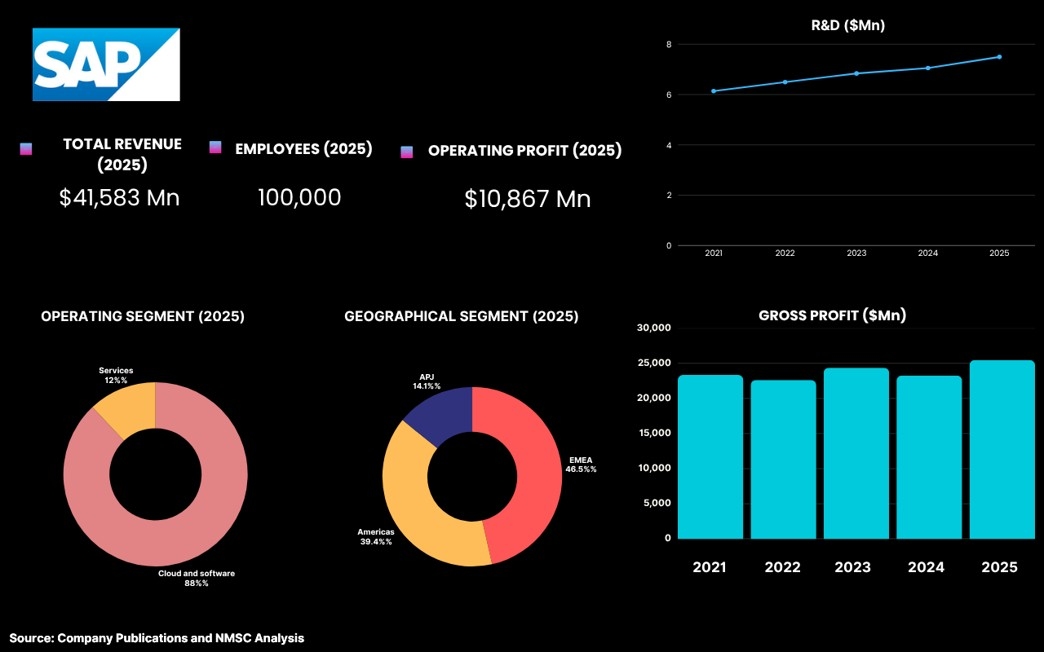
SAP SE is a German multinational enterprise software company headquartered in Walldorf, Baden Württemberg, Germany, and one of the world’s largest providers of business applications and cloud solutions. Founded in 1972, SAP develops integrated software that helps organisations manage processes across finance, human resources, supply chain, customer experience and other core functions, with a growing focus on cloud, analytics and artificial intelligence technologies. As a dominant player in enterprise software, SAP’s portfolio spans ERP, business intelligence and spend management solutions, and its scale influences trends and competition in the broader global expense management software market.
SAP Concur, a Bellevue, Washington–based subsidiary of SAP SE specialising in cloud based travel and expense management software, continues to advance its role in the expense management software market by integrating AI driven features and expanding strategic partnerships. At the 2026 SAP Concur Fusion event, SAP unveiled enhanced AI capabilities such as deeper integration of its Joule AI with Microsoft 365 Copilot and new automation agents for expense reporting, alongside expanded partnerships with American Express Global Business Travel and Visa that automate expense capture and improve compliance and control. We noticed that these developments are designed to strengthen SAP Concur’s competitive position in the travel and expense segment by increasing automation, reducing manual tasks, and improving user efficiency.
Highlights of Oracle Corporation
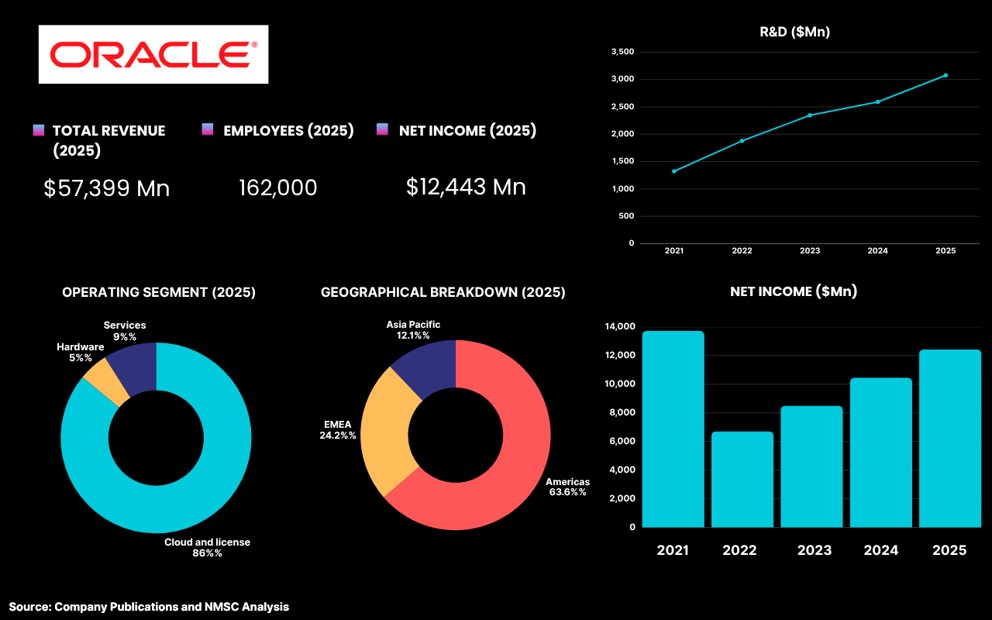
Oracle Corporation is an American multinational technology company headquartered in Austin, Texas, United States, recognised as one of the largest global providers of enterprise software, cloud infrastructure and data management solutions. Founded in 1977, Oracle specialises in database systems, enterprise resource planning (ERP), human capital management (HCM), customer experience (CX) and a broad suite of cloud applications that help organisations manage core business processes. In the expense management software market, the segment of enterprise applications that automate and streamline expense reporting, reimbursement and policy compliance, Oracle’s ERP and cloud applications influence how customers adopt automated, integrated financial and spend management solutions.
We observed that in 2026, Oracle has actively evolved its cloud software to embed artificial intelligence across its Fusion applications suite, revamping finance and procurement capabilities to automate routine tasks and support AI agent workflows that can handle functions such as data gathering, entry and recommendations, trends that extend into expense automation and financial process efficiency. This strategic pivot toward AI driven enterprise applications aims to enhance Oracle’s competitiveness in markets, including expense management by improving automation, analytics and user productivity. The company’s strong results, including double digit cloud revenue growth and growing adoption of its Fusion Cloud suite, reflect broader demand for integrated, intelligent spend and financial management software.
Highlights of Bill Holdings, Inc.
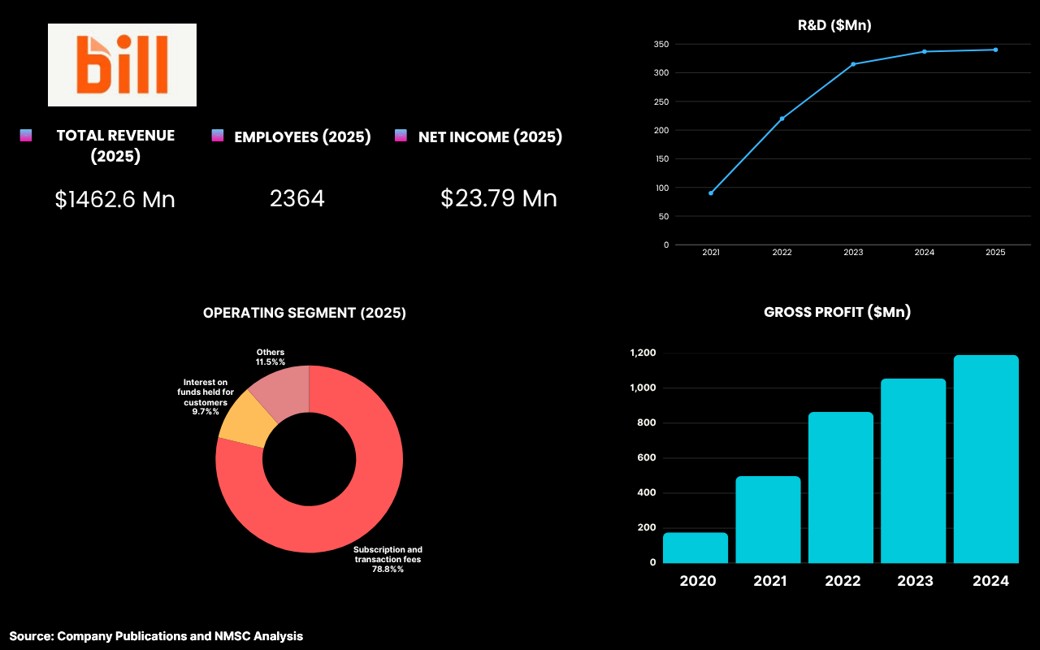
BILL Holdings, Inc, often branded simply as Bill.com is an American financial software company headquartered in San Jose, California, United States, that provides cloud based platforms automating accounts payable (AP), accounts receivable (AR), spend and expense management for small and midsize businesses (SMBs) and their accountants. Founded in 2006, Bill.com’s suite integrates payment processing, approval workflows and financial data to help organisations reduce manual effort, improve controls and accelerate cash flow. In the expense management software market, which encompasses software that streamlines expense reporting, policy enforcement and reimbursement, Bill.com’s spends and expense components help position it as a provider of integrated financial operations software that supports broader spend automation needs.
Our research indicates that in 2025 and 2026, Bill.com expanded its ecosystem and reported continued growth while strengthening partnerships and product integrations that can enhance its role in the expense management software market. In its first fiscal quarter of 2026, the company reported serving nearly 498,100 businesses and processing USD 89 billion in payment volume, and announced three marquee Embed 2.0 partnerships with NetSuite, Paychex and Acumatica to embed its finance platform deeper into key small business and accounting software stacks, reflecting strategic efforts to drive broader adoption of its AP/AR and expenses automation capabilities. These developments improve Bill.com’s competitive positioning by expanding distribution channels, increasing integration with ERP and HR/payroll systems, and leveraging AI agents to further automate financial workflows.
Highlights of Coupa Software Inc.
Coupa Software Inc. is an American technology company headquartered in Foster City, California, United States, that specialises in cloud based business spend management solutions, including procurement, invoicing, payables, sourcing and travel and expense management tools. Founded in 2006, Coupa’s platform enables organisations to gain visibility and control over direct and indirect spend, automate workflows, enforce compliance and optimise financial operations. In the expense management software market, the segment of enterprise software that automates expense reporting, policy enforcement and reimbursement processes, Coupa’s expense modules and AI driven spend intelligence help customers streamline financial operations and enhance spend visibility across global organisations.
NMSC’s analysis indicates that in 2025 and 2026, Coupa has reported strong momentum driven by expanded AI native capabilities and global customer growth that underpin its position in the broader expense management software market and total spend management category. Coupa’s Q1 FY26 results highlighted more than USD 19 billion in customer savings and dozens of new global customer wins as organisations increasingly adopt its AI powered platform to improve spend efficiency and resilience. In Q3 FY26, the company reported that organisations managed over USD 425 billion in business spend through its platform and realised nearly USD 15 billion in savings, along with expanded autonomous spend management capabilities such as Coupa Navi AI agents and enhanced supplier discovery. These developments reflect growing demand for integrated, AI enabled expense and spend automation, potentially strengthening Coupa’s competitive position and strategic relevance in global spend and expense management.
Highlights of Zoho Corporation (Zoho Expense)
Zoho Corporation is a privately held Indian multinational technology company headquartered in Chennai, Tamil Nadu, India, with additional offices around the world and a significant presence in Austin, Texas, United States. Founded in 1996, Zoho develops a broad portfolio of cloud based business software spanning CRM, productivity tools, finance, collaboration and enterprise applications that serve organisations of all sizes globally. Its Zoho Expense product offers travel and expense automation, corporate card reconciliation, policy controls and reporting. In the expense management software market, the segment focused on software that automates employee expense reporting, reimbursement and policy compliance, Zoho Expense positions Zoho as a provider of integrated spend and travel management tools that support financial visibility and cost control.
In 2025, Zoho continued to enhance Zoho Expense with product improvements, including the introduction of a Trip Expense Summary report that gives admins and employees a comprehensive view of all expenses incurred during business travel and new automation for trip expense reporting, alongside updates to mobile usability and report automation workflows, reflecting ongoing development of its expense management capabilities. These enhancements align with broader trends in the expense management software market toward richer analytics, automation and improved user experience, potentially strengthening Zoho’s competitive position by making Zoho Expense more attractive to businesses that prioritise integrated tracking, compliance and actionable spend data within a wider suite of business applications.
Summary of Expense Management Software Market
The expense management software (EMS) industry is evolving into a highly strategic and technology-driven segment of enterprise finance, driven by the need for automation, real-time compliance, and actionable spend insights. Leading players such as SAP SE (SAP Concur) and Oracle Corporation have leveraged their enterprise ecosystems to deliver integrated expense management platforms that streamline approvals, enforce policy compliance, and provide advanced analytics. Similarly, platforms like Coupa Software Inc., BILL Holdings, Inc, and Workday, Inc. are capitalizing on AI-driven automation and cloud infrastructure to improve operational efficiency, reduce processing cycles, and mitigate financial risk across diverse organizational environments. Our market assessment suggests that the growing adoption of AI, predictive analytics, and real-time auditing is redefining EMS as more than a transactional tool, positioning it as a strategic enabler of financial intelligence.
Our analysis further indicates that differentiation in the EMS market increasingly depends on scalability, ease of integration, and user-centric design. Companies such as Zoho Corporation (Zoho Expense) and Ramp Business Corporation are expanding in emerging markets and small-to-medium enterprise segments by offering flexible, intuitive platforms that balance automation with affordability. Customer support, platform reliability, and seamless integration with broader enterprise systems remain critical factors influencing adoption and retention. Overall, the EMS industry is transitioning from a back-office operational solution to a central, intelligence-driven platform that empowers organizations to optimize spend, strengthen compliance, and drive data-informed strategic decision-making.
About the Author
 Mayurima Roy
— Mayurima Roy is Research Analyst at Next Move Strategy Consulting, where she has spent 4 years working across the firm's full industry coverage rather than a single fixed vertical. Her work centers on structured research, ongoing trend tracking, competitive assessment, and insight-led content development, translating complex market data into clear, decision-ready narratives that support informed client decision-making across diverse global industries, market sectors, and world regions every day.
Mayurima Roy
— Mayurima Roy is Research Analyst at Next Move Strategy Consulting, where she has spent 4 years working across the firm's full industry coverage rather than a single fixed vertical. Her work centers on structured research, ongoing trend tracking, competitive assessment, and insight-led content development, translating complex market data into clear, decision-ready narratives that support informed client decision-making across diverse global industries, market sectors, and world regions every day.
About the Reviewer
 Supradip Baul
— Supradip Baul is an accomplished business consultant and strategist with over a decade of rich experience in market intelligence, strategy, technology, and business transformation. His work has included rigorous qualitative and quantitative analysis across multiple industries, helping clients shape investment decisions and long-term roadmaps. Earlier in his career, he was associated with Gartner, where he contributed to industry-leading reports and market share analyses. He has worked with leading global companies and holds an MBA with a dual specialization in Marketing and Finance.
Supradip Baul
— Supradip Baul is an accomplished business consultant and strategist with over a decade of rich experience in market intelligence, strategy, technology, and business transformation. His work has included rigorous qualitative and quantitative analysis across multiple industries, helping clients shape investment decisions and long-term roadmaps. Earlier in his career, he was associated with Gartner, where he contributed to industry-leading reports and market share analyses. He has worked with leading global companies and holds an MBA with a dual specialization in Marketing and Finance.

















Add Comment