Expense Management Software Market by Product Type (Travel and Expense Management Platform, Corporate and Virtual Card Platform, and Finance and ERP Embedded Expense Modules), by Deployment Model (Cloud, On-premises, and Hybrid), by Pricing Model (Per-User, Per-Transaction, and Others), and by Industry Vertical (BFSI, Information Technology and Telecom, Manufacturing and Industrials, and Other Industries) – Global Analysis and Industry Forecast, 2025–2035
Industry: ICT & Media | Publishing Date: June 13, 2026 | Last Updated: September 30, 2026 | No of Pages: N/A | No. of Tables: N/A | No. of Figures: N/A | Format: PDF | Report Code: IC4187
Industry Outlook
The Expense Management Software Market size was valued at USD 8.51 billion in 2025, and is expected to be valued at USD 9.92 billion by the end of 2026. The industry is projected to grow, hitting USD 24.64 billion by 2035, with a CAGR of 10.63% between 2026 and 2035.
Expense Management Software Market Size & Forecast
|
Parameters |
Details |
|
Market Size in 2026 |
USD 9.92 Billion |
|
Revenue Forecast in 2035 |
USD 24.64 Billion |
|
Growth Rate |
CAGR of 10.63% from 2026 to 2035 |
|
Analysis Period |
2025–2035 |
|
Base Year Considered |
2025 |
|
Forecast Period |
2026–2035 |
|
Market Size Estimation |
Billion (USD) |
|
Companies Profiled |
20 |
|
Countries Covered |
33 |
|
Market Share |
Available for 10 companies |
The expense management software market is currently positioned at a critical inflection point, driven by enterprises’ growing need for operational efficiency, compliance, and real-time financial oversight. Based on our market assessment, we observed that organizations are increasingly transitioning from manual, spreadsheet-based expense tracking to cloud-enabled, automated platforms, thereby streamlining approvals, reducing errors, and ensuring audit-ready documentation. We further noticed that key applications include corporate travel & expense (T&E) management software, employee reimbursement processing, and integration with ERP and accounting systems, which collectively enable centralised visibility and faster decision-making. Moreover, sectors such as BFSI, IT services, and large-scale manufacturing are leading adoption, while simultaneously, SMEs are rapidly embracing modular, cost-effective solutions, thereby reflecting the continued expansion of the addressable market.
Looking forward, the market is poised for sustained growth as AI-driven analytics, mobile-first platforms, and enhanced interoperability continue to transform enterprise expense operations. In particular, predictive insights, anomaly detection, and ESG-linked reporting are increasingly shaping software adoption and vendor differentiation strategies. At the same time, regulatory compliance requirements and broader digital transformation imperatives will continue to drive adoption globally, while data security and privacy considerations remain critical constraints. Our analysis suggests that vendors offering scalable, integrated, and user-centric solutions are well-positioned to capture emerging opportunities, particularly across regions such as North America, Europe, and Asia-Pacific, thereby aligning market evolution with evolving enterprise expectations and strategic operational priorities.
What Are the Key Trends in the Expense Management Software Market?
How is AI-Driven Analytics Transforming the Expense Management Software Market?
Artificial intelligence (AI) and machine learning (ML) are increasingly becoming core components of modern expense management platforms, effectively redefining how enterprises monitor, analyse, and optimize expenditures. These technologies enable finance teams to detect anomalies, prevent fraudulent claims, and forecast spending trends with greater precision, thereby reducing operational inefficiencies and minimizing manual intervention. Furthermore, our discussions with product managers reveal that predictive analytics not only enhances budget planning but also provides actionable insights into departmental and project-level cost optimization. Consequently, organizations implementing AI-driven expense solutions report faster approval cycles, improved compliance adherence, and measurable gains in financial control, positioning this trend as a key differentiator for advanced software vendors in competitive markets.
How Is Mobile-First Accessibility Enhancing User Engagement?
Industry insights indicate that mobile-first platforms are increasingly reshaping user expectations in expense management by offering on-the-go access to expense capture, claim submissions, and approval workflows. In particular, employees, especially those operating in field roles or remote settings, are progressively relying on mobile apps to maintain timely and accurate expense reporting. This mobile accessibility significantly reduces reimbursement delays, minimizes documentation errors, and encourages consistent adherence to corporate policies. Furthermore, market evidence indicates that organizations prioritizing mobile usability experience higher employee satisfaction and engagement, which, in turn, supports wider adoption and operational standardization across dispersed teams.
How Is Platform Interoperability Driving Enterprise Integration in the Expense Management Software Market?
Our technical evaluation shows that enterprises are increasingly demanding expense management solutions capable of seamless integration with ERP, HR, and accounting systems. Such interoperability enables consolidated workflows, unified reporting, and end-to-end visibility across finance and operations, thereby improving strategic decision-making and reducing administrative redundancies. Moreover, platforms offering API-driven connectivity and modular integration options gain a competitive advantage, as they support multi-system environments and scale effectively with enterprise growth. Consequently, this trend is especially critical for large and mid-sized organizations seeking cohesive digital ecosystems, where expense management is fully synchronized with the broader organizational financial infrastructure.
How Is Sustainability Reporting Influencing Software Design?
The growing emphasis on ESG compliance and corporate sustainability is increasingly shaping the development of expense management software. Based on our interviews with industry consultants, we found that organizations now require tools capable of tracking environmental impact, such as carbon footprints from travel or paperless expense approvals, alongside traditional financial metrics. Moreover, integrating sustainability reporting into expense platforms not only facilitates compliance with emerging regulatory standards but also strengthens corporate accountability and stakeholder trust. As a result, vendors who embed ESG analytics and reporting capabilities into their software are well-positioned to differentiate themselves, effectively aligning product offerings with broader corporate responsibility strategies and evolving investor expectations.
Ecosystem Analysis of the Expense Management Software Market
The infographic presents the key components of the expense management software market ecosystem, showing how innovation, adoption, and partnerships drive growth.
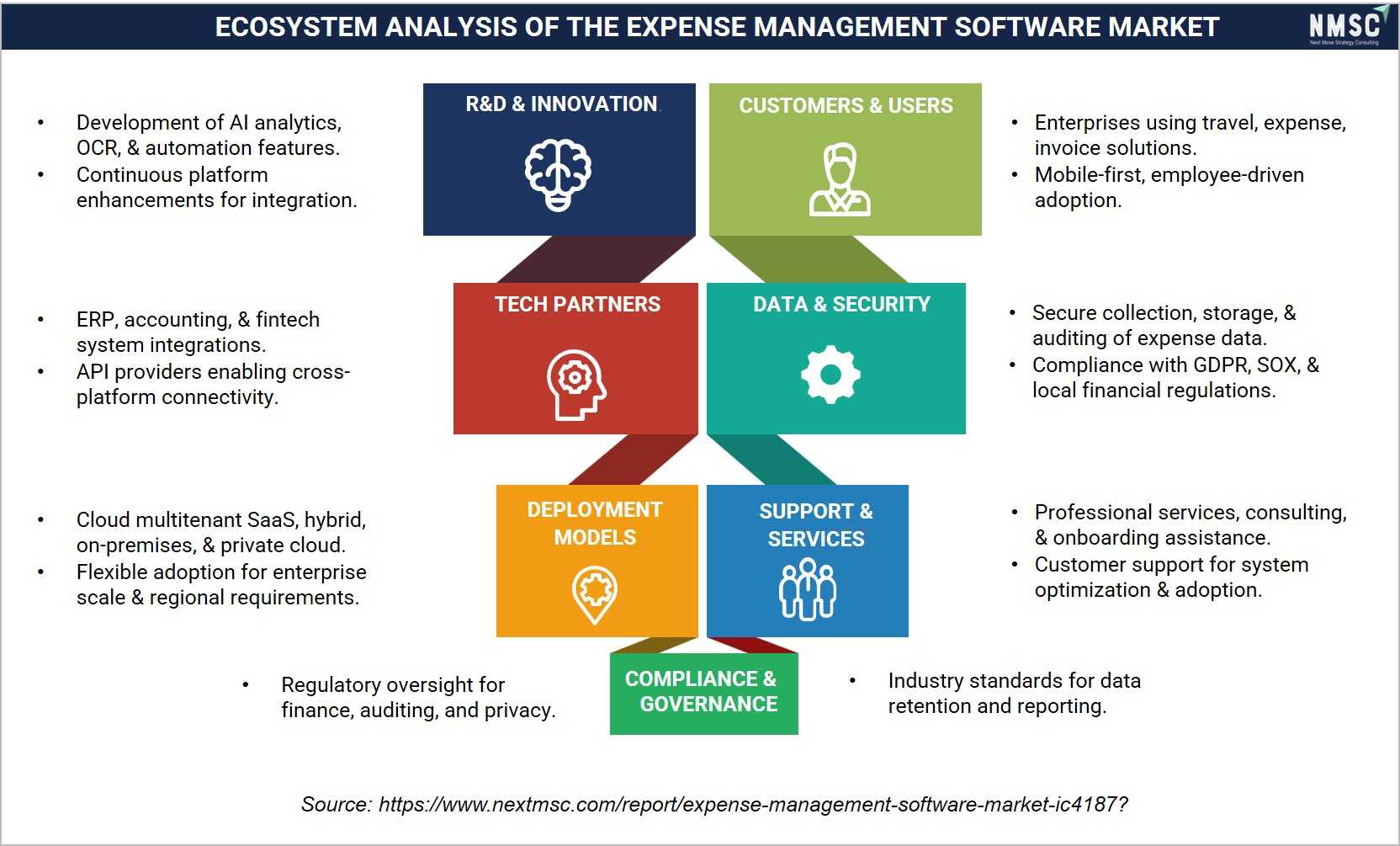
Our assessment outlines the interconnected ecosystem of the expense management software market, highlighting how innovation, customer adoption, and technology partnerships drive market evolution. Enterprise demand is strongly influenced by AI-powered automation, cloud-first deployment, and seamless ERP integrations, while robust data security and regulatory compliance underpin trust and scalability. Further, professional services and support accelerate adoption by enabling operational efficiency and user engagement. By visualizing the ecosystem from R&D to governance, the diagram clarifies key strategic levers, helping executives and investors identify value creation opportunities, optimize investment decisions, and plan long-term growth strategies in this rapidly evolving market.
What Are the Key Market Drivers, Breakthroughs, and Investment Opportunities That Will Shape the Expense Management Software Market in the Next Decade?
Growth Catalyst & Risk Assessment Matrix
|
DRIVERS/TRENDS/ RESTRAINTS |
(+/-) % IMPACT ON CAGR FORECAST |
GEOGRAPHIC RELEVANCE |
IMPACT TIMELINE |
|
Digital transformation is driving a shift from manual to automated, cloud-enabled expense management solutions |
+5.12% |
North America, Europe, Asia-Pacific (India, China, Southeast Asia) |
Short to Medium term (1–4 years) |
|
Regulatory compliance and corporate governance requirements boosting the adoption of audit-ready, automated reporting platforms |
+4.45% |
North America, Europe, Australia |
Medium to Long term (2–5 years) |
|
SMEs seeking cost-effective, scalable, and modular cloud-based platforms enabling wider market penetration |
+3.05% |
Asia-Pacific (India, Southeast Asia), Latin America, Africa |
Medium to Long term (2–6 years) |
|
Data privacy and cybersecurity concerns limiting adoption of cloud-based expense management platforms |
-3.82% |
Global (high sensitivity in North America, Europe, and Asia-Pacific) |
Short to Medium term (1–3 years) |
Our assessment indicates that the expense management software market is currently being shaped by a combination of digital adoption and structural enterprise transformation trends. The shift from manual, spreadsheet-based expense tracking to automated, cloud-enabled solutions and cloud-based expense management systems is driving operational efficiency, reducing errors, and strengthening compliance across organizations. Further, finance and operations teams face mounting pressure to optimise workflows, integrate with ERP systems, and adopt real-time expense monitoring platforms that improve financial visibility and operational control, particularly in sectors such as BFSI, IT services, and large-scale manufacturing, which are accelerating expansion across the broader market.
At the same time, regulatory compliance requirements are reinforcing demand, as automated business expense reporting, digital approvals, and audit-ready documentation mitigate the risk of non-compliance penalties. However, rising data security and privacy concerns remain a critical restraint, with finance and IT departments cautious about migrating sensitive financial and personal data to cloud platforms. Industry insights further suggest that SMEs present a key growth opportunity, as scalable, cost-effective, and modular solutions enable smaller organizations to pursue digitalization, enhance operational efficiency, and improve compliance, positioning vendors to capture substantial untapped market potential.
Growth Drivers:
How Is Digital Transformation Accelerating the Expense Management Software Market Demand?
NMSC’s analysis indicates that the ongoing digital transformation across enterprises is a primary growth driver for the expense management software market. Consequently, organizations are increasingly shifting from manual, spreadsheet-based expense tracking to automated, cloud-enabled solutions designed for travel and expense management, which help enhance operational efficiency, reduce processing errors, and ensure compliance. Furthermore, we noticed that finance departments are under mounting pressure to optimise workflows, integrate with ERP systems, and generate real-time insights. In addition, we observed that sectors such as BFSI, IT services, and large-scale manufacturing are spearheading adoption, largely driven by the need to improve data accuracy, accelerate employee reimbursement automation, and enforce robust audit trails, thereby further expanding the market footprint globally. This trend is also strengthening growth across the travel & expense (T&E) management software market among multinational enterprises.
How Is Regulatory Compliance Driving the Expense Management Software Market Adoption?
Stringent regulatory frameworks and corporate governance requirements are increasingly compelling enterprises to adopt expense management software. Based on our evaluation, we found that finance and compliance teams are progressively relying on these platforms to ensure adherence to tax laws, anti-fraud regulations, and internal audit policies. Moreover, automated expense reporting, digital approvals, and audit-ready documentation collectively help reduce the risk of non-compliance penalties. Advanced receipt scanning and OCR expense tools are also improving document verification accuracy and simplifying audit processes. As a result, regions with complex fiscal regimes, such as North America and Europe, are witnessing accelerated deployment of software solutions capable of generating comprehensive compliance reports, thereby positioning regulatory compliance as a key catalyst for expense management software market growth.
Growth Inhibitor:
How Are Data Security Concerns Limiting Expense Management Software Market Expansion?
Rising concerns regarding data privacy and cybersecurity present a significant restraint for the expense management software market. Our analysis indicates that finance teams and IT departments remain cautious about migrating sensitive financial and personal data to cloud-based platforms, primarily due to potential breaches, compliance risks, and inadequate security protocols in some legacy solutions. Furthermore, smaller organizations, in particular, face challenges in evaluating vendor security certifications and implementing multi-layered encryption across connected financial applications. Consequently, these apprehensions slow adoption, especially among enterprises implementing mobile-first expense management solutions that process large volumes of employee and transactional data, underscoring the necessity for robust security frameworks and continuous vendor audits to sustain market confidence.
Growth Opportunity:
How Is the SME Segment Creating New Market Potential?
Industry insights indicate that small and medium-sized enterprises (SMEs) represent a significant growth opportunity in the expense management software market. In particular, SMEs are increasingly seeking cost-effective, scalable, and cloud-enabled platforms that reduce administrative burden while enabling strategic financial oversight. Our discussions with investors and SaaS providers further reveal that subscription-based models, modular deployments, and mobile-first access are lowering barriers to entry, thereby making advanced solutions accessible to smaller organizations. As a result, as SMEs pursue digitalization to improve operational efficiency and compliance, vendors offering flexible, intuitive, and integrative solutions with enhanced business expense reporting capabilities are well-positioned to capture untapped demand, establishing substantial long-term growth potential across emerging markets.
How Is the Expense Management Software Market Segmented in This Report, and What Are the Key Insights From the Segmentation Analysis?
Market Highlights & Strategic Insights - Expense Management Software Market:
|
Segments |
Key Takeaways |
|
Product Type |
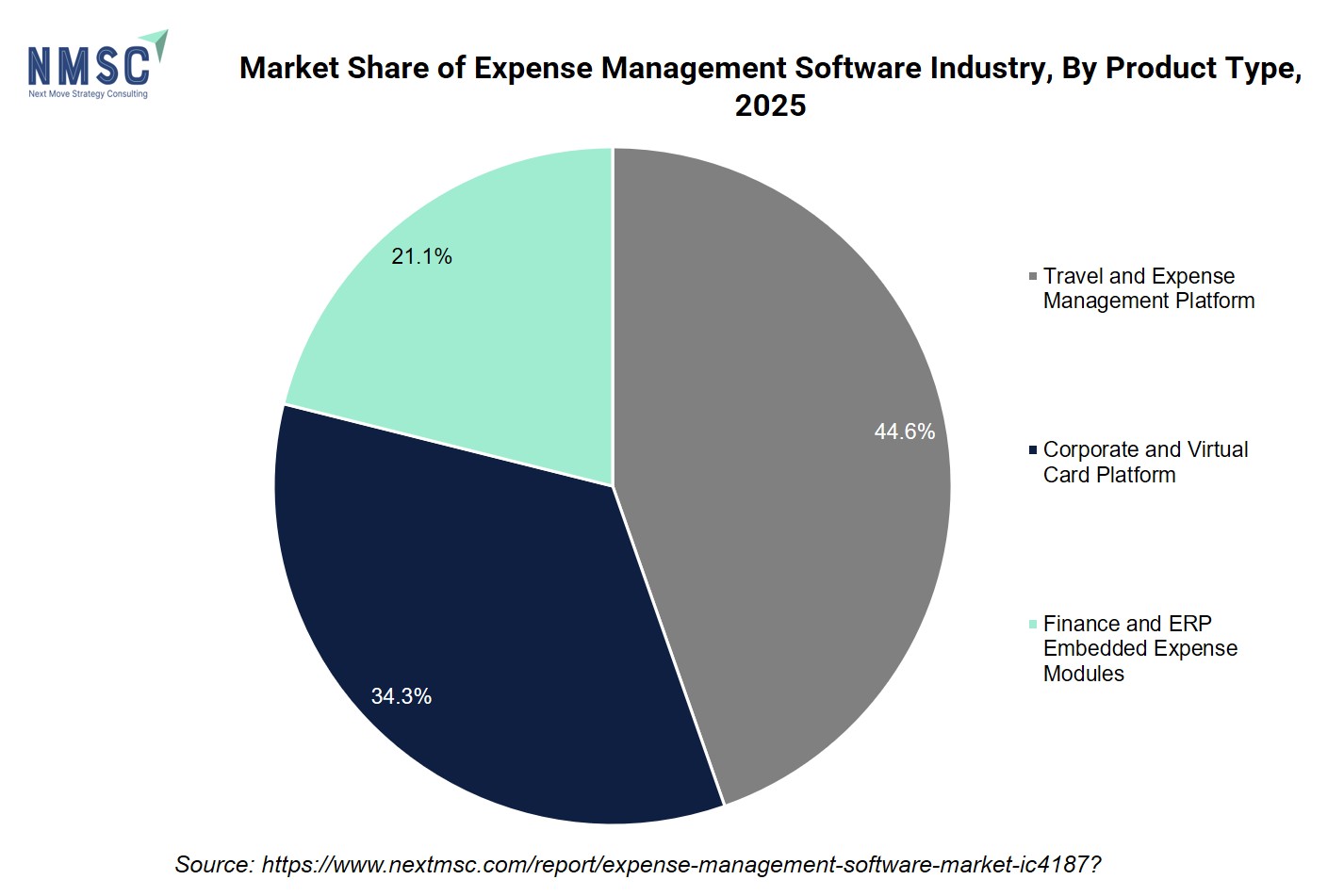
NMSC’s assessment indicates that travel and expense management Platforms dominate the market with a 44.6% share, driven by rising enterprise demand for integrated travel booking, expense tracking, and reimbursement management solutions. Meanwhile, Corporate and Virtual Card Platforms and Finance and ERP-Embedded Expense Modules support broader enterprise payment and financial operations requirements. |
|
Revenue Stream |
Software and License Revenue lead with an 81.8% share, reflecting the strong dominance of SaaS-based and subscription-driven delivery models. Industry analysis suggests that recurring revenue structures support stable vendor income, while Professional Services Revenue and Card and Payment Revenue contribute through implementation, consulting, and transaction-based monetization services. |
|
Deployment Model |
Cloud deployment dominates with an 83.0% share, highlighting the rapid transition toward scalable, cost-efficient, and remotely accessible software environments. Based on our evaluation, enterprises increasingly prefer cloud-native platforms due to faster deployment, lower infrastructure dependency, and seamless software updates, while on-premises and hybrid models support stricter security and compliance needs. |
|
Functional Modules |
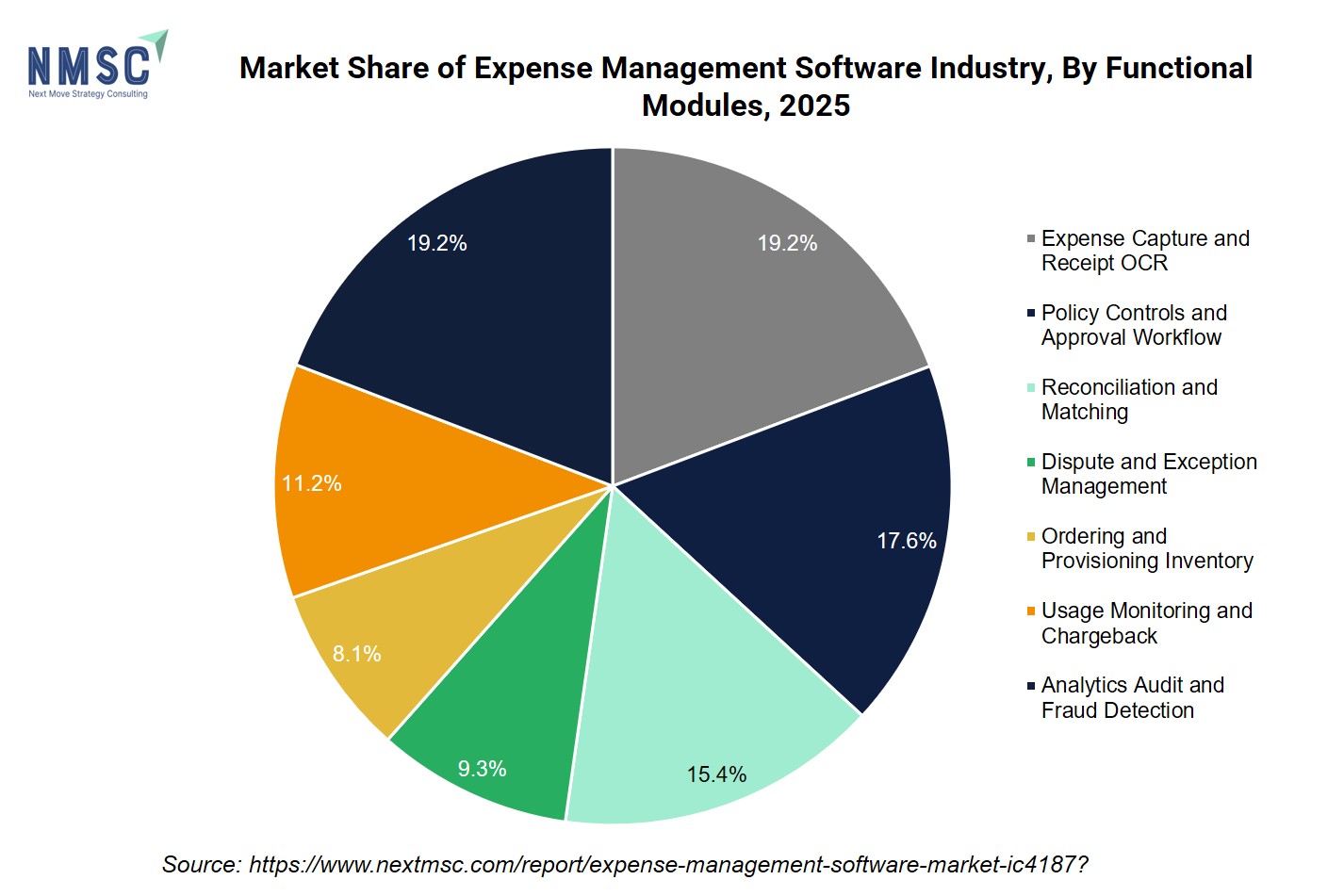
Expense Capture and Receipt OCR and Analytics, Audit and Fraud Detection jointly lead the market with a 19.2% share each, followed by Policy Controls and Approval Workflow modules. NMSC evaluation indicates that enterprises prioritize automation, policy compliance, audit readiness, and fraud prevention to strengthen operational efficiency and financial governance. |
|
Industry Vertical |
Information Technology and Telecom leads the market with a 14.3% share, driven by high digital adoption and distributed workforce structures. Our market research suggests that BFSI and Manufacturing and Industrials also contribute significantly due to growing compliance requirements and increasing financial workflow automation initiatives. |
By Product Type Insights
Is Integrated Platform Adoption Driving the Expense Management Software Market in 2025?
On the basis of product type, the expense management software market is segmented into travel and expense management platforms, corporate and virtual card platforms, and finance and ERP-embedded expense modules.
Based on our evaluation, we found that travel and expense management platforms dominate the market due to their ability to deliver integrated, end-to-end expense workflows within a unified ecosystem. Enterprises increasingly prefer platforms that combine travel booking, expense tracking, reimbursement management, and policy enforcement to improve financial visibility and operational efficiency. Meanwhile, Corporate and Virtual Card Platforms are gaining traction through fintech-driven payment innovation, while Finance and ERP-Embedded Expense Modules support integrated enterprise financial operations and workflow management. As a result, the growing preference for centralized and automated expense ecosystems continues to strengthen the dominance of integrated platform solutions across enterprises.
By Deployment Model Insights
Is Cloud-First Deployment Driving the Expense Management Software Market in 2025?
Based on deployment model, the expense management software market is segmented into Cloud, On-premises, and Hybrid.
Cloud deployment dominates the market due to its scalability, cost-effectiveness, and alignment with modern enterprise IT strategies. Based on our research, we found that organizations increasingly prioritize cloud-based platforms to enable real-time financial visibility, remote accessibility, simplified deployment, and seamless enterprise system integration. Meanwhile, hybrid and on-premises models continue supporting organizations requiring greater customization, data control, and regulatory compliance capabilities. Consequently, rising enterprise preference for flexible and scalable cloud-native environments continues to accelerate cloud deployment adoption across the global market.
By Functional Modules Insights
Are Automation and Compliance-Centric Functional Modules Driving the Expense Management Software Market in 2025?
Based on functional modules, the expense management software market is segmented into Expense Capture and Receipt OCR, Policy Controls and Approval Workflow, Reconciliation and Matching, Dispute and Exception Management, Ordering and Provisioning Inventory, Usage Monitoring and Chargeback, and Analytics, Audit and Fraud Detection.
Our research indicates that Expense Capture and Receipt OCR dominate the functional module landscape due to its direct impact on automation, processing accuracy, and user experience enhancement. We further observed that policy enforcement, reconciliation, audit readiness, and fraud detection functionalities are becoming increasingly important as organizations strengthen financial governance and compliance management frameworks. Industry evidence suggests that vendors are integrating OCR, analytics, and fraud monitoring capabilities into unified platforms, positioning automation and compliance-focused modules as major long-term growth drivers. Therefore, the increasing enterprise focus on operational efficiency, financial transparency, and regulatory compliance continues to drive demand for advanced functional modules.
By Industry Vertical Insights
Is Digital Adoption Across Industries Driving the Expense Management Software Market in 2025?
Based on industry vertical, the expense management software market is segmented into BFSI, Information Technology and Telecom, Manufacturing and Industrials, Retail and E-commerce, Healthcare and Life Sciences, Government and Public Sector, Hospitality, Travel and Leisure, Energy and Utilities, Education and Non-Profit, Transportation and Logistics, Professional Services and Consulting, and Other Industries.
Based on our assessment, we observed that Information Technology and Telecom dominate the market due to high digital adoption, distributed workforce structures, and strong reliance on automated financial workflows. While BFSI and Manufacturing and Industrials also contribute significantly due to compliance requirements and operational complexity, the broader market continues witnessing diversified adoption across industries. Moreover, increasing digital transformation initiatives, regulatory requirements, and demand for financial visibility are collectively supporting long-term expense management software market expansion. As a result, industry-specific customization and workflow automation capabilities are emerging as critical factors influencing future competitive positioning and adoption trends.
Regional Outlook:
Geographic Performance Snapshot:
|
Countries |
Corrected Key Takeaways |
|
North America |
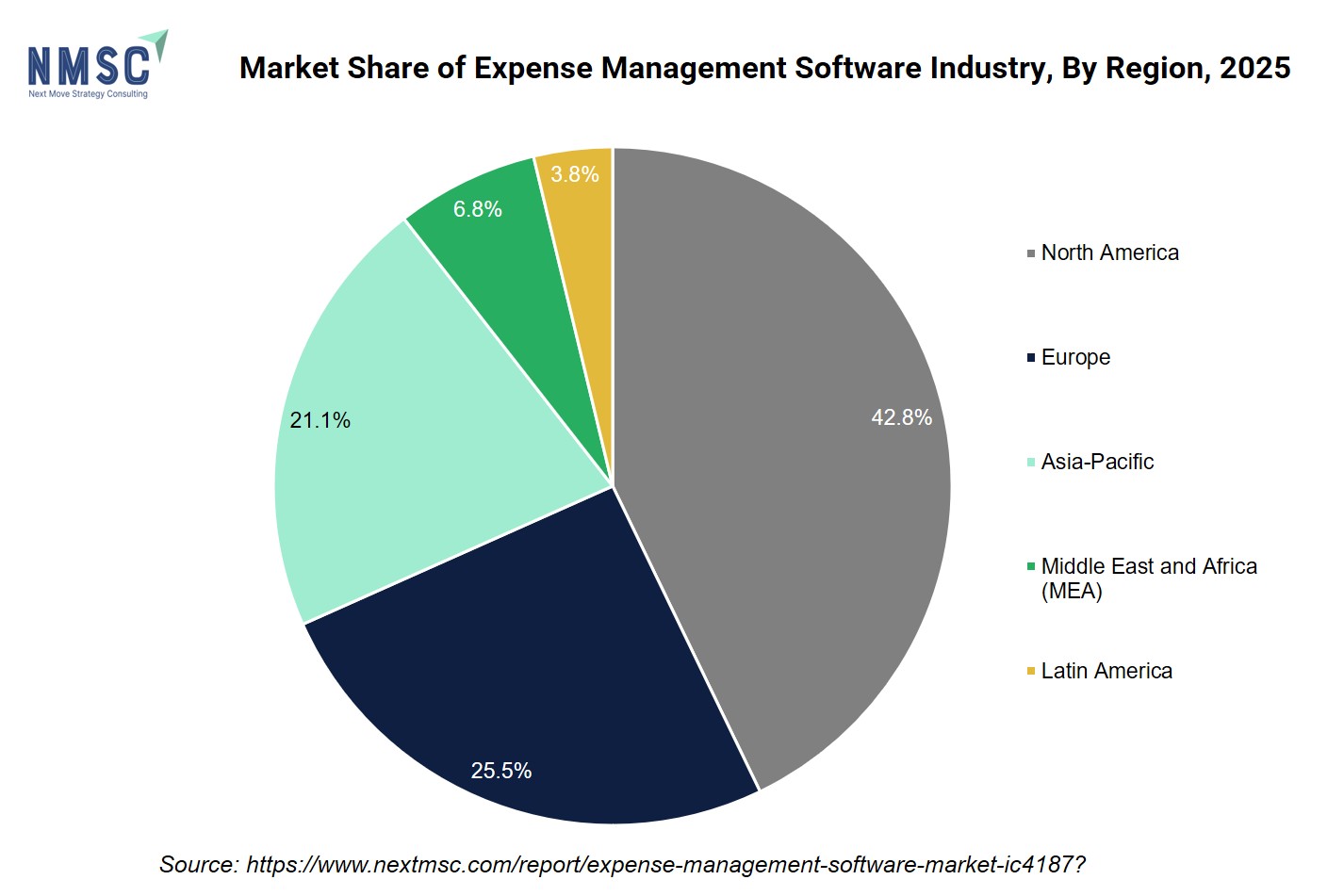
North America accounts for 42.8% of the global expense management software market, supported by strong enterprise adoption, mature SaaS ecosystems, and high demand for integrated financial management solutions. Based on our analysis, we found that organizations across the region increasingly prioritize automation, compliance management, and real-time financial visibility, positioning North America as the leading regional market. |
|
Europe |
Europe represents 25.5% of the global Market, with growth driven by strict regulatory requirements and increasing focus on financial governance and audit readiness. Our evaluation indicates that enterprises are adopting expense management solutions to strengthen compliance, transparency, and operational efficiency, while sustainability reporting requirements are also influencing platform adoption trends. |
|
Asia-Pacific |
Asia-Pacific holds 21.1% of the global market, driven by rapid digital transformation, expanding SME ecosystems, and rising cloud adoption across developing economies. Based on our research, we observed that businesses increasingly seek scalable and cost-efficient expense management solutions, particularly across India and Southeast Asia, supporting strong regional growth momentum. |
|
Middle East and Africa (MEA) |
The Middle East and Africa account for 6.8% of the global market, supported by ongoing digital transformation initiatives and government-led modernization programs. Industry analysis suggests that enterprises across the region are gradually increasing adoption of automated financial management solutions, although infrastructure gaps and uneven digital maturity continue to influence implementation rates. |
|
Latin America |
Latin America holds 3.8% of the global expense management software market, characterized by gradual enterprise digitalization and increasing awareness of automated expense management solutions. Based on our assessment, we found that economic volatility and regulatory complexity continue to encourage cautious technology investments, resulting in selective but steadily growing market adoption. |
The expense management software market is geographically studied across North America, Europe, Asia Pacific, the Middle East & Africa, and Latin America, and each region is further studied across countries.
Expense Management Software Market in North America
expense management software market in North America represents a highly mature and enterprise-centric ecosystem supported by advanced SaaS penetration, strong fintech integration, and widespread enterprise automation adoption. NMSC’s findings suggest that organizations across BFSI, retail, healthcare, and professional services sectors increasingly prioritize integrated expense and spend management platforms to strengthen financial visibility and policy compliance. Furthermore, enterprises continue expanding adoption of AI-enabled reimbursement automation, embedded payment systems, and analytics-driven financial controls to improve operational efficiency. The United States leads regional demand through large-scale enterprise deployments, while Canada demonstrates stable adoption across mid-sized businesses and SMEs. In addition, strong cloud infrastructure and digital finance ecosystems continue accelerating platform modernization initiatives, positioning North America as the benchmark market for enterprise expense management innovation and large-scale software deployment.
Expense Management Software Market in the United States
Based on research conducted by NMSC, we found that the United States remains the largest and most innovation-driven market for expense management software within North America. High enterprise density, rapid cloud adoption, and a mature fintech environment continue supporting deployment of integrated spend management platforms across industries. Organizations increasingly implement solutions combining expense tracking, procurement workflows, corporate cards, and payment automation within unified financial ecosystems. Moreover, hybrid workforce structures and complex tax governance frameworks continue driving demand for mobile-first and compliance-focused software platforms. Strong venture capital investment and embedded finance innovation are also reshaping vendor competition across the market. This evolving landscape is steadily shifting enterprise purchasing preferences toward scalable, API-driven, and AI-enabled expense management ecosystems capable of supporting enterprise-wide financial operations.
Expense Management Software Market in Canada
Canada demonstrates stable and steadily evolving growth within the expense management software market, supported by increasing cloud adoption, expanding SME digitization, and rising enterprise focus on workflow efficiency. Our assessment indicates that organizations increasingly adopt automated expense management platforms to improve reimbursement tracking, strengthen compliance readiness, and reduce administrative inefficiencies across financial operations. Additionally, cross-border trade activities with the United States continue encouraging enterprises to standardize financial reporting and spend management processes. Compared with larger regional markets, Canadian businesses place greater emphasis on deployment reliability, operational continuity, and long-term usability rather than aggressive platform customization. As digital transformation initiatives continue expanding across enterprises, the market is gradually creating stronger opportunities for vendors offering scalable, service-oriented, and compliance-focused expense management solutions tailored to mid-sized organizations.
Expense Management Software Market in Europe
Our analysis shows that Europe remains a regulation-intensive and compliance-focused market environment, where enterprise software adoption is strongly influenced by GDPR standards, tax governance requirements, and audit-focused financial reporting frameworks. Organizations increasingly integrate expense management solutions with ERP and accounting platforms to improve operational transparency, reimbursement control, and audit readiness across multinational operations. Moreover, sustainability reporting obligations and ESG-related financial disclosures are becoming influential procurement considerations among large enterprises. Adoption dynamics differ across regions, with Western Europe emphasizing mature SaaS integration and Northern Europe prioritizing automation and sustainability-linked reporting capabilities. These evolving regulatory and operational requirements continue increasing enterprise preference for highly secure, interoperable, and governance-oriented expense management platforms across the European market.
Expense Management Software Market in the United Kingdom
NMSC’s analysis indicates that the United Kingdom represents one of Europe’s most digitally mature and fintech-driven software markets. Enterprises increasingly adopt cloud-native expense and spend management platforms to support hybrid work environments, improve policy compliance, and strengthen financial oversight across distributed operations. Meanwhile, interoperability with banking infrastructure and digital payment ecosystems has emerged as a major differentiating factor among vendors operating in the region. The country’s active fintech startup environment further accelerates innovation surrounding embedded finance, AI-enabled analytics, and automated spend controls. As enterprise demand shifts toward integrated financial ecosystems rather than standalone reimbursement tools, vendors increasingly compete through platform connectivity, embedded payments functionality, and intelligent workflow automation capabilities.
Expense Management Software Market in Germany
expense management software market in Germany is characterized by structured enterprise operations, industrial-scale financial workflows, and strong emphasis on data governance and operational precision. Based on our market evaluation, we noticed that manufacturing and export-oriented organizations increasingly deploy expense management platforms to strengthen cost visibility, simplify approval workflows, and improve ERP interoperability across complex enterprise environments. However, enterprise adoption remains relatively measured due to strict privacy expectations and preference for highly secure software infrastructures. In addition, German buyers prioritize long-term reliability, process continuity, and integration depth during vendor selection processes. Rather than pursuing rapid deployment alone, enterprises increasingly focus on operational stability and governance alignment, encouraging demand for enterprise-grade expense management systems with strong compliance and interoperability capabilities.
Expense Management Software Market in France
France represents a highly compliance-oriented market, where complex VAT structures, audit documentation requirements, and financial governance standards strongly influence enterprise software adoption patterns. Through NMSC's assessment, we found that organizations increasingly prioritize expense management platforms capable of automating reimbursement validation, tax-sensitive expense categorization, and audit-ready reporting workflows. Additionally, enterprises emphasize localized accounting compatibility and seamless integration with financial management systems when evaluating software vendors. Regulatory scrutiny surrounding transaction accuracy and reporting transparency continues accelerating modernization of traditional reimbursement and approval processes across industries. These market conditions are steadily favouring providers capable of delivering strong localization capabilities, embedded compliance intelligence, and structured workflow automation aligned with French taxation and enterprise accounting environments.
Expense Management Software Market in Italy
Italy reflects a gradually modernizing expense management software landscape shaped by SME-driven business structures and increasing transition toward digitized financial workflows. From our research, we found that organizations increasingly adopt cloud-based expense management solutions to reduce manual administrative burdens, simplify approval processes, and improve operational transparency across distributed business functions. Government initiatives promoting digital invoicing and electronic tax reporting are further encouraging enterprises to automate reimbursement and expense tracking activities. Compared with more mature Western European markets, adoption remains heavily focused on usability, affordability, and deployment simplicity rather than advanced analytics functionality. This evolving market environment continues creating strong demand for intuitive, lightweight, and cost-efficient expense management platforms tailored to small and medium-sized enterprises.
Expense Management Software Market in Spain
Through our market assessment, we observed that Spain is evolving as an efficiency-driven and operationally focused market, supported by growing cloud adoption and rising enterprise emphasis on financial visibility. Organizations across retail, hospitality, and service-oriented industries increasingly deploy automated expense management platforms to improve reimbursement efficiency, spending oversight, and workflow standardization. Additionally, enterprises demonstrate strong preference for software solutions offering rapid deployment, intuitive interfaces, and measurable operational outcomes. Rising focus on cost optimization and workflow automation is also encouraging adoption among mid-sized enterprises and decentralized business environments. As operational agility becomes a higher strategic priority, vendors capable of combining affordability, scalability, and integration simplicity are strengthening their competitive positioning within the Spanish market.
Expense Management Software Market in the Nordics
The Nordic countries, comprising Sweden, Norway, and Finland, represent a highly digitalized and innovation-focused market environment for expense management software adoption. Our analysis shows that enterprises across the region increasingly prioritize automation, sustainability-linked financial reporting, and seamless integration with banking and payroll ecosystems. Furthermore, organizations demonstrate strong interest in AI-enabled analytics, cloud-native deployment models, and ESG-focused reporting functionalities to improve operational transparency and governance standards. High enterprise digital maturity and trust in automation technologies continue supporting rapid implementation of intelligent financial management platforms across industries. This advanced operating environment increasingly rewards vendors capable of delivering sophisticated automation capabilities, sustainability-oriented financial insights, and interoperable enterprise ecosystem integration.
Expense Management Software Market in the Asia-Pacific
expense management software market in the Asia-Pacific represents the fastest-growing regional ecosystem, supported by rapid digital transformation, expanding SME participation, and increasing adoption of cloud-native enterprise software platforms. Based on NMSC's research, we found that organizations across China, India, Japan, and Southeast Asia increasingly deploy automated expense management solutions to replace manual reimbursement processes and improve financial workflow efficiency. Moreover, mobile-first enterprise operations and rising workforce digitization continue accelerating demand for scalable and remotely accessible expense management platforms. Adoption patterns vary considerably across the region depending on enterprise maturity, infrastructure readiness, and regulatory environments. These regional dynamics continue encouraging vendors to prioritize localized deployment models, flexible pricing structures, and integration-focused software ecosystems tailored to diverse operational requirements.
Expense Management Software Market in China
China represents the largest expense management software market within Asia-Pacific, driven by large-scale enterprise digitization and highly integrated domestic software ecosystems. In our observation, we found that organizations increasingly prefer expense management capabilities embedded within broader ERP, procurement, and payment infrastructures instead of standalone reimbursement software environments. Domestic technology providers continue dominating the market through localized financial platforms, integrated payment systems, and strong compatibility with regional compliance frameworks. Furthermore, large enterprises prioritize automation tools capable of supporting high transaction volumes and centralized financial visibility across distributed operations. As enterprise software ecosystems become increasingly interconnected, market competitiveness is steadily shifting toward vendors offering deeper workflow integration, localized customization, and seamless interoperability with domestic financial technologies.
Expense Management Software Market in Japan
expense management software market in Japan reflects a structured and precision-oriented enterprise environment, where organizations prioritize workflow discipline, operational continuity, and long-term system reliability. Our findings suggest that enterprises continue relying on approval-intensive and documentation-heavy financial management processes, gradually shaping software modernization strategies across industries. Buyers strongly emphasize platform stability, seamless legacy system integration, and process accuracy rather than rapid transformation alone. Additionally, enterprises remain cautious toward disruptive workflow changes, encouraging gradual deployment of automation capabilities within existing operational structures. This measured adoption environment increasingly benefits vendors capable of modernizing financial workflows while preserving enterprise process stability, governance consistency, and long-established operational standards across Japanese organizations.
Expense Management Software Market in India
We analyzed that India represents a fast-expanding and mobile-first market, supported by rising SME digitization, expanding enterprise mobility, and strong growth in cloud-based financial operations. Organizations increasingly adopt automated expense management platforms to support real-time expense capture, remote approvals, and scalable reimbursement workflows across geographically distributed operations. Additionally, cost sensitivity and deployment flexibility remain major purchasing considerations among enterprises operating across diverse sectors. Demand for modular subscription-based software models is also increasing as businesses prioritize operational scalability and affordability. As enterprise digitization accelerates across both startups and established firms, vendors capable of delivering lightweight, mobile-centric, and cost-efficient expense management ecosystems continue achieving stronger adoption momentum across the Indian market.
Expense Management Software Market in South Korea
South Korea represents a highly advanced and technology-intensive market characterized by strong digital infrastructure and rapid enterprise automation adoption. Our assessment indicates that organizations increasingly prioritize integrated financial management platforms capable of delivering real-time visibility, automated approvals, and analytics-driven decision-making capabilities. Demand remains particularly strong across technology, electronics, and logistics industries requiring highly efficient operational environments and scalable financial workflows. In addition, enterprises demonstrate strong preference for software ecosystems supporting interoperability across payment platforms, ERP systems, and enterprise analytics infrastructure. This highly connected enterprise landscape continues encouraging competition around intelligent automation, AI-enabled analytics, and seamless financial workflow orchestration capabilities among software vendors operating in South Korea.
Expense Management Software Market in Taiwan
expense management software market in Taiwan is closely aligned with the country’s globally integrated electronics and manufacturing ecosystem, where enterprises increasingly require connected financial management workflows across procurement, supplier payments, and project-based operations. In our observation, we found that organizations prioritize ERP interoperability, multi-currency expense tracking, and real-time financial visibility when selecting expense management software platforms. Additionally, export-oriented industries increasingly seek automated reimbursement and approval systems capable of supporting cross-border operational complexity and distributed supplier networks. Enterprises also demonstrate strong preference for stable and integration-focused software ecosystems rather than standalone expense automation tools. This operating environment continues strengthening demand for vendors capable of delivering seamless enterprise integration, localized support capabilities, and scalable financial workflow management solutions across Taiwan’s manufacturing-driven economy.
Expense Management Software Market in Indonesia
Indonesia represents an emerging and high-potential market supported by rapid urbanization, expanding SME participation, and improving digital infrastructure across enterprises. Through our market assessment, we observed that organizations increasingly adopt cloud-based expense management platforms to replace manual bookkeeping systems, improve reimbursement accuracy, and strengthen financial process visibility. Moreover, affordability, mobile accessibility, and simplified deployment remain critical purchasing considerations among businesses operating across decentralized and developing commercial environments. Growing enterprise awareness regarding workflow automation and digital financial operations is also gradually accelerating adoption momentum across sectors. As market maturity continues improving, vendors offering lightweight deployment models, localized interfaces, and flexible subscription structures are increasingly gaining competitive advantage within Indonesia’s evolving expense management ecosystem.
Expense Management Software Market in Australia
expense management software market in Australia reflects a highly mature and compliance-oriented enterprise environment, where organizations increasingly integrate expense management platforms into broader financial and operational ecosystems. Our analysis shows that enterprises prioritize automation, audit readiness, and seamless integration with accounting, payroll, and taxation systems to improve governance standards and workflow efficiency. Additionally, demand is steadily shifting toward AI-enabled analytics, intelligent reporting functionalities, and operational optimization capabilities rather than first-time software implementation. Buyers also place strong emphasis on long-term vendor reliability, service continuity, and enterprise-grade compliance support across financial operations. This mature adoption landscape increasingly favours providers capable of delivering advanced automation, analytics-driven financial oversight, and scalable integration capabilities aligned with enterprise modernization strategies.
Expense Management Software Market in Latin America
Based on our market evaluation, we noticed that Latin America represents a structurally diverse and gradually evolving market, where enterprise adoption patterns vary considerably across countries due to economic volatility, regulatory complexity, and differing levels of digital maturity. Organizations increasingly deploy automated expense management solutions to improve financial discipline, strengthen spending visibility, and streamline reimbursement workflows across operations. Additionally, large enterprises within retail, manufacturing, and financial services sectors continue leading software adoption, while SMEs remain comparatively cautious because of budget constraints and uncertain economic conditions. Regional demand is also influenced by increasing enterprise digitization initiatives and rising focus on operational transparency. These conditions continue creating opportunities for vendors offering localized, flexible, and cost-efficient financial workflow automation platforms.
Expense Management Software Market in the Middle East & Africa
Middle East & Africa represents a regionally diverse expense management software landscape, where adoption patterns differ significantly between digitally advanced Gulf economies and emerging African enterprise environments. From our research, we found that organizations across the UAE and Saudi Arabia increasingly deploy integrated expense management platforms to support large-scale operations, financial governance, and enterprise modernization initiatives. Meanwhile, several African markets remain in earlier stages of financial software digitization, where organizations gradually transition from manual reimbursement systems toward cloud-based workflow automation platforms. Infrastructure readiness, digital maturity, and enterprise investment capacity continue shaping regional adoption dynamics across industries. This evolving regional ecosystem increasingly rewards vendors capable of delivering scalable, modular, and region-specific deployment strategies aligned with varying operational and technological requirements.
Strategic Framework of the Expense Management Software Industry
The infographic presents a strategic framework for the expense management software market, highlighting key drivers, operational levers, and market forces shaping adoption and growth.
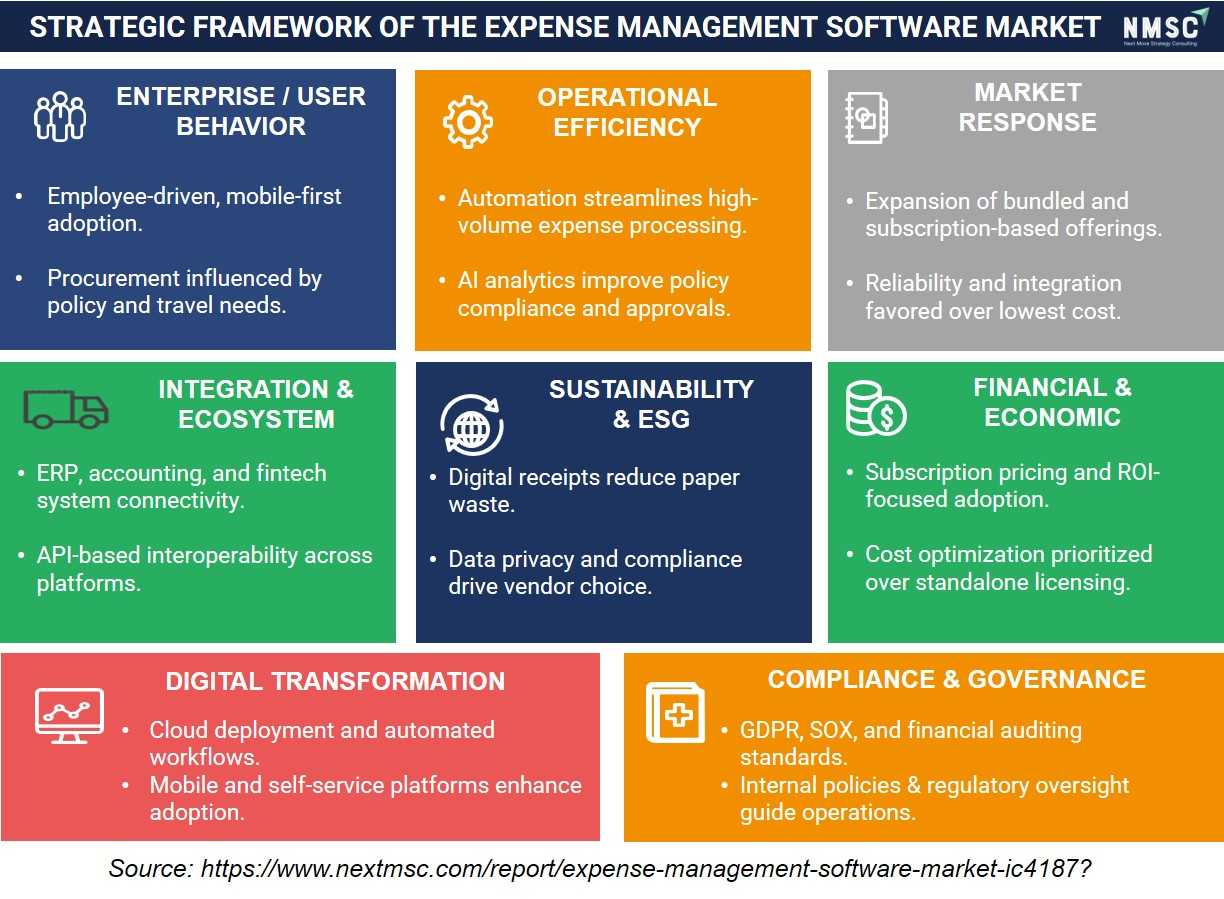
The above infographic illustrates the Expense Management Software ecosystem through a strategic framework, highlighting how enterprise behaviour, operational efficiency, and market responses drive growth. We noticed that automation, cloud-based deployment, and AI-enabled analytics enhance productivity and policy compliance, while integration with ERP and fintech systems strengthens adoption across enterprises. Sustainability, regulatory compliance, and data governance are increasingly influencing vendor selection and operational decisions. Financial models further favour subscription and ROI-focused approaches, and digital transformation initiatives, including mobile and self-service platforms, accelerate uptake. By visualizing these interconnected levers, the framework provides executives and investors with actionable insights to optimize deployment strategies, manage costs, and anticipate market evolution.
Competitive Landscape
Competitive Dynamics & M&A Landscape:
|
Key Takeaways |
|
The expense management software market is primarily led by major players, including SAP SE (SAP Concur), Oracle Corporation, Workday, Inc., Coupa Software Inc., Emburse, Inc., and BILL Holdings, Inc., alongside high-growth innovators such as Ramp Business Corporation, Brex Inc., Navan, Inc., and Payhawk. These companies compete through platform scalability, deep ERP integrations, and comprehensive spend management capabilities, enabling them to serve large enterprises as well as rapidly expanding SME segments across global markets. |
|
Leading companies distinguish themselves through AI-driven automation, real-time expense visibility, mobile-first platforms, and embedded financial services such as corporate cards and spend controls. Based on our analysis, we found that their ability to offer unified solutions integrating travel, expense, procurement, and payments enhances operational efficiency and user experience. Strategic emphasis on compliance, data security, and seamless interoperability with enterprise systems further strengthens their competitive positioning in an increasingly digital and compliance-driven market environment. |
|
Companies are actively pursuing partnerships, ecosystem integrations, and selective acquisitions to expand technological capabilities and regional reach. Industry analysis suggests that initiatives such as AI-powered analytics, intelligent workflow automation, and integrated financial operations platforms are reinforcing competitive differentiation. Our evaluation indicates that vendors focusing on modular SaaS delivery, API-driven architectures, and SME-focused offerings are well-positioned to capture emerging demand, supporting long-term growth and market resilience through 2025–2026. |

Which Companies Dominate the Expense Management Software Industry and How Do They Compete?
NMSC’s evaluation indicates that the expense management software market is led by a combination of enterprise-scale providers such as SAP SE (SAP Concur), Oracle Corporation, Workday, Inc., and Coupa Software Inc., alongside high-growth innovators including Ramp Business Corporation, Brex Inc., Navan, Inc., and Payhawk. Large vendors primarily compete through deep ERP integration, global scalability, compliance management, and unified financial workflow capabilities, while emerging players differentiate through mobile-first platforms, embedded finance offerings, and real-time spend visibility. Furthermore, vendors increasingly focus on integrated ecosystems combining travel, expense, procurement, and payments within a single platform. For instance, Workday continues expanding its financial management integration capabilities, reinforcing its enterprise-focused positioning across global markets.
Market Dominated by Expense Management Software Market Giants and Specialists
In our assessment, we observed that market competition follows a dual-layered structure where global enterprise vendors dominate large organizations, while regional and niche providers increasingly target SMEs and specialized operational requirements. Companies such as Sage Group Plc (Sage Intacct), Emburse, Inc., and Payhawk continue strengthening market presence through localized compliance support, vertical-focused functionality, and flexible deployment capabilities. At the same time, vendors including Pleo Technologies Ltd, Spendesk Ltd, and Rydoo NV focus heavily on mobile-centric and simplified expense management experiences tailored for European SMEs. Industry evidence further suggests that strategic partnerships and ecosystem integrations are becoming increasingly important, particularly across banking, accounting, and payment infrastructures. For example, Sage continues expanding the Sage Intacct partner ecosystem to strengthen interoperability across broader enterprise financial workflows.
Innovation and Adaptability Drive the Market Success
Continuous innovation across AI, automation, analytics, and mobile functionality remains a major competitive differentiator within the Market. Based on our market evaluation, we noticed that vendors increasingly invest in AI-driven expense categorization, predictive analytics, intelligent policy enforcement, and fraud detection capabilities to improve operational efficiency and financial decision-making. In addition, enterprises increasingly expect automated receipt capture, real-time approvals, and self-optimizing reimbursement workflows as standard platform functionalities. Companies such as Expensify, Inc., Zoho Corporation (Zoho Expense), and Webexpenses Pty Ltd continue enhancing platform usability, workflow automation, and mobile accessibility to strengthen customer retention and competitive positioning. For instance, Expensify continues introducing automation-focused platform enhancements aligned with growing enterprise demand for intelligent financial workflow management systems.
Market Players to Opt for Merger & Acquisition Strategies to Expand Their Presence
Our primary research suggests that mergers, acquisitions, strategic investments, and ecosystem partnerships are increasingly shaping competitive expansion strategies across the expense management software market. Vendors continue pursuing acquisitions and integrations to strengthen capabilities surrounding payments, procurement, analytics, and embedded financial operations within unified software ecosystems. This trend remains particularly visible among mid-sized and rapidly scaling companies aiming to compete with established enterprise vendors through broader functionality and platform depth. Moreover, industry consolidation increasingly enables providers to deliver end-to-end spend management ecosystems instead of standalone reimbursement tools. For example, BILL Holdings, Inc. continues expanding its financial operations platform through acquisitions, integrations, and ecosystem partnerships, strengthening its positioning across the SMB financial management segment and reinforcing long-term global competitiveness.
List of Key Expense Management Software Companies
-
SAP SE
-
Oracle Corporation
-
Workday, Inc.
-
Coupa Software Inc.
-
Navan, Inc.
-
Zoho Corporation Private Limited
-
The Sage Group Plc
-
Ramp Business Corporation
-
Brex Inc.
-
BILL Holdings, Inc
-
Rydoo NV
-
Paylocity Holding Corporation
-
Webexpenses Limited
-
Payhawk Ltd.
-
Spendesk Ltd
-
Rippling, Inc.
-
Pleo Technologies Ltd.
-
2ndSite Inc.
What Are the Latest Key Industry Developments?
-
March 2026- Ramp established its first international offices in London and Stockholm in line with the acquisition of Fintech
-
March 2026- Brex, the intelligent finance platform, announced that it is helping power OpenAI's global spend and financial operations.
-
February 2026- SAP Concur introduced automatic upgrades to its Concur Travel platform, enabling continuous feature enhancements without manual intervention. This development strengthens platform agility, improves user experience, and ensures enterprises remain aligned with evolving travel and expense policies, reinforcing SAP’s leadership in enterprise-grade expense automation.
-
December 2025- Zoho launched Zoho Spend and Billing Enterprise, a unified platform designed for large enterprises to manage expenses, billing, procurement, and payments within a single system.
-
October 2025- Workday partnered with Astrada to Bring Real-Time Expense Reporting.
-
July, 2025- Sage officially acquired Fyle, an AI-powered expense management platform
-
April 2025- Emburse Launched an AI-Powered Mobile App for Enterprise Expense Management.
-
March 2025- SAP Concur announced an expanded partnership with American Express to simplify expense management.
-
September 2024- US-based tech firm Paylocity had acquired spend management platform Airbase for USD 325 million in an effort to expand the capabilities of its HR and payroll software solutions.
Expert Insights

“The beauty of an expense automation tool is that it reclaims hours of manual entry – along with potentially costly human errors – for more critical thinking assignments.”
- Paul Wnek, CEO of ExpandAP
Statement made during the launch announcement of ExpandAP’s AI-powered expense and accounts payable automation platform in 2024.
Market Interpretation
The statement reflects the growing enterprise focus on reducing manual financial administration through intelligent automation technologies. Organizations are increasingly investing in expense management software capable of automating receipt capture, expense categorization, policy enforcement, and approval workflows to minimize errors and improve finance team productivity. The trend also demonstrates the rising importance of AI-enabled accounting and expense platforms in supporting strategic financial decision-making and operational scalability.
SWOT Analysis of the Expense Management Software Industry
The infographic outlines the key strengths, weaknesses, opportunities, and threats shaping the expense management software market, highlighting strategic levers for growth and operational efficiency.
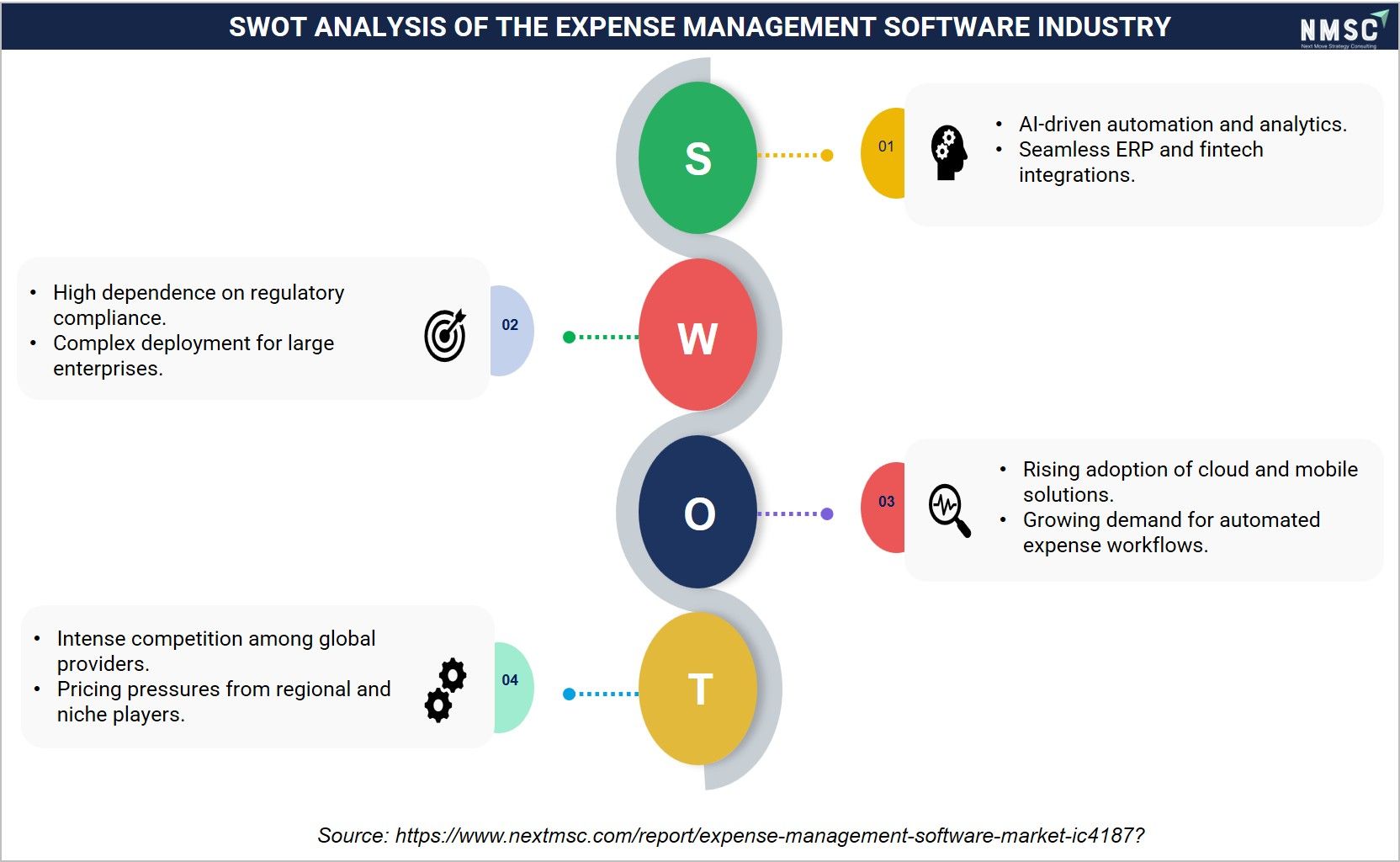
This infographic illustrates the expense management software market through a SWOT lens, highlighting how internal capabilities and external pressures shape industry dynamics. NMSC’s analysis indicates that strengths such as AI-enabled automation and ERP integrations drive operational efficiency and enhance enterprise adoption, while weaknesses like regulatory dependence and deployment complexity may limit scalability. Furthermore, market opportunities are expanding due to cloud-based solutions, mobile adoption, and increasing demand for automated workflows, whereas competitive intensity and pricing pressures pose strategic challenges.
What Are the Key Factors Influencing Investment Analysis & Opportunities in the Expense Management Software Market?
NMSC’s research indicates that investment activity in the expense management software market is increasingly concentrated around integrated spend management platforms that combine expense tracking, payments, and financial automation. Investors are prioritizing companies with scalable SaaS models, recurring subscription revenues, and embedded transaction-based monetization. Recent funding momentum around firms like Ramp and Navan highlights renewed investor confidence in fintech-driven expense ecosystems, particularly those leveraging AI for automation and compliance. Evidence suggests that platforms offering real-time policy enforcement, predictive analytics, and seamless ERP interoperability are commanding premium valuations due to their ability to deliver measurable cost control and operational efficiency.
From a strategic standpoint, we further observed that investment hotspots are emerging around AI-enabled spend intelligence, embedded finance, and SME-focused cloud solutions. Investors are increasingly backing vendors capable of expanding beyond expense reporting into broader financial operations, including procurement and accounts payable automation. Our evaluation suggests that strategic capital from financial institutions and enterprise software providers is accelerating platform consolidation and ecosystem expansion. This shift reflects a clear preference for end-to-end spend governance solutions, where long-term value creation is driven by data ownership, workflow integration, and the ability to scale across multi-entity, global enterprise environments.
Key Benefits for Stakeholders:
Next Move Strategy Consulting (NMSC) provides a comprehensive and evidence-based research of the expense management software market trends, covering historical developments from 2020 to 2025 and offering forward-looking forecasts through 2035. Our study assesses the market at global, regional, and country levels, combining quantitative outlooks with qualitative insights into key growth drivers, adoption constraints, technology evolution, and investment dynamics across major expense management software segments.
The expense management software market delivers differentiated value across key stakeholders, particularly investors and enterprise customers. Based on our assessment, we noticed that investors benefit from predictable recurring revenue models, strong retention dynamics, and expanding monetization opportunities through embedded finance and platform integration, positioning this market as a resilient, scalable SaaS investment avenue. From a customer perspective, we observed that organizations gain strategic and operational advantages through enhanced financial visibility, automated compliance, and streamlined expense workflows, enabling better cost control and faster decision-making. Industry insights further indicate that evolving regulatory expectations around auditability and transparency further reinforce adoption, as enterprises seek solutions that minimize compliance risk while improving efficiency. Collectively, these factors create a value-rich ecosystem where both capital providers and end users benefit from sustained digital transformation and financial process optimization.
|
Parameters |
Details |
|
Customization Scope |
Free customisation (equivalent to up to 80 analyst-working hours) after purchase. Addition or alteration to country, regional & segment scope. |
|
Pricing and Purchase Options |
Avail customised purchase options to meet your exact research needs. |
|
Approach |
In-depth primary and secondary research; proprietary databases; rigorous quality control and validation measures. |
|
Analytical Tools |
Porter's Five Forces, SWOT, value chain, and Harvey ball analysis to assess competitive intensity, stakeholder roles, and relative impact of key factors. |
Key Market Segments
By Product Type
-
Travel and Expense Management Platform
-
Corporate and Virtual Card Platform
-
Finance and ERP Embedded Expense Modules
By Revenue Stream
-
Software and License Revenue
-
Professional Services Revenue
-
Implementation and Integration
-
Consulting and Training
-
Managed and Support Services
-
Transactional Processing and BPO
-
-
Card and Payment Revenue
-
Interchange and Card Revenue Share
-
Card Processing Commissions and Fees
-
Card Platform Fees
-
By Deployment Model
-
Cloud
-
On-premises
-
Hybrid
By Functional Modules
-
Expense Capture and Receipt OCR
-
Policy Controls and Approval Workflow
-
Reconciliation and Matching
-
Dispute and Exception Management
-
Ordering and Provisioning Inventory
-
Usage Monitoring and Chargeback
-
Analytics, Audit and Fraud Detection
By Pricing Model
-
Per-User
-
Per-Transaction
-
Tiered Organization ARR
-
Per-module
-
Other Monetization Models
By Enterprise Size
-
SMEs
-
Large Enterprise
By Industry Vertical
-
BFSI
-
Information Technology and Telecom
-
Manufacturing and Industrials
-
Retail and E-commerce
-
Healthcare and Life Sciences
-
Government and Public Sector
-
Hospitality, Travel and Leisure
-
Energy and Utilities
-
Education and Non-Profit
-
Transportation and Logistics
-
Professional Services and Consulting
-
Other Industries
Conclusion & Recommendations
The expense management software market is evolving into a critical pillar of enterprise financial infrastructure, driven by the convergence of automation, compliance, and integrated spend management. Based on our market analysis, we observed that organizations are increasingly prioritizing unified platforms that deliver real-time visibility, enforce policy controls, and seamlessly integrate with broader financial ecosystems. Furthermore, AI-driven analytics, mobile-first accessibility, and interoperability are no longer differentiators but baseline expectations, reshaping vendor competition and accelerating adoption across both large enterprises and SMEs. At the same time, data security, regulatory complexity, and the need for scalable architectures remain central considerations influencing long-term market dynamics.
Looking ahead, the market continues to shift toward intelligent, end-to-end financial operations platforms where expense management is embedded within a broader ecosystem of procurement, payments, and analytics. Our evaluation indicates that vendors capable of combining user-centric design with advanced automation and compliance capabilities will be best positioned to capture sustained demand. For executives and investors, the strategic imperative is clear, with a strong emphasis on prioritizing partnerships and investments in platforms that offer extensibility, data intelligence, and robust integration capabilities. Based on our insights, aligning with providers that enable scalable, compliant, and insight-driven financial operations will be key to unlocking long-term value and maintaining competitive advantage in an increasingly digital enterprise landscape.


About the Author
 Mayurima Roy
— Mayurima Roy is Research Analyst at Next Move Strategy Consulting, where she has spent 4 years working across the firm's full industry coverage rather than a single fixed vertical. Her work centers on structured research, ongoing trend tracking, competitive assessment, and insight-led content development, translating complex market data into clear, decision-ready narratives that support informed client decision-making across diverse global industries, market sectors, and world regions every day.
Mayurima Roy
— Mayurima Roy is Research Analyst at Next Move Strategy Consulting, where she has spent 4 years working across the firm's full industry coverage rather than a single fixed vertical. Her work centers on structured research, ongoing trend tracking, competitive assessment, and insight-led content development, translating complex market data into clear, decision-ready narratives that support informed client decision-making across diverse global industries, market sectors, and world regions every day.
About the Reviewer
 Supradip Baul
— Supradip Baul is an accomplished business consultant and strategist with over a decade of rich experience in market intelligence, strategy, technology, and business transformation. His work has included rigorous qualitative and quantitative analysis across multiple industries, helping clients shape investment decisions and long-term roadmaps. Earlier in his career, he was associated with Gartner, where he contributed to industry-leading reports and market share analyses. He has worked with leading global companies and holds an MBA with a dual specialization in Marketing and Finance.
Supradip Baul
— Supradip Baul is an accomplished business consultant and strategist with over a decade of rich experience in market intelligence, strategy, technology, and business transformation. His work has included rigorous qualitative and quantitative analysis across multiple industries, helping clients shape investment decisions and long-term roadmaps. Earlier in his career, he was associated with Gartner, where he contributed to industry-leading reports and market share analyses. He has worked with leading global companies and holds an MBA with a dual specialization in Marketing and Finance.
At Next Move Strategy Consulting, we understand that insightful market research is the cornerstone of successful business decisions. That's why we employ a robust and multifaceted approach, combining various methodologies to deliver the most accurate and actionable data for our clients.

Research Landscape
We navigate the world of research with two primary approaches:
Qualitative Approach
Our qualitative research methodologies involve immersive techniques such as in-depth interviews, focus groups, and observational studies. By engaging directly with individuals and stakeholders, we uncover valuable insights that quantitative data alone may overlook.

Quantitative Research
In tandem with qualitative methodologies, NMSC leverages the power of Quantitative Research to provide a robust foundation of numerical insights. Through systematic data collection and analysis, we quantify patterns, preferences, and market trends, offering a comprehensive view of the business landscape.
Our quantitative research approach employs diverse tools, including surveys, experiments, and statistical modelling. These methodologies enable us to gather data from a large and representative sample, ensuring the statistical significance of our findings. By employing structured questionnaires and standardized data collection methods, we guarantee the reliability and validity of the information we present to our clients.
Quantitative research is particularly effective in measuring the prevalence of trends, assessing market size, and gauging the impact of various factors on consumer behavior. The numerical precision attained through this approach equips our clients with actionable insights, facilitating data-driven decision-making and strategy formulation.


Our Specialized Toolbox for Industry-Specific Market Research
We deploy a specialized arsenal of techniques tailored to meet your unique requirements. Here's a glimpse into our comprehensive toolbox:

Information Procurement
The stage entails acquiring market data or relevant information through various sources and methodologies.


Market Research Approach
We utilize both top-down and bottom-up approaches in market research analysis to achieve a comprehensive understanding of the market dynamics, leveraging the broad perspective of industry trends and macroeconomic factors alongside detailed insights from specific segments and individual companies.

Porters Five Forces Analysis
We conduct Porter's Five Forces analysis to evaluate the competitive landscape of an industry, providing us with insights into factors that affect profitability and strategic positioning.

SWOT Analysis

Forecasting
We utilize a forecasting model to predict future consumption by considering parameters like population, economics, regulations, market competition, drivers, constraints, technology, and pricing. We also employ statistical techniques such as multilinear regression, exponential smoothing, moving average, ARIMA, and Monte Carlo simulations for accurate predictions. In econometric forecasting, we analyzed short-term and long-term event impacts, attributing values based on regulatory frameworks, economic factors, and market events.





 Speak to Our Analyst