How Leading Players Are Transforming Dialysis Industry Through Smart Technologies
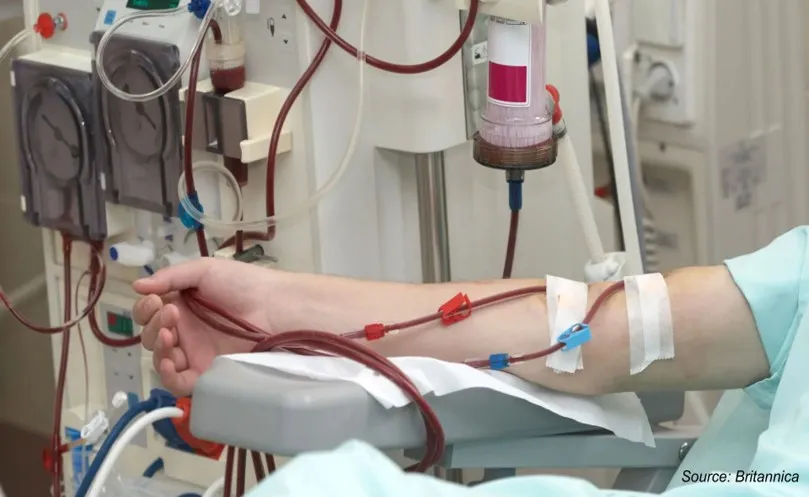
Based on NMSC assessment, the Dialysis Industry is expected to maintain steady growth momentum, with the market size projected to reach approximately USD 283.75 billion by 2035. We observed that the market was valued at around USD 130.21 billion in 2025 and is estimated to rise to USD 145.65 billion by 2026, reflecting a CAGR of 6.46%. Our analysis indicates that this growth is being driven by the rapid expansion of home-based dialysis solutions, telehealth platforms, and patient-centric care models, alongside rising healthcare spending across both developed and emerging economies.
Based on our indications, the emerging wearable dialysis technologies under clinical development, subscription-based treatment programs, and advanced AI-enabled monitoring systems is reshaping patient treatment habits globally. At the same time, the surge in demand for on-demand, technology-enabled dialysis services across hospitals, dialysis centres, home care, and specialised clinics is creating new opportunities for industry players. Moreover, due to ongoing innovations in resource-efficient dialysers, digital health platforms, and predictive treatment algorithms, the dialysis sector is set to evolve into a smarter, more sustainable, and patient-focused market by the end of the decade.
Dialysis Market Overview
NMSC assessment witnessed the dialysis market is undergoing a profound transformation, driven by rising patient-centric care imperatives, evolving treatment innovations, and shifting healthcare delivery models. We observed that growing awareness of chronic kidney disease, coupled with the demand for flexible treatment options and attention to the environmental impact of dialysis operations, is prompting providers to reimagine therapies through home-based, portable, and resource-efficient solutions. Further, our analysis indicates that the increasing prevalence of kidney disorders, along with the growing need for personalised, high-quality care, is accelerating the adoption of advanced dialysers, AI-enabled monitoring, and integrated telehealth platforms that enhance outcomes while reducing treatment burden.
Moreover, the evolution of healthcare delivery is expanding market reach, with telemedicine, remote monitoring, subscription-based care programs, and multi-channel healthcare strategies democratizing access to specialised and premium dialysis services worldwide. At the same time, governments and international regulators are reinforcing this transition by implementing stricter standards on patient safety, treatment quality, and environmental sustainability. Furthermore, our evaluation indicates that digital health platforms, patient education initiatives, and awareness campaigns are influencing patient preferences, and environmentally conscious dialysis practices.
According to our analysis, several major companies are leading the dialysis market, including Fresenius Medical Care AG & Co. KGaA, Baxter International Inc., DaVita Inc., B. Braun Melsungen AG, Nipro Corporation, Asahi Kasei Corporation, Becton, Dickinson and Company (BD), Teleflex Incorporated, Nikkiso Co., Ltd., Dialife SA, Terumo Corporation, Outset Medical, Inc., Shandong Weigao Blood Purification Products Co., Ltd., and others. Based on market dynamics these industry leaders are at the forefront of innovation, developing advanced dialysers, wearable and portable devices, AI-driven predictive care solutions, and home dialysis technologies.
Our finding indicates that by investing heavily in technological innovation, telehealth integration, and resource-efficient practices, these companies are addressing critical challenges such as treatment accessibility, patient adherence, and environmental impact. We also observed that their robust research and development pipelines, combined with extensive clinical networks across both mature and emerging markets, enable them to deliver high-performance care while maintaining affordability. As per our evaluation, these global leaders are collectively steering the dialysis industry toward its next phase, where kidney care becomes increasingly technologically advanced, patient-centric, and environmentally sustainable.
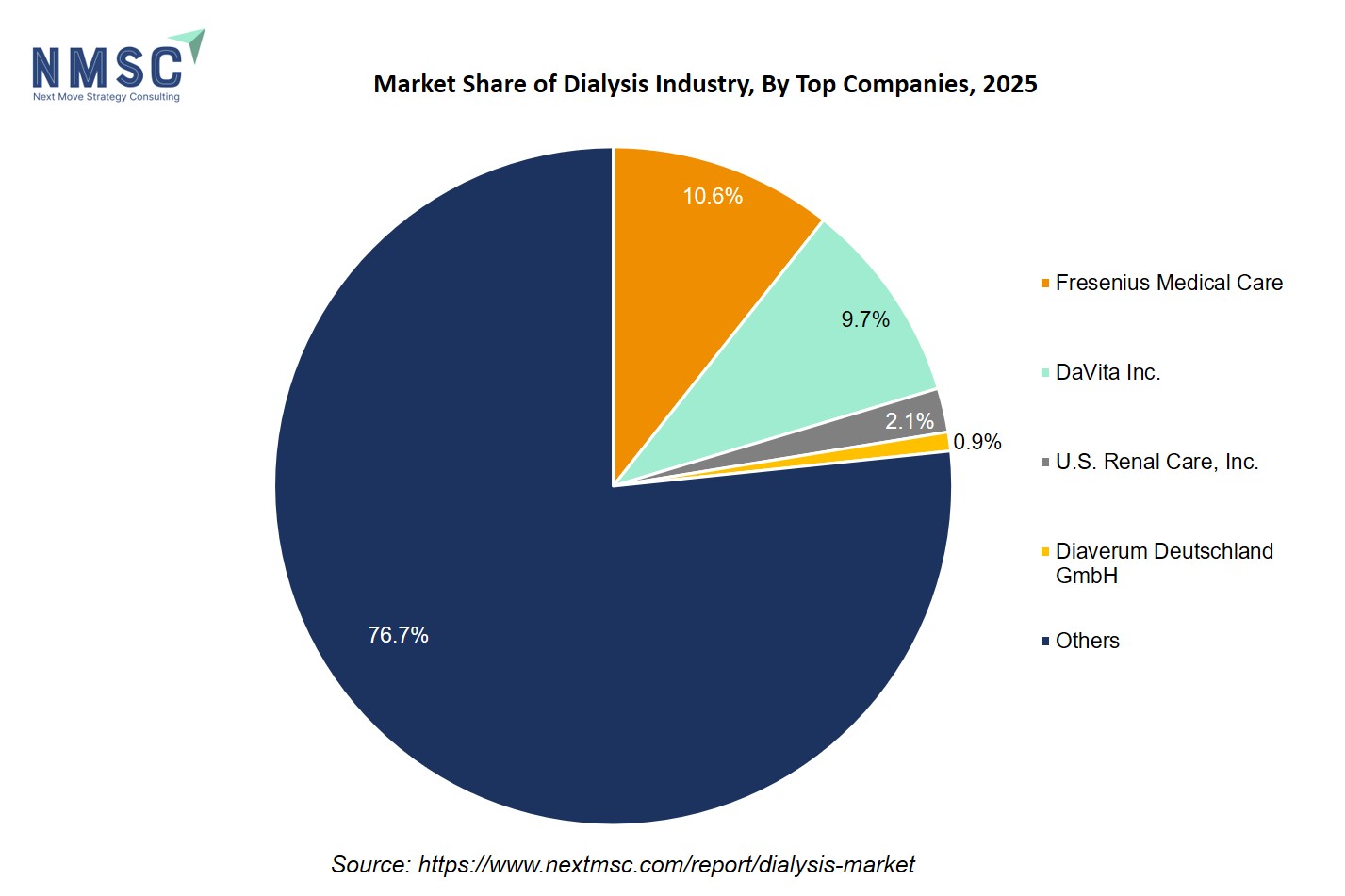
For an In-depth Analysis of the Dialysis Industry, Try a FREE Sample
Highlights of Fresenius Medical Care AG & Co. KGAA
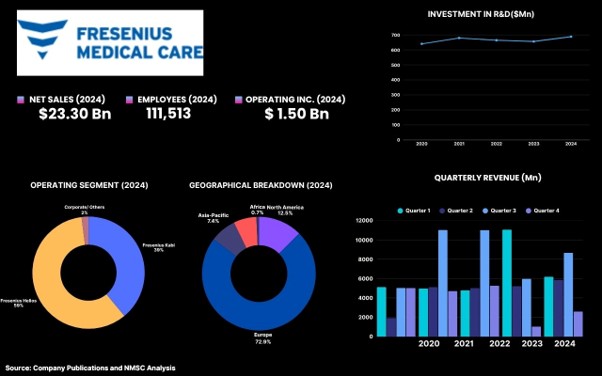
Fresenius Medical Care AG & Co. KGaA, headquartered in Germany, is a global leader in the dialysis market, offering comprehensive renal care solutions that include in-centre and home-based treatments, dialysis products, and integrated healthcare services. We observed that by continuously advancing its portfolio of hemodialyzers, dialysers, bloodlines, and digital health solutions, Fresenius Medical Care has transformed dialysis from a routine clinical procedure into a patient-centred, technologically sophisticated care experience. Our analysis indicates that its expansive network of dialysis clinics and homecare programs allows the company to serve diverse patient populations across Europe, North America, Asia-Pacific, and other key markets.
As per the discussion with that the company’s leadership is reinforced by substantial investments in research and development, driving innovations such as AI-enabled patient monitoring, predictive care algorithms, and telehealth integration that enhance treatment efficiency, safety, and patient outcomes. Fresenius Medical Care’s emphasis on sustainability and operational efficiency, including resource-optimised dialysis systems, water- and energy-saving technologies, and environmentally responsible manufacturing practices, further strengthens its competitive edge against peers such as DaVita, Baxter International, and B. Braun Melsungen AG. By combining technological expertise, a global clinic network, and a patient-centric approach, we conclude that Fresenius Medical Care AG & Co. KGaA has solidified its position as a dominant and innovative player in the global dialysis market, shaping the future of accessible, high-quality, and sustainable renal care.
Highlights of Davita Inc.
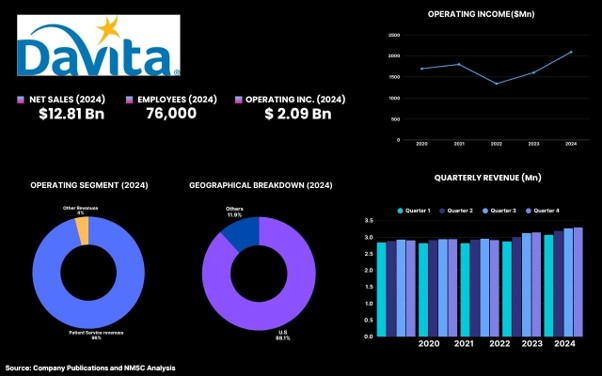
NMSC witnessed that DaVita Inc., headquartered in the United States, has established a prominent position in the dialysis market, supported by its extensive network of dialysis centers, home care programs, and comprehensive renal care services. We observed that the company delivers high-quality, patient-focused treatment across North America and international markets. Our analysis indicates that by continuously enhancing its portfolio of hemodialysis, peritoneal dialysis, and home-based care solutions, DaVita has transformed dialysis from a routine clinical procedure into a more accessible, flexible, and patient-centred experience.
We also observed that the company’s market leadership is reinforced by a strong commitment to innovation, quality, and patient outcomes, underpinned by significant investments in advanced dialysis technologies, digital health platforms, and telehealth integration. DaVita emphasises regulatory compliance, clinical excellence, and collaboration with healthcare providers to deliver reliable, efficient, and cost-effective care. Additionally, the company’s proactive approach to sustainability, including resource-efficient dialysis systems, water- and energy-saving technologies, and environmentally responsible operational practices, aligns with global healthcare standards and enhances its competitive position against peers such as Fresenius Medical Care, Baxter International, and B. Braun Melsungen AG. Our assessment concludes that by combining clinical expertise, a broad treatment network, and patient-centric innovation, DaVita Inc. has established itself as a leading provider of advanced, accessible, and sustainable dialysis solutions worldwide.
Highlights of Shandong Weigao Blood Purification Products Co., Ltd.
Based on our assessment, Shandong Weigao Blood Purification Products Co., Ltd., headquartered in China, has established a significant position in the dialysis market, offering a broad portfolio of medical devices and renal care solutions that deliver reliable, high-quality products for both in-centre and home-based dialysis treatments. We observed that by continuously advancing its range of hemodialyzers, bloodlines, and dialysis consumables, the company has transformed the supply of renal care products into a technologically sophisticated, patient-focused ecosystem that supports clinical efficiency and treatment safety across China and international markets.
Our analysis indicates that Shandong Weigao’s market strength is reinforced by its strong commitment to innovation and quality, with targeted investments in research and development enabling the creation of advanced blood purification systems, high-performance membranes, and automated dialysis equipment. We also observed that the company emphasises global regulatory compliance, manufacturing excellence, and collaboration with healthcare providers to deliver reliable and cost-effective solutions. According to our analysis, the company’s proactive sustainability strategy—encompassing resource-efficient devices, environmentally responsible manufacturing processes, and optimized energy and water usage—aligns with global healthcare standards and further strengthens its competitive positioning against key industry peers.
Highlights of Diaverum Deutschland GmbH
As per our observation, Diaverum Deutschland GmbH, headquartered in Germany, has established a strong hold in the dialysis market by providing comprehensive renal care services and delivering high-quality, patient-focused treatments across Europe. We observed that by continuously enhancing its offerings with state-of-the-art hemodialysis, peritoneal dialysis, and home-based care solutions, the company has transformed dialysis from a routine clinical procedure into a more flexible, accessible, and personalised experience. Our analysis indicates that its extensive network of dialysis centers, combined with patient support programs, enables Diaverum Deutschland to address diverse patient needs, treatment schedules, and lifestyle requirements across Germany and other European markets.
We also observed that the company’s market leadership is reinforced by the strategic adoption of advanced technologies, including telehealth integration, AI-driven patient monitoring, and predictive care tools that optimise treatment outcomes. We identified that, targeted investments in clinical R&D, staff training, and patient education initiatives have further enhanced treatment adherence, patient satisfaction, and loyalty. We conclude that by combining clinical expertise, a broad treatment network, and patient-centric innovations, Diaverum Deutschland GmbH has cemented its role as a leading provider of advanced, sustainable, and accessible dialysis solutions in Europe.
Highlights of U.S. Renal Care, Inc.
Based on our assessment, U.S. Renal Care, Inc., headquartered in the United States, has established a significant presence in the dialysis market through its comprehensive portfolio of in-centre and home-based renal care services. We observed that the company consistently delivers high-quality patient outcomes while driving growth in personalised kidney care. Our analysis indicates that by continuously enhancing its treatment offerings with advanced hemodialysis and peritoneal dialysis solutions, telehealth integration, and patient-centred care programs, U.S. Renal Care has transformed dialysis from a routine clinical procedure into a more flexible, accessible, and patient-focused experience across diverse regions in North America.
We also observed that the company’s extensive network of dialysis centers, homecare support programs, and mobile treatment solutions enables it to meet varying patient needs, treatment schedules, and lifestyle preferences. Based on our evaluation, U.S. Renal Care’s market strength is reinforced by its strategic adoption of innovative technologies, including AI-enabled patient monitoring, predictive care algorithms, and remote consultation platforms. Targeted investments in clinical R&D, staff training, and patient education initiatives have further improved treatment adherence, enhanced patient outcomes, and strengthened loyalty. Thus, by combining clinical expertise, a broad treatment network, and patient-centric innovation, U.S. Renal Care, Inc. has solidified its role as a leading player in the dialysis market, shaping the evolution of advanced, accessible, and sustainable renal care solutions.
Summary of Dialysis Market
The dialysis market is undergoing a significant transformation, driven by evolving patient needs, technological advancements, and an increasing emphasis on personalised healthcare. We observed that traditional in-centre hemodialysis is increasingly being complemented by home-based therapies, portable devices, and wearable dialysis solutions, reflecting a rising demand for convenience, flexibility, and patient-centred care. Our analysis indicates that innovations such as AI-enabled monitoring, telehealth integration, and advanced dialysers are enhancing treatment efficiency, safety, and patient outcomes.
We also observed that sustainability and cost-effectiveness are becoming key priorities, with ongoing efforts to optimise resource usage and reduce the environmental impact of dialysis operations. Based on our evaluation, while mature markets are focusing on the adoption of high-end technologies and integrated care models, emerging regions are driving overall patient volume growth, contributing to the global expansion of dialysis services. We conclude that these combined trends are shaping a dialysis market that is increasingly innovative, accessible, and patient-centric worldwide.
About the Author
 Tushmi Dutta
— Tushmi Dutta is a focused researcher specializing in detailed analysis and insight-driven research across diverse business landscapes. She supports strategic initiatives through structured data interpretation, thorough validation, and clear communication of findings that aid informed decision-making. With a strong interest in writing, she enjoys presenting research insights in an engaging and accessible manner. Beyond work, she enjoys traveling, reading, painting, and continuously learning new skills that contribute to her creative and professional growth.
Tushmi Dutta
— Tushmi Dutta is a focused researcher specializing in detailed analysis and insight-driven research across diverse business landscapes. She supports strategic initiatives through structured data interpretation, thorough validation, and clear communication of findings that aid informed decision-making. With a strong interest in writing, she enjoys presenting research insights in an engaging and accessible manner. Beyond work, she enjoys traveling, reading, painting, and continuously learning new skills that contribute to her creative and professional growth.
About the Reviewer
 Supradip Baul
— Supradip Baul is an accomplished business consultant and strategist with over a decade of rich experience in market intelligence, strategy, technology, and business transformation. His work has included rigorous qualitative and quantitative analysis across multiple industries, helping clients shape investment decisions and long-term roadmaps. Earlier in his career, he was associated with Gartner, where he contributed to industry-leading reports and market share analyses. He has worked with leading global companies and holds an MBA with a dual specialization in Marketing and Finance.
Supradip Baul
— Supradip Baul is an accomplished business consultant and strategist with over a decade of rich experience in market intelligence, strategy, technology, and business transformation. His work has included rigorous qualitative and quantitative analysis across multiple industries, helping clients shape investment decisions and long-term roadmaps. Earlier in his career, he was associated with Gartner, where he contributed to industry-leading reports and market share analyses. He has worked with leading global companies and holds an MBA with a dual specialization in Marketing and Finance.

















Add Comment