How the BCG Vaccine Supply Chain Is Reshaping Global TB Defense

Introduction
Tuberculosis remains the world's deadliest infectious disease, and the century-old Bacillus Calmette-Guérin (BCG) vaccine continues to sit at the center of the global response. In 2024, an estimated 10.7 million people fell ill with TB and 1.23 million lost their lives to the disease. Against this backdrop, the global BCG vaccine supply chain—spanning manufacturers, distribution networks, and national immunization programs—has become a strategic priority for governments, public health funders, and institutional investors alike.
For decision-makers evaluating immunization market opportunities, the conversation has shifted from whether BCG remains relevant to how procurement resilience, manufacturing capacity, and next-generation pipeline candidates will define the coming decade. With WHO confirming that 8.3 million people were newly diagnosed with TB in 2024, the demand signal for both legacy BCG vaccination and novel TB vaccines has never been clearer. This guide examines the breaking developments, institutional data, and forward-looking forecasts that matter most to stakeholders in the BCG vaccine ecosystem.
A Watershed Moment: India's Landmark TB Vaccine Trial Redefines the Pipeline
In April 2026, the global tuberculosis vaccine landscape reached an inflection point. A large clinical trial in India involving more than 12,000 participants evaluated two experimental candidates—VPM1002, a genetically modified version of the BCG vaccine, and Immuvac, a killed bacterial vaccine. Both were found to be safe and appeared to reduce progression from latent infection to active TB, though neither prevented infection nor fully protected against pulmonary TB, the form that drives transmission.
Notably, VPM1002 demonstrated 50.4% effectiveness against extrapulmonary TB across all age groups, rising to 79.5% among individuals aged 36–60 years—a meaningful public health signal given that extrapulmonary TB carries a higher risk of death than the pulmonary form. Simultaneously, two of the most promising candidates—M72/AS01E and MTBVAC—are advancing through late-stage trials, with M72/AS01E in a large Phase 3 study and MTBVAC being evaluated in newborns across several sub-Saharan African countries. There are now at least 20 TB vaccine candidates for adults and adolescents in the clinical pipeline.
NMSC Strategic Perspective
From NMSC's vantage point, this trial outcome carries dual significance for the BCG vaccine market. First, it validates that legacy BCG vaccination at birth will remain the indispensable standard of care for pediatric protection well into the next decade, since no next-generation candidate has yet displaced its role in neonatal immunization. The continued centrality of BCG in childhood TB prevention programs underpins the stable, recurring procurement demand that sustains the existing supply base. Second, the emergence of BCG-derived candidates such as VPM1002 signals a strategic broadening of the category—one where established BCG vaccine manufacturers possess a natural manufacturing and regulatory advantage. NMSC views this convergence of legacy demand and pipeline innovation as the defining commercial dynamic for tuberculosis vaccine suppliers through 2030.
Section Summary: The April 2026 India trial confirmed that while novel candidates show promise against active and extrapulmonary disease, BCG retains its irreplaceable role in neonatal protection, even as a richer pipeline emerges.
-
VPM1002 showed 50.4% effectiveness against extrapulmonary TB, rising to 79.5% in those aged 36–60.
-
At least 20 adult and adolescent TB vaccine candidates are now in clinical development.
-
M72/AS01E and MTBVAC, both in late-stage trials, represent the most advanced disruptors to the category.
Industry Impact Analysis
The most consequential macro development for the global BCG vaccine supply chain in 2025–2026 is the convergence of sustained disease burden with mounting funding pressure. The WHO Global TB Report 2025, released on 12 November 2025, warned that global gains in the TB response are being endangered by funding challenges, even as 184 countries representing more than 99% of the world's population and TB cases reported data. This financing strain directly affects procurement budgets for national immunization programs and the predictability of demand for BCG vaccine distribution networks.
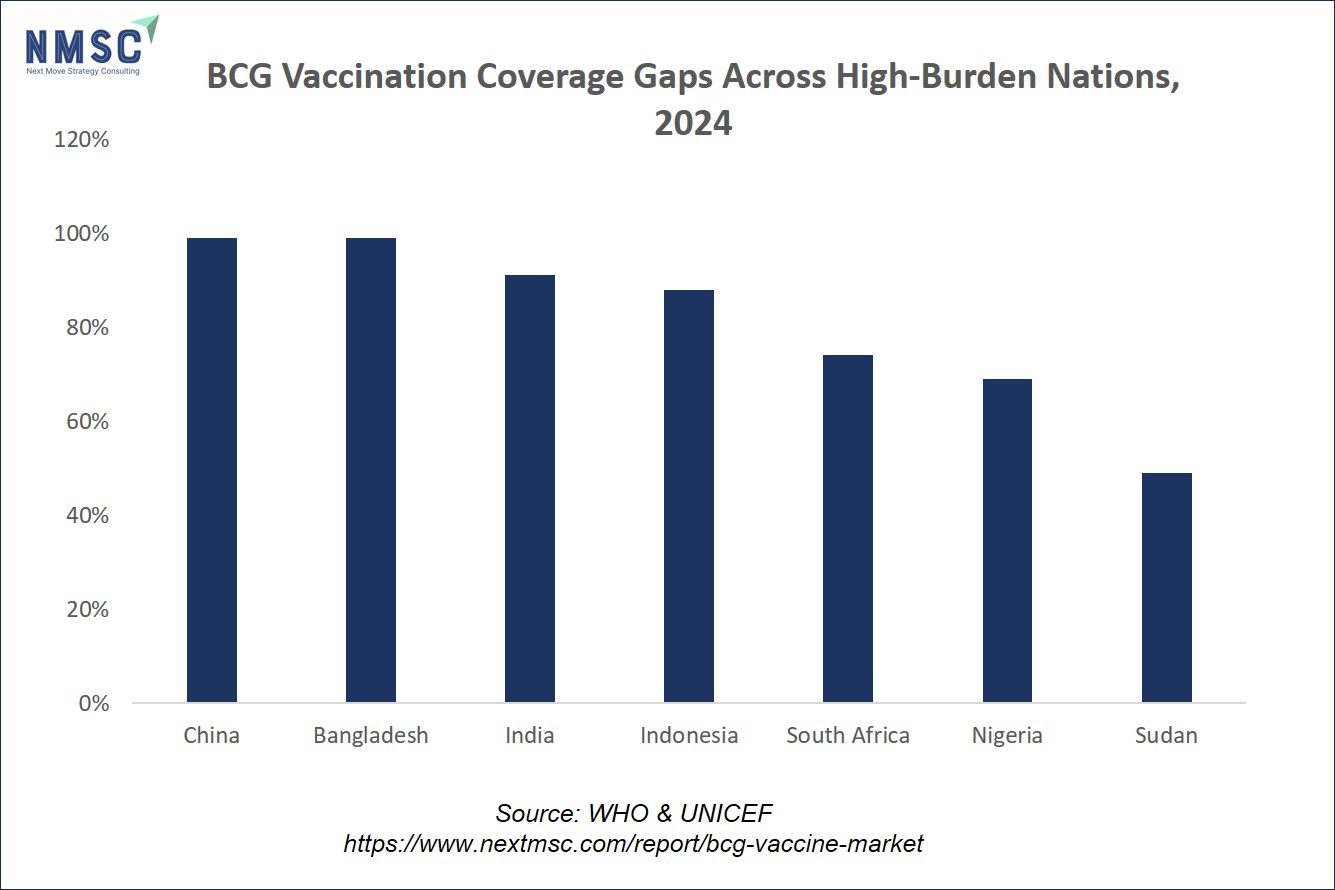
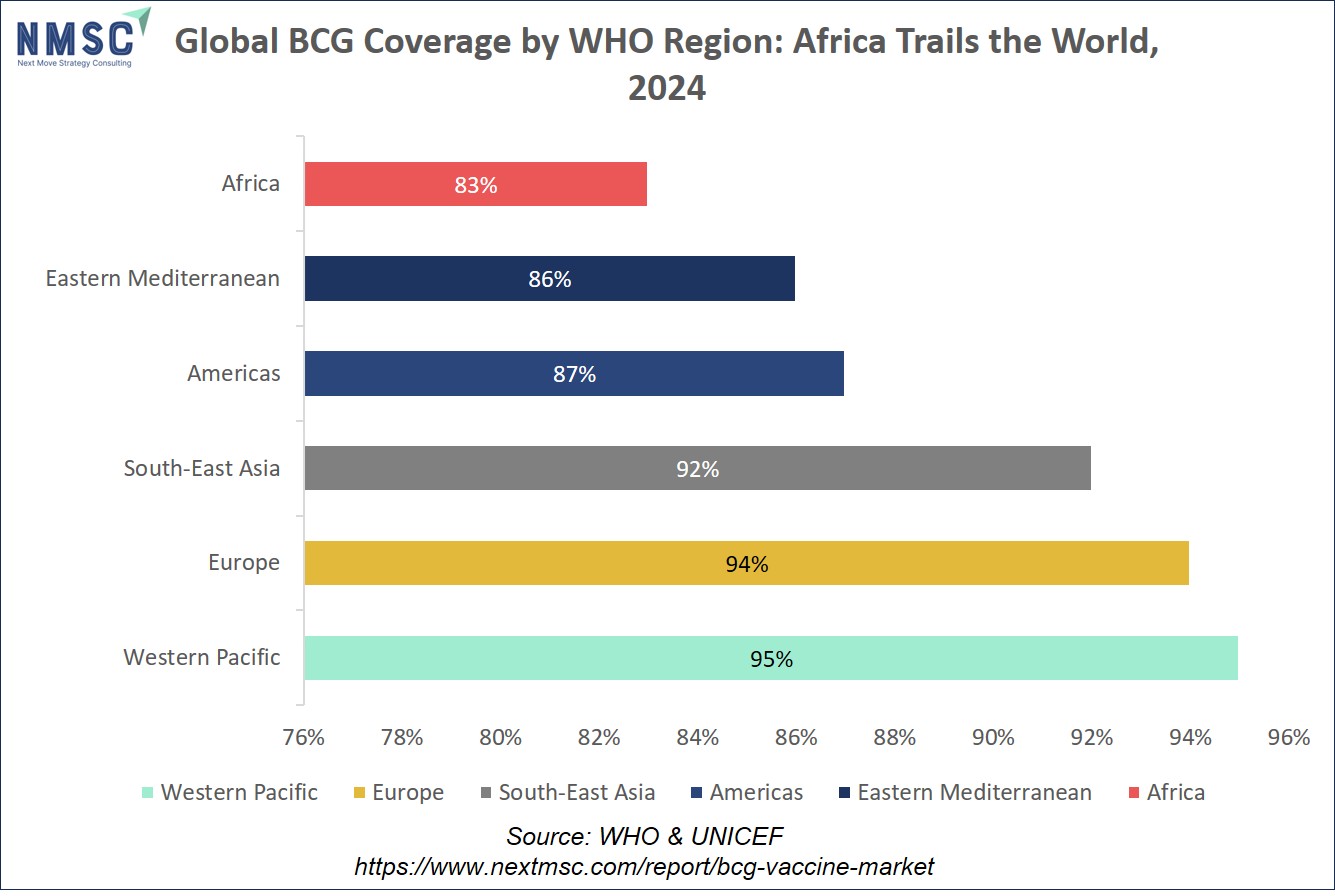
Encouragingly, the foundational demand base for pediatric vaccine procurement remains robust. Global coverage of BCG vaccination among children stood at 88% in 2024, broadly stable with 87% in 2023, demonstrating the resilience of universal BCG vaccination policy across high-burden settings. Yet significant coverage disparities persist: while countries such as China, Bangladesh, and Nepal report 99% newborn coverage, large high-burden nations including Nigeria (69%), South Africa (74%), and Sudan (49%) lag considerably, exposing structural gaps in the global BCG vaccine supply chain.
These disparities define both the public health imperative and the commercial opportunity. Closing the coverage gap in under-served high-burden geographies requires strengthened distribution networks, expanded manufacturing investment, and sustained public health vaccine funding—precisely the levers that determine market trajectory.
Section Summary: Stable global BCG coverage masks acute regional gaps and intensifying funding pressure, creating both risk and opportunity across the supply chain.
-
WHO confirmed global child BCG coverage at 88% in 2024, stable versus 87% in 2023.
-
High-burden coverage gaps remain stark—Nigeria at 69%, South Africa at 74%, Sudan at 49%.
-
The WHO 2025 report flagged funding challenges as a direct threat to sustained TB response gains.
Pros and Cons of Recent Market Developments
|
Pros |
Cons |
|
BCG-derived candidates (VPM1002) give incumbent manufacturers a pipeline advantage. |
Funding constraints flagged by WHO threaten procurement budget stability. |
|
Stable 88% global pediatric coverage sustains predictable, recurring demand. |
Coverage gaps in high-burden nations expose distribution and supply fragility. |
|
A pipeline of 20+ candidates expands the long-term tuberculosis vaccine market. |
No novel candidate yet prevents pulmonary TB transmission, limiting near-term displacement. |
|
Strengthened global partnerships and manufacturer involvement accelerate innovation. |
Persistent malnutrition undermines vaccine efficacy in vulnerable populations. |
Key Data & Statistics
The following datasets are drawn exclusively from primary institutional and verified news sources to support the design team's visualizations.
Table 1: Global Tuberculosis Burden & BCG Coverage Indicators (Latest Available)
|
Indicator |
Value |
|
People newly diagnosed with TB (2024) |
8.3 million |
|
TB-attributable deaths (2024) |
1.23 million |
|
People who fell ill with TB (2024) |
10.7 million |
|
Global child BCG coverage (2024) |
88% |
|
Countries reporting TB data (2025) |
184 |
|
Adult/adolescent TB vaccine candidates in pipeline |
20+ |
Future Outlook & Forecast
The trajectory of the global BCG vaccine market is shaped by two reinforcing forces: a durable demand base anchored in neonatal vaccination programs, and an expanding innovation frontier driven by next-generation candidates. With World TB Day 2026 rallying the global community behind the message "Yes! We Can End TB," and late-stage candidates MTBVAC and M72 advancing through final clinical evaluation, the broader tuberculosis vaccine demand forecast points to sustained, structurally supported growth.
According to Next Move Strategy Consulting, the global BCG Vaccine Market is projected to reach USD 76.3 million, growing at a CAGR of 4.7% by 2030. NMSC attributes this growth to surging tuberculosis prevalence linked to malnutrition, rising newborn populations in high-burden geographies, and BCG's expanding application in bladder cancer treatment, with Asia-Pacific holding the predominant market share owing to its rising birth rate and elevated TB burden.
Table 2: NMSC BCG Vaccine Market Forecast Snapshot
|
Parameter |
Detail |
|
Market Value (2021) |
USD 50.5 million |
|
Forecast Value (2030) |
USD 76.3 million |
|
CAGR (2022–2030) |
4.7% |
|
Leading Region |
Asia-Pacific |
|
Key Applications |
Tuberculosis, Bladder Cancer |
Section Summary: A resilient demand base and an advancing pipeline position the BCG vaccine market for steady expansion, with NMSC forecasting USD 76.3 million by 2030 at a 4.7% CAGR.
-
NMSC projects the market to grow from USD 50.5 million (2021) to USD 76.3 million (2030).
-
Asia-Pacific leads the market on the strength of high birth rates and TB prevalence.
-
Late-stage candidates MTBVAC and M72 will define the next innovation cycle.
Next Steps for Stakeholders
-
For C-level executives and institutional investors, the present moment calls for deliberate, evidence-driven positioning:
-
Prioritize supply chain resilience. Direct capital toward manufacturers and distribution networks capable of closing coverage gaps in high-burden, under-served markets such as Nigeria, South Africa, and Sudan.
-
Evaluate pipeline-adjacent exposure. Incumbent BCG manufacturers with BCG-derived candidates (for example, VPM1002) warrant close diligence given their manufacturing and regulatory advantages.
-
Stress-test against funding volatility. Given WHO's warning on financing pressure, model procurement scenarios that account for shifts in public health vaccine funding.
-
Engage early on introduction readiness. As TBVI emphasizes, preparing health systems and gathering country-specific cost-effectiveness evidence before regulatory approval is essential to capturing first-mover advantage.
Conclusion
The global BCG vaccine supply chain stands at a pivotal juncture. A century after its introduction, BCG remains the cornerstone of childhood TB prevention, supported by stable 88% global pediatric coverage and an enduring disease burden that shows no sign of abating. At the same time, the April 2026 India trial and the advance of MTBVAC and M72 signal an innovation cycle that will gradually reshape the tuberculosis vaccine market over the coming decade. With NMSC forecasting growth to USD 76.3 million by 2030 at a 4.7% CAGR, stakeholders who act now to strengthen procurement resilience, hedge against funding volatility, and position for pipeline convergence will be best placed to lead the next chapter of global TB defense.
About the Author
 Sanyukta Deb
— Sanyukta Deb is Digital Marketing Team Lead at Next Move Strategy Consulting, where she has led content strategy and technical SEO for the firm's B2B market research publications for over 2 years. Her editorial process translates NextMSC's primary and secondary research — spanning technology, industrial, and consumer sectors — into commercial narratives, backed by search-intent, keyword, and competitive analysis. She brings 5 years of overall experience in digital marketing and content strategy.
Sanyukta Deb
— Sanyukta Deb is Digital Marketing Team Lead at Next Move Strategy Consulting, where she has led content strategy and technical SEO for the firm's B2B market research publications for over 2 years. Her editorial process translates NextMSC's primary and secondary research — spanning technology, industrial, and consumer sectors — into commercial narratives, backed by search-intent, keyword, and competitive analysis. She brings 5 years of overall experience in digital marketing and content strategy.
About the Reviewer
 Debashree Dey
— Debashree Dey is Assistant Manager at Next Move Strategy Consulting, where she supports cross-vertical market content and communications across diverse industries for 6 years. Her professional background includes senior content writing, communications, and published manuscript authorship, with experience developing audience-focused business narratives and maintaining clear, consistent messaging. Her role supports research-led content development and editorial quality across NextMSC publications.
Debashree Dey
— Debashree Dey is Assistant Manager at Next Move Strategy Consulting, where she supports cross-vertical market content and communications across diverse industries for 6 years. Her professional background includes senior content writing, communications, and published manuscript authorship, with experience developing audience-focused business narratives and maintaining clear, consistent messaging. Her role supports research-led content development and editorial quality across NextMSC publications.


















Add Comment