How to Choose the Right Java Development Outsourcing Partner for Your Nearshore Project

Every major enterprise software vendor spent 2026 turning its platform into something it wasn't twelve months ago: an AI agent builder. Microsoft, Salesforce, SAP, ServiceNow, Appian and Pegasystems have each shipped a way for business users to design, deploy and govern autonomous agents using the same visual, low-code tools they already use to build forms and workflows. That shift is now the single biggest force behind current growth, reshaping what buyers expect a platform to do.
The scale of that shift shows up in the numbers. The low-code application platform market is being pulled forward by the same forces that mattered a year ago developer shortages, cloud migration, citizen-developer demand but AI agent-building has moved from an experimental add-on to the feature vendors lead with. What follows is a look at where that investment is actually landing, drawn from the last two quarters of vendor earnings and product launches.
Every Major Platform Just Became an Agent Builder
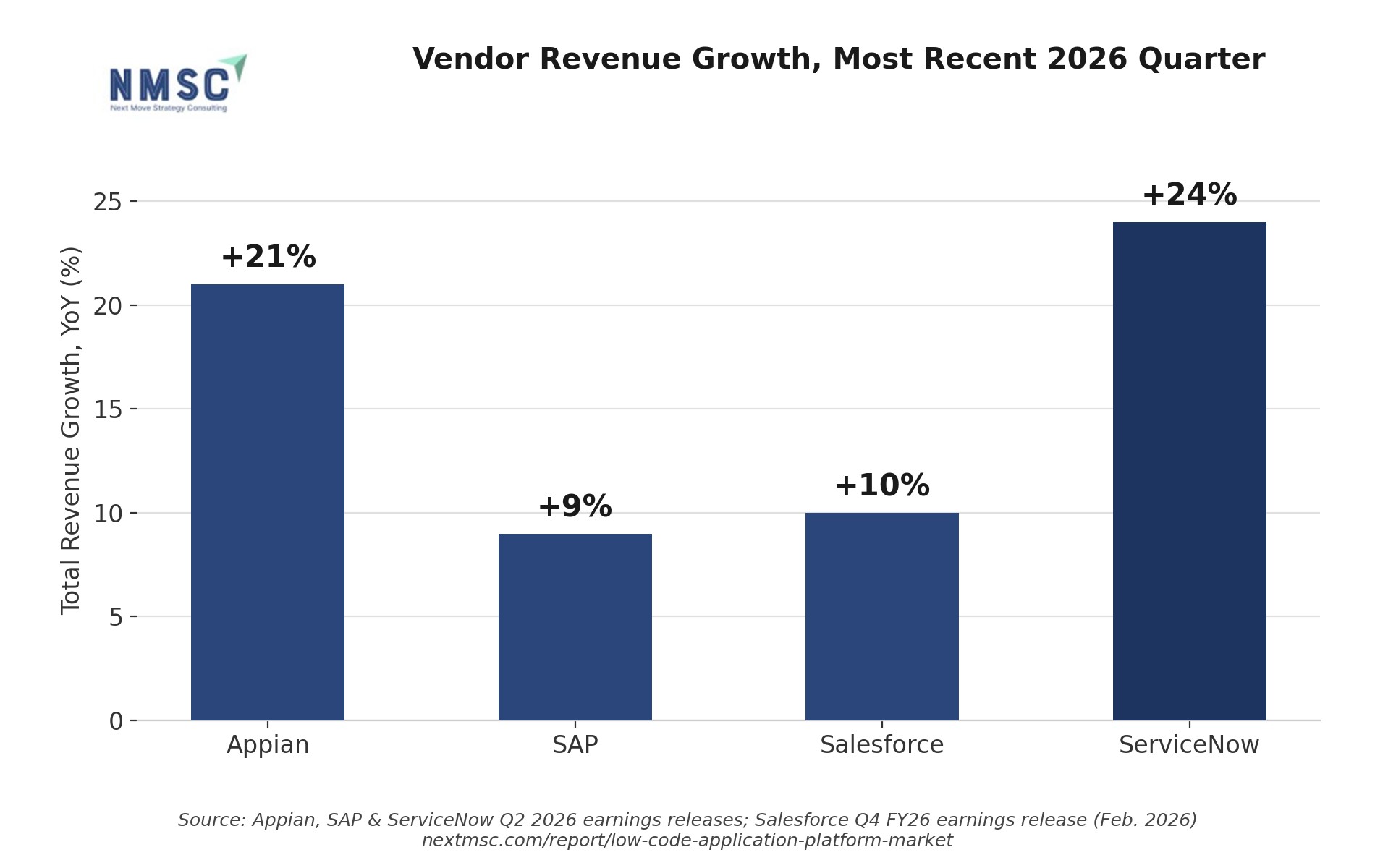
Revenue growth across the sector's biggest platforms tells a consistent story. ServiceNow's total revenue rose 24% year over year in its second quarter of 2026, and the company said its AI platform alone crossed $1 billion in annual contract value during the same quarter. Appian's total revenue grew 21%, with cloud subscription revenue up 25%, as the company leaned into AI-assisted, spec-driven development. Salesforce and SAP grew more slowly in headline revenue terms 10% and 9% respectively but both point to their agentic products as the fastest-growing part of the business: Salesforce closed its fiscal year with Agentforce annual recurring revenue of $800 million, up 169% year over year, while SAP's cloud revenue, the segment most tied to its Business AI Platform, grew 24% in constant currency even as total revenue growth stayed in single digits.
The pattern across all four companies is the same: the core platform business is growing at a modest, steady pace, while the AI-agent layer bolted onto it is growing several times faster. That gap is what is pulling capital and product attention into low-code and no-code tooling specifically, since a visual, governed interface is how most of these vendors are choosing to expose agent-building to non-specialist users.
-
ServiceNow: total revenue +24% YoY in Q2 2026; its AI platform crossed $1B in annual contract value in the same quarter
-
Appian: total revenue +21% YoY, cloud subscription revenue +25%, in Q2 2026
-
Salesforce and SAP grew total revenue more slowly (+10% and +9%) but report their agentic AI products growing far faster than the core business
Industry Leader Moves: Building the Agent Layer
Zoom into what each vendor actually shipped and a second pattern appears: 2026's product race is not about adding a chatbot to an existing app builder. It's about giving agents an identity, a governance layer, and a way to talk to agents built on other platforms.
|
Company |
Move |
Date |
Scale / Value |
Strategic Focus |
|
Microsoft |
Copilot Studio agent-to-agent (A2A) protocol reached general availability |
April 2026 |
N/A |
Cross-platform agent orchestration |
|
Microsoft |
Made Entra Agent ID mandatory for every new Copilot Studio agent |
Jul 2026 |
N/A |
Agent identity governance |
|
Salesforce |
Closed fiscal 2026 with Agentforce ARR of $800M |
Feb 2026 |
$800M ARR, +169% YoY |
Agentic CRM adoption |
|
Salesforce |
Added Multi-Agent Orchestration to Agentforce (Summer '26 release) |
Jun 2026 |
N/A |
Multi-agent coordination |
|
Appian |
Announced AI-assisted spec-driven development and MCP integration for agents |
Apr 2026 |
N/A |
Agent interoperability |
|
ServiceNow |
Build Agent reached GA in ServiceNow Studio; extended into Cursor, Claude Code, GitHub Copilot |
May 2026 |
N/A |
Governed AI-native app building |
|
SAP |
Unveiled Business AI Platform and Autonomous Suite at Sapphire |
Jun 2026 |
224 agents / 51 assistants (SAP's count) |
Enterprise AI agent suite |
|
Pegasystems |
Launched Pega Infinity Studio, an AI-powered development environment |
Jun 2026 |
N/A |
AI-assisted app building |
Microsoft and ServiceNow both moved on governance first. Microsoft's Copilot Studio now auto-creates a Microsoft Entra Agent ID for every new agent as of July 2026, with no way to opt out at the environment level, and reached general availability on an agent-to-agent (A2A) protocol so Copilot-built agents can coordinate with agents built elsewhere. ServiceNow took a similar tack from the developer-tooling side: at its Knowledge 2026 conference in May, the company made its Build Agent tool generally available inside ServiceNow Studio and extended it into Cursor, Windsurf, Claude Code and GitHub Copilot, so developers can build from whichever AI coding tool they prefer while ServiceNow's governance layer still applies. It also made its low-code App Engine Management Center free for all customers, removing a paywall that previously sat in front of app-governance tooling.
Appian and Pegasystems, the two pure-play process-automation vendors on this list, both leaned into interoperability rather than governance as their headline move. Appian's April 2026 platform update added Model Context Protocol (MCP) support so Appian-built agents can interface securely with external systems, alongside AI-assisted spec-driven development that turns a written specification directly into application logic. Pegasystems went further at PegaWorld in June, launching Pega Infinity Studio, a development environment built around its existing Blueprint agent-design tool, and previewing a shift in its pricing model from token-based charging to an outcomes-based model that bills per completed case rather than per unit of AI compute consumed a direct response to enterprise buyers' complaints about unpredictable AI costs.
Salesforce and SAP, the two largest platforms on this list by revenue, both used their user conferences to reposition around multi-agent coordination rather than single-agent deployment. Salesforce's Summer '26 release added Multi-Agent Orchestration to Agentforce, letting multiple specialized agents share context and hand off work so a customer never has to repeat themselves across channels. SAP used its Sapphire conference to launch what it calls an Autonomous Suite, which by the company's own count spans 224 agents and 51 assistants across five business domains, built on top of what SAP now brands as its Business AI Platform.
-
Microsoft and ServiceNow prioritized agent governance: mandatory agent identities, free governance tooling, and cross-tool interoperability
-
Appian and Pegasystems prioritized interoperability and cost predictability: MCP support and a shift toward outcomes-based pricing
-
Salesforce and SAP prioritized scale: multi-agent orchestration and a 224-agent Autonomous Suite, respectively
Where the Investment Is Going Next
Generative AI is the specific technology doing most of the work inside this shift. Autocomplete for logic flows, auto-generated UI, and natural-language-to-application generation are the features vendors are racing to ship, which is pulling generative AI deeper into low-code tooling than assistive AI ever went. That in turn is changing who builds software inside a company: platforms that used to be pitched purely at professional developers are now explicitly courting citizen developers with natural-language builders, on the logic that a prompt-based interface removes the last real skill barrier to entry.
That doesn't mean the older automation categories are being displaced they're converging. Robotic process automation vendors and low-code platforms are increasingly selling into the same buying committee, since an AI agent that can both reason about a request and execute a scripted action across systems blurs the line between the two categories. The same is true of broader digital transformation budgets, where low-code is increasingly the delivery layer rather than a separate line item.
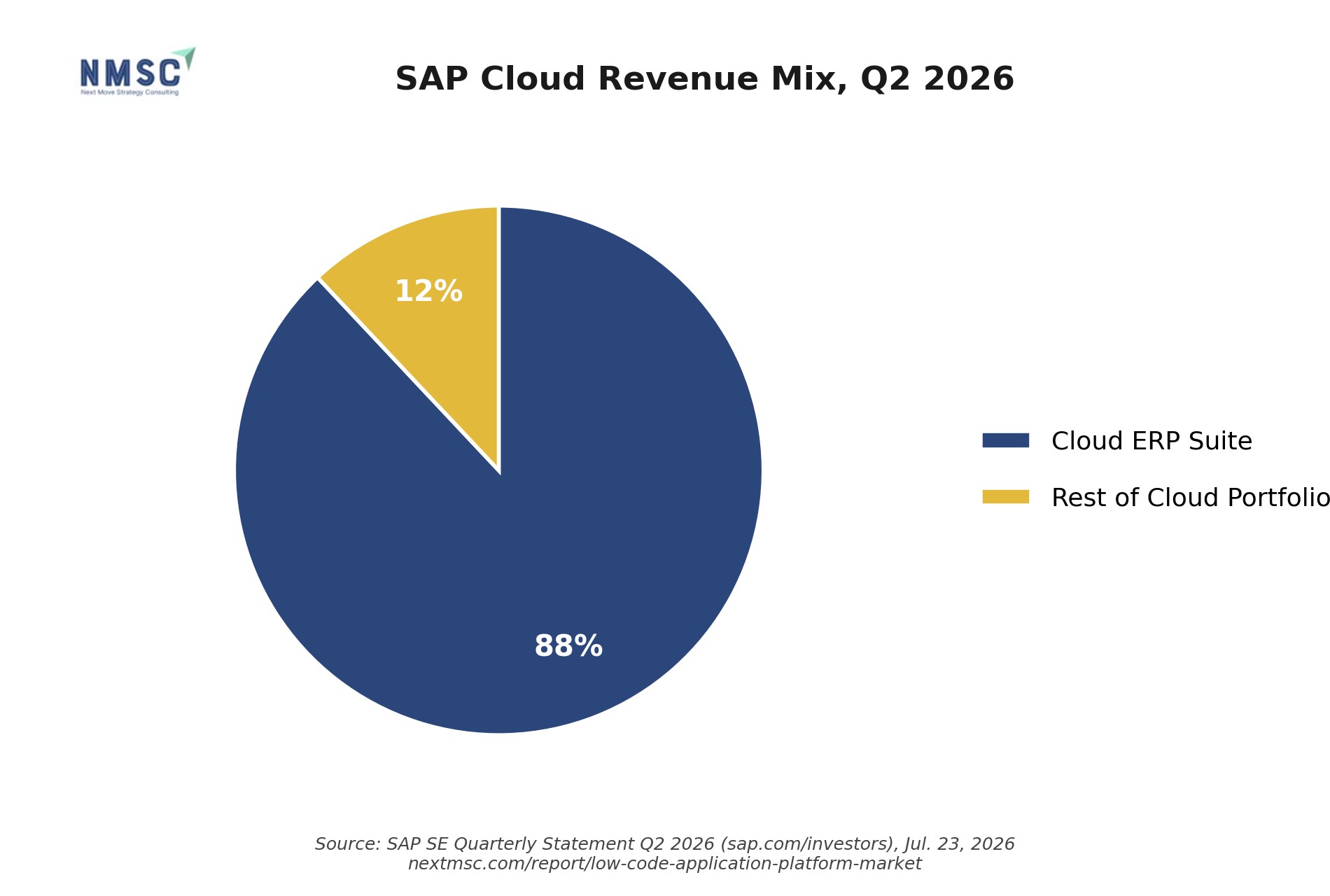
SAP's own most recent results illustrate how concentrated this shift can get inside a single vendor. Of SAP's €6.3 billion in Q2 2026 cloud revenue, its Cloud ERP Suite the product line most directly tied to its Business AI Platform accounted for 88%, with the rest of its cloud portfolio making up the remaining 12%. For a company the size of SAP, that's a striking concentration, and it's a preview of what several of the other vendors on this list are also chasing: making the AI-and-low-code layer the dominant part of the cloud business rather than an add-on to it.
-
Generative AI, specifically, is what's expanding low-code use cases from simple forms into document processing and natural-language app generation
-
Robotic process automation and low-code are converging into the same buying decision, driven by agents that can both reason and execute
-
SAP's Cloud ERP Suite its AI-platform-linked product line already accounts for 88% of its cloud revenue, a sign of where vendor investment is concentrating
Low-Code Application Platform Market Outlook
|
Parameter |
Detail |
|
Market Size (2024, base year) |
USD 36.81 Billion |
|
Market Size (2025) |
USD 49.43 Billion |
|
Revenue Forecast (2030) |
USD 215.97 Billion |
|
CAGR (2025–2030) |
34.3% |
|
Companies Profiled |
20 |
|
Countries Covered |
28 |
|
Key Platform Types Tracked |
No-Code Platforms, Low-Code Platforms, Pro-Developer Low-Code |
The broader trajectory backs up what the product announcements suggest. Growth is being driven by two forces: persistent developer shortages and time-to-market pressure that push organizations toward visual, faster-to-build tooling, and the accelerating integration of AI and cloud connectivity into that same tooling. North America continues to lead enterprise-grade adoption, on the strength of buyers who treat platform choice as a formal part of enterprise architecture rather than a departmental experiment.
For teams evaluating platforms against that backdrop, the practical question has shifted from “can this platform reduce our backlog” to “can this platform's agents be governed the same way we'd govern a new hire.” Download Free Sample
What This Means for Technology Leaders
The low-code application platform market of 2026 is no longer just a story about faster app delivery. It's a story about which vendors can let a citizen developer build an autonomous agent without that agent becoming an ungoverned liability. The platforms pulling ahead on the evidence of the last two quarters are the ones treating agent identity, interoperability and cost predictability as core platform features rather than afterthoughts. For most organizations evaluating a low-code investment today, that governance layer is now as important a selection criterion as the visual builder itself.
About the Author
 Sanyukta Deb
— Sanyukta Deb is Digital Marketing Team Lead at Next Move Strategy Consulting, where she has led content strategy and technical SEO for the firm's B2B market research publications for over 2 years. Her editorial process translates NextMSC's primary and secondary research — spanning technology, industrial, and consumer sectors — into commercial narratives, backed by search-intent, keyword, and competitive analysis. She brings 5 years of overall experience in digital marketing and content strategy.
Sanyukta Deb
— Sanyukta Deb is Digital Marketing Team Lead at Next Move Strategy Consulting, where she has led content strategy and technical SEO for the firm's B2B market research publications for over 2 years. Her editorial process translates NextMSC's primary and secondary research — spanning technology, industrial, and consumer sectors — into commercial narratives, backed by search-intent, keyword, and competitive analysis. She brings 5 years of overall experience in digital marketing and content strategy.
About the Reviewer
 Debashree Dey
— Debashree Dey is Assistant Manager at Next Move Strategy Consulting, where she supports cross-vertical market content and communications across diverse industries for 6 years. Her professional background includes senior content writing, communications, and published manuscript authorship, with experience developing audience-focused business narratives and maintaining clear, consistent messaging. Her role supports research-led content development and editorial quality across NextMSC publications.
Debashree Dey
— Debashree Dey is Assistant Manager at Next Move Strategy Consulting, where she supports cross-vertical market content and communications across diverse industries for 6 years. Her professional background includes senior content writing, communications, and published manuscript authorship, with experience developing audience-focused business narratives and maintaining clear, consistent messaging. Her role supports research-led content development and editorial quality across NextMSC publications.
















Add Comment