Where is the Deep Learning Software Market Headed in 2026?

Introduction
The deep learning software market has moved decisively from experimental promise to operational backbone. As of early 2026, generative AI has reached 53% population adoption within just three years, faster than either the personal computer or the internet achieved during their respective rises. For institutional investors and C-level executives, this is no longer a question of whether deep learning software will reshape enterprise economics, but how quickly organizations can convert capability into sustained competitive advantage.
What makes this moment particularly consequential is the convergence of three forces: dramatically cheaper inference, the arrival of agentic AI, and the migration of deep learning workloads from centralized data centers to the edge. The companies that understand the deep learning software market today are positioning themselves to capture disproportionate value across healthcare, automotive, manufacturing, and financial services in the years ahead.
For More Information – Download FREE Sample on Deep Learning Software Market Report
The Agentic Inflection: How 2026 Redefined Deep Learning Software
The most globally impactful event in this space arrived at CES 2026 in Las Vegas, where NVIDIA founder and CEO Jensen Huang unveiled the Rubin platform, the company's first extreme-codesigned, six-chip AI platform, now in full production. Rubin is engineered to slash the cost of generating AI tokens to roughly one-tenth that of the previous platform, making large-scale deep learning far more economical to deploy across the enterprise.
This economic shift was reinforced months later at Computex in Taipei. In June 2026, NVIDIA introduced the RTX Spark chip, developed with MediaTek, designed to run autonomous AI agents locally on laptops and desktops rather than relying solely on cloud computing. Qualcomm CEO Cristiano Amon, speaking ahead of the same event, framed 2026 as "the year of agents," arguing that the shift to agentic AI makes local edge computing unavoidable because today's device architectures were not built for always-on, autonomous operation.
The market reaction was immediate and telling. Following the RTX Spark announcement, NVIDIA shares jumped 4%, while shares of competing chipmakers fell between 4.9% and 8.5%, signaling how the financial markets are repricing leadership in deep learning infrastructure.
NMSC Strategic Perspective
At Next Move Strategy Consulting, our analysis indicates that the collapse in inference costs represents the single most important structural catalyst for the deep learning software market in this decade. When token generation becomes ten times cheaper, the addressable use cases expand non-linearly, particularly in cost-sensitive verticals such as retail, agriculture, and mid-market manufacturing where deep learning deployment was previously uneconomical. We view the parallel migration toward agentic, edge-resident deep learning as the decisive factor that will broaden the buyer base from large technology enterprises to the global mid-market, accelerating the adoption curve well beyond traditional software cycles.
Section Summary: The 2026 hardware and platform announcements have fundamentally altered the cost and architecture of deploying deep learning software, shifting the center of gravity toward affordable, agentic, edge-deployed solutions.
-
NVIDIA's Rubin platform reduces token generation costs to approximately one-tenth of the prior generation.
-
The RTX Spark chip brings autonomous agent execution directly to personal computers.
-
Industry leaders have designated 2026 as the inflection point for agentic AI.
-
Cheaper inference expands the economically viable use-case base across nearly every vertical.
Industry Impact Analysis
The downstream effects of these developments extend well beyond the technology sector. Stanford HAI's 2026 AI Index Report documents that organizational AI adoption has reached 88%, while industry produced over 90% of notable frontier models in 2025, underscoring how thoroughly the private sector now drives deep learning innovation.
Investment flows confirm the trajectory. United States private AI investment reached USD 285.9 billion in 2025, more than 23 times the USD 12.4 billion invested in China, while the U.S. led entrepreneurial activity with 1,953 newly funded AI companies in 2025. The infrastructure backbone is equally concentrated: the United States hosts 5,427 data centers, more than ten times any other country, with nearly every leading AI chip fabricated by a single Taiwanese foundry, TSMC.
While the initial narrative surrounding generative AI often focuses on Western tech hubs, a closer look at population-level penetration reveals a surprising geographic distribution. The chart below illustrates how leading nations in the Middle East and Asia are outpacing mature Western markets in widespread adoption:
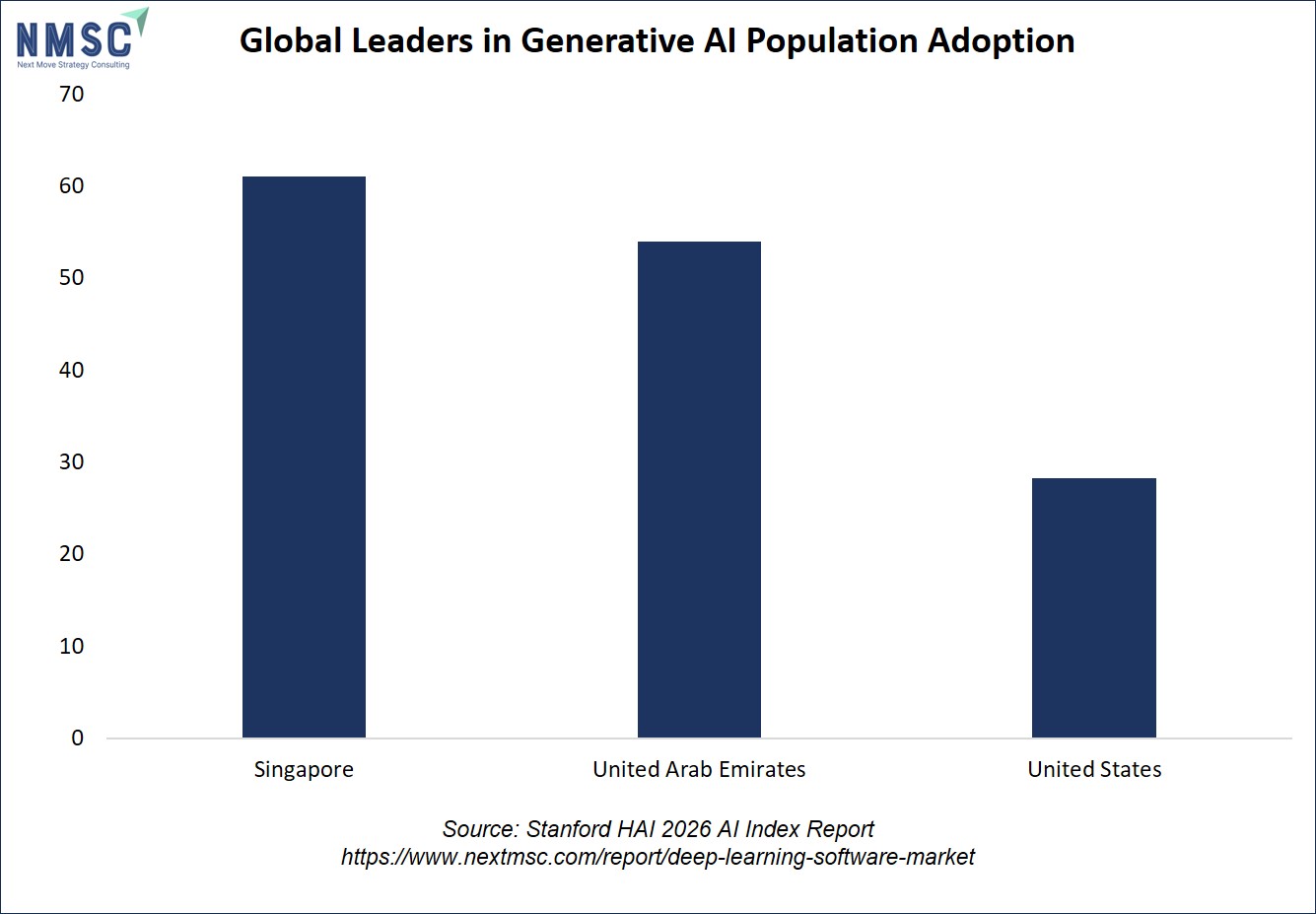
The labor market dimension is critical for enterprise planning. The World Economic Forum estimates that around 1.1 billion jobs could be transformed by technology over the next decade, and its Future of Jobs Report 2025 suggests that AI and information processing will affect 86% of businesses by 2030. Notably, NVIDIA's Huang dismissed concerns that AI would reduce demand for software engineers as "complete nonsense," arguing the technology is instead increasing the number of engineers being hired.
Section Summary: Capital, infrastructure, and talent are concentrating around deep learning software at an unprecedented pace, with adoption now near-universal among large organizations and investment heavily weighted toward the United States.
-
Organizational AI adoption has reached 88% globally.
-
U.S. private AI investment of USD 285.9 billion in 2025 dwarfed all competitors.
-
Approximately 1.1 billion jobs could be transformed by technology over the next decade.
-
Supply chain concentration around a single foundry introduces material geopolitical risk.
Pros and Cons of Recent Market Developments
|
Pros |
Cons |
|
Inference costs cut to roughly one-tenth, expanding viable use cases |
Hardware supply chain heavily dependent on a single Taiwanese foundry |
|
Edge-resident agents reduce cloud dependency and latency |
AI PC demand has been mixed, with some OEMs reporting shortfalls |
|
Near-universal enterprise adoption validates commercial maturity |
Documented AI incidents rose to 362, up from 233 in 2024 |
|
Open model ecosystems lower barriers to entry across industries |
Responsible AI benchmarks lag behind capability advances |
|
Strong investment momentum supports continued innovation |
Talent mobility into leading markets is declining sharply |
Key Data & Statistics
The following tables consolidate verified figures relevant to the deep learning software market and its surrounding ecosystem.
|
Deep Learning Software Market (2023) |
USD 27.2 billion |
|
Deep Learning Software Market (2030, forecast) |
USD 236.3 billion |
|
CAGR (2024–2030) |
36.2% |
|
Leading Region |
North America |
|
Ecosystem Indicator |
Value |
|
Organizational AI adoption |
88% |
|
U.S. private AI investment (2025) |
USD 285.9 billion |
|
U.S. data centers |
5,427 |
|
Generative AI population adoption (3 years) |
53% |
|
Documented AI incidents (2025) |
362 |
Future Outlook & Forecast
The trajectory for the deep learning software market is among the most robust in enterprise technology. According to Next Move Strategy Consulting, the deep learning software market is projected to reach USD 236.3 billion by 2030, expanding at a CAGR of 36.2% from 2024 to 2030. This growth is anchored by rapid adoption across healthcare, manufacturing, and automotive, supported by advancements in data center capabilities, high computing power, and the ability of deep learning software to perform tasks without human intervention.
Looking ahead, the strategic implications are substantial. The migration toward IP-led value creation, rather than isolated tools, is becoming the defining characteristic of mature enterprise deep learning solutions. The World Economic Forum emphasizes that AI value creation must shift from services and isolated tools toward IP-led solutions, built and scaled through coordinated technology and industry ecosystems. For the deep learning platforms vying for leadership, the differentiator will increasingly be the depth of vertical integration and the trustworthiness of governance frameworks rather than raw model performance alone.
Section Summary: The deep learning software market is forecast to grow nearly ninefold by 2030, with the most durable value accruing to providers who deliver vertically integrated, governance-ready, IP-led solutions.
-
The market is projected to reach USD 236.3 billion by 2030 at a 36.2% CAGR.
-
Healthcare, manufacturing, and automotive remain the principal demand drivers.
-
Competitive advantage is shifting from raw performance toward vertical depth and trust.
-
IP-led value creation is replacing isolated-tool deployment as the strategic standard.
Next Steps for Stakeholders
For C-level executives and institutional investors, the current environment rewards deliberate, well-sequenced action:
-
Reassess infrastructure economics. With inference costs falling sharply, revisit business cases that were previously rejected on cost grounds; many are now viable.
-
Prioritize edge and agentic readiness. Evaluate whether existing architectures can support always-on, autonomous agents, and plan migration paths accordingly.
-
Embed governance from the outset. Given the rise in documented AI incidents, build transparency, human oversight for high-stakes decisions, and bias checks directly into workflows.
-
Invest in the workforce. Align workforce strategy with AI strategy, creating clear skills taxonomies and internal mobility to capture productivity gains rather than merely layering tools onto legacy structures.
-
Diversify supply chain exposure. Monitor concentration risk in chip fabrication and factor geopolitical contingencies into long-term procurement planning.
Conclusion
The deep learning software market in 2026 stands at a genuine inflection point. The collapse in inference costs, the arrival of agentic AI, and the migration to the edge have collectively transformed deep learning software from a specialized capability into a broadly accessible enterprise utility. With the market on a path toward USD 236.3 billion by 2030 at a 36.2% CAGR, the organizations that act now, balancing aggressive adoption with disciplined governance, will be best positioned to lead. The defining question for leadership is no longer the pace of technological change, but the quality of the strategic choices made in response to it.
About the Author
 Sanyukta Deb
— Sanyukta Deb is Digital Marketing Team Lead at Next Move Strategy Consulting, where she has led content strategy and technical SEO for the firm's B2B market research publications for over 2 years. Her editorial process translates NextMSC's primary and secondary research — spanning technology, industrial, and consumer sectors — into commercial narratives, backed by search-intent, keyword, and competitive analysis. She brings 5 years of overall experience in digital marketing and content strategy.
Sanyukta Deb
— Sanyukta Deb is Digital Marketing Team Lead at Next Move Strategy Consulting, where she has led content strategy and technical SEO for the firm's B2B market research publications for over 2 years. Her editorial process translates NextMSC's primary and secondary research — spanning technology, industrial, and consumer sectors — into commercial narratives, backed by search-intent, keyword, and competitive analysis. She brings 5 years of overall experience in digital marketing and content strategy.
About the Reviewer
 Debashree Dey
— Debashree Dey is Assistant Manager at Next Move Strategy Consulting, where she supports cross-vertical market content and communications across diverse industries for 6 years. Her professional background includes senior content writing, communications, and published manuscript authorship, with experience developing audience-focused business narratives and maintaining clear, consistent messaging. Her role supports research-led content development and editorial quality across NextMSC publications.
Debashree Dey
— Debashree Dey is Assistant Manager at Next Move Strategy Consulting, where she supports cross-vertical market content and communications across diverse industries for 6 years. Her professional background includes senior content writing, communications, and published manuscript authorship, with experience developing audience-focused business narratives and maintaining clear, consistent messaging. Her role supports research-led content development and editorial quality across NextMSC publications.

















Add Comment