What Qualifications Should PRN Healthcare Workers Have?

Every year, hundreds of millions of resumes never reach a human recruiter an algorithm decides first. According to the AI Resume Screening Market report from Next Move Strategy Consulting, the global market was valued at USD 840.6 million in 2025 and is projected to reach USD 5.92 billion by 2035, growing at a CAGR of 21.4% from 2026 to 2035.
2026 has also been the year the technology's legal exposure caught up with its adoption curve. A federal court kept discrimination claims against Workday's AI screening tools moving forward, a first-of-its-kind lawsuit accused Eightfold AI of secretly running what amounts to an unlicensed credit-reporting operation, and the market's biggest platforms kept consolidating Paradox into Workday, SmartRecruiters into SAP even as each raced to add more agentic AI.
What's Driving the AI Resume Screening Market?
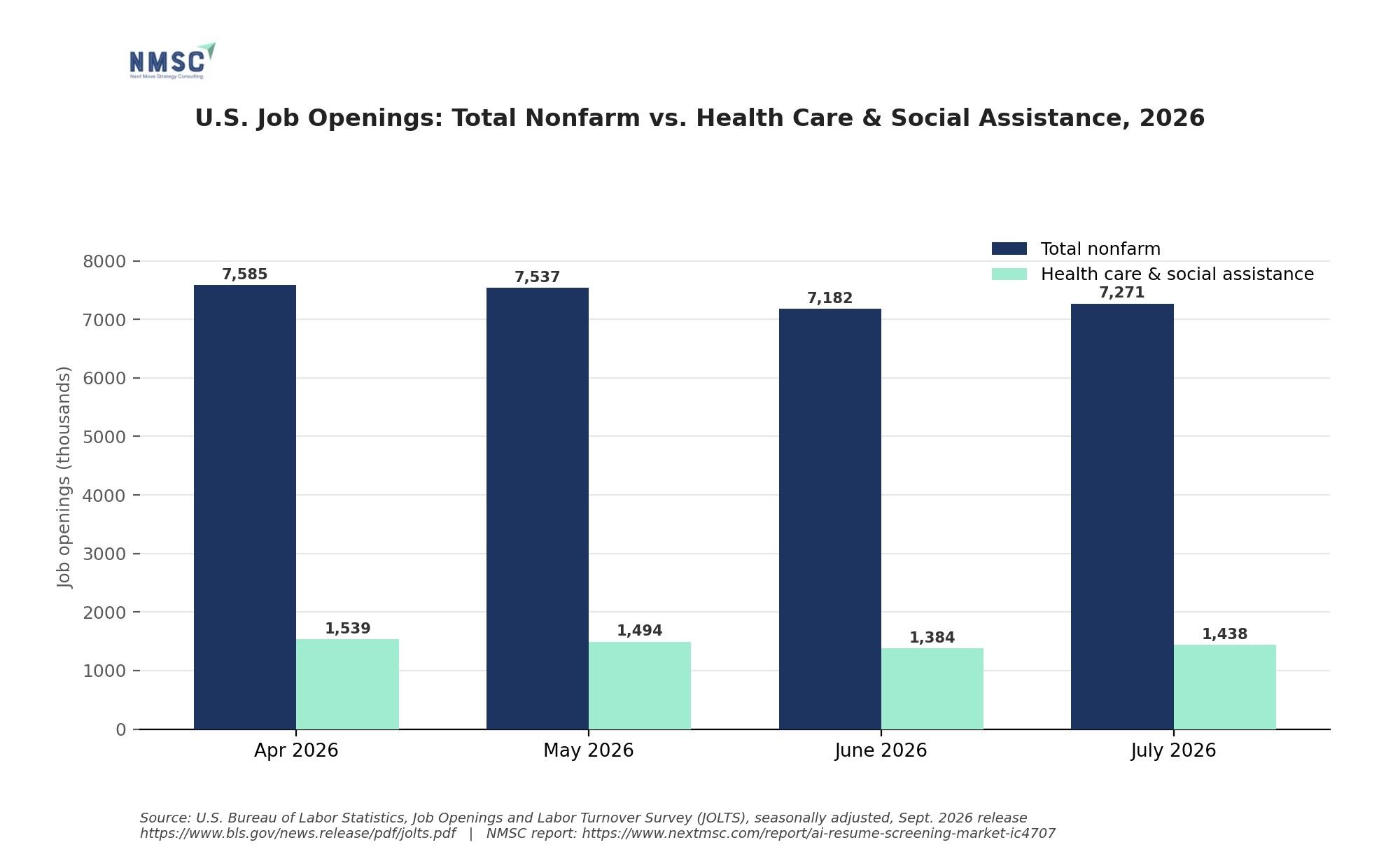
The market's growth is being pulled by a genuine mismatch between application volume and recruiter capacity. The U.S. Bureau of Labor Statistics' Job Openings and Labor Turnover Survey (JOLTS) put total nonfarm job openings at 7.27 million in July 2026 a labor market still tight enough that employers keep posting faster than they can screen. Health care and social assistance alone accounted for 1.44 million of those openings, reflecting the chronic staffing shortages that make healthcare, per NMSC's analysis, the fastest-growing end-user vertical for AI screening tools.
Healthcare staffing illustrates the pattern well. Agencies such as PRN Health Services, which places nurses and allied health professionals into as-needed shifts, depend on filling roles within days rather than weeks precisely the high-volume, time-sensitive hiring that AI screening tools are built to handle.
A second driver is skills-based hiring: as more employers drop degree requirements in favor of demonstrated competencies, screening platforms need to infer and score skills from unstructured resume data rather than simply matching keywords, a harder technical problem that favors vendors with deeper language-model capabilities. A third driver is regulation itself bias-audit mandates are pushing employers toward vendors who can document compliance rather than away from AI screening altogether. Elsewhere in the HR technology stack, NMSC's Human Capital Management Market report tracks the broader platform layer, from Workday to Oracle to SAP, that these screening tools increasingly plug into.
In short: the AI Resume Screening Market's growth is following where application volume, skills-based hiring, and compliance pressure are colliding hardest.
-
Job openings remain elevated at 7.27 million nationally, with health care and social assistance the single largest sector
-
Skills-based hiring is pushing screening platforms toward harder, more language-model-dependent matching problems
-
Bias-audit regulation is a demand driver, not just a compliance cost, for vendors that can document fairness
-
High-volume, time-sensitive hiring verticals like healthcare staffing are the clearest near-term adoption case
Industry Leader Moves: A Year of Litigation, Consolidation, and Agentic AI
No part of the AI Resume Screening Market illustrates 2026's shift more clearly than the events unfolding at its largest platforms some are defending their screening tools in federal court, others are being absorbed into larger suites, and nearly all are racing to ship agentic AI features.
Workday
Workday's AI-powered applicant screening tools remain the subject of Mobley v. Workday, a federal class and collective action in the Northern District of California. In a June 22, 2026 ruling, the court rejected Workday's argument that disparate-impact protections under the Age Discrimination in Employment Act apply only to current employees, keeping race, sex, age, and disability discrimination claims moving forward a decision that plaintiffs' counsel say exposes not just Workday but the more than 10,000 employers that use its AI-powered hiring tools. A May 29, 2026 discovery ruling separately denied plaintiffs' motion to compel Workday's internal bias-testing data, finding it protected by attorney-client privilege. Alongside the litigation, Workday completed its acquisition of conversational-AI vendor Paradox on October 1, 2025, folding Paradox's Olivia assistant and Workday's own HiredScore recommendation technology into a single "Workday Paradox Candidate Experience Agent" the same HiredScore technology the Mobley court has since ordered Workday to disclose customer-level usage data for.
Eightfold AI
On January 20, 2026, two job applicants filed a first-of-its-kind class action against Eightfold AI in California state court, alleging that the company's AI "match scores" which rank candidates zero to five and are used by employers including Microsoft, Morgan Stanley, and PayPal to filter applicants function as undisclosed consumer reports under the federal Fair Credit Reporting Act and California's Investigative Consumer Reporting Agencies Act. Unlike most AI hiring litigation, which targets algorithmic bias, the suit brought by former EEOC chair Jenny Yang argues Eightfold operates as an unregistered consumer reporting agency that never told applicants a report existed, never gave them access to it, and never let them dispute it. Eightfold disputes the claims, saying its tool "operates on data intentionally shared by candidates or provided by our customers" and does not scrape social media.
Oracle
Oracle introduced Fusion Agentic Applications for HR on April 9, 2026 eight autonomous AI agents embedded free of charge in Oracle Fusion Cloud HCM, including a Hiring Workspace for Store Managers designed to cut administrative recruiting work for retail hiring managers. Oracle expanded the lineup in its July 2026 "26C" release with a Recruiting Booster module adding an Interview Companion and a Candidate Outreach Agent for personalized bulk candidate messaging, and highlighted competitive wins over Workday during its fiscal third quarter.
HireVue
HireVue acquired AI interview-intelligence company Hireguide on March 10, 2026 to accelerate its push into agentic AI hiring, following a February 19, 2026 launch of Assessment Builder, which lets employers build role-specific, scientifically validated hiring assessments without specialist input. HireVue also joined the Workday AI Agent Partner Network in January 2026, positioning its skills-validation tools as a certified add-on inside Workday's recruiting suite even as Workday's own screening tools face litigation.
iCIMS
iCIMS launched its Summer 2026 Product Release in July, adding a High-Volume Hiring solution with embedded analytics aimed at frontline and seasonal recruiting a response, the company said, to a 9% year-over-year rise in frontline job openings alongside an 18% decline in application volume per its own platform data. iCIMS was also named a Strategic Leader in the Fosway 9-Grid for Talent Acquisition for a fifth consecutive year in July 2026.
Employ Inc. and SmartRecruiters: Consolidation Under Larger Owners
Two of the market's more established platforms changed hands, or continued operating under owners they joined years earlier. Employ Inc. the parent company behind Jobvite, JazzHR, and Lever since a series of private-equity-backed combinations completed in 2022 added AI interview-intelligence platform Pillar to its portfolio in March 2025, continuing a pattern of building rather than buying AI capability piecemeal. SmartRecruiters, meanwhile, is now an SAP company, and used an April 7, 2026 event to unveil agentic interviewing, an agentic CRM, applicant fraud detection, and deeper SAP SuccessFactors integration features CEO Rebecca Carr said were "dramatically accelerated" by being part of SAP. Both moves reflect the same underlying pressure: standalone screening and ATS vendors are increasingly hard to sustain outside a larger HR platform's distribution.
The Rest of the Field
Among the remaining named leaders, coverage is necessarily lighter where no material 2026 development was independently verifiable. Phenom People and Beamery continue to compete as enterprise-focused "talent intelligence" platforms serving Fortune 500 accounts; SeekOut remains focused on AI-driven candidate sourcing and search. Greenhouse and Workable continue operating under their existing ownership (TPG since 2021, in Greenhouse's case) without a distinct 2026 headline. Harver, which absorbed assessment-science firm Pymetrics in 2022, and ClearCompany continue to compete on pre-hire assessment and compliance tooling. Avature remains a recruiting-CRM specialist used heavily by large enterprises, while Daxtra Technologies focuses on resume-parsing infrastructure that other platforms build on top of. TurboHire, a Hyderabad-based vendor named directly in NMSC's own market report as a notable domestic Indian player, and Sapia.ai, known for asynchronous voice-based screening positioned around bias reduction, both continue to compete primarily outside the U.S. enterprise segment that dominates the market's revenue.
In short: the AI Resume Screening Market's 2026 story is as much about who owns which platform and who is being sued as it is about new features.
-
Workday and Eightfold AI are both defending high-profile litigation that could reshape vendor liability for AI hiring decisions
-
Oracle and HireVue are both shipping agentic AI features aimed at automating recruiter workflows, not just screening resumes
-
SmartRecruiters (SAP) and Jobvite/JazzHR/Lever (Employ Inc.) illustrate a broader pattern of standalone platforms consolidating under larger owners
-
Several smaller named leaders show no material 2026 activity, underscoring how concentrated real movement is among the market's largest players
The Labor Market and Legal Backdrop
The demand side of the AI Resume Screening Market is easiest to see in the U.S. Bureau of Labor Statistics' own hiring data. U.S. job openings fell below 7 million in the first quarter of 2026 before rebounding to 7.6 million in April and May, 7.4 million in June, and 7.3 million in July, according to the BLS. The sustained hiring demand is increasing the need for AI-powered tools that can help employers process high application volumes efficiently.
U.S. Job Openings, Total Nonfarm (Thousands, Seasonally Adjusted)
|
Month |
Job Openings |
|
January 2026 |
6.9 |
|
February 2026 |
6.9 |
|
March 2026 |
6.9 |
|
April 2026 |
7.6 |
|
May 2026 |
7.6 |
|
June 2026 |
7.4 |
|
July 2026 |
7.3 |
Alongside that labor-market backdrop, 2026 has produced a fast-accumulating record of litigation and regulation specifically targeting AI hiring tools the clearest evidence that compliance, not just efficiency, is now a purchasing criterion.
Major AI Hiring Litigation and Regulatory Developments, 2026
|
Date |
Development |
|
Jan. 20, 2026 |
Class action filed against Eightfold AI alleging its candidate "match scores" are undisclosed consumer reports under the FCRA |
|
Jan. 2026 |
Texas law prohibiting AI systems deployed with intent to discriminate in hiring takes effect |
|
May 29, 2026 |
Mobley v. Workday discovery ruling shields Workday's internal bias-testing data under attorney-client privilege |
|
June 22, 2026 |
Mobley v. Workday ruling allows race, sex, age, and disability discrimination claims to keep proceeding |
In short: hiring demand remains structurally high, and the legal ground under AI screening tools is shifting in real time rather than settling.
-
Job openings have held above 7 million every month in 2026, keeping screening volume elevated
-
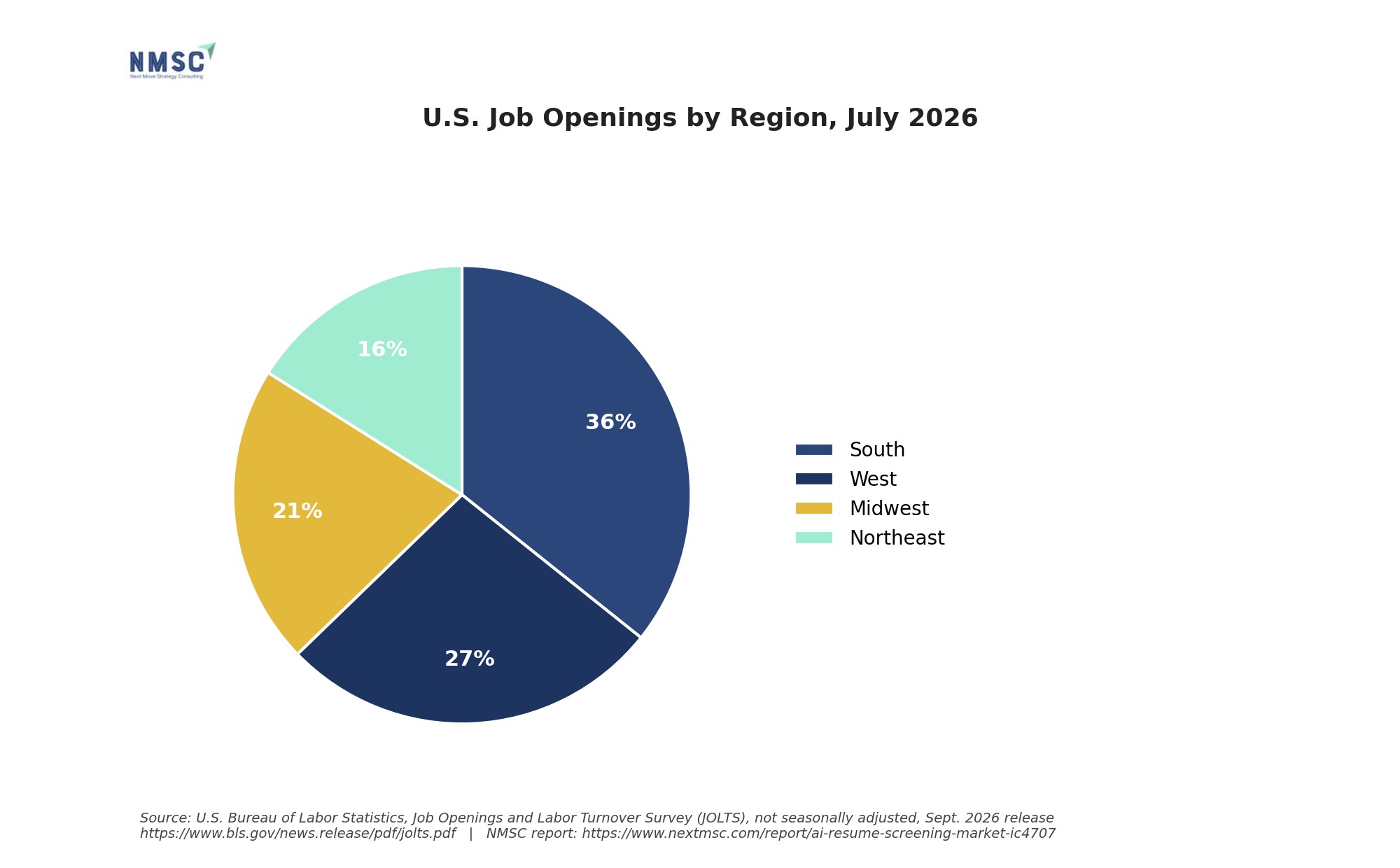
The South and West together account for 63% of U.S. job openings, shaping where screening demand concentrates
-
Mobley v. Workday and the Eightfold AI suit represent two distinct legal theories discrimination and undisclosed consumer reporting both still active
-
A patchwork of state AI-hiring laws (Texas, and others) is emerging alongside federal litigation, raising compliance complexity for multi-state employers
AI Resume Screening Market Outlook: What's Next
Through 2035, the AI Resume Screening Market's trajectory looks tied to how the current wave of litigation resolves. If courts continue to treat AI vendors as potential co-defendants alongside employers as Mobley v. Workday has so far expect procurement to favor platforms that can document bias testing and consumer-report compliance as a baseline feature, not a premium add-on. The consolidation pattern already underway at SmartRecruiters (SAP) and Jobvite (Employ Inc.) suggests standalone vendors without a large platform's compliance and distribution resources will keep getting absorbed rather than competing independently. At the same time, the shift toward agentic AI visible in Oracle's Fusion Agentic Applications, HireVue's Hireguide acquisition, and SmartRecruiters' agentic CRM signals that the market's next phase of competition is less about scoring resumes and more about automating the entire hiring workflow around them.
In short: compliance architecture and agentic automation, not raw screening accuracy, look set to define competitive position through 2035.
-
Litigation outcomes in Mobley v. Workday and the Eightfold AI case will likely shape procurement standards well beyond the two named defendants
-
Vendor consolidation under larger HCM platforms (SAP, Workday) is likely to continue for standalone screening and ATS specialists
-
Agentic AI automating scheduling, outreach, and interview workflows, not just scoring is the clearest current product battleground
Ready to dig into the full segment-by-segment forecast? Download Free Sample of NMSC's AI Resume Screening Market report for the complete market sizing, CAGR breakdown, and competitive analysis.
Conclusion
The AI Resume Screening Market is no longer just a story about faster shortlists it’s a story about who bears legal responsibility when an algorithm gets a hiring decision wrong. With the market on track to grow from USD 840.6 million in 2025 to USD 5.92 billion by 2035, the litigation working through federal courts against Workday and Eightfold AI, alongside the consolidation reshaping SmartRecruiters and Jobvite, will likely determine which platforms are still standing to capture that growth.
About the Author
 Sanyukta Deb
— Sanyukta Deb is Digital Marketing Team Lead at Next Move Strategy Consulting, where she has led content strategy and technical SEO for the firm's B2B market research publications for over 2 years. Her editorial process translates NextMSC's primary and secondary research — spanning technology, industrial, and consumer sectors — into commercial narratives, backed by search-intent, keyword, and competitive analysis. She brings 5 years of overall experience in digital marketing and content strategy.
Sanyukta Deb
— Sanyukta Deb is Digital Marketing Team Lead at Next Move Strategy Consulting, where she has led content strategy and technical SEO for the firm's B2B market research publications for over 2 years. Her editorial process translates NextMSC's primary and secondary research — spanning technology, industrial, and consumer sectors — into commercial narratives, backed by search-intent, keyword, and competitive analysis. She brings 5 years of overall experience in digital marketing and content strategy.
About the Reviewer
 Debashree Dey
— Debashree Dey is Assistant Manager at Next Move Strategy Consulting, where she supports cross-vertical market content and communications across diverse industries for 6 years. Her professional background includes senior content writing, communications, and published manuscript authorship, with experience developing audience-focused business narratives and maintaining clear, consistent messaging. Her role supports research-led content development and editorial quality across NextMSC publications.
Debashree Dey
— Debashree Dey is Assistant Manager at Next Move Strategy Consulting, where she supports cross-vertical market content and communications across diverse industries for 6 years. Her professional background includes senior content writing, communications, and published manuscript authorship, with experience developing audience-focused business narratives and maintaining clear, consistent messaging. Her role supports research-led content development and editorial quality across NextMSC publications.

















Add Comment