How is AI Cloud Surge Redrawing the 2026 ERP Software Market?

Introduction
The ERP Software Market has reached a defining inflection point in 2026, transforming from a back-office system of record into an intelligent, AI-native engine of enterprise decision-making. As cloud migration accelerates and agentic automation moves from roadmap to revenue, Enterprise Resource Planning is no longer a static infrastructure investment but a dynamic strategic asset that determines competitive velocity across global industries.
For C-level executives, institutional investors, and technology decision-makers, understanding the ERP Software Market today demands looking beyond licensing metrics toward cloud subscription momentum, SaaS ERP adoption rates, and the rapid embedding of AI copilots across financial, supply chain, and human capital functions. This guide synthesizes verified primary-source intelligence from the world's largest ERP vendors with proprietary forecasting from NMSC to deliver an institutional-grade view of where the market stands and where capital should be directed.
For More Information – Download FREE Sample on ERP Software Market Report
How AI-Native Cloud ERP Is Redefining Enterprise Resource Planning Trends
The single most globally impactful development reshaping the ERP Software Market in 2026 is Oracle's record fiscal year results, announced in June 2026, which crystallized the decisive shift toward AI-fueled cloud ERP. Oracle reported that for fiscal year 2026, total revenue reached a record $67.4 billion, up 17% year-over-year, while cloud revenues increased 39% to $34.0 billion. In the fourth quarter alone, revenue from cloud offerings increased 47% to $9.91 billion, with Oracle Cloud Infrastructure revenue growing 93% to $5.8 billion, underscoring the scale of AI-driven demand.
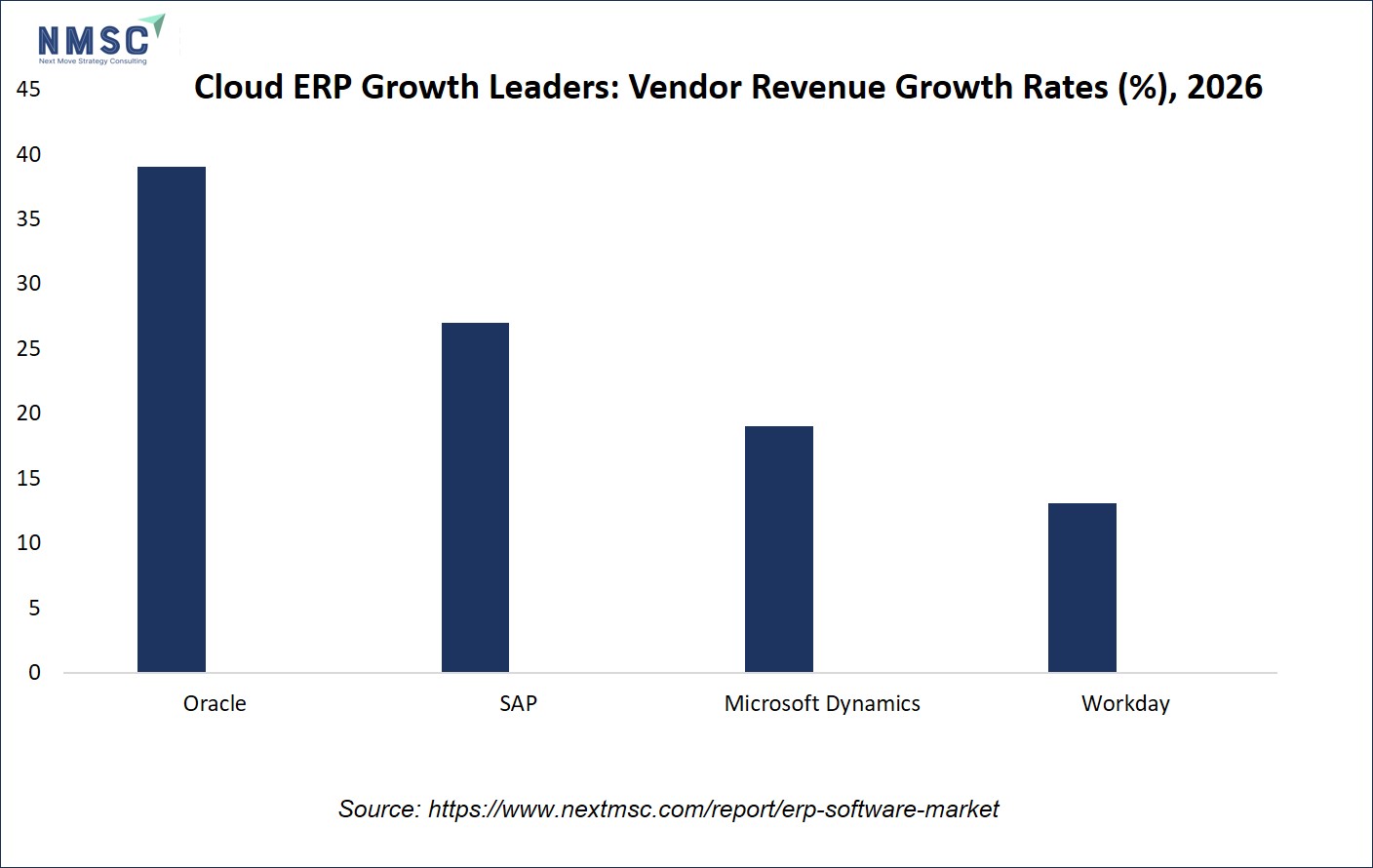
The momentum extends across the competitive landscape. SAP, the world's leading enterprise application company, reported in its Q1 2026 results that cloud revenue reached €5.962 billion, up 19% and up 27% at constant currencies, with a current cloud backlog of €21.9 billion, up 25% at constant currencies. Microsoft reported that its Dynamics products and cloud services revenue increased $363 million, or 19%, in its fiscal 2026 third quarter, driven by growth in Dynamics 365. Workday closed fiscal year 2026 with total revenues of $9.552 billion, an increase of 13.1%, and subsequently reported fiscal 2027 first-quarter total revenues of $2.542 billion, up 13.5%, reflecting sustained platform momentum.
This collective acceleration is being propelled by a wave of AI-native product launches. In October 2025, Oracle announced NetSuite Next, the next-generation AI-embedded ERP suite with conversational intelligence and agentic workflows, while in January 2025, SAP released its S/4HANA Cloud Public Edition 2502 update, embedding the SAP Joule copilot to automate tasks and accelerate business workflows.
NMSC Strategic Perspective on the AI-Cloud Convergence
From NMSC's analytical vantage point, the simultaneous cloud and AI acceleration represents a structural repricing of the ERP value proposition rather than a cyclical upturn. The economics of the modern ERP market are increasingly anchored in recurring subscription revenue and the monetization of embedded intelligence, where AI copilots and agentic workflows transform ERP from a system of record into a system of action.
NMSC anticipates three structural shifts. First, the gravitational pull toward cloud and SaaS deployment will intensify, with the shift toward cloud-first models contributing an estimated +1.63% impact on the market's CAGR forecast. Second, composable and low-code architectures will unlock the mid-market and SME segments, where demand outpaces traditional enterprise deployments. Third, AI-native challengers will attract significant venture capital, pressuring incumbents to embed intelligence natively rather than as a bolt-on. For investors, the signal is clear: value in Enterprise Resource Planning is migrating decisively toward intelligent, cloud-delivered, subscription-based platforms.
Section Summary: The ERP Software Market is being structurally redefined by the convergence of cloud acceleration and AI-native automation, evidenced by record cloud growth across Oracle, SAP, Microsoft, and Workday in 2026.
-
Oracle posted record FY2026 total revenue of $67.4 billion, with cloud revenue up 39% to $34.0 billion.
-
SAP Q1 2026 cloud revenue rose 27% at constant currencies to €5.962 billion.
-
Microsoft Dynamics 365 grew 19% and Workday delivered 13.1% full-year revenue growth.
-
NMSC expects cloud-first deployment to add an estimated +1.63% to the market's CAGR.
Industry Impact Analysis
The acceleration of AI-native cloud ERP is unfolding against a backdrop of fundamental shifts in enterprise buying behavior. The most powerful driver is the decisive pivot toward cloud and SaaS deployment models, which reduce upfront infrastructure costs, accelerate implementation cycles, and enable continuous upgrades. NMSC's analysis confirms that cloud ERP led deployment in 2025 due to scalability, lower upfront costs, and rapid deployment, while on-premise retained a 30% share among enterprises requiring data control and compliance.
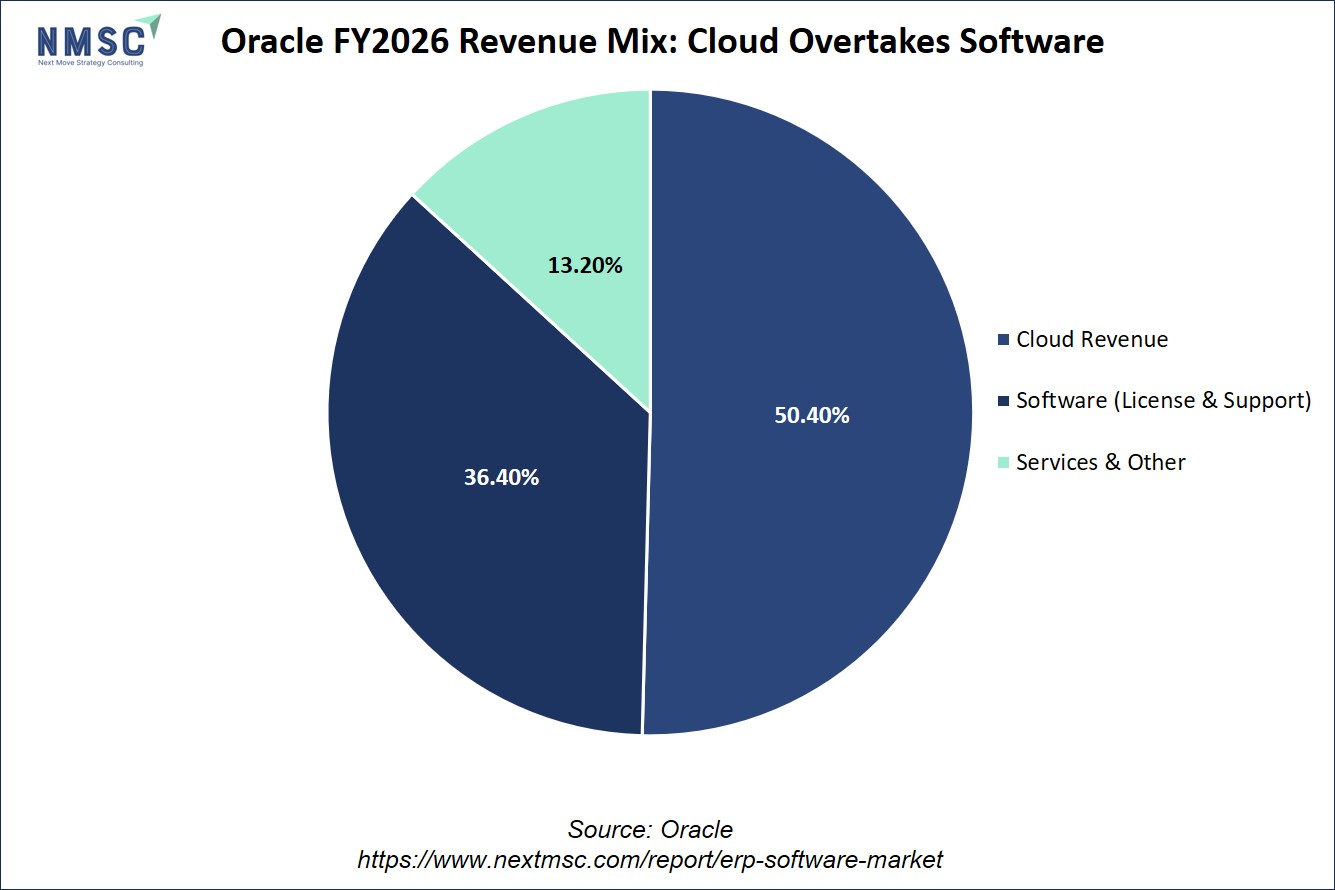
The financial evidence of this migration is unambiguous. Oracle's cloud revenues now substantially exceed its software license revenues, with software revenues down 1% to $24.5 billion even as cloud surged 39%. This same dynamic is visible at SAP, where cloud growth is steadily displacing legacy software support revenue, confirming the structural durability of the subscription transition.
The end-user dynamics are equally instructive. Software accounted for 84% of the global ERP software market in 2025, while small and medium-sized enterprises captured a 54% market share, reflecting the democratizing effect of cloud-first, subscription-based pricing that has placed sophisticated ERP capabilities within reach of organizations previously served only by basic accounting tools.
However, structural headwinds persist. Implementation complexity and legacy system dependencies remain a critical restraint, which NMSC quantifies as a -1.11% impact on the CAGR forecast, with the strongest effect among mid-sized enterprises and organizations with entrenched legacy infrastructure. Macroeconomic and currency volatility also exert pressure, as evidenced by the gap between SAP's reported and constant-currency growth rates.
Section Summary: The ERP Software Market's growth is anchored in cloud-first deployment, software dominance, and accelerating SME adoption, while implementation complexity remains the principal structural restraint.
-
Oracle's cloud revenue now far exceeds declining software license revenue, confirming the subscription transition.
-
Software represented 84% of the market in 2025; SMEs held a 54% end-user share.
-
Cloud ERP led deployment in 2025, with on-premise retaining 30% for compliance-sensitive enterprises.
-
Digital transformation adds an estimated +1.47% to CAGR, while legacy complexity subtracts an estimated -1.11%.
Pros and Cons of Recent Market Developments
The cloud and AI-driven dynamics reshaping the Enterprise Resource Planning landscape carry distinct advantages and risks for stakeholders.
|
Pros |
Cons |
|
Cloud and SaaS models deliver resilient, recurring subscription revenue |
Implementation complexity and legacy dependencies slow adoption |
|
AI agents and copilots transform ERP into a system of action |
High customization costs extend deployment timelines |
|
Composable and low-code architectures unlock SME and mid-market segments |
Data sovereignty and compliance concerns persist in regulated sectors |
|
Industry-specific ERP reduces customization and accelerates compliance |
Migration from entrenched legacy systems carries integration risk |
|
Continuous upgrades and seamless integration enhance total value |
Currency volatility and intense competition pressure margins |
Key Data & Statistics
The following tables draw exclusively on verified primary-source disclosures from key players' investor relations and regulatory filings, alongside reputable financial outlets.
Leading ERP Vendors — Verified Latest Reported Performance (2026)
|
Company |
Reported Period |
Key Metric |
Growth Rate |
Source Basis |
|
Oracle |
FY 2026 (Full Year) |
Cloud revenue $34.0 billion |
+39% |
Oracle Investor Relations |
|
SAP SE |
Q1 2026 |
Cloud revenue €5.962 billion |
+27% at cc |
SAP Q1 2026 Statement |
|
Microsoft (Dynamics) |
FY26 Q3 |
Dynamics products & cloud |
+19% |
Microsoft Investor Relations |
|
Workday |
FY 2026 (Full Year) |
Total revenue $9.552 billion |
+13.1% |
Workday Investor Relations |
Oracle reported FY2026 total revenue of a record $67.4 billion, up 17%, with cloud revenue up 39% to $34.0 billion. Workday's full-year fiscal 2026 revenue totaled $9.552 billion, up 13.1%.
Oracle FY2026 Revenue Composition
|
Revenue Stream |
FY2026 Value |
Year-over-Year Growth |
|
Cloud Revenue |
$34.0 billion |
+39% |
|
Software (License & Support) |
$24.5 billion |
-1% |
|
Total Revenue |
$67.4 billion |
+17% |
The composition confirms the decisive migration from traditional software toward cloud subscription, with cloud growth of 39% sharply outpacing the 1% decline in software revenue.
Future Outlook & Forecast for the ERP Software Market
The forward trajectory of the ERP Software Market is defined by the sustained convergence of cloud migration, AI integration, and modular architecture. Anchoring the long-term market sizing, Next Move Strategy Consulting values the global ERP Software Market at USD 115.29 billion in 2025, with a projected rise to USD 365.95 billion by 2035, registering a CAGR of 11.60% from 2026 to 2035. NMSC further projects the market to reach USD 136.33 billion by 2026, underscoring the pace of near-term expansion.
Regionally, North America holds the largest share of the ERP software market at 37.9%, driven by widespread enterprise digitisation and cloud ERP adoption, while Asia-Pacific is the fastest-growing region with a 24.1% share, fueled by digital transformation and public sector modernisation. Europe represents approximately 31% of the global market, distinguished by strong regulatory drivers such as GDPR and financial reporting mandates.
NMSC's outlook holds that composable and low-code ERP architectures represent the principal growth opportunity, contributing an estimated +1.31% to the CAGR forecast by enabling modular deployments and citizen-developer participation. This thesis is strongly corroborated by Oracle's record $638 billion backlog disclosed in its fiscal 2026 results, which signals durable, multi-year demand visibility for cloud ERP and infrastructure.
Section Summary: The ERP Software Market outlook is anchored by NMSC's USD 365.95 billion forecast by 2035 at an 11.60% CAGR, with cloud, AI, and composable architectures as the principal value drivers.
-
NMSC projects the market to grow from USD 115.29 billion in 2025 to USD 365.95 billion by 2035.
-
North America leads with a 37.9% share; Asia-Pacific is the fastest-growing region at 24.1%.
-
Oracle's record $638 billion backlog signals durable multi-year cloud ERP demand.
-
Composable and low-code ERP adds an estimated +1.31% to the CAGR forecast.
Next Steps for Stakeholders
For C-level executives and institutional investors positioning within the ERP Software Market, the strategic priorities are increasingly defined and actionable:
-
Prioritize cloud-native and AI-embedded exposure. Direct capital toward vendors demonstrating strong cloud subscription growth and native AI capabilities, as these command the most resilient recurring revenue.
-
Evaluate composable and low-code platforms. These architectures unlock the high-growth SME and mid-market segments while reducing implementation complexity.
-
Target high-growth geographies. Asia-Pacific offers the most attractive blend of structural growth and public-sector digitalization momentum.
-
Factor migration and currency risk into valuation models. Legacy integration complexity and FX volatility remain material; prioritize platforms that demonstrably ease migration bottlenecks.
-
Monitor backlog and demand visibility. Vendor backlog disclosures, such as Oracle's $638 billion, provide a leading indicator of durable cloud ERP demand.
Conclusion
The ERP Software Market in 2026 is being reshaped by a rare convergence of forces: record cloud acceleration led by Oracle's $67.4 billion fiscal year and 39% cloud growth; the maturation of AI agents from roadmap to revenue across SAP, Microsoft, and Workday; and the democratization of enterprise-grade capabilities through composable, low-code architectures. Against this backdrop, NMSC's forecast of a USD 365.95 billion market by 2035 at an 11.60% CAGR provides a credible long-term anchor for capital allocation. The decisive strategic insight is unambiguous—value in Enterprise Resource Planning now resides in cloud-delivered, AI-native, subscription-based platforms, and the stakeholders who align their portfolios accordingly will be best positioned to capture the next phase of growth.
About the Author
 Sanyukta Deb
— Sanyukta Deb is Digital Marketing Team Lead at Next Move Strategy Consulting, where she has led content strategy and technical SEO for the firm's B2B market research publications for over 2 years. Her editorial process translates NextMSC's primary and secondary research — spanning technology, industrial, and consumer sectors — into commercial narratives, backed by search-intent, keyword, and competitive analysis. She brings 5 years of overall experience in digital marketing and content strategy.
Sanyukta Deb
— Sanyukta Deb is Digital Marketing Team Lead at Next Move Strategy Consulting, where she has led content strategy and technical SEO for the firm's B2B market research publications for over 2 years. Her editorial process translates NextMSC's primary and secondary research — spanning technology, industrial, and consumer sectors — into commercial narratives, backed by search-intent, keyword, and competitive analysis. She brings 5 years of overall experience in digital marketing and content strategy.
About the Reviewer
 Debashree Dey
— Debashree Dey is Assistant Manager at Next Move Strategy Consulting, where she supports cross-vertical market content and communications across diverse industries for 6 years. Her professional background includes senior content writing, communications, and published manuscript authorship, with experience developing audience-focused business narratives and maintaining clear, consistent messaging. Her role supports research-led content development and editorial quality across NextMSC publications.
Debashree Dey
— Debashree Dey is Assistant Manager at Next Move Strategy Consulting, where she supports cross-vertical market content and communications across diverse industries for 6 years. Her professional background includes senior content writing, communications, and published manuscript authorship, with experience developing audience-focused business narratives and maintaining clear, consistent messaging. Her role supports research-led content development and editorial quality across NextMSC publications.

















Add Comment