Who’s Leading the Pet Clothing Market in 2025?
Introduction
The global pet clothing market has moved well beyond novelty status. What began as a niche segment of the broader pet care industry has matured into a commercially significant category where luxury fashion houses, sports leagues, and celebrity-backed brands compete for shelf space alongside functional outerwear specialists. According to Next Move Strategy Consulting's Pet Clothing Market report, the global pet clothing market was valued at USD 5.7 billion in 2025 and is projected to reach USD 7.23 billion by 2030, growing at a CAGR of 4.8% from 2025 to 2030. This trajectory is not driven by a single macro trend but by a convergence of structural forces — rising pet ownership across multiple generations, the mainstreaming of pet humanization as a consumer identity, and the entry of premium and tech-integrated product categories that command higher average selling prices.
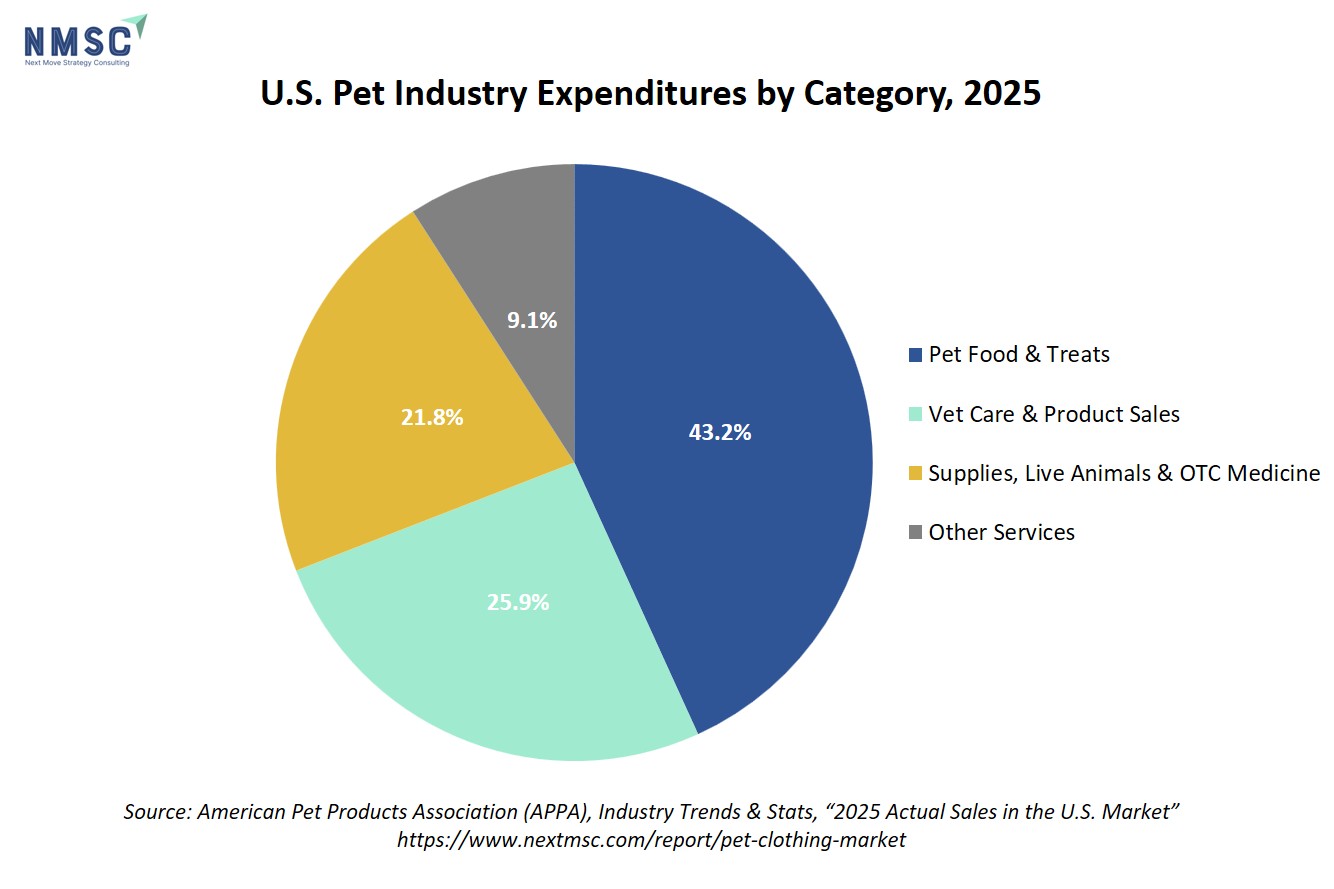
The broader context reinforces this momentum. According to the American Pet Products Association's (APPA) 2026 State of the Industry Report, released on March 26, 2026, total U.S. pet industry expenditures reached USD 158 billion in 2025, a 3.7% increase year-over-year, and are projected to reach USD 165 billion in 2026. Within this expanding ecosystem, apparel and accessories represent one of the fastest-evolving discretionary sub-categories, shaped by social media commerce, cross-industry brand collaborations, and a generational shift in how consumers define pet ownership.
For More Information: Download FREE Sample on Pet Clothing Market Report
From Runways to Retail Aisles: The Forces Reshaping Pet Fashion in 2026
Interzoo 2026 Sets the Global Agenda for Pet Apparel Innovation
The most significant industry signal of 2026 came from Nuremberg, Germany, where Interzoo — the world's leading B2B trade fair for the global pet industry — convened approximately 2,400 exhibitors from roughly 70 countries across 150,000 square meters of exhibition space from May 12–15, 2026. The event's official press release identified four defining themes for the year: health promotion, sustainability embedded across the full value chain, AI-supported pet care, and premium-quality functional accessories.
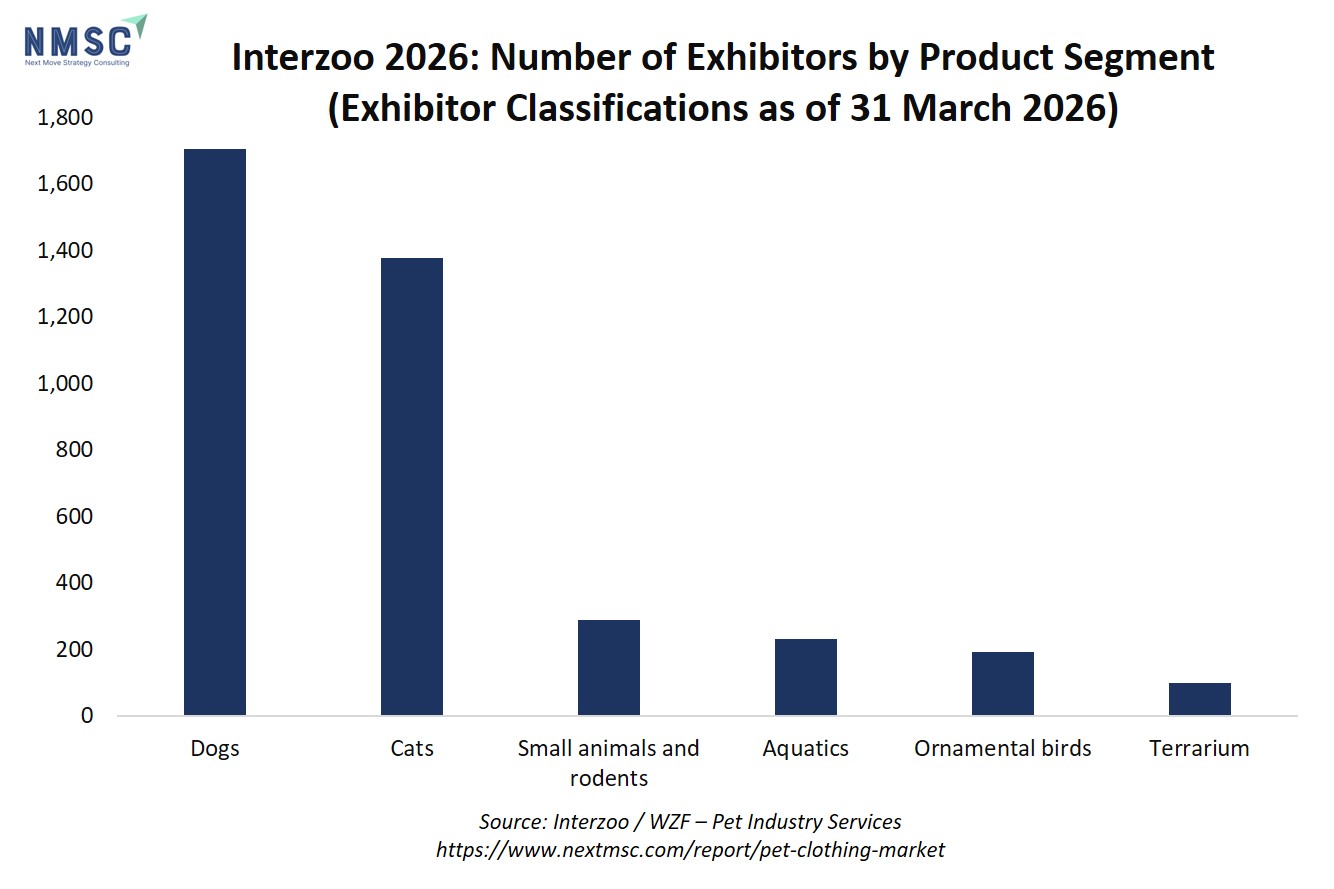
For the pet clothing segment specifically, Interzoo 2026 underscored a decisive shift: functional and stylish accessories are no longer treated as separate product philosophies. Exhibitors presented jogging leashes in fashionable colorways alongside life jackets, travel crates, and carry cases — products designed to facilitate an active, mobile lifestyle in the company of pets. This convergence of form and function is expanding the addressable market for pet apparel beyond seasonal costumes and into year-round, activity-specific wardrobes.
Norbert Holthenrich, President of the German Pet Trade & Industry Association ZZF and honorary sponsor of Interzoo, stated: "When pets are loved as 'furry children' and animal lovers become the health managers of their pets, it is not surprising that our customers are intensely interested in providing optimal care to their beloved pets and want to do everything they can to ensure that their pets enjoy long, comfortable lives." This sentiment — articulated at the industry's premier global gathering — encapsulates the consumer psychology that is structurally expanding demand for premium pet apparel.
Pet Ownership Expansion Is Broadening the Consumer Base
The demand foundation for pet clothing is widening, not just deepening. According to the APPA's 2026 State of the Industry Report, dog ownership in the U.S. expanded from 51% of households in 2024 to 53% in 2025 — representing approximately 71 million dog-owning households and roughly 4 million additional dog-owning households added in a single year. Cat ownership rose 5% year-over-year to 39% of U.S. households (53 million households), with growth propelled by Gen Z and Millennials.
Critically, growth is no longer concentrated in a single demographic. Gen X emerged as a significant contributor to pet ownership expansion, with dog ownership among Gen X households increasing 12% year-over-year, cat ownership rising 8%, and smaller pet categories — birds (+25% YoY), reptiles (+20% YoY), and freshwater fish (+17% YoY) — all recording double-digit gains. This broadening of the ownership base across species and generations directly expands the total addressable market for pet apparel, as each new pet-owning household represents a potential apparel buyer.
According to NextMSC primary research and analysis, the U.S. pet population reached 196.9 million in 2024, while India's pet population grew to approximately 42 million in 2024, up from 26 million in 2019 — a 62% increase in five years that signals the scale of emerging-market opportunity even as cultural adoption of pet apparel in these regions remains nascent.
Celebrity Collaborations and Sports Licensing: The New Commercial Architecture
The competitive landscape of the pet clothing market has been fundamentally restructured by cross-industry brand partnerships that import consumer loyalty from adjacent categories. According to NextMSC primary research and analysis, several landmark collaborations defined the 2024–2025 period:
-
Little Beast launched an official NBA pet clothing line featuring teams including the Los Angeles Lakers, Boston Celtics, and Golden State Warriors — directly tapping the USD multi-billion sports fan merchandise market and converting team loyalty into pet apparel purchases.
-
Max-Bone collaborated with Netflix's Bridgerton series to release a themed capsule collection, merging fashion-forward design with entertainment IP to reach a style-conscious, streaming-era audience.
-
Moshiqa partnered with celebrity Paris Hilton to unveil the MetaPink Pet Collection, combining tech aesthetics with celebrity influence to penetrate the luxury and lifestyle segments.
-
Mungo & Maud formed a creative collaboration with Japanese brand 45R, producing handcrafted, culturally inspired pet apparel targeting niche luxury buyers.
-
Canada Pooch launched the Eco Alaskan Army Parka using eco-conscious materials and introduced the Weighted Calm Collection, addressing pet anxiety — a functional positioning that differentiates the brand from purely fashion-driven competitors.
These partnerships are not marketing exercises; they are structural market-expansion mechanisms. By attaching pet apparel to established fan bases, entertainment franchises, and celebrity audiences, brands are converting consumers who would not have independently sought out pet clothing into active buyers.
NMSC Strategic Perspective: The Premiumization Inflection Point
NextMSC primary research and analysis identifies 2025–2026 as a premiumization inflection point for the global pet clothing market. Three structural dynamics are converging simultaneously:
First, the entry of luxury fashion houses — including Gucci, which has launched a dedicated pet collection featuring collars, harnesses, leashes, and ready-to-wear items — has established a price ceiling that legitimizes premium positioning across the entire category. When a consumer can purchase a Gucci dog coat, the psychological barrier to spending USD 80–120 on a Canada Pooch parka is substantially reduced.
Second, the integration of technology into pet apparel — GPS-enabled vests, health-monitoring smart jackets, battery-powered heated coats — is creating a new product tier that commands significantly higher average selling prices than conventional apparel, expanding revenue per unit without requiring proportional volume growth.
Third, the social media economy has created a self-reinforcing demand loop: pet influencers ("petfluencers") generate an average 5% engagement rate across major platforms, surpassing the typical 1–3% engagement rate of human influencers, according to NextMSC primary research and analysis. This outsized engagement translates directly into purchase intent, as followers replicate the styles and brands showcased by their favorite pet accounts.
Section Summary: The pet clothing market's 2026 growth narrative is anchored in three verifiable structural shifts — the Interzoo 2026 agenda confirming functional-fashion convergence as the industry's dominant product philosophy, APPA data documenting the broadening of the pet-owning consumer base across generations and species, and a wave of cross-industry brand collaborations that are importing consumer loyalty from sports, entertainment, and luxury fashion into the pet apparel category.
Key Takeaways:
-
Interzoo 2026 (May, Nuremberg) confirmed that functional and stylish pet accessories are converging into a single product category, expanding year-round demand beyond seasonal costumes.
-
U.S. dog-owning households grew by approximately 4 million in 2025 alone, adding a proportional increment to the addressable pet apparel market.
-
Gen X pet ownership grew 12% YoY for dogs and 8% for cats in 2025, broadening the buyer demographic beyond Millennials and Gen Z.
-
NBA licensing, Netflix IP collaborations, and celebrity partnerships are converting fan-base loyalty into pet apparel revenue — a structural market-expansion mechanism, not a temporary trend.
Industry Impact Analysis
The Generational Spending Shift and Its Implications for Product Strategy
The APPA's 2026 State of the Industry Report reveals a nuanced spending dynamic that has direct implications for pet apparel brands. While pet ownership is expanding, spending patterns are becoming more value-oriented — 22% of pet owners spent less on their pets in 2025, a 10% increase from 2024. However, this value-seeking behavior is concentrated in discretionary categories and does not uniformly suppress premium pet apparel demand.
Significantly, Gen Z and Millennials — the two demographics most likely to purchase pet clothing — reported that the economy did not affect their pet ownership decisions. This insulation of pet spending from broader consumer budget pressure among younger demographics creates a durable demand floor for the pet apparel segment, even as macroeconomic headwinds moderate overall discretionary spending.
Sustainability as a Competitive Differentiator, Not a Compliance Exercise
Interzoo 2026's official press release explicitly stated that sustainability at the 2026 edition was "not just a trend embodied in niche products, but an integral topic affecting all stages of the value chain from product development and production processes to sales and merchandise presentation." This framing — sustainability as operational DNA rather than marketing positioning — reflects the influence of the EU Supply Chain Act, which is now applicable to the pet industry and is compelling manufacturers to document and disclose environmental practices across their supply chains.
For pet clothing brands, this regulatory pressure is simultaneously a compliance burden and a brand-building opportunity. Canada Pooch's Eco Alaskan Army Parka — crafted with eco-conscious materials — exemplifies how sustainability credentials can be embedded into flagship product lines rather than relegated to a separate "green" sub-range. Brands that integrate sustainable materials (organic cotton, recycled polyester, hemp) into their core collections are better positioned to meet both regulatory requirements and the preferences of Millennial and Gen Z buyers, who according to NextMSC primary research and analysis represent the most influential consumer cohort in the pet clothing market.
Asia-Pacific's Structural Dominance and North America's Growth Trajectory
According to NextMSC primary research and analysis, Asia-Pacific accounts for approximately 35% of global pet clothing demand, with China leading the region at a 22% share, followed by Japan and South Korea. The region's dominance is underpinned by cultural shifts toward pet humanization in densely populated urban centers, the influence of K-pop culture on pet fashion aesthetics in South Korea, and Japan's structurally high per-capita pet spending driven by single-person household demographics.
North America, however, is projected to record the fastest regional growth, with a CAGR of 5.4% from 2025 to 2030, according to NextMSC primary research and analysis. The APPA's confirmation that more than 70% of U.S. households now own a pet — with dog ownership reaching 53% of households in 2025 — provides the ownership base that sustains this growth trajectory.
The E-Commerce Channel's Structural Advantage
The online distribution channel has become the primary growth engine for pet clothing sales, driven by the same digital fluency that characterizes the Millennial and Gen Z buyer cohorts. Social media platforms — particularly Instagram and TikTok — function simultaneously as discovery engines, marketing channels, and purchase pathways, compressing the consumer journey from awareness to transaction. Pet influencers with significant followings collaborate with brands to showcase specific products, generating purchase intent that is immediately actionable through embedded links and platform-native shopping features.
This channel dynamic has a measurable impact on brand strategy: companies that maintain strong online presences and offer seamless e-commerce experiences are disproportionately capturing the growth in the market, while brands reliant on traditional brick-and-mortar distribution face structural headwinds as consumer discovery increasingly originates on social platforms.
Section Summary: The industry impact of current market forces is bifurcated — brands with strong digital presences, sustainability credentials, and cross-industry partnership strategies are capturing disproportionate growth, while those reliant on conventional distribution and undifferentiated product lines face margin compression. Regulatory pressure from the EU Supply Chain Act is accelerating the sustainability transition across the value chain, and generational spending data confirms that Millennial and Gen Z pet owners represent a structurally resilient demand base even in a tightening consumer economy.
Key Takeaways:
-
Gen Z and Millennials reported that economic pressures did not affect their pet ownership decisions, insulating premium pet apparel demand from broader consumer budget pressure.
-
The EU Supply Chain Act now applies to the pet industry, compelling manufacturers to document environmental practices across their supply chains — a compliance requirement that is simultaneously a brand-building opportunity.
-
Asia-Pacific holds 35% of global pet clothing demand; North America is projected to grow at a CAGR of 5.4% from 2025 to 2030, per NextMSC primary research and analysis.
-
The e-commerce channel is structurally advantaged in pet clothing, as social media platforms compress the consumer journey from discovery to purchase.
Pros and Cons of Recent Market Developments
|
Recent Development |
Pros |
Cons |
|
NBA & Entertainment IP Licensing (Little Beast NBA line; Max-Bone × Bridgerton) |
Converts established fan bases into pet apparel buyers; reduces customer acquisition cost; generates media coverage without paid advertising spend |
Licensing fees compress margins; brand identity becomes dependent on third-party IP; collections have limited shelf life tied to franchise popularity |
|
Luxury Brand Entry (Gucci Pet Collection) |
Raises the category's price ceiling, legitimizing premium positioning across all tiers; attracts aspirational buyers who trade up from mass-market products |
Concentrates premium demand in a small number of high-income consumers; creates unrealistic quality expectations that mid-market brands struggle to meet |
|
Sustainability Mandates (EU Supply Chain Act; Canada Pooch Eco Parka) |
Differentiates brands with genuine eco-credentials; aligns with Millennial/Gen Z purchasing values; future-proofs supply chains against tightening regulation |
Increases production costs in the near term; requires supply chain transparency that smaller brands may lack the infrastructure to deliver |
|
Tech-Integrated Apparel (GPS vests, heated coats, health-monitoring jackets) |
Creates a new high-ASP product tier; appeals to tech-savvy pet owners; generates recurring revenue through app subscriptions and firmware updates |
High development costs; battery and hardware reliability concerns; consumer education required to justify premium price points |
|
Celebrity Collaborations (Moshiqa × Paris Hilton MetaPink Collection) |
Generates immediate brand awareness; reaches audiences outside the traditional pet product buyer demographic; drives social media engagement |
Celebrity association carries reputational risk; collections may not align with core brand identity; demand spikes are difficult to sustain post-launch |
|
Interzoo 2026 Functional-Fashion Convergence |
Validates year-round product demand beyond seasonal costumes; opens new product categories (travel, outdoor, active lifestyle) |
Requires significant R&D investment to develop products that genuinely deliver on both functional and aesthetic claims |
The Path to USD 7.23 Billion: Segment and Regional Dynamics
According to NextMSC primary research and analysis, the global pet clothing market is on a sustained growth trajectory from USD 5.7 billion in 2025 to USD 7.23 billion by 2030, at a CAGR of 4.8%. This growth is not uniformly distributed across segments and geographies — it is concentrated in specific product categories, consumer demographics, and regional markets that are experiencing structural tailwinds.
Dogs remain the dominant segment, with a projected CAGR exceeding 5.3% through 2030, according to NextMSC primary research and analysis. The breadth of the dog apparel category — spanning functional outerwear (coats, rainwear, boots), fashion items (shirts, dresses, suits), and tech-integrated products (GPS vests, heated jackets) — provides multiple price points and purchase occasions that sustain demand across economic cycles.
North America's 5.4% CAGR through 2030 reflects the compounding effect of three simultaneous forces: a growing pet ownership base (71 million dog-owning households in 2025), a Millennial consumer cohort entering peak earning years while maintaining strong emotional attachment to their pets, and a social media ecosystem that continuously generates new purchase occasions through seasonal trends, celebrity collaborations, and viral pet content.
Asia-Pacific's 35% global share is underpinned by China's 22% regional contribution, Japan's structurally high per-capita pet spending, and South Korea's K-pop-influenced pet fashion culture. As urbanization deepens across Southeast Asia and disposable incomes rise in markets like Indonesia, Thailand, and Singapore — all covered in NextMSC's regional analysis — the region's share of global pet clothing demand is expected to remain dominant through the forecast period.
Technology Integration as the Next Revenue Frontier
The convergence of wearable technology and pet apparel represents the most significant product-category expansion opportunity in the forecast period. Smart collars and vests equipped with GPS tracking, health monitors, and LED displays are transitioning from novelty products to mainstream pet care tools, according to NextMSC primary research and analysis. Heated pet coats with battery-powered heating elements address a genuine functional need in cold-climate markets, while AI-integrated accessories — showcased prominently at Interzoo 2026 — are creating new use cases that extend the product's value proposition beyond aesthetics.
The Emerging Market Opportunity: A Long-Term Growth Lever
While limited cultural awareness of pet clothing in markets like India and Pakistan currently constrains near-term demand, the structural conditions for future growth are forming. India's pet population grew from 26 million in 2019 to approximately 42 million in 2024 — a 62% increase in five years — according to NextMSC primary research and analysis. As urbanization, rising disposable incomes, and social media penetration accelerate in these markets, the awareness barrier that currently limits pet apparel adoption will progressively erode, creating a long-term growth lever that is not yet reflected in current market valuations.
Section Summary: The pet clothing market's path to USD 7.23 billion by 2030 is supported by a multi-layered growth architecture: a broadening ownership base across generations and geographies, a premiumization trend anchored by luxury brand entry and tech-integrated product categories, and an emerging-market opportunity that will become commercially significant in the latter half of the forecast period.
Key Takeaways:
-
The global pet clothing market is projected to grow from USD 5.7 billion (2025) to USD 7.23 billion (2030) at a 4.8% CAGR, per NextMSC primary research and analysis.
-
The dogs segment is projected to grow at a CAGR exceeding 5.3% through 2030, driven by the breadth of product categories and the strength of the human-canine bond.
-
North America's 5.4% CAGR through 2030 reflects compounding ownership growth, Millennial peak-earning dynamics, and social media-driven purchase occasions.
-
Tech-integrated pet apparel — GPS vests, heated coats, health-monitoring jackets — represents the highest-ASP growth frontier in the forecast period.
-
India's pet population grew 62% between 2019 and 2024, establishing the ownership base that will underpin emerging-market demand for pet apparel in the medium term.
Next Steps for Stakeholders
For Brand Manufacturers and Product Developers:
Prioritize the development of functional-fashion hybrid products that deliver measurable utility (thermal protection, GPS tracking, anxiety reduction) while maintaining aesthetic appeal. The Interzoo 2026 agenda confirmed that this convergence is the dominant product philosophy at the global industry level — brands that treat function and fashion as separate design briefs will cede ground to those that integrate both. Invest in sustainable material sourcing now, ahead of regulatory requirements, to build supply chain transparency that can be used as a brand differentiator with Millennial and Gen Z buyers.
For Retailers and E-Commerce Operators:
Allocate disproportionate investment to social commerce capabilities — shoppable content, influencer partnership programs, and platform-native storefronts on Instagram and TikTok. The pet influencer ecosystem's 5% average engagement rate, per NextMSC primary research and analysis, represents a cost-efficient customer acquisition channel relative to traditional paid media. Build inventory strategies around collaboration-driven demand spikes (sports licensing, entertainment IP, celebrity partnerships), which generate concentrated purchase intent that requires rapid fulfillment capability.
For Investors and Private Equity:
The pet clothing market's 4.8% CAGR through 2030 is supported by structural demand drivers — generational pet ownership expansion, premiumization, and tech integration — that are not dependent on a single macro variable. The APPA's confirmation that U.S. pet industry expenditures are projected to reach USD 165 billion in 2026, with full-year growth near 4.4%, provides a robust macro backdrop. Target investments in brands with defensible IP (proprietary licensing agreements, celebrity partnerships, sustainability certifications) and strong e-commerce infrastructure, as these are the characteristics that are generating disproportionate market share gains in the current competitive landscape.
For Brands Targeting Emerging Markets:
Do not wait for cultural awareness of pet clothing to develop organically in markets like India, Indonesia, and Thailand. Invest in consumer education — through social media content, pet influencer partnerships, and veterinarian endorsements — to accelerate the awareness-to-purchase journey. India's pet population of approximately 42 million in 2024, per NextMSC primary research and analysis, represents a commercially significant base that is currently underserved by the pet apparel category.
Conclusion
The global pet clothing market is at a structural inflection point. The convergence of rising pet ownership across multiple generations, the mainstreaming of pet humanization as a consumer identity, and the entry of luxury brands, sports leagues, and entertainment franchises into the category have collectively elevated pet apparel from a discretionary novelty to a commercially serious market segment. Interzoo 2026's confirmation that functional-fashion convergence is the industry's dominant product philosophy, combined with APPA data documenting the continued expansion of the U.S. pet ownership base, provides a credible foundation for NextMSC's projection of USD 7.23 billion in global market value by 2030.
The brands that will capture disproportionate value in this market are those that treat sustainability as operational DNA rather than marketing positioning, invest in tech-integrated product categories that command premium price points, and build the social commerce infrastructure to convert the pet influencer ecosystem's outsized engagement rates into measurable revenue. For investors and executives evaluating this market, the structural growth drivers are durable, the competitive landscape is actively differentiating, and the emerging-market opportunity in Asia and South Asia represents a long-term growth lever that is not yet fully priced into current market assessments.
About the Author
 Sanyukta Deb
— Sanyukta Deb is Digital Marketing Team Lead at Next Move Strategy Consulting, where she has led content strategy and technical SEO for the firm's B2B market research publications for over 2 years. Her editorial process translates NextMSC's primary and secondary research — spanning technology, industrial, and consumer sectors — into commercial narratives, backed by search-intent, keyword, and competitive analysis. She brings 5 years of overall experience in digital marketing and content strategy.
About the Reviewer
 Debashree Dey
— Debashree Dey is Assistant Manager at Next Move Strategy Consulting, where she supports cross-vertical market content and communications across diverse industries for 6 years. Her professional background includes senior content writing, communications, and published manuscript authorship, with experience developing audience-focused business narratives and maintaining clear, consistent messaging. Her role supports research-led content development and editorial quality across NextMSC publications.














Add Comment