Arrow, STMicroelectronics Unveil Industrial AMR Platform
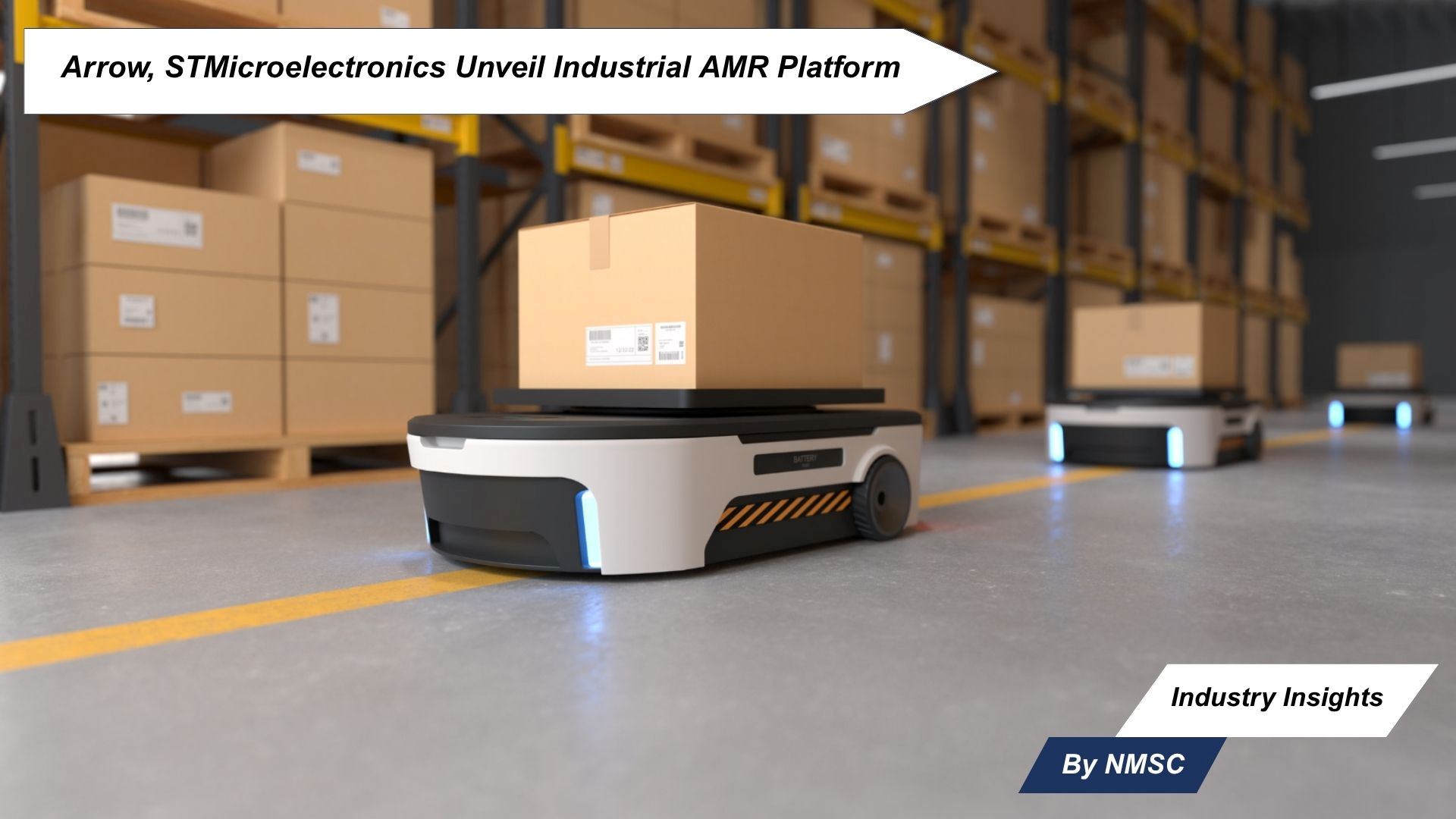
Arrow Electronics and STMicroelectronics Launch Industrial AMR Reference Platform to Speed Robot Deployment
New Delhi, India — June 26, 2026 — Arrow Electronics and STMicroelectronics (ST) have introduced a new industrial Autonomous Mobile Robot (AMR) reference platform designed to shorten the path from concept to deployment for professional service robots, addressing a key bottleneck for original equipment manufacturers and integrators in the global Autonomous Mobile Robot market. Arrow Electronics and STMicroelectronics (ST) unveil a new industrial Autonomous Mobile Robot (AMR) reference platform to shorten the path from concept to deployment for professional service robots.
The collaboration aims to help robotics manufacturers overcome the difficulty of independently assembling, validating, and industrializing complex AMR subsystems such as navigation, perception, and energy management. Many robotics original equipment manufacturers (OEMs) and integrators struggle to assemble, validate, and industrialize these complex subsystems independently.
Developed by Arrow and eInfochips in partnership with ST, the AMR kit is built on a complete ST bill of materials and integrated with an NVIDIA Jetson Orin Nano-based compute platform and the NVIDIA ROS 2 software stack. Arrow and eInfochips worked with ST to deliver a fully functional AMR kit built on a complete ST bill of materials, tightly integrated with an NVIDIA Jetson Orin Nano–based compute platform and NVIDIA ROS 2 software stack.
Key Highlights:
-
The reference kit features robust power and battery management for 24V operation, with a pre-validated path to 48V architectures, and an STM32-based real-time controller board. Robust power and battery management for 24V operation, with a pre-validated path to 48V architectures; STM32-based real-time controller board, acting as a powerful interface between the NVIDIA platform and the robot's sensors and actuators.
-
Advanced motion control is enabled through dual BLDC motor drives based on STSPIN32 and STDRIVE devices for precise navigation. Advanced motion control, including dual BLDC motor drives based on STSPIN32 and STDRIVE devices for precise, smooth navigation.
-
The platform incorporates ST MEMS IMUs, magnetometers, and environmental sensors, complemented by lidar and vision inputs for SLAM-based mapping. Rich sensing for perception and safety, using ST MEMS IMUs, magnetometers, and environmental sensors, complemented by lidar and vision inputs for SLAM-based mapping and navigation.
-
Industrial ROS 2 software integration supports mapping, localization, and autonomous navigation using standard tools including Cartographer, NAV2, and RViz. Industrial ROS 2 software integration, enabling mapping, localization, and autonomous navigation with standard tools such as Cartographer, NAV2, and RViz ROS 2.
According to Shelby Schnurrenberger, vice president of supplier management, global semiconductor at Arrow Electronics, the solution gives customers a scalable foundation that can address a broad range of industrial and commercial robotics applications. "This solution brings together the performance, flexibility, and pre-validated integration robotics customers need to move faster from development to deployment, while giving them a scalable foundation that can address a broad range of industrial and commercial robotics applications," said Shelby Schnurrenberger, vice president of supplier management, global semiconductor, Arrow Electronics.
Analyst Insight:
NMSC analysts note that the Autonomous Mobile Robot (AMR) market is projected to reach USD 3.13 billion by 2030, expanding at a CAGR of 13.4% from 2024 to 2030. The Autonomous Mobile Robot (AMR) Market size was valued at USD 1.24 billion in 2023, and is predicted to reach USD 3.13 billion by 2030, with a CAGR of 13.4% from 2024 to 2030.</cite> According to analysts at Next Move Strategy Consulting, the integration of advanced sensors such as LiDAR shapes the future outlook for AMRs, while high implementation and maintenance costs remain the principal restraining factor on broader adoption. The integration of advanced sensors such as LiDAR creates future outlook for the AMRs. High implementation and maintenance cost of AMRs hinders the market.
Industry Outlook:
Pre-validated, system-level reference designs such as the Arrow-ST platform are positioned to reduce development risk and integration effort across the robotics ecosystem, potentially accelerating the transition from prototype to production. As Industry 4.0 adoption and e-commerce-driven logistics demand continue to expand, particularly across North America and Asia-Pacific, such standardized building blocks may support sustained growth in industrial and commercial AMR deployments through the forecast period.
Source: ELE Times
Prepared By: Sanyukta Deb
For More Information – Download FREE Sample on AMR Market Report
About the Author
 Sanyukta Deb
— Sanyukta Deb is Digital Marketing Team Lead at Next Move Strategy Consulting, where she has led content strategy and technical SEO for the firm's B2B market research publications for over 2 years. Her editorial process translates NextMSC's primary and secondary research — spanning technology, industrial, and consumer sectors — into commercial narratives, backed by search-intent, keyword, and competitive analysis. She brings 5 years of overall experience in digital marketing and content strategy.
Sanyukta Deb
— Sanyukta Deb is Digital Marketing Team Lead at Next Move Strategy Consulting, where she has led content strategy and technical SEO for the firm's B2B market research publications for over 2 years. Her editorial process translates NextMSC's primary and secondary research — spanning technology, industrial, and consumer sectors — into commercial narratives, backed by search-intent, keyword, and competitive analysis. She brings 5 years of overall experience in digital marketing and content strategy.
About the Reviewer
 Debashree Dey
— Debashree Dey is Assistant Manager at Next Move Strategy Consulting, where she supports cross-vertical market content and communications across diverse industries for 6 years. Her professional background includes senior content writing, communications, and published manuscript authorship, with experience developing audience-focused business narratives and maintaining clear, consistent messaging. Her role supports research-led content development and editorial quality across NextMSC publications.
Debashree Dey
— Debashree Dey is Assistant Manager at Next Move Strategy Consulting, where she supports cross-vertical market content and communications across diverse industries for 6 years. Her professional background includes senior content writing, communications, and published manuscript authorship, with experience developing audience-focused business narratives and maintaining clear, consistent messaging. Her role supports research-led content development and editorial quality across NextMSC publications.
















Add Comment