Blood and Organ Bank Market: Record Transplants Drive Growth
WHO Reports Record 173,727 Organ Transplants in 2024, Accelerating Global Blood and Organ Bank Market Expansion
The World Health Organization's Global Observatory on Donation and Transplantation (GODT) published its landmark 2024 annual report in March 2026, documenting a record 173,727 solid organ transplants performed worldwide — the highest figure ever recorded since systematic global data collection commenced in 2007. The 2% year-on-year increase, driven primarily by a 17% surge in donations after the circulatory determination of death (DCD), signals a structural acceleration in global transplantation capacity that is reshaping demand dynamics across the broader healthcare supply chain, including the critical infrastructure underpinning blood and organ banking systems worldwide.
The findings, published in the peer-reviewed journal Transplantation (Volume 110, Issue 3, March 2026) and co-authored by researchers from Harvard Medical School's Brigham and Women's Hospital, the World Health Organization, and Spain's Organización Nacional de Trasplantes, represent the most authoritative global benchmark for transplantation activity. The report draws on data submitted by 92 WHO member states and underscores both the progress achieved and the persistent structural challenges — including a critical organ shortage and pronounced geographic disparities — that continue to define the operating environment for the global Blood and Organ Bank Market.
For More Information – Download FREE Sample on Blood and Organ Bank Market Report
Record Transplant Activity Underscores Structural Market Demand
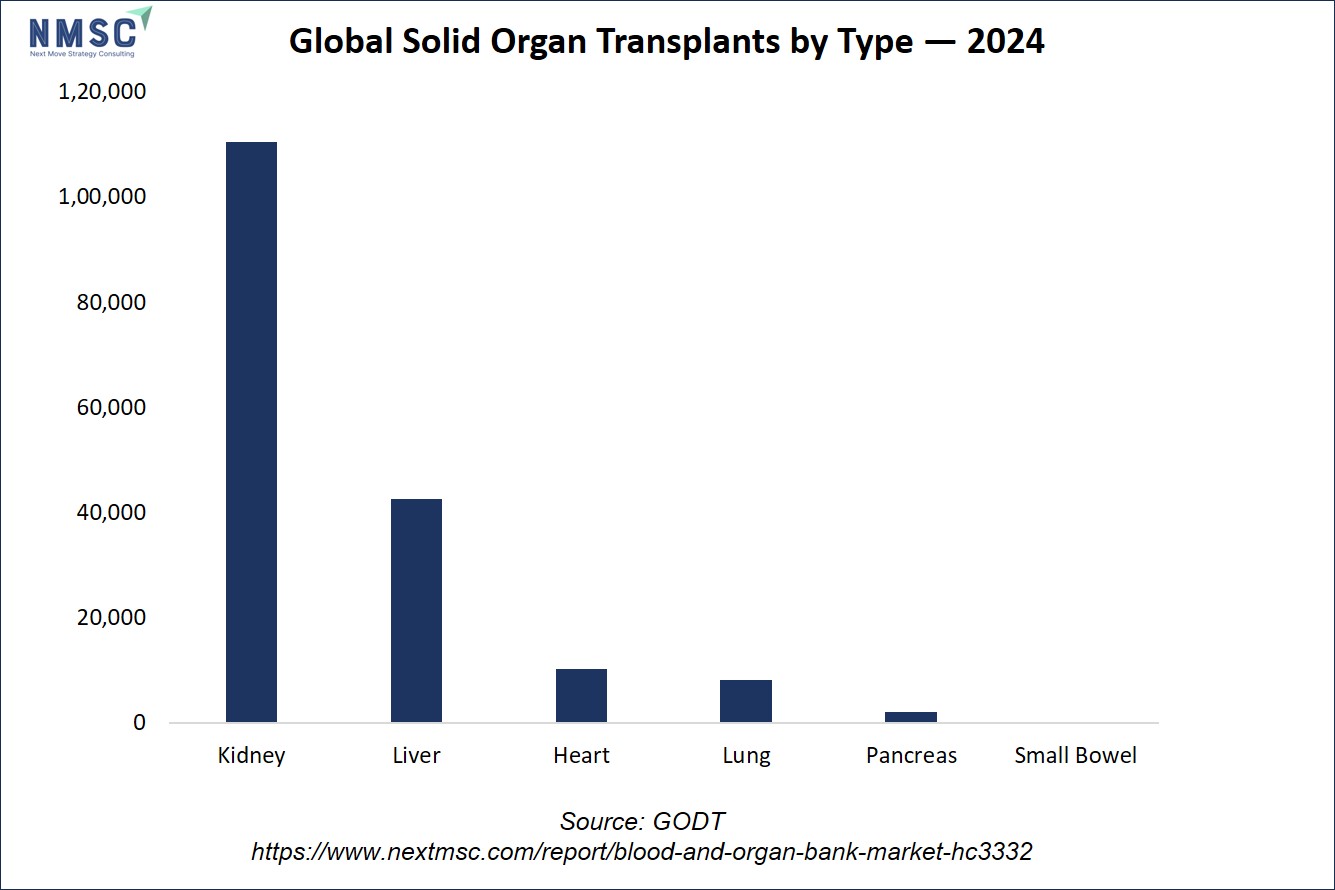
The GODT 2024 data reveals that kidney transplantation remained the dominant procedure, accounting for 110,467 procedures (63.6% of all solid organ transplants) across 90 countries. Liver transplantation followed with 42,497 procedures (24.5%), representing a 5% increase over 2023 — the strongest growth rate among major organ categories. Heart transplantation reached 10,287 procedures (5.9%), while lung transplantation recorded 8,236 procedures (4.7%), a 6% increase year-on-year.
Despite these record volumes, the demand-supply imbalance remains acute. As of year-end 2024, 668,160 patients were actively waitlisted for solid organ transplantation across 75 reporting countries. Critically, 31,853 patients died while awaiting a transplant during the year — a figure that underscores the systemic urgency driving investment in organ procurement, preservation, and banking infrastructure globally.
Blood Banking: A Global System Under Structural Pressure
Concurrent with the record transplant activity, the WHO's updated Blood Safety and Availability Fact Sheet (June 2026), drawing on data from 168 countries for the year 2023, reveals a global blood supply system that is expanding but remains structurally unequal. Approximately 120.4 million blood donations are collected worldwide annually, yet 36% of these are concentrated in high-income countries that account for only 15% of the global population.
The blood donation rate disparity across income groups is stark: high-income countries record 28.9 donations per 1,000 population, compared with 18.2 in upper-middle-income countries, 8.5 in lower-middle-income countries, and just 4.5 in low-income countries. Fifty-five countries report collecting fewer than 10 donations per 1,000 people — a threshold the WHO identifies as the minimum required to meet basic transfusion needs.
Progress in voluntary unpaid donation is notable: an increase of 10.7 million blood donations from voluntary unpaid donors was reported between 2013 and 2023, with 80 countries now collecting over 90% of their blood supply from voluntary unpaid donors. Nevertheless, 59 countries continue to rely on family/replacement or paid donors for more than 50% of their supply — a persistent vulnerability in global blood safety architecture.
Regional Distribution of Global Solid Organ Transplants
Categories and Percentages:
|
WHO Region |
Share of Global SOTs |
Absolute Volume |
|
Americas |
40% |
69,631 |
|
Europe |
26% |
45,439 |
|
Western Pacific |
19% |
33,634 |
|
South-East Asia |
12% |
20,677 |
|
Eastern Mediterranean |
2% |
3,705 |
|
Africa |
0.4% |
641 |
Global Blood Donation Rates by Country Income Group
|
Country Income Group |
Donation Rate (per 1,000 population) |
Share of Global Donations |
Blood Component Separation Rate |
|
High-Income |
28.9 |
36% |
98% |
|
Upper-Middle-Income |
18.2 |
N/A |
94% |
|
Lower-Middle-Income |
8.5 |
N/A |
81% |
|
Low-Income |
4.5 |
N/A |
52% |
Notes: Blood component separation rate refers to the percentage of collected blood separated into transfusable components (red cells, platelets, plasma, cryoprecipitate). N/A = not disaggregated in source data.
Market Intelligence: Growth Trajectory and Segmentation
According to Next Move Strategy Consulting's analysis, the global blood and organ bank market is projected to reach USD 55.39 billion, expanding at a compound annual growth rate (CAGR) of 6.5% during the 2026–2030 forecast period. The market's expansion is underpinned by three primary structural drivers: the rising global incidence of haematological diseases, sustained increases in healthcare expenditure across both developed and emerging economies, and accelerating demand for organ transplantation services.
The American Cancer Society reported approximately 20 million newly diagnosed cancer cases globally in 2023, with projections indicating this figure could reach 35 million by 2050 — a trajectory that directly amplifies demand for blood products, transfusion services, and related banking infrastructure. Simultaneously, the WHO's Global Health Expenditure Report confirms that global health spending reached USD 9.8 trillion in 2021, representing 10.3% of global GDP, with continued upward momentum expected through the decade.
The market is segmented across multiple dimensions. By product, blood components — including whole blood, red blood cells, platelets, plasma, and cryoprecipitate — represent the largest category, followed by organ products (kidney, liver, heart, lung, pancreas, intestine) and tissue products (cornea, skin grafts, bone grafts, heart valves). By service, blood banking services constitute the dominant revenue stream, encompassing collection, testing, processing, storage, and distribution. By bank type, the market spans blood banks, organ banks, tissue banks, and hybrid banks. By application, transfusion and transplantation account for the majority of end-use demand, with research and development and therapeutics representing growing segments.
Leading Countries by Solid Organ Transplant Activity
|
Country |
Total SOTs (2024) |
Transplants per Million Population (pmp) |
Notable Indicator |
|
United States |
48,935 |
143.0 |
Highest absolute transplant volume globally |
|
Spain |
6,463 |
136.0 |
Highest transplant rate pmp globally |
|
India |
Partial data |
N/A |
Highest living donor volume: 15,504 (10.8 pmp) |
|
Türkiye |
Partial data |
N/A |
Highest living donation rate: 54 pmp |
|
China |
Partial data |
N/A |
Largest KTx waitlist: 104,716 patients (73.1 pmp) |
|
Brazil |
Partial data |
N/A |
165 KTx centers; 100 LTx centers |
Geographic Dynamics: North America Leads, Asia-Pacific Accelerates
North America maintains its position as the dominant regional market, anchored by the United States' unparalleled transplant infrastructure. The U.S. reported 48,935 solid organ transplants — representing 28.2% of the global total — and maintains 232 kidney transplant centers, 144 liver transplant centers, and 150 heart transplant centers. The U.S. Centers for Medicare and Medicaid Services published a proposed rule in January 2026 (Federal Register Document No. 2026-01833) revising Conditions for Coverage for Organ Procurement Organizations, signaling continued regulatory attention to system efficiency and accountability.
Europe presents a mature but innovation-driven landscape. Spain, with 136.0 transplants per million population, leads the world in transplant rate efficiency — a model attributed to its nationally coordinated donation system. The European Directorate for the Quality of Medicines and HealthCare (EDQM) continues to set quality and safety standards for organs, tissues, and cells across EU member states, providing a robust regulatory framework that supports market stability.
The Asia-Pacific region is emerging as the most dynamic growth frontier. India reported 15,504 living kidney donors in 2024 — the highest absolute number globally — while China maintains the world's largest kidney transplant waitlist at 104,716 patients. The June 2026 publication in Transplantation journal of a comprehensive analysis of China's updated legal framework for organ donation and transplantation — including the State Council's Regulation on Human Organ Donation and Transplantation (effective May 1, 2024) — signals a maturing regulatory environment expected to support expanded transplant capacity and, by extension, organ banking infrastructure investment across the region.
Technology and Innovation: Digital Transformation as a Market Catalyst
The integration of advanced technologies into blood and organ banking operations represents one of the most significant near-term growth opportunities in the sector. Artificial intelligence (AI)-driven donor-recipient matching algorithms, blockchain-based supply chain traceability systems, IoT-enabled cold chain monitoring, and cloud-based laboratory information management systems (LIMS) are collectively transforming operational efficiency across the value chain.
In the organ preservation segment, machine perfusion technology — specifically hypothermic oxygenated perfusion (HOPE) and normothermic machine perfusion (NMP) — is extending organ viability windows and improving transplant outcomes. Bridge to Life's VitaSmart™ HOPE system, which received clinical validation through the Bridge to HOPE trial published in JAMA Surgery, exemplifies the commercial momentum in this space. Paragonix Technologies presented extensive organ transplant research at the 46th Annual International Society of Heart and Lung Transplantation Meeting in 2026, further demonstrating the sector's active innovation pipeline.
In February 2025, New York Blood Center Enterprises (NYBCe) and Human Life CORD Japan Inc. signed a letter of intent to deepen collaboration in the production of umbilical cord-derived mesenchymal stromal cells (MSCs) — a development that illustrates the expanding scope of blood banking beyond traditional transfusion services into regenerative medicine and advanced cell therapy applications.
Key Market Participants
The global blood and organ bank market is characterized by a mix of non-profit organizations, government-affiliated entities, and specialized commercial operators. Key participants identified in the NMSC analysis include: The American National Red Cross, Vitalant, MTF Biologics, New York Blood Center, NHS Blood and Transplant (United Kingdom), Sanquin (Netherlands), Terumo BCT, Blood Centers of America, CSL Plasma, New England Donor Services, LifeCenter Northwest, The Living Bank, Donate Life America, American Foundation for Donation and Transplantation, and Canadian Blood Services.
Strategic consolidation is a defining trend. The merger of Organ Procurement Organizations under the New England Organ Bank has broadened service areas and improved organ recovery efficiency. The acquisition of Nader by Cord Blood Registry reflects strategic moves for market share expansion and service diversification in the cord blood banking segment.
Regulatory Environment and Structural Challenges
The regulatory landscape governing blood and organ banking is evolving across all major markets. In the United States, the CMS proposed rule published in the Federal Register on January 30, 2026 (Document No. 2026-01833) proposes revisions to OPO Conditions for Coverage, with implications for operational standards and performance accountability across the nation's federally designated organ procurement organizations.
The short shelf life of blood components — whole blood remains viable for approximately 42 days — continues to impose significant logistical constraints on inventory management, demand forecasting, and waste minimization. This structural challenge is particularly acute in lower-income markets where cold chain infrastructure remains underdeveloped. The WHO's Global Status Report on Blood Safety and Availability 2025 documents that only 52% of blood collected in low-income countries is separated into components, compared with 98% in high-income countries — a gap that represents both a challenge and a long-term market opportunity for technology and infrastructure providers.
The GODT 2024 Report further highlights that 7.7% of all deceased donors — representing 3,580 individuals — did not proceed to transplantation in 2024, with the gap wider for DCD donors at a 14.8% non-utilization rate. Addressing this utilization gap through improved donor management protocols, expanded acceptance criteria, and novel preservation strategies represents a direct commercial opportunity for market participants.
Bottom Line
The global blood and organ bank market is entering a period of sustained structural expansion, underpinned by record-breaking transplant activity, rising disease burden, and accelerating technological innovation. The WHO GODT 2024 Report's documentation of 173,727 solid organ transplants — a historic high — validates the demand trajectory that supports the market's projected growth from USD 37.98 billion in 2024 to USD 55.39 billion by 2030 at a 6.5% CAGR. North America retains its dominant position, while Asia-Pacific — driven by India's living donor volumes and China's expanding regulatory framework — represents the most compelling growth frontier. The critical organ shortage, with 668,160 patients waitlisted globally and 31,853 deaths recorded while awaiting transplantation in 2024 alone, creates an imperative for continued investment in organ procurement infrastructure, preservation technology, and digital transformation. For investors and strategic operators, the convergence of regulatory modernization, machine perfusion adoption, and AI-driven operational efficiency presents a well-defined opportunity set. The primary risk factors include blood component shelf-life constraints, geographic disparities in healthcare infrastructure, and the complexity of navigating multi-jurisdictional regulatory frameworks. Organizations that can bridge the gap between technological capability and equitable access will be best positioned to capture long-term value in this critical healthcare segment.
About Next Move Strategy Consulting
Next Move Strategy Consulting is a premier market research and management consulting firm that has been committed to provide strategically analysed well documented latest research reports to its clients. The research industry is flooded with many firms to choose from, what makes NMSC different from the rest is its top-quality research and the obsession of turning data into knowledge by dissecting every bit of it and providing fact-based research recommendation that is supported by information collected from over 500 million websites, paid databases, industry journals and one on one consultations with industry experts across a diverse range of industry sectors. The high-quality customized research reports with actionable insights and excellent end-to-end customer service help our clients to take critical business decisions that enables them to move beyond time and have competitive edge in the industry.
We have been servicing over 1000 customers globally that includes 90% of the Fortune 500 companies over a decade. Our analysts are constantly tracking various high growth markets and identifying hidden opportunities in each sector or the industry. We provide one of the industry's best quality syndicate as well as custom research reports across 10 different industry verticals. We are committed to deliver high quality research solutions in accordance to your business needs. Our industry standard delivery solutions that ranges from the pre consultation to after-sales services, provide an excellent client experience and ensure right strategic decision making for businesses.
For more information, please contact:
Next Move Strategy Consulting
5th Floor 867
Boylston St, STE 500,
Boston, MA 02116, U.S.
E-Mail: [email protected]
Direct: +1-217-650-7991
Website: www.nextmsc.com
About the Author
 Sanyukta Deb
— Sanyukta Deb is Digital Marketing Team Lead at Next Move Strategy Consulting, where she has led content strategy and technical SEO for the firm's B2B market research publications for over 2 years. Her editorial process translates NextMSC's primary and secondary research — spanning technology, industrial, and consumer sectors — into commercial narratives, backed by search-intent, keyword, and competitive analysis. She brings 5 years of overall experience in digital marketing and content strategy.
Sanyukta Deb
— Sanyukta Deb is Digital Marketing Team Lead at Next Move Strategy Consulting, where she has led content strategy and technical SEO for the firm's B2B market research publications for over 2 years. Her editorial process translates NextMSC's primary and secondary research — spanning technology, industrial, and consumer sectors — into commercial narratives, backed by search-intent, keyword, and competitive analysis. She brings 5 years of overall experience in digital marketing and content strategy.
About the Reviewer
 Debashree Dey
— Debashree Dey is Assistant Manager at Next Move Strategy Consulting, where she supports cross-vertical market content and communications across diverse industries for 6 years. Her professional background includes senior content writing, communications, and published manuscript authorship, with experience developing audience-focused business narratives and maintaining clear, consistent messaging. Her role supports research-led content development and editorial quality across NextMSC publications.
Debashree Dey
— Debashree Dey is Assistant Manager at Next Move Strategy Consulting, where she supports cross-vertical market content and communications across diverse industries for 6 years. Her professional background includes senior content writing, communications, and published manuscript authorship, with experience developing audience-focused business narratives and maintaining clear, consistent messaging. Her role supports research-led content development and editorial quality across NextMSC publications.

















Add Comment