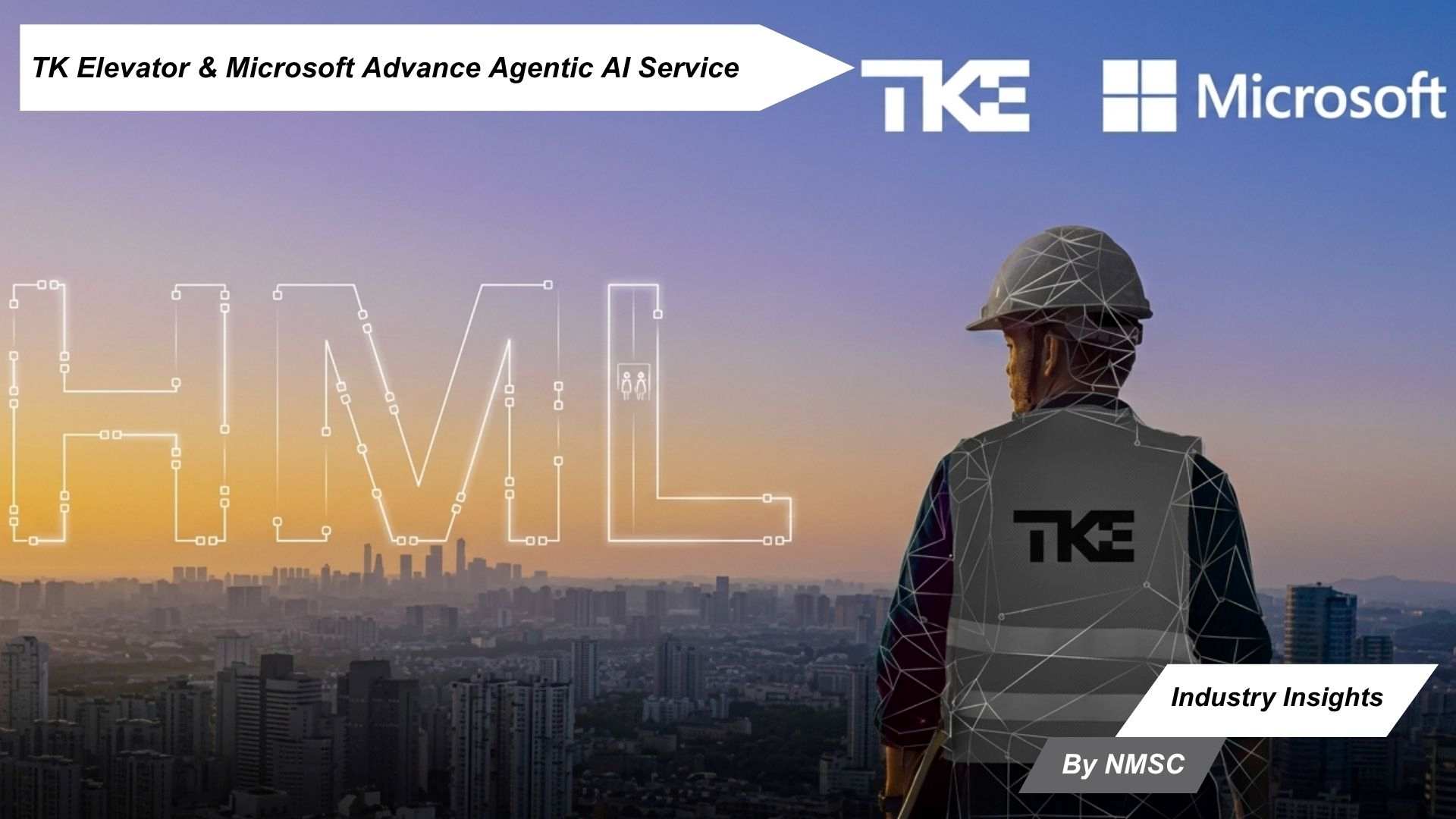
TK Elevator & Microsoft Advance Agentic AI Service
Industry Insights from Next Move Strategy Consulting
As building infrastructure becomes increasingly connected and service expectations continue to rise, TK Elevator’s latest collaboration with Microsoft marks a significant advancement in the global elevator industry. By integrating agentic AI into service, maintenance, and customer support operations, the company is reshaping how vertical transportation systems are managed, maintained, and optimized.
A New Chapter in Intelligent Elevator Operations
TK Elevator (TKE), a global leader in vertical transportation and urban mobility solutions, is introducing an AI-supported service model powered by Microsoft technologies. The initiative combines TKE’s proprietary operational data, technician expertise, and digital workflows with new agentic AI modules designed to improve decision-making and knowledge sharing across its global service network.
This transition moves elevator maintenance beyond traditional reactive service models toward a more predictive and intelligent operating framework. By enabling technicians with deeper insights before, during, and after service visits, the company aims to improve customer satisfaction while increasing equipment reliability and uptime.
Proven Results from Early Deployment
The impact of the new approach has already been demonstrated through pilot programs in the United States during 2025. According to the company, structured interventions supported by Digital Operations Centers helped reduce approximately 20,000 unplanned service visits while cutting callback rates by more than 40%. Customer satisfaction gains also contributed to a 33% decline in cancellation rates.
These results highlight the operational and commercial value of applying AI-driven intelligence to service delivery in mission-critical building systems.
Core Capabilities of the New Service Model
The AI-enabled ecosystem is supported by TKE’s regional Digital Operations Centers (DOCs), which act as hubs for scaling digital service excellence and assisting field technicians in real time. Key capabilities include:
-
Predictive Maintenance Intelligence to identify issues before failures occur.
-
Remote Diagnostics and Actions enabling faster interventions and issue resolution.
-
Portfolio Analytics to assess performance across connected units.
-
AI-Guided Technician Workflows that improve onsite readiness and service efficiency.
-
Digital Inspections and Remote Resets to enhance service quality across regions.
-
Continuous Knowledge Sharing that transforms technician experience into organization-wide intelligence.
Powered by Cloud and Data Intelligence
The solution is built on Microsoft Azure AI and agent platforms, with Databricks on Azure and TKE’s MAX digital platform for monitoring, maintenance, and control. This connected technology foundation enables the company to transform raw operational data into actionable insights while supporting service teams worldwide.
TKE currently operates eight Digital Operations Centers globally, with additional centers planned during the year to further expand service coverage and digital capabilities.
Executive Perspective
Matthias Gohl, Chief Digital Officer at TK Elevator, emphasized that more than a decade of collaboration with Microsoft has enabled the company to adopt emerging technologies such as agentic AI and embed them across workflows and customer-facing solutions. He noted that markets including the United States, Korea, Brazil, and Germany are already benefiting from the deployment.
Microsoft also highlighted the partnership as a strong example of how connected assets, unified data, and AI agents can transform industrial service at scale by shifting operations from reactive maintenance to intelligent performance management.
Industry Outlook from Next Move Strategy Consulting
According to Next Move Strategy Consulting, the rise of agentic AI is expected to significantly influence the future of industrial service markets worldwide. Organizations are increasingly seeking autonomous systems that can interpret data, recommend actions, and support frontline teams in real time. Industries such as manufacturing, mobility, infrastructure, and facility management are likely to accelerate investments in AI-powered maintenance ecosystems that improve uptime, productivity, and customer experience.
The TK Elevator–Microsoft collaboration demonstrates how agentic AI can move beyond experimentation into measurable enterprise outcomes, positioning intelligent service automation as a key growth driver in the broader Agentic AI Market.
Redefining the Future of Vertical Mobility
As elevators remain essential infrastructure in modern cities, reliability and responsiveness are becoming more important than ever. Through this collaboration, TK Elevator is setting a new benchmark for digital service excellence where predictive intelligence, connected operations, and human expertise work together to deliver smarter customer experiences.
Source: Airport Suppliers
Prepared by: Next Move Strategy Consulting
About the Author
 Sanyukta Deb
— Sanyukta Deb is Digital Marketing Team Lead at Next Move Strategy Consulting, where she has led content strategy and technical SEO for the firm's B2B market research publications for over 2 years. Her editorial process translates NextMSC's primary and secondary research — spanning technology, industrial, and consumer sectors — into commercial narratives, backed by search-intent, keyword, and competitive analysis. She brings 5 years of overall experience in digital marketing and content strategy.
Sanyukta Deb
— Sanyukta Deb is Digital Marketing Team Lead at Next Move Strategy Consulting, where she has led content strategy and technical SEO for the firm's B2B market research publications for over 2 years. Her editorial process translates NextMSC's primary and secondary research — spanning technology, industrial, and consumer sectors — into commercial narratives, backed by search-intent, keyword, and competitive analysis. She brings 5 years of overall experience in digital marketing and content strategy.
About the Reviewer
 Debashree Dey
— Debashree Dey is Assistant Manager at Next Move Strategy Consulting, where she supports cross-vertical market content and communications across diverse industries for 6 years. Her professional background includes senior content writing, communications, and published manuscript authorship, with experience developing audience-focused business narratives and maintaining clear, consistent messaging. Her role supports research-led content development and editorial quality across NextMSC publications.
Debashree Dey
— Debashree Dey is Assistant Manager at Next Move Strategy Consulting, where she supports cross-vertical market content and communications across diverse industries for 6 years. Her professional background includes senior content writing, communications, and published manuscript authorship, with experience developing audience-focused business narratives and maintaining clear, consistent messaging. Her role supports research-led content development and editorial quality across NextMSC publications.















Add Comment