Active Network Management Market Global Industry Analysis and Forecast (2026-2035)

The global Active Network Management Market is valued at USD 2.76 Billion in 2026 and is projected to reach USD 9.17 Billion by 2035, growing at a CAGR of 14.26% from 2026 to 2035. Key growth factors include rising DER interconnections, grid constraints, and flexibility-focused regulation, with Europe leading the market and Software accounting for approximately 46% share.

Download Free Sample PDF
Base Year (2025)
$2.05 Billion
Forecast (2035)
$9.17 Billion
CAGR (2026-2035)
14.3%
Top Country
Europe

What Is the Active Network Management Market Size?

The global Active Network Management Market size was valued at USD 2.05 Billion in 2025 and is estimated at USD 2.76 Billion in 2026, forecast to reach USD 9.17 Billion by 2035, expanding at a 14.26% CAGR between 2026 and 2035. Europe leads with approximately 38% share, while Software accounts for approximately 46% of the market by offering .

Rising distributed energy resource interconnection volume is pushing distribution networks past the constraint thresholds that static planning rules were designed for, forcing operators to adopt real-time control platforms in place of fixed connection limits.

Active Network Management Market Global Industry Analysis and Forecast (2026-2035) Revenue Forecast

Values in USD Billion

2025 $2.05 Billion
2025
2026 $2.34 Billion
2026
2027 $2.68 Billion
2027
2028 $3.06 Billion
2028
2029 $3.49 Billion
2029
2030 $3.99 Billion
2030
2031 $4.56 Billion
2031
2032 $5.21 Billion
2032
2033 $5.96 Billion
2033
2034 $6.80 Billion
2034
2035 $9.17 Billion
2035

Key Takeaways

By Offering: Software held the largest share of approximately 46% (USD 0.95 Billion) in 2025; Services is the fastest-growing segment at 19.1% CAGR from 2026–2035.

By Network Level: Distribution Network held the largest share of approximately 66% (USD 1.35 Billion) in 2025; Transmission and Distribution Interface is the fastest-growing segment at 21.7% CAGR from 2026–2035.

By Primary Control Function: Constraint Management held the largest share of approximately 30% (USD 0.62 Billion) in 2025; DER Dispatch and Curtailment is the fastest-growing segment at 19.7% CAGR from 2026–2035.

By Customer Type: Distribution System Operators held the largest share of approximately 51% (USD 1.05 Billion) in 2025; Aggregators and Energy Service Providers is the fastest-growing segment at 21.1% CAGR from 2026–2035.

By Deployment Model: On-Premises held the largest share of approximately 41% (USD 0.85 Billion) in 2025; Public Cloud is the fastest-growing segment at 20.9% CAGR from 2026–2035.

By Sales Channel: Direct Sales held the largest share of approximately 48% (USD 0.98 Billion) in 2025; System Integrators is the fastest-growing segment at 18.3% CAGR from 2026–2035.

Dominant Region: Europe dominated with approximately 38% revenue share (USD 0.78 Billion) in 2025.

Fastest-Growing Region: Asia-Pacific is expected to register the highest CAGR of 19.8% during 2026–2035.

Dominant Country: U.S. led with approximately USD 0.50 Billion in 2025.

Fastest-Growing Country: India is the fastest-growing country at approximately 22.6% CAGR from 2026–2035.

Between 2026 and 2035, the Active Network Management Market is set to generate an absolute dollar opportunity of USD 6.41 Billion, positioning DER-facing control software and aggregator-oriented platforms as the categories best placed to capture that growth.

According to NMSC analysis, distribution network operators that adopt active management platforms are able to connect new generation and storage capacity years ahead of conventional reinforcement schedules, turning what was previously a multi-year grid upgrade constraint into a software deployment decision.

What Does the Active Network Management Market Encompass?

Active Network Management refers to the software, hardware, and services that let grid operators monitor and control network constraints, voltage, and distributed energy resource output in real time rather than relying on static, worst-case connection limits. Its scope spans central platform software, embedded controllers, monitoring devices, and the professional and managed services required to implement and operate these systems across distribution, transmission, and transmission-distribution interface networks. The category has expanded beyond early pilot schemes on constrained UK distribution circuits as smart-grid modernization and DER integration programs scale across global electricity networks .

The UK's Ofgem regulates active network management indirectly through the RIIO-ED2 price control framework and its Distribution System Operation incentive, which rewards network operators for using flexible, software-based alternatives to physical reinforcement. In applicable U.S. RTO/ISO regions, FERC Order 2222 requires participation frameworks for distributed energy resource aggregations in wholesale markets. These frameworks can increase demand for the visibility, telemetry, forecasting, and coordination capabilities provided by DERMS and related active network management platforms. Vendors are increasingly bundling constraint management, voltage optimization, and DER dispatch into unified platforms rather than selling each function separately.

Market Drivers & Dynamics

Interactive Dataset
Rising DER interconnection volume exceeding static network hosting capacity driver +3.4% Europe, North America, Asia-Pacific 2026–2035
Regulatory incentives rewarding flexibility over physical network reinforcement driver +2.6% Europe, North America 2026–2033
DER aggregation mandates requiring wholesale and local market participation driver +1.9% North America, Europe 2026–2032
Utility consolidation of constraint, voltage, and DER functions into unified platforms driver +1.3% Global 2026–2032
Expanding renewable interconnection queues in emerging Asia-Pacific markets driver +0.9% Asia-Pacific 2026–2035
Growing low-voltage network telemetry and asset registration requirements driver +0.6% Europe 2026–2030
Limited low-voltage network visibility constraining full deployment scope restraint −1.5% Global 2026–2030
Integration complexity with legacy SCADA and outage management systems restraint −1.0% North America, Europe 2026–2030
Fragmented regulatory treatment of flexibility markets across jurisdictions restraint −0.6% Asia-Pacific, Latin America, Middle East & Africa 2026–2032
Source: Next Move Strategy Consulting

Growth Drivers

What Is the Primary Growth Driver of the Active Network Management Market?

Rising DER interconnection volume that exceeds what static network hosting capacity rules can accommodate is the primary driver of the Active Network Management Market. When connection requests for solar, storage, and flexible load exceed the fixed capacity a distribution circuit was designed for, operators face a choice between multi-year physical reinforcement and software-based real-time management of the same assets. Electricity North West's own procurement disclosures link its active network management deployment directly to accelerating connections ahead of reinforcement, illustrating the mechanism by which constrained networks convert into ANM demand.

How Is Flexibility-First Regulation Driving Market Growth?

Regulatory frameworks that encourage operators to consider flexible alternatives to physical reinforcement are increasing the role of ANM in network planning and operation. Ofgem’s RIIO-ED2 Distribution System Operation incentive generated approximately USD 52.2 million in combined rewards for GB distribution network companies in 2024–25. The incentive is designed to encourage more efficient development and use of distribution networks, including consideration of flexible alternatives to network reinforcement. This flexibility-oriented regulatory approach can support utility investment in ANM, DERMS, and related grid-flexibility capabilities.

Growth Inhibitors

What Is Restraining Active Network Management Market Expansion?

Limited visibility below the medium-voltage network restrains how far active management can extend toward household and small commercial connections. Ofgem's own December 2025 consultation acknowledges that incomplete DER and consumer energy resource registration data limits network operators' ability to plan and optimize investment at the low-voltage level. Operators face particular exposure where legacy metering and telemetry infrastructure was never designed to report the granular, near real-time data that voltage and DER dispatch functions require.

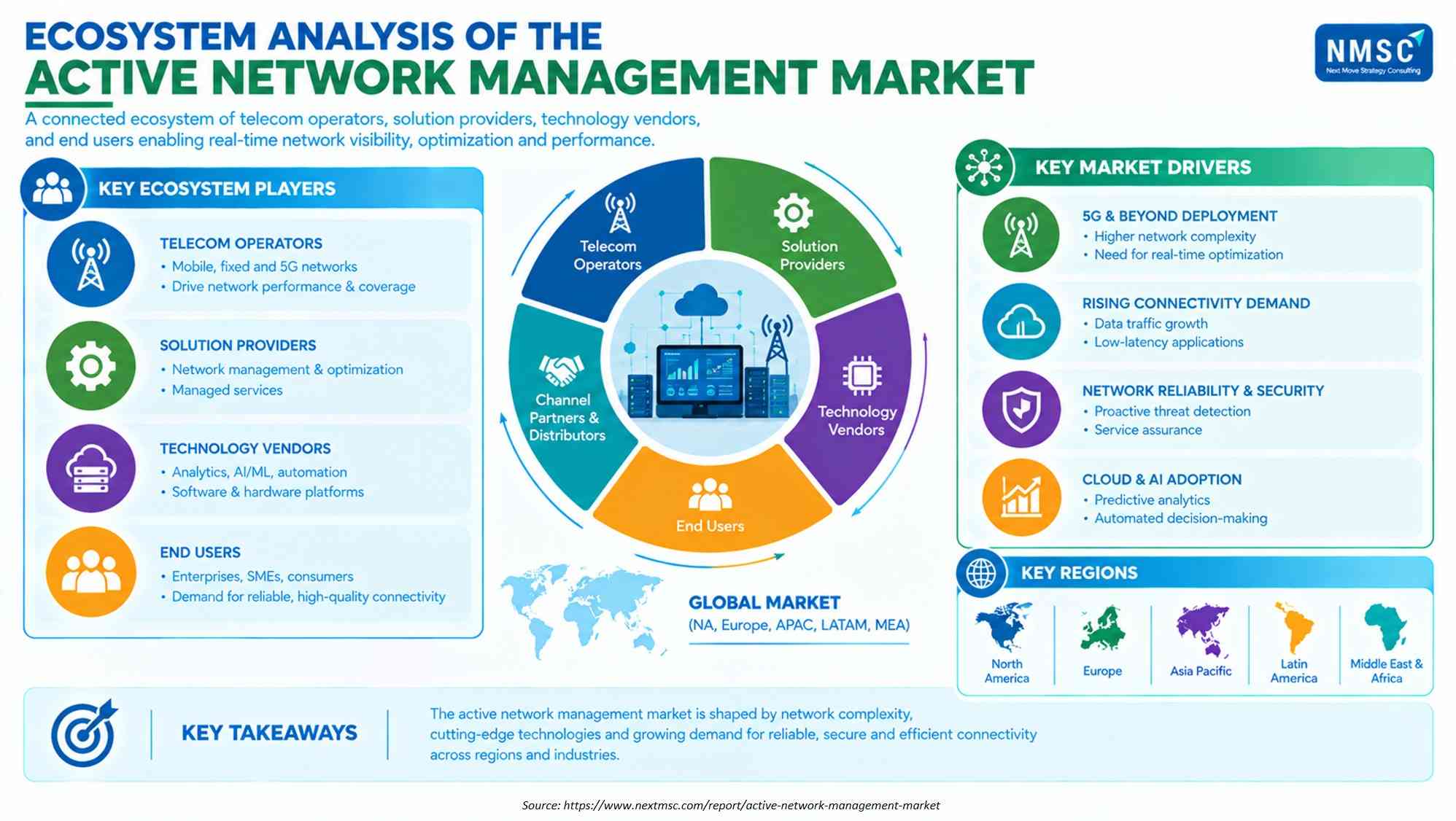
Ecosystem Analysis – Active Network Management Market
The Active Network Management market comprises telecom operators, solution providers, technology vendors, channel partners, system integrators, and end users. Its ecosystem is evolving around 5G deployment, rising connectivity demand, network reliability, cloud adoption, and AI-driven automation. Increasing integration of analytics, software platforms, and managed services is supporting real-time network visibility, optimization, security, and operational efficiency across regions.

Segmentation Analysis

2025 (USD Billion)
2035 (USD Billion)
Software
Central ANM
Embedded ANM
Hardware
ANM Controll
Segment Item 2025 (USD Billion) 2035 (USD Billion) CAGR
Software $10.0 USD Billion $40.0 USD Billion 15.0%
Central ANM Platform Software $17.1 USD Billion $51.1 USD Billion 9.0%
Embedded ANM Software $24.2 USD Billion $62.2 USD Billion 19.0%
Hardware $31.3 USD Billion $73.3 USD Billion 21.0%
ANM Controllers $38.4 USD Billion $84.4 USD Billion 26.0%

Segment-wise data is locked

Unlock complete segment-wise numbers for By Offering.

Unlock Full Data

Which Offering Dominates the Active Network Management Market?

Software led the market with USD 0.95 Billion in 2025 because constraint management, voltage optimization, and DER dispatch are fundamentally control-logic problems that utilities increasingly solve through centralized or embedded platforms rather than discrete hardware alone. Services is the fastest-growing offering, expanding at a 19.1% CAGR from 2026 to 2035, as distribution operators that lack in-house DERMS expertise turn to managed operations contracts to run day-to-day constraint and DER dispatch functions on their behalf.

2025 (USD Billion)
2035 (USD Billion)
Distribution
Medium-Volta
Low-Voltage
Transmission
High-Voltage
Segment Item 2025 (USD Billion) 2035 (USD Billion) CAGR
Distribution Network $10.0 USD Billion $40.0 USD Billion 17.0%
Medium-Voltage Network $17.1 USD Billion $51.1 USD Billion 27.0%
Low-Voltage Network $24.2 USD Billion $62.2 USD Billion 21.0%
Transmission Network $31.3 USD Billion $73.3 USD Billion 23.0%
High-Voltage Network $38.4 USD Billion $84.4 USD Billion 12.0%

Segment-wise data is locked

Unlock complete segment-wise numbers for By Network Level.

Unlock Full Data
2025 (USD Billion)
2035 (USD Billion)
Constraint M
Thermal Cons
Congestion M
Export and I
Voltage and
Segment Item 2025 (USD Billion) 2035 (USD Billion) CAGR
Constraint Management $10.0 USD Billion $40.0 USD Billion 21.0%
Thermal Constraint Management $17.1 USD Billion $51.1 USD Billion 19.0%
Congestion Management $24.2 USD Billion $62.2 USD Billion 17.0%
Export and Import Limit Management $31.3 USD Billion $73.3 USD Billion 27.0%
Voltage and Reactive Control $38.4 USD Billion $84.4 USD Billion 8.0%

Segment-wise data is locked

Unlock complete segment-wise numbers for By Primary Control Function.

Unlock Full Data
2025 (USD Billion)
2035 (USD Billion)
Distribution
Investor-Own
Public Utili
Cooperative
Transmission
Segment Item 2025 (USD Billion) 2035 (USD Billion) CAGR
Distribution System Operators $10.0 USD Billion $40.0 USD Billion 12.0%
Investor-Owned Utilities $17.1 USD Billion $51.1 USD Billion 18.0%
Public Utilities $24.2 USD Billion $62.2 USD Billion 16.0%
Cooperative Utilities $31.3 USD Billion $73.3 USD Billion 14.0%
Transmission System Operators $38.4 USD Billion $84.4 USD Billion 9.0%

Segment-wise data is locked

Unlock complete segment-wise numbers for By Customer Type.

Unlock Full Data

Which Customer Type Leads Active Network Management Market Demand?

Distribution System Operators remained the dominant customer type, reaching USD 1.05 Billion in 2025, because most DER interconnection and constraint pressure originates on the medium- and low-voltage circuits that DSOs directly operate. Aggregators and Energy Service Providers represent the fastest-growing customer type at a 21.1% CAGR from 2026 to 2035, a shift driven by FERC Order 2222 and comparable market-opening rules that let aggregators bid pooled DER portfolios into wholesale and local flexibility markets.

2025 (USD Billion)
2035 (USD Billion)
On-Premises
Private Clou
Public Cloud
Hybrid
Segment Item 2025 (USD Billion) 2035 (USD Billion) CAGR
On-Premises $10.0 USD Billion $40.0 USD Billion 18.0%
Private Cloud $17.1 USD Billion $51.1 USD Billion 24.0%
Public Cloud $24.2 USD Billion $62.2 USD Billion 26.0%
Hybrid $31.3 USD Billion $73.3 USD Billion 8.0%

Segment-wise data is locked

Unlock complete segment-wise numbers for By Deployment Model.

Unlock Full Data
2025 (USD Billion)
2035 (USD Billion)
Direct Sales
System Integ
Distributors
OEM and Embe
Segment Item 2025 (USD Billion) 2035 (USD Billion) CAGR
Direct Sales $10.0 USD Billion $40.0 USD Billion 24.0%
System Integrators $17.1 USD Billion $51.1 USD Billion 10.0%
Distributors $24.2 USD Billion $62.2 USD Billion 8.0%
OEM and Embedded Partnerships $31.3 USD Billion $73.3 USD Billion 14.0%

Segment-wise data is locked

Unlock complete segment-wise numbers for By Sales Channel.

Unlock Full Data

Growth Opportunities

Three forward-looking opportunities stand out for stakeholders positioning within the Active Network Management Market over the 2026-2035 forecast period.

How Is Low-Voltage Network Extension Creating Opportunities for Monitoring Device Vendors?

Extending active management down to low-voltage circuits requires monitoring hardware at a scale existing medium-voltage deployments never needed. Vendors that supply low-cost, mass-deployable monitoring devices stand to capture recurring hardware and telemetry revenue as regulators such as Ofgem push DER registration requirements toward the household connection level.

Why Is Dynamic Operating Envelope Software Emerging as a Growth Opportunity for Software Vendors?

Dynamic operating envelopes let each connection use variable, time-varying capacity limits instead of a single fixed value, unlocking hosting capacity without new hardware. Vendors that commercialize scalable dynamic envelope calculation engines can capture premium software contracts from DSOs seeking to connect DER faster than reinforcement schedules allow.

How Is DER Portfolio Aggregation Unlocking Opportunities for System Integrators?

Aggregators assembling thousands of small DER assets into single dispatchable portfolios need integration work that neither the aggregator nor the DSO's core platform vendor typically performs in-house. System integrators that build repeatable DER onboarding and telemetry pipelines can capture a growing share of aggregator-facing implementation contracts.

Regional Outlook

2025 (USD Billion)
2035 (USD Billion)
Europe
North Americ
Asia-Pacific
Middle East
Latin Americ
Region 2025 (USD Billion) 2035 (USD Billion) CAGR (%)
Europe $10.0 USD Billion $40.0 USD Billion 9.0%
North America $17.1 USD Billion $51.1 USD Billion 27.0%
Asia-Pacific $24.2 USD Billion $62.2 USD Billion 25.0%
Middle East & Africa $31.3 USD Billion $73.3 USD Billion 23.0%
Latin America $38.4 USD Billion $84.4 USD Billion 12.0%

Regional data is locked

Unlock complete regional numbers for this market.

Unlock Full Data

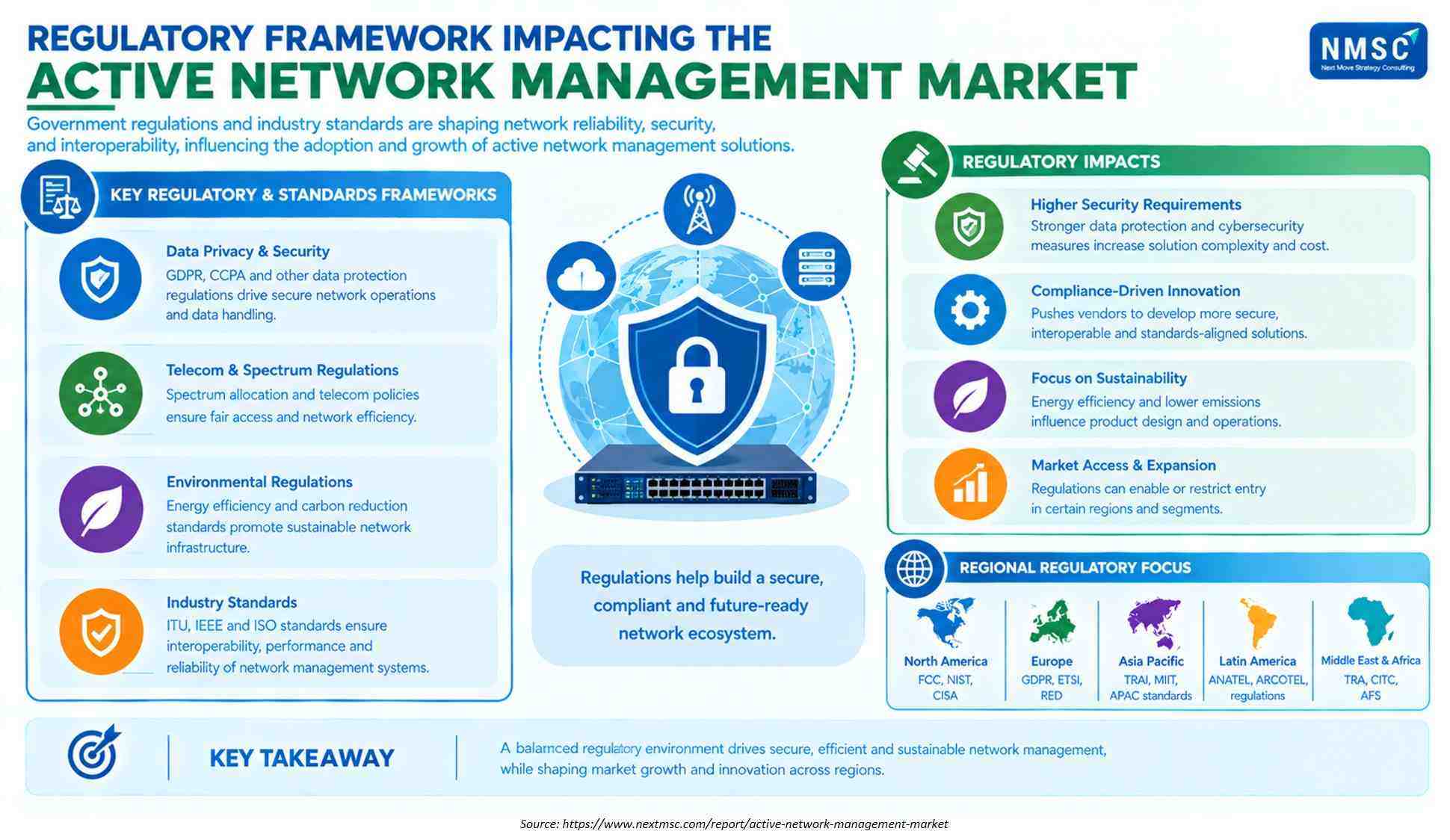
Regulatory Framework Impacting the Active Network Management Market

The Active Network Management market is shaped by regulations governing data privacy, telecommunications, spectrum allocation, environmental performance, and network interoperability. Frameworks such as GDPR, CCPA, and industry standards from ITU, IEEE, and ISO influence solution design and deployment. Increasing cybersecurity, sustainability, and compliance requirements are driving vendors toward secure, interoperable, energy-efficient, and standards-aligned network management solutions.

Competitive Landscape

The Active Network Management Market includes large grid-automation vendors alongside specialized ANM, DERMS, flexibility, monitoring, and control providers .

Dimension Description
Market Structure The market includes large multinational grid-automation vendors alongside specialized ANM, DERMS, flexibility, monitoring, and control providers. Competition varies by network level, customer type, geographic market, and solution specialization.
Innovation Focus Unified grid orchestration platforms, DER portfolio dispatch, and dynamic operating envelope calculation dominate current vendor innovation pipelines.
Partnership & Integration Activity Selective strategic partnerships and technology integrations are expanding DER orchestration, grid optimization, flexibility management, and network-visibility capabilities.

How Do Companies Compete in the Active Network Management Market?

Companies compete primarily on the breadth of functions unified within a single platform and on demonstrated utility deployment scale. GE Vernova Inc. and Siemens AG both offer platforms spanning SCADA , DERMS, and transmission-distribution coordination, while smaller vendors such as ETAP Automation, Inc. and Camlin Energy compete on deep specialization in constraint or voltage management for utilities that prefer best-of-breed tools over a single integrated suite.

Which Competitive Archetypes Dominate the Active Network Management Market?

Two common competitive archetypes are emerging in the market: large grid-automation vendors offering unified orchestration platforms across transmission and distribution, and specialized software providers focused on specific control functions or customer segments. GE Vernova Inc. and Hitachi Energy Ltd. exemplify the unified-platform archetype through combined ADMS, DERMS, and transmission EMS portfolios, while Uplight , Inc. and ARGAND Solutions Ltd. exemplify the specialized archetype built around DER engagement and flexibility program management.

How Are Companies Differentiating Through Innovation in Active Network Management?

Innovation and differentiation strategy increasingly center on consolidating previously separate constraint, voltage, and DER functions into one orchestration layer. GE Vernova's sequential 2026 launches of GridOS for Distribution and GridOS for Transmission illustrate how vendors are extending unified platforms across the transmission-distribution boundary rather than selling separate tools for each network level. Platform integration is therefore becoming an important consideration as utilities evaluate solutions spanning multiple network-management functions.

What Partnership and Integration Activity Is Shaping the Active Network Management Market?

Partnership and integration activity is increasingly expanding capabilities across the Active Network Management ecosystem. GE Vernova and EnergyHub announced a strategic partnership in September 2023 that combines GE Vernova’s GridOS DERMS grid-optimization capabilities with EnergyHub’s DER resource formation and portfolio-control capabilities.

Key Market Players

The following 20 companies were identified as key participants in the global Active Network Management Market based on their product portfolios, technology capabilities, utility deployments, and market presence .

GE Vernova Inc. Siemens AG Schneider Electric SE Hitachi Energy Ltd. Mitsubishi Electric Corporation ABB Ltd. Oracle Corporation Itron, Inc. Landis+Gyr Group AG Emerson Electric Co. Eaton Corporation plc Schweitzer Engineering Laboratories, Inc. S&C Electric Company Toshiba Energy Systems & Solutions Corporation ETAP Automation, Inc. ZIV AplicacionesyTecnología , S.L.U. Indra Sistemas, S.A. ARGAND Solutions Ltd. Uplight , Inc. Camlin Energy

Latest Developments

Recent product launches and utility deployments within the Active Network Management Market are concentrated on unified grid orchestration platforms and DER visibility programs.

Date Event
June 2026 Schneider Electric and Kraken announced a partnership to deliver solutions for utilities and distribution system operators that improve network visibility, forecast congestion and shift demand in real time. The companies said the collaboration is intended to accelerate connections for data centers and industrial loads without costly multi-year network upgrades.
March 2026 Ausgrid is deploying Itron’s IntelliFLEX Low Voltage DERMS to manage consumer energy resources including rooftop solar, batteries and electric vehicles. The solution is designed to help the distributor maintain reliability and comply with market requirements, strengthening real-time visibility, control and coordination at low-voltage network level.
February 2026 GE Vernova launched GridOS for Distribution, unifying distribution network modeling , real-time operations, DER management, field execution and visual intelligence on a governed data foundation. Alabama Power is among early adopters. The platform is designed to coordinate DERs and improve operational control as utilities manage rising demand and grid complexity.

Expert Insights

Paul Auckland

Paul Auckland

Head of Distribution System Operation | SP Electricity North West

"“ANM accelerates connections that would otherwise need to wait for reinforcement, enabling cleaner energy projects, such as renewables, to come online sooner and supporting the growth of flexibility services, facilitating greener growth in the region.”"

Analyst Interpretation

The comment highlights the growing role of Active Network Management in addressing grid-capacity constraints as renewable generation, battery storage, and other distributed energy resources expand. By continuously monitoring network conditions and automatically managing constrained assets, ANM can enable faster connections while improving utilization of existing infrastructure. This creates opportunities for ANM platforms, real-time monitoring systems, automated curtailment technologies, and flexibility-management solutions across increasingly decentralized electricity networks.

Investment Opportunities

What Capital Inflows Are Targeting the Active Network Management Market?

Capital inflows are concentrated on unified grid orchestration platforms and DER portfolio management capability. GE Vernova's sequenced 2026 launches of GridOS for Distribution and GridOS for Transmission, backed by new AI-focused development, reflect sustained vendor investment in extending platform functionality across the full transmission-distribution boundary. Utility-side capital continues to flow through regulatory mechanisms such as Ofgem's DSO incentive, which channels reinforcement-avoidance savings back into flexible network operation budgets.

How Is Infrastructure Investment Supporting Active Network Management Deployment?

Infrastructure investment in low-voltage telemetry and DER asset registration is expanding the data foundation that active network management depends on. Ofgem has appointed Elexon to deliver the Flexibility Market Asset Registration system, with Day 1 targeted for September 2027. The system is intended to provide aggregators with a single registration point for participation across multiple flexibility markets rather than requiring separate registrations with individual network operators. This shared infrastructure could reduce the administrative burden of bringing new DER capacity into flexibility markets.

What ESG Considerations Are Shaping Active Network Management Investment Decisions?

Environmental and governance considerations specific to this market center on unlocking renewable capacity that would otherwise sit curtailed behind network constraints, and on equitable access to flexibility markets for smaller DER owners. Ofgem's asset visibility consultation explicitly ties improved DER registration to better network planning and investment optimization, framing data governance as a prerequisite for both decarbonization and cost efficiency. Reduced renewable curtailment can serve as one measurable indicator of the potential grid-decarbonization benefits associated with ANM deployment.

Key Benefits for Stakeholders

How Does This Report Benefit Enterprise and Industry Leaders?

Enterprise and industry leaders gain validated segmentation, competitive benchmarking, and regional demand forecasts that support platform investment and deployment sequencing decisions across the Active Network Management Market. Detailed offering, customer type, and regional breakdowns help utility procurement teams identify which control functions and deployment models best match their own network constraint profile.

How Does This Report Benefit Investors and Financial Analysts?

Investors and financial analysts gain consistent, single-point market size and CAGR estimates that support valuation and capital-allocation decisions across the Active Network Management Market vendor landscape. The report's regional and segment-level growth differentials help identify which vendors are positioned to capture above-market growth in aggregator-facing and Asia-Pacific deployment categories through 2035.

How Does This Report Benefit Technology Vendors and Product Teams?

Technology vendors and product teams gain insight into the platform consolidation and low-voltage extension requirements reshaping the Active Network Management Market. This analysis helps R&D teams prioritize development roadmaps around unified transmission-distribution orchestration and DER portfolio dispatch capability increasingly required by utility and aggregator procurement processes.

Key Market Segments Evaluated

By Offering

  • Software 
    • Central ANM Platform Software
    • Embedded ANM Software
  • Hardware 
    • ANM Controllers
    • ANM Interface Gateways
    • Dedicated ANM Monitoring Devices
  • Services 
    • Professional Services
      • Implementation and Integration
      • Engineering and Consulting
      • Testing and Commissioning
    • Managed Services
      • Technical Support
      • Software Maintenance
      • Managed ANM Operations

By Network Level

  • Distribution Network 
    • Medium-Voltage Network
    • Low-Voltage Network
  • Transmission Network 
    • High-Voltage Network
    • Extra-High-Voltage Network
  • Transmission and Distribution Interface 
    • Transmission-Distribution Coordination
    • Distributed Energy Resource Grid Interface

By Primary Control Function

  • Constraint Management 
    • Thermal Constraint Management
    • Congestion Management
    • Export and Import Limit Management
  • Voltage and Reactive Control 
    • Voltage Constraint Management
    • Reactive Power Control
    • Volt/VAR Optimisation
  • DER Dispatch and Curtailment 
    • Renewable Curtailment
    • DER Active Power Control
    • Storage and Flexible Load Dispatch
  • Network Capacity Management 
    • Dynamic Operating Envelopes
    • Flexible Connection Management
    • Network Capacity Allocation
  • Monitoring and Control Coordination 
    • Real-Time Network Monitoring
    • Automated Control
    • DER Telemetry and Coordination

By Customer Type

  • Distribution System Operators 
    • Investor-Owned Utilities
    • Public Utilities
    • Cooperative Utilities
  • Transmission System Operators 
    • Independent Transmission Operators
    • Vertically Integrated Utilities
  • Generation and Storage Operators 
    • Renewable Generators
    • Energy Storage Operators
  • Aggregators and Energy Service Providers 
    • DER Aggregators
    • Flexibility Service Providers
  • Commercial and Industrial Operators 
    • Industrial Facilities
    • Commercial Facilities
    • Microgrid Operators

By Deployment Model

  • On-Premises
  • Private Cloud
  • Public Cloud
  • Hybrid

By Sales Channel

  • Direct Sales
  • System Integrators
  • Distributors
  • OEM and Embedded Partnerships

By Region

  • North America 
    • U.S.
    • Canada
    • Mexico
  • Europe 
    • UK
    • Germany
    • France
    • Italy
    • Spain
    • Sweden
    • Denmark
    • Finland
    • Netherlands
    • Rest of Europe
  • Asia-Pacific 
    • China
    • India
    • Japan
    • South Korea
    • Taiwan
    • Indonesia
    • Vietnam
    • Australia
    • Philippines
    • Malaysia
    • Rest of APAC
  • Middle East & Africa 
    • Saudi Arabia
    • UAE
    • Egypt
    • Israel
    • Turkey
    • Nigeria
    • South Africa
    • Rest of MEA
  • Latin America 
    • Brazil
    • Argentina
    • Chile
    • Colombia
    • Rest of LATAM

Conclusion & Recommendations

The long-term outlook for the Active Network Management Market remains positive, with global revenue projected to increase from USD 2.05 Billion in 2025 to USD 9.17 Billion by 2035. The market is projected to grow at a CAGR of 14.26% from 2026 to 2035 . Rising DER interconnection volume and flexibility-first regulation will continue to convert network constraints that once required physical reinforcement into software-addressable problems through the forecast period.

What Strategic Positioning Should Companies Pursue?

Vendors should prioritize unified platforms spanning constraint management, voltage control, and DER dispatch rather than single-function tools, since utilities increasingly evaluate suppliers on integration breadth. Companies investing in low-voltage telemetry, aggregator-facing portfolio dispatch, and interoperability may be better aligned with emerging utility and flexibility-market requirements.

How Attractive Is the Market for New Investment?

The market presents an attractive investment case, supported by a USD 6.41 Billion absolute dollar opportunity between 2026 and 2035 and above-average growth in Asia-Pacific and aggregator-facing customer categories. Investment considerations include demonstrated utility deployment experience, platform breadth, regulatory exposure, and growth prospects across established and emerging markets.

What Market Shifts and Key Risks Should Stakeholders Monitor?

Stakeholders should monitor limited low-voltage network visibility, legacy SCADA integration complexity, and fragmented regional flexibility market regulation as key risks to the Active Network Management Market. Compatibility with incumbent outage management and SCADA systems is likely to remain an important consideration in utility procurement as operators increasingly seek pre-integrated, unified platforms.

What Growth Pathways Should Companies Prioritize?

Priority growth pathways include extending platform coverage to low-voltage networks, scaling DER portfolio dispatch capability for aggregators, and deepening deployment across Asia-Pacific markets facing acute interconnection constraints. Companies pursuing these pathways while maintaining compatibility with incumbent utility systems may be better aligned with the projected market expansion through 2035 .

FAQs

Consolidated Source Table

Source Name / Organization URL
GE Vernova Inc. https://www.gevernova.com
Siemens AG https://www.siemens.com
Schneider Electric SE https://www.se.com
Hitachi Energy Ltd. https://www.hitachienergy.com
ABB Ltd. https://global.abb
Landis+Gyr Group AG https://www.landisgyr.com
Office of Gas and Electricity Markets (Ofgem) https://www.ofgem.gov.uk
Electricity North West Limited https://www.enwl.co.uk
UK Power Networks https://www.ukpowernetworks.co.uk
Electric Reliability Council of Texas (ERCOT) https://www.ercot.com
U.S. Federal Energy Regulatory Commission (FERC) https://www.ferc.gov
U.S. Securities and Exchange Commission (SEC) https://www.sec.gov
Methodology Note
Market size figures for 2025, 2026, and 2035, and the 14.26% CAGR, were supplied as fixed inputs for this report and are used identically throughout. Segment and regional splits are industry-derived estimates developed by Next Move Strategy Consulting through triangulation of company disclosures, utility regulatory filings, and a proprietary bottom-up segmentation model, as no single publicly verifiable dataset matches the Active Network Management Market's exact scope and segmentation.

About the Author

Mihul Sharma

Mihul Sharma

Mihul Sharma is Research Associate at Next Move Strategy Consulting, where he has covered technology, industrial, and healthcare markets for 3 years. His work applies structured business research, market analysis, and secondary-source review to assess market trends, competitive developments, and growth opportunities. He supports report development by fully synthesizing industry data, company information, and market signals into concise findings for strategy and investment-focused research teams.

About the Reviewer

Supradip Baul

Supradip Baul

Supradip Baul is an accomplished business consultant and strategist with over a decade of rich experience in market intelligence, strategy, technology, and business transformation. His work has included rigorous qualitative and quantitative analysis across multiple industries, helping clients shape investment decisions and long-term roadmaps. Earlier in his career, he was associated with Gartner, where he contributed to industry-leading reports and market share analyses. He has worked with leading global companies and holds an MBA with a dual specialization in Marketing and Finance.

Mohit Agarwal

MOHIT AGARWAL

Chief Manager

DryChem India Pvt. Ltd.

Next Move Strategy Consulting is an amazing team of consultants. We required a market study report for our investors on top priority and the team went above and beyond our expectations to deliver the same with ample supporting data within a short time span enabling us to secure the investments and keep our project timeline maintained. Their professionalism, attention to detail, and timely delivery of actionable recommendations have left a lasting impression on our organization.

Robert Sean Trevino

ROBERT SEAN TREVINO

Sr. Director, Head of Strategic Insights & Analytics

Foundation Medicine

I realized that it was a reliable source of information. These days, there are many people who are looking for authentic data, and this is one of the only sources that can offer them with what they need;

Henri Knyphausen

HENRI KNYPHAUSEN

Partner at Singulier [Ex-BCG]

Singulier

I recently engaged NEXTMSC.com for a commercial due diligence project within the intralogistics sector, and I am pleased to provide a reference based on my experience. In utilizing NEXTMSC.com's services, I found their report to offer valuable insights into market dynamics and key industry players. The initial report provided a solid foundation for our analysis. However, as we were investigating a smaller target in the market, and I had specific customization requests requiring additional research. These requests included detailed information on product portfolios of various players and sub-market sizes, both inclusive and exclusive of certain product categories. NEXTMSC.com demonstrated commendable responsiveness and agility in accommodating these customization requests. Within a timeframe of 1-2 weeks, they delivered a revised report that met our specific needs. Furthermore, they were receptive to my follow-up inquiries, ensuring clarity and understanding of the data provided. The final deliverable significantly contributed to our due diligence efforts. One of NEXTMSC.com's notable strengths lies in their qualitative research capabilities. However, for future engagements, I would recommend the inclusion of a quantified market model in Excel format. Such a model would offer the ability to conduct in-depth analyses and explore various market segments, including country-specific data and subcomponent breakdowns. Based on my positive experience, I would not hesitate to work with NEXTMSC.com again. Their responsiveness, willingness to accommodate customization requests, and commitment to delivering actionable insights make them a reliable partner for commercial research projects.

Ross J Mckenzie

ROSS J MCKENZIE

Business Insight Manager

Staysure Group

“Next MSC have been incredibly helpful in providing detailed & robust information on our market, alongside quantifying growth by different segments. The process to procure was simple and easy, with sample reports and regular contact to ensure we had what we needed. Succinct detail on their sources & methodologies is also greatly received, allowing transparency in this respect helps build trust in the detail you pay for. Joseph in particular was fantastic, and helped ensure efficient provision of the insight pack – thank you NMSC!”.

Nishant Awate

NISHANT AWATE

Business Development Global Sales

Zehnder Group Deutschland GmbH

Our experience working with Next Move Strategy Consulting was positive. The team was responsive, professional, and open to incorporating our specific requirements throughout the project. The India AHU market study was comprehensive and well structured, covering market value and volume forecasts, product and application segments, and key industry trends. The inclusion of both AHU and residential MVHR market insights made the study particularly relevant for our strategic market assessment. Overall, the report provides a solid foundation for evaluating market potential, identifying priority segments, and supporting business-development decisions in India.

Custom Market Research Services

We will customize the research for you if the listed report does not fully match your requirements.

Get 30% Free Customization

Select License

This website uses cookies to ensure you get the best experience on our website. Learn more

✖