Network Security Market By Product Revenue (Hardware Appliances, Software and Virtual, and Cloud Subscriptions), By Service Revenue (Managed Security Services, Professional Services, and Other Services), By Function (Perimeter Security, Secure Access, and Other Functions), By Deployment (On-Premises, Cloud, Hybrid, and Not Applicable), By Channel (Direct Sales, Partner and Reseller, and Others), and By End-User Industry – Global Opportunity Analysis and Industry Forecast, 2025–2035
Industry: ICT & Media | Publishing Date: July 15, 2026 | Last Updated: September 30, 2026 | No of Pages: N/A | No. of Tables: N/A | No. of Figures: N/A | Format: PDF | Report Code: IC5153
What Is the Network Security Market Size?
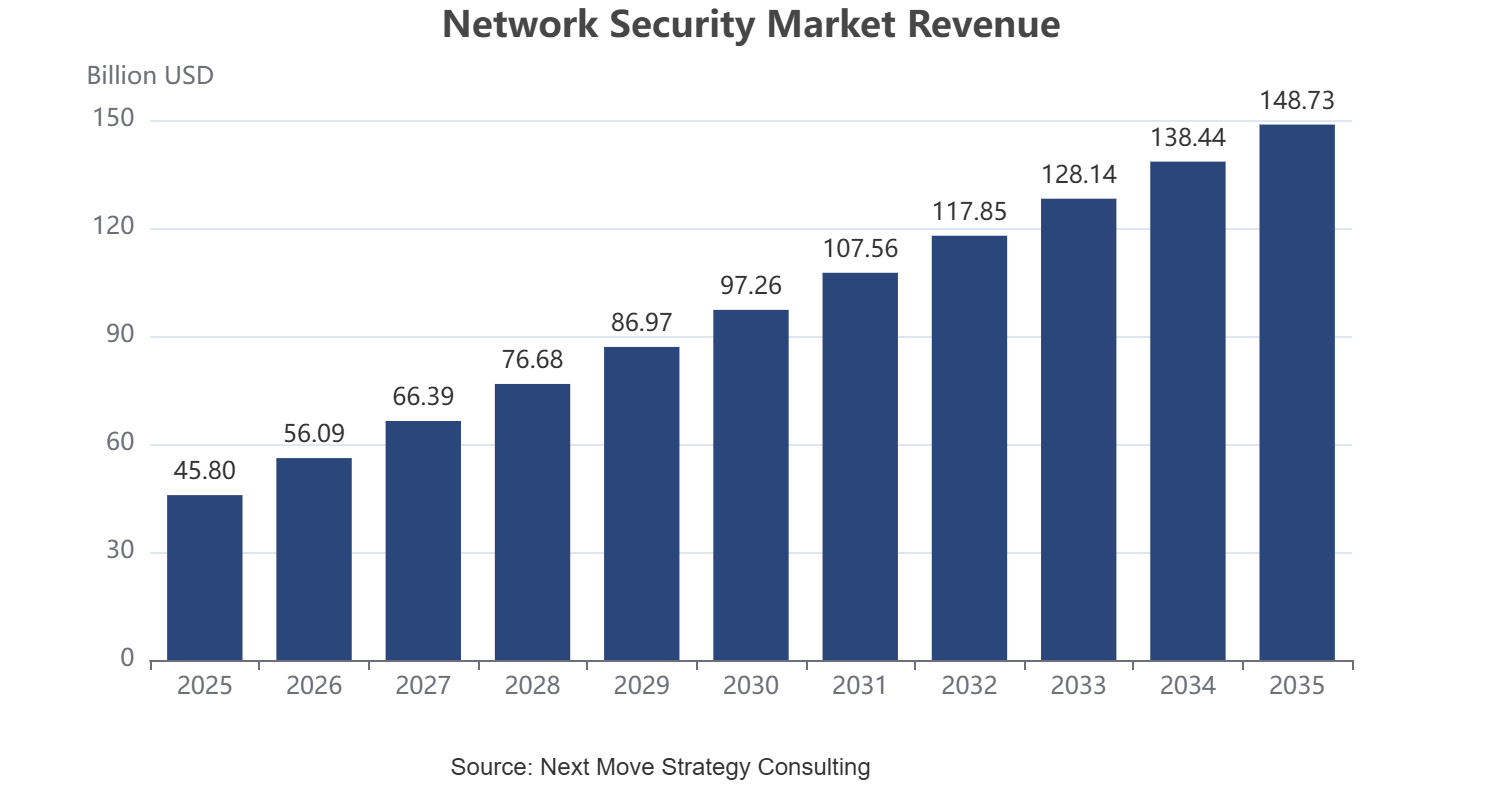
The network security market size was valued at USD 45.80 billion in 2025 and is estimated at USD 51.52 billion in 2026, advancing to USD 148.73 billion by 2035 at a CAGR of 12.5% across the 2026 to 2035 forecast period. Through our market assessment, we observed that this growth path is anchored in four converging forces: accelerating migration from appliance-based perimeter defense toward cloud-delivered secure access service edge architecture, rising enterprise spend on zero trust network access following large-scale ransomware and supply-chain incidents, expanding regulatory pressure under frameworks such as the EU NIS2 Directive, and the build-out of AI-native detection and response capability across hybrid network estates. These four drivers, taken together, explain why this market is compounding faster than general IT spending over the next decade.
|
Parameters |
Details |
|
Market Size in 2025 |
USD 45.80 Billion |
|
Market Size in 2026 |
USD 51.52 Billion |
|
Revenue Forecast in 2035 |
USD 148.73 Billion |
|
Growth Rate |
CAGR of 12.5% from 2026 to 2035 |
|
Analysis Period |
2025-2035 |
|
Base Year Considered |
2025 |
|
Forecast Period |
2026-2035 |
|
Market Size Estimation |
Billion USD |
|
Companies Profiled |
20 |
|
Countries Covered |
38 |
|
Market Share |
Top 10 |
Network Security Market Overview
What Is the Network Security Market?
The Network Security Market encompasses hardware appliances, software platforms, virtual security functions, cloud-delivered security services, and managed and professional services designed to protect enterprise networks, users, applications, and digital assets from evolving cyber threats. The market includes firewalls, intrusion prevention systems, distributed denial-of-service (DDoS) protection, secure web gateways, network access control, zero trust network access (ZTNA), network detection and response (NDR), DNS security, and secure access service edge (SASE) solutions deployed across on-premises, cloud, hybrid, and multi-cloud environments. These technologies support organizations across banking, healthcare, government, manufacturing, retail, telecommunications, and other industries by enabling secure connectivity, threat detection, policy enforcement, and regulatory compliance within increasingly distributed enterprise networks.
How Has the Network Security Market Evolved?
The Network Security Market has evolved through several distinct technology transitions. The first generation focused on perimeter-based security using hardware firewalls and intrusion prevention systems to protect enterprise data centers. The second phase introduced virtualized security appliances and cloud-managed solutions that addressed hybrid IT environments and remote connectivity requirements. NMSC's analysis indicates that the current phase is characterized by the convergence of networking and security through SASE, zero trust architectures, and AI-powered threat detection platforms that unify policy management and security operations. The emergence of integrated networking, cloud security, and AI-driven analytics continues to redefine enterprise security strategies while shifting vendor business models toward subscription-based and recurring service revenues.
How Do Regulations Influence the Network Security Market?
Regulatory frameworks significantly influence investment priorities and technology adoption across the Network Security Market. The European Union's NIS2 Directive strengthens cybersecurity risk management and incident reporting obligations across critical infrastructure sectors, while the General Data Protection Regulation (GDPR) continues to drive demand for secure network architectures, encryption, and continuous monitoring capabilities. In the United States, cybersecurity initiatives led by the Cybersecurity and Infrastructure Security Agency (CISA), together with sector-specific regulations for financial services, healthcare, and government organizations, encourage sustained investment in advanced network protection technologies. These evolving compliance requirements are accelerating enterprise adoption of zero trust architectures, network visibility, and continuous threat detection solutions.
How Is Technology Adoption Expanding Across the Network Security Market?
Technology adoption within the Network Security Market continues to accelerate as enterprises modernize cybersecurity architectures to secure cloud-native, hybrid, and distributed IT environments. Zero trust network access is increasingly replacing legacy VPN infrastructures, while AI-assisted threat detection, network detection and response, and automated security operations improve incident response capabilities. From our research, we found that organizations are rapidly adopting integrated SASE platforms that combine networking and security into unified cloud-delivered services, enabling simplified policy management, enhanced visibility, and scalable protection across users, devices, applications, and geographically distributed enterprise networks.
|
Key Takeaways |
|
By product revenue, Cloud Subscriptions held the largest share of the Network Security Market at USD 12.03 billion in 2025, driven by rapid enterprise adoption of Secure Access Service Edge (SASE), Firewall as a Service (FWaaS), and Zero Trust Network Access (ZTNA) solutions across hybrid and cloud environments. Cloud Subscriptions also represent the fastest-growing product category, projected to expand from USD 12.03 billion in 2025 to USD 56.63 billion by 2035 at a 16.8% CAGR, supported by the transition from appliance-based security to cloud-delivered subscription platforms. |
|
By service revenue, Managed Security Services accounted for USD 5.69 billion in 2025, representing the largest share of the Network Security Market as enterprises increasingly outsourced firewall management, threat monitoring, and security operations to managed service providers. Managed Security Services are also the fastest-growing service category, projected to reach USD 25.69 billion by 2035 at a 16.3% CAGR, driven by rising cybersecurity talent shortages and expanding demand for continuous security monitoring. |
|
By function, Perimeter Security generated USD 13.74 billion in 2025, reflecting the extensive installed base of enterprise firewalls and intrusion prevention systems protecting critical network infrastructure. Detection and Response is the fastest-growing function, projected to expand from USD 7.33 billion in 2025 to USD 35.70 billion by 2035 at a 17.2% CAGR, fueled by enterprise adoption of AI-powered threat detection, network detection and response (NDR), and automated security operations. |
|
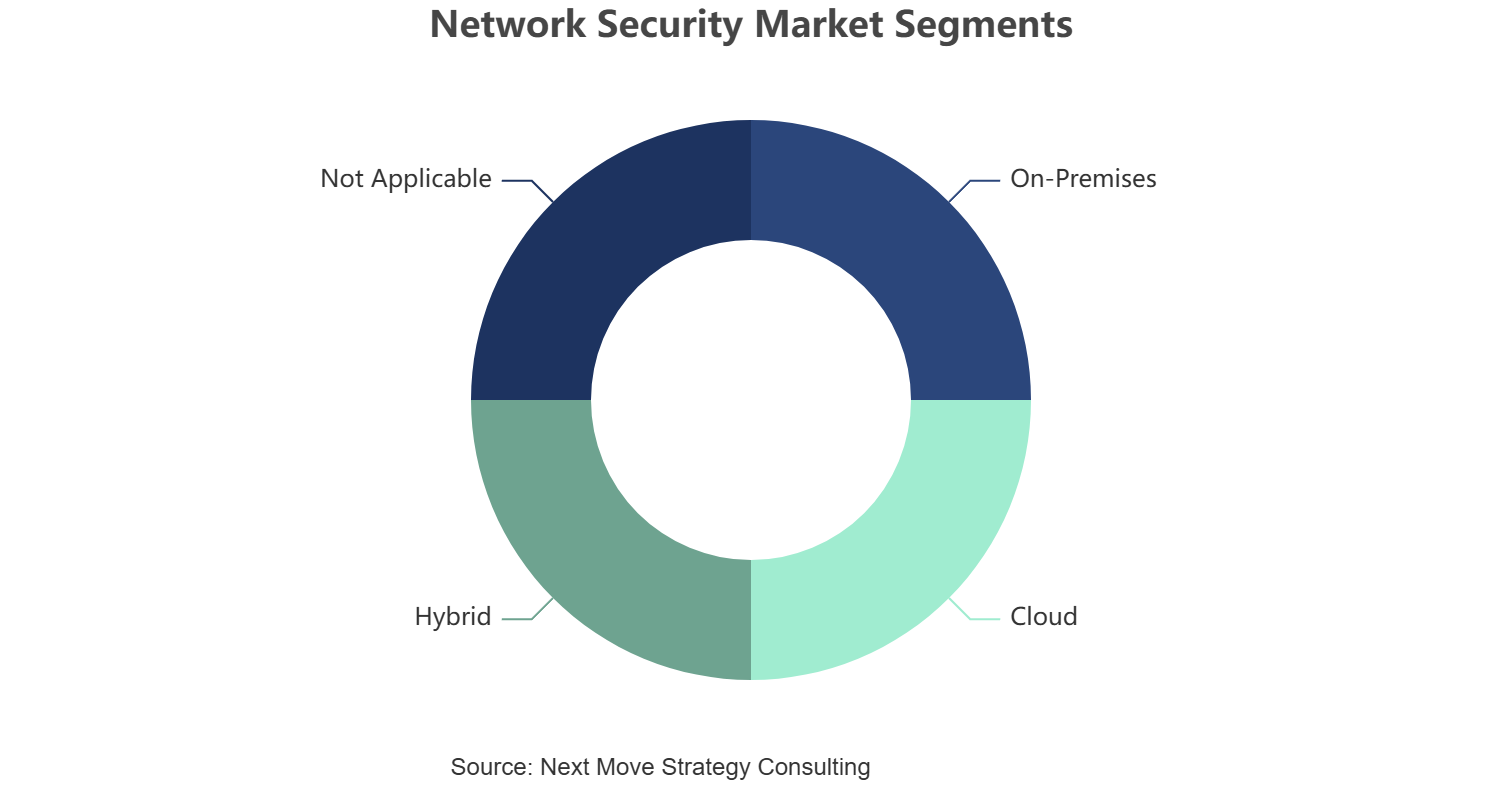
By deployment, On-Premises accounted for USD 17.41 billion in 2025, supported by strong demand from regulated industries requiring localized security controls and data residency compliance. Cloud deployment is the fastest-growing deployment model, projected to grow from USD 15.57 billion in 2025 to USD 74.36 billion by 2035 at a 16.9% CAGR, driven by accelerating adoption of cloud-native security architectures and unified SASE platforms. |
|
By customer type, Enterprise generated USD 19.23 billion in 2025, representing the largest revenue contribution to the Network Security Market due to complex multi-site infrastructures and extensive cybersecurity investments. Small and Medium Business is the fastest-growing customer segment at a 14.0% CAGR from 2026 to 2035, supported by growing adoption of subscription-based cloud security services and managed security offerings that reduce upfront infrastructure costs. |
|
By channel, Partner and Reseller generated USD 17.40 billion in 2025, representing the largest share of the Network Security Market as vendors continued to rely on established distribution networks for enterprise security deployments. MSP and MSSP is projected to register the fastest growth, reaching USD 34.21 billion by 2035 at a 16.7% CAGR, driven by increasing enterprise outsourcing of security operations and managed detection services. |
|
By end-user industry, BFSI accounted for USD 10.08 billion in 2025, supported by stringent regulatory requirements, high cybersecurity spending, and the need to secure financial transactions and critical digital infrastructure. Transportation and Logistics is the fastest-growing end-user segment at a 15.1% CAGR from 2026 to 2035, driven by increasing digitalization of fleet operations, connected logistics networks, and critical infrastructure protection initiatives. |
|
North America held the largest regional share of the Network Security Market at USD 16.48 billion in 2025, supported by mature cybersecurity infrastructure, widespread enterprise adoption of zero trust architectures, high cloud security spending, and the presence of leading network security vendors driving continuous technology innovation. |
|
Asia Pacific is the fastest-growing region in the Network Security Market, projected to expand from USD 12.37 billion in 2025 to USD 49.07 billion by 2035 at a 14.8% CAGR, driven by rapid cloud infrastructure expansion, strengthening cybersecurity regulations, accelerating enterprise digital transformation, and rising investments in secure network infrastructure across major regional economies. |
|
The United States dominated the Network Security Market in 2025, accounting for the largest share of global revenue. Its leadership is supported by advanced cybersecurity infrastructure, extensive enterprise adoption of SASE and zero trust architectures, substantial federal cybersecurity investments, and the strong presence of global network security technology providers. |
|
Vietnam is projected to be the fastest-growing country in the Network Security Market during the forecast period, expanding at an 18.1% CAGR, driven by rapid manufacturing expansion, increasing cloud adoption, strengthening cybersecurity regulations, rising digital infrastructure investments, and growing demand for secure enterprise network environments. |
Key Emerging Trends in the Network Security Market
How Is AI-Native Detection Reshaping the Network Security Market?
Vendors are embedding generative and agentic AI directly into detection and response workflows rather than offering it as an add-on module. Through NMSC's assessment, we found that this transformation is shifting buyer evaluation criteria from signature coverage toward autonomous triage speed. Zscaler's acquisition of Red Canary, announced in 2025, illustrates the trend, pairing agentic AI-driven threat intelligence with the Zero Trust Exchange platform. Stakeholder impact is concentrated among security operations teams, which are being asked to supervise AI-driven workflows rather than manually investigate every alert generated across the network security market.
How Is Secure Access Service Edge Consolidating Point Products in the Network Security Market?
Enterprises are replacing standalone VPN, secure web gateway, and CASB tools with unified SASE platforms delivered from a single vendor and operating system. Fortinet reported that Unified SASE billings grew 40% year over year in its fourth quarter of 2025, evidencing the pace of adoption. From our research, we found that mid-market buyers are the primary adopters, since SASE reduces the number of consoles and contracts they must manage. The transformation favors vendors with networking heritage who can bundle SD-WAN with security inside the network security market.
How Is Infrastructure-Level Security Acceleration Changing Network Security Market Deployment?
Security functions are migrating from general-purpose appliances onto dedicated data processing units embedded inside network and AI infrastructure. Fortinet's 2025 integration with NVIDIA, embedding FortiGate VM on BlueField-3 DPUs, delivers firewalling and segmentation directly inside AI Factory infrastructure. Based on our market evaluation, we noticed that this adoption pattern is concentrated among hyperscale and AI-infrastructure operators first, with stakeholder impact felt most by network architects who must now provision security at the silicon layer rather than as a separate appliance tier within the network security market.
How Is Regulatory Pressure from NIS2 Reshaping the Network Security Market?
The EU NIS2 Directive extended mandatory cybersecurity risk-management and incident-reporting duties to 18 critical sectors, with the European Commission proposing targeted amendments in January 2026 to simplify compliance for roughly 28,700 companies. Our analysis shows that boards, not just IT departments, are now accountable for network security posture under NIS2, accelerating budget approval cycles. The transformation is most visible among mid-sized manufacturers and digital infrastructure operators newly brought into scope, who are first-time buyers within the network security market.
Porter's Five Forces Analysis of the Network Security Industry
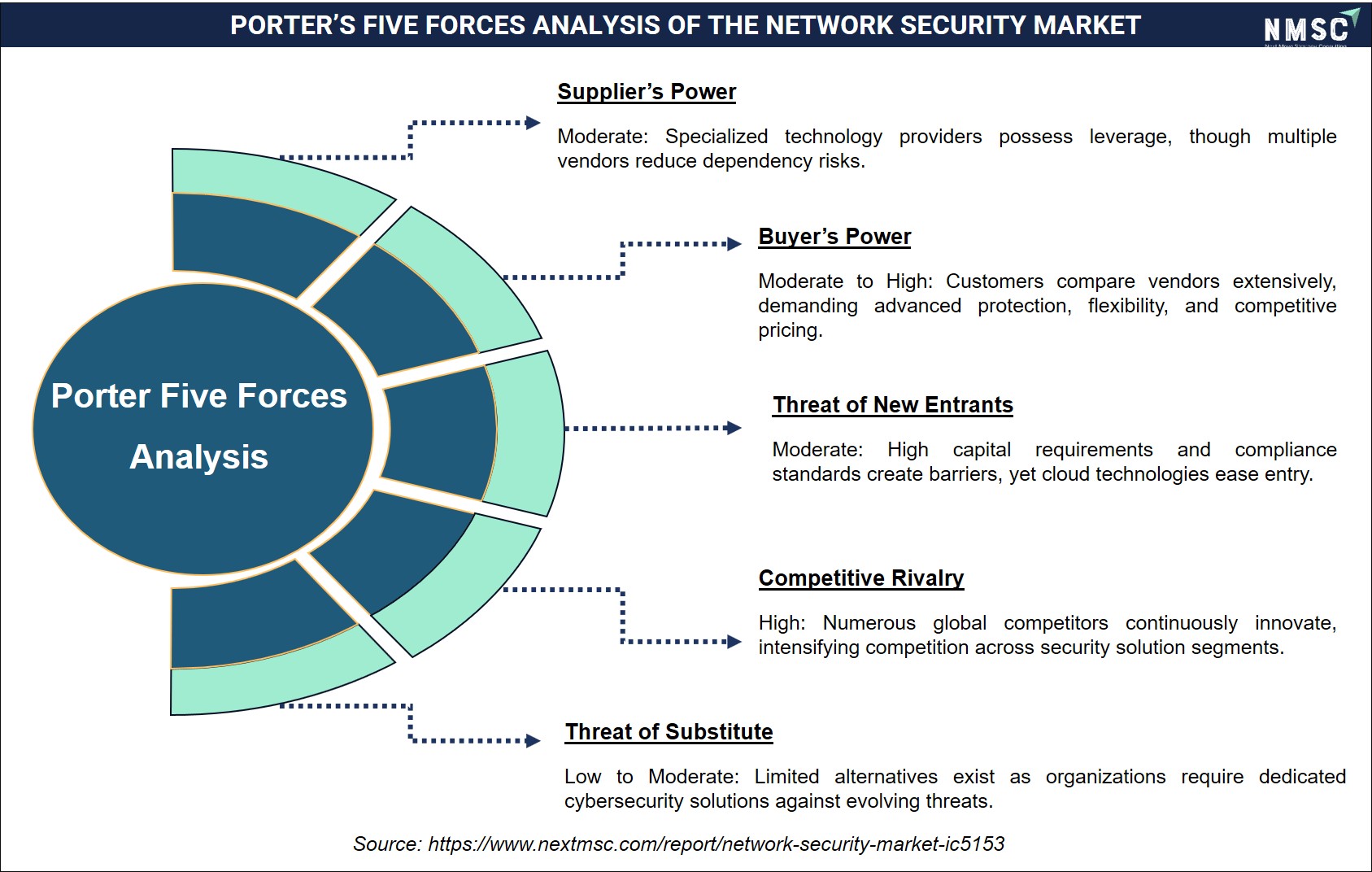
The Network Security Market operates within a highly competitive environment characterized by continuous innovation, regulatory compliance, and evolving cyber threats. Based on our market evaluation, we noticed that strong rivalry among established vendors, moderate barriers to entry, increasing buyer expectations, evolving supplier dynamics, and limited substitution risks encourage sustained investment in AI-driven security, cloud-native platforms, and integrated cybersecurity solutions.
What Are the Key Market Drivers, Breakthroughs, and Investment Opportunities That Will Shape the Network Security Industry in the Next Decade?
|
Drivers / Trends / Restraints |
(+/-) % Impact on CAGR |
Geographic Relevance |
Impact Timeline |
|
NIS2 and similar regulatory expansion |
+0.6% |
Europe |
2026-2028 |
|
Zero trust mandates in public-sector procurement |
+0.5% |
North America |
2026-2028 |
|
SASE and cloud-delivered security migration |
+1.2% |
Global |
2026-2030 |
|
AI-native threat detection and response adoption |
+0.8% |
Global |
2027-2031 |
|
Infrastructure-embedded security (DPU/NPU acceleration) |
+0.4% |
Global |
2027-2032 |
|
MSSP and managed services expansion in mid-market |
+0.5% |
Global |
2026-2030 |
|
Federal cybersecurity budget constraints |
-0.4% |
North America |
2026-2027 |
|
Fragmented multi-country compliance burden |
-0.3% |
Europe |
2026-2028 |
|
Platform consolidation and vendor lock-in risk |
-0.2% |
Global |
2028-2032 |
|
Lengthening legacy appliance replacement cycles |
-0.3% |
Global |
2031-2035 |
What Are the Growth Drivers of the Network Security Market?
How Is the Migration Toward Cloud-Delivered Security Platforms Driving the Network Security Market?
The transition from appliance-based security toward cloud-delivered security platforms is the primary structural growth driver of the Network Security Market. Our findings suggest that enterprises are increasingly replacing traditional firewall infrastructure with Secure Access Service Edge (SASE), Firewall as a Service (FWaaS), and Zero Trust Network Access (ZTNA) solutions to secure distributed users and cloud-native workloads. Fortinet reported Unified SASE billings growing 40% year over year during the fourth quarter of 2025, while Zscaler's annual recurring revenue surpassed USD 3 billion during the same period, demonstrating accelerating enterprise adoption of subscription-based network security platforms. This transition continues to expand recurring revenue opportunities while driving long-term market growth.
How Are Expanding Cybersecurity Regulations Accelerating Enterprise Adoption in the Network Security Market?
The expansion of cybersecurity regulations is creating sustained demand for advanced network security solutions across critical industries worldwide. Through our market assessment, we observed that the European Commission's NIS2 Directive extends mandatory cybersecurity obligations across 18 critical sectors, significantly expanding the addressable customer base for network security vendors. Organizations operating in manufacturing, transportation, digital infrastructure, healthcare, and public services are increasing investments in network visibility, threat detection, and zero trust architectures to comply with evolving regulatory requirements and strengthen cyber resilience.
How Is Government Cybersecurity Spending Supporting Growth in the Network Security Market?
Government investment in national cybersecurity infrastructure continues to strengthen long-term demand across the Network Security Market. The U.S. Department of Homeland Security allocated USD 1.37 billion toward cybersecurity initiatives in its Fiscal Year 2026 Congressional Budget Justification to protect federal civilian networks and strengthen cybersecurity capabilities across state, local, tribal, and territorial governments. Based on our market evaluation, we noticed that sustained public-sector investment provides a stable procurement pipeline for network security vendors while encouraging broader adoption of advanced cybersecurity technologies.
What Are the Growth Inhibitors of the Network Security Market?
How Does Public-Sector Budget Volatility Limit Growth in the Network Security Market?
Uncertainty surrounding government cybersecurity budgets remains a significant short-term restraint for the Network Security Market. The U.S. Department of Homeland Security proposed reducing the Cybersecurity and Infrastructure Security Agency's operating budget while separate congressional proposals suggested alternative funding levels. From our research, we found that delayed budget approvals extend procurement cycles for federal cybersecurity projects, slowing purchasing decisions and creating uncertainty for vendors serving government agencies.
How Does Fragmented Regulatory Implementation Constrain the Network Security Market?
Differences in national implementation of cybersecurity regulations continue to create operational complexity for multinational enterprises. The European Commission issued formal notices and reasoned opinions to multiple member states regarding incomplete implementation of the NIS2 Directive. NMSC's analysis indicates that inconsistent reporting requirements, compliance timelines, and regulatory obligations across countries increase implementation costs and delay enterprise-wide cybersecurity procurement, reducing purchasing efficiency across international organizations.
What Are the Growth Opportunities in the Network Security Market?
How Is AI-Agent Governance Creating New Growth Opportunities in the Network Security Market?
The rapid adoption of enterprise AI agents is creating a new category of cybersecurity investment within the Network Security Market. AI-driven business applications require governance, monitoring, and policy enforcement capabilities beyond traditional network security architectures. In our observation, Check Point's acquisition of Cyata demonstrates growing industry investment in AI-agent governance platforms, creating new opportunities for vendors expanding beyond conventional network access and segmentation technologies.
How Is Infrastructure-Embedded Security Creating Long-Term Opportunities for Network Security Vendors?
The integration of cybersecurity directly into AI infrastructure and advanced computing platforms is creating a significant long-term growth opportunity for the Network Security Market. Fortinet's integration of FortiGate VM with NVIDIA BlueField-3 DPUs demonstrates how security capabilities are increasingly embedded within next-generation computing infrastructure. Through our market assessment, we observed that infrastructure-level security remains an emerging technology segment with considerable opportunities for product innovation, strategic partnerships, and enterprise adoption through 2035.
How Are Government Cybersecurity Grant Programs Expanding Market Opportunities?
Government-funded cybersecurity initiatives continue to create new commercial opportunities across the Network Security Market. The extension of the U.S. State and Local Cybersecurity Grant Program through Fiscal Year 2026 supports cybersecurity modernization among smaller public-sector organizations with limited internal security resources. Based on our market evaluation, we noticed that managed security service providers are particularly well positioned to capture this growing demand by delivering outsourced cybersecurity capabilities to state and local government agencies.
How Is the Network Security Market Segmented, and What Are the Key Insights from the Segmentation Analysis?
Which Product Revenue Segment Leads the Network Security Market?
|
Segment |
2025 (USD Bn) |
2035 (USD Bn) |
CAGR (%) |
|
Hardware Appliances |
11.37 |
18.21 |
4.8% |
|
Software and Virtual |
10.03 |
26.30 |
10.1% |
|
Cloud Subscriptions |
12.03 |
56.63 |
16.8% |
Hardware Appliances, Software and Virtual, and Cloud Subscriptions together make up product revenue within the network security market, with firewall appliances the dominant line inside Hardware Appliances and ZTNA and VPN software the fastest-expanding line inside Software and Virtual. Cloud Subscriptions is both the largest and fastest-growing product category, led by Secure Access Service Edge and Firewall as a Service, while Zero Trust Network Access and DNS Security post the steepest adoption curves as enterprises retire appliance-based remote access in favor of cloud-delivered policy enforcement.
Which Service Revenue Segment Leads the Network Security Market?
|
Segment |
2025 (USD Bn) |
2035 (USD Bn) |
CAGR (%) |
|
Managed Security Services |
5.69 |
25.69 |
16.3% |
|
Professional Services |
2.97 |
10.47 |
13.4% |
|
Support and Maintenance |
2.97 |
8.57 |
11.2% |
|
Other Services |
0.74 |
2.86 |
14.5% |
Managed Security Services is the largest and fastest-growing service category in the network security market, with managed firewall and managed detection and response the dominant offerings as mid-market customers outsource day-to-day operations. Professional Services, covering consulting and integration and deployment work, supports initial SASE and zero trust rollouts, while Support and Maintenance grows more slowly as subscription models absorb functions once billed separately, and Incident Response and Forensics is the fastest-rising line within Professional Services.
Which Function Segment Leads the Network Security Market?
|
Segment |
2025 (USD Bn) |
2035 (USD Bn) |
CAGR (%) |
|
Perimeter Security |
13.74 |
28.26 |
7.5% |
|
Secure Access |
10.08 |
40.15 |
14.8% |
|
Edge Protection |
6.41 |
19.33 |
11.7% |
|
Access Control and Segmentation |
5.95 |
17.85 |
11.6% |
|
Detection and Response |
7.33 |
35.70 |
17.2% |
|
Other Function |
2.29 |
7.44 |
12.5% |
Perimeter Security remains the largest function in 2025, reflecting the continued installed base of firewalls protecting network boundaries, while Detection and Response is the fastest-growing function as AI-assisted threat hunting and automated response capability spread across security operations centers. Secure Access is the second-fastest function, tracking the same zero trust adoption curve visible in the product revenue view, while Edge Protection and Access Control and Segmentation grow steadily in line with branch and IoT network expansion.
Which Deployment Mode Leads the Network Security Market?
|
Segment |
2025 (USD Bn) |
2035 (USD Bn) |
CAGR (%) |
|
On-Premises |
17.41 |
29.75 |
5.5% |
|
Cloud |
15.57 |
74.36 |
16.9% |
|
Hybrid |
11.45 |
40.16 |
13.4% |
|
Not Applicable |
1.37 |
4.46 |
12.5% |
On-Premises deployment still leads in 2025 on the back of regulated industries that keep inspection appliances inside their own data centers, but Cloud deployment is the fastest-growing mode and overtakes On-Premises in absolute size well before 2035. Hybrid deployment, combining cloud-delivered policy with on-site enforcement points, is the preferred model for large enterprises mid-way through SASE migration, while the Not Applicable category captures embedded and OEM-licensed security functions not tied to a specific deployment mode.
Which Customer Type Leads the Network Security Market?
|
Segment |
2025 (USD Bn) |
2035 (USD Bn) |
CAGR (%) |
|
Enterprise |
19.23 |
59.49 |
12.0% |
|
Mid-Market |
9.62 |
32.72 |
13.0% |
|
Small and Medium Business |
6.41 |
23.80 |
14.0% |
|
Service Provider |
5.50 |
16.36 |
11.5% |
|
Public Sector |
5.04 |
16.36 |
12.5% |
Enterprise customers generate the largest share of network security market revenue, reflecting multi-site, multi-cloud environments that require the broadest policy and segmentation coverage. Small and Medium Business is the fastest-growing customer type as cloud-delivered, subscription-priced SASE and managed firewall offerings remove the capital-expenditure barrier that previously kept smaller organizations on consumer-grade routers, while Public Sector spending tracks national cybersecurity budget cycles more closely than any other customer category.
Which Channel Leads the Network Security Market?
|
Segment |
2025 (USD Bn) |
2035 (USD Bn) |
CAGR (%) |
|
Direct Sales |
15.57 |
43.13 |
10.7% |
|
Partner and Reseller |
17.40 |
49.08 |
10.9% |
|
MSP and MSSP |
7.33 |
34.21 |
16.7% |
|
Marketplace |
3.21 |
14.87 |
16.6% |
|
OEM |
2.29 |
7.44 |
12.5% |
Partner and Reseller remains the leading channel for the network security market, consistent with Fortinet's own disclosure of a two-tier distributor and reseller model handling the bulk of its product revenue. MSP and MSSP is the fastest-growing channel as managed providers bundle network security into broader IT outsourcing contracts, while cloud Marketplace listings, such as virtual firewall offerings on major hyperscaler marketplaces, are scaling quickly off a small base as usage-based licensing gains traction.
Which End-User Industry Leads the Network Security Market?
|
Segment |
2025 (USD Bn) |
2035 (USD Bn) |
CAGR (%) |
|
BFSI |
10.08 |
31.24 |
12.0% |
|
IT and Telecom |
8.24 |
25.28 |
11.9% |
|
Government and Defence |
6.41 |
19.33 |
11.7% |
|
Healthcare |
5.04 |
17.85 |
13.5% |
|
Manufacturing |
4.58 |
16.36 |
13.6% |
|
Retail |
3.66 |
11.90 |
12.5% |
|
Energy and Utilities |
3.21 |
10.41 |
12.5% |
|
Education |
1.83 |
5.95 |
12.5% |
|
Transportation and Logistics |
1.83 |
7.44 |
15.1% |
|
Other Industries |
0.92 |
2.97 |
12.4% |
BFSI leads end-user industry spend in the network security market, driven by regulatory exposure and the high cost of transaction-system downtime, with IT and Telecom close behind given the sector's role operating shared network infrastructure. Transportation and Logistics is the fastest-growing vertical as fleet telematics and port-logistics systems become network-connected and fall under expanded NIS2 and similar critical-infrastructure rules, while Manufacturing and Healthcare also post above-average growth as operational-technology networks converge with IT networks.
Regional Outlook
Geographic Performance Snapshot
|
Region |
2025 (USD Bn) |
2035 (USD Bn) |
CAGR (%) |
Key Driver |
|
North America |
16.48 |
46.11 |
10.8% |
Zero trust adoption, mature cybersecurity ecosystem, federal cybersecurity investment, leading security vendors |
|
Europe |
11.91 |
35.70 |
11.6% |
NIS2 compliance, GDPR enforcement, critical infrastructure protection, cloud security adoption |
|
Asia-Pacific |
12.37 |
49.07 |
14.8% |
Rapid cloud infrastructure expansion, digital transformation, cybersecurity regulations, enterprise AI adoption |
|
Middle East & Africa |
3.21 |
11.90 |
14.0% |
Vision 2030 initiatives, smart city development, national cybersecurity programs, digital government projects |
|
Latin America |
1.83 |
5.95 |
12.5% |
Banking digitalization, fintech growth, e-commerce expansion, data protection regulations |
North America Network Security Market
North America is the most mature network security industry globally, valued at USD 16.48 billion in 2025 and forecast to reach USD 46.11 billion by 2035 at a 10.8% CAGR. Through our analysis, federal zero trust mandates, cyber-insurance underwriting requirements, and a dense concentration of cloud-native security vendors headquartered in the region keep technology adoption ahead of the global average. Public-sector procurement is the key swing factor, as CISA budget negotiations directly influence the timing of federal network-defense contracts, while enterprise demand remains comparatively insulated from that volatility.
U.S. Network Security Market
Based on our engagements with the region, the U.S. is the largest single country in the network security industry at USD 13.68 billion in 2025, rising to USD 37.35 billion by 2035. Market maturity is highest here, with SASE and zero trust architectures already standard in large enterprises. The Cybersecurity and Infrastructure Security Agency anchors public-sector demand, though its fiscal year 2026 budget remains subject to congressional negotiation. Technology adoption is led by AI-native detection platforms, and the strategic outlook favors vendors that can bundle networking and security on a single operating system.
Canada Network Security Market
Through our analysis, Canada's network security industry reached USD 1.81 billion in 2025 and is projected to grow to USD 5.53 billion by 2035. Market demand is concentrated in financial services and energy, both subject to federal critical-infrastructure cybersecurity guidance. Regulatory influence comes primarily from provincial privacy law and sector-specific guidance from the Canadian Centre for Cyber Security. Cloud-delivered security adoption is rising quickly among mid-market firms, and the strategic outlook favors managed security providers serving resource and financial-sector clients across the country.
Mexico Network Security Market
From our assessment, Mexico's network security industry stood at USD 0.99 billion in 2025 and is forecast to reach USD 3.23 billion by 2035. Industry adoption is driven by manufacturing and logistics operators integrated into North American supply chains, which increasingly require network security baselines to satisfy partner and customs-system requirements. Government and regulatory influence remains comparatively light relative to the U.S. and Canada, while competitive intensity is rising as managed service providers extend coverage into secondary cities beyond Mexico City and Monterrey.
Europe Network Security Market
Europe's network security industry was valued at USD 11.91 billion in 2025 and is projected to reach USD 35.70 billion by 2035 at an 11.6% CAGR. According to evaluation, the EU NIS2 Directive is the dominant regulatory force shaping the region, expanding obligations to 18 critical sectors and pushing boards toward direct accountability for cybersecurity posture. Market maturity varies sharply by member state, and the strategic outlook favors vendors that can offer a single compliance-mapping layer across fragmented national transposition timelines.
UK Network Security Market
Based on our engagements with the region, the UK network security industry reached USD 2.26 billion in 2025, growing to USD 6.43 billion by 2035. Market maturity is high, supported by a concentrated financial-services sector and the National Cyber Security Centre's active guidance role. Post-Brexit, the UK is pursuing its own Cyber Security and Resilience Bill rather than transposing NIS2 directly, creating a parallel but related compliance track. Technology adoption favors cloud-delivered secure access platforms among London-based financial and professional-services firms.
Germany Network Security Market
Through our analysis, Germany is the largest network security industry in Europe at USD 2.62 billion in 2025, rising to USD 8.20 billion by 2035. Industry adoption is concentrated in manufacturing, automotive, and industrial-control environments where operational-technology security is now a board-level concern. Germany's national NIS2 implementing law was expected to take effect before the end of 2025, reinforcing regulatory pressure. Competitive intensity is high, with both domestic and U.S. vendors competing for large industrial accounts.
France Network Security Market
From our assessment, France's network security industry was valued at USD 1.67 billion in 2025 and is forecast to reach USD 5.00 billion by 2035. Government and regulatory influence is significant, with the French national cybersecurity agency ANSSI playing an active certification role alongside ongoing NIS2 transposition in the National Assembly. Technology penetration is advancing fastest in energy and transport operators newly brought into critical-infrastructure scope, while competitive intensity favors vendors with sovereign-cloud hosting options for public-sector contracts.
Italy Network Security Market
According to evaluation, Italy's network security industry reached USD 0.95 billion in 2025 and is projected to grow to USD 2.86 billion by 2035. Italy has already incorporated NIS2 into national legislation through Legislative Decree 138/2024, with full compliance obligations expected by October 2026, giving the market a defined adoption runway. Industry demand is led by manufacturing and public administration, and managed security services are gaining share among mid-sized enterprises that lack in-house security operations capability.
Spain Network Security Market
Based on our engagements with the region, Spain's network security industry was valued at USD 0.83 billion in 2025 and is forecast to reach USD 2.86 billion by 2035, the fastest-growing major Western European market. Industry adoption is concentrated in banking and tourism-linked retail infrastructure. Regulatory influence follows the broader EU NIS2 timeline, and competitive intensity is increasing as cloud-delivered security subscriptions replace legacy appliance contracts across mid-sized Spanish enterprises.
Sweden Network Security Market
Through our analysis, Sweden's network security industry reached USD 0.48 billion in 2025, rising to USD 1.43 billion by 2035. Market maturity is high relative to market size, reflecting strong baseline cloud and digital-infrastructure adoption. Government influence comes through the Swedish Civil Contingencies Agency and an evolving national Cyber Security Act building on the 2018 framework. Technology penetration favors cloud-native and zero trust deployment models ahead of most European peers.
Denmark Network Security Market
From our assessment, Denmark's network security industry was valued at USD 0.36 billion in 2025 and is projected to reach USD 1.07 billion by 2035. Industry adoption is concentrated in logistics, shipping, and energy, sectors with significant operational-technology exposure. Regulatory influence follows NIS2 transposition alongside Danish critical-infrastructure guidance, and competitive intensity remains moderate, with managed security providers serving as the primary route to market for mid-sized Danish enterprises.
Finland Network Security Market
According to evaluation, Finland's network security industry reached USD 0.36 billion in 2025 and is forecast to grow to USD 1.07 billion by 2035. Market demand is led by telecommunications and technology-sector enterprises operating in a country with a strong digital-infrastructure base. Government influence is exercised through the Finnish Transport and Communications Agency, and technology adoption skews toward cloud-delivered security among the country's export-oriented industrial base.
Netherlands Network Security Market
Based on our engagements with the region, the Netherlands network security industry was valued at USD 0.71 billion in 2025 and is projected to reach USD 2.14 billion by 2035. Industry adoption is concentrated around the country's position as a major European data-center and internet-exchange hub, which raises baseline demand for DDoS protection and network detection capability. Regulatory influence follows NIS2 transposition, and competitive intensity is high given the concentration of global cloud and hosting providers operating in the country.
Rest of Europe Network Security Market
Through our analysis, the remaining European markets, including Central and Eastern European and smaller Western European economies, together accounted for USD 1.67 billion in 2025 and are projected to reach USD 4.64 billion by 2035. Market maturity varies widely across this group, with NIS2 transposition status ranging from fully adopted national law to legislation still in process. Technology adoption is advancing fastest in countries with significant data-center and shared-services-center investment, while managed security services remain the dominant channel given limited local in-house security staffing.
Asia Pacific Network Security Market
Asia Pacific's network security industry was valued at USD 12.37 billion in 2025 and is forecast to reach USD 49.07 billion by 2035 at a 14.8% CAGR, the fastest of any region. According to evaluation, this growth reflects rapid cloud infrastructure build-out, expanding digital-payment ecosystems, and rising state-level cybersecurity regulation across the region's largest economies. Market maturity varies sharply between advanced markets such as Japan and South Korea and faster-growing but earlier-stage markets such as Vietnam and Indonesia.
China Network Security Market
Based on our engagements with the region, China is the largest network security industry in Asia Pacific at USD 3.71 billion in 2025, growing to USD 14.25 billion by 2035. Government influence is significant, with the Cybersecurity Law and Multi-Level Protection Scheme shaping procurement toward domestically certified vendors. Industry adoption is concentrated in financial services, telecommunications, and state-owned enterprises, and competitive intensity favors local vendors over international providers due to data-sovereignty requirements.
India Network Security Market
Through our analysis, India's network security industry reached USD 1.98 billion in 2025 and is projected to grow to USD 9.32 billion by 2035, the fastest pace among the region's large economies. Industry adoption is led by IT services, banking, and a rapidly expanding digital-payments ecosystem regulated by the Reserve Bank of India and CERT-In. Technology penetration is rising quickly as cloud-first enterprises bypass on-premises appliances entirely, and competitive intensity is increasing as global SASE vendors expand local data-residency options.
Japan Network Security Market
From our assessment, Japan's network security industry was valued at USD 2.10 billion in 2025 and is forecast to reach USD 6.87 billion by 2035. Market maturity is high, with large enterprises and government agencies operating under guidance from Japan's National center of Incident readiness and Strategy for Cybersecurity. Industry adoption is concentrated in manufacturing and financial services, and the strategic outlook favors vendors offering strong local support given Japanese enterprises' preference for managed and supported deployment models over self-managed cloud security.
South Korea Network Security Market
According to evaluation, South Korea's network security industry reached USD 0.99 billion in 2025 and is projected to grow to USD 3.93 billion by 2035. Industry adoption is led by telecommunications, semiconductor manufacturing, and financial services, sectors with significant operational-technology and intellectual-property exposure. Government influence comes through the Korea Internet and Security Agency, and technology penetration is advancing quickly given the country's broader leadership in 5G and cloud infrastructure deployment.
Taiwan Network Security Market
Based on our engagements with the region, Taiwan's network security industry was valued at USD 0.74 billion in 2025 and is forecast to reach USD 2.94 billion by 2035. Market demand is concentrated in semiconductor manufacturing and electronics supply chains, which face elevated targeting from network-borne espionage threats. Regulatory influence comes from Taiwan's Cyber Security Management Act, and competitive intensity is rising as global vendors prioritize the island given its critical role in advanced chip manufacturing.
Indonesia Network Security Market
Through our analysis, Indonesia's network security industry reached USD 0.62 billion in 2025 and is projected to grow to USD 2.94 billion by 2035. Industry adoption is led by banking and a rapidly digitizing retail and logistics sector. Government and regulatory influence is increasing under Indonesia's national data-protection and cybersecurity agency, and technology penetration favors cloud-delivered security given limited legacy appliance installed base across the country's fast-growing mid-market enterprises.
Vietnam Network Security Market
From our assessment, Vietnam is the fastest-growing country in the global network security industry, expanding from USD 0.37 billion in 2025 to USD 1.96 billion by 2035 at an 18.1% CAGR. Industry adoption is concentrated in manufacturing and electronics exports tied into regional and global supply chains. Government influence is rising under Vietnam's cybersecurity law framework, and technology penetration is accelerating as multinational manufacturers require network security baselines to qualify as supply-chain partners.
Australia Network Security Market
According to evaluation, Australia's network security industry was valued at USD 0.87 billion in 2025 and is forecast to reach USD 2.94 billion by 2035. Market maturity is high, supported by the Australian Signals Directorate's Essential Eight guidance and mandatory critical-infrastructure reporting obligations. Industry adoption is led by financial services, mining, and government, and competitive intensity remains strong given Australia's status as a priority market for global cloud security vendors expanding across the Asia Pacific region.
Philippines Network Security Market
Based on our engagements with the region, the Philippines network security industry reached USD 0.37 billion in 2025 and is projected to grow to USD 1.47 billion by 2035. Industry adoption is concentrated in business-process outsourcing and banking, both reliant on resilient network infrastructure for international client commitments. Regulatory influence comes from the National Privacy Commission and the Cybercrime Prevention Act, and technology penetration is rising fastest among outsourcing operators serving regulated overseas clients.
Malaysia Network Security Market
Through our analysis, Malaysia's network security industry was valued at USD 0.37 billion in 2025 and is forecast to reach USD 1.47 billion by 2035. Market demand is led by banking, palm-oil and manufacturing supply chains, and a growing data-center investment pipeline. Government influence comes through Malaysia's national cybersecurity agency, and competitive intensity is increasing as the country positions itself as a regional data-hosting alternative.
Rest of Asia Pacific Network Security Market
From our assessment, the remaining Asia Pacific markets, spanning Southeast Asian and South Asian economies outside the named countries above, together reached USD 0.25 billion in 2025 and are projected to grow to USD 0.98 billion by 2035. Market maturity is early-stage across most of this group, with growth concentrated in countries building out digital banking and e-government services. Managed security services remain the dominant adoption path given limited local cybersecurity talent pools.
Middle East and Africa Network Security Market
The Middle East and Africa network security industry was valued at USD 3.21 billion in 2025 and is forecast to reach USD 11.90 billion by 2035 at a 14.0% CAGR. According to evaluation, Gulf state national cybersecurity strategies and large-scale digital-government programs are the primary growth engines, while African markets grow off a smaller base driven by financial-sector digitization and mobile-network expansion.
Saudi Arabia Network Security Market
Based on our engagements with the region, Saudi Arabia is the largest network security industry in the Middle East and Africa at USD 0.71 billion in 2025, growing to USD 2.73 billion by 2035. Government influence is substantial, with the Saudi National Cybersecurity Authority mandating baseline controls across government and critical-infrastructure entities tied to Vision 2030 digital-transformation programs. Industry adoption is concentrated in energy, banking, and large-scale smart-city projects.
UAE Network Security Market
Through our analysis, the UAE network security industry reached USD 0.64 billion in 2025 and is projected to grow to USD 2.50 billion by 2035. Market maturity is high relative to the regional average, supported by the UAE's position as a financial and logistics hub and active guidance from national cybersecurity authorities. Industry adoption is led by banking, aviation, and government, with strong demand for cloud-delivered security among Dubai and Abu Dhabi-based multinational regional headquarters.
Egypt Network Security Market
From our assessment, Egypt's network security industry was valued at USD 0.26 billion in 2025 and is forecast to reach USD 1.07 billion by 2035. Industry adoption is concentrated in banking and telecommunications as the country expands digital-payment infrastructure. Government influence comes through Egypt's national cybersecurity strategy and central bank guidance, and technology penetration is rising as financial institutions modernize core network infrastructure to support broader financial-inclusion programs.
Israel Network Security Market
According to evaluation, Israel's network security industry reached USD 0.45 billion in 2025 and is projected to grow to USD 1.55 billion by 2035. Market maturity is exceptionally high relative to market size, reflecting Israel's position as a leading cybersecurity innovation hub and home to numerous network security vendors and research teams. Government influence comes through the Israel National Cyber Directorate, and competitive intensity is high given the dense concentration of domestic security technology talent.
Turkey Network Security Market
Based on our engagements with the region, Turkey's network security industry was valued at USD 0.42 billion in 2025 and is forecast to reach USD 1.55 billion by 2035. Industry adoption is led by banking and a growing domestic technology sector. Government influence comes through Turkey's national cybersecurity strategy and action plan, and technology penetration is rising as mid-sized enterprises adopt cloud-delivered security to support digital-banking expansion.
Nigeria Network Security Market
Through our analysis, Nigeria's network security industry reached USD 0.19 billion in 2025 and is projected to grow to USD 0.71 billion by 2035. Industry adoption is concentrated in banking and telecommunications, sectors central to Nigeria's fast-growing mobile-money ecosystem. Regulatory influence comes through the Nigeria Data Protection Act and central bank cybersecurity guidelines for financial institutions, and managed security services remain the primary adoption route given limited in-house security staffing across the market.
South Africa Network Security Market
From our assessment, South Africa's network security industry was valued at USD 0.35 billion in 2025 and is forecast to reach USD 1.19 billion by 2035. Market maturity is the highest in the African portion of the region, supported by an established financial-services sector and regional data-center hub status. Government influence comes through South Africa's Cybercrimes Act, and industry adoption is led by banking, mining, and telecommunications operators.
Rest of Middle East and Africa Network Security Market
According to evaluation, the remaining Middle East and African markets together reached USD 0.19 billion in 2025 and are projected to grow to USD 0.60 billion by 2035. Market maturity is early-stage across most of this group, with growth concentrated in Gulf states pursuing national digital-transformation programs and African markets expanding mobile-banking infrastructure. Managed security services and channel-led distribution remain the dominant go-to-market model across this group of markets.
Latin America Network Security Market
Latin America's network security industry was valued at USD 1.83 billion in 2025 and is forecast to reach USD 5.95 billion by 2035 at a 12.5% CAGR. Based on our engagements with the region, growth is led by banking-sector digitization and expanding e-commerce, while regulatory influence is rising as countries adopt and enforce national data-protection frameworks modeled on international standards.
Brazil Network Security Market
Through our analysis, Brazil is the largest network security industry in Latin America at USD 0.84 billion in 2025, growing to USD 2.69 billion by 2035. Government and regulatory influence is significant under Brazil's General Data Protection Law, which drives enterprise investment in network monitoring and breach-detection capability. Industry adoption is led by banking and a fast-growing fintech sector, and competitive intensity is increasing as global SASE vendors expand local cloud-region availability.
Argentina Network Security Market
From our assessment, Argentina's network security industry reached USD 0.29 billion in 2025 and is projected to grow to USD 1.01 billion by 2035. Industry adoption is concentrated in banking and a growing technology-services export sector. Regulatory influence comes through Argentina's Personal Data Protection Law, and technology penetration is rising as enterprises shift from legacy appliances toward subscription-priced cloud security amid currency-driven capital-expenditure constraints.
Chile Network Security Market
According to evaluation, Chile's network security industry was valued at USD 0.26 billion in 2025 and is forecast to reach USD 0.83 billion by 2035. Market maturity is comparatively advanced for the region, supported by a stable banking sector and growing mining-industry digitization. Government influence comes through Chile's recently established cybersecurity framework law, and industry adoption is led by financial services and mining-sector operational-technology networks.
Colombia Network Security Market
Based on our engagements with the region, Colombia's network security industry stood at USD 0.22 billion in 2025 and is forecast to reach USD 0.71 billion by 2035. Industry adoption is driven by banking, retail, and government digital-transformation programs that are expanding the attack surface requiring network-level protection. Regulatory influence comes through Colombia's national data protection framework and cybersecurity strategy, and competitive intensity is increasing as cloud-delivered security platforms gain traction among mid-market enterprises seeking to reduce capital-expenditure requirements.
Rest of Latin America Network Security Market
Through our analysis, the remaining Latin American markets together reached USD 0.22 billion in 2025 and are projected to grow to USD 0.71 billion by 2035. Market maturity is early-stage across most of this group, with growth concentrated in countries expanding digital-banking access and mobile-first internet adoption. Channel and reseller-led distribution remains the dominant go-to-market model given the fragmented and smaller-scale enterprise base across this group of markets.
Regulatory Framework Impacting the Network Security Industry
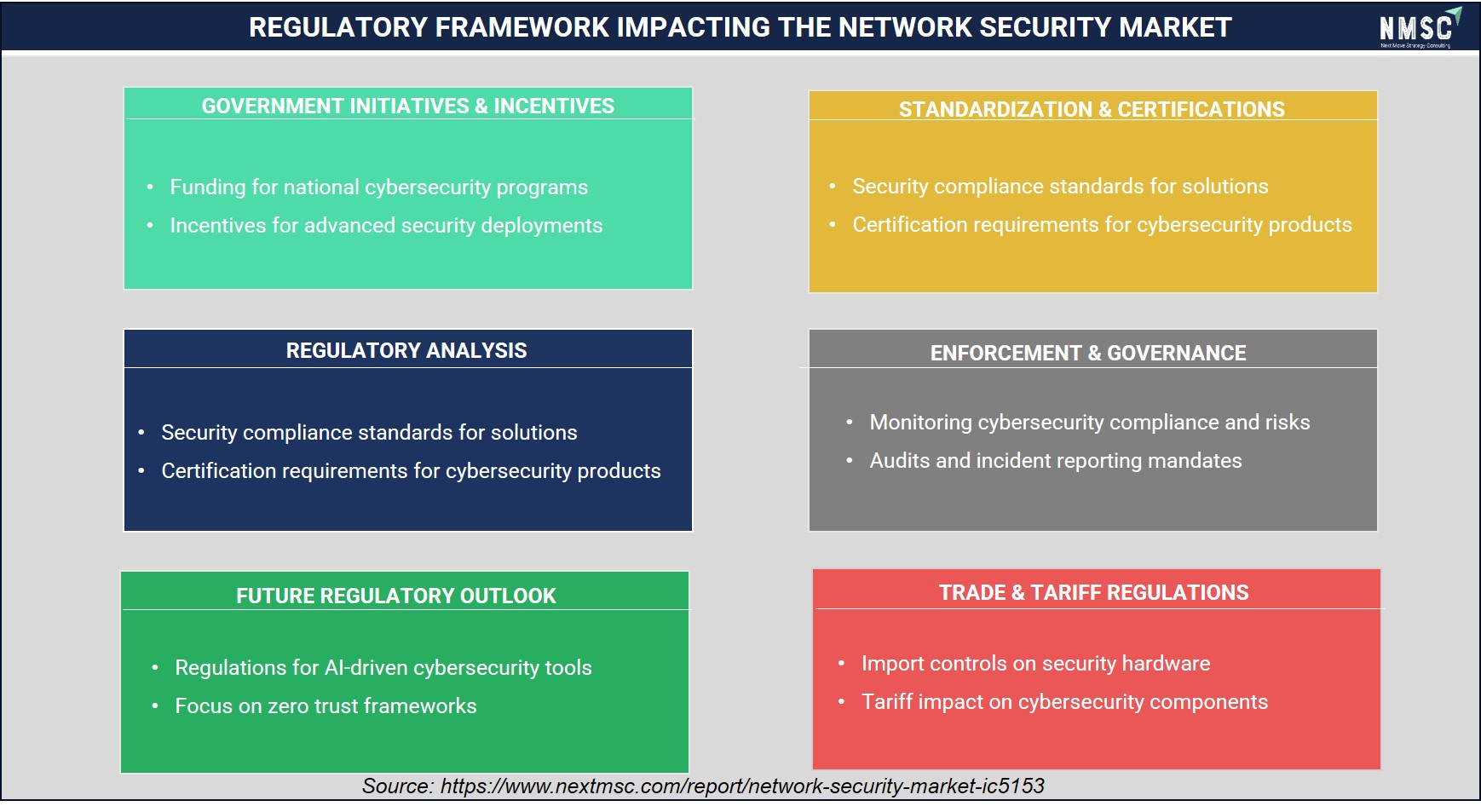
The regulatory framework continues to shape the Network Security industry by strengthening cybersecurity governance, compliance standards, and investment priorities across critical industries. Through our market assessment, we observed that evolving regulations such as NIS2, GDPR, and national cybersecurity strategies are accelerating enterprise adoption of secure network architectures, certification-compliant solutions, continuous monitoring capabilities, and AI-enabled security technologies while reinforcing long-term market growth.
Competitive Landscape
|
Key Takeaways |
Details |
|
Market Structure |
The Network Security Market is moderately consolidated, with Palo Alto Networks, Fortinet, Cisco Systems, Check Point Software Technologies, and Zscaler holding strong positions across enterprise network security, while Cloudflare, Netskope, and other cloud-native vendors continue to expand their presence in SASE, Zero Trust, and AI-driven security segments. The market also supports numerous specialized vendors across cloud security, network detection and response, managed security services, and secure access technologies. |
|
Innovation Focus |
Vendors are prioritizing AI-native threat detection and response, Secure Access Service Edge (SASE), Zero Trust Network Access (ZTNA), network detection and response (NDR), and cloud-delivered security platforms as core innovation areas. Infrastructure-embedded security, AI-powered security operations, automated threat response, and unified networking and security architectures represent the most active product development priorities across the Network Security Market. |
|
M&A Activity |
The Network Security Market is experiencing active strategic consolidation as established cybersecurity vendors acquire AI-powered threat detection, cloud security, and security operations automation companies to strengthen platform capabilities. Recent acquisitions by Check Point and Zscaler illustrate the industry's focus on expanding AI-driven cybersecurity portfolios, while private equity and strategic investors continue to target high-growth cloud-native security providers and security automation specialists. |
How Do Companies Compete in the Network Security Market?
Competitive strategy in the network security market centers on platform consolidation rather than point-product differentiation. Vendors increasingly compete on the breadth of a single operating system spanning firewall, SASE, and detection capability rather than on any one feature. Pricing has shifted from perpetual appliance licensing toward annual recurring revenue and consumption-based billing, mirrored in Fortinet's and Zscaler's own disclosed shift toward ARR as a primary reporting metric. Geographic expansion is concentrated in the build-out of regional cloud points of presence to meet data-residency requirements, particularly across the EU and the Gulf states. M&A activity is increasingly aimed at acquiring AI-agent governance and security-operations automation capability rather than at adding geographic reach, reflecting where competitive differentiation within the network security industry is now concentrated.
Which Kind of Companies Dominate the Network Security Market?
Vendors with networking heritage that successfully added security, and security-native vendors that successfully added networking, dominate the network security market, since both starting points converge on the same single-vendor SASE proposition. Fortinet's own disclosure that it holds a 55%-unit share of the firewall market illustrates how incumbency in core appliances still anchors competitive position even as revenue mix shifts toward subscriptions and cloud-delivered services.
AI-Native Differentiation and Open Standards Drive Market Success in the Network Security Market
Vendors that embed AI directly into detection and policy engines, rather than bolting it on as a separate analytics module, are differentiating fastest. Zscaler's and Check Point's recent acquisitions of AI-focused security-operations and AI-agent-governance startups both target this capability gap directly. Support for open integration standards, allowing security telemetry to flow into third-party SIEM and SOAR tools, is also becoming a competitive requirement as enterprises resist being locked into a single vendor's analytics stack.
Market Players to Opt for Merger and Acquisition Strategies to Expand Their Presence in the Network Security Market
Check Point's acquisitions of Lakera and Cyata within a single year, and Zscaler's acquisition of Red Canary, show that established network security vendors are using M&A to acquire AI-security and security-operations capability faster than they could build it internally. Expect continued acquisition activity targeting smaller AI-governance, cloud-security-posture, and automation specialists as larger platforms race to fill capability gaps ahead of competitors within the network security market.
Who Are the Key Market Players in the Network Security Market?
-
Fortinet, Inc.
-
Check Point Software Technologies Ltd.
-
Zscaler, Inc.
-
Akamai Technologies, Inc.
-
Broadcom Inc.
-
Microsoft Corporation
-
Cloudflare, Inc.
-
F5, Inc.
-
Trend Micro Incorporated
-
International Business Machines Corporation
-
Netskope, Inc.
-
Barracuda Networks, Inc.
-
Forcepoint LLC
-
SonicWall, Inc.
-
Radware Ltd.
-
Hillstone Networks Co., Ltd.
-
Trellix
-
Open Text Corporation
What Are the Latest Developments in the Network Security Industry?
|
Date |
Event |
|
June 2026 |
Cisco acquired WideField Security to strengthen Splunk's Agentic Security Operations Center (SOC) capabilities. The acquisition enhances identity, session, and activity telemetry across human and AI-agent environments, improving autonomous threat detection and response within enterprise network security. |
|
June 2026 |
Zscaler expanded its AI-Guardian initiative by integrating its Zero Trust Exchange with leading AI, cloud, and infrastructure providers. The enhanced platform strengthens secure AI adoption through unified security controls, interoperability, and real-time protection for enterprise AI applications and workloads. |
|
February 2026 |
Zscaler completed the acquisition of SquareX to extend Zero Trust browser security for the AI era. The acquisition enhances browser-based threat protection by integrating lightweight browser security capabilities into the Zero Trust Exchange platform, strengthening enterprise protection against AI-driven cyber threats. |
Expert Insights
 "AI can unlock groundbreaking opportunities for the enterprise. To achieve this, the integration of networking and security is essential. Cisco and NVIDIA's trusted, innovative solutions empower our customers to harness AI's full potential simply and securely."
— Chuck Robbins, Chair and CEO, Cisco
Statement made during the announcement of the Cisco Secure AI Factory with NVIDIA, emphasizing the growing need to integrate networking and security as enterprises deploy AI infrastructure and mission-critical workloads.
Market Interpretation
The statement highlights the increasing convergence of networking and cybersecurity as organizations modernize digital infrastructure to support AI-driven workloads. Enterprises are increasingly adopting integrated network security solutions that protect applications, workloads, and infrastructure while enabling secure connectivity across hybrid and cloud environments. As AI adoption expands and cyber threats become more sophisticated, demand for security architectures that embed protection across every network layer is expected to accelerate, driving continued growth in the Network Security Market.
What Are the Investment Opportunities in the Network Security Market?
Capital Inflows and Venture Activity
The Network Security Market continues to attract substantial capital from institutional investors, venture capital firms, and strategic technology companies as cybersecurity becomes a board-level priority across industries. Cloudflare reported USD 4.1 billion in cash and available-for-sale securities at the end of 2025, while Zscaler held USD 3.6 billion in cash and short-term investments, providing significant capacity for strategic acquisitions and technology expansion. We noticed that venture funding is increasingly concentrated in AI-native cybersecurity, zero trust, and security operations automation platforms, reflecting strong investor confidence in cloud-delivered security solutions and recurring subscription-based business models.
Infrastructure Investment
Infrastructure investment is becoming a major growth catalyst for the Network Security Market as organizations modernize cloud infrastructure, AI computing environments, and hyperscale data centers. Vendors are increasingly embedding security directly into networking and computing infrastructure to improve performance and reduce operational complexity. We found that Fortinet's integration of FortiGate VM with NVIDIA BlueField-3 DPUs illustrates the growing convergence of cybersecurity and AI infrastructure, enabling network security platforms to become an integral component of enterprise infrastructure investment rather than a standalone IT expenditure.
ESG and Cyber Resilience
Environmental, Social, and Governance (ESG) priorities are increasingly shaping investment strategies across the Network Security Market. Regulatory frameworks such as the EU NIS2 Directive have elevated cybersecurity governance to board-level accountability, making cyber resilience a fundamental element of enterprise risk management and corporate governance. We further analysed that organizations are prioritizing long-term investments in resilient network security architectures that strengthen operational continuity, regulatory compliance, and stakeholder confidence while supporting broader enterprise sustainability and digital resilience objectives.
Digital Transformation Enablement
Network security platforms have become a foundational component of enterprise digital transformation initiatives as organizations accelerate cloud migration, hybrid work adoption, AI deployment, and multi-cloud connectivity. Modern enterprises increasingly require integrated security architectures capable of protecting distributed users, applications, workloads, and network infrastructure across complex digital environments. We assessed that sustained investments in cloud transformation, zero trust adoption, and AI-enabled enterprise modernization will continue to generate durable long-term demand for advanced network security technologies throughout the forecast period.
Private Equity and Strategic M&A Activity
Private equity firms and strategic acquirers continue to expand investment across the Network Security Market by targeting companies specializing in AI-powered threat detection, security operations automation, cloud security, and identity-centric cybersecurity solutions. Recent acquisitions by Check Point and Zscaler demonstrate the industry's accelerating consolidation strategy as vendors strengthen platform capabilities through targeted technology acquisitions. We noticed that AI-native security platforms, security operations automation providers, and cloud security innovators are expected to remain among the most attractive acquisition targets between 2026 and 2035.
Key Benefits for Stakeholders
For Enterprise Technology Leaders
Enterprise technology leaders gain comprehensive, vendor-neutral insights into the Network Security Market, including quantitative market sizing across product categories, deployment models, customer types, distribution channels, and end-user industries. This intelligence supports cybersecurity investment planning, vendor evaluation, zero trust strategy development, and long-term network security modernization initiatives. Our competitive landscape analysis enables organizations to benchmark vendor capabilities and procurement strategies with confidence and analytical rigor.
For Investors and Financial Analysts
Investors and financial analysts access a structured assessment of the Network Security Market's growth trajectory, competitive dynamics, investment trends, and segment-level revenue forecasts through 2035. CAGR analysis across products, services, deployment models, customer segments, and regions supports portfolio construction, valuation modeling, acquisition screening, and long-term investment decision-making. Detailed company profiles and strategic development tracking provide an early-signal framework for identifying emerging cybersecurity leaders.
For Network Security Vendors and Solution Providers
Network security vendors and solution providers gain actionable intelligence on high-growth product categories, competitive positioning, regional expansion opportunities, and evolving customer requirements within the Network Security Market. Product and deployment analysis identifies attractive growth areas including cloud subscriptions, detection and response, zero trust architectures, and managed security services. Regional market analysis supports go-to-market optimization, channel expansion, and product roadmap prioritization across global markets.
For Government and Regulatory Bodies
Government agencies and regulatory authorities gain structured insights into how cybersecurity regulations, including NIS2, GDPR, and national cyber resilience initiatives, are influencing the Network Security Market. Country-level analysis provides evidence-based perspectives on regulatory impact, enterprise cybersecurity readiness, digital infrastructure protection, and critical infrastructure resilience, supporting informed policy development and national cybersecurity strategies.
For Channel Partners and Managed Security Service Providers
Channel partners, managed service providers (MSPs), and managed security service providers (MSSPs) gain detailed insights into customer adoption trends, outsourcing patterns, regional demand dynamics, and high-growth industry verticals. The report supports service portfolio development, partner ecosystem expansion, customer acquisition strategies, and long-term business planning by identifying the fastest-growing customer segments and deployment models across the global Network Security Market.
Key Market Segments
By Product Revenue
-
Hardware Appliances
-
Firewall
-
IPS
-
DDoS Mitigation Appliance
-
Secure Web Gateway Appliance
-
Network Access Control Appliance
-
Other Hardware Appliance
-
-
Software and Virtual
-
Virtual Firewall
-
Virtual IPS
-
ZTNA and VPN Software
-
NAC and Segmentation Software
-
NDR Software
-
Other Software
-
-
Cloud Subscriptions
-
Secure Access Service Edge
-
Firewall as a Service
-
Secure Web Gateway
-
Zero Trust Network Access
-
DDoS Protection
-
Web Application Firewall
-
DNS Security
-
Network Detection and Response
-
Other Cloud Subscription
-
By Service Revenue
-
Managed Security Services
-
Managed Firewall
-
Managed Secure Access
-
Managed DDoS Protection
-
Managed Detection and Response
-
Other Managed Security Service
-
-
Professional Services
-
Consulting
-
Integration and Deployment
-
Incident Response and Forensics
-
Other Professional Services
-
-
Support and Maintenance
-
Other Services
By Function
-
Perimeter Security
-
Secure Access
-
Edge Protection
-
Access Control and Segmentation
-
Detection and Response
-
Other Function
By Deployment
-
On-Premises
-
Cloud
-
Hybrid
-
Not Applicable
By Customer Type
-
Enterprise
-
Mid-Market
-
Small and Medium Business
-
Service Provider
-
Public Sector
By Channel
-
Direct Sales
-
Partner and Reseller
-
MSP and MSSP
-
Marketplace
-
OEM
By End-User Industry
-
BFSI
-
IT and Telecom
-
Government and Defence
-
Healthcare
-
Manufacturing
-
Retail
-
Energy and Utilities
-
Education
-
Transportation and Logistics
-
Other Industrie
By Region
-
North America: (U.S., Canada, Mexico)
-
Europe: (UK, Germany, France, Italy, Spain, Sweden, Denmark, Finland, Netherlands, Rest of Europe)
-
Asia-Pacific: (China, India, Japan, South Korea, Taiwan, Indonesia, Vietnam
-
Middle East & Africa: (Saudi Arabia, UAE, Egypt, Israel, Turkey, Nigeria, South Africa, Rest of MEA)
-
Latin America: (Brazil, Argentina, Chile, Colombia, Rest of LATAM)
Conclusion and Recommendations
Long-Term Outlook
The Network Security Market is positioned for sustained long-term growth through 2035, driven by structural trends including enterprise cloud migration, accelerating adoption of zero trust security architectures, increasing cybersecurity regulations, and the rapid expansion of AI-enabled threat detection capabilities. The market is projected to grow from USD 51.52 billion in 2026 to USD 148.73 billion by 2035 at a 12.5% CAGR, reflecting rising enterprise demand for cloud-delivered security services, subscription-based commercial models, and integrated cybersecurity platforms. Cloud Subscriptions, Detection and Response, and MSP and MSSP service models represent the highest-growth opportunities across the evolving network security ecosystem.
Strategic Positioning Recommendations
Network security vendors should prioritize unified Secure Access Service Edge (SASE) platforms, AI-native threat detection, Zero Trust Network Access (ZTNA), and cloud-delivered security services as their primary competitive differentiators through 2035. Investment in AI-driven security operations, automated threat response, and integrated networking and security platforms will strengthen competitive positioning as enterprises consolidate cybersecurity vendors. Geographic expansion into highly regulated markets, supported by compliance with NIS2, GDPR, and emerging national cybersecurity frameworks, represents the highest-priority international growth strategy for vendors seeking long-term market leadership.
Investment Attractiveness
The Network Security Market represents a structurally attractive investment opportunity characterized by expanding recurring subscription revenues, strong enterprise cybersecurity spending, and durable demand driven by digital transformation and evolving cyber threats. The highest-conviction investment themes include Cloud Subscriptions at a 16.8% CAGR, Detection and Response at a 17.2% CAGR, and MSP and MSSP delivery models at a 16.7% CAGR, reflecting the industry's transition toward cloud-native, AI-enabled security platforms. Investors should monitor consolidation among AI cybersecurity vendors, cloud security providers, and security operations automation specialists as key value creation opportunities.
Market Shifts and Key Risks
The most significant structural shift within the Network Security Market is the transition from appliance-centric network protection toward integrated cloud-native security platforms that combine networking, security, and AI-driven operations within a unified architecture. Key risks include public-sector budget uncertainty, fragmented regulatory implementation across international markets, cybersecurity talent shortages, increasing platform consolidation, and pricing pressure resulting from growing competition among cloud-delivered security providers. Vendors without differentiated AI capabilities or integrated cloud security platforms are likely to face increasing competitive pressure throughout the forecast period.
Growth Pathways
Organizations seeking to maximize value from the Network Security Market should adopt a phased cybersecurity modernization strategy. During the near term (2026–2028), enterprises should prioritize cloud migration, Zero Trust implementation, and SASE adoption to strengthen foundational security capabilities. During the mid-term (2028–2031), investment should focus on AI-native threat detection, automated security operations, and network detection and response platforms to improve cyber resilience. Over the long term (2031–2035), organizations should position for infrastructure-embedded security, AI-driven autonomous security operations, and integrated multi-cloud security architectures as enterprise digital ecosystems continue to expand.
About the Author
 Saista Faiyaz
— Saista Faiyaz is Research Associate at Next Move Strategy Consulting, where she has covered consumer markets and healthcare technologies for 3 years. Her work includes primary interview review, secondary-source validation, market sizing, and structured analysis of company and industry data. She supports research by comparing evidence across sources, organizing findings into market narratives, and documenting assumptions used in analysis. Her scope includes cross-market benchmarking, and reports.
Saista Faiyaz
— Saista Faiyaz is Research Associate at Next Move Strategy Consulting, where she has covered consumer markets and healthcare technologies for 3 years. Her work includes primary interview review, secondary-source validation, market sizing, and structured analysis of company and industry data. She supports research by comparing evidence across sources, organizing findings into market narratives, and documenting assumptions used in analysis. Her scope includes cross-market benchmarking, and reports.
About the Reviewer
 Supradip Baul
— Supradip Baul is an accomplished business consultant and strategist with over a decade of rich experience in market intelligence, strategy, technology, and business transformation. His work has included rigorous qualitative and quantitative analysis across multiple industries, helping clients shape investment decisions and long-term roadmaps. Earlier in his career, he was associated with Gartner, where he contributed to industry-leading reports and market share analyses. He has worked with leading global companies and holds an MBA with a dual specialization in Marketing and Finance.
Supradip Baul
— Supradip Baul is an accomplished business consultant and strategist with over a decade of rich experience in market intelligence, strategy, technology, and business transformation. His work has included rigorous qualitative and quantitative analysis across multiple industries, helping clients shape investment decisions and long-term roadmaps. Earlier in his career, he was associated with Gartner, where he contributed to industry-leading reports and market share analyses. He has worked with leading global companies and holds an MBA with a dual specialization in Marketing and Finance.
At Next Move Strategy Consulting, we understand that insightful market research is the cornerstone of successful business decisions. That's why we employ a robust and multifaceted approach, combining various methodologies to deliver the most accurate and actionable data for our clients.

Research Landscape
We navigate the world of research with two primary approaches:
Qualitative Approach
Our qualitative research methodologies involve immersive techniques such as in-depth interviews, focus groups, and observational studies. By engaging directly with individuals and stakeholders, we uncover valuable insights that quantitative data alone may overlook.

Quantitative Research
In tandem with qualitative methodologies, NMSC leverages the power of Quantitative Research to provide a robust foundation of numerical insights. Through systematic data collection and analysis, we quantify patterns, preferences, and market trends, offering a comprehensive view of the business landscape.
Our quantitative research approach employs diverse tools, including surveys, experiments, and statistical modelling. These methodologies enable us to gather data from a large and representative sample, ensuring the statistical significance of our findings. By employing structured questionnaires and standardized data collection methods, we guarantee the reliability and validity of the information we present to our clients.
Quantitative research is particularly effective in measuring the prevalence of trends, assessing market size, and gauging the impact of various factors on consumer behavior. The numerical precision attained through this approach equips our clients with actionable insights, facilitating data-driven decision-making and strategy formulation.


Our Specialized Toolbox for Industry-Specific Market Research
We deploy a specialized arsenal of techniques tailored to meet your unique requirements. Here's a glimpse into our comprehensive toolbox:

Information Procurement
The stage entails acquiring market data or relevant information through various sources and methodologies.


Market Research Approach
We utilize both top-down and bottom-up approaches in market research analysis to achieve a comprehensive understanding of the market dynamics, leveraging the broad perspective of industry trends and macroeconomic factors alongside detailed insights from specific segments and individual companies.

Porters Five Forces Analysis
We conduct Porter's Five Forces analysis to evaluate the competitive landscape of an industry, providing us with insights into factors that affect profitability and strategic positioning.

SWOT Analysis

Forecasting
We utilize a forecasting model to predict future consumption by considering parameters like population, economics, regulations, market competition, drivers, constraints, technology, and pricing. We also employ statistical techniques such as multilinear regression, exponential smoothing, moving average, ARIMA, and Monte Carlo simulations for accurate predictions. In econometric forecasting, we analyzed short-term and long-term event impacts, attributing values based on regulatory frameworks, economic factors, and market events.





 Speak to Our Analyst