Advanced Optics Market By Product and Service (Materials, Components, Modules and Subassemblies, Systems and Instruments, Ophthalmic Lenses, and Services and Software), By Technology (Refractive, Reflective, Diffractive, Fiber Optic, Integrated Photonics, Optoelectronic, Adaptive Optics, Quantum Optics, and Others), By Distribution Channel (Direct Sales and Indirect Sales), and By End User (Semiconductor and Electronics, and Others) – Global Analysis & Forecast, 2025–2030
Industry: Semiconductor & Electronics | Publishing Date: December 1, 2025 | Last Updated: August 3, 2026 | No of Pages: N/A | No. of Tables: N/A | No. of Figures: N/A | Format: PDF | Report Code: SE3748
Industry Outlook
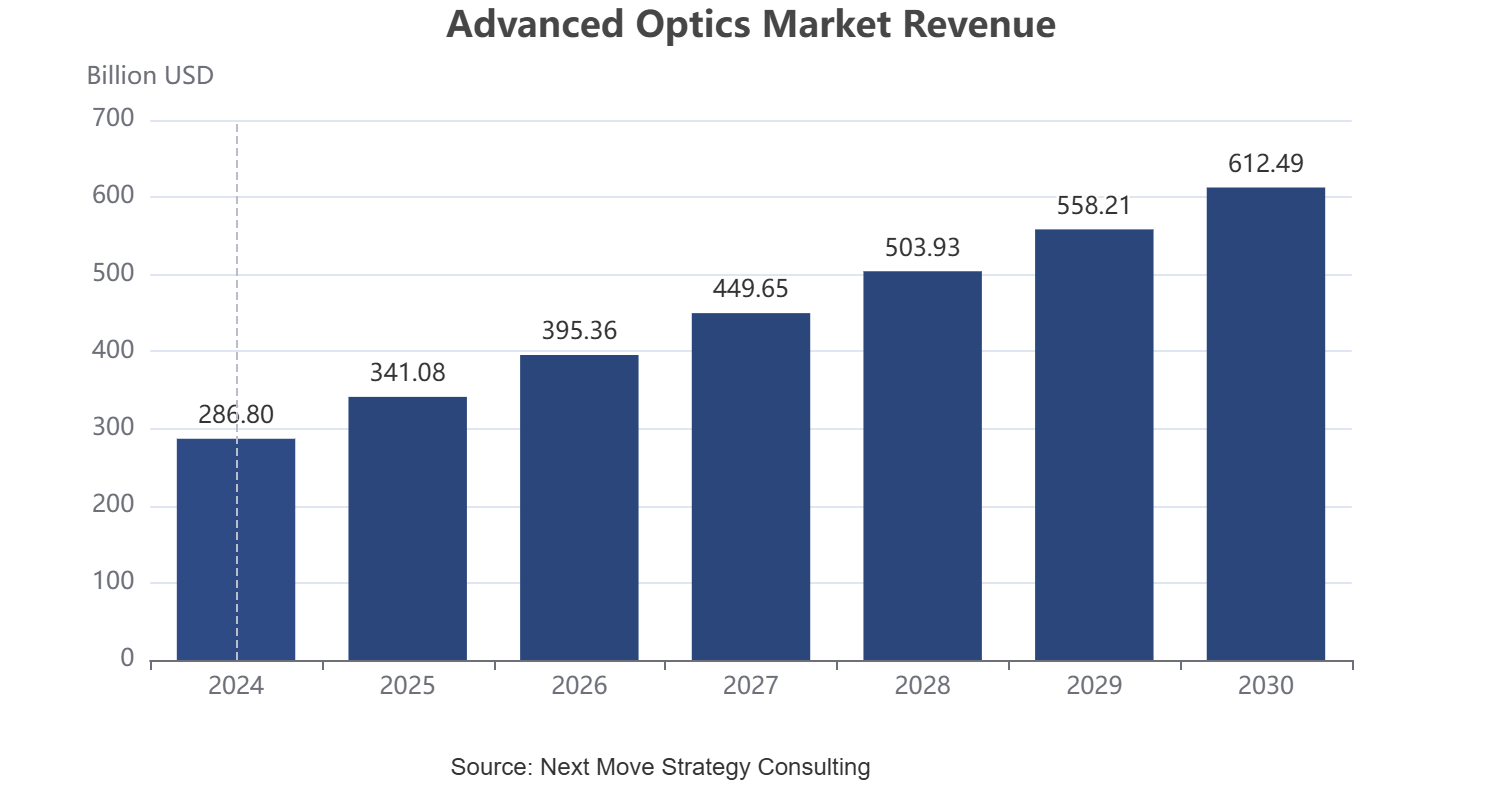
The global Advanced Optics Market size was valued at USD 286.80 billion in 2024 and is expected to reach USD 325.46 billion by 2025. Looking ahead, the industry is projected to expand significantly, reaching USD 612.49 billion by 2030, registering a CAGR of 13.48% from 2025 to 2030.
The advanced optics industry is expanding rapidly, driven by the growing demand for high-precision, high-performance optical components across industries such as consumer electronics, telecommunications, healthcare, automotive, and defense. The rise of technologies like AR/VR, autonomous vehicles, high-resolution imaging, LiDAR, and next-generation semiconductor manufacturing is increasing the need for sophisticated optical lenses, filters, coatings, sensors, and photonic systems. Advancements in materials science, such as meta-optics, nanophotonics, and ultra-thin optical films, are enabling lighter, smaller, and more efficient optical solutions. At the same time, increasing investments in laser technologies, optical communication networks, and biomedical imaging are accelerating market growth. By combining precision engineering, innovative materials, and cutting-edge photonic design, the high-performance optics market is shaping the future of imaging, sensing, connectivity, and high-tech manufacturing worldwide.
What are the Key Trends in the Advanced Optics Market?
How is Demand from Cloud and AI Infrastructure Reshaping the Optics Supply Chain?
The surge in optical transceiver and laser demand driven by cloud-scale networking and AI accelerators is a measurable market trend. Lumentum and other photonics suppliers reported capacity ramp plans and upward guidance tied to transceiver and laser demand across data centres, management commentary in 2025 highlights 200G/400G transceiver adoption and increased InP chip production to meet the market demand. This dynamic increases upstream demand for precision optical components, optical coatings and high-power lasers, amplifying capital intensity and spot shortages. For companies in the advanced optics stack, they prioritise capacity of core optical substrates such as InP, high-grade glass, secure long-lead suppliers, and invest in yield improvement. The actionable step is that companies establish prioritised supply agreements for InP and critical coating materials, and dedicate R&D resources to packaging and thermal management to win high-margin transceiver programs.

This chart presents AI adoption rates by country in 2024, with the U.S. (45%), UK (41%), China (39%), Germany (36%), and India (28%) leading. High AI uptake signals widespread integration of intelligent technologies to optimize manufacturing, logistics, and digital services. For the advanced optics market, strong AI adoption accelerates development and deployment of smart optical solutions, such as adaptive lenses, precision sensors, optical AI processing modules, and advanced photonics systems. AI-driven requirements in automation, healthcare, electric vehicles, and consumer electronics spur new applications and demand for advanced optics, making these markets pivotal for growth and innovation in optical technology platforms.
How are Medical and Life Sciences Applications Expanding Demand for Precision Optics?
Medical optics, including imaging modules, surgical optics, endoscopy systems, and diagnostic lasers, remain a resilient growth avenue, as reflected in medical-unit disclosures from leading optics manufacturers. ZEISS Meditec reported stable medical revenue and highlighted continued investment in surgical optics and diagnostic platforms. Growth is supported by ageing populations, rising adoption of minimally invasive procedures, and increasing demand for high-resolution imaging in clinical diagnostics. These trends accelerate requirements for tighter optical tolerances, sterilisable housings, and integrated software controls. Optics firms are securing early clinical-validation partnerships and map regulatory pathways upfront to shorten time-to-market and capture higher ASPs linked to proven clinical benefits.

For the advanced optics market, the trend in the above chart serves as a growth catalyst, where modern healthcare increasingly relies on sophisticated optical technologies for imaging, diagnostics, laser surgery, and wearable health monitoring. As nations ramp up spending, demand rises for advanced optical components, for example, sensors, lenses, and imaging modules used in next-gen medical devices and digital health platforms, positioning healthcare as a critical driver for innovation and adoption in the advanced optics sector.
How is Industrial Automation and Metrology Demand Influencing Optics Product Design?
Industrial automation, especially semiconductor fab metrology, 3D inspection, and LiDAR for robotics, is driving demand for ruggedised, high-precision optical systems. Jenoptik’s 2024 results highlight strong momentum in industrial metrology and photonics, reflecting manufacturers’ increasing investment in high-accuracy inspection platforms. This shift requires suppliers to deliver greater throughput without compromising measurement precision, accelerating the move toward modular optics, integrated calibration mechanisms, and on-board diagnostic capabilities. Prioritising software-enabled optics, such as embedded calibration routines and predictive maintenance, combined with modular mechanical designs that simplify field recalibration, allows OEMs to offer uptime guarantees and support premium pricing.

The chart reveals the operational stock of industrial robots by country in 2024, with China far ahead at over 2 million units, followed by Japan, the U.S., and Germany. High industrial robot deployment underscores a major push toward factory automation, smart manufacturing, and digital logistics. For the advanced optics market, this proliferation of robots drives strong demand for high-precision optical components, such as sensors, lasers, vision systems, and adaptive lenses, all crucial for robotic navigation, quality control, and AI-powered automation. As manufacturers automate at scale, advanced optics become foundational for next-generation robotics, enabling higher efficiency, safety, and productivity in automated environments.
What are the Key Market Drivers, Breakthroughs, and Investment Opportunities that will Shape the Advanced Optics Market in the Next Decade?
The advanced optics market growth is propelled by three structural drivers, such as expansion of cloud and AI infrastructure requiring high-performance photonics, growth in medical imaging and surgical optics, and industrial automation demanding high-precision metrology optics. Company filings document capital allocation towards capacity, R&D and tailored product lines aligned with these end markets.
However, the market faces two major constraints, such as supply-chain sensitivity for specialised substrates and coatings, and cyclical exposure tied to semiconductor capex and defence procurement. Firms that combine technical differentiation with secure supply agreements and serviceable revenue are best positioned.
Growth Drivers:
How will Cloud-Scale Optical Demand Drive Supplier Consolidation and Capacity Investment?
Cloud and AI infrastructure are generating unprecedented demand for optical transceivers, high-power lasers, and InP-based components, pushing suppliers toward rapid scale-up. Primary filings from photonics firms show revenue guidance increasingly tied to cloud-compute cycles, with Lumentum’s 2025 commentary highlighting accelerated production ramps for InP transceivers and higher-throughput lasers. This environment drives significant capex in packaging, test automation, and cleanroom capacity, and structurally favours suppliers capable of scaling volume without compromising yields. Optics firms are prioritising high-volume packaging, automated test lines, and strategic JV or contract-manufacturing partnerships to meet hyperscaler lead times, reduce supply-risk exposure, and avoid margin erosion from demand spikes.

This chart shows that in 2024, cloud services adoption rates among enterprises are very high in Finland (78.3%), Sweden (71.6%), Malta (66.7%), Denmark (69.5%), and the Netherlands (65.0%). This digital maturity fosters greater investment in cloud-native solutions and infrastructure, including advanced, cloud-integrated optical systems. For the advanced optics market, high cloud adoption enables wide deployment of cloud-connected optical sensors, remote diagnostics, machine vision, and photonics-driven AI platforms. As enterprises rely more on cloud for analytics and automation, the need for real-time, high-bandwidth, and precision optics escalates, driving market demand for next-generation optical devices and solutions in digitally advanced economies.
How will Medical Optics Validation and Regulatory Approvals Accelerate Premium Adoption?
Medical-grade optics that carry validated clinical benefits consistently secure higher ASPs and stable procurement cycles. ZEISS Meditec’s disclosures illustrate this dynamic, showing resilient margins and continued investment in surgical and diagnostic platforms supported by proven clinical outcomes. Hospitals increasingly prefer devices with demonstrated efficacy, robust software integration, and regulatory clarity because these reduce clinical risk and streamline purchasing. Optics firms are allocating budget early for clinical trials, usability studies, and regulatory filings, and synchronising product roadmaps with hospital procurement calendars. This compresses decision windows, strengthens tender competitiveness, and accelerates adoption of premium optics backed by measurable clinical evidence.
Growth Inhibitors:
What Risk does Supply-Chain Concentration Pose to Advanced Optics Manufacturers?
Advanced optics depend on specialised substrates like InP, fused silica, precision optical glass, high-uniformity coatings, and ultra-clean manufacturing lines, capabilities concentrated among a small number of global suppliers. This creates structural exposure to geopolitical shifts, logistics disruptions, and capacity bottlenecks. Equipment makers have recently reported regional revenue pressures tied to macro uncertainty, underscoring how supply instability inflates costs or delays shipments. Manufacturers are pursuing multi-sourcing strategies, securing long-term agreements with substrate fabs, and maintaining strategic inventory buffers for critical materials. Joint development programs with key suppliers further reduce single-point failures and stabilise production during market swings.
Where are the Most Attractive Opportunities in the Value Chain?
The most attractive investment opportunities lie in photonics packaging, speciality coatings, and aftermarket services such as calibration, repair, and replacement optics. Packaging and assembly, especially photonic integration, offer strong margin expansion because they reduce per-unit assembly costs for transceivers and modules while enabling long-term OEM contracts. Speciality coating firms also benefit from rising performance requirements across cloud, industrial, and medical markets. Investors prioritise companies with defensible IP, visible order books from Tier-1 cloud or medical OEMs, and clear disclosures on capacity expansion. Considering minority stakes or growth capital in packaging specialists that already supply leading photonics firms and have transparent, scalable expansion plans.
How Advanced Optics Market Segmented in this Report, and What are the Key Insights from the Segmentation Analysis?
By Technology Insights
Is Ray, Wave or Quantum Optics Shaping the Near-Term Addressable Market?
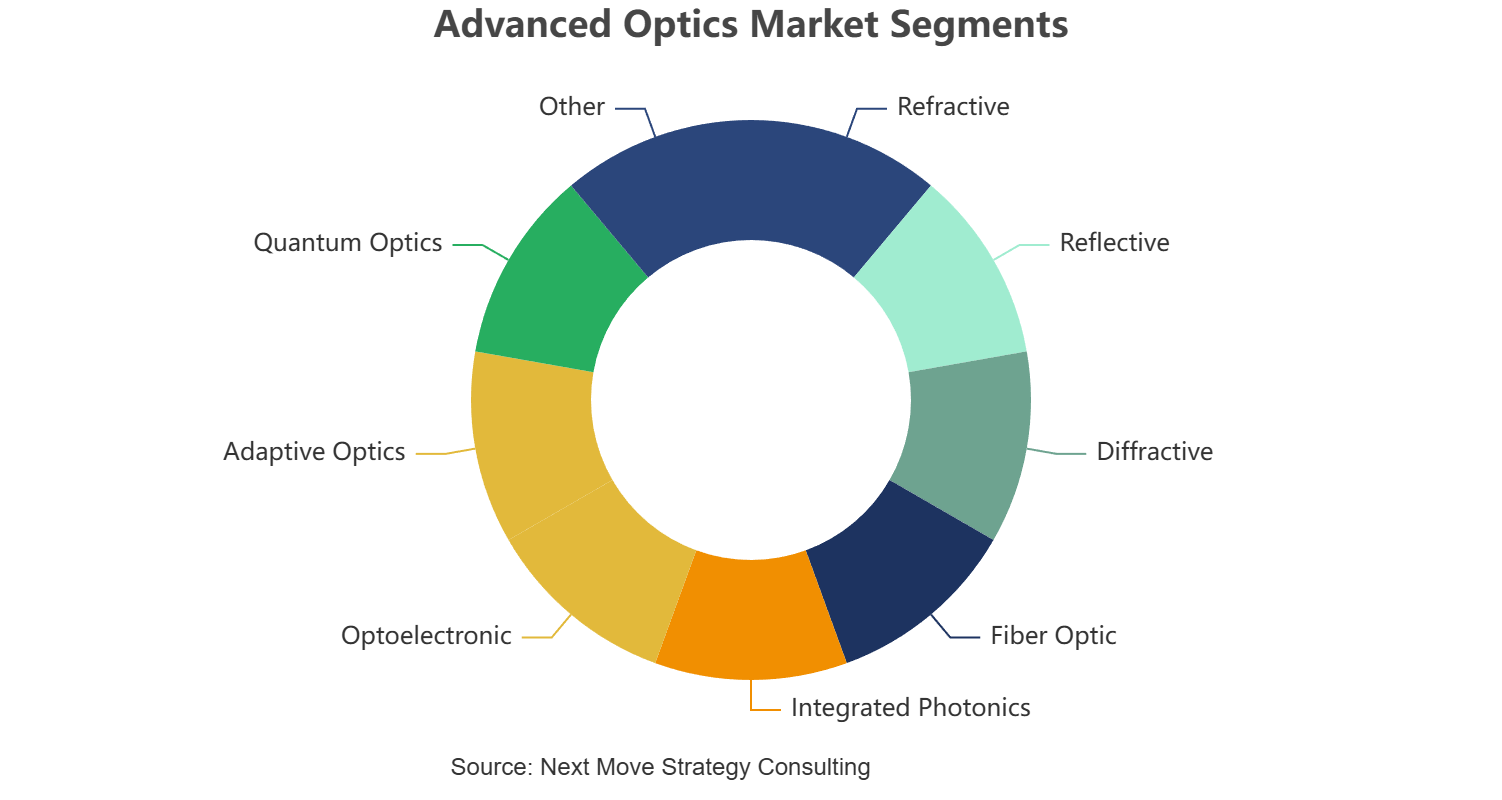
Based on technology, the advanced optics market share is segmented into ray optics, wave optics, and quantum optics.
Ray optics, such as precision lenses, imaging modules, remain dominant in camera, medical and machine-vision applications, supported by Canon, Nikon and ZEISS product portfolios and filings. Wave optics, diffractive optics, and interferometry are essential for metrology and LiDAR. Quantum optics, like quantum sensors and quantum photonics, is nascent but funded by government and corporate R&D. Primary filings reflect continued investment in traditional ray/wave optics for industrial and medical markets while noting exploratory quantum programs in R&D budgets. Companies prioritise near-term revenue from ray/wave optics while selectively funding quantum partnerships to capture future breakthroughs.
By Application Insights
Is LiDAR, Optical Communication or Medical Imaging Dominating Application Spend in 2025?
Based on application, the advanced optics market includes LiDAR, lighting solutions, optical communication, intelligence-surveillance-reconnaissance (ISR), medical equipment, cameras, metrology devices, 3D scanners, and other optical applications.
Applications are heterogeneous, optical communications like data-centre transceivers and lasers, and medical imaging have seen clear capital and product investment in 2024–2025 based on Lumentum, Coherent and ZEISS filings. LiDAR adoption is accelerating for automotive and industrial robotics, but remains smaller than comms and medical in absolute spend. Public filings show photonics suppliers increasing exposure to data-centre and medical OEMs, LiDAR specialists are growing faster percentage-wise, but from a smaller base. The actionable insight is that companies target optical-communications and medical OEM programs for near-term revenue while maintaining an R&D pipeline tailored for LiDAR’s unique cost/performance tradeoffs.
By End-Use Industry Insights
Is the Commercial, Industrial, Defense or Space Segment the Largest End-User in 2025?
Based on end-use industry, the advanced optics market is categorised into commercial, industrial, defense, medical, aviation, automotive, space, and other end-user sectors.
Commercial, such as imaging, consumer optics, and industrial, such as metrology, automation, account for the bulk of unit demand, while defence and space represent high-value but lower-volume opportunities with long procurement cycles. Company reports from TRUMPF and Jenoptik highlight industrial and machine-tool applications and growing defence/space orders for specialised optics. Space optics and defence procurements require certification and longer lead times but yield high margins and recurring upgrade cycles. Firms pursue a balanced portfolio, stable industrial/commercial programs for volume and cashflow, and selective defence/space programs for margin and strategic differentiation.
Regional Outlook
The advanced optics market is geographically studied across North America, Europe, Asia Pacific, Middle East & Africa, and Latin America and each region is further studied across countries.
Advanced Optics Market in North America
North America remains one of the most strategically important markets for optical communications, defense photonics, and medical imaging technologies, with U.S. photonics and laser suppliers reporting strong order pipelines tied to data-centre expansion, semiconductor investment, and continued procurement from medical device OEMs. Federal R&D funding for quantum, photonics and advanced manufacturing programs further reinforces demand visibility and supports the commercialization of next-generation optical components. The region’s customer base places high value on vertically integrated suppliers that guarantee quality, scale, and fast service response times. Primary filings from U.S. listed optics firms highlight substantial capex for cleanroom expansions, packaging automation, and long-term OEM programs, underscoring North America’s role as a premium, innovation-driven demand hub.
Advanced Optics Market in the United States
The United States leads global demand for data-centre optics, high-power lasers, defense-grade photonics, and advanced medical imaging systems. Corporate filings and investor presentations consistently show significant capital allocation toward scaling high-volume transceiver packaging, semiconductor-grade metrology optics, and precision laser production. U.S. manufacturers benefit from geographic proximity to hyperscalers, defense integrators, and major medical OEMs, enabling faster collaboration cycles and strong design-win visibility. However, growth is partly constrained by intense competition for skilled photonics assembly and test talent, pushing firms to invest heavily in automation. The U.S. market rewards suppliers with vertically integrated capabilities, dependable after-sales support, and the ability to meet aggressive qualification timelines for mission-critical applications.
Advanced Optics Market in Canada
Canada’s advanced optics market is smaller than the U.S. but maintains strong activity in photonics research, speciality optical manufacturing, and academic–industry innovation clusters centred around major universities. Demand is especially concentrated in medical imaging OEMs, scientific instrumentation, and defence-related optical systems. Government R&D grants and national photonics programs support a growing startup ecosystem that contributes niche optical components, speciality materials, and early-stage photonic integration technologies. Canadian buyers generally prioritise reliability, engineering support, and the ability to engage in joint development. While volume is modest, Canada’s focus on high-value, research-driven applications creates opportunities for suppliers specialising in precision optics, speciality coatings, and custom modules requiring tight tolerances and laboratory-grade performance.
Advanced Optics Market in Europe
Europe hosts many of the world’s most established optics and photonics players, including ZEISS, Jenoptik and TRUMPF, anchoring strong demand across industrial automation, medical imaging, metrology and scientific research. Corporate filings consistently highlight ongoing investment in automation, precision metrology, and production upgrades to support European manufacturing competitiveness. EU industrial policy, horizon europe research programs and photonics-specific initiatives further accelerate the commercialisation of advanced optical technologies while lowering development risk for suppliers. European customers place high importance on system reliability, sustainability, traceability, and long product lifecycles, creating opportunities for service-centric and modular optical platforms. Firms operating in Europe leverage regional grants, research partnerships and pilot-manufacturing funding to bring advanced optical systems to market with reduced financial exposure.
Advanced Optics Market in the United Kingdom
The United Kingdom maintains a strong photonics footprint built around research commercialisation, defense optics, quantum technologies and advanced sensing. Government programs supporting photonics startups and university-industry collaboration continue to attract investment, creating a pipeline of innovative companies in imaging, LiDAR and speciality optical subsystems. While smaller in scale than continental Europe, the UK offers deep academic partnerships, early-adopter OEMs and strong demand in aerospace, defence and niche industrial verticals. Domestic buyers value engineering support, rapid prototyping capability and the ability to customise optical modules for specialised end uses. For suppliers, the UK represents an opportunity to engage in high-value development programs and long-term research partnerships that reinforce premium positioning.
Advanced Optics Market in Germany
Germany remains Europe’s industrial and metrology powerhouse, with strong demand for high-precision lasers, machine-tool optics, industrial inspection systems and semiconductor-aligned metrology platforms. TRUMPF, Jenoptik and other German optics leaders emphasise the country’s importance for R&D, manufacturing and system integration in their filings. German OEMs place exceptional value on engineering quality, mechanical robustness, serviceability and local technical support, making Germany a high-expectation but high-yield market for premium optical systems. The country’s advanced manufacturing base, including automotive, electronics, machining, and automation, creates sustained demand for precise, repeatable optical tools. Suppliers with highly reliable products, long service lifecycles, and strong German-language technical documentation achieve superior conversion and long-term account stability.
Advanced Optics Market in France
France maintains strong demand for optics driven by defense procurement, medical imaging, scientific instrumentation and national research programs. The country benefits from well-developed academic clusters and government-backed initiatives that support R&D in photonics, imaging and laser technologies. French buyers typically value long-term partnerships, co-development opportunities and reliable service frameworks. Defense and aerospace programs continue to be significant demand anchors, while hospitals and scientific laboratories purchase high-precision imaging systems. For suppliers, opportunities exist in collaborating with national labs, integrating into aerospace and defense supply chains, and addressing specialized imaging needs within the healthcare sector. Localized technical support and French-language documentation help build trust in procurement-heavy environments.
Advanced Optics Market in Italy
Italy’s optics demand is moderate but steadily oriented toward industrial automation, machine-vision imaging, and specialized metrology solutions. Italian manufacturers integrate precision optics into packaging equipment, robotics, food processing, and industrial inspection systems, creating consistent mid-volume demand for high-quality components and modules. While Italy does not host major global optics OEMs, it plays an important role in the European supply chain by supporting specialised subsystem production and localised engineering. Opportunities exist for suppliers offering compact, ruggedised optical assemblies tailored for automation and inspection environments. Italian customers value durability, flexible integration, local distributor support and the ability to adapt global platforms to the needs of regional manufacturing clusters.
Advanced Optics Market in Spain
Spain is an emerging but progressively growing market for industrial inspection optics, machine-vision modules, and medical imaging systems. Demand is strongest in urban centres undergoing manufacturing modernisation and healthcare upgrades. Spain’s industrial base, automotive components, electronics assembly, and food processing, drives the adoption of optical inspection tools aimed at improving throughput and reducing defects. Hospitals and research institutions are also upgrading imaging equipment, creating pockets of premium demand. Successful market penetration requires strong local distributor networks, Spanish-language technical support, and competitive service agreements. While the overall market size is smaller than Western European peers, Spain offers meaningful mid-tier opportunities for suppliers that bundle performance, cost efficiency and fast service response.
Advanced Optics Market in the Nordics
Nordic countries, such as Sweden, Norway, Denmark and Finland, represent small but high-value markets characterised by advanced adoption of optical technologies across environmental sensing, maritime applications, renewable-energy monitoring, scientific research and medical devices. Governments prioritise sustainability, measurement accuracy and technology innovation, creating demand for precision optics, ruggedised sensors and serviceable imaging systems. Nordic buyers typically expect long product lifecycles, strong after-sales support, and technical transparency. The region’s high openness to new technology makes it an ideal testbed for premium optical platforms, including modular systems designed for repairability and field recalibration. Suppliers willing to invest in local partnerships and service readiness achieve strong customer loyalty despite modest market size.
Advanced Optics Market in the Asia-Pacific
Asia-Pacific is the fastest-growing global engine for optics, with substantial demand across optical communications in China, medical imaging in Japan, industrial automation in Korea, Taiwan, and emerging photonics hubs in India and Southeast Asia. OEM investments and product rollouts consistently highlight the region’s strategic importance for scale and localisation. However, APAC is highly heterogeneous, where China experiences demand oscillation due to policy and economic fluctuations, Japan and Korea show stable, high-value demand, India and Indonesia are rising but price-sensitive. APAC customers prioritise rapid lead times, localisation of service, cost-engineered SKUs for mid-markets and premium options for advanced industries. Contract manufacturing and regional assembly significantly boost competitiveness.
Advanced Optics Market in China
China is one of the world’s largest advanced optics markets, spanning data-centre transceivers, consumer imaging modules, industrial inspection, and LiDAR for EVs and robotics. However, demand is volatile and heavily shaped by policy cycles, supply-chain localisation incentives and macroeconomic fluctuations. Foreign suppliers face intense competition from fast-scaling local OEMs and must carefully navigate pricing, compliance and technology-transfer constraints. Many global optics firms report China's performance separately in filings due to its strategic importance and variability. Success increasingly depends on strong local partnerships, marketplace channels, and the ability to offer China-specific SKUs with competitive cost structures. Despite challenges, high volumes and rapid adoption cycles make China indispensable.
Advanced Optics Market in Japan
Japan remains a high-value, precision-oriented advanced optics market serving imaging, medical devices, semiconductor inspection and industrial automation. Japanese OEMs demand exceptional durability, precision tolerances, long service lifecycles and proven engineering performance, making the market well-aligned with high-end optical systems. Domestic customers prefer suppliers with strong brand heritage, local technical support and commitment to long-term service availability. Upgrade cycles tend to be conservative but deliberate, favouring vendors that demonstrate measurable performance improvements and robust reliability. For optics manufacturers, Japan offers stable demand, premium ASP potential and opportunities in high-accuracy metrology, endoscopy systems, and lens modules used in manufacturing and scientific research.
Advanced Optics Market in India
India presents rapidly expanding opportunities in medical imaging, industrial automation, academic photonics research and inspection systems. While the market is price-sensitive, urban clusters such as Bengaluru, Hyderabad, Pune and Delhi increasingly adopt premium imaging and industrial metrology solutions as manufacturing modernises. Government investment in healthcare infrastructure and digital manufacturing further supports demand. Companies that localise assembly, offer financing or leasing structures, and ensure easy access to service and spare parts gain a competitive advantage. India rewards suppliers with durable, cost-optimised optical systems that balance performance with affordability, while premium opportunities grow among corporate hospitals, semiconductor initiatives and high-tech R&D institutions.
Advanced Optics Market in South Korea
South Korea is one of Asia’s most advanced optics markets, anchored by strong demand in semiconductor inspection, LiDAR for robotics and automotive applications, and high-precision industrial imaging. Local electronics and semiconductor giants create continuous demand for fast-turnaround custom modules, high-accuracy metrology optics and advanced laser systems. Korean customers value engineering rigour, rapid customisation capability and dependable local support, making the market attractive but highly competitive. Suppliers that meet strict qualification requirements and provide on-the-ground service teams see strong engagement. South Korea’s innovation pace also makes it a promising location for piloting next-generation photonics technologies that require sophisticated early adopters.
Advanced Optics Market in Taiwan
Taiwan’s optics demand is dominated by its semiconductor manufacturing ecosystem, which relies heavily on metrology optics, inspection modules and precision alignment systems. Proximity to leading fabs and equipment makers makes close supplier relationships essential. Taiwanese customers prioritise high reliability, predictable lead times, and the ability to support continuous-improvement cycles within fabs. Beyond semiconductors, Taiwan also supports demand in electronics, medical devices and consumer imaging modules. The market rewards suppliers offering precision engineering, strong documentation, and the ability to integrate seamlessly into automated manufacturing environments. Given Taiwan’s manufacturing intensity, optics vendors that invest in local presence or partnerships achieve stronger, long-term account penetration.
Advanced Optics Market in Indonesia
Indonesia is an emerging optics market characterised by growing investment in industrial automation, digital manufacturing tools, and healthcare infrastructure, particularly in major urban centres like Jakarta and Surabaya. Price sensitivity remains high, but demand for mid-tier imaging, inspection and diagnostic optics is rising as manufacturers upgrade quality control and hospitals adopt more advanced imaging systems. Market access depends heavily on strong distributor networks, localised service capability and competitively priced SKUs. Opportunities exist for suppliers offering rugged, easy-to-maintain optical systems suited to industrial and clinical environments with varying infrastructure maturity. While still early-stage, Indonesia has the potential for long-term volume growth as technology adoption accelerates.
Advanced Optics Market in Australia
Australia is a small but high-value market with consistent demand in scientific research optics, medical imaging systems, defense photonics and environmental sensing. The country’s geographic spread places a premium on reliable service, long warranties and the durability of optical systems deployed in remote or harsh environments. Academic institutions and research labs drive high-end demand, while hospitals and defense agencies procure specialised imaging, laser and sensing platforms. Suppliers must emphasise after-sales support, training and consistent availability of spare parts. Though not a high-volume region, Australia rewards vendors offering premium performance, system robustness and long-term service commitments aligned with the needs of government and research customers.
Advanced Optics Market in Latin America
Latin America, led by Brazil and Mexico, shows selective but meaningful demand for medical imaging systems, industrial inspection optics and scientific instrumentation. Growth is driven by expanding private healthcare networks, modernisation of manufacturing, and government-led technology upgrades. However, logistics complexity, fragmented distribution, and counterfeit risks require careful partner selection and strong after-sales infrastructure. Customers prioritise reliability, cost-effective performance, and accessible service centres. Opportunities exist for mid-tier and premium optics suppliers that balance performance with affordability and maintain strong local relationships. While volume is moderate, rising healthcare investment and industrial modernisation create a foundation for long-term demand across key metropolitan clusters.
Advanced Optics Market in the Middle East & Africa
The Middle East & Africa region presents a diverse landscape for the advanced optics market, with varying growth patterns across countries. In the Middle East, there is a growing demand for herbal supplements and natural cosmetics, influenced by traditional medicine practices and increasing consumer awareness of health and wellness. In Africa, countries like South Africa are witnessing a rise in the use of advanced Optics ingredients in pharmaceuticals and personal care products, driven by the need for affordable and accessible health solutions. The region's rich biodiversity offers opportunities for the development of unique advanced optics products, although challenges related to infrastructure and regulatory frameworks need to be addressed.
Competitive Landscape
Which Companies Dominate the Advanced Optics Market and How do they Compete?
In the global advanced optics domain, key players such as EssilorLuxottica SA, Carl Zeiss AG, HOYA Corporation, Canon Inc. Corning Incorporated, Nikon Corporation, Teledyne Technologies Incorporated, Coherent Corp., Ciena Corporation, ams-OSRAM AG, Hamamatsu Photonics K.K., MKS Instruments, Inc., Jenoptik AG, Lumentum Holdings Inc., SCHOTT AG, IPG Photonics Corporation, Fabrinet, Topcon Corporation, Excelitas Technologies Corp., and Edmund Optics, Inc. vie for leadership by investing in component quality, breadth of applications, geographic footprint and technology depth. For example, Zeiss boasts a legacy in high precision optics and metrology systems that lets it serve semiconductor lithography segments. Meanwhile, Nikon and Canon remain strong in imaging and optics for both consumer and industrial markets, while material specialists like SCHOTT and HOYA focus on glass, coatings, and high-end optical materials. The competition is therefore multidimensional, firms compete in materials supply, component manufacturing, system integration and across multiple end uses. The winners are those that combine scale, reliability, innovation, and global supply chain presence.
Market Dominated by Advanced Optics Giants and Specialists
The advanced optics market is shaped by a mix of diversified technology giants such as, Canon, Nikon, ZEISS and specialist photonics players like Jenoptik, Lumentum, Coherent. Annual filings show incumbents consolidating around higher-margin verticals such as medical imaging, metrology and semiconductor inspection, while deepening investment in photonics packaging to secure long-term OEM programs. Scale advantages, global service networks, precision manufacturing, and robust R&D portfolios enable these firms to outcompete smaller rivals on delivery reliability and qualification speed. Ultimately, the players that combine optical IP with high-volume engineering capability capture premium margins across industrial and medical segments.
Innovation and Adaptability Drive Market Success
Market share increasingly depends on a company’s ability to convert R&D pipelines into manufacturable, thermally stable and software-enabled optical modules. Coherent and Lumentum filings outline aggressive development of next-generation lasers and transceivers, while Jenoptik continues to prioritise advanced metrology and industrial imaging. Successful suppliers’ pair optical design with packaging engineering, thermal optimisation and embedded software to meet stringent OEM integration requirements. Vendors that integrate diagnostics, automated calibration and predictive-maintenance features into their hardware stand out, as OEMs now evaluate not only optical performance but total lifecycle uptime. This shift rewards firms with multidisciplinary engineering depth.
Market Players to Opt for Merger & Acquisition Strategies to Expand their Presence
M&A activity and strategic partnerships remain essential for optics firms seeking rapid access to new technologies, packaging capabilities or manufacturing capacity. Recent disclosures show companies favouring targeted acquisitions in speciality coatings, integrated photonics and high-precision assembly, while also pursuing joint ventures with contract manufacturers to meet surging demand from cloud, medical and semiconductor OEMs. Investors increasingly monitor order-book visibility, customer qualification pipelines and committed capacity expansions as disclosed in annual reports. For firms lacking the scale to internalise everything, collaborative manufacturing models offer a path to protect margins while fulfilling large OEM volume and reliability requirements.
List of Key Advanced Optics Companies
-
EssilorLuxottica SA
-
Carl Zeiss AG
-
HOYA Corporation
-
Canon Inc.
-
Corning Incorporated
-
Nikon Corporation
-
Teledyne Technologies Incorporated
-
Coherent Corp.
-
Ciena Corporation
-
ams-OSRAM AG
-
Hamamatsu Photonics K.K.
-
MKS Instruments, Inc.
-
Jenoptik AG
-
Lumentum Holdings Inc.
-
SCHOTT AG
-
IPG Photonics Corporation
-
Fabrinet
-
Topcon Corporation
-
Excelitas Technologies Corp.
-
Edmund Optics, Inc.
What are the Latest Key Industry Developments?
-
June 2026 – EssilorLuxottica SA entered a long-term joint development agreement with Applied Materials to accelerate the commercialization of next-generation augmented reality optics platforms for AI-powered smart glasses. The collaboration combines advanced materials engineering with optical lens expertise to develop lightweight, high-performance optical systems that support the future of wearable computing and smart eyewear.
-
July 2026 – Carl Zeiss AG announced a leadership transition within its Spectroscopy business while continuing to strengthen its Photonics & Optics division. The company also advanced its next-generation optical technology platform through the introduction of new high-performance anamorphic lenses, reinforcing its position in precision optics and professional imaging applications.
-
November 2025 – Nikon Corporation updated its Nikon Z-series lens roadmap by introducing new premium lens models and teleconverters, expanding its precision optics portfolio for professional photography, industrial imaging, and scientific applications.
-
January 2025 – Canon Inc. continued significant investments in advanced imaging technologies, semiconductor lithography systems, and optical equipment through substantial capital expenditure and strategic acquisitions, strengthening its long-term innovation capabilities in precision optics.
What are the Key Factors Influencing Investment Analysis & Opportunities in the Advanced Optics Market?
Investment activity in the advanced optics market is increasingly shaped by the push toward next-generation imaging, sensing and photonics platforms, which has attracted steady interest from venture funds, strategic investors and sovereign innovation programs. Funding trends show a clear preference for technologies that enable higher precision, miniaturisation and energy efficiency, encouraging capital flows toward startups developing adaptive optics, meta-optics, optical computing modules and ultra-compact sensors. These segments are seen as strategically important for future applications in autonomy, healthcare diagnostics, semiconductor manufacturing and defence.
Valuations remain competitive as investors look for companies with strong IP portfolios, scalable manufacturing pathways and early partnerships with system integrators. Investment hotspots are emerging around firms that demonstrate clear integration potential with AI hardware, advanced semiconductor packaging and quantum technologies. Overall, investors are prioritising solutions that offer both technological differentiation and long-term applicability across multiple high-growth industries.
Key Benefits for Stakeholders:
Next Move Strategy Consulting (NMSC) presents a comprehensive analysis of the advanced optics market trends, covering historical trends from 2020 through 2024 and offering detailed forecasts through 2030. Our study examines the market at regional and country levels, providing quantitative projections and insights into key growth drivers, challenges, and investment opportunities across all major advanced optics segments.
The advanced optics market delivers significant benefits to a wide range of stakeholders, including investors and customers. Investors gain from the sector’s rapid technological innovation and expanding applications across industries such as healthcare, aerospace, defense, and consumer electronics, driving strong returns and portfolio diversification opportunities. Customers, on the other hand, benefit from enhanced imaging precision, energy efficiency, and product performance enabled by cutting-edge optical components like lenses, sensors, and lasers. These advancements support breakthroughs in medical diagnostics, autonomous systems, and high-speed communications, improving quality of life while fostering long-term industrial and economic growth.
Report Scope
|
Parameters |
Details |
|
Market Size in 2025 |
USD 325.46 Billion |
|
Revenue Forecast in 2030 |
USD 612.49 Billion |
|
Growth Rate |
CAGR of 13.48% from 2025 to 2030 |
|
Analysis Period |
2024–2030 |
|
Base Year Considered |
2024 |
|
Forecast Period |
2025–2030 |
|
Market Size Estimation |
Billion (USD) |
|
Growth Factors |
|
|
Companies Profiled |
13 |
|
Countries Covered |
33 |
|
Market Share |
Available for 10 companies |
|
Customization Scope |
Free customization (equivalent to up to 80 analyst-working hours) after purchase. Addition or alteration to country, regional & segment scope. |
|
Pricing and Purchase Options |
Avail customized purchase options to meet your exact research needs. |
|
Approach |
In-depth primary and secondary research; proprietary databases; rigorous quality control and validation measures. |
|
Analytical Tools |
Porter's Five Forces, SWOT, value chain, and Harvey ball analysis to assess competitive intensity, stakeholder roles, and relative impact of key factors. |
Key Market Segments
By Product and Service
-
Materials
-
Glass and Fused Silica
-
Quartz and Sapphire
-
Crystal and Ceramic
-
Silicon and Compound Semiconductors
-
Polymer and Other
-
-
Components
-
Lenses
-
Mirrors
-
Prisms and Beam Splitters
-
Optical Filters
-
Diffractive Elements and Gratings
-
Polarizers and Waveplates
-
Windows and Domes
-
Optical Fibers and Fiber Assemblies
-
Emitters and Detectors
-
Other Components
-
-
Modules and Subassemblies
-
Imaging Modules
-
Optical Transceivers
-
LiDAR Modules
-
Laser Modules
-
Sensor Modules
-
Optomechanical Assemblies
-
Other Modules
-
-
Systems and Instruments
-
Imaging Systems
-
Inspection Systems
-
Metrology Systems
-
Lithography Systems
-
Laser Systems
-
Optical Network Systems
-
Other Systems
-
-
-
Ophthalmic Lenses
-
Single Vision Lenses
-
Progressive Lenses
-
Myopia Management Lenses
-
Sun Lenses
-
Specialty Lenses
-
Lens Treatments
-
-
Services and Software
-
Custom Design and NRE
-
Fabrication Services
-
Coating Services
-
Calibration Services
-
Maintenance Services
-
Software and Analytics
-
By Technology
-
Refractive
-
Reflective
-
Diffractive
-
Fiber Optic
-
Integrated Photonics
-
Optoelectronic
-
Adaptive Optics
-
Quantum Optics
-
Other
By Distribution Channel
-
Direct Sales
-
OEM
-
Enterprise
-
Government
-
-
Indirect Sales
-
Distributor
-
Value-Added Reseller
-
System Integrator
-
Retail Optical
-
E-commerce
-
By End User
-
Semiconductor and Electronics
-
Data Communications and Telecom
-
Industrial and Manufacturing
-
Medical and Life Sciences
-
Automotive and Mobility
-
Defense and Aerospace
-
Consumer Electronics
-
Consumer Eyewear
-
Research and Academia
-
Other
Geographical Breakdown
-
North America: U.S., Canada, and Mexico.
-
Europe: U.K., Germany, France, Italy, Spain, Sweden, Denmark, Finland, Netherlands, and rest of Europe.
-
Asia Pacific: China, India, Japan, South Korea, Taiwan, Indonesia, Vietnam, Australia, Philippines, Malaysia and rest of APAC.
-
Middle East & Africa (MEA): Saudi Arabia, UAE, Egypt, Israel, Turkey, Nigeria, South Africa, and rest of MEA.
-
Latin America: Brazil, Argentina, Chile, Colombia, and rest of LATAM
Conclusion & Recommendations
Our report equips stakeholders, industry participants, investors, and consultants with actionable intelligence to capitalise on advanced optics’s transformative potential. By combining robust data-driven analysis with strategic frameworks, NMSC’s Advanced Optics Market Report serves as an indispensable resource for navigating the evolving landscape. Advanced optics is a structurally attractive, technology-intensive market, with near-term growth anchored in data-centre interconnects, medical imaging and industrial metrology. Market leaders will pair differentiated optical IP with scalable, high-yield packaging platforms, while securing reliable access to critical substrates and coatings. The most defensible positions will come from firms that supplement hardware with software, diagnostics and service programs, turning precision optical modules into recurring-revenue systems rather than one-time equipment sales.
About the Author
 Ridip Gogoi
— Ridip Gogoi is a Research Associate at Next Move Strategy Consulting, where he supports cross-vertical market research and analysis across multiple industry sectors, with four years of experience. His work includes market analysis, data validation, secondary research, and insight development, helping structure evidence into clear findings for business and strategy decisions. He contributes to research quality checks and reporting, with a focus on consistency, source review, and clarity accuracy.
Ridip Gogoi
— Ridip Gogoi is a Research Associate at Next Move Strategy Consulting, where he supports cross-vertical market research and analysis across multiple industry sectors, with four years of experience. His work includes market analysis, data validation, secondary research, and insight development, helping structure evidence into clear findings for business and strategy decisions. He contributes to research quality checks and reporting, with a focus on consistency, source review, and clarity accuracy.
About the Reviewer
 Supradip Baul
— Supradip Baul is an accomplished business consultant and strategist with over a decade of rich experience in market intelligence, strategy, technology, and business transformation. His work has included rigorous qualitative and quantitative analysis across multiple industries, helping clients shape investment decisions and long-term roadmaps. Earlier in his career, he was associated with Gartner, where he contributed to industry-leading reports and market share analyses. He has worked with leading global companies and holds an MBA with a dual specialization in Marketing and Finance.
Supradip Baul
— Supradip Baul is an accomplished business consultant and strategist with over a decade of rich experience in market intelligence, strategy, technology, and business transformation. His work has included rigorous qualitative and quantitative analysis across multiple industries, helping clients shape investment decisions and long-term roadmaps. Earlier in his career, he was associated with Gartner, where he contributed to industry-leading reports and market share analyses. He has worked with leading global companies and holds an MBA with a dual specialization in Marketing and Finance.
At Next Move Strategy Consulting, we understand that insightful market research is the cornerstone of successful business decisions. That's why we employ a robust and multifaceted approach, combining various methodologies to deliver the most accurate and actionable data for our clients.

Research Landscape
We navigate the world of research with two primary approaches:
Qualitative Approach
Our qualitative research methodologies involve immersive techniques such as in-depth interviews, focus groups, and observational studies. By engaging directly with individuals and stakeholders, we uncover valuable insights that quantitative data alone may overlook.

Quantitative Research
In tandem with qualitative methodologies, NMSC leverages the power of Quantitative Research to provide a robust foundation of numerical insights. Through systematic data collection and analysis, we quantify patterns, preferences, and market trends, offering a comprehensive view of the business landscape.
Our quantitative research approach employs diverse tools, including surveys, experiments, and statistical modelling. These methodologies enable us to gather data from a large and representative sample, ensuring the statistical significance of our findings. By employing structured questionnaires and standardized data collection methods, we guarantee the reliability and validity of the information we present to our clients.
Quantitative research is particularly effective in measuring the prevalence of trends, assessing market size, and gauging the impact of various factors on consumer behavior. The numerical precision attained through this approach equips our clients with actionable insights, facilitating data-driven decision-making and strategy formulation.


Our Specialized Toolbox for Industry-Specific Market Research
We deploy a specialized arsenal of techniques tailored to meet your unique requirements. Here's a glimpse into our comprehensive toolbox:

Information Procurement
The stage entails acquiring market data or relevant information through various sources and methodologies.


Market Research Approach
We utilize both top-down and bottom-up approaches in market research analysis to achieve a comprehensive understanding of the market dynamics, leveraging the broad perspective of industry trends and macroeconomic factors alongside detailed insights from specific segments and individual companies.

Porters Five Forces Analysis
We conduct Porter's Five Forces analysis to evaluate the competitive landscape of an industry, providing us with insights into factors that affect profitability and strategic positioning.

SWOT Analysis

Forecasting
We utilize a forecasting model to predict future consumption by considering parameters like population, economics, regulations, market competition, drivers, constraints, technology, and pricing. We also employ statistical techniques such as multilinear regression, exponential smoothing, moving average, ARIMA, and Monte Carlo simulations for accurate predictions. In econometric forecasting, we analyzed short-term and long-term event impacts, attributing values based on regulatory frameworks, economic factors, and market events.





 Speak to Our Analyst