Agricultural Pesticides Market Global Industry Analysis and Forecast (2026-2035)

Agricultural Pesticides Market size was USD 71.50 billion in 2026, projected to reach USD 118.75 billion by 2035, growing at a CAGR of 5.7% from 2026 to 2035. Key drivers include rising global food demand, growing adoption of biological and bio stimulant products, and increasing pest resistance requiring new modes of action, with Latin America leading the market.

Download Free Sample PDF
Base Year (2025)
$68.00 Billion
Forecast (2035)
$118.75 Billion
CAGR (2026-2035)
5.7%
Top Region
Latin America

What Is the Agricultural Pesticides Market Size?

The global agricultural pesticides industry size was valued at USD 68.00 billion in 2025 and is estimated at USD 71.50 billion in 2026, forecast to reach USD 118.75 billion by 2035, expanding at a 5.7% CAGR between 2026 and 2035. Latin America leads with approximately 31% share, while herbicides dominate all other product types with approximately 45% share.

We observed that the growth is broad-based across every segmentation axis, with biopesticide adoption and fungicide demand driving the dominant structural shifts through 2035.

Agricultural Pesticides Market Global Industry Analysis and Forecast (2026-2035) Revenue Forecast

Values in USD Billion

2025 $68.00 Billion
2025
2026 $71.88 Billion
2026
2027 $75.97 Billion
2027
2028 $80.30 Billion
2028
2029 $84.88 Billion
2029
2030 $89.72 Billion
2030
2031 $94.83 Billion
2031
2032 $100.24 Billion
2032
2033 $105.95 Billion
2033
2034 $111.99 Billion
2034
2035 $118.75 Billion
2035

Key Takeaways

By Product Type: Herbicides held the largest share of approximately 45% (USD 30.60 billion) in 2025; Fungicides is the fastest-growing sub-segment at 7.9% CAGR from 2026–2035.

By Origin: Synthetic Pesticides held the largest share of approximately 88% (USD 59.84 billion) in 2025; Biopesticides is the fastest-growing sub-segment at 12.3% CAGR from 2026–2035.

By Crop Type: Cereals and Grains held the largest share of approximately 43% (USD 29.24 billion) in 2025; Turf and Ornamentals is the fastest-growing sub-segment at 8.8% CAGR from 2026–2035.

By Formulation: Liquid Formulations held the largest share of approximately 65% (USD 44.20 billion) in 2025; Dry Formulations is the fastest-growing sub-segment at 6.8% CAGR from 2026–2035.

By Mode of Application: Foliar Application held the largest share of approximately 43% (USD 29.24 billion) in 2025; Seed Treatment is the fastest-growing sub-segment at 8.9% CAGR from 2026–2035.

By Distribution Channel: Agro-dealers and Distributors held the largest share of approximately 56% (USD 38.08 billion) in 2025; Online and Digital Platforms is the fastest-growing sub-segment at 15.0% CAGR from 2026–2035.

Dominant Region: Latin America dominated with approximately 31% revenue share (USD 21.08 billion) in 2025.

Fastest-Growing Region: Middle East & Africa is expected to register the highest CAGR of 9.3% during 2026–2035.

Dominant Country: Brazil led with approximately USD 15.20 billion in 2025.

Fastest-Growing Country: UAE is the fastest-growing country at approximately 9.6% CAGR from 2026–2035.

What Does the Agricultural Pesticides Market Encompass?

The agricultural pesticides industry encompasses synthetic and biologically derived crop protection products, including herbicides, insecticides, fungicides, and nematicides, formulated and applied to prevent, control, or eliminate pests, weeds, and plant diseases across food and fiber crops. Our assessment indicates that the scope spans liquid and dry formulations supplied through direct sales, agro-dealer networks, and emerging digital platforms to growers across cereals, oilseeds, fruits, vegetables, and commercial crop systems worldwide. The category has evolved from broad-spectrum generic chemistries into a more differentiated mix of precision-targeted actives and biological alternatives.
Regulatory frameworks such as the U.S. Environmental Protection Agency's pesticide registration process under FIFRA and the European Food Safety Authority's active-substance approval system shape product availability and reformulation timelines, while the Food and Agriculture Organization's International Code of Conduct on Pesticide Management increasingly influences stewardship practices in emerging markets. We observed that technology adoption is shifting toward biological and low-dose synthetic actives that reduce environmental load. NMSC's analysis indicates that this structural shift, combined with sustained generic pricing pressure in mature markets, is redefining competitive positioning across the agricultural pesticides market.

Market Drivers & Dynamics

Interactive Dataset
Rising global food demand and cultivated acreage expansion driver +1.8% Global 2026-2035
Growing pest resistance requiring new modes of action driver +1.4% Global 2026-2035
Rapid adoption of biological and biostimulant products driver +1.6% Global 2026-2035
Expansion of commercial farming in Latin America and Asia-Pacific driver +1.2% Latin America, Asia-Pacific 2026-2035
Rising fungal disease pressure linked to climate variability driver +0.9% Global 2026-2032
Precision application technology adoption driver +0.7% North America, Europe 2026-2033
Sustained generic pricing pressure in mature markets restraint -1.3% North America, Europe 2026-2035
Tightening regulatory approval and label restrictions restraint -1.0% North America, Europe 2026-2032
Volatility in raw material and feedstock costs restraint -0.6% Global 2026-2030
Source: Next Move Strategy Consulting

Growth Drivers

What Is the Primary Growth Driver of the Agricultural Pesticides industry?

Rising global food demand combined with expanding cultivated acreage under crop protection programs is the primary driver of the market. The U.S. Environmental Protection Agency continues to process new active-ingredient registrations under FIFRA, sustaining a pipeline of differentiated crop protection products for commercial growers. We observed that this registration activity, reinforced by rising pest resistance to existing chemistries, continues to anchor baseline demand for new-generation herbicides, insecticides, and fungicides across developed and emerging economies alike.

How Is Biological Product Adoption Driving Agricultural Pesticides industry’s Growth?

Rapid adoption of biological and biostimulant products is accelerating market growth as manufacturers respond to sustainability-linked retailer and regulatory expectations. The Food and Agriculture Organization's International Code of Conduct on Pesticide Management increasingly encourages integrated pest management approaches that combine biological and synthetic tools. Our assessment indicates that this shift, combined with expanding biological manufacturing capacity among leading producers, is compressing adoption timelines for biopesticides across high-value fruit and vegetable segments.

Growth Inhibitors

What Is Restraining Agricultural Pesticides Industry’s Expansion?

Sustained generic pricing pressure in mature markets restrains revenue growth for established chemistries, particularly in North America and Europe. Bayer's own 2025 financial disclosures cite lower crop protection pricing as a primary driver of Crop Science segment sales pressure. We found that this restraint disproportionately affects producers reliant on off-patent active ingredients, as competition from lower-cost generic manufacturers continues to compress margins across commodity herbicide categories.

What Are the Growth Opportunities?

How Can Biological Manufacturing Capacity Unlock Value for Specialty Crop Growers?

Expanding biological production capacity presents a whitespace opportunity for manufacturers seeking to serve fruit and vegetable growers facing residue-limit and export-market constraints. Suppliers that scale biocontrol and biostimulant capacity stand to capture recurring demand as retailers tighten maximum-residue-level requirements across premium export supply chains.

Where Do Digital and Direct-to-Farmer Distribution Channels Create New Demand?

Online and digital distribution platforms represent an underpenetrated opportunity for manufacturers seeking to bypass traditional multi-tier agro-dealer margins. Suppliers that develop validated e-commerce and direct-to-farmer ordering platforms can secure recurring revenue among cost-conscious growers in Asia-Pacific and Latin America, benefiting from the fastest-growing distribution channel in the market.

How Can Seed Treatment Formulations Benefit Large-Scale Commercial Growers?

Large-scale commercial growers seeking early-season pest protection create an opportunity for manufacturers offering integrated seed treatment formulations that reduce in-season application requirements. Early movers that combine seed treatment chemistries with precision planting equipment compatibility can differentiate with cereal and oilseed growers pursuing input-efficiency gains across mechanized farming regions.

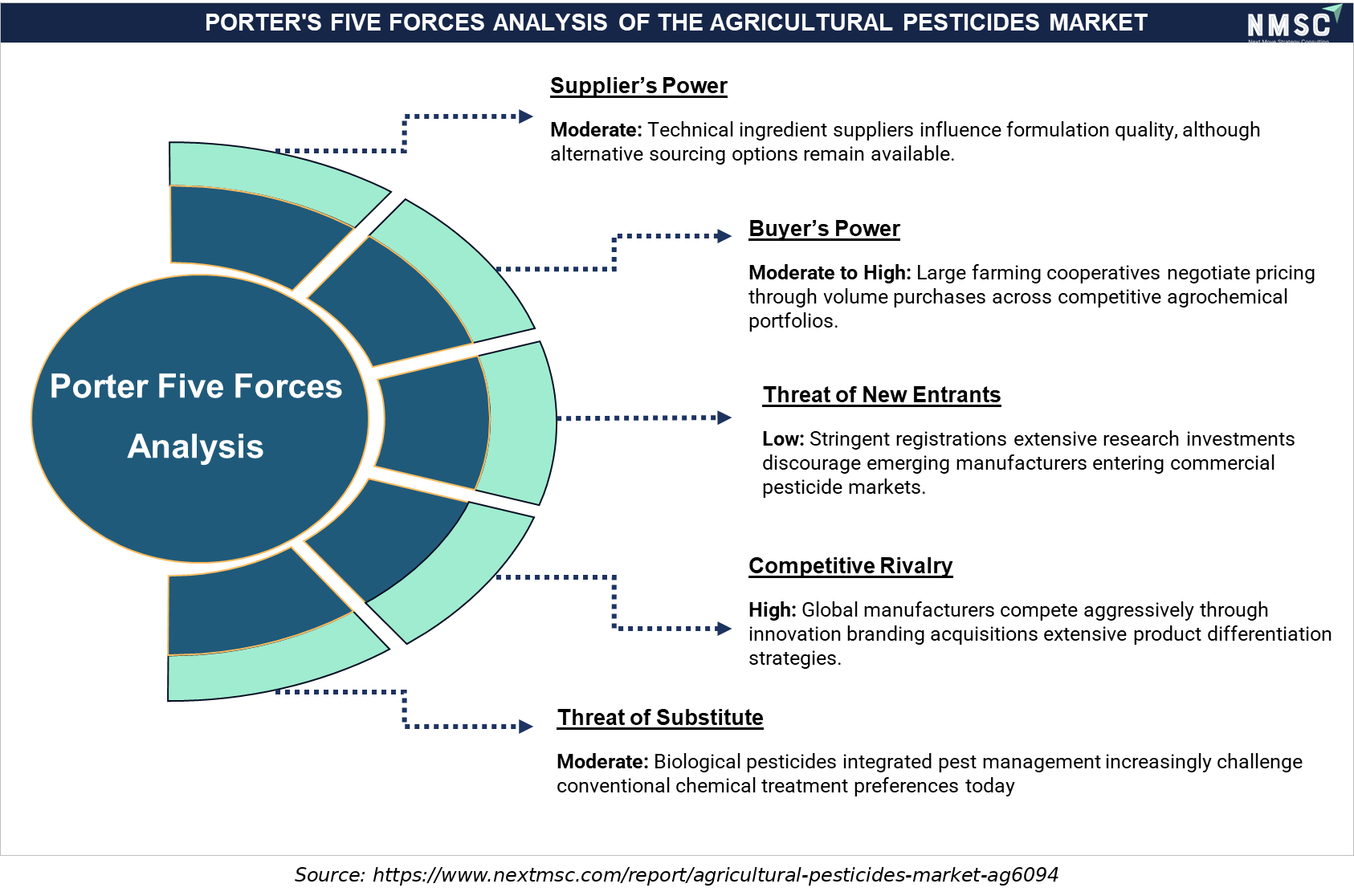
Porter’s Five Forces Analysis of the Agricultural Pesticides Market

The Porter’s Five Forces analysis evaluates the competitive structure of the agricultural pesticides market across new entrants, supplier power, buyer power, substitutes, and competitive rivalry. The framework highlights how regulatory requirements, formulation expertise, distribution capabilities, input costs, and evolving agricultural practices influence market attractiveness, competitive intensity, pricing dynamics, and strategic positioning among industry participants.

Segmentation Analysis

2025 (USD Billion)
2035 (USD Billion)
Herbicides 2025: $30.60 Billion | 2035: $49.28 Billion
Herbicides
Insecticides 2025: $18.36 Billion | 2035: $29.45 Billion
Insecticides
Fungicides 2025: $14.28 Billion | 2035: $30.64 Billion
Fungicides
Nematicides 2025: $2.72 Billion | 2035: $5.34 Billion
Nematicides
Other Pesticides 2025: $2.04 Billion | 2035: $4.04 Billion
Other Pestic
Herbicides $30.60 Billion $49.28 Billion 4.9%
Insecticides $18.36 Billion $29.45 Billion 4.8%
Fungicides $14.28 Billion $30.64 Billion 7.9%
Nematicides $2.72 Billion $5.34 Billion 7.0%
Other Pesticides $2.04 Billion $4.04 Billion 7.1%

Which Product Type Segment Dominates the Agricultural Pesticides Market?

Herbicides, encompassing selective and non-selective weed-control chemistries, led the market with USD 30.60 billion in 2025, supported by their critical role in cereal and grain cultivation where weed competition significantly affects yield. We observed that Fungicides are the fastest-growing product type, expanding at an 7.9% CAGR from 2026 to 2035, as climate-driven fungal disease pressure increases across cereal and high-value vegetable crops requiring more frequent protective applications.

2025 (USD Billion)
2035 (USD Billion)
Synthetic Pe
Biopesticide
Bioherbicide
Bioinsectici
Biofungicide
Segment Item 2025 (USD Billion) 2035 (USD Billion) CAGR
Synthetic Pesticides $10.0 USD Billion $40.0 USD Billion 10.0%
Biopesticides $17.1 USD Billion $51.1 USD Billion 12.0%
Bioherbicides $24.2 USD Billion $62.2 USD Billion 18.0%
Bioinsecticides $31.3 USD Billion $73.3 USD Billion 8.0%
Biofungicides $38.4 USD Billion $84.4 USD Billion 27.0%

Segment-wise data is locked

Unlock complete segment-wise numbers for By Origin.

Unlock Full Data

Which Origin Segment Is Growing Fastest in the Agricultural Pesticides Market?

Synthetic pesticides remained the dominant origin category, valued at USD 59.84 billion in 2025 on established manufacturing infrastructure and broad-spectrum efficacy across commodity crops. Our findings suggest that Biopesticides is the fastest-growing origin segment, registering a 12.3% CAGR from 2026 to 2035, as leading manufacturers expand biological production capacity to meet sustainability-linked demand from retailers and regulators across fruit and vegetable growing regions.

2025 (USD Billion)
2035 (USD Billion)
Cereals and
Fruits and V
Oilseeds and
Commercial C
Turf and Orn
Segment Item 2025 (USD Billion) 2035 (USD Billion) CAGR
Cereals and Grains $10.0 USD Billion $40.0 USD Billion 27.0%
Fruits and Vegetables $17.1 USD Billion $51.1 USD Billion 17.0%
Oilseeds and Pulses $24.2 USD Billion $62.2 USD Billion 27.0%
Commercial Crops $31.3 USD Billion $73.3 USD Billion 9.0%
Turf and Ornamentals $38.4 USD Billion $84.4 USD Billion 22.0%

Segment-wise data is locked

Unlock complete segment-wise numbers for By Crop Type.

Unlock Full Data

Which Crop Type Segment Leads Agricultural Pesticides Market Demand?

Cereals and Grains remained the leading crop type within the market, valued at USD 29.24 billion in 2025 on sustained wheat, rice, and corn cultivation requiring consistent weed and disease management across vast planted acreage. Based on research conducted by NMSC, we found that Turf and Ornamentals is the fastest-growing crop type, at a 8.8% CAGR from 2026 to 2035, as commercial landscaping and golf-course markets in developed economies increase specialty pesticide spending.

2025 (USD Billion)
2035 (USD Billion)
Liquid Formu
Dry Formulat
Segment Item 2025 (USD Billion) 2035 (USD Billion) CAGR
Liquid Formulations $10.0 USD Billion $40.0 USD Billion 17.0%
Dry Formulations $17.1 USD Billion $51.1 USD Billion 11.0%

Segment-wise data is locked

Unlock complete segment-wise numbers for By Formulation.

Unlock Full Data
2025 (USD Billion)
2035 (USD Billion)
Foliar Appli
Soil Treatme
Seed Treatme
Fumigation a
Segment Item 2025 (USD Billion) 2035 (USD Billion) CAGR
Foliar Application $10.0 USD Billion $40.0 USD Billion 12.0%
Soil Treatment $17.1 USD Billion $51.1 USD Billion 10.0%
Seed Treatment $24.2 USD Billion $62.2 USD Billion 20.0%
Fumigation and Other Modes $31.3 USD Billion $73.3 USD Billion 26.0%

Segment-wise data is locked

Unlock complete segment-wise numbers for By Mode of Application.

Unlock Full Data
2025 (USD Billion)
2035 (USD Billion)
Direct Sales
Agro-dealers
Online and D
Segment Item 2025 (USD Billion) 2035 (USD Billion) CAGR
Direct Sales $10.0 USD Billion $40.0 USD Billion 25.0%
Agro-dealers and Distributors $17.1 USD Billion $51.1 USD Billion 19.0%
Online and Digital Platforms $24.2 USD Billion $62.2 USD Billion 25.0%

Segment-wise data is locked

Unlock complete segment-wise numbers for By Distribution Channel.

Unlock Full Data

Growth Opportunities

Our analysis shows that three forward-looking opportunities stand out for stakeholders positioning within the agricultural pesticides market over the 2026-2035 forecast period.

How Can Biological Manufacturing Capacity Unlock Value for Specialty Crop Growers?

Expanding biological production capacity presents a whitespace opportunity for manufacturers seeking to serve fruit and vegetable growers facing residue-limit and export-market constraints. Suppliers that scale biocontrol and biostimulant capacity stand to capture recurring demand as retailers tighten maximum-residue-level requirements across premium export supply chains.

Where Do Digital and Direct-to-Farmer Distribution Channels Create New Demand?

Online and digital distribution platforms represent an underpenetrated opportunity for manufacturers seeking to bypass traditional multi-tier agro-dealer margins. Suppliers that develop validated e-commerce and direct-to-farmer ordering platforms can secure recurring revenue among cost-conscious growers in Asia-Pacific and Latin America, benefiting from the fastest-growing distribution channel in the market.

How Can Seed Treatment Formulations Benefit Large-Scale Commercial Growers?

Large-scale commercial growers seeking early-season pest protection create an opportunity for manufacturers offering integrated seed treatment formulations that reduce in-season application requirements. Early movers that combine seed treatment chemistries with precision planting equipment compatibility can differentiate with cereal and oilseed growers pursuing input-efficiency gains across mechanized farming regions.

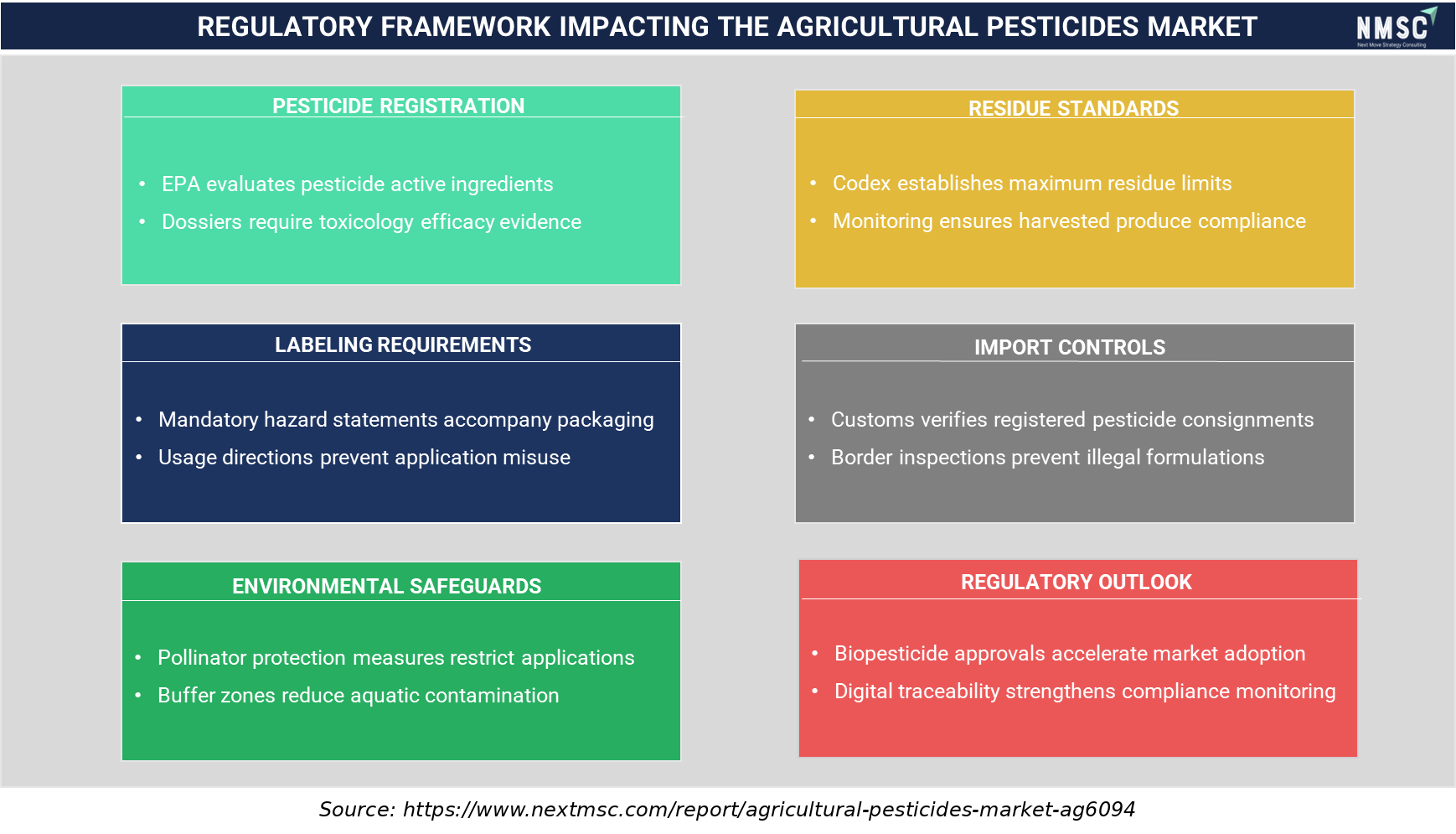
Regulatory Framework Impacting the Agricultural Pesticides Market

The regulatory framework outlines the key compliance factors shaping the agricultural pesticides market, including pesticide registration, residue standards, labeling requirements, import controls, environmental safeguards, and evolving regulations. Regulatory authorities assess product safety and efficacy, while residue monitoring, application restrictions, and environmental measures influence commercialization. Emerging biopesticide approvals and digital traceability are also supporting compliance and market development.

Regional Outlook

2025 (USD Billion)
2035 (USD Billion)
Latin Americ
Asia-Pacific
Europe
North Americ
Middle East
Region 2025 (USD Billion) 2035 (USD Billion) CAGR (%)
Latin America $10.0 USD Billion $40.0 USD Billion 9.0%
Asia-Pacific $17.1 USD Billion $51.1 USD Billion 27.0%
Europe $24.2 USD Billion $62.2 USD Billion 25.0%
North America $31.3 USD Billion $73.3 USD Billion 23.0%
Middle East & Africa $38.4 USD Billion $84.4 USD Billion 12.0%

Regional data is locked

Unlock complete regional numbers for this market.

Unlock Full Data

Competitive Landscape

We observed that the agricultural pesticides market features a moderately consolidated competitive landscape, with a small group of diversified multinationals accounting for a majority of global revenue alongside regional generic and biological specialists.

Dimension Description
Market Structure The market includes a mix of large diversified crop protection companies such as Bayer, Syngenta, BASF, Corteva, UPL, and FMC, alongside numerous regional and generic manufacturers serving cost-sensitive local demand.
Innovation Focus Biological product development, next-generation low-dose synthetic actives, and precision-application-compatible formulations dominate current innovation pipelines across leading suppliers.
M&A Activity Selective portfolio realignment, exemplified by BASF's plan to pursue a partial public listing of its Agricultural Solutions segment by 2027 to sharpen strategic focus and unlock segment-level value. (Source: basf.com)

How Do Companies Compete in the Agricultural Pesticides Market?

Companies compete primarily on active-ingredient patent protection, regulatory registration breadth, and distribution reach across the industry. Global players such as Bayer and Syngenta leverage extensive registration portfolios and proprietary technologies to serve multinational commercial growers, while regional manufacturers including UPL and ADAMA compete on generic-chemistry cost leadership and localized distribution networks supplied to price-sensitive growers.

Which Competitive Archetypes Dominate the Agricultural Pesticides Market?

Two archetypes dominate the market: innovation-led multinationals offering patent-protected, higher-margin chemistry, and generic-focused producers competing on manufacturing scale and cost. Bayer and Syngenta exemplify the innovation-led archetype through sustained R&D investment, while UPL and ADAMA exemplify the generic cost-leadership archetype serving price-sensitive growers across emerging markets.

How Are Companies Differentiating Through Innovation in Agricultural Pesticides?

Innovation and differentiation strategy increasingly center on biological product development and next-generation active ingredients with improved application-rate efficiency. Bayer's Plenexos insecticide and Syngenta's expanding biologicals manufacturing network both illustrate this shift toward differentiated, higher-margin chemistry. Our analysis shows that suppliers unable to demonstrate credible innovation pipelines risk losing share to generic competitors in commodity herbicide and insecticide categories.

What M&A and Expansion Activity Is Shaping the Agricultural Pesticides Market?

Portfolio realignment and geographic expansion continue to reshape supplier strategy within the industry. BASF's pursuit of IPO readiness for its Agricultural Solutions segment by 2027 illustrates how diversified chemical conglomerates are considering structural separation to sharpen agricultural focus, while Syngenta's new biologicals production facility in South Carolina illustrates how leading suppliers are expanding manufacturing capacity to capture biological product demand.

Key Market Players

Our assessment indicates that the following companies are actively shaping product innovation, capacity expansion, and regulatory strategy within the global agricultural pesticides market.

Bayer AG Syngenta Group BASF SE Corteva, Inc. FMC Corporation UPL Limited Sumitomo Chemical Co., Ltd. Nufarm Limited ADAMA Ltd. American Vanguard Corporation Albaugh, LLC Rallis India Limited Jiangsu Yangnong Chemical Co., Ltd. Nippon Soda Co., Ltd. Ishihara Sangyo Kaisha, Ltd. Rotam CropSciences Ltd. Sipcam Oxon S.p.A. Gowan Company, LLC PI Industries Limited Best Agrolife Limited

Latest Developments

We found that recent activity within the agricultural pesticides market is concentrated on biological product launches and portfolio realignment, reflecting the industry's broader shift toward differentiated, sustainability-linked chemistry.

Date Event
Jun 2026 FMC and Corteva signed a co-exclusive strategic supply and license agreement to expand FMC’s rimisoxafen herbicide technology across North and South American corn and soybean markets. The dual-mode-of-action technology is intended to help growers control herbicide-resistant weeds, including challenging Amaranthus species, strengthening both companies’ crop protection portfolios. (Source: corteva.com)
Apr 2026 Syngenta launched VIRESTINA™ technology, based on metproxybicyclone, described as the first selective herbicide technology in nearly 40 years specifically targeting resistant grass weeds in soybean and cotton. Argentina became the first country to approve the technology, with planned expansion to Brazil, Australia, the U.S. and Canada. (Source: syngenta.com)
Mar 2026 BASF introduced Ridivex™ herbicide, an all-in-one premix combining three active ingredients with three different sites of action for corn. The formulation is designed to provide rapid knockdown and residual weed control across critical crop-growth stages, while supporting resistance management. U.S. launch was pending EPA registration at announcement. (Source: basf.com)
Dec 2025 BASF and ADAMA signed a strategic co-development and commercialization agreement centered on ADAMA’s proprietary Gilboa® fungicide active ingredient, flumetylsulforim. BASF will develop and commercialize new formulations alongside ADAMA’s products. Wheat formulations are expected in Great Britain in 2027, followed by broader European launches from 2029. (Source: basf.com)
Dec 2025 Corteva and Hexagon Bio established a multi-million-dollar joint venture to accelerate discovery and development of nature-inspired crop protection solutions. The collaboration combines Corteva’s crop protection capabilities and nature-inspired franchises with Hexagon Bio’s natural-product discovery platform, creating a new research pathway for differentiated agricultural pesticide technologies. (Source: corteva.com)

Investment Opportunities

What Capital Inflows Are Targeting the Agricultural Pesticides Market?

Capital inflows into the agricultural pesticides market are increasingly directed toward biological manufacturing capacity and next-generation active-ingredient development. Strategic investors continue to fund expansion of biological production, as seen in Syngenta's new Orangeburg, South Carolina facility. We observed that investors favor manufacturers demonstrating diversified biological and synthetic pipelines, viewing this balance as a proxy for long-term resilience against generic pricing pressure.

How Is Infrastructure Investment Supporting Agricultural Pesticides Manufacturing?

Infrastructure investment is expanding formulation and active-ingredient manufacturing capacity across Asia-Pacific and Latin America to serve rising domestic and export demand. Our findings suggest that China-based manufacturers continue to invest in technical-grade active-ingredient production, including glyphosate and 2,4-D ester, supporting global formulation supply chains for herbicide and fungicide products.

What ESG Considerations Are Shaping Agricultural Pesticides Investment Decisions?

Environmental, social, and governance considerations are central to investment decisions across the industry, with reduced environmental persistence and lower application-rate chemistry cited as key criteria. The Food and Agriculture Organization's International Code of Conduct on Pesticide Management continues to inform stewardship expectations across global supply chains. We found that investors increasingly favor manufacturers with credible biological and low-residue product pipelines, treating this data as a governance indicator alongside worker safety and regulatory compliance.

Key Benefits for Stakeholders

How Does This Report Benefit Enterprise and Industry Leaders?

Enterprise and industry leaders gain access to validated segmentation, competitive benchmarking, and regional demand forecasts that support product-portfolio and manufacturing-sourcing decisions across the agricultural pesticides industry. Our analysis shows that detailed product-type, origin, and crop-type breakdowns help procurement and R&D teams align investment with regulatory and sustainability requirements while identifying underserved crop segments for portfolio expansion.

How Does This Report Benefit Investors and Financial Analysts?

Investors and financial analysts benefit from consistent, single-point market size and CAGR estimates that support valuation and capital-allocation decisions across the agricultural pesticides supply chain. We observed that the report's regional and segment-level growth differentials help identify which manufacturers and biological specialists are best positioned to capture above-market growth in fungicide and biopesticide categories through 2035.

How Does This Report Benefit Technology Vendors and Product Teams?

Technology vendors and product teams gain insight into emerging formulation, biological, and precision-application requirements that are reshaping the industry. Our findings suggest that this analysis helps R&D teams prioritize development roadmaps around biological manufacturing and low-dose active-ingredient technology increasingly required by retailer sustainability scorecards and regulatory renewal reviews.

Key Market Segments Evaluated

By Product Type

  • Herbicides
  • Insecticides
  • Fungicides
  • Nematicides
  • Other Pesticides

By Origin

  • Synthetic Pesticides
  • Biopesticides

By Crop Type

  • Cereals and Grains
  • Fruits and Vegetables
  • Oilseeds and Pulses
  • Commercial Crops
  • Turf and Ornamentals
  • Other Crops

By Formulation

  • Liquid Formulations
  • Dry Formulations

By Mode of Application

  • Foliar Application
  • Soil Treatment
  • Seed Treatment
  • Fumigation and Other Modes

By Distribution Channel

  • Direct Sales
  • Agro-dealers and Distributors
  • Online and Digital Platforms

Conclusion & Recommendations

The long-term outlook for the market remains positive, with global revenue projected to grow from USD 68.00 billion in 2025 to USD 118.75 billion by 2035 at a 5.7% CAGR. We observed that sustained food demand, expanding biological product adoption, and rising fungal disease pressure will continue underpinning demand across herbicide, fungicide, and biopesticide categories through the forecast period.

What Strategic Positioning Should Agricultural Pesticides Suppliers Pursue?

Suppliers should prioritize biological manufacturing capacity while pursuing next-generation, low-dose synthetic chemistry to secure long-term grower and regulatory support. Our assessment indicates that manufacturers investing early in diversified biological and synthetic pipelines will be best positioned to capture premium pricing within the agricultural pesticides market.

How Attractive Is the Agricultural Pesticides Market for New Investment?

The agricultural pesticides industry presents an attractive investment case, supported by a USD 47.25 billion absolute dollar opportunity between 2026 and 2035 and above-average growth in Asia-Pacific and biopesticide categories. We found that investment attractiveness is highest for manufacturers combining biological innovation with scaled synthetic manufacturing capacity, positioning them to serve both cost-sensitive and premium grower segments simultaneously.

What Market Shifts and Key Risks Should Stakeholders Monitor?

Stakeholders should monitor sustained generic pricing pressure, tightening regulatory label restrictions, and raw material cost volatility as key risks to the agricultural pesticides market. Our analysis shows that suppliers unable to adapt to biological and low-residue product requirements risk losing shelf space to competitors with certified sustainable chemistry, particularly within Europe's increasingly regulated renewal environment.

What Are the Key Growth Pathways for the Agricultural Pesticides Market?

Key growth pathways include expanding biological manufacturing capacity, scaling next-generation low-dose synthetic chemistry, and deepening penetration into digital and direct-to-farmer distribution channels. NMSC's analysis indicates that suppliers pursuing these pathways while maintaining cost competitiveness in commodity herbicide categories will be best positioned to capture the agricultural pesticides market's projected growth through 2035.

FAQs

About the Author

Mihul Sharma

Mihul Sharma

Mihul Sharma is Research Associate at Next Move Strategy Consulting, where he has covered technology, industrial, and healthcare markets for 3 years. His work applies structured business research, market analysis, and secondary-source review to assess market trends, competitive developments, and growth opportunities. He supports report development by fully synthesizing industry data, company information, and market signals into concise findings for strategy and investment-focused research teams.

About the Reviewer

Supradip Baul

Supradip Baul

Supradip Baul is an accomplished business consultant and strategist with over a decade of rich experience in market intelligence, strategy, technology, and business transformation. His work has included rigorous qualitative and quantitative analysis across multiple industries, helping clients shape investment decisions and long-term roadmaps. Earlier in his career, he was associated with Gartner, where he contributed to industry-leading reports and market share analyses. He has worked with leading global companies and holds an MBA with a dual specialization in Marketing and Finance.

Download Free Sample

Henri Knyphausen

HENRI KNYPHAUSEN

Partner at Singulier [Ex-BCG]

Singulier

I recently engaged NEXTMSC.com for a commercial due diligence project within the intralogistics sector, and I am pleased to provide a reference based on my experience. In utilizing NEXTMSC.com's services, I found their report to offer valuable insights into market dynamics and key industry players. The initial report provided a solid foundation for our analysis. However, as we were investigating a smaller target in the market, and I had specific customization requests requiring additional research. These requests included detailed information on product portfolios of various players and sub-market sizes, both inclusive and exclusive of certain product categories. NEXTMSC.com demonstrated commendable responsiveness and agility in accommodating these customization requests. Within a timeframe of 1-2 weeks, they delivered a revised report that met our specific needs. Furthermore, they were receptive to my follow-up inquiries, ensuring clarity and understanding of the data provided. The final deliverable significantly contributed to our due diligence efforts. One of NEXTMSC.com's notable strengths lies in their qualitative research capabilities. However, for future engagements, I would recommend the inclusion of a quantified market model in Excel format. Such a model would offer the ability to conduct in-depth analyses and explore various market segments, including country-specific data and subcomponent breakdowns. Based on my positive experience, I would not hesitate to work with NEXTMSC.com again. Their responsiveness, willingness to accommodate customization requests, and commitment to delivering actionable insights make them a reliable partner for commercial research projects.


Nishant Awate

NISHANT AWATE

Business Development Global Sales

Zehnder Group Deutschland GmbH

Our experience working with Next Move Strategy Consulting was positive. The team was responsive, professional, and open to incorporating our specific requirements throughout the project. The India AHU market study was comprehensive and well structured, covering market value and volume forecasts, product and application segments, and key industry trends. The inclusion of both AHU and residential MVHR market insights made the study particularly relevant for our strategic market assessment. Overall, the report provides a solid foundation for evaluating market potential, identifying priority segments, and supporting business-development decisions in India.

Robert Sean Trevino

ROBERT SEAN TREVINO

Sr. Director, Head of Strategic Insights & Analytics

Foundation Medicine

I realized that it was a reliable source of information. These days, there are many people who are looking for authentic data, and this is one of the only sources that can offer them with what they need;

Pratyush Kumar Das

PRATYUSH KUMAR DAS

Assistant Manager

Polycab India Limited

We would like to express our appreciation for the data and insights provided by nextmsc. We are very pleased with the quality and depth of the information, which has proven to be highly valuable and beneficial for our business decision-making.

Amos Chang

AMOS CHANG

Strategy Consultant

Kardex Group

I have bought the intralogistics market reports from NMSC two times so far. Joseph and his team are always very helpful and flexible in responding to any customization requirements on the report. Their expertise in market reports really helps us steer the day-to-day business. I will definitely recommend and come back myself whenever there is a need.

Custom Market Research Services

We will customize the research for you if the listed report does not fully match your requirements.

Get 30% Free Customization

Select License

This website uses cookies to ensure you get the best experience on our website. Learn more

✖