AI-Based Language Learning Market Global Industry Analysis and Forecast (2026-2035)

AI-Based Language Learning Market size was USD 10.4 billion in 2026, projected to reach USD 51.8 billion by 2035, growing at a CAGR of 19.5% from 2026 to 2035. Key drivers include rapid generative AI adoption, rising enterprise demand for scalable workforce language training, and growing smartphone-based learning adoption, with North America leading the market.

Download Free Sample PDF
Base Year (2025)
$8.60 Billion
Forecast (2035)
$51.80 Billion
CAGR (2026-2035)
19.5%
Top Region
North America

What Is the AI-Based Language Learning Market Size?

The global AI-based language learning industry size was valued at USD 8.6 billion in 2025 and is estimated at USD 10.4 billion in 2026, forecast to reach USD 51.8 billion by 2035, expanding at a 19.5% CAGR between 2026 and 2035. North America leads with approximately 36% share, while the Platform component dominates all other categories with approximately 52% share.

We observed that growth is accelerating across every segmentation axis, with generative AI content generation and enterprise adoption driving the dominant structural shifts through 2035.

AI-Based Language Learning Market Global Industry Analysis and Forecast (2026-2035) Revenue Forecast

Values in USD Billion

2025 $8.60 Billion
2025
2026 $10.40 Billion
2026
2027 $12.43 Billion
2027
2028 $14.85 Billion
2028
2029 $17.75 Billion
2029
2030 $21.21 Billion
2030
2031 $25.34 Billion
2031
2032 $30.29 Billion
2032
2033 $36.19 Billion
2033
2034 $43.25 Billion
2034
2035 $51.80 Billion
2035

Key Takeaways

By Component: Platform held the largest share of approximately 52% (USD 4.47 billion) in 2025; Services is the fastest-growing sub-segment at 24.8% CAGR from 2026–2035.

By Deployment Mode: Cloud held the largest share of approximately 86% (USD 7.40 billion) in 2025 and is also the fastest-growing sub-segment at 22.8% CAGR from 2026–2035.

By Learning Mode: Self-Paced Learning held the largest share of approximately 58% (USD 4.99 billion) in 2025; Blended Learning is the fastest-growing sub-segment at 25.1% CAGR from 2026–2035.

By Technology: Speech Recognition and Pronunciation Analysis held the largest share of approximately 24% (USD 2.06 billion) in 2025; Generative AI Content Generation is the fastest-growing sub-segment at 31.9% CAGR from 2026–2035.

By Device Type: Smartphone held the largest share of approximately 62% (USD 5.33 billion) in 2025; Tablet is the fastest-growing sub-segment at 25.2% CAGR from 2026–2035.

By End User: Individual Learners held the largest share of approximately 60% (USD 5.16 billion) in 2025; Enterprises is the fastest-growing sub-segment at 26.0% CAGR from 2026–2035.

By Application: General Language Learning held the largest share of approximately 48% (USD 4.13 billion) in 2025; Immigration and Citizenship Language Training is the fastest-growing sub-segment at 25.6% CAGR from 2026–2035.

Dominant Region: North America dominated with approximately 36% revenue share (USD 3.10 billion) in 2025.

Fastest-Growing Region: Middle East & Africa is expected to register the highest CAGR of 25.0% during 2026–2035.

Dominant Country: U.S. led with approximately USD 2.48 billion in 2025.

Fastest-Growing Country: India is the fastest-growing country at approximately 27.0% CAGR from 2026–2035.

Market Opportunity: The AI-based language learning ecosystem is expected to create an absolute dollar opportunity of USD 41.4 billion between 2026 and 2035, presenting significant investment potential across generative AI content platforms and enterprise language training solutions.

According to NMSC analysis, vendors are increasingly bundling conversational AI practice tools with adaptive curriculum engines, a shift that favors platform providers with large proprietary learner-interaction datasets over static content libraries as consumers and enterprises alike prioritize measurable speaking proficiency outcomes through 2035.

What Does the AI-Based Language Learning Market Encompass?
The AI-based language learning industry encompasses mobile applications, web platforms, and services that apply speech recognition, natural language processing, and generative artificial intelligence to personalize vocabulary, grammar, and conversational practice for individual learners, academic institutions, and enterprises. Our assessment indicates that scope spans platform software, licensed content, and implementation services delivered primarily through cloud-based smartphone and desktop applications. The category has evolved from static flashcard-style drilling into adaptive, conversation-driven tutoring, propelled by consumer demand for affordable alternatives to classroom instruction and enterprise demand for scalable workforce language training.
Data-privacy regulations such as the European Union's General Data Protection Regulation shape how vendors process learner speech and performance data used for AI personalization, while U.S. Federal Trade Commission guidance on AI-driven consumer applications increasingly influences disclosure practices. We observed that technology adoption is shifting rapidly toward generative AI content generation and real-time conversational practice tools. NMSC's analysis indicates that this structural shift, combined with rising enterprise adoption, is redefining competitive positioning across the AI-based language learning market.

Market Drivers & Dynamics

Interactive Dataset
Rapid adoption of generative AI content generation across platforms driver +3.2% Global 2026-2035
Rising enterprise demand for scalable workforce language training driver +2.4% North America, Europe 2026-2035
Growing smartphone penetration and mobile-first learning adoption driver +2.0% Asia-Pacific, Latin America 2026-2035
Increasing demand for conversational AI speaking practice tools driver +1.8% Global 2026-2035
Rising international student mobility and test-preparation demand driver +1.2% Asia-Pacific, Middle East & Africa 2026-2032
Growing government-funded immigration language training initiatives driver +0.9% Europe, North America 2026-2035
Data-privacy compliance burden tied to AI-personalized learner data restraint -1.0% Europe, North America 2026-2032
Free open-source and low-cost content alternatives restraint -0.8% Global 2026-2035
High computational cost of generative AI model deployment restraint -0.6% Global 2026-2032
Limited monetization conversion among free-tier consumer users restraint -0.5% Latin America, Middle East & Africa 2028-2035
Source: Next Move Strategy Consulting

Growth Drivers

What Is the Primary Growth Driver of the AI-Based Language Learning Market?

Rapid adoption of generative AI content generation is the primary driver of the market. Duolingo, Inc.'s expansion of AI-powered personalized feedback tools to its full user base in January 2026 illustrates how generative AI is shifting from a paid differentiator into a core learning mechanism. We observed that this adoption pattern, reinforced by continuous large-scale product experimentation, continues to anchor engagement and retention gains across leading consumer platforms.

How Is Enterprise Demand Driving AI-Based Language Learning Market Growth?

Rising enterprise demand for scalable workforce language training is accelerating market growth toward assessment-backed, cloud-based platform adoption. Multinational employers increasingly favor AI-based platforms over traditional classroom training to support cross-border collaboration and workforce mobility. Our assessment indicates that this enterprise shift, combined with rising Asia-Pacific smartphone penetration, is compressing adoption timelines for AI-based language platforms relative to legacy instructor-led programs.

Growth Inhibitors

What Is Restraining AI-Based Language Learning Market Expansion?

Data-privacy compliance obligations tied to AI-personalized learner data restrain platform expansion, particularly across Europe. The European Union's General Data Protection Regulation continues to shape how vendors process learner speech and performance data used for AI-driven personalization. We found that smaller platform vendors face particular exposure, as limited compliance budgets reduce their ability to match the data-governance credentials of larger, well-resourced competitors.

What Are the Growth Opportunities?

How Can Generative AI Content Tools Unlock Growth Among Enterprise Buyers?

Generative AI content-generation tools present a whitespace opportunity among enterprises seeking customized, role-specific language curricula. Vendors that commercialize enterprise-grade generative AI content platforms stand to capture recurring subscription and services revenue as multinational employers replace generic course libraries with tailored workforce training programs.

Where Does Conversational AI Create New Demand in Test Preparation?

Test-preparation learners represent an underpenetrated opportunity for conversational AI speaking-assessment tools that simulate proctored examination formats. Providers that develop validated, exam-aligned conversational practice modules can capture recurring revenue from students preparing for standardized proficiency examinations across Asia-Pacific and the Middle East.

How Can Tablet-Optimized Platforms Accelerate Academic Institution Adoption?

Academic institutions adopting blended classroom models create an opportunity for tablet-optimized AI language platforms designed for shared classroom devices. Vendors that build validated, curriculum-aligned tablet applications can secure long-term institutional licensing agreements, benefiting from recurring per-seat renewal revenue as schools formalize digital language curricula.

Segmentation Analysis

2025 (USD Billion)
2035 (USD Billion)
Platform 2025: $4.47 Billion | 2035: $25.64 Billion
Platform
Content 2025: $2.58 Billion | 2035: $14.76 Billion
Content
Services 2025: $1.55 Billion | 2035: $11.40 Billion
Services
Platform $4.47 Billion $25.64 Billion 21.4%
Content $2.58 Billion $14.76 Billion 21.4%
Services $1.55 Billion $11.40 Billion 24.8%

Which Component Segment Dominates the AI-Based Language Learning Market?

Platform led the market with USD 4.47 billion in 2025, supported by subscription-based mobile and web applications that serve as the primary point of sale across the industry. We observed that Services is the fastest-growing component segment, expanding at a 24.8% CAGR from 2026 to 2035, as enterprises increasingly license implementation and curriculum-customization support alongside core platform subscriptions.

2025 (USD Billion)
2035 (USD Billion)
Cloud
On-Premise
Segment Item 2025 (USD Billion) 2035 (USD Billion) CAGR
Cloud $10.0 USD Billion $40.0 USD Billion 9.0%
On-Premise $17.1 USD Billion $51.1 USD Billion 23.0%

Segment-wise data is locked

Unlock complete segment-wise numbers for By Deployment Mode.

Unlock Full Data
2025 (USD Billion)
2035 (USD Billion)
Self-Paced L
Live Tutor-A
Blended Lear
Segment Item 2025 (USD Billion) 2035 (USD Billion) CAGR
Self-Paced Learning $10.0 USD Billion $40.0 USD Billion 18.0%
Live Tutor-Assisted Learning $17.1 USD Billion $51.1 USD Billion 24.0%
Blended Learning $24.2 USD Billion $62.2 USD Billion 14.0%

Segment-wise data is locked

Unlock complete segment-wise numbers for By Learning Mode.

Unlock Full Data
2025 (USD Billion)
2035 (USD Billion)
Speech Recog
Natural Lang
Adaptive Lea
Conversation
Generative A
Segment Item 2025 (USD Billion) 2035 (USD Billion) CAGR
Speech Recognition and Pronunciation Analysis $10.0 USD Billion $40.0 USD Billion 16.0%
Natural Language Processing $17.1 USD Billion $51.1 USD Billion 22.0%
Adaptive Learning Algorithms $24.2 USD Billion $62.2 USD Billion 16.0%
Conversational AI Chatbots $31.3 USD Billion $73.3 USD Billion 26.0%
Generative AI Content Generation $38.4 USD Billion $84.4 USD Billion 25.0%

Segment-wise data is locked

Unlock complete segment-wise numbers for By Technology.

Unlock Full Data

Which Technology Segment Leads the AI-Based Language Learning Market?

Speech Recognition and Pronunciation Analysis remained the dominant technology category, reaching USD 2.06 billion in 2025 due to its foundational role in speaking-practice features across nearly all platforms. Based on research conducted by NMSC, we found that Generative AI Content Generation is the fastest-growing technology category at a 31.9% CAGR from 2026 to 2035, reflecting rapid adoption of personalized feedback and adaptive content tools.

2025 (USD Billion)
2035 (USD Billion)
Smartphone
Desktop and
Tablet
Segment Item 2025 (USD Billion) 2035 (USD Billion) CAGR
Smartphone $10.0 USD Billion $40.0 USD Billion 18.0%
Desktop and Web $17.1 USD Billion $51.1 USD Billion 20.0%
Tablet $24.2 USD Billion $62.2 USD Billion 18.0%

Segment-wise data is locked

Unlock complete segment-wise numbers for By Device Type.

Unlock Full Data
2025 (USD Billion)
2035 (USD Billion)
Individual L
Academic Ins
Enterprises
Government a
Segment Item 2025 (USD Billion) 2035 (USD Billion) CAGR
Individual Learners $10.0 USD Billion $40.0 USD Billion 26.0%
Academic Institutions $17.1 USD Billion $51.1 USD Billion 16.0%
Enterprises $24.2 USD Billion $62.2 USD Billion 18.0%
Government and Public Sector $31.3 USD Billion $73.3 USD Billion 8.0%

Segment-wise data is locked

Unlock complete segment-wise numbers for By End User.

Unlock Full Data

Which End User Leads AI-Based Language Learning Market Demand?

Individual Learners remained the leading end user within the market, valued at USD 5.16 billion in 2025 on sustained consumer demand for affordable, self-directed language instruction. Our findings suggest that Enterprises is the fastest-growing end user, registering a 26.0% CAGR from 2026 to 2035, as multinational employers scale AI-based platforms to support workforce language proficiency and cross-border collaboration.

2025 (USD Billion)
2035 (USD Billion)
General Lang
Business and
Test Prepara
Immigration
Other Applic
Segment Item 2025 (USD Billion) 2035 (USD Billion) CAGR
General Language Learning $10.0 USD Billion $40.0 USD Billion 18.0%
Business and Professional Language Training $17.1 USD Billion $51.1 USD Billion 16.0%
Test Preparation $24.2 USD Billion $62.2 USD Billion 22.0%
Immigration and Citizenship Language Training $31.3 USD Billion $73.3 USD Billion 12.0%
Other Application $38.4 USD Billion $84.4 USD Billion 19.0%

Segment-wise data is locked

Unlock complete segment-wise numbers for By Application.

Unlock Full Data

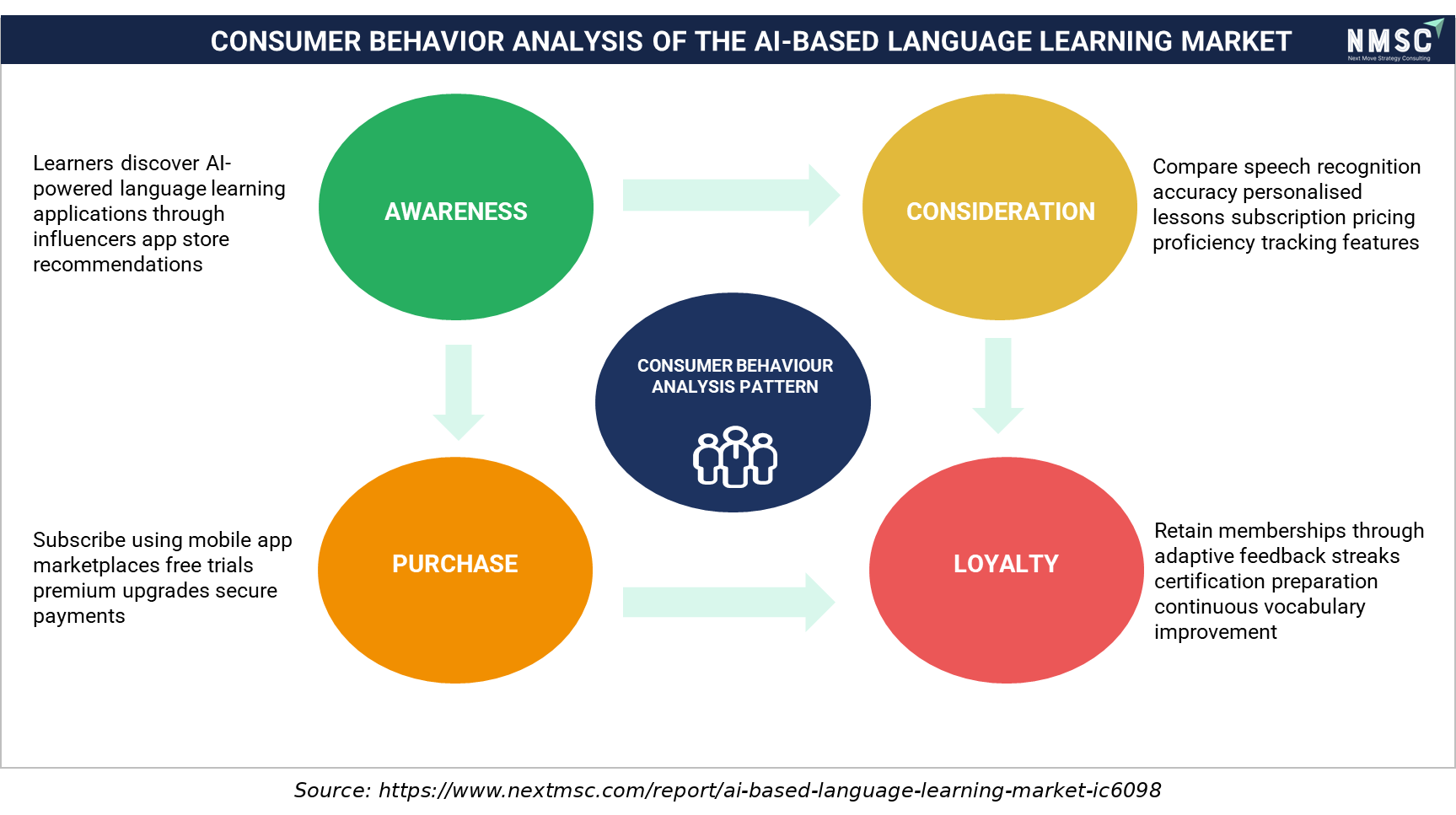
Consumer Behavior Analysis of the AI-Based Language Learning Market

Consumer Behavior Analysis of the AI-Based Language Learning Market
The consumer journey in the AI-based language learning market progresses from awareness to long-term engagement through personalized digital experiences. Learners discover platforms via app stores and online recommendations, evaluate AI capabilities and subscription value, subscribe through digital channels, and remain loyal to solutions offering adaptive learning, continuous feedback, progress tracking, and personalized language improvement.

Growth Opportunities

Our analysis shows that three forward-looking opportunities stand out for stakeholders positioning within the AI-based language learning market over the 2026-2035 forecast period.

How Can Generative AI Content Tools Unlock Growth Among Enterprise Buyers?

Generative AI content-generation tools present a whitespace opportunity among enterprises seeking customized, role-specific language curricula. Vendors that commercialize enterprise-grade generative AI content platforms stand to capture recurring subscription and services revenue as multinational employers replace generic course libraries with tailored workforce training programs.

Where Does Conversational AI Create New Demand in Test Preparation?

Test-preparation learners represent an underpenetrated opportunity for conversational AI speaking-assessment tools that simulate proctored examination formats. Providers that develop validated, exam-aligned conversational practice modules can capture recurring revenue from students preparing for standardized proficiency examinations across Asia-Pacific and the Middle East.

How Can Tablet-Optimized Platforms Accelerate Academic Institution Adoption?

Academic institutions adopting blended classroom models create an opportunity for tablet-optimized AI language platforms designed for shared classroom devices. Vendors that build validated, curriculum-aligned tablet applications can secure long-term institutional licensing agreements, benefiting from recurring per-seat renewal revenue as schools formalize digital language curricula.

Regional Outlook

2025 (USD Billion)
2035 (USD Billion)
North Americ
Europe
Asia-Pacific
Middle East
Latin Americ
Region 2025 (USD Billion) 2035 (USD Billion) CAGR (%)
North America $10.0 USD Billion $40.0 USD Billion 9.0%
Europe $17.1 USD Billion $51.1 USD Billion 27.0%
Asia-Pacific $24.2 USD Billion $62.2 USD Billion 25.0%
Middle East & Africa $31.3 USD Billion $73.3 USD Billion 23.0%
Latin America $38.4 USD Billion $84.4 USD Billion 12.0%

Regional data is locked

Unlock complete regional numbers for this market.

Unlock Full Data

Competitive Landscape

We observed that the AI-based language learning market features a moderately consolidated competitive landscape, with publicly listed consumer platforms competing alongside specialized tutoring marketplaces and regional AI education vendors on conversational AI depth and content breadth. Key Takeaways

Dimension Description
Market Structure Moderately consolidated; the top companies profiled in this report collectively account for a significant share of global AI-based language learning market revenue, while numerous regional and niche vendors serve underserved language pairs and local markets.
Innovation Focus Generative AI content generation, conversational AI speaking practice, adaptive learning algorithms, and gamified engagement mechanics dominate current innovation pipelines across leading vendors.
M&A Activity Selective consolidation activity, exemplified by larger platform groups acquiring complementary tutoring marketplaces and content specialists to expand language coverage and distribution reach.

How Do Companies Compete in the AI-Based Language Learning Market?

Companies compete primarily on conversational AI depth, proprietary learner-interaction data, and content breadth across the industry. Duolingo, Inc. leverages large-scale user experimentation and proprietary engagement data to refine personalization, while specialized vendors such as ELSA Corp compete on pronunciation-assessment accuracy for narrower use cases, and enterprise-focused vendors compete on assessment rigor and administrative reporting capability.

Which Competitive Archetypes Dominate the AI-Based Language Learning Market?

Two archetypes dominate the market: large consumer-scale platforms offering broad language coverage with gamified engagement, and specialized vendors focused on narrow use cases such as pronunciation coaching or business communication. Duolingo, Inc. and Babbel GmbH exemplify the consumer-scale archetype, while ELSA Corp and Speak Technologies Inc. exemplify the specialized archetype focused on conversational speaking practice.

How Are Companies Differentiating Through Innovation in AI-Based Language Learning?

Innovation and differentiation strategy increasingly center on embedding generative AI directly into feedback and content-creation workflows rather than static course libraries. Duolingo, Inc.'s Explain My Answer and Video Call features illustrate how vendors embed proprietary AI models into core learning workflows. Our analysis shows that vendors unable to demonstrate credible conversational AI capability risk losing engagement share to competitors with deeper generative AI integration.

What M&A and Expansion Activity Is Shaping the AI-Based Language Learning Market?

Strategic acquisitions and content-category expansion continue to shape competitive positioning within the industry. Babbel GmbH's prior acquisition of business-English platform Voxy illustrates how consumer-scale vendors pursue enterprise-channel expansion, while Duolingo, Inc.'s extension into adjacent subjects such as Chess and Math demonstrates how platforms are broadening engagement beyond core language instruction to sustain user growth.

Key Market Players

Our assessment indicates that the following 20 companies are actively shaping product innovation, content expansion, and generative AI capability strategy within the global AI-based language learning market.

Duolingo, Inc. Lesson Nine GmbH (Babbel) Bussu Ltd Preply B.V. ELSA Corp. Speak Technologies, Inc. Memrise Ltd. Lingoda GmbH Pearson plc EF Education First Ltd digital publishing AG Cambly, Inc. Hello-Hello, Inc. Lingvist Technologies OÜ Promova Group Ltd. Youdao, Inc. iFLYTEK Co., Ltd. Benesse Holdings, Inc. iTutorGroup, Inc. Loora AI Ltd.

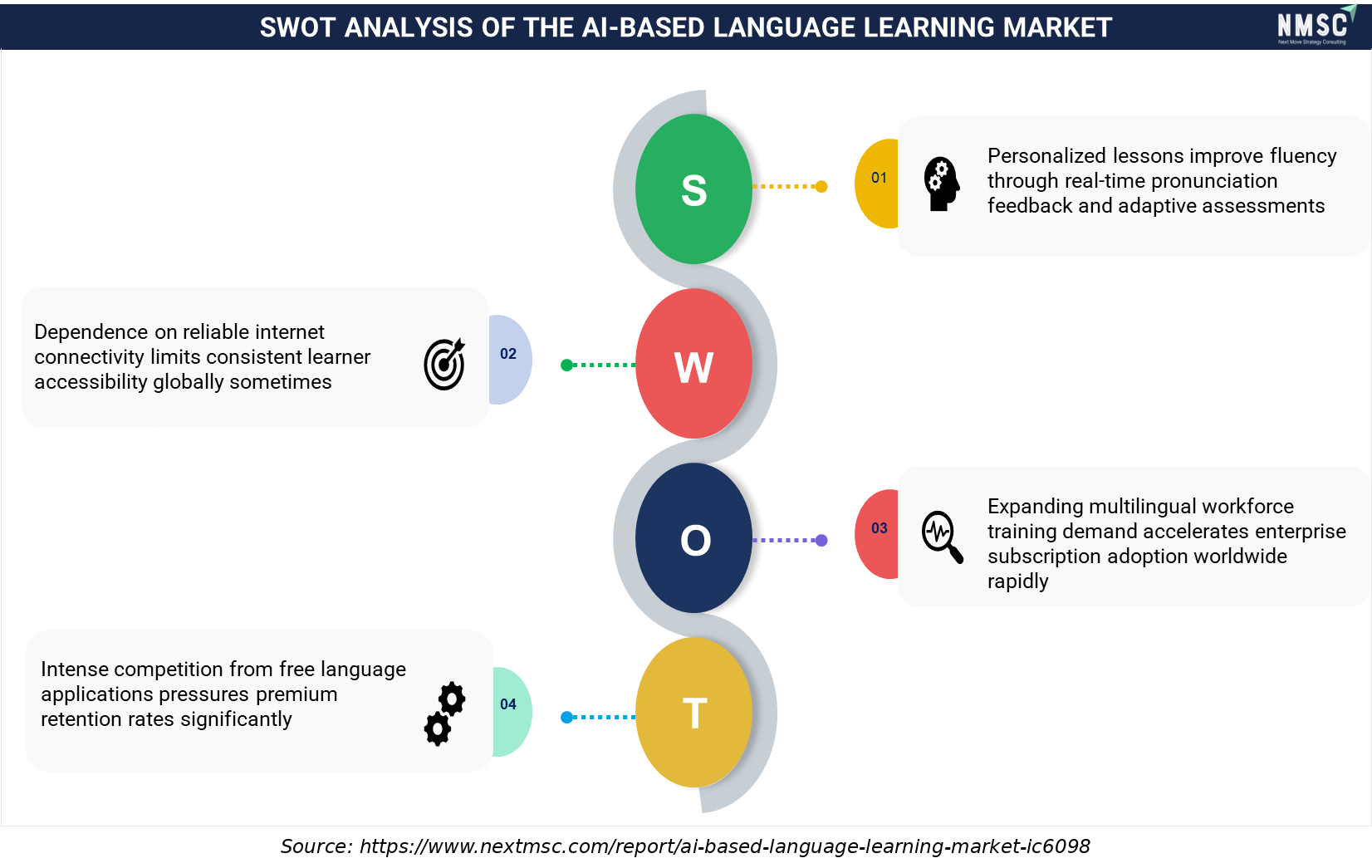
SWOT Analysis

This SWOT view highlights structural strengths, strategic gaps, expansion headroom, and external risks shaping outcomes in the AI-Based Language Learning Market Global Industry Analysis and Forecast (2026-2035).
Strengths

Weaknesses

Opportunities

Threats

Latest Developments

We found that recent product launches within the AI-based language learning market are concentrated on generative AI feedback and conversational practice tools, reflecting the industry's broader shift toward personalized, speaking-focused instruction.

Date Event
Jan 2026 Preply raised USD 150 million in Series D funding to accelerate its human-led, AI-enhanced language learning platform. The investment will expand AI-powered tutoring tools, personalized learning, and tutor productivity features.
Aug 2025 Duolingo acquired the team behind London-based music gaming startup NextBeat to strengthen its Music course and accelerate gamified learning experiences. The acquisition added expertise in game design, user retention, monetization, sound design, and music licensing to support product innovation and more engaging educational experiences.

Investment Opportunities

What Capital Inflows Are Targeting the AI-Based Language Learning Market?

Capital inflows into the AI-based language learning market are increasingly directed toward generative AI content tools and conversational practice features. Vendors continue to fund product expansion, as seen in Duolingo's continuous AI feature rollout and course-category expansion. We observed that investors favor vendors demonstrating large proprietary learner-interaction datasets, viewing engagement scale as a proxy for long-term retention and monetization potential.

How Is Infrastructure Investment Supporting AI-Based Language Learning Delivery?

Infrastructure investment is expanding cloud and AI-model computing capacity to support real-time conversational practice at global scale. Our findings suggest that platform vendors are investing in speech-recognition and generative AI infrastructure to support low-latency feedback across mobile devices, supporting the scalability required as adoption expands across Asia-Pacific and Middle East & Africa smartphone users.

What ESG Considerations Are Shaping AI-Based Language Learning Investment Decisions?

Environmental, social, and governance considerations increasingly shape investment decisions, with equitable access to affordable language education and responsible AI data practices as key criteria. Platform vendors increasingly publicize free-tier accessibility commitments alongside data-governance disclosures. We found that investors increasingly favor vendors demonstrating measurable accessibility outcomes, treating it as a governance indicator alongside data-privacy compliance.

Key Benefits for Stakeholders

How Does This Report Benefit Enterprise and Industry Leaders?

Enterprise and industry leaders gain access to validated segmentation, competitive benchmarking, and regional demand forecasts that support platform sourcing and vendor-selection decisions across the AI-based language learning industry. Our analysis shows that detailed component, technology, and application breakdowns help learning and development teams align platform specifications with workforce mobility requirements while identifying underserved training categories for program expansion.

How Does This Report Benefit Investors and Financial Analysts?

Investors and financial analysts benefit from consistent, single-point market size and CAGR estimates that support valuation and capital-allocation decisions across the AI-based language learning software and services supply chain. We observed that the report's regional and segment-level growth differentials help identify which vendors are best positioned to capture above-market growth in generative AI and enterprise categories through 2035.

How Does This Report Benefit Technology Vendors and Product Teams?

Technology vendors and product teams gain insight into emerging design requirements, including generative AI content tools, conversational speaking-assessment engines, and gamified engagement mechanics, that are reshaping the industry. Our findings suggest that this analysis helps product roadmap teams prioritize investment around generative AI integration capability increasingly expected by both consumer and enterprise buyers.

Key Market Segments Evaluated

By Component

  • Platform
  • Content
  • Services

By Deployment Mode

  • Cloud
  • On-Premise

By Learning Mode

  • Self-Paced Learning
  • Live Tutor-Assisted Learning
  • Blended Learning

By Technology

  • Speech Recognition and Pronunciation Analysis
  • Natural Language Processing
  • Adaptive Learning Algorithms
  • Conversational AI Chatbots
  • Generative AI Content Generation
  • Other Technology

By Device Type

  • Smartphone
  • Desktop and Web
  • Tablet

By End User

  • Individual Learners
  • Academic Institutions
  • Enterprises
  • Government and Public Sector

By Application

  • General Language Learning
  • Business and Professional Language Training
  • Test Preparation
  • Immigration and Citizenship Language Training
  • Other Application

Conclusion & Recommendations

The long-term outlook for the market remains strongly positive, with global revenue projected to expand from USD 8.6 billion in 2025 to USD 51.8 billion by 2035 at a 19.5% CAGR. We observed that sustained generative AI adoption, enterprise workforce training investment, and Asia-Pacific smartphone penetration will continue underpinning demand across individual, academic, and enterprise end-user categories through the forecast period.

What Strategic Positioning Should AI-Based Language Learning Vendors Pursue?

Vendors should prioritize generative AI content tools and conversational speaking-assessment capability while pursuing enterprise-channel expansion to secure durable subscription and services revenue. Our assessment indicates that vendors investing early in proprietary learner-interaction data and tablet-optimized institutional offerings will be best positioned to capture premium pricing within the AI-based language learning market.

How Attractive Is the AI-Based Language Learning Market for New Investment?
The AI-based language learning industry presents an attractive investment case, supported by a USD 41.4 billion absolute dollar opportunity between 2026 and 2035 and above-average growth in Middle East & Africa and generative AI technology categories. We found that investment attractiveness is highest for vendors combining large proprietary learner datasets with generative AI capability, positioning them to serve both consumer and enterprise segments simultaneously.

What Market Shifts and Key Risks Should Stakeholders Monitor?

Stakeholders should monitor data-privacy compliance burden, free-tier monetization limits, and computational cost of generative AI deployment as key risks to the AI-based language learning market. Our analysis shows that vendors unable to demonstrate credible data-governance and generative AI cost efficiency risk losing user growth to competitors with more scalable AI infrastructure, particularly within Europe's increasingly regulated data environment.

What Are the Key Growth Pathways for the AI-Based Language Learning Market?

Key growth pathways include expanding generative AI content capability, scaling enterprise workforce training channels, and deepening penetration into tablet-optimized academic institution licensing. NMSC's analysis indicates that vendors pursuing these pathways while maintaining engagement quality in core consumer categories will be best positioned to capture the AI-based language learning market's projected growth through 2035.

FAQs

About the Author

Mihul Sharma

Mihul Sharma

Mihul Sharma is Research Associate at Next Move Strategy Consulting, where he has covered technology, industrial, and healthcare markets for 3 years. His work applies structured business research, market analysis, and secondary-source review to assess market trends, competitive developments, and growth opportunities. He supports report development by fully synthesizing industry data, company information, and market signals into concise findings for strategy and investment-focused research teams.

About the Reviewer

Supradip Baul

Supradip Baul

Supradip Baul is an accomplished business consultant and strategist with over a decade of rich experience in market intelligence, strategy, technology, and business transformation. His work has included rigorous qualitative and quantitative analysis across multiple industries, helping clients shape investment decisions and long-term roadmaps. Earlier in his career, he was associated with Gartner, where he contributed to industry-leading reports and market share analyses. He has worked with leading global companies and holds an MBA with a dual specialization in Marketing and Finance.

Download Free Sample

Kevin Coker

KEVIN COKER

Founder, CEO and Board Diector

Proxima Clinical Research

I have been using Next MSC reports for product positioning in a new geography for a long time. They have by far the best reports I have found and the price is reasonable too!

Diana Trejo

DIANA TREJO

Assistant Manager

Sumitomo Corporation de Mexico, S.A. de C.V.

Recently, we purchased a report on the Mexico Data Center Market from Next Move Strategy Consulting. The service has been excellent, with support that is always timely and thoroughly professional. The information provided is interesting, highly useful, and delivered with clarity. I would highly recommend NextMSC for anyone seeking insightful and dependable analysis.

Ross J Mckenzie

ROSS J MCKENZIE

Business Insight Manager

Staysure Group

“Next MSC have been incredibly helpful in providing detailed & robust information on our market, alongside quantifying growth by different segments. The process to procure was simple and easy, with sample reports and regular contact to ensure we had what we needed. Succinct detail on their sources & methodologies is also greatly received, allowing transparency in this respect helps build trust in the detail you pay for. Joseph in particular was fantastic, and helped ensure efficient provision of the insight pack – thank you NMSC!”.

Gustaf Hummel Burstrom

GUSTAF HUMMEL BURSTROM

Founder

Revline Tools AB

Joseph and the team at Next Move Strategy Consulting have been excellent to work with, in supplying us with relevant market data and forecasts for our specific category. We had some special requirements and they were able to do a custom package to suit our needs. We would definitely recommend them to any other company needing market data and forecasts

Henri Knyphausen

HENRI KNYPHAUSEN

Partner at Singulier [Ex-BCG]

Singulier

I recently engaged NEXTMSC.com for a commercial due diligence project within the intralogistics sector, and I am pleased to provide a reference based on my experience. In utilizing NEXTMSC.com's services, I found their report to offer valuable insights into market dynamics and key industry players. The initial report provided a solid foundation for our analysis. However, as we were investigating a smaller target in the market, and I had specific customization requests requiring additional research. These requests included detailed information on product portfolios of various players and sub-market sizes, both inclusive and exclusive of certain product categories. NEXTMSC.com demonstrated commendable responsiveness and agility in accommodating these customization requests. Within a timeframe of 1-2 weeks, they delivered a revised report that met our specific needs. Furthermore, they were receptive to my follow-up inquiries, ensuring clarity and understanding of the data provided. The final deliverable significantly contributed to our due diligence efforts. One of NEXTMSC.com's notable strengths lies in their qualitative research capabilities. However, for future engagements, I would recommend the inclusion of a quantified market model in Excel format. Such a model would offer the ability to conduct in-depth analyses and explore various market segments, including country-specific data and subcomponent breakdowns. Based on my positive experience, I would not hesitate to work with NEXTMSC.com again. Their responsiveness, willingness to accommodate customization requests, and commitment to delivering actionable insights make them a reliable partner for commercial research projects.

Custom Market Research Services

We will customize the research for you if the listed report does not fully match your requirements.

Get 30% Free Customization

Select License

This website uses cookies to ensure you get the best experience on our website. Learn more

✖