AI Language Translator Market Size, Share, Growth & Forecast By Offer Type (Consumer Apps, Cloud APIs, Enterprise Software, Website Translation Tools, Speech Translation Tools, Embedded & OEM Tools, and Other Tool Revenue), By Deployment Mode (Public Cloud, Private Cloud, On-Premise, Hybrid, Offline), By Buyer Type, By Modality, By Pricing Model, By Sales Channel, and By Industry Vertical – Global Analysis, 2025–2035
Industry: ICT & Media | Publishing Date: July 13, 2026 | Last Updated: September 30, 2026 | No of Pages: N/A | No. of Tables: N/A | No. of Figures: N/A | Format: PDF | Report Code: IC5111
What Is the AI Language Translator Market Size?
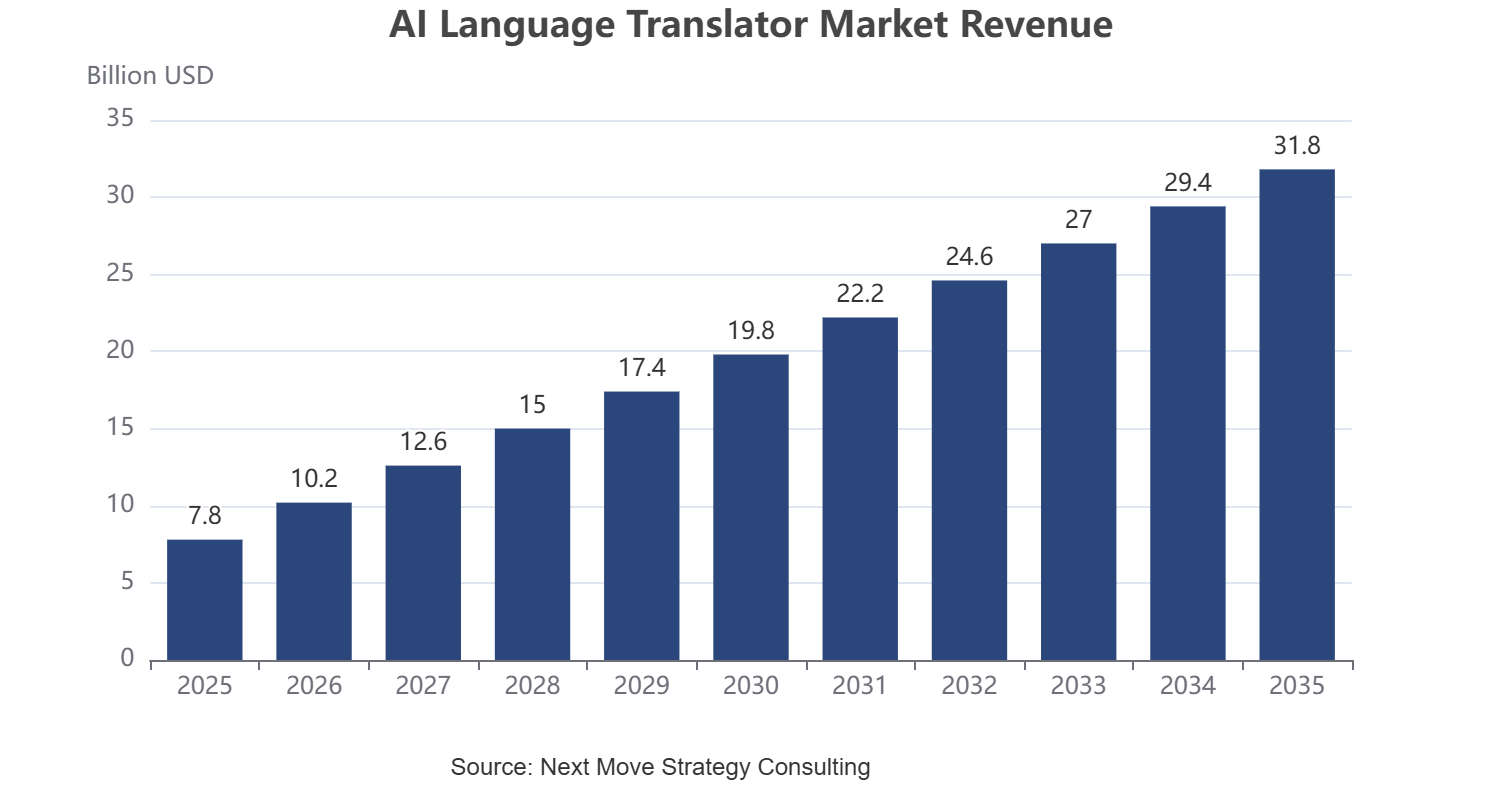
The AI Language Translator Market size was valued at USD 7.8 billion in 2025 and is expected to reach USD 9.5 billion in revenue by the end of 2026, before advancing to USD 31.8 billion by 2035 at a CAGR of 14.3% between 2026 and 2035. Growth is driven by expanding cross-border e-commerce, rising enterprise localization budgets, growing adoption of real-time speech translation among global enterprises, and increasing government mandates for multilingual digital access across public services worldwide.
Based on research conducted by NMSC, we found that the market is evolving from rule-based and statistical machine translation toward large language model powered engines capable of context-aware, tone-sensitive translation across text, speech, and document formats. Cloud API adoption is accelerating as software vendors embed translation directly into productivity, commerce, and customer service applications, while enterprises increasingly prioritize private cloud and hybrid deployment for regulated content across financial services, healthcare, and legal workflows.
|
Parameters |
Details |
|
Market Size in 2025 |
USD 7.8 Billion |
|
Market Size in 2026 |
USD 9.5 Billion |
|
Revenue Forecast in 2035 |
USD 31.8 Billion |
|
Growth Rate |
CAGR of 14.3% from 2026 to 2035 |
|
Analysis Period |
2025–2035 |
|
Base Year Considered |
2025 |
|
Forecast Period |
2026–2035 |
|
Market Size Estimation |
Revenue (USD Billion) |
|
Companies Profiled |
20 |
|
Countries Covered |
33 |
|
Market Share |
Available for Top 10 Companies |
AI Language Translator Market Overview
The AI Language Translator Industry spans consumer apps, cloud APIs, enterprise software, website translation tools, and speech translation platforms that convert text, speech, documents, and images across languages. Our analysis indicates that the industry is shifting from standalone neural machine translation engines toward large language model integrated platforms embedded within productivity and commerce software. Regulatory frameworks such as European Union language access rules, data localization requirements across China and the Gulf, and the United States Executive Order 13166 on limited English proficiency access are shaping vendor design toward compliance-ready, auditable translation. Enterprise technology adoption is accelerating as generative AI models mature.
|
Key Takeaways |
|
By offer type, Cloud APIs held the largest share of the AI Language Translator Market at USD 1.87 billion in 2025, driven by widespread programmatic integration of translation into enterprise and consumer software. The Speech Translation Tools segment is the fastest-growing sub-segment, projected to expand from USD 0.94 billion in 2025 to USD 5.52 billion by 2035 at a CAGR of 19.2%, fueled by rising enterprise adoption of real-time voice interpretation. |
|
By deployment mode, Public Cloud accounted for USD 4.06 billion in 2025, the largest deployment share in the AI Language Translator Market. The Hybrid model is the fastest-growing at a CAGR of 17% from 2026 to 2035, as enterprises combine public cloud scalability with private infrastructure for regulated content. |
|
By buyer type, Enterprise commanded the largest share at USD 2.65 billion in 2025. Public Sector is the fastest-growing buyer category in the AI Language Translator Market at a CAGR of 17.5% from 2026 to 2035, driven by rising government digital-access mandates. |
|
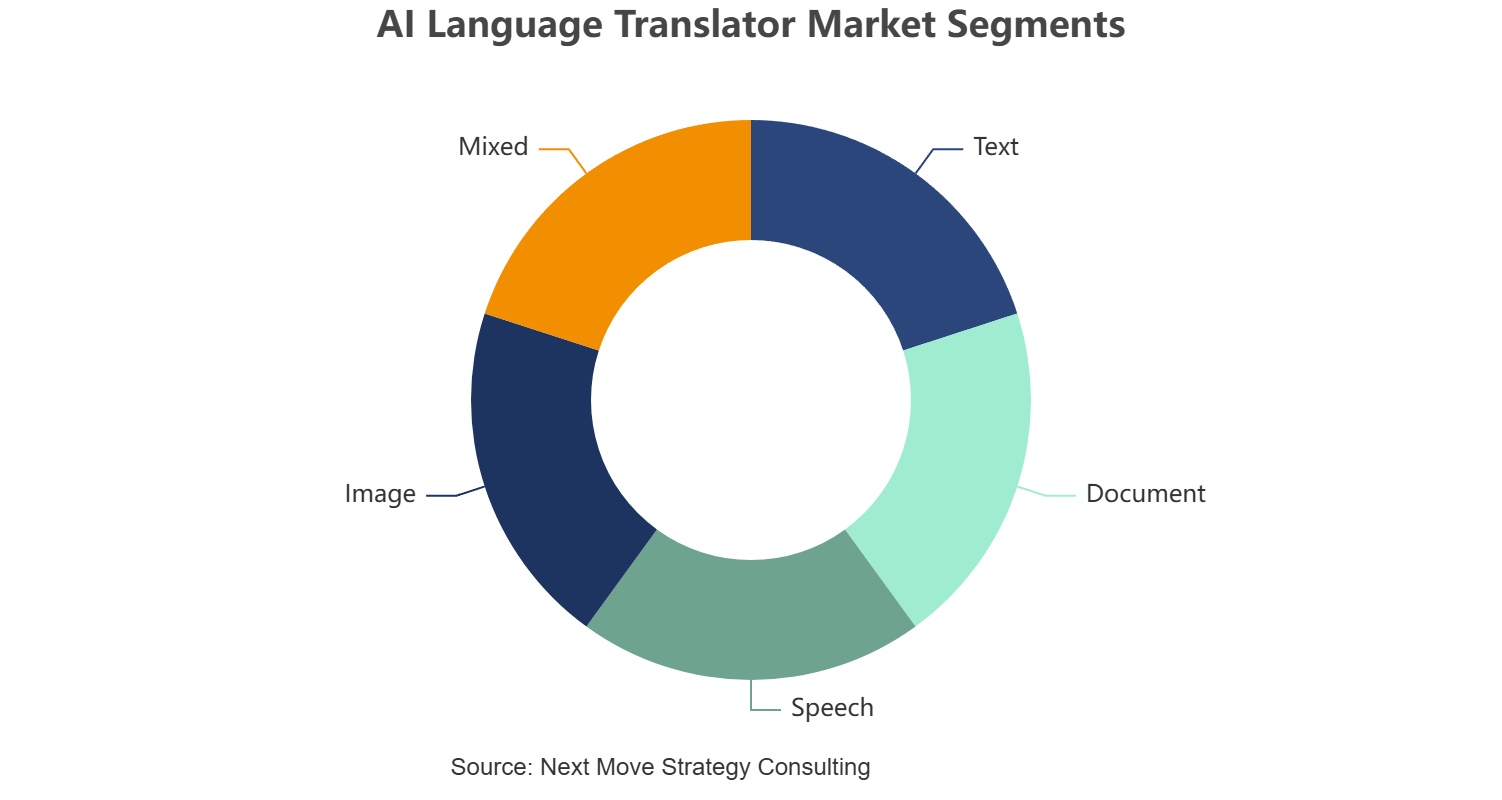
By modality, Text held USD 3.12 billion in 2025, the largest modality share. Speech is the fastest-growing modality at a CAGR of 19.4% from 2026 to 2035, reflecting rapid consumer and enterprise adoption of real-time conversational translation. |
|
By pricing model, Subscription led at USD 2.96 billion in 2025, the largest pricing share in the AI Language Translator Market. The Usage Based model is the fastest-growing at a CAGR of 18.6% from 2026 to 2035, as vendors increasingly price translation on a per-word or per-call basis. |
|
By sales channel, Direct Sales led at USD 2.81 billion in 2025, reflecting the enterprise-heavy nature of AI translation procurement. Marketplace is the fastest-growing channel in the AI Language Translator Market at a CAGR of 19.4%, as software marketplaces increasingly distribute embedded translation capability. |
|
By industry vertical, Technology and IT held USD 1.48 billion in 2025 and is forecast to reach USD 5.85 billion by 2035. Healthcare and Life Sciences is the fastest-growing vertical in the AI Language Translator Market at a CAGR of 18%, advancing from USD 0.86 billion in 2025 to USD 4.62 billion by 2035. |
|
North America held the largest regional share at USD 2.65 billion in 2025, projected to reach USD 8.77 billion by 2035 at a CAGR of 11.7%, anchored by leading AI translation vendors and the highest enterprise technology budgets. |
|
Asia-Pacific is the fastest-growing major region in the AI Language Translator Market at a CAGR of 17.7%, propelled by large-scale cross-border e-commerce and multilingual population growth across China and India. |
|
The U.S. dominated the AI Language Translator Industry in 2025, accounting for the largest share of global revenue, supported by the presence of major AI translation vendors and extensive enterprise localization budgets across technology, retail, and financial-services industries. |
|
India is projected to be the fastest-growing country in the AI Language Translator Industry during the forecast period, advancing at a CAGR of approximately 20.3%, driven by large-scale technical hiring, expanding IT-services exports, and strong enterprise willingness to adopt AI-native translation platforms. |
Consumer Behavior Analysis of the AI Language Translator Market
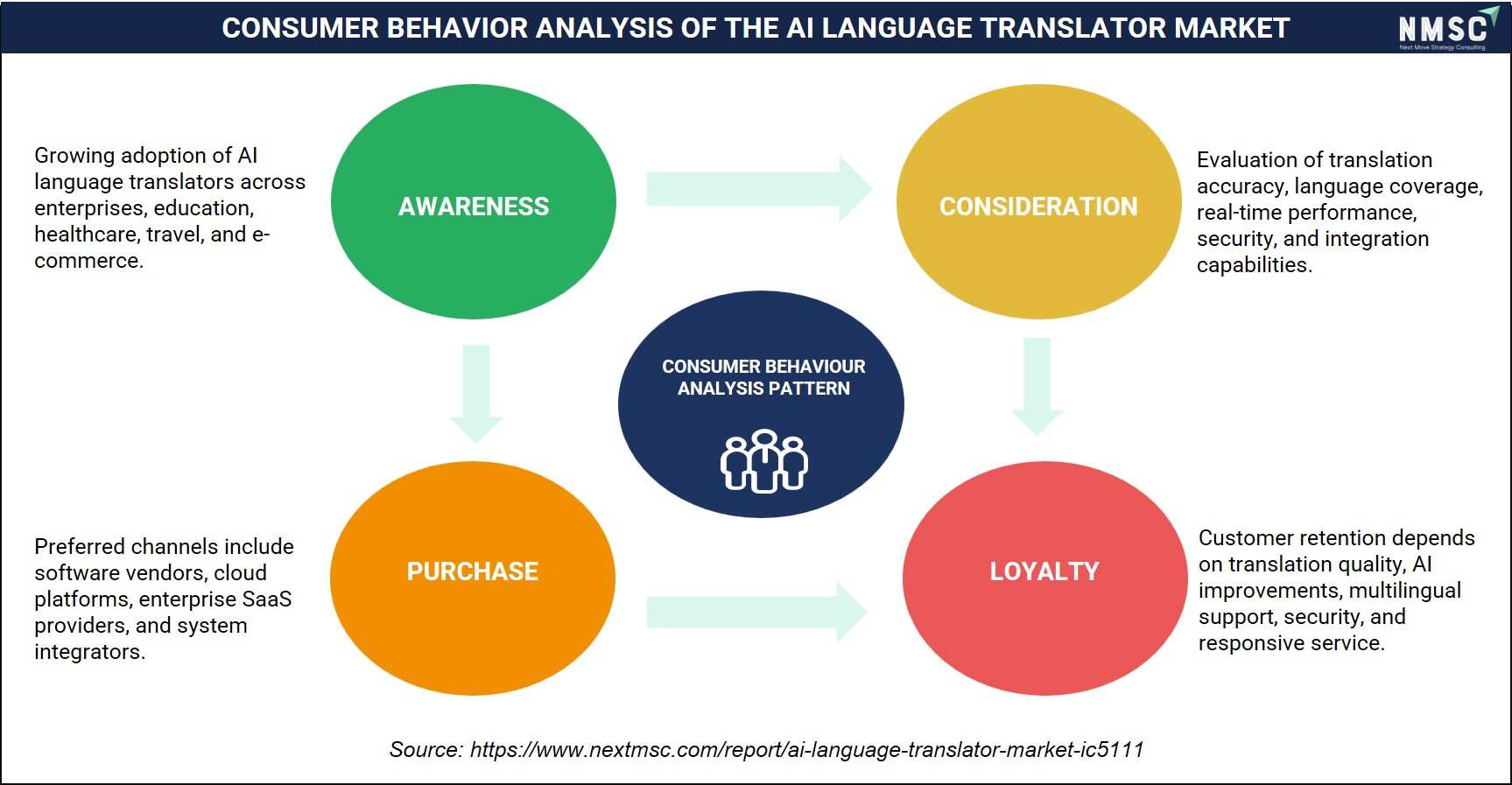
The infographic illustrates the consumer behavior journey in the Market, from awareness to loyalty. Organizations evaluate AI translation solutions based on accuracy, language coverage, security, and integration capabilities before adoption. Purchasing decisions are driven by trusted software providers, while long-term customer loyalty depends on translation quality, continuous AI enhancements, multilingual support, and reliable customer service.
Key Emerging Trends in the AI Language Translator Market
How Is Real-Time Speech AI Reshaping Cross-Border Communication?
Real-time, speech-to-speech translation is transforming how travelers, contact centers, and multinational teams communicate across languages. Google's January 2026 rollout of AI-powered live translation within the Translate app, enabling natural back-and-forth conversations with audio and on-screen output in more than 70 languages, illustrates this shift. Our research indicates that this transformation is extending translation from static text conversion into continuous, ambient conversational infrastructure, with headphone-based live interpretation emerging as an early enterprise and consumer use case.
How Are Large Language Models Improving Context-Aware Translation Quality?
NMSC's analysis indicates that large language model integration is materially improving translation nuance, particularly for idioms, slang, and tone-sensitive business communication. Google's February 2026 update brought Gemini-powered contextual alternatives to the Translate app, helping users choose the most appropriate phrasing for a given audience or dialect. This transformation is reshaping vendor roadmaps toward context-aware, explainable translation output rather than single, literal renderings, particularly for marketing, legal, and customer-facing enterprise content.
How Is Enterprise Demand for Compliance-Ready Translation Reshaping Vendor Strategy?
Our assessment indicates that tightening data-residency and content-governance expectations are pushing enterprise buyers toward secure, auditable AI translation infrastructure. RWS Holdings plc's March 2026 launch of Language Weaver Pro, a dedicated enterprise translation model built with governance and security controls for regulated content, reflects this shift. We expect vendors offering verifiable data handling, glossary-based consistency, and human-in-the-loop review to capture disproportionate share among financial-services, healthcare, and government buyers navigating divergent regional data rules.
What Are the Key Market Drivers, Restraints, and Investment Opportunities that will Shape the AI Language Translator Market in the Next Decade?
Growth Drivers, Restraints & Opportunities
|
Driver / Trend / Restraint |
(+/−) % Impact on CAGR Forecast |
Geographic Relevance |
Impact Timeline |
|
Expanding cross-border e-commerce driving demand for storefront and customer-support translation |
+3.0% |
North America, Europe, Asia-Pacific |
Medium term (2–4 years) |
|
Rising enterprise localization budgets and cloud API adoption across software vendors |
+2.6% |
North America, Western Europe, APAC |
Medium to Long term (3–6 years) |
|
Government mandates for multilingual digital access across public services |
+1.8% |
North America, European Union, GCC |
Medium term (2–5 years) |
|
Data privacy and cross-border data localization requirements raising compliance costs |
−1.5% |
European Union, China, GCC |
Medium term (2–4 years) |
|
Residual translation quality variability limiting adoption in high-stakes regulated content |
−1.0% |
North America, European Union, Japan |
Short to Medium term (1–3 years) |
What Are the Growth Drivers of the AI Language Translator Industry?
How Is Expanding Cross-Border E-Commerce Accelerating Demand for AI Translation?
Expanding cross-border e-commerce is a primary growth catalyst for the Market, as online retailers localize storefronts, product listings, and customer support across new markets. The European Commission's eTranslation service, part of the Digital Europe Programme, is used by public administrations and small and medium-sized businesses across the EU to translate content into all official EU languages, reflecting institutional-scale demand for accessible machine translation. NMSC's analysis indicates that retailers entering multilingual markets increasingly rely on API-based translation to launch storefronts faster than human-only localization allows.
How Is Enterprise Localization Spend Fueling Cloud API Adoption?
Enterprise localization spend is a significant growth driver as software vendors embed translation capability directly into productivity, commerce, and support platforms via cloud APIs. Google's continued expansion of its Cloud Translation service, including large language model-based translation and expanded glossary support across additional languages, reflects sustained enterprise investment in programmatic translation infrastructure. Our analysis indicates that this API-first approach is compressing localization timelines while enabling enterprises to embed translation natively within existing software workflows rather than relying on standalone tools.
How Do Data Privacy and Localization Requirements Restrain Market Growth?
We observed that evolving data-privacy and localization requirements represent a meaningful restraint on AI translation adoption, particularly for regulated content. The European Commission requires that data processed through its eTranslation service remain within secure institutional infrastructure and not be used to train commercial AI models, reflecting broader regulatory caution toward cross-border data flows. NMSC's assessment indicates that this evolving compliance landscape is raising implementation costs and lengthening procurement cycles among public-sector and heavily regulated enterprise buyers.
What Are the Growth Inhibitors of the AI Language Translator Industry?
How Does Translation Quality Variability Limit Adoption in High-Stakes Content?
Based on our assessment, residual quality variability across language pairs and domains continues to restrain adoption of fully automated translation in legal, medical, and regulatory content. Independent benchmarking cited in RWS Holdings plc's TrainAI research shows that performance gaps between major and underrepresented languages are narrowing but shift unpredictably between model releases. This uncertainty is prompting regulated buyers to retain human-in-the-loop review for business-critical translation rather than adopting fully autonomous machine output.
What Are the Growth Opportunities in the AI Language Translator Industry?
How Is Demand for Domain-Specific Enterprise Translation Creating Growth Opportunities?
Based on our assessment, we found that demand for domain-specific, enterprise-grade translation represents a significant growth opportunity for vendors able to differentiate on accuracy and security. RWS Holdings plc's March 2026 launch of Language Weaver Pro, a large dedicated translation model built for business-critical content in partnership with Cohere, illustrates how vendors are positioning specialized accuracy as a competitive advantage over general-purpose AI models. We expect vendors offering verifiable, benchmarked domain accuracy to capture disproportionate share among regulated enterprise buyers.
Regulatory Framework Impacting the AI Language Translator Market
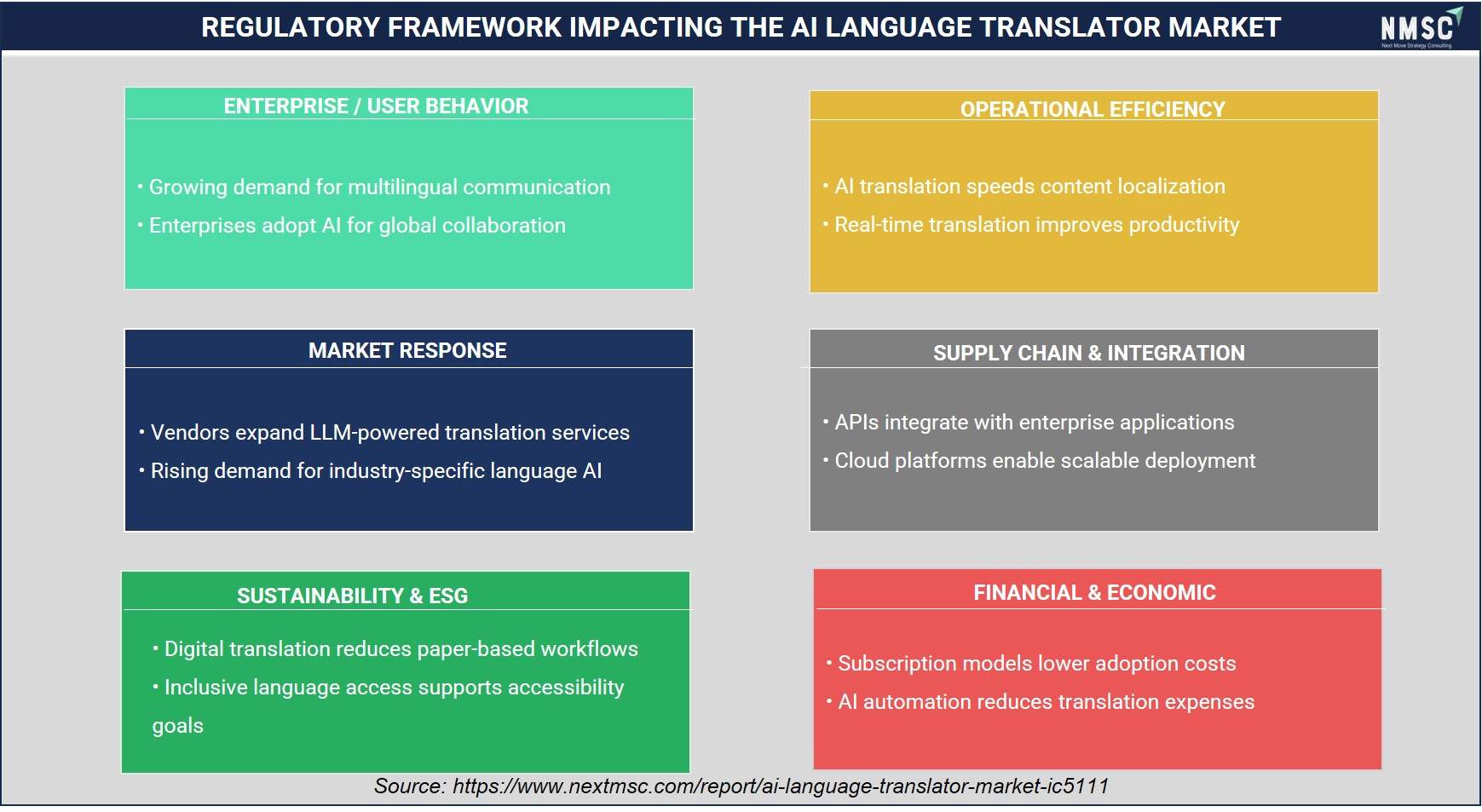
The infographic highlights the strategic framework influencing the AI Language Translator Market, emphasizing enterprise adoption, operational efficiency, market innovation, cloud integration, sustainability, and financial benefits. Growing demand for multilingual communication and AI-powered localization is driving technology adoption, while scalable cloud deployment, subscription-based pricing, and responsible AI practices are enabling organizations to improve global collaboration, accessibility, and cost-efficient multilingual operations.
How Is the AI Language Translator Industry Segmented in This Report, and What Are the Key Insights from the Segmentation Analysis?
Which Offer Type Leads the AI Language Translator Market, and Which Is Growing Fastest?
|
Offer Type Segment |
2025 (USD Bn) |
2035 (USD Bn) |
CAGR (%) |
|
Cloud APIs |
1.87 |
9.49 |
17.2% |
|
Enterprise Software |
1.64 |
6.84 |
14.7% |
|
Consumer Apps |
1.48 |
3.82 |
8.7% |
|
Speech Translation Tools |
0.94 |
5.52 |
19.2% |
|
Website Translation Tools |
0.70 |
2.31 |
11.7% |
|
Embedded and OEM Tools |
0.70 |
2.71 |
13.7% |
|
Other Tool Revenue |
0.47 |
1.11 |
7.7% |
|
Total |
7.80 |
31.80 |
14.3% |
Based on our analysis of enterprise procurement patterns and vendor product roadmaps, the AI Language Translator Industry is structured across cloud APIs, enterprise software, consumer apps, speech translation tools, website translation tools, embedded and OEM tools, and other tool revenue. Cloud APIs lead in 2025 given their broad programmatic integration into commerce, productivity, and support software. Speech Translation Tools is the fastest-growing offer type at a 19.2% CAGR, as real-time conversational and meeting-captioning use cases scale across enterprise and consumer segments.
Which Buyer Type Drives the Largest Share of AI Language Translator Adoption?
|
Buyer Type Segment |
2025 (USD Bn) |
2035 (USD Bn) |
CAGR (%) |
|
Enterprise |
2.65 |
11.76 |
15.4% |
|
Mid-Market |
1.56 |
7.48 |
16.4% |
|
Small Business |
1.25 |
4.73 |
13.4% |
|
Consumer |
1.17 |
2.95 |
8.4% |
|
Prosumer |
0.70 |
2.45 |
12.4% |
|
Public Sector |
0.47 |
2.43 |
17.5% |
|
Total |
7.80 |
31.80 |
14.3% |
Through our market assessment, the AI Language Translator Industry is segmented by buyer type into enterprise, mid-market, small business, consumer, prosumer, and public sector buyers. Enterprise buyers dominate, reflecting large-scale localization budgets across multinational technology, retail, and financial-services organizations. Public Sector is the fastest-growing buyer category, propelled by government digital-access mandates and multilingual citizen-service requirements that are driving structured procurement of compliance-ready translation platforms across national and regional government agencies.
Which Industry Vertical Leads Demand for AI Language Translator Solutions?
|
Industry Vertical Segment |
2025 (USD Bn) |
2035 (USD Bn) |
CAGR (%) |
|
Technology and IT |
1.48 |
5.85 |
14.0% |
|
Retail and Ecommerce |
1.17 |
5.00 |
15.0% |
|
Financial Services |
1.01 |
3.70 |
13.0% |
|
Healthcare and Life Sciences |
0.86 |
4.62 |
18.0% |
|
Government and Public Sector |
0.70 |
3.24 |
16.0% |
|
Travel and Hospitality |
0.62 |
2.27 |
12.9% |
|
Media and Entertainment |
0.62 |
2.10 |
12.0% |
|
Education |
0.47 |
2.33 |
16.9% |
|
Legal and Compliance |
0.39 |
1.31 |
11.9% |
|
Manufacturing and Automotive |
0.31 |
0.97 |
11.0% |
|
Other |
0.17 |
0.41 |
8.9% |
|
Total |
7.80 |
31.80 |
14.3% |
Based on industry vertical, the AI Language Translator Industry is segmented into technology and IT, retail and ecommerce, financial services, healthcare and life sciences, government and public sector, travel and hospitality, media and entertainment, education, legal and compliance, manufacturing and automotive, and other industries. Technology and IT leads, reflecting sustained investment in embedded translation APIs and multilingual product experiences. Healthcare and Life Sciences is the fastest-growing vertical, as providers and life-sciences companies deploy AI-assisted translation to manage multilingual patient communication and regulatory documentation.
Regional Outlook
Geographic Performance Snapshot
|
Region |
2025 (USD Bn) |
2035 (USD Bn) |
CAGR (%) |
Key Driver |
|
North America |
2.65 |
8.77 |
11.7% |
Enterprise localization budgets and cloud API adoption |
|
Europe |
2.03 |
7.26 |
12.7% |
Regulatory-driven demand for compliant, auditable translation |
|
Asia-Pacific |
2.11 |
11.13 |
17.7% |
Large-scale cross-border e-commerce and multilingual population growth |
|
Middle East & Africa |
0.55 |
2.67 |
16.7% |
Government digital-transformation and workforce-nationalization programs |
|
Latin America |
0.46 |
1.97 |
14.8% |
Expanding nearshore customer-service and e-commerce localization |
|
Total |
7.80 |
31.80 |
14.3% |
|
North America AI Language Translator Market
North America is the dominant region in the global Market, contributing USD 2.65 billion in 2025 and forecast to reach USD 8.77 billion by 2035 at a CAGR of 11.7%. The region benefits from the headquarters of leading AI translation vendors including Google LLC, Microsoft Corporation, and Amazon.com, Inc., alongside sustained enterprise localization budgets across technology, retail, and financial-services sectors. Growing use of Executive Order 13166 language-access compliance among federal and state agencies is reinforcing steady public-sector demand for AI-assisted translation infrastructure.
U.S. AI Language Translator Market
Based on our engagements with enterprise localization leaders, the United States represents the largest share of North American Market revenue in 2025, valued at approximately USD 1.85 billion and forecast to reach approximately USD 6.14 billion by 2035 at a CAGR of approximately 11.6%. The U.S. benefits from the world's highest concentration of enterprise technology budgets and the presence of Google LLC, Microsoft Corporation, and Amazon.com, Inc. The U.S. Census Bureau's ongoing collection of language-use data under Executive Order 13166 continues to sustain public-sector demand for multilingual digital access.
Canada AI Language Translator Market
Through our analysis, Canada represents an approximate USD 0.45 billion share of the North American Market in 2025, forecast to reach approximately USD 1.49 billion by 2035 at a CAGR of approximately 13.0%. Growth is supported by bilingual English-French public-sector translation requirements and expanding enterprise adoption of cloud-based translation among Toronto and Vancouver technology employers. Canada's federal language-services obligations continue to anchor steady public-sector procurement of compliant translation platforms.
Europe AI Language Translator Market
Europe is the second-largest region in the Market, contributing USD 2.03 billion in 2025 and forecast to reach USD 7.26 billion by 2035 at a CAGR of 12.7%. The region's regulatory environment, shaped by European Commission data-protection standards and the eTranslation service operated by the Directorate-General for Translation, drives structured investment in secure, auditable machine translation over unregulated consumer tools. Demand is concentrated among multinational enterprises, public administrations, and small and medium-sized businesses across the region's largest markets.
U.K. AI Language Translator Market
Based on our engagements, the United Kingdom is Europe's largest individual Market, valued at approximately USD 0.49 billion in 2025 and forecast to reach approximately USD 1.74 billion by 2035 at a CAGR of approximately 13.5%. London's status as a global financial and professional-services hub makes multinational enterprises dominant buyers of enterprise translation platforms. RWS Holdings plc, headquartered in Maidenhead, is a notable domestic vendor serving regulated life-sciences, legal, and financial-services clients.
Germany AI Language Translator Market
According to our evaluation, Germany is Europe's second-largest , valued at approximately USD 0.41 billion in 2025 and forecast to reach approximately USD 1.45 billion by 2035 at a CAGR of approximately 13.2%. DeepL SE, headquartered in Cologne, is a leading domestic vendor whose neural machine translation technology serves enterprise and consumer users worldwide. Germany's rigorous data-protection standards under EU law continue to favor vendors offering explainable, secure translation infrastructure for manufacturing and automotive clients.
France AI Language Translator Market
Through our analysis, France represents the third-largest European Market, valued at approximately USD 0.28 billion in 2025 and forecast to reach approximately USD 1.02 billion by 2035 at a CAGR of approximately 13.6%. SYSTRAN SA, headquartered in Paris, is a long-established domestic machine translation vendor serving government and enterprise clients. Large public-sector and multinational-enterprise localization programs concentrated around Paris continue to support steady market expansion.
Asia-Pacific AI Language Translator Market
Asia-Pacific is the fastest-growing major region in the Market, advancing from USD 2.11 billion in 2025 to an estimated USD 11.13 billion by 2035 at a CAGR of 17.7%. The region's growth is driven by massive cross-border e-commerce volumes across China and India, expanding cloud infrastructure, and rising smartphone penetration. Domestic technology conglomerates including Alibaba Group Holding Limited, Tencent Holdings Limited, Baidu, Inc., and Huawei Technologies Co., Ltd. are accelerating adoption of AI-native translation across commerce, cloud, and communication platforms.
China AI Language Translator Market
Based on our engagements, China is the largest individual Market in Asia-Pacific, valued at approximately USD 0.63 billion in 2025 and forecast to reach approximately USD 3.34 billion by 2035 at a CAGR of approximately 17.2%. Alibaba Group Holding Limited, Tencent Holdings Limited, and Baidu, Inc. are active domestic vendors embedding translation into cross-border e-commerce and cloud platforms. Competitive intensity is rising as domestic technology vendors expand alongside international entrants.
India AI Language Translator Market
Through our analysis, India is the fastest-growing Market in Asia-Pacific, advancing at a CAGR of approximately 20.3%, from approximately USD 0.46 billion in 2025 to approximately USD 2.45 billion by 2035. Growth is propelled by exceptionally high-volume information-technology and business-process-outsourcing exports, where AI-assisted translation reduces turnaround time across large multilingual content pipelines. Rising smartphone penetration and strong enterprise willingness to adopt cloud-based translation APIs reinforce India's long-term growth trajectory.
Japan AI Language Translator Market
According to our evaluation, Japan is the second-largest Asia-Pacific Market, valued at approximately USD 0.30 billion in 2025 and forecast to reach approximately USD 1.56 billion by 2035 at a CAGR of approximately 15.4%. Rozetta Corp. and Mirai Translate, Inc., both domestic vendors, serve enterprise and government clients requiring high-accuracy Japanese-language translation. Persistent labor shortages and an aging workforce encourage employers to adopt AI-assisted translation to manage multilingual business communication efficiently.
South Korea AI Language Translator Market
From our assessment, South Korea demonstrates high Market maturity, valued at approximately USD 0.19 billion in 2025 and forecast to reach approximately USD 1.00 billion by 2035 at a CAGR of approximately 17.4%. NAVER Corporation, developer of the Papago translation service, is a leading domestic vendor supporting strong consumer and enterprise adoption. High smartphone and broadband penetration continue to support consistent candidate and consumer acceptance of AI-assisted translation formats.
Middle East and Africa (MEA) AI Language Translator Market
The Middle East and Africa region represents a growing segment of the Market, advancing from USD 0.55 billion in 2025 to USD 2.67 billion by 2035 at a CAGR of 16.7%. Vision-driven national digital-transformation programs in Saudi Arabia and the UAE are the primary growth engines, supplemented by South Africa's established business-process-outsourcing hub. Continued digital-economy investment and expanding formal-sector employment support substantial long-term opportunity across the region.
Saudi Arabia AI Language Translator Market
Based on our engagements, Saudi Arabia is the largest Market within MEA, valued at approximately USD 0.15 billion in 2025 and forecast to reach approximately USD 0.75 billion by 2035 at a CAGR of approximately 18.0%. Vision 2030's digital-transformation agenda is driving large-scale government and banking investment in Arabic-language AI translation infrastructure. Public-sector employers are increasingly adopting AI-assisted translation to support multilingual citizen services and international business communication.
UAE AI Language Translator Market
Through our analysis, the UAE is the second-largest Market in MEA, valued at approximately USD 0.13 billion in 2025 and forecast to reach approximately USD 0.64 billion by 2035 at a CAGR of approximately 16.8%. Dubai and Abu Dhabi's ambitions as global business hubs are driving adoption of AI-assisted translation across finance, tourism, and government services. Continued investment in digital-government infrastructure supports steady long-term market expansion.
South Africa AI Language Translator Market
Through our analysis, South Africa represents one of the leading Markets in Africa, valued at approximately USD 0.09 billion in 2025 and forecast to reach approximately USD 0.43 billion by 2035 at a CAGR of approximately 15.4%. South Africa's well-established business-process-outsourcing sector is a key adopter of AI-assisted translation and multilingual customer-support tools serving both domestic and international clients across its eleven official languages.
Latin America AI Language Translator Market
Latin America is an emerging segment of the global Market, advancing from USD 0.46 billion in 2025 to USD 1.97 billion by 2035 at a CAGR of 14.8%. Expanding cross-border e-commerce and customer-service outsourcing across Brazil and Argentina are the primary demand drivers, reinforced by rising nearshoring of customer-support roles from North America. Cost-sensitive, high-volume operations favor cloud-based translation APIs over premium enterprise licensing, though adoption of advanced tools is gradually increasing.
Brazil AI Language Translator Market
Based on our engagements, Brazil is the largest Market in Latin America, valued at approximately USD 0.21 billion in 2025 and forecast to reach approximately USD 0.91 billion by 2035 at a CAGR of approximately 16.0%. Large-scale retail, banking, and business-process-outsourcing operations concentrated in São Paulo drive steady demand for Portuguese-language AI translation. Growing multinational presence is gradually increasing adoption of more advanced AI-assisted translation tools.
Argentina AI Language Translator Market
Through our analysis, Argentina is the second-largest Market in Latin America, valued at approximately USD 0.09 billion in 2025 and forecast to reach approximately USD 0.37 billion by 2035 at a CAGR of approximately 14.8%. A growing technology and business-process-outsourcing sector centered in Buenos Aires is encouraging steady adoption of AI-assisted translation tools serving both domestic and international clients despite broader macroeconomic volatility.
Competitive Landscape
Competitive Dynamics and M&A Landscape
|
Key Takeaways |
Details |
|
Market Structure |
The AI Language Translator Market is moderately fragmented, with global technology platforms such as Google LLC, Microsoft Corporation, and Amazon.com, Inc. competing alongside specialized vendors including DeepL SE, RWS Holdings plc, and SYSTRAN SA across distinct offer types and geographies. |
|
Innovation Focus |
Competitive differentiation is increasingly centered on large language model integrated translation, real-time speech-to-speech capability, and enterprise-grade data governance, as reflected in recent product launches from Google LLC and RWS Holdings plc. |
|
M&A Activity |
Consolidation and strategic partnership activity is accelerating as platform leaders and specialist vendors combine capabilities to expand large language model translation depth, exemplified by RWS Holdings plc's March 2026 partnership with Cohere to launch Language Weaver Pro. |
How Do Companies Compete in the AI Language Translator Industry?
The AI Language Translator Industry is characterized by multi-dimensional competition across translation quality, language-pair coverage, and enterprise integration depth. Google LLC, Microsoft Corporation, and Amazon.com, Inc. compete on cloud-platform breadth and language-pair scale, while DeepL SE and RWS Holdings plc compete on translation accuracy and enterprise-grade security for regulated content. NMSC's analysis indicates that market structure is evolving from discrete translation-tool competition toward platform ecosystem competition, where vendors differentiate through the completeness of their offering spanning text, speech, document, and API-based translation.
Which Competitive Archetypes Dominate the AI Language Translator Market?
Three competitive archetypes dominate the Market: global cloud platforms such as Google LLC and Microsoft Corporation that bundle translation within broader productivity and cloud ecosystems; specialized AI-native vendors such as DeepL SE and Lilt, Inc. that compete on translation quality and enterprise focus; and regional or vertical specialists such as NAVER Corporation, Rozetta Corp., and Pangeanic B.I. Europa S.L. that serve language-specific or domain-specific enterprise and government needs across their home markets.
What Innovation and Differentiation Strategies Define Market Leadership?
Our assessment indicates that large language model integration and real-time speech capability have become the primary competitive frontier in the AI Language Translator Industry, with vendors racing to embed context-aware translation, live conversational interpretation, and domain-specific accuracy within their core platforms. Explainability, glossary consistency, and secure data handling are becoming key competitive strategies enabling regulatory-risk reduction and enterprise trust at scale. Vendors that successfully combine large model accuracy with verifiable governance are capturing disproportionate share among enterprise and public-sector buyers.
How Is M&A Activity Shaping the AI Language Translator Industry?
Merger, acquisition, and strategic-partnership activity is expected to intensify within the AI Language Translator Industry through 2035, driven by platform leaders seeking to acquire or partner for best-of-breed large language model translation technology. RWS Holdings plc's March 2026 partnership with Cohere to launch Language Weaver Pro exemplifies this trend. Based on our analysis, the most likely consolidation targets include mid-tier specialist vendors with strong niche positioning in speech translation, domain-specific accuracy, or regional language distribution.
Key Market Players
-
Microsoft Corporation
-
Amazon.com, Inc.
-
DeepL SE
-
Tencent Holdings Limited
-
Baidu, Inc.
-
Huawei Technologies Co., Ltd.
-
NAVER Corporation
-
Yandex
-
RWS Holdings plc
-
SYSTRAN SA
-
Lilt, Inc.
-
Translated S.r.l.
-
Rozetta Corp.
-
Mirai Translate, Inc.
-
iTranslate GmbH
-
Tilde, SIA
-
Omniscien Technologies
-
Pangeanic B.I. Europa S.L.
What Are the Latest Developments in the AI Language Translator Industry?
|
Date |
Event |
|
Dec 2025 |
Google announced a major upgrade to Google Translate, integrating Gemini-powered AI to improve contextual translations, speech translation, and language learning capabilities. |
|
January 2026 |
DeepL launched its next-generation Language AI LLM specifically designed for translation and editing. The company stated that the model outperformed GPT-4, Google, and Microsoft in blind translation quality evaluations, marking a major advancement in enterprise AI translation. |
Expert Insights
 "More and more companies are exploring the potential of AI and are looking for technology that delivers real value and ROI. DeepL goes beyond being a cutting-edge AI company we're building AI that delivers tangible, proven benefits for a variety of important language use cases ranging from internal operations to customer service. Our mission is to break down language barriers for businesses worldwide."
— Jarek Kutylowski, CEO & Founder, DeepL
Statement made during DeepL's official announcement of its global expansion into 165 new markets, highlighting the increasing enterprise demand for AI-powered language solutions that deliver measurable business value and support multilingual communication across global operations.
Market Interpretation
The statement highlights the growing enterprise demand for AI language translation solutions that deliver measurable business value rather than simply providing translation capabilities. As organizations expand globally, AI-powered translators are increasingly being integrated into customer support, internal collaboration, content localization, and cross-border business communication to improve operational efficiency and reduce language barriers. This trend is accelerating the adoption of secure, enterprise-grade AI language translation platforms capable of supporting multilingual workflows, enhancing productivity, and enabling organizations to scale international operations more effectively.
What Are the Investment Opportunities in the AI Language Translator Industry?
The AI Language Translator Industry is attracting substantial investment driven by rising demand for large language model (LLM)-powered translation, real-time multilingual speech translation, and enterprise-grade language AI platforms with robust security and compliance capabilities. Continued investments by leading companies such as DeepL SE, Google LLC, and RWS Holdings plc are accelerating technological innovation, expanding multilingual AI capabilities, and strengthening global market adoption. Infrastructure investments are increasingly focused on cloud-native, multi-region deployments to support enterprise-scale operations, while organizations are prioritizing platforms that demonstrate responsible AI practices, transparent data governance, accessibility compliance, and secure handling of multilingual business communications across highly regulated industries.
Key Benefits for Stakeholders
The AI Language Translator Industry report provides actionable intelligence for enterprise technology leaders, investors, language service providers, and AI technology vendors through comprehensive market sizing, long-term forecasts, competitive benchmarking, and technology adoption analysis through 2035. It supports strategic investment planning, product innovation, and market expansion by evaluating high-growth translation applications, deployment models, enterprise adoption trends, and regional market opportunities. Country-level market analysis, competitive intelligence, and evolving AI language technology trends further enable informed decision-making, efficient resource allocation, and sustainable business growth across the rapidly evolving AI language translation ecosystem.
Key Market Segments
By Offer Type
-
Consumer apps
-
Text apps
-
Voice apps
-
Camera apps
-
Browser extensions
-
Other apps
-
-
Cloud APIs
-
Text API
-
Document API
-
Speech API
-
Custom model API
-
Other API
-
-
Enterprise software
-
SaaS portal
-
Private cloud
-
On-premise server
-
Embedded SDK
-
Other enterprise software
-
-
Website translation tools
-
Website widget
-
CMS plugin
-
Other website tool
-
-
Speech translation tools
-
Live interpretation
-
Meeting captioning
-
Contact centre
-
Other speech tool
-
-
Embedded and OEM tools
-
Third party SDK
-
White label
-
Device bundle
-
Other embedded tool
-
-
Other tool revenue
-
Bundled offering
-
Legacy license
-
OEM revenue
-
By Deployment Mode
-
Public cloud
-
Private cloud
-
On-premise
-
Hybrid
-
Offline
By Buyer Type
-
Consumer
-
Prosumer
-
Small business
-
Mid-market
-
Enterprise
-
Public sector
By Modality
-
Text
-
Document
-
Speech
-
Image
-
Mixed
By Pricing Model
-
Usage based
-
Subscription
-
License
-
Freemium
-
Bundled
By Sales Channel
-
Direct sales
-
Self-serve
-
Marketplace
-
OEM partner
-
Reseller
By Industry Vertical
-
Technology and IT
-
Healthcare and life sciences
-
Legal and compliance
-
Financial services
-
Travel and hospitality
-
Retail and ecommerce
-
Government and public sector
-
Media and entertainment
-
Education
-
Manufacturing and automotive
-
Other
By Region
-
North America: U.S., Canada, Mexico.
-
Europe: UK, Germany, France, Italy, Spain, Sweden, Denmark, Finland, Netherlands, Rest of Europe.
-
Asia-Pacific: China, India, Japan, South Korea, Taiwan, Indonesia, Vietnam, Australia, Australia, Philippines, Malaysia, Rest of APAC.
-
Middle East & Africa: Saudi Arabia, UAE, Egypt, Israel, Turkey, Nigeria, South Africa, Rest of MEA.
-
Latin America: Brazil, Argentina, Chile, Colombia, Rest of LATAM.
Conclusion and Recommendations
The Market is expected to witness sustained growth through 2035, driven by expanding cross-border e-commerce, rising enterprise localization budgets, and increasing government mandates for multilingual digital access. Vendors should prioritize large language model integrated translation, verifiable data governance, and real-time speech capability spanning text, document, and conversational formats to strengthen competitiveness. Organizations can maximize long-term value by adopting phased modernization strategies that advance from standalone translation tools to fully integrated, compliance-ready AI translation platforms, enabling scalable, secure, and high-performance multilingual infrastructure for future global operations.
About the Author
 Liza Phukan
— Liza Phukan is Research Associate at Next Move Strategy Consulting, where she has covered emerging industries and market research across sectors for 3.5 years. Her work includes analyzing industry developments, validating market data, and developing structured business content from research findings. She uses secondary research and data-validation practices to turn complex market information into clear decision-useful market analysis for business audiences and support report development and B2B.
Liza Phukan
— Liza Phukan is Research Associate at Next Move Strategy Consulting, where she has covered emerging industries and market research across sectors for 3.5 years. Her work includes analyzing industry developments, validating market data, and developing structured business content from research findings. She uses secondary research and data-validation practices to turn complex market information into clear decision-useful market analysis for business audiences and support report development and B2B.
About the Reviewer
 Supradip Baul
— Supradip Baul is an accomplished business consultant and strategist with over a decade of rich experience in market intelligence, strategy, technology, and business transformation. His work has included rigorous qualitative and quantitative analysis across multiple industries, helping clients shape investment decisions and long-term roadmaps. Earlier in his career, he was associated with Gartner, where he contributed to industry-leading reports and market share analyses. He has worked with leading global companies and holds an MBA with a dual specialization in Marketing and Finance.
Supradip Baul
— Supradip Baul is an accomplished business consultant and strategist with over a decade of rich experience in market intelligence, strategy, technology, and business transformation. His work has included rigorous qualitative and quantitative analysis across multiple industries, helping clients shape investment decisions and long-term roadmaps. Earlier in his career, he was associated with Gartner, where he contributed to industry-leading reports and market share analyses. He has worked with leading global companies and holds an MBA with a dual specialization in Marketing and Finance.
At Next Move Strategy Consulting, we understand that insightful market research is the cornerstone of successful business decisions. That's why we employ a robust and multifaceted approach, combining various methodologies to deliver the most accurate and actionable data for our clients.

Research Landscape
We navigate the world of research with two primary approaches:
Qualitative Approach
Our qualitative research methodologies involve immersive techniques such as in-depth interviews, focus groups, and observational studies. By engaging directly with individuals and stakeholders, we uncover valuable insights that quantitative data alone may overlook.

Quantitative Research
In tandem with qualitative methodologies, NMSC leverages the power of Quantitative Research to provide a robust foundation of numerical insights. Through systematic data collection and analysis, we quantify patterns, preferences, and market trends, offering a comprehensive view of the business landscape.
Our quantitative research approach employs diverse tools, including surveys, experiments, and statistical modelling. These methodologies enable us to gather data from a large and representative sample, ensuring the statistical significance of our findings. By employing structured questionnaires and standardized data collection methods, we guarantee the reliability and validity of the information we present to our clients.
Quantitative research is particularly effective in measuring the prevalence of trends, assessing market size, and gauging the impact of various factors on consumer behavior. The numerical precision attained through this approach equips our clients with actionable insights, facilitating data-driven decision-making and strategy formulation.


Our Specialized Toolbox for Industry-Specific Market Research
We deploy a specialized arsenal of techniques tailored to meet your unique requirements. Here's a glimpse into our comprehensive toolbox:

Information Procurement
The stage entails acquiring market data or relevant information through various sources and methodologies.


Market Research Approach
We utilize both top-down and bottom-up approaches in market research analysis to achieve a comprehensive understanding of the market dynamics, leveraging the broad perspective of industry trends and macroeconomic factors alongside detailed insights from specific segments and individual companies.

Porters Five Forces Analysis
We conduct Porter's Five Forces analysis to evaluate the competitive landscape of an industry, providing us with insights into factors that affect profitability and strategic positioning.

SWOT Analysis

Forecasting
We utilize a forecasting model to predict future consumption by considering parameters like population, economics, regulations, market competition, drivers, constraints, technology, and pricing. We also employ statistical techniques such as multilinear regression, exponential smoothing, moving average, ARIMA, and Monte Carlo simulations for accurate predictions. In econometric forecasting, we analyzed short-term and long-term event impacts, attributing values based on regulatory frameworks, economic factors, and market events.





 Speak to Our Analyst