AI-Enabled Spatial Management Market Size, Share, Trends and Growth Analysis, By Solution Type (Spatial Analytics Software, Occupancy Sensing Hardware, Space Planning and Optimization Software, Digital Twin and 3D Mapping Platforms, and Workplace Experience Applications), By Deployment Mode (Cloud-based, On-premise, and Hybrid), By Application (Corporate Office Space Management, Retail and Commercial Real Estate, and Others), and Region — Global Industry Report and Forecast, 2026–2035
Industry: ICT & Media | Publishing Date: August 7, 2026 | Last Updated: August 7, 2026 | No of Pages: N/A | No. of Tables: N/A | No. of Figures: N/A | Format: PDF | Report Code: IC5632
What Is the AI-Enabled Spatial Management Market Size?
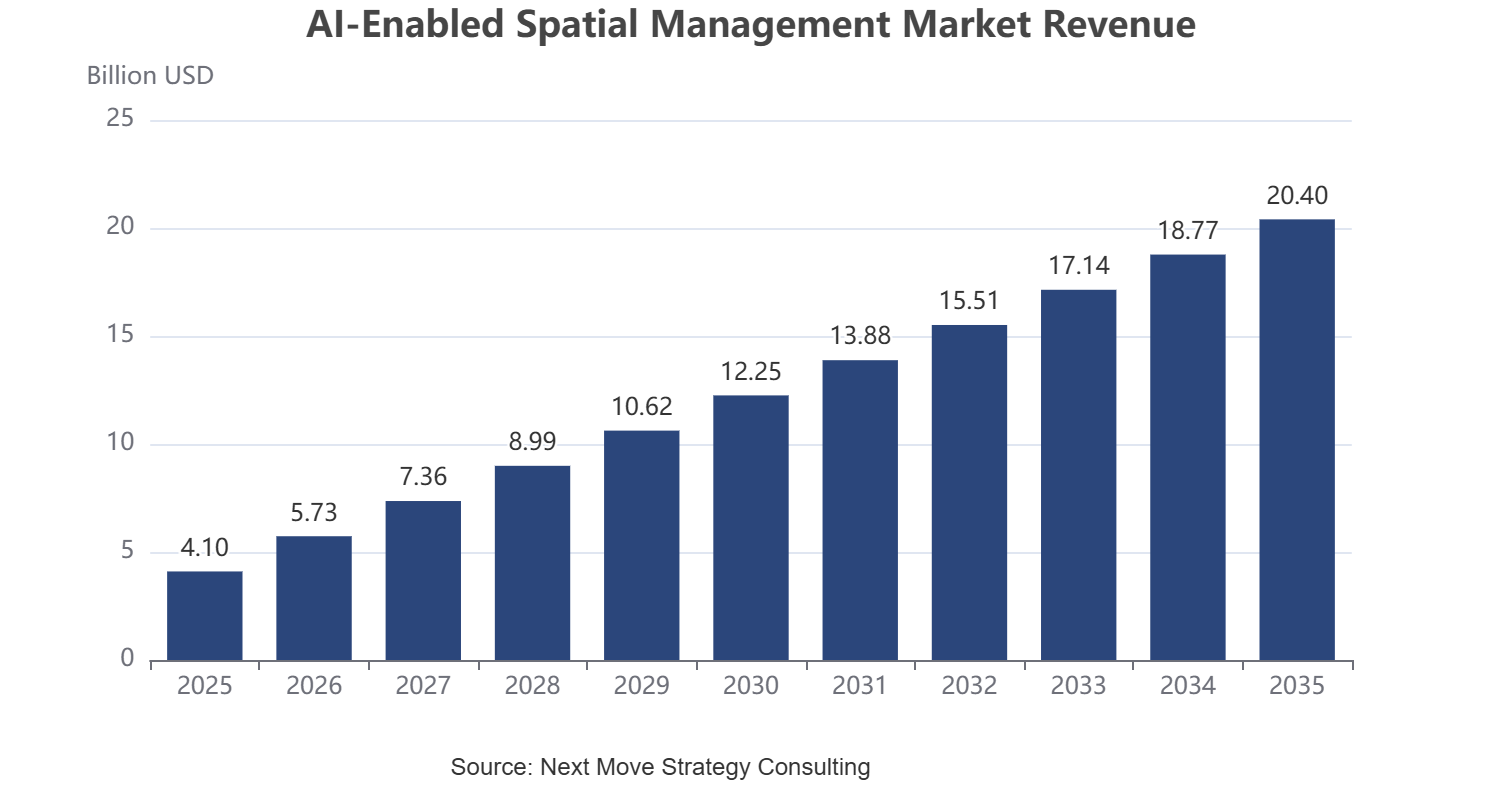
The global AI-Enabled Spatial Management Market size was valued at USD 4.10 billion in 2025 and is estimated at USD 4.85 billion in 2026, forecast to reach USD 20.40 billion by 2035, expanding at a 17.30% CAGR between 2026 and 2035. North America leads with approximately 46% share, while spatial analytics software dominates all solution types with approximately 34% share.
We observed that growth is broad-based across every segmentation axis, with predictive spatial modeling and digital twin convergence driving the dominant structural shifts in the AI-enabled spatial management market through 2035.
|
Key Takeways |
|
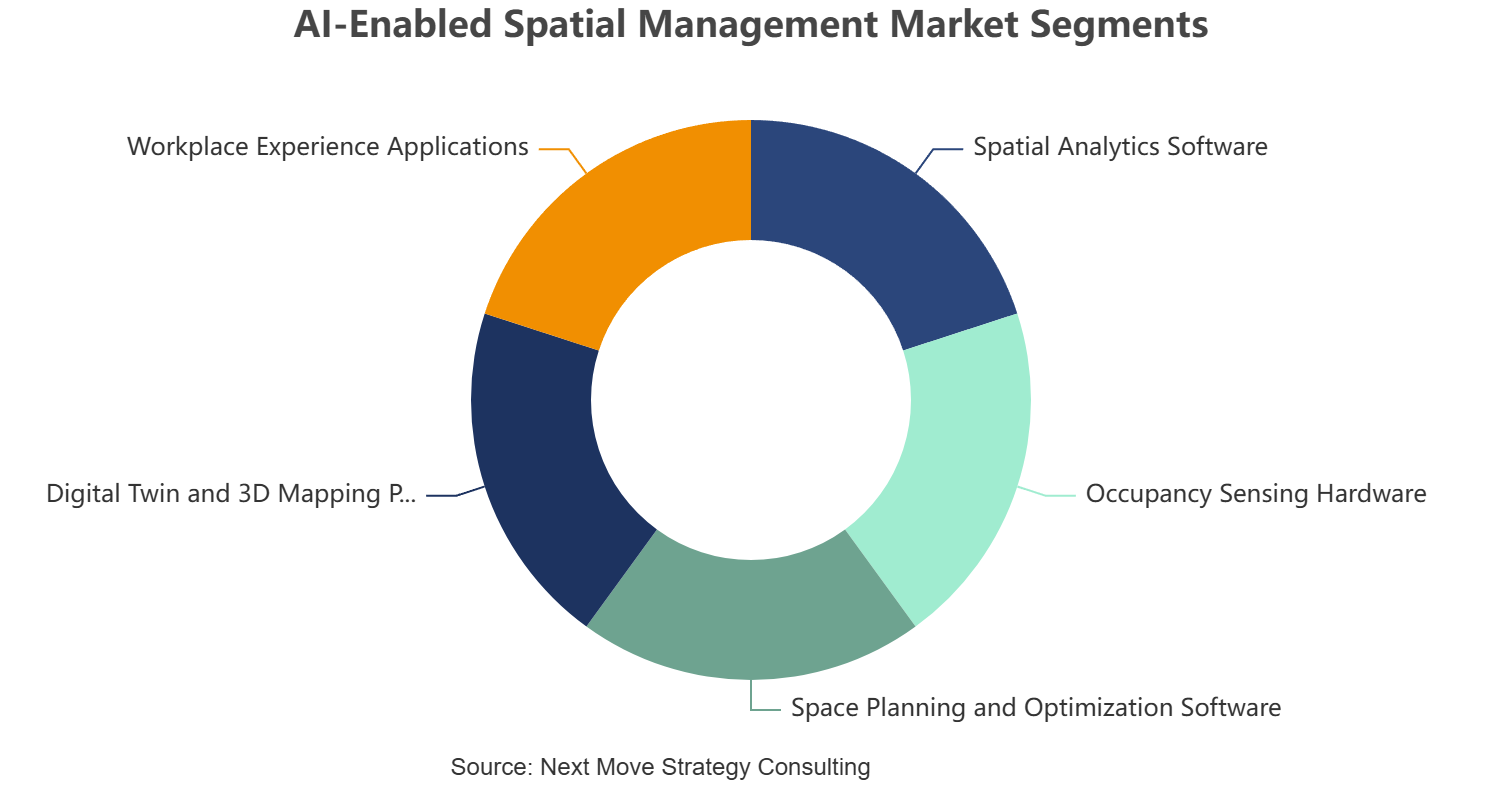
By Solution Type: Spatial Analytics Software held the largest share of approximately 34% (USD 1.39 Billion) in 2025; Digital Twin and 3D Mapping Platforms is the fastest-growing sub-segment at 22.54% CAGR from 2026–2035. |
|
By Deployment Mode: Cloud-based held the largest share of approximately 62% (USD 2.54 Billion) in 2025; Hybrid is the fastest-growing sub-segment at 22.49% CAGR from 2026–2035. |
|
By Application: Corporate Office Space Management held the largest share of approximately 45% (USD 1.85 Billion) in 2025; Healthcare Facility Management is the fastest-growing sub-segment at 21.58% CAGR from 2026–2035. |
|
Dominant Region: North America dominated with approximately 46% revenue share (USD 1.89 Billion) in 2025. |
|
Fastest-Growing Region: Asia-Pacific is expected to register the highest CAGR of 22.78% during 2026–2035. |
|
Dominant Country: U.S. led with approximately USD 1.55 billion in 2025. |
|
Fastest-Growing Country: India is the fastest-growing country at approximately 26.36% CAGR from 2026–2035. |
Market Opportunity: The AI-enabled spatial management market is expected to create an absolute dollar opportunity of USD 15.55 billion between 2026 and 2035, presenting significant investment potential across the predictive occupancy modeling and digital twin value chain.
According to NMSC analysis, spatial management vendors are increasingly training foundational AI models on aggregated occupancy datasets spanning hundreds of millions of square feet to shift from descriptive utilization reporting toward predictive space planning, a shift that favors data-rich incumbents over point-solution sensor vendors as enterprise real estate teams consolidate technology stacks through 2035.
What Does the AI-Enabled Spatial Management Market Encompass?
The AI-enabled spatial management market encompasses occupancy sensing hardware, spatial analytics software, space planning and optimization platforms, digital twin and 3D mapping systems, and workplace experience applications supplied to enterprise corporate real estate teams, facilities management providers, and commercial real estate owners. Our assessment indicates that the category has evolved from static utilization reporting into a predictive, AI-driven discipline that models how people move through and use physical spaces, supported by foundational spatial AI models trained on measured workplace behavior data.
Regulatory frameworks such as building occupancy safety codes and workplace data privacy statutes shape sensor deployment, while corporate real estate disclosure requirements increasingly influence portfolio optimization decisions. We found that technology adoption is shifting toward camera-free thermal and Wi-Fi-based sensing that avoids personally identifiable data capture. NMSC's analysis indicates that this structural shift, combined with hybrid work-driven real estate right-sizing, is redefining sourcing criteria across the AI-enabled spatial management market report landscape.
|
Parameter |
Details |
|
Market Size in 2025 |
USD 4.10 Billion |
|
Market Size in 2026 |
USD 4.85 Billion |
|
Revenue Forecast in 2035 |
USD 20.40 Billion |
|
Growth Rate |
CAGR of 17.30% from 2026 to 2035 |
|
Analysis Period |
2025–2035 |
|
Base Year Considered |
2025 |
|
Forecast Period |
2026–2035 |
|
Market Size Estimation |
Revenue (USD Billion) |
|
Companies Profiled |
20 |
|
Countries Covered |
33 |
|
Market Share |
Available for Top 10 Companies |
Key Emerging Trends
We found that four structural trends are reshaping product development and deployment strategy across the AI-enabled spatial management market heading into 2035.
How Are Foundational Spatial AI Models Reshaping Predictive Planning?
Foundational spatial AI models trained on hundreds of millions of square feet of measured workplace behavior are enabling vendors to shift from reporting past utilization to forecasting future space demand. Our analysis shows that this shift is accelerating scenario modeling adoption for lease renewal and portfolio consolidation decisions. VergeSense has publicly disclosed its Large Spatial Model, trained on over 200 million square feet of real workplace behavior, illustrating how established occupancy intelligence vendors are integrating predictive AI into commercial platforms.
How Is Digital Twin Convergence Transforming Facility Management?
Digital twin platforms are converging with real-time occupancy data to create continuously updated 3D representations of physical spaces rather than static point-in-time captures. We observed that CoStar Group has expanded Matterport's 3D digital twin library to over 14 million spaces following its 2024 acquisition. This convergence of spatial visualization and live occupancy analytics is becoming a key differentiator among top-tier platforms competing on data completeness.
How Is Privacy-First Sensing Reshaping Hardware Deployment?
Camera-free thermal and Wi-Fi-based occupancy sensors are addressing workplace privacy concerns that previously limited sensor deployment in sensitive environments such as healthcare and senior living facilities. Based on research conducted by NMSC, we found that hardware portfolios are being restructured around anonymous, non-personally-identifiable sensing methods rather than camera-based systems alone. Butlr Technologies, Inc. has disclosed continued expansion of its thermal wireless occupancy sensor platform, reflecting accelerated privacy-first hardware adoption.
How Is Platform Consolidation Reshaping the Competitive Landscape?
Workplace technology platforms are consolidating through acquisition, combining space planning, asset management, and booking functionality into unified integrated workplace management systems. Our findings suggest that this consolidation is becoming the dominant go-to-market structure rather than point-solution competition, reshaping how enterprise real estate teams evaluate vendor breadth versus specialized depth through 2035.
Ecosystem Analysis of the AI-Enabled Spatial Management Market
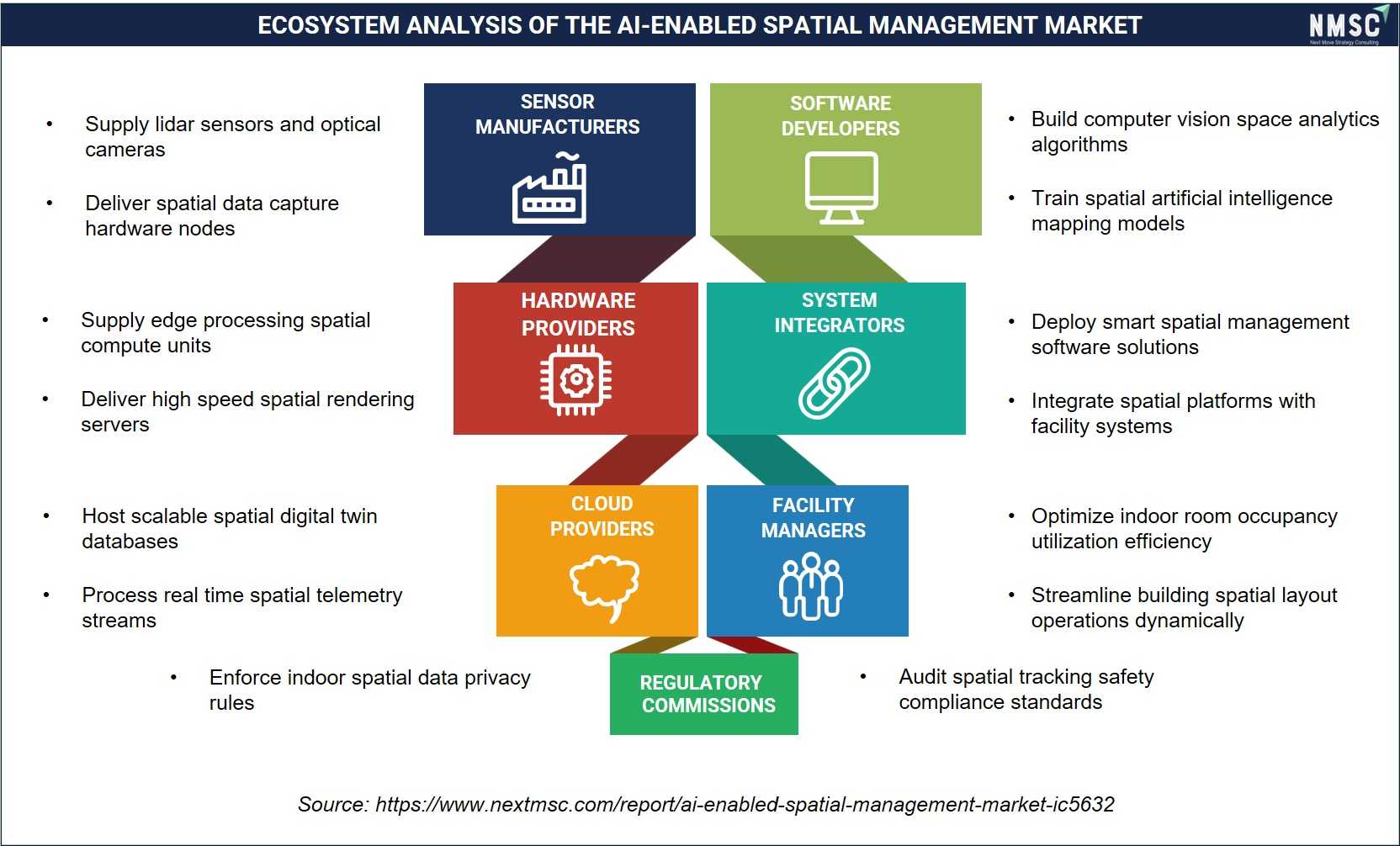
Based on research conducted by NMSC, we found that the AI-Enabled Spatial Management Market functions within an interconnected ecosystem uniting sensor manufacturers, software developers, hardware providers, and cloud infrastructure. System integrators and facility managers leverage spatial telemetry to optimize room occupancy and building operations dynamically. Ultimately, regulatory commissions enforce indoor data privacy rules and audit safety compliance standards to ensure secure deployment.
Growth Drivers and Restraints
|
Factors |
Type |
(+/-) % Impact on CAGR |
Geographic Relevance |
Impact Timeline |
|
Hybrid work-driven real estate portfolio right-sizing |
Driver |
+3.2% |
North America, Europe |
2026–2035 |
|
Expansion of foundational spatial AI model capabilities |
Driver |
+2.8% |
North America, Asia-Pacific |
2026–2035 |
|
Rising enterprise investment in workplace experience platforms |
Driver |
+2.1% |
Global |
2026–2032 |
|
Growing digital twin adoption in commercial real estate |
Driver |
+1.7% |
North America, Europe |
2027–2035 |
|
Expansion of privacy-first occupancy sensing technology |
Driver |
+1.2% |
Global |
2026–2033 |
|
Data privacy and workplace surveillance regulatory scrutiny |
Restraint |
-1.4% |
Europe, North America |
2026–2032 |
|
High upfront sensor hardware and integration costs |
Restraint |
-1.1% |
Global |
2026–2030 |
|
Fragmented building system integration standards |
Restraint |
-0.8% |
Asia-Pacific, Latin America |
2026–2031 |
|
Limited spatial AI adoption among small and mid-size enterprises |
Restraint |
-0.6% |
Middle East and Africa, Latin America |
2026–2030 |
What Is the Primary Growth Driver?
Hybrid work-driven real estate portfolio right-sizing is the primary growth driver, with the U.S. General Services Administration reporting sustained federal office space consolidation initiatives tied to reduced average daily occupancy. We observed that this consolidation pressure, combined with rising corporate real estate cost scrutiny, is pushing enterprises toward AI-enabled occupancy intelligence platforms to justify portfolio decisions with measured data, directly supporting the 17.30% CAGR projected for 2026–2035.
How Is Foundational Spatial AI Driving Market Growth?
Foundational spatial AI model adoption is expanding as vendors move beyond descriptive occupancy reporting toward predictive scenario modeling for space planning decisions. Regulatory guidance from the U.S. Department of Energy on building performance data standards is supporting broader building system data integration. Our assessment indicates that this predictive capability shift is replicating across European and Asia-Pacific markets as enterprise real estate teams seek forward-looking planning tools, reinforcing digital twin and 3D mapping platforms as the fastest-growing solution type segment through 2035.
What Is Restraining AI-Enabled Spatial Management Market Growth?
Data privacy and workplace surveillance regulatory scrutiny remain the primary restraint, particularly across the European Union where employee monitoring rules under data protection statutes constrain certain occupancy sensing deployments. We found that high upfront sensor hardware and integration costs further limit adoption among small and mid-size enterprises, an industry-derived estimate given the absence of a single publicly verifiable global deployment cost dataset for this category.
Segmentation Analysis
Segment Sizing: By Solution Type
|
Segment |
2025 (USD Billion) |
2035 (USD Billion) |
CAGR% (2026–2035) |
|
Spatial Analytics Software |
1.39 |
7.60 |
20.78% |
|
Occupancy Sensing Hardware |
1.07 |
4.55 |
17.45% |
|
Space Planning and Optimization Software |
0.74 |
3.35 |
18.27% |
|
Digital Twin and 3D Mapping Platforms |
0.57 |
3.55 |
22.54% |
|
Workplace Experience Applications |
0.33 |
1.35 |
16.94% |
|
Total |
4.10 |
20.40 |
17.30% |
Which Solution Type Segment Dominates the AI-Enabled Spatial Management Market?
Spatial analytics software, which processes sensor, Wi-Fi, badge, and booking data into unified occupancy insights, defines the leading solution type. We found that this segment held approximately 34% share in 2025 given its role as the analytical core connecting raw occupancy data to actionable planning decisions. Digital twin and 3D mapping platforms is the fastest-growing sub-segment at 22.54% CAGR, driven by rising convergence of 3D spatial visualization with live occupancy data across commercial real estate portfolios.
Segment Sizing: By Deployment Mode
|
Segment |
2025 (USD Billion) |
2035 (USD Billion) |
CAGR% (2026–2035) |
|
Cloud-based |
2.54 |
13.50 |
20.40% |
|
On-premise |
0.98 |
3.30 |
14.44% |
|
Hybrid |
0.58 |
3.60 |
22.49% |
|
Total |
4.10 |
20.40 |
17.30% |
Which Deployment Mode Is Fastest-Growing in the AI-Enabled Spatial Management Market?
Cloud-based deployment dominates with approximately 62% share in 2025, reflecting enterprise preference for centrally managed, continuously updated occupancy intelligence platforms across distributed real estate portfolios. Our analysis shows that hybrid deployment is the fastest-growing sub-segment at 22.49% CAGR as enterprises with strict data residency requirements combine on-premise sensor processing with cloud-based analytics, narrowing the gap with pure cloud-based deployment through 2035.
Segment Sizing: By Application
|
Segment |
2025 (USD Billion) |
2035 (USD Billion) |
CAGR% (2026–2035) |
|
Corporate Office Space Management |
1.85 |
8.20 |
17.99% |
|
Retail and Commercial Real Estate |
0.90 |
4.70 |
20.16% |
|
Healthcare Facility Management |
0.62 |
3.60 |
21.58% |
|
Educational Campus Management |
0.45 |
2.40 |
20.44% |
|
Industrial and Warehouse Space Management |
0.28 |
1.50 |
20.50% |
|
Total |
4.10 |
20.40 |
17.30% |
Which Application Segment Leads AI-Enabled Spatial Management Market Demand?
Corporate office space management dominates the application axis with approximately 45% share in 2025, reflecting sustained enterprise investment in hybrid work-driven portfolio optimization. Our analysis shows that healthcare facility management is the fastest-growing sub-segment at 21.58% CAGR as privacy-first sensing technology enables broader occupancy intelligence adoption in patient care and senior living environments previously constrained by camera-based sensing limitations.
Growth Opportunities
We identified three forward-looking whitespace opportunities within the AI-enabled spatial management market that are distinct from the primary investment thesis outlined above.
How Can API-First Data Platforms Expand Technology Partner Reach?
Offering spatial intelligence through open API integrations enables workplace technology partners to embed predictive occupancy capabilities directly into their own platforms, benefiting spatial analytics software vendors as they expand distribution beyond direct enterprise sales relationships.
How Can Vertical-Specific Sensing Expand Healthcare and Education Adoption?
Developing privacy-first sensing configurations tailored to healthcare and educational campus environments creates a mechanism for hardware vendors to enter previously underserved verticals, benefiting the occupancy sensing hardware segment as regulatory comfort with anonymous sensing technology grows.
How Can Digital Twin and Energy Management Integration Expand Platform Value?
Connecting digital twin platforms directly to building energy management systems creates a combined sustainability and space optimization value proposition, benefiting digital twin and 3D mapping platforms as enterprises pursue integrated carbon reduction and real estate efficiency goals.
Regional Outlook
|
Region |
2025 (USD Billion) |
2035 (USD Billion) |
CAGR% (2026–2035) |
Key Driver |
|
North America |
1.89 |
8.60 |
18.34% |
Hybrid work-driven portfolio right-sizing and mature vendor ecosystem |
|
Europe |
0.98 |
4.60 |
18.74% |
Data privacy-compliant sensing adoption and sustainability mandates |
|
Asia-Pacific |
0.82 |
5.20 |
22.78% |
Rapid smart building investment and commercial real estate expansion |
|
Latin America |
0.25 |
1.20 |
19.04% |
Growing enterprise real estate technology adoption |
|
Middle East and Africa |
0.16 |
0.80 |
19.58% |
Government-backed smart city and smart building programs |
|
Total |
4.10 |
20.40 |
17.30% |
|
North America AI-Enabled Spatial Management Market Outlook
North America dominates the AI-enabled spatial management market with approximately 46% share in 2025, supported by a mature vendor ecosystem and sustained hybrid work-driven portfolio right-sizing across the U.S. and Canada. We observed rapid technology adoption in foundational spatial AI models, while regulatory clarity from workplace data guidance is easing enterprise sensor deployment decisions. Our assessment indicates that continued corporate real estate cost scrutiny will sustain the region's leadership through 2035.
Europe AI-Enabled Spatial Management Market Outlook
Europe's AI-enabled spatial management market reflects strong sustainability-driven demand tempered by strict data privacy compliance requirements. We found that camera-free sensing adoption is well established, with General Data Protection Regulation frameworks shaping deployment design choices. Strategic outlook favors continued growth in privacy-compliant occupancy intelligence platforms integrated with building energy management systems.
Asia-Pacific AI-Enabled Spatial Management Market Outlook
Asia-Pacific is the fastest-growing region at 22.78% CAGR, driven by rapid smart building investment and commercial real estate expansion across China, India, and Southeast Asia. Our analysis shows that growing government smart city investment is accelerating category awareness, while technology penetration in occupancy sensing hardware continues to rise. Strategic outlook favors continued expansion in regional data center and cloud infrastructure supporting spatial analytics platforms.
Latin America AI-Enabled Spatial Management Market Outlook
Latin America is emerging as a growing market for enterprise real estate technology adoption, supported by expanding commercial real estate modernization across Brazil and Argentina. We observed that regulatory clarity on data handling has supported platform adoption, while technology penetration in cloud-based deployment continues to expand. Strategic outlook favors continued growth in regional systems integrator partnerships.
Middle East and Africa AI-Enabled Spatial Management Market Outlook
Middle East and Africa growth is supported by government-backed smart city and smart building programs across Gulf states and South Africa. Our findings suggest that regulatory environments are gradually expanding technology adoption pathways, though limited domestic vendor presence continues to moderate regional self-sufficiency. Strategic outlook favors continued public-private smart infrastructure partnerships.
U.S. AI-Enabled Spatial Management Market
Based on our estimates, U.S. AI-enabled spatial management demand stood at approximately USD 1.55 billion in 2025, projected to approach USD 6.95 billion by 2035 at an 18.14% CAGR. Demand is anchored in mature enterprise real estate technology adoption and sustained hybrid work-driven portfolio optimization. Regulatory oversight through federal workplace data guidance supports predictable deployment decisions. Technology penetration in foundational spatial AI models is advanced, and competitive intensity among top-tier vendors is high.
Canada AI-Enabled Spatial Management Market
The market in Canada AI-enabled spatial management demand stood at approximately USD 0.34 billion in 2025, projected to reach USD 1.65 billion by 2035 at a 19.19% CAGR. Demand is shaped by growing enterprise real estate modernization supported by domestic technology adoption programs. Regulatory influence from provincial privacy authorities shapes sensor deployment compliance. Technology penetration in cloud-based platforms is rising, and strategic outlook favors continued vendor partnership expansion.
UK AI-Enabled Spatial Management Market
As per our estimate, UK AI-enabled spatial management demand stood at approximately USD 0.28 billion in 2025, projected to reach USD 1.25 billion by 2035 at an 18.08% CAGR. Demand centers on sustainability-linked occupancy intelligence adoption under a strict data privacy compliance framework. Regulatory influence from the Information Commissioner's Office shapes sensor deployment design. Technology penetration favors camera-free sensing, and strategic outlook favors continued privacy-compliant platform innovation.
Germany AI-Enabled Spatial Management Market
According to our analysis, Germany AI-enabled spatial management demand stood at approximately USD 0.38 billion in 2025, projected to reach USD 1.85 billion by 2035 at a 19.23% CAGR. Demand is driven by strong corporate real estate modernization supported by domestic building technology infrastructure. Regulatory oversight aligns with General Data Protection Regulation frameworks. Technology adoption in digital twin platforms is advanced, and competitive intensity among domestic integrators remains high.
France AI-Enabled Spatial Management Market
Based on our estimates, France AI-enabled spatial management demand stood at approximately USD 0.20 billion in 2025, projected to reach USD 0.95 billion by 2035 at an 18.90% CAGR. Demand reflects growing enterprise workplace technology adoption supported by established commercial real estate infrastructure. Regulatory influence follows European Union data protection frameworks. Technology penetration in occupancy sensing hardware is expanding, and strategic outlook favors continued sustainability-linked platform adoption.
China AI-Enabled Spatial Management Market
The market in China, AI-enabled spatial management demand stood at approximately USD 0.28 billion in 2025, projected to reach USD 2.05 billion by 2035 at a 24.76% CAGR. Demand is driven by rapid smart building investment and commercial real estate expansion supporting occupancy intelligence adoption. Regulatory influence from national data security authorities shapes platform deployment, while technology penetration in cloud infrastructure is rising. Competitive intensity is high among domestic and multinational suppliers.
India AI-Enabled Spatial Management Market
As per our estimate, India AI-enabled spatial management demand stood at approximately USD 0.14 billion in 2025, projected to reach USD 1.15 billion by 2035 at a 26.36% CAGR. Demand reflects rapidly expanding commercial real estate technology adoption supported by growing smart building investment. Regulatory influence from national data protection authorities shapes deployment standards, while technology penetration in spatial analytics continues to accelerate. Strategic outlook favors continued high-growth platform expansion.
Japan AI-Enabled Spatial Management Market
According to our analysis, Japan AI-enabled spatial management demand stood at approximately USD 0.16 billion in 2025, projected to reach USD 0.75 billion by 2035 at an 18.73% CAGR. Demand centers on premium workplace technology adoption supported by advanced building infrastructure. Regulatory oversight through national data protection authorities ensures strict privacy compliance standards. Technology penetration in digital twin platforms is mature, and competitive intensity favors domestic specialty integrators.
South Korea AI-Enabled Spatial Management Market
Based on our estimates, South Korea AI-enabled spatial management demand stood at approximately USD 0.10 billion in 2025, projected to reach USD 0.55 billion by 2035 at a 20.85% CAGR. Demand is supported by growing enterprise real estate technology adoption with government-backed smart building research programs. Regulatory influence from national data protection authorities shapes deployment standards. Technology penetration in occupancy sensing is rising, and strategic outlook favors continued public research investment.
Australia AI-Enabled Spatial Management Market
The market in Australia AI-enabled spatial management demand stood at approximately USD 0.09 billion in 2025, projected to reach USD 0.45 billion by 2035 at a 19.58% CAGR. Demand reflects growing commercial real estate and workplace technology consumption across urban business districts. Regulatory oversight through national privacy frameworks shapes sensor deployment approval. Technology penetration in cloud-based platforms is advanced, and competitive intensity remains moderate among established suppliers.
UAE AI-Enabled Spatial Management Market
As per our estimate, UAE AI-enabled spatial management demand stood at approximately USD 0.045 billion in 2025, projected to reach USD 0.24 billion by 2035 at a 20.44% CAGR. Demand is emerging around government-backed smart city programs supporting occupancy intelligence adoption. Regulatory influence from national technology authorities is expanding platform deployment pathways. Technology penetration remains early-stage, and strategic outlook favors continued public-private smart infrastructure partnerships.
Saudi Arabia AI-Enabled Spatial Management Market
According to our analysis, Saudi Arabia AI-enabled spatial management demand stood at approximately USD 0.05 billion in 2025, projected to reach USD 0.27 billion by 2035 at a 20.61% CAGR. Demand is driven by government smart building diversification programs supporting workplace technology investment. Regulatory influence from national technology authorities shapes platform deployment standards. Technology penetration in cloud-based analytics is rising, and competitive intensity is moderate.
South Africa AI-Enabled Spatial Management Market
Based on our estimates, South Africa AI-enabled spatial management demand stood at approximately USD 0.035 billion in 2025, projected to reach USD 0.16 billion by 2035 at an 18.40% CAGR. Demand reflects gradually expanding workplace technology adoption supported by domestic systems integrator networks. Regulatory influence from national data protection authorities shapes deployment registration. Technology penetration in occupancy sensing adoption is expanding, and strategic outlook favors continued awareness-building programs.
Brazil AI-Enabled Spatial Management Market
The market in Brazil, AI-enabled spatial management demand stood at approximately USD 0.16 billion in 2025, projected to reach USD 0.82 billion by 2035 at a 19.91% CAGR. Demand is anchored in expanding commercial real estate modernization and growing enterprise technology investment. Regulatory influence from national data protection authorities has supported platform deployment. Technology penetration in cloud-based analytics is advanced, and competitive intensity among multinational suppliers is high.
Argentina AI-Enabled Spatial Management Market
As per our estimate Argentina, AI-enabled spatial management demand stood at approximately USD 0.05 billion in 2025, projected to reach USD 0.24 billion by 2035 at a 19.04% CAGR. Demand reflects expanding workplace technology adoption supported by favorable enterprise technology investment policy. Regulatory influence from national data protection authorities shapes deployment standards. Technology penetration is rising, and strategic outlook favors continued regional systems integrator expansion.
PESTEL Analysis of the AI-Enabled Spatial Management Market
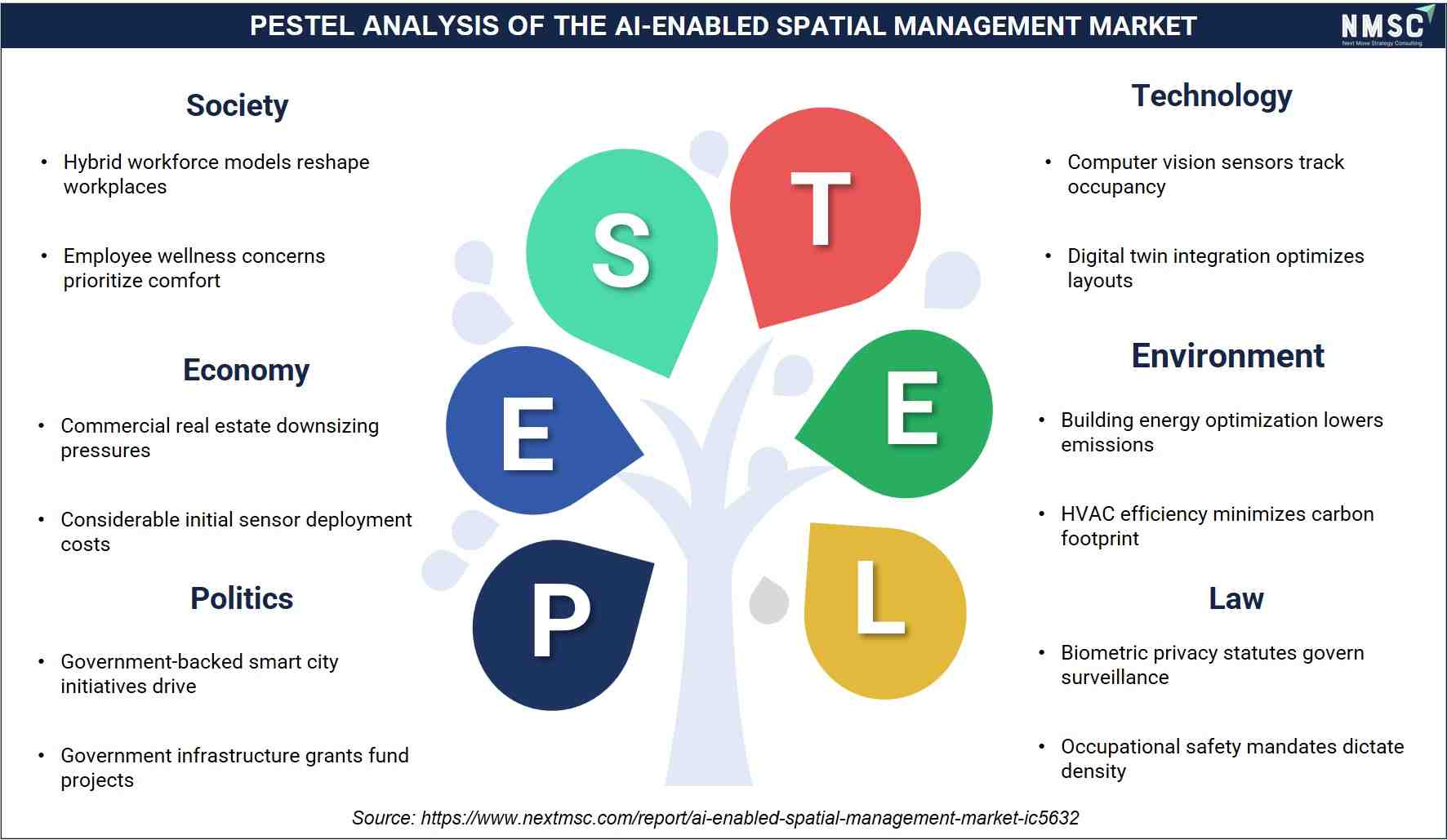
NMSC's analysis indicates that hybrid workforce models, real estate downsizing pressures, and government infrastructure grants drive growth in the AI-Enabled Spatial Management Market. Furthermore, computer vision sensors and digital twin technology optimize space layouts. Concurrently, building energy and HVAC efficiency minimize carbon emissions, while strict compliance with biometric privacy statutes and occupational safety mandates governs workplace surveillance and spatial density regulations globally.
Competitive Landscape
We found that the AI-enabled spatial management industry is moderately fragmented, with a mix of specialized occupancy intelligence vendors and diversified real estate technology platforms competing across solution categories.
|
Dimension |
Details |
|
Market Structure |
Moderately fragmented with specialized occupancy intelligence vendors alongside diversified real estate technology platforms |
|
Innovation Focus |
Foundational spatial AI models, digital twin convergence, and privacy-first sensing technology |
|
M & A Activity |
Active consolidation combining space planning, asset management, and digital twin capabilities |
How Do Companies Compete in the AI-Enabled Spatial Management Market?
Leading companies compete on spatial data breadth, AI model training scale, and integration depth across building system and workplace technology ecosystems. Our analysis shows that pricing strategies vary by solution type, with predictive AI-enabled platforms commanding premium pricing over conventional utilization reporting tools. Geographic expansion is pursued through technology partner integrations and systems integrator partnerships in emerging smart building markets.
Which Competitive Archetypes Dominate the AI-Enabled Spatial Management Industry?
Occupancy intelligence specialists such as VergeSense, Inc. compete on foundational spatial AI model depth trained on measured workplace data, while consolidated platforms such as Eptura, Inc. compete on integrated workplace management breadth spanning space, asset, and booking functionality. Digital twin specialists such as CoStar Group, Inc. differentiate through 3D spatial data library scale. This archetype segmentation explains sustained competitive diversity across the category.
What Is the Innovation and Differentiation Strategy Across the Industry?
Industry leaders differentiate through foundational spatial AI model training, digital twin and live occupancy data convergence, and privacy-first sensing hardware that connects platform performance to measurable real estate decision outcomes. We observed that API-first data platforms are becoming a standard differentiator, allowing vendors to embed spatial intelligence into partner ecosystems beyond direct enterprise sales relationships.
How Active Is M&A in the AI-Enabled Spatial Management Industry?
M&A activity remains active, concentrated on combining space planning, asset management, and digital twin capabilities into unified integrated workplace management systems. CoStar Group's 2024 acquisition of Matterport and Eptura's consolidation of Archibus, Condeco, Serraview, and iOFFICE illustrate how established platforms are reinforcing spatial data breadth rather than expanding into unrelated categories.
Key Market Players
Our assessment indicates that the following companies represent the validated set of leading global AI-enabled spatial management providers active as of 2026, ranked by verifiable market-specific scale of operations.
-
VergeSense, Inc.
-
Eptura, Inc.
-
CoStar Group, Inc.
-
Planon Corporation
-
Robin Powered, Inc.
-
Density, Inc.
-
Butlr Technologies, Inc.
-
Esri (Environmental Systems Research Institute, Inc.)
-
Autodesk, Inc.
-
Siemens AG
-
Accruent, LLC
-
Nuvolo Technologies Corporation
-
HqO, Inc.
-
Kadence Technologies Inc.
-
Skedda Pty Ltd
-
Tactic Software Inc.
-
Smarten Spaces Pte. Ltd.
-
Basking Automation Ltd.
-
InnerSpace Inc.
Latest Developments
We found that recent corporate activity reflects continued AI model development and platform consolidation among leading AI-enabled spatial management providers heading into 2026.
|
Date |
Event |
|
July 2026 |
VergeSense announced a strategic partnership with laiout, integrating its predictive occupancy data directly into automated architectural planning. This collaboration enables the immediate generation of code-aware, buildable floor plans from spatial analytics, transforming data-driven office redesigns and real estate consolidation into rapid, single-session workflows. |
|
May 2026 |
Autodesk entered a definitive agreement to acquire modern operations and maintenance solution provider MaintainX for 3.6 billion USD. The platform will integrate into Autodesk Operations Solutions, merging AI-powered performance analysis with digital twin and spatial capabilities to seamlessly connect physical and digital operations. |
|
May 2026 |
Siemens launched Asset Performance Advanced, a new AI-enabled managed building service integrated within its Building X ecosystem. The solution combines predictive failure mode classification and advanced fault detection to optimize HVAC operations, driving the global transition toward fully autonomous, human-centric smart building infrastructure. |
|
February 2025 |
CoStar Group completed its acquisition of Matterport, effectively integrating the global leader in 3D digital twin technology. This strategic merger accelerates the global adoption of AI-driven digital twins, deepening machine learning and computer vision capabilities to optimize spatial data insights across the property sector. |
Expert Insights
 “We’ve been navigating workplace changes since our founding in 2017 and have learned that companies are missing out on opportunities to increase productivity, improve collaboration, and enhance employee and workplace experience. We know from first-hand customer experience that utilizing data to create adaptable spaces is enabling leaders to remain agile in a dynamic work landscape and will be crucial as occupancy levels continue to rise.”
— Dan Ryan, CEO and Co-Founder, VergeSense
Statement made while discussing findings from the 2025 Workplace Occupancy & Utilization Index and the growing importance of data-driven, adaptable workplaces amid changing occupancy patterns.
Market Interpretation
The statement highlights the growing importance of occupancy data and adaptable workplace design as organizations respond to changing utilization patterns. As workplace occupancy levels evolve, companies are increasingly using real-time spatial data to optimize space utilization, improve collaboration, and enhance employee experiences. This trend is supporting the adoption of AI-enabled spatial management solutions that can analyze occupancy patterns and translate workplace data into actionable insights. Consequently, organizations are increasingly shifting from conventional space planning toward data-driven, flexible, and responsive workplace management strategies.
Investment Opportunities
What Capital Inflows Are Shaping the AI-Enabled Spatial Management Market?
Capital inflows are concentrated in foundational spatial AI model development and platform consolidation acquisitions, exemplified by CoStar Group's 2024 acquisition of Matterport and continued VergeSense investment in its Large Spatial Model. We observed that this activity reflects a broader industry trend toward data-rich, AI-native platforms as enterprise real estate teams consolidate technology vendor relationships.
How Is Infrastructure Investment Evolving Across the Industry?
Infrastructure investment is expanding in cloud data processing capacity and privacy-first sensor manufacturing designed to serve growing global demand for occupancy intelligence platforms. Our analysis shows that similar capacity investments are likely across Asia-Pacific and European markets through 2035 as multinational vendors diversify their geographic data center footprint.
What ESG Considerations Are Relevant to AI-Enabled Spatial Management Market Investment?
Environmental, social, and governance considerations increasingly center on building energy efficiency optimization through occupancy-informed HVAC scheduling, employee privacy protection through anonymous sensing, and reduced real estate carbon footprint through data-driven portfolio right-sizing. We found that these considerations are becoming embedded in institutional investment screening criteria applied to workplace technology providers.
Key Benefits for Stakeholders
How Does This Report Benefit Real Estate Industry Leaders?
Industry leaders gain a validated view of segment-level growth rates, competitive archetypes, and regional demand drivers that inform technology investment prioritization and go-to-market sequencing across solution categories through 2035.
How Does This Report Benefit Investors and Financial Analysts?
Investors and financial analysts gain access to consistent market sizing, CAGR benchmarks, and competitive landscape analysis that support capital allocation decisions across spatial analytics, sensing hardware, and digital twin companies.
How Does This Report Benefit Technology Vendors and Product Teams?
Technology vendors and product teams gain visibility into foundational spatial AI, digital twin convergence, and privacy-first sensing trends that inform partnership and product development strategies aligned with leading platforms' innovation roadmaps.
Key Market Segments
By Solution Type
-
Spatial Analytics Software
-
Occupancy Sensing Hardware
-
Space Planning and Optimization Software
-
Digital Twin and 3D Mapping Platforms
-
Workplace Experience Applications
By Deployment Mode
-
Cloud-based
-
On-premise
-
Hybrid
By Application
-
Corporate Office Space Management
-
Retail and Commercial Real Estate
-
Healthcare Facility Management
-
Educational Campus Management
-
Industrial and Warehouse Space Management
By Region
-
North America: U.S., Canada, Mexico
-
Europe: UK, Germany, France, Italy, Spain, Sweden, Denmark, Finland, Netherlands, Rest of Europe
-
Asia-Pacific: China, India, Japan, South Korea, Taiwan, Indonesia, Vietnam, Australia, Philippines, Malaysia, Rest of APAC
-
Middle East and Africa: Saudi Arabia, UAE, Egypt, Israel, Turkey, Nigeria, South Africa, Rest of MEA
-
Latin America: Brazil, Argentina, Chile, Colombia, Rest of LATAM
Conclusion and Recommendations
What Is the Long-Term Outlook for the AI-Enabled Spatial Management Market?
The AI-enabled spatial management market is projected to expand from USD 4.85 billion in 2026 to USD 20.40 billion by 2035 at a 17.30% CAGR, supported by sustained hybrid work-driven portfolio optimization and expanding foundational spatial AI capabilities. We found that this trajectory reflects durable structural demand rather than a cyclical upswing, positioning the industry for continued long-term expansion.
What Are the Strategic Positioning Recommendations?
Producers should prioritize digital twin and predictive analytics portfolio expansion in North America and Europe while building smart building infrastructure partnerships in Asia-Pacific to serve rapidly growing regional demand. Our assessment indicates that companies balancing both strategies will capture the broadest share of the projected USD 15.55 billion incremental opportunity through 2035.
How Attractive Is the AI-Enabled Spatial Management Market for Investment?
The market's 17.30% CAGR, combined with a moderately fragmented competitive structure among twenty validated global providers, signals a highly attractive investment profile for capital targeting AI-native, data-rich platforms rather than legacy point-solution real estate technology categories.
What Market Shifts and Key Risks Should Stakeholders Monitor?
Stakeholders should monitor data privacy regulatory changes, sensor hardware cost trends, and building system integration standardization that could moderate deployment pace across the forecast period.
What Are the Primary Growth Pathways Through 2035?
Primary growth pathways include expanding foundational spatial AI model capabilities, scaling digital twin and live occupancy data convergence, and growing privacy-first sensing adoption in healthcare and education, each reinforcing the AI-enabled spatial management market's projected expansion to USD 20.40 billion by 2035.
About the Author
 Saista Faiyaz
— Saista Faiyaz is Research Associate at Next Move Strategy Consulting, where she has covered consumer markets and healthcare technologies for 3 years. Her work includes primary interview review, secondary-source validation, market sizing, and structured analysis of company and industry data. She supports research by comparing evidence across sources, organizing findings into market narratives, and documenting assumptions used in analysis. Her scope includes cross-market benchmarking, and reports.
Saista Faiyaz
— Saista Faiyaz is Research Associate at Next Move Strategy Consulting, where she has covered consumer markets and healthcare technologies for 3 years. Her work includes primary interview review, secondary-source validation, market sizing, and structured analysis of company and industry data. She supports research by comparing evidence across sources, organizing findings into market narratives, and documenting assumptions used in analysis. Her scope includes cross-market benchmarking, and reports.
About the Reviewer
 Supradip Baul
— Supradip Baul is an accomplished business consultant and strategist with over a decade of rich experience in market intelligence, strategy, technology, and business transformation. His work has included rigorous qualitative and quantitative analysis across multiple industries, helping clients shape investment decisions and long-term roadmaps. Earlier in his career, he was associated with Gartner, where he contributed to industry-leading reports and market share analyses. He has worked with leading global companies and holds an MBA with a dual specialization in Marketing and Finance.
Supradip Baul
— Supradip Baul is an accomplished business consultant and strategist with over a decade of rich experience in market intelligence, strategy, technology, and business transformation. His work has included rigorous qualitative and quantitative analysis across multiple industries, helping clients shape investment decisions and long-term roadmaps. Earlier in his career, he was associated with Gartner, where he contributed to industry-leading reports and market share analyses. He has worked with leading global companies and holds an MBA with a dual specialization in Marketing and Finance.
At Next Move Strategy Consulting, we understand that insightful market research is the cornerstone of successful business decisions. That's why we employ a robust and multifaceted approach, combining various methodologies to deliver the most accurate and actionable data for our clients.

Research Landscape
We navigate the world of research with two primary approaches:
Qualitative Approach
Our qualitative research methodologies involve immersive techniques such as in-depth interviews, focus groups, and observational studies. By engaging directly with individuals and stakeholders, we uncover valuable insights that quantitative data alone may overlook.

Quantitative Research
In tandem with qualitative methodologies, NMSC leverages the power of Quantitative Research to provide a robust foundation of numerical insights. Through systematic data collection and analysis, we quantify patterns, preferences, and market trends, offering a comprehensive view of the business landscape.
Our quantitative research approach employs diverse tools, including surveys, experiments, and statistical modelling. These methodologies enable us to gather data from a large and representative sample, ensuring the statistical significance of our findings. By employing structured questionnaires and standardized data collection methods, we guarantee the reliability and validity of the information we present to our clients.
Quantitative research is particularly effective in measuring the prevalence of trends, assessing market size, and gauging the impact of various factors on consumer behavior. The numerical precision attained through this approach equips our clients with actionable insights, facilitating data-driven decision-making and strategy formulation.


Our Specialized Toolbox for Industry-Specific Market Research
We deploy a specialized arsenal of techniques tailored to meet your unique requirements. Here's a glimpse into our comprehensive toolbox:

Information Procurement
The stage entails acquiring market data or relevant information through various sources and methodologies.


Market Research Approach
We utilize both top-down and bottom-up approaches in market research analysis to achieve a comprehensive understanding of the market dynamics, leveraging the broad perspective of industry trends and macroeconomic factors alongside detailed insights from specific segments and individual companies.

Porters Five Forces Analysis
We conduct Porter's Five Forces analysis to evaluate the competitive landscape of an industry, providing us with insights into factors that affect profitability and strategic positioning.

SWOT Analysis

Forecasting
We utilize a forecasting model to predict future consumption by considering parameters like population, economics, regulations, market competition, drivers, constraints, technology, and pricing. We also employ statistical techniques such as multilinear regression, exponential smoothing, moving average, ARIMA, and Monte Carlo simulations for accurate predictions. In econometric forecasting, we analyzed short-term and long-term event impacts, attributing values based on regulatory frameworks, economic factors, and market events.





 Speak to Our Analyst