AI-Powered Customer Experience Market Global Industry Analysis and Forecast (2026-2035)

AI-Powered Customer Experience Market size was USD 20.84 billion in 2026, projected to reach USD 149.62 billion by 2035, growing at a CAGR of 24.50% from 2026 to 2035. Key drivers include generative AI adoption in customer service, rising demand for omnichannel engagement, and enterprise cloud migration of contact centers, with North America leading the market.

Download Free Sample PDF
Base Year (2025)
$16.90 Billion
Forecast (2035)
$149.62 Billion
CAGR (2026-2035)
24.5%
Top Region
North America

What Is the AI-Powered Customer Experience Market Size?

The global AI-powered customer experience market size was valued at USD 16.90 billion in 2025 and is estimated at USD 20.84 billion in 2026, forecast to reach USD 149.62 billion by 2035, expanding at a 24.50% CAGR between 2026 and 2035. North America leads with approximately 37% share, while software solutions dominate the AI-powered customer experience market with approximately 68% share in 2025.

From our research, we found that growth is broad-based across every segmentation axis, with generative AI-enabled conversational platforms and real-time sentiment analytics driving the dominant structural shifts through 2035. Based on research conducted by NMSC, we found that enterprises are consolidating fragmented point solutions into unified AI customer experience suites, a shift that favors platform vendors with native generative AI, omnichannel orchestration, and enterprise-grade data governance capabilities over single-function tool providers.

AI-Powered Customer Experience Market Global Industry Analysis and Forecast (2026-2035) Revenue Forecast

Values in USD Billion

2025 $16.90 Billion
2025
2026 $20.84 Billion
2026
2027 $25.95 Billion
2027
2028 $32.30 Billion
2028
2029 $40.22 Billion
2029
2030 $50.07 Billion
2030
2031 $62.34 Billion
2031
2032 $77.61 Billion
2032
2033 $96.62 Billion
2033
2034 $120.30 Billion
2034
2035 $149.62 Billion
2035

Key Takeaways

By Component: Software held the largest share of approximately 68% (USD 11.49 Billion) in 2025; Services is the fastest-growing sub-segment at 29.1% CAGR from 2026–2035.

By Technology: Natural Language Processing held the largest share of approximately 30% (USD 5.07 Billion) in 2025; Machine Learning and Deep Learning is the fastest-growing sub-segment at 28.4% CAGR from 2026–2035.

By Deployment Mode: Cloud held the largest share of approximately 71% (USD 12.00 Billion) in 2025; Cloud is also the fastest-growing sub-segment at 29.1% CAGR from 2026–2035.

By Application: Chatbots and Virtual Assistants held the largest share of approximately 34% (USD 5.75 Billion) in 2025; Customer Journey Analytics is the fastest-growing sub-segment at 29.1% CAGR from 2026–2035.

By Organization Size: Large Enterprises held the largest share of approximately 66% (USD 11.15 Billion) in 2025; Small and Medium Enterprises is the fastest-growing sub-segment at 30.4% CAGR from 2026–2035.

By End-Use Industry: BFSI held the largest share of approximately 24% (USD 4.06 Billion) in 2025; Media and Entertainment is the fastest-growing sub-segment at 29.4% CAGR from 2026–2035.

Dominant Region: North America dominated with approximately 37% revenue share (USD 6.25 Billion) in 2025.

Fastest-Growing Region: Asia-Pacific is expected to register the highest CAGR of 31.5% during 2026–2035.

Dominant Country: The U.S. led with approximately USD 4.88 Billion in 2025.

Fastest-Growing Country: China is the fastest-growing country at approximately 31.5% CAGR from 2026–2035.

Market Opportunity: The AI-powered customer experience market is expected to create an absolute dollar opportunity of USD 128.78 billion between 2026 and 2035, presenting significant investment potential across the retail, BFSI, healthcare, and travel and hospitality customer engagement value chain.

According to Next Move Strategy Consulting analysis, brand owners are increasingly consolidating AI customer experience sourcing with fewer, generative-AI-ready vendors to simplify multi-channel deployment and data governance, a shift that favors diversified platform providers over narrow point-solution specialists as enterprise scrutiny of AI reliability and data privacy intensifies through 2035.

Parameters | Details

Market Size in 2025 | USD 16.90 Billion

Market Size in 2026 | USD 20.84 Billion

Revenue Forecast in 2035 | USD 149.62 Billion

Growth Rate | CAGR of 24.50% from 2026 to 2035

Analysis Period | 2025–2035

Base Year Considered | 2025

Forecast Period | 2026–2035

Market Size Estimation | Revenue (USD Billion)

Companies Profiled | 20

Countries Covered | 33

Market Share | Available for Top 10 Companies

What Does the AI-Powered Customer Experience Market Encompass?

The AI-powered customer experience market encompasses software platforms and services that apply natural language processing, machine learning, computer vision, and robotic process automation to customer-facing interactions across digital and voice channels. Our assessment indicates that the scope spans chatbots, virtual assistants, sentiment analytics, personalized recommendation engines, and journey orchestration tools supplied to enterprises across BFSI, retail, healthcare, travel, and telecom sectors. The category has evolved from rule-based scripted bots into generative AI-native platforms capable of contextual, multi-turn, multilingual customer engagement at enterprise scale.

How Has the AI-Powered Customer Experience Market Structurally Evolved?

The market has shifted from siloed help-desk automation tools toward unified customer experience suites combining conversational AI, analytics, and workflow orchestration on a single data layer. We observed that vendors are bundling generative AI copilots with legacy CRM and contact center infrastructure to reduce integration friction for enterprise buyers. This consolidation trend has accelerated merger and acquisition activity among specialist analytics and conversational AI vendors, reshaping competitive dynamics and pricing structures across the AI-powered customer experience market since 2024.

What Regulatory Environment Shapes the AI-Powered Customer Experience Market?

Regulatory frameworks such as the European Union's Artificial Intelligence Act and the U.S. Federal Trade Commission's guidance on AI-driven consumer interactions shape disclosure, transparency, and bias-testing requirements for customer-facing AI systems. Through NMSC's assessment, we found that data protection regimes including the General Data Protection Regulation and the California Consumer Privacy Act increasingly influence how customer interaction data is processed, stored, and used to train AI models, requiring vendors to embed configurable data governance controls into deployment architectures.

How Is Technology Adoption Progressing Across the AI-Powered Customer Experience Market?

Technology adoption is shifting from single-channel chatbot deployments toward omnichannel, agentic AI systems capable of autonomously resolving multi-step customer requests without human handoff. Based on our market evaluation, we noticed that enterprises are prioritizing retrieval-augmented generation architectures that ground AI responses in verified company data to reduce hallucination risk. Next Move Strategy Consulting's analysis indicates that this shift toward grounded, agentic AI is redefining vendor selection criteria across the AI-powered customer experience market.

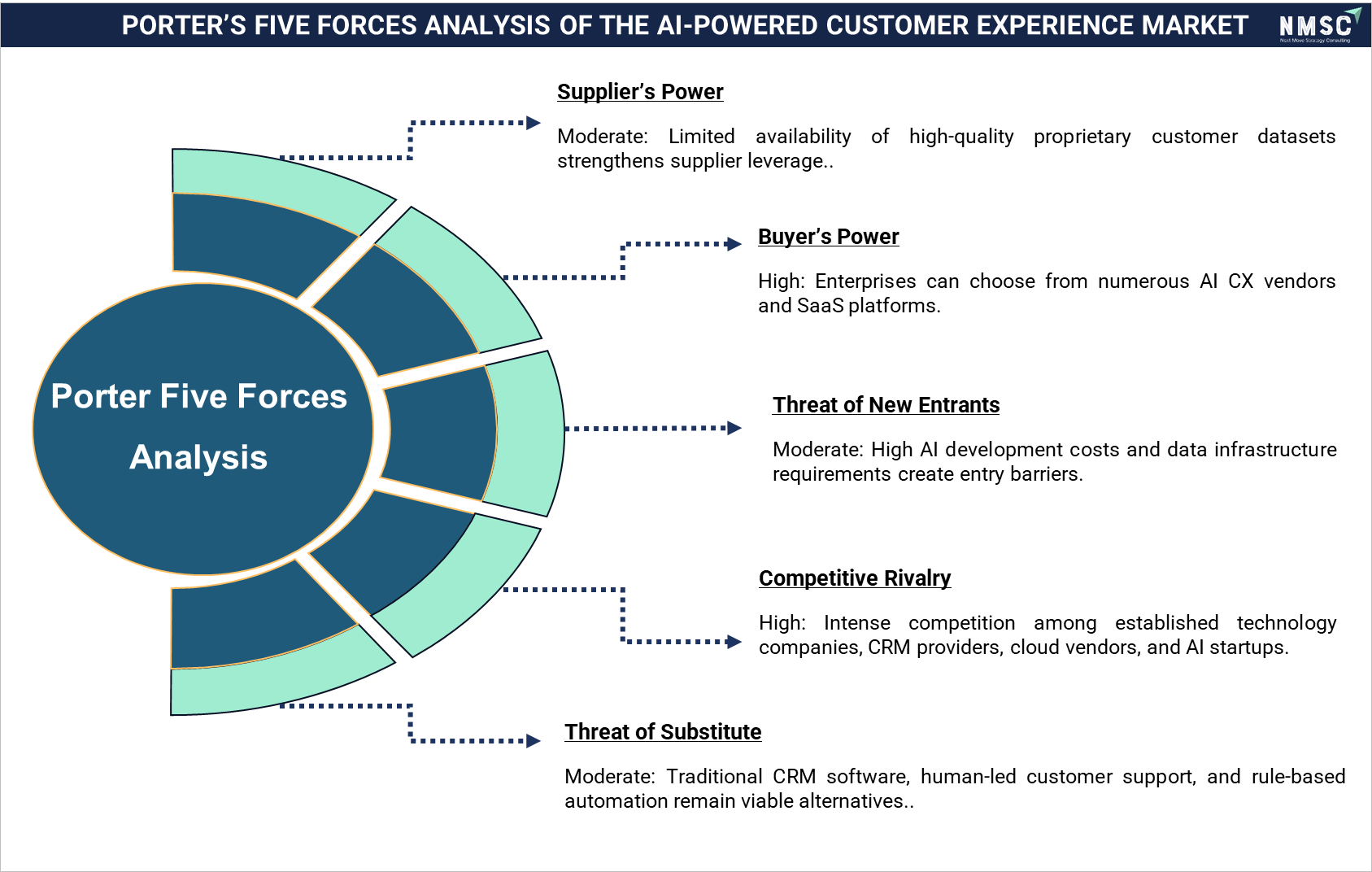
Porter’s Five Forces Analysis of the AI-Powered Customer Experience Market

Based on our Porter’s Five Forces assessment, we identified that the AI-powered customer experience market is characterized by intense competitive rivalry, moderate supplier bargaining power, high buyer bargaining power, moderate threat of new entrants due to technological and investment requirements, and moderate threat of substitutes from conventional customer engagement solutions. Furthermore, our industry evaluation indicates that innovation in artificial intelligence, proprietary data capabilities, cloud infrastructure, platform integration, and customer experience differentiation strengthen competitive positioning and support sustainable market growth.

Market Drivers & Dynamics

Interactive Dataset
Generative AI adoption in customer service driver +8.5% Global Short-term (2026–2028)
Rising demand for omnichannel engagement driver +6.2% Global Short-term (2026–2028)
Enterprise cloud migration of contact centers driver +5.4% North America, Europe Medium-term (2027–2031)
Data privacy and AI governance compliance costs restraint -3.1% Europe, North America Medium-term (2026–2030)
Shortage of AI-skilled implementation talent restraint -2.4% Global Short-term (2026–2028)
Expansion of agentic AI into emerging markets opportunity +4.8% Asia-Pacific, Latin America Long-term (2028–2035)
Growth of voice commerce and conversational shopping opportunity +4.1% North America, Asia-Pacific Medium-term (2027–2032)
Integration of AI customer experience with IoT devices opportunity +3.6% Global Long-term (2029–2035)
Source: Next Move Strategy Consulting

Growth Drivers

How Does Generative AI Adoption Drive Market Growth?

Generative AI adoption is a primary growth driver, enabling enterprises to automate complex, context-rich customer conversations previously requiring human agents. Our analysis shows that the U.S. Bureau of Labor Statistics reports customer service representative employment is projected to decline through automation-driven productivity gains, reflecting accelerating enterprise AI deployment. Vendors embedding generative AI natively within contact center and CRM platforms are capturing disproportionate revenue growth as enterprises replace legacy scripted bots industry-wide.

Why Is Rising Demand for Personalized Engagement a Key Driver?

Rising consumer expectations for personalized, real-time engagement across digital channels is driving enterprise investment in AI-powered recommendation and journey analytics platforms. Based on our market evaluation, we noticed that the U.S. Federal Trade Commission's consumer protection guidance increasingly shapes how personalization data is collected and disclosed, pushing enterprises toward compliant AI personalization architectures. Retailers and BFSI firms are prioritizing personalization as a direct lever for customer lifetime value and retention.

How Does Cloud Migration of Contact Centers Support Growth?

Enterprise migration of contact center infrastructure to cloud-native platforms is a key growth driver, enabling faster deployment of AI capabilities without costly on-premise hardware upgrades. Through our market assessment, we observed that cloud deployment reduces implementation timelines from months to weeks for mid-sized enterprises adopting AI customer experience tools. This shift is particularly pronounced among small and medium enterprises seeking to match large enterprise service quality without proportional capital investment.

Growth Inhibitors

Data privacy and AI governance compliance costs

Data privacy and AI governance compliance costs restrain market growth, particularly across Europe where the Artificial Intelligence Act imposes conformity assessment obligations on high-risk customer-facing AI systems. We found that compliance-related deployment delays are most pronounced among regulated BFSI and healthcare enterprises, which require extensive bias testing and documentation before production deployment, slowing adoption timelines relative to less-regulated retail and e-commerce sectors.

How Does Talent Restrain Market Expansion?

A shortage of AI-skilled implementation talent restrains market expansion, as enterprises struggle to configure, fine-tune, and govern generative AI systems for customer-facing use cases. Our assessment indicates that this talent gap is prompting increased demand for managed services and pre-configured AI platforms that reduce internal implementation burden, benefiting vendors offering turnkey deployment models over those requiring extensive in-house AI engineering resources.

What Are the Growth Opportunities?

What Opportunities Exist in Emerging Market Expansion?

Expansion of agentic AI platforms into Asia-Pacific and Latin American emerging markets presents a significant opportunity, supported by rapid e-commerce growth and rising smartphone-based customer engagement. NMSC's analysis indicates that India's Ministry of Electronics and Information Technology has prioritized AI adoption frameworks that are accelerating enterprise AI customer experience deployment across the country's expanding digital services sector, creating first-mover advantages for vendors establishing regional presence early.

How Does Voice Commerce Growth Create Opportunity?

Growth of voice commerce and conversational shopping presents an opportunity for vendors integrating AI customer experience platforms directly with transactional commerce systems. Our findings suggest that enterprises combining conversational AI with real-time inventory and payment integration are capturing incremental revenue from voice-initiated purchases, particularly across North American and Asia-Pacific retail markets where smart speaker and messaging-app commerce adoption continues to expand.

What Opportunity Does IoT Integration Present for the Market?

Integration of AI customer experience platforms with Internet of Things-enabled products presents a long-term opportunity, enabling proactive service interactions triggered by device-level data rather than reactive customer-initiated contact. Through NMSC's assessment, we found that appliance, automotive, and connected-device manufacturers are beginning to embed AI customer experience capabilities directly into product ecosystems, creating new revenue channels for vendors extending platforms beyond traditional contact center use cases.

Segmentation Analysis

2025 (USD Billion)
2035 (USD Billion)
Software 2025: $11.49 Billion | 2035: $95.76 Billion
Software
Services 2025: $5.41 Billion | 2035: $53.86 Billion
Services
Software $11.49 Billion $95.76 Billion 26.6%
Services $5.41 Billion $53.86 Billion 29.1%

Which Component Segment Leads the AI-Powered Customer Experience Market?

The component axis divides the market into software platforms and implementation-related services supplied to enterprise customer experience teams. Software dominates with a 68% share in 2025, reflecting enterprise preference for licensed AI platforms embedding conversational, analytics, and orchestration capabilities in a single deployment. We found that services is the fastest-growing segment at 29.1% CAGR, driven by rising demand for fine-tuning, integration, and managed governance support as generative AI implementations scale across regulated industries.

2025 (USD Billion)
2035 (USD Billion)
Natural Lang
Machine Lear
Computer Vis
Robotic Proc
Other Techno
Segment Item 2025 (USD Billion) 2035 (USD Billion) CAGR
Natural Language Processing $10.0 USD Billion $40.0 USD Billion 16.0%
Machine Learning and Deep Learning $17.1 USD Billion $51.1 USD Billion 22.0%
Computer Vision $24.2 USD Billion $62.2 USD Billion 16.0%
Robotic Process Automation $31.3 USD Billion $73.3 USD Billion 26.0%
Other Technologies $38.4 USD Billion $84.4 USD Billion 25.0%

Segment-wise data is locked

Unlock complete segment-wise numbers for By Technology.

Unlock Full Data

Which Technology Segment Dominates the AI-Powered Customer Experience Market?

The technology axis reflects the underlying AI capabilities powering customer interactions, from language understanding to visual and process automation. Natural Language Processing dominates with a 30% share in 2025, underpinning chatbots, virtual assistants, and generative response systems. Based on our market evaluation, we noticed that Machine Learning and Deep Learning is the fastest-growing sub-segment at 28.4% CAGR, driven by predictive personalization models and agentic reasoning capabilities gaining enterprise adoption across the forecast period.

2025 (USD Billion)
2035 (USD Billion)
Cloud
On-Premise
Segment Item 2025 (USD Billion) 2035 (USD Billion) CAGR
Cloud $10.0 USD Billion $40.0 USD Billion 9.0%
On-Premise $17.1 USD Billion $51.1 USD Billion 23.0%

Segment-wise data is locked

Unlock complete segment-wise numbers for By Deployment Mode.

Unlock Full Data

Why Does Cloud Deployment Dominate the AI-Powered Customer Experience Market?

The deployment mode axis distinguishes cloud-hosted platforms from on-premise infrastructure serving enterprise customer experience functions. Cloud dominates with a 71% share in 2025 and is also the fastest-growing mode at 29.1% CAGR, reflecting enterprise preference for rapid deployment, elastic scaling, and continuous AI model updates without on-site hardware investment. Our analysis shows that on-premise deployment persists mainly among regulated BFSI and government customers with strict data residency requirements.

2025 (USD Billion)
2035 (USD Billion)
Chatbots and
Sentiment an
Personalized
Customer Jou
Other Applic
Segment Item 2025 (USD Billion) 2035 (USD Billion) CAGR
Chatbots and Virtual Assistants $10.0 USD Billion $40.0 USD Billion 18.0%
Sentiment and Behavior Analytics $17.1 USD Billion $51.1 USD Billion 16.0%
Personalized Recommendations $24.2 USD Billion $62.2 USD Billion 22.0%
Customer Journey Analytics $31.3 USD Billion $73.3 USD Billion 12.0%
Other Applications $38.4 USD Billion $84.4 USD Billion 19.0%

Segment-wise data is locked

Unlock complete segment-wise numbers for By Application.

Unlock Full Data

Which Application Segment Holds the Largest AI-Powered Customer Experience Market Share?

The application axis captures the specific customer-facing use cases AI systems support across the engagement lifecycle. Chatbots and Virtual Assistants dominate with a 34% share in 2025, reflecting their role as the most mature and widely deployed application. Through our market assessment, we observed that Customer Journey Analytics is the fastest-growing application at 29.1% CAGR, as enterprises increasingly invest in unified cross-channel visibility to reduce friction across complex, multi-touchpoint customer journeys.

2025 (USD Billion)
2035 (USD Billion)
Large Enterp
Small and Me
Segment Item 2025 (USD Billion) 2035 (USD Billion) CAGR
Large Enterprises $10.0 USD Billion $40.0 USD Billion 10.0%
Small and Medium Enterprises $17.1 USD Billion $51.1 USD Billion 24.0%

Segment-wise data is locked

Unlock complete segment-wise numbers for By Organization Size.

Unlock Full Data

How Does Organization Size Influence AI-Powered Customer Experience Market Adoption?

The organization size axis distinguishes large enterprises from small and medium enterprises adopting AI customer experience tools. Large Enterprises dominate with a 66% share in 2025, supported by larger customer interaction volumes and dedicated budgets for AI transformation initiatives. In our observation, Small and Medium Enterprises represent the fastest-growing segment at 30.4% CAGR, as affordable cloud-based, subscription-priced AI platforms lower adoption barriers previously limited to well-resourced large enterprises.

2025 (USD Billion)
2035 (USD Billion)
BFSI
Retail and E
Healthcare
IT and Telec
Travel and H
Segment Item 2025 (USD Billion) 2035 (USD Billion) CAGR
BFSI $10.0 USD Billion $40.0 USD Billion 20.0%
Retail and E-commerce $17.1 USD Billion $51.1 USD Billion 18.0%
Healthcare $24.2 USD Billion $62.2 USD Billion 12.0%
IT and Telecom $31.3 USD Billion $73.3 USD Billion 22.0%
Travel and Hospitality $38.4 USD Billion $84.4 USD Billion 25.0%

Segment-wise data is locked

Unlock complete segment-wise numbers for By End-Use Industry.

Unlock Full Data

Which End-Use Industry Leads AI-Powered Customer Experience Market Demand?

The end-use industry axis reflects the sectors deploying AI customer experience platforms to manage customer interactions at scale. BFSI dominates with a 24% share in 2025, driven by high transaction volumes and fraud-sensitive interactions requiring AI-assisted verification and support. Our findings suggest that Media and Entertainment is the fastest-growing vertical at 29.4% CAGR, as streaming and subscription platforms adopt AI-driven personalization and churn-prevention tools to retain increasingly choice-rich consumers.

2025 (USD Billion)
2035 (USD Billion)
North Americ
Canada
Mexico
Europe: UK
Germany
Segment Item 2025 (USD Billion) 2035 (USD Billion) CAGR
North America: U.S. $10.0 USD Billion $40.0 USD Billion 25.0%
Canada $17.1 USD Billion $51.1 USD Billion 19.0%
Mexico $24.2 USD Billion $62.2 USD Billion 17.0%
Europe: UK $31.3 USD Billion $73.3 USD Billion 15.0%
Germany $38.4 USD Billion $84.4 USD Billion 16.0%

Segment-wise data is locked

Unlock complete segment-wise numbers for By Region.

Unlock Full Data

Regional Outlook

2025 (USD Billion)
2035 (USD Billion)
North Americ
Europe
Asia-Pacific
Middle East
Latin Americ
Region 2025 (USD Billion) 2035 (USD Billion) CAGR (%)
North America $10.0 USD Billion $40.0 USD Billion 9.0%
Europe $17.1 USD Billion $51.1 USD Billion 27.0%
Asia-Pacific $24.2 USD Billion $62.2 USD Billion 25.0%
Middle East and Africa $31.3 USD Billion $73.3 USD Billion 23.0%
Latin America $38.4 USD Billion $84.4 USD Billion 12.0%

Regional data is locked

Unlock complete regional numbers for this market.

Unlock Full Data

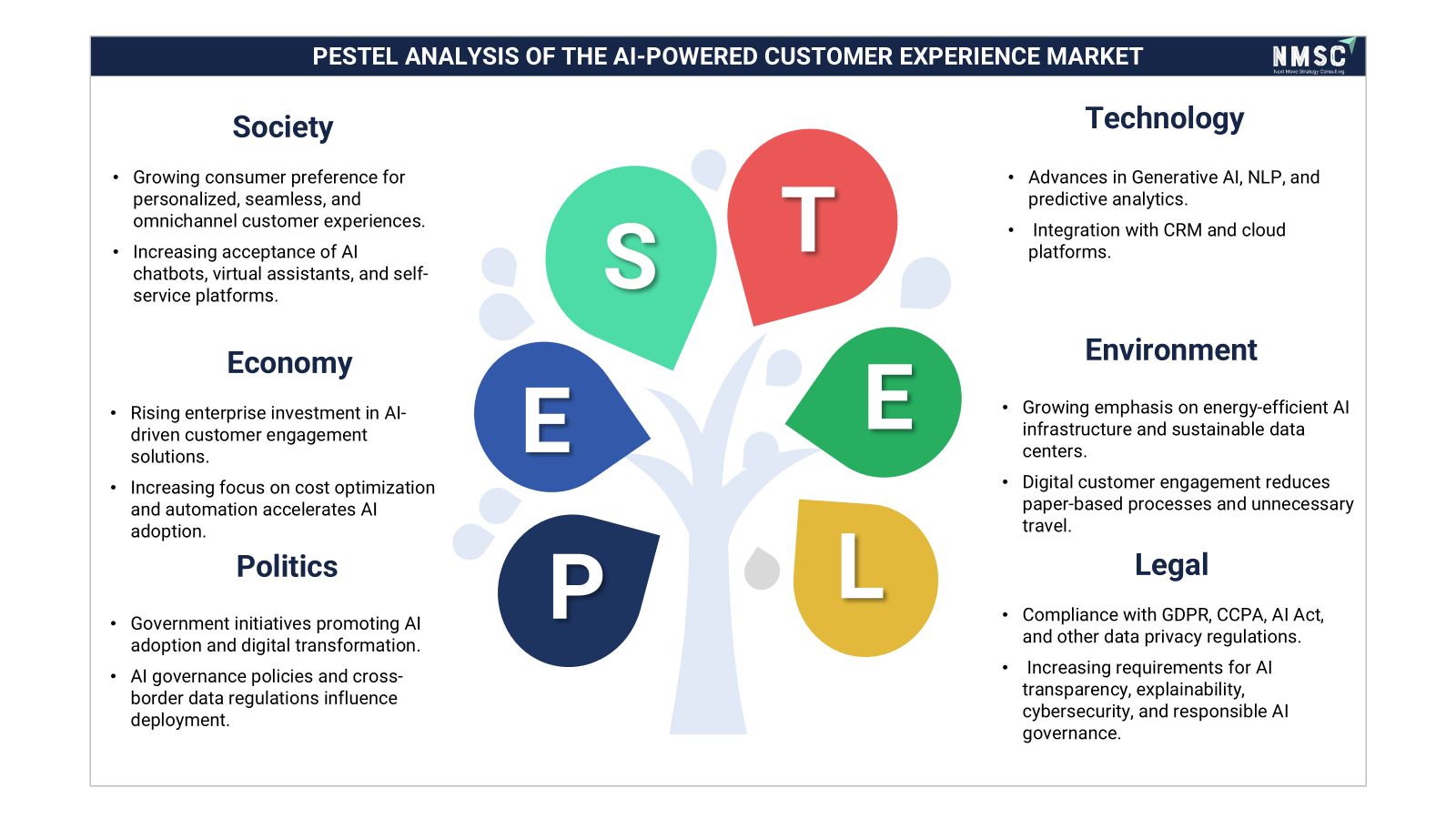
PESTEL Analysis of the AI-Powered Customer Experience Market

PESTEL Analysis of the AI-Powered Customer Experience Market
Based on our PESTEL assessment, we identified that the AI-powered customer experience market is shaped by government regulations on artificial intelligence, enterprise investment priorities, evolving customer expectations, rapid advancements in generative AI and analytics, increasing focus on sustainable digital infrastructure, and stringent data privacy and AI governance frameworks. Furthermore, our industry evaluation indicates that responsible AI deployment, cybersecurity requirements, ethical AI practices, and compliance with global data protection regulations significantly influence technology adoption, competitive differentiation, and long-term market expansion.

Competitive Landscape

Dimension Description
Market Structure Moderately fragmented, with the top 10 companies accounting for an estimated 58% of 2025 revenue amid active consolidation.
Innovation Focus Agentic AI, retrieval-augmented generation, and omnichannel journey orchestration lead vendor product roadmaps through 2035.
M&A Activity Elevated deal activity as platform vendors acquire specialist conversational AI and analytics startups to close capability gaps.

How Do Companies Compete in the AI-Powered Customer Experience Market?

Companies compete primarily on breadth of generative AI capability, depth of omnichannel integration, and speed of deployment across enterprise environments. Our analysis shows that vendors differentiate through proprietary large language model fine-tuning, industry-specific compliance features, and native integration with existing CRM and contact center infrastructure. Pricing strategies increasingly favor consumption-based and outcome-linked models over flat per-seat licensing as enterprises seek measurable return on AI investment.

Which Competitive Archetypes Dominate the AI-Powered Customer Experience Market?

Three archetypes dominate: hyperscale cloud and CRM incumbents embedding AI into existing enterprise software suites, contact center specialists extending legacy platforms with generative AI, and venture-backed AI-native challengers built exclusively around agentic and conversational AI. We found that incumbents leverage installed-base distribution advantages, while AI-native challengers compete on innovation speed and specialized accuracy, together shaping a bifurcated competitive landscape across the AI-powered customer experience market.

What Innovation and Differentiation Strategies Define Competitive Positioning?

Leading vendors differentiate through investment in agentic AI reasoning, retrieval-augmented generation for factual grounding, and proprietary industry-specific data sets that improve response accuracy in regulated sectors. Based on our market evaluation, we noticed that vendors are increasingly marketing measurable outcome metrics, such as resolution rate and customer satisfaction lift, as primary differentiators over feature checklists, reflecting growing enterprise buyer sophistication in evaluating AI customer experience investments.

Key Market Players

Salesforce, Inc.

Salesforce, Inc. Microsoft Corporation Alphabet Inc. Amazon.com, Inc. Oracle Corporation SAP SE International Business Machines Corporation Adobe Inc. NICE Ltd. Genesys Cloud Services, Inc. Verint Systems Inc. Zendesk, Inc. Freshworks Inc. Twilio Inc. Five9, Inc. Sprinklr, Inc. Medallia, Inc. Talkdesk, Inc. Qualtrics International Inc. HubSpot, Inc.

Latest Developments

Our findings suggest that vendor product launches through 2025 and 2026 are concentrated around agentic AI and generative reasoning capabilities across leading platforms.

Date Event
July 2026 International Business Machines Corporation (IBM) published a detailed architectural case study of a permission-aware knowledge assistant built with IBM watsonx Orchestrate, Symplistic.ai ContentIQ and Microsoft 365/SharePoint. The solution was developed with Australian digital-transformation consultancy Origin Digital for Swan Christian Education Association (SCEA), with the pilot validating permission-aware retrieval, source traceability and integration with the organization's Microsoft 365 environment.
June 2026 NICE Ltd. announced major platform updates at NICE World 2026, integrating NICE Cognigy agentic AI natively at the core of its enterprise CX ecosystem. The launch included a unified Workforce Empowerment Suite to govern and optimize both human and AI agents within a single operational framework. Additionally, NICE expanded its strategic partnership with RingCentral, Inc. in July 2026 under a multi-year, bi-directional agreement combining RingCentral's UCaaS capabilities with NICE's CXone platform.
May 2025 At its SIGNAL 2025 conference, Twilio Inc. unveiled its next-generation customer engagement platform, combining CPaaS, the Segment Customer Data Platform (CDP), and real-time conversational AI. The platform introduces advanced agentic streaming capabilities, interrupt-handling speech recognition, and automated compliance tools to optimize customer interaction workflows.

Expert Insights

Olivier Jouve

Olivier Jouve

Chief Product Officer | Genesys

"Earning customer loyalty requires organizations to scale personalized, end-to-end experiences. This is possible with an AI-powered solution that connects data, systems, employees, and communication channels to create a 360-degree view of the customer experience."

Analyst Interpretation

The statement underscores the growing role of artificial intelligence in transforming customer experience by enabling organizations to deliver personalized, omnichannel interactions through connected data and intelligent automation. As enterprises increasingly invest in AI-powered customer engagement platforms to improve customer satisfaction, operational efficiency, and loyalty, demand for advanced AI-driven customer experience solutions is expected to accelerate, supporting the sustained growth of the global AI-Powered Customer Experience Market.

Investment Opportunities

What Capital Inflows Are Supporting the AI-Powered Customer Experience Market?

Capital inflows into AI customer experience vendors remain strong, with venture and growth-equity funding concentrated among agentic AI and conversational analytics startups. Our findings suggest that investors are prioritizing companies demonstrating measurable enterprise deployment traction over early-stage technology alone, reflecting a maturing investment environment. Public market capital allocation from incumbent software vendors toward AI research and development continues to rise as a share of total technology spending.

How Is Infrastructure Investment Shaping the Market?

Infrastructure investment in cloud computing capacity and specialized AI processing hardware underpins the market's ability to scale generative AI-powered customer interactions. We observed that hyperscale cloud providers are expanding regional data center footprints partly to support low-latency AI customer experience workloads, particularly across Asia-Pacific and Middle Eastern markets where enterprise cloud migration is accelerating fastest during the forecast period.

What ESG Considerations Affect AI-Powered Customer Experience Investment?

Environmental, social, and governance considerations increasingly influence AI customer experience investment decisions, particularly around energy consumption of large language model inference and equitable access to AI-enhanced customer service. Through our market assessment, we observed that enterprises are evaluating vendor energy efficiency credentials alongside functional capabilities, while governance considerations around algorithmic bias testing are becoming standard components of vendor procurement evaluation criteria.

How Does Digital Transformation Investment Support Market Growth?

Broader enterprise digital transformation budgets continue to allocate rising shares toward AI-powered customer experience initiatives as organizations prioritize customer retention and operational efficiency simultaneously. Based on our market evaluation, we noticed that digital transformation investment is increasingly outcome-linked, with enterprises measuring AI customer experience return on investment against specific metrics such as resolution time reduction and customer satisfaction score improvement.

What PE/VC and M&A Activity Characterizes the Investment Landscape?

Private equity and venture capital firms continue active investment in specialist AI customer experience vendors, while strategic acquirers pursue consolidation to close capability gaps in agentic reasoning and industry-specific compliance. NMSC's analysis indicates that deal valuations remain elevated for companies demonstrating enterprise-grade reliability and measurable customer outcome improvements, reflecting sustained investor confidence in the market's long-term growth trajectory through 2035.

Key Benefits for Stakeholders

What Benefits Does This Report Offer Enterprise Technology Leaders and CIOs?

Enterprise technology leaders and CIOs gain a structured framework for evaluating AI customer experience vendor capabilities across component, technology, and deployment axes detailed in the Segmentation Analysis. Our assessment indicates that the Regional Outlook and Competitive Landscape sections support informed vendor selection decisions aligned with organizational compliance requirements, deployment timelines, and total cost of ownership considerations relevant to enterprise-scale AI transformation initiatives.

What Benefits Does This Report Offer Investors and Financial Analysts?

Investors and financial analysts benefit from the quantified market sizing, segmentation, and Competitive Landscape analysis that supports evidence-based evaluation of vendor positioning and growth trajectory. We found that the Investment Opportunities and Latest Developments sections provide grounded context for assessing capital allocation decisions across public and private AI customer experience companies through the 2026–2035 forecast period.

What Benefits Does This Report Offer Technology Vendors and Product Teams?

Technology vendors and product teams gain competitive benchmarking through the Key Market Players and Competitive Landscape sections, alongside demand signals from the Segmentation and Regional Outlook analyses. Our analysis shows that the Key Emerging Trends section highlights specific product development priorities, such as agentic AI and retrieval-augmented generation, that inform roadmap prioritization decisions aligned with validated market demand patterns.

Key Market Segments Evaluated

By Component

  • Software
  • Services

By Technology

  • Natural Language Processing
  • Machine Learning and Deep Learning
  • Computer Vision
  • Robotic Process Automation
  • Other Technologies

By Deployment Mode

  • Cloud
  • On-Premise

By Application

  • Chatbots and Virtual Assistants
  • Sentiment and Behavior Analytics
  • Personalized Recommendations
  • Customer Journey Analytics
  • Other Applications

By Organization Size

  • Large Enterprises
  • Small and Medium Enterprises

By End-Use Industry

  • BFSI
  • Retail and E-commerce
  • Healthcare
  • IT and Telecom
  • Travel and Hospitality
  • Media and Entertainment
  • Other Industries

By Region

  • North America: U.S.
  • Canada
  • Mexico
  • Europe: UK
  • Germany
  • France
  • Italy
  • Spain
  • Sweden
  • Denmark
  • Finland
  • Netherlands
  • Rest of Europe
  • Asia-Pacific: China
  • India
  • Japan
  • South Korea
  • Taiwan
  • Indonesia
  • Vietnam
  • Australia
  • Philippines
  • Malaysia
  • Rest of APAC
  • Middle East & Africa: Saudi Arabia
  • UAE
  • Egypt
  • Israel
  • Turkey
  • Nigeria
  • South Africa
  • Rest of MEA
  • Latin America: Brazil
  • Argentina
  • Chile
  • Colombia
  • Rest of LATAM

Conclusion & Recommendations

The long-term outlook for the AI-powered customer experience market remains exceptionally strong, with global revenue projected to increase from USD 16.90 billion in 2025 to USD 149.62 billion by 2035 at a 24.50% CAGR. We observed that enterprises are transitioning from reactive, rules-based customer engagement solutions toward autonomous, agentic AI platforms capable of delivering personalized, real-time interactions. Growth is expected to remain broad-based across industries, with Asia-Pacific and the Services segment emerging as the fastest-growing markets throughout the forecast period.

What Strategic Positioning Should AI-Powered Customer Experience Solution Providers Pursue?

Solution providers should prioritize the development of agentic AI capabilities and retrieval-augmented generation while strengthening industry-specific compliance and governance features for highly regulated sectors such as BFSI and healthcare. Our assessment indicates that enterprises increasingly prefer unified customer experience platforms over fragmented point solutions. Vendors combining advanced generative AI capabilities with enterprise-grade scalability, transparent governance, and proven deployment expertise will be best positioned to secure high-value, long-term contracts as customer expectations and regulatory requirements continue to evolve.

How Attractive Is the AI-Powered Customer Experience Market for New Investment?

The AI-powered customer experience industry presents a highly attractive investment opportunity, supported by a USD 128.78 billion absolute dollar opportunity between 2026 and 2035 and robust growth across the Asia-Pacific region and Services segment. We found that investment attractiveness is highest among technology providers combining advanced agentic AI capabilities with scalable enterprise deployment infrastructure. Companies capable of supporting large-scale digital transformation initiatives are expected to capture a disproportionate share of enterprise spending as organizations increasingly consolidate AI investments with trusted platform providers.

What Market Shifts and Key Risks Should Stakeholders Monitor?

Stakeholders should closely monitor evolving AI governance regulations, including conformity assessment requirements under the European Union Artificial Intelligence Act, alongside the growing shortage of skilled AI professionals and increasing competition from open-source large language model alternatives. Our analysis shows that vendors unable to demonstrate transparent, auditable, and reliable AI systems risk losing enterprise contracts to competitors offering stronger governance frameworks, particularly as regulatory oversight and enterprise procurement standards become more stringent across global markets.

What Are the Key Growth Pathways for the AI-Powered Customer Experience Market?

Key growth pathways include expanding agentic AI capabilities to support autonomous multi-step customer issue resolution, scaling retrieval-augmented generation for compliance-intensive industries, and increasing penetration among small and medium-sized enterprises through cost-effective cloud-based deployment models. Next Move Strategy Consulting's analysis indicates that solution providers investing in autonomous AI innovation while maintaining robust governance, security, and regulatory compliance will be best positioned to capture the AI-powered customer experience market's projected growth opportunities through 2035.

FAQs

About the Author

Saista Faiyaz

Saista Faiyaz

Saista Faiyaz is Research Associate at Next Move Strategy Consulting, where she has covered consumer markets and healthcare technologies for 3 years. Her work includes primary interview review, secondary-source validation, market sizing, and structured analysis of company and industry data. She supports research by comparing evidence across sources, organizing findings into market narratives, and documenting assumptions used in analysis. Her scope includes cross-market benchmarking, and reports.

About the Reviewer

Supradip Baul

Supradip Baul

Supradip Baul is an accomplished business consultant and strategist with over a decade of rich experience in market intelligence, strategy, technology, and business transformation. His work has included rigorous qualitative and quantitative analysis across multiple industries, helping clients shape investment decisions and long-term roadmaps. Earlier in his career, he was associated with Gartner, where he contributed to industry-leading reports and market share analyses. He has worked with leading global companies and holds an MBA with a dual specialization in Marketing and Finance.

Download Free Sample

Kishu Kanda

KISHU KANDA

Strategy Analyst

Accenture

We purchased the AI Consumer Market Report from this company. Not only did they customize the report to meet our specific requirements, but they also showed great flexibility in accommodating our budget. The report we received fully met our expectations. Additionally, they provided prompt and thorough responses to both our pre-purchase and follow-up questions. We look forward to working with this company again in the future.

Robert Sean Trevino

ROBERT SEAN TREVINO

Sr. Director, Head of Strategic Insights & Analytics

Foundation Medicine

I realized that it was a reliable source of information. These days, there are many people who are looking for authentic data, and this is one of the only sources that can offer them with what they need;

Pratyush Kumar Das

PRATYUSH KUMAR DAS

Assistant Manager

Polycab India Limited

We would like to express our appreciation for the data and insights provided by nextmsc. We are very pleased with the quality and depth of the information, which has proven to be highly valuable and beneficial for our business decision-making.

Melanie Samko

MELANIE SAMKO

Director of Marketing

TOSOH BIOSCIENCE, INC.

The information provided by NMSC is incredibly valuable, thank you so much for such a excellent work. I really appreciate it. I will make sure to reference all of it, in my summary document.

Mohit Agarwal

MOHIT AGARWAL

Chief Manager

DryChem India Pvt. Ltd.

Next Move Strategy Consulting is an amazing team of consultants. We required a market study report for our investors on top priority and the team went above and beyond our expectations to deliver the same with ample supporting data within a short time span enabling us to secure the investments and keep our project timeline maintained. Their professionalism, attention to detail, and timely delivery of actionable recommendations have left a lasting impression on our organization.

Custom Market Research Services

We will customize the research for you if the listed report does not fully match your requirements.

Get 30% Free Customization

Select License

This website uses cookies to ensure you get the best experience on our website. Learn more

✖