AI Customer Journey Market Size, Share, Growth & Forecast by Solution Type (Customer Data Platform: Identity Resolution, Unified Profiles, Segmentation and Activation, Consent and Governance; Experience Scoring and Other), Deployment Mode (Cloud SaaS, Private Cloud, On Premises, Hybrid), Industry (Retail and E-commerce, BFSI, and Other Industries), Organization Size (Small, Mid-Market, Enterprise), Journey Stage (Acquire, Convert,and Ohers) — Global Analysis 2025–2035.
Industry: ICT & Media | Publishing Date: July 7, 2026 | Last Updated: September 30, 2026 | No of Pages: N/A | No. of Tables: N/A | No. of Figures: N/A | Format: PDF | Report Code: IC4992
What Is the AI Customer Journey Market Size?
The global AI Customer Journey Market was valued at USD 6.4 billion in 2025 and is expected to reach USD 7.6 billion in 2026. Rising enterprise investment in AI-powered personalization, real-time decisioning, and omnichannel orchestration is projected to propel the AI Customer Journey Market to USD 45.5 billion by 2035, advancing at a CAGR of 22.0% from 2026 to 2035. Key growth drivers include the proliferation of cloud-native customer data platforms, expanding deployment of AI-driven next best action engines, growing demand for real-time journey analytics, and enterprise prioritization of customer experience as a primary competitive differentiator.
|
Parameters |
Details |
|
Market Size in 2025 |
USD 6.4 Billion |
|
Market Size in 2026 |
USD 7.6 Billion |
|
Revenue Forecast in 2035 |
USD 45.5 Billion |
|
Growth Rate |
CAGR of 22.0% from 2026 to 2035 |
|
Analysis Period |
2025–2035 |
|
Base Year Considered |
2025 |
|
Forecast Period |
2026–2035 |
|
Market Size Estimation |
Billion USD |
|
Companies Profiled |
20 |
|
Countries Covered |
33 |
|
Market Share |
Top 10 |
AI Customer Journey Market Overview
What Is the AI Customer Journey Market?
The AI Customer Journey Market encompasses a broad ecosystem of software platforms, analytics engines, and automation solutions that apply artificial intelligence and machine learning to map, analyze, orchestrate, and optimize every interaction between enterprises and their customers. These solutions span customer data platforms, journey analytics, journey orchestration engines, customer service automation, and experience management suites. The Market enables organizations to deliver hyper-personalized, context-aware, and consistent experiences across digital and physical touchpoints throughout the complete customer lifecycle.
How Has the AI Customer Journey Market Evolved?
The AI Customer Journey Market has progressed through three distinct phases of technological evolution. The initial phase centered on basic customer segmentation and rule-based campaign management systems that operated on aggregated behavioral data. The second phase introduced real-time data integration and predictive analytics capabilities, enabling more responsive customer interactions. The current phase is defined by generative AI, large language model integration, and autonomous decisioning engines that can dynamically adapt journey paths in milliseconds based on individual customer signals, intent predictions, and contextual environmental data.
How Do Regulations Influence the AI Customer Journey Market?
Regulatory frameworks are reshaping the structural architecture of the AI Customer Journey Market. The European Union's General Data Protection Regulation, the California Consumer Privacy Act, and the EU AI Act collectively mandate consent-based data collection, algorithmic transparency, and explainable AI decision-making within customer-facing applications. These requirements are driving investment in privacy-by-design customer data platforms, consent and governance modules, and AI audit trail capabilities. Regulations across Asia-Pacific and the Middle East further influence deployment architectures, particularly mandating data residency and sovereign cloud adoption for regulated industry verticals.
How Is Technology Adoption Expanding Across the AI Customer Journey Market?
Technology adoption across the AI Customer Journey Market is accelerating as organizations transition from point-solution customer engagement tools toward unified, AI-native journey management platforms. Cloud SaaS delivery has become the dominant deployment model, enabling rapid deployment, continuous model updates, and consumption-based pricing that lowers adoption barriers for mid-market buyers. Large enterprises are increasingly implementing composable architectures that combine specialized best-of-breed journey analytics, orchestration, and service automation solutions integrated through open APIs and standardized customer data schemas.
|
Key Takeaways |
|
By Solution Type, Journey Orchestration held the largest share at USD 1.5 billion in 2025, commanding dominance through its role in enabling real-time next best action decisioning, dynamic personalization, and omnichannel campaign coordination that directly tie AI capabilities to measurable revenue outcomes. Customer Service Automation is the fastest-growing solution type in the AI Customer Journey Market at a CAGR of 24.0% from 2026 to 2035, driven by enterprise adoption of AI virtual agents, agent assist tools, and self-service automation that reduce operational costs while improving customer satisfaction metrics at scale. |
|
By Deployment Mode, Cloud SaaS is the dominant deployment model, generating USD 3.7 billion in 2025, as enterprises benefit from rapid provisioning, AI model updates, and flexible consumption-based pricing that align data platform costs with business growth. Hybrid deployment is the fastest-growing deployment mode in the AI Customer Journey Market at a CAGR of 24.6% from 2026 to 2035, as regulated industries including financial services and healthcare seek to balance cloud AI capabilities with data sovereignty and on-premises legacy system integration requirements. |
|
By Buyer Function, Marketing holds the largest share at USD 1.6 billion in 2025, reflecting sustained investment in AI-powered customer segmentation, personalization, and campaign orchestration capabilities that improve acquisition efficiency and customer lifetime value. Service is the fastest-growing buyer function in the AI Customer Journey Market at a CAGR of 23.5% from 2026 to 2035, driven by enterprise investment in AI-powered virtual agents, agent assist, and self-service platforms that transform service cost structures while enabling proactive and predictive customer engagement. |
|
By Industry, Retail and E-commerce is the largest industry vertical at USD 1.2 billion in 2025, leveraging AI customer journey platforms for personalized product discovery, abandoned cart recovery, loyalty management, and omnichannel experience optimization across digital and physical retail environments. Healthcare and Life Sciences is the fastest-growing industry vertical in the AI Customer Journey Market at a CAGR of 23.9% from 2026 to 2035, as providers and life sciences organizations deploy AI journey platforms for patient engagement, treatment adherence support, and personalized health education programs. |
|
By Organization Size, Enterprise dominates with USD 4.3 billion in 2025, underpinned by large-scale deployments of end-to-end journey management platforms integrated across marketing, sales, service, and digital functions. Small organizations represent the fastest-growing size segment in the AI Customer Journey Market at a CAGR of 23.3% from 2026 to 2035, as cloud SaaS delivery, usage-based commercial models, and AI-native SMB-focused platforms lower deployment complexity and cost barriers for smaller enterprises seeking competitive CX differentiation. |
|
By Commercial Model, Subscription is the dominant commercial model, generating USD 3.2 billion in 2025, as enterprise buyers prefer predictable licensing costs and continuous product update cycles. Usage-based pricing is the fastest-growing commercial model in the AI Customer Journey Market at a CAGR of 24.5% from 2026 to 2035, reflecting growing enterprise preference for consumption-aligned cost structures tied to interaction volumes, AI inference calls, and active customer profiles managed across the platform. |
|
By Journey Stage, the Serve stage generates the largest revenue at USD 1.3 billion in 2025, reflecting the substantial enterprise investment in AI-powered customer service automation, case resolution, and proactive issue prevention capabilities that drive retention and satisfaction. The Retain stage is the fastest-growing journey stage in the AI Customer Journey Market at a CAGR of 23.0% from 2026 to 2035, as enterprises prioritize AI-driven churn prediction, proactive intervention, and personalized loyalty programs that maximize customer lifetime value in competitive markets. |
|
North America holds the largest regional share in the AI Customer Journey Market at USD 2.8 billion in 2025, projected to reach USD 19.1 billion by 2035 at a CAGR of 20.9%, underpinned by the global headquarters of leading platform vendors, the highest enterprise technology budgets, and the most advanced AI adoption maturity in customer experience applications worldwide. |
|
Asia-Pacific is the fastest-growing region in the AI Customer Journey Market at a CAGR of 23.3% from 2026 to 2035, driven by rapid digital economy expansion in China, India, and Southeast Asia, increasing enterprise investment in AI-powered customer engagement platforms, and a large mobile-first consumer base that generates rich behavioral data for AI model training and optimization. |
|
The United States is the single largest country market in the AI Customer Journey Market, hosting the global headquarters of Salesforce, Adobe, Microsoft, Oracle, HubSpot, Genesys, and NICE, and maintaining the world's deepest enterprise technology buyer base with the highest concentration of Fortune 500 AI Customer Journey platform investments. |
|
India is the fastest-growing national market in the AI Customer Journey Market within Asia-Pacific at a CAGR exceeding 26.0%, propelled by the rapid digitalization of retail, financial services, and telecommunications sectors, expanding cloud infrastructure investments by global hyperscalers, and increasing consumer expectation for personalized and AI-powered digital engagement experiences. |
Key Emerging Trends in the AI Customer Journey Market
How Is Generative AI Transforming Real-Time Personalization in the AI Customer Journey Market?
Generative AI is fundamentally redefining what is achievable in real-time customer personalization across the AI Customer Journey Market. NMSC's analysis indicates that large language model integration within journey orchestration platforms now enables enterprises to generate dynamically composed messages, product recommendations, and next best action sequences tailored to individual customer contexts at scale. Salesforce's Einstein Copilot and Adobe's Firefly AI demonstrate this shift, enabling marketing and service teams to deploy AI-generated content variations tested against behavioral signals in milliseconds, compressing personalization cycles from days to real-time adaptive engagement.
How Is AI-Powered Predictive Analytics Reshaping Journey Stage Interventions?
Predictive scoring and intent modeling are becoming core infrastructure layers within the AI Customer Journey Market, enabling enterprises to anticipate customer needs before they are explicitly expressed. Our analysis shows that advanced predictive models trained on behavioral, transactional, and contextual data can now identify churn risk, purchase propensity, and service escalation probability with high accuracy. Platforms including Pegasystems and NICE deploy real-time predictive models that trigger proactive interventions at critical journey moments, transforming customer service from reactive issue resolution to AI-driven proactive engagement that measurably improves retention and lifetime value outcomes.
What Role Is Unified Customer Data Infrastructure Playing in Advancing the AI Customer Journey Market?
The consolidation of fragmented customer data into governed, AI-ready customer data platforms is a defining structural trend across the AI Customer Journey Market. Based on NMSC's research, we found that organizations investing in identity resolution, unified profile creation, and real-time segmentation engines are achieving materially superior personalization outcomes compared to those operating with siloed data environments. Adobe Real-Time CDP and Salesforce Data Cloud exemplify the platform consolidation trend, bringing together behavioral streams, transactional history, and third-party data signals into a single persistent customer graph that powers downstream AI decisioning and journey orchestration capabilities.
How Is the Rise of Autonomous AI Agents Influencing the AI Customer Journey Market?
Autonomous AI agents represent the frontier of innovation within the AI Customer Journey Market, moving beyond assisted decisioning toward fully automated customer interaction management across digital channels. Through our market assessment, we observed that Salesforce Agentforce, ServiceNow AI Agents, and Microsoft Copilot Studio are enabling enterprises to deploy AI agents capable of handling complex multi-step customer journeys without human intervention, including product research, purchase assistance, service escalation, and subscription management. This development is compressing enterprise service workforce requirements while simultaneously raising customer experience quality expectations across digital commerce and support functions globally.
Consumer Behavior Analysis of the AI Customer Journey Market
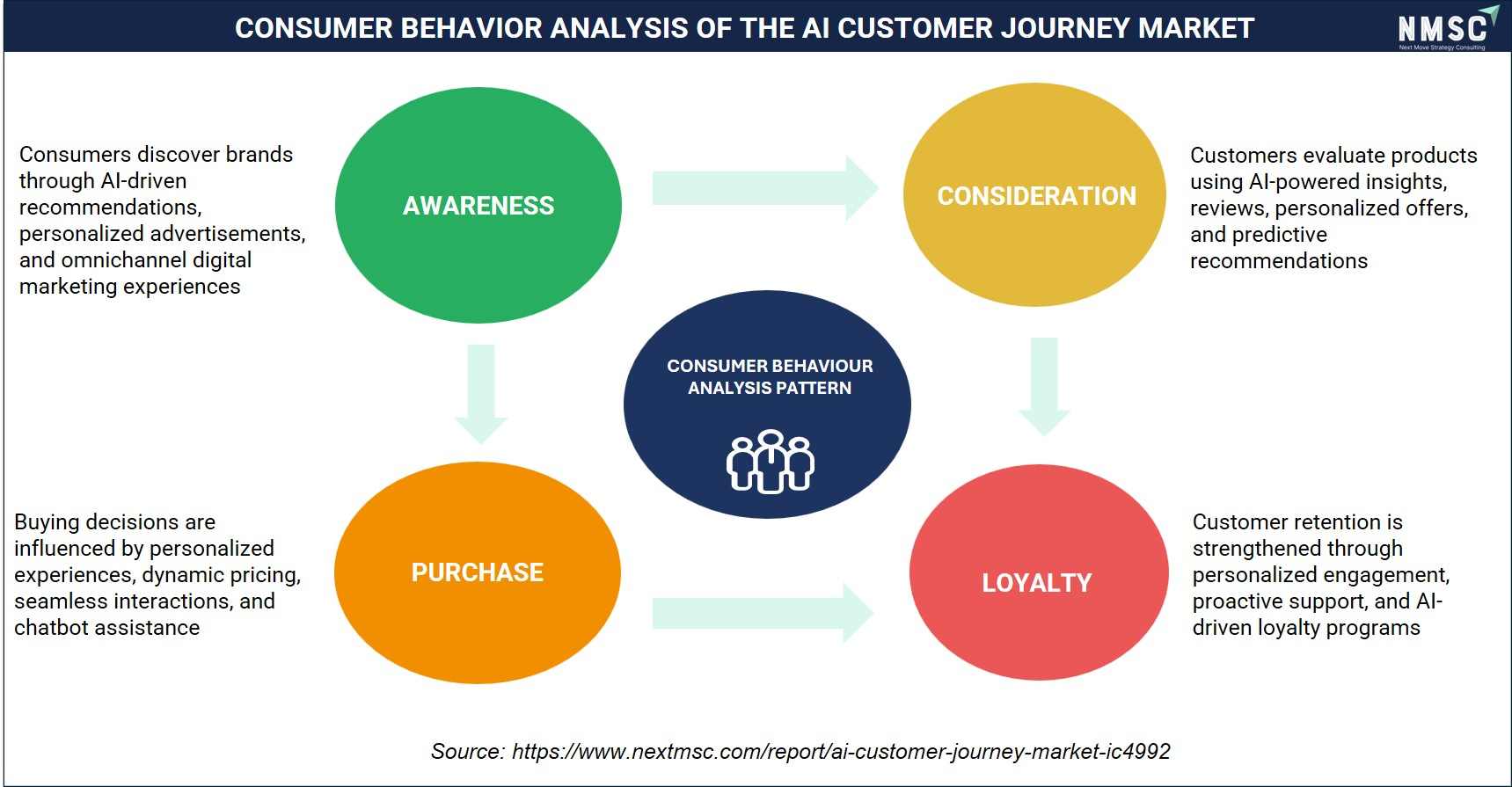
Based on our comprehensive assessment, we found that consumer behavior in the AI Customer Journey Market follows a data-driven path from awareness to loyalty. AI-powered recommendations, predictive analytics, and personalized engagement influence purchasing decisions across digital channels. Our analysis indicates that businesses leveraging customer journey intelligence improve conversion rates, strengthen customer retention, and deliver highly personalized experiences that enhance long-term brand relationships.
What Are the Key Market Drivers, Breakthroughs, and Investment Opportunities that will Shape the AI Customer Journey Industry in the Next Decade?
|
Drivers / Trends / Restraints |
(+/-) % Impact on CAGR Forecast |
Geographic Relevance |
Impact Timeline |
|
Generative AI Integration in Journey Platforms |
+3.1% |
Global (led by North America, Europe) |
2025–2030 |
|
Enterprise Investment in Customer Data Platforms |
+2.4% |
North America, Europe, Australia |
2025–2035 |
|
AI-Powered Customer Service Automation Adoption |
+2.2% |
Global (all regions) |
2025–2030 |
|
Expansion of Real-Time Journey Orchestration Engines |
+1.8% |
North America, APAC, Europe |
2025–2032 |
|
Growing Digital-First Consumer Expectation |
+1.6% |
Global |
2025–2035 |
|
Autonomous AI Agent Deployment |
+2.0% |
North America, Europe |
2026–2035 |
|
Data Privacy Regulation Complexity |
-1.4% |
Europe, APAC, North America |
Ongoing |
|
AI Bias and Algorithmic Transparency Risk |
-0.8% |
Europe, North America |
Ongoing |
|
Integration Complexity with Legacy CRM and ERP Systems |
-0.9% |
All regions |
2025–2028 |
|
SMB AI Literacy and Adoption Gap |
-0.6% |
Latin America, MEA, Southeast Asia |
2025–2027 |
What Are the Growth Drivers of the AI Customer Journey Market?
How Is Surging Enterprise Demand for AI-Powered Personalization Driving the AI Customer Journey Market?
Enterprise investment in AI-powered personalization is the primary structural growth driver of the AI Customer Journey Market. Our findings suggest that organizations deploying AI personalization across marketing, sales, and service functions are achieving measurably higher customer engagement rates, reduced churn, and improved revenue per customer. The U.S. Small Business Administration's digital economy frameworks and the European Commission's Digital Decade policy explicitly cite personalized digital services as a competitiveness driver for European enterprises. Platforms including Salesforce, Adobe, and HubSpot are reporting consistent multi-year growth in AI Customer Journey platform annual recurring revenues, validating sustained enterprise demand for scalable personalization capabilities across customer-facing digital functions.
How Is the Proliferation of Digital Commerce Channels Accelerating AI Customer Journey Market Growth?
The structural shift toward digital-first consumer commerce is generating sustained demand for AI Customer Journey platforms capable of orchestrating consistent experiences across mobile applications, e-commerce storefronts, social commerce, and in-store digital touchpoints. The U.S. Census Bureau consistently reports sustained growth in e-commerce as a share of total retail sales, with digital commerce transaction volumes generating rich behavioral datasets that fuel AI model training. Based on NMSC's research, we found that retailers, financial services firms, and telecommunications operators deploying AI journey orchestration across digital channels report measurably higher conversion rates and customer lifetime value compared to organizations relying on rule-based campaign management systems.
How Is Regulatory Pressure on Customer Data Governance Driving AI Customer Journey Platform Investment?
Paradoxically, stringent data privacy regulations are simultaneously constraining certain data practices and driving investment in more sophisticated, compliant AI Customer Journey platforms. The EU General Data Protection Regulation, enforced by national data protection authorities across 27 member states, mandates lawful basis for customer data processing, consent management, and the right to erasure. The U.S. Federal Trade Commission has issued guidance on AI in commercial settings that compels enterprises to deploy transparent, explainable AI systems in customer-facing applications. These regulatory requirements are driving investment in customer data platforms with native consent and governance modules, AI explainability frameworks, and privacy-preserving personalization capabilities within the AI Customer Journey Market ecosystem.
What Are the Growth Inhibitors of the AI Customer Journey Market?
How Does Data Fragmentation and CRM Legacy Architecture Constrain AI Customer Journey Market Penetration?
The persistent fragmentation of customer data across disconnected CRM, ERP, marketing automation, and service management platforms represents one of the most significant operational barriers to AI Customer Journey platform adoption. Our assessment indicates that large enterprises operating with legacy Siebel, SAP CRM, or custom-built customer engagement systems face substantial data migration, API integration, and identity resolution costs before AI journey platforms can access the unified customer profiles required for effective AI model training. The U.S. Government Accountability Office has documented analogous technology modernization challenges across federal agencies, noting that data fragmentation and workforce skills gaps represent the primary drivers of extended technology transformation timelines that mirror enterprise AI Customer Journey deployment challenges.
How Does AI Bias Risk and Algorithmic Transparency Concern Limit AI Customer Journey Market Expansion?
Concerns about AI algorithmic bias, discriminatory customer treatment, and the opacity of AI-driven decisioning systems are creating enterprise caution in deploying fully autonomous AI Customer Journey platforms, particularly in regulated industries. The U.S. Equal Employment Opportunity Commission and Consumer Financial Protection Bureau have issued guidance on algorithmic accountability in consumer-facing AI applications that applies directly to AI customer journey decisioning in financial services, housing, and employment contexts. The EU AI Act classifies certain AI customer interaction systems as high-risk applications subject to mandatory conformity assessments, creating compliance overhead that extends procurement cycles and increases platform certification costs within the AI Customer Journey Market.
What Are the Growth Opportunities in the AI Customer Journey Market?
How Does the Emergence of Autonomous AI Agents Create a Multi-Billion Dollar Opportunity in the AI Customer Journey Market?
Autonomous AI agents represent the most consequential commercial opportunity in the AI Customer Journey Market through 2035, enabling enterprises to automate complex multi-step customer interactions without human agent involvement. NMSC's analysis indicates that enterprises deploying AI agents for customer onboarding, subscription management, and proactive retention are reporting significant reductions in per-interaction service costs while simultaneously improving customer satisfaction and first-contact resolution rates. The National Institute of Standards and Technology's AI Risk Management Framework provides a governance foundation for responsible AI agent deployment in consumer-facing applications, reducing enterprise regulatory uncertainty and accelerating adoption within financial services, healthcare, and telecommunications sectors.
How Does the Global Expansion of Digital Public Infrastructure Create Structural Demand in the AI Customer Journey Market?
Digital public infrastructure programs across India, Southeast Asia, and Africa are creating national-scale digital identity and payment ecosystems that drive enterprise demand for AI Customer Journey platforms capable of engaging large mobile-first consumer populations. India's Aadhaar-based digital identity infrastructure, overseen by the Unique Identification Authority of India, has enabled digital KYC and customer onboarding at scale, creating demand for AI journey platforms optimized for high-volume, mobile-first consumer engagement. Similar digital infrastructure programs in Indonesia under Visi 2045 and Saudi Arabia under Vision 2030 are generating demand for AI Customer Journey platforms localized for specific regulatory, linguistic, and cultural engagement requirements across these high-growth markets.
How Does the Healthcare Sector's Digital Transformation Create an Accelerated Opportunity in the AI Customer Journey Market?
The healthcare and life sciences sector represents one of the most structurally attractive growth opportunities within the AI Customer Journey Market through 2035, as health systems, pharmaceutical companies, and digital health platforms invest in AI-powered patient engagement, treatment adherence, and preventive care journey orchestration. The U.S. Centers for Medicare and Medicaid Services has introduced value-based care models that directly incentivize health system investment in patient engagement and adherence improvement technologies, creating durable regulatory tailwinds for AI Customer Journey platform adoption. Our analysis shows that healthcare organizations deploying AI journey platforms for patient onboarding, appointment reminders, medication adherence, and chronic disease management report measurably improved patient activation rates and health outcome metrics.
How Is the AI Customer Journey Market Segmented in This Report, and What Are the Key Insights from the Segmentation Analysis?
Which Solution Types Are Defining the Competitive Architecture of the AI Customer Journey Market?
|
Solution Type |
2025 (USD Bn) |
2035 (USD Bn) |
CAGR (%) |
|
Customer Data Platform |
1.6 |
9.2 |
19.2% |
|
Journey Analytics |
1.1 |
6.8 |
20.4% |
|
Journey Orchestration |
1.5 |
11.2 |
22.6% |
|
Customer Service Automation |
1.3 |
11.5 |
24.0% |
|
Experience Management |
0.5 |
4.3 |
23.3% |
|
Other |
0.4 |
2.5 |
20.3% |
Based on our analysis of enterprise CX platform adoption patterns, we observed that the AI Customer Journey Market is segmented into Customer Data Platform, Journey Analytics, Journey Orchestration, Customer Service Automation, Experience Management, and Other solution types. The Customer Data Platform segment, encompassing identity resolution, unified profiles, segmentation and activation, and consent and governance sub-segments, maintains the largest combined share alongside Journey Orchestration due to its role as the foundational data infrastructure layer that powers all downstream AI personalization. Journey Orchestration is advancing at the highest growth rate among established solution types, with next best action, decisioning, and journey optimization capabilities gaining rapid enterprise adoption. Customer Service Automation, spanning virtual agents, agent assist, self-service, case automation, and knowledge search, is the fastest-growing solution type at a CAGR of 24.0%, driven by enterprise adoption of generative AI-powered virtual agents and autonomous resolution platforms from vendors including Genesys, NICE, Zendesk, and Five9.
How Does Deployment Mode Influence AI Customer Journey Platform Adoption and Revenue Distribution?
|
Deployment Mode |
2025 (USD Bn) |
2035 (USD Bn) |
CAGR (%) |
|
Cloud SaaS |
3.7 |
28.2 |
22.4% |
|
Private Cloud |
1.2 |
6.8 |
18.9% |
|
On Premises |
0.8 |
4.5 |
18.9% |
|
Hybrid |
0.7 |
6.0 |
24.6% |
Through our market assessment, we observed that the AI Customer Journey Market is segmented across Cloud SaaS, Private Cloud, On Premises, and Hybrid deployment modes. Cloud SaaS dominates at USD 3.7 billion in 2025, driven by its ability to deliver continuous AI model updates, elastic scalability for peak interaction volumes, and consumption-based pricing that aligns platform costs with business growth trajectories. Private Cloud deployment remains relevant among financial services, healthcare, and government enterprises requiring enhanced data control, security customization, and compliance with sector-specific regulatory mandates. On Premises deployment represents a declining but persistent share among organizations with deep legacy system dependencies or strict data sovereignty requirements. Hybrid deployment is the fastest-growing mode at a CAGR of 24.6%, as enterprises architect solutions that combine cloud AI inference capabilities with on-premises data residency, meeting both innovation objectives and regulatory compliance requirements simultaneously across the forecast period.
Which Buyer Functions Are Driving AI Customer Journey Platform Purchasing Decisions?
|
Buyer Function |
2025 (USD Bn) |
2035 (USD Bn) |
CAGR (%) |
|
Marketing |
1.6 |
11.2 |
21.5% |
|
Sales |
0.8 |
5.2 |
20.5% |
|
Service |
1.5 |
12.2 |
23.5% |
|
CX |
1.2 |
8.1 |
20.9% |
|
Digital |
0.8 |
5.6 |
21.4% |
|
IT |
0.5 |
3.2 |
19.6% |
In our observation, the AI Customer Journey Market is segmented by buyer function across Marketing, Sales, Service, CX, Digital, and IT organizational units. Marketing holds the largest buyer function share at USD 1.6 billion in 2025, as organizations prioritize AI-powered customer acquisition, segmentation, campaign orchestration, and lifecycle marketing automation. Service is the fastest-growing buyer function at a CAGR of 23.5%, reflecting enterprise investment in AI-powered virtual agents, agent assist tools, and self-service platforms that simultaneously reduce service delivery costs and improve customer satisfaction. CX leadership functions are increasing direct platform ownership as enterprises elevate customer experience to board-level strategic priority, while Digital and IT functions drive infrastructure consolidation and AI governance investments that underpin cross-functional journey capabilities throughout the AI Customer Journey Market ecosystem.
Which Industry Verticals Generate the Most Value in the AI Customer Journey Market?
|
Industry Vertical |
2025 (USD Bn) |
2035 (USD Bn) |
CAGR (%) |
|
Retail and E-commerce |
1.2 |
8.6 |
21.6% |
|
BFSI |
1.1 |
8.1 |
22.5% |
|
Healthcare and Life Sciences |
0.7 |
5.7 |
23.9% |
|
Telecommunications and Media |
0.9 |
5.7 |
19.8% |
|
Travel and Hospitality |
0.5 |
4.3 |
23.3% |
|
Technology and Software |
0.9 |
6.3 |
21.1% |
|
Manufacturing |
0.4 |
2.8 |
21.5% |
|
Other Industries |
0.7 |
4.0 |
19.6% |
Based on NMSC's research, we found that the AI Customer Journey Market is segmented across Retail and E-commerce, BFSI, Healthcare and Life Sciences, Telecommunications and Media, Travel and Hospitality, Technology and Software, Manufacturing, and Other Industries. Retail and E-commerce leads with USD 1.2 billion in 2025, driven by high personalization maturity and large-scale investment in AI-powered product recommendation, loyalty management, and omnichannel journey orchestration platforms. BFSI is advancing rapidly as financial institutions deploy AI journey platforms for customer onboarding, cross-sell personalization, and proactive retention across digital banking channels. Healthcare and Life Sciences is the fastest-growing vertical at a CAGR of 23.9%, reflecting expanding investment in AI-powered patient engagement, adherence support, and value-based care journey orchestration programs. Telecommunications and Media maintains significant scale through AI-driven subscriber retention and cross-sell journey platforms that address persistently high churn rates across competitive digital service markets.
How Does Organization Size Shape AI Customer Journey Platform Adoption and Investment Patterns?
|
Organization Size |
2025 (USD Bn) |
2035 (USD Bn) |
CAGR (%) |
|
Small |
0.5 |
4.3 |
23.3% |
|
Mid-Market |
1.6 |
11.2 |
21.5% |
|
Enterprise |
4.3 |
30.0 |
21.5% |
Our findings suggest that the AI Customer Journey Market is segmented by organization size into Small, Mid-Market, and Enterprise categories. Enterprise organizations dominate with USD 4.3 billion in 2025, investing in comprehensive end-to-end AI Customer Journey platforms integrated across marketing, sales, service, CX, and digital functions, with global deployments spanning thousands of customer-facing touchpoints. Mid-Market organizations are rapidly expanding adoption as platform vendors including HubSpot, Braze, Freshworks, and Intercom develop AI Customer Journey solutions calibrated for smaller technology teams with more streamlined deployment requirements. Small organizations represent the fastest-growing size segment at a CAGR of 23.3%, benefiting from cloud SaaS delivery, AI-native SMB-focused features, and usage-based commercial models that enable cost-effective AI Customer Journey capability deployment without enterprise-scale technology investment or organizational complexity.
How Do Commercial Models Reflect the Evolving Enterprise Procurement Preferences in the AI Customer Journey Market?
|
Commercial Model |
2025 (USD Bn) |
2035 (USD Bn) |
CAGR (%) |
|
Subscription |
3.2 |
21.7 |
21.0% |
|
Usage Based |
1.1 |
9.5 |
24.5% |
|
Professional Services |
1.2 |
6.8 |
18.9% |
|
Perpetual License |
0.9 |
7.5 |
23.0% |
From our assessment, the AI Customer Journey Market is segmented by commercial model into Subscription, Usage Based, Professional Services, and Perpetual License categories. Subscription remains the dominant commercial model at USD 3.2 billion in 2025, providing vendors with predictable recurring revenue while offering enterprises contractual access to continuous AI model improvements and feature releases. Usage-based pricing is the fastest-growing commercial model at a CAGR of 24.5%, reflecting enterprise preference for consumption-aligned cost structures tied to active customer profiles managed, AI inference calls executed, or customer interactions orchestrated. Professional Services represent a significant revenue stream for complex enterprise implementations requiring multi-system integration, custom AI model training, and organizational change management support. Perpetual License is experiencing renewed growth as enterprises in regulated markets seek long-term cost certainty for mission-critical customer engagement infrastructure throughout the forecast period.
How Does Journey Stage Analysis Reveal Investment Priorities Across the AI Customer Journey Market?
|
Journey Stage |
2025 (USD Bn) |
2035 (USD Bn) |
CAGR (%) |
|
Acquire |
1.1 |
7.2 |
21.1% |
|
Convert |
1.2 |
8.1 |
21.1% |
|
Onboard |
0.7 |
4.7 |
21.5% |
|
Serve |
1.3 |
10.3 |
22.7% |
|
Retain |
1.2 |
9.5 |
23.0% |
|
Grow |
0.9 |
5.7 |
19.8% |
Based on our market evaluation, we noticed that the AI Customer Journey Market is segmented by journey stage across Acquire, Convert, Onboard, Serve, Retain, and Grow stages. The Serve stage generates the largest revenue at USD 1.3 billion in 2025, reflecting enterprise investment in AI-powered customer service automation, proactive case resolution, and self-service platforms that handle the highest interaction volumes across the customer lifecycle. The Retain stage is the fastest-growing at a CAGR of 23.0% from 2026 to 2035, driven by enterprise recognition that AI-driven churn prediction, proactive intervention, and personalized loyalty orchestration deliver superior return on investment compared to acquisition-focused spending. The Convert stage commands significant investment as enterprises deploy AI journey orchestration to optimize purchase path personalization, abandoned journey recovery, and real-time offer decisioning. Onboard stage investment is expanding as organizations recognize that AI-guided onboarding completion rates directly correlate with long-term customer retention and expansion revenue across subscription and service business models.
Regional Outlook
Geographic Performance Snapshot
|
Region |
2025 (USD Bn) |
2035 (USD Bn) |
CAGR (%) |
Key Driver |
|
North America |
2.8 |
19.1 |
20.9% |
AI platform HQ, enterprise CX spend |
|
Europe |
1.5 |
9.9 |
20.8% |
GDPR compliance, journey platform investment |
|
Asia-Pacific |
1.2 |
9.7 |
23.3% |
Digital economy expansion, mobile-first CX |
|
Middle East & Africa |
0.4 |
3.2 |
23.1% |
Vision programs, digital transformation |
|
Latin America |
0.5 |
3.6 |
25.4% |
Fintech growth, cloud AI adoption |
North America AI Customer Journey Market
North America is the global epicenter of the AI Customer Journey Market, accounting for USD 2.8 billion in 2025 and forecast to reach USD 19.1 billion by 2035 at a CAGR of 20.9%. The region benefits from the global headquarters of leading AI Customer Journey platform vendors, the highest enterprise CX technology budgets globally, and the most advanced AI model deployment maturity in customer-facing applications. Regulatory frameworks including CCPA, CPRA, and FTC AI guidance compel enterprises to invest in compliant, explainable, and consent-governed AI Customer Journey architectures that are reshaping platform requirements across the vendor ecosystem.
U.S. AI Customer Journey Market
Based on our analysis, we found that the United States represents over 80% of North American AI Customer Journey Market revenue and is the world's single largest national market. The U.S. hosts the global headquarters of Salesforce, Adobe, Microsoft, Oracle, HubSpot, Genesys, NICE, Zendesk, Braze, Qualtrics, and Sprinklr, giving the market unmatched platform innovation velocity. The Federal Trade Commission's ongoing AI commercial oversight, CPRA enforcement by the California Privacy Protection Agency, and emerging federal AI legislation are creating a compliance-driven investment environment that is accelerating enterprise adoption of governed AI Customer Journey platforms with built-in consent management and algorithmic accountability capabilities.
Canada AI Customer Journey Market
Through our analysis, we noticed that Canada represents approximately 12% of North American AI Customer Journey Market revenue, driven by a sophisticated financial services sector, a growing technology industry cluster in Toronto and Vancouver, and government digital transformation programs under the Government of Canada Digital Ambition. Canadian enterprises are significant buyers of AI Customer Journey platforms for financial onboarding automation, personalized advisory services, and omnichannel customer engagement. Canada's Personal Information Protection and Electronic Documents Act and the proposed Consumer Privacy Protection Act are driving enterprise investment in consent management and data governance modules within AI Customer Journey platform deployments across regulated industries.
Mexico AI Customer Journey Market
From our assessment, Mexico is the fastest-growing AI Customer Journey Market within North America, advancing at a CAGR exceeding 26.0%, driven by a rapidly expanding fintech ecosystem, growing digital retail sector, and manufacturing industry digitization driven by nearshoring investment waves. Mexican financial institutions and telecoms are increasing investment in AI-powered customer onboarding automation, digital service personalization, and proactive retention platforms. The federal Ley Federal de Proteccion de Datos Personales en Posesion de los Particulares establishes data governance requirements compelling enterprises to invest in compliant AI Customer Journey architectures with consent tracking and data residency capabilities.
Europe AI Customer Journey Market
Europe is the second-largest region in the AI Customer Journey Market, contributing USD 1.5 billion in 2025 and forecast to reach USD 9.9 billion by 2035 at a CAGR of 20.8%. Europe's regulatory environment, dominated by GDPR, the EU AI Act, the Digital Markets Act, and the Data Act, is simultaneously a growth driver and a compliance complexity factor. Enterprises across the continent are investing in privacy-by-design AI Customer Journey platforms that embed consent management, algorithmic transparency, and right-to-explanation capabilities as core architectural requirements rather than optional compliance overlays throughout the forecast period.
U.K. AI Customer Journey Market
According to our evaluation, the United Kingdom is Europe's largest individual country market for AI Customer Journey platforms, representing approximately 22% of European revenue in 2025. Post-Brexit, the UK maintains UK GDPR standards while the Information Commissioner's Office provides an increasingly pragmatic AI regulatory framework that supports enterprise innovation. The Financial Conduct Authority's Consumer Duty regulation, effective from 2023, directly mandates that financial services firms invest in customer journey monitoring, personalization quality assurance, and outcome measurement capabilities that are driving structured investment in AI Customer Journey analytics and experience management platforms.
Germany AI Customer Journey Market
From our assessment, Germany is the second-largest European AI Customer Journey Market, driven by its world-class manufacturing and financial services sectors and a highly privacy-conscious enterprise buyer community. German enterprises are among the most demanding AI Customer Journey buyers globally, requiring on-premises or sovereign cloud deployment options that comply with Bundesdatenschutzgesetz and stringent industry-specific data handling mandates. SAP SE's Emarsys and CX platform suite benefit from a strong home market advantage, while international vendors including Salesforce and Adobe compete actively for German enterprise digital transformation budgets centered on AI-driven customer engagement modernization programs.
France AI Customer Journey Market
Based on our market evaluation, we noticed that France is the third-largest European AI Customer Journey Market, distinguished by substantial government investment in digital sovereignty and a national AI strategy that encourages enterprise AI adoption. The Commission Nationale de l'Informatique et des Libertes is among Europe's most active GDPR enforcement bodies, compelling enterprises to invest in consent-governed AI Customer Journey architectures. France 2030 program investments include allocations toward enterprise AI and digital experience platform modernization, creating demand for AI Customer Journey platforms among mid-market French enterprises seeking to compete with digitally native competitors in retail, financial services, and media sectors.
Italy AI Customer Journey Market
In our assessment, Italy represents a growing AI Customer Journey Market within Europe, with meaningful adoption across financial services, telecommunications, retail, and public administration sectors. The Italian Garante, one of Europe's most active GDPR regulators, has issued significant enforcement actions compelling enterprises to invest in compliant AI customer engagement architectures. The Piano Nazionale di Ripresa e Resilienza has directed substantial public sector investment toward digital service modernization that includes AI-powered citizen experience platforms. Italian enterprises including Enel, Intesa Sanpaolo, and Telecom Italia are significant AI Customer Journey platform buyers implementing omnichannel engagement and personalization capabilities.
Spain AI Customer Journey Market
Through our analysis, we observed that Spain demonstrates growing momentum in the AI Customer Journey Market, supported by a dynamic financial sector, expanding e-commerce ecosystem, and public digital transformation under Agenda Espana Digital 2026. Spanish banks including BBVA and Santander are globally recognized leaders in digital banking and AI-powered customer experience innovation, investing heavily in AI Customer Journey platforms for personalized financial guidance, proactive service, and digital onboarding automation. The Agencia Espanola de Proteccion de Datos actively enforces GDPR, driving enterprise investment in consent management and privacy-by-design journey orchestration architectures across regulated industry verticals.
Sweden AI Customer Journey Market
According to evaluation, Sweden is a high-per-capita AI Customer Journey Market consumer, supported by a highly digitized enterprise base, advanced telecommunications infrastructure, and a government committed to open data and public sector service digitization. Swedish enterprises in financial services, retail, and manufacturing are early adopters of AI-powered customer journey platforms, with Ericsson, Telia, Klarna, and Spotify representing globally recognized digital customer experience innovators. The Integritetsskyddsmyndigheten provides robust GDPR oversight that has made Swedish enterprises among the most compliant AI Customer Journey platform buyers, investing in built-in governance capabilities as standard procurement requirements.
Denmark AI Customer Journey Market
Based on NMSC's research, we found that Denmark is among Europe's most advanced AI Customer Journey Market economies, consistently ranking at the top of the EU Digital Economy and Society Index. Danish financial services, healthcare, and retail organizations are sophisticated AI Customer Journey platform buyers with mature digital engagement capabilities. The Danish government's digital strategy and investment in citizen digital services creates public sector demand for AI journey platforms. The Datatilsynet provides active GDPR enforcement that drives enterprise investment in consent management and algorithmic transparency capabilities within AI Customer Journey deployments across Danish industry verticals.
Finland AI Customer Journey Market
Our analysis shows that Finland's AI Customer Journey Market is characterized by high cloud adoption, strong government open data initiatives, and an advanced telecommunications sector that generates significant enterprise demand for AI-powered customer engagement platforms. Nokia's global operations and Finland's deep technology sector create enterprise demand for AI Customer Journey analytics and orchestration capabilities. The Finnish government's MyData initiative for human-centric data governance provides a policy framework accelerating compliant AI personalization adoption. Finland's cloud infrastructure investments and data center expansion are supporting both domestic AI Customer Journey platform deployment and broader European digital service delivery from Finnish data center facilities.
Netherlands AI Customer Journey Market
From our assessment, the Netherlands is a critical hub for the European AI Customer Journey Market, hosting significant cloud infrastructure and serving as a European headquarters location for multiple international AI Customer Journey platform vendors. Dutch enterprises in financial services, logistics, and technology are sophisticated AI Customer Journey buyers. ING Group's globally recognized digital banking personalization and ABN AMRO's AI-powered customer engagement programs represent benchmark enterprise AI Customer Journey deployments in the region. The Dutch Data Protection Authority's active GDPR enforcement and Netherlands' role as a European data gateway make it a strategically important compliance reference market for AI Customer Journey platform vendors expanding across Europe.
Rest of Europe AI Customer Journey Market
The Rest of Europe, encompassing Poland, Belgium, Switzerland, Austria, Portugal, Czech Republic, and other European nations, collectively represents a growing portion of the European AI Customer Journey Market. Poland and Czech Republic are emerging adoption leaders in Central and Eastern Europe, driven by expanding business process outsourcing hubs and growing fintech sectors investing in AI-powered customer engagement platforms. Switzerland hosts major financial and pharmaceutical enterprise buyers with demanding privacy requirements. Belgium, home to EU institutions, serves as a compliance reference environment. Portugal is emerging as a digital services innovation hub, attracting enterprise investment in AI Customer Journey platforms aligned with Southern European digital economy growth trajectories.
Asia-Pacific AI Customer Journey Market
Asia-Pacific is the fastest-growing major region in the AI Customer Journey Market, advancing from USD 1.2 billion in 2025 to an estimated USD 9.7 billion by 2035 at a CAGR of 23.3%. Regional growth is propelled by rapid digital economy expansion in China, India, and Southeast Asia, the advanced digital service maturity of Japan, South Korea, Taiwan, and Australia, and a large mobile-first consumer base that generates rich behavioral data enabling AI Customer Journey model training and optimization at scale across diverse digital engagement channels.
China AI Customer Journey Market
Based on our analysis, China is the largest single AI Customer Journey Market in Asia-Pacific, driven by its massive digital commerce ecosystem, national AI development strategy, and government-directed technology self-sufficiency programs. China's Personal Information Protection Law and Data Security Law mandate domestic data processing and governance investment that directly drives demand for locally deployed AI Customer Journey platforms. Alibaba Cloud, Tencent, and Huawei have developed China-specific AI customer experience ecosystems. Domestic e-commerce leaders including JD.com, Pinduoduo, and Meituan operate among the world's most advanced AI-driven customer journey personalization platforms at unprecedented consumer interaction scale.
India AI Customer Journey Market
Through our market assessment, India is the fastest-growing national AI Customer Journey Market in Asia-Pacific, advancing at a CAGR exceeding 26.0%, propelled by rapid digitalization of financial services, retail, and telecommunications sectors. The India Stack digital public infrastructure, encompassing Aadhaar-based identity verification and UPI payment rails, has enabled AI Customer Journey platform deployments for frictionless digital onboarding and personalized financial engagement at national scale. The Digital Personal Data Protection Act 2023, administered by the Ministry of Electronics and Information Technology, establishes data governance requirements compelling enterprises to invest in consent-governed AI Customer Journey architectures. India's expanding cloud infrastructure across AWS, Microsoft Azure, and Google Cloud is supporting enterprise AI Customer Journey deployments.
Japan AI Customer Journey Market
From our assessment, Japan is the second-largest Asia-Pacific AI Customer Journey Market, supported by mature financial services, retail, and manufacturing sectors with long-standing customer experience excellence traditions. Japanese enterprises are increasingly deploying AI Customer Journey platforms to modernize legacy customer engagement systems and meet rising consumer expectations for personalized digital service delivery. Japan's Act on Protection of Personal Information, enforced by the Personal Information Protection Commission, governs customer data handling practices and drives investment in compliant AI journey architectures. Japan's Society 5.0 vision and Digital Agency initiatives are accelerating public sector and enterprise digital service transformation investment including AI-powered citizen and customer engagement platforms.
South Korea AI Customer Journey Market
Based on NMSC's research, South Korea demonstrates high AI Customer Journey Market maturity, supported by world-leading broadband infrastructure, a technologically sophisticated consumer base, and a proactive national AI policy environment. Major conglomerates including Samsung, LG, SK Telecom, and Kakao are sophisticated AI Customer Journey platform buyers and developers. South Korea's Personal Information Protection Act and the Korea Communications Commission's digital service regulations establish compliance requirements compelling enterprise investment in governed AI customer engagement platforms. South Korea's high-speed 5G infrastructure enables advanced mobile-first AI Customer Journey deployments delivering real-time personalization across mobile commerce and digital service applications.
Taiwan AI Customer Journey Market
In our observation, Taiwan's AI Customer Journey Market is concentrated in technology, financial services, and semiconductor-adjacent industry sectors. Major financial institutions including Cathay Financial, Fubon, and E.SUN Bank are significant buyers of AI Customer Journey platforms for digital banking personalization, customer onboarding automation, and proactive retention programs. Taiwan's Personal Data Protection Act provides the regulatory governance framework for enterprise AI customer data handling. The government's digital transformation programs and investment in smart city infrastructure are creating public sector demand for AI-powered citizen engagement and service delivery journey platforms across government agencies and state-owned enterprises.
Indonesia AI Customer Journey Market
According to our evaluation, Indonesia is among the most rapidly growing AI Customer Journey Markets in Southeast Asia, driven by a large and young digital population, a fast-growing fintech and e-commerce sector, and government-backed digital economy programs under Visi Indonesia 2045. Gojek, Tokopedia, Bank Central Asia, and Telkom Indonesia are among the largest enterprise AI Customer Journey platform buyers. Indonesia's Personal Data Protection Law enacted in 2022 establishes data governance requirements compelling enterprises to invest in compliant customer data platforms and consent management capabilities. Indonesia's expanding domestic cloud market, with hyperscalers investing in Jakarta-based data center regions, supports enterprise AI Customer Journey platform deployments.
Vietnam AI Customer Journey Market
Our findings suggest that Vietnam is an emerging and high-growth AI Customer Journey Market in Southeast Asia, supported by accelerating digital economy development, a manufacturing sector expanding through China-plus-one supply chain diversification, and government commitments under the National Digital Transformation Program 2025–2030. Vietnamese banks including Vietcombank, Techcombank, and digital banks are early AI Customer Journey adopters investing in mobile-first customer onboarding and personalized digital banking experience platforms. Vietnam's Cybersecurity Law and Decree 13/2023/ND-CP on Personal Data Protection are establishing a data governance framework that shapes enterprise AI Customer Journey platform procurement requirements across regulated industry sectors.
Australia AI Customer Journey Market
Based on our market evaluation, Australia is the most mature AI Customer Journey Market in Asia-Pacific outside Northeast Asia, with strong platform adoption across financial services, telecommunications, retail, and healthcare. The Australian Privacy Act 1988 and the Consumer Data Right framework, administered by the Australian Competition and Consumer Commission, are driving structured enterprise investment in AI Customer Journey platforms with built-in data portability, consent management, and governance capabilities. All major global AI Customer Journey vendors operate Australian sovereign cloud regions. Commonwealth Bank, Westpac, Telstra, and Woolworths represent benchmark enterprise AI Customer Journey deployers advancing personalization, proactive service, and AI-powered retention across digital engagement channels.
Philippines AI Customer Journey Market
Through our analysis, the Philippines is a developing but rapidly growing AI Customer Journey Market in Southeast Asia, supported by a large business process outsourcing industry, a growing digital banking sector, and government ICT modernization programs. The Data Privacy Act of 2012, enforced by the National Privacy Commission, governs enterprise AI customer data handling practices. Philippine banks including BDO, BPI, and UnionBank are increasing AI Customer Journey investments in digital onboarding automation, personalized financial guidance, and proactive retention programs. The government's eGov SuperApp and Public Sector Digital Transformation program are generating early public sector demand for AI-powered citizen engagement and government service journey platforms.
Malaysia AI Customer Journey Market
From our research, Malaysia represents a mid-tier and growing AI Customer Journey Market in Southeast Asia, characterized by strong government-led digital transformation, a rapidly maturing financial sector, and Kuala Lumpur's emergence as a regional digital services hub. Malaysia's MyDigital strategy targets 25% GDP contribution from the digital economy, creating sustained policy support for enterprise AI Customer Journey adoption. Maybank, CIMB, and Celcom Digi are significant AI Customer Journey platform buyers investing in personalized digital banking, loyalty management, and proactive retention capabilities. The Personal Data Protection Act 2010, currently undergoing GDPR-alignment reform, shapes enterprise data governance investment within AI Customer Journey platform deployments.
Rest of APAC AI Customer Journey Market
The Rest of Asia-Pacific, comprising Thailand, Singapore, Bangladesh, Sri Lanka, Pakistan, New Zealand, and smaller Pacific Island nations, collectively represents a growing share of the AI Customer Journey Market. Singapore, despite its small size, serves as a major regional hub for AI Customer Journey platform vendor Asia-Pacific headquarters, benefiting from the Monetary Authority of Singapore's advanced FinTech regulatory sandbox and PDPA data governance framework. Thailand's PDPA enacted in 2022 and national digital economy strategy are accelerating enterprise AI Customer Journey adoption. New Zealand's cloud market and digital government programs are creating structured demand for AI-powered citizen and customer engagement platforms.
Middle East and Africa AI Customer Journey Market
The Middle East and Africa represent the third-fastest-growing region in the AI Customer Journey Market, advancing from USD 0.4 billion in 2025 to USD 3.2 billion by 2035 at a CAGR of 23.1%. Vision-driven national transformation programs in Saudi Arabia and the UAE are the primary growth engines, supplemented by Israel's advanced technology sector, South Africa's financial services hub, Nigeria's large digital economy, and Turkey's dynamic manufacturing and financial services sectors. Sovereign cloud infrastructure investment across the Gulf Cooperation Council is creating structural demand for AI Customer Journey platforms with in-country data residency and Arabic-language AI capabilities.
Saudi Arabia AI Customer Journey Market
Based on our analysis, Saudi Arabia is the largest AI Customer Journey Market in the Middle East and Africa region, driven by Vision 2030's Digital Transformation Program, NEOM smart city customer experience initiatives, and Saudi Aramco's digital customer and partner engagement modernization programs. The Saudi Authority for Data and Artificial Intelligence and National Data Management Office have published AI governance frameworks that mandate enterprise investment in compliant AI customer interaction systems. Major Saudi banks including Al Rajhi Bank, Saudi National Bank, and Riyad Bank are significant AI Customer Journey platform buyers implementing personalized digital banking, onboarding automation, and proactive service programs aligned with Vision 2030 digital economy objectives.
UAE AI Customer Journey Market
Through our market assessment, we observed that the UAE is the second-largest AI Customer Journey Market in MEA, powered by Dubai and Abu Dhabi's ambitions as global AI and smart city leaders. The UAE National AI Strategy 2031 and UAE Data Law provide the governance framework underpinning enterprise AI Customer Journey platform investment. Emirates NBD, Abu Dhabi Islamic Bank, and Etisalat are notable AI Customer Journey platform buyers deploying personalized digital banking, AI-powered service automation, and customer retention analytics. The DIFC and ADGM financial centers maintain distinct data protection regimes aligned with global privacy standards, attracting international AI Customer Journey vendors and enterprise buyers to the UAE market.
Egypt AI Customer Journey Market
According to evaluation, Egypt is an emerging AI Customer Journey Market in Africa and the broader MEA region, supported by a large population of over 100 million, a rapidly growing digital banking sector, and government digital transformation programs under Egypt Vision 2030. The Personal Data Protection Law enacted in 2020, administered by the National Telecommunication Regulatory Authority, establishes data governance requirements for enterprise AI customer data handling. Egyptian financial institutions including Banque Misr, QNB Alahli, and digital banks are early AI Customer Journey adopters investing in mobile-first customer onboarding, personalized financial guidance, and AI-powered service automation capabilities aligned with Egypt's financial inclusion objectives.
Israel AI Customer Journey Market
Based on our analysis, we observed that Israel occupies a unique position within the AI Customer Journey Market as both a significant platform vendor origin country and a sophisticated enterprise buyer market. Israel's strong technology startup ecosystem has produced AI Customer Journey innovation companies in predictive analytics, personalization, and customer intelligence. The Privacy Protection Law and Privacy Protection Authority govern enterprise data handling practices. Israeli technology firms, financial services companies, and e-commerce platforms are sophisticated AI Customer Journey buyers. Per-capita enterprise investment in AI-powered customer experience technology among Israeli organizations is among the highest in the MEA region across the forecast period.
Turkey AI Customer Journey Market
From our assessment, Turkey is a mid-sized and growing AI Customer Journey Market within MEA, characterized by a dynamic financial sector, large manufacturing industry, and the government's National Artificial Intelligence Strategy 2021–2025. Turkish banks including Is Bankasi, Garanti BBVA, and Akbank are significant AI Customer Journey platform buyers implementing personalized digital banking, proactive retention, and AI-powered customer service automation. Turkey's Personal Data Protection Law, enforced by the Personal Data Protection Authority, establishes compliance requirements driving enterprise investment in consent-governed AI Customer Journey platform architectures. Turkey's large and digitally active population creates significant scale for AI Customer Journey platform deployments across financial services, telecommunications, and e-commerce verticals.
Nigeria AI Customer Journey Market
Based on NMSC's research, Nigeria is Sub-Saharan Africa's largest AI Customer Journey Market, powered by its 220 million population, rapidly growing fintech ecosystem including Flutterwave, Paystack, and Interswitch, and the Central Bank of Nigeria's open banking framework mandating financial data API sharing. The Nigeria Data Protection Act 2023 and the Nigeria Data Protection Commission establish enterprise data governance requirements that shape AI Customer Journey platform procurement. Major telecoms including MTN Nigeria and Airtel Africa are significant buyers of AI-powered customer retention and personalization platforms. Digital identity verification, mobile financial service personalization, and AI-powered customer service automation represent the highest-demand AI Customer Journey categories in Nigeria.
South Africa AI Customer Journey Market
Our assessment indicates that South Africa is the most mature and developed AI Customer Journey Market in Sub-Saharan Africa, driven by Johannesburg's status as the continent's financial capital, a sophisticated banking sector, and the Protection of Personal Information Act that came into full effect in 2021 under the Information Regulator. Standard Bank, FirstRand, Nedbank, and Vodacom are significant AI Customer Journey platform buyers deploying personalized digital banking, proactive customer retention programs, and AI-powered service automation. South Africa's well-developed technology ecosystem, relatively advanced cloud infrastructure, and skilled technology talent pool support enterprise AI Customer Journey platform deployments at regional best-practice quality levels.
Rest of MEA AI Customer Journey Market
The Rest of Middle East and Africa, encompassing Kuwait, Qatar, Bahrain, Oman, Jordan, Morocco, Kenya, Ghana, Ethiopia, and other nations, collectively represents a growing segment of the AI Customer Journey Market. GCC countries outside Saudi Arabia and UAE are investing in national AI strategies and digital customer experience programs modeled on regional Vision transformation initiatives. Kenya is Africa's fastest-growing digital economy, with M-Pesa's financial services ecosystem creating significant demand for AI Customer Journey platforms focused on mobile financial service personalization and retention. Morocco serves as a nearshore technology hub for European enterprises requiring MEA-resident AI Customer Journey platform deployments and Arabic-language AI customer engagement capabilities.
Latin America AI Customer Journey Market
Latin America is the fastest-growing region in the AI Customer Journey Market at a CAGR of 25.4% from 2026 to 2035, advancing from USD 0.5 billion in 2025 to USD 3.6 billion by 2035. Brazil and Mexico collectively account for approximately 65% of regional AI Customer Journey Market revenue. Growing digital economy activity, hyperscaler cloud infrastructure investment in regional data center capacity, expanding fintech ecosystems, and evolving data protection legislation across major economies are the primary drivers of accelerating AI Customer Journey platform adoption throughout the Latin American region.
Brazil AI Customer Journey Market
Based on our analysis, Brazil is the largest AI Customer Journey Market in Latin America, accounting for approximately 38% of regional revenue in 2025. Brazil's Lei Geral de Protecao de Dados, enforced by the Autoridade Nacional de Protecao de Dados, is a GDPR-aligned data protection law that drives enterprise investment in consent-governed AI Customer Journey architectures. Nubank, Itau Unibanco, Mercado Libre, and major Brazilian telecoms are significant AI Customer Journey platform buyers deploying personalized digital financial services, e-commerce journey optimization, and AI-powered customer service automation. The Pix instant payment infrastructure is generating demand for real-time AI Customer Journey platforms that leverage transactional behavioral signals for personalized financial product engagement and proactive service delivery.
Argentina AI Customer Journey Market
Through our assessment, we noticed that Argentina is the second-largest AI Customer Journey Market in Latin America, with a strong technology sector concentration and one of the highest technology talent densities in the region. Argentina's Personal Data Protection Law governs enterprise customer data handling, with ongoing modernization aligned with GDPR standards. Buenos Aires hosts a growing concentration of technology companies and AI Customer Journey platform development teams. Argentine financial institutions including Banco Galicia, Santander Argentina, and leading fintech platforms are investing in AI-powered digital onboarding, personalized financial guidance, and proactive retention programs that leverage Argentina's high smartphone penetration and digital-savvy consumer base.
Chile AI Customer Journey Market
Based on our market evaluation, Chile represents a stable and growing AI Customer Journey Market, benefiting from one of Latin America's strongest per-capita digital economies, the highest cloud penetration rate in the region, and a proactive regulatory environment. Chile's Data Protection Law approved in 2024 aligns with GDPR standards, establishing data governance mandates for Chilean enterprises. Banco de Chile, BancoEstado, Falabella, and Cencosud are significant AI Customer Journey platform buyers deploying personalized digital banking, retail loyalty management, and omnichannel customer engagement programs. Google Cloud and Microsoft Azure operate Chilean cloud regions, supporting enterprise AI Customer Journey platform deployments with local data residency capabilities.
Colombia AI Customer Journey Market
Our findings suggest that Colombia is among the fastest-growing AI Customer Journey Markets in Latin America, supported by Bogota's emergence as a regional technology hub, a dynamic fintech sector, and government digital economy frameworks under Colombia Digital and the National Development Plan. Colombia's Statutory Law 1581 of 2012 on Personal Data Protection, administered by the Superintendencia de Industria y Comercio, establishes compliance requirements for enterprise AI customer data handling. Financial institutions including Bancolombia and Davivienda, telecoms including Claro and Movistar, and growing e-commerce platforms are primary AI Customer Journey platform buyers investing in personalized digital service delivery and AI-powered customer retention capabilities.
Rest of LATAM AI Customer Journey Market
The Rest of Latin America, including Peru, Ecuador, Uruguay, Bolivia, Paraguay, Costa Rica, Panama, and Caribbean nations, represents a smaller but growing component of the AI Customer Journey Market. Uruguay has a notably advanced data protection framework and a high-technology services export industry, making it a regional reference market for compliant AI Customer Journey deployments. Costa Rica serves as a nearshore technology hub for North American enterprises, generating enterprise demand for AI Customer Journey implementation services and platform localization. Panama's regional logistics and financial hub status creates demand for AI-powered B2B customer engagement and personalized financial service journey platforms serving Central American market needs.
Porter’s Five Forces Analysis of the AI Customer Journey Market
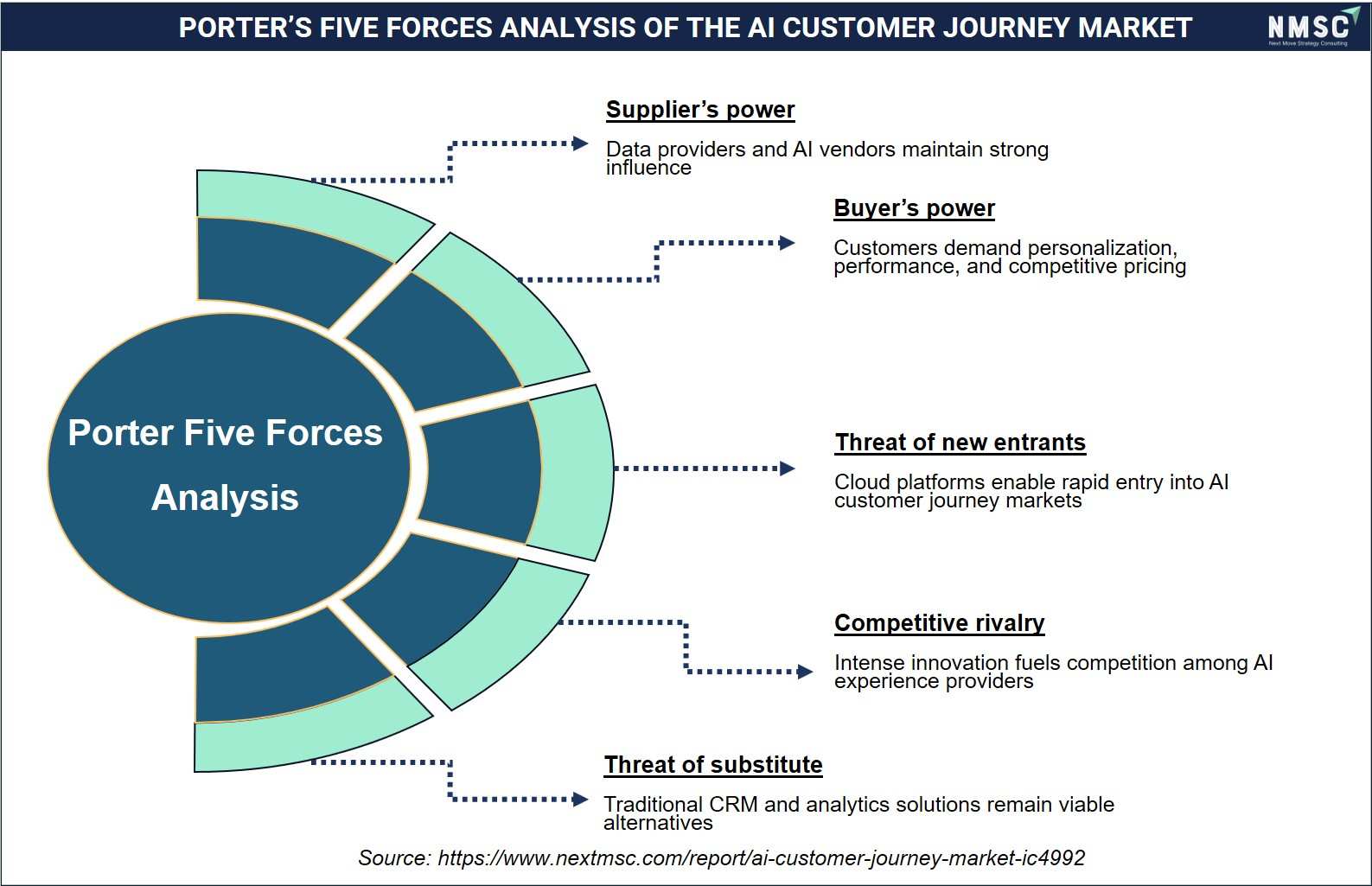
Based on our comprehensive assessment, we found that the AI Customer Journey Market experiences high competitive rivalry due to the presence of established AI and customer experience vendors. Buyer bargaining power remains moderate as enterprises seek customized solutions. Supplier influence is limited by diverse technology providers, while substitution threats remain moderate. New entrants face barriers related to data access, AI expertise, and platform integration capabilities.
Competitive Landscape
Competitive Dynamics and M&A Landscape
|
Key Takeaways |
Details |
|
Market Structure |
The AI Customer Journey industry features multi-tiered competition among full-suite CX platform leaders (Salesforce, Adobe, Oracle, SAP), specialist journey platform vendors (Genesys, NICE, Qualtrics, Braze), and AI-native challengers (Intercom, Talkdesk, Five9), each competing on distinct AI capability, industry depth, and go-to-market differentiation. |
|
Innovation Focus |
Innovation centers on generative AI integration for real-time personalization, autonomous AI agent deployment for customer service automation, unified customer data platform architecture, real-time journey orchestration engine capability, and privacy-preserving AI decisioning frameworks aligned with evolving global regulatory requirements. |
|
M&A Activity |
Strategic consolidation is accelerating as full-suite CX platform vendors acquire specialist AI Customer Journey capabilities. Salesforce's Agentforce platform build-out, ServiceNow's expansion into CX workflow automation, and HubSpot's AI-native CRM evolution reflect platform extension strategies. Private equity investment in CX automation vendors including Five9, Talkdesk, and Medallia is creating M&A consolidation pressure across mid-market segments. |
How Do Companies Compete in the AI Customer Journey Market?
The AI Customer Journey Market is characterized by multi-tiered competition across full-suite enterprise CX platforms, specialist journey management vendors, and AI-native challengers. Full-suite leaders including Salesforce, Adobe, Oracle, SAP, and Microsoft compete on breadth of integrated AI Customer Journey capabilities spanning CDP, analytics, orchestration, service automation, and experience management within unified platform architectures. Specialist vendors including Genesys, NICE, Qualtrics, Braze, and Sprinklr differentiate on depth of AI capability within specific journey stages or industry verticals. AI-native challengers including Intercom, Talkdesk, and Five9 are disrupting traditional categories with purpose-built generative AI capabilities that incumbent vendors are racing to match or acquire.
Which Kind of Companies Dominate the AI Customer Journey Market?
Three distinct categories of companies dominate the AI Customer Journey Market. First, global enterprise software platforms including Salesforce, Microsoft, Oracle, SAP, and Adobe leverage comprehensive AI Customer Journey platform suites integrated with ERP, CRM, and marketing automation ecosystems to capture full-enterprise deployment commitments. Second, specialist journey and experience platform vendors including Genesys, NICE, Qualtrics, Braze, Pegasystems, and Medallia provide purpose-built AI Customer Journey capabilities with deep industry vertical expertise and workflow integration. Third, AI-native and cloud-born vendors including Freshworks, HubSpot, Intercom, Talkdesk, and Five9 compete on deployment velocity, user experience simplicity, and AI model quality targeted at mid-market and digitally native enterprise buyers seeking rapid time-to-value without complex enterprise procurement processes.
AI-Native Differentiation and Open Standards Drive Market Success in the AI Customer Journey Market
Innovation focus across the AI Customer Journey Market is concentrated in generative AI integration for real-time content personalization and next best action generation, autonomous AI agent deployment for end-to-end journey automation, unified customer data platform architecture enabling single persistent customer profiles, real-time journey orchestration engine capability at sub-second decisioning latency, and privacy-preserving AI decisioning frameworks that embed consent and governance as native platform capabilities. Vendors successfully embedding generative AI within governed journey platforms are achieving premium contract values and accelerating land-and-expand growth economics. Open API adoption enabling composable AI Customer Journey architectures is differentiating platforms that support multi-vendor best-of-breed deployments, reducing proprietary lock-in risk for enterprise buyers.
Market Players to Opt for Merger and Acquisition Strategies to Expand Their Presence in the AI Customer Journey Market
Mergers and acquisitions are reshaping the competitive map of the AI Customer Journey Market as full-suite platform vendors accelerate capability acquisition across specialist AI journey segments. Salesforce's organic Agentforce platform development and strategic acquisition activity reflect the competitive imperative to embed generative AI throughout the customer journey stack. ServiceNow's expansion into customer workflow automation and CX management represents a platform extension strategy that competes directly with established AI Customer Journey incumbents. Private equity firms are actively evaluating mid-market AI Customer Journey vendors in customer service automation, journey analytics, and experience management as consolidation candidates throughout the 2025 to 2028 timeframe.
Who Are the Key Market Players in the AI Customer Journey Market?
-
Salesforce, Inc.
-
Microsoft Corporation
-
Oracle Corporation
-
SAP SE
-
Adobe Inc.
-
ServiceNow, Inc.
-
HubSpot, Inc.
-
Twilio Inc.
-
Genesys Cloud Services, Inc.
-
NICE Ltd.
-
Zendesk, Inc.
-
Braze, Inc.
-
Qualtrics International Inc.
-
Sprinklr, Inc.
-
Freshworks Inc.
-
Pegasystems Inc.
-
Medallia, Inc.
-
Five9, Inc.
-
Intercom, Inc.
-
Talkdesk, Inc.
What Are the Latest Developments in the AI Customer Journey Industry?
|
Date |
Event |
|
April 2026 |
Adobe Inc. announced at Adobe Summit 2026 the evolution of its CX Enterprise platform into an "AI coworker" operating system. Unlike previous assistants, these agents can reason, plan, and self-correct across complex workflows, allowing brands to orchestrate end-to-end customer journeys—including audience building, content production, and in-flight optimization—at machine speed. |
|
March 2026 |
ServiceNow, Inc. released its "Third Customer Experience Report," identifying that fragmented service infrastructure—not a lack of AI—is the biggest threat to customer loyalty. The company’s 2026 strategy focuses on unifying service platforms to bridge the "empathy gap," arguing that AI must handle scale while human representatives provide the judgment and trust necessary for meaningful relationships. |
Expert Insights

" AI can help pinpoint the specific customer preferences and market to a "segment of one," creating a more personal relationship with the brand."
— Rachel Thornton, Enterprise CMO, Adobe
Statement made while discussing the role of artificial intelligence in delivering hyper-personalized customer experiences and enabling organizations to engage customers on an individual level.
Market Interpretation
The comment highlights the increasing importance of AI-driven personalization in shaping modern customer journeys. AI-powered customer journey platforms leverage machine learning, predictive analytics, and behavioral data to identify individual customer preferences and deliver highly targeted interactions across multiple touchpoints. The ability to market to a "segment of one" enables organizations to create personalized experiences that strengthen customer engagement, improve satisfaction, and enhance brand loyalty. As businesses increasingly prioritize customer-centric strategies, demand for AI-enabled journey orchestration, real-time personalization, and customer intelligence solutions is accelerating across retail, financial services, telecommunications, healthcare, and other customer-facing industries.
What Are the Investment Opportunities in the AI Customer Journey Market?
Capital Inflows and Venture Activity
The AI Customer Journey Market continues to attract substantial private and institutional capital, reflecting sustained investor confidence in the structural growth of enterprise AI-powered customer experience technology. Braze's consistent revenue growth reported in its public financial filings, Five9's strategic evaluation of acquisition proposals, and HubSpot's expanding AI platform revenue demonstrate the commercial scale achievable by focused AI Customer Journey platform vendors. The National Venture Capital Association has documented AI-related enterprise software as a primary category for U.S. venture capital deployment, with AI Customer Journey sub-segments including autonomous agent platforms, predictive analytics, and real-time personalization infrastructure attracting significant seed and growth-stage investment activity throughout 2024 and 2025.
Infrastructure Investment
AI Customer Journey platform infrastructure investment is a foundational enabler of market growth, with cloud hyperscalers committing substantial capital to AI inference infrastructure that directly supports AI Customer Journey platform capability delivery. Microsoft announced plans to invest USD 80 billion in AI-optimized data centers in fiscal 2025, the majority supporting Azure AI and Copilot platform services that underpin AI Customer Journey deployments on Microsoft infrastructure. Alphabet committed USD 75 billion in 2025 capital expenditure directed primarily at cloud and AI infrastructure supporting Google Cloud AI Customer Journey platform capabilities. These capital programs are expanding the compute capacity available for real-time AI Customer Journey inference, reducing latency and cost barriers for enterprise deployments globally.
ESG and Sustainable Customer Experience Infrastructure
Environmental, Social, and Governance considerations are increasingly influencing AI Customer Journey platform investment decisions, particularly regarding the sustainability credentials of the cloud infrastructure underlying AI inference workloads. Data center energy consumption associated with AI model training and inference is subject to growing regulatory scrutiny under the EU Energy Efficiency Directive and U.S. executive frameworks for federal agency sustainability. AI Customer Journey platform vendors demonstrating renewable energy commitments, carbon-aware workload scheduling, and energy-efficient AI model architecture are commanding preference in enterprise procurement evaluations with ESG-weighted vendor assessment criteria, creating a differentiation opportunity for sustainably positioned AI Customer Journey infrastructure providers.
Digital Transformation Enablement
AI Customer Journey platforms serve as the customer intelligence and engagement layer for broader enterprise digital transformation programs, making them structurally integral to multi-year technology investment cycles. Enterprises undergoing CRM modernization, contact center cloud migration, and e-commerce platform upgrades require AI Customer Journey orchestration, analytics, and service automation layers to extract customer lifetime value from these infrastructure investments. The European Commission's Industry 5.0 initiative and the U.S. National AI Initiative explicitly reference AI-powered customer engagement as a competitiveness priority for enterprise digital transformation programs, creating durable multi-year demand tied to broader technology modernization cycles across global enterprise markets.
Private Equity and Strategic M&A Activity
Private equity firms are deploying significant capital into the AI Customer Journey ecosystem, targeting mid-market journey analytics, customer service automation, and experience management platform vendors as attractive consolidation candidates. Vista Equity Partners and Thoma Bravo have historically been active investors in enterprise CX software companies, with AI capability enhancement representing the primary value creation thesis in current portfolio companies. Strategic M&A activity is accelerating as full-suite platform vendors acquire specialist AI Customer Journey capabilities in autonomous agent deployment, journey orchestration, and predictive experience scoring. Investors should monitor consolidation activity around AI-native customer service automation vendors, real-time personalization engine providers, and experience analytics platform companies as structurally attractive targets within the 2025 to 2028 timeframe.
Key Benefits for Stakeholders
For Enterprise Buyers
Enterprise buyers gain comprehensive, vendor-neutral intelligence on the AI Customer Journey Market trends, including quantitative market sizing across all solution types, deployment modes, buyer functions, industry verticals, organization sizes, commercial models, and journey stages. This intelligence supports AI Customer Journey platform strategy development, vendor evaluation frameworks, and multi-year technology investment roadmap planning. Our competitive landscape analysis and latest development tracking enable procurement teams to benchmark vendor AI capability maturity, pricing model alignment, and go-to-market fit against specific enterprise AI Customer Journey program requirements with analytical rigor and commercial objectivity.
For Investors and Financial Analysts
Investors and financial analysts gain a structured, data-rich assessment of the AI Customer Journey Market's growth trajectory, competitive dynamics, M&A pipeline, and segment-level revenue forecasts through 2035. The 22.0% CAGR analysis by solution type, region, industry vertical, and organization size enables precise portfolio construction and investment thesis validation for AI Customer Journey platform vendor positions. Detailed competitive landscape analysis covering all 20 profiled companies, combined with latest development tracking and expert insights, provides an early-signal framework for identifying emerging AI Customer Journey platform leaders, acquisition targets, and at-risk incumbents within the rapidly evolving global market landscape.
For AI Customer Journey Vendors and Platform Providers
AI Customer Journey vendors and platform providers gain actionable intelligence on white-space opportunities, competitive positioning gaps, and fastest-growing sub-segments within the evolving market landscape. Solution type analysis identifies highest-CAGR segments including Customer Service Automation at 24.0% and Experience Management at 23.3% where innovation investment yields superior market positioning. Regional outlook sections provide geographic expansion priority guidance with regulatory, technology adoption, and competitive maturity context. Buyer function and commercial model analysis enables vendors to refine go-to-market strategies, identify cross-sell opportunities, and optimize channel mix across direct enterprise sales, cloud marketplace, and systems integrator routes throughout the 2025 to 2035 period.
For Government and Regulatory Bodies
Government agencies and regulatory bodies gain a structured analysis of how national AI governance frameworks, including GDPR, CCPA, EU AI Act, India's DPDPA, and Saudi Arabia's NDMO guidelines, are shaping AI Customer Journey Market architecture, competitive dynamics, and enterprise investment decisions. Country-level insights provide policymakers with evidence-based perspectives on how regulatory design choices affect enterprise AI Customer Journey adoption rates, cloud investment attraction, and national digital economy competitiveness. The regional analysis sections offer direct relevance to national AI strategy development programs seeking to support enterprise CX technology adoption while ensuring consumer protection and algorithmic accountability requirements are embedded within AI Customer Journey platform governance frameworks.
AI Customer Journey Market Key Segments
By Solution Type
-
Customer Data Platform
-
Identity Resolution
-
Unified Profiles
-
Segmentation and Activation
-
Consent and Governance
-
-
Journey Analytics
-
Journey Mapping
-
Path Analysis
-
Funnel Analysis
-
Attribution
-
Predictive Scoring
-
Voice of Customer
-
-
Journey Orchestration
-
Next Best Action
-
Personalization
-
Campaign Orchestration
-
Decisioning
-
Journey Optimization
-
-
Customer Service Automation
-
Virtual Agent
-
Agent Assist
-
Self Service
-
Case Automation
-
Knowledge Search
-
-
Experience Management
-
Survey Analytics
-
Feedback Management
-
Sentiment Analysis
-
Experience Scoring
-
-
Other
-
Loyalty Management
-
Customer Success
-
Niche Journey Apps
-
By Deployment Mode
-
Cloud SaaS
-
Private Cloud
-
On Premises
-
Hybrid
By Buyer Function
-
Marketing
-
Sales
-
Service
-
CX
-
Digital
-
IT
By Industry
-
Retail and E-commerce
-
BFSI
-
Healthcare and Life Sciences
-
Telecommunications and Media
-
Travel and Hospitality
-
Technology and Software
-
Manufacturing
-
Other Industries
By Organization Size
-
Small
-
Mid-Market
-
Enterprise
By Commercial Model
-
Subscription
-
Usage Based
-
Professional Services
-
Perpetual License
By Journey Stage
-
Acquire
-
Convert
-
Onboard
-
Serve
-
Retain
-
Grow
By Region
-
North America: U.S., Canada, and Mexico.
-
Europe: UK, Germany, France, Italy, Spain, Sweden, Denmark, Finland, the Netherlands, and the rest of Europe.
-
Asia Pacific: China, India, Japan, South Korea, Taiwan, Indonesia, Vietnam, Australia, Philippines, Malaysia, and the rest of APAC.
-
Middle East & Africa (MEA): Saudi Arabia, UAE, Egypt, Israel, Turkey, Nigeria, South Africa, and the rest of MEA.
-
Latin America: Brazil, Argentina, Chile, Colombia, and the rest of LATAM.
Conclusion and Recommendations
Long-Term Outlook
The AI Customer Journey Market is entering its most consequential decade of growth, driven by generative AI integration within journey platforms, autonomous AI agent deployment across customer-facing functions, and the consolidation of fragmented customer engagement tools into unified AI-powered journey management ecosystems. The market is forecast to grow from USD 7.6 billion in 2026 to USD 45.5 billion by 2035, at a CAGR of 22.0%. This growth reflects the structural shift from rule-based, batch-oriented customer engagement toward real-time, AI-driven, individually personalized customer journey orchestration that operates at the speed of each individual customer interaction across digital and physical touchpoints.
Strategic Positioning Recommendations
Platform vendors should prioritize generative AI embedding within journey orchestration engines, moving from AI-assisted to AI-autonomous journey management to capture premium contract values and superior retention economics. Investment in unified customer data platform architecture is non-negotiable for vendors targeting enterprise buyers requiring single persistent customer profiles across all journey stage capabilities. Sovereign cloud and in-country data residency options are becoming mandatory competitive requirements for vendors targeting regulated industries across European, Middle Eastern, and Asia-Pacific enterprise markets. Composable platform architectures supporting open API integration with third-party best-of-breed AI Customer Journey components are differentiating vendors that reduce proprietary lock-in risk for enterprise buyers.
Investment Attractiveness
The AI Customer Journey Market represents a highly attractive investment environment with durable secular growth drivers, recurring subscription and usage-based revenue models, and expanding enterprise recognition that AI-powered customer journey management delivers quantifiable return on investment. The highest-conviction investment themes include Customer Service Automation at a CAGR of 24.0%, Hybrid Deployment at 24.6%, Usage-Based Commercial Models at 24.5%, Healthcare vertical adoption at 23.9%, and Latin America regional growth at 25.4%. Investors should monitor mid-market AI Customer Journey platform vendors in customer service automation, journey analytics, and experience management as primary consolidation candidates within the 2025 to 2028 strategic timeframe.
Market Shifts and Key Risks
The most significant market shift underway is the migration from discrete, department-specific AI Customer Journey tool procurement toward consolidated AI Customer Journey operating system purchasing that spans marketing, sales, service, CX, and digital organizational functions within single unified platform commitments. This shift benefits full-suite platform leaders including Salesforce, Adobe, Microsoft, and SAP at the expense of point-solution vendors. Key risks include AI regulatory escalation constraining real-time personalization data practices, macroeconomic pressures reducing enterprise technology budget growth, AI bias and algorithmic accountability concerns slowing deployment in regulated industries, and quantum computing disruption of current encryption architectures protecting customer data at rest and in transit.
Growth Pathways
Organizations seeking to maximize value from the AI Customer Journey Market should pursue a three-horizon investment strategy. In the near term spanning 2025 to 2027, prioritize customer data platform unification, identity resolution, and consent governance framework deployment to establish the AI-ready customer data foundation. In the mid-term spanning 2027 to 2031, invest in autonomous AI agent deployment, real-time journey orchestration engine optimization, and generative AI personalization capabilities to capture AI-driven customer lifetime value creation. In the long term spanning 2031 to 2035, position for AI journey architecture interoperability across digital, physical, and extended reality customer engagement environments as AI Customer Journey interaction volumes and complexity exceed current platform architectural capacity limits.
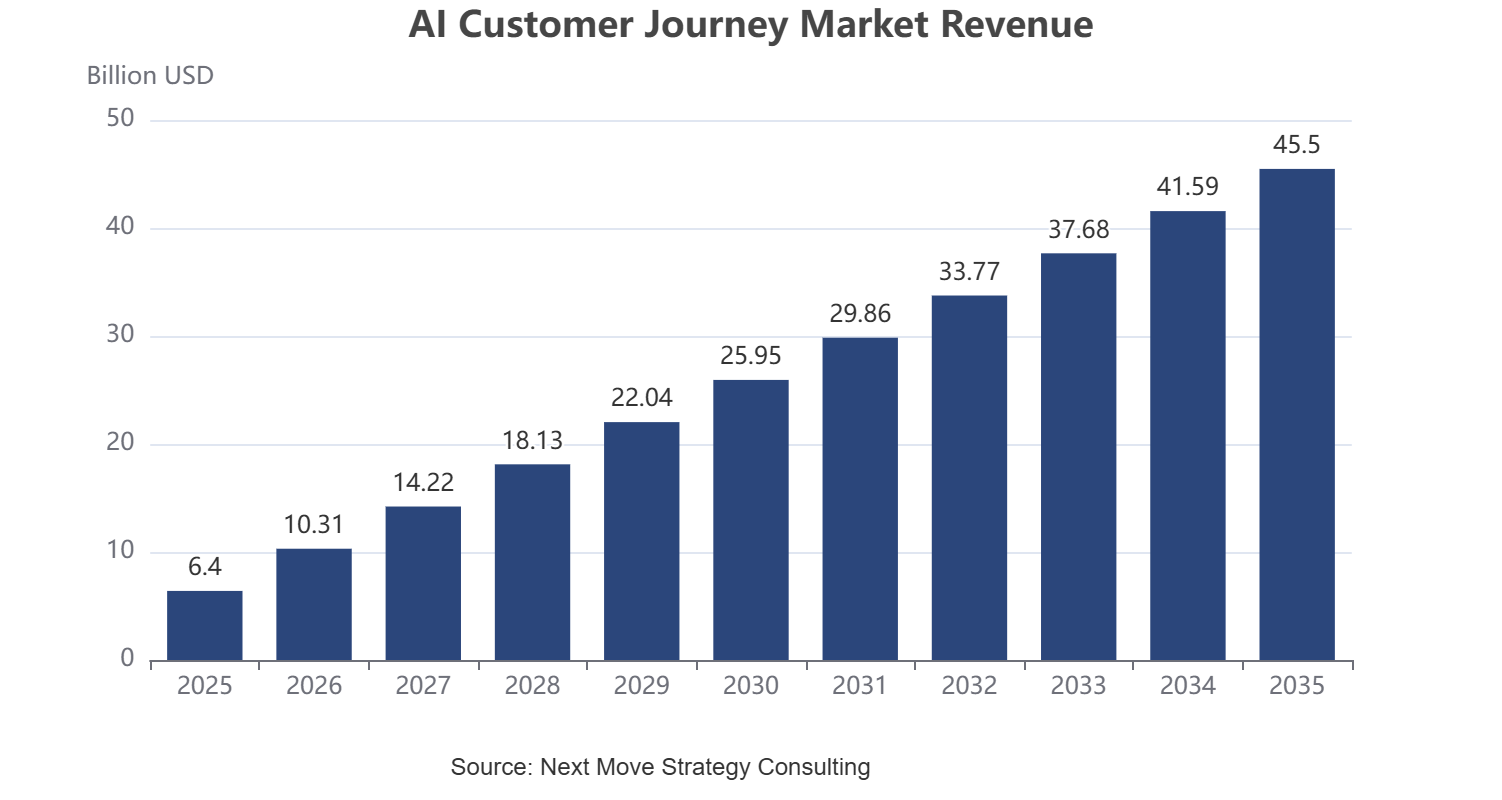
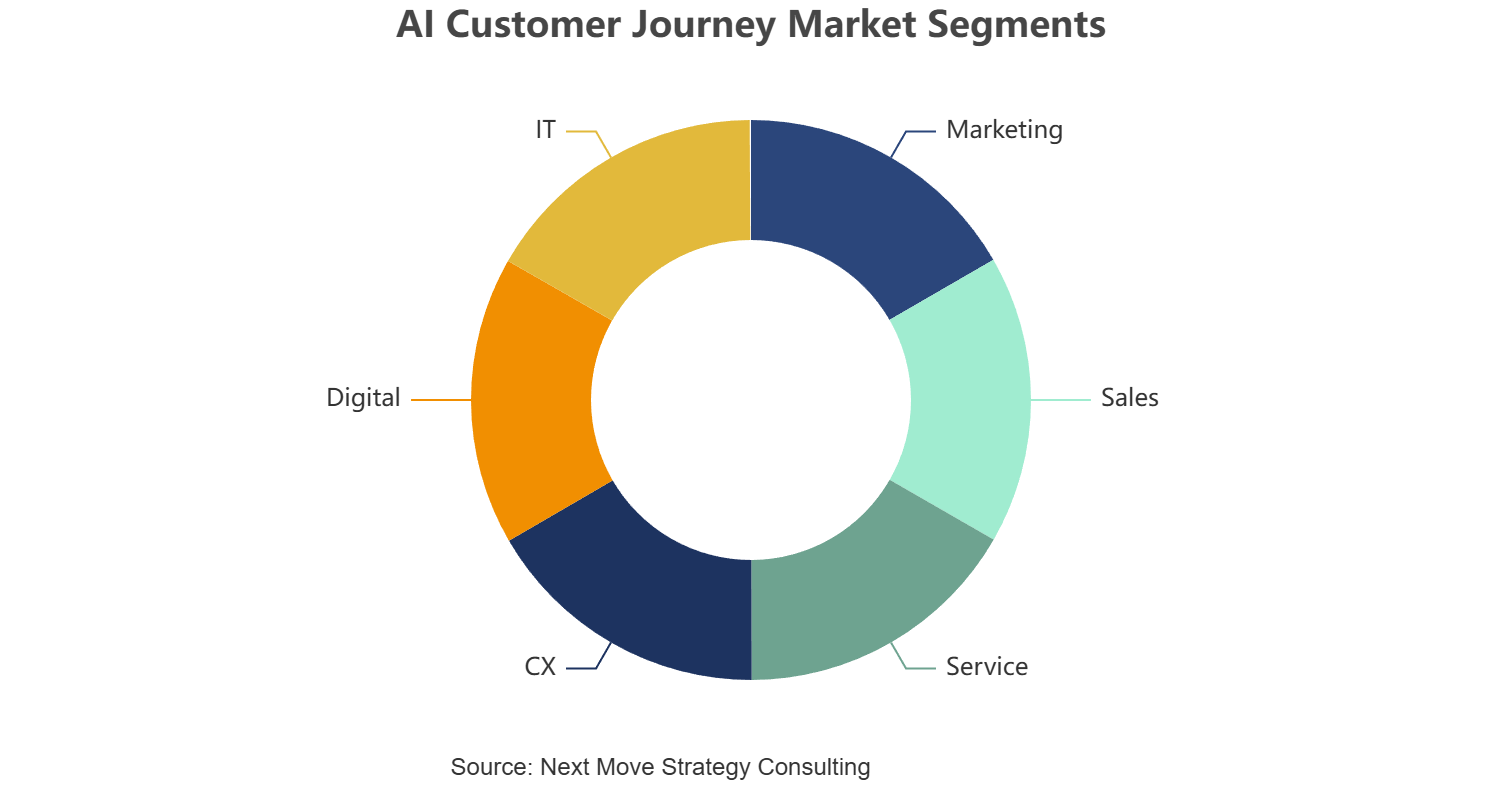
About the Author
 Saista Faiyaz
— Saista Faiyaz is Research Associate at Next Move Strategy Consulting, where she has covered consumer markets and healthcare technologies for 3 years. Her work includes primary interview review, secondary-source validation, market sizing, and structured analysis of company and industry data. She supports research by comparing evidence across sources, organizing findings into market narratives, and documenting assumptions used in analysis. Her scope includes cross-market benchmarking, and reports.
Saista Faiyaz
— Saista Faiyaz is Research Associate at Next Move Strategy Consulting, where she has covered consumer markets and healthcare technologies for 3 years. Her work includes primary interview review, secondary-source validation, market sizing, and structured analysis of company and industry data. She supports research by comparing evidence across sources, organizing findings into market narratives, and documenting assumptions used in analysis. Her scope includes cross-market benchmarking, and reports.
About the Reviewer
 Supradip Baul
— Supradip Baul is an accomplished business consultant and strategist with over a decade of rich experience in market intelligence, strategy, technology, and business transformation. His work has included rigorous qualitative and quantitative analysis across multiple industries, helping clients shape investment decisions and long-term roadmaps. Earlier in his career, he was associated with Gartner, where he contributed to industry-leading reports and market share analyses. He has worked with leading global companies and holds an MBA with a dual specialization in Marketing and Finance.
Supradip Baul
— Supradip Baul is an accomplished business consultant and strategist with over a decade of rich experience in market intelligence, strategy, technology, and business transformation. His work has included rigorous qualitative and quantitative analysis across multiple industries, helping clients shape investment decisions and long-term roadmaps. Earlier in his career, he was associated with Gartner, where he contributed to industry-leading reports and market share analyses. He has worked with leading global companies and holds an MBA with a dual specialization in Marketing and Finance.
At Next Move Strategy Consulting, we understand that insightful market research is the cornerstone of successful business decisions. That's why we employ a robust and multifaceted approach, combining various methodologies to deliver the most accurate and actionable data for our clients.

Research Landscape
We navigate the world of research with two primary approaches:
Qualitative Approach
Our qualitative research methodologies involve immersive techniques such as in-depth interviews, focus groups, and observational studies. By engaging directly with individuals and stakeholders, we uncover valuable insights that quantitative data alone may overlook.

Quantitative Research
In tandem with qualitative methodologies, NMSC leverages the power of Quantitative Research to provide a robust foundation of numerical insights. Through systematic data collection and analysis, we quantify patterns, preferences, and market trends, offering a comprehensive view of the business landscape.
Our quantitative research approach employs diverse tools, including surveys, experiments, and statistical modelling. These methodologies enable us to gather data from a large and representative sample, ensuring the statistical significance of our findings. By employing structured questionnaires and standardized data collection methods, we guarantee the reliability and validity of the information we present to our clients.
Quantitative research is particularly effective in measuring the prevalence of trends, assessing market size, and gauging the impact of various factors on consumer behavior. The numerical precision attained through this approach equips our clients with actionable insights, facilitating data-driven decision-making and strategy formulation.


Our Specialized Toolbox for Industry-Specific Market Research
We deploy a specialized arsenal of techniques tailored to meet your unique requirements. Here's a glimpse into our comprehensive toolbox:

Information Procurement
The stage entails acquiring market data or relevant information through various sources and methodologies.


Market Research Approach
We utilize both top-down and bottom-up approaches in market research analysis to achieve a comprehensive understanding of the market dynamics, leveraging the broad perspective of industry trends and macroeconomic factors alongside detailed insights from specific segments and individual companies.

Porters Five Forces Analysis
We conduct Porter's Five Forces analysis to evaluate the competitive landscape of an industry, providing us with insights into factors that affect profitability and strategic positioning.

SWOT Analysis

Forecasting
We utilize a forecasting model to predict future consumption by considering parameters like population, economics, regulations, market competition, drivers, constraints, technology, and pricing. We also employ statistical techniques such as multilinear regression, exponential smoothing, moving average, ARIMA, and Monte Carlo simulations for accurate predictions. In econometric forecasting, we analyzed short-term and long-term event impacts, attributing values based on regulatory frameworks, economic factors, and market events.





 Speak to Our Analyst