Things as Customer Market Global Industry Analysis and Forecast (2026–2035)

The global Things as Customer Market size was valued at USD 4.82 billion in 2025 and is estimated at USD 5.98 billion in 2026, forecast to reach USD 48.65 billion by 2035, expanding at a 26.2% CAGR from 2026 to 2035. Key drivers include rapid proliferation of connected endpoints capable of independent purchasing behavior and expanding agentic commerce infrastructure, with North America leading the global market.

Download Free Sample PDF
Base Year (2025)
$4.82 Billion
Forecast (2035)
$48.65 Billion
CAGR (2026-2035)
26.2%
Top Region
North America

What Is the Things as Customer Market Size?

The global things as customer market size was valued at USD 4.82 billion in 2025 and is estimated at USD 5.98 billion in 2026, forecast to reach USD 48.65 billion by 2035, expanding at a 26.2% CAGR between 2026 and 2035. North America leads with approximately 34% share, while hardware dominates all other components with approximately 46% share.

We observed that the growth is broad-based across every segmentation axis, with agentic payment infrastructure and autonomous replenishment adoption driving the dominant structural shifts through 2035.

Things as Customer Market Global Industry Analysis and Forecast (2026–2035) Revenue Forecast

Values in USD Billion

2025 $4.82 Billion
2025
2026 $6.08 Billion
2026
2027 $7.68 Billion
2027
2028 $9.69 Billion
2028
2029 $12.23 Billion
2029
2030 $15.43 Billion
2030
2031 $19.47 Billion
2031
2032 $24.57 Billion
2032
2033 $31.01 Billion
2033
2034 $39.14 Billion
2034
2035 $48.65 Billion
2035

Key Takeaways

By Component: Hardware held the largest share of approximately 46% (USD 2.22 billion) in 2025; Software is the fastest-growing sub-segment at 28.9% CAGR from 2026–2035.

By Device Type: Smart Home Appliances held the largest share of approximately 29% (USD 1.40 billion) in 2025; Smart Retail and Vending Systems are the fastest-growing sub-segment at 29.2% CAGR from 2026–2035.

By Application: Autonomous Replenishment held the largest share of approximately 38% (USD 1.83 billion) in 2025; Usage Based Subscription Billing is the fastest-growing sub-segment at 30.0% CAGR from 2026–2035.

By End User: Residential held the largest share of approximately 41% (USD 1.98 billion) in 2025; Industrial and Manufacturing is the fastest-growing sub-segment at 29.6% CAGR from 2026–2035.

Dominant Region: North America dominated with approximately 34% revenue share (USD 1.64 billion) in 2025.

Fastest-Growing Region: Asia-Pacific is expected to register the highest CAGR of 30.1% during 2026–2035.

Dominant Country: U.S. led with approximately USD 1.28 billion in 2025.

Fastest-Growing Country: India is the fastest-growing country at approximately 33.2% CAGR from 2026–2035.

Market Opportunity: The things as customer market is expected to create an absolute dollar opportunity of USD 42.67 billion between 2026 and 2035, presenting significant investment potential across the connected device and agentic payment infrastructure value chain.

According to NMSC analysis, device manufacturers are increasingly consolidating payment integration with fewer, standards-compliant network partners to simplify multi-region agentic commerce deployment, a shift that favors diversified technology providers over single-protocol specialists as regulatory scrutiny intensifies through 2035.

What Does the Things as Customer Market Encompass?

The things as customer market encompasses connected hardware, decision-making software, and integration services that enable IoT-enabled products to independently evaluate, initiate, and complete purchase transactions on behalf of their owners. Our assessment indicates that the scope spans smart home appliances, connected vehicles, industrial equipment, wearables, and unattended retail systems supplied to residential, commercial, industrial, and automotive end users across autonomous replenishment, predictive maintenance procurement, and usage-based billing applications worldwide.
Regulatory frameworks such as the European Commission's data governance requirements and Federal Trade Commission disclosure guidance shape consent and auditability requirements for autonomous transactions, while payment network protocols including Mastercard's Agent Pay and Visa's Trusted Agent Protocol increasingly define technical interoperability standards. We observed that technology adoption is shifting from human-supervised, rules-based ordering toward increasingly autonomous, agentic AI-driven purchasing decisions. NMSC's analysis indicates that this structural shift, combined with expanding connectivity infrastructure, is redefining sourcing criteria across the things as customer market.

Strategic Framework of the Things as Customer Market

Strategic Framework of the Things as Customer Market
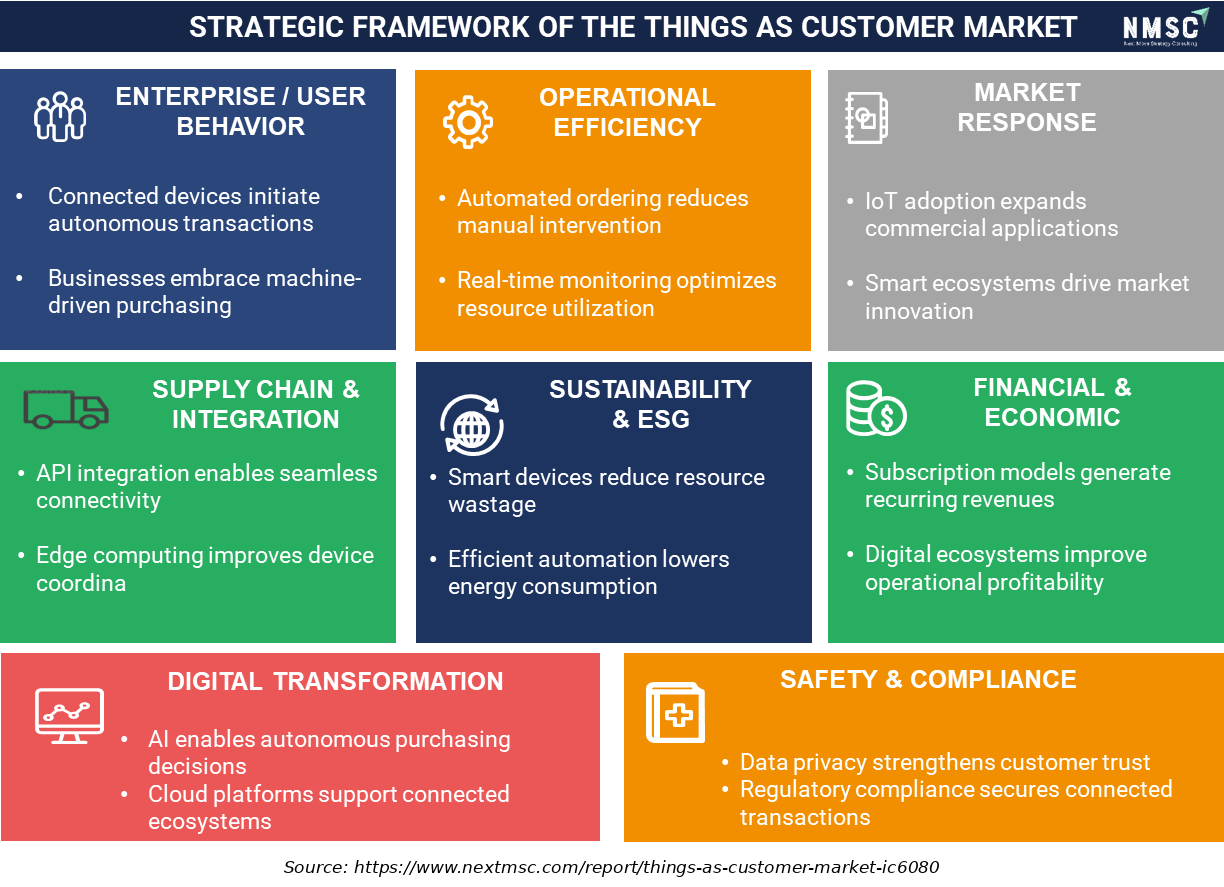
Based on research conducted by NMSC, we found that businesses embracing machine-driven purchasing drive the Things as Customer Market. Automated ordering optimizes resource utilization, while AI and cloud platforms enable autonomous purchasing decisions. Furthermore, API integration and edge computing enhance supply chain coordination. Concurrently, subscription models generate recurring revenues, whereas strict data privacy and regulatory compliance secure connected commercial transactions.

Market Drivers & Dynamics

Interactive Dataset
Rapid proliferation of connected IoT endpoints driver +6.8% Global 2026–2035
Expansion of API-based machine payment rails driver +5.4% North America, Europe 2026–2035
Rising enterprise adoption of predictive maintenance procurement driver +4.9% North America, Asia-Pacific 2026–2032
Growth of subscription and usage-based consumption models driver +4.2% Global 2026–2035
Government-backed smart infrastructure and 5G rollout driver +3.6% Asia-Pacific, Middle East & Africa 2026–2033
Increasing consumer trust in autonomous replenishment devices driver +3.1% North America, Europe 2027–2035
Data privacy and consent regulations for autonomous transactions restraint −3.4% Europe, North America 2026–2035
Cybersecurity vulnerabilities in unattended machine payments restraint −2.9% Global 2026–2032
Interoperability gaps across device and payment platforms restraint −2.2% Global 2026–2030
High integration cost for legacy industrial equipment restraint −1.8% Latin America, Middle East & Africa 2026–2031
Source: Next Move Strategy Consulting

Growth Drivers

What Is the Primary Growth Driver of the Things as Customer Market?

The primary growth driver is the rapid proliferation of connected endpoints capable of independent purchasing behavior. Our assessment indicates that the expanding installed base of IoT-enabled products, combined with falling connectivity module costs, is the single largest contributor to CAGR, adding an estimated 6.8 percentage points to growth through 2035. The Federal Communications Commission's ongoing spectrum allocations for unlicensed IoT connectivity continue to lower the cost of deploying autonomous purchasing capability across consumer and industrial devices alike.

How Is Agentic Commerce Infrastructure Driving Market Growth?

Our analysis shows that agentic commerce infrastructure from major payment networks is directly driving market growth by giving devices a trusted, standardized way to transact. Visa reported that AI-driven traffic to U.S. retail sites surged 4,700% year-over-year by July 2025, based on click-throughs that led to purchases, according to Adobe Data Insights cited in Visa's official announcement. This surge is compelling merchants and device manufacturers to integrate machine-payment rails, reinforcing the structural growth captured in the market.

Growth Inhibitors

What Is Restraining the Things as Customer Market Growth?

Data privacy and consent regulation is the primary restraint, subtracting an estimated 3.4 percentage points from CAGR as manufacturers slow autonomous purchasing rollouts pending compliance clarity. The European Commission's evolving data governance framework requires explicit, auditable consent trails before a connected device can execute a financial transaction on a consumer's behalf. We observed that this compliance burden disproportionately affects smaller device makers and regional retailers without dedicated regulatory affairs teams, slowing adoption in several European markets covered by this fraud detection and prevention and consent-verification landscape.

What Are the Growth Opportunities?

How Can Predictive Procurement Unlock Value for Industrial Operators?

Predictive maintenance procurement lets equipment autonomously order replacement parts before failure, creating a clear whitespace opportunity for industrial equipment manufacturers and their component suppliers. Operators adopting sensor-triggered purchasing reduce unplanned downtime while suppliers gain predictable, recurring order volume tied directly to equipment telemetry rather than periodic manual reordering cycles.

What Opportunity Does Embedded Payment Infrastructure Create for Fintech Providers?

Embedded, agent-scoped payment credentials such as Mastercard's Agentic Tokens and Visa's Trusted Agent Protocol create a whitespace opportunity for payment networks and fintech providers to monetize machine-initiated transaction volume. Providers that build merchant-facing agent verification tools stand to capture new interchange and licensing revenue as autonomous checkout scales across mobile payment rails worldwide.

How Can Emerging Markets Capture Machine-Driven Retail Demand?

Emerging markets present a whitespace opportunity for regional payment processors and device distributors to capture machine-driven retail demand as 5G and IoT connectivity costs continue falling. Mastercard's planned 2026 expansion of Agent Pay into Latin America and the Caribbean illustrates how local payment enablers and device assemblers can capture first-mover advantage among connected appliance owners in historically underpenetrated regions.

Segmentation Analysis

2025 (USD Billion)
2035 (USD Billion)
Hardware 2025: $2.22 Billion | 2035: $18.50 Billion
Hardware
Software 2025: $1.59 Billion | 2035: $19.39 Billion
Software
Services 2025: $1.01 Billion | 2035: $10.76 Billion
Services
Hardware $2.22 Billion $18.50 Billion 23.6%
Software $1.59 Billion $19.39 Billion 28.9%
Services $1.01 Billion $10.76 Billion 27.0%

What Is the Outlook for the Things as Customer Market By Component?

We observed that the component axis divides value between physical connectivity hardware, decision and payment orchestration software, and integration services. Hardware led with approximately 46% share in 2025, reflecting the sheer scale of sensor and connectivity module shipments across appliances and vehicles. Our findings suggest that software is the fastest-growing sub-segment at 28.9% CAGR from 2026–2035, as decision-engine and payment-orchestration platforms capture increasing value once the underlying hardware base has already been deployed.

2025 (USD Billion)
2035 (USD Billion)
Smart Home A
Connected Ve
Industrial E
Wearables an
Smart Retail
Segment Item 2025 (USD Billion) 2035 (USD Billion) CAGR
Smart Home Appliances $10.0 USD Billion $40.0 USD Billion 25.0%
Connected Vehicles $17.1 USD Billion $51.1 USD Billion 11.0%
Industrial Equipment $24.2 USD Billion $62.2 USD Billion 25.0%
Wearables and Personal Devices $31.3 USD Billion $73.3 USD Billion 11.0%
Smart Retail and Vending Systems $38.4 USD Billion $84.4 USD Billion 16.0%

Segment-wise data is locked

Unlock complete segment-wise numbers for By Device Type.

Unlock Full Data

What Is the Outlook for the Things as Customer Market By Device Type?

Based on research conducted by NMSC, we found that smart home appliances dominate the device type axis with approximately 29% share in 2025, led by printers, refrigerators, and water treatment systems that autonomously reorder consumables. Connected vehicles and industrial equipment are scaling quickly as autonomous fuel, toll, and parts-procurement transactions mature. Smart retail and vending systems post the fastest CAGR at 29.2% as unattended commerce infrastructure expands across transit hubs, campuses, and dense urban environments through 2035.

2025 (USD Billion)
2035 (USD Billion)
Autonomous R
Predictive M
Usage Based
Autonomous E
Other Applic
Segment Item 2025 (USD Billion) 2035 (USD Billion) CAGR
Autonomous Replenishment $10.0 USD Billion $40.0 USD Billion 27.0%
Predictive Maintenance Procurement $17.1 USD Billion $51.1 USD Billion 9.0%
Usage Based Subscription Billing $24.2 USD Billion $62.2 USD Billion 19.0%
Autonomous Energy and Fleet Transactions $31.3 USD Billion $73.3 USD Billion 17.0%
Other Applications $38.4 USD Billion $84.4 USD Billion 18.0%

Segment-wise data is locked

Unlock complete segment-wise numbers for By Application.

Unlock Full Data

What Is the Outlook for the Things as Customer Market By Application?

Our assessment indicates that autonomous replenishment remains the dominant application at approximately 38% share in 2025, anchored by consumables such as ink, filters, and household staples that devices reorder without owner input. Usage based subscription billing is the fastest-growing application at 30.0% CAGR, as manufacturers shift from one-time hardware sales toward consumption-linked revenue models. Predictive maintenance procurement and autonomous energy and fleet transactions are both scaling steadily as industrial and mobility operators automate parts and energy purchasing decisions.

2025 (USD Billion)
2035 (USD Billion)
Residential
Commercial a
Industrial a
Automotive a
Healthcare
Segment Item 2025 (USD Billion) 2035 (USD Billion) CAGR
Residential $10.0 USD Billion $40.0 USD Billion 14.0%
Commercial and Retail $17.1 USD Billion $51.1 USD Billion 24.0%
Industrial and Manufacturing $24.2 USD Billion $62.2 USD Billion 22.0%
Automotive and Transportation $31.3 USD Billion $73.3 USD Billion 12.0%
Healthcare $38.4 USD Billion $84.4 USD Billion 27.0%

Segment-wise data is locked

Unlock complete segment-wise numbers for By End User.

Unlock Full Data

Growth Opportunities

We found that three whitespace opportunities stand out as the things as customer market matures beyond early pilots into scaled commercial deployment.

How Can Predictive Procurement Unlock Value for Industrial Operators?

Predictive maintenance procurement lets equipment autonomously order replacement parts before failure, creating a clear whitespace opportunity for industrial equipment manufacturers and their component suppliers. Operators adopting sensor-triggered purchasing reduce unplanned downtime while suppliers gain predictable, recurring order volume tied directly to equipment telemetry rather than periodic manual reordering cycles.

What Opportunity Does Embedded Payment Infrastructure Create for Fintech Providers?

Embedded, agent-scoped payment credentials such as Mastercard's Agentic Tokens and Visa's Trusted Agent Protocol create a whitespace opportunity for payment networks and fintech providers to monetize machine-initiated transaction volume. Providers that build merchant-facing agent verification tools stand to capture new interchange and licensing revenue as autonomous checkout scales across mobile payment rails worldwide.

How Can Emerging Markets Capture Machine-Driven Retail Demand?

Emerging markets present a whitespace opportunity for regional payment processors and device distributors to capture machine-driven retail demand as 5G and IoT connectivity costs continue falling. Mastercard's planned 2026 expansion of Agent Pay into Latin America and the Caribbean illustrates how local payment enablers and device assemblers can capture first-mover advantage among connected appliance owners in historically underpenetrated regions.

Ecosystem Analysis

Other

  • North America: U.S., Canada, Mexico.
  • Europe: UK, Germany, France, Italy, Spain, Sweden, Denmark, Finland, Netherlands, Rest of Europe.
  • Asia-Pacific: China, India, Japan, South Korea, Taiwan, Indonesia, Vietnam, Australia, Philippines, Malaysia, Rest of APAC.
  • Middle East & Africa: Saudi Arabia, UAE, Egypt, Israel, Turkey, Nigeria, South Africa, Rest of MEA.
  • Latin America: Brazil, Argentina, Chile, Colombia, Rest of LATAM.

Regional Outlook

2025 (USD Billion)
2035 (USD Billion)
North Americ
Europe
Asia-Pacific
Middle East
Latin Americ
Region 2025 (USD Billion) 2035 (USD Billion) CAGR (%)
North America $10.0 USD Billion $40.0 USD Billion 9.0%
Europe $17.1 USD Billion $51.1 USD Billion 27.0%
Asia-Pacific $24.2 USD Billion $62.2 USD Billion 25.0%
Middle East & Africa $31.3 USD Billion $73.3 USD Billion 23.0%
Latin America $38.4 USD Billion $84.4 USD Billion 12.0%

Regional data is locked

Unlock complete regional numbers for this market.

Unlock Full Data

Consumer Behavior Analysis of the Things as Customer Market

Consumer Behavior Analysis of the Things as Customer Market

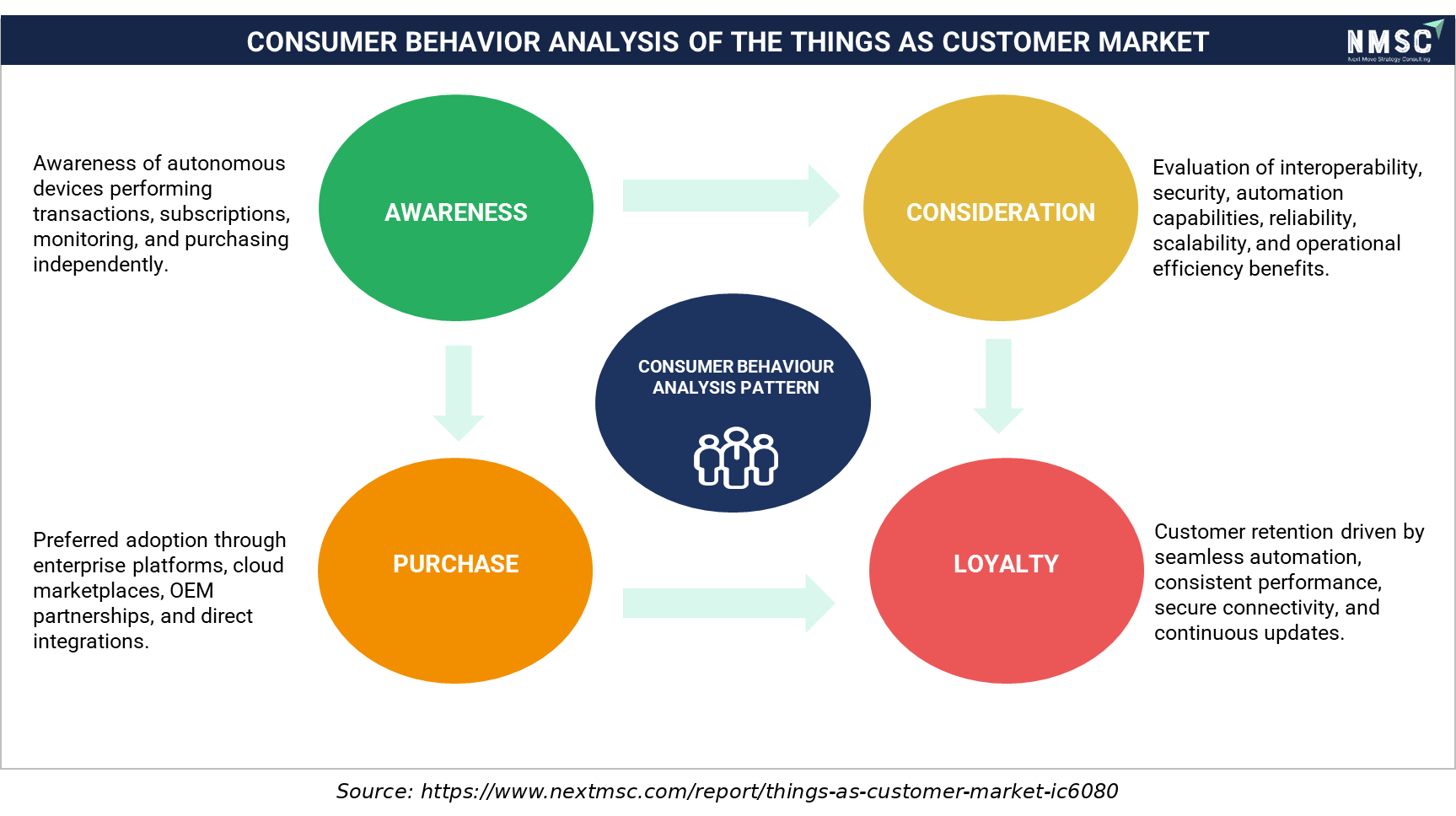
In our observation, the consumer buying journey in the Things as Customer Industry begins as businesses build awareness of autonomous devices executing independent transactions. Consequently, organizations evaluate interoperability, security, automation capabilities, and operational efficiency during consideration. Deployment is preferred through enterprise platforms, cloud marketplaces, and OEM integrations, while client loyalty is sustained through seamless automation and secure connectivity.

Competitive Landscape

Our analysis shows that competition in the things as customer market is intensifying as payment networks, device manufacturers, and industrial technology providers converge around shared agentic commerce standards. Key Takeaways

Dimension Description
Dimension Assessment
Market Structure Moderately fragmented, with payment networks and diversified device manufacturers holding the largest revenue share among 20 profiled companies.
Innovation Focus Agentic payment tokenization, sensor-triggered procurement, and cross-platform interoperability protocols.
M&A Activity Partnership-led expansion, including Mastercard's October 2025 integration with PayPal's wallet, dominates over outright acquisitions.

How Do Companies Compete in the Things as Customer Market?

Companies compete primarily on the breadth and trust level of their agentic payment integration, device installed base, and ability to demonstrate secure, auditable autonomous transactions. We observed that firms combining hardware manufacturing scale with direct payment network partnerships hold a durable advantage over single-function competitors.

Which Competitive Archetypes Dominate the Market?

Two archetypes dominate: diversified device manufacturers embedding autonomous purchasing into existing appliance and vehicle lines, and payment network providers building agent-verification infrastructure that device makers plug into. Our findings suggest that firms straddling both archetypes, such as Mastercard's partnerships with Microsoft and IBM, capture disproportionate influence over emerging technical standards.

How Are Companies Differentiating Through Innovation?

Innovation and differentiation strategy centers on tokenized, agent-scoped payment credentials and merchant-facing verification tools that distinguish legitimate purchasing agents from malicious bots. Across the industry, competitive differentiation increasingly depends on interoperability across multiple agentic commerce protocols rather than proprietary, closed ecosystems.

What M&A and Partnership Activity Is Shaping the Market?

M&A activity remains limited relative to partnership-led expansion, with Mastercard's collaborations spanning Microsoft, IBM, Salesforce, and PayPal illustrating a preference for interoperable alliances over acquisitions. Our assessment indicates that this partnership-first approach reflects the still-forming nature of technical standards across the things as customer market.

Key Market Players

We found that the following companies represent the leading providers of connected devices, payment infrastructure, and enabling technology across the things as customer market.

Mastercard Incorporated Visa Inc. Amazon.com, Inc. Samsung Electronics Co., Ltd. Robert Bosch GmbH PayPal Holdings, Inc. Microsoft Corporation International Business Machines Corporation (IBM) HP Inc. Whirlpool Corporation LG Electronics Inc. Cisco Systems, Inc. PTC Inc. Stripe, Inc. Telefónica, S.A. Vodafone Group Plc AT&T Inc. Telefonaktiebolaget LM Ericsson Honeywell International Inc. Siemens AG

Latest Developments

Our assessment indicates that agentic payment infrastructure has advanced rapidly since April 2025, with major payment networks and device ecosystem partners announcing successive rollouts.

Date Event
June 2026 Visa launched Agentic Registry, Agent Scoring, and Large Transaction Model capabilities within its intelligent-commerce infrastructure. The Agentic Registry verifies legitimate agents and merchants, while Agent Scoring helps assess agent behavior. These capabilities strengthen secure autonomous transactions and support trusted AI-driven commerce across Visa’s global payment ecosystem.
January 2026 Microsoft launched agentic AI solutions for retail, including Copilot Checkout, enabling shoppers to complete purchases discovered directly within Copilot without external redirects. It also introduced Brand Agents for Shopify and a personalized shopping agent template in Copilot Studio, expanding autonomous product discovery, recommendations, and transaction capabilities across digital retail experiences.
December 2025 Visa announced Agent Score, Agentic Directory, and Large Transaction Model capabilities as part of its Visa Intelligent Commerce platform, strengthening trust, security, and controls for AI-agent-driven commerce. Agent Score enables merchants to assess their websites for agentic-commerce readiness, while the Agentic Directory verifies legitimate agents and merchants. The Large Transaction Model, trained on billions of transactions, is designed to improve fraud detection and authorization performance while reducing false declines.

Expert Insights

Don Scheibenreif

Don Scheibenreif

Distinguished VP Analyst | Gartner

"AI will accelerate the replacement of human customers by machine customers."

Analyst Interpretation

The statement highlights the emergence of machine customers as AI enables connected devices, software agents, and other autonomous systems to increasingly make purchasing and service decisions. This shift is transforming traditional customer relationships by introducing non-human entities that can independently evaluate options, initiate transactions, and act on behalf of human users. As businesses adapt their products, services, pricing models, and digital interfaces to accommodate autonomous machine-driven interactions, the growing role of machine customers is creating new opportunities for technologies that support automated purchasing, decision-making, and customer engagement.

Investment Opportunities

How Are Capital Inflows Shaping the Things as Customer Market?

Capital inflows into the market are increasingly concentrated among payment network providers and device manufacturers building agentic checkout infrastructure. Our findings suggest that established technology and financial services firms are self-funding this expansion through existing balance sheets rather than relying heavily on external venture capital, reflecting confidence in near-term monetization through transaction-based revenue models tied to autonomous purchasing volume.

What Infrastructure Investment Is Required to Scale Machine Commerce?

Scaling machine commerce requires sustained investment in edge connectivity, tokenized credential systems, and merchant-facing agent-verification tools. We observed that Visa's collaboration with Cloudflare to build Trusted Agent Protocol on existing web infrastructure reflects a capital-efficient approach, minimizing the need for merchants to rebuild checkout systems from scratch while still enabling secure autonomous transactions across the edge AI and connectivity layer.

What ESG Considerations Apply to the Things as Customer Market?

Environmental, social, and governance considerations center on data privacy safeguards, equitable access to autonomous purchasing infrastructure, and the energy footprint of always-on connected devices. Our analysis shows that governance frameworks requiring auditable consent trails, such as those shaping European Commission policy, are becoming a competitive differentiator for manufacturers seeking to build long-term consumer trust in autonomous transaction systems.

Key Benefits for Stakeholders

How Does This Report Benefit Industry Leaders and Device Manufacturers?

This report benefits industry leaders and device manufacturers by quantifying segment-level revenue opportunity across component, device type, and application axes, enabling more precise product roadmap prioritization. Our analysis shows that manufacturers can use the segmentation and regional forecasts to identify where autonomous purchasing features will generate the strongest near-term return before committing engineering resources.

How Does This Report Benefit Investors and Financial Analysts?

Investors and financial analysts benefit from validated 2025 base-year sizing, a fundamentals-supported 2026–2035 CAGR, and a ranked view of the twenty companies actively shaping the market. Our findings suggest that this data supports more informed capital allocation decisions across payment network, device manufacturing, and connectivity infrastructure investment theses.

How Does This Report Benefit Technology Vendors and Product Teams?

Technology vendors and product teams benefit from the report's growth driver and restraint analysis, which identifies where regulatory and interoperability friction is most likely to slow adoption. We found that this insight helps product teams prioritize compliance-ready consent architecture and cross-platform interoperability features ahead of competitors still designing for single-network agentic payment rails.

Key Market Segments Evaluated

By Component

  • Hardware
  • Software
  • Services

By Device Type

  • Smart Home Appliances
  • Connected Vehicles
  • Industrial Equipment
  • Wearables and Personal Devices
  • Smart Retail and Vending Systems
  • Other Connected Devices

By Application

  • Autonomous Replenishment
  • Predictive Maintenance Procurement
  • Usage Based Subscription Billing
  • Autonomous Energy and Fleet Transactions
  • Other Applications

By End User

  • Residential
  • Commercial and Retail
  • Industrial and Manufacturing
  • Automotive and Transportation
  • Healthcare

Conclusion & Recommendations

The long-term outlook remains strongly positive, with the market expanding from USD 5.98 billion in 2026 to USD 48.65 billion by 2035 at a 26.2% CAGR. Our assessment indicates that this growth trajectory is underpinned by durable structural shifts in payment infrastructure and device design rather than short-term hype, positioning the category for sustained expansion well beyond the current forecast window.

What Strategic Positioning Should Companies Adopt?

Companies should prioritize strategic positioning around interoperable, compliance-ready agentic payment integration rather than single-network exclusivity. We observed that manufacturers combining hardware, software, and payment partnerships into unified autonomous purchasing offerings are best positioned to capture premium pricing and defend share against narrower single-function competitors entering the managed IoT services and device ecosystem.

How Attractive Is the Things as Customer Market for New Investment?

The things as customer market presents an attractive investment case, supported by a USD 42.67 billion absolute dollar opportunity between 2026 and 2035 and above-average growth across Asia-Pacific and usage-based billing applications. Our analysis shows that investment attractiveness is highest for firms combining scaled device manufacturing with agentic payment credentials, positioning them to serve both mass-market and premium autonomous purchasing segments simultaneously.

What Market Shifts and Key Risks Should Stakeholders Monitor?

Stakeholders should monitor tightening data privacy regulation, cybersecurity vulnerabilities in unattended payment credentials, and interoperability gaps between competing agentic commerce protocols as key risks. Our findings suggest that suppliers unable to adapt to converging network standards risk losing merchant and consumer trust, particularly as regulatory scrutiny intensifies across Europe's increasingly structured data governance environment through 2035.

What Are the Key Growth Pathways for the Things as Customer Market?

Key growth pathways include expanding usage-based subscription billing, scaling predictive maintenance procurement in industrial settings, and deepening agentic payment penetration across emerging markets. NMSC's analysis indicates that suppliers pursuing these pathways while maintaining interoperability across competing payment networks will be best positioned to capture the market's projected growth through 2035.

FAQs

About the Author

Saista Faiyaz

Saista Faiyaz

Saista Faiyaz is Research Associate at Next Move Strategy Consulting, where she has covered consumer markets and healthcare technologies for 3 years. Her work includes primary interview review, secondary-source validation, market sizing, and structured analysis of company and industry data. She supports research by comparing evidence across sources, organizing findings into market narratives, and documenting assumptions used in analysis. Her scope includes cross-market benchmarking, and reports.

About the Reviewer

Supradip Baul

Supradip Baul

Supradip Baul is an accomplished business consultant and strategist with over a decade of rich experience in market intelligence, strategy, technology, and business transformation. His work has included rigorous qualitative and quantitative analysis across multiple industries, helping clients shape investment decisions and long-term roadmaps. Earlier in his career, he was associated with Gartner, where he contributed to industry-leading reports and market share analyses. He has worked with leading global companies and holds an MBA with a dual specialization in Marketing and Finance.

Download Free Sample

Nishant Awate

NISHANT AWATE

Business Development Global Sales

Zehnder Group Deutschland GmbH

Our experience working with Next Move Strategy Consulting was positive. The team was responsive, professional, and open to incorporating our specific requirements throughout the project. The India AHU market study was comprehensive and well structured, covering market value and volume forecasts, product and application segments, and key industry trends. The inclusion of both AHU and residential MVHR market insights made the study particularly relevant for our strategic market assessment. Overall, the report provides a solid foundation for evaluating market potential, identifying priority segments, and supporting business-development decisions in India.

Gustaf Hummel Burstrom

GUSTAF HUMMEL BURSTROM

Founder

Revline Tools AB

Joseph and the team at Next Move Strategy Consulting have been excellent to work with, in supplying us with relevant market data and forecasts for our specific category. We had some special requirements and they were able to do a custom package to suit our needs. We would definitely recommend them to any other company needing market data and forecasts

Gaurav Jaiswal

GAURAV JAISWAL

Founder & CEO

Yano Charge Private Limited

The EV Charging market research report provided by the NextMSC was exceptionally detailed and insightful. It offered a comprehensive analysis that proved to be a game-changer for our strategic planning. Truly a testament to the NextMSC’s expertise and thoroughness in EV market landscape & analysis.

Amos Chang

AMOS CHANG

Strategy Consultant

Kardex Group

I have bought the intralogistics market reports from NMSC two times so far. Joseph and his team are always very helpful and flexible in responding to any customization requirements on the report. Their expertise in market reports really helps us steer the day-to-day business. I will definitely recommend and come back myself whenever there is a need.

Diana Trejo

DIANA TREJO

Assistant Manager

Sumitomo Corporation de Mexico, S.A. de C.V.

Recently, we purchased a report on the Mexico Data Center Market from Next Move Strategy Consulting. The service has been excellent, with support that is always timely and thoroughly professional. The information provided is interesting, highly useful, and delivered with clarity. I would highly recommend NextMSC for anyone seeking insightful and dependable analysis.

Custom Market Research Services

We will customize the research for you if the listed report does not fully match your requirements.
Get 30% Free Customization

Select License

This website uses cookies to ensure you get the best experience on our website. Learn more

✖