AI Promotion Optimization Market Size, Share, Growth & Forecast by Offering (Software: Trade Promotion Management, Trade Promotion Optimization, Revenue Growth Management Suite, Data and Analytics; Services: Advisory, Implementation), Deployment Model (Cloud, Hybrid, On-Premises), Buyer Type (Consumer Goods Manufacturers, Retailers), End User Industry (Food and Beverage, Beauty and Personal Care), and Sales Channel (Direct, Partner-Led, Embedded) — Global Analysis 2025–2035
Industry: ICT & Media | Publishing Date: July 8, 2026 | Last Updated: September 30, 2026 | No of Pages: N/A | No. of Tables: N/A | No. of Figures: N/A | Format: PDF | Report Code: IC5014
What Is the AI Promotion Optimization Market Size?
The global AI Promotion Optimization Market was valued at USD 2.1 billion in 2025 and is expected to reach USD 2.5 billion in 2026. Rising adoption of artificial intelligence across trade promotion workflows, accelerating shift to cloud-native platforms, and consumer goods manufacturers' growing need for ROI-driven promotion management are projected to propel the market to USD 11.8 billion by 2035, advancing at a CAGR of 18.8% from 2026 to 2035. Key growth drivers include deepening AI and machine learning integration within trade promotion management software, expanded demand for post-event measurement and uplift modeling, growing retailer participation in promotion planning ecosystems, and the structural shift from legacy spreadsheet-based processes to intelligent revenue growth management suites.
|
Parameters |
Details |
|
Market Size in 2025 |
USD 2.1 Billion |
|
Market Size in 2026 |
USD 2.5 Billion |
|
Revenue Forecast in 2035 |
USD 11.8 Billion |
|
Growth Rate |
CAGR of 18.8% from 2026 to 2035 |
|
Analysis Period |
2025–2035 |
|
Base Year Considered |
2025 |
|
Forecast Period |
2026–2035 |
|
Market Size Estimation |
Billion USD |
|
Companies Profiled |
20 |
|
Countries Covered |
33 |
|
Market Share |
Top 10 |
AI Promotion Optimization Market Overview
What Is the AI Promotion Optimization Market?
The AI Promotion Optimization Market encompasses software platforms and professional services that apply artificial intelligence, machine learning, and advanced analytics to plan, execute, measure, and optimize trade promotions and consumer promotions across the consumer goods value chain. These solutions enable manufacturers, retailers, wholesalers, and distributors to forecast promotional uplift, optimize promotional investments, automate settlement workflows, simulate scenarios, and measure post-event ROI with a level of precision that traditional methods cannot deliver. NMSC's analysis indicates that the market spans trade promotion management, trade promotion optimization, revenue growth management suites, data and analytics capabilities, and a broad spectrum of advisory and managed services.
How Has the AI Promotion Optimization Market Evolved?
The AI Promotion Optimization Market has evolved through distinct phases of technological advancement. The initial phase centered on spreadsheet-based trade promotion tracking and manual claims reconciliation, characterized by high error rates and limited visibility into ROI. The second phase introduced purpose-built trade promotion management software for planning, funding, and settlement automation. From our research, we found that the current phase is defined by AI-native promotion intelligence platforms that embed predictive uplift modeling, scenario simulation, real-time syndicated data integration, and automated ROI optimization within unified revenue growth management ecosystems a structural leap that is redefining competitive benchmarking across the fast-moving consumer goods sector.
How Do Regulations Influence the AI Promotion Optimization Market?
Regulatory developments across data privacy, retail competition, and consumer protection are increasingly shaping the AI Promotion Optimization Market. The European Union's General Data Protection Regulation imposes strict requirements on how shopper behavior data and panel data are collected, stored, and processed within AI-powered promotion platforms. In the United States, the Federal Trade Commission's guidance on algorithmic pricing and promotion fairness is compelling vendors to embed explainability and auditability into AI promotion models. Through our market assessment, we observed that food labeling regulations in key markets are additionally influencing promotional campaign design for food and beverage manufacturers, adding compliance layers to promotion optimization workflows.
How Is Technology Adoption Expanding Across the AI Promotion Optimization Market?
Technology adoption across the AI Promotion Optimization Market is accelerating as consumer goods manufacturers and retailers prioritize digital transformation of commercial operations. Cloud-native deployment models have dramatically reduced time-to-value for trade promotion management implementations, with major vendors migrating their platforms to SaaS architectures to support real-time data access and mobile-enabled account planning. Based on NMSC's research, we found that machine learning integration within uplift modeling, forecasting, and scenario simulation sub-modules is compressing promotion planning cycles from weeks to days. The convergence of syndicated data, panel data, and internal sales data within unified analytics environments is further accelerating adoption among mid-size consumer goods companies seeking enterprise-grade promotion intelligence.
|
Key Takeaways |
|
Cloud deployment is the dominant model, accounting for approximately 62% of AI Promotion Optimization Market revenue in 2025 at USD 1.3 billion, supported by SaaS migration across all major vendor platforms. Hybrid deployment is the fastest-growing model at a CAGR of 20.4% from 2026 to 2035 as large enterprises manage data integration between cloud promotion platforms and on-premises ERP systems. |
|
Consumer Goods Manufacturers hold the largest buyer share at USD 1.26 billion in 2025, as they drive the majority of AI Promotion Optimization platform investments. Retailers are the fastest-growing buyer segment at a CAGR of 20.1% from 2026 to 2035, expanding their use of AI Promotion Optimization tools to analyze promotional ROI and negotiate more effectively with manufacturer trading partners. |
|
Food and Beverage is the largest end user industry at USD 0.84 billion in 2025, commanding approximately 40% of total market revenue due to the high frequency and complexity of promotions in this sector. Beauty and Personal Care is the fastest-growing end user industry at a CAGR of 20.6% from 2026 to 2035, driven by increasing adoption of AI-driven personalized promotion strategies across omnichannel retail environments. |
|
Direct sales dominate as the primary go-to-market channel for AI Promotion Optimization solutions, accounting for over 55% of revenue in 2025. Partner-Led sales channels are growing the fastest at a CAGR of 21.0% from 2026 to 2035 as major ERP and retail execution software providers embed AI Promotion Optimization capabilities through their partner ecosystems. |
|
North America held the largest regional share of the AI Promotion Optimization Market, supported by advanced retail analytics adoption and strong investment in AI-enabled commercial operations. |
|
Asia-Pacific is the fastest-growing region in the AI Promotion Optimization Market, driven by expanding consumer goods markets in China and India and increasing retailer sophistication across Southeast Asia. |
|
The United States is the single largest country market in the AI Promotion Optimization Market, supported by widespread adoption of AI-powered trade promotion technologies across consumer goods and retail enterprises. |
|
India is the fastest-growing individual country market in the AI Promotion Optimization Market, fueled by rapid modern retail expansion and growing investments in AI-powered commercial operations by both multinational and domestic FMCG companies. |
Key Emerging Trends in the AI Promotion Optimization Market
How Is Generative AI Reshaping Scenario Planning Within the AI Promotion Optimization Market?
Generative AI is fundamentally transforming how promotional scenarios are built, evaluated, and communicated within the AI Promotion Optimization Market. Our analysis shows that platforms from vendors such as o9 Solutions and Anaplan are embedding large language model interfaces that allow account managers to describe promotion parameters in natural language and receive instant financial simulations. Unilever has publicly indicated that AI-driven scenario planning tools reduce its promotional planning cycle significantly, enabling more agile responses to retailer calendar demands. This shift democratizes advanced analytics access beyond data science teams to commercial planners, accelerating enterprise-wide adoption across consumer goods organizations.
How Is Real-Time Syndicated Data Integration Transforming Promotion Intelligence in the AI Promotion Optimization Market?
The integration of real-time syndicated data streams directly into AI Promotion Optimization platforms is creating a new standard for promotion intelligence. Through our market assessment, we observed that NielsenIQ and Circana have developed direct API connectors to trade promotion management platforms, enabling manufacturers to access point-of-sale lift data within days of a promotion event rather than waiting weeks for batch data delivery. This real-time feedback loop is enabling closed-loop optimization where post-event measurement directly informs future planning, creating a continuous improvement cycle that is most visible in the food and beverage sector where promotion frequency is highest.
How Is the Shift from Trade Promotion Management to Revenue Growth Management Suites Defining the AI Promotion Optimization Market?
The structural migration from standalone trade promotion management software to integrated revenue growth management suites represents the most consequential platform evolution within the AI Promotion Optimization Market. NMSC's analysis indicates that platforms now combine pricing, promotions, assortment, and trade terms management within a single AI-native environment. SAP's Revenue Growth Management capabilities and Salesforce's consumer goods cloud illustrate this convergence trend. By unifying pricing analytics, promotional investment management, and assortment intelligence, these suites enable consumer goods manufacturers to optimize revenue across the entire commercial equation rather than managing promotional spend in isolation.
How Is Retailer-Manufacturer Data Collaboration Driving New Value in the AI Promotion Optimization Market?
Collaborative data sharing between retailers and manufacturers is emerging as a significant growth catalyst within the AI Promotion Optimization Market. Based on our market evaluation, we noticed that embedded AI Promotion Optimization solutions are enabling secure, governed promotion data exchange without requiring both parties to share sensitive commercial data openly. Walmart's partner collaboration platforms and Kroger's data ecosystem programs are examples of retail-initiated frameworks that feed manufacturer promotion planning systems with shopper insights, driving more targeted promotion designs. This collaboration model is stimulating demand for embedded sales channel solutions that operate within retailer-governed data environments.
CONSUMER BEHAVIOR ANALYSIS OF THE AI PROMOTION OPTIMIZATION MARKET
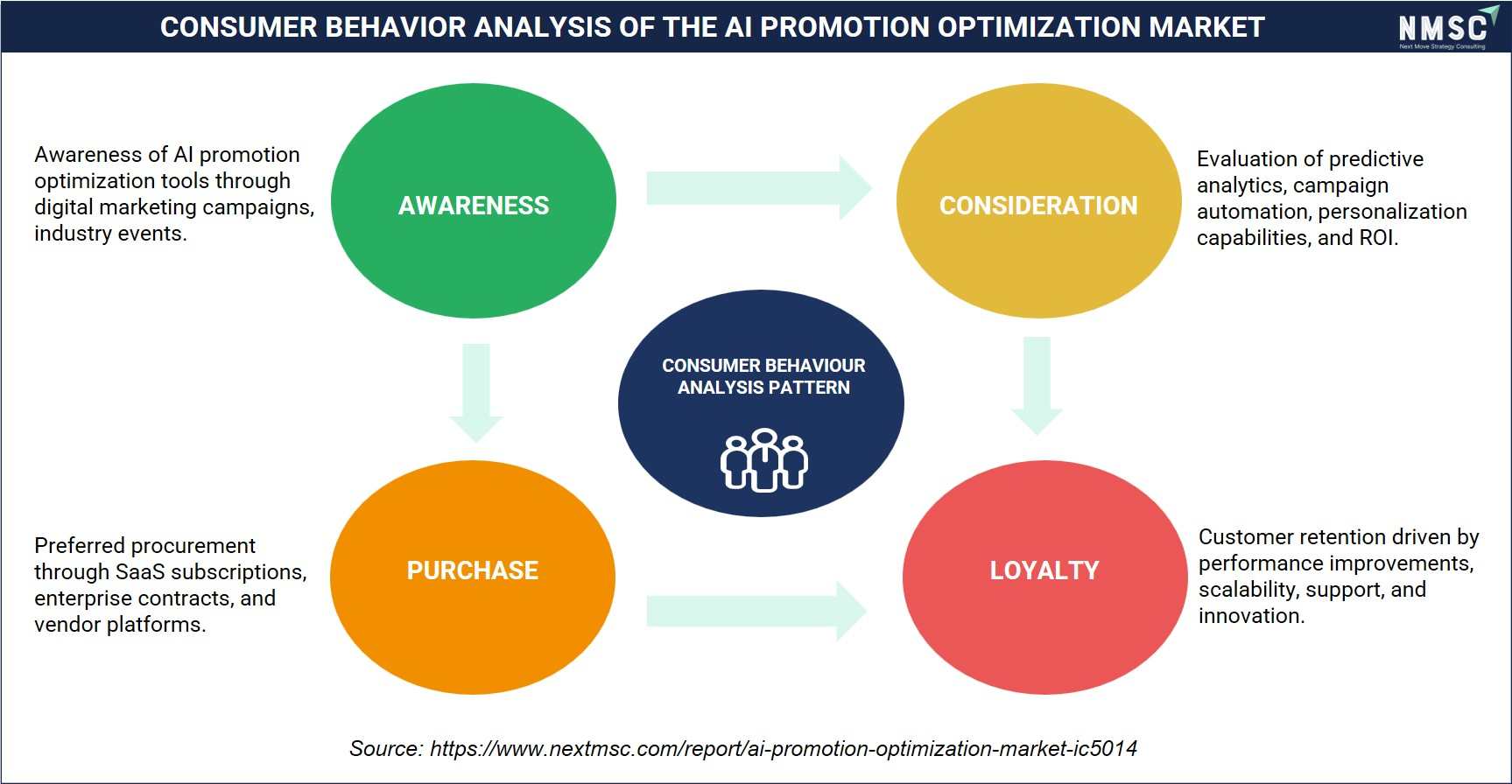
The consumer behavior analysis of the AI Promotion Optimization Market follows a four-stage adoption journey consisting of awareness, consideration, purchase, and loyalty. Organizations first become aware of AI promotion optimization solutions through digital marketing initiatives, industry events, and technology partners. During the consideration stage, buyers evaluate predictive analytics capabilities, automation features, personalization functionality, and expected return on investment. Purchasing decisions are typically driven by SaaS-based subscription models and enterprise agreements. Long-term loyalty is influenced by measurable business outcomes, platform scalability, customer support quality, continuous innovation, and the ability to improve promotional effectiveness and trade spend performance.
What Are the Key Market Drivers, Breakthroughs, and Investment Opportunities that Will Shape the AI Promotion Optimization Market in the Next Decade?
|
Drivers / Trends / Restraints |
(+/-) % Impact on CAGR Forecast |
Geographic Relevance |
Impact Timeline |
|
AI/ML Integration in Uplift Modeling |
+2.4% |
Global (led by North America, Europe) |
2025–2030 |
|
Revenue Growth Management Suite Adoption |
+2.0% |
North America, Europe, APAC |
2025–2035 |
|
Real-Time Syndicated Data Integration |
+1.6% |
North America, Europe |
2025–2028 |
|
Retailer-Manufacturer Collaboration Platforms |
+1.3% |
North America, APAC |
2026–2035 |
|
Cloud-Native SaaS Platform Migration |
+1.5% |
Global |
2025–2030 |
|
Data Privacy & Consumer Data Regulation |
-1.0% |
Europe, APAC, North America |
Ongoing |
|
High Implementation Complexity and Cost |
-0.8% |
SMB, Mid-market globally |
2025–2028 |
|
Fragmented Retailer Data Standards |
-0.6% |
All regions |
Ongoing |
|
Embedded AI in Partner ERP Ecosystems |
+1.8% |
Global |
2026–2035 |
|
Emerging Market Modern Trade Expansion |
+1.4% |
Asia-Pacific, Latin America, MEA |
2026–2035 |
What Are the Growth Drivers of the AI Promotion Optimization Market?
How Is Increasing AI and Machine Learning Integration Driving AI Promotion Optimization Market Growth?
Artificial intelligence and machine learning are the primary technical catalysts accelerating investment in the AI Promotion Optimization Market. AI-powered uplift modeling can identify which products, geographies, and retailer formats respond most favorably to promotional investment, allowing manufacturers to reallocate budgets from underperforming promotions to high-impact events. Based on our market evaluation, we noticed that consumer goods companies managing billions in annual trade spend can generate material margin improvements through AI-optimized allocation alone. The U.S. Bureau of Economic Analysis reports that consumer spending on food and beverages exceeded USD 2.2 trillion in 2024, indicating the immense commercial volume against which AI Promotion Optimization tools operate and from which they can extract measurable value for manufacturers and retailers.
How Is the Structural Shift to Revenue Growth Management Platforms Fueling AI Promotion Optimization Market Expansion?
The consumer goods industry's transition from isolated trade promotion tools to integrated revenue growth management platforms is structurally expanding the AI Promotion Optimization Market's total addressable opportunity. By combining pricing, promotions, assortment, and trade terms within a single AI-driven platform, vendors such as SAP, Oracle, and Blue Yonder enable manufacturers to optimize revenue holistically rather than managing individual commercial levers in isolation. From our research, we found that the Food and Agriculture Organization of the United Nations documents increasing food price volatility globally, which is compelling consumer goods manufacturers to adopt dynamic pricing and promotion optimization tools that can respond to commodity cost fluctuations in near-real time.
How Does Expansion of Modern Retail Trade in Emerging Markets Accelerate AI Promotion Optimization Market Growth?
The rapid expansion of organized modern retail trade across Asia-Pacific, Latin America, and the Middle East is creating significant incremental demand for AI Promotion Optimization solutions. As multinational consumer goods manufacturers extend their commercial operations into markets where modern trade penetration is growing, the complexity of managing promotions across diverse retail formats, pricing tiers, and shopper demographics necessitates AI-driven optimization capabilities. The World Bank estimates that modern retail penetration in Southeast Asia is growing at over three percentage points annually, compressing the timeline for manufacturers to deploy scalable AI Promotion Optimization platforms to maintain competitiveness in these high-growth channels.
What Are the Growth Inhibitors of the AI Promotion Optimization Market?
How Does Data Privacy Regulation Constrain AI Promotion Optimization Market Adoption?
Stringent data privacy regulations across key consumer goods markets present a significant structural constraint on the AI Promotion Optimization Market, particularly for capabilities dependent on shopper-level panel data and behavioral analytics. The European Union's General Data Protection Regulation restricts how consumer purchase data and loyalty program data can be collected, processed, and shared within AI promotion models. The California Consumer Privacy Act similarly limits the use of consumer behavioral data for commercial optimization purposes without explicit consent mechanisms. Our findings suggest that these regulatory requirements are increasing implementation costs for AI Promotion Optimization platforms that rely on rich consumer datasets, extending procurement timelines particularly among European grocery and beauty retailers.
How Does Implementation Complexity Limit AI Promotion Optimization Market Penetration Among Smaller Organizations?
The high implementation complexity and total cost of deploying enterprise-grade AI Promotion Optimization platforms represents a meaningful barrier to market penetration among small and mid-size consumer goods manufacturers and regional retailers. Successful deployments require integration with ERP systems such as SAP S/4HANA and Oracle ERP Cloud, synchronization with syndicated data feeds, cleansing of historical promotion data, and retraining of commercial planning teams in new workflows. Through NMSC's assessment, we found that organizations may require 12 to 18 months for full platform deployment, creating extended sales cycles and dampening near-term demand growth among buyers with limited IT resources or change management capabilities.
What Are the Growth Opportunities in the AI Promotion Optimization Market?
How Does Embedding AI Promotion Optimization in Partner ERP Ecosystems Create a Multi-Billion Dollar Opportunity?
Embedding AI Promotion Optimization capabilities within major ERP and retail execution software ecosystems represents the highest-leverage distribution opportunity in the market. SAP's Store (SAP App Center), Oracle's NetSuite partner network, and Salesforce's consumer goods cloud ecosystem all provide channels through which AI Promotion Optimization specialists such as UpClear, Price f(x), and Zilliant can reach buyers without competing on direct sales resources alone. The U.S. Small Business Administration reports that over 21,000 companies operate in the food and beverage manufacturing space in the United States, representing a large addressable mid-market segment that is increasingly accessible through embedded ERP distribution models for AI Promotion Optimization solutions.
How Does Expansion of Modern Retail Ecosystems in Asia-Pacific Create Structural Opportunity in the AI Promotion Optimization Market?
Asia-Pacific's rapidly modernizing retail landscape, anchored by e-commerce giants, digital-first grocery chains, and expanding organized trade formats, is generating structurally significant new demand for AI Promotion Optimization platforms. NMSC's analysis indicates that China's online fast-moving consumer goods channel, which exceeded USD 350 billion in gross merchandise value in 2024, requires promotion optimization capabilities adapted for digital shelf dynamics, flash sale mechanics, and livestream commerce use cases underserved by Western-designed legacy platforms. Governments across Southeast Asia, including Singapore's Digital Industry Framework and Malaysia's digital economy blueprint, are also funding commercial digitization programs that create institutional tailwinds for AI-driven promotion platform adoption.
How Do Sustainability and ESG-Linked Promotion Strategies Create New Use Cases Within the AI Promotion Optimization Market?
Environmental, Social, and Governance priorities are creating new functional requirements within the AI Promotion Optimization Market as consumer goods companies seek to align promotional investment with sustainability objectives. The European Commission's Green Deal and Farm to Fork Strategy explicitly encourage promotional support for sustainably sourced and low-carbon products, creating regulatory tailwinds for AI systems capable of modeling the ROI of sustainability-aligned promotions. Our assessment indicates that leading consumer goods companies including Nestle and Procter and Gamble have publicly committed to integrating sustainability metrics into commercial investment decisions, which is driving demand for AI Promotion Optimization platforms that can model and optimize ESG-linked promotional strategies alongside traditional financial ROI metrics.
STRATEGIC FRAMEWORK OF THE AI PROMOTION OPTIMIZATION MARKET
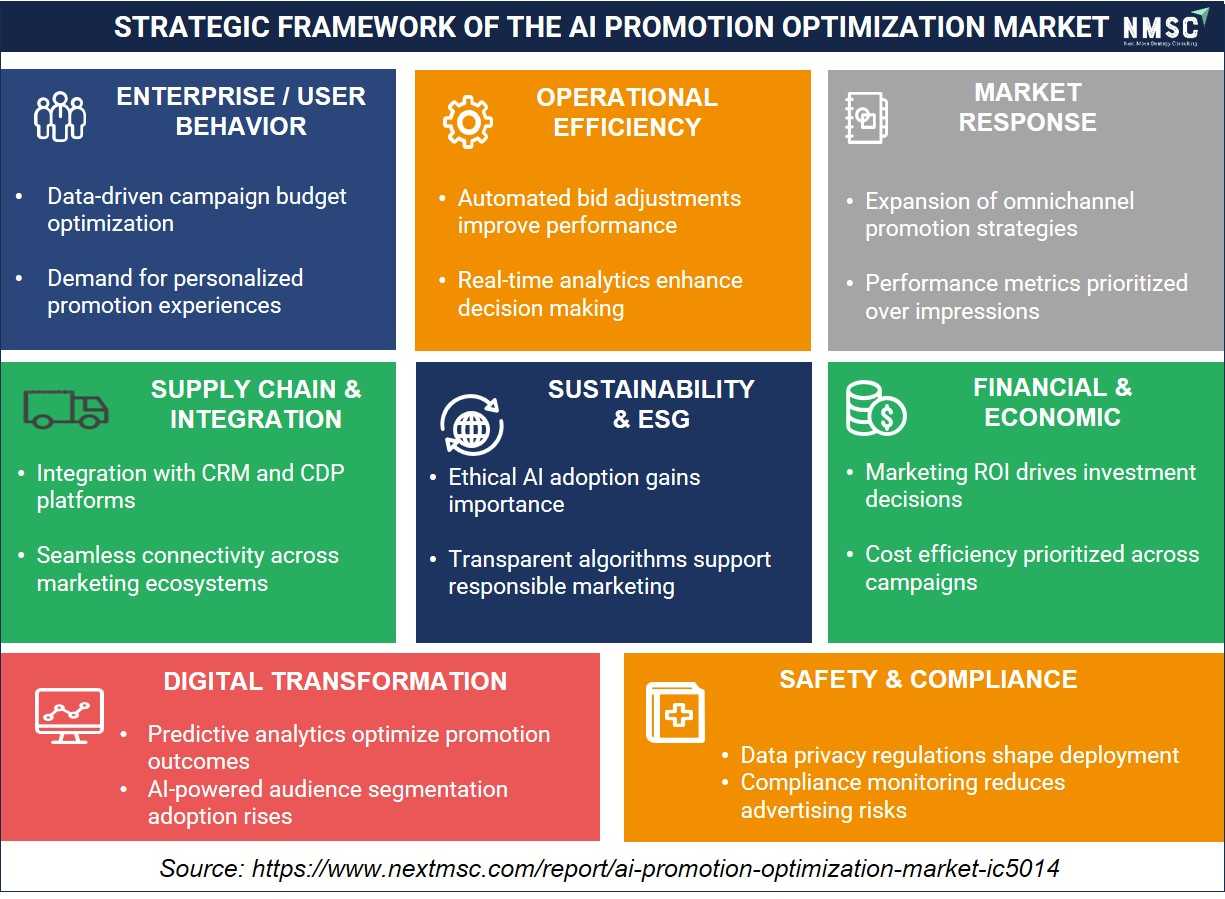
The strategic framework of the AI Promotion Optimization Market is shaped by advancements in digital transformation, operational efficiency, and data-driven decision-making. Organizations are increasingly adopting AI-powered predictive analytics, audience segmentation, and real-time optimization tools to improve promotional performance and marketing ROI. Market growth is further supported by seamless integration with CRM and customer data platforms, expansion of omnichannel promotion strategies, and growing emphasis on ethical AI practices. Additionally, regulatory compliance, data privacy requirements, and transparent algorithmic governance are becoming critical factors influencing deployment strategies and long-term market adoption.
How Is the AI Promotion Optimization Market Segmented in This Report, and What Are the Key Insights from the Segmentation Analysis?
How Does Deployment Model Choice Shape Platform Adoption in the AI Promotion Optimization Market?
|
Deployment Segment |
2025 (USD Bn) |
2035 (USD Bn) |
CAGR (%) |
|
Cloud |
1.30 |
7.20 |
18.7% |
|
Hybrid |
0.55 |
3.52 |
20.4% |
|
On-Premises |
0.25 |
1.08 |
15.7% |
Through our market assessment, we observed that Cloud deployment dominates the AI Promotion Optimization Market, representing approximately 62% of total revenue in 2025, supported by broad vendor migration to SaaS architectures and enterprise preference for lower upfront infrastructure cost and faster feature update cycles. All major AI Promotion Optimization vendors, including SAP, Oracle, and Blue Yonder, have repositioned their platforms as cloud-native offerings with continuous delivery models. Hybrid deployment is the fastest-growing model as large global manufacturers maintain on-premises ERP investments while adopting cloud-based promotion optimization and analytics overlays that integrate through secure API connectors. On-Premises deployment persists among regulated-market organizations and large enterprises with data residency requirements, although its share is declining as cloud security certifications mature.
Which Buyer Types Are Driving Demand in the AI Promotion Optimization Market?
|
Buyer Type |
2025 (USD Bn) |
2035 (USD Bn) |
CAGR (%) |
|
Consumer Goods Manufacturers |
1.26 |
6.90 |
18.5% |
|
Retailers |
0.55 |
3.46 |
20.1% |
|
Wholesalers and Distributors |
0.19 |
0.84 |
16.0% |
|
Service Providers |
0.10 |
0.60 |
19.6% |
From our research, we found that Consumer Goods Manufacturers represent the dominant buyer segment in the AI Promotion Optimization Market, accounting for USD 1.26 billion in 2025, as they carry the primary responsibility for trade promotion investment across mass-market, grocery, drug, and club channels. These manufacturers require the full stack of planning, optimization, and analytics capabilities to manage complex promotional calendars across thousands of SKUs and hundreds of retailer accounts. Retailers are the fastest-growing buyer segment, increasingly investing in AI Promotion Optimization tools to evaluate the profitability of vendor-funded promotions, optimize their promotional calendars, and negotiate more effectively during joint business planning processes. Wholesalers and Distributors represent a growing buyer category, particularly in foodservice and specialty distribution channels where dynamic promotional pricing is essential to margin management.
How Does End User Industry Distribution Reveal Demand Concentration in the AI Promotion Optimization Market?
|
End User Industry |
2025 (USD Bn) |
2035 (USD Bn) |
CAGR (%) |
|
Food and Beverage |
0.84 |
4.60 |
18.6% |
|
Beauty and Personal Care |
0.40 |
2.60 |
20.6% |
|
Household Care |
0.30 |
1.66 |
18.8% |
|
Durables and Electronics |
0.23 |
1.18 |
17.8% |
|
Foodservice |
0.15 |
0.92 |
19.8% |
|
Other Consumer Goods |
0.18 |
0.84 |
16.6% |
Based on our analysis of promotional investment patterns across consumer goods categories, we observed that the Food and Beverage industry commands the largest share of the AI Promotion Optimization Market at USD 0.84 billion in 2025, driven by the highest promotional frequency, the broadest retailer coverage, and the most complex trade promotion management requirements of any consumer goods sector. Major food and beverage manufacturers such as Nestle, Unilever, and PepsiCo are among the most advanced deployers of AI promotion platforms globally. Beauty and Personal Care is the fastest-growing end user industry as brands increasingly adopt AI-driven personalized promotion strategies across omnichannel environments including direct-to-consumer, specialty retail, and e-commerce. Household Care and Durables and Electronics sectors are adopting AI Promotion Optimization at a steady pace, with Foodservice emerging as a new growth vertical as restaurant chains and foodservice distributors adopt AI-powered promotional pricing tools.
How Do Sales Channels Shape Go-to-Market Strategies in the AI Promotion Optimization Market?
|
Sales Channel |
2025 (USD Bn) |
2035 (USD Bn) |
CAGR (%) |
|
Direct |
1.16 |
6.08 |
18.0% |
|
Partner-Led |
0.63 |
4.24 |
21.0% |
|
Embedded |
0.31 |
1.48 |
17.0% |
Our findings suggest that Direct sales channels dominate AI Promotion Optimization Market go-to-market activity, with vendors maintaining specialized enterprise sales forces targeting large consumer goods manufacturers and retailers through account-based selling programs. Direct channels support the consultative sales cycles required for complex platform implementations at Fortune 500 consumer goods companies. Partner-Led channels are the fastest-growing distribution model as major ERP vendors, management consulting firms including Accenture and Deloitte, and regional system integrators build AI Promotion Optimization practices that expand vendor reach into mid-market segments. Embedded sales channels, where AI Promotion Optimization capabilities are packaged within broader ERP or retail execution software platforms, represent a growing commercial model that lowers acquisition cost and accelerates time-to-value for buyers.
Regional Outlook
Geographic Performance Snapshot
|
Region |
2025 (USD Bn) |
2035 (USD Bn) |
CAGR (%) |
Key Driver |
|
North America |
0.84 |
4.70 |
18.8% |
Large manufacturer base, advanced analytics adoption |
|
Europe |
0.52 |
2.86 |
18.5% |
GDPR compliance, FMCG digital transformation |
|
Asia-Pacific |
0.45 |
2.82 |
20.2% |
E-commerce growth, China/India market expansion |
|
Middle East & Africa (MEA) |
0.13 |
0.84 |
20.5% |
Modern trade growth, Vision 2030 initiatives |
|
Latin America |
0.16 |
1.08 |
21.0% |
E-commerce expansion, FMCG channel modernization |
North America AI Promotion Optimization Market
North America is the global epicenter of the AI Promotion Optimization Market, accounting for USD 0.84 billion in 2025 and forecast to reach USD 4.7 billion by 2035 at a CAGR of 18.8%. The region hosts the headquarters of the world's largest consumer goods manufacturers including Procter and Gamble, Colgate-Palmolive, and Kraft Heinz, as well as major AI Promotion Optimization vendors including SAP, Oracle, and Salesforce. Highly mature trade promotion practices, sophisticated retailer data ecosystems, and deep penetration of cloud-based commercial software underpin North America's market leadership. Regulatory developments under the FTC's algorithmic accountability guidelines are also compelling manufacturers to adopt AI platforms with built-in explainability and audit trail capabilities.
U.S. AI Promotion Optimization Market
Based on our engagements across the consumer goods sector, the United States represents over 75% of North American AI Promotion Optimization Market revenue in 2025, driven by the world's highest concentration of large consumer goods manufacturers, a sophisticated multi-format retail landscape, and the deepest enterprise software adoption rate globally. The U.S. market is characterized by intense competition among major AI Promotion Optimization vendors and a strong ecosystem of specialist consultants. The U.S. Food and Drug Administration's food labeling requirements and the FTC's promotional fairness guidelines are shaping AI model design standards for compliance-ready promotion optimization platforms.
Canada AI Promotion Optimization Market
Through our analysis, Canada's AI Promotion Optimization Market is advancing steadily, supported by a concentrated grocery retail landscape dominated by Loblaw, Empire, and Metro, which drives demand for AI-enabled joint business planning and promotion analytics tools among their supplier base. Canadian consumer goods manufacturers are investing in cloud-based trade promotion management platforms to comply with Competition Bureau guidelines on promotional pricing transparency. The government's Digital Charter Implementation Act and the proposed Consumer Privacy Protection Act are additionally shaping data governance requirements for AI promotion models that process consumer panel data.
Mexico AI Promotion Optimization Market
From our assessment, Mexico is the fastest-growing AI Promotion Optimization Market within North America, with manufacturers and retailers accelerating digital transformation of commercial operations. The growing presence of organized retail formats including Walmart Mexico, OXXO, and Chedraui is creating demand for sophisticated trade promotion management and optimization tools among both multinational and domestic consumer goods companies. Mexico's Secretariat of Economy digital economy programs and nearshoring-driven manufacturing growth are increasing organizational capability for enterprise software adoption, while the Federal Consumer Protection Law shapes promotional claim standards for AI-generated promotional content.
Europe AI Promotion Optimization Market
Europe is the second-largest region in the AI Promotion Optimization Market, contributing USD 0.52 billion in 2025 and forecast to reach USD 2.86 billion by 2035 at a CAGR of 18.5%. The region's complex multi-market retail landscape, with distinct shopper behaviors and retailer structures across each country, amplifies the need for AI-driven promotion localization capabilities. The EU's GDPR and emerging e-commerce regulations are simultaneously driving demand for privacy-compliant promotion analytics and creating complexity for vendors serving pan-European manufacturer clients. Major FMCG companies headquartered in Europe, including Unilever, Nestle, Reckitt, and Henkel, are significant adopters and innovation drivers within the AI Promotion Optimization Market.
U.K. AI Promotion Optimization Market
Based on our engagements, the United Kingdom is Europe's largest individual AI Promotion Optimization Market, driven by a highly concentrated grocery retail sector led by Tesco, Sainsbury's, Asda, and Morrisons. UK retailers are among the most analytically sophisticated globally, creating a competitive environment where manufacturers must deploy AI Promotion Optimization tools to negotiate effectively during annual joint business planning cycles. The UK Competition and Markets Authority has examined promotional pricing practices in grocery retail, creating demand for AI platforms with transparent promotion ROI tracking. Post-Brexit regulatory divergence from the EU is creating unique data governance requirements for UK-based promotion analytics platforms.
Germany AI Promotion Optimization Market
According to our evaluation, Germany represents the second-largest AI Promotion Optimization Market in Europe, distinguished by its highly cost-conscious retail environment anchored by Aldi, Lidl, Rewe, and Edeka. The dominance of hard discounters creates unique promotional dynamics where traditional promotional mechanics are limited, driving demand for precision AI models that optimize the narrow promotional windows available to manufacturers. The Federal Cartel Office monitors retail promotional practices, and Germany's Bundesdatenschutzgesetz data protection law imposes stringent requirements on consumer data usage within AI promotion models. Major German consumer goods companies including Henkel and Beiersdorf are key enterprise adopters.
France AI Promotion Optimization Market
Through our analysis, France's AI Promotion Optimization Market is characterized by significant promotional complexity driven by the Egalim law framework that regulates trade negotiation practices between manufacturers and retailers. These legal constraints on commercial negotiation make AI-driven promotion optimization tools particularly valuable for modeling compliant promotional structures. French consumer goods manufacturers and major retailers including Carrefour and E.Leclerc are investing in AI Promotion Optimization platforms to manage the analytical demands of Egalim compliance. The CNIL's GDPR enforcement activity shapes how shopper-level data can be incorporated into AI promotion models for French market deployment.
Italy AI Promotion Optimization Market
From our assessment, Italy's AI Promotion Optimization Market is expanding steadily, underpinned by the food and beverage sector's prominence in Italy's consumer economy and the growing adoption of modern retail formats. Italian consumer goods manufacturers, particularly in food, personal care, and household products, are adopting AI Promotion Optimization platforms to manage increasing complexity in promotional planning across fragmented retail channels. Italy's Autorità Garante data protection authority actively enforces GDPR compliance, creating requirements for privacy-by-design architectures within AI promotion analytics platforms. Public digital transformation programs under the Piano Nazionale di Ripresa e Resilienza are stimulating broader enterprise software investment.
Spain AI Promotion Optimization Market
Based on our evaluation, Spain demonstrates growing momentum in the AI Promotion Optimization Market, driven by a dynamic FMCG sector and a retail landscape led by Mercadona, Carrefour Spain, and Dia. Spanish consumer goods manufacturers are increasing investment in AI-driven trade promotion management tools to optimize performance across a highly promotional retail environment. The Agencia Española de Protección de Datos enforces GDPR compliance, shaping data processing requirements for AI promotion optimization platforms. Spain's digital transformation agenda under Agenda España Digital 2026 is accelerating enterprise cloud adoption, creating favorable conditions for SaaS-based AI Promotion Optimization platform deployments.
Sweden AI Promotion Optimization Market
Through our market assessment, we observed that Sweden's AI Promotion Optimization Market is advancing steadily, supported by Sweden's high enterprise software adoption rate and the presence of major consumer goods players including SCA and Swedish Match. Sweden's organized retail sector, dominated by ICA, Coop, and Axfood, provides a concentrated buying environment that creates demand for sophisticated AI promotion analytics. IMY, Sweden's data protection authority, actively enforces GDPR, shaping compliance standards for AI promotion platforms operating in the Nordic region. Sweden's well-developed digital infrastructure supports rapid cloud deployment of AI Promotion Optimization solutions.
Denmark AI Promotion Optimization Market
Our analysis shows that Denmark's AI Promotion Optimization Market is growing consistently, anchored by the country's advanced digital economy and a retail sector shaped by Salling Group and Coop Danmark. Danish consumer goods manufacturers benefit from one of Europe's highest digital readiness indices, facilitating rapid adoption of cloud-based AI promotion platforms. Denmark's strict GDPR enforcement and digital bookkeeping requirements are driving demand for AI Promotion Optimization tools with robust audit trail capabilities. The Danish Digital Partnership's enterprise digitization initiatives further support commercial software investment among Danish consumer goods companies.
Finland AI Promotion Optimization Market
Based on our market evaluation, Finland's AI Promotion Optimization Market is developing steadily, supported by Finland's strong enterprise technology culture and a concentrated retail sector led by S-Group and Kesko. Finnish consumer goods companies are adopting AI Promotion Optimization tools to optimize promotional investment across a cost-sensitive retail environment. The Data Protection Ombudsman actively enforces GDPR compliance for digital commerce data processing, influencing how AI promotion models can incorporate consumer behavioral data. Finland's National AI Strategy and enterprise digitization support programs are creating favorable institutional conditions for AI Promotion Optimization platform adoption.
Netherlands AI Promotion Optimization Market
From our research, we found that the Netherlands is an increasingly important AI Promotion Optimization Market in Europe, driven by its role as a European logistics hub and the presence of Albert Heijn, the most analytically sophisticated grocery retailer in the Benelux region. Dutch consumer goods manufacturers and retailers are investing in AI-driven promotion intelligence to manage the complexity of pan-European distribution and multi-format promotional calendars. The Autoriteit Persoonsgegevens enforces GDPR with particular focus on digital marketing and consumer data, shaping how AI promotion platforms handle shopper-level datasets. The Netherlands' strong startup and scale-up ecosystem is generating AI Promotion Optimization innovation from emerging regional vendors.
Rest of Europe AI Promotion Optimization Market
According to our evaluation, the rest of Europe including Poland, Belgium, Austria, Switzerland, Portugal, and Central and Eastern European markets represents a growing collective opportunity for AI Promotion Optimization solutions. Poland's large consumer goods manufacturing sector, Belgium's role as headquarters for major FMCG multinationals, and Switzerland's premium consumer goods industry are key demand anchors. The proliferation of EU GDPR compliance requirements across all European markets is standardizing data governance expectations for AI promotion platforms, reducing cross-border implementation complexity for vendors operating pan-European deployments.
Asia-Pacific AI Promotion Optimization Market
Asia-Pacific is the fastest-growing major region in the AI Promotion Optimization Market, contributing USD 0.45 billion in 2025 and forecast to reach USD 2.82 billion by 2035 at a CAGR of 20.2%. The region encompasses the world's two most populous consumer markets in China and India, both experiencing rapid expansion of organized retail and digital commerce channels. E-commerce-native promotion formats unique to Asia-Pacific, including livestream commerce and instant delivery promotional mechanics, are creating demand for AI Promotion Optimization capabilities specifically designed for digital-first retail environments. ASEAN digital economy growth programs and government-backed enterprise digitization initiatives are further accelerating platform adoption across the region.
China AI Promotion Optimization Market
Based on our engagements, China represents the largest AI Promotion Optimization Market in Asia-Pacific at USD 0.14 billion in 2025, propelled by the world's most advanced e-commerce promotional ecosystem anchored by platforms including Alibaba, JD.com, and Douyin Commerce. Chinese consumer goods companies and multinational manufacturers operating in China are deploying AI Promotion Optimization tools adapted for digital shelf promotion, 618 shopping festival planning, and Double Eleven campaign optimization. China's Personal Information Protection Law shapes how consumer behavioral data can be incorporated into AI promotion models, driving demand for compliance-ready platforms. The Ministry of Industry and Information Technology's AI industry policy supports domestic AI promotion technology development.
India AI Promotion Optimization Market
Through our analysis, India is the fastest-growing AI Promotion Optimization Market in Asia-Pacific, advancing at a CAGR of 26.0% from 2026 to 2035. The rapid expansion of modern retail through Reliance Retail, DMart, and organized e-commerce channels including Blinkit and Swiggy Instamart is compelling manufacturers to adopt AI-driven trade promotion management. India's Digital Personal Data Protection Act is shaping how consumer data can be processed within promotion analytics platforms. NMSC's analysis indicates that major consumer goods companies including Hindustan Unilever and ITC are investing significantly in AI Promotion Optimization capabilities to manage increasingly complex promotional calendars across India's diverse retail landscape.
Japan AI Promotion Optimization Market
From our assessment, Japan's AI Promotion Optimization Market is advancing at a moderate pace, characterized by the unique dynamics of Japanese consumer goods retail, including convenience store dominance, category management sophistication, and highly structured supplier-retailer relationships. Japanese consumer goods manufacturers including Kao Corporation and Lion Corporation are adopting AI-driven promotion optimization tools to navigate the complexity of managing promotions across Seven-Eleven, Lawson, and FamilyMart convenience chains alongside traditional grocery formats. Japan's Act on the Protection of Personal Information governs data processing within AI promotion platforms, with the Personal Information Protection Commission enforcing compliance standards.
South Korea AI Promotion Optimization Market
Based on our market evaluation, South Korea's AI Promotion Optimization Market is growing steadily, supported by the country's highly digitalized retail environment and strong enterprise technology adoption culture. South Korean consumer goods companies and multinational brands operating in the market are deploying AI Promotion Optimization solutions to manage promotional complexity across e-commerce giants Coupang and Naver Shopping alongside traditional hypermarket chains Emart and Lotte Mart. The Personal Information Protection Act governs consumer data usage within AI promotion analytics, with the Personal Information Protection Commission enforcing compliance. South Korea's government AI policy and digital transformation agenda support enterprise AI adoption.
Taiwan AI Promotion Optimization Market
Our assessment indicates that Taiwan's AI Promotion Optimization Market is developing steadily, driven by the island's sophisticated consumer electronics and consumer goods manufacturing sectors and a well-developed convenience retail channel led by 7-Eleven Taiwan and FamilyMart. Taiwanese consumer goods manufacturers are increasingly adopting AI promotion tools to optimize promotional calendars across modern trade and e-commerce channels. Taiwan's Personal Data Protection Act governs how consumer behavioral data can be processed within AI promotion optimization models, creating compliance requirements for vendors serving the Taiwanese market.
Indonesia AI Promotion Optimization Market
Based on our engagements, Indonesia's AI Promotion Optimization Market is at an early but high-growth phase, propelled by the rapid expansion of e-commerce through Tokopedia, Shopee, and Lazada alongside organized retail expansion. Indonesian consumer goods manufacturers and multinational companies are deploying AI Promotion Optimization tools to navigate a complex omnichannel retail environment combining traditional trade, modern grocery, and digital commerce channels. Indonesia's Personal Data Protection Law, enacted in 2022 and overseen by the Ministry of Communication and Information Technology, is shaping data governance standards for AI promotion platforms entering this market.
Vietnam AI Promotion Optimization Market
Through our market assessment, we observed that Vietnam's AI Promotion Optimization Market is in an emerging phase, with growing demand from multinational FMCG companies and domestic manufacturers responding to rapid modern trade penetration. Vietnam's retail sector is undergoing significant transformation as organized retail chains including VinMart and Circle K expand alongside platforms such as Shopee and TikTok Shop. The Ministry of Industry and Trade's retail development strategy is supporting organized retail growth that creates demand for AI-driven promotion optimization tools. Vietnam's Cybersecurity Law and data localization requirements shape how AI promotion platforms handle consumer data.
Australia AI Promotion Optimization Market
According to our evaluation, Australia's AI Promotion Optimization Market is one of Asia-Pacific's most mature markets outside Japan, driven by the highly concentrated grocery retail duopoly of Woolworths and Coles, which creates intense competition for promotional calendar slots among manufacturer trading partners. Australian consumer goods manufacturers are sophisticated AI Promotion Optimization adopters, using predictive analytics and ROI optimization tools to maximize returns from limited promotional investment windows. The Australian Competition and Consumer Commission monitors supermarket promotional pricing practices, creating demand for AI platforms with transparent audit capabilities. The Privacy Act 1988 governs consumer data processing within AI promotion analytics systems.
Philippines AI Promotion Optimization Market
From our research, we found that the Philippines AI Promotion Optimization Market is developing rapidly, supported by the country's young, digitally active consumer population and growing organized retail sector led by SM Retail and Puregold. Multinational consumer goods companies operating in the Philippines are extending AI Promotion Optimization capabilities to manage increasingly complex promotional calendars across traditional trade, modern grocery, and e-commerce channels. The National Privacy Commission enforces the Data Privacy Act governing how consumer behavioral data is processed within AI promotion platforms. The Department of Trade and Industry's digital commerce development programs are supporting enterprise technology adoption.
Malaysia AI Promotion Optimization Market
Based on our evaluation, Malaysia's AI Promotion Optimization Market is expanding at a solid pace, driven by the country's advanced retail sector anchored by Aeon, Jaya Grocer, and a well-developed e-commerce ecosystem including Shopee Malaysia and Lazada Malaysia. Malaysian consumer goods manufacturers and multinational brands are deploying AI Promotion Optimization tools to optimize promotions across a diverse retail landscape spanning modern trade, convenience, and digital commerce. The Personal Data Protection Act governs consumer data processing within AI promotion analytics platforms. Malaysia's Digital Economy Blueprint 2030 is creating institutional support for enterprise AI adoption across the consumer goods sector.
Rest of Asia-Pacific AI Promotion Optimization Market
Our analysis shows that the rest of Asia-Pacific, encompassing Singapore, Thailand, Bangladesh, Pakistan, New Zealand, Sri Lanka, and other markets, collectively represents a growing opportunity for AI Promotion Optimization solutions. Singapore's advanced enterprise technology culture and regional headquarters presence of major consumer goods companies make it a disproportionately important regional demand center. Thailand and New Zealand both have maturing modern retail sectors where AI Promotion Optimization is gaining traction. The Singapore Personal Data Protection Commission and equivalent authorities across the region are establishing data governance frameworks that shape AI promotion analytics platform standards.
Middle East & Africa (MEA) AI Promotion Optimization Market
The Middle East and Africa region is an emerging but high-growth market for AI Promotion Optimization, contributing USD 0.13 billion in 2025 and forecast to reach USD 0.84 billion by 2035 at a CAGR of 20.5%. Saudi Arabia's Vision 2030 retail modernization agenda, UAE's position as a regional consumer goods hub, and the rapid growth of e-commerce and organized retail across Africa are creating structural demand for AI-driven promotion management. Multinational consumer goods companies operating in the region are extending enterprise AI promotion platforms to MEA markets, while regional retailers including Carrefour Middle East and Majid Al Futtaim are investing in promotion analytics capabilities.
Saudi Arabia AI Promotion Optimization Market
Based on our engagements, Saudi Arabia's AI Promotion Optimization Market is growing rapidly under the influence of Vision 2030's retail sector modernization programs and the rapid growth of organized retail through Panda Retail and e-commerce via noon.com and Saudia Arabia's Amazon marketplace. Consumer goods manufacturers operating in the Kingdom are deploying AI Promotion Optimization tools to manage complex promotional calendars across Ramadan, Hajj, and National Day promotional cycles that are unique to the Saudi market. The Saudi Authority for Data and Artificial Intelligence governs data practices within AI platforms, with the National Data Management Office establishing standards for commercial AI applications.
UAE AI Promotion Optimization Market
Through our analysis, the UAE represents the most advanced AI Promotion Optimization Market in the MEA region, driven by Dubai and Abu Dhabi's positions as regional headquarters for major multinational consumer goods companies. The UAE's highly developed modern retail sector, anchored by Carrefour UAE, Lulu Hypermarket, and a sophisticated e-commerce ecosystem, creates demand for AI Promotion Optimization tools among both manufacturers and retailers. The UAE's Federal Personal Data Protection Law shapes data processing requirements for AI promotion platforms. Dubai's AI roadmap and Abu Dhabi's technology investment programs are creating favorable conditions for enterprise AI adoption across commercial functions.
Egypt AI Promotion Optimization Market
From our assessment, Egypt's AI Promotion Optimization Market is at an early stage with growing momentum, driven by a large consumer goods market and an expanding organized retail sector. Major multinational manufacturers operating in Egypt are extending their AI Promotion Optimization capabilities to manage promotional complexity across traditional trade and modern retail channels. Egypt's Personal Data Protection Law, enacted in 2020, is establishing data governance requirements for AI-powered commercial applications. Egypt's national digital transformation strategy under Digital Egypt is accelerating enterprise technology adoption among large commercial organizations.
Israel AI Promotion Optimization Market
According to our evaluation, Israel's AI Promotion Optimization Market is developing with growing adoption among consumer goods companies and retailers. Israel's strong technology culture and deep AI expertise are contributing to local innovation in promotion optimization algorithms and analytics capabilities. Major Israeli retailers and consumer goods manufacturers are deploying AI Promotion Optimization tools to manage a complex retail environment. Israel's Privacy Protection Authority enforces data protection requirements for AI platforms processing consumer behavioral data. Israel's government AI development programs and startup ecosystem are generating innovation in promotion optimization technology.
Turkey AI Promotion Optimization Market
Based on our market evaluation, Turkey's AI Promotion Optimization Market is expanding steadily, supported by a large FMCG market and the rapid growth of organized retail led by BIM, A101, and Migros. Turkish consumer goods manufacturers are adopting AI Promotion Optimization tools to manage highly promotional retail environments where price sensitivity demands precision targeting. Turkey's Personal Data Protection Law governs how consumer data is processed within AI promotion analytics platforms. Turkey's digital transformation agenda and growing enterprise software investment are creating favorable adoption conditions for AI Promotion Optimization solutions.
Nigeria AI Promotion Optimization Market
Our assessment indicates that Nigeria's AI Promotion Optimization Market is at a nascent stage with early-mover demand emerging from multinational FMCG companies operating Nigeria's large consumer market. Companies including Unilever Nigeria, Nigerian Breweries, and Nestle Nigeria are exploring AI-driven trade promotion management to improve investment efficiency across complex informal and formal retail channels. The Nigeria Data Protection Commission, established under the Nigeria Data Protection Act 2023, is creating a regulatory framework for how consumer data can be processed within AI-powered commercial systems. Nigeria's National Digital Economy Policy supports enterprise technology adoption across commercial sectors.
South Africa AI Promotion Optimization Market
Based on our engagements, South Africa is the most developed AI Promotion Optimization Market in Sub-Saharan Africa, driven by a sophisticated consumer goods retail sector anchored by Shoprite, Pick n Pay, Woolworths SA, and SPAR. South African consumer goods manufacturers are among the earliest African adopters of AI Promotion Optimization tools, using advanced analytics to optimize trade investment across a promotional-intensive grocery retail environment. The Information Regulator enforces the Protection of Personal Information Act, creating data governance requirements for AI promotion analytics platforms. South Africa's ICT sector policy is supporting enterprise digital transformation investments.
Rest of MEA AI Promotion Optimization Market
Our analysis shows that the rest of the Middle East and Africa, encompassing Kuwait, Qatar, Bahrain, Oman, Jordan, Morocco, Kenya, Ethiopia, and other markets, collectively represents an early-stage but high-growth opportunity for AI Promotion Optimization solutions. Gulf Cooperation Council markets beyond Saudi Arabia and the UAE are expanding organized retail rapidly, creating demand for AI promotion management tools among multinational manufacturers. Kenya and Morocco represent early-stage demand anchors in East and North Africa respectively, where multinational FMCG companies are beginning to extend AI Promotion Optimization platform deployments.
Latin America AI Promotion Optimization Market
Latin America is the fastest-growing regional market for AI Promotion Optimization, contributing USD 0.16 billion in 2025 and forecast to reach USD 1.08 billion by 2035 at a CAGR of 21.0%. Brazil's large FMCG market, Argentina's sophisticated consumer goods sector, and the rapid expansion of e-commerce across the region are driving demand for AI-powered promotion management. Hyperinflationary dynamics in certain markets amplify the importance of AI Promotion Optimization tools that can dynamically recalibrate promotional pricing models. Multinational consumer goods companies operating across Latin America are standardizing AI Promotion Optimization platforms across their regional operations to improve investment efficiency and data visibility.
Brazil AI Promotion Optimization Market
Based on our engagements, Brazil is the largest AI Promotion Optimization Market in Latin America, driven by the region's largest consumer goods market and a rapidly modernizing retail sector anchored by Pão de Açúcar, Carrefour Brasil, and fast-growing e-commerce through Mercado Libre and Americanas. Brazilian consumer goods manufacturers including Ambev, JBS, and BRF are investing in AI Promotion Optimization platforms to manage complex promotional calendars across diverse retail formats and regional market variations. Brazil's Lei Geral de Proteção de Dados, overseen by the Autoridade Nacional de Proteção de Dados, shapes data processing requirements for AI promotion analytics systems.
Argentina AI Promotion Optimization Market
Through our analysis, Argentina's AI Promotion Optimization Market operates in a highly distinctive commercial environment shaped by persistent inflation, foreign exchange controls, and dynamic pricing environments. AI Promotion Optimization tools capable of real-time promotional price recalibration are particularly valuable in this context. Argentine consumer goods manufacturers and retailers including Carrefour Argentina and Coto are adopting AI-driven tools to navigate promotional complexity. Argentina's Law 25.326 on Personal Data Protection governs consumer data processing requirements for AI promotion platforms. The Argentine government's digital economy initiatives are supporting technology adoption despite macroeconomic challenges.
Chile AI Promotion Optimization Market
From our assessment, Chile's AI Promotion Optimization Market is growing steadily, supported by a sophisticated consumer goods market and a modern retail sector led by Cencosud, Falabella, and SMU. Chilean consumer goods manufacturers and retailers are adopting AI Promotion Optimization tools to improve promotional ROI across an increasingly competitive retail environment. Chile's Law 19.628 on Personal Data Protection and proposed modernization amendments are shaping data governance requirements for AI-powered commercial applications. Chile's strong digital infrastructure and enterprise software adoption rate support rapid deployment of cloud-based AI Promotion Optimization platforms.
Colombia AI Promotion Optimization Market
According to our evaluation, Colombia's AI Promotion Optimization Market is developing rapidly, driven by growing modern retail penetration and increasing investment by multinational FMCG companies in digital commercial capabilities. Colombia's retail sector, led by Grupo Éxito and Cencosud Colombia, is increasingly adopting analytics-driven promotion management. The Superintendencia de Industria y Comercio enforces Colombia's Statutory Law 1581 on Personal Data Protection, creating compliance requirements for AI promotion analytics platforms. Colombia's digital economy strategy MinTIC 2022–2026 supports enterprise technology adoption across commercial sectors.
Rest of Latin America AI Promotion Optimization Market
Our analysis shows that the rest of Latin America, encompassing Peru, Ecuador, Bolivia, Uruguay, Paraguay, Central America, and the Caribbean, represents an early-stage but growing opportunity for AI Promotion Optimization solutions. Peru and Ecuador are the most active markets within this grouping, with growing organized retail sectors and increasing investment by multinational consumer goods companies in commercial digitization. Regional data protection frameworks aligned with Ibero-American privacy standards are shaping how AI promotion analytics platforms handle consumer behavioral data across these emerging AI Promotion Optimization markets.
Competitive Landscape
Competitive Dynamics and M&A Landscape
|
Key Takeaways |
Details |
|
Market Structure |
The AI Promotion Optimization Market features multi-tiered competition among enterprise software conglomerates (SAP, Oracle, Salesforce), specialized trade promotion management vendors (Blue Yonder, Vistex, UpClear), data analytics providers (NielsenIQ, Circana, Kantar), AI platform specialists (o9 Solutions, Anaplan, RELEX), and management consulting-led implementation houses (Accenture, Deloitte, McKinsey). |
|
Innovation Focus |
Innovation centers on AI-native uplift modeling, scenario simulation, real-time syndicated data integration, generative AI-enabled promotion scenario planning, embedded promotion optimization within ERP ecosystems, and sustainability-aligned promotion ROI frameworks. |
|
M&A Activity |
Consolidation is accelerating as enterprise software vendors acquire specialist AI Promotion Optimization capabilities. SAP's continued investment in Revenue Growth Management, Blue Yonder's category management integration, and private equity activity among mid-tier trade promotion management vendors reflect an active M&A landscape that is expected to intensify through 2028. |
How Do Companies Compete in the AI Promotion Optimization Market?
The AI Promotion Optimization Market is characterized by multi-tiered competition among enterprise software providers, specialized promotion optimization vendors, AI-driven planning platforms, and retail analytics companies. Enterprise technology leaders such as SAP, Oracle, and Salesforce compete on platform breadth, enterprise integration capabilities, and global deployment expertise. Specialized vendors including Blue Yonder, Vistex, and UpClear differentiate on trade promotion management functionality, promotion effectiveness measurement, and ROI optimization accuracy. Retail analytics providers such as NielsenIQ and Circana compete on data coverage, consumer insights, and analytics depth, while AI-native platforms including o9 Solutions and Anaplan focus on advanced scenario modeling, predictive analytics, and machine learning-driven decision support.
Which Kind of Companies Dominate the AI Promotion Optimization Market?
Three distinct categories of companies dominate the AI Promotion Optimization Market. First, enterprise software providers including SAP, Oracle, Salesforce, and Microsoft leverage broad enterprise ecosystems and integrated business applications to deliver promotion planning and optimization capabilities. Second, specialized promotion and revenue management vendors such as Blue Yonder, Vistex, UpClear, and RELEX Solutions provide purpose-built trade promotion optimization, revenue growth management, and retail execution platforms. Lastly, AI-driven planning and analytics providers including o9 Solutions, Anaplan, NielsenIQ, Circana, and SymphonyAI deliver predictive modeling, demand forecasting, and data-driven promotion optimization solutions that support strategic decision-making across consumer goods and retail organizations.
AI-Powered Predictive Analytics and Revenue Growth Management Drive Market Success in the AI Promotion Optimization Market
Innovation across the AI Promotion Optimization Market is centered on AI-powered demand forecasting, real-time promotion effectiveness measurement, revenue growth management (RGM), and autonomous decision intelligence. Vendors are increasingly investing in machine learning models that optimize pricing, promotional spending, assortment planning, and customer targeting across omnichannel environments. Advanced scenario simulation, generative AI-assisted planning, retail media integration, and closed-loop performance analytics are emerging as key differentiators. Companies that successfully combine high-quality consumer data, predictive analytics, and automated optimization capabilities are strengthening customer retention and capturing premium market opportunities.
Market Players to Opt for Merger and Acquisition Strategies to Expand Their Presence in the AI Promotion Optimization Market
Mergers, acquisitions, and strategic partnerships are increasingly shaping the competitive landscape of the AI Promotion Optimization Market. Leading software providers are acquiring AI analytics, revenue growth management, and retail intelligence companies to strengthen promotion optimization capabilities and accelerate innovation. Strategic partnerships between enterprise software vendors, consumer goods manufacturers, retailers, and data analytics providers are expanding solution ecosystems and improving data interoperability. Private equity firms continue to invest in high-growth retail technology and AI planning vendors, while consolidation is expected to increase among trade promotion management, retail analytics, and revenue optimization providers as organizations seek comprehensive end-to-end optimization platforms.
Who Are the Key Market Players in the AI Promotion Optimization Market?
-
SAP SE
-
Oracle Corporation
-
Salesforce, Inc.
-
Blue Yonder Group, Inc.
-
NielsenIQ
-
Circana, Inc.
-
Kantar Group Limited
-
Vistex, Inc.
-
Anaplan, Inc.
-
o9 Solutions, Inc.
-
RELEX Oy
-
SymphonyAI LLC
-
Accenture plc
-
Deloitte Touche Tohmatsu Limited
-
McKinsey & Company
-
Wipro Limited
-
Price f(x) AG
-
Zilliant Inc.
-
Revionics, LLC
-
UpClear
What Are the Latest Developments in the AI Promotion Optimization Market?
|
Date |
Event |
|
May 2026 |
Blue Yonder announced new AI-Driven Cognitive Solutions at ICON 2026, including advanced planning, category management, space planning, and AI agents that improve retail decision-making and promotional effectiveness. |
|
January 2026 |
SAP introduced AI-assisted Promotion Creation in SAP Revenue Growth Management, enabling sales and account teams to create and optimize trade promotions using generative AI. |
What Are the Investment Opportunities in the AI Promotion Optimization Market?
Capital Inflows and Venture Activity
The AI Promotion Optimization Market is attracting increasing private and institutional capital as investors recognize the market's strong unit economics and multi-year secular growth drivers. o9 Solutions has raised over USD 1 billion in funding, reflecting venture confidence in AI-native supply chain and commercial planning platforms. RELEX Oy's growth equity funding from TCV and General Atlantic validates the commercial scale attainable by specialized AI promotion and supply chain optimization platforms. The National Venture Capital Association reports that AI enterprise software is among the most active U.S. venture investment categories, with commercial planning software representing a growing share of consumer goods technology investment specifically.
Infrastructure Investment
Infrastructure investment underlying the AI Promotion Optimization Market encompasses cloud platform capacity expansion by major hyperscalers that host promotion optimization workloads and the data center expansion programs supporting real-time syndicated data delivery. Microsoft's USD 80 billion AI infrastructure investment announced for FY2025 and Google's USD 75 billion capital expenditure commitment for cloud and AI services directly expand the compute capacity available for AI promotion optimization model training and inference. Data providers NielsenIQ and Circana are investing in real-time data processing infrastructure to reduce promotion measurement latency from weeks to days, which is a critical enabler for closed-loop AI promotion optimization systems.
ESG Considerations
Environmental and sustainability considerations are creating new functional investment requirements within the AI Promotion Optimization Market. The European Commission's Green Deal mandates that promotional support for sustainably sourced products be measurable and verifiable, driving demand for AI promotion platforms capable of tracking and reporting sustainability-linked promotional ROI. Consumer goods companies including Procter and Gamble and Unilever have publicly committed to integrating sustainability metrics into commercial investment decisions, creating enterprise demand for AI Promotion Optimization platforms that can model ESG-aligned promotion strategies. This sustainability integration use case is emerging as a distinct product differentiation dimension for AI promotion platform vendors.
Digital Transformation Enablement
AI Promotion Optimization platforms serve as a critical digital transformation enabler for consumer goods commercial functions, making them structurally embedded in multi-year enterprise IT investment cycles. Organizations undergoing ERP migrations to SAP S/4HANA or Oracle Fusion Cloud require AI Promotion Optimization platform integration as part of their commercial function modernization programs. NMSC's analysis indicates that the NIST Digital Transformation Framework references data-driven commercial decision-making as a core competency for advanced enterprise digital maturity, creating institutional validation for AI Promotion Optimization investment as a strategic imperative rather than a discretionary technology upgrade.
PE and VC Activity
Private equity and venture capital activity in the AI Promotion Optimization Market is intensifying, with firms including Vista Equity Partners, Thoma Bravo, and Francisco Partners historically active in enterprise commercial software. Mid-tier trade promotion management vendors represent consolidation targets as larger platform vendors seek to acquire specialized capabilities in settlement automation, channel-specific optimization, and regional market data integrations. The combination of recurring SaaS revenue models, high switching costs, and secular demand growth makes AI Promotion Optimization specialists attractive acquisition targets for PE-backed platform rollup strategies through the 2025 to 2030 period.
Key Benefits for Stakeholders
For Consumer Goods Manufacturers
Consumer goods manufacturers gain comprehensive visibility into promotion effectiveness, trade spend allocation, and revenue growth opportunities through AI Promotion Optimization solutions. These platforms enable organizations to improve trade promotion ROI, reduce promotional leakage, automate settlement processes, and strengthen collaborative planning with retail partners. Advanced predictive analytics and scenario modeling support more informed decision-making, helping manufacturers optimize promotional investments across channels, regions, and customer accounts while accelerating commercial planning cycles.
For Retailers
Retailers benefit from AI Promotion Optimization by gaining data-driven insights into category performance, promotional profitability, and consumer purchasing behavior. AI-powered analytics enable retailers to optimize promotional calendars, improve inventory planning, and enhance category management strategies. These solutions also strengthen collaboration with consumer goods manufacturers by providing greater transparency into promotion outcomes, enabling more effective negotiations and mutually beneficial joint business planning initiatives.
For Investors and Financial Analysts
Investors and financial analysts gain access to a high-growth software segment characterized by recurring SaaS revenues, strong customer retention rates, and increasing enterprise adoption of AI-driven commercial planning solutions. The AI Promotion Optimization Market presents multiple value creation opportunities through platform expansion, AI capability enhancement, geographic growth, and strategic acquisitions. Market intelligence on competitive positioning, innovation trends, and consolidation activity supports investment evaluation, valuation modeling, and identification of emerging market leaders.
For System Integrators and Consulting Firms
System integrators and consulting firms benefit from increasing demand for implementation services, system integration, data modernization, and organizational transformation programs associated with AI Promotion Optimization deployments. As consumer goods companies accelerate commercial digitization initiatives, consulting partners play a critical role in platform implementation, process redesign, change management, analytics enablement, and ongoing managed services. Growing adoption of AI-driven revenue growth management solutions continues to expand service opportunities across global markets.
For Technology Vendors and Platform Providers
Technology vendors and platform providers gain opportunities to expand recurring subscription revenues, increase annual contract values, and strengthen customer relationships through advanced AI-enabled optimization capabilities. Growing demand for predictive analytics, revenue growth management, and trade promotion effectiveness solutions enables vendors to develop differentiated offerings and deepen platform adoption. Data network effects, AI model refinement, and ecosystem partnerships further enhance competitive positioning and long-term market sustainability.
For Government and Regulatory Bodies
Government agencies and regulatory bodies gain improved transparency into promotional pricing practices, commercial agreements, and retail market dynamics through AI Promotion Optimization technologies. Enhanced reporting, auditability, and analytical capabilities support oversight of consumer protection regulations, fair competition requirements, and pricing transparency standards. Market intelligence generated by these platforms can assist policymakers in understanding evolving retail promotion practices and assessing the impact of commercial strategies on consumers and market competitiveness.
Key Market Segments
By Offering
-
Software
-
Trade Promotion Management
-
Planning
-
Funding and Claims
-
Account Planning
-
Settlement
-
-
Trade Promotion Optimization
-
Forecasting
-
Scenario Simulation
-
Uplift Modeling
-
ROI Optimization
-
Post Event Measurement
-
-
Revenue Growth Management Suite
-
Pricing
-
Promotions
-
Assortment
-
Trade Terms
-
-
Data and Analytics
-
Syndicated Data
-
Panel Data
-
Promotion Benchmarking
-
Shopper Insights
-
-
-
Services
-
Advisory
-
Implementation
-
Managed Services
-
Change Management
-
By Deployment Model
-
Cloud
-
Hybrid
-
On Premises
By Buyer Type
-
Consumer Goods Manufacturers
-
Retailers
-
Wholesalers and Distributors
-
Service Providers
By End User Industry
-
Food and Beverage
-
Beauty and Personal Care
-
Household Care
-
Durables and Electronics
-
Foodservice
-
Other Consumer Goods
By Sales Channel
-
Direct
-
Partner Led
-
Embedded
By Region
-
North America: U.S., Canada, and Mexico.
-
Europe: UK, Germany, France, Italy, Spain, Sweden, Denmark, Finland, the Netherlands, and the rest of Europe.
-
Asia Pacific: China, India, Japan, South Korea, Taiwan, Indonesia, Vietnam, Australia, Philippines, Malaysia and the rest of APAC.
-
Middle East & Africa (MEA): Saudi Arabia, UAE, Egypt, Israel, Turkey, Nigeria, South Africa, and the rest of MEA.
-
Latin America: Brazil, Argentina, Chile, Colombia, and the rest of LATAM.
Conclusion and Recommendations
Long-Term Outlook
The AI Promotion Optimization Market is positioned for one of its most consequential growth decades, advancing from USD 2.5 billion in 2026 to USD 11.8 billion by 2035 at a CAGR of 18.8%. This growth trajectory reflects the structural transition of consumer goods commercial operations from manual, spreadsheet-dependent processes to AI-native platforms that deliver real-time promotion intelligence, closed-loop measurement, and cross-functional commercial optimization. NMSC's analysis indicates that the market's long-term growth is underpinned by durable secular drivers including accelerating AI adoption, expanding modern retail trade in Asia-Pacific and the Middle East, and the strategic imperative for consumer goods companies to optimize every dollar of trade investment in margin-constrained operating environments.
Strategic Positioning Recommendations
Platform vendors should prioritize AI-native differentiation through integrated uplift modeling, generative AI-enabled scenario planning, and real-time syndicated data connectivity that closes the promotion measurement loop. Vendors without robust cloud-native SaaS architectures will face structural disadvantage as enterprise buyers accelerate digital transformation timelines. Establishing embedded distribution partnerships within major ERP ecosystems particularly SAP, Oracle, and Salesforce represents the most capital-efficient market expansion strategy for mid-size AI Promotion Optimization specialists. Geography-specific product development for Asia-Pacific's digital commerce promotional formats is a critical growth enabler that most Western vendors have underinvested in through the current cycle.
Investment Attractiveness
The AI Promotion Optimization Market represents an attractive investment environment characterized by recurring SaaS revenue models, high customer switching costs, and strong multi-year secular demand growth. Our assessment indicates that the highest-conviction investment themes include Trade Promotion Optimization software (24.0% CAGR), Managed Services delivery models (22.0% CAGR), Partner-Led channel growth (21.0% CAGR), Asia-Pacific regional expansion (20.2% CAGR), and the Retailer buyer segment (20.1% CAGR). Private equity investors should monitor mid-tier specialist vendors in settlement automation, channel-specific optimization, and regional syndicated data integration as consolidation targets through 2028.
Market Shifts and Key Risks
The most significant market shift underway is the migration from standalone trade promotion management software to integrated revenue growth management platforms that combine pricing, promotions, assortment, and trade terms within a single AI-driven environment. This shift benefits large ERP vendors and full-stack platforms at the expense of point-solution trade promotion management specialists. Key risks for the AI Promotion Optimization Market include data privacy regulatory escalation limiting consumer data usage in AI promotion models, macroeconomic pressures constraining consumer goods manufacturer software investment budgets, open-source AI model development reducing barriers to in-house promotion optimization capabilities, and potential disruption from retail platform-native AI promotion tools operated by major e-commerce companies.
Growth Pathways
Organizations seeking to maximize value from the AI Promotion Optimization Market should pursue a three-horizon strategy. In the near term through 2027, prioritize cloud migration of trade promotion management platforms and deployment of AI uplift modeling to establish a governed promotional data foundation. In the mid-term from 2027 to 2031, invest in full revenue growth management suite adoption, real-time syndicated data integration, and Asia-Pacific market-specific platform capabilities. In the long term from 2031 to 2035, position for embedded AI promotion optimization within retail operating systems and the integration of sustainability-linked promotion ROI modeling as a competitive differentiator in regulated consumer goods markets.
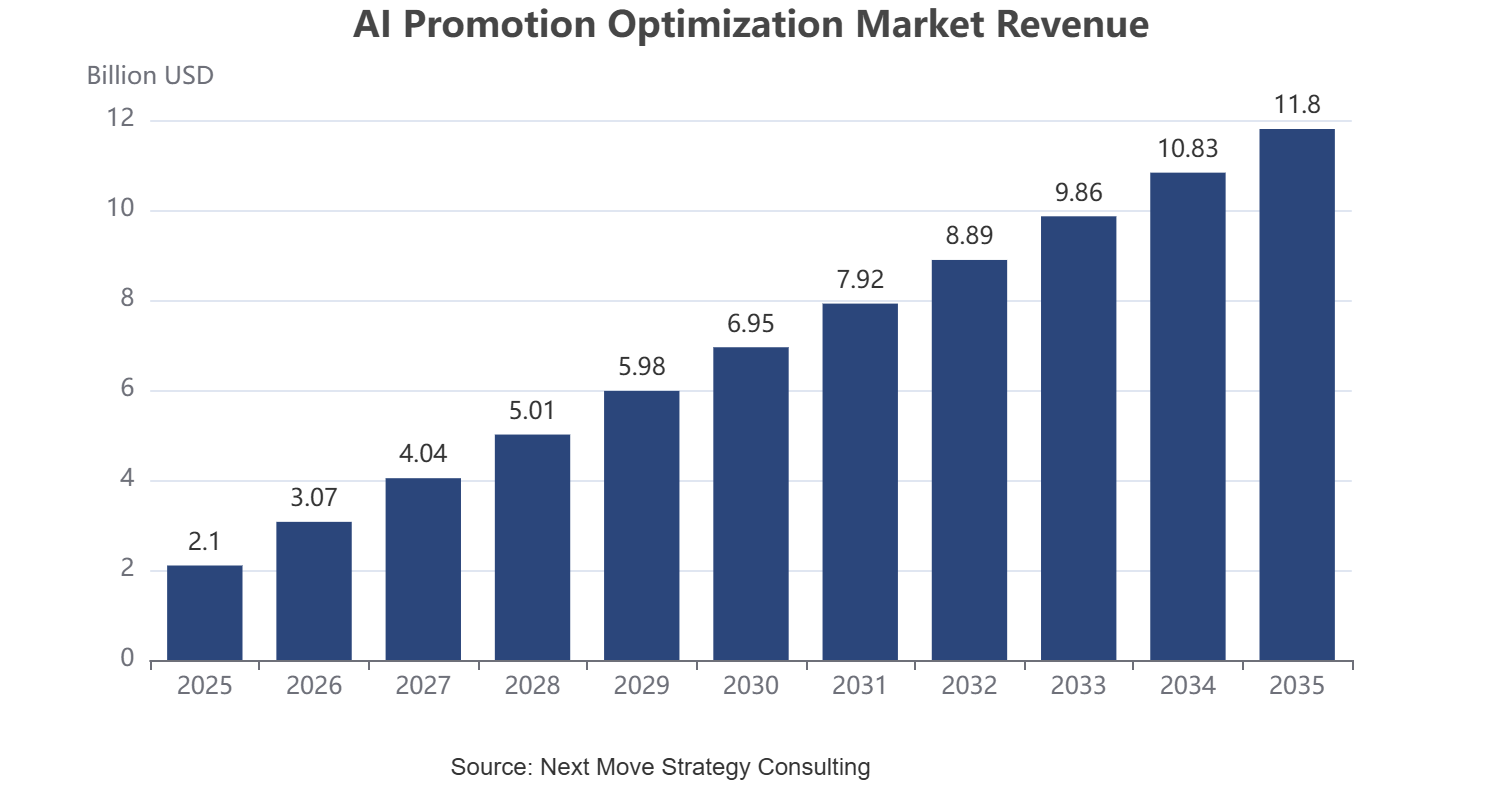
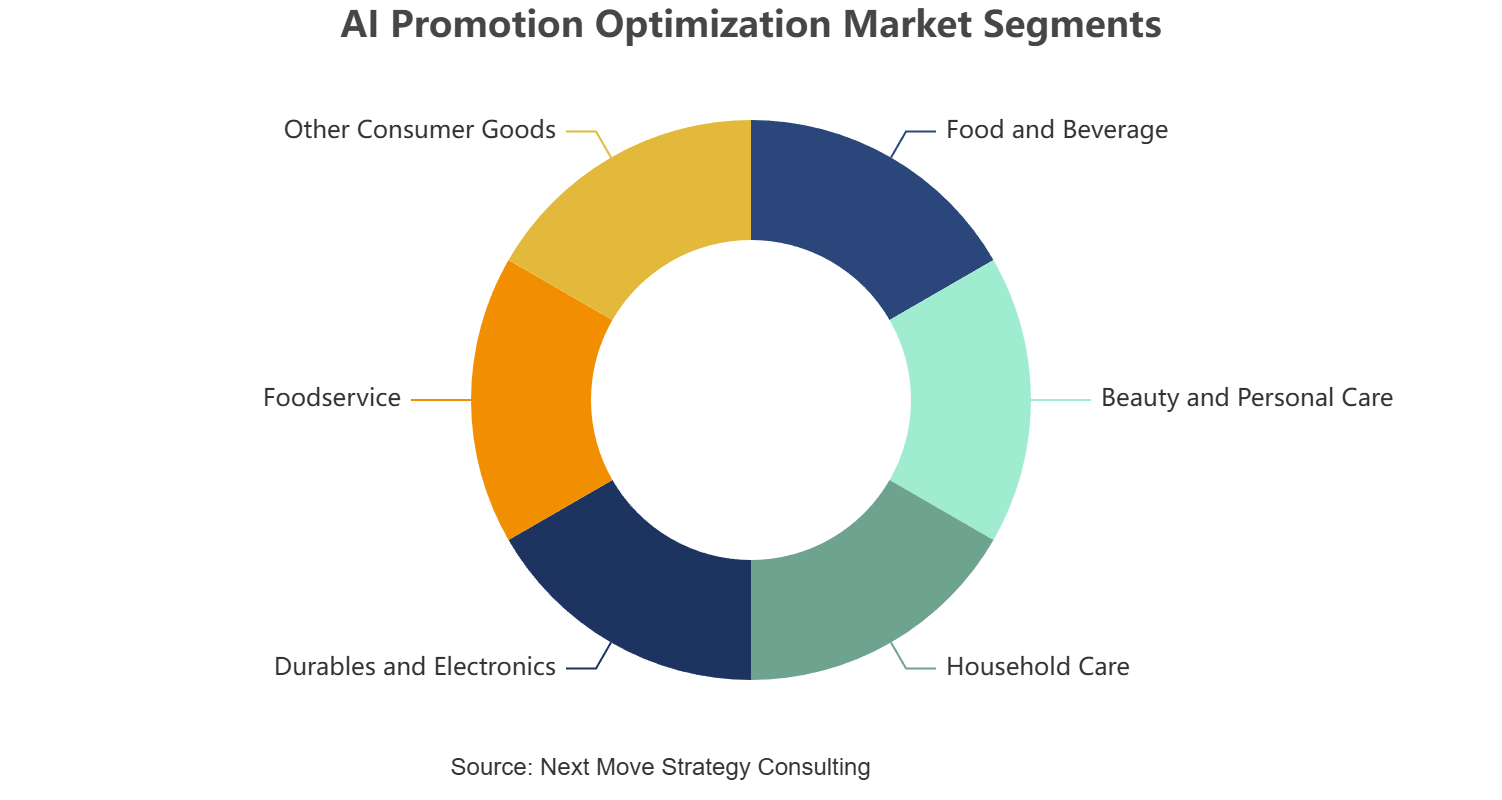
About the Author
 Liza Phukan
— Liza Phukan is Research Associate at Next Move Strategy Consulting, where she has covered emerging industries and market research across sectors for 3.5 years. Her work includes analyzing industry developments, validating market data, and developing structured business content from research findings. She uses secondary research and data-validation practices to turn complex market information into clear decision-useful market analysis for business audiences and support report development and B2B.
Liza Phukan
— Liza Phukan is Research Associate at Next Move Strategy Consulting, where she has covered emerging industries and market research across sectors for 3.5 years. Her work includes analyzing industry developments, validating market data, and developing structured business content from research findings. She uses secondary research and data-validation practices to turn complex market information into clear decision-useful market analysis for business audiences and support report development and B2B.
About the Reviewer
 Supradip Baul
— Supradip Baul is an accomplished business consultant and strategist with over a decade of rich experience in market intelligence, strategy, technology, and business transformation. His work has included rigorous qualitative and quantitative analysis across multiple industries, helping clients shape investment decisions and long-term roadmaps. Earlier in his career, he was associated with Gartner, where he contributed to industry-leading reports and market share analyses. He has worked with leading global companies and holds an MBA with a dual specialization in Marketing and Finance.
Supradip Baul
— Supradip Baul is an accomplished business consultant and strategist with over a decade of rich experience in market intelligence, strategy, technology, and business transformation. His work has included rigorous qualitative and quantitative analysis across multiple industries, helping clients shape investment decisions and long-term roadmaps. Earlier in his career, he was associated with Gartner, where he contributed to industry-leading reports and market share analyses. He has worked with leading global companies and holds an MBA with a dual specialization in Marketing and Finance.
At Next Move Strategy Consulting, we understand that insightful market research is the cornerstone of successful business decisions. That's why we employ a robust and multifaceted approach, combining various methodologies to deliver the most accurate and actionable data for our clients.

Research Landscape
We navigate the world of research with two primary approaches:
Qualitative Approach
Our qualitative research methodologies involve immersive techniques such as in-depth interviews, focus groups, and observational studies. By engaging directly with individuals and stakeholders, we uncover valuable insights that quantitative data alone may overlook.

Quantitative Research
In tandem with qualitative methodologies, NMSC leverages the power of Quantitative Research to provide a robust foundation of numerical insights. Through systematic data collection and analysis, we quantify patterns, preferences, and market trends, offering a comprehensive view of the business landscape.
Our quantitative research approach employs diverse tools, including surveys, experiments, and statistical modelling. These methodologies enable us to gather data from a large and representative sample, ensuring the statistical significance of our findings. By employing structured questionnaires and standardized data collection methods, we guarantee the reliability and validity of the information we present to our clients.
Quantitative research is particularly effective in measuring the prevalence of trends, assessing market size, and gauging the impact of various factors on consumer behavior. The numerical precision attained through this approach equips our clients with actionable insights, facilitating data-driven decision-making and strategy formulation.


Our Specialized Toolbox for Industry-Specific Market Research
We deploy a specialized arsenal of techniques tailored to meet your unique requirements. Here's a glimpse into our comprehensive toolbox:

Information Procurement
The stage entails acquiring market data or relevant information through various sources and methodologies.


Market Research Approach
We utilize both top-down and bottom-up approaches in market research analysis to achieve a comprehensive understanding of the market dynamics, leveraging the broad perspective of industry trends and macroeconomic factors alongside detailed insights from specific segments and individual companies.

Porters Five Forces Analysis
We conduct Porter's Five Forces analysis to evaluate the competitive landscape of an industry, providing us with insights into factors that affect profitability and strategic positioning.

SWOT Analysis

Forecasting
We utilize a forecasting model to predict future consumption by considering parameters like population, economics, regulations, market competition, drivers, constraints, technology, and pricing. We also employ statistical techniques such as multilinear regression, exponential smoothing, moving average, ARIMA, and Monte Carlo simulations for accurate predictions. In econometric forecasting, we analyzed short-term and long-term event impacts, attributing values based on regulatory frameworks, economic factors, and market events.





 Speak to Our Analyst