Data Center Rack Market Global Industry Analysis and Forecast (2026–2035)

The global Data Center Rack Market is valued at USD 9.22 Billion in 2026 and is projected to reach USD 27.75 Billion by 2035, growing at a CAGR of 13.02% from 2026 to 2035. Key growth factors include rising AI and high-density computing workloads, alongside expanding hyperscale and colocation data center capacity, with North America leading the market and Enclosed Server Racks accounting for approximately 53% share.
Download Free Sample PDF
Base Year (2025)
$9.22 Billion
Forecast (2035)
$27.75 Billion
CAGR (2026-2035)
13.0%
Top Region
North America

Investment Opportunities

Where Are Capital Inflows Concentrating in the Data Center Rack Market?

Capital is concentrating in high-density AI rack system manufacturing capacity, liquid cooling integration engineering, and DCIM software development three capability clusters that directly address the specification requirements of hyperscale AI infrastructure procurement programs. Strategic investment is also flowing into pre-configured modular rack production facilities in North America and Europe, where regional supply chain resilience and proximity to major data center construction corridors reduce logistics lead times for large volume rack orders. The data center power solution sector is a related capital-intensive investment area that is co-developing with advanced rack procurement.

How Is Data Center Rack Market Infrastructure Investment Shaping Long-Term Rack Market Capacity?
The announced hyperscale and colocation data center capital expenditure pipeline exceeding USD 500 Billion globally across 2025–2030 based on publicly disclosed operator investment programs creates a committed multi-year rack procurement demand that justifies manufacturing capacity investment at a scale not previously seen in the data center hardware market. Rack vendors with the balance sheet and production infrastructure to scale manufacturing ahead of this demand curve are positioned to capture disproportionate revenue share, particularly in the data center cooling and power-integrated rack systems where integration complexity limits rapidity new entrant competition.

What ESG Considerations Are Influencing Investment Decisions in the Data Center Rack Market?

ESG considerations in the Data Center Rack Market center on energy efficiency, circular economy rack design, and lifecycle management programs that enable certified equipment recovery and resale rather than landfill disposal. The Green Grid's PUE metrics and ASHRAE's thermal efficiency guidelines are embedding rack-level energy performance requirements into data center procurement specifications, with EU Green Deal compliance requirements specifically targeting per-rack power and cooling efficiency thresholds for new facilities permitted after 2026. Investors are weighing green datacenter compliance credentials alongside financial returns, making energy-efficient rack platform certification a commercial prerequisite in the European market.

Where Are Capital Inflows Concentrating in the Data Center Rack Market?

Capital is concentrating in high-density AI rack system manufacturing capacity, liquid cooling integration engineering, and DCIM software development three capability clusters that directly address the specification requirements of hyperscale AI infrastructure procurement programs. Strategic investment is also flowing into pre-configured modular rack production facilities in North America and Europe, where regional supply chain resilience and proximity to major data center construction corridors reduce logistics lead times for large volume rack orders. The data center power solution sector is a related capital-intensive investment area that is co-developing with advanced rack procurement.
How Is Data Center Rack Market Infrastructure Investment Shaping Long-Term Rack Market Capacity?

The announced hyperscale and colocation data center capital expenditure pipeline exceeding USD 500 Billion globally across 2025–2030 based on publicly disclosed operator investment programs creates a committed multi-year rack procurement demand that justifies manufacturing capacity investment at a scale not previously seen in the data center hardware market. Rack vendors with the balance sheet and production infrastructure to scale manufacturing ahead of this demand curve are positioned to capture disproportionate revenue share, particularly in the data center cooling and power-integrated rack systems where integration complexity limits rapid new entrant competition.
What ESG Considerations Are Influencing Investment Decisions in the Data Center Rack Market?
ESG considerations in the Data Center Rack Market center on energy efficiency, circular economy rack design, and lifecycle management programs that enable certified equipment recovery and resale rather than landfill disposal. The Green Grid's PUE metrics and ASHRAE's thermal efficiency guidelines are embedding rack-level energy performance requirements into data center procurement specifications, with EU Green Deal compliance requirements specifically targeting per-rack power and cooling efficiency thresholds for new facilities permitted after 2026. Investors are weighing green datacenter compliance credentials alongside financial returns, making energy-efficient rack platform certification a commercial prerequisite in the European market.

Key Benefits for Stakeholders

How Does This Report Benefit Data Center Infrastructure Leaders?

Data center infrastructure manufacturers, operators, and procurement teams gain segment-level revenue forecasts and CAGR benchmarks across rack type, end user, and rack height dimensions enabling capital expenditure planning, product roadmap prioritization, and supplier negotiation strategies grounded in the 2025–2035 data used consistently throughout this analysis. The report's competitive landscape and latest developments sections provide specific intelligence on rival innovation directions and customer acquisition strategies that inform strategic positioning in the hyperscale, colocation, and enterprise segments.
How Does This Report Benefit Investors and Financial Analysts?
Investors and financial analysts gain a reconciled market-sizing model with verified 2025–2035 figures, quantified growth catalyst and restraint impact on the 13.02% CAGR, competitive archetype mapping, and recent company development tracking that support valuation, due-diligence, and portfolio-allocation decisions across the data center infrastructure value chain. The report's absolute investment opportunity figure of USD 18.53 Billion between 2026 and 2035 and its sub-segment CAGR differentiation provide scenario-analysis inputs for modeling infrastructure vendor revenue trajectories at a granularity unavailable from aggregate technology sector data.

How Does This Report Benefit Technology Vendors and Product Teams?

Technology vendors and product development teams gain direct intelligence on the fastest-growing rack type segment Blade Server Enclosures at 21.10% CAGR and the fastest-growing end-user segment Hyperscale Data Centers at 16.34% CAGR alongside specific innovation directions including liquid cooling integration, DCIM sensor embedding, and pre-configured modular rack architectures that define the competitive standard for premium rack procurement in AI infrastructure deployments through 2035.
Key Market Segments
By Rack Type
• Enclosed Server Racks
Standard enclosed server rack (42U)
High-density enclosed rack (48U and above)
Liquid-cooled enclosed rack
• Open-Frame Racks
Two-post open-frame rack
Four-post open-frame rack
OCP open-rack compliant
• Wall-Mount Racks
Fixed wall-mount enclosure
Swing-out wall-mount rack
• Blade Server Enclosures
Standard blade chassis
High-density GPU blade enclosure
By End User
• Hyperscale Data Centers
Cloud service provider facilities
AI training and inference clusters
• Colocation Data Centers
Multi-tenant colocation facilities
Wholesale colocation campuses
• Enterprise Data Centers
Corporate on-premises data centers
Government and institutional data centers
• Edge Data Centers
Telco edge and carrier-neutral facilities
Micro data centers and remote site deployments
By Rack Height
• 42U Racks
Standard 42U server rack
42U rack with integrated cable management
• 48U and Above Racks
48U high-density rack
52U and above AI cluster rack
• Below 42U Racks
12U to 22U mid-size rack
Sub-12U mini rack
By Region
• North America: U.S., Canada, Mexico
• Europe: UK, Germany, France, Italy, Spain, Sweden, Denmark, Finland, Netherlands, Rest of Europe
• Asia-Pacific: China, India, Japan, South Korea, Taiwan, Indonesia, Vietnam, Australia, Philippines, Malaysia, Rest of APAC
• Middle East & Africa: Saudi Arabia, UAE, Egypt, Israel, Turkey, Nigeria, South Africa, Rest of MEA
• Latin America: Brazil, Argentina, Chile, Colombia, Rest of LATAM

What Is the Long-Term Outlook for the Data Center Rack Market?

The long-term outlook is strongly positive, with the market expanding from USD 9.22 Billion in 2026 to USD 27.75 Billion by 2035 at a 13.02% CAGR. We observed that this trajectory is underpinned by structurally durable AI infrastructure investment, the global colocation expansion cycle, and the transition to high density liquid-cooled rack architectures that command materially higher average selling prices than the commodity rack configurations that dominated procurement through 2022. Regulatory and sustainability requirements will sustain premium specification adoption in European and emerging markets through the forecast period.
What Strategic Positioning Do We Recommend?
Our assessment indicates that rack manufacturers should prioritize liquid cooling integration certification, hyperscale and colocation direct sales capability, and Middle East market entry as the three highest-return strategic investments through 2030. Companies that can offer factory-configured, liquid cooling ready rack systems with committed 8–12 week delivery windows for 1,000-plus unit orders will capture disproportionate hyperscale contract share, while those that establish manufacturing and service presence in Saudi Arabia and the UAE before 2028 will benefit from first-mover specification advantages in the region's fastest-growing data center market.
How Attractive Is the Data Center Rack Market for Investment?

Investment attractiveness is very high, anchored by the USD 18.53 Billion absolute revenue opportunity between 2026 and 2035 and a 13.02% CAGR that outpaces the broader data center infrastructure market. The Blade Server Enclosures segment at 21.10% CAGR and the 48U and Above Racks segment at 17.65% CAGR offer growth profiles that are structurally linked to AI infrastructure capex cycles with multi-year committed spending visibility, providing investment return predictability superior to most other hardware market categories at equivalent risk profiles.
What Are the Key Market Shifts and Risks?
Key risks include concentration of demand among a small number of hyperscale operators whose capex decisions are sensitive to macroeconomic conditions, supply chain vulnerability for specialized liquid-cooling rack components, and the pace of regulatory permitting for new large-scale data center construction in constrained European markets. Our analysis shows that vendors overly dependent on a single large hyperscale customer relationship face meaningful revenue volatility risk, making diversification across end-user segments and geographies a strategic necessity for sustainable growth through 2035.

What Are the Primary Growth Pathways Through 2035?

Primary growth pathways include the commercialization of liquid-cooling-integrated rack systems as standard high-density configurations, geographic expansion into GCC hyperscale markets, and the transition to modular pre-configured rack service contracts that generate recurring revenue beyond hardware transactions. We found that companies combining AI-optimized rack engineering, Middle East market presence, and integrated power and cooling system capability are best positioned to capture the USD 18.53 Billion absolute opportunity the Data Center Rack Market presents between 2026 and 2035.

FAQs

Market Size & Forecast

Data Center Rack Market Global Industry Analysis and Forecast (2026–2035) Revenue Forecast

Values in USD Billion

2025 $9.22 Billion
2025
2026 $10.42 Billion
2026
2027 $11.78 Billion
2027
2028 $13.31 Billion
2028
2029 $15.04 Billion
2029
2030 $17.00 Billion
2030
2031 $19.22 Billion
2031
2032 $21.72 Billion
2032
2033 $24.55 Billion
2033
2034 $27.74 Billion
2034
2035 $27.75 Billion
2035

Key Takeaways

Dimension | Assessment

Market Structure | Moderately concentrated; top 5 players Vertiv, Schneider Electric, Dell, HPE, and Rittal command an estimated 48–52% of global revenue; the remainder is fragmented among regional specialists and white-box rack manufacturers

Innovation Focus | AI-optimized high-density rack systems (100 kW+ per rack), direct liquid cooling integration, intelligent PDUs with real-time power monitoring, modular rack architectures, and pre-configured integrated rack solutions

M&A Activity | Strategic acquisitions targeting thermal management, power distribution, and DCIM software integration; Vertiv, Schneider Electric, and Legrand active in bolt-on acquisitions of power and cooling complementary asset bases

How Do Companies Compete in the Data Center Rack Market?

Companies compete primarily on thermal engineering capability, power density certification, DCIM integration compatibility, and the ability to fulfill large-volume orders within committed lead time windows for hyperscale operators managing aggressive facility deployment timelines. We found that vendors with the manufacturing capacity to fulfill multi-thousand-rack orders per quarter and the engineering teams to co-develop custom configurations with specific GPU cluster architecture requirements hold a structural competitive advantage that smaller and regional rack manufacturers cannot replicate through standard product catalogue offerings.

Which Competitive Archetypes Dominate the Data Center Rack Market?

Integrated infrastructure platform leaders Vertiv, Schneider Electric, and HPE dominate through complete rack ecosystem offerings that integrate power distribution, thermal management, and DCIM software within a single vendor relationship, enabling hyperscale operators to standardize procurement and reduce integration risk. Precision rack engineering specialists Rittal and Legrand compete through depth of customization capability, rack-level thermal testing, and established European market relationships that give them disproportionate share in compliance-driven European enterprise and government data center procurement.

What Innovation and Differentiation Strategies Are Leading Companies Pursuing?

NMSC's analysis indicates that leading rack vendors are investing in three primary innovation directions through 2030: liquid cooling manifold integration as a standard feature in high-density rack lines to address 80–100 kW per-rack AI requirements; intelligent power distribution units with per-outlet real-time monitoring to enable granular energy management at the rack level; and pre-configured modular rack systems that ship factory-tested and arrive on-site ready for equipment loading, compressing hyperscale facility deployment timelines from weeks to days per rack row.

What M&A Activity Is Shaping the Competitive Landscape?

We observed that M&A activity in the Data Center Rack Market is concentrated around thermal management and power distribution asset acquisition, as rack vendors seek to internalize cooling and power competencies that their hyperscale customers increasingly require as integrated rack-level solutions rather than procured separately from specialist vendors. Vertiv's acquisition of cooling and UPS assets and Schneider Electric's strategic investment in liquid cooling partnerships reflect this pattern, where rack enclosure leadership is being extended horizontally into the complete thermal and power stack to defend margin against commoditization pressure on standard enclosure products.

Key Market Players

Based on research conducted by NMSC, the following 20 companies represent the validated set of leading participants in the global Data Center Rack Market, ranked by market-specific revenue, manufacturing scale, and geographic market presence as of 2026.

• Vertiv Holdings Co.

• Schneider Electric SE

• Dell Technologies Inc.

• Hewlett Packard Enterprise Co.

• Rittal GmbH & Co. KG

• Legrand SA

• Eaton Corporation PLC

• Panduit Corp.

• Siemon Company

• Tripp Lite

• IBM Corporation

• Cisco Systems Inc.

• Chatsworth Products, Inc.

• Rack Solutions Inc.

• Middle Atlantic Products Inc.

• Great Wall Technology Co., Ltd.

• Inspur Group Co., Ltd.

• Nanning Bozhi Science and Technology Development Co., Ltd.

• Enoc Technology Co., Ltd.

• Stulz GmbH

Latest Developments

We found that product launches, strategic partnerships, and technology certifications in 2025–2026 reflect the Data Center Rack Market's rapid transition toward AI-optimized, liquid-cooling-capable, and DCIM-integrated rack system architectures.

Date | Event

June 2026 | Vertiv introduced Vertiv™ Rack Extreme, a next-generation rack platform designed for heavier and deeper IT equipment used in AI and high-performance computing environments. The rack features higher load ratings, deeper configurations, integrated cable management, and compatibility with power and thermal-management systems for high-density data-center deployments.

March 2026 | Rittal and Siemens announced a strategic partnership to develop future-proof, standardized power-distribution infrastructure for data centers. One of their first joint solutions is a next-generation “sidecar” power rack designed to supply scalable power directly within the white space and accommodate rapidly increasing AI-driven rack power densities.

March 2026 | HPE introduced the NVIDIA Vera Rubin NVL72 by HPE rack-scale system, combining 36 NVIDIA Vera CPUs and 72 NVIDIA Rubin GPUs with NVIDIA networking components and HPE liquid-cooling integration. The system is designed for frontier-scale AI workloads and is scheduled for availability in December 2026.

Competitive Landscape

Dimension Description
Market Structure Moderately concentrated; top 5 players Vertiv, Schneider Electric, Dell, HPE, and Rittal command an estimated 48–52% of global revenue; the remainder is fragmented among regional specialists and white-box rack manufacturers
Innovation Focus AI-optimized high-density rack systems (100 kW+ per rack), direct liquid cooling integration, intelligent PDUs with real-time power monitoring, modular rack architectures, and pre-configured integrated rack solutions
M&A Activity Strategic acquisitions targeting thermal management, power distribution, and DCIM software integration; Vertiv, Schneider Electric, and Legrand active in bolt-on acquisitions of power and cooling complementary asset bases

How Do Companies Compete in the Data Center Rack Market?

Companies compete primarily on thermal engineering capability, power density certification, DCIM integration compatibility, and the ability to fulfill large-volume orders within committed lead time windows for hyperscale operators managing aggressive facility deployment timelines. We found that vendors with the manufacturing capacity to fulfill multi-thousand-rack orders per quarter and the engineering teams to co-develop custom configurations with specific GPU cluster architecture requirements hold a structural competitive advantage that smaller and regional rack manufacturers cannot replicate through standard product catalogue offerings.

Which Competitive Archetypes Dominate the Data Center Rack Market?

Integrated infrastructure platform leaders Vertiv, Schneider Electric, and HPE dominate through complete rack ecosystem offerings that integrate power distribution, thermal management, and DCIM software within a single vendor relationship, enabling hyperscale operators to standardize procurement and reduce integration risk. Precision rack engineering specialists Rittal and Legrand compete through depth of customization capability, rack-level thermal testing, and established European market relationships that give them disproportionate share in compliance-driven European enterprise and government data center procurement.

What Innovation and Differentiation Strategies Are Leading Companies Pursuing?

NMSC's analysis indicates that leading rack vendors are investing in three primary innovation directions through 2030: liquid cooling manifold integration as a standard feature in high-density rack lines to address 80–100 kW per-rack AI requirements; intelligent power distribution units with per-outlet real-time monitoring to enable granular energy management at the rack level; and pre-configured modular rack systems that ship factory-tested and arrive on-site ready for equipment loading, compressing hyperscale facility deployment timelines from weeks to days per rack row.

What M&A Activity Is Shaping the Competitive Landscape?

We observed that M&A activity in the Data Center Rack Market is concentrated around thermal management and power distribution asset acquisition, as rack vendors seek to internalize cooling and power competencies that their hyperscale customers increasingly require as integrated rack-level solutions rather than procured separately from specialist vendors. Vertiv's acquisition of cooling and UPS assets and Schneider Electric's strategic investment in liquid cooling partnerships reflect this pattern, where rack enclosure leadership is being extended horizontally into the complete thermal and power stack to defend margin against commoditization pressure on standard enclosure products.
Competitive Dynamics and M&A Landscape

Recent strategic moves, partnerships, and acquisitions shaping the Data Center Rack Market Global Industry Analysis and Forecast (2026–2035).

June 2026 Vertiv Product Launch Vertiv introduced Vertiv™ Rack Extreme, a next-generation rack platform designed for heavier and deeper IT equipment used in AI and high-performance computing environments. The rack features higher load ratings, deeper configurations, integrated cable management, and compatibility with power and thermal-management systems for high-density data-center deployments.
March 2026 Rittal and Siemens Strategic Partnership Rittal and Siemens announced a strategic partnership to develop future-proof, standardized power-distribution infrastructure for data centers. One of their first joint solutions is a next-generation “sidecar” power rack designed to supply scalable power directly within the white space and accommodate rapidly increasing AI-driven rack power densities.
March 2026 HPE Product Launch HPE introduced the NVIDIA Vera Rubin NVL72 by HPE rack-scale system, combining 36 NVIDIA Vera CPUs and 72 NVIDIA Rubin GPUs with NVIDIA networking components and HPE liquid-cooling integration. The system is designed for frontier-scale AI workloads and is scheduled for availability in December 2026.

Key Market Players

• Vertiv Holdings Co. • Schneider Electric SE • Dell Technologies Inc. • Hewlett Packard Enterprise Co. • Rittal GmbH & Co. KG • Legrand SA • Eaton Corporation PLC • Panduit Corp. • Siemon Company • Tripp Lite • IBM Corporation • Cisco Systems Inc. • Chatsworth Products, Inc. • Rack Solutions Inc. • Middle Atlantic Products Inc. • Great Wall Technology Co., Ltd. • Inspur Group Co., Ltd. • Nanning Bozhi Science and Technology Development Co., Ltd. • Enoc Technology Co., Ltd. • Stulz GmbH

What Is the Data Center Rack Market Size?

We observed that the intersection of AI-driven infrastructure investment and the global colocation expansion cycle is reshaping demand for high density, thermally engineered rack systems at a pace that consistently outpaces historical data center hardware refresh rates.

By Rack Type: Enclosed Server Racks held the largest share, growing from USD 3.79 Billion in 2025 to USD 13.87 Billion by 2035; Blade Server Enclosures is the fastest-growing sub-segment at 21.10% CAGR from 2026–2035.
By End User: Hyperscale Data Centers held the largest share, growing from USD 2.87 Billion in 2025 to USD 13.06 Billion by 2035; Hyperscale also registers the fastest CAGR of 16.34% from 2026–2035.
By Rack Height: 42U Racks held the largest share, growing from USD 3.27 Billion in 2025 to USD 12.10 Billion by 2035; 48U and Above Racks is the fastest-growing sub-segment at 17.65% CAGR from 2026–2035.
Dominant Region: North America dominated with approximately 41% revenue share in 2025, valued at USD 2.94 Billion.
Fastest-Growing Region: Middle East & Africa is expected to register the highest CAGR of 16.39% during 2026–2035.
Dominant Country: The U.S. led the market, driven by the world's largest concentration of hyperscale and colocation data center operators.
Fastest-Growing Country: India is the fastest-growing country, propelled by Vision 2030 digital infrastructure programs and major hyperscale operator commitments to GCC data center expansion.

The market presents an absolute investment opportunity of approximately USD 18.53 Billion between 2026 and 2035, calculated as the difference between the 2035 forecast of USD 27.75 Billion and the 2026 estimate of USD 9.22 Billion, positioning AI-optimized high density and liquid-cooled rack platforms as the highest conviction infrastructure categories in global data center capital expenditure planning.
According to NMSC analysis, the structural shift from traditional 1U and 2U server deployments to GPU cluster configurations requiring blade enclosures and 48U plus rack formats is compressing replacement cycles and driving average rack selling prices to multi-year highs, amplifying both revenue per shipment and total addressable market growth rates well above those observed in previous infrastructure expansion cycles.

What Does the Data Center Rack Market Encompass?

The Data Center Rack Market covers the hardware enclosures including enclosed server racks, open-frame racks, wall-mount racks, and blade server enclosures that physically house, organize, and protect IT equipment in enterprise, colocation, hyperscale, and edge computing environments. Racks are procured at the data center infrastructure hardware layer and serve as the structural foundation for server, storage, networking, power distribution, and cooling equipment integration. The market has evolved from commodity steel enclosures toward engineered, thermally managed, and instrumented rack systems that support AI GPU cluster power densities exceeding 100 kW per rack a specification that was commercially marginal as recently as 2022.

Regulatory and standards influence from ASHRAE thermal guidelines, TIA-942 data center design standards, and emerging EU Green Deal data center efficiency requirements is mandating rack level power and thermal monitoring capabilities as prerequisites for new facility permitting and operator compliance. Technology adoption across direct liquid cooling, rear-door heat exchangers, and Open Compute Project open rack specifications is redefining rack procurement criteria from commodity purchasing toward engineered systems with multi-year supply and service relationships. The hyperscale data center buildout cycle, anchored by hyperscalers including Microsoft, Amazon, Alphabet, and Meta, is the single largest demand catalyst shaping rack volume and specification standards through 2035.

Key Benefits for Stakeholders

How Does This Report Benefit Data Center Infrastructure Leaders?

Data center infrastructure manufacturers, operators, and procurement teams gain segment-level revenue forecasts and CAGR benchmarks across rack type, end user, and rack height dimensions enabling capital expenditure planning, product roadmap prioritization, and supplier negotiation strategies grounded in the 2025–2035 data used consistently throughout this analysis. The report's competitive landscape and latest developments sections provide specific intelligence on rival innovation directions and customer acquisition strategies that inform strategic positioning in the hyperscale, colocation, and enterprise segments.

How Does This Report Benefit Investors and Financial Analysts?

Investors and financial analysts gain a reconciled market-sizing model with verified 2025–2035 figures, quantified growth catalyst and restraint impact on the 13.02% CAGR, competitive archetype mapping, and recent company development tracking that support valuation, due-diligence, and portfolio-allocation decisions across the data center infrastructure value chain. The report's absolute investment opportunity figure of USD 18.53 Billion between 2026 and 2035 and its sub-segment CAGR differentiation provide scenario-analysis inputs for modeling infrastructure vendor revenue trajectories at a granularity unavailable from aggregate technology sector data.

How Does This Report Benefit Technology Vendors and Product Teams?

Technology vendors and product development teams gain direct intelligence on the fastest-growing rack type segment Blade Server Enclosures at 21.10% CAGR and the fastest-growing end-user segment Hyperscale Data Centers at 16.34% CAGR alongside specific innovation directions including liquid cooling integration, DCIM sensor embedding, and pre-configured modular rack architectures that define the competitive standard for premium rack procurement in AI infrastructure deployments through 2035.

Key Market Segments Evaluated

By Rack Type

  • Enclosed Server Racks
  • Open-Frame Racks
  • Wall-Mount Racks
  • Blade Server Enclosures

By End User

  • Hyperscale Data Centers
  • Colocation Data Centers
  • Enterprise Data Centers
  • Edge Data Centers

By Rack Height

  • 42U Racks
  • 48U and Above Racks
  • Below 42U Racks

By Region

  • North America: U.S.
  • Canada
  • Mexico
  • Europe: UK
  • Germany
  • France
  • Italy
  • Spain
  • Sweden
  • Denmark
  • Finland
  • Netherlands
  • Rest of Europe
  • Asia-Pacific: China
  • India
  • Japan
  • South Korea
  • Taiwan
  • Indonesia
  • Vietnam
  • Australia
  • Philippines
  • Malaysia
  • Rest of APAC
  • Middle East & Africa: Saudi Arabia
  • UAE
  • Egypt
  • Israel
  • Turkey
  • Nigeria
  • South Africa
  • Rest of MEA
  • Latin America: Brazil
  • Argentina
  • Chile
  • Colombia
  • Rest of LATAM

Market Drivers & Dynamics

Interactive Dataset
Surge in AI and generative AI workloads driving hyperscale server deployments driver +3.2% Global — led by U.S., China, Europe 2026–2035
Rapid expansion of hyperscale and colocation data center capacity driver +2.4% North America, Asia-Pacific, Europe 2026–2035
Shift to high-density liquid-cooled rack architectures for GPU clusters driver +2.0% U.S., Germany, Japan, China 2026–2033
Growth of edge computing deployments requiring compact rack form factors driver +1.3% Asia-Pacific, North America, Europe 2026–2035
Increasing demand from cloud service providers and sovereign cloud programs driver +1.1% Global 2026–2035
Supply chain constraints for specialized steel and aluminum rack components restraint −0.8% Global 2026–2030
High capital expenditure barriers limiting SME and mid-tier data center upgrades restraint −0.5% Emerging markets 2026–2033
Rapid technology churn accelerating rack obsolescence cycles restraint −0.4% Global 2026–2031
Regulatory permitting delays for new large-scale data center construction restraint −0.3% Europe, Singapore, Ireland 2026–2031
Source: Next Move Strategy Consulting

Growth Drivers

What Is the Primary Growth Driver in the Data Center Rack Market?

The primary growth driver is the unprecedented surge in AI and generative AI workload infrastructure investment, which is compelling hyperscale operators, cloud service providers, and colocation facilities to procure high-density rack systems at volumes, specifications, and price points that have no historical precedent in the data center hardware market. The U.S. Department of Energy has documented rapidly rising data center electricity consumption directly attributable to AI compute expansion, and the capital expenditure commitments of the four largest hyperscale operators collectively exceeding USD 250 Billion in 2025 alone create a sustained multi-year pipeline of rack hardware demand that underpins the 13.02% CAGR projection for the DataCenterRack Market through 2035.

How Is Colocation and Hyperscale Capacity Expansion Driving Market Growth?

Our findings suggest that the global buildout of colocation datacenter capacity driven by enterprise cloud migration, digital transformation mandates, and sovereign cloud programs is generating sustained rack procurement demand independent of any single hyperscale operator's capex cycle. Colocation operators are signing long-term lease agreements with enterprises and cloud providers that require pre-built, fully provisioned rack infrastructure, creating committed forward order books for rack vendors and establishing multi-year visibility into demand that supports manufacturing capacity investment at scale.

Growth Inhibitors

What Is Restraining the Data Center Rack Market?

The primary restraint is supplying chain vulnerability for the specialized steel alloys, aluminium extrusions, and precision machined rack components required for high density and liquid cooling ready rack systems. Industry derived estimates indicate that lead times for custom high density rack configurations extended to 28–36 weeks at peak AI infrastructure demand periods in 2024–2025, constraining operators' ability to accelerate capacity deployment timelines and creating revenue recognition delays for rack vendors dependent on just-in time manufacturing models. Regulatory permitting delays for large-scale data center construction in Europe and Singapore are further constraining the pace at which new rack capacity can be commissioned.

What Are the Growth Opportunities?

Can Liquid-Cooling-Ready Rack Systems Capture the AI GPU Cluster Infrastructure Premium?

Rack manufacturers that engineer and certify direct liquid cooling manifolds, rear-door heat exchanger compatibility, and immersion cooling bay integration as standard features of their high-density rack lines can capture meaningful average selling price premiums industry-derived estimates suggest 40–80% above comparable air-cooled configurations directly benefiting the Blade Server Enclosures and 48U and Above Racks segments, and the Hyperscale end user segment where per-rack data center power solution requirements exceed air-cooling thresholds.

Does the Middle East's Hyperscale Buildout Represent a Greenfield Market Opportunity?

The Gulf Cooperation Council's concentration of sovereign wealth capital, regulatory incentives for foreign hyperscale investment, and ambitious digital transformation programs including Saudi Arabia's NEOM and the UAE's national AI strategy are creating a greenfield hyperscale rack market that is starting from near-zero penetration relative to North America and Europe, offering rack manufacturers and sovereign cloud infrastructure vendors first-mover specification advantages in a market expected to achieve the fastest regional CAGR of 16.39% through 2035.

Can Pre-Configured Modular Rack Systems Enable New Service Revenue Models for Vendors?

Vendors that transition from transactional rack hardware sales to integrated modular infrastructure service models offering factory configured rack systems bundled with multi-year maintenance, remote monitoring, and capacity-upgrade service agreements can generate recurring revenue streams that reduce dependence on new facility construction cycles, primarily benefiting the Colocation and Enterprise end user segments where operators prefer operational expenditure models over large upfront capital expenditure commitments for infrastructure refresh projects.

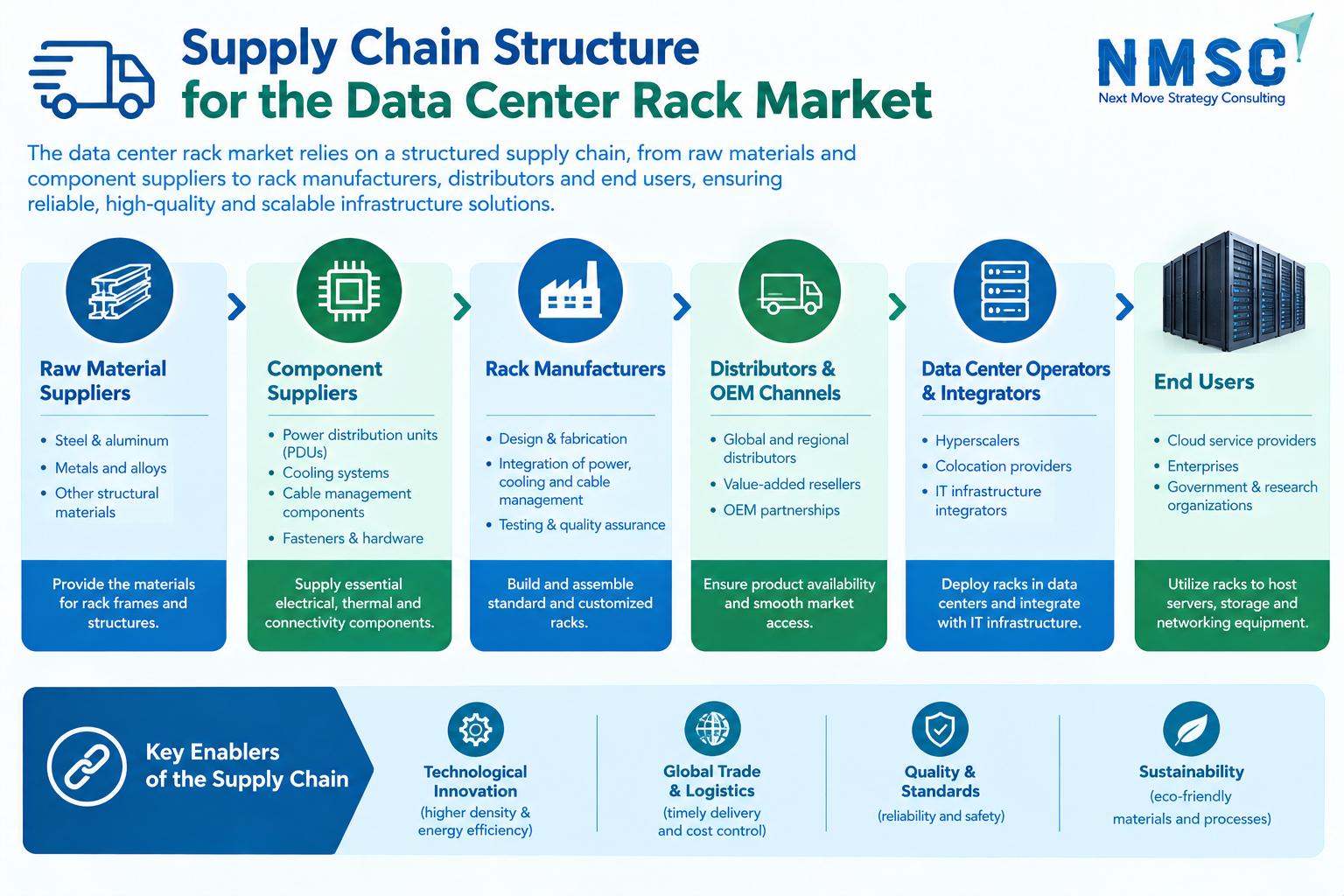
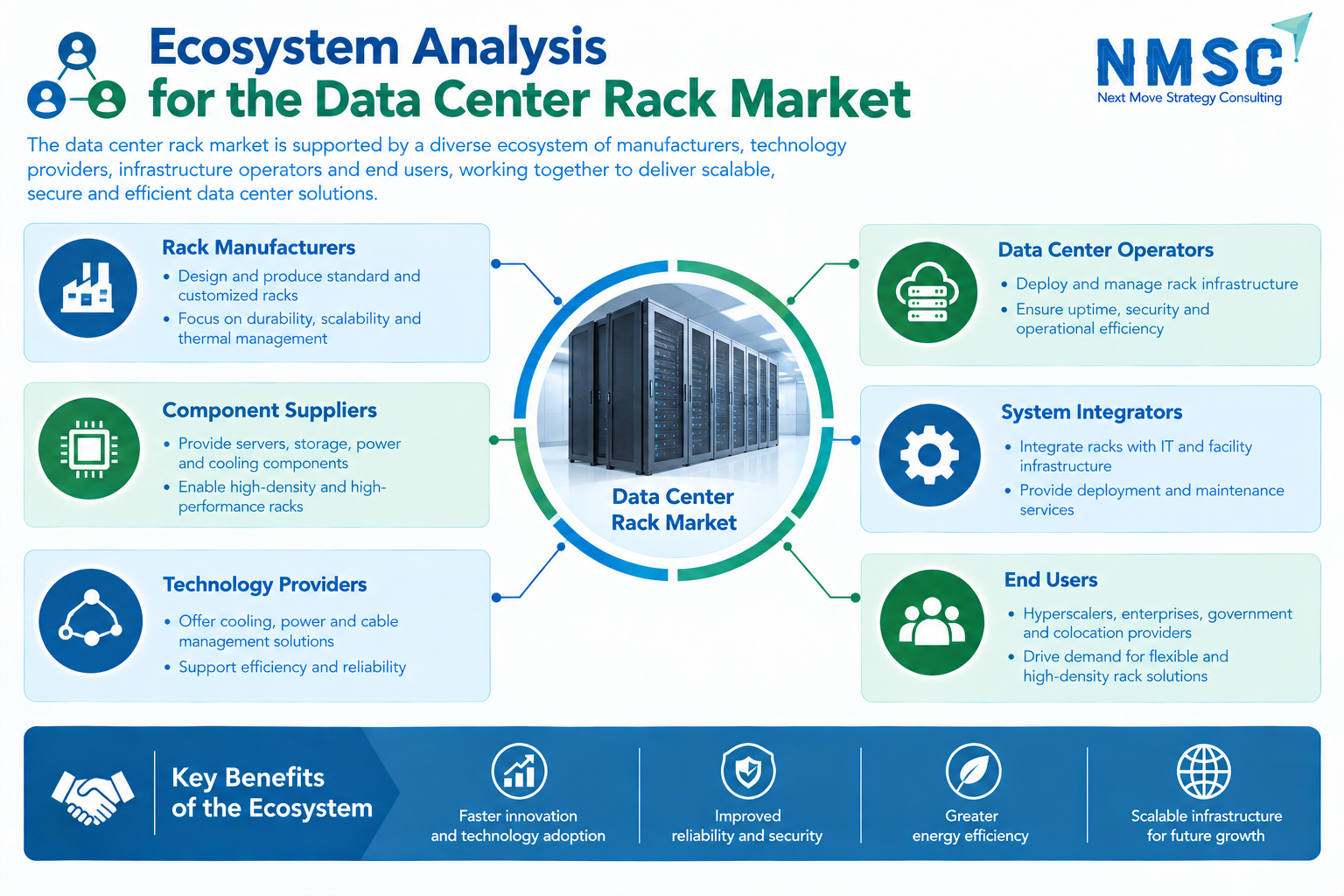
Ecosystem Analysis

Segmentation Analysis

2025 (USD Billion)
2035 (USD Billion)
Enclosed Server Racks 2025: $3.79 Billion | 2035: $13.87 Billion
Enclosed Ser
Open-Frame Racks 2025: $2.14 Billion | 2035: $8.10 Billion
Open-Frame R
Wall-Mount Racks 2025: $0.80 Billion | 2035: $2.85 Billion
Wall-Mount R
Blade Server Enclosures 2025: $0.43 Billion | 2035: $2.93 Billion
Blade Server
Enclosed Server Racks $3.79 Billion $13.87 Billion 13.80%
Open-Frame Racks $2.14 Billion $8.10 Billion 13.99%
Wall-Mount Racks $0.80 Billion $2.85 Billion 13.55%
Blade Server Enclosures $0.43 Billion $2.93 Billion 21.10%

Which Rack Type Dominates and Which Is Fastest Growing?

Enclosed Server Racks lead the rack type segment at USD 3.79 Billion in 2025, expanding to USD 13.87 Billion by 2035, reflecting the dominant preference of enterprise and colocation operators for fully enclosed systems that provide physical security, dust management, and integrated cable organization in multi-tenant and regulated facility environments. Blade Server Enclosures represent the fastest growing rack type at an exceptional 21.10% CAGR, driven by AI GPU cluster configurations where blade chassis maximize compute density per rack unit height and enable the liquid cooling manifold integration required for 80–100 kW per rack power configurations demanded by AI training workloads.

2025 (USD Billion)
2035 (USD Billion)
Hyperscale D
Cloud servic
AI training
Colocation D
Multi-tenant
Segment Item 2025 (USD Billion) 2035 (USD Billion) CAGR
Hyperscale Data Centers $10.0 USD Billion $40.0 USD Billion 26.0%
Cloud service provider facilities $17.1 USD Billion $51.1 USD Billion 16.0%
AI training and inference clusters $24.2 USD Billion $62.2 USD Billion 18.0%
Colocation Data Centers $31.3 USD Billion $73.3 USD Billion 8.0%
Multi-tenant colocation facilities $38.4 USD Billion $84.4 USD Billion 23.0%

Segment-wise data is locked

Unlock complete segment-wise numbers for By End User.

Unlock Full Data

Which End User Segment Leads and Which Is Fastest-Growing?

Hyperscale Data Centers lead the end-user segment at USD 2.87 Billion in 2025 and register the fastest CAGR of 16.34%, reflecting both the dominance and the disproportionate growth acceleration of the world's largest cloud and AI infrastructure operators as rack purchasers. The hyperscale segment's simultaneous position as the largest and fastest-growing end user category is unprecedented in the data center hardware market and reflects the structural concentration of AI infrastructure investment among a small number of operators that are each deploying rack volumes measured in the tens of thousands per quarter. Edge Data Centers follow at 14.76% CAGR, as low latency and distributed workload requirements scale independently of central facility growth.

2025 (USD Billion)
2035 (USD Billion)
42U Racks
Standard 42U
42U rack wit
48U and Abov
48U high-den
Segment Item 2025 (USD Billion) 2035 (USD Billion) CAGR
42U Racks $10.0 USD Billion $40.0 USD Billion 27.0%
Standard 42U server rack $17.1 USD Billion $51.1 USD Billion 17.0%
42U rack with integrated cable management $24.2 USD Billion $62.2 USD Billion 11.0%
48U and Above Racks $31.3 USD Billion $73.3 USD Billion 13.0%
48U high-density rack $38.4 USD Billion $84.4 USD Billion 26.0%

Segment-wise data is locked

Unlock complete segment-wise numbers for By Rack Height.

Unlock Full Data

Which Rack Height Segment Leads and Which Is Fastest Growing?

42U Racks dominate the rack height segment at USD 3.27 Billion in 2025, expanding to USD 12.10 Billion by 2035, reflecting the entrenched industry standard for general-purpose server, networking, and storage deployments across enterprise and colocation environments where physical floor-space efficiency and compatibility with standard server form factors are primary procurement criteria. The 48U and Above Racks segment is the fastest growing at a 17.65% CAGR, driven by hyperscale operators' requirement for maximum compute density per rack footprint in AI GPU cluster configurations, where the additional usable rack units enable higher server count per footprint and reduce total facility floor space cost per compute node.

2025 (USD Billion)
2035 (USD Billion)
North Americ
Canada
Mexico
Europe: UK
Germany
Segment Item 2025 (USD Billion) 2035 (USD Billion) CAGR
North America: U.S. $10.0 USD Billion $40.0 USD Billion 25.0%
Canada $17.1 USD Billion $51.1 USD Billion 19.0%
Mexico $24.2 USD Billion $62.2 USD Billion 17.0%
Europe: UK $31.3 USD Billion $73.3 USD Billion 15.0%
Germany $38.4 USD Billion $84.4 USD Billion 16.0%

Segment-wise data is locked

Unlock complete segment-wise numbers for By Region.

Unlock Full Data

Regional Outlook

2025 (USD Billion)
2035 (USD Billion)
North Americ
Asia-Pacific
Europe
Middle East
Latin Americ
Region 2025 (USD Billion) 2035 (USD Billion) CAGR (%)
North America $10.0 USD Billion $40.0 USD Billion 9.0%
Asia-Pacific $17.1 USD Billion $51.1 USD Billion 27.0%
Europe $24.2 USD Billion $62.2 USD Billion 25.0%
Middle East & Africa $31.3 USD Billion $73.3 USD Billion 23.0%
Latin America $38.4 USD Billion $84.4 USD Billion 12.0%

Regional data is locked

Unlock complete regional numbers for this market.

Unlock Full Data

About the Author

Mihul Sharma

Mihul Sharma

Mihul Sharma is Research Associate at Next Move Strategy Consulting, where he has covered technology, industrial, and healthcare markets for 3 years. His work applies structured business research, market analysis, and secondary-source review to assess market trends, competitive developments, and growth opportunities. He supports report development by fully synthesizing industry data, company information, and market signals into concise findings for strategy and investment-focused research teams.

About the Reviewer

Supradip Baul

Supradip Baul

Supradip Baul is an accomplished business consultant and strategist with over a decade of rich experience in market intelligence, strategy, technology, and business transformation. His work has included rigorous qualitative and quantitative analysis across multiple industries, helping clients shape investment decisions and long-term roadmaps. Earlier in his career, he was associated with Gartner, where he contributed to industry-leading reports and market share analyses. He has worked with leading global companies and holds an MBA with a dual specialization in Marketing and Finance.

Download Free Sample

Diana Trejo

DIANA TREJO

Assistant Manager

Sumitomo Corporation de Mexico, S.A. de C.V.

Recently, we purchased a report on the Mexico Data Center Market from Next Move Strategy Consulting. The service has been excellent, with support that is always timely and thoroughly professional. The information provided is interesting, highly useful, and delivered with clarity. I would highly recommend NextMSC for anyone seeking insightful and dependable analysis.

Kishu Kanda

KISHU KANDA

Strategy Analyst

Accenture

We purchased the AI Consumer Market Report from this company. Not only did they customize the report to meet our specific requirements, but they also showed great flexibility in accommodating our budget. The report we received fully met our expectations. Additionally, they provided prompt and thorough responses to both our pre-purchase and follow-up questions. We look forward to working with this company again in the future.

Gustaf Hummel Burstrom

GUSTAF HUMMEL BURSTROM

Founder

Revline Tools AB

Joseph and the team at Next Move Strategy Consulting have been excellent to work with, in supplying us with relevant market data and forecasts for our specific category. We had some special requirements and they were able to do a custom package to suit our needs. We would definitely recommend them to any other company needing market data and forecasts

Rishabh Jogani

RISHABH JOGANI

Strategy Analyst

Accenture Japan

We are incredibly impressed with the market report on the real estate market in India provided by Next Move Strategy Consulting. The report was thorough, insightful, and well-structured, offering deep analysis and actionable recommendations. It not only captured the current trends and dynamics but also provided a forward-looking perspective that has been invaluable for our strategic planning. Their team demonstrated exceptional professionalism, attention to detail, and a profound understanding of the industry. The data-driven insights and clarity of presentation exceeded our expectations, making complex market trends easy to understand. We highly recommend Next Move Strategy Consulting to anyone looking for reliable and comprehensive market research services. Their expertise has given us the confidence to navigate the complexities of the Indian real estate market with clarity and foresight.

Gaurav Jaiswal

GAURAV JAISWAL

Founder & CEO

Yano Charge Private Limited

The EV Charging market research report provided by the NextMSC was exceptionally detailed and insightful. It offered a comprehensive analysis that proved to be a game-changer for our strategic planning. Truly a testament to the NextMSC’s expertise and thoroughness in EV market landscape & analysis.

Custom Market Research Services

We will customize the research for you if the listed report does not fully match your requirements.

Get 30% Free Customization

Select License

This website uses cookies to ensure you get the best experience on our website. Learn more

✖