AI Public Sector Market Size, Share, Trends and Growth Analysis, By Solution Category (AI Software, AI Cloud Services, AI Professional Services, and AI Hardware), By Deployment Model (Cloud, Sovereign Cloud, Hybrid, On Premises, and Edge), By Mission Area, By AI Capability (Generative AI, Machine Learning, NLP and Conversational AI, Computer Vision, Agentic AI, and Others), By Buyer Type, and Region – Global Industry Report and Forecast, 2026–2035
Industry: ICT & Media | Publishing Date: July 14, 2026 | Last Updated: September 30, 2026 | No of Pages: N/A | No. of Tables: N/A | No. of Figures: N/A | Format: PDF | Report Code: IC5120
What Is the AI Public Sector Market Size?
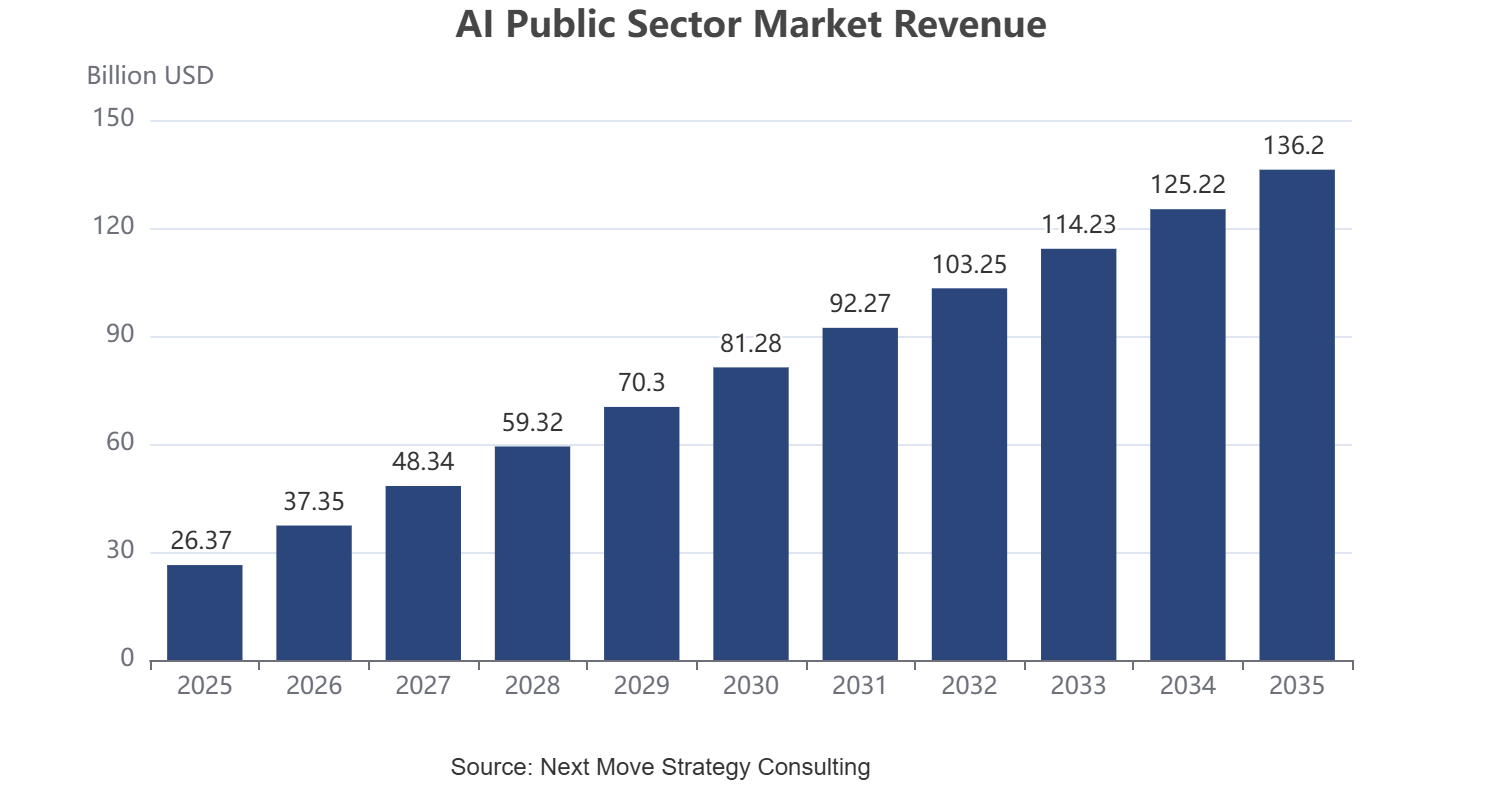
The global AI Public Sector Market size was valued at USD 26.37 Billion in 2025 and is estimated at USD 31.07 Billion in 2026, forecast to reach USD 136.2 Billion by 2035, expanding at a 17.8% CAGR between 2026 and 2035. North America leads with approximately 38% share, while under solution category, AI Professional Services dominate with approximately 34% share.
We observed that growth is broad-based across every segmentation axis, with generative and agentic AI adoption alongside sovereign cloud deployment driving the dominant structural shifts across civilian, defense, and state and local missions through 2035.
|
Key Takeaways |
|
By Solution Category: AI Professional Services held the largest share of approximately 34% (USD 8.97 Billion) in 2025; AI Cloud Services is the fastest-growing sub-segment at 21.0% CAGR from 2026–2035. |
|
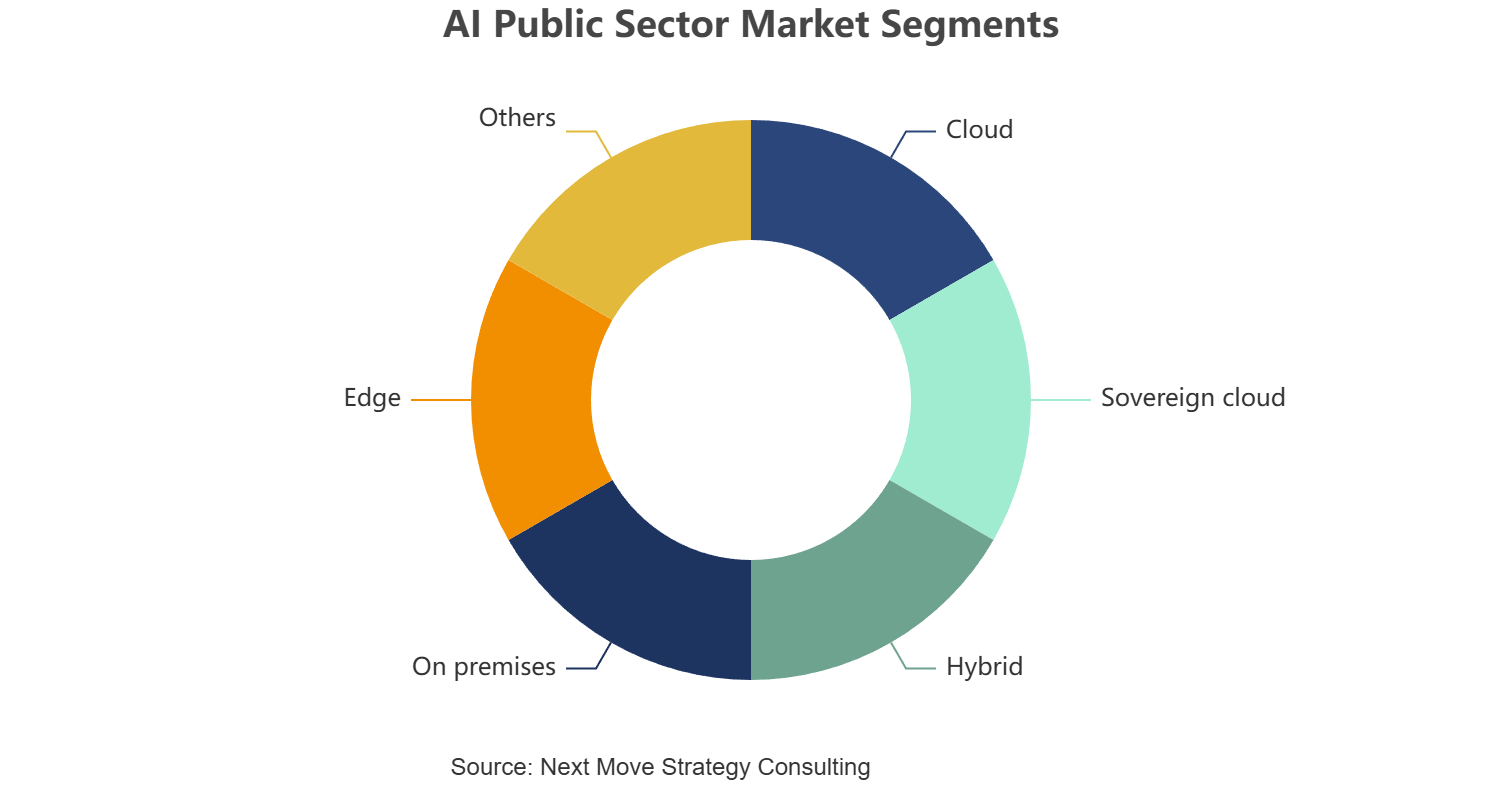
By Deployment Model: Cloud held the largest share of approximately 34% (USD 8.97 Billion) in 2025; Sovereign Cloud is the fastest-growing sub-segment at 23.9% CAGR from 2026–2035. |
|
By Mission Area: Defence and National Security held the largest share of approximately 16% (USD 4.22 Billion) in 2025; Fraud and Compliance is the fastest-growing sub-segment at 22.3% CAGR from 2026–2035. |
|
By AI Capability: Generative AI held the largest share of approximately 21% (USD 5.54 Billion) in 2025; Agentic AI is the fastest-growing sub-segment at 30.5% CAGR from 2026–2035. |
|
By Sales Channel: Direct held the largest share of approximately 28% (USD 7.38 Billion) in 2025; Marketplace is the fastest-growing sub-segment at 26.1% CAGR from 2026–2035. |
|
By Buyer Type: Civilian Government held the largest share of approximately 27% (USD 7.12 Billion) in 2025; Education and Research is the fastest-growing sub-segment at 20.3% CAGR from 2026–2035. |
|
Dominant Region: North America dominated with approximately 38% revenue share (USD 10.02 Billion) in 2025. |
|
Fastest-Growing Region: Asia-Pacific is expected to register the highest CAGR of 21.0% during 2026–2035. |
|
Dominant Country: U.S. led with approximately USD 7.12 Billion in 2025. |
|
Fastest-Growing Country: India is the fastest-growing country at approximately 25.2% CAGR from 2026–2035. |
Between 2026 and 2035, the AI Public Sector Market is set to generate an absolute dollar opportunity of USD 105.13 Billion, positioning agentic AI platforms and sovereign cloud infrastructure as a compelling area for capital allocation.
According to Next Move Strategy Consulting's analysis, sustained investment in agentic AI and sovereign cloud architectures is reshaping procurement criteria for government buyers, as compliance with federal AI governance frameworks increasingly determines vendor shortlisting across civilian, defense, and state and local agencies.
What Does the AI Public Sector Market Encompass?
The market encompasses software, cloud services, professional services, and hardware platforms that government agencies deploy to automate citizen services, case management, defense operations, and regulatory functions. Our assessment indicates that the scope spans generative AI, machine learning, predictive analytics, and agentic AI systems supplied to civilian government, defense and intelligence, state and local, and multilateral buyers across mission areas including public safety, health and social services, and tax and revenue. The category has evolved from pilot-stage chatbots into mission-critical, agentic decision-support systems, driven by workforce shortages and legacy IT modernization mandates.
Regulatory frameworks such as the U.S. Office of Management and Budget's Memoranda M-25-21 and M-25-22 on federal AI use and procurement, and the European Union's Artificial Intelligence Act requirements for high-risk systems used by public administration, shape agency AI governance and vendor compliance obligations. We observed that technology adoption is shifting toward agentic AI and sovereign, air-gapped model deployment that keep training data and model weights under government control. Next Move Strategy Consulting's analysis indicates that this structural shift, combined with expanding classified-environment partnerships between frontier AI developers and defense agencies, is redefining sourcing criteria across the AI Public Sector Market.
|
Parameter |
Details |
|
Market Size in 2025 |
USD 26.37 Billion |
|
Market Size in 2026 |
USD 31.07 Billion |
|
Revenue Forecast in 2035 |
USD 136.2 Billion |
|
Growth Rate |
CAGR of 17.8% from 2026 to 2035 |
|
Analysis Period |
2025–2035 |
|
Base Year Considered |
2025 |
|
Forecast Period |
2026–2035 |
|
Market Size Estimation |
Revenue (USD Billion) |
|
Companies Profiled |
20 |
|
Countries Covered |
37 |
|
Market Share |
Available for Top 10 Companies |
Key Emerging Trends
Based on research conducted by Next Move Strategy Consulting, we found that four structural trends are reshaping technology adoption, procurement, and stakeholder engagement across the AI Public Sector Market.
How Is Agentic AI Moving from Pilots to Operational Government Missions?
Agentic AI systems capable of adapting plans and coordinating resources autonomously are advancing from experimentation into operational government use. We observed that Booz Allen Hamilton executives highlighted 2026 as the year agentic systems demonstrate combat-relevant adaptability, reallocating resources and commanding autonomous assets in high-profile defense demonstrations. Civilian agencies are following a parallel path, with Copilot Agents automating citizen-facing transportation and case-management workflows, reducing manual handoffs and accelerating decision cycles across federal, state, and local government operations.
Why Is Sovereign AI Infrastructure Becoming a Government Procurement Priority?
Sovereign, air-gapped AI deployment is emerging as a procurement priority as agencies seek to retain full control over model weights and training data. Our findings suggest that Palantir Technologies' June 2026 partnership with Nvidia, pairing Nemotron open models with Palantir's Foundry and Ontology platforms, exemplifies this shift toward customer-owned, auditable AI engines for classified and critical-infrastructure environments. Government buyers increasingly favor architectures that support explicit data authorization and full auditability over closed, externally hosted model application programming interfaces.
How Are Frontier AI Developers Institutionalizing Partnerships With Government Contractors?
Frontier AI developers are deepening formal partnerships with established government contractors to accelerate mission deployment. We found that OpenAI's January 2026 collaboration with Leidos and its June 2026 partnership with Booz Allen Hamilton both pair frontier models with contractors' mission expertise and secure configurations, while the Pentagon's May 2026 agreement with seven technology firms extended classified-network access to leading AI developers. These arrangements are shortening the path from model release to accredited government deployment.
What Role Does AI Governance and Bias Testing Play in Public Sector Adoption?
Formal governance and bias-testing requirements are increasingly shaping which AI systems agencies may procure. Based on research conducted by Next Move Strategy Consulting, we found that the Office of Management and Budget's December 2025 memorandum on Unbiased AI Principles requires vendors to disclose bias-evaluation methodologies and model cards before contract award, while the Department of Commerce's Center for AI Standards and Innovation has completed more than 40 pre-deployment model evaluations. These requirements are becoming a qualification gate for public sector AI vendors.
Regulatory Framework Impacting The Ai Public Sector Market
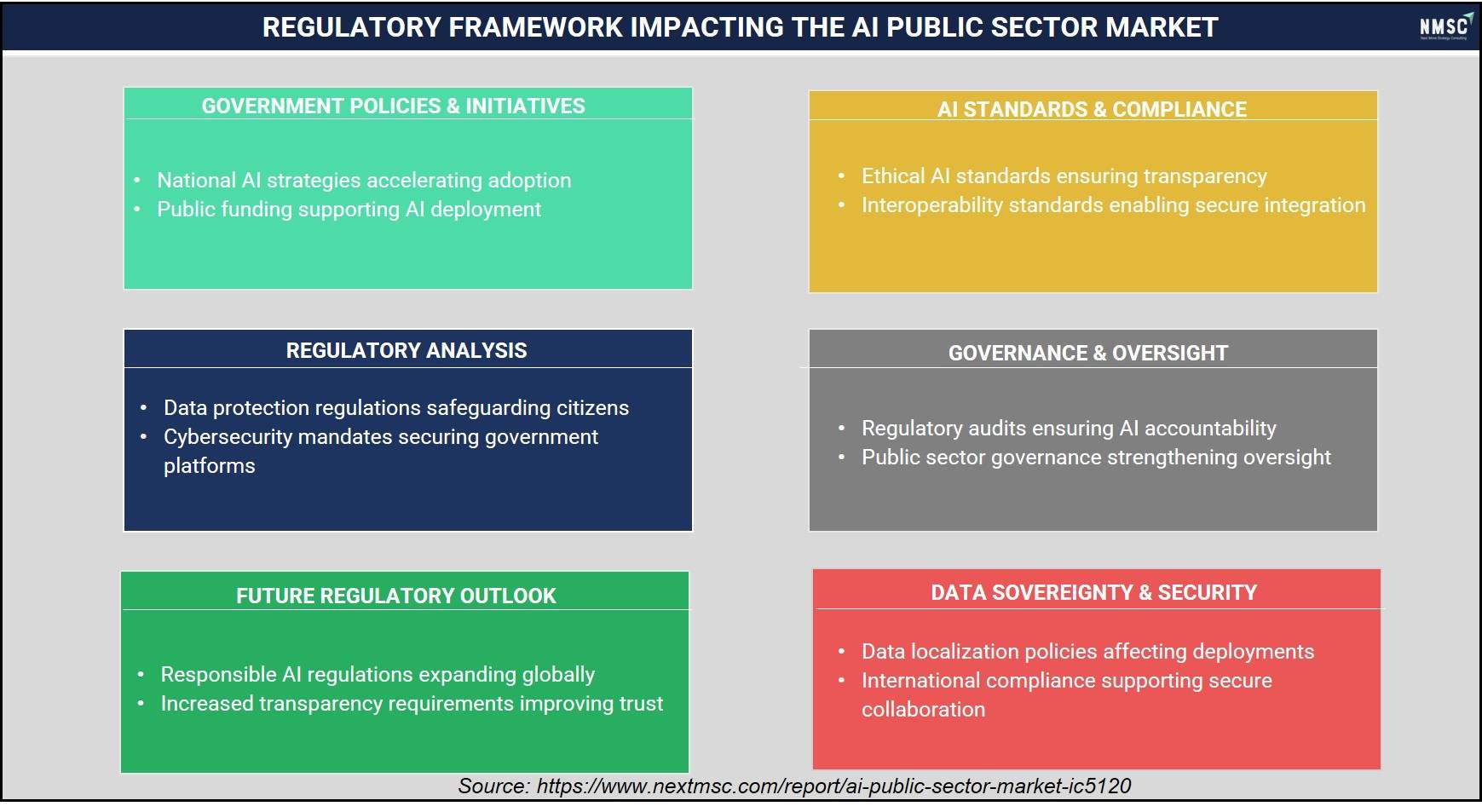
The infographic highlights the key regulatory pillars shaping the AI Public Sector Market. It emphasizes government AI strategies, funding initiatives, ethical AI standards, interoperability, data protection regulations, cybersecurity mandates, governance frameworks, and regulatory oversight. The visual also underscores the growing importance of responsible AI regulations, transparency requirements, data sovereignty, and secure cross-border compliance, all of which influence AI adoption, trust, and implementation across public sector organizations.
Growth Drivers and Restraints
Growth Catalyst and Risk Assessment Matrix
|
Factors |
Type |
(+/−) % Impact on CAGR |
Geographic Relevance |
Impact Timeline |
|
OMB M-25-21/M-25-22 accelerating federal AI use and procurement |
Driver |
+2.3% |
North America |
2026-2035 |
|
Pentagon classified-network AI agreements with frontier developers |
Driver |
+1.9% |
North America |
2026-2032 |
|
Rising defense and intelligence AI modernization budgets |
Driver |
+1.6% |
North America, Europe |
2026-2035 |
|
Sovereign cloud and data-residency mandates |
Driver |
+1.7% |
Global |
2026-2035 |
|
EU AI Act high-risk compliance driving structured procurement |
Driver |
+1.5% |
Europe |
2026-2035 |
|
Legacy IT modernization backlogs across civilian agencies |
Driver |
+1.4% |
Global |
2026-2035 |
|
Expansion of agentic AI into citizen service delivery |
Driver |
+1.2% |
Global |
2027-2035 |
|
FedRAMP and Authority-to-Operate accreditation delays |
Restraint |
-1.4% |
North America |
2026-2035 |
|
AI skills and talent shortage across public agencies |
Restraint |
-0.9% |
Global |
2026-2032 |
|
Budget constraints and continuing resolution cycles |
Restraint |
-0.7% |
North America |
2026-2030 |
What Is the Primary Growth Driver of the AI Public Sector Industry?
The Office of Management and Budget's April 2025 memoranda, M-25-21 and M-25-22, are the primary driver of market growth, directing covered agencies to designate Chief AI Officers, publish agency-wide AI strategies within 180 days, and apply minimum risk-management practices to high-impact AI use cases. The U.S. General Services Administration's OneGov initiative further accelerates procurement by unifying agency access to commercial AI platforms at negotiated pricing. We observed that this policy-driven mandate continues to anchor baseline government AI spending across civilian and defense missions alike.
How Is Sovereign AI Infrastructure Driving AI Public Sector Market Growth?
Sovereign and air-gapped AI infrastructure investment is accelerating AI Public Sector Market growth as agencies prioritize data residency and model ownership. Palantir Technologies' June 2026 partnership with Nvidia to deploy Nemotron open models within government-controlled sovereign environments illustrates how vendors are engineering explicit data authorization and full auditability into mission-critical systems. Our assessment indicates that this sovereignty-first architecture, combined with the European Union's Artificial Intelligence Act compliance timeline, is compressing adoption cycles for auditable, self-hosted AI models across defense and critical-infrastructure buyers.
What Is Restraining AI Public Sector Industry Expansion?
Accreditation delays tied to Federal Risk and Authorization Management Program authorization and Authority-to-Operate processes restrain the market expansion, extending vendor time-to-contract in security-sensitive environments. The Office of Management and Budget's guidance require agencies to complete risk-management reviews for high-impact AI use cases before deployment, a process that can span multiple review cycles. We found that smaller AI vendors face particular exposure, as limited compliance staff reduces their ability to navigate multi-agency accreditation compared with large, established government contractors.
Segmentation Analysis
Segment Sizing: By Solution Category
|
Segment |
2025 (USD) |
2035 (USD) |
CAGR% (2026–2035) |
|
AI Professional Services |
USD 8.97 Billion |
USD 39.50 Billion |
15.8% |
|
AI Software |
USD 7.91 Billion |
USD 39.50 Billion |
17.4% |
|
AI Cloud Services |
USD 6.86 Billion |
USD 44.95 Billion |
21.0% |
|
AI Hardware |
USD 2.64 Billion |
USD 12.26 Billion |
16.5% |
|
Total |
USD 26.37 Billion |
USD 136.2 Billion |
17.8% |
Which Solution Category Segment Dominates the AI Public Sector Industry?
AI Professional Services, encompassing advisory, integration, and operate-and-manage engagements, led the AI Public Sector Market with USD 8.97 Billion in 2025, supported by agencies' reliance on systems integrators to modernize legacy infrastructure and navigate complex procurement rules. We observed that AI Cloud Services is the fastest-growing solution category, expanding at a 21.0% CAGR from 2026 to 2035, as agencies shift workloads to managed machine learning platforms and sovereign cloud infrastructure to meet data-residency and scalability requirements.
Segment Sizing: By Mission Area
|
Segment |
2025 (USD) |
2035 (USD) |
CAGR% (2026–2035) |
|
Citizen Services |
USD 3.69 Billion |
USD 17.71 Billion |
16.9% |
|
Case Management |
USD 2.37 Billion |
USD 10.90 Billion |
16.3% |
|
Finance and Procurement |
USD 2.11 Billion |
USD 9.53 Billion |
16.1% |
|
Tax and Revenue |
USD 1.85 Billion |
USD 8.17 Billion |
15.8% |
|
Public Safety and Justice |
USD 3.43 Billion |
USD 16.34 Billion |
16.8% |
|
Defence and National Security |
USD 4.22 Billion |
USD 24.52 Billion |
19.4% |
|
Health and Social Services |
USD 2.90 Billion |
USD 16.34 Billion |
19.0% |
|
Transport and Infrastructure |
USD 2.11 Billion |
USD 12.26 Billion |
19.4% |
|
Policy and Planning |
USD 1.06 Billion |
USD 5.45 Billion |
17.8% |
|
Workforce and HR |
USD 1.06 Billion |
USD 4.09 Billion |
14.1% |
|
Fraud and Compliance |
USD 1.32 Billion |
USD 9.53 Billion |
22.3% |
|
Other |
USD 264 Million |
USD 1.36 Billion |
17.8% |
|
Total |
USD 26.37 Billion |
USD 136.2 Billion |
17.8% |
Which Mission Area Segment Leads AI Public Sector Market Demand?
Defence and National Security remained the leading mission area within the market, valued at USD 4.22 Billion in 2025 on sustained classified-environment AI deployment and battlefield-awareness applications. Our findings suggest that Fraud and Compliance is the fastest-growing mission area, registering a 22.3% CAGR from 2026 to 2035, as tax authorities and benefits agencies increasingly deploy predictive analytics and agentic AI to detect improper payments and reduce fraud losses across civilian government programs.
Segment Sizing: By AI Capability
|
Segment |
2025 (USD) |
2035 (USD) |
CAGR% (2026–2035) |
|
Generative AI |
USD 5.54 Billion |
USD 34.05 Billion |
20.2% |
|
Machine Learning |
USD 5.01 Billion |
USD 21.79 Billion |
15.6% |
|
Predictive Analytics |
USD 3.69 Billion |
USD 14.98 Billion |
14.7% |
|
NLP and Conversational AI |
USD 3.16 Billion |
USD 14.98 Billion |
16.7% |
|
Computer Vision |
USD 2.90 Billion |
USD 12.26 Billion |
15.2% |
|
Agentic AI |
USD 1.58 Billion |
USD 20.43 Billion |
30.5% |
|
RPA and Process Mining |
USD 2.64 Billion |
USD 8.17 Billion |
11.3% |
|
Optimization and Forecasting |
USD 1.32 Billion |
USD 6.81 Billion |
17.8% |
|
Other |
USD 527 Million |
USD 2.72 Billion |
17.8% |
|
Total |
USD 26.37 Billion |
USD 136.2 Billion |
17.8% |
Which AI Capability Is Most Widely Adopted in the Public Sector?
Generative AI remained the dominant capability across the AI Public Sector Market, reaching USD 5.54 Billion in 2025 as agencies expanded drafting, summarization, and citizen-correspondence copilot tools. Based on research conducted by Next Move Strategy Consulting, we found that Agentic AI is the fastest-growing capability, expanding at a 30.5% CAGR from 2026 to 2035, reflecting agencies' shift toward autonomous, multi-step workflow orchestration in defense, fraud detection, and case-management applications.
Growth Opportunities
Our analysis shows that three forward-looking opportunities stand out for stakeholders positioning within the AI Public Sector Market over the 2026-2035 forecast period.
How Are Agentic AI Platforms Creating Opportunities for Citizen Service Delivery?
Agentic AI platforms capable of autonomously resolving multi-step citizen requests present a whitespace opportunity for civilian government agencies modernizing benefits and permitting workflows. Vendors that commercialize accredited, audit-ready agentic case-management systems stand to capture recurring platform-licensing revenue as agencies shift from single-turn chatbots toward autonomous service completion, particularly within Citizen Services and Case Management mission areas seeking measurable reductions in processing backlogs.
Why Is Sovereign AI Infrastructure Emerging as a Growth Opportunity for Defense Buyers?
Sovereign, air-gapped AI infrastructure represents an underpenetrated opportunity for defense and intelligence buyers seeking full control over model weights in classified environments. Vendors that deliver customer-owned, auditable AI engines, following the Palantir-Nvidia Nemotron model, can secure long-term procurement relationships with Defence and Intelligence buyers, benefiting from recurring compute and platform-licensing revenue tied to classified-environment modernization programs.
How Are AI Governance and Compliance Platforms Unlocking Opportunities for State and Local Governments?
State and local governments facing EU AI Act-style and OMB bias-disclosure compliance obligations create an opportunity for vendors offering automated AI-governance and model-documentation platforms. Early movers that deliver turnkey bias-testing, model-card generation, and audit trails can differentiate with State and Local Government buyers pursuing responsible AI adoption commitments without the compliance staff scale available to federal agencies.
Ecosystem Analysis Of The Ai Public Sector Industry
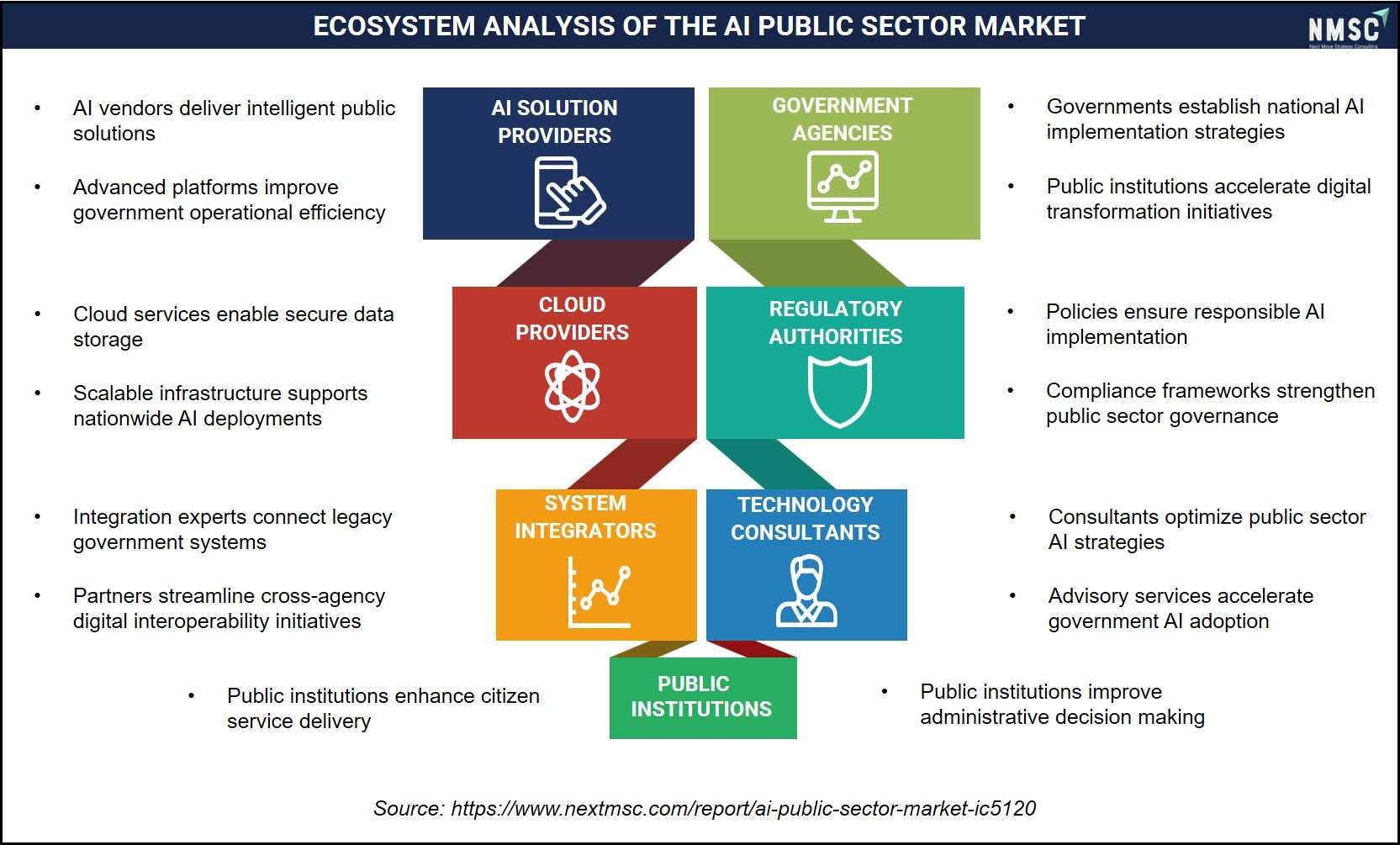
The infographic illustrates the ecosystem of the AI Public Sector Market, highlighting the collaboration among AI solution providers, government agencies, cloud providers, regulatory authorities, system integrators, technology consultants, and public institutions. These stakeholders collectively drive AI adoption, ensure regulatory compliance, enable secure digital infrastructure, and support the development and deployment of AI-powered public services to improve government efficiency and citizen outcomes.
Regional Outlook
Geographic Performance Snapshot
|
Region |
2025 (USD) |
2035 (USD) |
CAGR% (2026–2035) |
Key Driver |
|
North America |
USD 10.02 Billion |
USD 46.31 Billion |
16.4% |
OMB AI procurement mandates and Pentagon classified-network AI adoption |
|
Europe |
USD 6.86 Billion |
USD 34.05 Billion |
17.3% |
EU AI Act compliance and sovereign cloud mandates |
|
Asia-Pacific |
USD 5.80 Billion |
USD 38.14 Billion |
21.0% |
Expanding digital-government programs and AI infrastructure investment |
|
Middle East & Africa |
USD 2.37 Billion |
USD 10.90 Billion |
16.3% |
Vision 2030-linked diversification and smart-government initiatives |
|
Latin America |
USD 1.32 Billion |
USD 6.81 Billion |
17.8% |
Digital-government modernization and expanding e-governance platforms |
|
Total |
USD 26.37 Billion |
USD 136.2 Billion |
17.8% |
– |
North America AI Public Sector Market
North America leads the market with an established base of federal AI governance frameworks and mature systems-integrator relationships. We observed that OMB Memoranda M-25-21 and M-25-22 sustain demand for compliant AI procurement, while the Pentagon's classified-network agreements with seven leading AI developers accelerate defense adoption. Technology adoption remains advanced, with agentic AI and sovereign cloud architectures gaining traction across civilian, defense, and state and local agencies pursuing measurable efficiency gains.
Europe AI Public Sector Market
Europe's AI Public Sector Market reflects a mature but regulation-intensive landscape shaped by the European Union's Artificial Intelligence Act and its high-risk system requirements for public administration. Our findings suggest that agencies across the UK, Germany, and France are accelerating adoption of sovereign cloud and auditable AI systems to satisfy conformity-assessment and fundamental-rights obligations. Technology adoption favors governance-integrated platforms, supported by the European Data Protection Supervisor's expanding oversight role for AI used by EU institutions.
Asia-Pacific AI Public Sector Market
Asia-Pacific is the fastest-growing market region, propelled by expanding digital-government programs in China and India and rising defense-modernization spending. We found that regulatory frameworks remain less harmonized than in Europe, giving agencies flexibility to scale generative and predictive AI deployment rapidly. Technology adoption is accelerating as regional systems integrators, including several China-based and India-based vendors, expand capacity to serve civilian and defense buyers across the region.
Middle East & Africa AI Public Sector Market
The Middle East & Africa AI Public Sector Market is expanding as Gulf Cooperation Council governments pursue economic diversification and large-scale smart-government programs. Our analysis shows that Saudi Arabia and the UAE are attracting significant AI infrastructure investment tied to national digital-transformation strategies. Regulatory influence remains moderate relative to Europe, while technology adoption is shifting toward cloud-based citizen-service platforms as regional governments align with global AI governance expectations.
Latin America AI Public Sector Market
Latin America's AI Public Sector Market is supported by growing digital-government investment in Brazil and Argentina and expanding e-governance infrastructure. We observed that regulatory frameworks are less stringent than in North America or Europe, though national governments are introducing AI-governance guidelines aligned with international norms. Technology adoption remains centered on citizen-service automation and predictive analytics, with competitive intensity increasing as global systems integrators expand regional delivery capacity.
U.S. AI Public Sector Market
Based on our engagements, the U.S. AI Public Sector Market was valued at approximately USD 7.12 Billion in 2025 and is projected to reach USD 31.49 Billion by 2035, growing at a 15.8% CAGR. Demand is anchored by OMB-mandated Chief AI Officer programs, GSA OneGov procurement, and Pentagon classified-network AI adoption. Technology penetration favors agentic and generative AI, and competitive intensity remains high among systems integrators and frontier AI developers serving federal civilian and defense agencies.
Canada AI Public Sector Market
Through our analysis, Canada's AI Public Sector Market reached roughly USD 1.50 Billion in 2025 and is forecast to hit USD 7.41 Billion by 2035 at a 17.2% CAGR. Demand structure mirrors U.S. federal modernization patterns, while national privacy and AI-governance guidance shapes procurement of citizen-facing systems. Technology penetration is rising as provincial and federal agencies adopt predictive analytics and generative AI, with competitive intensity moderate given reliance on cross-border systems integrators.
UK AI Public Sector Market
From our assessment, the UK market stood at about USD 1.51 Billion in 2025, advancing toward USD 7.15 Billion by 2035 at a 16.7% CAGR. Demand is driven by central government digital-transformation programs navigating data-residency requirements alongside the broader European Union Artificial Intelligence Act framework. Regulatory influence is significant, technology penetration favors sovereign cloud adoption, and competitive intensity remains steady among domestic and global systems integrators serving UK public bodies.
Germany AI Public Sector Market
According to evaluation, Germany's market was valued near USD 1.30 Billion in 2025 and is set to reach USD 6.13 Billion by 2035, expanding at a 16.6% CAGR. Demand structure benefits from a strong federal digital-administration modernization agenda. Germany's implementation of the EU Artificial Intelligence Act's high-risk system requirements drives regulatory influence, while technology penetration favors auditable, governance-integrated AI platforms among leading systems integrators serving federal ministries and state governments.
France AI Public Sector Market
Based on our engagements, France's market reached approximately USD 1.03 Billion in 2025, projected to climb to USD 5.11 Billion by 2035 at a 17.3% CAGR. Demand is supported by France's centralized digital-government agenda, which shapes citizen-service and case-management AI adoption. Regulatory influence from the EU Artificial Intelligence Act is notable, and competitive intensity remains high given the concentration of domestic systems integrators and consulting firms headquartered in Paris.
China AI Public Sector Market
Through our analysis, China's AI Public Sector Market stood at roughly USD 1.74 Billion in 2025 and is forecast to reach USD 12.20 Billion by 2035, registering a 21.9% CAGR. Demand is fueled by large-scale smart-government and digital-infrastructure programs across provincial administrations. Regulatory influence is increasing gradually, technology penetration is accelerating through domestic AI platform development, and competitive intensity remains elevated among numerous China-based technology suppliers.
India AI Public Sector Market
From our assessment, India's AI Public Sector Market was valued at about USD 0.81 Billion in 2025, projected to reach USD 7.25 Billion by 2035 at a 25.2% CAGR, the fastest among covered countries. Demand structure is driven by large-scale digital-identity and e-governance platforms spanning citizen services, tax administration, and public safety. Technology penetration is accelerating as domestic and global systems integrators expand delivery capacity, and competitive intensity remains high amid rapid platform modernization.
Japan AI Public Sector Market
According to evaluation, Japan's market was valued near USD 1.04 Billion in 2025 and is projected to reach USD 5.34 Billion by 2035, advancing at a 17.7% CAGR. Demand is supported by national digital-government modernization programs addressing workforce shortages through automation. Regulatory influence remains moderate, technology penetration favors predictive analytics and generative AI, and competitive intensity is steady among domestic systems integrators serving central ministries and local governments.
South Korea AI Public Sector Market
Based on our engagements, South Korea's market reached approximately USD 0.58 Billion in 2025, projected to reach USD 3.43 Billion by 2035 at a 19.6% CAGR. Demand structure is supported by an advanced digital-government infrastructure and strong public investment in AI research. Regulatory influence is moderate, technology penetration favors computer vision and predictive analytics for public safety applications, and competitive intensity remains steady among domestic technology suppliers and global cloud providers.
Australia AI Public Sector Market
Through our analysis, Australia's AI Public Sector Market was valued at approximately USD 0.52 Billion in 2025, projected to reach USD 3.05 Billion by 2035 at a 19.5% CAGR. Demand is anchored by federal and state digital-service modernization initiatives spanning citizen services and public safety. Regulatory influence is moderate, technology penetration is rising for generative and predictive AI, and competitive intensity remains steady among domestic systems integrators and global cloud and software vendors.
UAE AI Public Sector Market
From our assessment, the UAE's AI Public Sector Market was valued at roughly USD 0.55 Billion in 2025 and is projected to reach USD 2.62 Billion by 2035 at a 16.9% CAGR. Demand structure is driven by national AI strategy programs and smart-government initiatives across federal and emirate-level entities. Regulatory influence remains moderate, technology penetration favors cloud-based citizen-service platforms, and competitive intensity is rising as global systems integrators expand regional delivery capacity.
Saudi Arabia AI Public Sector Market
According to evaluation, Saudi Arabia's market stood at about USD 0.62 Billion in 2025, projected to reach USD 2.94 Billion by 2035 at a 16.8% CAGR. Demand is fueled by Vision 2030-linked digital-transformation programs spanning citizen services, health, and public safety. Regulatory influence is moderate and evolving, technology penetration is accelerating through large-scale government cloud modernization, and competitive intensity remains elevated among global systems integrators pursuing Kingdom-wide digital-government contracts.
South Africa AI Public Sector Market
Based on our engagements, South Africa's AI Public Sector Market was valued near USD 0.26 Billion in 2025, projected to reach USD 1.09 Billion by 2035 at a 15.1% CAGR. Demand structure is supported by gradual digital-government modernization across national and provincial administrations. Regulatory influence remains limited, technology penetration is modest and concentrated in citizen-service automation, and competitive intensity is centered on a small number of regional systems integrators serving public sector clients.
Brazil AI Public Sector Market
Through our analysis, Brazil's AI Public Sector Market was valued at approximately USD 0.62 Billion in 2025, projected to reach USD 3.13 Billion by 2035 at a 17.6% CAGR. Demand is supported by federal digital-government platforms spanning tax administration and social services. Regulatory influence is increasing as national AI-governance guidelines take shape, technology penetration favors predictive analytics and generative AI, and competitive intensity remains moderate among domestic and global systems integrators.
Argentina AI Public Sector Market
From our assessment, Argentina's AI Public Sector Market was valued near USD 0.19 Billion in 2025, projected to reach USD 1.02 Billion by 2035 at an 18.7% CAGR. Demand structure is supported by steady digital-government modernization despite macroeconomic volatility. Regulatory influence remains limited, technology penetration is modest, and competitive intensity is centered on a small number of regional systems integrators serving national and municipal government clients.
Competitive Landscape
Our analysis shows that the AI Public Sector Market remains moderately consolidated, with large systems integrators and hyperscale cloud providers competing alongside specialized AI software vendors for prime government contracts.
|
Dimension |
Description |
|
Market Structure |
Moderately consolidated, with prime contractors and hyperscale cloud providers holding leading positions across large federal and defense programs. |
|
Innovation Focus |
Agentic AI orchestration, sovereign cloud deployment, and classified-environment model integration. |
|
M&A Activity |
Rising strategic partnership activity as systems integrators embed frontier AI models to expand mission-specific agentic AI capabilities. |
How Do Companies Compete in the AI Public Sector Market?
Companies compete primarily on security accreditation, mission-domain expertise, and the ability to navigate complex federal and multilateral procurement rules rather than on price alone. We observed that prime contractors such as Leidos Holdings and Booz Allen Hamilton leverage established cleared-personnel relationships and existing contract vehicles, while hyperscale cloud providers compete on platform scale and pre-authorized government cloud infrastructure. Competitive positioning increasingly depends on demonstrated agentic AI deployment and sovereign cloud readiness.
Which Competitive Archetypes Dominate the AI Public Sector Market?
Three archetypes dominate the AI Public Sector Market: hyperscale cloud and software platforms, including Microsoft Corporation, Amazon Web Services, and Google LLC; mission-focused systems integrators, including Booz Allen Hamilton, Leidos Holdings, and CACI International; and defense-technology primes, including Lockheed Martin, RTX, and Northrop Grumman, that embed AI into command and weapons systems. Each archetype differentiates through platform breadth, mission-specific integration depth, or cleared-workforce scale respectively.
How Are Companies Differentiating Through Innovation in the AI Public Sector Market?
Vendors differentiate through proprietary agentic AI orchestration layers, sovereign and air-gapped deployment options, and formal partnerships with frontier AI developers. Our findings suggest that Palantir Technologies' Nvidia-powered sovereign AI engine and Booz Allen Hamilton's agentic cyber product suite, launched at the 2026 RSA Conference, exemplify how companies embed proprietary orchestration and governance tooling atop third-party foundation models to win accreditation-sensitive government contracts.
What M&A and Partnership Activity Is Shaping the AI Public Sector Market?
Consolidation activity is concentrated on integrating AI-native capabilities into established government systems integrators, often through strategic partnership rather than outright acquisition. We found that Leidos Holdings' January 2026 partnership with OpenAI and Booz Allen Hamilton's June 2026 collaboration with OpenAI reflect a broader pattern of contractors embedding frontier models through partnership, preserving flexibility while accelerating time-to-accreditation for new agentic AI capabilities.
Key Market Players
Based on research conducted by Next Move Strategy Consulting, the following companies represent the validated competitive set shaping the AI Public Sector Market.
-
Microsoft Corporation
-
Amazon Web Services, Inc.
-
Oracle Corporation
-
Palantir Technologies Inc.
-
Accenture plc
-
Booz Allen Hamilton Holding Corporation
-
Leidos Holdings, Inc.
-
RTX Corporation
-
Lockheed Martin Corporation
-
Northrop Grumman Corporation
-
General Dynamics Corporation
-
CGI Inc.
-
SAP SE
-
Capgemini SE
-
Tata Consultancy Services Limited
-
Science Applications International Corporation
-
CACI International Inc.
-
L3Harris Technologies, Inc.
Latest Developments
We observed that vendor activity across the AI Public Sector Market has accelerated through 2025 and 2026, spanning frontier-model partnerships, sovereign infrastructure launches, and federal governance memoranda.
|
Date |
Event |
|
June 2025 |
Palantir and Accenture Federal Services announced a strategic partnership to help U.S. federal agencies reinvent operations using AI. The partnership combines Palantir's AI Platform (AIP) with Accenture's federal consulting expertise to accelerate AI deployment across government agencies. |
|
January 2025 |
AWS and Booz Allen expanded their strategic partnership to accelerate generative AI, cloud modernization, cybersecurity, and mission solutions for U.S. federal, defense, and intelligence agencies. The collaboration includes reusable AI capabilities for government customers. |
|
October 2024 |
Accenture Federal Services launched the Federal AI Solution Factory with Google Public Sector to rapidly prototype, test, and deploy generative AI solutions for U.S. federal agencies, accelerating secure government AI innovation. |
Expert Insights

"The ability to use optimal large language models to synthesize, analyze, and contextualize data in a responsible and ethical way offers boundless opportunities for the federal government to jumpstart new capabilities and transform their operations. We look forward to helping clients rapidly prototype, build, automate, and scale AI to speed content discovery and summarization, modernize interactive call center chat, and ultimately deliver more intuitive and seamless end user experiences."
— John Goodman, Chief Executive Officer, Accenture Federal Services
The statement was made during the announcement of the Accenture Federal Services and Google Public Sector Data & AI Center of Excellence, which aims to accelerate the adoption of generative AI and advanced data capabilities across U.S. federal agencies through secure, responsible, and scalable AI solutions.
Market Interpretation
This statement reflects the accelerating adoption of generative AI across government agencies to modernize public services and improve operational efficiency. The emphasis on responsible AI, large language models, workflow automation, and enhanced citizen engagement indicates that governments are moving from pilot projects to enterprise-scale AI implementation. As public institutions continue investing in AI-powered digital transformation, demand is expected to grow for secure AI platforms, cloud infrastructure, intelligent automation, and AI-driven citizen service solutions, supporting the expansion of the AI Public Sector Market.
Investment Opportunities
How Are Capital Inflows Shaping the AI Public Sector Market?
Capital inflows into the AI Public Sector Market are increasingly channeled through strategic partnerships between frontier AI developers and established government contractors rather than traditional venture financing. We observed that OpenAI's 2026 partnerships with Leidos Holdings and Booz Allen Hamilton exemplify this capital-light model, where contractors commit delivery infrastructure and cleared personnel while AI developers commit model access. This structure allows capital to flow toward accreditation and integration rather than pure research and development.
What Infrastructure Investment Is Underway to Support Government AI Adoption?
Infrastructure investment is concentrated on sovereign, air-gapped compute environments that satisfy classified and data-residency requirements. Our findings suggest that Palantir Technologies' June 2026 partnership with Nvidia to deploy Nemotron open models within customer-owned environments illustrates rising capital commitment toward government-controlled AI infrastructure. The Pentagon's parallel agreement extending classified-network access to seven leading technology firms further signals substantial infrastructure investment directed at defense and intelligence computing environments through 2035.
What ESG Considerations Are Relevant to AI Public Sector Investment?
Environmental, social, and governance considerations increasingly influence AI Public Sector Market investment decisions, particularly around energy-efficient data center design and workforce equity in AI deployment. We observed that the Office of Management and Budget's Unbiased AI Principles under Memorandum M-26-04 formalize governance expectations around bias disclosure and model transparency for federally procured AI. Investors are also monitoring compute-related energy demand as agencies scale generative and agentic AI workloads across sovereign cloud environments.
Key Benefits for Stakeholders
How Does This Report Benefit Government Program and Agency Leaders?
Government program and agency leaders gain access to segmented spending forecasts across solution category, mission area, and deployment model, enabling more accurate budget planning and vendor evaluation. Our analysis shows that benchmarking data on regional and country-level AI adoption helps agency leaders compare their AI maturity against peer governments and prioritize investment in high-growth capabilities such as generative and agentic AI within citizen services and defense missions.
How Does This Report Benefit Investors and Financial Analysts?
Investors and financial analysts gain a reconciled, segment-level revenue base and forecast that supports valuation and competitive benchmarking of companies serving the AI Public Sector Market. We found that detailed company profiles, regional growth-rate breakdowns, and partnership tracking help analysts identify vendors positioned to capture the fastest-growing segments, including agentic AI and sovereign cloud infrastructure, ahead of broader market recognition.
How Does This Report Benefit Technology Vendors and Product Teams?
Technology vendors and product teams gain visibility into which mission areas, deployment models, and buyer types are expanding fastest, informing product roadmaps and go-to-market prioritization. Based on research conducted by Next Move Strategy Consulting, we found that granular segmentation across AI capability and sales channel helps product teams align roadmap investment with agencies' compliance requirements and procurement pathways, shortening the path from product launch to accredited government deployment.
Key Market Segments
By Solution Category
-
AI Software
-
Platforms and development tools
-
AI applications
-
Data and content
-
Governance and safety
-
Other
-
-
AI Cloud Services
-
Model API
-
Managed ML platform
-
AI infrastructure
-
Application SaaS
-
Other
-
-
AI Professional Services
-
Advisory and strategy
-
Build and integrate
-
Operate and manage
-
Training and change management
-
Others
-
-
AI Hardware
-
Accelerators
-
Servers and systems
-
Storage and networking
-
Edge devices
-
Embedded systems
-
Others
-
By Deployment Model
-
Cloud
-
Sovereign cloud
-
Hybrid
-
On premises
-
Edge
-
Others
By Mission Area
-
Citizen services
-
Case management
-
Finance and procurement
-
Tax and revenue
-
Public safety and justice
-
Defence and national security
-
Health and social services
-
Transport and infrastructure
-
Policy and planning
-
Workforce and HR
-
Fraud and compliance
-
Other
By AI Capability
-
Generative AI
-
Machine learning
-
Predictive analytics
-
NLP and conversational AI
-
Computer vision
-
Agentic AI
-
RPA and process mining
-
Optimization and forecasting
-
Other
By Sales Channel
-
Direct
-
Prime contractor
-
Systems integrator
-
Partner
-
Marketplace
-
OEM embedded
-
Other
By Buyer Type
-
Civilian government
-
Defence and intelligence
-
State and local government
-
Public safety and justice
-
Health and human services
-
Education and research
-
Multilateral and supranational
-
Other public bodies
By Region
-
North America: U.S., Canada, Mexico
-
Europe: UK, Germany, France, Italy, Spain, Sweden, Denmark, Finland, Netherlands, Rest of Europe
-
Asia-Pacific: China, India, Japan, South Korea, Taiwan, Indonesia, Vietnam, Australia, Philippines, Malaysia
-
Middle East & Africa: Saudi Arabia, UAE, Egypt, Israel, Turkey, Nigeria, South Africa, Rest of MEA
-
Latin America: Brazil, Argentina, Chile, Colombia, Rest of LATAM
Conclusion and Recommendations
What Is the Long-Term Outlook for the AI Public Sector Market?
The long-term outlook for the AI Public Sector Market remains robust, with revenue expected to expand from USD 31.07 Billion in 2026 to USD 136.2 Billion by 2035 at a 17.8% CAGR. We observed that sustained policy support from OMB governance memoranda, expanding defense-sector AI agreements, and accelerating agentic AI adoption underpin this trajectory. North America and Asia-Pacific are expected to anchor absolute growth, while sovereign cloud and generative AI capabilities continue gaining structural share through 2035.
What Strategic Positioning Should Vendors Pursue in the AI Public Sector Market?
Vendors should prioritize accreditation-ready, sovereign-capable AI architectures and formal partnerships with frontier AI developers to secure durable positioning within the AI Public Sector Market. Our assessment indicates that companies combining cleared-workforce delivery capacity with proprietary agentic orchestration layers, following the Palantir-Nvidia and Booz Allen-OpenAI partnership models, are best positioned to capture share across defense, civilian, and state and local missions.
How Attractive Is the AI Public Sector Market for Investment?
The AI Public Sector Market presents an attractive investment profile, supported by an absolute dollar opportunity of USD 105.13 Billion between 2026 and 2035 and a diversified base of mission areas, deployment models, and buyer types. We found that Agentic AI and Sovereign Cloud sub-segments, growing at 30.5% and 23.9% CAGR respectively, offer compelling risk-adjusted growth profiles for investors seeking exposure to structural government AI modernization.
What Market Shifts and Key Risks Should Stakeholders Monitor?
Stakeholders should monitor the shift from single-turn generative AI tools toward autonomous, agentic decision systems, which is redefining vendor qualification criteria across the AI Public Sector Market. Key risks include FedRAMP and Authority-to-Operate accreditation delays, continuing-resolution budget cycles, and evolving compliance obligations under the EU AI Act and OMB bias-disclosure requirements, each of which could slow deployment timelines for vendors lacking dedicated compliance capacity.
What Are the Key Growth Pathways for the AI Public Sector Market?
Key growth pathways include expanding agentic AI into citizen services and fraud detection, scaling sovereign cloud infrastructure for defense and intelligence buyers, and packaging AI-governance compliance tooling for state and local governments. Next Move Strategy Consulting's analysis indicates that vendors executing across these three pathways simultaneously, rather than a single mission area, are best positioned to sustain share gains through the 2035 forecast horizon.
About the Author
 Liza Phukan
— Liza Phukan is Research Associate at Next Move Strategy Consulting, where she has covered emerging industries and market research across sectors for 3.5 years. Her work includes analyzing industry developments, validating market data, and developing structured business content from research findings. She uses secondary research and data-validation practices to turn complex market information into clear decision-useful market analysis for business audiences and support report development and B2B.
Liza Phukan
— Liza Phukan is Research Associate at Next Move Strategy Consulting, where she has covered emerging industries and market research across sectors for 3.5 years. Her work includes analyzing industry developments, validating market data, and developing structured business content from research findings. She uses secondary research and data-validation practices to turn complex market information into clear decision-useful market analysis for business audiences and support report development and B2B.
About the Reviewer
 Supradip Baul
— Supradip Baul is an accomplished business consultant and strategist with over a decade of rich experience in market intelligence, strategy, technology, and business transformation. His work has included rigorous qualitative and quantitative analysis across multiple industries, helping clients shape investment decisions and long-term roadmaps. Earlier in his career, he was associated with Gartner, where he contributed to industry-leading reports and market share analyses. He has worked with leading global companies and holds an MBA with a dual specialization in Marketing and Finance.
Supradip Baul
— Supradip Baul is an accomplished business consultant and strategist with over a decade of rich experience in market intelligence, strategy, technology, and business transformation. His work has included rigorous qualitative and quantitative analysis across multiple industries, helping clients shape investment decisions and long-term roadmaps. Earlier in his career, he was associated with Gartner, where he contributed to industry-leading reports and market share analyses. He has worked with leading global companies and holds an MBA with a dual specialization in Marketing and Finance.
At Next Move Strategy Consulting, we understand that insightful market research is the cornerstone of successful business decisions. That's why we employ a robust and multifaceted approach, combining various methodologies to deliver the most accurate and actionable data for our clients.

Research Landscape
We navigate the world of research with two primary approaches:
Qualitative Approach
Our qualitative research methodologies involve immersive techniques such as in-depth interviews, focus groups, and observational studies. By engaging directly with individuals and stakeholders, we uncover valuable insights that quantitative data alone may overlook.

Quantitative Research
In tandem with qualitative methodologies, NMSC leverages the power of Quantitative Research to provide a robust foundation of numerical insights. Through systematic data collection and analysis, we quantify patterns, preferences, and market trends, offering a comprehensive view of the business landscape.
Our quantitative research approach employs diverse tools, including surveys, experiments, and statistical modelling. These methodologies enable us to gather data from a large and representative sample, ensuring the statistical significance of our findings. By employing structured questionnaires and standardized data collection methods, we guarantee the reliability and validity of the information we present to our clients.
Quantitative research is particularly effective in measuring the prevalence of trends, assessing market size, and gauging the impact of various factors on consumer behavior. The numerical precision attained through this approach equips our clients with actionable insights, facilitating data-driven decision-making and strategy formulation.


Our Specialized Toolbox for Industry-Specific Market Research
We deploy a specialized arsenal of techniques tailored to meet your unique requirements. Here's a glimpse into our comprehensive toolbox:

Information Procurement
The stage entails acquiring market data or relevant information through various sources and methodologies.


Market Research Approach
We utilize both top-down and bottom-up approaches in market research analysis to achieve a comprehensive understanding of the market dynamics, leveraging the broad perspective of industry trends and macroeconomic factors alongside detailed insights from specific segments and individual companies.

Porters Five Forces Analysis
We conduct Porter's Five Forces analysis to evaluate the competitive landscape of an industry, providing us with insights into factors that affect profitability and strategic positioning.

SWOT Analysis

Forecasting
We utilize a forecasting model to predict future consumption by considering parameters like population, economics, regulations, market competition, drivers, constraints, technology, and pricing. We also employ statistical techniques such as multilinear regression, exponential smoothing, moving average, ARIMA, and Monte Carlo simulations for accurate predictions. In econometric forecasting, we analyzed short-term and long-term event impacts, attributing values based on regulatory frameworks, economic factors, and market events.





 Speak to Our Analyst