Blockchain-Based Supply Chain Management (SCM) Market Global Industry Analysis and Forecast (2026-2035)

Blockchain-Based Supply Chain Management (SCM) Market size was USD 3.75 billion in 2026, projected to reach USD 45.20 billion by 2035, growing at a CAGR of 31.8% from 2026 to 2035. Key drivers include enterprise blockchain integration into core SCM suites, Digital Product Passport compliance requirements, and growing supply chain traceability adoption, with North America leading the market.

Download Free Sample PDF
Base Year (2025)
$2.85 Billion
Forecast (2035)
$45.20 Billion
CAGR (2026-2035)
31.8%
Top Region
North America

What Is the Blockchain-Based Supply Chain Management (SCM) Market Size?

The global blockchain-based supply chain management (SCM) market size was valued at USD 2.85 billion in 2025 and is estimated at USD 3.75 billion in 2026, forecast to reach USD 45.20 billion by 2035, expanding at a 31.8% CAGR between 2026 and 2035. North America leads with approximately 38% share, while Platform dominates all other components with approximately 68% share.

We observed that growth is broad-based across every segmentation axis, with product traceability adoption and cloud-native deployment driving the most pronounced structural shifts through 2035.

Blockchain-Based Supply Chain Management (SCM) Market Global Industry Analysis and Forecast (2026-2035) Revenue Forecast

Values in USD Billion

2025 $2.85 Billion
2025
2026 $3.75 Billion
2026
2027 $4.94 Billion
2027
2028 $6.51 Billion
2028
2029 $8.59 Billion
2029
2030 $11.32 Billion
2030
2031 $14.91 Billion
2031
2032 $19.66 Billion
2032
2033 $25.91 Billion
2033
2034 $34.15 Billion
2034
2035 $45.20 Billion
2035

Key Takeaways

By Component: Platform held the largest share of approximately 68% (USD 1,938 million) in 2025; Services is the fastest-growing sub-segment at 34.1% CAGR from 2026–2035.

By Deployment Mode: Cloud held the largest share of approximately 78% (USD 2,223 million) in 2025; Cloud is also the fastest-growing sub-segment at 33.0% CAGR from 2026–2035.

By Organization Size: Large Enterprises held the largest share of approximately 64% (USD 1,824 million) in 2025; Small and Medium Enterprises is the fastest-growing sub-segment at 34.5% CAGR from 2026–2035.

By Application: Product Traceability and Provenance held the largest share of approximately 34% (USD 969 million) in 2025; Smart Contracts and Automated Settlement is the fastest-growing sub-segment at 34.5% CAGR from 2026–2035.

By End-Use Industry: Food and Beverage held the largest share of approximately 24% (USD 684 million) in 2025; Energy and Utilities is the fastest-growing sub-segment at 36.5% CAGR from 2026–2035.

Dominant Region: North America dominated with approximately 38% revenue share (USD 1,083 million) in 2025.

Fastest-Growing Region: Asia-Pacific is expected to register the highest CAGR of 34.4% during 2026–2035.

Dominant Country: The U.S. led with approximately USD 921 million in 2025.

Fastest-Growing Country: India is the fastest-growing country at approximately 37.2% CAGR from 2026–2035.

Market Opportunity: The blockchain-based supply chain management (SCM) market is expected to create an absolute dollar opportunity of USD 41.45 billion between 2026 and 2035, presenting significant investment potential across product traceability platforms, smart contract automation, and cloud-native deployment infrastructure.

According to Next Move Strategy Consulting analysis, enterprise software incumbents embedding blockchain traceability directly into existing ERP and supply chain planning suites are capturing adoption faster than standalone blockchain-native platforms, a shift that is reshaping vendor selection criteria for large enterprises through 2035.

What Does the Blockchain-Based Supply Chain Management (SCM) Market Encompass?

The blockchain-based supply chain management (SCM) market encompasses platform and services offerings deployed across cloud and on-premises environments that enable product traceability, smart contract automation, inventory and asset tracking, compliance auditing, and counterfeit detection for large enterprises and small and medium enterprises. We observed that the scope spans retail and consumer goods, food and beverage, healthcare and pharmaceutical, automotive and manufacturing, logistics and transportation, energy and utilities, and agricultural end-use industries deploying distributed ledger technology to improve supply chain visibility and trust. The category has evolved from isolated pilot programs into production-scale deployments as enterprise software vendors embed blockchain traceability directly into existing supply chain planning platforms.
Regulatory frameworks such as the European Union's Digital Product Passport requirements under the EU Green Deal shape data provenance and traceability documentation standards across the industry. Our assessment indicates that technology adoption is shifting toward cloud-native, interoperable platforms that integrate blockchain traceability with Internet of Things sensor data and artificial intelligence-driven risk scoring. Next Move Strategy Consulting's analysis indicates that this structural shift, combined with growing enterprise software incumbent participation, is redefining vendor selection criteria across the blockchain-based supply chain management (SCM) market.

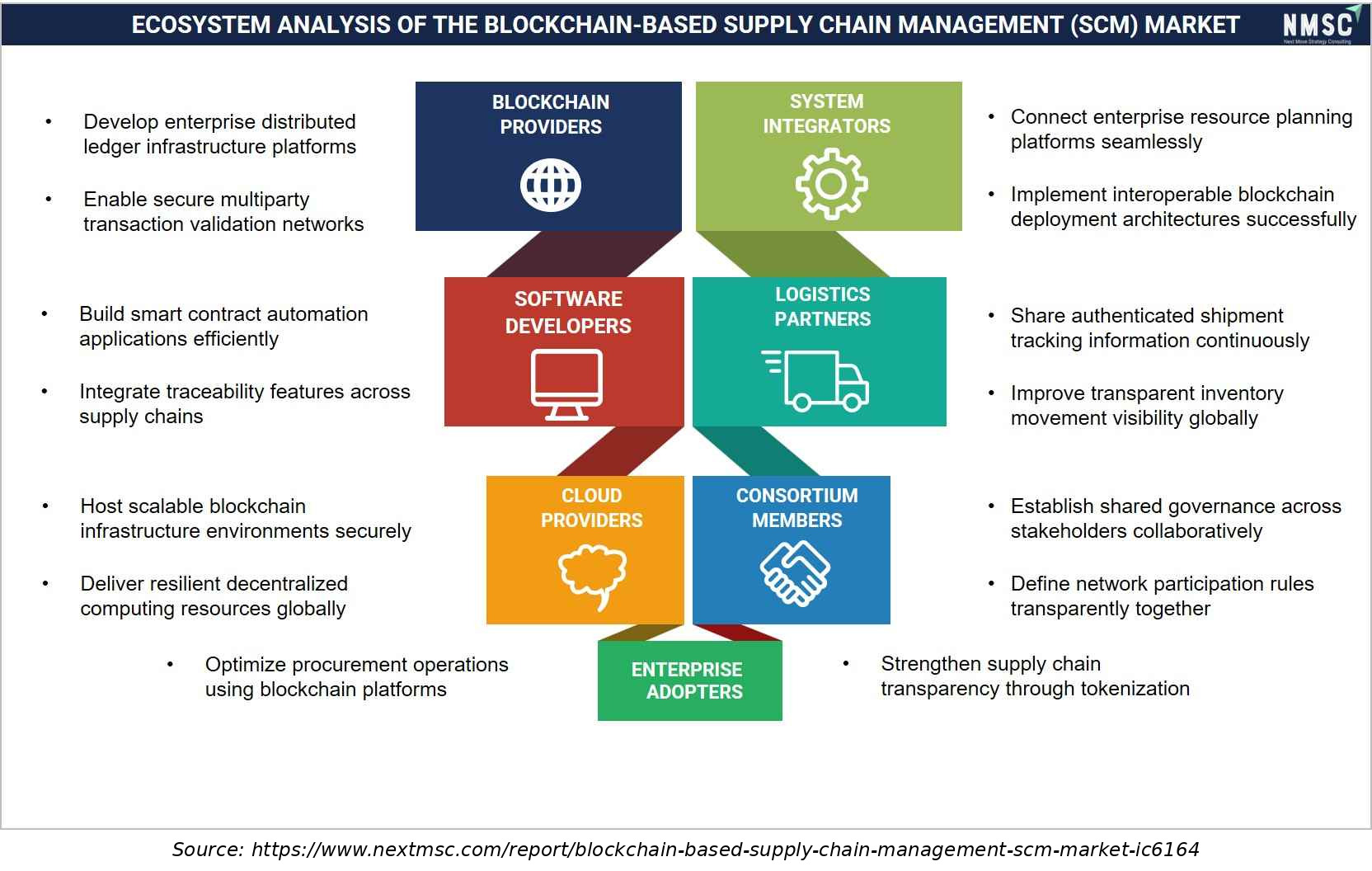
ECOSYSTEM ANALYSIS OF THE BLOCKCHAIN-BASED SUPPLY CHAIN MANAGEMENT (SCM) MARKET

The blockchain-based supply chain management ecosystem comprises blockchain providers, system integrators, software developers, logistics partners, cloud providers, consortium members, and enterprise adopters working together to enable secure, transparent, and efficient supply chains. Blockchain platforms provide immutable data records, while cloud infrastructure, integration services, and software solutions facilitate deployment. Industry consortia promote interoperability and standards, enabling enterprises across manufacturing, retail, logistics, healthcare, and food sectors to enhance traceability, compliance, and operational efficiency.

Market Drivers & Dynamics

Interactive Dataset
Enterprise software incumbents embedding blockchain into core SCM suites driver +8.4% Global 2026–2035
EU Digital Product Passport and Green Deal compliance requirements driver +5.6% Europe 2026–2032
Growing food and pharmaceutical traceability mandates driver +4.8% Global 2026–2035
Asia-Pacific manufacturing digitalization and blockchain pilot scale-up driver +5.2% Asia-Pacific 2026–2035
AI-integrated traceability and risk scoring adoption driver +3.9% Global 2026–2032
Rising SME adoption via cloud-native, lower-cost platforms driver +3.1% Global 2026–2032
Interoperability gaps between competing blockchain protocols restraint −2.6% Global 2026–2032
High integration cost with legacy enterprise resource planning systems restraint −1.9% Global 2026–2030
Limited multi-tier supplier participation slowing network effects restraint −1.3% Asia-Pacific, Latin America, MEA 2026–2032
Source: Next Move Strategy Consulting

Growth Drivers

What Is the Primary Growth Driver of the Blockchain-Based Supply Chain Management (SCM) Market?

Enterprise software incumbents embedding blockchain traceability directly into core supply chain management suites remain the primary driver of the market. IBM Corporation's Sterling Supply Chain suite integrates blockchain-based traceability as a dedicated product capability rather than a standalone add-on, according to the company's official product documentation. We observed that this embedded approach is accelerating enterprise adoption by removing the need for separate blockchain platform procurement.

How Is EU Digital Product Passport Regulation Driving Market Growth?

European Union Digital Product Passport regulation is driving growth by mandating verifiable product lifecycle data under the EU Green Deal framework. SAP SE confirmed the launch of a blockchain-based Digital Product Passport pilot with multiple automotive original equipment manufacturers to meet these emerging requirements. Our assessment indicates that this regulatory-driven pilot activity is establishing a compliance template that is likely to extend into additional manufacturing sectors covered by future Digital Product Passport requirements.

Growth Inhibitors

What Is Restraining Blockchain-Based Supply Chain Management (SCM) Market Expansion?

Interoperability gaps between competing blockchain protocols restrain broader market expansion. Industry-derived estimates indicate that enterprises deploying multiple blockchain-based traceability systems across different supplier tiers often encounter data format and consensus mechanism incompatibilities that limit end-to-end visibility. We found that high integration costs with legacy enterprise resource planning systems further compound this restraint, extending implementation timelines for organizations without dedicated blockchain integration expertise.

Segmentation Analysis

2025 (USD Billion)
2035 (USD Billion)
Platform 2025: $1,938.00 Billion | 2035: $28,024.00 Billion
Platform
Services 2025: $912.00 Billion | 2035: $17,176.00 Billion
Services
Platform $1,938.00 Billion $28,024.00 Billion 30.6%
Services $912.00 Billion $17,176.00 Billion 34.1%

Which Component Segment Dominates the Blockchain-Based Supply Chain Management (SCM) Market?

Platform led the market with USD 1,938 million in 2025, supported by enterprise demand for core traceability, smart contract, and ledger infrastructure. We observed that Services is the fastest-growing component, expanding at a 34.1% CAGR from 2026 to 2035, as enterprises increasingly require consulting, integration, and support services to connect blockchain platforms with legacy enterprise resource planning and supply chain planning systems.

2025 (USD Billion)
2035 (USD Billion)
Cloud
On-premises
Segment Item 2025 (USD Billion) 2035 (USD Billion) CAGR
Cloud $10.0 USD Billion $40.0 USD Billion 25.0%
On-premises $17.1 USD Billion $51.1 USD Billion 11.0%

Segment-wise data is locked

Unlock complete segment-wise numbers for By Deployment Mode.

Unlock Full Data
2025 (USD Billion)
2035 (USD Billion)
Large enterp
Small and me
Segment Item 2025 (USD Billion) 2035 (USD Billion) CAGR
Large enterprises $10.0 USD Billion $40.0 USD Billion 27.0%
Small and medium enterprises $17.1 USD Billion $51.1 USD Billion 9.0%

Segment-wise data is locked

Unlock complete segment-wise numbers for By Organization Size.

Unlock Full Data
2025 (USD Billion)
2035 (USD Billion)
Product trac
Smart contra
Inventory an
Compliance a
Counterfeit
Segment Item 2025 (USD Billion) 2035 (USD Billion) CAGR
Product traceability and provenance $10.0 USD Billion $40.0 USD Billion 14.0%
Smart contracts and automated settlement $17.1 USD Billion $51.1 USD Billion 24.0%
Inventory and asset tracking $24.2 USD Billion $62.2 USD Billion 22.0%
Compliance and regulatory auditing $31.3 USD Billion $73.3 USD Billion 12.0%
Counterfeit detection and brand protection $38.4 USD Billion $84.4 USD Billion 27.0%

Segment-wise data is locked

Unlock complete segment-wise numbers for By Application.

Unlock Full Data

Which Application Segment Leads Market Demand?

Product Traceability and Provenance remained the leading application, valued at USD 969 million in 2025, reflecting its status as the sector's most commercially mature use case across food, pharmaceutical, and luxury goods supply chains. Our findings suggest that Smart Contracts and Automated Settlement is the fastest-growing application, registering a 34.5% CAGR from 2026 to 2035, as enterprises increasingly automate supplier payment and settlement processes tied to verified delivery milestones.

2025 (USD Billion)
2035 (USD Billion)
Retail and c
Food and bev
Healthcare a
Automotive a
Logistics an
Segment Item 2025 (USD Billion) 2035 (USD Billion) CAGR
Retail and consumer goods $10.0 USD Billion $40.0 USD Billion 24.0%
Food and beverage $17.1 USD Billion $51.1 USD Billion 22.0%
Healthcare and pharmaceuticals $24.2 USD Billion $62.2 USD Billion 20.0%
Automotive and manufacturing $31.3 USD Billion $73.3 USD Billion 22.0%
Logistics and transportation $38.4 USD Billion $84.4 USD Billion 13.0%

Segment-wise data is locked

Unlock complete segment-wise numbers for By End-Use Industry.

Unlock Full Data

Which End-Use Industry Segment Dominates the Blockchain-Based Supply Chain Management (SCM) Market?

Food and Beverage remained the leading end-use industry, reaching USD 684 million in 2025, as food safety traceability mandates and high-profile retail deployments continue to anchor sector demand. Based on research conducted by Next Move Strategy Consulting, we found that Energy and Utilities is the fastest-growing end-use industry, expanding at a 36.5% CAGR from 2026 to 2035, as utilities adopt blockchain-based carbon tracking and emissions reporting to meet expanding environmental disclosure requirements.

Growth Opportunities

Our analysis shows that three forward-looking opportunities stand out for stakeholders positioning within the blockchain-based supply chain management (SCM) market over the 2026–2035 forecast period.

How Can AI-Integrated Risk Scoring Unlock Value for Enterprise Buyers?

AI-integrated risk scoring built on blockchain traceability data presents a whitespace opportunity for platform vendors serving large enterprise supply chain teams. Vendors that combine verified blockchain records with predictive analytics stand to capture premium contracts as buyers seek to move beyond reactive traceability lookups toward proactive multi-tier supplier risk management.

Where Does Digital Product Passport Compliance Create New Demand?

Digital Product Passport compliance requirements under the EU Green Deal create a significant opportunity for platform vendors serving automotive, electronics, and textile manufacturers. Companies that scale compliant digital passport infrastructure ahead of expanding regulatory coverage can secure long-term contracts with manufacturers navigating sequential EU compliance deadlines across product categories.

How Can SME-Focused Cloud Platforms Benefit Smaller Supply Chain Participants?

Cloud-native platforms priced for small and medium enterprises create an opportunity for vendors seeking to expand beyond large enterprise customers. Providers that offer simplified, lower-cost onboarding for smaller supplier network participants can capture recurring subscription revenue as multi-tier traceability networks require broader supplier-level participation to function effectively.

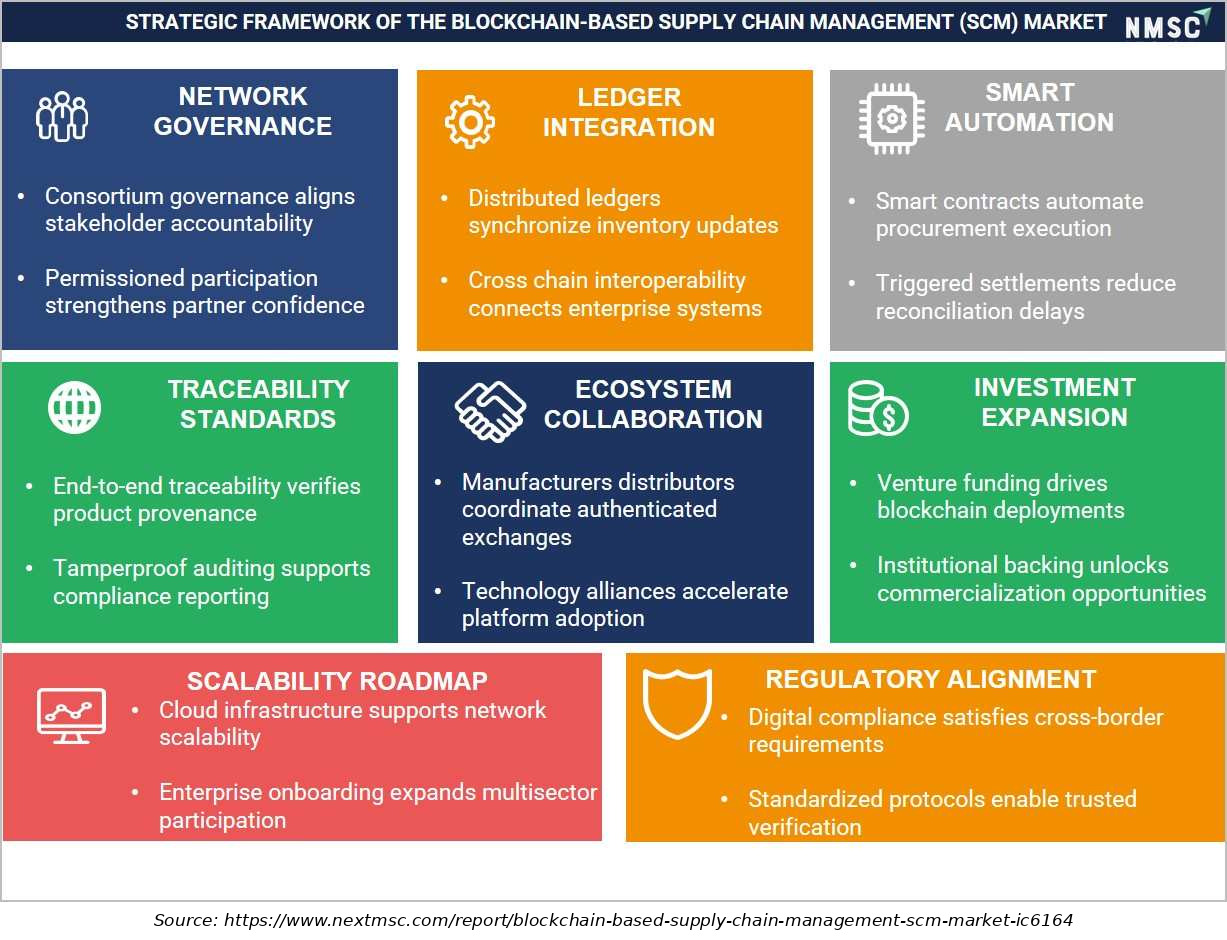
STRATEGIC FRAMEWORK OF THE BLOCKCHAIN-BASED SUPPLY CHAIN MANAGEMENT (SCM) MARKET

STRATEGIC FRAMEWORK OF THE BLOCKCHAIN-BASED SUPPLY CHAIN MANAGEMENT (SCM) MARKET
The strategic framework of the blockchain-based supply chain management (SCM) market centers on strengthening governance, ledger integration, automation, and traceability to improve supply chain transparency and efficiency. Collaborative ecosystems, cloud-enabled scalability, and growing investments accelerate enterprise adoption across industries. At the same time, regulatory alignment and standardized protocols support secure cross-border transactions, compliance, and trusted data sharing, enabling organizations to build resilient, interoperable, and digitally connected supply chain networks.

Regional Outlook

2025 (USD Billion)
2035 (USD Billion)
North Americ
Europe
Asia-Pacific
Middle East
Latin Americ
Region 2025 (USD Billion) 2035 (USD Billion) CAGR (%)
North America $10.0 USD Billion $40.0 USD Billion 9.0%
Europe $17.1 USD Billion $51.1 USD Billion 27.0%
Asia-Pacific $24.2 USD Billion $62.2 USD Billion 25.0%
Middle East & Africa $31.3 USD Billion $73.3 USD Billion 23.0%
Latin America $38.4 USD Billion $84.4 USD Billion 12.0%

Regional data is locked

Unlock complete regional numbers for this market.

Unlock Full Data

Competitive Landscape

We observed that the competitive landscape spans large diversified enterprise software and cloud infrastructure providers alongside specialized blockchain-native platform vendors, with differentiation increasingly determined by AI integration depth.

Dimension Description
Category Assessment
Market Structure Moderately consolidated; large enterprise software and cloud infrastructure incumbents hold significant combined share alongside a broader base of specialized blockchain-native traceability vendors
Innovation Focus AI-integrated risk scoring, Digital Product Passport compliance tooling, IoT-linked emissions tracking, and cloud-native platform architecture
M&A Activity Continued platform partnership and integration activity, including enterprise software incumbents embedding blockchain traceability directly into core supply chain planning suites

How Do Companies Compete in the Blockchain-Based Supply Chain Management (SCM) Market?

Companies compete primarily on integration depth with existing enterprise resource planning systems, breadth of supported industries, and the ability to embed AI-driven analytics atop blockchain-recorded data. We found that enterprise software incumbents increasingly anchor competitive positioning by offering blockchain traceability as a native module rather than a standalone product. Pricing strategies remain closely tied to platform scale and services attach rate, pushing vendors toward broader services portfolios to capture recurring revenue.

Which Competitive Archetypes Dominate the Blockchain-Based Supply Chain Management (SCM) Market?

Two archetypes dominate the blockchain-based supply chain management (SCM) market: large enterprise software and cloud infrastructure incumbents that compete on integration breadth and existing customer relationships, and specialized blockchain-native platform vendors that compete on deep traceability functionality and industry-specific expertise. Our analysis shows that differentiation increasingly centers on AI-integrated risk scoring, positioning incumbents with generative AI capabilities to capture greater enterprise wallet share as buyers consolidate vendor relationships.

How Are Companies Differentiating Through Innovation?

Leading vendors are differentiating through generative AI-enabled contract analytics, IoT sensor integration for real-time emissions tracking, and Digital Product Passport compliance tooling. During our market evaluation, we noticed that several vendors are simultaneously expanding industry-specific traceability modules and pursuing interoperability improvements between competing blockchain protocols, positioning themselves as full-service partners across the supply chain data lifecycle rather than single-function ledger providers.

What M&A and Geographic Expansion Activity Is Reshaping the Market?

Geographic expansion and platform partnership activity are reshaping competitive positioning across the industry. We observed that VeChain Foundation's continued expansion of its Walmart China food traceability partnership and SAP SE's automotive Digital Product Passport pilot both illustrate how vendors are deepening sector-specific deployments rather than pursuing broad horizontal expansion, reflecting a maturing market that increasingly rewards vertical specialization.

Key Market Players

Our assessment indicates that the following companies represent the leading vendors shaping competitive dynamics across the blockchain-based supply chain management (SCM) market.

International Business Machines Corporation (IBM) SAP SE Oracle Corporation Microsoft Corporation Amazon.com, Inc. (Amazon Web Services) Accenture plc VeChain Foundation Everledger Group Limited ConsenSys Software Inc. R3 LLC Guardtime AS Circulor Ltd Morpheus.Network Inc. Data Gumbo Corp OriginTrail Foundation Chronicled, Inc. Wholechain, Inc. TE-FOOD International GmbH Ambrosus AG

Latest Developments

We found that recent product launches and platform integrations underscore the pace of change across the blockchain-based supply chain management industry.

Date Event
October 2025 SAP launched new supply-chain innovations at SAP Connect, including SAP Supply Chain Orchestration, AI-driven planning capabilities, Joule Agents, and enhancements to SAP Business Network. The innovations aim to improve multi-tier supply-chain visibility, disruption detection, risk management, and resilience, supporting broader enterprise supply-chain digitalization.

Investment Opportunities

Where Are Capital Inflows Concentrated in the Blockchain-Based Supply Chain Management (SCM) Market?

Capital inflows are concentrated in AI-integrated traceability platforms and Digital Product Passport compliance infrastructure. We observed that IBM Corporation, SAP SE, and Oracle Corporation have all directed continued product investment toward generative AI integration and ESG-linked traceability capabilities since 2024. This pattern reflects sustained enterprise software incumbent confidence in blockchain traceability as a durable, long-term product category.

How Is Infrastructure Investment Expanding Platform Capacity?

Infrastructure investment is expanding platform capacity as vendors scale cloud-native deployment options and IoT sensor integration. We found that Oracle Corporation's integration of IoT sensors with its Oracle Blockchain Platform for real-time carbon tracking reflects a broader pattern of infrastructure investment aimed at supporting higher-volume, real-time supply chain data ingestion across enterprise customer networks.

What ESG Considerations Are Shaping Blockchain-Based SCM Investment?

Environmental, social, and governance considerations are central to investment decisions as blockchain traceability increasingly underpins corporate emissions and ethical sourcing disclosure. Our findings suggest that IBM Corporation's expansion of ESG audit trail and AI-driven risk scoring capabilities signals growing investor and customer expectation that traceability platforms document verified sourcing and environmental impact data, favoring vendors with mature ESG reporting integration over less transparent alternatives.

Key Benefits for Stakeholders

How Does This Report Benefit Enterprise and Industry Leaders?

Enterprise and industry leaders gain a structured view of segment-level demand across component, deployment mode, organization size, application, and end-use industry, supported by Next Move Strategy Consulting's forecasts through 2035. Our analysis shows that this data enables platform investment decisions, helping enterprises prioritize the fastest-growing segments, including smart contract automation and energy and utilities traceability.

How Does This Report Benefit Investors and Financial Analysts?

Investors and financial analysts benefit from validated market sizing, regional growth differentials, and competitive landscape analysis that inform capital allocation decisions. We found that the report's country-level revenue breakdowns and CAGR projections support comparative evaluation of expansion opportunities across North America, Europe, Asia-Pacific, the Middle East & Africa, and Latin America, strengthening due diligence on blockchain-related investment targets.

How Does This Report Benefit Technology Vendors and Product Teams?

Technology vendors and product teams gain insight into emerging trends, including AI-integrated traceability, Digital Product Passport compliance, and IoT-linked emissions tracking. Our assessment indicates that this analysis helps product teams prioritize research and development roadmaps toward the applications and industries showing the strongest forecast growth, improving alignment between innovation investment and evolving enterprise procurement specifications.

Key Market Segments Evaluated

By Component

  • Platform 
    • Public blockchain platform
    • Private blockchain platform
    • Consortium blockchain platform
  • Services 
    • Consulting services
    • Integration and deployment services
    • Support and maintenance services

By Deployment Mode

  • Cloud
  • On-premises

By Organization Size

  • Large enterprises
  • Small and medium enterprises

By Application

  • Product traceability and provenance
  • Smart contracts and automated settlement
  • Inventory and asset tracking
  • Compliance and regulatory auditing
  • Counterfeit detection and brand protection
  • Other applications

By End-Use Industry

  • Retail and consumer goods
  • Food and beverage
  • Healthcare and pharmaceuticals
  • Automotive and manufacturing
  • Logistics and transportation
  • Energy and utilities
  • Agriculture
  • Other industries

By Region

  • North America 
    • U.S.
    • Canada
    • Mexico
  • Europe 
    • UK
    • Germany
    • France
    • Italy
    • Spain
    • Sweden
    • Denmark
    • Finland
    • Netherlands
    • Rest of Europe
  • Asia-Pacific 
    • China
    • India
    • Japan
    • South Korea
    • Taiwan
    • Indonesia
    • Vietnam
    • Australia
    • Philippines
    • Malaysia
    • Rest of APAC
  • Middle East & Africa 
    • Saudi Arabia
    • UAE
    • Egypt
    • Israel
    • Turkey
    • Nigeria
    • South Africa
    • Rest of MEA
  • Latin America 
    • Brazil
    • Argentina
    • Chile
    • Colombia
    • Rest of LATAM

Conclusion & Recommendations

The long-term outlook remains strongly positive, with the market projected to expand from USD 3.75 billion in 2026 to USD 45.20 billion by 2035 at a 31.8% CAGR. Our assessment indicates that this growth will be increasingly concentrated among enterprise software incumbents embedding blockchain traceability into core supply chain suites as AI integration and regulatory compliance requirements accelerate adoption through 2035.

What Strategic Positioning Should Vendors Pursue?

Vendors should pursue integrated positioning that combines blockchain traceability with AI-driven analytics and Digital Product Passport compliance tooling. We found that companies embedding blockchain capabilities directly into existing enterprise resource planning workflows, following the models set by IBM, SAP, and Oracle, are best positioned to capture long-term enterprise contracts as buyers consolidate vendor relationships.

How Attractive Is the Market for New Investment?

The market presents high investment attractiveness given its 31.8% forecast CAGR and the accelerating pace of regulatory-driven compliance demand. Our findings suggest that investors focusing on AI-integrated risk scoring, Digital Product Passport infrastructure, and Asia-Pacific manufacturing digitalization stand to benefit from above-market growth relative to the broader blockchain-based supply chain management category.

What Are the Key Market Shifts and Risks?

Key shifts include accelerating AI integration into traceability platforms and expanding regulatory-driven Digital Product Passport adoption. We observed that principal risks include interoperability gaps between competing blockchain protocols, high integration costs with legacy systems, and limited multi-tier supplier participation, all of which could slow the pace of the industry's network-effect-driven growth if unresolved.

What Are the Primary Growth Pathways Through 2035?

Primary growth pathways include scaling AI-integrated traceability platforms, expanding Digital Product Passport compliance infrastructure, and deepening Asia-Pacific manufacturing digitalization partnerships. Based on research conducted by Next Move Strategy Consulting, we found that vendors combining these three pathways with embedded enterprise resource planning integration are best positioned to capture the USD 41.45 billion absolute dollar opportunity created between 2026 and 2035.

FAQs

About the Author

Liza Phukan

Liza Phukan

Liza Phukan is Research Associate at Next Move Strategy Consulting, where she has covered emerging industries and market research across sectors for 3.5 years. Her work includes analyzing industry developments, validating market data, and developing structured business content from research findings. She uses secondary research and data-validation practices to turn complex market information into clear decision-useful market analysis for business audiences and support report development and B2B.

About the Reviewer

Supradip Baul

Supradip Baul

Supradip Baul is an accomplished business consultant and strategist with over a decade of rich experience in market intelligence, strategy, technology, and business transformation. His work has included rigorous qualitative and quantitative analysis across multiple industries, helping clients shape investment decisions and long-term roadmaps. Earlier in his career, he was associated with Gartner, where he contributed to industry-leading reports and market share analyses. He has worked with leading global companies and holds an MBA with a dual specialization in Marketing and Finance.

Download Free Sample

Kishu Kanda

KISHU KANDA

Strategy Analyst

Accenture

We purchased the AI Consumer Market Report from this company. Not only did they customize the report to meet our specific requirements, but they also showed great flexibility in accommodating our budget. The report we received fully met our expectations. Additionally, they provided prompt and thorough responses to both our pre-purchase and follow-up questions. We look forward to working with this company again in the future.

Gustaf Hummel Burstrom

GUSTAF HUMMEL BURSTROM

Founder

Revline Tools AB

Joseph and the team at Next Move Strategy Consulting have been excellent to work with, in supplying us with relevant market data and forecasts for our specific category. We had some special requirements and they were able to do a custom package to suit our needs. We would definitely recommend them to any other company needing market data and forecasts

Diana Trejo

DIANA TREJO

Assistant Manager

Sumitomo Corporation de Mexico, S.A. de C.V.

Recently, we purchased a report on the Mexico Data Center Market from Next Move Strategy Consulting. The service has been excellent, with support that is always timely and thoroughly professional. The information provided is interesting, highly useful, and delivered with clarity. I would highly recommend NextMSC for anyone seeking insightful and dependable analysis.

Melanie Samko

MELANIE SAMKO

Director of Marketing

TOSOH BIOSCIENCE, INC.

The information provided by NMSC is incredibly valuable, thank you so much for such a excellent work. I really appreciate it. I will make sure to reference all of it, in my summary document.

Ross J Mckenzie

ROSS J MCKENZIE

Business Insight Manager

Staysure Group

“Next MSC have been incredibly helpful in providing detailed & robust information on our market, alongside quantifying growth by different segments. The process to procure was simple and easy, with sample reports and regular contact to ensure we had what we needed. Succinct detail on their sources & methodologies is also greatly received, allowing transparency in this respect helps build trust in the detail you pay for. Joseph in particular was fantastic, and helped ensure efficient provision of the insight pack – thank you NMSC!”.

Custom Market Research Services

We will customize the research for you if the listed report does not fully match your requirements.

Get 30% Free Customization

Select License

This website uses cookies to ensure you get the best experience on our website. Learn more

✖