Liveness Detection Market Size, Share, Trends and Growth Analysis, By Product Type (Face Detection, Voice Detection, Document Detection, Multimodal Detection, and Other Biometric Detection), By Component, By Deployment Mode (Cloud, On Premise, and Edge), By Application (Digital Account Opening, Identity Verification, User Authentication, and Other Applications),By Commercial Model, By Enterprise Size, By Sales Channel, By End User, and Region – Global Industry Report and Forecast, 2026–2035
Industry: ICT & Media | Publishing Date: July 14, 2026 | Last Updated: September 30, 2026 | No of Pages: N/A | No. of Tables: N/A | No. of Figures: N/A | Format: PDF | Report Code: IC5133
What Is the Liveness Detection Market Size?
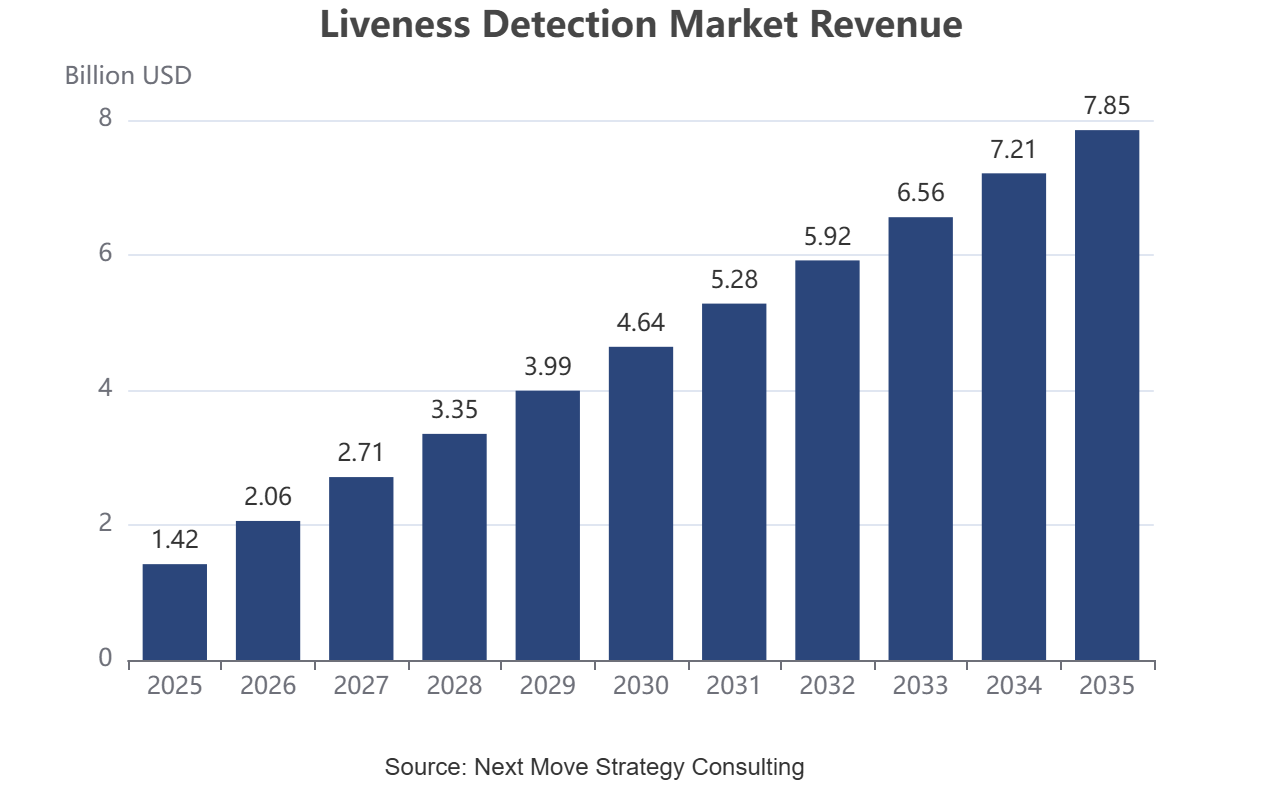
The global liveness detection market size was valued at USD 1.42 billion in 2025 and is estimated at USD 1.65 billion in 2026, forecast to reach USD 7.85 billion by 2035, expanding at an 18.9% CAGR between 2026 and 2035. North America leads with approximately 35% share, while Face Detection dominates all other product types with approximately 38% share.
We observed that growth is broad-based across every segmentation axis, with multimodal detection adoption and cloud-based deployment driving the dominant structural shifts through 2035.
|
Key Takeaways |
|
By Product Type: Face Detection held the largest share of approximately 38% (USD 0.54 billion) in 2025; Multimodal Detection is the fastest-growing sub-segment at 23.0% CAGR from 2026–2035. |
|
By Component: Software held the largest share of approximately 64% (USD 0.91 billion) in 2025; Services is the fastest-growing sub-segment at 19.7% CAGR from 2026–2035. |
|
By Deployment Mode: Cloud held the largest share of approximately 58% (USD 0.82 billion) in 2025; Edge is the fastest-growing sub-segment at 21.6% CAGR from 2026–2035. |
|
By Application: Identity Verification held the largest share of approximately 22% (USD 0.31 billion) in 2025; Age Verification is the fastest-growing sub-segment at 22.1% CAGR from 2026–2035. |
|
By Commercial Model: Per Transaction held the largest share of approximately 41% (USD 0.58 billion) in 2025; Subscription is the fastest-growing sub-segment at 20.0% CAGR from 2026–2035. |
|
By Enterprise Size: Large Enterprises held the largest share of approximately 63% (USD 0.89 billion) in 2025; SMEs is the fastest-growing sub-segment at 20.4% CAGR from 2026–2035. |
|
By Sales Channel: Direct Sales held the largest share of approximately 40% (USD 0.57 billion) in 2025; Cloud Marketplace is the fastest-growing sub-segment at 23.4% CAGR from 2026–2035. |
|
By End User: BFSI held the largest share of approximately 30% (USD 0.43 billion) in 2025; Automotive is the fastest-growing sub-segment at 22.2% CAGR from 2026–2035. |
|
Dominant Region: North America dominated with approximately 35% revenue share (USD 0.50 billion) in 2025. |
|
Fastest-Growing Region: Asia-Pacific is expected to register the highest CAGR of 22.5% during 2026–2035. |
|
Dominant Country: U.S. led with approximately USD 398 million in 2025. |
|
Fastest-Growing Country: India is the fastest-growing country at approximately 25.5% CAGR from 2026–2035. |
Market Opportunity: The liveness detection market is expected to create an absolute dollar opportunity of USD 6.20 billion between 2026 and 2035, presenting significant investment potential across the digital identity verification and biometric authentication value chain.
According to Next Move Strategy Consulting analysis, enterprises are increasingly consolidating identity-verification vendor relationships around providers offering multimodal, presentation-attack-resistant liveness engines, a shift that favors diversified technology vendors over single-modality specialists as fraud sophistication and regulatory scrutiny intensify through 2035.
What Does the Liveness Detection Market Encompass?
The liveness detection market encompasses software and services that verify whether a biometric sample, such as a face, voice, document, or fingerprint, originates from a genuine, physically present individual rather than a spoofed artifact, photograph, deepfake, or replayed recording. Our assessment indicates that the scope spans active, passive, and hybrid detection architectures deployed across cloud, on premise, and edge environments to serve digital account opening, identity verification, authentication, and fraud prevention use cases across BFSI, government, healthcare, and e-commerce sectors worldwide.
Regulatory frameworks such as the European Union's eIDAS 2.0 digital identity regulation and the U.S. National Institute of Standards and Technology's biometric presentation attack detection guidance (ISO/IEC 30107) shape certification requirements for liveness engines, while anti-money-laundering and know-your-customer mandates increasingly require certified liveness checks during digital onboarding. We observed that technology adoption is shifting toward multimodal, AI-driven detection that combines facial, voice, and device-signal cues to counter increasingly realistic deepfake and injection-attack threats. Next Move Strategy Consulting's analysis indicates that this structural shift, combined with rising remote-onboarding volumes, is redefining vendor selection criteria across the liveness detection market.
|
Parameters |
Details |
|
Market Size in 2025 |
USD 1.42 Billion |
|
Market Size in 2026 |
USD 1.65 Billion |
|
Revenue Forecast in 2035 |
USD 7.85 Billion |
|
Growth Rate |
CAGR of 18.9% from 2026 to 2035 |
|
Analysis Period |
2025–2035 |
|
Base Year Considered |
2025 |
|
Forecast Period |
2026–2035 |
|
Market Size Estimation |
Revenue (USD Billion) |
|
Companies Profiled |
20 |
|
Countries Covered |
38 |
|
Market Share |
Available for Top 10 Companies |
Key Emerging Trends
Based on research conducted by Next Move Strategy Consulting, we found that four structural trends are reshaping product development, deployment, and stakeholder engagement across the industry.
How Is Deepfake-Resistant AI Transforming Liveness Detection Accuracy?
Deepfake-resistant, AI-driven detection models are replacing legacy passive liveness checks to counter increasingly realistic synthetic media attacks. We observed that iProov's Dynamic Liveness technology, updated through 2025, uses controlled illumination sequences to defend against generative-AI injection attacks in real time. Enterprises are adopting these engines to satisfy financial-sector fraud-prevention mandates, while identity platforms retool onboarding flows to accommodate multimodal, deepfake-aware verification across banking and telecom applications.
Why Are Multimodal Detection Architectures Gaining Adoption?
Multimodal detection, combining face, voice, and device-signal analysis, is gaining share as enterprises respond to stricter presentation-attack-detection expectations. Our findings suggest that banking and government-issued credential applications increasingly specify layered liveness checks to reduce spoofing success rates. Vendors such as FaceTec and iProov are expanding multimodal portfolios, positioning these formats as a premium, higher-assurance category within the broader market segmentation structure.
How Is Regulation Reshaping Liveness Detection Certification Requirements?
Regulatory frameworks including the EU's eIDAS 2.0 and evolving remote-identity-proofing standards are pushing vendors toward certified, standards-compliant liveness engines. We observed that ISO/IEC 30107-3 presentation-attack-detection certification is becoming a procurement prerequisite among banks and government agencies deploying digital identity systems. This trend is elevating demand for independently tested detection engines among system integrators and identity platforms serving regulated end markets.
What Role Does Edge Deployment Play in Liveness Detection Innovation?
Edge-based liveness processing is emerging as a latency- and privacy-driven response to cloud-dependency concerns. Our analysis shows that device manufacturers and enterprises in border-control and access-control applications are piloting on-device detection models that process biometric data without transmitting raw imagery externally. Thales Group's edge-optimized liveness modules, refined through 2025, exemplify this direction with on-device processing engineered for offline border-checkpoint and access-control deployments.
Ecosystem Analysis of the Liveness Detection Market
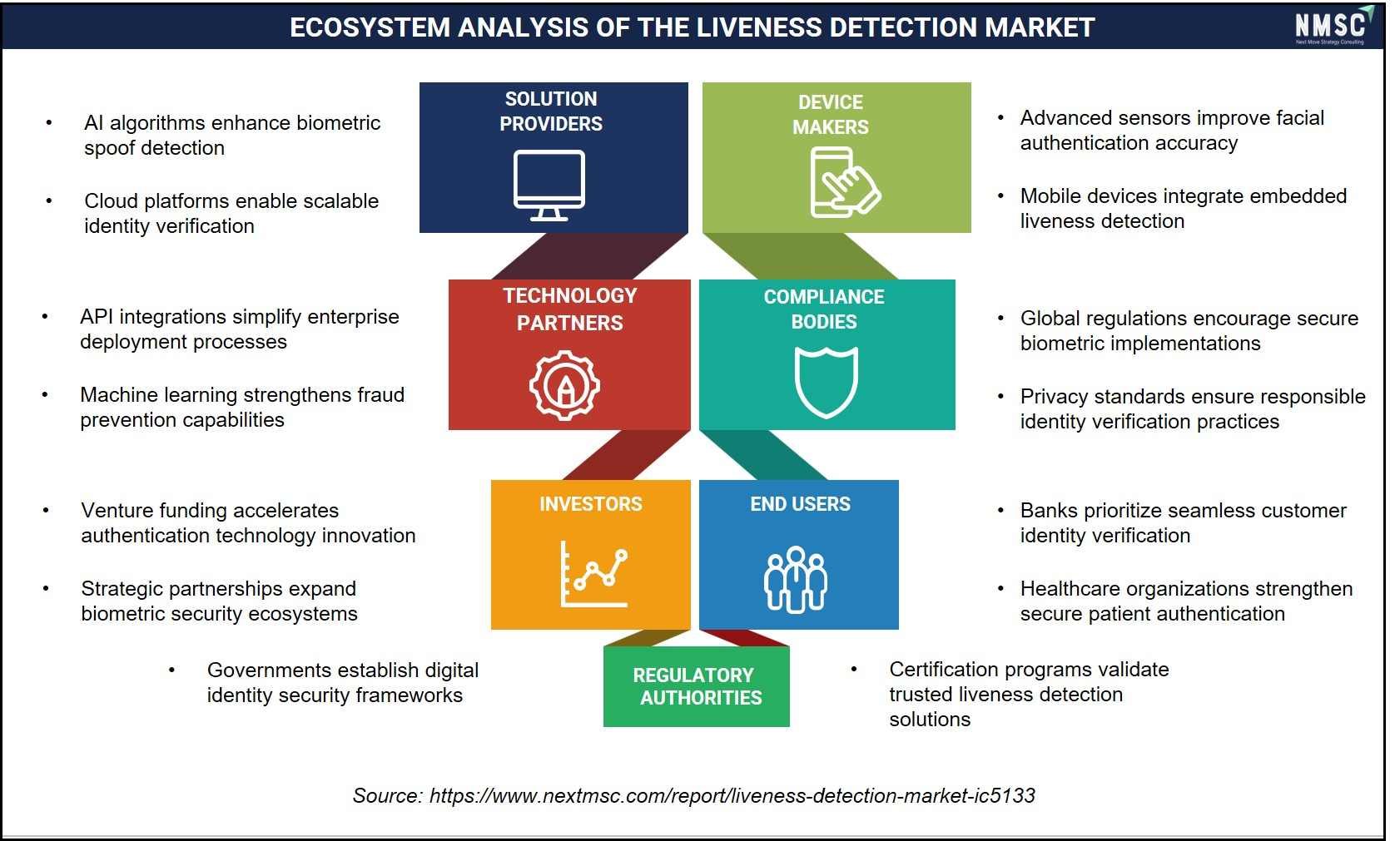
Based on our ecosystem assessment, we identified that the liveness detection market consists of solution providers, device manufacturers, technology partners, compliance bodies, investors, end users, and regulatory authorities that collectively support the development, deployment, and governance of secure biometric authentication solutions. Furthermore, our analysis indicates that continuous collaboration across the ecosystem enhances spoof detection capabilities, strengthens cybersecurity, ensures regulatory compliance, and accelerates enterprise adoption across financial services, healthcare, government, and digital identity applications.
Growth Drivers and Restraints
Growth Catalyst and Risk Assessment Matrix
|
Factors |
Type |
(+/−) % Impact on CAGR |
Geographic Relevance |
Impact Timeline |
|
Rising digital account opening and remote onboarding volumes |
Driver |
+3.2% |
Global |
2026-2035 |
|
Escalating deepfake and presentation attack sophistication |
Driver |
+2.8% |
Global |
2026-2035 |
|
eIDAS 2.0 and KYC/AML regulatory mandates |
Driver |
+2.1% |
Europe, North America |
2026-2035 |
|
Expansion of digital banking and fintech in Asia-Pacific |
Driver |
+2.4% |
Asia-Pacific |
2026-2035 |
|
Growing adoption of multimodal biometric authentication |
Driver |
+1.6% |
Global |
2026-2032 |
|
Rising age-verification mandates for online platforms |
Driver |
+1.2% |
North America, Europe |
2027-2035 |
|
Data privacy and biometric data protection concerns |
Restraint |
-1.4% |
Europe, North America |
2026-2035 |
|
High implementation cost for advanced multimodal systems |
Restraint |
-1.0% |
Global |
2026-2032 |
|
Fragmented regional certification and compliance standards |
Restraint |
-0.7% |
Asia-Pacific, MEA |
2026-2033 |
What Is the Primary Growth Driver of the Liveness Detection Market?
Rising digital account opening and remote onboarding volumes are the primary driver of the market. The U.S. Financial Crimes Enforcement Network continues to reinforce customer identification program requirements that increasingly rely on remote biometric verification, sustaining enterprise demand for certified liveness checks. We observed that this behavioral shift, reinforced by banking and telecom onboarding protocols, continues to anchor baseline consumption of face and document detection technologies across developed and emerging economies alike.
How Is Deepfake Sophistication Driving Liveness Detection Market Growth?
Escalating deepfake and injection-attack sophistication is accelerating market growth toward AI-driven, multimodal detection engines. The U.S. National Institute of Standards and Technology's biometric evaluation programs continue to document rising synthetic-media attack success rates against legacy systems. Our assessment indicates that this threat environment, combined with financial-sector fraud-prevention mandates, is compressing adoption timelines for advanced multimodal and edge-based liveness architectures across North America and Europe.
What Is Restraining Liveness Detection Market Expansion?
Data privacy and biometric data protection concerns restrain broader market expansion across privacy-sensitive jurisdictions. The European Data Protection Board's guidance under the General Data Protection Regulation classifies biometric data as a special category requiring heightened processing safeguards, which lengthens enterprise procurement cycles. We found that smaller vendors face particular exposure, as limited compliance resources reduce their ability to navigate cross-border data-residency requirements compared with larger, established identity-verification providers.
Segmentation Analysis
Segment Sizing: By Product Type
|
Segment |
2025 (USD) |
2035 (USD) |
CAGR% (2026–2035) |
|
Face Detection |
USD 0.54 Billion |
USD 2.78 Billion |
18.0% |
|
Voice Detection |
USD 0.23 Billion |
USD 1.31 Billion |
19.5% |
|
Document Detection |
USD 0.27 Billion |
USD 1.29 Billion |
17.0% |
|
Multimodal Detection |
USD 0.24 Billion |
USD 1.81 Billion |
23.0% |
|
Other Biometric Detection |
USD 0.14 Billion |
USD 0.65 Billion |
16.5% |
|
Total |
USD 1.42 Billion |
USD 7.85 Billion |
18.9% |
Which Product Type Segment Dominates the Liveness Detection Market?
Face Detection, encompassing active, passive, and hybrid face liveness formats, led the market with USD 540 million in 2025, supported by its broad compatibility with mobile onboarding and identity-verification workflows. We observed that Multimodal Detection is the fastest-growing product type, expanding at a 23.0% CAGR from 2026 to 2035, as banks and government agencies increasingly layer face, document, and device-signal checks to counter sophisticated presentation and injection attacks.
Segment Sizing: By Application
|
Segment |
2025 (USD) |
2035 (USD)
|
CAGR% (2026–2035) |
|
Digital Account Opening |
USD 0.26 Billion |
USD 1.38 Billion |
18.6% |
|
Identity Verification |
USD 0.31 Billion |
USD 1.82 Billion |
19.6% |
|
User Authentication |
USD 0.23 Billion |
USD 1.18 Billion |
18.1% |
|
Access Control |
USD 0.13 Billion |
USD 0.59 Billion |
16.6% |
|
Age Verification |
USD 0.10 Billion |
USD 0.70 Billion |
22.1% |
|
Fraud Prevention |
USD 0.18 Billion |
USD 1.16 Billion |
20.6% |
|
Border Control |
USD 0.09 Billion |
USD 0.38 Billion |
16.1% |
|
Account Recovery |
USD 0.06 Billion |
USD 0.32 Billion |
19.1% |
|
Electronic Signature Verification |
USD 0.04 Billion |
USD 0.21 Billion |
17.6% |
|
Other Applications |
USD 0.03 Billion |
USD 0.11 Billion |
14.6% |
|
Total |
USD 1.42 Billion |
USD 7.85 Billion |
18.9% |
Which Application Segment Leads Liveness Detection Market Demand?
Identity Verification remained the leading application within the market, valued at USD 310 million in 2025 on sustained digital banking and telecom onboarding consumption. Our findings suggest that Age Verification is the fastest-growing application, registering a 22.1% CAGR from 2026 to 2035, as social media and online gaming platforms increasingly specify certified liveness checks to comply with emerging minor-protection regulations across developed markets.
Segment Sizing: By Deployment Mode
|
Segment |
2025 (USD) |
2035 (USD) |
CAGR% (2026–2035) |
|
Cloud |
USD 0.82 Billion |
USD 4.99 Billion |
20.1% |
|
On Premise |
USD 0.40 Billion |
USD 1.52 Billion |
14.1% |
|
Edge |
USD 0.20 Billion |
USD 1.35 Billion |
21.6% |
|
Total |
USD 1.42 Billion |
USD 7.85 Billion |
18.9% |
Which Deployment Mode Leads the Liveness Detection Market?
Cloud deployment remained the dominant mode across the market, reaching USD 820 million in 2025 due to its scalability and lower upfront infrastructure requirements for enterprises. Based on research conducted by Next Move Strategy Consulting, we found that Edge deployment represents the fastest-growing category at a 21.6% CAGR from 2026 to 2035, reflecting enterprises' efforts to reduce latency and address biometric data residency requirements across border-control and access-control applications.
Growth Opportunities
Our analysis shows that three forward-looking opportunities stand out for stakeholders positioning within the liveness detection market over the 2026-2035 forecast period.
How Can Edge-Optimized Detection Unlock Value for Device Manufacturers?
Edge-optimized liveness detection presents a whitespace opportunity for device manufacturers and border-control system integrators seeking to reduce cloud dependency while preserving detection accuracy. Suppliers that commercialize lightweight, on-device detection models stand to capture recurring licensing revenue as agencies shift toward offline-capable verification, particularly among border-control and access-control end users seeking latency-resilient authentication.
Where Does Age-Verification Compliance Create New Demand?
Social media, gaming, and e-commerce platforms represent an underpenetrated opportunity for certified age-verification liveness engines aligned to emerging minor-protection regulation. Vendors that develop validated, privacy-preserving age-estimation liveness checks can secure long-term platform contracts, benefiting from recurring transaction-based revenue tied to expanding online age-assurance mandates.
How Can Multimodal Fraud Prevention Benefit BFSI Institutions?
BFSI institutions seeking to curb account-takeover fraud create an opportunity for vendors offering integrated multimodal detection combining face, voice, and device-signal analysis. Early movers that secure ISO/IEC 30107-3 certification can differentiate with banks and payment providers pursuing layered fraud-prevention strategies across digital account opening and authentication workflows.
Regional Outlook
Geographic Performance Snapshot
|
Region |
2025 (USD) |
2035 (USD) |
CAGR% (2026–2035) |
Key Driver |
|
North America |
USD 0.50 Billion |
USD 2.28 Billion |
16.5% |
Mature digital banking sector and FinCEN identity-verification mandates |
|
Europe |
USD 0.34 Billion |
USD 1.69 Billion |
17.5% |
eIDAS 2.0 digital identity regulation and GDPR biometric compliance |
|
Asia-Pacific |
USD 0.38 Billion |
USD 2.76 Billion |
22.5% |
Expanding digital banking and fintech adoption across China and India |
|
Middle East & Africa |
USD 0.11 Billion |
USD 0.65 Billion |
19.5% |
Vision 2030-linked digital government initiatives and fintech expansion |
|
Latin America |
USD 0.09 Billion |
USD 0.47 Billion |
19.0% |
Growing digital banking penetration and expanding e-commerce fraud-prevention needs |
|
Total |
USD 1.42 Billion |
USD 7.85 Billion |
18.9% |
– |
North America Liveness Detection Market Outlook
North America leads the liveness detection market with an established digital banking sector and mature identity-verification regulatory framework. We observed that the U.S. Financial Crimes Enforcement Network's customer identification program requirements sustain demand for certified liveness checks, while enterprises increasingly specify multimodal detection to meet fraud-prevention commitments. Technology adoption remains advanced, with cloud-based deployment driving demand across the region's fintech-heavy digital identity sector.
Europe Liveness Detection Market Outlook
Europe's liveness detection market reflects a mature but regulation-intensive landscape shaped by the European Union's eIDAS 2.0 digital identity framework and GDPR biometric-data requirements. Our findings suggest that enterprises across Germany, France, and the UK are accelerating adoption of certified multimodal detection systems to satisfy cross-border digital identity wallet obligations. Technology adoption favors privacy-preserving architectures, supported by regional vendors investing in ISO/IEC 30107-3-certified detection engines.
Asia-Pacific Liveness Detection Market Outlook
Asia-Pacific is the fastest-growing liveness detection market region, propelled by expanding digital banking penetration in China and India and rising fintech adoption. We found that regulatory frameworks remain less harmonized than in Europe, giving vendors flexibility to scale cloud-based detection deployment rapidly. Technology adoption is accelerating as regional providers, including several China-based suppliers, expand capacity to serve growing digital account opening volumes.
Middle East & Africa Liveness Detection Market Outlook
The liveness detection market in Middle East & Africa is expanding as Gulf Cooperation Council economies advance digital government initiatives and fintech-driven identity verification demand rises. Our analysis shows that Saudi Arabia and the UAE are attracting technology investment tied to national digital identity programs. Regulatory influence remains moderate, while technology adoption is gradually shifting toward cloud-based multimodal detection as regional integrators align with global compliance expectations.
Latin America Liveness Detection Market Outlook
Latin America's liveness detection market is supported by growing digital banking penetration in Brazil and Argentina and expanding e-commerce fraud-prevention needs. We observed that regulatory frameworks are less stringent than in North America or Europe, though multinational financial institutions operating locally are introducing certified liveness specifications. Technology adoption remains centered on cloud-based face detection, with competitive intensity increasing as regional distributors partner with global identity-verification integrators.
U.S. Liveness Detection Market
Based on our estimates, the U.S. market was valued at approximately USD 398 million in 2025 and is projected to reach USD 1,757 million by 2035, growing at a 16.0% CAGR. Demand is anchored by mature digital banking sector adoption, high fintech penetration, and Financial Crimes Enforcement Network customer identification requirements. Technology penetration favors multimodal detection, and competitive intensity remains high among established identity-verification vendors serving national financial institutions.
Canada Liveness Detection Market
The market in Canada's market was valued at approximately USD 60 million in 2025 and is projected to reach USD 296 million by 2035, growing at a 17.5% CAGR. Demand structure mirrors U.S. digital banking and fintech consumption patterns, while the Office of the Superintendent of Financial Institutions' guidance shapes identity-verification specifications. Technology penetration is rising as national banks request certified multimodal detection formats, with competitive intensity moderate given the market's reliance on cross-border vendor supply from U.S.-based providers.
UK Liveness Detection Market
As per our estimate, the UK market was valued at approximately USD 75 million in 2025 and is projected to reach USD 358 million by 2035, growing at a 17.0% CAGR. Demand is driven by established digital banking and telecom onboarding sectors navigating post-Brexit identity-verification rules under the UK's digital identity and attributes trust framework. Regulatory influence is significant, technology penetration favors cloud-based multimodal adoption, and competitive intensity remains steady among domestic and European vendors serving UK financial institutions.
Germany Liveness Detection Market
According to our analysis, Germany's market was valued at approximately USD 68 million in 2025 and is projected to reach USD 331 million by 2035, growing at a 17.2% CAGR. Demand structure benefits from a strong domestic banking and automotive digital-identity sector. Germany's implementation of the EU's eIDAS 2.0 framework drives regulatory influence, while technology penetration favors privacy-preserving, edge-capable detection architectures among leading identity-verification providers.
France Liveness Detection Market
Based on our estimates, France's market was valued at approximately USD 51 million in 2025 and is projected to reach USD 260 million by 2035, growing at a 17.8% CAGR. Demand is supported by France's prominent digital banking and government-services identity sector, which shapes multimodal and document-detection adoption. Regulatory influence from France's national digital identity program is notable, and competitive intensity remains high given the concentration of identity-verification vendors headquartered domestically.
China Liveness Detection Market
The market in China's market was valued at approximately USD 115 million in 2025 and is projected to reach USD 799 million by 2035, growing at a 22.0% CAGR. Demand is fueled by expanding domestic digital banking infrastructure and a dense base of regional biometric technology providers. Regulatory influence is increasing gradually under China's Personal Information Protection Law, technology penetration is accelerating through domestic AI-driven detection upgrades, and competitive intensity remains elevated among numerous China-based suppliers.
India Liveness Detection Market
As per our estimate, India's market was valued at approximately USD 77 million in 2025 and is projected to reach USD 687 million by 2035, growing at a 25.5% CAGR. Demand structure reflects rising digital banking adoption and expanding Aadhaar-linked identity-verification requirements. Regulatory influence remains developing, while technology penetration is rising quickly as fintech platforms localize liveness detection sourcing to serve India's rapidly growing digital account opening base, the fastest among covered countries.
Japan Liveness Detection Market
According to our analysis, Japan's market was valued at approximately USD 54 million in 2025 and is projected to reach USD 310 million by 2035, growing at a 19.5% CAGR. Demand is supported by Japan's precision-engineered digital identity infrastructure, led by domestic technology suppliers such as NEC Corporation. Regulatory influence is well established, technology penetration is advanced, and competitive intensity remains high among long-standing domestic providers serving banking and government sectors.
South Korea Liveness Detection Market
Based on our estimates, South Korea's market was valued at approximately USD 38 million in 2025 and is projected to reach USD 247 million by 2035, growing at a 21.0% CAGR. Demand structure benefits from the country's advanced digital banking infrastructure and strong mobile-first identity-verification adoption. Technology penetration is high, with domestic providers supplying premium multimodal detection engines, and competitive intensity remains pronounced amid rapid product innovation cycles.
Australia Liveness Detection Market
The liveness detection market in Australia reached about USD 23 million in 2025 and is projected to reach USD 138 million by 2035, expanding at a 20.0% CAGR. Demand is supported by a well-established digital banking sector and growing government digital identity initiatives. Regulatory influence stems from Australia's Digital ID framework, while technology penetration favors cloud-based multimodal detection amid moderate competitive intensity.
UAE Liveness Detection Market
As per our estimate, the UAE market was valued at approximately USD 27 million in 2025 and is projected to reach USD 170 million by 2035, growing at a 20.5% CAGR. Demand structure is shaped by the UAE's role as a regional fintech and digital government hub. Regulatory influence remains moderate, technology penetration is improving through imported multimodal detection formats, and competitive intensity is rising as integrators expand identity-verification portfolios to serve Gulf financial markets.
Saudi Arabia Liveness Detection Market
According to our analysis, Saudi Arabia's market was valued at approximately USD 32 million in 2025 and is projected to reach USD 214 million by 2035, growing at a 21.5% CAGR. Demand is driven by Vision 2030-linked digital government diversification and rising fintech-sector identity-verification spending. Regulatory influence is developing under Saudi Central Bank guidelines, and technology penetration is advancing as domestic integrators scale multimodal detection deployment.
South Africa Liveness Detection Market
Based on our estimates, South Africa's market was valued at approximately USD 14 million in 2025 and is projected to reach USD 71 million by 2035, growing at a 18.0% CAGR. Demand structure reflects a developing digital banking sector serving regional Southern African markets. Regulatory influence remains moderate, technology penetration is gradually improving, and competitive intensity is limited given reliance on imported detection technology from Europe and North America.
Brazil Liveness Detection Market
The market in Brazil's market was valued at approximately USD 36 million in 2025 and is projected to reach USD 206 million by 2035, growing at a 19.5% CAGR. Demand is underpinned by Brazil's large domestic digital banking industry and expanding fintech sector. Regulatory influence stems from Brazil's General Data Protection Law, technology penetration favors cloud-based face detection, and competitive intensity remains moderate among regional identity-verification providers.
Argentina Liveness Detection Market
As per our estimate, Argentina's market was valued at approximately USD 12 million in 2025 and is projected to reach USD 61 million by 2035, growing at a 18.0% CAGR. Demand structure is supported by steady digital banking and e-commerce fraud-prevention consumption despite macroeconomic volatility. Regulatory influence remains limited, technology penetration is modest, and competitive intensity is centered on a small number of regional distributors serving domestic financial institutions.
SWOT Analysis of the Liveness Detection Market
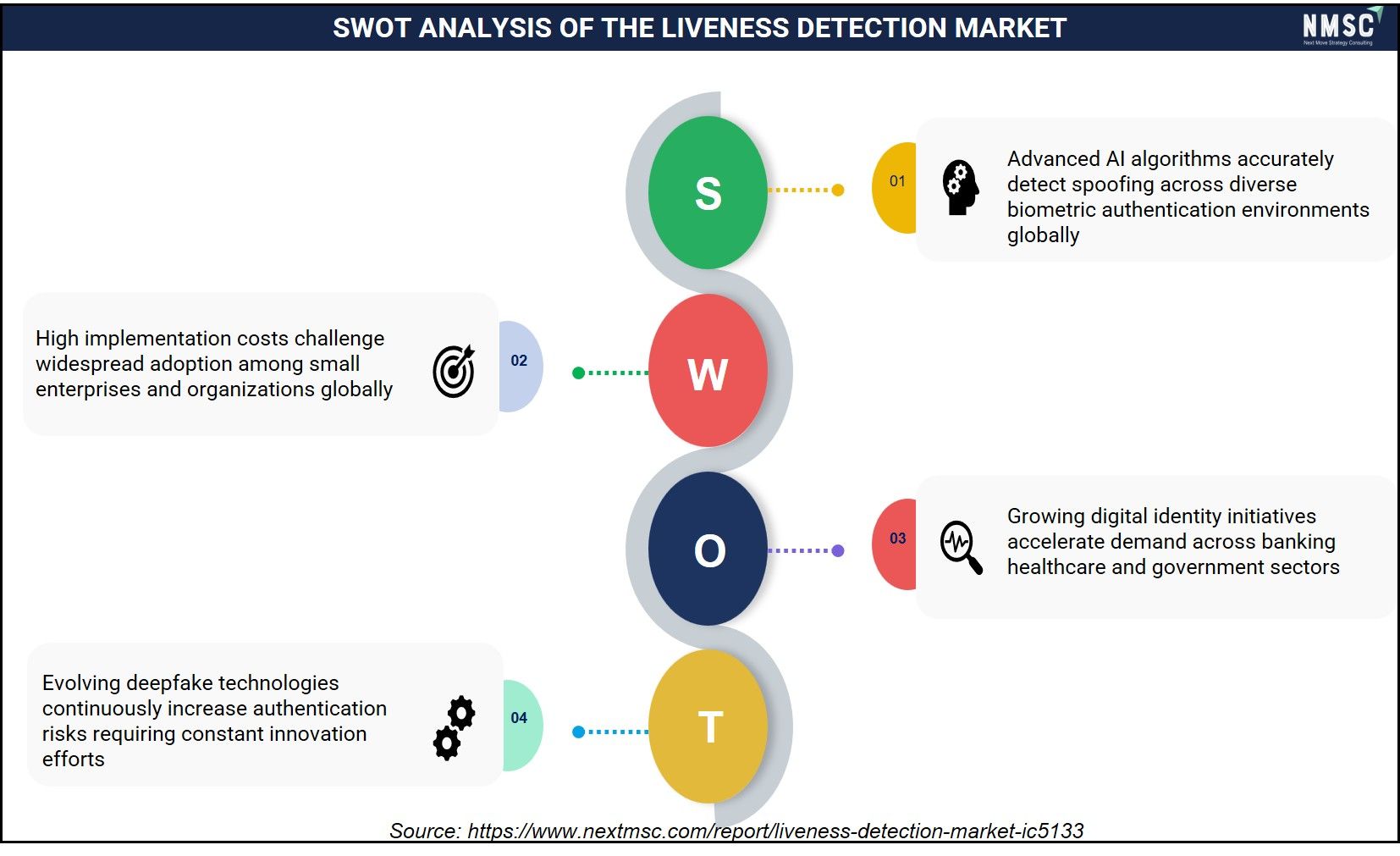
Based on our SWOT assessment, we observed that advanced AI algorithms capable of accurately detecting spoofing attacks represent a major competitive strength, while high implementation costs continue to limit widespread adoption among small organizations. Moreover, our industry analysis indicates that expanding digital identity initiatives create substantial growth opportunities, whereas increasingly sophisticated deepfake technologies and evolving authentication threats require continuous innovation to maintain security and market competitiveness.
Competitive Landscape
We observed that the liveness detection market features a moderately consolidated competitive landscape, with global biometric identity specialists competing alongside cloud-platform providers and regional Asian technology vendors on accuracy, certification, and integration flexibility.
|
Dimension |
Description |
|
Market Structure |
Moderately consolidated; the top companies profiled in this report collectively account for a majority of global liveness detection market revenue, while numerous regional Asia-Pacific vendors serve cost-sensitive document-detection demand. |
|
Innovation Focus |
Multimodal detection architectures, deepfake-resistant AI models, and edge-optimized processing dominate current innovation pipelines across leading vendors. |
|
M&A Activity |
Selective consolidation through platform acquisitions and strategic partnerships, exemplified by identity-verification providers integrating specialized liveness engines to broaden multimodal detection capabilities. |
How Do Companies Compete in the Liveness Detection Market?
Companies compete primarily on detection accuracy, certification credentials, and integration flexibility across the industry. Global players such as IDEMIA Group and Thales Group leverage broad biometric portfolios to serve government and enterprise clients, while specialized providers such as iProov and FaceTec compete on presentation-attack-detection accuracy and rapid API integration for digital identity platforms.
Which Competitive Archetypes Dominate the Liveness Detection Market?
Two archetypes dominate the Liveness Detection market: diversified global biometric groups offering full-service identity-verification suites, and specialized detection vendors focused on high-accuracy, certification-led liveness engines. NEC Corporation and Thales Group exemplify the diversified archetype through integrated biometric-to-identity platform offerings, while iProov and FaceTec exemplify the specialized archetype serving certification-sensitive banking and government demand.
How Are Companies Differentiating Through Innovation in Liveness Detection?
Innovation and differentiation strategy increasingly center on deepfake-resistant AI models and multimodal detection engineering. iProov's Dynamic Liveness and FaceTec's 3D face-mapping technology both target certification under ISO/IEC 30107-3 to secure banking and government procurement approval. Our analysis shows that vendors unable to demonstrate credible presentation-attack-detection accuracy risk exclusion from enterprise request-for-proposal shortlists in North America and Europe.
What M&A and Expansion Activity Is Shaping the Liveness Detection Market?
Mergers, acquisitions, and geographic expansion continue to consolidate identity-verification capabilities within the industry. Identity-verification platforms such as Jumio and Mitek Systems continue to expand liveness detection functionality through product integration and strategic partnerships, while Entrust Corporation's biometric-identity portfolio consolidation illustrates how diversified groups pursue geographic expansion across BFSI, government, and healthcare end markets.
Key Market Players
Our assessment indicates that the following 20 companies are actively shaping product innovation, certification strategy, and geographic expansion within the global liveness detection market.
-
NEC Corporation
-
Thales Group
-
Amazon Web Services, Inc.
-
Microsoft Corporation
-
FaceTec, Inc.
-
Entrust Corporation
-
iProov Limited
-
Veriff, Inc.
-
Mitek Systems, Inc.
-
Daon, Inc.
-
Innovatrics s.r.o.
-
Sumsub Limited
-
Aware, Inc.
-
Regula Forensics Inc.
-
Facephi Biometrics S.A.
-
Yoti Ltd.
-
Intellicheck, Inc.
-
Fourthline B.V.
Latest Developments
We found that recent product launches within the liveness detection market are concentrated on deepfake-resistant and multimodal detection architectures, reflecting the industry's broader shift toward layered fraud prevention.
|
Date |
Event |
|
June 2026 |
In a significant legal development, the U.S. Patent Trial and Appeal Board (PTAB) upheld all four of FaceTec's foundational 3D liveness detection patents in Inter Partes Review (IPR) proceedings initiated by Jumio Corporation. This "total victory" has major implications for the competitive landscape, as FaceTec proceeds with infringement lawsuits against both Jumio and iProov, asserting its intellectual property in 3D face biometric verification |
|
June 2026 |
Match Group's "Face Check" Expansion: Tinder's "Face Check" biometric identity feature, powered by FaceTec's 3D liveness technology, was recognized as a 2026 "World Changing Idea" by Fast Company. This adoption by a major consumer platform highlights the trend of bringing high-assurance biometrics into mainstream social and dating ecosystems to reduce "bad actor" interactions. |
Expert Insights

“Liveness verification is becoming an essential extra element in biometric identity systems. For instance, if a security check requires a selfie for facial recognition, a criminal could try to present a photo or video instead of a real-time live selfie. Liveness detection can combat these efforts by helping to determine if it's a real, live person in the selfie.”
— Ricardo Amper, Founder & CEO, Incode Technologies
Statement made in a World Economic Forum article discussing the growing importance of liveness verification in biometric identity systems amid the rising sophistication of AI-generated deepfakes and presentation attacks. Amper emphasized that liveness detection plays a critical role in distinguishing genuine users from fraudulent attempts using photos, videos, or synthetic media.
Market Interpretation
The statement highlights the increasing importance of liveness detection as a foundational layer of modern biometric authentication systems in response to the growing threat of AI-generated deepfakes and identity spoofing. As digital onboarding, remote identity verification, and passwordless authentication continue to expand across banking, healthcare, government, and enterprise applications, organizations are increasingly adopting AI-powered liveness detection technologies to verify the physical presence of legitimate users while preventing presentation attacks. This evolving security landscape is accelerating demand for advanced liveness detection solutions capable of enhancing trust, strengthening fraud prevention, and ensuring regulatory compliance in digital identity ecosystems.
Investment Opportunities
What Capital Inflows Are Targeting the Liveness Detection Market?
Capital inflows into the liveness detection market are increasingly directed toward AI model development and deepfake-detection research. Strategic acquirers and venture investors continue to fund identity-verification platform consolidation, as seen in ongoing product-integration activity among leading vendors. We observed that investors favor vendors demonstrating validated certification credentials, viewing regulatory alignment as a proxy for long-term enterprise contract retention.
How Is Infrastructure Investment Supporting Liveness Detection Deployment?
Infrastructure investment is expanding cloud-processing and edge-computing capacity to support rising digital account opening volumes across Asia-Pacific and North America. Our findings suggest that vendors are investing in scalable API infrastructure to improve response-time consistency for enterprises processing high-volume identity-verification transactions across banking, telecom, and e-commerce applications.
What ESG Considerations Are Shaping Liveness Detection Investment Decisions?
Environmental, social, and governance considerations are increasingly relevant to investment decisions, with data-privacy governance and equitable algorithmic performance as key criteria. The U.S. National Institute of Standards and Technology's biometric evaluation programs continue to inform bias-testing disclosures across demographic groups. We found that investors increasingly favor vendors with third-party algorithmic-fairness testing, treating it as a governance indicator alongside data-protection compliance.
Key Benefits for Stakeholders
How Does This Report Benefit Enterprise and Industry Leaders?
Enterprise and industry leaders gain access to validated segmentation, competitive benchmarking, and regional demand forecasts that support vendor-selection and deployment decisions across the liveness detection industry. Our analysis shows that detailed deployment-mode, application, and commercial-model breakdowns help procurement teams align specifications with regulatory and fraud-prevention requirements while identifying underserved application segments for portfolio expansion.
How Does This Report Benefit Investors and Financial Analysts?
Investors and financial analysts benefit from consistent, single-point market size and CAGR estimates that support valuation and capital-allocation decisions across the liveness detection market supply chain. We observed that the report's regional and segment-level growth differentials help identify which vendors are best positioned to capture above-market growth in multimodal and edge-based detection categories through 2035.
How Does This Report Benefit Technology Vendors and Product Teams?
Technology vendors and product teams gain insight into emerging design requirements, including multimodal detection, deepfake-resistant AI, and edge-optimized processing, that are reshaping the industry. Our findings suggest that this analysis helps R&D teams prioritize development roadmaps around certification pathways and layered fraud-prevention mechanisms increasingly required by enterprise request-for-proposal processes.
Key Market Segments
By Product Type
-
Face Detection
-
Active Face
-
Passive Face
-
Hybrid Face
-
-
Voice Detection
-
Active Voice
-
Passive Voice
-
Hybrid Voice
-
-
Document Detection
-
Physical Presence
-
Reproduction
-
Tamper
-
-
Multimodal Detection
-
Face and Document
-
Face and Voice
-
Face and Device Signal
-
-
Other Biometric Detection
-
Fingerprint
-
Iris
-
Palm
-
Behavioural
-
By Component
-
Software
-
Application Programming Interface
-
Software Development Kit
-
Standalone Software
-
-
Services
-
Professional
-
Integration
-
Managed
-
Support and Maintenance
-
By Deployment Mode
-
Cloud
-
Public Cloud
-
Private Cloud
-
Hybrid Cloud
-
-
On Premise
-
Edge
By Application
-
Digital Account Opening
-
Identity Verification
-
User Authentication
-
Access Control
-
Age Verification
-
Fraud Prevention
-
Border Control
-
Account Recovery
-
Electronic Signature Verification
-
Other Applications
By Commercial Model
-
Per Transaction
-
Subscription
-
Annual License
-
Perpetual License
By Enterprise Size
-
Large Enterprises
-
SMEs
By Sales Channel
-
Direct Sales
-
Value Added Resellers
-
System Integrators
-
Independent Software Vendors
-
Cloud Marketplace
By End User
-
BFSI
-
Government and Public Sector
-
Healthcare
-
Telecommunications
-
Retail and Electronic Commerce
-
Travel and Hospitality
-
Gaming and Gambling
-
Education
-
Automotive
-
Other Industries
By Region
-
North America: U.S., Canada, Mexico
-
Europe: UK, Germany, France, Italy, Spain, Sweden, Denmark, Finland, Netherlands, Rest of Europe
-
Asia-Pacific: China, India, Japan, South Korea, Taiwan, Indonesia, Vietnam,Australia, Philippines, Malaysia, Rest of APAC
-
Middle East & Africa: Saudi Arabia, UAE, Egypt, Israel, Turkey, Nigeria, South Africa, Rest of MEA
-
Latin America: Brazil, Argentina, Chile, Colombia, Rest of LATAM
Conclusion and Recommendations
What Is the Long-Term Outlook for the Liveness Detection Market?
The long-term outlook for the market remains highly positive, with global revenue projected to expand more than fivefold from USD 1.42 billion in 2025 to USD 7.85 billion by 2035 at an 18.9% CAGR. We observed that escalating deepfake threats, regulatory-driven certification adoption, and multimodal detection expansion will continue underpinning demand across BFSI, government, and healthcare applications through the forecast period.
What Strategic Positioning Should Liveness Detection Vendors Pursue?
Vendors should prioritize multimodal and edge-capable detection platforms while pursuing ISO/IEC 30107-3 certification to secure long-term enterprise contracts. Our assessment indicates that providers investing early in deepfake-resistant AI capability and privacy-preserving architectures will be best positioned to capture premium pricing within the liveness detection market.
How Attractive Is the Liveness Detection Market for New Investment?
The liveness detection industry presents a highly attractive investment case, supported by a USD 6.20 billion absolute dollar opportunity between 2026 and 2035 and above-average growth in Asia-Pacific and multimodal detection categories. We found that investment attractiveness is highest for vendors combining certification credentials with scaled cloud infrastructure, positioning them to serve both cost-sensitive and premium enterprise segments simultaneously.
What Market Shifts and Key Risks Should Stakeholders Monitor?
Stakeholders should monitor data-privacy regulation, escalating deepfake sophistication, and fragmented regional certification standards as key risks to the liveness detection market. Our analysis shows that vendors unable to adapt to multimodal detection specifications risk losing enterprise contracts to competitors with certified, deepfake-resistant platforms, particularly within Europe's increasingly regulated data-protection environment.
What Are the Key Growth Pathways for the Liveness Detection Market?
Key growth pathways include expanding multimodal and edge-based detection portfolios, scaling AI-driven deepfake-detection capability, and deepening penetration into healthcare and government institutional channels. Next Move Strategy Consulting's analysis indicates that vendors pursuing these pathways while maintaining certification leadership will be best positioned to capture the liveness detection market's projected growth through 2035.
About the Author
 Saista Faiyaz
— Saista Faiyaz is Research Associate at Next Move Strategy Consulting, where she has covered consumer markets and healthcare technologies for 3 years. Her work includes primary interview review, secondary-source validation, market sizing, and structured analysis of company and industry data. She supports research by comparing evidence across sources, organizing findings into market narratives, and documenting assumptions used in analysis. Her scope includes cross-market benchmarking, and reports.
Saista Faiyaz
— Saista Faiyaz is Research Associate at Next Move Strategy Consulting, where she has covered consumer markets and healthcare technologies for 3 years. Her work includes primary interview review, secondary-source validation, market sizing, and structured analysis of company and industry data. She supports research by comparing evidence across sources, organizing findings into market narratives, and documenting assumptions used in analysis. Her scope includes cross-market benchmarking, and reports.
About the Reviewer
 Supradip Baul
— Supradip Baul is an accomplished business consultant and strategist with over a decade of rich experience in market intelligence, strategy, technology, and business transformation. His work has included rigorous qualitative and quantitative analysis across multiple industries, helping clients shape investment decisions and long-term roadmaps. Earlier in his career, he was associated with Gartner, where he contributed to industry-leading reports and market share analyses. He has worked with leading global companies and holds an MBA with a dual specialization in Marketing and Finance.
Supradip Baul
— Supradip Baul is an accomplished business consultant and strategist with over a decade of rich experience in market intelligence, strategy, technology, and business transformation. His work has included rigorous qualitative and quantitative analysis across multiple industries, helping clients shape investment decisions and long-term roadmaps. Earlier in his career, he was associated with Gartner, where he contributed to industry-leading reports and market share analyses. He has worked with leading global companies and holds an MBA with a dual specialization in Marketing and Finance.
At Next Move Strategy Consulting, we understand that insightful market research is the cornerstone of successful business decisions. That's why we employ a robust and multifaceted approach, combining various methodologies to deliver the most accurate and actionable data for our clients.

Research Landscape
We navigate the world of research with two primary approaches:
Qualitative Approach
Our qualitative research methodologies involve immersive techniques such as in-depth interviews, focus groups, and observational studies. By engaging directly with individuals and stakeholders, we uncover valuable insights that quantitative data alone may overlook.

Quantitative Research
In tandem with qualitative methodologies, NMSC leverages the power of Quantitative Research to provide a robust foundation of numerical insights. Through systematic data collection and analysis, we quantify patterns, preferences, and market trends, offering a comprehensive view of the business landscape.
Our quantitative research approach employs diverse tools, including surveys, experiments, and statistical modelling. These methodologies enable us to gather data from a large and representative sample, ensuring the statistical significance of our findings. By employing structured questionnaires and standardized data collection methods, we guarantee the reliability and validity of the information we present to our clients.
Quantitative research is particularly effective in measuring the prevalence of trends, assessing market size, and gauging the impact of various factors on consumer behavior. The numerical precision attained through this approach equips our clients with actionable insights, facilitating data-driven decision-making and strategy formulation.


Our Specialized Toolbox for Industry-Specific Market Research
We deploy a specialized arsenal of techniques tailored to meet your unique requirements. Here's a glimpse into our comprehensive toolbox:

Information Procurement
The stage entails acquiring market data or relevant information through various sources and methodologies.


Market Research Approach
We utilize both top-down and bottom-up approaches in market research analysis to achieve a comprehensive understanding of the market dynamics, leveraging the broad perspective of industry trends and macroeconomic factors alongside detailed insights from specific segments and individual companies.

Porters Five Forces Analysis
We conduct Porter's Five Forces analysis to evaluate the competitive landscape of an industry, providing us with insights into factors that affect profitability and strategic positioning.

SWOT Analysis

Forecasting
We utilize a forecasting model to predict future consumption by considering parameters like population, economics, regulations, market competition, drivers, constraints, technology, and pricing. We also employ statistical techniques such as multilinear regression, exponential smoothing, moving average, ARIMA, and Monte Carlo simulations for accurate predictions. In econometric forecasting, we analyzed short-term and long-term event impacts, attributing values based on regulatory frameworks, economic factors, and market events.





 Speak to Our Analyst