Anomaly Detection Market Size, Share and Growth Analysis, By Offering (Software and Services), By Buyer Workflow (Cybersecurity, IT Operations and Observability, Fraud and Financial Crime, Industrial and Asset Monitoring, Data and Business Analytics, and Horizontal Anomaly Detection Platforms), By Deployment (Cloud, On Premise, and Hybrid), By Data Type, By Detection Logic, By Organization Size, By Sales Channel, By Industry Vertical, and Region — Global Industry Report and Forecast, 2026–2035
Industry: ICT & Media | Publishing Date: July 21, 2026 | Last Updated: September 30, 2026 | No of Pages: N/A | No. of Tables: N/A | No. of Figures: N/A | Format: PDF | Report Code: IC5272
What Is the Anomaly Detection Market Size?
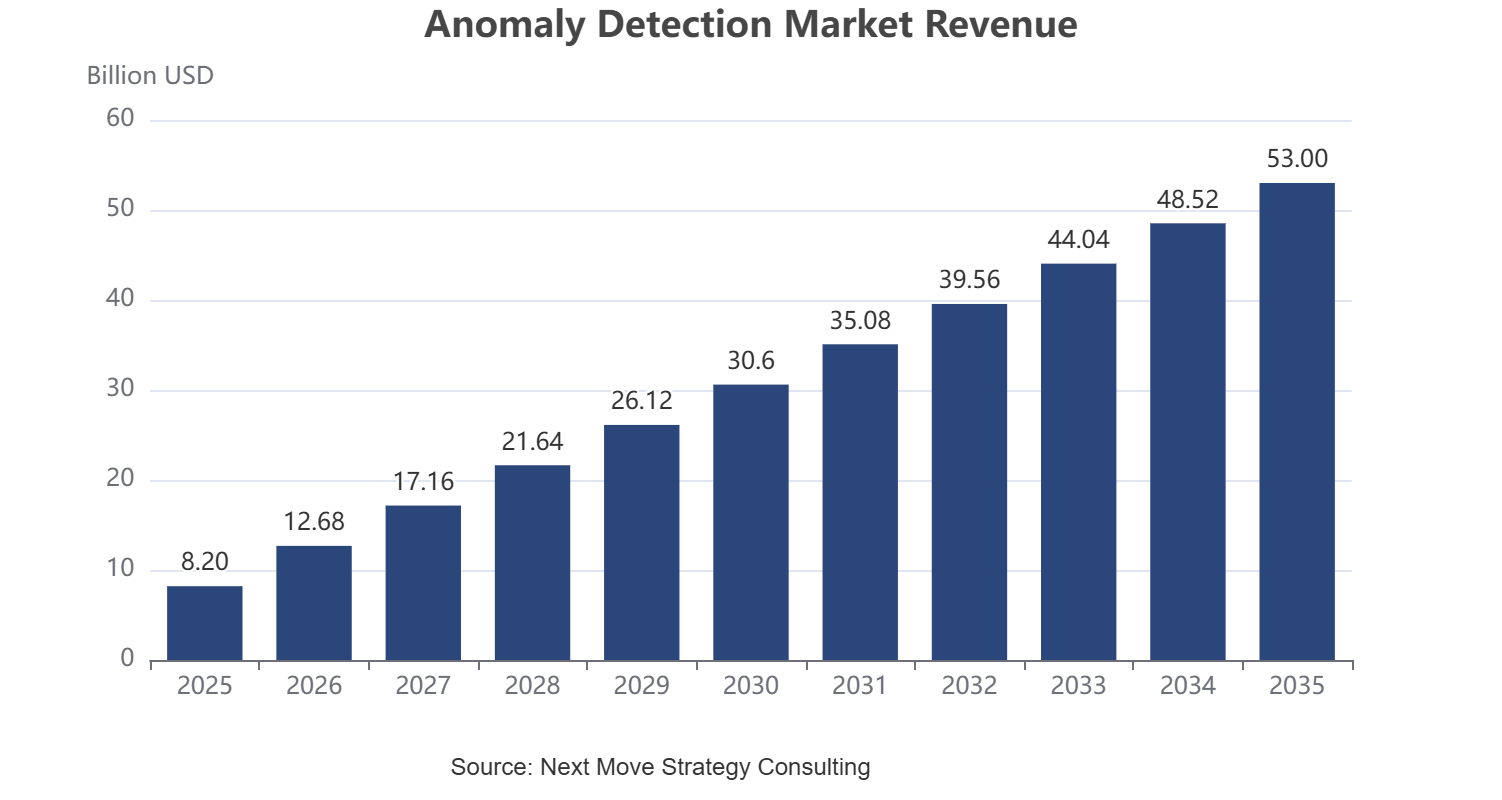
The global anomaly detection market size was valued at USD 8.20 billion in 2025 and is estimated at USD 9.90 billion in 2026, forecast to reach USD 53.00 billion by 2035, expanding at a 20.5% CAGR between 2026 and 2035. North America leads with approximately 42% share, while cybersecurity leads with approximately 28% share.
We observed that the growth is broad-based across every segmentation axis, with agentic AI adoption and cloud-native observability platforms driving the dominant structural shifts through 2035.
|
Key Takeaways |
Details |
|
By Offering |
Software held the largest share of approximately 72% (USD 5.90 billion) in 2025; Services is the fastest-growing sub-segment at 24.2% CAGR from 2026–2035. |
|
By Buyer Workflow |
Cybersecurity held the largest share of approximately 28% (USD 2.30 billion) in 2025; IT Operations and Observability is the fastest-growing sub-segment at 23.2% CAGR from 2026–2035. |
|
By Deployment |
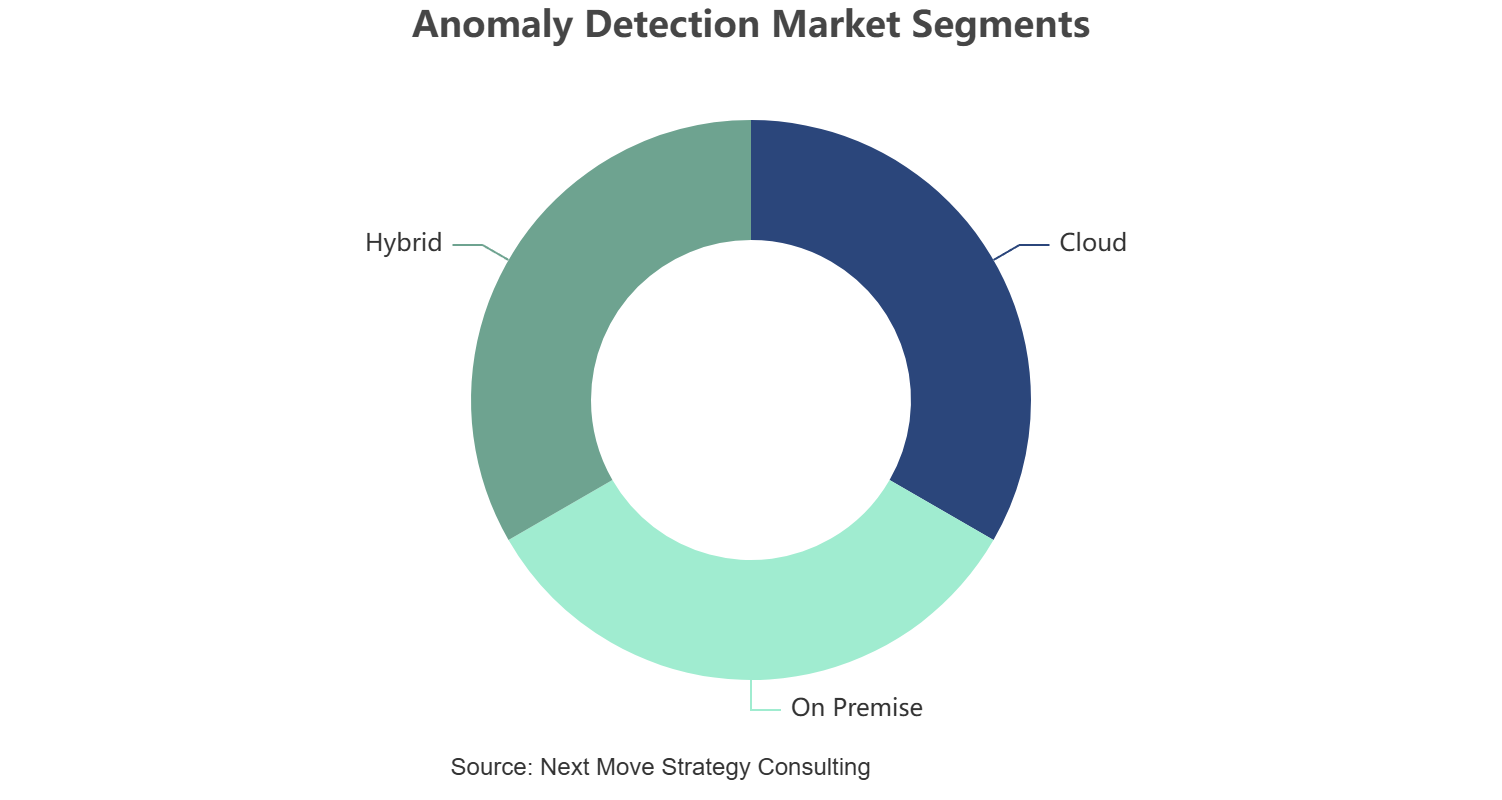
Cloud held the largest share of approximately 64% (USD 5.25 billion) in 2025; Hybrid is the fastest-growing sub-segment at 24.0% CAGR from 2026–2035. |
|
By Data Type |
Time Series Data held the largest share of approximately 22% (USD 1.80 billion) in 2025; Sensor Data is the fastest-growing sub-segment at 24.3% CAGR from 2026–2035. |
|
By Detection Logic |
Machine Learning held the largest share of approximately 42% (USD 3.44 billion) in 2025; Deep Learning is the fastest-growing sub-segment at 27.6% CAGR from 2026–2035. |
|
By Organization Size |
Large Enterprise held the largest share of approximately 52% (USD 4.26 billion) in 2025; Small Business is the fastest-growing sub-segment at 24.1% CAGR from 2026–2035. |
|
By Sales Channel |
Direct Sales held the largest share of approximately 48% (USD 3.93 billion) in 2025; Cloud Marketplace is the fastest-growing sub-segment at 25.5% CAGR from 2026–2035. |
|
By Industry Vertical |
Banking Financial Services and Insurance held the largest share of approximately 26% (USD 2.13 billion) in 2025; Transportation and Logistics is the fastest-growing sub-segment at 23.2% CAGR from 2026–2035. |
|
Dominant Region |
North America dominated with approximately 42% revenue share (USD 3.44 billion) in 2025. |
|
Fastest-Growing Region |
Asia-Pacific is expected to register the highest CAGR of 23.5% during 2026–2035. |
|
Dominant Country |
U.S. led with approximately USD 2.86 billion in 2025. |
|
Fastest-Growing Country |
India is the fastest-growing country at approximately 25.6% CAGR from 2026–2035. |
Market Opportunity: The anomaly detection market is expected to create an absolute dollar opportunity of USD 43.10 billion between 2026 and 2035, presenting significant investment potential across cybersecurity, observability, and fraud prevention platforms.
According to NMSC analysis, enterprises are increasingly consolidating cybersecurity, IT operations, and fraud detection anomaly workflows onto shared machine learning infrastructure rather than siloed point tools, a shift that favors vendors with cross-domain data ingestion capability as buyers rationalize technology stacks through 2035.
What Does the Anomaly Detection Market Encompass?
The anomaly detection market encompasses software platforms and services that apply statistical, machine learning, and deep learning methods to identify deviations from expected behavior across network traffic, user identity, application performance, financial transactions, industrial equipment, and business data. Our assessment indicates that the scope spans standalone platforms, embedded modules, and embedded APIs deployed across cybersecurity, IT operations and observability, fraud and financial crime, industrial and asset monitoring, and data and business analytics buyer workflows, serving organizations seeking to convert high-volume telemetry and transaction data into automated, real-time deviation alerts.
The category has evolved from rule-based statistical outlier detection into self-learning platforms that continuously retrain on network, identity, and transaction baselines. The Payment Card Industry Data Security Standard version 4.0, with mandatory automated anomaly detection provisions that took effect March 31, 2025, and the U.S. Securities and Exchange Commission’s cybersecurity incident disclosure rules are reshaping how enterprises document detection and response capability. We observed that vendors are responding by embedding agentic AI investigation and automated remediation directly into detection platforms, while cloud-native observability providers increasingly bundle anomaly detection with broader monitoring and security telemetry.
|
Parameters |
Details |
|
Market Size in 2025 |
USD 8.20 Billion |
|
Market Size in 2026 |
USD 9.90 Billion |
|
Revenue Forecast in 2035 |
USD 53.00 Billion |
|
Growth Rate |
CAGR of 20.5% from 2026 to 2035 |
|
Analysis Period |
2025–2035 |
|
Base Year Considered |
2025 |
|
Forecast Period |
2026–2035 |
|
Market Size Estimation |
Revenue (USD Billion) |
|
Companies Profiled |
20 |
|
Countries Covered |
33 |
|
Market Share |
Available for Top 10 Companies |
Key Emerging Trends
Based on research conducted by NMSC, we found that four structural trends are reshaping product development, regulatory compliance, and stakeholder engagement across the industry.
How Is Agentic AI Transforming Anomaly Investigation?
Agentic AI is replacing manual alert triage with autonomous agents that investigate and act on detected anomalies with minimal analyst intervention. We observed that CrowdStrike’s April 2026 Agentic MDR offering combines elite analyst expertise with intelligent agents to automate high-friction security workflows, with GM and VP Austin Murphy stating that agentic defense is now a requirement against AI-powered adversaries. Enterprises are adopting these agent-based workflows to reduce alert fatigue and accelerate investigation across cybersecurity, observability, and fraud detection use cases.
Why Is Causal and Root Cause Analytics Gaining Adoption?
Statistical outlier flagging is giving way to causal analytics that trace anomalies to their precise root cause rather than surfacing isolated alerts. Our findings suggest that Dynatrace’s Davis AI engine, which determines exact cause-and-effect relationships across service dependencies, contributed to 19% subscription revenue growth and 16% annual recurring revenue growth in the company’s fiscal first quarter of 2026. IT operations teams are integrating causal anomaly analytics into incident response to reduce false positives and shorten mean time to resolution.
How Is Regulation Reshaping Payment Fraud Anomaly Detection?
Heightened payment security regulation is accelerating mandatory adoption of automated anomaly detection across transaction monitoring systems. We observed that PCI DSS 4.0’s automated technical solution requirements, which became fully mandatory on March 31, 2025, require organizations to continuously detect and prevent web-based payment attacks rather than relying on periodic manual review. Payment processors and merchants are upgrading transaction monitoring infrastructure to satisfy these continuous detection requirements ahead of compliance assessments.
What Role Does AI Observability Play in Data and Business Analytics?
Anomaly detection is expanding beyond infrastructure monitoring into observability of AI systems themselves, including large language model outputs and agentic application behavior. Next Move Strategy Consulting’s analysis indicates that Datadog’s February 2026 introduction of AI Guard for real-time prompt and response evaluation, alongside its Data Observability capability for AI pipeline lineage, illustrates how vendors are extending anomaly detection into AI reliability monitoring. Enterprises are adopting these tools to detect model drift and unreliable AI agent behavior before it reaches production workloads.
Growth Drivers and Restraints
Growth Catalyst and Risk Assessment Matrix
|
Factors |
Type |
(+/-) % Impact on CAGR |
Geographic Relevance |
Impact Timeline |
|
Rising adoption of agentic AI in security and IT operations |
Driver |
+3.4% |
Global |
2026–2035 |
|
PCI DSS 4.0 mandatory automated anomaly detection provisions |
Driver |
+2.3% |
Global |
2026–2033 |
|
Growing AI workload observability and LLM reliability monitoring |
Driver |
+2.1% |
North America, Europe |
2026–2035 |
|
Expansion of real-time payment and digital transaction volumes |
Driver |
+1.8% |
Global |
2026–2035 |
|
Rising industrial IoT sensor deployment and predictive maintenance |
Driver |
+1.5% |
Asia-Pacific, North America |
2026–2035 |
|
SEC and CISA cybersecurity incident disclosure requirements |
Driver |
+1.2% |
North America |
2026–2034 |
|
Alert fatigue and false positive rates in legacy rule-based systems |
Restraint |
−1.5% |
Global |
2026–2032 |
|
Data privacy and cross-border data residency restrictions |
Restraint |
−1.0% |
Europe, Asia-Pacific |
2026–2035 |
|
Shortage of skilled data science and security analytics talent |
Restraint |
−0.7% |
Global |
2026–2035 |
What Is the Primary Growth Driver of the Anomaly Detection Market?
How Is Agentic AI Driving Market Growth?
Rapid enterprise adoption of agentic AI in security and IT operations is the primary driver of the market. Dynatrace reported fiscal first-quarter 2026 subscription revenue growth of 19% and logs consumption growth of more than 100% year-over-year, reflecting accelerating demand for AI-driven observability and anomaly analytics. We observed that this adoption curve is reinforced by enterprises replacing manual, threshold-based alerting with autonomous agents capable of investigating and correlating anomalies across cybersecurity, application, and infrastructure telemetry in real time.
How Is Payment Security Regulation Driving Market Growth?
Mandatory payment security compliance requirements are accelerating investment in automated anomaly detection infrastructure. The Payment Card Industry Data Security Standard 4.0 required organizations to implement automated technical solutions for continuous web-based attack detection by March 31, 2025, with non-compliance penalties reaching up to USD 500,000. Our assessment indicates that payment processors and merchants are prioritizing real-time transaction anomaly detection platforms to satisfy these continuous monitoring obligations, sustaining demand for fraud and financial crime detection solutions.
What Is Restraining Anomaly Detection Market Expansion?
Alert fatigue and false positive rates in legacy rule-based systems restrain near-term platform expansion, particularly among organizations with limited security operations staffing. Darktrace’s 2026 State of AI Cybersecurity survey found that reducing alert volume and fatigue ranked among the lower priorities cited by chief information security officers relative to improving detection of new and unknown threats, reflecting persistent skepticism toward unproven detection tools. We found that vendors are responding by emphasizing explainable, low-false-positive detection models to rebuild buyer confidence and shorten evaluation cycles.
Segmentation Analysis
By Buyer Workflow
Segment Sizing: By Buyer Workflow
|
Segment |
2025 (USD) |
2035 (USD) |
CAGR% (2026–2035) |
|
Cybersecurity |
USD 2.30 Billion |
USD 12.72 Billion |
18.6% |
|
IT Operations and Observability |
USD 1.80 Billion |
USD 14.50 Billion |
23.2% |
|
Fraud and Financial Crime |
USD 1.97 Billion |
USD 10.60 Billion |
18.3% |
|
Industrial and Asset Monitoring |
USD 0.82 Billion |
USD 5.83 Billion |
21.7% |
|
Data and Business Analytics |
USD 0.90 Billion |
USD 6.70 Billion |
22.2% |
|
Horizontal Anomaly Detection Platforms |
USD 0.41 Billion |
USD 2.65 Billion |
20.5% |
|
Total |
USD 8.20 Billion |
USD 53.00 Billion |
20.5% |
Which Buyer Workflow Dominates the Anomaly Detection Market?
Cybersecurity led the market with USD 2.30 billion in 2025, reflecting mature network, identity, endpoint, and cloud threat detection deployment across enterprises defending against escalating attack volumes. We observed that IT Operations and Observability is the fastest-growing buyer workflow, expanding at a 23.2% CAGR from 2026 to 2035, as enterprises increasingly deploy AIOps and causal analytics to manage the operational complexity of AI infrastructure and cloud-native application environments.
By Industry Vertical
Segment Sizing: By Industry Vertical
|
Segment |
2025 (USD) |
2035 (USD) |
CAGR% (2026–2035) |
|
Banking Financial Services and Insurance |
USD 2.13 Billion |
USD 11.66 Billion |
18.5% |
|
Information Technology and Telecommunications |
USD 1.64 Billion |
USD 10.07 Billion |
19.9% |
|
Manufacturing |
USD 0.98 Billion |
USD 6.89 Billion |
21.5% |
|
Energy and Utilities |
USD 0.66 Billion |
USD 4.77 Billion |
21.9% |
|
Healthcare and Life Sciences |
USD 0.74 Billion |
USD 5.30 Billion |
21.8% |
|
Retail and E Commerce |
USD 0.90 Billion |
USD 5.83 Billion |
20.5% |
|
Government and Defense |
USD 0.57 Billion |
USD 4.24 Billion |
22.2% |
|
Transportation and Logistics |
USD 0.33 Billion |
USD 2.65 Billion |
23.2% |
|
Media and Entertainment |
USD 0.16 Billion |
USD 1.06 Billion |
20.8% |
|
Other Industries |
USD 0.09 Billion |
USD 0.53 Billion |
19.4% |
|
Total |
USD 8.20 Billion |
USD 53.00 Billion |
20.5% |
Which Industry Vertical Leads Anomaly Detection Market Demand?
Banking Financial Services and Insurance remained the leading industry vertical, valued at USD 2.13 billion in 2025, as financial institutions deploy anomaly detection across payment fraud, account takeover, and anti-money-laundering transaction monitoring under sustained regulatory pressure. Our findings suggest that Transportation and Logistics is the fastest-growing vertical, registering a 23.2% CAGR from 2026 to 2035, as fleet operators and logistics providers adopt sensor-based equipment health monitoring and route anomaly analytics to reduce downtime and improve delivery reliability.
By Data Type
Segment Sizing: By Data Type
|
Segment |
2025 (USD) |
2035 (USD) |
CAGR% (2026–2035) |
|
Time Series Data |
USD 1.80 Billion |
USD 10.67 Billion |
19.5% |
|
Log and Event Data |
USD 1.64 Billion |
USD 10.07 Billion |
19.9% |
|
Transaction Data |
USD 1.48 Billion |
USD 8.48 Billion |
19.1% |
|
Network Data |
USD 1.15 Billion |
USD 6.36 Billion |
18.6% |
|
Identity Data |
USD 0.74 Billion |
USD 5.30 Billion |
21.8% |
|
Sensor Data |
USD 0.66 Billion |
USD 5.83 Billion |
24.3% |
|
Text Data |
USD 0.49 Billion |
USD 4.24 Billion |
24.1% |
|
Multimedia Data |
USD 0.24 Billion |
USD 2.05 Billion |
23.9% |
|
Total |
USD 8.20 Billion |
USD 53.00 Billion |
20.5% |
Which Data Type Leads the Anomaly Detection Market?
Time Series Data led the market with USD 1.80 billion in 2025, reflecting its foundational role across infrastructure monitoring, financial markets, and industrial equipment telemetry analysis. Based on research conducted by NMSC, we found that Sensor Data is the fastest-growing data type, expanding at a 24.3% CAGR from 2026 to 2035, as industrial IoT deployment accelerates predictive maintenance and equipment health monitoring adoption across manufacturing and energy sectors.
Strategic Framework of the Anomaly Detection Market
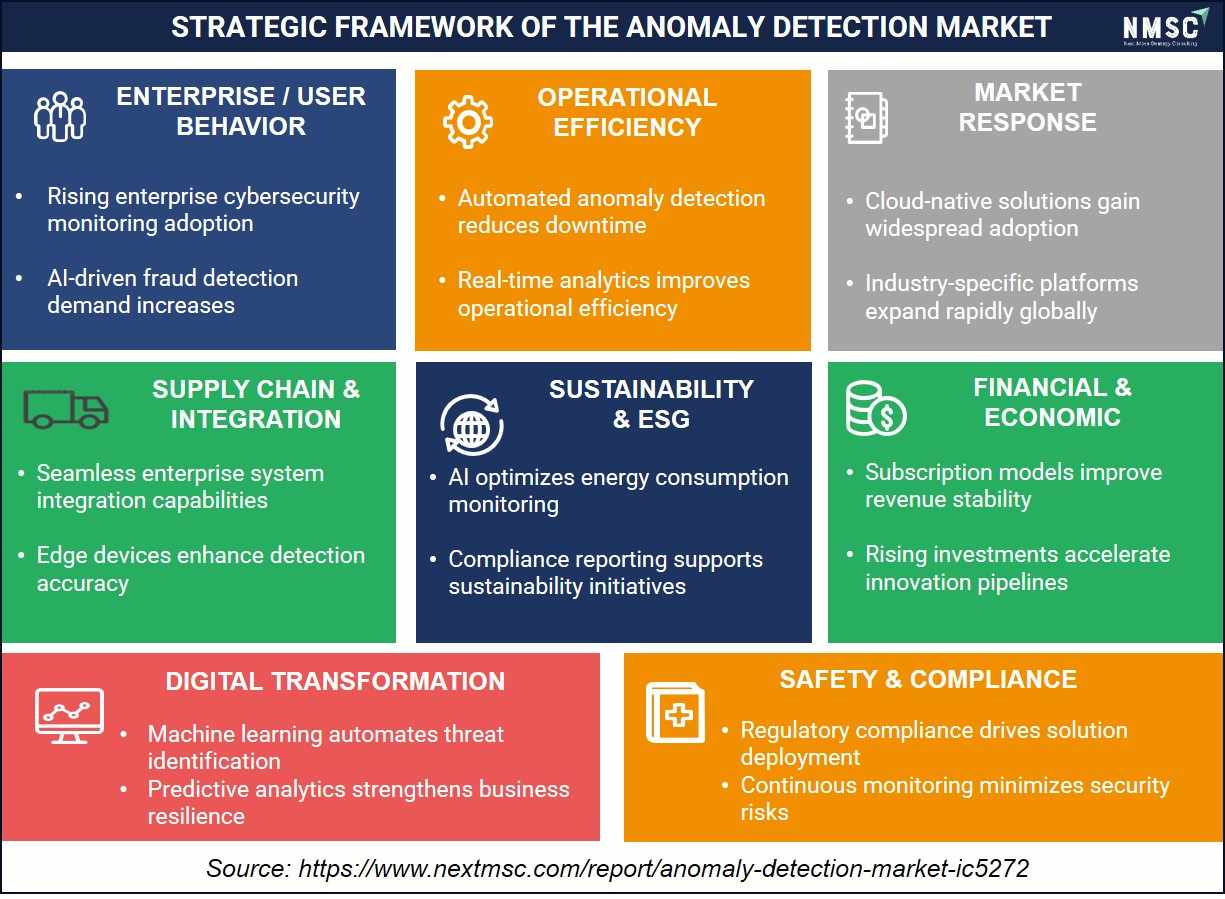
The strategic framework of the Anomaly Detection Market highlights the key factors shaping market growth, including enterprise adoption, operational efficiency, digital transformation, and regulatory compliance. Advances in AI-driven analytics, cloud-native architectures, edge computing, and predictive monitoring are enabling organizations to improve threat detection, optimize operations, strengthen business resilience, and support sustainable, data-driven decision-making across industries.
Growth Opportunities
Our analysis shows that three forward-looking opportunities stand out for stakeholders positioning within the anomaly detection market over the 2026–2035 forecast period.
How Can Agentic Investigation Unlock Value for IT Operations Teams?
IT operations teams overwhelmed by alert volume represent a whitespace opportunity for vendors offering agentic, causal root cause analytics. Dynatrace’s Davis AI, which determines exact cause-and-effect relationships rather than surfacing isolated statistical outliers, illustrates how causal analytics reduce false positives and investigation time. Vendors that extend agentic investigation capability into AIOps workflows stand to capture recurring subscription revenue from the fastest-growing buyer workflow through 2035.
Where Does AI Workload Observability Create New Demand?
Enterprises deploying large language models and agentic applications represent an underpenetrated opportunity for anomaly detection extended into AI reliability monitoring. Datadog’s February 2026 introduction of AI Guard and Data Observability, designed to evaluate prompt and response behavior and trace AI pipeline data lineage, illustrates the emerging AI observability category. Vendors that extend anomaly detection into model drift and agent behavior monitoring can capture new revenue as enterprises scale production AI deployments.
How Can Embedded APIs Expand Adoption Among Software Vendors?
Software vendors that need anomaly detection without building in-house data science teams create an opportunity for embedded, API-based detection engines. Horizontal, general-purpose anomaly detection platforms that expose embeddable APIs allow product teams to add detection capability directly into existing applications. Vendors that package cross-functional detection logic into lightweight, developer-friendly APIs stand to capture disproportionate share of the OEM and embedded sales channel through 2035.
Regional Outlook
Geographic Performance Snapshot
|
Region |
2025 (USD) |
2035 (USD) |
CAGR% (2026–2035) |
Key Driver |
|
North America |
USD 3.44 Billion |
USD 19.08 Billion |
18.7% |
Mature cybersecurity and observability platform adoption |
|
Europe |
USD 1.97 Billion |
USD 11.40 Billion |
19.2% |
Data protection enforcement and payment security compliance |
|
Asia-Pacific |
USD 1.80 Billion |
USD 14.84 Billion |
23.5% |
Expanding digital payment volumes and industrial IoT adoption |
|
Middle East & Africa |
USD 0.57 Billion |
USD 4.50 Billion |
23.0% |
Digital banking transformation and national cybersecurity programs |
|
Latin America |
USD 0.42 Billion |
USD 3.18 Billion |
22.4% |
Expanding fintech transaction volumes and fraud monitoring adoption |
|
Total |
USD 8.20 Billion |
USD 53.00 Billion |
20.5% |
— |
North America Anomaly Detection Market Outlook
North America leads the anomaly detection market, anchored by mature cybersecurity and observability platform adoption alongside an established base of enterprise software vendors including Microsoft, Amazon, and CrowdStrike. We observed that the SEC’s cybersecurity incident disclosure rules and the Cyber Incident Reporting for Critical Infrastructure Act, with final rules expected as early as May 2026, are reshaping detection and reporting practices across the region’s regulated industries. Technology adoption remains advanced, with agentic AI copilots increasingly embedded into security and IT operations workflows, while competitive intensity stays high among incumbent vendors defending large enterprise accounts.
Europe Anomaly Detection Market Outlook
Europe’s anomaly detection market reflects a mature but increasingly compliance-conscious landscape shaped by regional data protection and payment security enforcement. Our findings suggest that financial institutions and enterprises across Germany, France, and the UK are accelerating adoption of automated transaction and network anomaly detection to satisfy PCI DSS 4.0 and national payment security obligations. Technology adoption favors cloud-native deployment, supported by vendors such as SAP and Elastic investing in compliant, auditable detection architectures across the bloc.
Asia-Pacific Anomaly Detection Market Outlook
Asia-Pacific is the fastest-growing anomaly detection market region, propelled by expanding digital payment volumes and industrial IoT adoption across China and India. We observed that regional manufacturers and financial institutions are scaling predictive maintenance and real-time fraud screening capability to support rapidly growing digital commerce and industrial automation. Competitive intensity is elevated among domestic and international vendors competing for share in the region’s fast-growing cybersecurity and fraud detection infrastructure base.
Middle East & Africa Anomaly Detection Market Outlook
The anomaly detection market in Middle East & Africa is expanding as Gulf Cooperation Council economies pursue digital banking transformation and national cybersecurity strategies that require modern, AI-enabled threat and fraud detection infrastructure. Our analysis shows that Saudi Arabia and the UAE are attracting significant fintech and government cybersecurity investment under national digital economy programs. Regulatory influence remains moderate, while technology adoption is accelerating as regional banks and government agencies implement AI-driven anomaly detection to compete with international standards.
Latin America Anomaly Detection Market Outlook
Latin America’s anomaly detection market is supported by an expanding fintech transaction base and growing fraud monitoring adoption in Brazil and Argentina. We observed that regulatory frameworks are less stringent than in North America or Europe, though multinational banks and payment processors operating locally are introducing anomaly detection specifications to match global standards. Technology adoption remains concentrated among larger banks and fintech lenders, with competitive intensity increasing as regional providers partner with global anomaly detection vendors.
U.S. Anomaly Detection Market
Based on our estimates, the U.S. market was valued at approximately USD 2.86 billion in 2025 and is projected to reach USD 15.46 billion by 2035, growing at a 18.4% CAGR. Demand is anchored by mature cybersecurity, observability, and fraud detection adoption alongside heightened SEC and CISA disclosure requirements. Technology penetration favors agentic AI investigation tools, and competitive intensity remains high among established vendors including Microsoft, CrowdStrike, and Datadog serving national enterprise accounts.
Canada Anomaly Detection Market
The market in Canada reached roughly USD 0.31 billion in 2025 and is forecast to hit USD 1.72 billion by 2035 at a 18.7% CAGR. Demand structure mirrors U.S. cybersecurity and observability adoption patterns, while Canadian financial regulators are monitoring payment security compliance following heightened North American enforcement activity. Technology penetration is rising as national banks and enterprises adopt cloud-based anomaly detection tools, with competitive intensity moderate given reliance on vendors headquartered in the United States.
UK Anomaly Detection Market
As per our estimate, the UK market stood at about USD 0.37 billion in 2025, advancing toward USD 2.05 billion by 2035 at a 18.7% CAGR. Demand is driven by established financial institutions and enterprises navigating national payment security and data protection obligations that increasingly touch automated anomaly detection. Regulatory influence is significant, technology penetration favors cloud-native detection platforms, and competitive intensity remains steady among domestic and European vendors serving UK financial and enterprise brands.
Germany Anomaly Detection Market
According to our analysis, Germany’s market was valued near USD 0.43 billion in 2025 and is set to reach USD 2.39 billion by 2035, expanding at a 18.7% CAGR. Demand structure benefits from a strong domestic manufacturing and financial services base, with SAP headquartered in the country and supplying embedded anomaly detection across enterprise applications. Germany’s data protection enforcement under the EU framework shapes regulatory influence, while technology penetration favors cloud-based detection platforms among leading enterprises.
France Anomaly Detection Market
Based on our estimates, France’s market reached approximately USD 0.28 billion in 2025, projected to climb to USD 1.48 billion by 2035 at a 18.1% CAGR. Demand is supported by France’s prominent banking and telecommunications sector, which shapes adoption of transaction monitoring and network anomaly detection solutions. Regulatory influence from French and EU payment security authorities is notable, and competitive intensity remains high given the concentration of global anomaly detection vendors serving French financial brands.
China Anomaly Detection Market
The market in China stood at roughly USD 0.52 billion in 2025 and is forecast to reach USD 3.86 billion by 2035, registering a 22.2% CAGR. Demand is fueled by a dense base of digital payment platforms and manufacturers adopting real-time fraud and equipment anomaly detection. Regulatory influence is increasing gradually, technology penetration is accelerating through cloud-based deployment, and competitive intensity remains elevated among domestic vendors serving China’s fast-growing digital commerce and industrial sectors.
India Anomaly Detection Market
As per our estimate, India’s market was valued at about USD 0.32 billion in 2025, projected to reach USD 3.12 billion by 2035 at a 25.6% CAGR, the fastest among covered countries. Demand structure reflects rapidly expanding digital payment volumes and IT services sector adoption, with India’s fintech transaction growth among the fastest-growing globally. Regulatory influence remains developing, while technology penetration is rising quickly as domestic and multinational vendors localize anomaly detection platforms to serve India’s expanding digital economy.
Japan Anomaly Detection Market
According to our analysis, Japan’s market reached close to USD 0.27 billion in 2025 and is expected to hit USD 1.78 billion by 2035, growing at a 20.8% CAGR. Demand is supported by Japan’s precision-oriented manufacturing and financial services sectors, which prioritize equipment health monitoring and transaction fraud detection accuracy. Regulatory influence is well established, technology penetration is advancing among domestic enterprises, and competitive intensity remains high among long-standing enterprise software vendors serving Japan’s industry.
South Korea Anomaly Detection Market
Based on our estimates, South Korea’s market stood at approximately USD 0.18 billion in 2025, forecast to reach USD 1.34 billion by 2035 at a 22.2% CAGR. Demand structure benefits from the country’s advanced telecommunications and manufacturing infrastructure alongside growing digital payment fraud detection needs. Technology penetration is high, with domestic and international vendors supplying cloud-based detection platforms, and competitive intensity remains pronounced amid rapid product innovation cycles.
Australia Anomaly Detection Market
The anomaly detection market in Australia reached about USD 0.16 billion in 2025 and is projected to reach USD 1.19 billion by 2035, expanding at a 22.2% CAGR. Demand is supported by a well-established banking sector alongside growing enterprise investment in cloud security and observability. Regulatory influence stems from Australian data protection and payment security guidelines, while technology penetration favors cloud-native platforms amid moderate competitive intensity.
UAE Anomaly Detection Market
As per our estimate, the UAE market was valued near USD 0.14 billion in 2025, projected to reach USD 0.99 billion by 2035 at a 21.6% CAGR. Demand structure is shaped by the UAE’s role as a regional fintech and banking hub anchored by major financial institutions and government cybersecurity programs. Regulatory influence remains moderate, technology penetration is improving through cloud-based platform adoption, and competitive intensity is rising as vendors expand product portfolios to serve Gulf financial markets.
Saudi Arabia Anomaly Detection Market
According to our analysis, Saudi Arabia’s market reached roughly USD 0.16 billion in 2025 and is expected to hit USD 1.17 billion by 2035, growing at a 22.0% CAGR. Demand is driven by Vision 2030-linked digital banking transformation and expanding national cybersecurity investment supported by government-backed digital economy programs. Regulatory influence is developing, and technology penetration is advancing as domestic banks and newly established fintech platforms scale anomaly detection deployment.
South Africa Anomaly Detection Market
Based on our estimates, South Africa’s market stood at about USD 0.07 billion in 2025, forecast to reach USD 0.45 billion by 2035 at a 20.4% CAGR. Demand structure reflects a developing banking and telecommunications sector serving regional Southern African financial and enterprise markets. Regulatory influence remains moderate, technology penetration is gradually improving, and competitive intensity is limited given reliance on international vendors supplying anomaly detection platforms to regional banks and enterprises.
Brazil Anomaly Detection Market
The market in Brazil reached approximately USD 0.20 billion in 2025 and is projected to reach USD 1.40 billion by 2035, registering a 21.5% CAGR. Demand is underpinned by Brazil’s large domestic banking sector and expanding fintech base adopting real-time fraud and transaction anomaly detection. Regulatory influence stems from Brazilian central bank oversight of open finance and payment security, technology penetration favors cloud-based deployment, and competitive intensity remains moderate among regional and international vendors.
Argentina Anomaly Detection Market
As per our estimate, Argentina’s market was valued near USD 0.06 billion in 2025, projected to reach USD 0.45 billion by 2035 at a 22.3% CAGR. Demand structure is supported by steady banking and fintech consumption despite macroeconomic volatility affecting capital investment cycles. Regulatory influence remains limited, technology penetration is modest, and competitive intensity is centered on a small number of vendors serving domestic banks and enterprises across the country.
Competitive Landscape
We observed that the anomaly detection market features a moderately fragmented competitive landscape, with cybersecurity and observability specialists competing alongside diversified cloud platform providers and fraud analytics vendors.
Key Takeaways
|
Dimension |
Description |
|
Market Structure |
Moderately fragmented; the top companies profiled in this report collectively serve a majority of large enterprise and government accounts, while numerous specialized vendors serve mid-market and industry-specific buyers. |
|
Innovation Focus |
Agentic AI investigation, causal root cause analytics, and cross-domain detection platforms connecting cybersecurity, observability, and fraud workflows dominate current innovation pipelines across leading vendors. |
|
M&A Activity |
Active integration and platform partnership expansion, exemplified by Darktrace’s native integration with CrowdStrike Falcon and continued bundling of anomaly detection into broader cloud and security platforms. |
How Do Companies Compete in the Anomaly Detection Market?
Companies compete primarily on detection accuracy, breadth of cross-domain data ingestion, and depth of agentic investigation automation across the industry. Diversified cloud platform vendors such as Microsoft, Amazon, and Google leverage broad infrastructure footprints to embed anomaly detection into existing customer workflows, while specialized vendors including CrowdStrike, Darktrace, and Exabeam compete on domain-specific detection precision for cybersecurity buyers seeking faster, lower-touch deployment.
Which Competitive Archetypes Dominate the Anomaly Detection Market?
Two archetypes dominate the anomaly detection industry: diversified cloud and enterprise software groups offering embedded, cross-functional detection capability, and specialized point-solution vendors focused on a single buyer workflow such as cybersecurity, observability, or fraud. Microsoft and Amazon exemplify the diversified archetype through embedded detection across cloud infrastructure and productivity platforms, while Darktrace and Exabeam exemplify focused, AI-native vendors built specifically around self-learning behavioral analytics.
How Are Companies Differentiating Through Innovation?
Innovation and differentiation strategy increasingly center on agentic AI investigation and causal analytics that extend beyond statistical outlier flagging. CrowdStrike’s Agentic MDR, announced in April 2026, and Dynatrace’s Davis causal AI engine both extend detection into automated root cause investigation and response. Our analysis shows that vendors unable to demonstrate agentic, explainable detection capability risk exclusion from enterprise request-for-proposal shortlists as buyers consolidate technology stacks.
What M&A and Expansion Activity Is Shaping the Market?
Platform integration and partnership expansion continue to consolidate capabilities within the industry. Darktrace’s native integration with CrowdStrike Falcon, which extends Darktrace’s self-learning AI to endpoint telemetry, illustrates how vendors are combining complementary detection domains rather than pursuing outright acquisitions alone. Datadog’s expansion into AI Guard and Data Observability similarly reflects organic capability extension into adjacent anomaly detection use cases, illustrating how diversified groups pursue geographic and functional expansion across the detection value chain.
Porter’s Five Forces Analysis of the Anomaly Detection Market
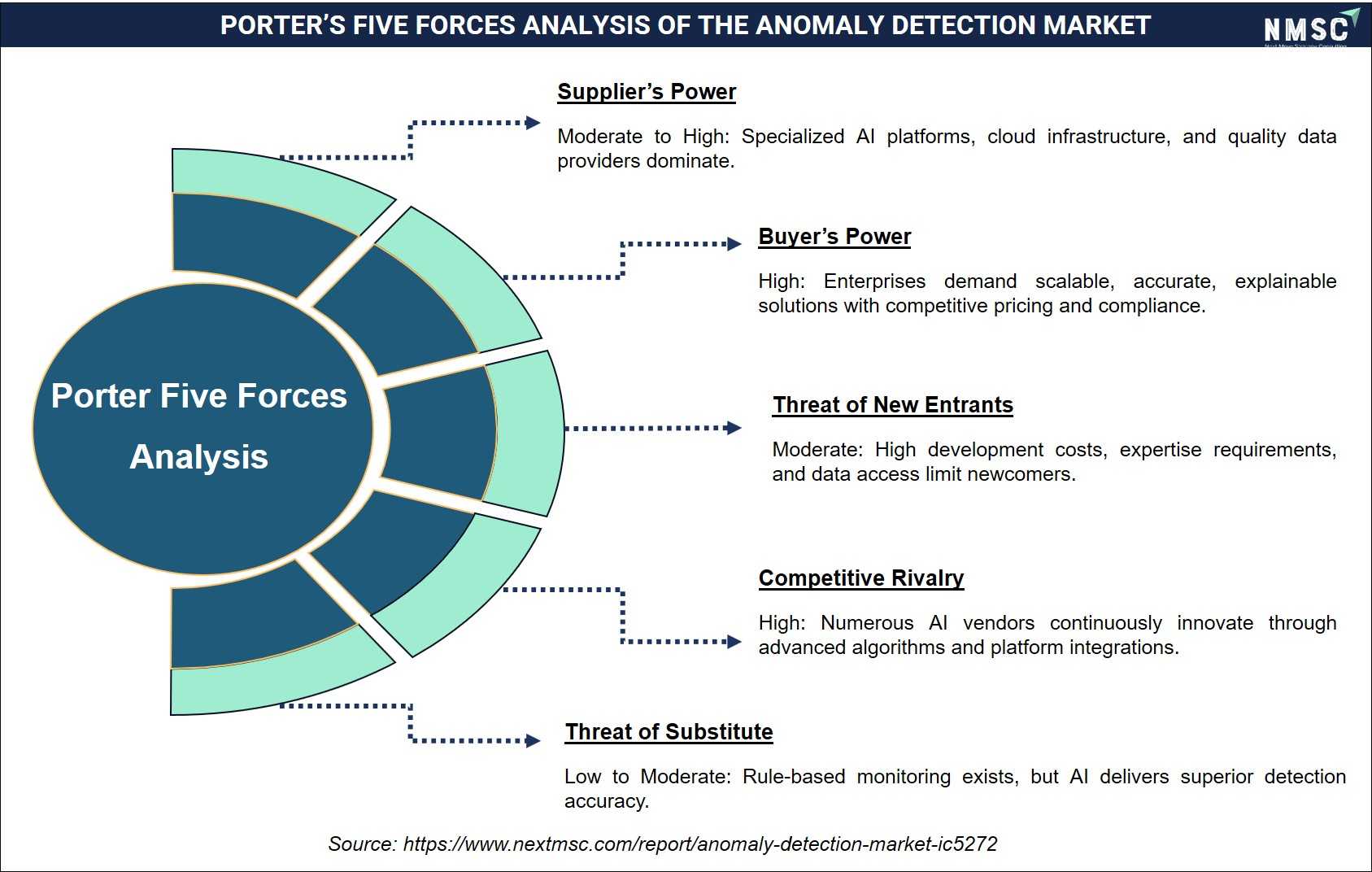
Porter’s Five Forces analysis evaluates the competitive dynamics influencing the Anomaly Detection Market by assessing supplier power, buyer bargaining strength, competitive rivalry, barriers to entry, and substitute technologies. The market is characterized by rapid AI innovation, increasing enterprise demand, and strong competition among analytics platform providers, while high technical expertise and data requirements create significant entry barriers.
Key Market Players
Our assessment indicates that the following 20 companies are actively shaping product innovation, agentic AI capability, and geographic expansion within the global anomaly detection market.
-
Microsoft Corporation
-
Amazon.com Inc.
-
Oracle Corporation
-
Cisco Systems Inc.
-
SAP SE
-
ServiceNow Inc.
-
Palo Alto Networks Inc.
-
Fortinet Inc.
-
CrowdStrike Holdings Inc.
-
Datadog Inc.
-
Dynatrace Inc.
-
SAS Institute Inc.
-
Fair Isaac Corporation
-
Elastic N.V.
-
Darktrace Holdings Limited
-
Rapid7 Inc.
-
Varonis Systems Inc.
-
Exabeam Inc.
Latest Developments
We found that recent developments within the anomaly detection market are concentrated on agentic AI product launches and AI observability expansion, reflecting the industry’s broader shift toward autonomous, cross-domain detection platforms.
|
Date |
Event |
|
Jun 2026 |
AWS enhanced Cost Anomaly Detection with Amazon Q-powered investigations, enabling organizations to automatically identify the root causes of abnormal cloud spending. The update strengthens AI-driven anomaly detection capabilities in FinOps by improving operational visibility, accelerating issue resolution, and enabling proactive cloud cost governance. |
|
May 2026 |
Elastic 9.4 expanded machine learning-driven anomaly analysis across observability and security operations. The release enables organizations to automatically identify abnormal system behavior, correlate events, and accelerate root cause investigations, reinforcing Elastic’s position in AI-powered anomaly detection and operational analytics. |
|
Apr 2026 |
SAP integrated anomaly detection into SAP HANA Cloud’s AI engine, allowing enterprises to detect abnormal business patterns within structured datasets. The enhancement supports predictive analytics, forecasting, and data quality monitoring, expanding anomaly detection adoption across enterprise analytics applications. |
|
Mar 2026 |
IBM introduced anomaly detection capabilities within Db2 Genius Hub to automatically identify abnormal database performance and operational issues. The solution improves enterprise database monitoring through AI-powered diagnostics and predictive analytics, reducing downtime and improving operational resilience. |
|
Jan 2026 |
Oracle introduced OCI Cost Anomaly Detection to automatically identify unexpected cloud spending patterns using machine learning. The service enables organizations to detect abnormal resource consumption, optimize cloud expenditures, and improve financial governance across enterprise cloud environments. |
Investment Opportunities
What Capital Inflows Are Targeting the Anomaly Detection Market?
Capital inflows are increasingly directed toward agentic AI detection platforms and cross-domain observability capability. Dynatrace’s fiscal first-quarter 2026 results, including 12 seven-figure annual contract value deals and a strategic enterprise pipeline that grew nearly 50% year-over-year, illustrate sustained enterprise capital commitment to AI-driven anomaly analytics. We observed that investors favor vendors demonstrating agentic AI differentiation and multi-domain data ingestion, viewing platform breadth as a proxy for durable enterprise contract retention amid intensifying competition.
How Is Infrastructure Investment Supporting Anomaly Detection Platforms?
Infrastructure investment is expanding cloud computing and real-time data-streaming capacity to support increasingly autonomous detection and investigation workflows. Datadog ended 2025 with more than USD 4 billion in cash and securities, supporting continued platform investment and potential tuck-in acquisitions to expand AI observability capability. Our findings suggest that vendors are prioritizing scalable, cloud-native architecture investment to support the high-volume telemetry ingestion required by agentic detection agents operating across enterprise environments.
What ESG Considerations Are Shaping Anomaly Detection Investment Decisions?
Environmental, social, and governance considerations increasingly shape investment decisions, with algorithmic fairness and model transparency emerging as key criteria for fraud and identity detection vendors. FICO’s Falcon platform, which combines consortium fraud models with explainable AI and transparent auditability, reflects growing vendor emphasis on governance-ready detection models. We found that investors increasingly favor vendors with documented model governance and bias-testing practices, treating regulatory readiness as a governance indicator alongside data privacy compliance.
Key Benefits for Stakeholders
How Does This Report Benefit Enterprise and Industry Leaders?
Enterprise and industry leaders gain access to validated segmentation, competitive benchmarking, and regional demand forecasts that support technology-sourcing and platform-consolidation decisions across the anomaly detection industry. Our analysis shows that detailed buyer workflow, data type, and organization size breakdowns help procurement and security operations teams align platform selection with organizational scale and regulatory requirements, while identifying underserved segments such as industrial and asset monitoring for portfolio expansion.
How Does This Report Benefit Investors and Financial Analysts?
Investors and financial analysts benefit from consistent, single-point market size and CAGR estimates that support valuation and capital-allocation decisions across the anomaly detection supply chain. We observed that the report’s regional and segment-level growth differentials help identify which vendors are best positioned to capture above-market growth in IT operations and observability and cloud marketplace categories through 2035, informing diligence on pending and future platform partnership transactions.
How Does This Report Benefit Technology Vendors and Product Teams?
Technology vendors and product teams gain insight into emerging design requirements, including agentic AI automation, causal root cause analytics, and AI workload observability, that are reshaping the industry. Our findings suggest that this analysis helps product teams prioritize development roadmaps around explainability and cross-domain data ingestion capability that are increasingly required by enterprise request-for-proposal processes across cybersecurity, IT operations, and fraud detection buyers.
Key Market Segments
By Offering
-
Software
-
Standalone Platform
-
Embedded Module
-
Embedded API
-
-
Services
-
Consulting
-
Implementation
-
Training
-
Support
-
Managed Services
-
By Buyer Workflow
-
Cybersecurity
-
Network Anomaly Detection
-
Network Traffic Analysis
-
East West Traffic Monitoring
-
Network Intrusion Detection
-
-
Identity Anomaly Detection
-
User Behavior Analytics
-
Privileged Access Monitoring
-
Account Compromise Detection
-
-
Endpoint Anomaly Detection
-
Endpoint Behavior Monitoring
-
Malware Anomaly Detection
-
Device Risk Analytics
-
-
Cloud Anomaly Detection
-
Cloud Workload Monitoring
-
Cloud Configuration Analytics
-
Cloud Threat Detection
-
-
-
IT Operations and Observability
-
Infrastructure Monitoring
-
Server Monitoring
-
Storage Monitoring
-
Network Infrastructure Monitoring
-
-
Application Monitoring
-
Application Performance Monitoring
-
Transaction Monitoring
-
Service Dependency Analysis
-
-
Log Analytics
-
Log Pattern Detection
-
Event Correlation
-
Root Cause Analytics
-
-
AIOps
-
Incident Prediction
-
Alert Correlation
-
Automated Remediation Analytics
-
-
-
Fraud and Financial Crime
-
Payment Fraud Detection
-
Card Transaction Monitoring
-
Digital Payment Monitoring
-
Real Time Fraud Screening
-
-
Account Fraud Detection
-
Account Takeover Detection
-
Identity Fraud Detection
-
Synthetic Identity Detection
-
-
Insurance Fraud Detection
-
Claims Fraud Detection
-
Policy Abuse Detection
-
-
Anti Money Laundering
-
Transaction Monitoring
-
Suspicious Activity Detection
-
-
-
Industrial and Asset Monitoring
-
Equipment Health Monitoring
-
Predictive Maintenance
-
Machine Condition Monitoring
-
Failure Prediction
-
-
Process Monitoring
-
Process Deviation Detection
-
Process Optimization Analytics
-
Production Quality Monitoring
-
-
Energy and Utility Monitoring
-
Grid Monitoring
-
Power Asset Monitoring
-
Utility Infrastructure Monitoring
-
-
-
Data and Business Analytics
-
Data Quality Monitoring
-
Data Drift Detection
-
Data Integrity Monitoring
-
Data Pipeline Monitoring
-
-
Revenue Analytics
-
Revenue Leakage Detection
-
Demand Anomaly Detection
-
Pricing Anomaly Detection
-
-
Customer Analytics
-
Customer Behavior Monitoring
-
Churn Risk Detection
-
Digital Experience Analytics
-
-
Product Analytics
-
Usage Pattern Monitoring
-
Product Performance Analytics
-
Adoption Analytics
-
-
-
Horizontal Anomaly Detection Platforms
-
General Purpose Anomaly Detection Engines
-
Embedded Anomaly Detection APIs
-
Cross Functional Analytics Platforms
-
By Deployment
-
Cloud
-
On Premise
-
Hybrid
By Data Type
-
Time Series Data
-
Log and Event Data
-
Transaction Data
-
Network Data
-
Identity Data
-
Sensor Data
-
Text Data
-
Multimedia Data
By Detection Logic
-
Statistical Methods
-
Machine Learning
-
Deep Learning
-
Rule Based Methods
-
Hybrid Methods
By Organization Size
-
Small Business
-
Medium Business
-
Large Enterprise
-
Government and Public Sector
By Sales Channel
-
Direct Sales
-
Channel Partners
-
Cloud Marketplace
-
OEM and Embedded
By Industry Vertical
-
Banking Financial Services and Insurance
-
Information Technology and Telecommunications
-
Manufacturing
-
Energy and Utilities
-
Healthcare and Life Sciences
-
Retail and E Commerce
-
Government and Defense
-
Transportation and Logistics
-
Media and Entertainment
-
Other Industries
By Region
-
North America: U.S., Canada, Mexico
-
Europe: UK, Germany, France, Italy, Spain, Sweden, Denmark, Finland, Netherlands, Rest of Europe
-
Asia-Pacific: China, India, Japan, South Korea, Taiwan, Indonesia, Vietnam, Australia, Philippines, Malaysia, Rest of APAC
-
Middle East & Africa: Saudi Arabia, UAE, Egypt, Israel, Turkey, Nigeria, South Africa, Rest of MEA
-
Latin America: Brazil, Argentina, Chile, Colombia, Rest of LATAM
Conclusion and Recommendations
What Is the Long-Term Outlook for the Anomaly Detection Market?
The long-term outlook for the market remains strongly positive, with global revenue projected to expand more than sixfold from USD 8.20 billion in 2025 to USD 53.00 billion by 2035 at a 20.5% CAGR. We observed that sustained agentic AI adoption, payment security regulation, and cross-domain expansion into AI workload observability will continue underpinning demand across cybersecurity, IT operations, and fraud detection solutions through the forecast period.
What Strategic Positioning Should Anomaly Detection Suppliers Pursue?
Suppliers should prioritize agentic AI and causal root cause analytics while pursuing cross-domain data ingestion to secure long-term enterprise contracts amid intensifying alert volumes. Our assessment indicates that vendors investing early in explainable detection models, autonomous investigation capability, and AI workload observability, alongside compliance-ready reporting, will be best positioned to capture premium enterprise and government accounts within the anomaly detection market.
How Attractive Is the Anomaly Detection Market for New Investment?
The anomaly detection industry presents an attractive investment case, supported by a USD 43.10 billion absolute dollar opportunity between 2026 and 2035 and above-average growth in Asia-Pacific and small business organization-size categories. We found that investment attractiveness is highest for vendors combining agentic AI differentiation with proven cross-domain detection capability, positioning them to serve both cost-sensitive small business and premium enterprise segments simultaneously.
What Market Shifts and Key Risks Should Stakeholders Monitor?
Stakeholders should monitor alert fatigue skepticism, data privacy and cross-border residency restrictions, and competitive pressure from in-house AI development as key risks to the anomaly detection market. Our analysis shows that vendors unable to demonstrate measurable false-positive reduction risk losing enterprise contracts to competitors with proven, explainable detection frameworks, particularly within North America’s increasingly disclosure-driven regulatory environment.
What Are the Key Growth Pathways for the Anomaly Detection Market?
Key growth pathways include expanding agentic AI investigation portfolios, scaling causal analytics for IT operations teams, and deepening penetration into AI workload observability and industrial asset monitoring segments. NMSC’s analysis indicates that suppliers pursuing these pathways while maintaining explainable, compliance-ready detection models will be best positioned to capture the anomaly detection market’s projected growth through 2035.
About the Author
 Mihul Sharma
— Mihul Sharma is Research Associate at Next Move Strategy Consulting, where he has covered technology, industrial, and healthcare markets for 3 years. His work applies structured business research, market analysis, and secondary-source review to assess market trends, competitive developments, and growth opportunities. He supports report development by fully synthesizing industry data, company information, and market signals into concise findings for strategy and investment-focused research teams.
Mihul Sharma
— Mihul Sharma is Research Associate at Next Move Strategy Consulting, where he has covered technology, industrial, and healthcare markets for 3 years. His work applies structured business research, market analysis, and secondary-source review to assess market trends, competitive developments, and growth opportunities. He supports report development by fully synthesizing industry data, company information, and market signals into concise findings for strategy and investment-focused research teams.
About the Reviewer
 Supradip Baul
— Supradip Baul is an accomplished business consultant and strategist with over a decade of rich experience in market intelligence, strategy, technology, and business transformation. His work has included rigorous qualitative and quantitative analysis across multiple industries, helping clients shape investment decisions and long-term roadmaps. Earlier in his career, he was associated with Gartner, where he contributed to industry-leading reports and market share analyses. He has worked with leading global companies and holds an MBA with a dual specialization in Marketing and Finance.
Supradip Baul
— Supradip Baul is an accomplished business consultant and strategist with over a decade of rich experience in market intelligence, strategy, technology, and business transformation. His work has included rigorous qualitative and quantitative analysis across multiple industries, helping clients shape investment decisions and long-term roadmaps. Earlier in his career, he was associated with Gartner, where he contributed to industry-leading reports and market share analyses. He has worked with leading global companies and holds an MBA with a dual specialization in Marketing and Finance.
At Next Move Strategy Consulting, we understand that insightful market research is the cornerstone of successful business decisions. That's why we employ a robust and multifaceted approach, combining various methodologies to deliver the most accurate and actionable data for our clients.

Research Landscape
We navigate the world of research with two primary approaches:
Qualitative Approach
Our qualitative research methodologies involve immersive techniques such as in-depth interviews, focus groups, and observational studies. By engaging directly with individuals and stakeholders, we uncover valuable insights that quantitative data alone may overlook.

Quantitative Research
In tandem with qualitative methodologies, NMSC leverages the power of Quantitative Research to provide a robust foundation of numerical insights. Through systematic data collection and analysis, we quantify patterns, preferences, and market trends, offering a comprehensive view of the business landscape.
Our quantitative research approach employs diverse tools, including surveys, experiments, and statistical modelling. These methodologies enable us to gather data from a large and representative sample, ensuring the statistical significance of our findings. By employing structured questionnaires and standardized data collection methods, we guarantee the reliability and validity of the information we present to our clients.
Quantitative research is particularly effective in measuring the prevalence of trends, assessing market size, and gauging the impact of various factors on consumer behavior. The numerical precision attained through this approach equips our clients with actionable insights, facilitating data-driven decision-making and strategy formulation.


Our Specialized Toolbox for Industry-Specific Market Research
We deploy a specialized arsenal of techniques tailored to meet your unique requirements. Here's a glimpse into our comprehensive toolbox:

Information Procurement
The stage entails acquiring market data or relevant information through various sources and methodologies.


Market Research Approach
We utilize both top-down and bottom-up approaches in market research analysis to achieve a comprehensive understanding of the market dynamics, leveraging the broad perspective of industry trends and macroeconomic factors alongside detailed insights from specific segments and individual companies.

Porters Five Forces Analysis
We conduct Porter's Five Forces analysis to evaluate the competitive landscape of an industry, providing us with insights into factors that affect profitability and strategic positioning.

SWOT Analysis

Forecasting
We utilize a forecasting model to predict future consumption by considering parameters like population, economics, regulations, market competition, drivers, constraints, technology, and pricing. We also employ statistical techniques such as multilinear regression, exponential smoothing, moving average, ARIMA, and Monte Carlo simulations for accurate predictions. In econometric forecasting, we analyzed short-term and long-term event impacts, attributing values based on regulatory frameworks, economic factors, and market events.





 Speak to Our Analyst