AI Threat Detection Market Size, Share, Trends and Growth Analysis, By Component (Software, Hardware, and Services), By Deployment Mode (Cloud, On Premise, and Hybrid), By Organization Size (Large Enterprises, Medium Enterprises, and Small Enterprises), By Threat Vector, By AI Technology, By Delivery Model, By Sales Channel, By End User Industry, by Region – Global Industry Report and Forecast, 2026–2035
Industry: ICT & Media | Publishing Date: July 20, 2026 | Last Updated: September 30, 2026 | No of Pages: N/A | No. of Tables: N/A | No. of Figures: N/A | Format: PDF | Report Code: IC5255
What Is the AI Threat Detection Market Size?
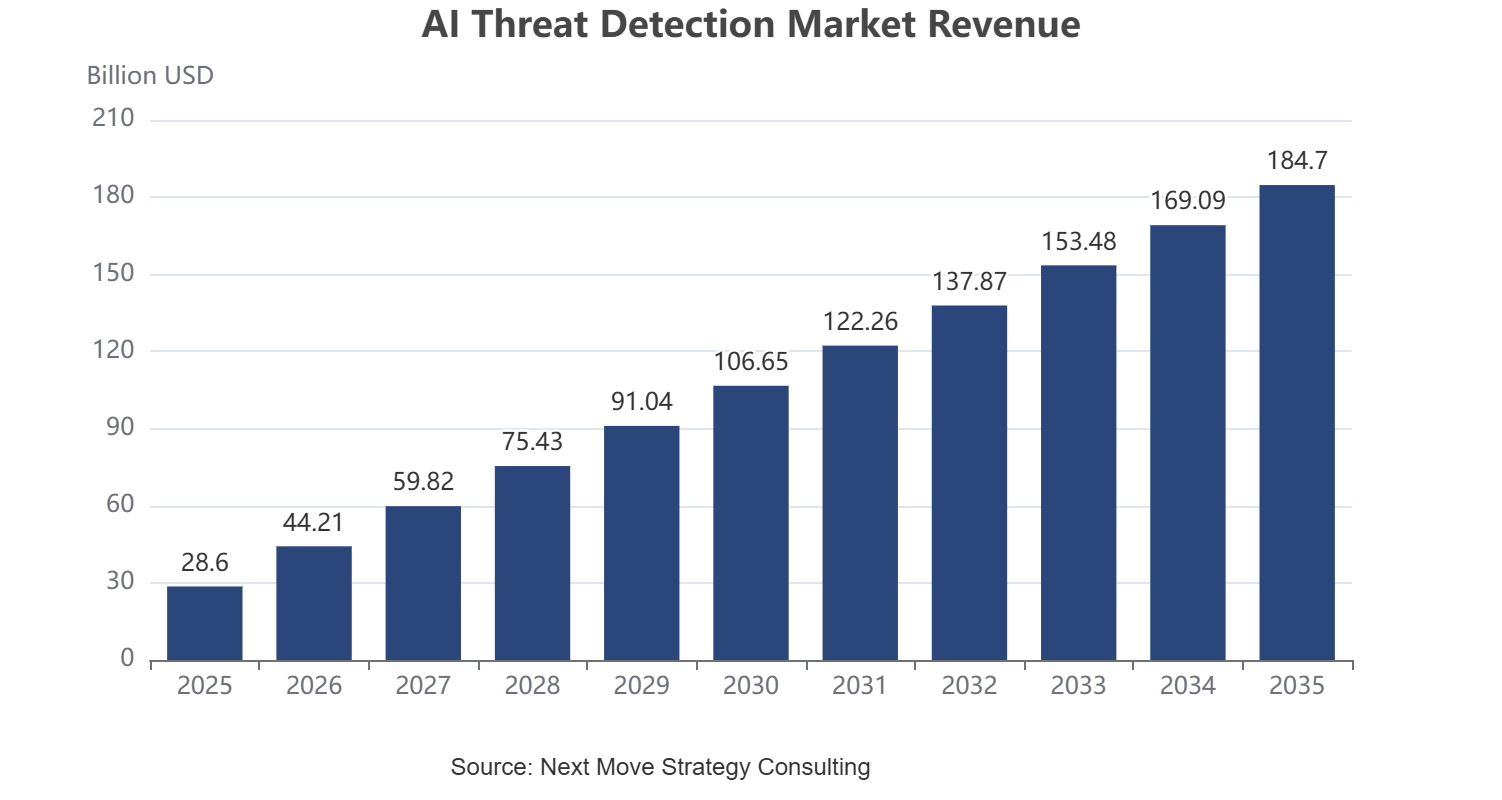
The global AI Threat Detection Market was valued at USD 28.6 Billion in 2025 and is estimated at USD 34.2 Billion in 2026, forecast to reach USD 184.7 Billion by 2035, expanding at a 20.6% CAGR from 2026 to 2035. North America leads with approximately 48.3% revenue share, while under the Component dimension, Software dominates with approximately 78.3% share of 2025 market revenue.
Our analysis shows that growth is structurally broad-based across every segmentation axis, with agentic AI automation, cloud-native threat detection, and regulatory cybersecurity mandates acting as the dominant expansion catalysts through 2035.
|
Key Takeaways |
|
By Component: Software held the largest share of approximately 78.3% (USD 22.4 Billion) in 2025, reaching USD 148.6 Billion by 2035; Services is the fastest-growing sub-segment at 24.6% CAGR from 2026–2035. |
|
By Deployment Mode: Cloud held the largest share of approximately 46.2% (USD 13.2 Billion) in 2025; Cloud is also the fastest-growing sub-segment at 25.2% CAGR from 2026–2035. |
|
By Organization Size: Large Enterprises held the largest share of approximately 58.4% (USD 16.7 Billion) in 2025; Small Enterprises is the fastest-growing sub-segment at 27.1% CAGR from 2026–2035. |
|
By Threat Vector: Endpoint Threats held the largest share of approximately 23.8% (USD 6.8 Billion) in 2025; Application Threats is the fastest-growing sub-segment at 26.1% CAGR from 2026–2035. |
|
By AI Technology: ML held the largest share of approximately 34.3% (USD 9.8 Billion) in 2025; Agentic AI is the fastest-growing sub-segment at 33.0% CAGR from 2026–2035. |
|
By Delivery Model: Standalone Platforms held the largest share of approximately 43.4% (USD 12.4 Billion) in 2025; Managed Services is the fastest-growing sub-segment at 25.1% CAGR from 2026–2035. |
|
By Sales Channel: Direct Sales held the largest share of approximately 39.2% (USD 11.2 Billion) in 2025; Cloud Marketplaces is the fastest-growing sub-segment at 28.0% CAGR from 2026–2035. |
|
By End User Industry: BFSI held the largest share of approximately 25.9% (USD 7.4 Billion) in 2025; E-Commerce is the fastest-growing sub-segment at 26.2% CAGR from 2026–2035. |
|
Dominant Region: North America dominated with approximately 48.3% revenue share (USD 13.6 Billion) in 2025. |
|
Fastest-Growing Region: Latin America is expected to register the highest CAGR of 30.2% during 2026–2035. |
|
Dominant Country: U.S. led with approximately USD 12.2 Billion in 2025. |
|
Fastest-Growing Country: India is the fastest-growing country at approximately 32.1% CAGR from 2026–2035. |
Market Opportunity: The AI Threat Detection Market is expected to create an absolute dollar opportunity of USD 150.5 billion between 2026 and 2035, presenting significant investment potential across AI-powered cybersecurity platforms, cloud security, network security, endpoint protection, threat intelligence, and security operations solutions.
According to NMSC analysis, the convergence of agentic AI orchestration, zero-trust architecture mandates, and the proliferation of cloud-native workloads is fundamentally shifting the competitive advantage in enterprise security from human-speed reactive response toward machine-speed proactive threat neutralization, compressing mean-time-to-detect below one minute for AI-powered vendors.
What does the AI Threat Detection Market Encompass?
The AI Threat Detection Market encompasses the full range of AI-powered software, hardware, and services that identify, analyze, and prioritize security threats across enterprise digital environments in real time. During our market evaluation, we noticed that the scope spans ten software sub-categories — from Endpoint Threat Detection and Extended Threat Detection to Cloud, Application, and Data Threat Detection — alongside network security hardware appliances and a managed services layer that includes MDR, SOC-as-a-Service, and professional implementation. Revenue captured covers licenses, subscriptions, hardware shipments, and contracted service engagements across all organization sizes, deployment modes, and industries globally.
The market evolved from signature-based antivirus and rule-driven SIEM platforms toward behavioral AI and ML-driven detection engines following the 2017–2020 wave of sophisticated nation-state and ransomware campaigns that exposed the limitations of static detection logic. Regulatory mandates — including the U.S. Cybersecurity and Infrastructure Security Agency's Binding Operational Directive 22-01, the EU Network and Information Security Directive 2 (NIS2), and the SEC's cybersecurity disclosure rules effective 2023 — are compelling organizations to adopt documented, auditable AI threat detection capabilities. Technology adoption is now accelerating toward Generative AI threat triage and Agentic AI autonomous response, with hybrid cloud-edge deployment architectures enabling real-time detection without latency constraints.
|
Parameters |
Details |
|
Market Size in 2025 |
USD 28.6 Billion |
|
Market Size in 2026 |
USD 34.2 Billion |
|
Revenue Forecast in 2035 |
USD 184.7 Billion |
|
Growth Rate |
CAGR of 20.6% from 2026 to 2035 |
|
Analysis Period |
2025–2035 |
|
Base Year Considered |
2025 |
|
Forecast Period |
2026–2035 |
|
Market Size Estimation |
Revenue (USD Billion) |
|
Companies Profiled |
20 |
|
Countries Covered |
33 |
|
Market Share |
Available for Top 10 Companies |
Key Emerging Trends
Based on research conducted by NMSC, we found that four structural trends are redefining threat detection architecture, product strategy, and investment priorities across the AI Threat Detection Market.
How Is Agentic AI Redefining Autonomous Threat Response in Cybersecurity?
Agentic AI autonomous AI agents capable of reasoning across multi-step security workflows, executing response actions, and refining detection logic without human prompting — is emerging as the most disruptive architectural shift in the AI Threat Detection Market. We observed that CrowdStrike's Charlotte AI and Microsoft Security Copilot represent early commercial deployments, where AI agents autonomously investigate alerts, correlate indicators of compromise, and initiate containment actions within seconds of detection. This trend is collapsing the analyst skill gap, enabling lean security teams to manage enterprise-grade detection at scale and accelerating the displacement of legacy rule-based SIEM architectures.
Why Is XDR Becoming the Consolidation Platform of Choice for AI Threat Detection?
Extended Detection and Response platforms are consolidating historically fragmented point solutions — EDR, NDR, SIEM, and UEBA — into unified AI analytics engines that correlate telemetry across endpoints, networks, identities, and cloud workloads. Our findings suggest that enterprise security operations teams are actively rationalizing vendor portfolios, and XDR's ability to surface high-fidelity, cross-vector threat narratives from a single pane of glass directly reduces alert fatigue and analyst burnout. Palo Alto Networks' Cortex XSIAM and SentinelOne's Singularity XDR exemplify how platform consolidation generates competitive ecosystem lock-in and recurring subscription revenue streams.
How Is Generative AI Transforming Threat Intelligence Analysis and SOC Productivity?
Generative AI is automating natural language threat report generation, intelligent alert summarization, and adversary technique attribution in security operations centers, materially reducing mean-time-to-respond across the AI Threat Detection Market. NMSC's analysis indicates that security vendors embedding large language model capabilities into analyst workflows are enabling tier-one analysts to handle tier-three complexity investigations, effectively multiplying SOC capacity without proportional headcount growth. Darktrace's Cyber AI Analyst and IBM's Threat Intelligence capabilities illustrate how generative AI overlays transform raw telemetry into executive-ready incident reports, accelerating regulatory disclosure timelines under SEC cybersecurity disclosure requirements.
What Role Does Identity Threat Detection and Response Play in the AI Security Market?
Identity Threat Detection and Response is experiencing accelerated investment following the surge in identity-based attacks — including credential theft, privilege escalation, and machine identity compromise — that have become the leading initial access vector in enterprise breaches. We found that AI-driven behavioral analytics applied to identity telemetry can detect anomalous authentication patterns, impossible travel events, and lateral movement sequences that evade perimeter controls. CyberArk's identity security platform and Microsoft's Entra ID Protection illustrate how privileged identity analytics, integrated with broader XDR ecosystems, provide the high-signal detection layer required to protect hybrid cloud and SaaS-heavy enterprise environments.
Growth Drivers and Restraints
Growth Catalyst and Risk Assessment Matrix
|
Factors |
(+/−) % Impact on CAGR |
Geographic Relevance |
Impact Timeline |
|
Escalating ransomware and nation-state cyberattack frequency |
+2.8% |
Global |
2026–2035 |
|
Regulatory cybersecurity mandates (NIS2, CISA BOD, SEC rules) |
+2.2% |
North America, Europe |
2026–2035 |
|
Agentic AI automation eliminating analyst capacity constraints |
+2.0% |
Global |
2026–2035 |
|
Cloud workload proliferation expanding attack surface |
+1.8% |
Global |
2026–2035 |
|
Zero-trust architecture adoption requiring AI detection layers |
+1.6% |
North America, Europe, APAC |
2026–2035 |
|
MDR and SOC-as-a-Service growth democratizing AI security access |
+1.4% |
SME segments globally |
2027–2035 |
|
AI model adversarial attacks and model poisoning risks |
−1.2% |
Global |
2026–2035 |
|
Cybersecurity talent shortage constraining deployment velocity |
−1.0% |
Global |
2026–2032 |
|
High total cost of ownership for AI threat detection platforms |
−0.8% |
SME, Emerging Markets |
2026–2031 |
|
Data privacy regulations limiting cross-border telemetry sharing |
−0.6% |
Europe, APAC |
2026–2035 |
What Is the Primary Growth Driver of the AI Threat Detection Market?
Escalating ransomware and nation-state cyberattack frequency is the dominant structural driver of the AI Threat Detection Market, creating a compounding demand imperative that traditional security architectures cannot adequately address. The U.S. Cybersecurity and Infrastructure Security Agency reported over 2,000 known exploited vulnerabilities in its catalog as of 2025, with ransomware incidents disrupting critical infrastructure, healthcare systems, and financial institutions across all major geographies. We observed that each high-profile breach event directly accelerates enterprise security investment cycles and compresses procurement decision timelines, particularly for AI-native detection platforms capable of autonomous, real-time threat neutralization.
How Are Regulatory Mandates Driving AI Threat Detection Market Growth?
Regulatory cybersecurity frameworks are converting AI threat detection from a discretionary investment into a compliance obligation across the AI Threat Detection Market's core verticals. The European Union's NIS2 Directive, effective October 2024, mandates advanced incident detection and reporting capabilities for more than 160,000 organizations across critical sectors. The U.S. Securities and Exchange Commission's cybersecurity disclosure rules, effective December 2023, require public companies to disclose material incidents within four business days, compelling firms to deploy AI detection systems capable of real-time anomaly identification. Our assessment indicates that compliance-driven procurement is expanding the total addressable market across government, financial services, and healthcare segments globally.
What Is Restraining AI Threat Detection Market Expansion?
Adversarial attacks targeting AI detection models — including data poisoning, model evasion, and adversarial perturbation techniques — represent the most technically significant restraint on AI Threat Detection Market adoption confidence. The U.S. National Institute of Standards and Technology's AI Risk Management Framework explicitly categorizes adversarial machine learning as a primary trustworthiness risk for AI systems deployed in critical applications. Our findings suggest that security buyers in regulated industries are demanding third-party AI model validation, explainability documentation, and bias audit reports before deployment, extending sales cycles and increasing implementation costs for AI threat detection vendors whose model robustness cannot be independently verified.
Segmentation Analysis
Segment Sizing: By Component
|
Segment |
2025 (USD Billion) |
2035 (USD Billion) |
CAGR% (2026–2035) |
|
Software |
22.4 |
148.6 |
23.8% |
|
Hardware |
2.8 |
15.6 |
18.8% |
|
Services |
3.4 |
20.5 |
21.9% |
|
Total |
28.6 |
184.7 |
20.6% |
Which Component Segment Dominates the AI Threat Detection Market?
Software commanded USD 22.4 Billion in 2025, representing approximately 78.3% of total AI Threat Detection Market revenue, reflecting enterprise demand for EDR, XDR, SIEM, UEBA, and cloud threat detection platforms that deliver AI-powered detection logic without hardware dependency. We found that within Software, Extended Threat Detection and Cloud Threat Detection are the fastest-growing sub-categories, driven by hybrid workload expansion and cross-vector telemetry unification requirements. Services, growing at 21.9% CAGR from 2026 to 2035, represents the fastest-growing top-level component, as MDR, SOC-as-a-Service, and professional implementation engagements scale with increasing platform adoption across mid-market organizations globally.
Segment Sizing: By AI Technology
|
Segment |
2025 (USD Billion) |
2035 (USD Billion) |
CAGR% (2026–2035) |
|
ML |
9.8 |
52.4 |
20.4% |
|
DL |
6.2 |
38.6 |
22.6% |
|
Behavioral Analytics |
4.8 |
28.4 |
21.9% |
|
NLP |
2.4 |
18.2 |
25.2% |
|
Generative AI |
2.8 |
20.4 |
24.6% |
|
Agentic AI |
1.4 |
18.2 |
33.0% |
|
Other AI Technologies |
1.2 |
8.5 |
24.4% |
|
Total |
28.6 |
184.7 |
20.6% |
Which AI Technology Segment Leads the AI Threat Detection Market?
ML retained the dominant AI technology position at USD 9.8 Billion in 2025, underpinning anomaly detection, malware classification, behavioral baselining, and threat scoring engines across virtually all threat detection product categories. Our assessment indicates that Agentic AI is the fastest-growing technology segment at a 33.0% CAGR from 2026 to 2035, expanding from USD 1.4 Billion in 2025 to USD 18.2 Billion by 2035, as vendors embed autonomous investigation and response agents into SOC workflows. Generative AI at a 24.6% CAGR reflects the accelerating integration of large language model capabilities into alert triage, threat report generation, and natural language analyst query interfaces.
Segment Sizing: By Deployment Mode
|
Segment |
2025 (USD Billion) |
2035 (USD Billion) |
CAGR% (2026–2035) |
|
Cloud |
13.2 |
96.4 |
25.2% |
|
On Premise |
9.6 |
52.8 |
20.9% |
|
Hybrid |
5.8 |
35.5 |
22.3% |
|
Total |
28.6 |
184.7 |
20.6% |
Which Deployment Mode Dominates the AI Threat Detection Market?
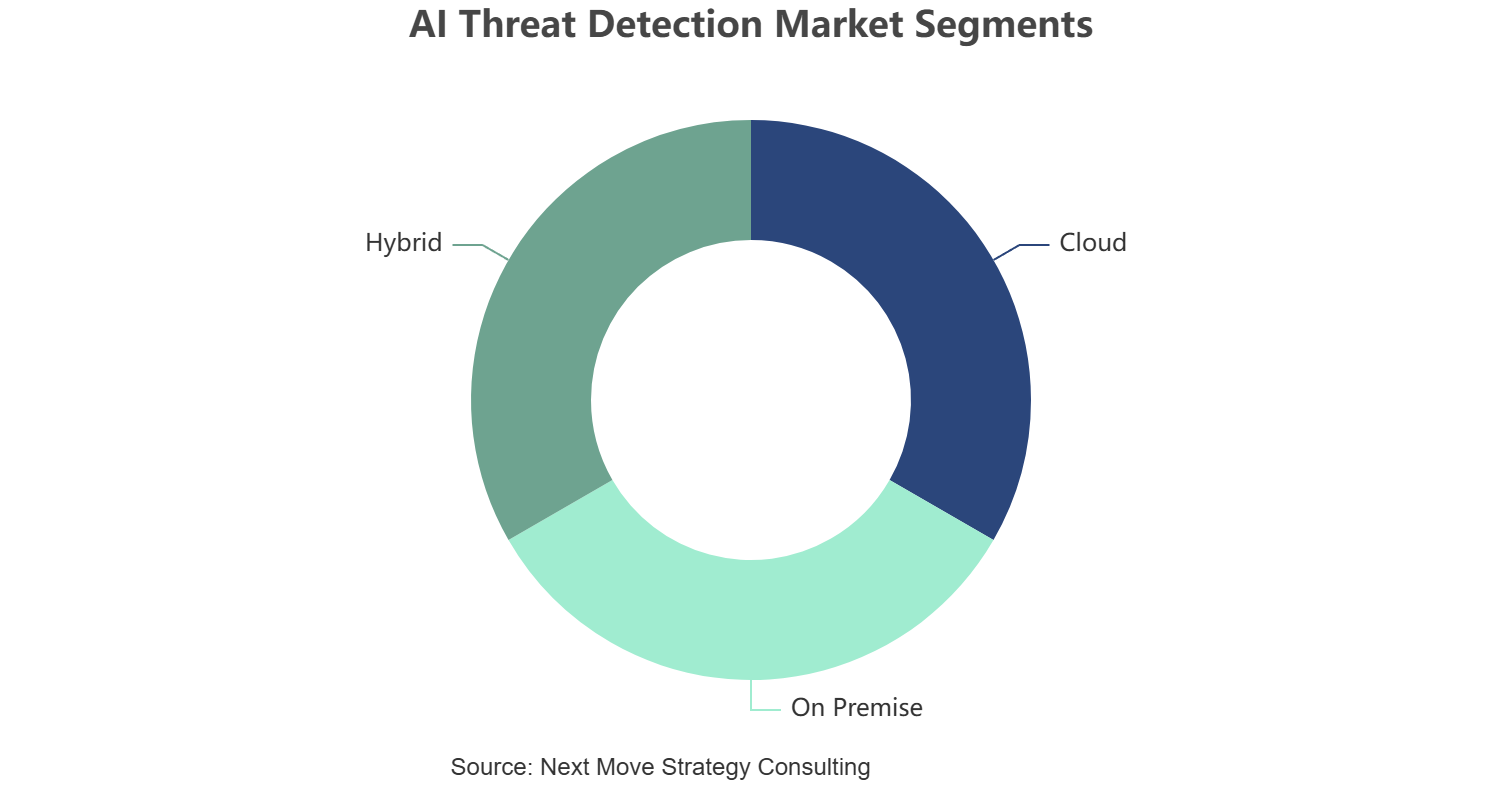
Cloud deployment led the AI Threat Detection Market at USD 13.2 Billion in 2025, representing 46.2% of total revenue, driven by the shift of enterprise workloads to public and hybrid cloud environments, the operational scalability advantages of cloud-native AI detection pipelines, and SaaS licensing models that reduce upfront capital expenditure. NMSC's analysis indicates that Cloud is also the fastest-growing deployment mode at a 25.2% CAGR from 2026 to 2035, projecting USD 96.4 Billion by 2035, as hyperscaler-integrated security platforms from Microsoft, CrowdStrike, and Zscaler capture the majority of net-new enterprise security deployments in cloud-first organizations.
Pain Point Analysis of the AI Threat Detection Market
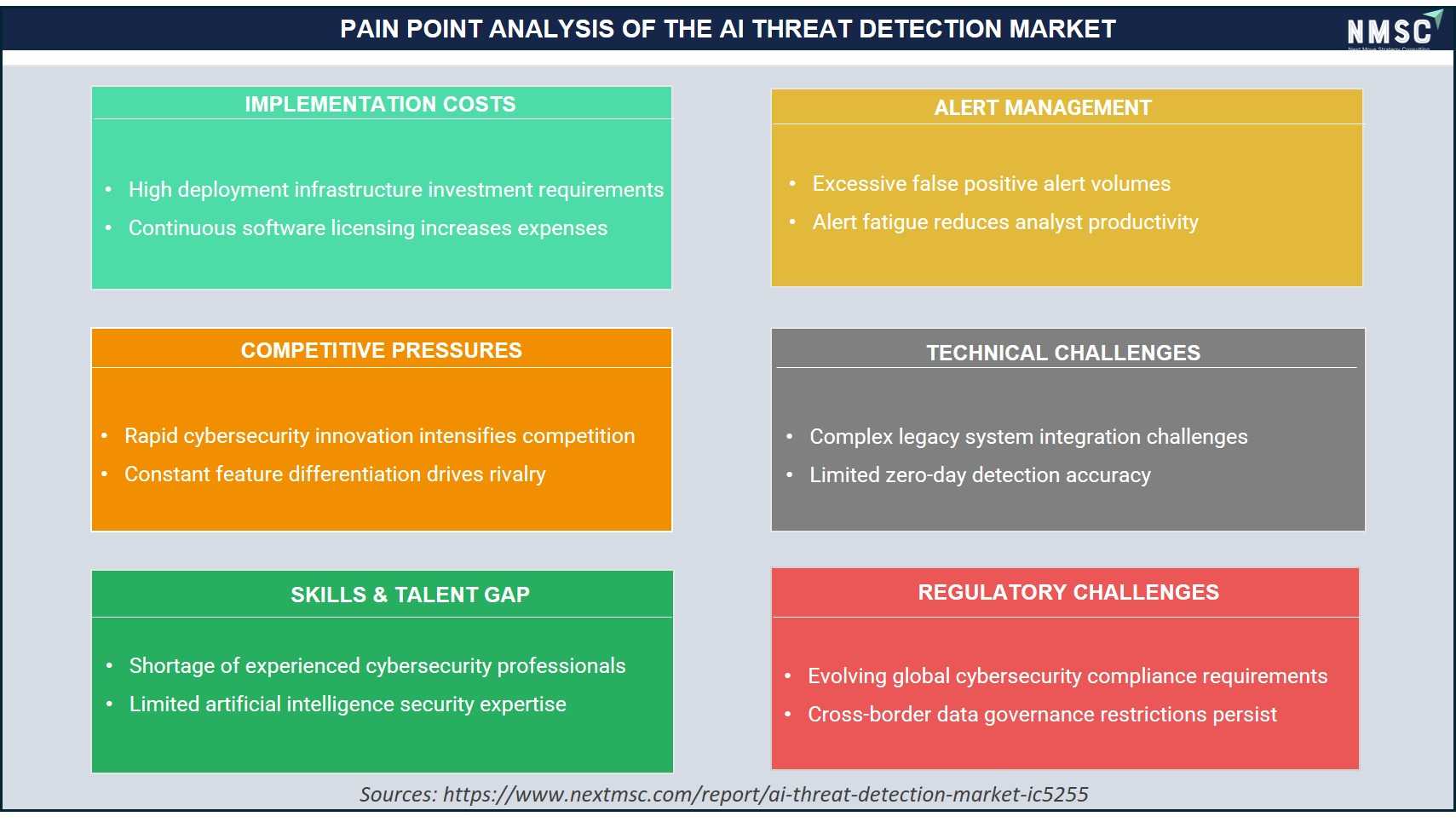
The pain point analysis identifies the primary operational and strategic challenges affecting AI threat detection adoption, including high implementation costs, alert fatigue, technical integration complexity, cybersecurity talent shortages, and evolving regulatory requirements. These factors collectively influence deployment efficiency, detection effectiveness, and return on investment, while shaping vendor differentiation and enterprise decision-making across the cybersecurity ecosystem.
Growth Opportunities
Our assessment indicates that three forward-looking whitespace opportunities represent the highest-potential investment and expansion themes within the AI Threat Detection Market through 2035.
How Does SME Market Penetration Through Managed Detection Services Create a Structural Growth Opportunity?
Small and medium enterprises remain significantly underserved by AI threat detection, constrained by budget limitations and the absence of in-house security expertise, yet they represent the majority of registered businesses globally. MDR and SOC-as-a-Service delivery models that package AI threat detection into affordable, outcome-based subscription contracts create a large greenfield opportunity. Arctic Wolf Networks and ReliaQuest — both profiled in this report — are primary beneficiaries of this democratization trend, with their managed AI detection platforms purpose-built for organizations unable to staff or operate enterprise-grade security operations independently.
Why Does Agentic AI for Autonomous SOC Operations Represent a High-Value Innovation Whitespace?
Agentic AI platforms capable of orchestrating multi-step investigation, threat hunting, and containment workflows without human intervention address the most acute operational bottleneck in security operations: analyst throughput. Vendors that productize agentic AI as a supervisory layer above existing SIEM, XDR, and SOAR investments — rather than requiring rip-and-replace deployments — can capture rapid land-and-expand deals across the installed base. CrowdStrike, Microsoft, and Darktrace are early movers, while specialist agentic AI security startups represent acquisition targets for diversified platform operators seeking to accelerate autonomous SOC capability roadmaps.
How Does the Convergence of AI Threat Detection with OT and IoT Security Create an Emerging Vertical Opportunity?
Operational technology and IoT environments — spanning industrial control systems, medical devices, and smart infrastructure — present an expanding AI threat detection opportunity as nation-state actors increasingly target critical infrastructure. Traditional IT-centric detection tools lack the protocol support and asset inventory visibility required for OT/IoT environments, creating demand for AI behavioral analytics purpose-built for industrial network traffic. Energy, utilities, and manufacturing verticals — together representing substantial enterprise security budgets — offer a structurally underpenetrated opportunity for vendors including Claroty, Nozomi, and the OT security divisions of Cisco and Fortinet, all operating adjacent to the core AI Threat Detection Market.
Regional Outlook
Geographic Performance Snapshot
|
Region |
2025 (USD Billion) |
2035 (USD Billion) |
CAGR% (2026–2035) |
Key Driver |
|
North America |
13.6 |
72.8 |
20.5% |
Mature cybersecurity ecosystem and regulatory compliance mandates |
|
Europe |
7.0 |
37.8 |
20.8% |
NIS2 Directive enforcement and government cybersecurity investment |
|
Asia-Pacific |
5.2 |
46.4 |
27.4% |
Rapid digitization, cloud adoption, and escalating cyber threats |
|
Middle East & Africa |
1.8 |
16.9 |
28.2% |
Vision 2030 digital programs and critical infrastructure protection |
|
Latin America |
1.0 |
10.8 |
30.2% |
Rising cyberattack frequency and expanding digital economy exposure |
|
Total |
28.6 |
184.7 |
20.6% |
– |
North America AI Threat Detection Market Outlook
North America leads the AI Threat Detection Market with the most mature cybersecurity ecosystem globally, anchored by market-defining platform vendors — Microsoft, CrowdStrike, Palo Alto Networks, and Cisco — that headquarter domestically and serve enterprise clients across BFSI, government, healthcare, and technology sectors. Regulatory drivers including CISA's Known Exploited Vulnerabilities catalog, the SEC's cybersecurity disclosure rules, and HIPAA security safeguard requirements create persistent compliance-driven procurement across regulated industries. We observed that technology adoption is advanced across XDR, AI-powered SIEM, and cloud threat detection categories, with competitive intensity the highest globally as pure-play AI security vendors compete directly with diversified platform operators.
Europe AI Threat Detection Market Outlook
Europe's AI Threat Detection Market is structurally shaped by the EU's NIS2 Directive, the General Data Protection Regulation, the EU AI Act's obligations for high-risk AI systems, and the Digital Operational Resilience Act (DORA) for financial entities, collectively creating the world's most intensive regulatory compliance demand for AI threat detection capabilities. Our findings suggest that GDPR data minimization requirements are accelerating the adoption of on-premise and hybrid AI detection architectures that process sensitive telemetry without cross-border data transfer. Germany and the UK lead regional deployment, with government-backed national cybersecurity agencies — BSI and NCSC respectively — setting security standards that propagate procurement requirements across both public and private sector organizations.
Asia-Pacific AI Threat Detection Market Outlook
Asia-Pacific is the fastest-growing major region in the AI Threat Detection Market at a 27.4% CAGR, driven by accelerating enterprise cloud migration, proliferating digital payment ecosystems, and escalating state-sponsored cyber threat activity targeting APAC financial infrastructure. NMSC's analysis indicates that regulatory frameworks are maturing rapidly — Japan's Cybersecurity Policy for Critical Infrastructure, South Korea's Network Act amendments, and Australia's Security of Critical Infrastructure Act — creating compliance-driven AI threat detection adoption across the region. Technology penetration is expanding fastest in cloud and identity threat detection, with competitive intensity intensifying as global platform vendors compete with regional managed security service providers for enterprise market share.
Middle East and Africa AI Threat Detection Market Outlook
The Middle East and Africa AI Threat Detection Market is expanding at a 28.2% CAGR, supported by Vision 2030 digital transformation programs in Saudi Arabia and UAE, Gulf Cooperation Council national cybersecurity strategies, and the National Cybersecurity Authority frameworks that mandate critical infrastructure protection. We observed that technology adoption is concentrated in cloud and network threat detection, with major multinational vendors establishing regional security operations centers in Dubai and Riyadh to serve government and financial sector clients. Competitive intensity is rising as global vendors including Palo Alto Networks, CrowdStrike, and Cisco expand regional partner ecosystems and local managed security service provider networks.
Latin America AI Threat Detection Market Outlook
Latin America is the fastest-growing region in the AI Threat Detection Market at a 30.2% CAGR from 2026 to 2035, driven by rapidly escalating ransomware incidents targeting Brazilian financial institutions and retail organizations, expanding cloud adoption across Colombia and Chile, and growing government investment in national cyber defense capabilities. Our assessment indicates that regulatory frameworks including Brazil's Lei Geral de Proteção de Dados (LGPD) and Mexico's CNBV cybersecurity guidance are advancing compliance-driven security procurement. Technology adoption is primarily cloud-delivered, with SME-oriented MDR services gaining traction as the dominant go-to-market model for international vendors entering the Latin American market.
U.S. AI Threat Detection Market
Based on our engagements, the U.S. AI Threat Detection Market was valued at approximately USD 12.2 Billion in 2025 and is projected to reach USD 62.4 Billion by 2035, growing at a 19.9% CAGR. Demand structure is underpinned by the world's deepest enterprise security software spending base, CISA's mandatory cybersecurity directives for federal agencies, and SEC cybersecurity disclosure obligations compelling public company boards to demonstrate AI-powered detection capabilities. Competitive intensity is the highest globally, with Microsoft, CrowdStrike, and Palo Alto Networks competing for multi-year platform consolidation contracts alongside specialist vendors in identity, cloud, and email threat detection categories.
Canada AI Threat Detection Market
Through our analysis, Canada's AI Threat Detection Market reached approximately USD 1.4 Billion in 2025 and is forecast to reach USD 10.4 Billion by 2035 at a 24.8% CAGR. Demand is shaped by the Communications Security Establishment's National Cyber Security Strategy, Canadian government cloud-first mandates, and financial sector cybersecurity guidelines from the Office of the Superintendent of Financial Institutions. Regulatory influence is significant and growing, competitive intensity is moderate with both U.S. platform vendors and domestic managed security service providers competing for government and financial services contracts, and strategic outlook favors cloud-native AI detection solutions given the concentration of enterprise workloads on hyperscaler infrastructure.
UK AI Threat Detection Market
From our assessment, the UK AI Threat Detection Market stood at approximately USD 2.2 Billion in 2025, advancing toward USD 12.4 Billion by 2035 at a 21.2% CAGR. The National Cyber Security Centre's cybersecurity guidance, the UK's Cyber Essentials Plus certification scheme, and the Computer Misuse Act create regulatory and compliance-driven procurement activity across government, financial services, and critical infrastructure sectors. Demand structure reflects the UK's status as Europe's largest financial services technology hub, with BFSI, telecommunications, and government representing the three highest-spending end user verticals. Competitive intensity is high, with all major global AI threat detection platform vendors maintaining UK sales and services operations.
Germany AI Threat Detection Market
According to evaluation, Germany's AI Threat Detection Market was valued at approximately USD 1.8 Billion in 2025 and is set to reach USD 10.4 Billion by 2035, expanding at a 21.5% CAGR. The Federal Office for Information Security (BSI) Grundschutz standards and Germany's implementation of NIS2 create a comprehensive compliance framework that mandates AI-capable threat detection and incident reporting for operators of critical infrastructure and essential services. Regulatory influence is the most structured in Europe, technology penetration is advanced in on-premise and hybrid deployment architectures reflecting German data sovereignty preferences, and competitive intensity is elevated among platform vendors with established German enterprise relationships and BSI-certified product portfolios.
France AI Threat Detection Market
Based on our engagements, France's AI Threat Detection Market reached approximately USD 1.4 Billion in 2025, projected to reach USD 7.6 Billion by 2035 at a 21.1% CAGR. The Agence nationale de la sécurité des systèmes d'information (ANSSI) cybersecurity qualification framework and France's NIS2 transposition legislation shape procurement requirements for critical infrastructure operators and essential service providers. Demand structure concentrates in government, defense-adjacent industries, and major financial institutions, with ANSSI qualification requirements creating a compliance-driven entry barrier that favors established platform vendors. Technology penetration is strong in SIEM, network threat detection, and endpoint security categories, with strategic outlook favoring hybrid AI deployment architectures aligned with French data sovereignty policy.
China AI Threat Detection Market
Through our analysis, China's AI Threat Detection Market stood at approximately USD 2.4 Billion in 2025 and is forecast to reach USD 23.0 Billion by 2035, registering a 28.5% CAGR. Demand is driven by China's Multi-Level Protection Scheme (MLPS 2.0) cybersecurity certification requirements, government mandates for critical information infrastructure protection, and rapid expansion of AI-driven security operations within China's large financial institution, telecommunications, and state enterprise sectors. Regulatory influence is dominant, with the Cyberspace Administration of China shaping mandatory data localization requirements that effectively favor domestic AI threat detection vendors over international competitors for government and critical infrastructure deployments.
India AI Threat Detection Market
From our assessment, India's AI Threat Detection Market was valued at approximately USD 0.8 Billion in 2025, projected to reach USD 9.8 Billion by 2035 at a 32.1% CAGR — the fastest among all countries covered in this report. Demand structure is driven by the Reserve Bank of India's cybersecurity framework for regulated entities, the Digital Personal Data Protection Act 2023, and rapidly expanding cloud adoption across BFSI, IT services, and e-commerce sectors. Technology penetration is accelerating in cloud threat detection and MDR services, competitive intensity is intensifying as global vendors and domestic managed security service providers compete for enterprise contracts, and strategic outlook is highly positive as India's digital economy deepens its cybersecurity investment cycle.
Japan AI Threat Detection Market
According to evaluation, Japan's AI Threat Detection Market reached approximately USD 1.0 Billion in 2025 and is expected to reach USD 5.4 Billion by 2035, growing at a 20.5% CAGR. Demand is shaped by the National center of Incident readiness and Strategy for Cybersecurity (NISC) policy framework, Japan's Cybersecurity Basic Act amendments, and escalating state-sponsored cyber espionage targeting Japanese semiconductor, automotive, and defense-adjacent industries. Technology penetration is advancing in endpoint and network threat detection, competitive intensity is moderate among global platform vendors and domestic managed security service providers, and the strategic outlook favors AI-powered detection platforms capable of detecting sophisticated supply chain infiltration techniques.
South Korea AI Threat Detection Market
Based on our engagements, South Korea's AI Threat Detection Market stood at approximately USD 0.6 Billion in 2025, forecast to reach USD 4.4 Billion by 2035 at a 24.9% CAGR. Demand is underpinned by the Korea Internet and Security Agency's cybersecurity response framework, the Personal Information Protection Act, and the government's national AI security strategy that promotes domestic AI threat detection adoption. Technology penetration is strong in financial services and government sectors, competitive intensity reflects a blend of domestic security software providers and global platform vendors, and strategic outlook is positive as South Korea's advanced digital infrastructure and high broadband penetration support rapid AI-native security platform adoption.
Australia AI Threat Detection Market
Through our analysis, Australia's AI Threat Detection Market reached approximately USD 0.4 Billion in 2025 and is projected to reach USD 3.8 Billion by 2035, expanding at a 28.6% CAGR. Demand structure reflects the Australian Cyber Security Centre's Essential Eight maturity model that prescribes advanced endpoint and application threat detection controls, the Security of Critical Infrastructure Act 2022's mandatory security obligations, and Australian financial regulator APRA's CPS 234 cybersecurity prudential standard. Regulatory influence is strong and actively enforced, technology penetration favors cloud-delivered AI threat detection solutions aligned with the government's cloud-first policy, and competitive intensity is moderate with both global and Asia-Pacific regional managed security service providers competing for enterprise contracts.
UAE AI Threat Detection Market
From our assessment, the UAE AI Threat Detection Market was valued at approximately USD 0.6 Billion in 2025, projected to reach USD 6.4 Billion by 2035 at a 30.1% CAGR. Demand is shaped by the UAE Cybersecurity Council's national cybersecurity strategy, the Dubai Electronic Security Center's regulatory framework, and extensive digital infrastructure investment as part of the UAE's Vision 2031 smart city and digital economy agenda. Technology penetration is rapidly advancing in cloud and identity threat detection, competitive intensity is rising as global vendors expand UAE-based security operations centers, and strategic outlook is highly positive given the government's commitment to positioning the UAE as a regional AI and cybersecurity innovation hub.
Saudi Arabia AI Threat Detection Market
According to evaluation, Saudi Arabia's AI Threat Detection Market reached approximately USD 0.8 Billion in 2025 and is expected to reach USD 7.2 Billion by 2035, growing at a 27.6% CAGR. Demand is driven by the National Cybersecurity Authority's Essential Cybersecurity Controls mandate for government entities, Vision 2030 critical infrastructure protection priorities, and NEOM's smart city AI security architecture requirements. Regulatory influence is authoritative and rapidly evolving, technology penetration is advancing across cloud, network, and identity threat detection categories, and competitive intensity is growing as U.S., European, and regional managed security service providers compete for large-scale government and Saudi Aramco supply chain security contracts.
South Africa AI Threat Detection Market
Based on our engagements, South Africa's AI Threat Detection Market stood at approximately USD 0.4 Billion in 2025, forecast to reach USD 3.3 Billion by 2035 at a 26.5% CAGR. Demand structure reflects the Protection of Personal Information Act (POPIA) compliance requirements driving endpoint and data threat detection adoption, escalating ransomware incidents targeting South African financial institutions and government agencies, and the South African Reserve Bank's cybersecurity guidance for regulated entities. Technology penetration concentrates in endpoint and email threat detection categories, competitive intensity is moderate with global vendors serving the market through local partner networks, and strategic outlook is positive as broadband infrastructure expansion extends AI security capabilities to secondary business centers.
Brazil AI Threat Detection Market
Through our analysis, Brazil's AI Threat Detection Market reached approximately USD 0.6 Billion in 2025 and is projected to reach USD 6.8 Billion by 2035, registering a 31.0% CAGR. Demand is driven by the Lei Geral de Proteção de Dados (LGPD) data protection compliance requirements, rising ransomware incidents targeting Brazil's banking and retail sectors — which CISA has identified as among the most targeted in Latin America — and rapid digital banking and e-commerce expansion creating cloud-native threat surface growth. Technology penetration is increasing in cloud and endpoint threat detection, competitive intensity is expanding as global vendors deepen Brazil-specific partner ecosystems, and strategic outlook is highly favorable given Brazil's status as Latin America's largest digital economy.
Argentina AI Threat Detection Market
From our assessment, Argentina's AI Threat Detection Market was valued at approximately USD 0.4 Billion in 2025, projected to reach USD 4.0 Billion by 2035 at a 29.2% CAGR. Demand structure reflects the Agencia de Acceso a la Información Pública's data protection enforcement, growing financial services cybersecurity investment, and expanding cloud adoption by Argentina's active technology startup and fintech sectors in Buenos Aires. Regulatory influence is developing, technology penetration concentrates in cloud-delivered endpoint and email threat detection solutions, and competitive intensity is growing as global platform vendors and Latin America-focused managed security providers expand channel partner presence to serve Argentina's growing enterprise security market.
Competitive Landscape
We observed that the AI Threat Detection Market features a moderately concentrated competitive landscape at the platform layer, dominated by Microsoft, CrowdStrike, Palo Alto Networks, and Cisco, with specialist AI-native vendors and pure-play managed detection service providers competing vigorously across defined sub-categories.
|
Dimension |
Description |
|
Market Structure |
Moderately concentrated at the integrated platform layer, with Microsoft, CrowdStrike, Palo Alto Networks, and Cisco controlling the largest AI threat detection platform footprints; network security hardware is more fragmented, and managed services exhibit high fragmentation with hundreds of MDR providers competing on service quality and vertical specialization. |
|
Innovation Focus |
Agentic AI autonomous investigation and response, XDR platform consolidation, generative AI analyst assistant interfaces, cloud-native AI detection pipelines, identity threat detection and response, and AI-powered threat intelligence correlation define current product roadmap investment priorities across all major vendors. |
|
M&A Activity |
Platform consolidation acquisitions targeting AI startups with advanced agentic, behavioral analytics, and cloud detection capabilities are the dominant transaction archetype; identity security, managed detection, and cloud security analytics are the most active M&A sub-categories within the AI Threat Detection Market. |
How Do Companies Compete in the AI Threat Detection Market?
Competition in the AI Threat Detection Market operates across three primary dimensions: AI model detection efficacy measured by mean-time-to-detect and false positive rates, platform integration breadth enabling XDR telemetry unification, and managed services depth providing outcome-based security for resource-constrained organizations. Platform orchestrators — Microsoft, CrowdStrike, and Palo Alto Networks — compete on ecosystem breadth and partner certification programs that generate deployment network effects. Specialist vendors including CyberArk, Proofpoint, and Vectra AI compete on depth of coverage in their respective threat vector domains — identity, email, and network — delivering higher-fidelity detection within their categories than generalist platforms.
Which Competitive Archetypes Dominate the AI Threat Detection Market?
Four archetypes dominate: Integrated AI Security Platform Orchestrators that consolidate detection across all threat vectors (Microsoft, CrowdStrike, Palo Alto Networks, Cisco, Fortinet); AI-Native Detection Specialists targeting specific threat vectors with superior model performance (Darktrace for network, Vectra AI for identity and cloud, Proofpoint for email, CyberArk for identity); Managed AI Detection Service Providers delivering SOC-as-a-Service outcomes (Arctic Wolf, ReliaQuest, IBM); and Cybersecurity Infrastructure Vendors embedding AI detection into network appliances and cloud gateways (Akamai, Zscaler, Check Point, Sophos, Fortinet).
How Are Companies Differentiating Through AI Innovation in the AI Threat Detection Market?
Innovation differentiation is concentrated on three vectors: agentic AI autonomy (CrowdStrike Charlotte AI, Microsoft Security Copilot, Darktrace ActiveAI), generative AI analyst interface quality (SentinelOne Purple AI, IBM Threat Intelligence, Palo Alto Cortex XSIAM), and behavioral AI model accuracy (Vectra AI, Darktrace, Trend Micro). NMSC's analysis indicates that vendors able to demonstrate quantifiable reductions in mean-time-to-detect and false positive alert rates through independent red team validation are winning enterprise competitive evaluations against incumbents, as security buyers demand measurable AI efficacy evidence rather than marketing claims about detection capability.
What M&A Activity Is Shaping the AI Threat Detection Market?
Strategic acquisitions within the AI Threat Detection Market are targeting three asset classes: AI model talent and intellectual property in behavioral analytics and agentic automation, identity security platforms to complete XDR telemetry coverage, and managed security service providers to accelerate services revenue diversification. Our findings suggest that CrowdStrike's acquisition of Adaptive Shield, Palo Alto Networks' acquisitions of Demisto and Expanse, and Cisco's acquisition of Splunk illustrate the platform consolidation strategy, while private equity interest in mid-market MDR providers reflects the attractiveness of recurring services revenue models. The next wave of transactions will likely target agentic AI security startups developing autonomous SOC orchestration capabilities.
Porter's Five Forces Analysis of the AI Threat Detection Market
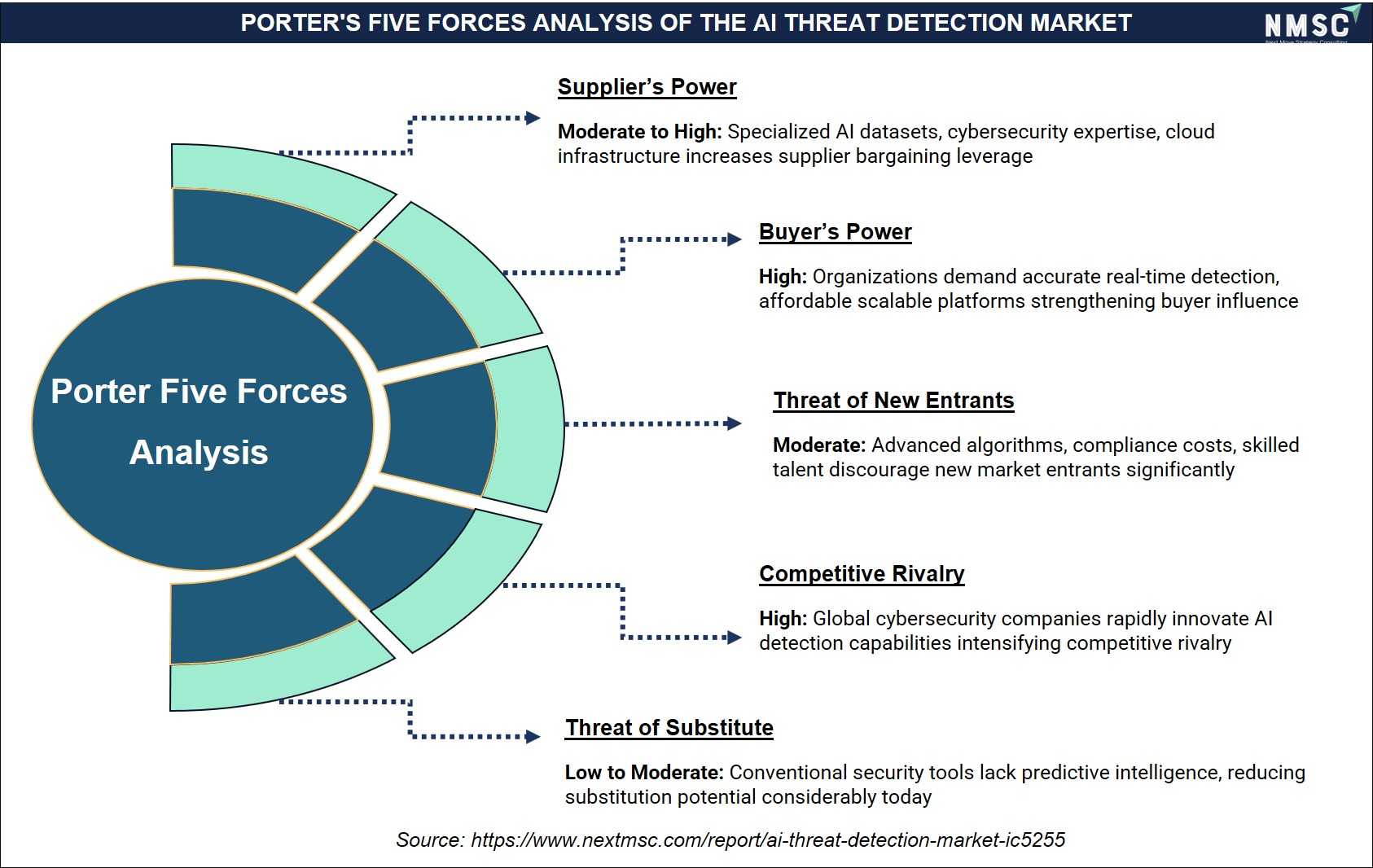
The Porter's Five Forces analysis highlights the competitive structure of the AI threat detection market by assessing the bargaining power of buyers and suppliers, the threat of new entrants and substitutes, and the intensity of competitive rivalry. The framework indicates a highly dynamic cybersecurity environment where innovation, platform integration, and regulatory compliance significantly influence market positioning and long-term profitability.
Key Market Players
Our findings suggest that the following 20 companies represent the validated competitive set shaping AI platform strategy, detection model innovation, managed service delivery, and regulatory compliance solutions within the global AI Threat Detection Market.
-
Microsoft Corporation
-
CrowdStrike Holdings, Inc.
-
Fortinet, Inc.
-
International Business Machines Corporation
-
Check Point Software Technologies Ltd.
-
Trend Micro Incorporated
-
Zscaler, Inc.
-
SentinelOne, Inc.
-
Darktrace Holdings Limited
-
Akamai Technologies, Inc.
-
Proofpoint, Inc.
-
CyberArk Software Ltd.
-
Rapid7, Inc.
-
Qualys, Inc.
-
Sophos Ltd.
-
Arctic Wolf Networks, Inc.
-
ReliaQuest, LLC
-
Vectra AI, Inc.
Latest Developments
We found that 2025–2026 product and partnership announcements in the AI Threat Detection Market are concentrated on agentic AI capability launches, XDR platform expansions, and strategic acquisitions targeting AI behavioral analytics and identity security asset classes.
|
Date |
Event |
|
Nov 2025 |
Microsoft announced new AI-powered capabilities across Microsoft Defender, including autonomous threat detection, agentic AI for Security Copilot, and enhanced AI-driven SOC workflows to accelerate threat detection and incident response. |
|
Aug 2025 |
CrowdStrike announced the general availability of CrowdStrike Signal, a new AI-powered detection engine that uses self-learning behavioral models to identify subtle attacks that traditional detection methods miss. |
|
July 2025 |
Palo Alto Networks completed its acquisition of Protect AI, strengthening its AI security platform with capabilities to detect threats targeting AI models, AI applications, and AI infrastructure. |
|
April 2025 |
IBM released the X-Force Threat Intelligence Index 2025, highlighting the increasing use of AI by cybercriminals and emphasizing AI-powered threat detection, identity threat analytics, and machine learning-driven cyber defense through IBM X-Force. |
Expert Insights
 “Fighting AI with AI is now a non-negotiable. And a personalized approach to protect data and defend against complex threats unique to an organization's attack surface, at-speed, and scale, is paramount.”
— Matthew Prince, Co-Founder & CEO, Cloudflare
Statement made during the launch of Cloudflare's Defensive AI platform, highlighting the growing need for AI-driven cybersecurity to counter increasingly sophisticated AI-powered cyber threats.
Market Interpretation
The statement underscores a major transformation in the AI Threat Detection Market, where organizations are shifting from traditional rule-based security systems to AI-powered adaptive threat detection solutions. As attackers increasingly employ artificial intelligence to automate phishing, malware, and advanced persistent threats, enterprises are investing in AI-enabled security platforms that can continuously analyze behavior, detect anomalies in real time, and automate threat response. This trend is accelerating the adoption of intelligent threat detection technologies capable of protecting increasingly complex enterprise attack surfaces.
Investment Opportunities
What Capital Inflows Are Targeting the AI Threat Detection Market?
Capital inflows into the AI Threat Detection Market are concentrated across three asset classes: venture and growth equity funding of agentic AI and behavioral analytics security startups, private equity consolidation of managed detection and response platforms targeting SME segments, and strategic corporate investment through hyperscaler security platform expansion. We observed that the USD 150.5 Billion absolute dollar opportunity generated between 2026 and 2035 is attracting multi-stage investors across the full AI security vendor landscape. AI-native detection startups with demonstrable model accuracy advantages and IP-protected behavioral baseline algorithms command premium valuations in a market where proprietary AI detection efficacy is the primary competitive differentiator.
How Is Infrastructure Investment Supporting AI Threat Detection Market Expansion?
Infrastructure investment supporting AI threat detection expansion operates at three levels: hyperscaler cloud security service platform build-out by Microsoft Azure, Amazon Web Services, and Google Cloud that embed native AI threat detection into cloud-native customer environments; AI accelerator chip capacity expansion enabling on-device and edge AI inference for latency-sensitive real-time threat detection; and government national cybersecurity capability investment across the U.S. CISA, UK NCSC, EU ENISA, and equivalent national agencies that create demand-side pull for certified AI threat detection solutions. Our findings suggest that government-mandated security capability frameworks are increasingly referencing AI-powered detection as the minimum acceptable standard for critical infrastructure protection.
What ESG Considerations Are Shaping AI Threat Detection Investment Decisions?
ESG considerations in AI Threat Detection Market investment center on AI model governance (explainability, bias auditing, and adversarial robustness), data privacy stewardship for sensitive security telemetry, and the social responsibility dimension of protecting critical infrastructure serving healthcare, energy, and financial systems. The NIST AI Risk Management Framework provides a structured governance lens that institutional investors are applying to AI security vendor due diligence, evaluating how vendors document model performance, manage AI risk, and disclose AI system limitations. Our assessment indicates that vendors with mature AI governance programs, third-party model audits, and transparent false positive disclosure practices are increasingly preferred by ESG-screened institutional capital and regulated financial sector buyers.
Key Benefits for Stakeholders
How Does This Report Benefit Enterprise Security Leaders and CISOs?
Enterprise security leaders and CISOs gain validated ten-axis segmentation, competitive archetype benchmarking, and regional regulatory demand analysis that support platform selection, budget justification, and technology roadmap decisions within the AI Threat Detection Market. Our analysis shows that the AI Technology segment CAGR differential — Agentic AI at 33.0% versus ML at 20.4% from 2026 to 2035 — enables security executives to align procurement priorities with the technology trajectories most likely to define detection efficacy and SOC automation capability through the end of the forecast period, ensuring that capital allocation decisions reflect market-validated architecture trends rather than individual vendor claims.
How Does This Report Benefit Investors and Financial Analysts?
Investors and financial analysts benefit from consistent single-point market estimates — USD 34.2 Billion in 2026 growing to USD 184.7 Billion by 2035 at a 20.6% CAGR — supporting valuation, comparable company analysis, and capital deployment decisions across the AI Threat Detection Market. We found that the regional growth differential analysis — Latin America at 30.2% CAGR versus North America at 20.5% — enables geographic allocation decisions, while the segment-level revenue breakdowns by Component, AI Technology, and Deployment Mode enable granular assessment of which market sub-segments present the most attractive growth and margin profile for investment thesis construction across the 20 profiled companies.
How Does This Report Benefit Technology Vendors and Product Strategy Teams?
Technology vendors and product strategy teams gain actionable insight into the AI technology adoption hierarchy, competitive archetype dynamics, and M&A landscape that should inform product roadmap, partnership strategy, and market positioning decisions within the AI Threat Detection Market. During our market evaluation, we noticed that the Cloud deployment mode's 25.2% CAGR trajectory and Agentic AI's 33.0% expansion pace provide clear signals for R&D investment prioritization, while the Managed Services component's 21.9% CAGR versus Hardware's 18.8% indicates the structural revenue model shift toward services that product teams should incorporate into their go-to-market and pricing strategy development for the 2026–2035 period.
Key Market Segments
By Component
-
Software
-
Endpoint Threat Detection
-
EDR
-
EPP
-
Endpoint Behavioural Analytics
-
-
Extended Threat Detection
-
XDR
-
Open XDR
-
Native XDR
-
-
Security Analytics
-
SIEM
-
UEBA
-
Security Analytics Platforms
-
-
-
Network Threat Detection
-
NDR
-
Network Traffic Analytics
-
Network Behavioural Analytics
-
-
Identity Threat Detection
-
ITDR
-
Privileged Identity Analytics
-
Identity Behavioural Analytics
-
-
Cloud Threat Detection
-
CDR
-
Cloud Workload Threat Detection
-
Cloud Security Analytics
-
-
Application Threat Detection
-
API Threat Detection
-
Web Application Threat Detection
-
Runtime Application Threat Detection
-
-
Email Threat Detection
-
Phishing Detection
-
BEC Detection
-
Email Behavioral Analytics
-
-
Data Threat Detection
-
Data Access Anomaly Detection
-
Data Exfiltration Detection
-
Data Behavioral Analytics
-
-
Threat Intelligence Platforms
-
Threat Hunting Platforms
-
Other Threat Detection Software
-
Hardware
-
Network Security Appliances
-
Secure Gateway Appliances
-
Threat Detection Sensors
-
Other Threat Detection Hardware
-
-
Services
-
MDR
-
SOC As A Service
-
Threat Hunting As A Service
-
Incident Detection Services
-
Professional Services
-
Consulting
-
Integration
-
Training
-
Support
-
-
By Deployment Mode
-
Cloud
-
On Premise
-
Hybrid
By Organization Size
-
Large Enterprises
-
Medium Enterprises
-
Small Enterprises
By Threat Vector
-
Endpoint Threats
-
Network Threats
-
Identity Threats
-
Cloud Threats
-
Application Threats
-
Email Threats
-
Data Threats
-
Insider Threats
By AI Technology
-
ML
-
DL
-
Behavioral Analytics
-
NLP
-
Generative AI
-
Agentic AI
-
Other AI Technologies
By Delivery Model
-
Standalone Platforms
-
Integrated Security Platforms
-
Managed Services
By Sales Channel
-
Direct Sales
-
Channel Partners
-
Cloud Marketplaces
-
OEM Partnerships
By End User Industry
-
BFSI
-
Government
-
Healthcare
-
Life Sciences
-
IT
-
Telecommunications
-
Retail
-
E Commerce
-
Manufacturing
-
Energy
-
Utilities
-
Education
-
Transportation
-
Logistics
-
Media
-
Entertainment
-
Other Industries
By Region
-
North America: U.S., Canada, Mexico.
-
Europe: UK, Germany, France, Italy, Spain, Sweden, Denmark, Finland, Netherlands, Rest of Europe.
-
Asia-Pacific: China, India, Japan, South Korea, Taiwan, Indonesia, Vietnam, Australia, Philippines, Malaysia, Rest of APAC.
-
Middle East & Africa: Saudi Arabia, UAE, Egypt, Israel, Turkey, Nigeria, South Africa, Rest of MEA.
-
Latin America: Brazil, Argentina, Chile, Colombia, Rest of LATAM.
Conclusion and Recommendations
What Is the Long-Term Outlook for the AI Threat Detection Market?
The long-term outlook for the AI Threat Detection Market is strongly positive, with global revenue forecast to grow more than fivefold from USD 28.6 Billion in 2025 to USD 184.7 Billion by 2035 at a 20.6% CAGR. We observed that agentic AI autonomous response, XDR platform consolidation, and compounding regulatory compliance mandates across North America, Europe, and Asia-Pacific will sustain demand expansion across all ten software sub-categories, three deployment modes, and eight vertical industries through the forecast period. Latin America's 30.2% CAGR and Asia-Pacific's 27.4% CAGR ensure geographically diversified growth momentum.
What Strategic Positioning Should AI Threat Detection Market Participants Pursue?
Participants should prioritize agentic AI detection and response capability, XDR platform telemetry unification, and managed service delivery model investment as the three non-negotiable strategic positions for capturing above-market growth in the AI Threat Detection Market. Our assessment indicates that vendors without credible agentic AI roadmaps and validated detection efficacy metrics face accelerating competitive displacement as security buyers consolidate vendor relationships around platforms offering measurable machine-speed response capabilities. Identity threat detection, cloud workload protection, and SME-accessible MDR services represent the three highest-priority vertical expansion investments for participants seeking to grow addressable market share through 2035.
How Attractive Is the AI Threat Detection Market for New Investment?
The AI Threat Detection Market presents a highly attractive investment case, supported by a USD 150.5 Billion absolute dollar opportunity between 2026 and 2035, a 20.6% structural CAGR driven by non-discretionary security compliance spending, and accelerating recurring subscription revenue models that provide predictable cash flow for investors. We found that investment attractiveness is highest for agentic AI security software vendors, managed detection service platforms with defensible SME customer bases, and identity threat detection specialists — all of which combine above-market organic growth trajectories with capital-efficient, software-led business models generating expanding gross margins as AI model costs decline.
What Market Shifts and Key Risks Should Stakeholders Monitor?
Stakeholders should monitor four key risks: AI model adversarial attacks that undermine detection reliability and buyer confidence, regulatory fragmentation between U.S. and EU AI governance frameworks creating compliance complexity for global vendors, platform consolidation dynamics that may compress addressable market for point solution specialists, and talent scarcity constraining both vendor product development velocity and customer deployment capacity. NMSC's analysis indicates that vendors lacking third-party AI model validation, explainability documentation, and adversarial robustness testing capabilities face increasing scrutiny from regulated financial, healthcare, and government buyers implementing formal AI procurement governance frameworks aligned with NIST AI RMF requirements.
What Are the Key Growth Pathways for the AI Threat Detection Market?
Key growth pathways include scaling agentic AI SOC automation to eliminate analyst throughput constraints, expanding SME market penetration through affordable MDR subscription services, deepening identity and cloud threat detection integration within XDR platforms, and capturing emerging market demand in Latin America, MEA, and South and Southeast Asia. Our findings suggest that participants combining platform breadth with Agentic AI automation depth — specifically CrowdStrike, Microsoft, and Palo Alto Networks — are best positioned to capture the AI Threat Detection Market's projected USD 184.7 Billion revenue scale by 2035 while sustaining above-market subscription revenue growth rates throughout the forecast period.
About the Author
 Mihul Sharma
— Mihul Sharma is Research Associate at Next Move Strategy Consulting, where he has covered technology, industrial, and healthcare markets for 3 years. His work applies structured business research, market analysis, and secondary-source review to assess market trends, competitive developments, and growth opportunities. He supports report development by fully synthesizing industry data, company information, and market signals into concise findings for strategy and investment-focused research teams.
Mihul Sharma
— Mihul Sharma is Research Associate at Next Move Strategy Consulting, where he has covered technology, industrial, and healthcare markets for 3 years. His work applies structured business research, market analysis, and secondary-source review to assess market trends, competitive developments, and growth opportunities. He supports report development by fully synthesizing industry data, company information, and market signals into concise findings for strategy and investment-focused research teams.
About the Reviewer
 Supradip Baul
— Supradip Baul is an accomplished business consultant and strategist with over a decade of rich experience in market intelligence, strategy, technology, and business transformation. His work has included rigorous qualitative and quantitative analysis across multiple industries, helping clients shape investment decisions and long-term roadmaps. Earlier in his career, he was associated with Gartner, where he contributed to industry-leading reports and market share analyses. He has worked with leading global companies and holds an MBA with a dual specialization in Marketing and Finance.
Supradip Baul
— Supradip Baul is an accomplished business consultant and strategist with over a decade of rich experience in market intelligence, strategy, technology, and business transformation. His work has included rigorous qualitative and quantitative analysis across multiple industries, helping clients shape investment decisions and long-term roadmaps. Earlier in his career, he was associated with Gartner, where he contributed to industry-leading reports and market share analyses. He has worked with leading global companies and holds an MBA with a dual specialization in Marketing and Finance.
At Next Move Strategy Consulting, we understand that insightful market research is the cornerstone of successful business decisions. That's why we employ a robust and multifaceted approach, combining various methodologies to deliver the most accurate and actionable data for our clients.

Research Landscape
We navigate the world of research with two primary approaches:
Qualitative Approach
Our qualitative research methodologies involve immersive techniques such as in-depth interviews, focus groups, and observational studies. By engaging directly with individuals and stakeholders, we uncover valuable insights that quantitative data alone may overlook.

Quantitative Research
In tandem with qualitative methodologies, NMSC leverages the power of Quantitative Research to provide a robust foundation of numerical insights. Through systematic data collection and analysis, we quantify patterns, preferences, and market trends, offering a comprehensive view of the business landscape.
Our quantitative research approach employs diverse tools, including surveys, experiments, and statistical modelling. These methodologies enable us to gather data from a large and representative sample, ensuring the statistical significance of our findings. By employing structured questionnaires and standardized data collection methods, we guarantee the reliability and validity of the information we present to our clients.
Quantitative research is particularly effective in measuring the prevalence of trends, assessing market size, and gauging the impact of various factors on consumer behavior. The numerical precision attained through this approach equips our clients with actionable insights, facilitating data-driven decision-making and strategy formulation.


Our Specialized Toolbox for Industry-Specific Market Research
We deploy a specialized arsenal of techniques tailored to meet your unique requirements. Here's a glimpse into our comprehensive toolbox:

Information Procurement
The stage entails acquiring market data or relevant information through various sources and methodologies.


Market Research Approach
We utilize both top-down and bottom-up approaches in market research analysis to achieve a comprehensive understanding of the market dynamics, leveraging the broad perspective of industry trends and macroeconomic factors alongside detailed insights from specific segments and individual companies.

Porters Five Forces Analysis
We conduct Porter's Five Forces analysis to evaluate the competitive landscape of an industry, providing us with insights into factors that affect profitability and strategic positioning.

SWOT Analysis

Forecasting
We utilize a forecasting model to predict future consumption by considering parameters like population, economics, regulations, market competition, drivers, constraints, technology, and pricing. We also employ statistical techniques such as multilinear regression, exponential smoothing, moving average, ARIMA, and Monte Carlo simulations for accurate predictions. In econometric forecasting, we analyzed short-term and long-term event impacts, attributing values based on regulatory frameworks, economic factors, and market events.





 Speak to Our Analyst