AI Talent Matching Market Size, Share, Trends and Growth Analysis, By Talent Sourcing and Matching, By Screening and Assessment, By Conversational Recruiting and Scheduling, By CRM and Engagement, By Internal Talent Marketplace, By Job Marketplace and Distribution, By Matching Infrastructure and APIs, By Professional and Managed Services, By Deployment Model, By Revenue Model, By Buyer Type, By End User Industry, and Region — Global Industry Report and Forecast, 2026–2035
Industry: ICT & Media | Publishing Date: July 22, 2026 | Last Updated: September 30, 2026 | No of Pages: N/A | No. of Tables: N/A | No. of Figures: N/A | Format: PDF | Report Code: IC5308
What Is the AI Talent Matching Market Size?
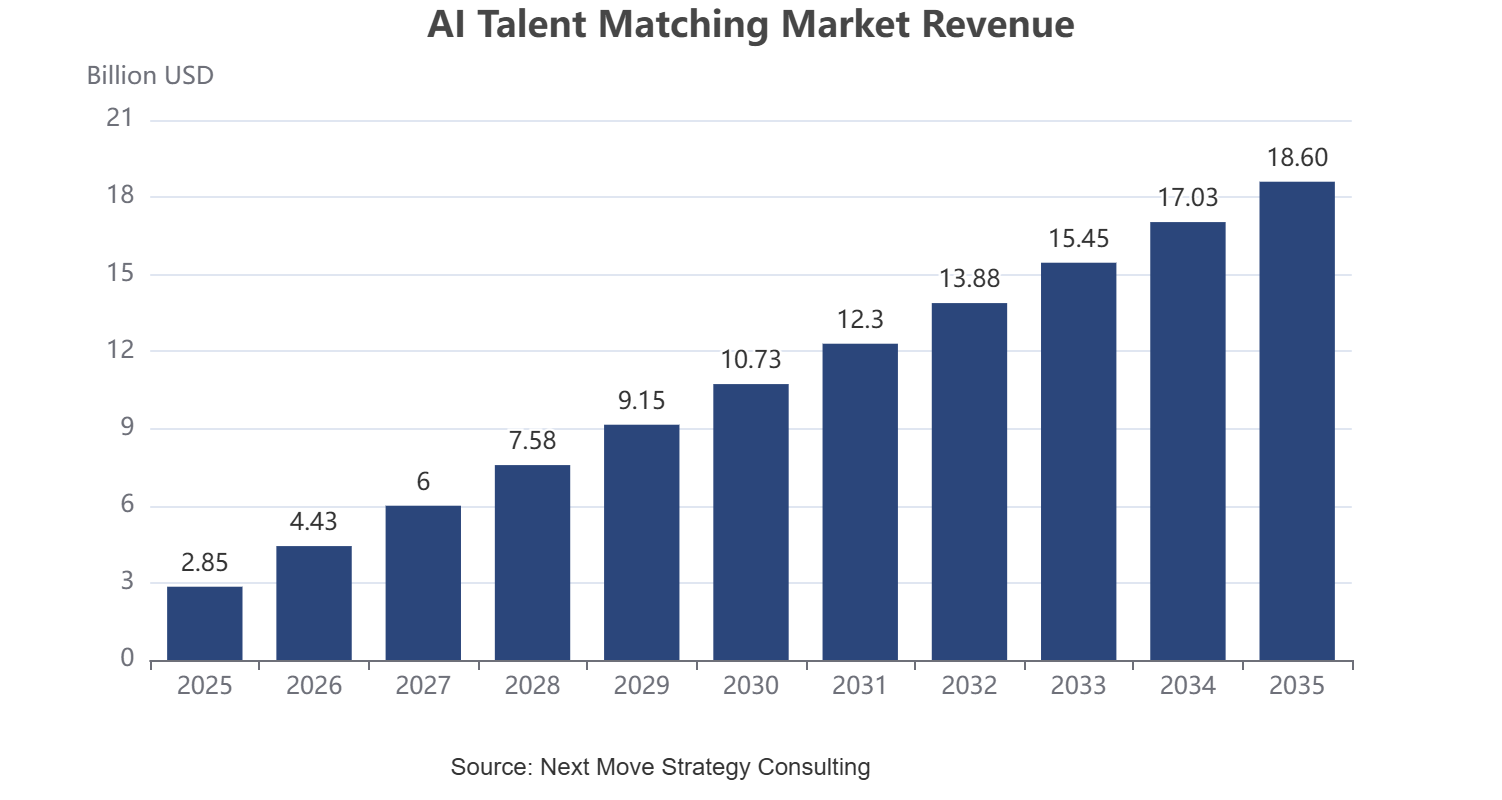
The global AI talent matching market size was valued at USD 2.85 billion in 2025 and is estimated at USD 3.42 billion in 2026, forecast to reach USD 18.60 billion by 2035, expanding at a 20.7% CAGR between 2026 and 2035. North America leads with approximately 38% share, while Candidate Ranking and Matching dominates all other sourcing categories with approximately 40% share.
We observed that growth is broad based across every segmentation axis, with skills based matching adoption and internal talent marketplace expansion driving the dominant structural shifts through 2035.
|
Key Takeaways |
|
By Talent Sourcing and Matching: Candidate Ranking and Matching held the largest share of approximately 40% (USD 1.15 Billion) in 2025; Talent Rediscovery is the fastest-growing sub-segment at 25.2% CAGR from 2026–2035. |
|
By Screening and Assessment: Candidate Assessment held the largest share of approximately 37% (USD 1.05 Billion) in 2025; Interview Intelligence is the fastest-growing sub-segment at 24.2% CAGR from 2026–2035. |
|
By Conversational Recruiting and Scheduling: Conversational Recruiting held the largest share of approximately 42% (USD 1.20 Billion) in 2025; Interview Scheduling is the fastest-growing sub-segment at 26.5% CAGR from 2026–2035. |
|
By CRM and Engagement: Candidate Relationship Management held the largest share of approximately 45% (USD 1.28 Billion) in 2025; Alumni and Referral Engagement is the fastest-growing sub-segment at 24.8% CAGR from 2026–2035. |
|
By Internal Talent Marketplace: Internal Mobility Matching held the largest share of approximately 39% (USD 1.11 Billion) in 2025; Project and Gig Matching is the fastest-growing sub-segment at 27.9% CAGR from 2026–2035. |
|
By Job Marketplace and Distribution: Job Marketplace Matching held the largest share of approximately 41% (USD 1.17 Billion) in 2025; Job Distribution Optimization is the fastest-growing sub-segment at 25.4% CAGR from 2026–2035. |
|
By Matching Infrastructure and APIs: Matching APIs and SDKs held the largest share of approximately 36% (USD 1.03 Billion) in 2025; Profile Intelligence Infrastructure is the fastest-growing sub-segment at 26.1% CAGR from 2026–2035. |
|
By Professional and Managed Services: Implementation Services held the largest share of approximately 34% (USD 0.97 Billion) in 2025; Managed Talent Matching Operations is the fastest-growing sub-segment at 29.3% CAGR from 2026–2035. |
|
By Deployment Model: SaaS Platforms held the largest share of approximately 57% (USD 1.62 Billion) in 2025; Managed Operations is the fastest-growing sub-segment at 28.0% CAGR from 2026–2035. |
|
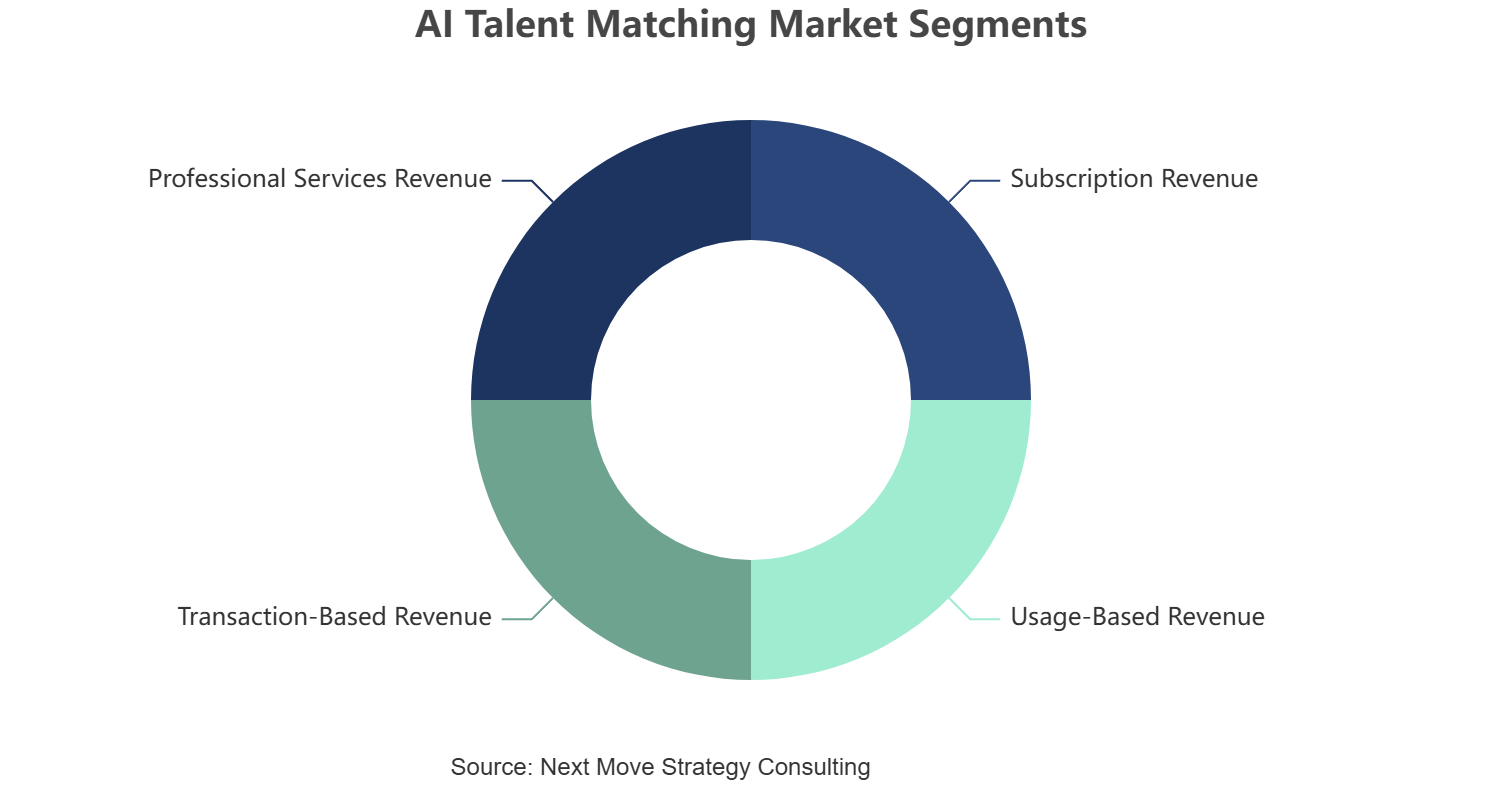
By Revenue Model: Subscription Revenue held the largest share of approximately 48% (USD 1.37 Billion) in 2025; Usage-Based Revenue is the fastest-growing sub-segment at 27.2% CAGR from 2026–2035. |
|
By Buyer Type: Enterprise Organizations held the largest share of approximately 33% (USD 0.94 Billion) in 2025; Staffing and Recruitment Firms is the fastest-growing sub-segment at 26.7% CAGR from 2026–2035. |
|
By End User Industry: IT and Telecommunications held the largest share of approximately 22% (USD 0.63 Billion) in 2025; Healthcare is the fastest-growing sub-segment at 27.5% CAGR from 2026–2035. |
|
Dominant Region: North America dominated with approximately 38% revenue share (USD 1.08 Billion) in 2025. |
|
Fastest-Growing Region: Asia-Pacific is expected to register the highest CAGR of 28.6% during 2026–2035. |
|
Dominant Country: U.S. led with approximately USD 800 million in 2025. |
|
Fastest-Growing Country: India is the fastest-growing country at approximately 32.0% CAGR from 2026–2035. |
Market Opportunity: The AI talent matching market is expected to create an absolute dollar opportunity of USD 15.18 billion between 2026 and 2035, presenting significant investment potential across the enterprise recruiting, staffing, and internal workforce mobility value chain.
According to Next Move Strategy Consulting analysis, enterprises are increasingly consolidating point recruiting tools into unified talent intelligence platforms that span sourcing, screening, and internal mobility, a shift that favors vendors with skills graph depth over single-function applicant tracking add-ons as budget scrutiny intensifies through 2035.
AI Talent Matching Market Overview
What Does the AI Talent Matching Market Encompass?
The AI talent matching market encompasses software and services that apply machine learning, natural language processing, and predictive analytics to connect candidates with roles across external hiring and internal mobility. Our assessment indicates that the scope spans sourcing, screening, assessment, conversational recruiting, candidate relationship management, internal talent marketplaces, job distribution, matching infrastructure, and professional services supplied to enterprises, staffing firms, recruitment process outsourcing providers, and public sector organizations across every major end user industry. The category has evolved from keyword-based applicant tracking add-ons into standalone, skills-based talent intelligence platforms.
Regulatory frameworks such as the U.S. Equal Employment Opportunity Commission's guidance on algorithmic decision making and the European Union's Artificial Intelligence Act shape bias auditing and explainability requirements for automated hiring tools, while New York City's Local Law 144 increasingly influences vendor disclosure practices. We observed that technology adoption is shifting toward agentic AI that autonomously screens and interviews candidates under human oversight, often embedded within the broader Human Capital Management Market. Next Move Strategy Consulting's analysis indicates that this structural shift, combined with rising skills based hiring mandates, is redefining vendor selection criteria across the AI talent matching market.
|
Parameters |
Details |
|
Market Size in 2025 |
USD 2.85 Billion |
|
Market Size in 2026 |
USD 3.42 Billion |
|
Revenue Forecast in 2035 |
USD 18.60 Billion |
|
Growth Rate |
CAGR of 20.7% from 2026 to 2035 |
|
Analysis Period |
2025–2035 |
|
Base Year Considered |
2025 |
|
Forecast Period |
2026–2035 |
|
Market Size Estimation |
Revenue (USD Billion) |
|
Companies Profiled |
20 |
|
Countries Covered |
33 |
|
Market Share |
Available for Top 10 Companies |
Key Emerging Trends in the AI Talent Matching Market
Based on research conducted by Next Move Strategy Consulting, we found that four structural trends are reshaping sourcing, screening, and internal mobility across the industry.
How Is Agentic AI Transforming Candidate Screening?
Agentic AI systems, an application area closely tied to the broader AI Agents Market, are moving beyond keyword matching to autonomously screen and interview candidates at scale under human oversight. We observed that Eightfold AI expanded its Talent Agents across the full interview lifecycle in April 2026, introducing AI Interview Companion alongside functional and coding interview capabilities. Enterprises are adopting these agents to compress time-to-hire, while talent acquisition leaders retain final decision authority over every automated recommendation.
Why Is Skills Based Matching Replacing Resume Keyword Search?
Skills based matching is displacing resume keyword search as employers seek to widen candidate pools beyond degree and title requirements. Our findings suggest that vendors are building large scale skills taxonomies and occupational ontologies to normalize candidate and job data across disparate formats. This shift is elevating demand for skills graph management and competency data infrastructure among enterprise buyers pursuing more equitable, capability based hiring decisions.
How Are Internal Talent Marketplaces Reshaping Workforce Deployment?
Internal talent marketplaces are gaining adoption as enterprises seek to redeploy existing employees into open roles, projects, and gigs before external sourcing. We observed that large employers are pairing internal mobility matching with career path recommendations to improve retention. This trend is elevating demand for employee skills intelligence platforms among human resources leaders managing workforce transformation and succession planning programs.
How Is Native Platform Integration Changing Vendor Competition?
Native integration of agentic hiring tools directly inside applicant tracking and human capital management systems, rather than as adjacent point solutions, is reshaping vendor competition. Our analysis shows that Eightfold AI and Oracle integrated agentic interview intelligence directly within Oracle Recruiting Cloud in May 2026. This trend is elevating demand for embedded ATS and HCM extensions over standalone browser-based tools among enterprise information technology buyers.
SWOT Analysis of the AI Talent Matching Market
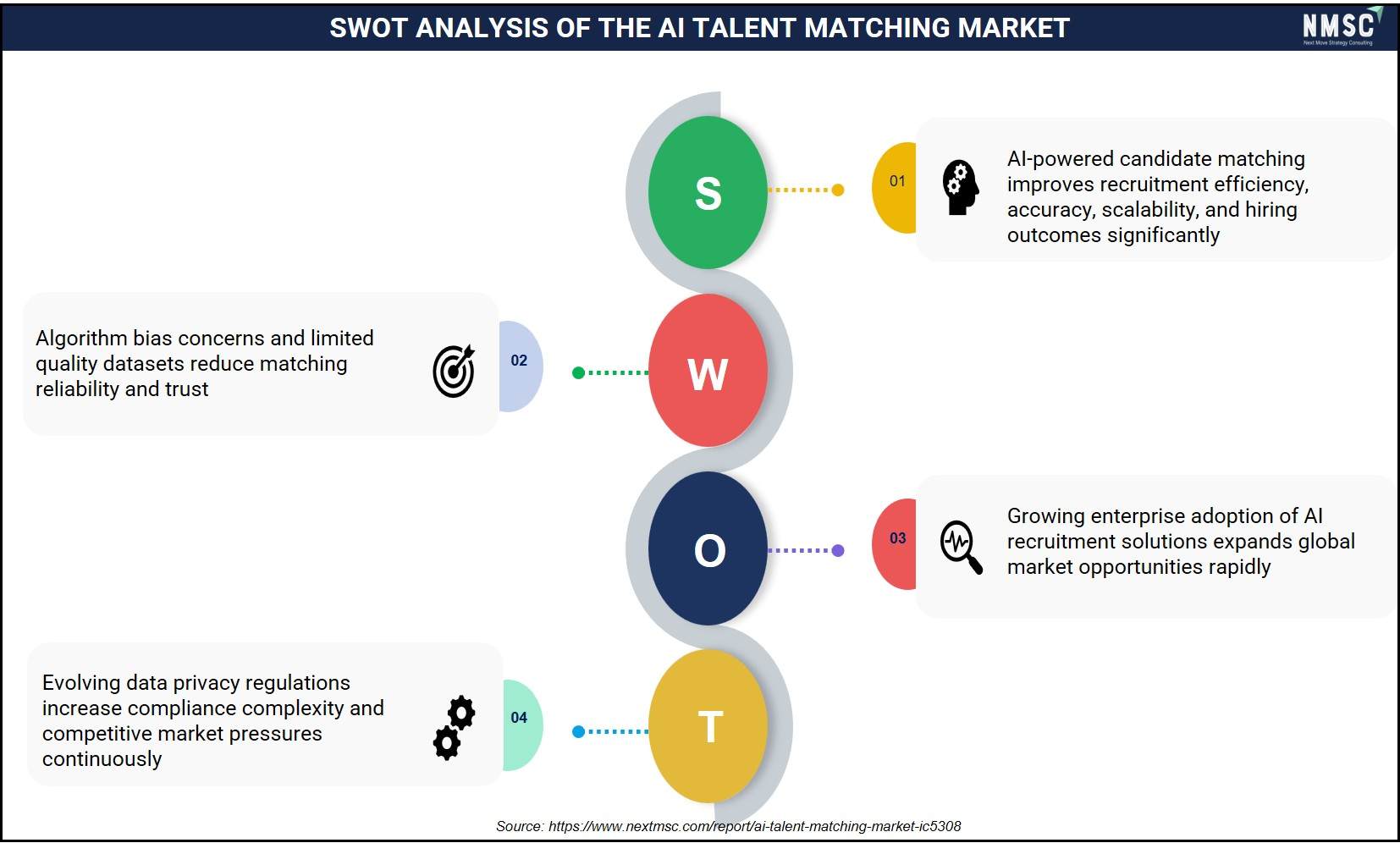
Based on our SWOT assessment, we observed that AI-powered candidate matching significantly improves recruitment efficiency, hiring accuracy, scalability, and workforce outcomes, representing a major competitive strength. However, algorithm bias concerns and limited high-quality training datasets reduce matching reliability and user trust. Moreover, our analysis indicates that expanding enterprise adoption of AI recruitment solutions creates substantial global growth opportunities, while evolving data privacy regulations, increasing compliance requirements, and intense market competition continue to challenge vendors operating in the AI talent matching market.
Growth Drivers and Restraints
Growth Catalyst and Risk Assessment Matrix
|
Factors |
Type |
(+/−) % Impact on CAGR |
Geographic Relevance |
Impact Timeline |
|
Rising enterprise adoption of skills based hiring |
Driver |
+4.8% |
Global |
2026-2035 |
|
Persistent global talent and skills shortages |
Driver |
+4.1% |
North America, Europe, Asia-Pacific |
2026-2035 |
|
Shift toward agentic AI screening and interviewing |
Driver |
+3.6% |
Global |
2026-2035 |
|
Growth of internal talent marketplaces |
Driver |
+2.9% |
North America, Europe |
2026-2035 |
|
Expansion of staffing and RPO digitization in Asia-Pacific |
Driver |
+2.4% |
Asia-Pacific |
2026-2032 |
|
Rising API based embedded delivery adoption |
Driver |
+1.7% |
Global |
2026-2035 |
|
Algorithmic bias and AI hiring regulation compliance costs |
Restraint |
-2.2% |
Europe, North America |
2026-2035 |
|
Candidate and workforce data privacy concerns |
Restraint |
-1.4% |
Global |
2026-2035 |
|
Integration complexity with legacy HCM and ATS systems |
Restraint |
-1.1% |
Global |
2026-2032 |
What Is the Primary Growth Driver of the AI Talent Matching Market?
Rising enterprise adoption of skills-based hiring is the primary driver of the market. The U.S. Equal Employment Opportunity Commission continues to publish guidance encouraging employers to evaluate candidates on demonstrated competencies rather than credentials alone, reinforcing demand for skills graph and competency intelligence platforms. We observed that this shift, combined with persistent skilled labor shortages across technology and healthcare occupations, continues to anchor baseline consumption of matching and assessment software across developed and emerging economies alike.
How Is Agentic AI Adoption Driving AI Talent Matching Market Growth?
Enterprise adoption of agentic AI screening and interviewing tools is accelerating market growth as organizations seek to manage high volume hiring without proportional recruiter headcount growth. Eightfold AI reported that its agentic interview intelligence integration with Oracle Recruiting Cloud compresses time-to-hire from an industry benchmark of 42 days to under a week in early deployments. Our assessment indicates that this compression of hiring cycles, combined with maintained human oversight, is compressing adoption timelines for autonomous screening tools across North America and Europe.
What Is Restraining AI Talent Matching Market Expansion?
Algorithmic bias auditing and explainability requirements under frameworks such as New York City's Local Law 144 and the European Union's Artificial Intelligence Act restrain deployment speed across the supply chain, a compliance burden closely linked to the wider AI Governance Market. Compliance obligations require vendors to conduct independent bias audits and publish disclosure reports before automated hiring tools can be used in covered jurisdictions. We found that smaller vendors face particular exposure, as limited scale reduces their ability to absorb recurring audit and compliance costs compared with larger, diversified platform providers.
Segmentation Analysis
Segment Sizing: By Talent Sourcing and Matching
|
Segment |
2025 (USD) |
2035 (USD) |
CAGR% (2026–2035) |
|
External Candidate Search |
USD 1.02 Billion |
USD 6.10 Billion |
21.9% |
|
Candidate Ranking and Matching |
USD 1.15 Billion |
USD 7.35 Billion |
22.9% |
|
Talent Rediscovery |
USD 0.68 Billion |
USD 5.15 Billion |
25.2% |
|
Total |
USD 2.85 Billion |
USD 18.60 Billion |
20.7% |
Which Talent Sourcing and Matching Segment Dominates the AI Talent Matching Market?
Candidate Ranking and Matching, encompassing semantic profile matching, skills based matching, and predictive fit scoring, led the market with USD 1.15 billion in 2025, supported by enterprise demand for higher quality shortlists across high volume requisitions. We observed that Talent Rediscovery is the fastest-growing sourcing category, expanding at a 25.2% CAGR from 2026 to 2035, as employers increasingly mine historical applicant pools to reduce external sourcing costs.
Segment Sizing: By Screening and Assessment
|
Segment |
2025 (USD) |
2035 (USD) |
CAGR% (2026–2035) |
|
Resume Screening |
USD 0.79 Billion |
USD 4.35 Billion |
20.9% |
|
Candidate Assessment |
USD 1.05 Billion |
USD 7.10 Billion |
23.4% |
|
Interview Intelligence |
USD 1.01 Billion |
USD 7.15 Billion |
24.2% |
|
Total |
USD 2.85 Billion |
USD 18.60 Billion |
20.7% |
Which Screening and Assessment Segment Leads AI Talent Matching Market Demand?
Candidate Assessment remained the leading category within the market, valued at USD 1.05 billion in 2025 on sustained skills, technical, and cognitive assessment consumption. Our findings suggest that Interview Intelligence is the fastest-growing category, registering a 24.2% CAGR from 2026 to 2035, as video interview analytics and sentiment analytics increasingly support structured, bias-resistant candidate evaluation across enterprise hiring programs.
Segment Sizing: By Deployment Model
|
Segment |
2025 (USD) |
2035 (USD) |
CAGR% (2026–2035) |
|
SaaS Platforms |
USD 1.62 Billion |
USD 10.85 Billion |
23.6% |
|
Embedded ATS Extensions |
USD 0.51 Billion |
USD 2.95 Billion |
21.5% |
|
Embedded HCM Extensions |
USD 0.38 Billion |
USD 2.10 Billion |
20.8% |
|
API Based Delivery |
USD 0.24 Billion |
USD 1.75 Billion |
24.9% |
|
Managed Operations |
USD 0.10 Billion |
USD 0.95 Billion |
28.0% |
|
Total |
USD 2.85 Billion |
USD 18.60 Billion |
20.7% |
Which Deployment Model Is Most Widely Adopted in AI Talent Matching?
SaaS Platforms remained the dominant deployment model across the market, reaching USD 1.62 billion in 2025 due to faster implementation timelines and lower upfront infrastructure requirements. Based on research conducted by Next Move Strategy Consulting, we found that Managed Operations represent the fastest-growing category at a 28.0% CAGR from 2026 to 2035, reflecting staffing firms' and RPO providers' preference for outsourced, fully managed sourcing and screening operations.
Growth Opportunities
Our analysis shows that three forward-looking opportunities stand out for stakeholders positioning within the AI talent matching market over the 2026-2035 forecast period.
How Can Internal Talent Marketplaces Unlock Value for Large Enterprises?
Internal talent marketplace platforms present a whitespace opportunity for large enterprises seeking to redeploy existing employees ahead of costly external hiring. Vendors that commercialize internal mobility matching and career path recommendation engines stand to capture recurring platform revenue as employers shift budget from external sourcing toward internal workforce redeployment programs.
Where Do Agentic Sourcing Agents Create New Demand Among Passive Candidates?
Passive candidate engagement represents an underpenetrated opportunity for vendors offering agentic sourcing agents capable of continuous, cross-platform candidate aggregation. Providers that develop always-on discovery agents can secure long-term enterprise contracts, benefiting from recurring subscription revenue tied to sustained passive talent pool expansion.
How Can Managed Screening Operations Benefit Staffing and RPO Providers?
Staffing and recruitment process outsourcing providers seeking to scale without proportional headcount growth create an opportunity for vendors offering managed candidate sourcing and managed screening operations. Early movers that combine AI-enabled recruitment process outsourcing with transparent audit trails can differentiate with staffing firms pursuing higher placement volume commitments.
Regional Outlook
Geographic Performance Snapshot
|
Region |
2025 (USD) |
2035 (USD) |
CAGR% (2026–2035) |
Key Driver |
|
North America |
USD 1.08 Billion |
USD 5.60 Billion |
20.1% |
Mature enterprise HR technology base and EEOC-driven skills-based hiring adoption |
|
Europe |
USD 0.68 Billion |
USD 3.95 Billion |
21.6% |
EU AI Act compliance driving auditable, explainable matching adoption |
|
Asia-Pacific |
USD 0.65 Billion |
USD 6.25 Billion |
28.6% |
Expanding IT services hiring base and rapid staffing industry digitization |
|
Middle East & Africa |
USD 0.24 Billion |
USD 1.55 Billion |
23.0% |
Vision 2030-linked workforce nationalization and public sector digitization |
|
Latin America |
USD 0.20 Billion |
USD 1.25 Billion |
22.6% |
Growing outsourcing and staffing sector adoption of cloud recruiting tools |
|
Total |
USD 2.85 Billion |
USD 18.60 Billion |
20.7% |
— |
North America AI Talent Matching Market Outlook
North America leads the AI talent matching market with an established enterprise human resources technology base and deep applicant tracking system penetration. We observed that U.S. Equal Employment Opportunity Commission guidance sustains demand for auditable, skills based matching tools, while employers increasingly specify agentic screening platforms to manage high volume requisitions. Technology adoption remains advanced, with internal talent marketplace pilots expanding across large enterprises pursuing workforce redeployment strategies.
Europe AI Talent Matching Market Outlook
Europe's AI talent matching market reflects a regulation-intensive landscape shaped by the European Union's Artificial Intelligence Act and national algorithmic transparency requirements. Our findings suggest that employers across Germany, France, and the UK are accelerating adoption of auditable, explainable matching platforms to satisfy bias-testing obligations. Strategic outlook favors vendors demonstrating documented compliance frameworks over unaudited automated decision tools.
Asia-Pacific AI Talent Matching Market Outlook
Asia-Pacific's AI talent matching market is expanding rapidly as information technology services firms and staffing companies digitize high volume hiring pipelines. We observed that China, India, and Japan are driving regional demand through large scale technical hiring programs, while South Korea and Australia contribute steady enterprise software adoption. Regulatory influence remains comparatively light, supporting faster deployment cycles than in Europe or North America.
Middle East & Africa AI Talent Matching Market Outlook
The Middle East and Africa AI talent matching market is expanding on the back of Vision 2030-linked workforce nationalization programs and public sector digitization initiatives across Saudi Arabia and the UAE. Our assessment indicates that government and public sector organizations are increasingly specifying skills intelligence platforms to support localization mandates, while South Africa's staffing sector adopts cloud based screening tools to serve regional outsourcing demand.
Latin America AI Talent Matching Market Outlook
Latin America's AI talent matching market benefits from growing business process outsourcing activity and rising staffing sector digitization across Brazil and Argentina. We found that regional employers are prioritizing conversational recruiting and candidate communication automation to manage high volume, hourly, and frontline hiring, reflecting the region's labor-intensive service and retail employment base.
U.S. AI Talent Matching Market Outlook
The market in the U.S. was valued at approximately USD 800 million in 2025 and is projected to reach USD 4.05 billion by 2035, expanding at a 19.7% CAGR from 2026 to 2035, supported by the largest applicant tracking system installed base globally. Demand structure reflects enterprise legal and technology sector hiring demand, while regulatory influence stems from EEOC algorithmic guidance. Technology adoption reflects advanced agentic screening pilots, positioning the country as a strategic priority within the region's competitive landscape.
Canada AI Talent Matching Market Outlook
Based on our estimates, the market in Canada was valued at approximately USD 190 million in 2025 and is projected to reach USD 1.05 billion by 2035, expanding at a 20.9% CAGR from 2026 to 2035, supported by steady public sector and financial services hiring. Demand structure reflects moderate technology adoption, while regulatory influence stems from federal employment equity requirements. Technology adoption reflects growing internal mobility adoption, positioning the country as a strategic priority within the region's competitive landscape.
UK AI Talent Matching Market Outlook
As per our estimate, the UK was valued at approximately USD 220 million in 2025 and is projected to reach USD 1.30 billion by 2035, expanding at a 21.4% CAGR from 2026 to 2035, supported by mature staffing and RPO sector demand. Demand structure reflects financial services hiring digitization, while regulatory influence stems from UK data protection and AI guidance. Technology adoption reflects expanding conversational recruiting adoption, positioning the country as a strategic priority within the region's competitive landscape.
Germany AI Talent Matching Market Outlook
According to our analysis, the German was valued at approximately USD 195 million in 2025 and is projected to reach USD 1.15 billion by 2035, expanding at a 21.7% CAGR from 2026 to 2035, supported by engineering and manufacturing sector hiring needs. Demand structure reflects works council-driven transparency requirements, while regulatory influence stems from EU AI Act compliance pressure. Technology adoption reflects cautious but accelerating enterprise adoption, positioning the country as a strategic priority within the region's competitive landscape.
France AI Talent Matching Market Outlook
The market in France was valued at approximately USD 130 million in 2025 and is projected to reach USD 0.78 billion by 2035, expanding at a 22.0% CAGR from 2026 to 2035, supported by public sector and retail hiring digitization. Demand structure reflects national algorithmic transparency rules, while regulatory influence stems from growing staffing sector demand. Technology adoption reflects moderate technology penetration, positioning the country as a strategic priority within the region's competitive landscape.
China AI Talent Matching Market Outlook
Based on our estimates, China's was valued at approximately USD 210 million in 2025 and is projected to reach USD 2.35 billion by 2035, expanding at a 31.0% CAGR from 2026 to 2035, supported by large scale technology and manufacturing hiring volume. Demand structure reflects rapid staffing sector digitization, while regulatory influence stems from expanding domestic vendor competition. Technology adoption reflects strong e-commerce and logistics hiring demand, positioning the country as a strategic priority within the region's competitive landscape.
India AI Talent Matching Market Outlook
As per our estimate, India's was valued at approximately USD 175 million in 2025 and is projected to reach USD 2.10 billion by 2035, expanding at a 32.0% CAGR from 2026 to 2035, supported by the fastest-growing country globally. Demand structure reflects large scale information technology services hiring, while regulatory influence stems from rapid staffing firm digitization. Technology adoption reflects strong outsourcing sector demand, positioning the country as a strategic priority within the region's competitive landscape.
Japan AI Talent Matching Market Outlook
According to our analysis, Japan's was valued at approximately USD 145 million in 2025 and is projected to reach USD 1.15 billion by 2035, expanding at a 26.4% CAGR from 2026 to 2035, supported by aging workforce driving automation adoption. Demand structure reflects conservative but steady enterprise technology uptake, while regulatory influence stems from labor shortage-driven hiring urgency. Technology adoption reflects growing internal mobility interest, positioning the country as a strategic priority within the region's competitive landscape.
South Korea AI Talent Matching Market Outlook
The market in South Korea was valued at approximately USD 90 million in 2025 and is projected to reach USD 0.85 billion by 2035, expanding at a 28.0% CAGR from 2026 to 2035, supported by strong technology sector hiring demand. Demand structure reflects rapid enterprise software adoption, while regulatory influence stems from growing conglomerate internal mobility programs. Technology adoption reflects expanding conversational recruiting use, positioning the country as a strategic priority within the region's competitive landscape.
Australia AI Talent Matching Market Outlook
Based on our estimates, Australia's was valued at approximately USD 80 million in 2025 and is projected to reach USD 0.72 billion by 2035, expanding at a 27.6% CAGR from 2026 to 2035, supported by mature staffing and RPO sector demand. Demand structure reflects steady public sector hiring digitization, while regulatory influence stems from growing skills based hiring mandates. Technology adoption reflects expanding cloud platform adoption, positioning the country as a strategic priority within the region's competitive landscape.
UAE AI Talent Matching Market Outlook
As per our estimate, the UAE was valued at approximately USD 65 million in 2025 and is projected to reach USD 0.44 billion by 2035, expanding at a 23.6% CAGR from 2026 to 2035, supported by Vision-linked workforce nationalization hiring. Demand structure reflects public sector digitization programs, while regulatory influence stems from growing staffing sector demand. Technology adoption reflects expanding government adoption, positioning the country as a strategic priority within the region's competitive landscape.
Saudi Arabia AI Talent Matching Market Outlook
According to our analysis, Saudi Arabia's was valued at approximately USD 78 million in 2025 and is projected to reach USD 0.51 billion by 2035, expanding at a 23.4% CAGR from 2026 to 2035, supported by Vision 2030 workforce localization mandates. Demand structure reflects public sector and energy sector hiring demand, while regulatory influence stems from growing government adoption. Technology adoption reflects expanding skills intelligence infrastructure use, positioning the country as a strategic priority within the region's competitive landscape.
South Africa AI Talent Matching Market Outlook
The market in South Africa was valued at approximately USD 42 million in 2025 and is projected to reach USD 0.26 billion by 2035, expanding at a 22.4% CAGR from 2026 to 2035, supported by staffing sector outsourcing demand. Demand structure reflects moderate enterprise technology adoption, while regulatory influence stems from growing business process outsourcing hiring. Technology adoption reflects steady public sector interest, positioning the country as a strategic priority within the region's competitive landscape.
Brazil AI Talent Matching Market Outlook
Based on our estimates, Brazil's was valued at approximately USD 95 million in 2025 and is projected to reach USD 0.58 billion by 2035, expanding at a 22.3% CAGR from 2026 to 2035, supported by growing business process outsourcing hiring demand. Demand structure reflects expanding retail and logistics sector adoption, while regulatory influence stems from steady staffing sector digitization. Technology adoption reflects rising conversational recruiting use, positioning the country as a strategic priority within the region's competitive landscape.
Argentina AI Talent Matching Market Outlook
As per our estimate, Argentina's was valued at approximately USD 38 million in 2025 and is projected to reach USD 0.24 billion by 2035, expanding at a 22.9% CAGR from 2026 to 2035, supported by growing outsourcing sector hiring demand. Demand structure reflects moderate enterprise technology adoption, while regulatory influence stems from steady staffing sector digitization. Technology adoption reflects expanding cloud platform interest, positioning the country as a strategic priority within the region's competitive landscape.
Consumer Behavior Analysis of the AI Talent Matching Market
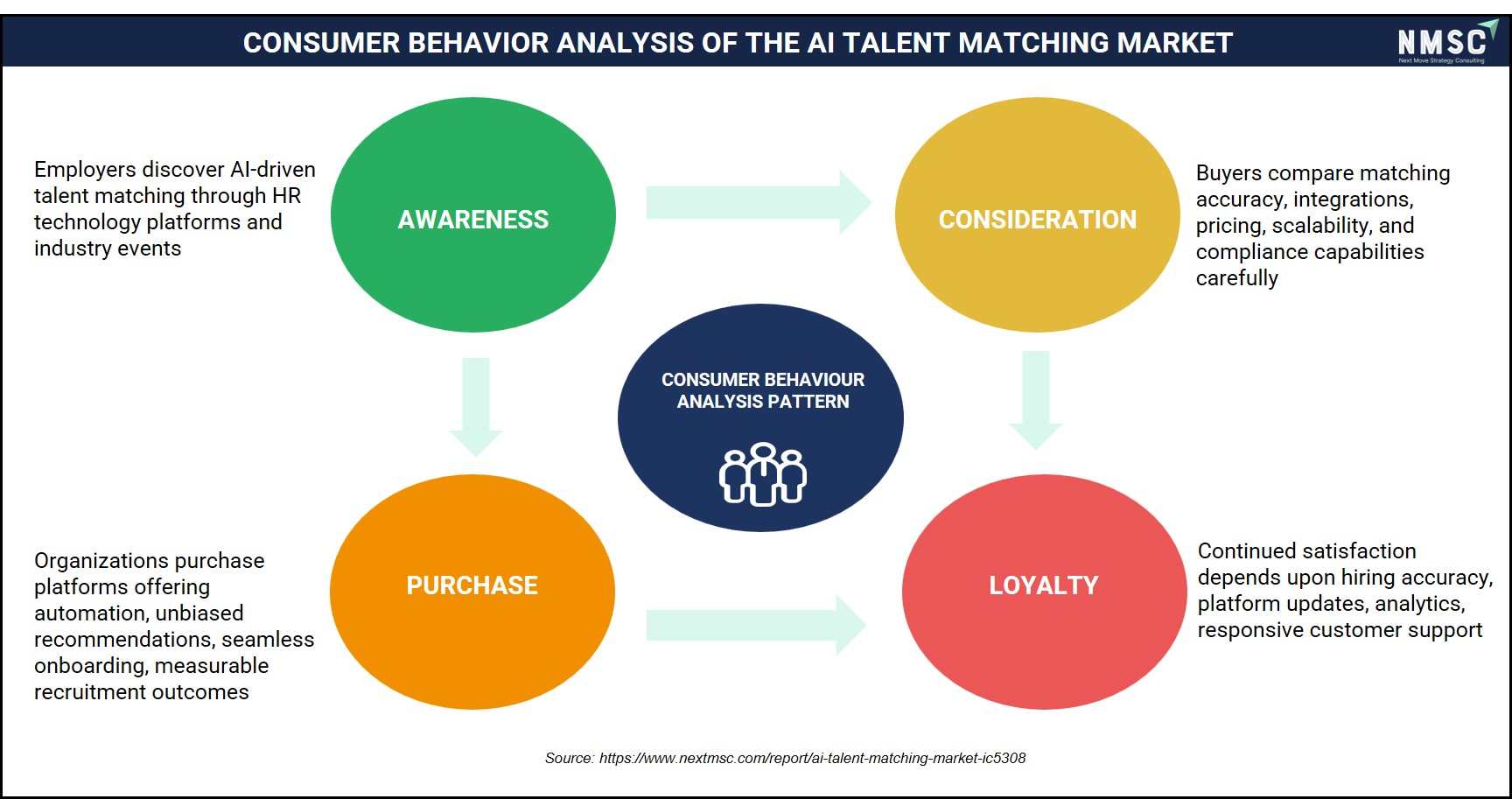
Based on our consumer behavior assessment, we observed that organizations become aware of AI talent matching platforms through HR technology providers, digital recruitment channels, and industry events before evaluating matching accuracy, integration capabilities, scalability, pricing, and compliance features. Furthermore, our analysis indicates that enterprises prioritize platforms offering automated candidate screening, unbiased recommendations, seamless onboarding, and measurable hiring outcomes, while consistent recruitment performance, regular platform enhancements, advanced analytics, and responsive customer support strengthen long-term customer loyalty and platform retention.
Competitive Landscape
We observed that the AI talent matching market remains moderately fragmented, with global talent intelligence platforms competing alongside specialized point solution vendors across sourcing, screening, and internal mobility.
|
Dimension |
Description |
|
Market Structure |
Moderately fragmented; the top companies profiled in this report collectively account for a significant share of global AI talent matching revenue, while numerous regional point-solution vendors serve niche sourcing and screening needs. |
|
Innovation Focus |
Agentic AI screening and interviewing, skills taxonomy infrastructure, and internal talent marketplace development dominate current innovation pipelines across leading vendors. |
|
M&A Activity |
Selective consolidation through platform partnerships, exemplified by Eightfold AI's agentic interview intelligence integration with Oracle Recruiting Cloud to broaden embedded distribution reach. |
How Do Companies Compete in the AI Talent Matching Market?
Companies compete primarily on skills graph depth, integration breadth, and agentic automation maturity across the industry. Global players such as Eightfold AI Inc. and LinkedIn Corporation leverage large scale talent intelligence data sets to serve multinational enterprises, while specialized vendors compete on niche capabilities such as interview scheduling or conversational recruiting chatbots supplied to mid-market buyers.
Which Competitive Archetypes Dominate the AI Talent Matching Market?
Two archetypes dominate the market: diversified enterprise human capital management suites offering embedded matching capabilities, and specialized talent intelligence platforms focused on skills based sourcing and screening. Workday, Inc. and Oracle Corporation exemplify the diversified archetype through native human capital management integration, while Eightfold AI Inc. and SeekOut, Inc. exemplify the specialized talent intelligence archetype serving enterprise sourcing demand.
How Are Companies Differentiating Through Innovation in AI Talent Matching?
Innovation and differentiation strategy increasingly center on agentic screening and native platform embedding. Eightfold AI's expanded Talent Agents and its agentic interview intelligence integration with Oracle Recruiting Cloud both illustrate how vendors are moving matching capability from adjacent tools into systems of record. Our analysis shows that vendors unable to demonstrate explainable, auditable matching logic risk exclusion from enterprise procurement shortlists in regulated markets.
What M&A and Expansion Activity Is Shaping the AI Talent Matching Market?
Partnerships and platform integrations continue to consolidate distribution reach within the industry. Eightfold AI's integration with Oracle Fusion Cloud Recruiting broadened its enterprise distribution footprint, while LinkedIn Corporation's quarterly release cadence for Hiring Assistant illustrates how platform incumbents pursue continuous feature expansion and geographic language rollout to defend market position.
Key Market Players
Our assessment indicates that the following 20 companies are actively shaping product innovation, platform integration, and skills intelligence strategy within the global AI talent matching market.
-
Recruit Holdings Co., Ltd.
-
LinkedIn Corporation
-
Workday, Inc.
-
Phenom People, Inc.
-
SmartRecruiters, Inc.
-
iCIMS, Inc.
-
Bullhorn, Inc.
-
Greenhouse Software, Inc.
-
Beamery Inc.
-
SeekOut, Inc.
-
hireEZ, Inc.
-
Employ, Inc.
-
CEIPAL Corp.
-
HireVue, Inc.
-
Paradox, Inc.
-
Gem, Inc.
-
Avature Limited
Latest Developments
We found that recent product activity within the AI talent matching market is concentrated on agentic interview intelligence and native platform embedding, reflecting the industry's broader shift toward autonomous, embedded hiring workflows.
|
Date |
Event |
|
June 2026 |
Greenhouse completed its acquisition of Ezra AI Labs, a voice AI interviewer, to bring structured, natural conversational AI into the hiring process. |
|
February 2026 |
Phenom launched its new Agent Center, a dedicated hub for agentic AI that automates complex tasks such as candidate fraud detection, automated avatar-based interviewing, and end-to-end hiring manager coordination. This move signals a push toward "human-in-the-loop" automation where AI acts on behalf of recruiters to build pipelines and manage requisitions. |
Expert Insights
 "The more we can leverage AI to assess your skills and match you with different jobs, the more you can be successful — to me, that's exciting."
— Eric Dozier, Executive Vice President, Human Resources and Diversity, Eli Lilly
Statement made in LinkedIn's Future of Recruiting 2025 report while discussing the growing adoption of AI-powered, skills-based hiring, where artificial intelligence is used to assess candidate skills and improve job matching.
Market Interpretation
The statement highlights the growing role of AI in transforming talent acquisition by shifting recruitment toward skills-based matching. AI-powered talent matching platforms leverage machine learning to evaluate candidates' capabilities beyond traditional resumes, enabling organizations to identify qualified talent more accurately and efficiently. Consequently, enterprises are increasingly adopting AI-driven recruitment solutions to improve hiring quality, reduce time-to-hire, and address evolving workforce skill requirements.
Investment Opportunities
What Capital Inflows Are Targeting the AI Talent Matching Market?
Capital inflows into the AI talent matching market are increasingly directed toward agentic screening infrastructure and skills taxonomy development. Strategic acquirers and enterprise software incumbents continue to fund platform integration, as seen in Eightfold AI's expanded Oracle partnership. We observed that investors favor vendors demonstrating validated compliance credentials, viewing regulatory alignment as a proxy for long-term enterprise contract retention.
How Is Infrastructure Investment Supporting AI Talent Matching Platforms?
Infrastructure investment is expanding matching API capacity and skills taxonomy engines to serve rising enterprise demand for embedded, low-latency candidate recommendations. Our findings suggest that vendors are investing in profile normalization and identity resolution infrastructure to improve match accuracy across fragmented candidate data sources spanning applicant tracking, human capital management, and professional networking systems.
What ESG Considerations Are Shaping AI Talent Matching Investment Decisions?
Environmental, social, and governance considerations are central to investment decisions across the industry, with algorithmic fairness and bias auditing as key governance criteria. The U.S. Equal Employment Opportunity Commission's guidance on automated employment decision tools continues to inform vendor compliance disclosures. We found that investors increasingly favor vendors with documented bias-testing frameworks, treating it as a governance indicator alongside data privacy and security compliance.
Key Benefits for Stakeholders
How Does This Report Benefit Enterprise and Industry Leaders?
Enterprise and industry leaders gain access to validated segmentation, competitive benchmarking, and regional demand forecasts that support vendor selection and technology roadmap decisions across the AI talent matching industry. Our analysis shows that detailed deployment model, buyer type, and end user industry breakdowns help talent acquisition teams align vendor evaluation criteria with compliance and integration requirements.
How Does This Report Benefit Investors and Financial Analysts?
Investors and financial analysts benefit from consistent, single-point market size and CAGR estimates that support valuation and capital-allocation decisions across the AI talent matching supply chain. We observed that the report's regional and segment-level growth differentials help identify which vendors are best positioned to capture above-market growth in agentic screening and internal mobility categories through 2035.
How Does This Report Benefit Technology Vendors and Product Teams?
Technology vendors and product teams gain insight into emerging design requirements, including agentic interview intelligence, skills taxonomy infrastructure, and embedded ATS and HCM extensions, that are reshaping the industry. Our findings suggest that this analysis helps product teams prioritize development roadmaps around explainability and compliance capabilities increasingly required by enterprise procurement processes.
Key Market Segments
By Talent Sourcing and Matching
-
External Candidate Search
-
AI Candidate Discovery
-
Passive Candidate Identification
-
Cross-Platform Candidate Aggregation
-
-
Candidate Ranking and Matching
-
Semantic Profile Matching
-
Skills-Based Matching
-
Predictive Fit Scoring
-
-
Talent Rediscovery
-
Historical Candidate Mining
-
Silver Medalist Rediscovery
-
Archived Applicant Re-Matching
-
By Screening and Assessment
-
Resume Screening
-
Resume Parsing
-
Qualification Filtering
-
AI Resume Ranking
-
-
Candidate Assessment
-
Skills Assessment
-
Technical Assessment
-
Coding Assessment
-
Cognitive Assessment
-
-
Interview Intelligence
-
Video Interview Analytics
-
Behavioral Assessment
-
Speech Analytics
-
Sentiment Analytics
-
By Conversational Recruiting and Scheduling
-
Conversational Recruiting
-
Recruiting Chatbots
-
Virtual Recruiting Assistants
-
Conversational Application Flows
-
-
Candidate Communication Automation
-
SMS Automation
-
Email Automation
-
Workflow Messaging Automation
-
-
Interview Scheduling
-
Calendar Coordination
-
Automated Interview Booking
-
Candidate Reminder Automation
-
By CRM and Engagement
-
Candidate Relationship Management
-
Talent Database Management
-
Candidate Pipeline Management
-
Recruiting Campaign Management
-
-
Talent Community Engagement
-
Talent Pool Nurturing
-
Event Recruitment Engagement
-
Campus Recruitment Engagement
-
-
Alumni and Referral Engagement
-
Alumni Network Engagement
-
Employee Referral Matching
-
Rehire Candidate Engagement
-
By Internal Talent Marketplace
-
Internal Mobility Matching
-
Internal Job Matching
-
Career Opportunity Recommendations
-
Succession Candidate Matching
-
-
Project and Gig Matching
-
Internal Gig Assignment
-
Project Staffing Recommendations
-
Skills-Based Workforce Allocation
-
-
Employee Skills Intelligence
-
Skills Graph Management
-
Skills Gap Identification
-
Career Path Recommendations
-
By Job Marketplace and Distribution
-
Job Marketplace Matching
-
Employer Candidate Marketplace Matching
-
Marketplace Recommendation Engines
-
AI Job Feed Personalization
-
-
Job Distribution Optimization
-
Programmatic Job Advertising
-
Sponsored Job Optimization
-
Multi-Channel Job Distribution
-
-
Network Recruitment Platforms
-
Professional Network Recruitment
-
Freelancer Talent Matching
-
Campus Recruitment Networks
-
By Matching Infrastructure and APIs
-
Skills Intelligence Infrastructure
-
Skills Taxonomy Engines
-
Occupational Ontology Engines
-
Competency Data Infrastructure
-
-
Profile Intelligence Infrastructure
-
Profile Normalization
-
Candidate Data Enrichment
-
Identity Resolution
-
-
Matching APIs and SDKs
-
Matching APIs
-
Recommendation APIs
-
Recruiting Workflow SDKs
-
By Professional and Managed Services
-
Implementation Services
-
Platform Integration
-
Workflow Configuration
-
Data Migration
-
-
Consulting Services
-
AI Recruiting Strategy
-
Workforce Intelligence Consulting
-
Skills Transformation Advisory
-
-
Managed Talent Matching Operations
-
AI-Enabled Recruitment Process Outsourcing
-
Managed Candidate Sourcing
-
Managed Screening Operations
-
By Deployment Model
-
SaaS Platforms
-
Embedded ATS Extensions
-
Embedded HCM Extensions
-
API Based Delivery
-
Managed Operations
By Revenue Model
-
Subscription Revenue
-
Usage-Based Revenue
-
Transaction-Based Revenue
-
Professional Services Revenue
By Buyer Type
-
Enterprise Organizations
-
Mid-Market Organizations
-
Small and Medium Businesses
-
Staffing and Recruitment Firms
-
Recruitment Process Outsourcing Providers
-
Job Marketplace Operators
-
Government and Public Sector Organizations
-
Educational Institutions
By End User Industry
-
Horizontal Multi-Industry Deployments
-
IT and Telecommunications
-
BFSI
-
Healthcare
-
Retail and E Commerce
-
Manufacturing and Industrial
-
Transportation and Logistics
-
Government and Public Sector
-
Education and Research
-
Energy and Utilities
-
Media and Entertainment
-
Other Industry Verticals
By Region
-
North America: U.S., Canada, Mexico.
-
Europe: UK, Germany, France, Italy, Spain, Sweden, Denmark, Finland, Netherlands, Rest of Europe.
-
Asia-Pacific: China, India, Japan, South Korea, Taiwan, Indonesia, Vietnam, Australia, Philippines, Malaysia, Rest of APAC.
-
Middle East & Africa: Saudi Arabia, UAE, Egypt, Israel, Turkey, Nigeria, South Africa, Rest of MEA.
-
Latin America: Brazil, Argentina, Chile, Colombia, Rest of LATAM.
Conclusion & Recommendations
What Is the Long-Term Outlook for the AI Talent Matching Market?
The long-term outlook for the AI talent matching market remains strongly positive, supported by sustained enterprise investment in skills based hiring and agentic screening infrastructure through 2035. Our assessment indicates that vendors combining deep skills intelligence with embedded platform distribution will be best positioned to capture the majority of incremental demand as legacy applicant tracking systems are progressively displaced.
What Strategic Positioning Should Vendors Pursue?
Vendors should prioritize embedded ATS and HCM integration while pursuing documented bias-auditing frameworks to secure long-term enterprise contracts. Our assessment indicates that providers investing early in skills taxonomy infrastructure and agentic interview capability, such as functional and coding assessment, will be best positioned to capture premium enterprise pricing within the AI talent matching market.
How Attractive Is the AI Talent Matching Market for New Investment?
The AI talent matching industry presents an attractive investment case, supported by a USD 15.18 billion absolute dollar opportunity between 2026 and 2035 and above-average growth in Asia-Pacific and internal talent marketplace categories. We found that investment attractiveness is highest for vendors combining skills graph depth with scaled enterprise distribution, positioning them to serve both cost-sensitive mid-market and premium enterprise segments simultaneously.
What Market Shifts and Key Risks Should Stakeholders Monitor?
Stakeholders should monitor tightening algorithmic hiring regulation, candidate data privacy scrutiny, and integration complexity with legacy human capital management systems as key risks to the AI talent matching market. Our analysis shows that vendors unable to adapt to explainability mandates risk losing enterprise contracts to competitors with certified, auditable matching platforms, particularly within Europe's increasingly regulated compliance environment.
What Are the Key Growth Pathways for the AI Talent Matching Market?
Key growth pathways include expanding internal talent marketplace portfolios, scaling agentic screening infrastructure, and deepening penetration into staffing and recruitment process outsourcing channels. Next Move Strategy Consulting's analysis indicates that vendors pursuing these pathways while maintaining compliance readiness will be best positioned to capture the AI talent matching market's projected growth through 2035.
About the Author
 Saista Faiyaz
— Saista Faiyaz is Research Associate at Next Move Strategy Consulting, where she has covered consumer markets and healthcare technologies for 3 years. Her work includes primary interview review, secondary-source validation, market sizing, and structured analysis of company and industry data. She supports research by comparing evidence across sources, organizing findings into market narratives, and documenting assumptions used in analysis. Her scope includes cross-market benchmarking, and reports.
Saista Faiyaz
— Saista Faiyaz is Research Associate at Next Move Strategy Consulting, where she has covered consumer markets and healthcare technologies for 3 years. Her work includes primary interview review, secondary-source validation, market sizing, and structured analysis of company and industry data. She supports research by comparing evidence across sources, organizing findings into market narratives, and documenting assumptions used in analysis. Her scope includes cross-market benchmarking, and reports.
About the Reviewer
 Supradip Baul
— Supradip Baul is an accomplished business consultant and strategist with over a decade of rich experience in market intelligence, strategy, technology, and business transformation. His work has included rigorous qualitative and quantitative analysis across multiple industries, helping clients shape investment decisions and long-term roadmaps. Earlier in his career, he was associated with Gartner, where he contributed to industry-leading reports and market share analyses. He has worked with leading global companies and holds an MBA with a dual specialization in Marketing and Finance.
Supradip Baul
— Supradip Baul is an accomplished business consultant and strategist with over a decade of rich experience in market intelligence, strategy, technology, and business transformation. His work has included rigorous qualitative and quantitative analysis across multiple industries, helping clients shape investment decisions and long-term roadmaps. Earlier in his career, he was associated with Gartner, where he contributed to industry-leading reports and market share analyses. He has worked with leading global companies and holds an MBA with a dual specialization in Marketing and Finance.
At Next Move Strategy Consulting, we understand that insightful market research is the cornerstone of successful business decisions. That's why we employ a robust and multifaceted approach, combining various methodologies to deliver the most accurate and actionable data for our clients.

Research Landscape
We navigate the world of research with two primary approaches:
Qualitative Approach
Our qualitative research methodologies involve immersive techniques such as in-depth interviews, focus groups, and observational studies. By engaging directly with individuals and stakeholders, we uncover valuable insights that quantitative data alone may overlook.

Quantitative Research
In tandem with qualitative methodologies, NMSC leverages the power of Quantitative Research to provide a robust foundation of numerical insights. Through systematic data collection and analysis, we quantify patterns, preferences, and market trends, offering a comprehensive view of the business landscape.
Our quantitative research approach employs diverse tools, including surveys, experiments, and statistical modelling. These methodologies enable us to gather data from a large and representative sample, ensuring the statistical significance of our findings. By employing structured questionnaires and standardized data collection methods, we guarantee the reliability and validity of the information we present to our clients.
Quantitative research is particularly effective in measuring the prevalence of trends, assessing market size, and gauging the impact of various factors on consumer behavior. The numerical precision attained through this approach equips our clients with actionable insights, facilitating data-driven decision-making and strategy formulation.


Our Specialized Toolbox for Industry-Specific Market Research
We deploy a specialized arsenal of techniques tailored to meet your unique requirements. Here's a glimpse into our comprehensive toolbox:

Information Procurement
The stage entails acquiring market data or relevant information through various sources and methodologies.


Market Research Approach
We utilize both top-down and bottom-up approaches in market research analysis to achieve a comprehensive understanding of the market dynamics, leveraging the broad perspective of industry trends and macroeconomic factors alongside detailed insights from specific segments and individual companies.

Porters Five Forces Analysis
We conduct Porter's Five Forces analysis to evaluate the competitive landscape of an industry, providing us with insights into factors that affect profitability and strategic positioning.

SWOT Analysis

Forecasting
We utilize a forecasting model to predict future consumption by considering parameters like population, economics, regulations, market competition, drivers, constraints, technology, and pricing. We also employ statistical techniques such as multilinear regression, exponential smoothing, moving average, ARIMA, and Monte Carlo simulations for accurate predictions. In econometric forecasting, we analyzed short-term and long-term event impacts, attributing values based on regulatory frameworks, economic factors, and market events.





 Speak to Our Analyst