AI Training Market Size, Share, Growth & Forecast by Offering (Training Compute: Accelerators, AI Servers, AI Appliances, Cloud Compute, Storage and Networking; Training Data: Prebuilt Datasets, Synthetic Data, Dataset Marketplaces; Training Software: Annotation Platforms, Dataset Management, MLOps), Modality (Text, Image, Video), Buyer Type (AI Labs, Enterprises), End Use Industry (Software and Technology), Revenue Model, and Channel — Global Analysis 2025–2035
Industry: ICT & Media | Publishing Date: July 8, 2026 | Last Updated: September 30, 2026 | No of Pages: N/A | No. of Tables: N/A | No. of Figures: N/A | Format: PDF | Report Code: IC5019
What Is the AI Training Market Size?
The global AI Training Market was valued at USD 45.8 billion in 2025 and is projected to reach USD 54.9 billion in 2026. Escalating enterprise demand for large language model development, autonomous systems training, and AI-driven automation is forecast to propel the market to USD 412.6 billion by 2035, advancing at a CAGR of 24.6% from 2026 to 2035. Key growth drivers include the explosive proliferation of foundation model development, increasing adoption of synthetic data generation to address real-world data scarcity, the emergence of specialized AI accelerators beyond general-purpose GPUs, and the expansion of managed training operations across hyperscaler and enterprise cloud environments.
|
Parameters |
Details |
|
Market Size in 2025 |
USD 45.8 Billion |
|
Market Size in 2026 |
USD 54.9 Billion |
|
Revenue Forecast in 2035 |
USD 412.6 Billion |
|
Growth Rate |
CAGR of 24.6% from 2026 to 2035 |
|
Analysis Period |
2025–2035 |
|
Base Year Considered |
2025 |
|
Forecast Period |
2026–2035 |
|
Market Size Estimation |
Billion USD |
|
Companies Profiled |
20 |
|
Countries Covered |
33 |
|
Market Share |
Top 10 |
AI Training Market Overview
What Is the AI Training Market?
The AI Training Market encompasses the full ecosystem of compute infrastructure, curated datasets, software platforms, and professional services required to develop, optimize, and deploy artificial intelligence and machine learning models. This market spans hardware accelerators, cloud-based training compute, annotation tools, MLOps platforms, synthetic data pipelines, fine-tuning services, and managed training operations. NMSC's analysis indicates that the AI Training Market serves a diverse set of buyers ranging from frontier AI research laboratories to enterprises, public sector agencies, and academic institutions seeking to develop and customize AI capabilities for specific use cases and vertical applications.
How Has the AI Training Market Evolved?
The AI Training Market has undergone three distinct technology evolution phases. The first phase was dominated by academic research using CPUs and small labeled datasets. The second phase saw the rise of GPU-accelerated deep learning and cloud-based training infrastructure pioneered by NVIDIA, AWS, and Google. Based on our market evaluation, we noticed that the current third phase is defined by foundation model development, distributed training across thousands of accelerators, the emergence of synthetic data at scale, and the commercialization of fine-tuning and managed training operations as enterprise-grade services. Each evolutionary shift has expanded the market's total addressable revenue and complexity.
How Do Regulations Influence the AI Training Market?
Regulatory developments are increasingly shaping the AI Training Market. The EU AI Act, enacted in 2024, introduced obligations for high-risk AI systems including documentation of training data sources, bias assessments, and model transparency requirements that directly drive investment in annotation platforms, evaluation tools, and governance frameworks. The United States Executive Order on AI Safety issued in 2023 directed federal agencies to assess AI training risk and establish data governance standards. Through our market assessment, we observed that regulatory frameworks across the EU, UK, and Asia are compelling enterprises to invest in compliant, auditable training data supply chains and model evaluation infrastructure.
How Is Technology Adoption Expanding Across the AI Training Market?
Technology adoption across the AI Training Market is accelerating as the cost-per-parameter of model training declines through hardware efficiency improvements and algorithmic innovations. Distributed training techniques including data parallelism, tensor parallelism, and pipeline parallelism are enabling models with trillions of parameters to be trained across thousands of AI accelerators. Our findings suggest that cloud-based training-as-a-service offerings from AWS, Microsoft Azure, and Google Cloud, alongside specialized AI cloud providers such as CoreWeave, are lowering barriers to market entry for enterprises seeking to develop proprietary foundation models without capital-intensive on-premises GPU cluster investments.
|
Key Takeaways |
|
By primary offering, Training Compute held the largest position in the AI Training Market at USD 24.6 billion in 2025. Training Data is the fastest-growing segment, projected to expand from USD 9.8 billion in 2025 to USD 99.4 billion by 2035 at a CAGR of 27.1%, fueled by synthetic data generation demand from enterprises unable to source sufficient real-world labeled datasets. |
|
By modality, Text led the AI Training Market at USD 13.2 billion in 2025, reflecting the primacy of large language model development across enterprise, research, and consumer AI applications globally. Multimodal is the fastest-growing segment at a CAGR of 40.2% from 2026 to 2035, as leading AI labs develop models capable of processing and generating text, images, audio, and video simultaneously. |
|
By deployment, Cloud led the AI Training Market at USD 30.2 billion in 2025, as enterprises and AI labs leverage hyperscaler GPU clusters and specialized AI clouds for scalable training compute. Hybrid deployment is the fastest-growing model at a CAGR of 29.0% from 2026 to 2035, as regulated enterprises and government agencies combine on-premises data governance with cloud-scale training infrastructure. |
|
By buyer, Enterprises accounted for USD 17.4 billion in 2025, driven by growing investments in proprietary AI model development and fine-tuning. AI Labs is the fastest-growing buyer category at a CAGR of 27.6% from 2026 to 2035, as commercialization of frontier AI research attracts venture capital and corporate investment. |
|
By end use industry, Software and Technology held USD 12.8 billion in 2025. Automotive is the fastest-growing industry in the AI Training Market at a CAGR of 26.1%, advancing from USD 3.9 billion in 2025 to USD 39.6 billion by 2035, driven by autonomous vehicle training data and simulation requirements. |
|
North America is the largest regional market in the AI Training Market, supported by its advanced AI infrastructure and strong enterprise investment ecosystem. |
|
Asia-Pacific is the fastest-growing region in the AI Training Market, driven by China's national AI strategy, India's rapidly expanding technology sector, and the advanced semiconductor ecosystems of South Korea and Taiwan. |
|
The United States is the single largest country market in the AI Training Market, backed by its leadership in frontier AI development and large-scale training infrastructure. |
|
China is the fastest-growing major economy in the AI Training Market, propelled by government-directed AI national champion development and frontier model programs. |
Key Emerging Trends in the AI Training Market
How Is the Synthetic Data Revolution Transforming the AI Training Market?
Synthetic data generation is fundamentally reshaping the AI Training Market by addressing chronic scarcity of real-world labeled datasets at production scale. Companies including Scale AI and Databricks have deployed synthetic data pipelines that generate millions of domain-specific training examples per day, eliminating reliance on costly manual labeling for high-complexity tasks. NMSC's analysis indicates that autonomous vehicle developers such as Waymo and Tesla use simulation-based synthetic sensor data to train perception models, achieving data volumes that physical world collection cannot match. This transformation reduces training data cost, improves data diversity, and accelerates AI model development timelines across all major verticals.
How Is the Rise of Specialized AI Accelerators Reshaping the AI Training Market Ecosystem?
The AI Training Market is witnessing a structural shift from general-purpose GPU dominance toward purpose-built AI accelerators designed for specific training workloads. Cerebras Systems' wafer-scale engines, Google's Tensor Processing Units (TPUs), and AWS Trainium chips represent architectures purpose-designed to maximize throughput for transformer-based model training. Through our market assessment, we observed that these domain-specific accelerators achieve superior compute efficiency relative to general-purpose GPUs for defined training tasks, enabling hyperscalers and enterprises to reduce per-token training costs. This trend is increasing hardware diversity across the AI Training Market and reducing NVIDIA's dominant market share over the forecast period.
What Role Is Foundation Model Fine-Tuning Playing in the Evolution of the AI Training Market?
Foundation model fine-tuning has emerged as the dominant AI adoption pattern across enterprises, fundamentally reshaping the demand structure of the AI Training Market. Rather than training models from scratch, organizations are fine-tuning pre-trained base models such as Meta's Llama, Mistral, and Falcon on proprietary datasets using techniques including parameter-efficient fine-tuning (PEFT), LoRA, and reinforcement learning from human feedback (RLHF). Our findings suggest that this approach reduces training compute requirements by orders of magnitude while delivering domain-specific performance improvements. This trend is driving rapid growth in fine-tuning services, annotation platforms, and evaluation infrastructure across the AI Training Market.
How Is AI Cluster Networking Infrastructure Becoming a Critical Differentiator in the AI Training Market?
High-speed interconnect infrastructure is increasingly determining competitive positioning within the AI Training Market, as training compute clusters scale to thousands of accelerators requiring ultra-low latency communication fabric. NVIDIA's NVLink and InfiniBand networking, alongside emerging alternatives such as Ultra Ethernet Consortium standards, are enabling efficient gradient synchronization across distributed training clusters. Based on NMSC's research, we found that hyperscalers including Microsoft and Google have built proprietary networking fabrics to reduce inter-accelerator communication bottlenecks. Storage and networking infrastructure now accounts for a significant and growing share of total training cluster capital expenditure, elevating its strategic importance within the AI Training Market.
What Are the Key Market Drivers, Breakthroughs, and Investment Opportunities that Will Shape the AI Training Market Industry in the Next Decade?
|
Drivers / Trends / Restraints |
(+/-) % Impact on CAGR Forecast |
Geographic Relevance |
Impact Timeline |
|
Surging Foundation Model Development Investment |
+3.2% |
Global (led by North America, APAC) |
2025–2030 |
|
Synthetic Data Adoption Across All Verticals |
+2.4% |
North America, Europe, China |
2025–2035 |
|
Specialized AI Accelerator Proliferation |
+2.1% |
North America, APAC (Taiwan, South Korea) |
2025–2032 |
|
Enterprise AI Fine-Tuning Adoption |
+1.9% |
Global |
2025–2030 |
|
Autonomous Vehicle AI Training Demand |
+1.7% |
North America, China, Germany |
2026–2035 |
|
Government AI National Programs (US, EU, China, India) |
+1.5% |
Global |
2025–2035 |
|
Data Privacy Regulations Restricting Training Datasets |
-1.4% |
Europe, APAC, North America |
Ongoing |
|
High Energy Consumption of AI Training Operations |
-0.9% |
All regions |
Ongoing |
|
Talent Scarcity in AI Model Training Specializations |
-0.7% |
All regions |
2025–2030 |
|
Managed Training Operations Growth (MLaaS) |
+1.8% |
North America, Europe, APAC |
2025–2032 |
What Are the Growth Drivers of the AI Training Market?
How Is the Global Surge in Foundation Model Development Driving the AI Training Market?
Foundation model development represents the most powerful structural driver of the AI Training Market, as competing AI laboratories and technology firms invest tens of billions of dollars in developing and iterating increasingly capable general-purpose AI systems. The U.S. Department of Energy's National Laboratories, including Argonne and Oak Ridge, are allocating exascale computing resources to frontier AI model training programs. From our research, we found that the U.S. CHIPS and Science Act, signed into law in 2022 and allocating over USD 52 billion to domestic semiconductor manufacturing, directly strengthens the supply chain underpinning AI accelerator availability essential for large-scale model training operations globally.
How Is Autonomous Systems Development Accelerating AI Training Market Growth?
Autonomous vehicle and robotics development represents a structurally significant and rapidly growing demand source within the AI Training Market, requiring continuous training on massive multi-modal sensor datasets including camera, LiDAR, radar, and proprietary simulation data. The U.S. National Highway Traffic Safety Administration (NHTSA) has issued guidelines requiring documented AI model testing and validation for autonomous driving systems, creating compliance-driven demand for structured training data pipelines and evaluation frameworks. Based on our market evaluation, we noticed that major automotive OEMs and EV manufacturers including General Motors, Ford, and BMW have publicly committed multi-billion-dollar investments to autonomous AI system development through 2030.
How Is Enterprise AI Adoption Creating Sustained Demand in the AI Training Market?
Enterprise adoption of AI for core business operations is generating durable and recurring demand across every primary segment of the AI Training Market. The U.S. National Institute of Standards and Technology (NIST) AI Risk Management Framework, published in 2023, provides a structured approach for enterprise AI governance that explicitly requires model evaluation, training data documentation, and ongoing monitoring practices, directly driving investment in annotation platforms, MLOps tools, and evaluation infrastructure. Through NMSC's assessment, we found that financial institutions regulated by the U.S. Federal Reserve and OCC are increasingly required to document AI model training methodology as part of model risk management frameworks, further institutionalizing AI Training Market demand.
Strategic Framework of the AI Training Market
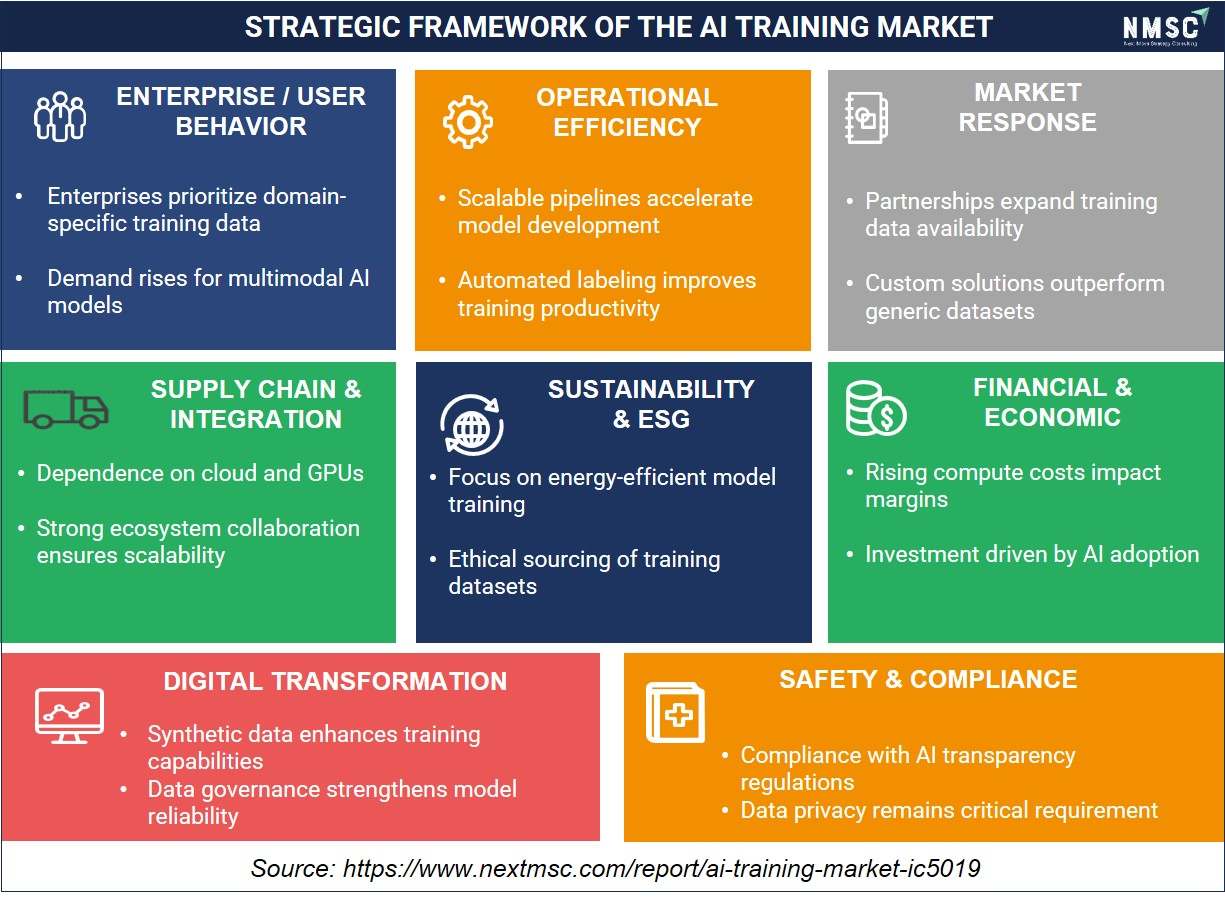
The strategic framework of the AI Training Market highlights the key forces shaping industry growth and competition. Enterprises are prioritizing domain-specific and multimodal AI training, while scalable pipelines and automated labeling improve operational efficiency. Market participants are expanding partnerships and customized solutions to strengthen data availability. Growth is supported by cloud and GPU ecosystems, increasing AI investments, and digital transformation initiatives such as synthetic data. At the same time, energy-efficient training, ethical data sourcing, regulatory compliance, and data privacy are becoming essential factors for long-term market sustainability.
What Are the Growth Inhibitors of the AI Training Market?
How Do Data Privacy Regulations Constrain Training Data Access in the AI Training Market?
Data privacy regulations represent the most significant structural constraint on the AI Training Market by limiting access to real-world personal data required to train high-performance AI models. The EU General Data Protection Regulation (GDPR) restricts the use of personal data for AI model training without explicit consent, while the EU AI Act introduces additional transparency and data governance obligations for high-risk AI systems. The Italian Data Protection Authority (Garante) temporarily suspended ChatGPT in 2023 citing GDPR concerns with training data collection practices, illustrating real regulatory enforcement risk. Our assessment indicates that these constraints are accelerating investment in synthetic data generation and privacy-preserving federated learning techniques, which partially mitigate but do not eliminate the inhibitor's structural impact.
How Does the Energy and Infrastructure Cost of AI Model Training Limit AI Training Market Expansion?
The energy intensity of large-scale AI model training represents a significant operational and reputational constraint on the AI Training Market, particularly as sustainability commitments become central to enterprise technology procurement decisions. The U.S. Department of Energy has documented that data center electricity consumption is projected to double between 2023 and 2026, with AI training workloads among the fastest-growing contributors to this demand. Our analysis shows that training a single large language model with hundreds of billions of parameters can consume megawatt-hours of electricity equivalent to thousands of average U.S. household monthly consumption levels, creating material carbon footprint concerns and escalating operational costs that limit the frequency and scale of training runs for smaller buyers.
What Are the Growth Opportunities in the AI Training Market?
How Does the Expansion of AI in Healthcare Create a Multi-Billion Dollar Opportunity in the AI Training Market?
Healthcare AI model development represents one of the highest-value and fastest-growing opportunity segments within the AI Training Market, with regulatory-grade data requirements creating premium demand for specialized annotation services, synthetic patient data generation, and compliant training infrastructure. The U.S. Food and Drug Administration (FDA) has cleared over 1,000 AI-enabled medical devices as of 2024, each requiring documented training data and validation frameworks. Through our market evaluation, we assessed that the FDA's Predetermined Change Control Plans framework creates a pathway for adaptive AI learning in medical devices, which mandates continuous retraining infrastructure and model monitoring, generating recurring AI Training Market revenue streams from healthcare AI developers and medical device manufacturers.
How Does the U.S. Government's AI Investment Create Structural Opportunity in the AI Training Market?
Federal government investment in AI capabilities is creating a durable and growing institutional demand segment within the AI Training Market. The National AI Initiative Act and the CHIPS and Science Act collectively direct federal agencies to accelerate AI research and domestic AI infrastructure development, with specific allocations for AI training compute at national laboratories and research universities. The Defense Advanced Research Projects Agency (DARPA) runs multiple programs requiring frontier AI model training on classified and sensitive datasets, creating demand for on-premises and FedRAMP-authorized AI training infrastructure. NMSC's analysis indicates that the U.S. Department of Defense's Joint Artificial Intelligence Center (JAIC) and successor AI organizations collectively represent a multi-billion-dollar annual AI Training Market buyer.
How Does the Commoditization of Fine-Tuning Infrastructure Create Platform Monetization Opportunities in the AI Training Market?
The standardization of fine-tuning techniques including LoRA, QLoRA, and RLHF is creating a new category of managed AI training platforms and marketplaces that represent a rapidly expanding commercial opportunity within the AI Training Market. Open-source base models released by Meta (Llama series), Mistral, and the Allen Institute for AI have dramatically lowered the cost of building customized enterprise AI capabilities, redirecting enterprise training spend from compute-intensive pre-training toward annotation services, fine-tuning platforms, and evaluation infrastructure. Based on NMSC's research, we found that dataset marketplaces such as Hugging Face's dataset hub and Scale AI's data platform are capturing this opportunity by providing curated, licensed, and compliance-ready training data assets optimized for fine-tuning workflows.
SWOT ANALYSIS OF THE AI TRAINING MARKET
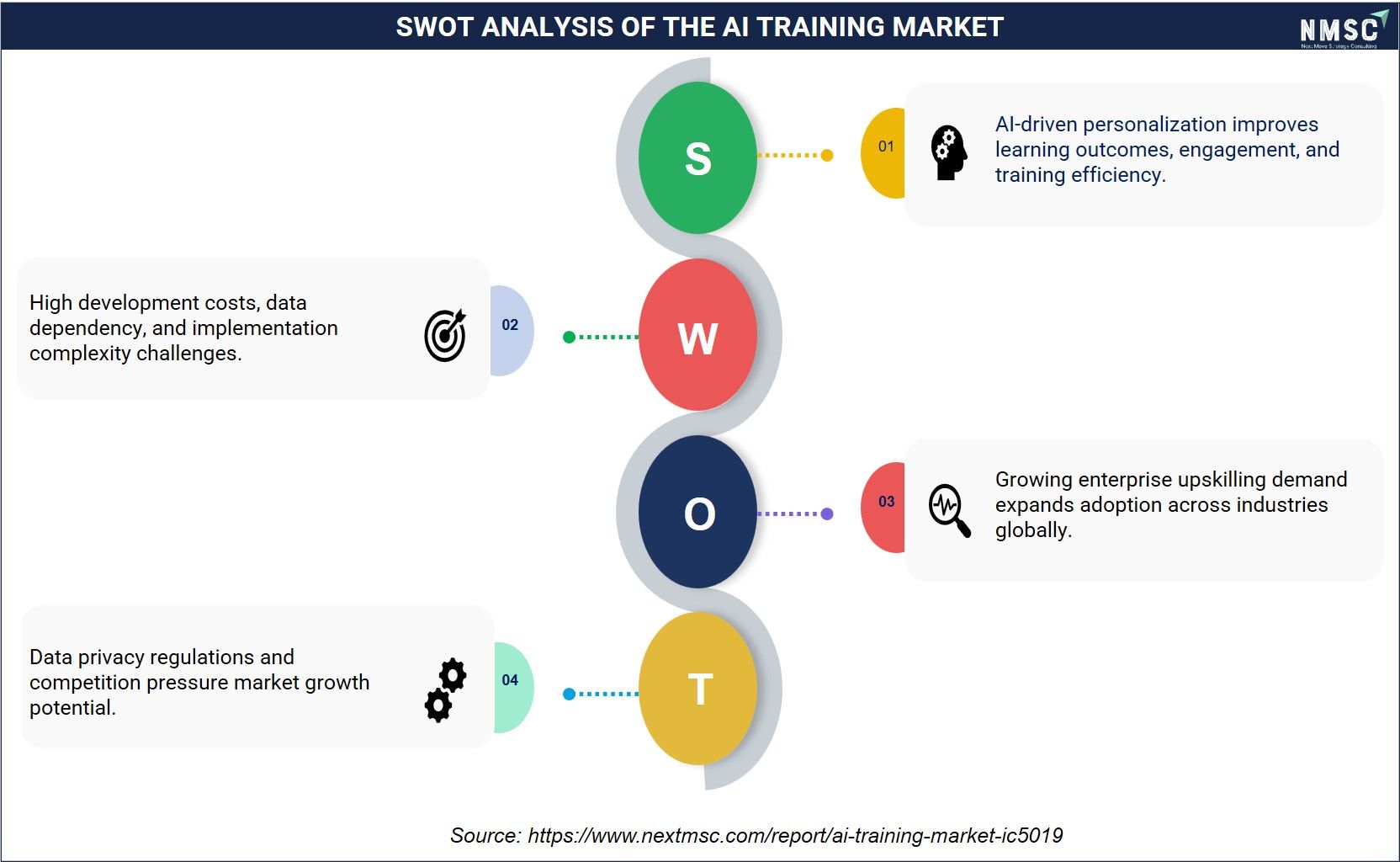
The SWOT analysis of the AI Training Market highlights its strong growth potential driven by AI-powered personalization, which improves learning outcomes, user engagement, and training efficiency. However, the market faces challenges including high development costs, dependence on large volumes of quality data, and implementation complexity. Expanding enterprise upskilling initiatives create significant opportunities for broader adoption across industries, while increasing data privacy regulations and intensifying competition remain key threats that could influence long-term market growth and profitability.
How Is the AI Training Market Segmented in This Report, and What Are the Key Insights from the Segmentation Analysis?
Which Offering Segments Define the Revenue Structure of the AI Training Market?
|
Offering Segment |
2025 (USD Bn) |
2035 (USD Bn) |
CAGR (%) |
|
Training Compute |
24.6 |
183.2 |
22.3% |
|
Accelerators |
11.2 |
86.4 |
22.7% |
|
AI Servers |
6.4 |
47.8 |
22.3% |
|
AI Appliances |
2.1 |
16.8 |
23.1% |
|
Cloud Compute |
3.8 |
27.6 |
22.0% |
|
Storage & Networking |
1.1 |
4.6 |
15.4% |
|
Training Data |
9.8 |
99.4 |
27.1% |
|
Prebuilt Datasets |
3.8 |
26.4 |
21.4% |
|
Synthetic Data |
3.2 |
52.8 |
32.2% |
|
Dataset Marketplaces |
2.2 |
16.8 |
22.4% |
|
Training Software |
5.6 |
58.4 |
26.5% |
|
Annotation Platforms |
1.8 |
19.2 |
26.8% |
|
Dataset Management |
0.9 |
9.8 |
26.9% |
|
MLOps & Experiment Mgmt |
1.6 |
18.6 |
27.8% |
|
Evaluation & Monitoring |
1.3 |
10.8 |
23.5% |
|
Training Services |
5.8 |
71.6 |
28.9% |
|
Data Collection & Labeling |
2.4 |
28.8 |
28.1% |
|
Fine Tuning Services |
1.4 |
22.4 |
32.1% |
|
Managed Training Operations |
1.2 |
14.8 |
28.6% |
|
Training Support & Optimization |
0.8 |
5.6 |
21.4% |
Based on our analysis of enterprise AI infrastructure investment and technology procurement patterns, we observed that the AI Training Market is segmented into Training Compute, Training Data, Training Software, and Training Services. The Training Compute segment continues to hold the dominant market share, led by accelerators including NVIDIA H100 and H200 GPUs, Google TPUs, and AWS Trainium chips that power large-scale foundation model development globally. Training Services, encompassing data collection and labeling, fine-tuning services, managed training operations, and optimization support, represent the fastest-growing primary offering at a CAGR of 28.9%, as enterprises increasingly outsource complex training workflows to specialized providers. Synthetic Data within the Training Data segment is the fastest-growing sub-segment at a CAGR of 32.2%, reflecting the structural shift toward AI-generated training data that addresses real-world data scarcity across regulated and high-complexity verticals.
How Does Modality Segmentation Reveal Demand Patterns in the AI Training Market?
|
Modality Segment |
2025 (USD Bn) |
2035 (USD Bn) |
CAGR (%) |
|
Text |
13.2 |
96.4 |
22.1% |
|
Image |
8.6 |
68.4 |
23.0% |
|
Video |
5.8 |
62.8 |
26.7% |
|
Audio |
3.2 |
28.4 |
24.5% |
|
3D and Sensor |
4.6 |
44.8 |
25.6% |
|
Geospatial |
2.1 |
18.6 |
24.4% |
|
Tabular |
3.4 |
22.8 |
20.9% |
|
Code |
2.8 |
24.6 |
24.3% |
|
Multimodal |
1.4 |
41.2 |
40.2% |
|
Other |
0.7 |
4.6 |
20.8% |
From our research, we found that the AI Training Market is segmented by modality into Text, Image, Video, Audio, 3D and Sensor, Geospatial, Tabular, Code, Multimodal, and Other categories. The Text modality continues to dominate due to the primacy of large language model development, instruction tuning, and retrieval-augmented generation infrastructure that collectively constitute the largest segment of training data and compute expenditure. Video is among the fastest-growing single-modality segments at a CAGR of 26.7%, driven by autonomous vehicle training, content moderation systems, and video understanding models. Multimodal is the highest-growth segment at a CAGR of 40.2%, as AI systems capable of jointly processing text, images, audio, and video represent the dominant architectural direction of frontier AI development through 2035.
How Does Deployment Mode Shape Revenue Distribution Across the AI Training Market?
|
Deployment Segment |
2025 (USD Bn) |
2035 (USD Bn) |
CAGR (%) |
|
Cloud |
30.2 |
264.6 |
24.3% |
|
On Premises |
10.4 |
78.8 |
22.4% |
|
Hybrid |
4.8 |
62.4 |
29.0% |
|
Other |
0.4 |
6.8 |
32.5% |
Based on NMSC's research, we found that the AI Training Market is segmented by deployment into Cloud, On Premises, Hybrid, and Other modes. Cloud deployment dominates the market due to the unmatched scalability of hyperscaler AI compute clusters and the ability to provision thousands of GPUs on demand for large-scale training runs. The On Premises segment remains substantial at USD 10.4 billion in 2025, driven by government agencies, defense contractors, and regulated enterprises that require complete data sovereignty and cannot transfer sensitive training datasets to external cloud environments. Hybrid deployment is the fastest-growing mode at a CAGR of 29.0%, as enterprises seek to balance governance requirements with cloud-scale training compute access, routing sensitive data through on-premises preprocessing before leveraging cloud GPU clusters for training execution.
Which Buyer Types Are Driving Purchasing Decisions in the AI Training Market?
|
Buyer Type Segment |
2025 (USD Bn) |
2035 (USD Bn) |
CAGR (%) |
|
AI Labs |
8.6 |
98.4 |
27.6% |
|
Enterprises |
17.4 |
148.6 |
23.8% |
|
Public Sector |
6.8 |
56.4 |
23.4% |
|
SMEs |
5.2 |
48.6 |
24.9% |
|
Research and Academia |
5.6 |
44.8 |
23.0% |
|
Other |
2.2 |
15.8 |
21.8% |
Through NMSC's assessment, we found that the AI Training Market is segmented by buyer type into AI Labs, Enterprises, Public Sector, Small and Medium Enterprises, Research and Academia, and Other buyers. Enterprises represent the dominant buyer category at USD 17.4 billion in 2025, driven by Fortune 500 companies accelerating investment in proprietary AI model development for competitive differentiation across customer service, operations, and product development. AI Labs, encompassing organizations such as OpenAI, Anthropic, Cohere, and Inflection AI, represent the fastest-growing buyer category at a CAGR of 27.6% through 2035, as venture capital investment and technology licensing revenues fund ever-larger frontier model training runs. The Public Sector represents a structurally important and growing segment, with government agencies investing in sovereign AI capabilities for defense, intelligence, and public service delivery.
Which End Use Industries Generate the Most Value in the AI Training Market?
|
End Use Industry |
2025 (USD Bn) |
2035 (USD Bn) |
CAGR (%) |
|
Software and Technology |
12.8 |
108.4 |
23.9% |
|
Automotive |
3.9 |
39.6 |
26.1% |
|
Healthcare |
4.2 |
41.8 |
25.8% |
|
BFSI |
5.6 |
46.8 |
23.7% |
|
Retail |
3.2 |
26.4 |
23.4% |
|
Manufacturing |
4.8 |
38.4 |
23.2% |
|
Telecom |
3.4 |
26.6 |
22.9% |
|
Media and Entertainment |
2.8 |
22.8 |
23.2% |
|
Government and Defense |
5.1 |
44.8 |
24.3% |
|
Other Industries |
5.0 |
36.6 |
22.2% |
Based on our analysis of enterprise AI adoption trends across industries, we observed that the AI Training Market is segmented across Software and Technology, Automotive, Healthcare, BFSI, Retail, Manufacturing, Telecom, Media and Entertainment, Government and Defense, and Other industries. The Software and Technology sector continues to dominate as both the primary developer and consumer of AI training infrastructure, with technology companies building internal AI capabilities and developing AI-powered products for downstream enterprise customers. Automotive is the fastest-growing end use sector at a CAGR of 26.1%, driven by the training compute, simulation data, and sensor annotation requirements of autonomous and semi-autonomous vehicle programs at major OEMs and dedicated autonomous vehicle developers. Healthcare and Government and Defense represent the highest-value regulated segments within the AI Training Market, commanding premium pricing for compliance-grade data annotation and secure training infrastructure.
How Do Revenue Models Reflect the Commercial Evolution of the AI Training Market?
|
Revenue Model |
2025 (USD Bn) |
2035 (USD Bn) |
CAGR (%) |
|
Subscription |
8.2 |
69.8 |
23.9% |
|
Usage Based |
14.6 |
134.2 |
24.8% |
|
Project Based |
9.4 |
72.8 |
22.7% |
|
Marketplace Take Rate |
4.2 |
44.6 |
26.7% |
|
Hardware Sale |
8.6 |
79.4 |
24.8% |
|
Other |
0.8 |
11.8 |
30.9% |
In our analysis of commercial purchasing patterns across the AI Training Market, we assessed that revenue models are segmented into Subscription, Usage Based, Project Based, Marketplace Take Rate, Hardware Sale, and Other structures. Usage-based pricing is the dominant and highest-revenue model at USD 14.6 billion in 2025, preferred by cloud compute providers that bill by GPU-hours consumed and training service providers that price by token or compute unit. Hardware sales, encompassing AI server and accelerator procurement, represent a structurally important segment at USD 8.6 billion in 2025, fueled by enterprise and government on-premises cluster investments. Marketplace take-rate models are the fastest-growing non-hardware revenue model at a CAGR of 26.7%, reflecting the commercialization of dataset and model marketplaces that aggregate supply and demand across the AI Training Market ecosystem.
How Are Distribution Channels Reshaping Go-to-Market Strategies in the AI Training Market?
|
Channel |
2025 (USD Bn) |
2035 (USD Bn) |
CAGR (%) |
|
Direct |
19.4 |
156.8 |
23.3% |
|
Partner |
8.6 |
74.4 |
24.2% |
|
Marketplace |
6.8 |
76.4 |
27.3% |
|
Reseller |
5.2 |
44.8 |
24.0% |
|
OEM |
4.6 |
44.6 |
25.4% |
|
Other |
1.2 |
15.6 |
29.3% |
We noticed that the AI Training Market is segmented by distribution channel into Direct, Partner, Marketplace, Reseller, OEM, and Other structures. The Direct channel continues to dominate due to the complexity and customization requirements of enterprise AI training engagements, where dedicated account management, solution architecture, and technical support are prerequisites for large-scale deals. Marketplace channels are the fastest-growing distribution model at a CAGR of 27.3%, as AWS Marketplace, Azure Marketplace, and Google Cloud Marketplace enable frictionless procurement of training software tools, dataset subscriptions, and AI services through existing committed cloud spend balances. OEM channels represent an important and growing vector, particularly for AI accelerator and AI appliance vendors embedding their hardware and software within systems integrator and hyperscaler solution stacks.
Regional Outlook
Geographic Performance Snapshot
|
Region |
2025 (USD Bn) |
2035 (USD Bn) |
CAGR (%) |
Key Driver |
|
North America |
22.4 |
187.6 |
23.9% |
Hyperscaler GPU clusters, frontier AI lab investments |
|
Europe |
7.8 |
61.4 |
22.8% |
EU AI Act compliance, sovereign AI programs |
|
Asia-Pacific |
9.6 |
96.8 |
26.0% |
China AI national programs, India technology scale-up |
|
Middle East & Africa |
2.4 |
28.6 |
27.9% |
Vision 2030 AI infrastructure, UAE AI Strategy |
|
Latin America |
3.6 |
38.2 |
26.5% |
Digital transformation, cloud AI adoption |
North America AI Training Market
North America is the global epicenter of the AI Training Market, accounting for USD 22.4 billion in 2025 and forecast to reach USD 187.6 billion by 2035 at a CAGR of 23.9%. The region hosts the world's highest concentration of frontier AI laboratories, hyperscaler GPU cluster investments, and enterprise AI adopters. Strong regulatory frameworks including the U.S. Executive Order on AI, NIST AI Risk Management Framework, and FedRAMP authorization structure are compelling organizations to invest in compliant, auditable AI training infrastructure. North America's mature venture capital ecosystem and deep AI talent pool across universities and technology firms underpin sustained regional market leadership through the forecast period.
U.S. AI Training Market
Based on our engagements, the United States represents over 85% of North American AI Training Market revenue, driven by the global headquarters of NVIDIA, Google, Microsoft, Amazon, Meta, and all leading frontier AI laboratories including OpenAI, Anthropic, and Cohere. The U.S. CHIPS and Science Act allocated over USD 52 billion toward domestic semiconductor manufacturing, directly strengthening the AI accelerator supply chain. The National AI Initiative Act coordinates federal AI research investments across DARPA, DOE national laboratories, and NSF. U.S. federal AI governance requirements under OMB Memorandum M-24-10 are driving government agency investment in documented, validated AI training infrastructure and model evaluation frameworks.
Canada AI Training Market
Through our analysis, Canada is a structurally important AI Training Market within North America, hosting world-class AI research institutions including the Vector Institute, Mila, and the Alberta Machine Intelligence Institute (AMII) that generate significant demand for training compute and datasets. The Government of Canada's Pan-Canadian Artificial Intelligence Strategy has allocated CAD 443.8 million toward AI research and talent development through 2025. Major Canadian financial institutions and telecommunications providers are significant enterprise buyers of AI training services and MLOps platforms. Canada's data sovereignty requirements under PIPEDA are driving investment in on-premises and sovereign cloud AI training deployments appropriate for federally regulated industries.
Mexico AI Training Market
From our assessment, Mexico is an emerging AI Training Market within North America, benefiting from its proximity to the United States, a growing technology sector, and manufacturing industry digitization driven by nearshoring investments. Mexico's National Digital Strategy and planned AI regulatory framework are creating early public sector demand for AI training infrastructure. The country's rapidly growing fintech and manufacturing sectors represent primary enterprise buyers of AI training data annotation and model development services. Mexico's lower labor costs relative to the United States create a competitive advantage for data collection and labeling operations serving North American AI training supply chains.
Europe AI Training Market
Europe is the second-largest region in the AI Training Market, contributing USD 7.8 billion in 2025 and forecast to reach USD 61.4 billion by 2035 at a CAGR of 22.8%. The EU AI Act, which entered into force in 2024 and applies progressively through 2027, establishes the world's most comprehensive regulatory framework for AI systems and directly drives investment in compliant training data governance, model evaluation platforms, and documentation infrastructure across European enterprises and public sector organizations. Sovereign AI programs in France, Germany, and the UK are accelerating government investment in independent AI training compute infrastructure.
U.K. AI Training Market
Based on our engagements, the United Kingdom is Europe's largest individual AI Training Market, representing approximately 24% of European revenue in 2025. The UK AI Safety Institute, established in 2023 as the world's first dedicated AI safety evaluation body, drives structured demand for model evaluation, red-teaming, and safety assessment infrastructure. The UK's National AI Strategy commits GBP 2.5 billion to AI research and adoption, with significant allocations to computing infrastructure. London's concentration of financial services firms creates strong enterprise demand for BFSI-specific AI training data and fine-tuning services across credit risk, fraud detection, and compliance automation applications.
Germany AI Training Market
According to evaluation, Germany represents Europe's second-largest AI Training Market, driven by automotive OEM investment in autonomous vehicle AI training, industrial AI adoption across manufacturing conglomerates, and government investment in the High-Performance Computing (HPC) infrastructure that serves dual-purpose scientific and AI training workloads. The German government's AI Strategy allocated EUR 3 billion toward AI research and adoption through 2025. BMW, Volkswagen, and Bosch are among the largest enterprise buyers of AI training data, simulation infrastructure, and model evaluation platforms in Europe. The Federal Office for Information Security (BSI) provides AI security guidelines that shape training infrastructure procurement requirements.
France AI Training Market
Through our analysis, France is the third-largest European AI Training Market, distinguished by the government's France 2030 plan which allocated EUR 1.5 billion specifically to AI, including training infrastructure and sovereign AI capabilities. The French AI national champion Mistral AI, which has released open-source foundation models, is a significant domestic AI Training Market buyer and demonstrates France's ambition to develop European frontier AI capabilities. The CNIL actively enforces GDPR requirements for AI training data, compelling enterprises to adopt privacy-compliant annotation and dataset management practices. France's sovereign cloud initiative through OVHcloud and Thales is creating localized AI training infrastructure for government and regulated industries.
Italy AI Training Market
Based on our market evaluation, we noticed that Italy is developing its AI Training Market through the National AI Strategy 2022–2024 and the broader PNRR digital transformation investment framework. Italian automotive, manufacturing, and financial services companies are the primary enterprise buyers of AI training services and compute infrastructure. The national supercomputing center CINECA provides HPC infrastructure that serves both scientific and AI training workloads. Italy's Garante data protection authority enforces GDPR rigorously, compelling enterprise buyers to invest in privacy-compliant training data pipelines and annotation governance platforms.
Spain AI Training Market
Based on our evaluation, Spain is an increasingly active AI Training Market within Europe, supported by the government's National Artificial Intelligence Strategy (ENIA) and its EUR 600 million investment framework. Spanish financial institutions including Banco Santander and BBVA, and telecommunications operators including Telefonica, are significant enterprise buyers of AI training services for customer intelligence and fraud detection applications. Spain's Supercomputing Center (BSC-CNS), home to MareNostrum 5, provides national AI training compute infrastructure. The AEPD actively enforces data protection requirements shaping training data governance investment across Spanish enterprises.
Sweden AI Training Market
Through NMSC's assessment, we found that Sweden is a high-per-capita AI Training Market consumer, supported by technology firms including Ericsson, Spotify, and Klarna that are active enterprise buyers of AI training compute and services. Sweden's national AI strategy and strong university research ecosystem at KTH, Chalmers, and Lund University create sustained demand for academic AI training infrastructure. Swedish data centers benefit from renewable energy advantages that reduce the carbon footprint of energy-intensive AI training operations, attracting sustainable AI training investments. The IMY enforces GDPR compliance affecting training data collection and annotation practices.
Denmark AI Training Market
In our observation, Denmark is among Scandinavia's most advanced AI Training Markets, with strong government investment in Denmark's National Strategy for Artificial Intelligence and digital public infrastructure. Danish life sciences companies including Novo Nordisk are significant buyers of healthcare AI training data and clinical annotation services, representing the highest-value vertical within the Danish AI Training Market. The Digital Hub Denmark and Confederation of Danish Industry are actively driving enterprise AI adoption programs that create structured demand for fine-tuning services and MLOps platforms. Denmark's consistent top ranking in the EU DESI index reflects deep digital literacy supporting AI training adoption.
Finland AI Training Market
From our assessment, Finland's AI Training Market is supported by the government's AuroraAI program and national AI strategy that positions Finland as a leading AI application economy. Nokia's global operations and Finland's advanced telecommunications sector create enterprise demand for network intelligence AI training. The CSC (IT Center for Science Ltd.), owned by the Finnish state, operates LUMI, one of Europe's most powerful supercomputers, which is available for AI training workloads by European research institutions and companies. Finland's open data tradition and MyData initiative create structured frameworks for consented training data access across public sector datasets.
Netherlands AI Training Market
Based on our engagements, the Netherlands is a critical hub within the European AI Training Market, hosting SURF's national computing facilities including Snellius that serve dual scientific and AI training purposes. Dutch enterprises in financial services, logistics (Heineken, ASML), and technology are significant AI Training Market buyers. The Netherlands' role as a gateway for European data flows, anchored by AMS-IX internet exchange, creates colocation and networking infrastructure advantages for AI training cluster deployment. ASML, a critical enabler of advanced semiconductor manufacturing used in AI chip production, is a structurally important Dutch participant in the AI Training Market supply chain.
Rest of Europe AI Training Market
Through our analysis, the Rest of Europe, comprising Poland, Belgium, Switzerland, Austria, Portugal, Czech Republic, and other European nations, collectively represents a growing and strategically significant portion of the European AI Training Market. Switzerland hosts EPFL and ETH Zurich, world-class AI research institutions that generate sustained demand for high-performance training compute. Belgium, home to EU institutions, drives public sector AI training investment in governance-compliant model development. Poland and Czech Republic are emerging as AI training service delivery centers, with growing data annotation and labeling workforces serving Western European enterprise buyers.
Asia-Pacific AI Training Market
Asia-Pacific is the fastest-growing major region in the AI Training Market, advancing from USD 9.6 billion in 2025 to an estimated USD 96.8 billion by 2035 at a CAGR of 26.0%. The region's growth is propelled by China's government-directed national AI champion development programs, India's rapidly scaling technology sector and open-source AI ecosystem, and the advanced semiconductor and electronics manufacturing ecosystems of South Korea and Taiwan. Japan's Society 5.0 vision and South Korea's National AI Strategy are driving public sector AI training infrastructure investment across the region through the forecast period.
China AI Training Market
Based on our engagements, China is the largest single market in Asia-Pacific for AI Training, driven by state-directed investment in frontier AI model development, the world's second-largest AI research ecosystem, and a national AI industrial policy that mandates domestic AI capability development. China's Ministry of Science and Technology (MOST) and the Cyberspace Administration of China (CAC) provide regulatory frameworks governing AI model training data and system registration. Domestic foundation model developers including Baidu (ERNIE), Alibaba (Qwen), and Huawei (PanGu) are among Asia-Pacific's largest AI Training Market buyers. The AI Safety Measures for Generative AI Services regulation requires documentation of training data sources and model evaluation.
India AI Training Market
Through our analysis, India is the fastest-growing national AI Training Market within Asia-Pacific, advancing at a CAGR of 28.6% from 2026 to 2035. The India AI Mission, approved in 2024 with an INR 10,372 crore allocation, specifically invests in sovereign AI computing infrastructure including GPU clusters available to Indian startups and researchers through the IndiaAI Compute platform. India's massive technology services sector, including Infosys, Wipro, and TCS, provides AI training data annotation and labeling services to global clients. The Digital Personal Data Protection Act 2023 is shaping training data governance requirements for Indian enterprises developing AI systems.
Japan AI Training Market
In our evaluation, Japan is the second-largest Asia-Pacific AI Training Market, driven by manufacturing sector AI adoption, robotics AI training requirements, and government investment through the Strategic AI Plan of the Cabinet Office. Japanese enterprises including Toyota, Honda, Panasonic, and Fujitsu are significant buyers of AI training data, compute infrastructure, and model evaluation services for manufacturing intelligence and robotics applications. The Personal Information Protection Commission (PPC) enforces APPI data protection requirements affecting training data collection and usage. Japan's National Institute of Advanced Industrial Science and Technology (AIST) provides AI research infrastructure and training compute for academic and enterprise collaborative programs.
South Korea AI Training Market
From our assessment, South Korea demonstrates strong and growing AI Training Market maturity, supported by the government's K-AI strategy and investment commitments to AI infrastructure development. Samsung Electronics, SK Hynix, and LG are significant enterprise buyers of AI training compute and data services, applying AI to semiconductor process optimization, product development, and supply chain intelligence. The Korean National Computing and Information Service (KISTI) provides national supercomputing infrastructure for AI training. South Korea's advanced telecommunications networks (5G, 6G research) create demand for network intelligence AI training data. The Personal Information Protection Commission (PIPC) enforces PIPA data privacy requirements.
Taiwan AI Training Market
Based on our engagements, Taiwan's AI Training Market is strategically significant due to its role in the global AI accelerator supply chain through TSMC's manufacturing of leading-edge semiconductor nodes for NVIDIA, AMD, Apple, and Google AI chips. Enterprise AI training demand is concentrated in semiconductor process intelligence, electronics manufacturing optimization, and supply chain prediction applications at companies including TSMC, Foxconn, and MediaTek. Taiwan's government has invested in AI cloud infrastructure and research programs through the National Applied Research Laboratories (NARLabs). The Personal Data Protection Act (PDPA) governs training data governance practices for Taiwanese enterprise AI systems.
Indonesia AI Training Market
In our observation, Indonesia is among Southeast Asia's most rapidly growing AI Training Markets, driven by a digital economy exceeding USD 77 billion and government programs under Indonesia's National AI Strategy 2020–2045. Gojek, Tokopedia, Bank Central Asia, and Telkom Indonesia are the primary enterprise AI Training Market buyers, investing in customer intelligence, fraud detection, and logistics optimization AI models. Indonesia's large multilingual population creates specialized demand for Bahasa Indonesia language model training data. The Personal Data Protection Law (PDP Law 2022) is establishing data governance requirements affecting training data collection and labeling operations.
Vietnam AI Training Market
Through NMSC's assessment, we found that Vietnam is an emerging and high-growth AI Training Market within Southeast Asia, supported by the National Strategy on Research, Development and Application of Artificial Intelligence through 2030. Vietnam's competitive labor cost structure has positioned the country as a significant provider of AI training data annotation and labeling services for global technology companies. VinAI Research, affiliated with Vingroup, is Vietnam's most prominent domestic AI research organization driving national AI training capability development. Growing electronics manufacturing exports following China-plus-one supply chain diversification create demand for manufacturing intelligence AI training applications.
Australia AI Training Market
Based on our market evaluation, we noticed that Australia is the most mature AI Training Market in Oceania, with strong adoption in financial services, mining, defense, and healthcare. The Australian government's AI in Government program and the National Artificial Intelligence Centre (NAIC) within CSIRO are driving structured public sector AI training investment. The Defence Science and Technology Group (DSTG) represents a significant buyer of secure AI training infrastructure and synthetic data for defense applications. Australia's Consumer Data Right (CDR) framework and Privacy Act amendments create governed data-sharing mechanisms supporting compliant AI training dataset development across regulated industries.
Philippines AI Training Market
From our assessment, the Philippines is a developing but strategically important AI Training Market, with a globally significant competitive advantage in AI training data annotation and labeling services. The Philippines' Business Process Outsourcing (BPO) sector, which employs over 1.4 million workers, has pivoted to AI data services, providing cost-competitive manual annotation, content moderation, and AI training support for global technology companies. The National Privacy Commission (NPC) governs data handling under the Data Privacy Act 2012. Philippine government AI initiatives under the Department of Information and Communications Technology (DICT) are developing national AI capability investment programs.
Malaysia AI Training Market
Based on our engagements, Malaysia is a mid-tier and growing AI Training Market within Southeast Asia, supported by the government's Malaysia AI Roadmap and MyDigital Blueprint which commit national investment to AI infrastructure and skills development. Malaysia's National Supercomputing Centre (NSCC) provides HPC infrastructure serving research and AI training workloads. Petronas and major Malaysian banks including Maybank and CIMB are significant enterprise AI Training Market buyers for energy industry optimization and financial services AI development respectively. Kuala Lumpur's emergence as a regional cloud and data center hub creates infrastructure capacity for AI training cluster deployment.
Rest of Asia-Pacific AI Training Market
Through our analysis, the Rest of Asia-Pacific, comprising Thailand, Singapore, Bangladesh, Sri Lanka, New Zealand, and Pacific Island nations, collectively represents a growing segment of the regional AI Training Market. Singapore is particularly significant despite its size, serving as the regional headquarters for global AI companies and hosting AI Singapore (AISG), a national AI program that provides AI training compute resources and curated datasets to local enterprises and researchers. Thailand's national AI strategy and the PDPA (2022) are driving structured enterprise AI investment. New Zealand's AI Forum is advancing national AI capability development in close alignment with the broader Australia-New Zealand digital economy.
Middle East and Africa AI Training Market
The Middle East and Africa AI Training Market is the fastest-growing region over the forecast period, advancing from USD 2.4 billion in 2025 to USD 28.6 billion by 2035 at a CAGR of 27.9%. Vision-driven national AI investment programs in Saudi Arabia and the UAE, supported by oil-to-knowledge economy transformation agendas, are the primary growth engines. Both countries are making direct investments in sovereign AI training compute infrastructure, attracting global AI companies to establish regional training operations. Israel's world-class AI research and startup ecosystem contributes disproportionate AI Training Market participation relative to its size.
Saudi Arabia AI Training Market
Based on our engagements, Saudi Arabia is the largest AI Training Market in the Middle East and Africa, driven by Vision 2030's National AI Strategy and SDAIA's mandate to position Saudi Arabia as a global AI leader by 2030. The Saudi Data and AI Authority (SDAIA) has established the National Center for AI (NCAI) and the Thakaa Center, which operate national AI training compute resources and curated Arabic language datasets. ARAMCO's digital transformation program is generating industrial AI training demand at scale. All major hyperscalers have established Saudi Arabia cloud regions. NEOM smart city development creates simulation and sensor AI training requirements across transportation, energy, and urban management applications.
UAE AI Training Market
Through our analysis, the UAE is the second-largest AI Training Market in MEA, driven by the UAE National AI Strategy 2031 and Abu Dhabi's Technology Innovation Institute (TII) which developed the Falcon LLM open-source foundation model series. The TII's investment in Arabic language model development represents a sovereign AI training initiative that has generated global recognition. Dubai AI Campus and Abu Dhabi AI Hub provide infrastructure and ecosystem support for AI companies establishing regional training operations. The UAE's Zero-Carbon initiative and commitment to renewable energy data centers position it competitively for sustainable AI training infrastructure attracting ESG-conscious hyperscaler investments.
Egypt AI Training Market
From our assessment, Egypt is an emerging AI Training Market within MEA, supported by Egypt's National AI Strategy and Vision 2030 digital economy targets. Egypt's large population, Arabic-speaking AI training data requirement, and growing technology workforce create domestic demand for Arabic language model training data and annotation services. The Ministry of Communications and Information Technology (MCIT) is driving public sector AI capability development. The Information Technology Industry Development Agency (ITIDA) supports AI startup ecosystem development. Egypt's Technology Innovation and Entrepreneurship Center (TIEC) provides structured AI development support for emerging enterprise buyers.
Israel AI Training Market
Based on our engagements, Israel occupies a unique position within the AI Training Market as both a leading vendor ecosystem and a sophisticated enterprise buyer. Israeli AI startups including Mobileye (autonomous vehicle AI), Wiz (cloud security AI), and numerous defense AI companies are significant buyers of AI training compute and data services. The Israel Innovation Authority provides structured funding for AI research and development. Israel's defense sector, supported by the Ministry of Defense and Unit 8200's AI-trained alumni network, drives demand for secure, on-premises AI training infrastructure and proprietary data annotation capabilities unavailable through commercial channels.
Turkey AI Training Market
Through NMSC's assessment, we found that Turkey is a growing AI Training Market within MEA, supported by the National Artificial Intelligence Strategy 2021–2025 developed by the Ministry of Industry and Technology. Turkey's large technology sector, growing startup ecosystem, and established manufacturing base create enterprise demand for AI training services across automotive (Ford Turkey, Tofas), financial services, and telecommunications verticals. TUBITAK, Turkey's national research institute, invests in AI compute infrastructure for research and development applications. Turkey's Strategic position bridging Europe and Asia creates a natural advantage for AI training service delivery to both regional markets.
Nigeria AI Training Market
In our observation, Nigeria is Sub-Saharan Africa's largest AI Training Market, driven by Africa's largest economy, a rapidly growing fintech and technology startup ecosystem, and the National Information Technology Development Agency (NITDA)'s National Artificial Intelligence Policy. Nigerian AI training demand is concentrated in natural language processing for indigenous languages (Yoruba, Igbo, Hausa) that are underrepresented in global AI training datasets, creating specialized data labeling demand. The Nigeria Data Protection Commission (NDPC), established under the Nigeria Data Protection Act 2023, governs training data collection and usage requirements for enterprise AI development.
South Africa AI Training Market
Based on our market evaluation, we noticed that South Africa is the most mature AI Training Market in Sub-Saharan Africa, supported by advanced financial services, mining, and telecommunications sectors that are primary enterprise AI training buyers. The Department of Science and Innovation's National AI Council coordinates national AI research investments including computing infrastructure at the Centre for High Performance Computing (CHPC). South Africa's Protection of Personal Information Act (POPIA), fully effective since 2021, governs AI training data governance practices. Standard Bank, FirstRand, and Nedbank are leading enterprise buyers of AI training data services for credit risk, fraud detection, and customer intelligence applications.
Rest of MEA AI Training Market
Through our analysis, the Rest of MEA, encompassing Kuwait, Qatar, Bahrain, Oman, Jordan, Morocco, Kenya, Ghana, and Ethiopia, collectively represents a growing segment of the Middle East and Africa AI Training Market. GCC countries are investing in national AI training infrastructure modeled on Saudi Vision 2030, with Qatar Foundation and Kuwait Institute for Scientific Research funding AI research programs. Morocco serves as a nearshore AI training data annotation hub for European enterprises, leveraging French-Arabic bilingual workforce capabilities. Kenya's Silicon Savannah startup ecosystem and iHub technology accelerator are creating early-stage enterprise AI training demand.
Latin America AI Training Market
Latin America is the second-fastest-growing region in the AI Training Market at a CAGR of 26.5% from 2026 to 2035, advancing from USD 3.6 billion in 2025 to USD 38.2 billion by 2035. Brazil and Mexico collectively account for approximately 68% of regional AI Training Market revenue. Hyperscaler investment in regional cloud infrastructure, growing enterprise technology budgets driven by digital transformation, and large multilingual populations creating demand for Spanish and Portuguese language AI model training are the primary regional growth drivers. Financial services, e-commerce, and agribusiness sectors represent the leading enterprise buyers across the Latin American region.
Brazil AI Training Market
Based on our engagements, Brazil is the largest AI Training Market in Latin America, accounting for approximately 40% of regional revenue in 2025. The Brazilian Ministry of Science, Technology, and Innovation's National AI Plan (PNAI) and the MCTI's investments in national computing infrastructure support AI research and enterprise adoption. Nubank, Itau Unibanco, Mercado Libre, and Embrapa (agricultural research) are significant enterprise buyers of AI training services across financial services, e-commerce, and precision agriculture verticals. Brazil's LGPD enforced by ANPD governs AI training data practices. AWS, Azure, and Google Cloud operate Sao Paulo cloud regions supporting enterprise AI training deployments.
Argentina AI Training Market
Through our analysis, Argentina is the second-largest AI Training Market in Latin America, notable for one of the region's highest concentrations of AI research talent and technology startup activity. Argentina's CONICET national research council and major universities generate sustained academic demand for AI training compute. Buenos Aires hosts a growing AI startup ecosystem with companies developing language models for Spanish and River Plate region-specific applications. Argentine financial institutions and insurance companies are significant enterprise buyers of AI training services. Mercado Libre, headquartered in Buenos Aires, is a major buyer of AI training data for e-commerce and fintech applications across Latin America.
Chile AI Training Market
From our assessment, Chile represents a stable and growing AI Training Market with strong institutional support from the Chilean AI Policy (ENIA) and CORFO's innovation funding programs. Chile's advanced mining sector, led by Codelco, is a significant enterprise buyer of predictive maintenance and operational AI training services, representing the highest-value application of industrial AI training in the country. Chile's regulatory environment is maturing with the new Data Protection Law (2024), creating compliance-driven demand for training data governance infrastructure. Google Cloud and Microsoft Azure operate Chilean cloud regions that serve as regional AI training compute access points for Andean and southern Latin American enterprises.
Colombia AI Training Market
Based on our engagements, Colombia is among the fastest-growing AI Training Markets in Latin America, supported by Bogota's emergence as a regional technology hub, a dynamic fintech sector, and the government's Centro Nacional de Inteligencia Artificial (CENIA). Colombia's large bilingual workforce creates competitive advantages for AI training data annotation and content labeling services in Spanish. Bancolombia, Davivienda, and Claro (telecommunications) are primary enterprise buyers of AI training services. AWS and Google Cloud operate Colombian cloud regions, enabling enterprise access to training compute for financial services and telecommunications AI model development without cross-border data transfer.
Rest of Latin America AI Training Market
Through our analysis, the Rest of Latin America, comprising Peru, Ecuador, Uruguay, Bolivia, Paraguay, Costa Rica, Panama, and Caribbean nations, represents an emerging and collectively growing component of the AI Training Market. Uruguay has established a structured AI governance framework through the National Technology and Open Government Agency (AGESIC), attracting technology services investment. Costa Rica and Panama serve as nearshore technology service delivery hubs for North American enterprises, creating structured demand for AI training data annotation services. Peru and Ecuador are experiencing early-stage enterprise AI adoption primarily in mining, agriculture, and financial services applications.
Competitive Landscape
Competitive Dynamics and M&A Landscape
|
Key Takeaways |
Details |
|
Market Structure |
The AI Training Market features multi-tiered competition among compute infrastructure providers (NVIDIA, AMD, Cerebras), hyperscaler AI cloud platforms (AWS, Microsoft Azure, Google Cloud, CoreWeave), training data specialists (Scale AI, Appen, iMerit), and integrated software and services providers (Databricks, IBM, Oracle), each competing on distinct value propositions across the AI training value chain. |
|
Innovation Focus |
Innovation in the AI Training Market centers on next-generation AI accelerator architectures, synthetic data generation at scale, automated annotation and active learning platforms, distributed training orchestration across thousands of GPUs, and privacy-preserving federated learning techniques that enable AI model training on sensitive datasets without centralized data collection. |
|
M&A Activity |
Significant consolidation is reshaping the AI Training Market, with hyperscalers acquiring AI infrastructure and data companies to expand their training platform capabilities. Strategic investments in AI training data quality and MLOps platforms are increasing, as enterprises seek integrated solutions that reduce the operational complexity of AI model lifecycle management from data curation through model deployment and monitoring. |
How Do Companies Compete in the AI Training Market?
The AI Training Market is characterized by multi-tiered competition among compute infrastructure providers, hyperscalers, training data specialists, and MLOps platform vendors. Compute leaders such as NVIDIA, AMD, Cerebras, and Broadcom compete on accelerator performance, memory bandwidth, and training throughput. Hyperscalers differentiate through managed AI training services, large-scale GPU cluster availability, and integration with enterprise data ecosystems. Training data and annotation providers compete on data quality, domain expertise, and workforce scale, while MLOps vendors focus on experiment tracking, workflow automation, and compatibility with major cloud platforms and open-source frameworks.
Which Kind of Companies Dominate the AI Training Market?
Three distinct categories of companies dominate the AI Training Market. First, compute infrastructure leaders including NVIDIA, AMD, Cerebras, Broadcom, and other accelerator providers deliver the hardware foundation for large-scale AI model training. Second, hyperscalers such as Amazon Web Services, Microsoft Azure, and Google Cloud provide cloud-based AI training infrastructure and managed services. At last, AI software and data platform providers, including training data specialists, annotation companies, and MLOps vendors, enable data preparation, model development, experiment management, and deployment workflows for enterprise and research applications.
Compute Innovation and Integrated AI Ecosystems Drive Market Success in the AI Training Market
Innovation across the AI Training Market is concentrated in next-generation AI accelerators, high-bandwidth memory technologies, large-scale GPU clustering, synthetic data generation, and advanced MLOps capabilities. Vendors that combine scalable compute infrastructure with integrated software frameworks, data management tools, and cloud-native AI services are strengthening customer retention and expanding enterprise adoption. Open-source frameworks and interoperable AI ecosystems are also becoming important competitive differentiators by reducing vendor lock-in and improving development flexibility.
Market Players to Opt for Merger and Acquisition Strategies to Expand Their Presence in the AI Training Market
Mergers, acquisitions, and strategic partnerships are reshaping the competitive landscape of the AI Training Market. Companies are pursuing acquisitions to strengthen AI hardware portfolios, expand cloud infrastructure capabilities, enhance training data assets, and integrate advanced MLOps technologies. Strategic investments in semiconductor companies, AI software platforms, and data infrastructure providers are expected to accelerate as enterprises and governments increase spending on frontier AI development and large-scale model training.
Who Are the Key Market Players in the AI Training Market?
-
NVIDIA Corporation
-
Amazon Web Services, Inc.
-
Microsoft Corporation
-
Google LLC
-
CoreWeave, Inc.
-
Oracle Corporation
-
IBM Corporation
-
Dell Technologies Inc.
-
Hewlett Packard Enterprise Company
-
Super Micro Computer, Inc.
-
Lenovo Group Limited
-
Advanced Micro Devices, Inc.
-
Broadcom Inc.
-
Cerebras Systems Inc.
-
Databricks, Inc.
-
Scale AI, Inc.
-
TransPerfect Global, Inc.
-
Appen Limited
-
Labelbox, Inc.
-
iMerit Technology Services Pvt. Ltd.
What Are the Latest Developments in the AI Training Market Industry?
|
Date |
Event |
|
June 2026 |
NVIDIA and NAVER announced the expansion of sovereign AI infrastructure, starting at 55 MW with plans to scale to gigawatt-level AI factories using the NVIDIA DSX platform.. |
|
March 2026 |
IBM expanded its collaboration with NVIDIA to help enterprises operationalize AI at scale, including GPU-native analytics, AI infrastructure, and Blackwell Ultra GPU deployment on IBM Cloud.. |
|
October 2025 |
NVIDIA partnered with the South Korean government and major industrial companies to deploy more than 250,000 NVIDIA GPUs across sovereign clouds and AI factories. |
Expert Insights
 "AI will be the most powerful tool for expanding human capability and potential that anyone has ever seen. Demand for this tool will be essentially uncapped, and people will do incredible things with it. The world deserves huge amounts of AI and we must figure out how to make it happen."
— Sam Altman, CEO, OpenAI
Statement said in Sam Altman's official blog post, "response," published on April 10, 2026, discussing the future of AI development and the need for massive AI infrastructure expansion.
Market Interpretation
This statement highlights the expectation of sustained and virtually unlimited demand for artificial intelligence capabilities, reinforcing the long-term growth prospects of the AI Training Market. As AI adoption expands across industries, organizations are expected to increase investments in AI training infrastructure, including high-performance computing (HPC), GPU clusters, large-scale datasets, foundation model development, and cloud-based training platforms. The insight also underscores the need for scalable AI ecosystems capable of supporting the development and continuous improvement of increasingly sophisticated AI models.
What Are the Investment Opportunities in the AI Training Market?
Capital Inflows and Venture Investment in the AI Training Market
The AI Training Market is experiencing unprecedented capital inflow from venture capital, corporate venture arms, and sovereign wealth funds targeting all layers of the training value chain. The U.S. National Venture Capital Association (NVCA) documented record AI-specific venture investment across seed through late-stage rounds in 2024, with AI infrastructure and training platforms capturing a significant share of total investment. Our analysis shows that sovereign wealth funds from Saudi Arabia (PIF), UAE (Mubadala), and Singapore (GIC) are making direct investments in AI training infrastructure companies, reflecting their national strategic interest in securing AI compute capacity and training technology access for domestic AI development programs.
Infrastructure Investment and Hyperscaler Capital Expenditure in the AI Training Market
Hyperscaler capital expenditure directed at AI training infrastructure represents the single largest investment theme within the AI Training Market. Microsoft, Amazon, and Google have collectively committed hundreds of billions of dollars in multi-year capital expenditure plans that include AI accelerator procurement, data center construction, and networking infrastructure for AI training clusters. The U.S. Department of Energy's Loan Programs Office is providing financing for AI-enabling infrastructure including electricity generation and transmission projects that support large-scale AI training data center power requirements. From our research, we found that these infrastructure commitments create durable long-term demand across the AI accelerator, AI server, and storage and networking segments of the AI Training Market.
ESG Considerations and Sustainable AI Training in the AI Training Market
Environmental sustainability is becoming a material investment and procurement consideration within the AI Training Market, as the energy intensity of large-scale model training raises carbon footprint concerns for enterprise buyers and investors. The U.S. Department of Energy's Better Climate Challenge includes data center energy efficiency commitments from major technology companies that are shaping AI training infrastructure procurement standards. NMSC's analysis indicates that AI training compute providers investing in renewable energy sourcing, liquid cooling efficiency, and hardware utilization optimization are gaining competitive advantages in procurement processes with ESG-mandated enterprise buyers across European and North American markets.
PE and VC Activity in the AI Training Market
Private equity and venture capital activity in the AI Training Market reflects a bifurcated investment thesis. Early-stage venture investment is concentrated in synthetic data generation platforms, automated annotation infrastructure, and specialized AI accelerator architectures that represent disruptive innovation potential. Growth-stage investment is targeting MLOps platform consolidation, managed AI training operations at scale, and fine-tuning service providers that are capturing the enterprise AI adoption wave without the capital intensity of hardware manufacturing. Our findings suggest that PE firms including Vista Equity Partners and Thoma Bravo, with established portfolios in enterprise software, are actively evaluating AI Training Market software platform acquisition opportunities as the segment matures toward predictable recurring revenue models.
Key Benefits for Stakeholders
For Enterprise Technology Buyers
Enterprise technology buyers gain comprehensive, vendor-neutral insights into the AI Training Market, including detailed segmentation across training compute, training data, software platforms, deployment models, buyer types, and end-use industries. This intelligence supports AI infrastructure planning, vendor evaluation, and long-term investment decisions for model development and training capabilities. Competitive landscape analysis enables procurement teams to compare deployment strategies and optimize investments across AI training hardware, software, and services.
For Investors and Financial Analysts
Investors and financial analysts receive a structured, data-driven assessment of the AI Training Market's growth outlook, competitive environment, M&A activity, and segment-level forecasts through 2035. Analysis of high-growth offerings, buyer categories, modalities, and regional markets supports portfolio allocation and valuation modeling. Company benchmarking and market development tracking provide an effective framework for identifying investment opportunities, acquisition targets, and emerging technology leaders across the AI training ecosystem.
For Technology Vendors and Platform Providers
Technology vendors and platform providers gain actionable intelligence on competitive positioning, white-space opportunities, and the fastest-growing segments within the AI Training Market. Offering and deployment analysis helps identify product expansion opportunities, while regional and buyer segmentation supports geographic growth strategies. Insights into purchasing behavior and technology adoption enable vendors to refine go-to-market strategies, optimize pricing models, and strengthen channel partnerships.
For Government and Public Sector Agencies
Government agencies and public sector organizations gain a structured analysis of the AI Training Market, including sovereign AI infrastructure development, national competitiveness, and evolving regulatory considerations. Country-level insights support evidence-based policymaking, public investment planning, and AI ecosystem development strategies. The report also provides benchmarking for government AI initiatives and procurement planning, helping policymakers strengthen domestic AI capabilities and long-term digital competitiveness.
Key Market Segments
By Offering
-
Training Compute
-
Accelerators
-
AI Servers
-
AI Appliances
-
Cloud Compute
-
Storage and Networking
-
Other Compute
-
-
Training Data
-
Prebuilt Datasets
-
Synthetic Data
-
Dataset Marketplaces
-
Other Data Products
-
-
Training Software
-
Annotation Platforms
-
Dataset Management
-
MLOps and Experiment Management
-
Evaluation and Monitoring
-
Other Software
-
-
Training Services
-
Data Collection and Labeling
-
Fine Tuning Services
-
Managed Training Operations
-
Training Support and Optimization
-
Other Services
-
By Modality
-
Text
-
Image
-
Video
-
Audio
-
3D and Sensor
-
Geospatial
-
Tabular
-
Code
-
Multimodal
-
Other
By Deployment
-
Cloud
-
On Premises
-
Hybrid
-
Other
By Buyer Type
-
AI Labs
-
Enterprises
-
Public Sector
-
Small and Medium Enterprises
-
Research and Academia
-
Other
By Revenue Model
-
Subscription
-
Usage Based
-
Project Based
-
Marketplace Take Rate
-
Hardware Sale
-
Other
By Sales Channel
-
Direct
-
Partner
-
Marketplace
-
Reseller
-
OEM
-
Other
By End Use Industry
-
Software and Technology
-
Automotive
-
Healthcare
-
BFSI
-
Retail
-
Manufacturing
-
Telecom
-
Media and Entertainment
-
Government and Defense
-
Other Industries
By Region
-
North America: U.S., Canada, and Mexico.
-
Europe: UK, Germany, France, Italy, Spain, Sweden, Denmark, Finland, the Netherlands, and the rest of Europe.
-
Asia Pacific: China, India, Japan, South Korea, Taiwan, Indonesia, Vietnam, Australia, Philippines, Malaysia and the rest of APAC.
-
Middle East & Africa (MEA): Saudi Arabia, UAE, Egypt, Israel, Turkey, Nigeria, South Africa, and the rest of MEA.
-
Latin America: Brazil, Argentina, Chile, Colombia, and the rest of LATAM.
Conclusion and Recommendations
Long-Term Outlook
The AI Training Market is entering its most consequential growth decade, transitioning from an infrastructure category dominated by research laboratories and frontier AI companies to a mainstream enterprise technology market serving every major industry vertical globally. The market is forecast to grow from USD 54.9 billion in 2026 to USD 412.6 billion by 2035, at a CAGR of 24.6%. NMSC's analysis indicates that this growth reflects both the structural expansion of AI model development at enterprise scale and the increasing commoditization of training services that is lowering barriers to AI adoption across SMEs, public sector agencies, and emerging market organizations that previously lacked access to world-class AI training capabilities.
Strategic Positioning Recommendations
Compute infrastructure vendors should prioritize next-generation accelerator efficiency, AI cluster networking capabilities, and hybrid deployment architectures that serve both cloud-scale and on-premises sovereign AI training requirements. Training data and annotation providers should invest in automated quality assurance, synthetic data generation, and domain-specific compliance certifications that command premium pricing from regulated industry buyers. MLOps and software platform vendors should prioritize cloud marketplace distribution, consumption-based pricing models, and deep integration with open-source frameworks to capture the expanding enterprise AI fine-tuning adoption wave across the AI Training Market.
Investment Attractiveness
The AI Training Market represents an exceptionally attractive investment environment given multi-decade secular drivers rooted in the fundamental economics of AI capability development, recurring revenue models across software and training services, and a structural shift from capital-intensive bespoke model training toward managed and fine-tuning-oriented AI development approaches. Our assessment indicates that the highest-conviction investment themes include Synthetic Data generation (32.2% CAGR), Fine-Tuning Services (32.1% CAGR), Multimodal training infrastructure (40.2% CAGR), and AI Training Market development in the MEA region (27.9% CAGR) and Asia-Pacific (26.0% CAGR) across the 2026 to 2035 forecast period.
Market Shifts and Key Risks
The most significant market shift underway is the democratization of AI model training through open-source foundation models and managed fine-tuning services, which is expanding the buyer base of the AI Training Market from a small number of frontier AI laboratories to thousands of enterprises and public sector organizations globally. Key risks include data privacy regulatory escalation constraining real-world training dataset access, energy supply constraints limiting AI training cluster expansion, geopolitical technology restrictions affecting AI accelerator supply chains across China and Taiwan, and open-source model releases that reduce willingness-to-pay for commercial AI training platforms and services.
Growth Pathways
Organizations seeking to maximize value from the AI Training Market should pursue a three-horizon strategy. In the near term through 2027, prioritize cloud-based fine-tuning infrastructure, annotation platform deployment, and MLOps tooling to establish the governed AI model development foundation required for enterprise AI capability building. In the mid-term through 2031, invest in synthetic data generation capabilities, multimodal AI training infrastructure, and sovereign cloud AI training deployments to capture AI capability expansion in regulated industries and emerging market geographies. In the long term through 2035, position for AI training fabric interoperability across distributed edge, sovereign, and hyperscaler environments as AI model training volumes and diversity exceed current architectural capacities.
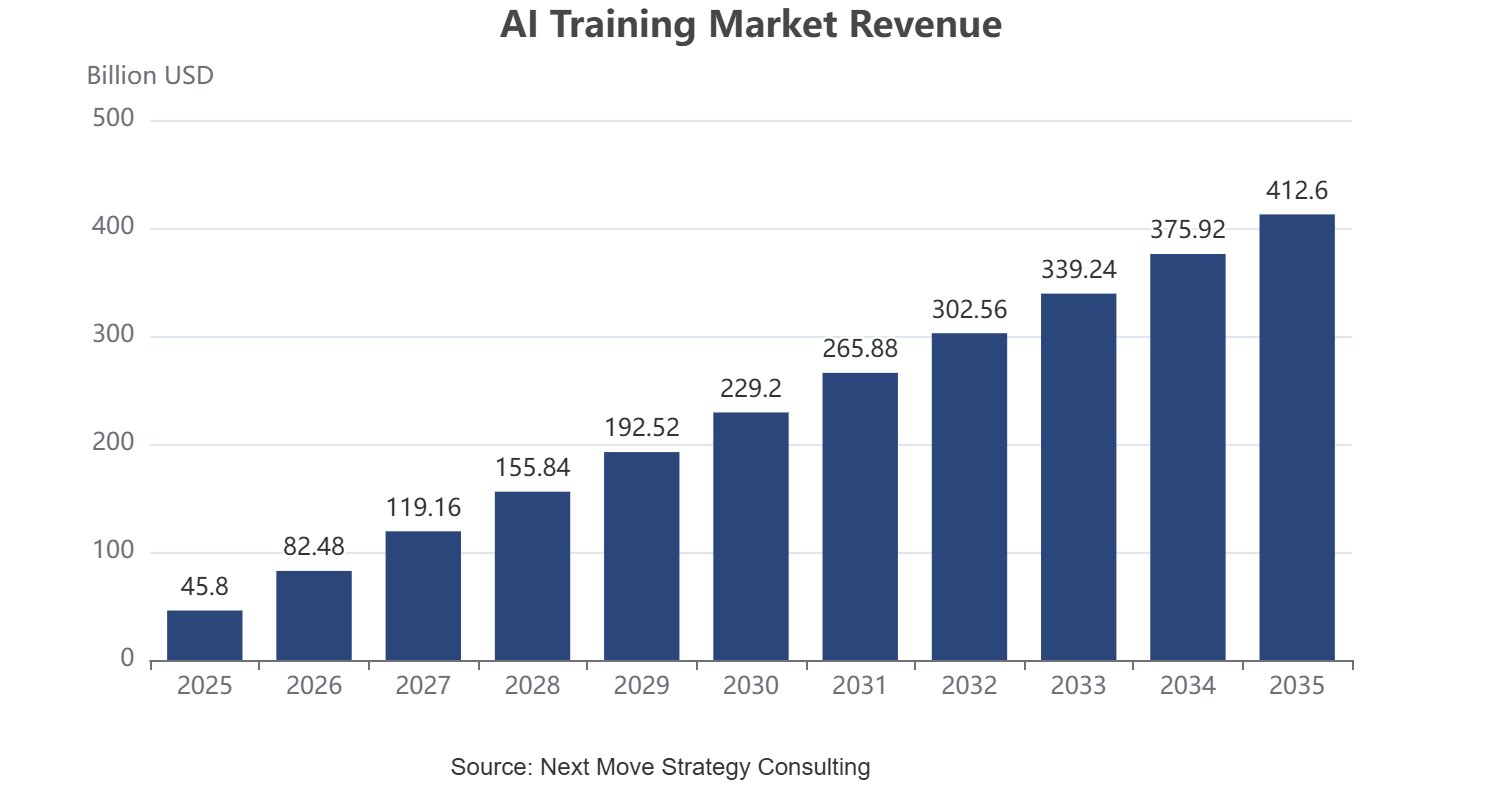
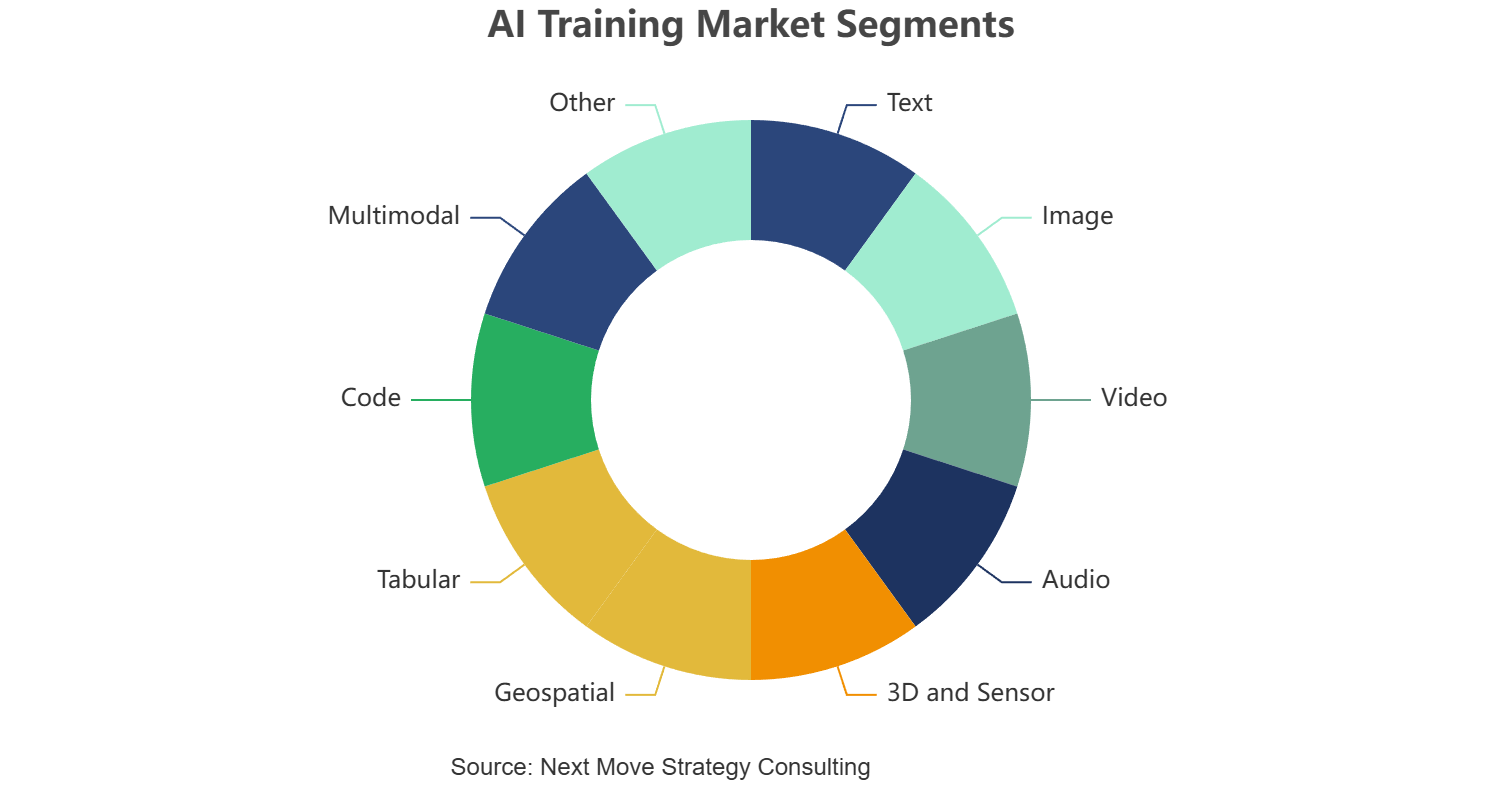
About the Author
 Liza Phukan
— Liza Phukan is Research Associate at Next Move Strategy Consulting, where she has covered emerging industries and market research across sectors for 3.5 years. Her work includes analyzing industry developments, validating market data, and developing structured business content from research findings. She uses secondary research and data-validation practices to turn complex market information into clear decision-useful market analysis for business audiences and support report development and B2B.
Liza Phukan
— Liza Phukan is Research Associate at Next Move Strategy Consulting, where she has covered emerging industries and market research across sectors for 3.5 years. Her work includes analyzing industry developments, validating market data, and developing structured business content from research findings. She uses secondary research and data-validation practices to turn complex market information into clear decision-useful market analysis for business audiences and support report development and B2B.
About the Reviewer
 Supradip Baul
— Supradip Baul is an accomplished business consultant and strategist with over a decade of rich experience in market intelligence, strategy, technology, and business transformation. His work has included rigorous qualitative and quantitative analysis across multiple industries, helping clients shape investment decisions and long-term roadmaps. Earlier in his career, he was associated with Gartner, where he contributed to industry-leading reports and market share analyses. He has worked with leading global companies and holds an MBA with a dual specialization in Marketing and Finance.
Supradip Baul
— Supradip Baul is an accomplished business consultant and strategist with over a decade of rich experience in market intelligence, strategy, technology, and business transformation. His work has included rigorous qualitative and quantitative analysis across multiple industries, helping clients shape investment decisions and long-term roadmaps. Earlier in his career, he was associated with Gartner, where he contributed to industry-leading reports and market share analyses. He has worked with leading global companies and holds an MBA with a dual specialization in Marketing and Finance.
At Next Move Strategy Consulting, we understand that insightful market research is the cornerstone of successful business decisions. That's why we employ a robust and multifaceted approach, combining various methodologies to deliver the most accurate and actionable data for our clients.

Research Landscape
We navigate the world of research with two primary approaches:
Qualitative Approach
Our qualitative research methodologies involve immersive techniques such as in-depth interviews, focus groups, and observational studies. By engaging directly with individuals and stakeholders, we uncover valuable insights that quantitative data alone may overlook.

Quantitative Research
In tandem with qualitative methodologies, NMSC leverages the power of Quantitative Research to provide a robust foundation of numerical insights. Through systematic data collection and analysis, we quantify patterns, preferences, and market trends, offering a comprehensive view of the business landscape.
Our quantitative research approach employs diverse tools, including surveys, experiments, and statistical modelling. These methodologies enable us to gather data from a large and representative sample, ensuring the statistical significance of our findings. By employing structured questionnaires and standardized data collection methods, we guarantee the reliability and validity of the information we present to our clients.
Quantitative research is particularly effective in measuring the prevalence of trends, assessing market size, and gauging the impact of various factors on consumer behavior. The numerical precision attained through this approach equips our clients with actionable insights, facilitating data-driven decision-making and strategy formulation.


Our Specialized Toolbox for Industry-Specific Market Research
We deploy a specialized arsenal of techniques tailored to meet your unique requirements. Here's a glimpse into our comprehensive toolbox:

Information Procurement
The stage entails acquiring market data or relevant information through various sources and methodologies.


Market Research Approach
We utilize both top-down and bottom-up approaches in market research analysis to achieve a comprehensive understanding of the market dynamics, leveraging the broad perspective of industry trends and macroeconomic factors alongside detailed insights from specific segments and individual companies.

Porters Five Forces Analysis
We conduct Porter's Five Forces analysis to evaluate the competitive landscape of an industry, providing us with insights into factors that affect profitability and strategic positioning.

SWOT Analysis

Forecasting
We utilize a forecasting model to predict future consumption by considering parameters like population, economics, regulations, market competition, drivers, constraints, technology, and pricing. We also employ statistical techniques such as multilinear regression, exponential smoothing, moving average, ARIMA, and Monte Carlo simulations for accurate predictions. In econometric forecasting, we analyzed short-term and long-term event impacts, attributing values based on regulatory frameworks, economic factors, and market events.





 Speak to Our Analyst