AI Fine-Tuning Market Size, Share, Trends and Growth Analysis, By Offering Type (Fine-Tuning Platforms, Fine-Tuning Infrastructure, Fine-Tuning Software Tools, and Fine-Tuning Services), By Model Type, By Fine-Tuning Technique, By Deployment Mode, By Organization Size, By Use Case (Conversational AI and Virtual Assistants, Enterprise Search and Retrieval, Content Generation and Localization, Software Development and Code Intelligence,and Others)— Global Industry Report and Forecast, 2026–2035
Industry: ICT & Media | Publishing Date: July 15, 2026 | Last Updated: September 30, 2026 | No of Pages: N/A | No. of Tables: N/A | No. of Figures: N/A | Format: PDF | Report Code: IC5154
What Is the AI Fine-Tuning Market Size?
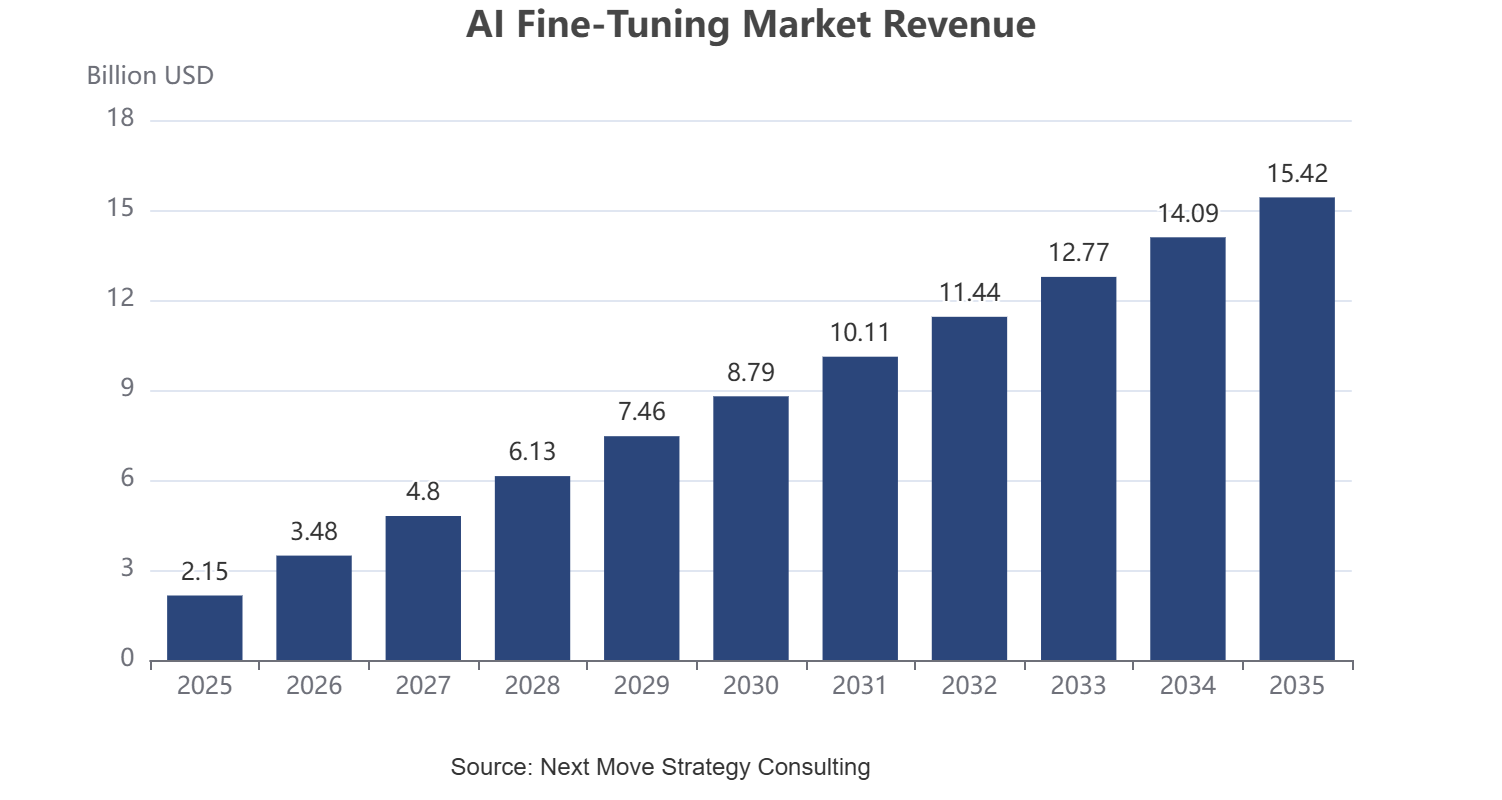
The global AI Fine-Tuning Market size was valued at USD 2.15 Billion in 2025 and is estimated at USD 2.68 Billion in 2026, forecast to reach USD 15.42 Billion by 2035, expanding at a 21.4% CAGR between 2026 and 2035. North America leads with approximately 38% share, while under offering type, Fine-Tuning Platforms dominate with approximately 34% share.
We observed that growth is broad-based across every segmentation axis, with parameter-efficient tuning methods and managed platform adoption driving the dominant structural shifts through 2035.
|
Key Takeaways |
|
By Offering Type: Fine-Tuning Platforms held the largest share of approximately 34% (USD 0.73 Billion) in 2025; Fine-Tuning Services is the fastest-growing sub-segment at 23.6% CAGR from 2026–2035. |
|
By Model Type: Large Language Models held the largest share of approximately 45% (USD 0.97 Billion) in 2025; Multimodal Models is the fastest-growing sub-segment at 25.5% CAGR from 2026–2035. |
|
By Fine-Tuning Technique: Parameter-Efficient Fine-Tuning held the largest share of approximately 42% (USD 0.90 Billion) in 2025; Preference Alignment and Reinforcement Tuning is the fastest-growing sub-segment at 24.8% CAGR from 2026–2035. |
|
By Deployment Mode: Public Cloud held the largest share of approximately 47% (USD 1.01 Billion) in 2025; Hybrid Cloud is the fastest-growing sub-segment at 25.5% CAGR from 2026–2035. |
|
By Organization Size: Large Enterprises held the largest share of approximately 58% (USD 1.25 Billion) in 2025; Small Enterprises is the fastest-growing sub-segment at 23.7% CAGR from 2026–2035. |
|
By Industry Vertical: Information Technology and Software held the largest share of approximately 30% (USD 0.65 Billion) in 2025; Healthcare and Life Sciences is the fastest-growing sub-segment at 24.2% CAGR from 2026–2035. |
|
By Use Case: Conversational AI and Virtual Assistants held the largest share of approximately 27% (USD 0.58 Billion) in 2025; Software Development and Code Intelligence is the fastest-growing sub-segment at 25.1% CAGR from 2026–2035. |
|
Dominant Region: North America dominated with approximately 38% revenue share (USD 0.82 Billion) in 2025. |
|
Fastest-Growing Region: Asia-Pacific is expected to register the highest CAGR of 26.0% during 2026–2035. |
|
Dominant Country: U.S. led with approximately USD 0.62 Billion in 2025. |
|
Fastest-Growing Country: India is the fastest-growing country at approximately 29.4% CAGR from 2026–2035. |
Between 2026 and 2035, the AI Fine-Tuning Market is set to generate an absolute dollar opportunity of USD 12.74 Billion, positioning parameter-efficient tuning platforms and managed fine-tuning services as a compelling area for capital allocation.
According to Next Move Strategy Consulting analysis, sustained investment in orchestration and evaluation tooling is reshaping procurement criteria for enterprise buyers, as governance and experiment-tracking capability increasingly determines vendor shortlisting across regulated industries.
What does the AI Fine-Tuning Market Encompass?
The AI Fine-Tuning Market encompasses platforms, infrastructure, software tools, and services that adapt pre-trained foundation models to domain-specific and task-specific requirements. Our assessment indicates that scope spans managed and self-hosted platforms, GPU-based compute and orchestration infrastructure, parameter-efficient tuning libraries, and annotation-to-validation services supplied to enterprises, government bodies, and independent developers customizing large language, vision, speech, and multimodal models across regulated and consumer-facing industries.
The market has evolved from academic transfer-learning research into a commercial layer of the AI stack, propelled by rising demand for domain-accurate outputs and data-sovereignty requirements. Regulatory frameworks such as the EU Artificial Intelligence Act and the U.S. NIST AI Risk Management Framework increasingly shape model documentation and evaluation obligations. We observed that technology adoption is shifting toward low-rank adaptation and quantized tuning methods that cut compute cost, while Next Move Strategy Consulting's analysis indicates that reinforcement-based alignment techniques are redefining vendor differentiation across the AI Fine-Tuning Market.
|
Parameter |
Details |
|
Market Size in 2025 |
USD 2.15 Billion |
|
Market Size in 2026 |
USD 2.68 Billion |
|
Revenue Forecast in 2035 |
USD 15.42 Billion |
|
Growth Rate |
CAGR of 21.4% from 2026 to 2035 |
|
Analysis Period |
2025–2035 |
|
Base Year Considered |
2025 |
|
Forecast Period |
2026–2035 |
|
Market Size Estimation |
Revenue (USD Billion) |
|
Companies Profiled |
20 |
|
Countries Covered |
38 |
|
Market Share |
Available for Top 10 Companies |
Key Emerging Trends
Based on research conducted by Next Move Strategy Consulting, we found that four structural trends are reshaping tooling, sourcing, and stakeholder engagement across the AI Fine-Tuning Market.
How Is Parameter-Efficient Fine-Tuning Transforming Cost Structures?
Low-rank adaptation and quantized tuning methods are replacing full parameter updates as enterprises seek to cut GPU-hours without sacrificing accuracy. We found that adapter-based workflows let teams maintain multiple task-specific variants from a single base model, lowering storage and deployment overhead. Microsoft's Azure AI Foundry has expanded LoRA-based tuning support, signaling that stakeholder impact now extends from research labs to mainstream enterprise IT procurement teams.
How Is Preference Alignment Reshaping Model Customization Workflows?
Reinforcement learning from human feedback and direct preference optimization are becoming standard steps after initial supervised tuning. Our findings suggest that enterprises increasingly pair domain fine-tuning with alignment passes to control tone, safety, and factual grounding. Anthropic's published work on constitutional alignment illustrates how principle-based reinforcement is transforming stakeholder trust in customized deployments across customer-facing use cases.
How Is Distributed Training Infrastructure Adapting to Smaller Fine-Tuning Jobs?
Distributed training orchestration originally built for pre-training is being re-architected for shorter, smaller fine-tuning runs. We observed that orchestration vendors now offer job schedulers optimized for burst GPU access rather than sustained multi-week clusters. NVIDIA's NeMo framework updates reflect this transformation, giving enterprise stakeholders finer control over compute allocation during iterative fine-tuning cycles.
How Are Evaluation and Governance Tools Becoming Central to Fine-Tuning Adoption?
Evaluation, experiment-tracking, and governance tooling are moving from optional add-ons to core requirements for regulated deployments. Our analysis shows that enterprises now require audit trails linking training data, hyperparameters, and evaluation scores before releasing tuned models into production. Weights & Biases' expanded governance dashboards demonstrate how this trend is transforming stakeholder accountability across the AI Fine-Tuning Market.
Ecosystem Analysis of the AI Fine-Tuning Industry
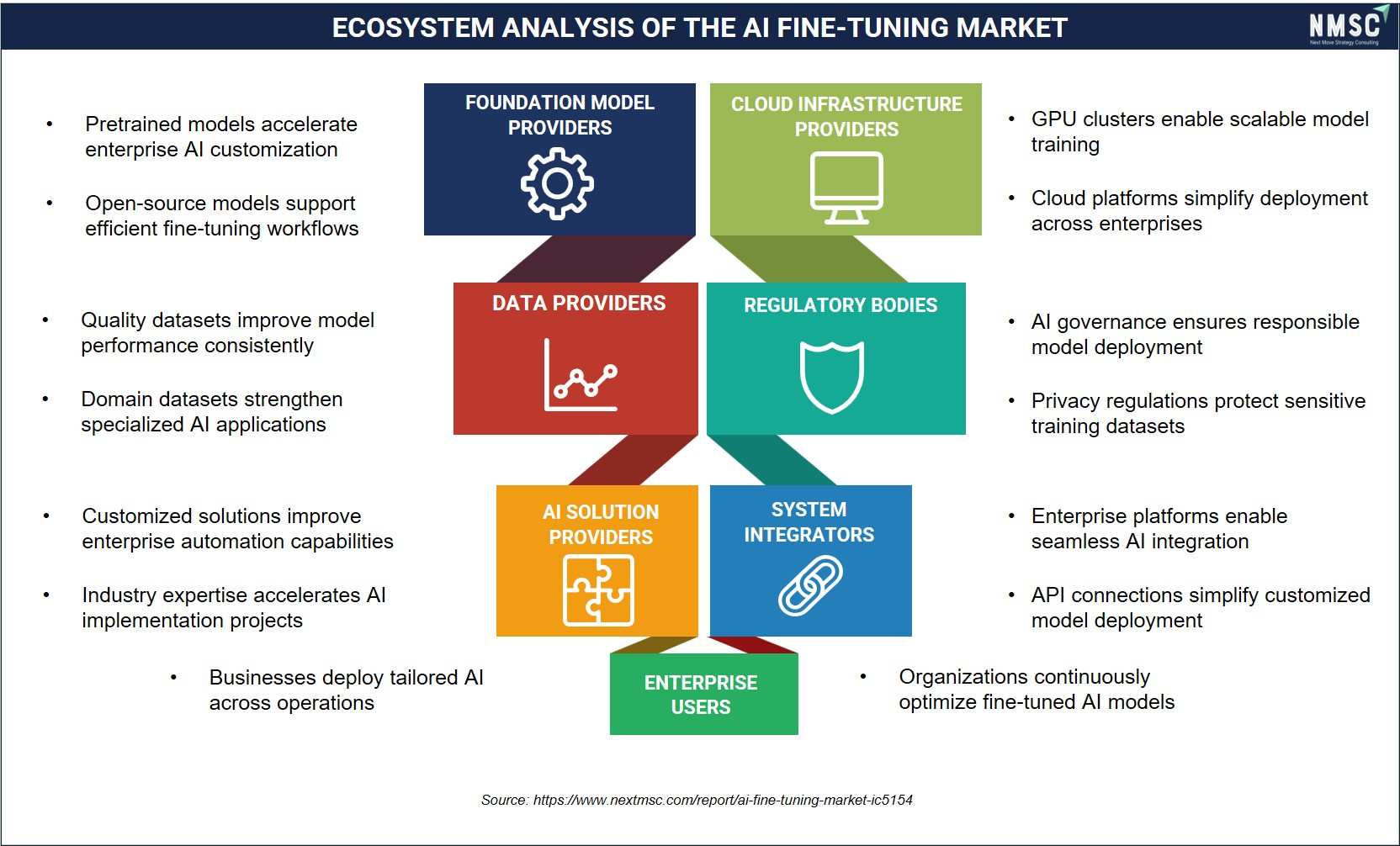
The ecosystem of the AI Fine-Tuning ecosystem comprises foundation model providers, cloud infrastructure providers, data providers, regulatory bodies, AI solution providers, system integrators, and enterprise users. Foundation model developers supply pretrained models, while cloud providers deliver scalable computing resources for fine-tuning workloads. Data providers contribute domain-specific datasets that improve model performance, and regulatory bodies establish governance and compliance requirements. AI solution providers customize models for business applications, system integrators deploy enterprise solutions, and end users drive demand across industries through production-scale AI adoption.
Growth Drivers & Restraints
Growth Catalyst & Risk Assessment Matrix
|
Factors |
Type |
(+/-) % Impact on CAGR |
Geographic Relevance |
Impact Timeline |
|
Rising enterprise demand for domain-accurate models |
Driver |
+4.2% |
Global |
2026–2035 |
|
Falling compute cost per tuning run |
Driver |
+3.5% |
North America, Asia-Pacific |
2026–2032 |
|
Expansion of parameter-efficient tuning libraries |
Driver |
+3.1% |
Global |
2026–2035 |
|
Government-backed sovereign AI programs |
Driver |
+2.4% |
Asia-Pacific, MEA |
2027–2035 |
|
Growth of open-weight foundation models |
Driver |
+2.0% |
Global |
2026–2033 |
|
Shortage of specialized fine-tuning talent |
Restraint |
-2.6% |
Global |
2026–2030 |
|
Data privacy and cross-border transfer restrictions |
Restraint |
-2.1% |
Europe, MEA |
2026–2035 |
|
High GPU capital expenditure for large jobs |
Restraint |
-1.8% |
Global |
2026–2029 |
|
Model drift and evaluation complexity |
Restraint |
-1.4% |
Global |
2026–2031 |
What is the primary growth driver of the AI Fine-Tuning Market?
Rising enterprise demand for domain-accurate outputs is the primary growth driver, as organizations move beyond generic foundation models toward customized deployments. We observed that NIST's AI Risk Management Framework has pushed regulated industries toward documented tuning pipelines, while falling per-token compute cost has made iterative fine-tuning economically viable for mid-sized enterprises previously priced out of model customization.
How is parameter-efficient tuning driving the market growth?
Parameter-efficient methods such as low-rank adaptation are driving growth by cutting the compute and memory required per tuning job. Our analysis shows that this reduction allows enterprises to maintain multiple task-specific model variants economically, expanding the addressable base of fine-tuning buyers beyond hyperscale technology firms into mid-market software, healthcare, and financial services organizations pursuing domain customization at scale.
What is restraining the AI Fine-Tuning Market?
A shortage of specialized fine-tuning talent is restraining market growth, as enterprises struggle to recruit engineers proficient in dataset curation, hyperparameter selection, and evaluation design. Based on research conducted by Next Move Strategy Consulting, we found that data privacy rules under the EU General Data Protection Regulation further complicate cross-border training data movement, slowing multinational deployment timelines for customized models.
Segmentation Analysis
Segment Sizing: By Offering Type
|
Segment |
2025 (USD) |
2035 (USD) |
CAGR% (2026–2035) |
|
Fine-Tuning Platforms |
USD 0.73 Billion |
USD 4.85 Billion |
20.9% |
|
Fine-Tuning Infrastructure |
USD 0.60 Billion |
USD 4.20 Billion |
21.5% |
|
Fine-Tuning Software Tools |
USD 0.45 Billion |
USD 3.30 Billion |
22.0% |
|
Fine-Tuning Services |
USD 0.37 Billion |
USD 3.07 Billion |
23.6% |
|
Total |
USD 2.15 Billion |
USD 15.42 Billion |
21.4% |
Which Offering Type Leads the AI Fine-Tuning Market?
Fine-Tuning Platforms lead with approximately 34% share (USD 0.73 Billion) in 2025, reflecting enterprise preference for managed environments that bundle compute, tooling, and governance. Our findings suggest that Fine-Tuning Services is the fastest-growing sub-segment at 23.6% CAGR, as organizations without in-house expertise outsource dataset preparation and model validation to specialized providers.
Segment Sizing: By Model Type
|
Segment |
2025 (USD) |
2035 (USD) |
CAGR% (2026–2035) |
|
Large Language Models |
USD 0.97 Billion |
USD 6.20 Billion |
20.4% |
|
Vision Models |
USD 0.43 Billion |
USD 2.85 Billion |
20.8% |
|
Speech and Audio Models |
USD 0.26 Billion |
USD 1.75 Billion |
21.0% |
|
Multimodal Models |
USD 0.32 Billion |
USD 3.10 Billion |
25.5% |
|
Specialized AI Models |
USD 0.17 Billion |
USD 1.52 Billion |
24.5% |
|
Total |
USD 2.15 Billion |
USD 15.42 Billion |
21.4% |
Which Model Type Dominates Fine-Tuning Demand?
Large Language Models dominate with approximately 45% share (USD 0.97 Billion) in 2025, driven by enterprise chatbot, search, and code-generation deployments. We found that Multimodal Models is the fastest-growing sub-segment at 25.5% CAGR, as vision-language and unified multimodal architectures gain traction across content generation and enterprise search applications requiring combined text and image understanding.
Segment Sizing: By Deployment Mode
|
Segment |
2025 (USD) |
2035 (USD) |
CAGR% (2026–2035) |
|
Public Cloud |
USD 1.01 Billion |
USD 6.17 Billion |
19.9% |
|
Private Cloud |
USD 0.56 Billion |
USD 3.70 Billion |
20.8% |
|
Hybrid Cloud |
USD 0.43 Billion |
USD 4.16 Billion |
25.5% |
|
On-Premises |
USD 0.15 Billion |
USD 1.39 Billion |
24.9% |
|
Total |
USD 2.15 Billion |
USD 15.42 Billion |
21.4% |
Which Deployment Mode Leads Fine-Tuning Adoption?
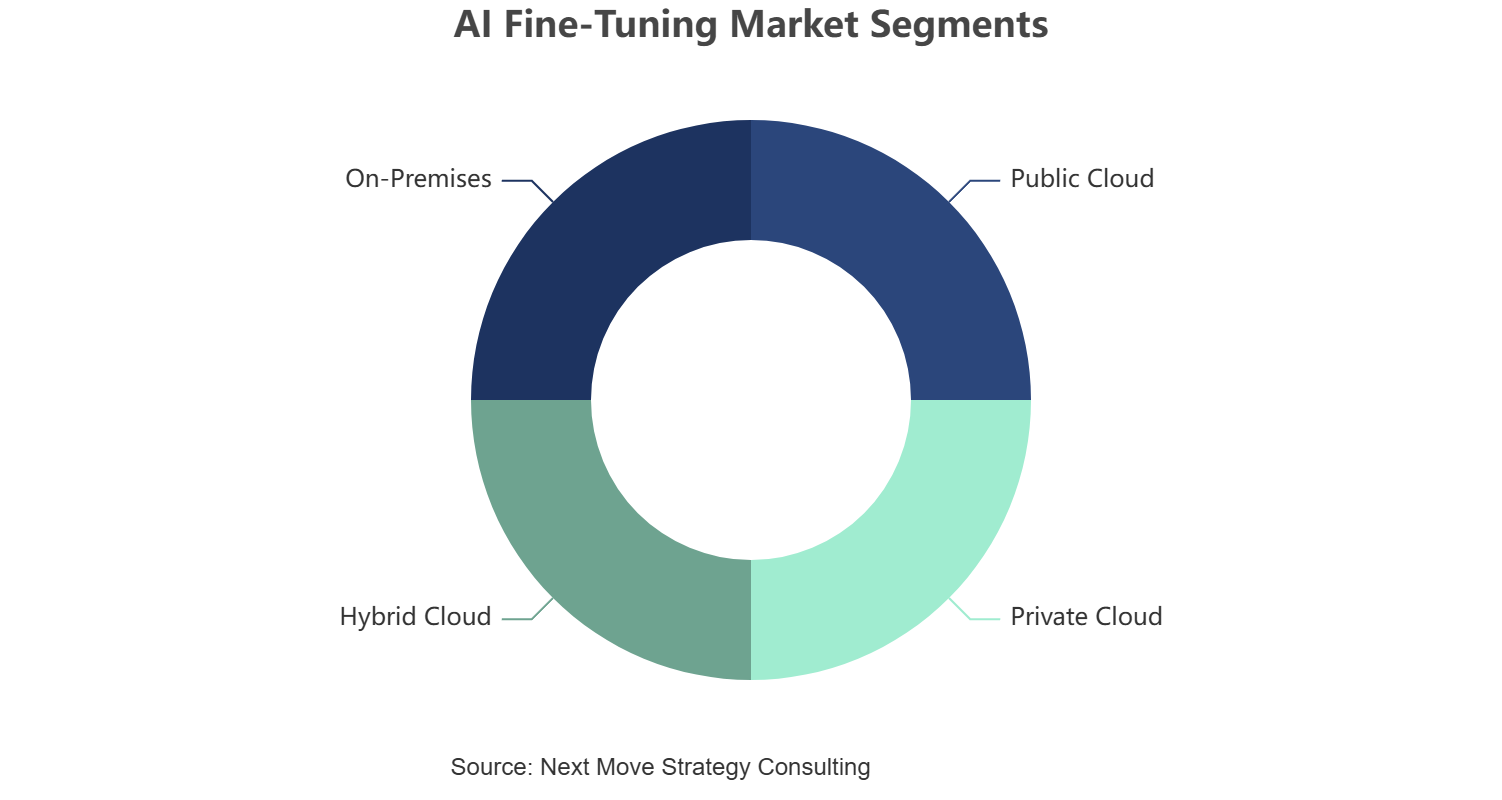
Public Cloud leads with approximately 47% share (USD 1.01 Billion) in 2025, as hyperscaler-managed GPU capacity remains the default choice for iterative tuning workloads. Our assessment indicates that Hybrid Cloud is the fastest-growing sub-segment at 25.5% CAGR, reflecting enterprise demand to keep sensitive training data on-premises while bursting compute-intensive tuning jobs to public cloud infrastructure.
Growth Opportunities
Next Move Strategy Consulting's analysis indicates that three forward-looking whitespace opportunities are emerging across the AI Fine-Tuning industry value chain.
Can Vertical-Specific Fine-Tuning Templates Unlock Mid-Market Demand?
Pre-built fine-tuning templates tailored to banking, healthcare, and manufacturing workflows could unlock mid-market enterprises lacking dedicated machine learning teams, benefiting managed fine-tuning platform vendors positioned to package domain datasets and evaluation suites.
Will Governance-as-a-Service Become a Standalone Revenue Stream?
Standalone governance and experiment-tracking subscriptions could emerge as regulated industries demand audit-ready documentation, benefiting evaluation and governance tooling providers that decouple compliance features from core training infrastructure.
Can Edge-Optimized Fine-Tuning Expand Automotive and Manufacturing Use Cases?
Fine-tuning workflows optimized for compact, quantized models deployable on edge hardware could expand adoption among automotive and manufacturing users, benefiting infrastructure vendors offering on-premises and hybrid deployment tooling for latency-sensitive industrial applications.
Regional Outlook
|
Region |
2025 (USD) |
2035 (USD) |
CAGR% (2026–2035) |
Key Driver |
|
North America |
USD 0.82 Billion |
USD 4.63 Billion |
18.9% |
Hyperscaler R&D concentration and enterprise AI budgets |
|
Europe |
USD 0.52 Billion |
USD 3.08 Billion |
19.5% |
AI Act compliance driving auditable fine-tuning workflows |
|
Asia-Pacific |
USD 0.58 Billion |
USD 5.86 Billion |
26.0% |
Manufacturing and government digitalization programs |
|
Middle East & Africa |
USD 0.13 Billion |
USD 0.93 Billion |
21.7% |
Sovereign AI initiatives and national data platforms |
|
Latin America |
USD 0.10 Billion |
USD 0.92 Billion |
24.9% |
Fintech and retail adoption of localized language models |
|
Total |
USD 2.15 Billion |
USD 15.42 Billion |
21.4% |
|
North America AI Fine-Tuning Market
North America leads the AI Fine-Tuning industry with mature hyperscaler infrastructure and dense enterprise AI budgets. Our assessment indicates strong adoption of managed platforms, supported by NIST's AI Risk Management Framework guiding governance practices. Technology adoption is advanced across financial services and software sectors, and strategic outlook favors continued platform consolidation among leading cloud providers through 2035.
Europe AI Fine-Tuning Market
Europe's market maturity is shaped heavily by the EU Artificial Intelligence Act, which mandates documentation for high-risk model customization. We observed that regulatory compliance is accelerating demand for governance and evaluation tooling. Technology adoption remains concentrated among large enterprises, with strategic outlook favoring vendors offering built-in compliance reporting across regulated industries.
Asia-Pacific AI Fine-Tuning Market
Asia-Pacific is the fastest-growing region, propelled by government-backed sovereign AI programs and expanding manufacturing digitalization. Our findings suggest regulatory frameworks remain comparatively flexible, encouraging rapid technology adoption. Strategic outlook favors infrastructure vendors partnering with national data centers to support localized, compliant model customization across China, India, and Japan.
Middle East & Africa AI Fine-Tuning Market
The Middle East & Africa market is emerging, anchored by national AI strategies in Saudi Arabia and the UAE. We found that government sovereign-cloud initiatives are shaping technology adoption toward on-premises and hybrid deployment. Strategic outlook favors vendors able to support Arabic and regional language fine-tuning for public sector and financial services use cases.
Latin America AI Fine-Tuning Market
Latin America's market is in an early growth phase, led by fintech and retail adoption of localized language models. Our analysis shows regulatory environments are still forming, with Brazil's data protection law shaping early governance practices. Strategic outlook favors managed service providers offering Portuguese and Spanish language fine-tuning support to regional enterprises.
U.S. AI Fine-Tuning Market
Based on our engagements, the U.S. AI Fine-Tuning industry was valued at approximately USD 0.62 Billion in 2025 and is projected to reach USD 3.55 Billion by 2035, at a CAGR of 18.8% from 2026 to 2035, supported by deep hyperscaler presence, dense enterprise AI budgets, and NIST-aligned governance practices, with high competitive intensity among platform vendors and strong technology penetration across financial services and software firms.
Canada AI Fine-Tuning Market
Through our analysis, the Canada AI Fine-Tuning industry was valued at approximately USD 0.11 Billion in 2025 and is projected to reach USD 0.62 Billion by 2035, at a CAGR of 19.0% from 2026 to 2035, supported by steady public-sector adoption and federal AI strategy funding, moderate regulatory influence from the proposed Artificial Intelligence and Data Act, and growing technology penetration among mid-sized software exporters.
UK AI Fine-Tuning Market
From our assessment, the UK AI Fine-Tuning industry was valued at approximately USD 0.14 Billion in 2025 and is projected to reach USD 0.79 Billion by 2035, at a CAGR of 19.1% from 2026 to 2035, supported by an active fintech and public-sector customization base, regulatory influence from the UK's pro-innovation AI framework, and rising competitive intensity among domestic evaluation-tooling startups.
Germany AI Fine-Tuning Market
According to evaluation, the Germany AI Fine-Tuning industry was valued at approximately USD 0.12 Billion in 2025 and is projected to reach USD 0.70 Billion by 2035, at a CAGR of 19.4% from 2026 to 2035, supported by strong manufacturing-sector demand for domain-specific models, regulatory influence from the EU AI Act, and expanding technology penetration across automotive and industrial software providers.
France AI Fine-Tuning Market
Based on our engagements, the France AI Fine-Tuning industry was valued at approximately USD 0.09 Billion in 2025 and is projected to reach USD 0.52 Billion by 2035, at a CAGR of 19.3% from 2026 to 2035, supported by growing sovereign AI ambitions supported by national compute initiatives, moderate regulatory complexity under EU frameworks, and rising adoption among public administration and telecom operators.
China AI Fine-Tuning Market
Through our analysis, the China AI Fine-Tuning industry was valued at approximately USD 0.19 Billion in 2025 and is projected to reach USD 2.10 Billion by 2035, at a CAGR of 27.3% from 2026 to 2035, supported by aggressive state-backed AI infrastructure investment, a fast-evolving regulatory environment under the Cyberspace Administration's generative AI rules, and intense competitive activity among domestic model developers.
India AI Fine-Tuning Market
From our assessment, the India AI Fine-Tuning industry was valued at approximately USD 0.08 Billion in 2025 and is projected to reach USD 0.98 Billion by 2035, at a CAGR of 29.4% from 2026 to 2035, supported by rapid growth in domestic software services demand for customized models, supportive government digitalization programs, and rising technology penetration among IT services exporters.
Japan AI Fine-Tuning Market
According to evaluation, the Japan AI Fine-Tuning industry was valued at approximately USD 0.10 Billion in 2025 and is projected to reach USD 0.86 Billion by 2035, at a CAGR of 23.9% from 2026 to 2035, supported by steady enterprise modernization in manufacturing and automotive sectors, cautious regulatory influence favoring voluntary AI guidelines, and growing competitive intensity among domestic cloud providers.
South Korea AI Fine-Tuning Market
Based on our engagements, the South Korea AI Fine-Tuning industry was valued at approximately USD 0.07 Billion in 2025 and is projected to reach USD 0.68 Billion by 2035, at a CAGR of 25.6% from 2026 to 2035, supported by strong government investment in sovereign AI infrastructure, an emerging regulatory framework under the AI Basic Act, and rising technology penetration among telecom and electronics manufacturers.
Australia AI Fine-Tuning Market
Through our analysis, the Australia AI Fine-Tuning industry was valued at approximately USD 0.05 Billion in 2025 and is projected to reach USD 0.39 Billion by 2035, at a CAGR of 22.7% from 2026 to 2035, supported by growing public-sector and mining-industry adoption, moderate regulatory influence from voluntary AI safety standards, and increasing competitive intensity among regional cloud resellers.
UAE AI Fine-Tuning Market
From our assessment, the UAE AI Fine-Tuning Market was valued at approximately USD 0.04 Billion in 2025 and is projected to reach USD 0.31 Billion by 2035, at a CAGR of 22.9% from 2026 to 2035, supported by strong sovereign AI investment through national strategy programs, favorable regulatory posture supporting rapid deployment, and rising technology penetration across government and financial services.
Saudi Arabia AI Fine-Tuning Market
According to evaluation, the Saudi Arabia AI Fine-Tuning industry was valued at approximately USD 0.04 Billion in 2025 and is projected to reach USD 0.29 Billion by 2035, at a CAGR of 22.4% from 2026 to 2035, supported by Vision 2030-linked digital transformation funding, an evolving data-governance framework, and growing competitive intensity as regional cloud providers expand local fine-tuning capacity.
South Africa AI Fine-Tuning Market
Based on our engagements, the South Africa AI Fine-Tuning industry was valued at approximately USD 0.02 Billion in 2025 and is projected to reach USD 0.14 Billion by 2035, at a CAGR of 20.9% from 2026 to 2035, supported by emerging enterprise AI adoption concentrated in banking and telecom, moderate regulatory influence from the Protection of Personal Information Act, and gradual technology penetration across mid-sized enterprises.
Brazil AI Fine-Tuning Market
Through our analysis, the Brazil AI Fine-Tuning industry was valued at approximately USD 0.05 Billion in 2025 and is projected to reach USD 0.47 Billion by 2035, at a CAGR of 24.8% from 2026 to 2035, supported by expanding fintech and retail adoption of localized language models, regulatory influence from the Lei Geral de Proteção de Dados, and rising competitive intensity among regional cloud and services vendors.
Argentina AI Fine-Tuning Market
From our assessment, the Argentina AI Fine-Tuning industry was valued at approximately USD 0.02 Billion in 2025 and is projected to reach USD 0.16 Billion by 2035, at a CAGR of 22.6% from 2026 to 2035, supported by early-stage enterprise adoption led by financial services, developing regulatory guidance on data protection, and gradually increasing technology penetration among software exporters.
Regulatory Framework Impacting the AI Fine-Tuning Market
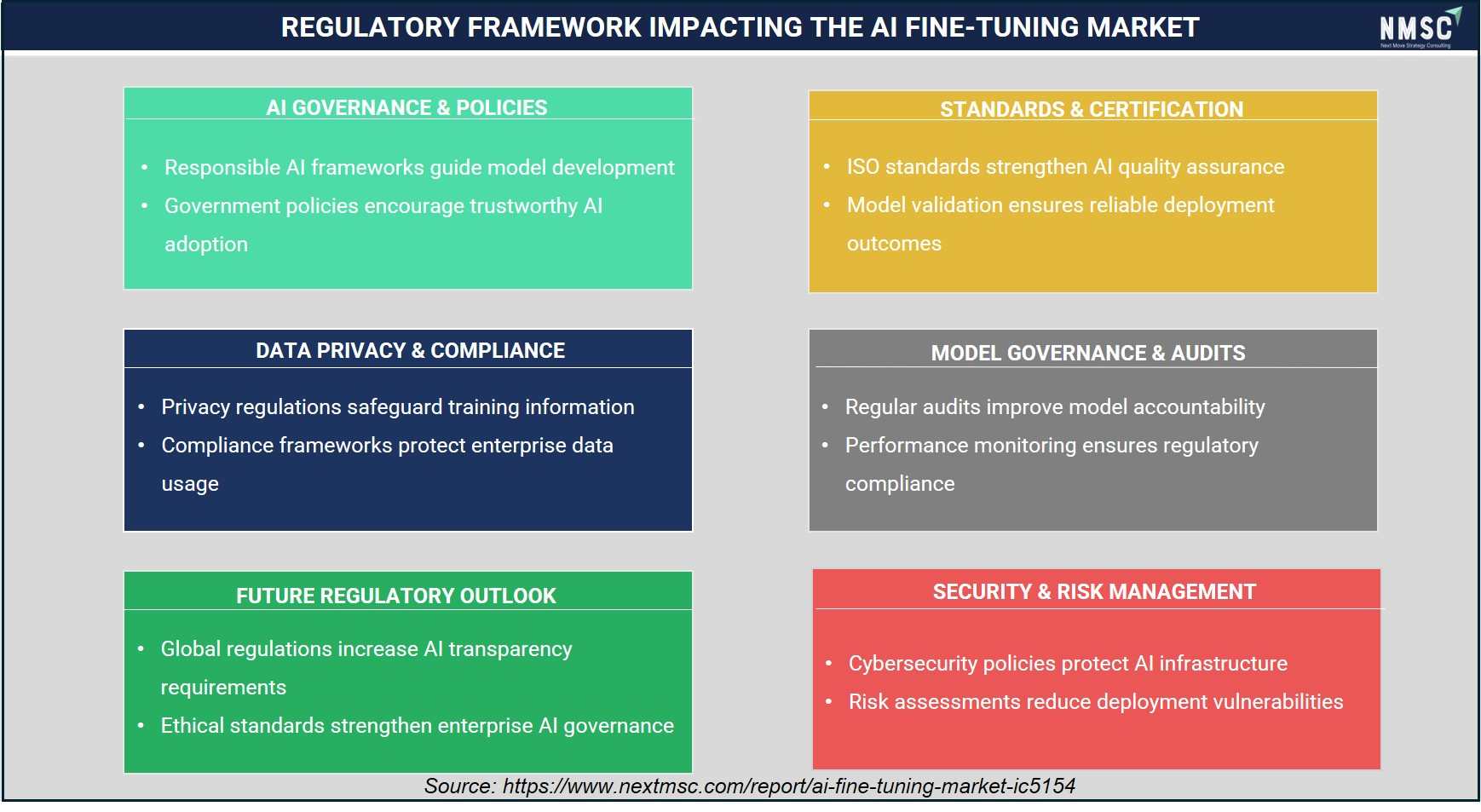
The regulatory framework influencing the AI Fine-Tuning Market focuses on responsible AI governance, data privacy, model accountability, and cybersecurity. Privacy regulations protect enterprise training data, while AI governance policies promote transparent and trustworthy model development. International standards and certification frameworks strengthen model validation and deployment quality. Regulatory audits and performance monitoring improve accountability, while evolving global requirements for AI transparency, ethical development, and risk management encourage secure, compliant, and reliable fine-tuned AI solutions across enterprise environments.
Competitive Landscape
We observed that the competitive landscape spans hyperscale cloud providers, specialized fine-tuning platform startups, and infrastructure vendors, each pursuing differentiated strategies to capture enterprise customization demand.
|
Dimension |
Description |
|
Market Structure |
Moderately consolidated, with hyperscalers and specialized platform vendors accounting for a significant share of managed fine-tuning revenue. |
|
Innovation Focus |
Parameter-efficient tuning, preference alignment, and governance tooling integration. |
|
M&A Activity |
Active acquisition of evaluation, annotation, and orchestration startups by larger cloud and infrastructure vendors. |
How Do Companies Compete in the AI Fine-Tuning Market?
Companies compete primarily on tuning cost efficiency, breadth of supported base models, and integration with existing enterprise data pipelines. Our analysis shows that vendors bundling compute, orchestration, and evaluation into a single managed offering command premium pricing, while infrastructure-only providers compete chiefly on GPU availability and per-hour compute pricing across global regions.
Which Competitive Archetypes Dominate the Market?
Three archetypes dominate: hyperscale cloud platforms offering end-to-end managed tuning, specialized software vendors focused on parameter-efficient tooling and governance, and services-led firms handling dataset preparation and validation. We found that hyperscalers dominate through infrastructure scale, while specialized vendors differentiate through deep technical focus on evaluation rigor and experiment tracking.
What Innovation and Differentiation Strategies Are Vendors Pursuing?
Vendors are differentiating through expanded support for low-rank adaptation, quantization, and reinforcement-based alignment techniques, alongside deeper integration with enterprise data governance systems. Our findings suggest that companies investing in evaluation transparency and audit-ready reporting are gaining preference among regulated-industry buyers seeking documented, defensible model customization pipelines.
What M&A Activity Is Shaping the Market?
M&A activity is concentrated on acquiring annotation, evaluation, and orchestration startups to round out end-to-end platform offerings. Based on research conducted by Next Move Strategy Consulting, we found that larger infrastructure vendors are acquiring smaller governance-tooling firms to meet enterprise compliance requirements, consolidating capability that previously required multi-vendor integration across the fine-tuning pipeline.
Key Market Players
Our assessment indicates that the following companies represent the validated competitive set profiled across the AI Fine-Tuning industry, ranked by overall platform breadth and enterprise adoption.
-
Microsoft Corporation
-
Amazon.com, Inc.
-
NVIDIA Corporation
-
Databricks, Inc.
-
OpenAI, Inc.
-
Anthropic PBC
-
Cohere Inc.
-
Mistral AI SAS
-
Hugging Face, Inc.
-
Scale AI, Inc.
-
Together AI, Inc.
-
Anyscale, Inc.
-
Predibase, Inc.
-
Snorkel AI, Inc.
-
Weights & Biases, Inc.
-
AI21 Labs Ltd.
-
Stability AI Ltd.
-
Labelbox, Inc.
Latest Developments
We observed several notable developments across the AI Fine-Tuning industry during 2025 and 2026 that illustrate accelerating platform investment.
|
Date |
Event |
|
June 2026 |
Anyscale officially launched on Microsoft Azure, enabling enterprises to build sovereign AI infrastructure directly within their own Azure tenants. This integration allows companies to manage variable API costs and fine-tune models in a secure, private cloud environment, significantly lowering the barriers to entry for highly regulated industries. |
|
Feb 2026 |
Mistral AI formalized a strategic partnership with Accenture to deploy enterprise-grade AI at scale. The partnership focuses on "model customization factories" where companies can fine-tune Mistral’s Mixture-of-Experts (MoE) architectures on private, industry-specific data, leveraging Accenture’s deep vertical integration to handle secure, on-premise deployments. |
|
Jan 2026 |
Anthropic completed its 4.5 family release, positioning the models as the industry leader for coding and agentic task execution. This release heavily utilized advanced fine-tuning techniques, specifically Constitutional AI (CAI), to allow models to self-correct during training based on a predefined "Constitution," reducing the need for massive, manual human-labeling datasets for safety alignment |
Expert Insights
 “It’s not just the training. It’s training, then there’s fine-tuning, then there’s inferencing. Those last two steps are likely going to be done more on-prem and at the edge.”
- Rajiv Ramaswami, CEO, Nutanix
Shared during an interview with CRN, where Nutanix’s CEO discussed the evolving deployment landscape of generative AI and highlighted how enterprises are shifting beyond model training toward fine-tuning and inference closer to their data environments.
Market Interpretation:
This insight emphasizes a fundamental structural shift in the AI fine-tuning market, positioning fine-tuning as a critical phase in the AI lifecycle rather than a secondary process. The statement highlights that enterprises are increasingly prioritizing localized fine-tuning at the edge and on-premises environments, driven by data privacy, latency, and customization requirements. This trend is accelerating demand for domain-specific model adaptation, enabling organizations to tailor pre-trained models to proprietary datasets. As a result, the market is witnessing strong growth in enterprise AI infrastructure, private model deployment, and edge-based optimization, reinforcing fine-tuning as a key driver of scalable and secure AI adoption.
Investment Opportunities
How Are Capital Inflows Shaping the AI Fine-Tuning industry?
Venture and strategic capital continue flowing into fine-tuning platform and evaluation-tooling startups. Our findings suggest that funding is concentrated among companies offering parameter-efficient tuning and governance features, as investors prioritize vendors positioned to serve regulated-industry buyers with audit-ready customization pipelines through 2035.
What Infrastructure Investment Trends Support Market Growth?
Hyperscalers and specialized infrastructure providers are expanding GPU capacity dedicated to fine-tuning workloads distinct from pre-training clusters. We observed that NVIDIA's continued data center investment disclosures signal sustained capital deployment toward burst-capacity compute suited to shorter, iterative fine-tuning cycles across enterprise customers.
What ESG Considerations Are Relevant to Fine-Tuning Investment?
Energy consumption from GPU-intensive tuning runs is drawing investor attention to efficiency-focused parameter-efficient methods. Our assessment indicates that vendors disclosing energy-per-training-run metrics, consistent with emerging corporate sustainability reporting requirements, are gaining favorable consideration among environmentally conscious institutional investors evaluating AI infrastructure allocations.
Key Benefits for Stakeholders
How Does This Report Benefit Enterprise and Industry Leaders?
Enterprise leaders gain access to segmentation, regional, and competitive data needed to prioritize fine-tuning investment across offering types and deployment modes. Our analysis shows that the report's forecasts help technology decision-makers benchmark planned spending against documented market trajectories through 2035.
How Does This Report Benefit Investors and Financial Analysts?
Investors and financial analysts gain quantified market sizing, CAGR, and competitive positioning data supporting capital allocation decisions. We found that the report's regional and segment-level forecasts help analysts evaluate which fine-tuning sub-segments offer the strongest risk-adjusted growth profile through 2035.
How Does This Report Benefit Technology Vendors and Product Teams?
Technology vendors and product teams gain insight into emerging trends, growth drivers, and competitive archetypes shaping buyer preference. Our assessment indicates that this analysis helps product teams prioritize roadmap investment toward parameter-efficient tuning and governance features favored by enterprise buyers.
Key Market Segments
By Offering Type
-
Fine-Tuning Platforms
-
Managed Fine-Tuning Platforms
-
Self-Hosted Fine-Tuning Platforms
-
Hybrid Fine-Tuning Platforms
-
-
Fine-Tuning Infrastructure
-
Compute Infrastructure
-
Distributed Training Infrastructure
-
Model Training Orchestration Infrastructure
-
-
Fine-Tuning Software Tools
-
Parameter-Efficient Fine-Tuning Tools
-
Preference Alignment and Reinforcement Tools
-
Evaluation and Optimization Tools
-
Governance and Experiment Tracking Tools
-
-
Fine-Tuning Services
-
Custom Model Fine-Tuning Services
-
Managed Fine-Tuning Services
-
Data Preparation and Annotation Services
-
Model Evaluation and Validation Services
-
By Model Type
-
Large Language Models
-
General-Purpose Language Models
-
Domain-Specific Language Models
-
Code Generation Models
-
-
Vision Models
-
Image Classification Models
-
Object Detection Models
-
Image Generation Models
-
Video Models
-
-
Speech and Audio Models
-
Speech Recognition Models
-
Speech Synthesis Models
-
Audio Generation Models
-
-
Multimodal Models
-
Vision-Language Models
-
Audio-Language Models
-
Unified Multimodal Models
-
-
Specialized AI Models
-
Recommendation Models
-
Time Series Models
-
Scientific Models
-
Graph Models
-
By Fine-Tuning Technique
-
Full Fine-Tuning
-
Full Parameter Update
-
Continual Pre-Training
-
-
Parameter-Efficient Fine-Tuning
-
Low-Rank Adaptation
-
Quantized Low-Rank Adaptation
-
Adapter Layers
-
Prompt Tuning
-
Prefix Tuning
-
-
Preference Alignment and Reinforcement Tuning
-
Reinforcement Learning from Human Feedback
-
Direct Preference Optimization
-
Constitutional Alignment
-
By Deployment Mode
-
Public Cloud
-
Private Cloud
-
Hybrid Cloud
-
On-Premises
By Organization Size
-
Large Enterprises
-
Medium Enterprises
-
Small Enterprises
-
Government and Public Sector Organizations
By Industry Vertical
-
Information Technology and Software
-
Banking Financial Services and Insurance
-
Healthcare and Life Sciences
-
Retail and E-Commerce
-
Manufacturing
-
Telecommunications
-
Media and Entertainment
-
Automotive and Transportation
-
Government and Defense
-
Education
-
Energy and Utilities
-
Other Industries
By Use Case
-
Conversational AI and Virtual Assistants
-
Enterprise Search and Retrieval
-
Content Generation and Localization
-
Software Development and Code Intelligence
-
Customer Support Automation
-
Knowledge Management and Document Processing
-
Research and Analytics
-
Decision Intelligence
By Region
-
North America: U.S., Canada, Mexico
-
Europe: UK, Germany, France, Italy, Spain, Sweden, Denmark, Finland, Netherlands, Rest of Europe
-
Asia-Pacific: China, India, Japan, South Korea, Taiwan, Indonesia, Vietnam, Australia, Philippines, Malaysia, Rest of APAC
-
Middle East & Africa: Saudi Arabia, UAE, Egypt, Israel, Turkey, Nigeria, South Africa, Rest of MEA
-
Latin America: Brazil, Argentina, Chile, Colombia, Rest of LATAM
Conclusion & Recommendations
What Is the Long-Term Outlook for the AI Fine-Tuning Market?
The long-term outlook remains strongly positive, with the market projected to expand from USD 2.68 Billion in 2026 to USD 15.42 Billion by 2035 at a 21.4% CAGR. Our analysis shows that sustained enterprise demand for domain-accurate models will keep growth broad-based across offering types, model types, and regions through the forecast period.
What Are the Strategic Positioning Recommendations for Vendors?
Vendors should prioritize parameter-efficient tuning support and integrated governance features, as these capabilities increasingly determine enterprise vendor selection. We recommend that infrastructure providers deepen orchestration tooling for burst compute demand, while services firms expand domain-specific dataset preparation capabilities to capture mid-market customization budgets.
How Attractive Is the AI Fine-Tuning industry for Investment?
Investment attractiveness remains high, supported by a 21.4% CAGR and a USD 12.74 Billion absolute dollar opportunity between 2026 and 2035. Our findings suggest that governance-tooling and parameter-efficient platform vendors offer particularly favorable risk-adjusted return profiles given rising regulatory-driven demand.
What Market Shifts and Key Risks Should Stakeholders Monitor?
Stakeholders should monitor talent shortages, cross-border data transfer restrictions, and evolving evaluation standards as key risks. We observed that regulatory shifts under the EU AI Act and similar frameworks could reshape compliance costs, while rapid open-weight model proliferation may compress platform vendor pricing power over the forecast period.
What Are the Primary Growth Pathways Through 2035?
Primary growth pathways include vertical-specific tuning templates, governance-as-a-service offerings, and edge-optimized fine-tuning for industrial applications. Our assessment indicates that vendors combining these pathways with strong evaluation transparency are best positioned to capture disproportionate share of the projected USD 15.42 Billion 2035 market.
About the Author
 Saista Faiyaz
— Saista Faiyaz is Research Associate at Next Move Strategy Consulting, where she has covered consumer markets and healthcare technologies for 3 years. Her work includes primary interview review, secondary-source validation, market sizing, and structured analysis of company and industry data. She supports research by comparing evidence across sources, organizing findings into market narratives, and documenting assumptions used in analysis. Her scope includes cross-market benchmarking, and reports.
Saista Faiyaz
— Saista Faiyaz is Research Associate at Next Move Strategy Consulting, where she has covered consumer markets and healthcare technologies for 3 years. Her work includes primary interview review, secondary-source validation, market sizing, and structured analysis of company and industry data. She supports research by comparing evidence across sources, organizing findings into market narratives, and documenting assumptions used in analysis. Her scope includes cross-market benchmarking, and reports.
About the Reviewer
 Supradip Baul
— Supradip Baul is an accomplished business consultant and strategist with over a decade of rich experience in market intelligence, strategy, technology, and business transformation. His work has included rigorous qualitative and quantitative analysis across multiple industries, helping clients shape investment decisions and long-term roadmaps. Earlier in his career, he was associated with Gartner, where he contributed to industry-leading reports and market share analyses. He has worked with leading global companies and holds an MBA with a dual specialization in Marketing and Finance.
Supradip Baul
— Supradip Baul is an accomplished business consultant and strategist with over a decade of rich experience in market intelligence, strategy, technology, and business transformation. His work has included rigorous qualitative and quantitative analysis across multiple industries, helping clients shape investment decisions and long-term roadmaps. Earlier in his career, he was associated with Gartner, where he contributed to industry-leading reports and market share analyses. He has worked with leading global companies and holds an MBA with a dual specialization in Marketing and Finance.
At Next Move Strategy Consulting, we understand that insightful market research is the cornerstone of successful business decisions. That's why we employ a robust and multifaceted approach, combining various methodologies to deliver the most accurate and actionable data for our clients.

Research Landscape
We navigate the world of research with two primary approaches:
Qualitative Approach
Our qualitative research methodologies involve immersive techniques such as in-depth interviews, focus groups, and observational studies. By engaging directly with individuals and stakeholders, we uncover valuable insights that quantitative data alone may overlook.

Quantitative Research
In tandem with qualitative methodologies, NMSC leverages the power of Quantitative Research to provide a robust foundation of numerical insights. Through systematic data collection and analysis, we quantify patterns, preferences, and market trends, offering a comprehensive view of the business landscape.
Our quantitative research approach employs diverse tools, including surveys, experiments, and statistical modelling. These methodologies enable us to gather data from a large and representative sample, ensuring the statistical significance of our findings. By employing structured questionnaires and standardized data collection methods, we guarantee the reliability and validity of the information we present to our clients.
Quantitative research is particularly effective in measuring the prevalence of trends, assessing market size, and gauging the impact of various factors on consumer behavior. The numerical precision attained through this approach equips our clients with actionable insights, facilitating data-driven decision-making and strategy formulation.


Our Specialized Toolbox for Industry-Specific Market Research
We deploy a specialized arsenal of techniques tailored to meet your unique requirements. Here's a glimpse into our comprehensive toolbox:

Information Procurement
The stage entails acquiring market data or relevant information through various sources and methodologies.


Market Research Approach
We utilize both top-down and bottom-up approaches in market research analysis to achieve a comprehensive understanding of the market dynamics, leveraging the broad perspective of industry trends and macroeconomic factors alongside detailed insights from specific segments and individual companies.

Porters Five Forces Analysis
We conduct Porter's Five Forces analysis to evaluate the competitive landscape of an industry, providing us with insights into factors that affect profitability and strategic positioning.

SWOT Analysis

Forecasting
We utilize a forecasting model to predict future consumption by considering parameters like population, economics, regulations, market competition, drivers, constraints, technology, and pricing. We also employ statistical techniques such as multilinear regression, exponential smoothing, moving average, ARIMA, and Monte Carlo simulations for accurate predictions. In econometric forecasting, we analyzed short-term and long-term event impacts, attributing values based on regulatory frameworks, economic factors, and market events.





 Speak to Our Analyst