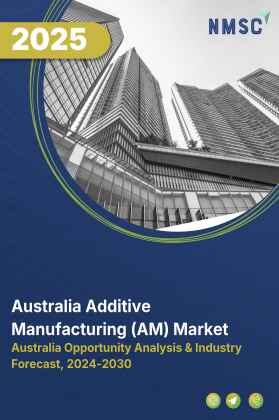
Australia Additive Manufacturing Market by Type (Desktop 3D Printer, and Industrial 3D Printer), by Technology (Stereolithography, Fused Deposition Modeling, Selective Laser Sintering, Direct Metal Laser Sintering, Polyjet Printing, Inkjet Printing, Electron Beam Melting, Laser Metal Deposition, Digital Light Processing, Laminated Object Manufacturing, and Other Technology), by Component (Hardware, Software, and Services), and Others – Opportunity Analysis and Industry Forecast, 2024–2030
Industry: Construction & Manufacturing | Lastest Edition: April 20, 2026 | No of Pages: 138 | No. of Tables: 102 | No. of Figures: 67 | Format: PDF | Report Code : CM665
Australia Additive Manufacturing Market Overview
Australia Additive Manufacturing Market size was valued at USD 65.2 million in 2023, and is predicted to reach USD 197.0 million by 2030, at a CAGR of 15.5% from 2024 to 2030. In terms of volume, the market size was 2 thousand units in 2023, and is projected to reach 8 thousand units by 2030, with a CAGR of 16.9% from 2024 to 2030.
The additive manufacturing (AM) market, also known as additive layer manufacturing (ALM) or three-dimensional (3D) printing, is a global industry focused on the development, production, and distribution of technologies and materials for creating three-dimensional objects layer by layer from digital models. This market serves a variety of sectors, including aerospace, automotive, healthcare, and consumer goods, by offering advanced solutions for prototyping, production, and customized manufacturing.
AM is highly valued for its ability to produce intricate and personalized components while minimizing material waste, leading to significant cost savings and environmental benefits. A key feature of this market is its diverse range of printing technologies, such as stereolithography (SLA), selective laser sintering (SLS), and fused deposition modeling (FDM), each designed to meet specific industry needs and applications. Additionally, AM's capability for rapid prototyping shortens product development cycles, enabling businesses to innovate and bring products to market more quickly than traditional manufacturing methods.
Implementation of Government Initiatives Drives the Demand for Additive Manufacturing
The Australian government is significantly boosting the demand for additive manufacturing (AM) through various initiatives aimed at advancing manufacturing technologies. By providing substantial funding, grants, and policy support, the government is fostering innovation and encouraging the adoption of AM.
These governmental initiatives facilitate collaboration between research institutions, industry, and government, driving the development and commercialization of cutting-edge AM technologies.
In 2023, the Australian government enacted the National Reconstruction Fund Corporation Act to invest in manufacturing technologies and products that enhance the country's industrial capabilities, including the development of AM as part of advancing manufacturing technologies. This extensive support framework is driving strong demand for AM by promoting technological advancement, positioning Australia as a leader in advanced manufacturing.
Rising Advancement in the Aerospace Sector Boosts the Growth of the Market
The advancement of the aerospace sector is further propelling the Australia additive manufacturing market growth due to the technology's ability to produce lightweight, high-performance components essential for aerospace applications. AM enables rapid prototyping, cost-efficient production, and the creation of complex geometries, which are crucial for innovation and efficiency in aerospace manufacturing.
In March 2024, Australia's first multi-metal 3D printing, the Nikon SLM-280, was launched at the Commonwealth Scientific and Industrial Research Organisation (CSIRO) Lab22 facility in Melbourne as part of the iLAuNCH Trailblazer initiative.
This advanced printer can produce high-performance, lightweight aerospace components, potentially reducing costs and improving efficiency in space missions. It supports the development of novel superalloys and benefits the Australian aerospace, defense, and racing industries by offering faster production times and enhanced material capabilities, fueling the demand for AM in the country.
High Upfront Investment Restrains Market Growth
The substantial upfront investment required for equipment, materials, and training presents a significant obstacle to market expansion. This financial commitment poses a notable challenge for businesses, particularly smaller ones, limiting their capacity to enter or expand operations within the additive manufacturing market.
Additionally, ongoing expenses related to materials and training further increase the overall financial burden. Consequently, many businesses are hesitant to adopt AM technology due to these initial financial challenges, thereby impeding the potential of the Australia additive manufacturing market expansion.
Integration of Artificial Intelligence (AI) in Additive Manufacturing Presents Lucrative Opportunity for Market Expansion
Integrating artificial intelligence (AI) into additive manufacturing (AM) is anticipated to expand the 3D printing market by refining production processes, enhancing product design capabilities, and facilitating the creation of intricate and personalized objects. AI integration enables businesses to analyze extensive datasets gathered during printing, such as material properties, printing parameters, and environmental conditions. This analysis helps identify patterns, optimize settings, and predict potential defects, thereby improving printing precision and reducing material waste.
Competitive Landscape
The prominent key players operating in Australia additive manufacturing industry include Stratasys Ltd., 3D Systems Corporation, HP Inc., EOS GmbH, Nano Dimension Ltd., Nikon SLM Solutions AG, Renishaw plc, Formlabs Inc., UltiMaker B.V., Carbon, Inc., Shenzhen Tuozhu Technology Co., Ltd. (Bambu Lab), Shenzhen Creality 3D Technology Co., Ltd., Prusa Research a.s., Shenzhen Anycubic Technology Co., Ltd., FlashForge Corporation (Zhejiang Flashforge 3D Technology Co., Ltd.), and others.
Australia Additive Manufacturing Market Key Segments
By Offering
-
Printers
-
Desktop Printers
-
Industrial Printers
-
-
Materials
-
Plastics
-
Thermoplastics
-
Photopolymers
-
-
Metals
-
Steel
-
Aluminum
-
Titanium
-
Nickel
-
Other metals
-
-
Ceramics
-
Other Materials
-
Wax
-
Laywood
-
Paper
-
Biocompatible materials
-
-
-
Software
-
Design
-
Inspection
-
Printing
-
Scanning
-
-
Services
By Technology
-
Fused Deposition Modelling (FDM)
-
Stereolithography (SLA)
-
Selective Laser Sintering (SLS)
-
Polyjet Printing/Multijet Printing (MJP)
-
Electron Beam Melting (EBM)
-
Digital Light Processing (DLP)
-
Direct Metal Laser Sintering (DMLS)
-
Other Technologies
By Process
-
Powder Bed Fusion (PBF)
-
Vat Photopolymerization
-
Binder Jetting
-
Material Extrusion
-
Material Jetting
-
Other Processes
By Application
-
Prototyping
-
Tooling
-
Functional Part Manufacturing
By Vertical
-
Automotive
-
Aerospace & Defense
-
Healthcare
-
Architecture & Construction
-
Education
-
Industrial
-
Energy
-
Printed Electronics
-
Jewelry
-
Food & Culinary
-
Other Verticals
Key Players
-
Stratasys Ltd.
-
3D Systems Corporation
-
HP Inc.
-
EOS GmbH
-
Nano Dimension Ltd.
-
Nikon SLM Solutions AG
-
Renishaw plc
-
Formlabs Inc.
-
UltiMaker B.V.
-
Carbon, Inc.
-
Shenzhen Tuozhu Technology Co., Ltd. (Bambu Lab)
-
Shenzhen Creality 3D Technology Co., Ltd.
-
Prusa Research a.s.
-
Shenzhen Anycubic Technology Co., Ltd.
-
FlashForge Corporation (Zhejiang Flashforge 3D Technology Co., Ltd.)
Report Scope and Segmentation
|
Parameters |
Details |
|
Market Size Value in 2023 |
USD 65.2 million |
|
Revenue Forecast in 2030 |
USD 197.0 million |
|
Growth Rate |
CAGR of 15.5% from 2024 to 2030 |
|
Market Volume in 2023 |
2 thousand units |
|
Market Forecast in 2030 |
8 thousand units |
|
Volume Growth Rate |
CAGR of 16.9% from 2024 to 2030 |
|
Analysis Period |
2023–2030 |
|
Base Year Considered |
2023 |
|
Forecast Period |
2024–2030 |
|
Market Size Estimation |
Million (USD) |
|
Growth Factors |
|
|
Companies Profiled |
15 |
|
Market Share |
Available for 10 companies |
|
Customization Scope |
Free customization (equivalent up to 80 working hours of analysts) after purchase. Addition or alteration to country, regional, and segment scope. |
|
Pricing and Purchase Options |
Avail customized purchase options to meet your exact research needs. |


About the Author
 Sikha Haritwal is an assistant manager with strong expertise in market research, data analysis, and cross-functional coordination. She plays a key role in leading complex research initiatives, strengthening analytical rigor, and enabling data-driven decision-making across teams. Known for her leadership mindset and structured problem-solving approach, she supports process improvement, enhances operational efficiency, and contributes to building scalable frameworks that drive long-term strategic outcomes and organizational effectiveness.
About the Reviewer
 Supradip Baul is an accomplished business consultant and strategist with over a decade of rich experience in market intelligence, strategy, technology, and business transformation. His work has included rigorous qualitative and quantitative analysis across multiple industries, helping clients shape investment decisions and long-term roadmaps. Earlier in his career, he was associated with Gartner, where he contributed to industry-leading reports and market share analyses. He has worked with leading global companies and holds an MBA with a dual specialization in Marketing and Finance.
At Next Move Strategy Consulting, we understand that insightful market research is the cornerstone of successful business decisions. That's why we employ a robust and multifaceted approach, combining various methodologies to deliver the most accurate and actionable data for our clients.

Research Landscape
We navigate the world of research with two primary approaches:
Qualitative Approach
Our qualitative research methodologies involve immersive techniques such as in-depth interviews, focus groups, and observational studies. By engaging directly with individuals and stakeholders, we uncover valuable insights that quantitative data alone may overlook.

Quantitative Research
In tandem with qualitative methodologies, NMSC leverages the power of Quantitative Research to provide a robust foundation of numerical insights. Through systematic data collection and analysis, we quantify patterns, preferences, and market trends, offering a comprehensive view of the business landscape.
Our quantitative research approach employs diverse tools, including surveys, experiments, and statistical modelling. These methodologies enable us to gather data from a large and representative sample, ensuring the statistical significance of our findings. By employing structured questionnaires and standardized data collection methods, we guarantee the reliability and validity of the information we present to our clients.
Quantitative research is particularly effective in measuring the prevalence of trends, assessing market size, and gauging the impact of various factors on consumer behavior. The numerical precision attained through this approach equips our clients with actionable insights, facilitating data-driven decision-making and strategy formulation.


Our Specialized Toolbox for Industry-Specific Market Research
We deploy a specialized arsenal of techniques tailored to meet your unique requirements. Here's a glimpse into our comprehensive toolbox:

Information Procurement
The stage entails acquiring market data or relevant information through various sources and methodologies.


Market Research Approach
We utilize both top-down and bottom-up approaches in market research analysis to achieve a comprehensive understanding of the market dynamics, leveraging the broad perspective of industry trends and macroeconomic factors alongside detailed insights from specific segments and individual companies.

Porters Five Forces Analysis
We conduct Porter's Five Forces analysis to evaluate the competitive landscape of an industry, providing us with insights into factors that affect profitability and strategic positioning.

SWOT Analysis

Forecasting
We utilize a forecasting model to predict future consumption by considering parameters like population, economics, regulations, market competition, drivers, constraints, technology, and pricing. We also employ statistical techniques such as multilinear regression, exponential smoothing, moving average, ARIMA, and Monte Carlo simulations for accurate predictions. In econometric forecasting, we analyzed short-term and long-term event impacts, attributing values based on regulatory frameworks, economic factors, and market events.





 Speak to Our Analyst