
Automotive Quality Inspection AI System Market Size, Share, Trends and Growth Analysis, By Offering (Turnkey Inspection Systems, Inspection Software, Inspection Hardware, Services,), By Inspection Function, By Production Stage, By AI Technology (Rule-Based Vision, Machine Learning Inspection, Deep Learning Inspection, Generative AI Assisted Inspection, Hybrid AI Inspection), By Deployment Mode, By Sales Channel, By Buyer Type – Global Industry Report and Forecast, 2026–2035
Industry: Automotive & Transportation | Publishing Date: July 21, 2026 | Last Updated: September 30, 2026 | No of Pages: N/A | No. of Tables: N/A | No. of Figures: N/A | Format: PDF | Report Code: AT5274
What Is the Automotive Quality Inspection AI System Market Size?
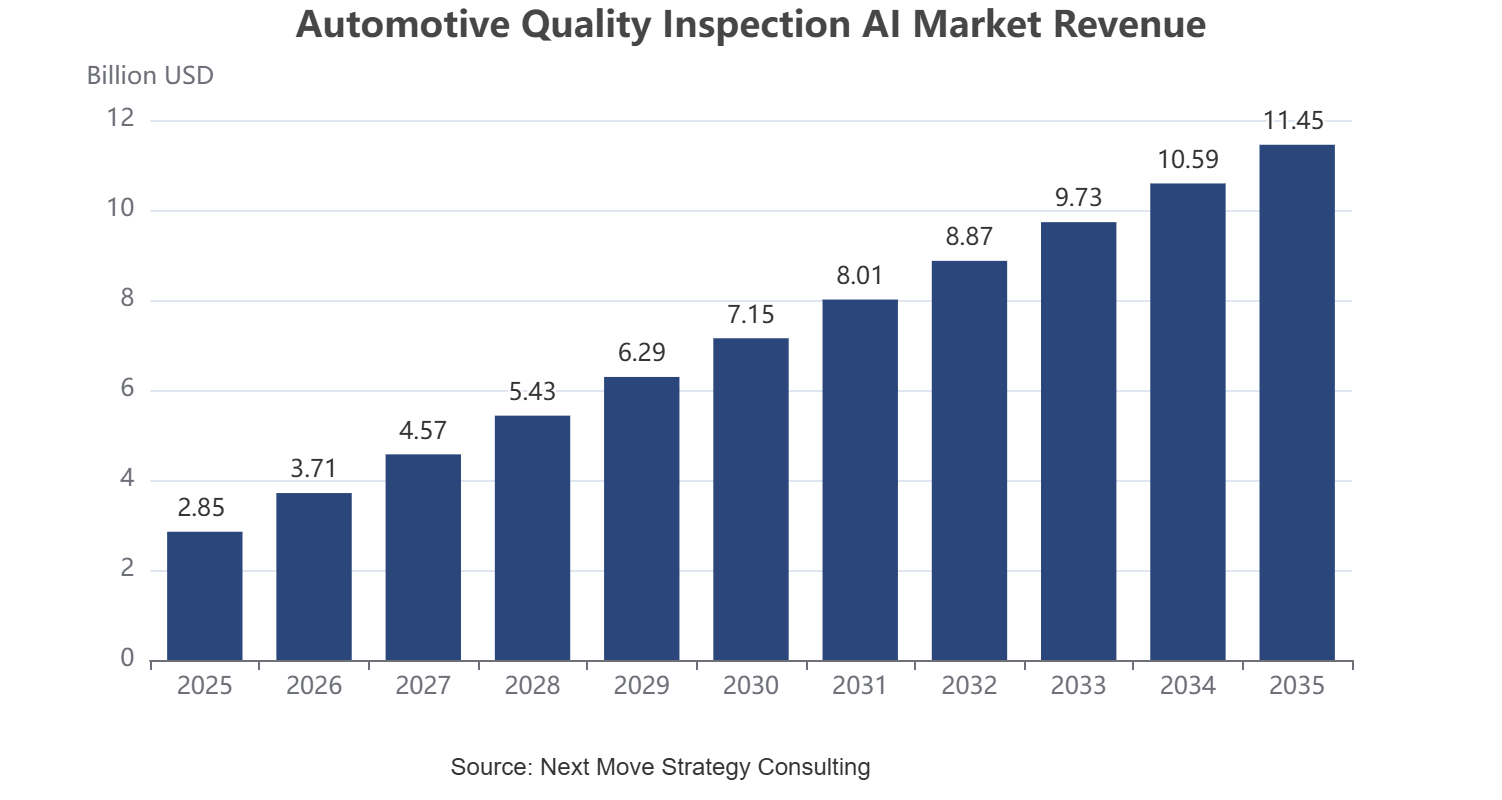
The global Automotive Quality Inspection AI System market was valued at USD 2.85 billion in 2025 and is estimated at USD 3.26 billion in 2026, forecast to reach USD 11.45 billion by 2035, expanding at a 15.0% CAGR from 2026 to 2035. Asia-Pacific leads with approximately 35% revenue share, while Turnkey Inspection Systems command approximately 32% of total market value in 2025.
During our market evaluation, we noticed that growth is broad-based across all segmentation axes, with electric vehicle battery inspection and generative AI adoption driving the most structurally significant demand shifts through 2035.
|
Key Takeaways |
|
By Offering: Turnkey Inspection Systems held the largest share of approximately 32% (USD 0.92 Billion) in 2025; Inspection Software is the fastest-growing sub-segment at 18.2% CAGR from 2026–2035. |
|
By Inspection Function: Surface Defect Inspection held the largest share of approximately 22% (USD 0.63 Billion) in 2025; Battery Inspection is the fastest-growing sub-segment at approximately 26% CAGR from 2026–2035. |
|
By Production Stage: End of Line Inspection held the largest share of approximately 18% (USD 0.51 Billion) in 2025; Battery Manufacturing Inspection is the fastest-growing sub-segment at approximately 28% CAGR from 2026–2035. |
|
By AI Technology: Deep Learning Inspection held the largest share of approximately 34% (USD 0.96 Billion) in 2025; Generative AI Assisted Inspection is the fastest-growing sub-segment at 23.7% CAGR from 2026–2035. |
|
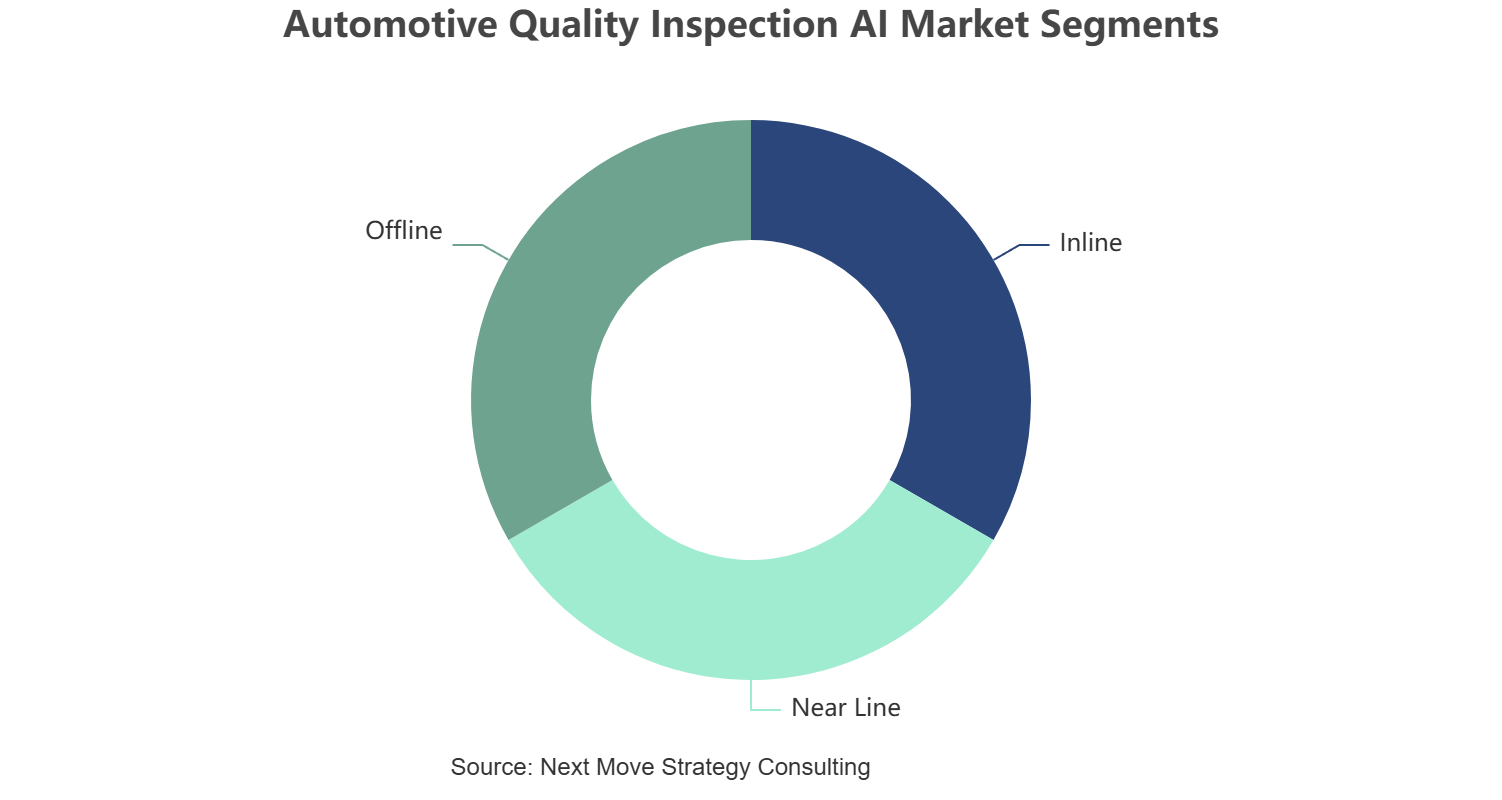
By Deployment Mode: Inline held the largest share of approximately 52% (USD 1.48 Billion) in 2025; Near Line is the fastest-growing sub-segment at approximately 18% CAGR from 2026–2035. |
|
By Sales Channel: Direct Sales held the largest share of approximately 45% (USD 1.28 Billion) in 2025; OEM Automation Partner Sales is the fastest-growing sub-segment at approximately 17% CAGR from 2026–2035. |
|
By Buyer Type: Automotive OEM held the largest share of approximately 37% (USD 1.05 Billion) in 2025; Battery Manufacturer is the fastest-growing sub-segment at 20.0% CAGR from 2026–2035. |
|
Dominant Region: Asia-Pacific dominated with approximately 35% revenue share (USD 0.99 Billion) in 2025. |
|
Fastest-Growing Region: Middle East & Africa is expected to register the highest regional CAGR of approximately 20.5% during 2026–2035. |
|
Dominant Country: U.S. led with approximately USD 760 Million in 2025. |
|
Fastest-Growing Country: Vietnam is the fastest-growing country at approximately 24.0% CAGR from 2026–2035. |
Market Opportunity: The Automotive Quality Inspection AI System market is expected to create an absolute dollar opportunity of USD 8.19 billion between 2026 and 2035, presenting significant investment potential across the automotive manufacturing quality technology value chain.
According to NMSC analysis, automotive OEMs commissioning dedicated battery gigafactory production lines are specifying AI inspection systems as baseline infrastructure from initial facility design rather than retrofit additions, a procurement posture that compresses supplier selection timelines and favors vendors with proven battery manufacturing inspection validation packages.
What Does the Automotive Quality Inspection AI System Market Encompass?
The Automotive Quality Inspection AI System market encompasses hardware, software, turnkey systems, and associated services that deploy artificial intelligence technologies to automate and enhance defect detection, dimensional measurement, and quality verification across automotive manufacturing operations. Our assessment indicates that the scope spans rule-based vision, machine learning, deep learning, generative AI, and hybrid AI inspection architectures applied across incoming parts inspection, body-in-white, paint shop, powertrain, battery manufacturing, final assembly, end-of-line, and finished vehicle inspection stages by automotive OEMs, tier suppliers, battery manufacturers, contract manufacturers, and independent test laboratories worldwide.
The market has evolved from early rule-based machine vision into sophisticated AI-driven inspection ecosystems over the past decade, driven by rising component complexity, the proliferation of electric vehicle platforms, and OEM supplier quality mandates aligned with IATF 16949 automotive quality management standards. NMSC's analysis indicates that technology adoption is accelerating sharply as deep learning inspection software achieves defect detection performance on complex, variable-appearance automotive surfaces that rule-based algorithms cannot reliably replicate, while regulatory pressures from Euro 7 vehicle safety rules, NHTSA recall reduction directives, and ISO/IEC 17025 laboratory accreditation requirements continue to elevate the inspection standard across global automotive supply chains.
|
Parameter |
Details |
|
Market Size in 2025 |
USD 2.85 Billion |
|
Market Size in 2026 |
USD 3.26 Billion |
|
Revenue Forecast in 2035 |
USD 11.45 Billion |
|
Growth Rate |
CAGR of 15.0% from 2026 to 2035 |
|
Analysis Period |
2025–2035 |
|
Base Year Considered |
2025 |
|
Forecast Period |
2026–2035 |
|
Market Size Estimation |
Revenue (USD Billion) |
|
Companies Profiled |
20 |
|
Countries Covered |
33 |
|
Market Share |
Available for Top 10 Companies |
Key Emerging Trends
Based on research conducted by NMSC, we found that four structural trends are reshaping product development, technology investment, and stakeholder priorities across the Automotive Quality Inspection AI System market.
How Is Electric Vehicle Production Reshaping Automotive Quality Inspection AI System Requirements?
Electric vehicle battery manufacturing is redefining the inspection mandate for automotive producers worldwide. We observed that battery cell and pack assembly introduces inspection challenges distinct from traditional powertrain lines, including microscopic electrode coating uniformity, electrolyte fill level precision, and laser weld integrity verification on cell-to-busbar connections. OEM battery gigafactories are deploying inline deep learning inspection at throughput speeds incompatible with manual sampling, driving demand for vision AI runtime software and edge AI computing units capable of simultaneous multi-channel defect classification across hundreds of inspection points per production cycle.
Why Is Generative AI Synthetic Data Generation Transforming Inspection Model Training?
A persistent barrier to deep learning inspection deployment has been the scarcity of labeled real-world defect images needed to train robust models, particularly for rare automotive failure modes such as micro-porosity in aluminum die castings or sub-surface paint delamination. Generative AI tools are enabling inspection engineers to synthesize photorealistic defect imagery to augment sparse training datasets. Our findings suggest that automotive suppliers adopting generative AI-assisted model training are reducing time-to-deployment for new inspection cells from months to weeks, materially lowering the commissioning cost of AI inspection programs across multi-part production lines.
How Are Edge AI Computing Units Accelerating Real-Time Defect Detection at Automotive Assembly Lines?
The transition from centralized server-based vision processing to edge AI computing units mounted at the inspection cell is enabling sub-100-millisecond defect response times compatible with high-throughput automotive assembly cycle rates. NMSC's analysis indicates that this architectural shift reduces network latency exposure and data transmission costs while improving fault tolerance in high-vibration environments. Automotive Tier 1 suppliers are increasingly specifying edge AI units with onboard inference acceleration hardware alongside industrial cameras to future-proof inline inspection cells against rising image resolution and model complexity requirements.
What Role Does Digital Quality Management Software Play in Connecting Inspection to the Enterprise?
Digital quality management software is bridging the gap between point-of-inspection defect data and enterprise-level process control, enabling automotive quality teams to identify systematic production deviations before they escalate into warranty events or recall campaigns. Our assessment indicates that integration between workflow and analytics software and manufacturing execution systems is accelerating, with major automotive OEMs mandating supplier API connectivity to centralized quality intelligence platforms. This trend positions digital quality management software as one of the highest-growth segments within the Automotive Quality Inspection AI System market through 2035.
Growth Drivers and Restraints
Growth Catalyst and Risk Assessment Matrix
|
Factors |
Type |
(+/−) % Impact on CAGR |
Geographic Relevance |
Impact Timeline |
|
Rapid electrification of passenger and commercial vehicles |
Driver |
+3.2% |
Global |
2026–2035 |
|
Zero-defect OEM supply chain mandates and IATF 16949 compliance |
Driver |
+2.6% |
Global |
2026–2035 |
|
Battery cell and pack quality inspection in EV gigafactories |
Driver |
+2.8% |
Global, esp. Asia-Pacific |
2026–2030 |
|
Industry 4.0 smart factory automation investment |
Driver |
+2.1% |
North America, Europe, Asia-Pacific |
2026–2035 |
|
ADAS and autonomous vehicle component traceability requirements |
Driver |
+1.8% |
North America, Europe |
2026–2035 |
|
Rising customer safety expectations and OEM recall reduction pressure |
Driver |
+1.4% |
Global |
2026–2035 |
|
High upfront capital cost of turnkey AI inspection systems |
Restraint |
−1.5% |
Global, esp. MEA, Latin America |
2026–2032 |
|
Shortage of skilled AI and machine vision integration engineers |
Restraint |
−1.2% |
Global |
2026–2030 |
|
Cybersecurity and data integrity concerns in connected inspection systems |
Restraint |
−0.8% |
North America, Europe |
2026–2035 |
What Is the Primary Growth Driver of the Automotive Quality Inspection AI System Market?
Rapid electrification of the global vehicle fleet is the single most powerful demand catalyst for automotive quality inspection AI systems. The International Energy Agency's Global EV Outlook confirms that electric vehicle sales have maintained double-digit annual growth rates across major markets, compelling automotive OEMs to commission battery manufacturing inspection capabilities at unprecedented scale. We observed that gigafactory expansions in Europe, North America, and Asia-Pacific each specify inline AI inspection as a baseline requirement for battery cell formation, electrode coating, and pack assembly, directly expanding the addressable market for turnkey inspection systems, deep learning software, and edge AI hardware.
How Is the IATF 16949 Quality Standard Driving Automotive Quality Inspection AI System Market Growth?
The International Automotive Task Force's IATF 16949 standard mandates documented defect-detection processes, measurement system analyses, and continuous product and process monitoring across automotive supply chains, elevating AI inspection adoption from an efficiency option to a compliance prerequisite. Based on research conducted by NMSC, we found that Tier 1 and Tier 2 suppliers under IATF 16949 certification pressure are prioritizing deep learning inspection software deployments to satisfy documented measurement repeatability requirements that legacy rule-based vision systems cannot reliably meet across complex, variable-appearance automotive components such as stamped body panels and molded interior trim.
What Is Restraining the Automotive Quality Inspection AI System Market?
High upfront capital expenditure for turnkey AI inspection systems represents the primary near-term restraint on market expansion. A fully instrumented robotic inspection cell integrating industrial cameras, three-dimensional sensors, edge AI computing units, and deep learning inspection software can exceed the capital budgets of smaller Tier 2 suppliers, particularly in cost-sensitive geographies across the Middle East & Africa and Latin America. The U.S. Small Business Administration's data on manufacturing capital access confirms that smaller manufacturers consistently identify capital availability as a primary constraint on automation investment, creating a structural adoption gap between large OEMs and the smaller supplier base dependent on managed inspection services.
Segmentation Analysis
Segment Sizing: By Offering
|
Segment |
2025 (USD) |
2035 (USD) |
CAGR% (2026–2035) |
|
Turnkey Inspection Systems |
USD 0.92 Billion |
USD 3.81 Billion |
17.0% |
|
Inspection Software |
USD 0.71 Billion |
USD 3.20 Billion |
18.2% |
|
Inspection Hardware |
USD 0.82 Billion |
USD 2.77 Billion |
13.0% |
|
Services |
USD 0.35 Billion |
USD 1.54 Billion |
17.8% |
|
Other Offerings |
USD 0.05 Billion |
USD 0.13 Billion |
10.0% |
|
Total |
USD 2.85 Billion |
USD 11.45 Billion |
15.0% |
Which Offering Segment Dominates the Automotive Quality Inspection AI System Market?
Turnkey Inspection Systems commanded the largest revenue share, reaching USD 0.92 billion in 2025, as automotive OEMs and Tier 1 suppliers consistently prefer comprehensive end-to-end inspection solutions that minimize integration risk and accelerate deployment across body-in-white, paint shop, and end-of-line production stages. We observed that Inspection Software is the fastest-growing offering segment, expanding at an 18.2% CAGR from 2026 to 2035, as the market matures beyond initial hardware deployments and buyers invest in upgrading existing camera-equipped inspection infrastructure with advanced deep learning, generative AI, and digital quality management capabilities rather than replacing full hardware installations.
Segment Sizing: By AI Technology
|
Segment |
2025 (USD) |
2035 (USD) |
CAGR% (2026–2035) |
|
Rule-Based Vision |
USD 0.62 Billion |
USD 1.38 Billion |
8.2% |
|
Machine Learning Inspection |
USD 0.73 Billion |
USD 2.74 Billion |
15.8% |
|
Deep Learning Inspection |
USD 0.96 Billion |
USD 4.58 Billion |
18.9% |
|
Generative AI Assisted Inspection |
USD 0.24 Billion |
USD 1.62 Billion |
23.7% |
|
Hybrid AI Inspection |
USD 0.30 Billion |
USD 1.13 Billion |
16.0% |
|
Total |
USD 2.85 Billion |
USD 11.45 Billion |
15.0% |
Which AI Technology Segment Leads the Automotive Quality Inspection AI System Market?
Deep Learning Inspection dominated the AI technology axis, valued at USD 0.96 billion in 2025, driven by its superior performance on complex automotive surfaces, including stamped body panels, weld beads, and molded plastic trim, where traditional rule-based algorithms require prohibitively extensive rule authoring. Our findings suggest that Generative AI Assisted Inspection is the fastest-growing AI technology, advancing at a 23.7% CAGR from 2026 to 2035, as automotive inspection engineers adopt synthetic data generation to overcome the limited defect image availability that has historically constrained deep learning model accuracy and extended deployment timelines in production automotive inspection programs.
Segment Sizing: By Buyer Type
|
Segment |
2025 (USD) |
2035 (USD) |
CAGR% (2026–2035) |
|
Automotive OEM |
USD 1.05 Billion |
USD 4.35 Billion |
17.1% |
|
Tier 1 Supplier |
USD 0.86 Billion |
USD 3.32 Billion |
16.2% |
|
Tier 2 Supplier |
USD 0.42 Billion |
USD 1.59 Billion |
16.0% |
|
Battery Manufacturer |
USD 0.22 Billion |
USD 1.14 Billion |
20.0% |
|
Contract Manufacturer |
USD 0.15 Billion |
USD 0.59 Billion |
16.6% |
|
Independent Test Laboratory |
USD 0.09 Billion |
USD 0.31 Billion |
14.7% |
|
Other Automotive Manufacturers |
USD 0.06 Billion |
USD 0.15 Billion |
10.7% |
|
Total |
USD 2.85 Billion |
USD 11.45 Billion |
15.0% |
Which Buyer Type Leads the Automotive Quality Inspection AI System Market?
Automotive OEMs accounted for the largest share of market revenue, contributing USD 1.05 billion in 2025, as global vehicle manufacturers operating large body-in-white, paint shop, and end-of-line inspection requirements deploy AI inspection systems across full production sequences. Battery Manufacturers are the fastest-growing buyer segment at a 20.0% CAGR from 2026 to 2035, driven by the accelerating build-out of dedicated EV battery cell and pack production facilities that require specialized inspection AI systems capable of detecting formation defects, foreign object contamination, and dimensional deviations at the precision levels demanded by automotive battery safety and performance standards.
Growth Opportunities
Our analysis shows that three forward-looking opportunities stand out for stakeholders positioning within the Automotive Quality Inspection AI System market over the 2026–2035 forecast period.
How Can Managed Inspection Services Unlock the Long-Tail Supplier Market?
Managed inspection services represent a significant whitespace opportunity for system integrators and technology vendors targeting Tier 2 and Tier 3 suppliers that lack capital to purchase turnkey AI inspection systems outright. By structuring AI inspection delivery as a subscription or outcomes-based service model, vendors can capture the underserved cost-sensitive segment of the automotive supply chain, particularly contract manufacturers and smaller component suppliers whose defect-detection obligations are rising in step with OEM zero-defect mandates. System integrators and managed service providers are the primary near-term beneficiaries of this structural transition.
Where Does Specialized Battery Inspection AI Create New Market Adjacencies?
The specialized demands of lithium-ion and emerging solid-state battery manufacturing — including electrode coating uniformity, separator integrity, electrolyte fill precision, and cell formation defect detection — create a distinct inspection sub-market that does not overlap with traditional automotive body and powertrain inspection. Vision AI vendors and metrology software providers that develop battery-specific inspection workflows and train deep learning models on battery manufacturing defect libraries can secure first-mover positioning with dedicated battery manufacturers and automotive OEMs building captive cell production capability, establishing long-term data and model advantages before the competitive field matures.
How Can AI Inspection Software Unlock Retrofit Opportunities in Existing Automotive Plants?
Millions of industrial cameras and smart vision sensors are already deployed in legacy automotive inspection stations globally, representing a large installed base addressable through software-only AI upgrade paths rather than full hardware replacement. Deep learning inspection software and vision AI runtime vendors that deliver certified compatibility with legacy camera platforms, standard industrial communication protocols, and existing manufacturing execution system integrations can convert existing hardware investments into AI-capable inspection assets. This retrofit opportunity is most pronounced among mid-tier automotive OEMs and Tier 1 suppliers whose inspection infrastructure was installed before 2020 and is approaching software capability limits.
Strategic Framework of the Automotive Quality Inspection AI System Market
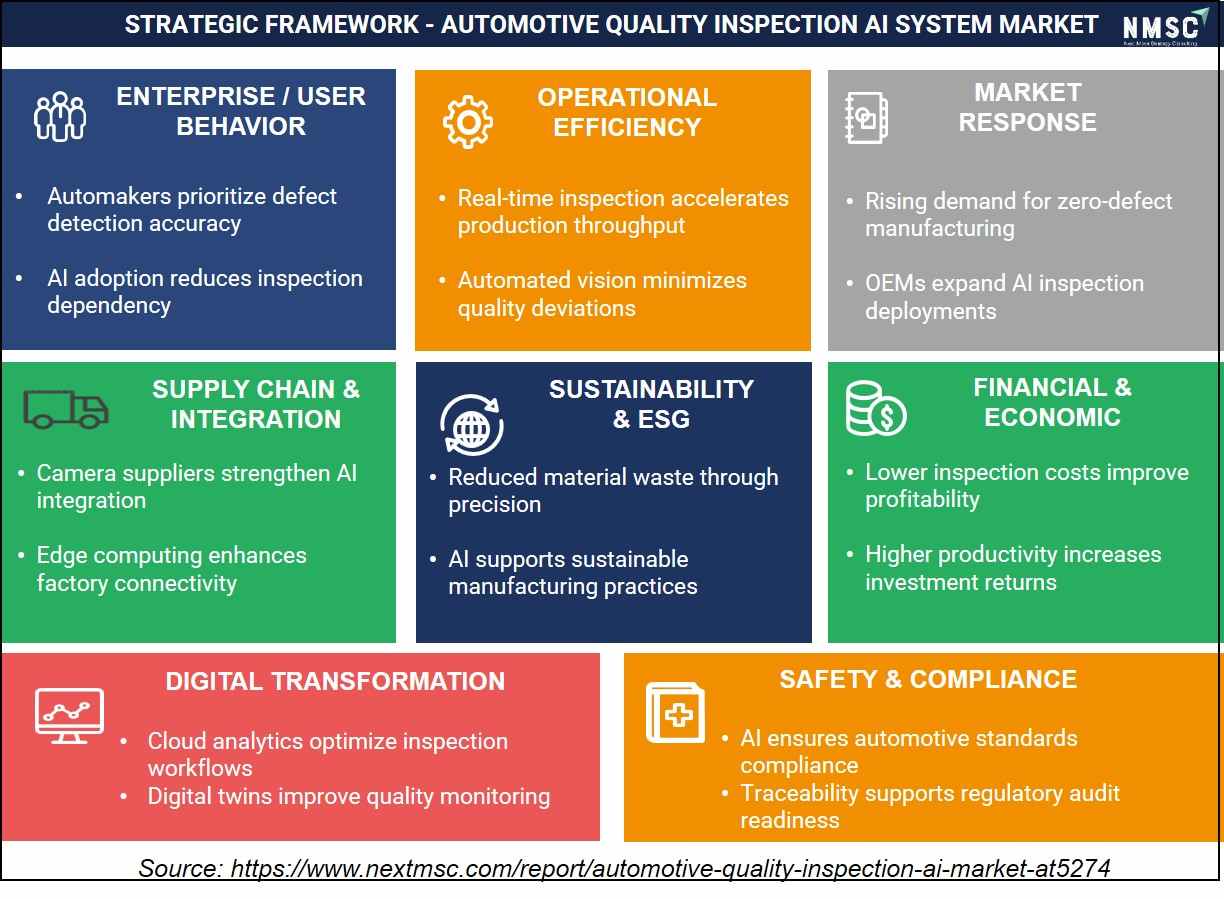
The strategic framework outlines the key factors accelerating the Automotive Quality Inspection AI System Market, including enterprise adoption, operational efficiency, digital transformation, sustainability, regulatory compliance, and financial benefits. Growing demand for precision inspection, AI-enabled automation, cloud-based analytics, and connected manufacturing is enabling automakers to improve product quality, optimize production processes, and achieve long-term operational and business resilience.
Regional Outlook
Geographic Performance Snapshot
|
Region |
2025 (USD) |
2035 (USD) |
CAGR% (2026–2035) |
Key Driver |
|
North America |
USD 0.94 Billion |
USD 3.37 Billion |
14.8% |
Domestic EV gigafactory build-out and NHTSA-driven zero-defect OEM supply chain mandates |
|
Europe |
USD 0.74 Billion |
USD 2.79 Billion |
15.9% |
Euro 7 vehicle safety regulation and IATF 16949 compliance investment across German OEM supply chains |
|
Asia-Pacific |
USD 0.99 Billion |
USD 4.27 Billion |
17.1% |
China and South Korea EV production concentration and India's expanding automotive manufacturing base |
|
Middle East & Africa |
USD 0.11 Billion |
USD 0.67 Billion |
20.5% |
Turkey automotive manufacturing expansion and Vision 2030-linked industrial diversification in Gulf states |
|
Latin America |
USD 0.07 Billion |
USD 0.35 Billion |
17.8% |
Brazil and Mexico automotive OEM facility upgrade investment and multinational quality standard alignment |
|
Total |
USD 2.85 Billion |
USD 11.45 Billion |
15.0% |
— |
North America Automotive Quality Inspection AI System Market Outlook
North America is the second-largest region in the Automotive Quality Inspection AI System market, valued at USD 0.94 billion in 2025, supported by the highly automated vehicle assembly operations of established domestic OEMs and a dense network of Tier 1 suppliers equipped with legacy machine vision infrastructure approaching AI upgrade cycles. NMSC's analysis indicates that technology adoption is advancing toward deep learning and hybrid AI inspection architectures, particularly for body-in-white and paint quality applications, while NHTSA recall reduction expectations and OEM supplier quality agreements sustain premium inspection investment. The region is expected to maintain technology leadership in battery manufacturing inspection through 2035.
Europe Automotive Quality Inspection AI System Market Outlook
Europe's Automotive Quality Inspection AI System market reached USD 0.74 billion in 2025, shaped by Germany's dominant automotive OEM base, strict Euro 7 regulatory frameworks, and strong historical adoption of precision metrology and dimensional inspection technologies. Our findings suggest that European OEMs, including members of the Volkswagen Group, BMW Group, and Stellantis, have been early and influential adopters of deep learning inspection software across paint quality and weld inspection applications. Euro 7 General Safety Regulation mandates are elevating component quality standards, sustaining inspection investment across the region's established automotive supplier base through the forecast period.
Asia-Pacific Automotive Quality Inspection AI System Market Outlook
Asia-Pacific is the largest and fastest-growing region in the Automotive Quality Inspection AI System market, valued at USD 0.99 billion in 2025, led by China's dominant vehicle production volumes, South Korea's technology-intensive automotive supply chain, and Japan's precision manufacturing heritage. We observed that the region's aggressive EV adoption trajectory, with China accounting for the majority of global EV production, is driving dedicated battery manufacturing inspection demand at a pace exceeding all other regions. Technology adoption spans established deep learning deployments in Japan and South Korea to rapid AI inspection system build-out in India and Vietnam, reflecting the region's diverse maturity profile.
Middle East & Africa Automotive Quality Inspection AI System Market Outlook
The Middle East & Africa Automotive Quality Inspection AI System market was valued at USD 0.11 billion in 2025 and is projected to expand at approximately 20.5% CAGR from 2026 to 2035, the fastest among all regions. Our analysis shows that Turkey's established automotive manufacturing base anchors near-term demand, while manufacturing industrialization programs in Saudi Arabia and the UAE under Vision 2030 and related industrial diversification frameworks are creating new automotive assembly capacity requiring AI inspection deployments. Technology adoption remains at an earlier stage compared with North America and Europe, with system integrator and OEM automation partner channels predominant.
Latin America Automotive Quality Inspection AI System Market Outlook
Latin America's Automotive Quality Inspection AI System market stood at USD 0.07 billion in 2025, the smallest regional share, with Brazil's vehicle manufacturing sector and Mexico's automotive export corridor anchoring the majority of regional demand. Our assessment indicates that technology adoption is primarily concentrated in machine learning and rule-based vision applications, with deep learning inspection system deployments centered on multinational OEM facilities that replicate global quality standards locally. Regulatory influence from Brazil's INMETRO certification requirements and Mexico's NOM quality standards is gradually elevating inspection requirements, while nearshoring trends are attracting new automotive investment to Mexico that creates AI inspection opportunities.
U.S. Automotive Quality Inspection AI System Market
Based on our estimates, the U.S. market was valued at approximately USD 760 million in 2025 and is projected to reach approximately USD 2.72 billion by 2035, growing at a 15.2% CAGR from 2026 to 2035. Demand is anchored by domestic automotive OEM facilities across the Midwest and Southeast, expanding EV platform manufacturing hubs in the Sun Belt, and a dense Tier 1 supplier base that collectively operates some of the world's most automated vehicle assembly lines. Technology penetration is advanced, spanning deep learning inspection, three-dimensional sensor systems, and enterprise digital quality management platforms, while competitive intensity remains high among established machine vision vendors and AI-native inspection software companies competing for major program awards.
Canada Automotive Quality Inspection AI System Market
The market in Canada reached approximately USD 120 million in 2025 and is forecast to reach approximately USD 420 million by 2035, at a 15.0% CAGR from 2026 to 2035. Demand structure is shaped by automotive assembly operations in Ontario, including major facilities operated by global OEMs, and a developing EV battery supply chain supported by federal and provincial manufacturing investment incentives under Canada's zero-emission vehicle industrial strategy. Regulatory influence reflects close alignment with U.S. automotive quality standards, while technology adoption mirrors North American trends toward deep learning inspection and inline AI inspection cell deployments across body-in-white and powertrain applications.
UK Automotive Quality Inspection AI System Market
As per our estimate, the UK market stood at approximately USD 90 million in 2025, advancing toward approximately USD 340 million by 2035 at a 16.1% CAGR from 2026 to 2035. Demand is driven by active automotive OEM manufacturing including Jaguar Land Rover, Nissan Sunderland, and BMW Mini Oxford, alongside growing EV battery production investment in the North East and West Midlands. Regulatory influence from the UK Automotive Council's technology roadmap and post-Brexit vehicle safety standards shapes inspection investment, while technology penetration favors deep learning and dimensional inspection, and competitive intensity is sustained among European machine vision vendors serving UK OEM production platforms.
Germany Automotive Quality Inspection AI System Market
According to our analysis, Germany's market was valued at approximately USD 230 million in 2025 and is set to reach approximately USD 840 million by 2035, expanding at a 15.5% CAGR from 2026 to 2035. Germany benefits from the Volkswagen Group, BMW Group, Mercedes-Benz, and their extensive Tier 1 and Tier 2 domestic supplier networks, collectively representing Europe's most advanced automotive quality inspection ecosystem. Regulatory alignment with EU General Safety Regulation requirements and IATF 16949 mandates sustains premium inspection investment, and German OEMs are early adopters of deep learning inspection for body-in-white, paint quality, and EV battery production stages.
France Automotive Quality Inspection AI System Market
Based on our estimates, France's market reached approximately USD 90 million in 2025, projected to climb to approximately USD 310 million by 2035 at a 14.7% CAGR from 2026 to 2035. Demand is supported by Stellantis and Renault Group manufacturing operations and their respective supplier ecosystems, alongside France's recognized strengths in metrology software and dimensional inspection technology for precision automotive components. Regulatory influence from Euro 7 and French industrial decarbonization programs is shaping component quality standards, while competitive intensity is moderate, with domestic French metrology specialists competing alongside global machine vision vendors for major OEM program awards.
China Automotive Quality Inspection AI System Market
The market in China stood at approximately USD 370 million in 2025 and is forecast to reach approximately USD 1.57 billion by 2035, registering an 18.3% CAGR from 2026 to 2035. China's position as the world's largest vehicle production market and dominant global EV production hub drives both the scale and pace of AI inspection system deployment. Technology penetration is rapidly advancing, with domestic and international AI inspection vendors competing intensively for program awards on EV battery manufacturing lines. Regulatory influence from China's GB automotive standards and manufacturer quality obligations is elevating inspection mandates across the supply chain.
India Automotive Quality Inspection AI System Market
As per our estimate, India's market was valued at approximately USD 90 million in 2025, projected to reach approximately USD 540 million by 2035 at a 20.2% CAGR from 2026 to 2035. Demand structure reflects India's rapidly expanding domestic automotive production, the government's Production Linked Incentive scheme attracting EV and battery manufacturing investment, and rising supply chain quality requirements from multinational OEMs sourcing from Indian Tier 1 suppliers. Technology penetration is accelerating from a relatively early adoption stage, with system integrator and direct vendor partnership channels as the primary AI inspection deployment routes.
Japan Automotive Quality Inspection AI System Market
According to our analysis, Japan's market reached approximately USD 180 million in 2025 and is expected to hit approximately USD 660 million by 2035, growing at a 15.6% CAGR from 2026 to 2035. Japan's automotive quality inspection market benefits from a precision engineering heritage and a domestic supply chain that has historically set global benchmarks for defect-free manufacturing. Technology penetration is high, with deep learning inspection and dimensional metrology systems widely deployed across Toyota, Honda, and Nissan supply chains. JIS automotive quality standards sustain measurement system rigor, while competitive intensity remains high among domestic machine vision suppliers and global system integrators.
South Korea Automotive Quality Inspection AI System Market
Based on our estimates, South Korea's market stood at approximately USD 150 million in 2025, forecast to reach approximately USD 600 million by 2035 at a 16.7% CAGR from 2026 to 2035. South Korea's market is shaped by Hyundai Motor Group's advanced manufacturing operations and an EV-forward product strategy that drives battery cell and pack inspection investment across LGES, Samsung SDI, and SK On battery production facilities. Technology adoption is advanced, with deep learning inspection and three-dimensional sensor systems widely deployed, and competitive intensity is high among Korean domestic suppliers, Japanese machine vision vendors, and global AI inspection software companies.
Australia Automotive Quality Inspection AI System Market
The market in Australia reached approximately USD 40 million in 2025 and is projected to reach approximately USD 140 million by 2035, expanding at a 15.3% CAGR from 2026 to 2035. Australia's automotive manufacturing sector has transitioned from vehicle assembly toward component, materials, and technology development, with inspection demand primarily concentrated in Tier 1 supplier facilities serving regional aftermarket and global export programs. Technology adoption reflects Australian subsidiaries of global OEM suppliers applying international quality standards, and competitive intensity is moderate among imported machine vision systems and locally represented global vendors.
UAE Automotive Quality Inspection AI System Market
As per our estimate, the UAE market was valued at approximately USD 20 million in 2025, projected to reach approximately USD 130 million by 2035 at a 23.1% CAGR from 2026 to 2035. Demand is driven by industrial diversification investment within the UAE's economic program, which includes attracting automotive parts manufacturing capacity and establishing domestic automotive quality testing and verification infrastructure. Regulatory influence remains in development under UAE industrial quality frameworks, technology penetration is improving through imported turnkey AI inspection systems, and competitive intensity is rising as global inspection vendors establish regional partnership networks.
Saudi Arabia Automotive Quality Inspection AI System Market
According to our analysis, Saudi Arabia's market reached approximately USD 20 million in 2025 and is expected to hit approximately USD 130 million by 2035, growing at a 23.1% CAGR from 2026 to 2035. Vision 2030 manufacturing diversification targets include automotive assembly investment, with greenfield industrial zones designed to accommodate AI-enabled inspection infrastructure from inception. Regulatory influence is developing under Saudi Standards, Metrology and Quality Organization frameworks, and competitive intensity remains limited, with reliance on imported systems from established global inspection vendors serving Gulf Cooperation Council markets.
South Africa Automotive Quality Inspection AI System Market
Based on our estimates, South Africa's market stood at approximately USD 10 million in 2025, forecast to reach approximately USD 70 million by 2035 at a 24.1% CAGR from 2026 to 2035. South Africa's automotive manufacturing sector, centered on BMW, Mercedes-Benz, Toyota, Ford, and Volkswagen assembly plants in Gauteng and the Eastern Cape, represents the established demand base for AI inspection systems in the MEA region. South African National Accreditation System quality requirements and OEM-imposed IATF 16949 mandates sustain inspection investment, while technology penetration is advancing as OEM subsidiaries align local supplier quality standards with global corporate requirements.
Brazil Automotive Quality Inspection AI System Market
The market in Brazil reached approximately USD 30 million in 2025 and is projected to reach approximately USD 170 million by 2035, registering a 19.9% CAGR from 2026 to 2035. Brazil's established automotive manufacturing base, anchored by Volkswagen, Fiat, and General Motors facilities in São Paulo and Minas Gerais states, provides the principal demand foundation, with deepening EV and hybrid vehicle production investment creating new AI inspection requirements across battery and powertrain stages. Regulatory influence from Brazil's INMETRO certification requirements is shaping inspection standards, and competitive intensity is increasing as global inspection vendors expand Brazilian distributor networks.
Argentina Automotive Quality Inspection AI System Market
As per our estimate, Argentina's market was valued at approximately USD 10 million in 2025, projected to reach approximately USD 70 million by 2035 at a 24.1% CAGR from 2026 to 2035. Demand structure is constrained by macroeconomic volatility, though multinational OEM facilities operated by Volkswagen, Toyota, and Renault sustain baseline AI inspection investment aligned with global corporate quality standards. Regulatory influence remains limited domestically, technology penetration is modest relative to regional neighbors, and competitive intensity centers on a small number of authorized distributors representing major machine vision brands in the Argentine market.
Competitive Landscape
We observed that the Automotive Quality Inspection AI System market features a moderately consolidated competitive landscape, with global industrial automation groups, machine vision specialists, and AI-native software companies competing across hardware depth, AI model performance, system integration capability, and automotive application expertise.
Key Takeaways
|
Dimension |
Description |
|
Market Structure |
Moderately consolidated; the 20 companies profiled in this report collectively account for a majority of global Automotive Quality Inspection AI System market revenue, while specialized regional integrators and niche AI software startups serve application-specific demand in body-in-white, battery, and end-of-line inspection. |
|
Innovation Focus |
Deep learning inspection software for complex surface defect detection, generative AI synthetic training data generation, edge AI computing units for zero-latency inline inspection, and battery manufacturing inspection workflow development dominate current innovation investment. |
|
M&A Activity |
Strategic acquisitions of AI software and imaging technology companies by established industrial automation groups, alongside technology partnerships between machine vision hardware vendors and pure-play deep learning software specialists, characterize the consolidation dynamic. |
How Do Companies Compete in the Automotive Quality Inspection AI System Market?
Competition across the industry is structured around three primary vectors: breadth of inspection function coverage, depth of automotive-specific AI model libraries, and speed of system integration and commissioning. We observed that established machine vision companies such as Keyence and Cognex compete on proven inspection hardware reliability and extensive automotive application experience, while AI-native entrants such as LandingAI and Apera AI compete on deep learning model sophistication and the speed with which they adapt pre-trained models to new automotive inspection use cases without extensive custom engineering investment from the buyer.
Which Competitive Archetypes Dominate the Automotive Quality Inspection AI System Market?
Two archetypes define the competitive landscape: full-stack industrial automation groups offering integrated inspection hardware, software, and services through direct and integrator channels, and pure-play AI software specialists focused on deep learning inspection and generative AI model development for complex surface and dimensional applications. Keyence Corporation and Cognex Corporation exemplify the full-stack hardware-software archetype with decades of automotive machine vision expertise, while LandingAI and MVTec Software GmbH represent the software-led differentiation archetype, emphasizing model accuracy, development toolchain flexibility, and deployment speed as primary differentiators within the Automotive Quality Inspection AI System market.
How Are Companies Differentiating Through Innovation in the Automotive Quality Inspection AI System Market?
Innovation investment is concentrated in generative AI for synthetic training data generation, edge AI computing for zero-latency inline inspection, and digital quality management for enterprise-wide defect analytics. Our analysis shows that system integrators and turnkey solution providers are increasingly differentiating through their ability to certify AI inspection system performance against automotive-specific standards such as IATF 16949 and customer-mandated process capability indices, an increasingly decisive criterion in OEM and Tier 1 supplier procurement decisions that hardware-only vendors cannot address without complementary software and data capability investment.
What M&A and Expansion Activity Is Shaping the Automotive Quality Inspection AI System Market?
Strategic acquisitions and technology partnerships are accelerating AI capability expansion across the industry, with established industrial automation groups acquiring or licensing deep learning software competencies they lack organically. NMSC's analysis indicates that Teledyne Technologies has pursued a deliberate acquisition strategy in imaging and instrumentation to strengthen its automotive inspection capabilities, while Hexagon AB has expanded its metrology and AI-driven quality intelligence portfolio through targeted acquisitions within the manufacturing intelligence space. Geographic expansion into Asia-Pacific battery manufacturing corridors and European EV platform launch sites represents the dominant organic growth vector for the near-term forecast period.
Key Market Players
Our assessment indicates that the following 20 companies are actively shaping product innovation, technology investment, capacity expansion, and strategic positioning within the global Automotive Quality Inspection AI System market.
-
Keyence Corporation
-
Cognex Corporation
-
OMRON Corporation
-
Siemens AG
-
Mitsubishi Electric Corporation
-
Zebra Technologies Corporation
-
Teledyne Technologies Incorporated
-
Hexagon AB
-
Atlas Copco AB
-
SICK AG
-
Datalogic S.p.A.
-
Kistler Group
-
Basler AG
-
LMI Technologies Inc.
-
MVTec Software GmbH
-
Averna Technologies Inc.
-
Apera AI Inc.
-
LandingAI, Inc.
-
EINES Vision Systems S.L.
Latest Developments
We found that recent product launches and strategic investments within the Automotive Quality Inspection AI System market are concentrated on deep learning inspection software upgrades, battery manufacturing inspection capability, and edge AI hardware for high-throughput automotive assembly lines.
|
Date |
Event |
|
March 2026 |
Basler AG demonstrated an AI-enabled 3D vision solution for inline inspection of structural adhesive beads in automotive body manufacturing. The solution improves adhesive verification accuracy, reduces manual inspection, and supports automated body-in-white quality assurance processes. |
|
May 2025 |
LandingAI, Inc. partnered with Snowflake to integrate Visual AI into automotive manufacturing workflows. The collaboration enables automated defect detection, component inspection, assembly verification, and quality analytics using manufacturing image data and enterprise AI infrastructure. |
|
May 2025 |
Hexagon AB launched PRESTO Quality Stations, turnkey automated inspection systems that combine metrology, vision technology, and workflow automation. The solution helps automotive manufacturers accelerate dimensional inspection, production validation, and quality control with minimal operator intervention. |
|
April 2025 |
Kistler Group implemented an automated optical inspection solution for Ningbo Tianlong, enabling 100% inspection of press-fit pins used in automotive electronics. The deployment enhances defect detection, production traceability, and quality assurance for safety-critical automotive components. |
|
Mar 2025 |
Siemens AG and Audi deployed AI-powered vision inspection to automatically detect and remove weld spatter during vehicle body production. The implementation improves weld quality, reduces manual rework, and increases manufacturing efficiency across automotive assembly operations. |
Porter’s Five Forces Analysis of the Automotive Quality Inspection AI System Market
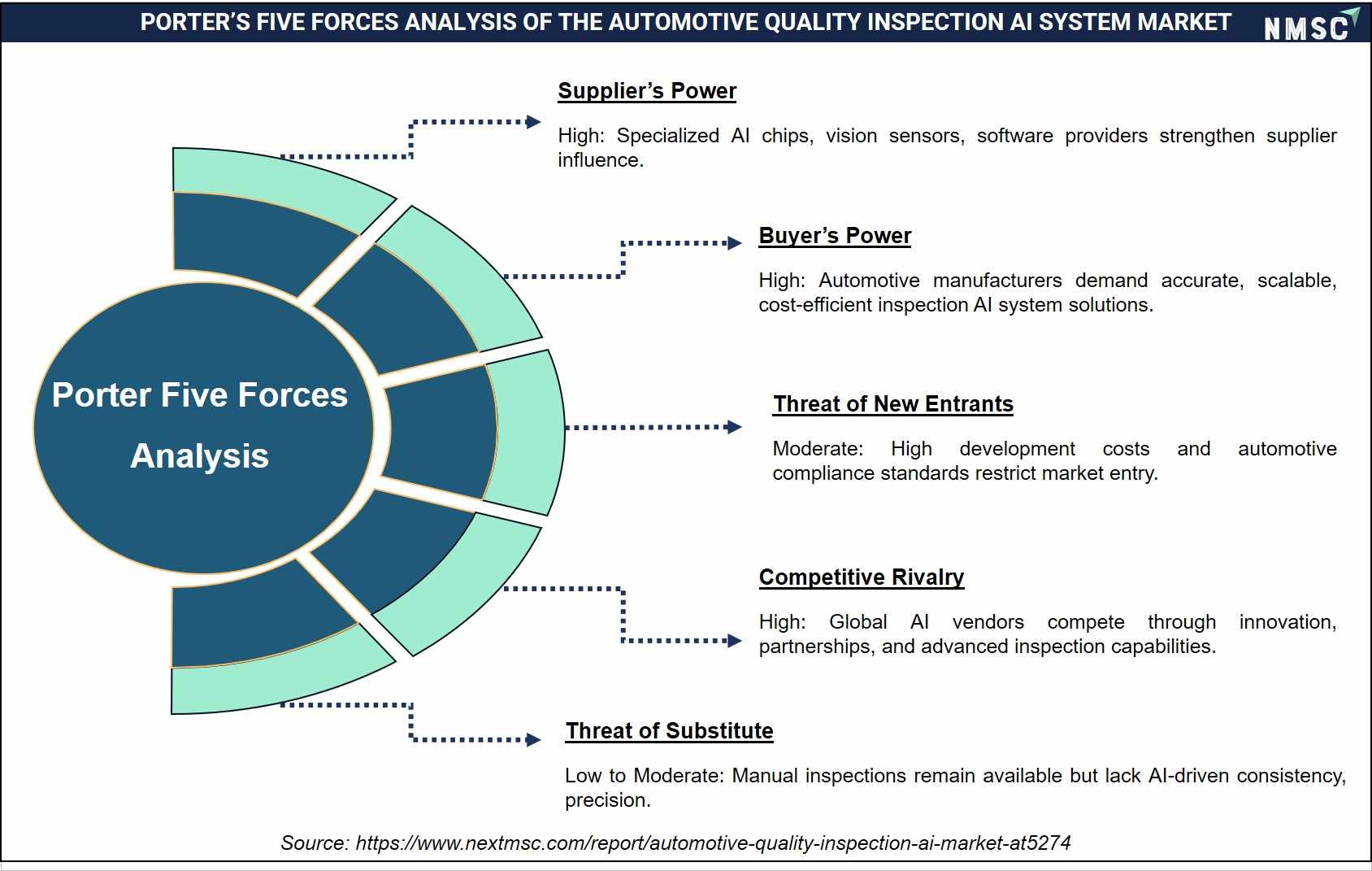
The Porter’s Five Forces analysis highlights the competitive dynamics shaping the Automotive Quality Inspection AI System Market. It evaluates supplier and buyer influence, competitive rivalry, barriers to new entrants, and substitution risks. The framework indicates that continuous AI innovation, strategic partnerships, and increasing demand for automated quality assurance are strengthening market competitiveness while creating opportunities for technology-driven solution providers.
Investment Opportunities
What Capital Inflows Are Targeting the Automotive Quality Inspection AI System Market?
Capital inflows into the Automotive Quality Inspection AI System market are accelerating across venture, private equity, and strategic corporate investment channels. AI-native inspection software companies focused on generative AI model development and edge deployment architectures are attracting venture funding as the automotive industry's AI quality transformation creates clear commercialization pathways. We observed that strategic investments by automotive OEMs in software-forward inspection companies are establishing preferred supplier relationships that translate into supply agreements as new EV platforms enter production. The U.S. Department of Energy's Advanced Manufacturing Office supports domestic manufacturing technology investment encompassing AI-enabled quality inspection infrastructure at battery gigafactories, providing a policy anchor for investment theses.
How Is Infrastructure Investment Supporting Automotive Quality Inspection AI System Manufacturing?
Infrastructure investment in automotive manufacturing globally is creating co-located demand for AI inspection system deployment. New EV gigafactories across North America, Europe, and Asia-Pacific are specifying AI inspection as embedded infrastructure from initial design rather than a post-construction retrofit, materially increasing capital commitment visibility for inspection system vendors. Our findings suggest that government manufacturing investment programs, including the U.S. Inflation Reduction Act's manufacturing tax credits for domestic battery production and European Union industrial policy support for battery gigafactory development, are accelerating facility build-out timelines and, by extension, inspection system deployment schedules and revenue recognition for market participants.
What ESG Considerations Are Shaping Automotive Quality Inspection AI System Investment Decisions?
Environmental, social, and governance considerations are influencing inspection system investment decisions in two dimensions. First, zero-defect manufacturing supported by AI inspection directly reduces material waste, energy consumption from rework, and scrap generation, aligning with OEM sustainability commitments and Scope 3 supply chain carbon reduction targets. Second, battery quality inspection prevents field failures that carry both safety and environmental consequences, making inspection system investment a governance priority for EV manufacturers. We found that investors in the automotive technology sector increasingly view AI quality inspection capability as a proxy indicator of manufacturing process maturity and ESG risk management sophistication.
Key Benefits for Stakeholders
How Does This Report Benefit Automotive OEMs, Tier 1 Suppliers, and Industry Leaders?
Enterprise and industry leaders gain access to validated segmentation across all offering, inspection function, production stage, AI technology, deployment mode, sales channel, and buyer type axes, enabling procurement, quality, and operations teams to benchmark inspection investment decisions against market trends. Our analysis shows that the report's detailed breakdown of turnkey system, software, and hardware revenue trajectories — from USD 2.85 billion in 2025 to USD 11.45 billion by 2035 — supports make-versus-buy decisions and supplier qualification processes across the full automotive production value chain, from incoming parts through end-of-line and finished vehicle inspection.
How Does This Report Benefit Investors and Financial Analysts in the Automotive Quality Inspection AI System Market?
Investors and financial analysts benefit from consistent, single-point market size and CAGR estimates that support valuation, comparables analysis, and capital allocation decisions across the Automotive Quality Inspection AI System market ecosystem. We observed that the report's regional differentiation, buyer type growth rates, and AI technology segment projections — particularly the 23.7% CAGR for Generative AI Assisted Inspection and 20.0% CAGR for Battery Manufacturers — help identify which vendors and geographies present above-market growth profiles relative to the 15.0% overall market CAGR through the 2026 to 2035 forecast horizon.
How Does This Report Benefit Technology Vendors and Product Teams in the Automotive Quality Inspection AI System Market?
Technology vendors and product teams gain insight into the inspection function, production stage, and AI technology demand patterns shaping automotive buyer purchasing priorities through 2035. Our findings suggest that the report's analysis of battery inspection growth, generative AI adoption trajectories, and digital quality management software demand enables R&D and product management teams to prioritize roadmap investment in segments where automotive buyer willingness-to-pay is growing fastest. Competitive landscape analysis further identifies the strategic positioning shifts underway among full-stack industrial automation groups and software-led AI inspection specialists that define the market's competitive evolution.
Key Market Segments
By Offering
-
Turnkey Inspection Systems
-
Inline Inspection Cells
-
End of Line Inspection Stations
-
Robotic Inspection Cells
-
Automated Inspection Tunnels
-
Multi-Station Inspection Systems
-
-
Inspection Software
-
Vision AI Runtime Software
-
Deep Learning Inspection Software
-
Defect Classification Software
-
Metrology Software
-
Workflow and Analytics Software
-
Digital Quality Management Software
-
-
Inspection Hardware
-
Smart Cameras
-
Industrial Cameras
-
Three-Dimensional Sensors
-
Vision Controllers
-
Edge AI Computing Units
-
Lighting Systems
-
Optical Components
-
-
Services
-
System Integration
-
Installation and Commissioning
-
AI Model Development
-
Training and Consulting
-
Support and Maintenance
-
Managed Inspection Services
-
-
Other Offerings
By Inspection Function
-
Presence Verification
-
Assembly Verification
-
Dimensional Inspection
-
Geometric Inspection
-
Surface Defect Inspection
-
Paint Quality Inspection
-
Weld Inspection
-
Seal Inspection
-
Gap and Flush Inspection
-
Code Reading
-
Traceability Inspection
-
Battery Inspection
-
Foreign Object Detection
-
Material Classification
-
Other Inspection Functions
By Production Stage
-
Incoming Parts Inspection
-
Body in White Inspection
-
Paint Shop Inspection
-
Powertrain Inspection
-
Battery Manufacturing Inspection
-
Final Assembly Inspection
-
End of Line Inspection
-
Finished Vehicle Inspection
By AI Technology
-
Rule-Based Vision
-
Machine Learning Inspection
-
Deep Learning Inspection
-
Generative AI Assisted Inspection
-
Hybrid AI Inspection
By Deployment Mode
-
Inline
-
Near Line
-
Offline
By Sales Channel
-
Direct Sales
-
System Integrator Sales
-
OEM Automation Partner Sales
-
Distributor Sales
By Buyer Type
-
Automotive OEM
-
Tier 1 Supplier
-
Tier 2 Supplier
-
Battery Manufacturer
-
Contract Manufacturer
-
Independent Test Laboratory
-
Other Automotive Manufacturers
By Region
-
North America: U.S., Canada, Mexico
-
Europe: UK, Germany, France, Italy, Spain, Sweden, Denmark, Finland, Netherlands, Rest of Europe
-
Asia-Pacific: China, India, Japan, South Korea, Taiwan, Indonesia, Vietnam, Australia, Philippines,Malaysia, Rest of APAC
-
Middle East & Africa: Saudi Arabia, UAE, Egypt, Israel, Turkey, Nigeria, South Africa, Rest of MEA
-
Latin America: Brazil, Argentina, Chile, Colombia, Rest of LATAM
Conclusion and Recommendations
What Is the Long-Term Outlook for the Automotive Quality Inspection AI System Market?
The long-term outlook for the Automotive Quality Inspection AI System market is strongly positive, with global revenue projected to grow from USD 3.26 billion in 2026 to USD 11.45 billion by 2035 at a 15.0% CAGR. We observed that the structural forces sustaining this growth — vehicle electrification, IATF 16949 compliance mandates, generative AI model capability expansion, and the proliferation of battery gigafactories — are durable rather than cyclical, positioning the market to maintain above-average growth rates even as the broader automotive production cycle experiences typical volume fluctuations. Asia-Pacific will consolidate its market leadership position, while Middle East & Africa will emerge as the fastest-growing regional contributor at approximately 20.5% CAGR.
What Strategic Positioning Should Market Participants Pursue?
Vendors should prioritize deep learning inspection software capabilities pre-certified for IATF 16949 compliance, address battery manufacturing inspection use cases with validated AI models, and develop managed inspection service delivery models that unlock the cost-constrained Tier 2 and Tier 3 supplier segment. Our assessment indicates that geographic expansion into Asia-Pacific EV battery manufacturing corridors, particularly in China, South Korea, and India, represents the highest-priority growth vector for full-stack inspection system providers, while pure-play AI software vendors should focus on retrofit software compatibility with the large installed base of legacy industrial cameras deployed before 2020.
How Attractive Is the Automotive Quality Inspection AI System Market for New Investment?
The Automotive Quality Inspection AI System market presents a highly attractive investment profile through 2035, combining a 15.0% CAGR with structural demand anchored by the automotive electrification megatrend and increasing regulatory inspection mandates. We found that AI inspection software sub-segments, particularly Deep Learning Inspection at 18.9% CAGR and Generative AI Assisted Inspection at 23.7% CAGR, offer the highest growth potential within the market. Battery Manufacturer and Automotive OEM buyer segments represent the most commercially concentrated demand pools, combining scale with durable long-term quality program contracts that create recurring revenue for inspection system and software providers.
What Market Shifts and Key Risks Should Stakeholders Monitor?
The primary structural shift underway is the migration from rule-based vision to deep learning and generative AI inspection architectures, compressing the revenue trajectory of legacy system providers who fail to execute timely software capability transitions. Key risks include potential capital expenditure deferral during automotive production contractions, cybersecurity vulnerabilities in connected inspection infrastructure that trigger adoption hesitancy among compliance-sensitive OEMs, and concentration of battery manufacturing investment in a small number of geographies creating single-country exposure for vendors dependent on gigafactory rollout timelines. Based on our estimates, disruption risk is highest for hardware-only vendors lacking differentiated AI software capabilities entering new automotive platform programs.
What Are the Key Growth Pathways for the Automotive Quality Inspection AI System Market?
Three principal growth pathways exist for market participants through 2035: first, capturing battery manufacturing inspection demand by developing specialized AI models for electrode, cell, and pack inspection use cases before competitors achieve market lock-in with gigafactory OEMs; second, converting the large installed base of legacy automotive inspection hardware through software-only AI upgrades, a low-capital-intensity pathway with high per-site revenue conversion value; and third, scaling managed inspection service models to unlock the cost-constrained Tier 2 and Tier 3 supplier segment that currently underinvests in AI inspection relative to its defect-detection obligations under OEM supply quality agreements.
About the Author
 Mihul Sharma
— Mihul Sharma is Research Associate at Next Move Strategy Consulting, where he has covered technology, industrial, and healthcare markets for 3 years. His work applies structured business research, market analysis, and secondary-source review to assess market trends, competitive developments, and growth opportunities. He supports report development by fully synthesizing industry data, company information, and market signals into concise findings for strategy and investment-focused research teams.
Mihul Sharma
— Mihul Sharma is Research Associate at Next Move Strategy Consulting, where he has covered technology, industrial, and healthcare markets for 3 years. His work applies structured business research, market analysis, and secondary-source review to assess market trends, competitive developments, and growth opportunities. He supports report development by fully synthesizing industry data, company information, and market signals into concise findings for strategy and investment-focused research teams.
About the Reviewer
 Supradip Baul
— Supradip Baul is an accomplished business consultant and strategist with over a decade of rich experience in market intelligence, strategy, technology, and business transformation. His work has included rigorous qualitative and quantitative analysis across multiple industries, helping clients shape investment decisions and long-term roadmaps. Earlier in his career, he was associated with Gartner, where he contributed to industry-leading reports and market share analyses. He has worked with leading global companies and holds an MBA with a dual specialization in Marketing and Finance.
Supradip Baul
— Supradip Baul is an accomplished business consultant and strategist with over a decade of rich experience in market intelligence, strategy, technology, and business transformation. His work has included rigorous qualitative and quantitative analysis across multiple industries, helping clients shape investment decisions and long-term roadmaps. Earlier in his career, he was associated with Gartner, where he contributed to industry-leading reports and market share analyses. He has worked with leading global companies and holds an MBA with a dual specialization in Marketing and Finance.
At Next Move Strategy Consulting, we understand that insightful market research is the cornerstone of successful business decisions. That's why we employ a robust and multifaceted approach, combining various methodologies to deliver the most accurate and actionable data for our clients.

Research Landscape
We navigate the world of research with two primary approaches:
Qualitative Approach
Our qualitative research methodologies involve immersive techniques such as in-depth interviews, focus groups, and observational studies. By engaging directly with individuals and stakeholders, we uncover valuable insights that quantitative data alone may overlook.

Quantitative Research
In tandem with qualitative methodologies, NMSC leverages the power of Quantitative Research to provide a robust foundation of numerical insights. Through systematic data collection and analysis, we quantify patterns, preferences, and market trends, offering a comprehensive view of the business landscape.
Our quantitative research approach employs diverse tools, including surveys, experiments, and statistical modelling. These methodologies enable us to gather data from a large and representative sample, ensuring the statistical significance of our findings. By employing structured questionnaires and standardized data collection methods, we guarantee the reliability and validity of the information we present to our clients.
Quantitative research is particularly effective in measuring the prevalence of trends, assessing market size, and gauging the impact of various factors on consumer behavior. The numerical precision attained through this approach equips our clients with actionable insights, facilitating data-driven decision-making and strategy formulation.


Our Specialized Toolbox for Industry-Specific Market Research
We deploy a specialized arsenal of techniques tailored to meet your unique requirements. Here's a glimpse into our comprehensive toolbox:

Information Procurement
The stage entails acquiring market data or relevant information through various sources and methodologies.


Market Research Approach
We utilize both top-down and bottom-up approaches in market research analysis to achieve a comprehensive understanding of the market dynamics, leveraging the broad perspective of industry trends and macroeconomic factors alongside detailed insights from specific segments and individual companies.

Porters Five Forces Analysis
We conduct Porter's Five Forces analysis to evaluate the competitive landscape of an industry, providing us with insights into factors that affect profitability and strategic positioning.

SWOT Analysis

Forecasting
We utilize a forecasting model to predict future consumption by considering parameters like population, economics, regulations, market competition, drivers, constraints, technology, and pricing. We also employ statistical techniques such as multilinear regression, exponential smoothing, moving average, ARIMA, and Monte Carlo simulations for accurate predictions. In econometric forecasting, we analyzed short-term and long-term event impacts, attributing values based on regulatory frameworks, economic factors, and market events.





 Speak to Our Analyst