Autonomous Drone Market Global Industry Analysis and Forecast (2026-2035)

Autonomous Drone Market size was USD 16.8 billion in 2026, projected to reach USD 75.7 billion by 2035, growing at a CAGR of 18.2% from 2026 to 2035. Key drivers include regulatory progress on BVLOS operations, rising defense modernization investment, and advances in AI-enabled autonomous navigation, with North America leading the market.
Download Free Sample PDF
Base Year (2025)
$14.50 Billion
Forecast (2035)
$75.70 Billion
CAGR (2026-2035)
18.2%
Top Region
North America

What Is the Autonomous Drone Market Size?
The global autonomous drone market size was valued at USD 14.5 billion in 2025, estimated at USD 16.8 billion in 2026, and forecast to reach USD 75.7 billion by 2035, expanding at an 18.2% CAGR between 2026 and 2035. North America leads with approximately 35% share, while rotary-wing drones dominate all other platform types with approximately 48% share.

We observed that the growth is broad-based across every segmentation axis, with fully autonomous flight capabilities and defense modernization spending driving the dominant structural shifts through 2035.

Autonomous Drone Market Global Industry Analysis and Forecast (2026-2035) Revenue Forecast
Values in USD Billion

2025 $14.50 Billion
2025
2026 $17.14 Billion
2026
2027 $20.26 Billion
2027
2028 $23.95 Billion
2028
2029 $28.30 Billion
2029
2030 $33.45 Billion
2030
2031 $39.54 Billion
2031
2032 $46.74 Billion
2032
2033 $55.25 Billion
2033
2034 $65.30 Billion
2034
2035 $75.70 Billion
2035

Key Takeaways

By Platform Type: Rotary-Wing Drones held the largest share of approximately 48% (USD 6.96 billion) in 2025; Hybrid VTOL Drones are the fastest-growing sub-segment at a 23.3% CAGR from 2026–2035.

By Component: Hardware held the largest share of approximately 62% (USD 8.99 billion) in 2025; Software is the fastest-growing sub-segment at 22.9% CAGR from 2026–2035.

By Autonomy Level: Semi-Autonomous Drones held the largest share of approximately 57% (USD 8.27 billion) in 2025; Fully Autonomous Drones are the fastest-growing sub-segment at a 23.1% CAGR from 2026–2035.

By Application: Defense and Security held the largest share of approximately 29% (USD 4.21 billion) in 2025; Logistics and Delivery is the fastest-growing sub-segment at 26.3% CAGR from 2026–2035.

By End Use: Government and Defense held the largest share of approximately 46% (USD 6.67 billion) in 2025; Commercial is the fastest-growing sub-segment at 22.1% CAGR from 2026–2035.

Dominant Region: North America dominated with approximately 35% revenue share (USD 5.08 billion) in 2025.

Fastest-Growing Region: Asia-Pacific is projected to register the highest CAGR of 20.3% during 2026–2035.

Dominant Country: U.S. led with approximately USD 4.06 billion in 2025.

Fastest-Growing Country: India is the fastest-growing country at approximately 24.6% CAGR from 2026–2035.

What Does the Autonomous Drone Market Encompass?

The autonomous drone market encompasses unmanned aerial platforms capable of navigating, sensing, and executing missions with reduced or no real-time human piloting input, spanning fixed-wing, rotary-wing, hybrid vertical take-off and landing, and nano and micro form factors. Our assessment indicates that the scope covers hardware, autonomy and fleet-management software, and support services supplied to defense agencies, commercial operators, and infrastructure owners across surveillance, inspection, agriculture, logistics, and mapping applications. The category has evolved from remotely piloted line-of-sight tools into AI-driven systems capable of independent obstacle avoidance and mission planning, reflecting rising demand for scalable, repeatable operations.
Regulatory frameworks such as the U.S. Federal Aviation Administration's proposed Part 108 rule for beyond visual line of sight operations and the European Union Aviation Safety Agency's U-space regulation shape how autonomous platforms integrate into controlled airspace. We observed that technology adoption is shifting toward onboard detect-and-avoid systems and edge artificial intelligence that reduce reliance on continuous operator supervision. NMSC's analysis indicates that this structural shift, combined with rising defense modernization budgets, is redefining sourcing criteria across the autonomous drone market.

PESTEL Analysis of the Autonomous Drone Market

PESTEL Analysis of the Autonomous Drone Market

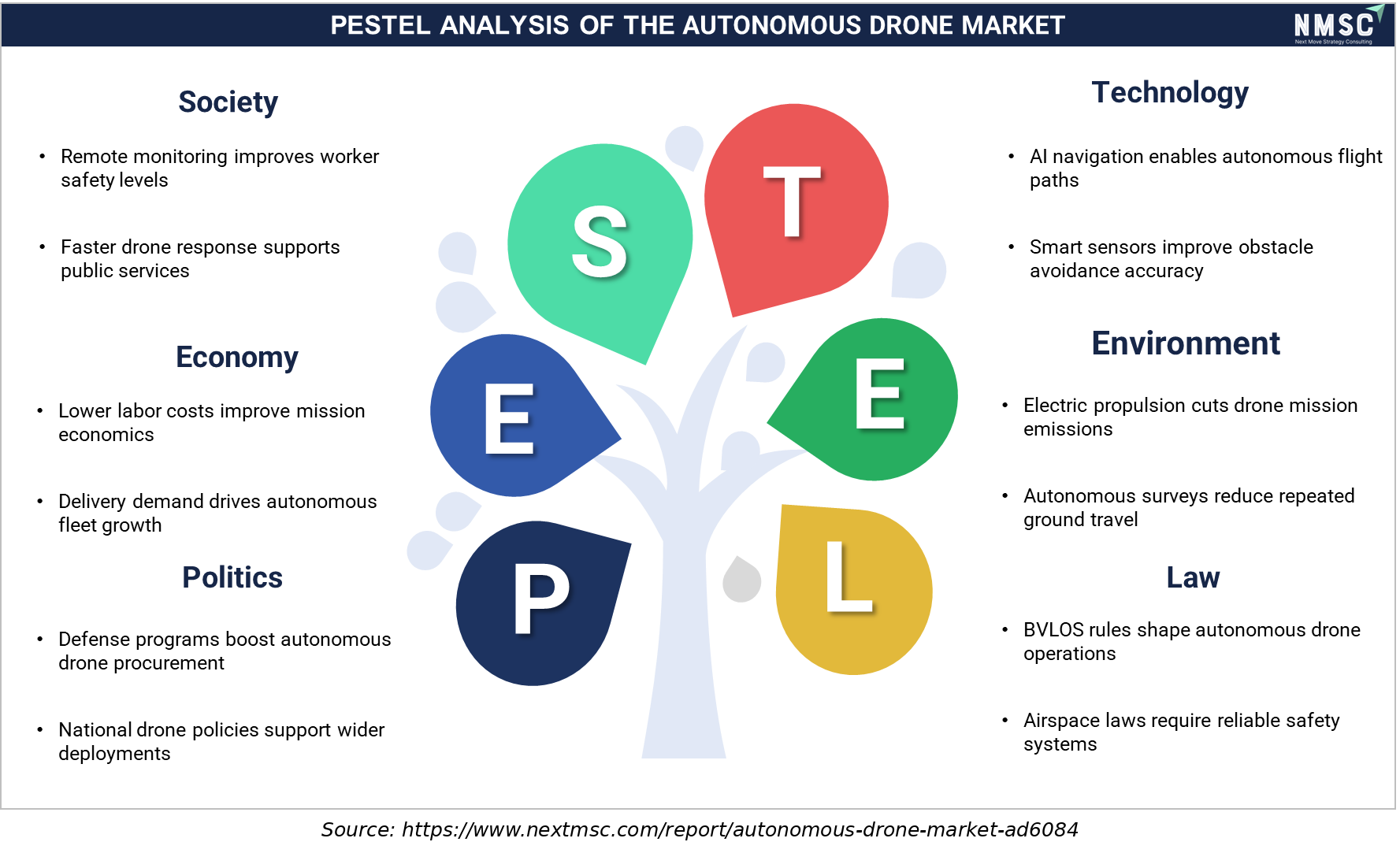
Based on our market evaluation, we noticed that delivery demand, public service response, and defense procurement drive expansion across the autonomous drone market. Furthermore, AI navigation and smart sensors optimize autonomous flight paths and obstacle avoidance. Concurrently, lower labor costs and electric propulsion reduce operational expenditures and mission emissions. Ultimately, evolving national policies, BVLOS regulations, and airspace safety laws govern widespread commercial deployment across the autonomous drone industry.

Market Drivers & Dynamics

Interactive Dataset
FAA Part 108 BVLOS rulemaking enabling scaled operations driver +3.2% North America 2026-2035
Rising defense modernization and counter-drone investment driver +2.8% Global 2026-2035
AI-enabled autonomous navigation and obstacle avoidance advances driver +2.4% Global 2026-2035
Expansion of drone-based logistics and last-mile delivery driver +2.1% North America, Asia-Pacific 2026-2033
Government smart-city and infrastructure inspection programs driver +1.7% Asia-Pacific 2026-2035
Airspace integration and detect-and-avoid certification complexity restraint -1.4% Global 2026-2032
Import restrictions on foreign-made drone components restraint -1.1% North America 2026-2030
High capital cost of autonomy sensor stacks and edge compute restraint -0.9% Global 2026-2032
Fragmented cross-border airspace regulation limiting BVLOS corridors restraint -0.7% Europe, MEA, LATAM 2026-2035
Source: Next Move Strategy Consulting

Growth Drivers

What Is the Primary Growth Driver of the Autonomous Drone Market?

Regulatory progress toward standardized beyond visual line of sight operations is the primary driver of the market. The U.S. Federal Aviation Administration's Part 108 proposal, developed in the policy framework established by Executive Order 14307, is designed to replace the individual waiver process with a repeatable operational framework. We observed that this regulatory clarity, once finalized, is projected to unlock large-scale commercial delivery, inspection, and public-safety deployments that remain waiver-constrained under current Part 107 rules.

How Is Defense Modernization Driving Autonomous Drone Market Growth?

Rising defense budgets allocated to unmanned and autonomous systems are accelerating market growth. The U.S. Department of Defense requested substantial fiscal year 2026 funding for autonomous weapons and systems, with counter-unmanned aircraft capability identified as a priority area. Our assessment indicates that this procurement pressure, combined with allied-nation modernization programs, is compressing development timelines for autonomous attack and reconnaissance platforms across North America, Europe, and the Middle East.

Growth Inhibitors

What Is Restraining Autonomous Drone Market Expansion?

Airspace-integration and detect-and-avoid certification complexity restrains the pace of commercial scale-up. The Federal Aviation Administration's Part 108 Notice of Proposed Rulemaking drew more than 3,000 public comments, with over half addressing contested right-of-way and electronic conspicuity provisions. We found that this regulatory uncertainty delays operator investment decisions, as commercial fleet operators await a finalized technical standard before committing capital to large beyond visual line of sight deployments.

Segmentation Analysis

2025 (USD Billion)
2035 (USD Billion)
Rotary-Wing Drones 2025: $6.96 Billion | 2035: $33.31 Billion
Rotary-Wing
Fixed-Wing Drones 2025: $4.21 Billion | 2035: $20.44 Billion
Fixed-Wing D
Hybrid VTOL Drones 2025: $2.18 Billion | 2035: $16.65 Billion
Hybrid VTOL
Nano and Micro Drones 2025: $1.16 Billion | 2035: $5.30 Billion
Nano and Mic
Rotary-Wing Drones $6.96 Billion $33.31 Billion 17.1%
Fixed-Wing Drones $4.21 Billion $20.44 Billion 17.3%
Hybrid VTOL Drones $2.18 Billion $16.65 Billion 23.3%
Nano and Micro Drones $1.16 Billion $5.30 Billion 16.5%

Which Platform Type Dominates the Autonomous Drone Market?

Platform type spans rotary-wing, fixed-wing, hybrid vertical take-off and landing, and nano and micro configurations serving distinct mission profiles. Rotary-wing drones dominated with approximately 48% share in 2025, supported by versatility across inspection, surveillance, and public-safety deployments requiring vertical launch. Hybrid VTOL drones are the fastest-growing sub-segment at 23.3% CAGR, driven by logistics operators seeking fixed-wing range combined with rotary-wing takeoff flexibility for beyond visual line of sight delivery corridors.

2025 (USD Billion)
2035 (USD Billion)
Hardware
Airframe
Propulsion S
Sensors and
Navigation a
Segment Item 2025 (USD Billion) 2035 (USD Billion) CAGR
Hardware $10.0 USD Billion $40.0 USD Billion 13.0%
Airframe $17.1 USD Billion $51.1 USD Billion 19.0%
Propulsion System $24.2 USD Billion $62.2 USD Billion 13.0%
Sensors and Payload $31.3 USD Billion $73.3 USD Billion 11.0%
Navigation and Communication Systems $38.4 USD Billion $84.4 USD Billion 12.0%

Segment-wise data is locked

Unlock complete segment-wise numbers for By Component.

Unlock Full Data
2025 (USD Billion)
2035 (USD Billion)
Semi-Autonom
Fully Autono
Segment Item 2025 (USD Billion) 2035 (USD Billion) CAGR
Semi-Autonomous Drones $10.0 USD Billion $40.0 USD Billion 26.0%
Fully Autonomous Drones $17.1 USD Billion $51.1 USD Billion 8.0%

Segment-wise data is locked

Unlock complete segment-wise numbers for By Autonomy Level.

Unlock Full Data
2025 (USD Billion)
2035 (USD Billion)
Defense and
Agriculture
Logistics an
Infrastructu
Surveying an
Segment Item 2025 (USD Billion) 2035 (USD Billion) CAGR
Defense and Security $10.0 USD Billion $40.0 USD Billion 18.0%
Agriculture $17.1 USD Billion $51.1 USD Billion 16.0%
Logistics and Delivery $24.2 USD Billion $62.2 USD Billion 22.0%
Infrastructure Inspection $31.3 USD Billion $73.3 USD Billion 12.0%
Surveying and Mapping $38.4 USD Billion $84.4 USD Billion 19.0%

Segment-wise data is locked

Unlock complete segment-wise numbers for By Application.

Unlock Full Data

Which Application Is Fastest-Growing in the Autonomous Drone Market?

Application segmentation covers defense and security, infrastructure inspection, agriculture, surveying and mapping, logistics and delivery, environmental monitoring, and other niche uses. Defense and security led with approximately 29% share in 2025, anchored by sustained military modernization spending. Logistics and delivery is the fastest-growing application at 26.3% CAGR, supported by continued expansion of Zipline's delivery partnerships as beyond visual line of sight corridors expand across U.S. metropolitan markets.

2025 (USD Billion)
2035 (USD Billion)
Government a
Commercial
Consumer
Segment Item 2025 (USD Billion) 2035 (USD Billion) CAGR
Government and Defense $10.0 USD Billion $40.0 USD Billion 15.0%
Commercial $17.1 USD Billion $51.1 USD Billion 13.0%
Consumer $24.2 USD Billion $62.2 USD Billion 23.0%

Segment-wise data is locked

Unlock complete segment-wise numbers for By End Use.

Unlock Full Data

How Is the Commercial End Use Segment Reshaping Market Structure?

End use segmentation divides demand across government and defense, commercial, and consumer buyers. Government and defense held the largest share at approximately 46% in 2025, reflecting sustained procurement by military and public-safety agencies. Commercial end use is the fastest-growing category at 22.1% CAGR, as retail, healthcare, and construction operators adopt autonomous platforms for delivery, inspection, and monitoring functions once limited to specialized defense and public-sector budgets.

Growth Opportunities

We identified three forward-looking whitespace opportunities positioned to shape competitive strategy through the forecast period.

How Can Suppliers Capture Value from Domestic Manufacturing Reshoring?

Import restrictions on foreign-made drone components create an opening for U.S.-based hardware and component suppliers to capture displaced procurement volume. Manufacturers that localize propulsion, sensor, and airframe production stand to benefit as public-safety and defense buyers face expanding domestic-sourcing eligibility requirements through 2035.

What Opportunity Does BVLOS Corridor Certification Create for Logistics Operators?

Finalization of the Part 108 framework is projected to unlock certified beyond visual line of sight delivery corridors at metropolitan scale. Logistics and healthcare-delivery operators that secure early operational certificates stand to gain first-mover positioning in urban and suburban last-mile networks as competitors await regulatory clarity.

How Can Software Providers Monetize Fleet Autonomy Platforms?

Rising fleet sizes across public safety, inspection, and delivery operators create demand for centralized autonomy and mission-management software. Providers offering subscription-based fleet orchestration, detect-and-avoid certification support, and data-analytics services stand to benefit as commercial end users prioritize recurring-revenue software over one-time hardware purchases.

Regional Outlook

2025 (USD Billion)
2035 (USD Billion)
North Americ
Europe
Asia-Pacific
Middle East
Latin Americ
Region 2025 (USD Billion) 2035 (USD Billion) CAGR (%)
North America $10.0 USD Billion $40.0 USD Billion 9.0%
Europe $17.1 USD Billion $51.1 USD Billion 27.0%
Asia-Pacific $24.2 USD Billion $62.2 USD Billion 25.0%
Middle East and Africa $31.3 USD Billion $73.3 USD Billion 23.0%
Latin America $38.4 USD Billion $84.4 USD Billion 12.0%

Regional data is locked

Unlock complete regional numbers for this market.

Unlock Full Data

Pain Point Analysis of the Autonomous Drone Market

Pain Point Analysis of the Autonomous Drone Market

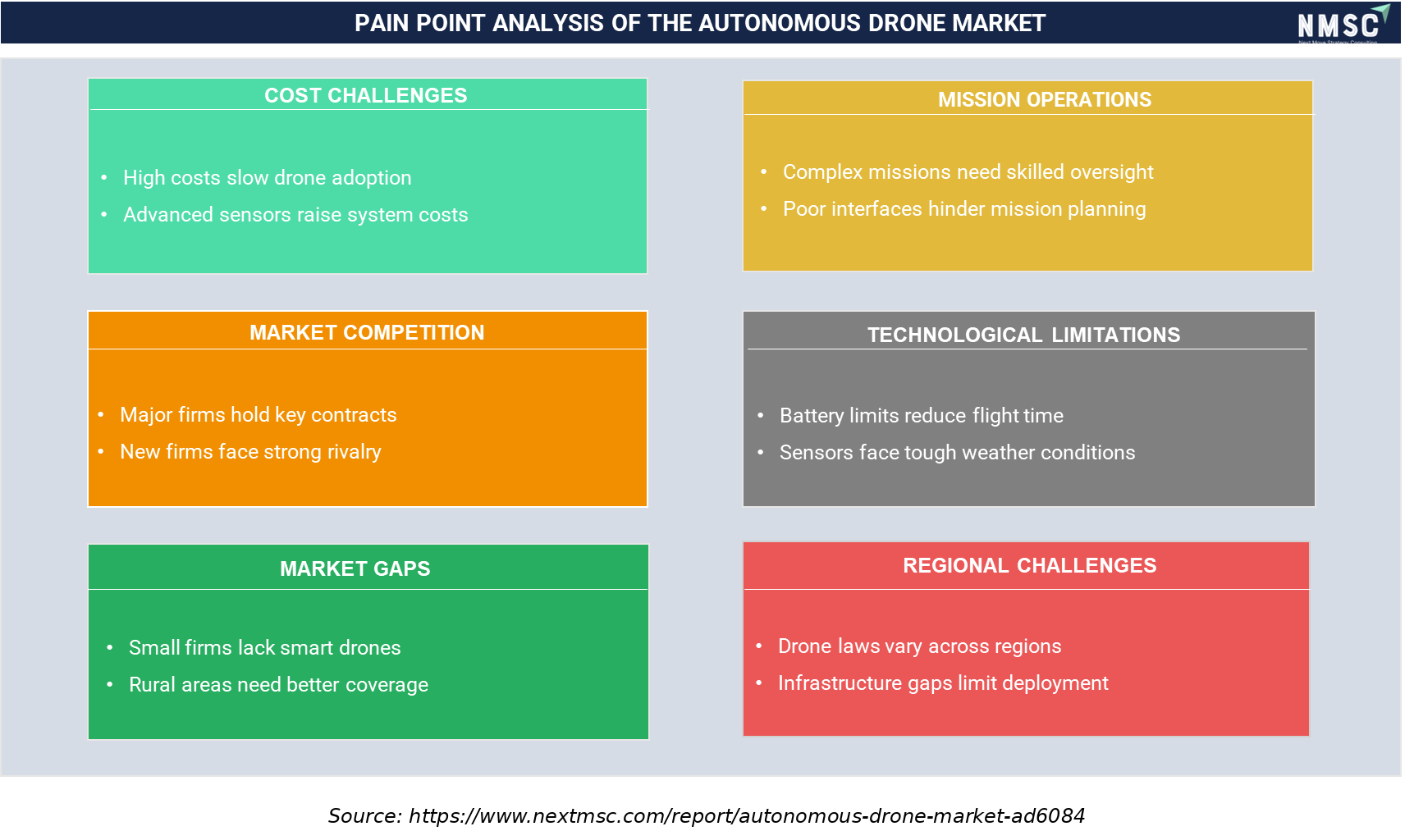
In our observation, high procurement expenses and advanced sensor costs create adoption barriers within the autonomous drone market. Furthermore, battery limitations reduce flight durations, while harsh weather challenges sensor reliability and poor interfaces hinder mission planning. Concurrently, major contractors dominate competition, creating hurdles for new entrants. Ultimately, rural coverage gaps, varied regional regulations, and infrastructure deficits restrict widespread operational deployment across the global autonomous drone industry.

Competitive Landscape

We observed that the industry remains moderately consolidated, with defense primes commanding large-scale government contracts while venture-backed specialists compete on autonomy software differentiation.

Dimension Description
Market Structure Moderately consolidated, led by defense primes and venture-backed autonomy specialists
Innovation Focus Edge AI navigation, detect-and-avoid systems, and swarm coordination software
M&A Activity Selective acquisitions targeting autonomy software and sensor-fusion capability

How Do Companies Compete in the Autonomous Drone Market?

Companies compete on autonomy software sophistication, certification readiness, and domestic manufacturing capacity rather than hardware specifications alone. Our findings suggest that platform developers increasingly bundle detect-and-avoid software, fleet-management dashboards, and data-analytics services to differentiate beyond commodity airframe production, positioning recurring-revenue software contracts as a growing share of total company revenue across the competitive landscape.

Which Competitive Archetypes Dominate the Market?

Two archetypes dominate the autonomous drone industry: large defense primes leveraging established government relationships and manufacturing scale, and venture-backed specialists differentiating on rapid autonomy-software iteration. We observed that Skydio's positioning as the largest U.S.-based manufacturer reflects the second archetype, while Lockheed Martin and Northrop Grumman anchor the first through diversified defense-platform portfolios spanning multiple autonomous system categories.

What Innovation and Differentiation Strategies Are Companies Pursuing?

Companies are prioritizing edge artificial intelligence, sensor fusion, and swarm-coordination capability to differentiate mission performance. Our analysis shows that Anduril Industries' Thunder autonomous rotorcraft, unveiled in 2026, exemplifies this strategy by combining hybrid-electric propulsion with autonomous formation-flight software. Manufacturers are also investing in domestic supply-chain resilience, positioning localized production as a differentiator amid tightening component-sourcing regulations.

How Active Is M&A Activity in the Autonomous Drone Market?

M&A activity remains selective, concentrated on acquiring autonomy-software and sensor-fusion capability rather than broad platform consolidation. We found that established defense primes continue to pursue targeted investments in smaller autonomy specialists to accelerate detect-and-avoid certification timelines, while venture capital funding rounds, including Skydio's 2026 Series F, continue to supplement organic growth among independent platform developers.

Key Market Players

We identified the following companies as the leading validated participants shaping competitive dynamics across the autonomous drone market.

SZ DJI Technology Co., Ltd. Lockheed Martin Corporation Northrop Grumman Corporation General Atomics Aeronautical Systems, Inc. Elbit Systems Ltd. Israel Aerospace Industries Ltd. Thales Group BAE Systems plc Textron Inc. Anduril Industries, Inc. AeroVironment, Inc. Skydio, Inc. Insitu, Inc. Wing Aviation LLC Zipline International Inc. Shield AI, Inc. Parrot Drone SAS Quantum-Systems GmbH EHang Holdings Limited XAG Co., Ltd.

Latest Developments

Date Event
June 2026 Wing and Walmart announced expansion into seven additional U.S. metropolitan areas: Memphis, New Orleans, Philadelphia, Phoenix, San Diego, San Francisco Bay Area and Salt Lake City. The expansion brings Wing’s planned footprint to nearly 20 U.S. markets and advances its nationwide autonomous drone delivery network.
May 2026 Skydio announced a follow-on multi-million-dollar U.S. Air Force award that more than doubles the scope of its initial X10D deployment to Explosive Ordnance Disposal units. The systems provide rapid deployment, standoff distance and immediate situational awareness for EOD missions.
February 2026 Rwanda signed an expansion agreement with Zipline that will establish nationwide autonomous delivery coverage, Africa’s first urban drone delivery network and an autonomous delivery testing center. The agreement represents the first milestone under Zipline’s USD 150 million U.S. Department of State award.
March 2025 U.S. Special Operations Command awarded Anduril a three-year, USD 86 million contract to accelerate development and deployment of mission autonomy software across multi-domain uncrewed systems. Anduril’s Lattice for Mission Autonomy coordinates diverse autonomous systems, sensors and payloads under human supervision.
March 2025 Quantum Systems introduced Vector AI, an AI-powered extended-endurance tactical eVTOL sUAS designed for reconnaissance, surveillance and target acquisition. The platform combines autonomous mission execution, electronic-warfare resilience and real-time AI-driven situational awareness for operations in contested environments.

Expert Insights

Adam Bry

CEO & Co-Founder | Skydio

"Drones are becoming the first widely deployed class of autonomous robots, with flying robots already doing useful work across the country."

Analyst Interpretation

The comment highlights the broader transition of drones from remotely operated aircraft toward autonomous robotic systems capable of performing useful tasks with limited human intervention. The growing deployment of autonomous drones across public safety, infrastructure inspection, defense, and other commercial applications indicates increasing acceptance of autonomous aerial systems as a practical robotics platform. This shift is supporting demand for AI-powered navigation, autonomous flight capabilities, and fleet-management technologies, while expanding the potential applications and addressable market for autonomous drones.

Investment Opportunities

How Are Capital Inflows Shaping the Autonomous Drone Market?

Venture and private capital continue to flow into autonomy-software specialists, exemplified by Skydio's USD 110 million Series F round at a USD 4.4 billion valuation in April 2026. We observed that investors are prioritizing companies demonstrating defense and public-safety contract traction over consumer-facing platforms, reflecting a broader capital shift toward government-validated recurring revenue streams within the sector.

What Infrastructure Investment Trends Are Supporting Market Growth?

Domestic manufacturing infrastructure investment is accelerating, led by Skydio's USD 3.5 billion U.S. facility expansion and Anduril's Arsenal-1 manufacturing site in Ohio. Our analysis shows that these investments aim to rebuild domestic component supply chains, reducing reliance on foreign-sourced parts amid tightening national-security procurement requirements across defense and public-safety buyers.

What ESG Considerations Are Relevant to Autonomous Drone Investment?

Environmental and social considerations are shaping investment evaluation, particularly around domestic job creation and supply-chain transparency. We found that Skydio's expansion is projected to create more than 2,000 direct manufacturing jobs and support over 3,000 additional domestic supplier roles, a factor increasingly weighed by institutional investors alongside governance standards tied to export-control and defense-procurement compliance.

Key Benefits for Stakeholders

How Does This Report Benefit Industry Leaders?

Industry leaders gain access to validated segmentation, regional sizing, and competitive-positioning data that inform product-development and manufacturing-investment decisions. Our analysis of platform-type and application demand shifts supports strategic prioritization of hybrid VTOL and logistics-oriented product lines, helping manufacturers align capital allocation with the fastest-growing sub-segments identified across the forecast period.

How Does This Report Benefit Investors and Financial Analysts?

Investors and financial analysts gain a fundamentals-based market-sizing methodology, triangulated CAGR assumptions, and company-level competitive context to support valuation and due-diligence work. The report's regional and segmental forecasts provide a benchmark for assessing growth-stage autonomy specialists against established defense primes across comparable revenue and market-share metrics.

How Does This Report Benefit Technology Vendors and Product Teams?

Technology vendors and product teams gain visibility into emerging trends such as beyond visual line of sight rulemaking, edge artificial intelligence adoption, and domestic manufacturing reshoring that directly inform software-roadmap and certification-strategy decisions. The report's segmentation structure helps product teams identify underserved application areas, including environmental monitoring and specialty logistics, positioned for above-average growth through 2035.

Key Market Segments Evaluated

By Platform Type

  • Rotary-Wing Drones
  • Fixed-Wing Drones
  • Hybrid VTOL Drones
  • Nano and Micro Drones

By Component

  • Hardware
  • Airframe
  • Propulsion System
  • Sensors and Payload
  • Navigation and Communication Systems
  • Software
  • Autonomy and Flight Control Software
  • Fleet Management Software
  • Services
  • Maintenance and Support Services
  • Data Analytics Services

By Autonomy Level

  • Semi-Autonomous Drones
  • Fully Autonomous Drones

By Application

  • Defense and Security
  • Infrastructure Inspection
  • Agriculture
  • Surveying and Mapping
  • Logistics and Delivery
  • Environmental Monitoring
  • Others

By End Use

  • Government and Defense
  • Commercial
  • Consumer

Conclusion & Recommendations

The long-term outlook remains strongly positive, with the market projected to expand from USD 16.8 Billion in 2026 to USD 75.7 Billion by 2035 at an 18.2% CAGR. We observed that this trajectory is underpinned by regulatory normalization of beyond visual line of sight operations and sustained defense modernization spending, positioning the market for durable, broad-based expansion across both government and commercial end uses through the forecast period.

What Strategic Positioning Should Companies Pursue?

Companies should prioritize investment in detect-and-avoid certification readiness and domestic manufacturing capacity to align with tightening procurement and regulatory requirements. Our recommendation is that platform developers pair hardware production with recurring-revenue autonomy software to diversify beyond one-time equipment sales, strengthening competitive resilience as commercial buyers increasingly evaluate total-fleet lifecycle costs.

How Attractive Is the Market for New Investment?

Investment attractiveness remains high, supported by an absolute dollar opportunity of USD 58.9 Billion between 2026 and 2035 and accelerating capital inflows into autonomy-software specialists. We found that defense-validated revenue streams and expanding commercial logistics applications provide investors with diversified exposure across both stable government demand and higher-growth commercial adoption curves.

What Market Shifts and Key Risks Should Stakeholders Monitor?

Stakeholders should monitor finalization timelines for the FAA's Part 108 rule, as continued delays could postpone commercial beyond visual line of sight scale-up. Our assessment indicates that component-sourcing restrictions and resin or semiconductor supply volatility also present near-term risks, particularly for manufacturers with limited domestic supply-chain diversification across critical sensor and compute components.

What Are the Primary Growth Pathways Through 2035?

Primary growth pathways include beyond visual line of sight logistics expansion, defense fleet modernization, and fully autonomous software adoption across commercial inspection applications. We observed that companies combining certification-ready hardware with scalable fleet-management software are best positioned to capture disproportionate share of the market's projected USD 58.9 billion incremental growth opportunity through 2035.

FAQs

About the Author

Saista Faiyaz

Saista Faiyaz

Saista Faiyaz is Research Associate at Next Move Strategy Consulting, where she has covered consumer markets and healthcare technologies for 3 years. Her work includes primary interview review, secondary-source validation, market sizing, and structured analysis of company and industry data. She supports research by comparing evidence across sources, organizing findings into market narratives, and documenting assumptions used in analysis. Her scope includes cross-market benchmarking, and reports.

About the Reviewer

Supradip Baul

Supradip Baul

Supradip Baul is an accomplished business consultant and strategist with over a decade of rich experience in market intelligence, strategy, technology, and business transformation. His work has included rigorous qualitative and quantitative analysis across multiple industries, helping clients shape investment decisions and long-term roadmaps. Earlier in his career, he was associated with Gartner, where he contributed to industry-leading reports and market share analyses. He has worked with leading global companies and holds an MBA with a dual specialization in Marketing and Finance.

Download Free Sample

Kishu Kanda

KISHU KANDA

Strategy Analyst

Accenture

We purchased the AI Consumer Market Report from this company. Not only did they customize the report to meet our specific requirements, but they also showed great flexibility in accommodating our budget. The report we received fully met our expectations. Additionally, they provided prompt and thorough responses to both our pre-purchase and follow-up questions. We look forward to working with this company again in the future.

Rishabh Jogani

RISHABH JOGANI

Strategy Analyst

Accenture Japan

We are incredibly impressed with the market report on the real estate market in India provided by Next Move Strategy Consulting. The report was thorough, insightful, and well-structured, offering deep analysis and actionable recommendations. It not only captured the current trends and dynamics but also provided a forward-looking perspective that has been invaluable for our strategic planning. Their team demonstrated exceptional professionalism, attention to detail, and a profound understanding of the industry. The data-driven insights and clarity of presentation exceeded our expectations, making complex market trends easy to understand. We highly recommend Next Move Strategy Consulting to anyone looking for reliable and comprehensive market research services. Their expertise has given us the confidence to navigate the complexities of the Indian real estate market with clarity and foresight.

Nishant Awate

NISHANT AWATE

Business Development Global Sales

Zehnder Group Deutschland GmbH

Our experience working with Next Move Strategy Consulting was positive. The team was responsive, professional, and open to incorporating our specific requirements throughout the project. The India AHU market study was comprehensive and well structured, covering market value and volume forecasts, product and application segments, and key industry trends. The inclusion of both AHU and residential MVHR market insights made the study particularly relevant for our strategic market assessment. Overall, the report provides a solid foundation for evaluating market potential, identifying priority segments, and supporting business-development decisions in India.

Pratyush Kumar Das

PRATYUSH KUMAR DAS

Assistant Manager

Polycab India Limited

We would like to express our appreciation for the data and insights provided by nextmsc. We are very pleased with the quality and depth of the information, which has proven to be highly valuable and beneficial for our business decision-making.

Henri Knyphausen

HENRI KNYPHAUSEN

Partner at Singulier [Ex-BCG]

Singulier

I recently engaged NEXTMSC.com for a commercial due diligence project within the intralogistics sector, and I am pleased to provide a reference based on my experience. In utilizing NEXTMSC.com's services, I found their report to offer valuable insights into market dynamics and key industry players. The initial report provided a solid foundation for our analysis. However, as we were investigating a smaller target in the market, and I had specific customization requests requiring additional research. These requests included detailed information on product portfolios of various players and sub-market sizes, both inclusive and exclusive of certain product categories. NEXTMSC.com demonstrated commendable responsiveness and agility in accommodating these customization requests. Within a timeframe of 1-2 weeks, they delivered a revised report that met our specific needs. Furthermore, they were receptive to my follow-up inquiries, ensuring clarity and understanding of the data provided. The final deliverable significantly contributed to our due diligence efforts. One of NEXTMSC.com's notable strengths lies in their qualitative research capabilities. However, for future engagements, I would recommend the inclusion of a quantified market model in Excel format. Such a model would offer the ability to conduct in-depth analyses and explore various market segments, including country-specific data and subcomponent breakdowns. Based on my positive experience, I would not hesitate to work with NEXTMSC.com again. Their responsiveness, willingness to accommodate customization requests, and commitment to delivering actionable insights make them a reliable partner for commercial research projects.

Custom Market Research Services

We will customize the research for you if the listed report does not fully match your requirements.

Get 30% Free Customization

Select License

This website uses cookies to ensure you get the best experience on our website. Learn more

✖