Israel Drone Market By Component (Hardware, Software, and Services), By Platform Type (Multi-Rotor, Fixed-Wing, Hybrid VTOL, and Others), By Autonomy Level (Remotely Piloted, Assisted, Advanced, and Fully Autonomous), By Maximum Take-off Weight {Nano (<250 g), Micro (250 g–2 kg), Small (>2 kg–25 kg), and Others}, By End-User (Consumer Drone, Commercial & Industrial Drone, Government & Public Safety Drone, and Military Drone) – Analysis & Forecast, 2025–2035
Industry: Aerospace & Defense | Latest Edition: August 17, 2026 | No of Pages: 265 | No. of Tables: 140 | No. of Figures: 128 | Format: PDF | Report Code: AD5722
Israel Drone Market Size & Forecast
|
Parameters |
Details |
|
Market Size in 2025 |
USD 529.7 million |
|
Market Size in 2026 |
USD 604.0 million |
|
Revenue Forecast in 2035 |
USD 1,131.9 million |
|
Market Size Growth Rate |
CAGR of 7.23% from 2026 to 2035 |
|
Market Volume in 2025 |
17 thousand units |
|
Market Volume in 2026 |
20 thousand units |
|
Volume Forecast in 2035 |
52 thousand units |
|
Market Volume Growth Rate |
CAGR of 10.9% from 2026 to 2035 |
|
Analysis Period |
2025–2035 |
|
Base Year Considered |
2025 |
|
Forecast Period |
2026–2035 |
|
Market Size Estimation |
Million (USD) |
|
Companies Profiled |
15 |
|
Market Share |
Available for 10 companies |
Industry Outlook
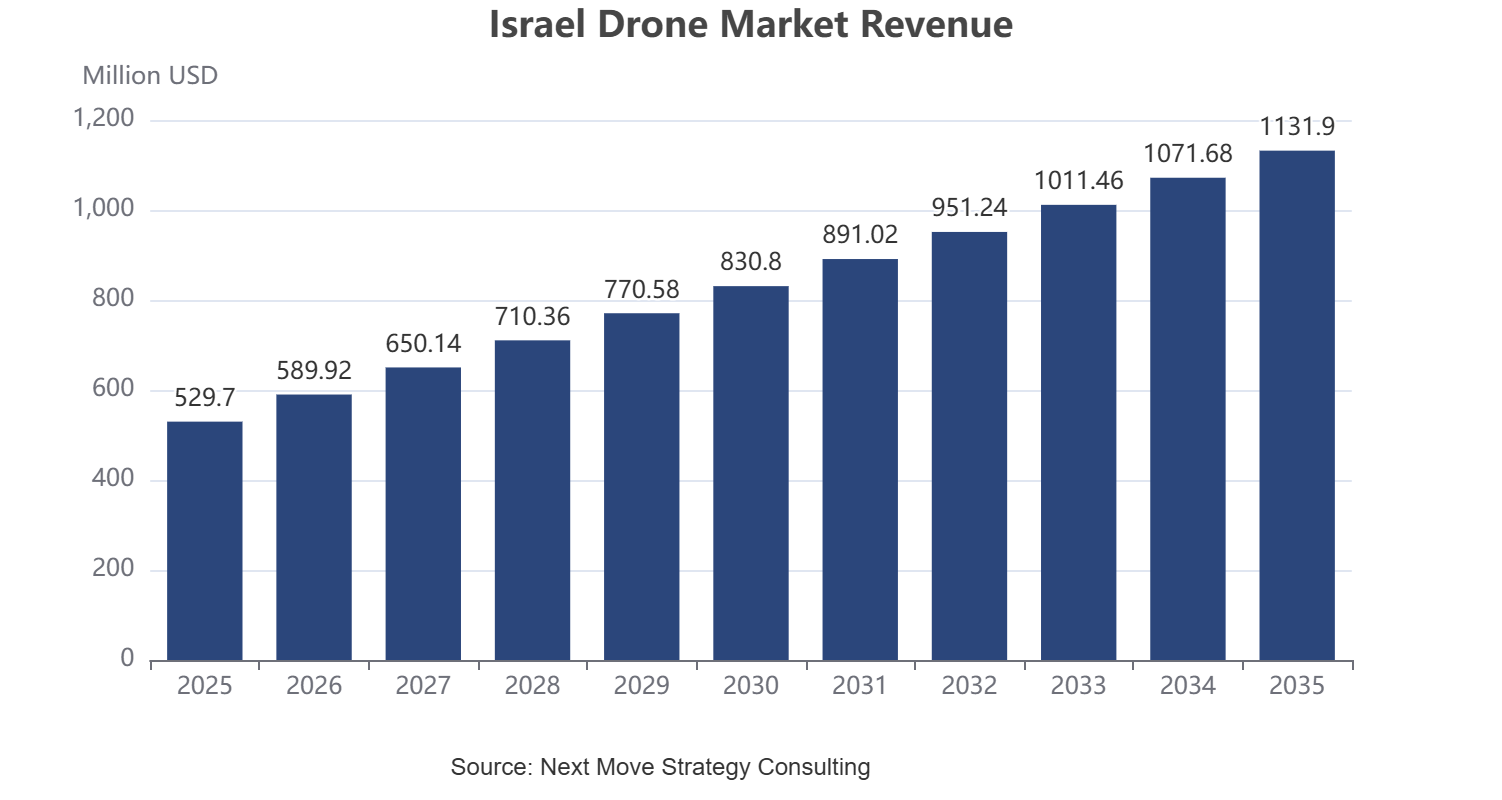
The Israel Drone Market was valued at USD 529.7 million in 2025 and is estimated to reach USD 604.0 million in 2026, projected to expand to USD 1,131.9 million by 2035 at a revenue CAGR of 7.23%. In volume terms, the market stood at 17 thousand units in 2025, estimated at 20 thousand units in 2026, and forecast to reach 52 thousand units by 2035 at a volume CAGR of 10.9%. This trajectory reflects Israel’s position as a global drone technology exporter, ongoing domestic defence procurement, and a growing commercial adoption base across agriculture, infrastructure inspection, and public safety verticals.
Ecosystem Analysis of the Israel Drone Market:
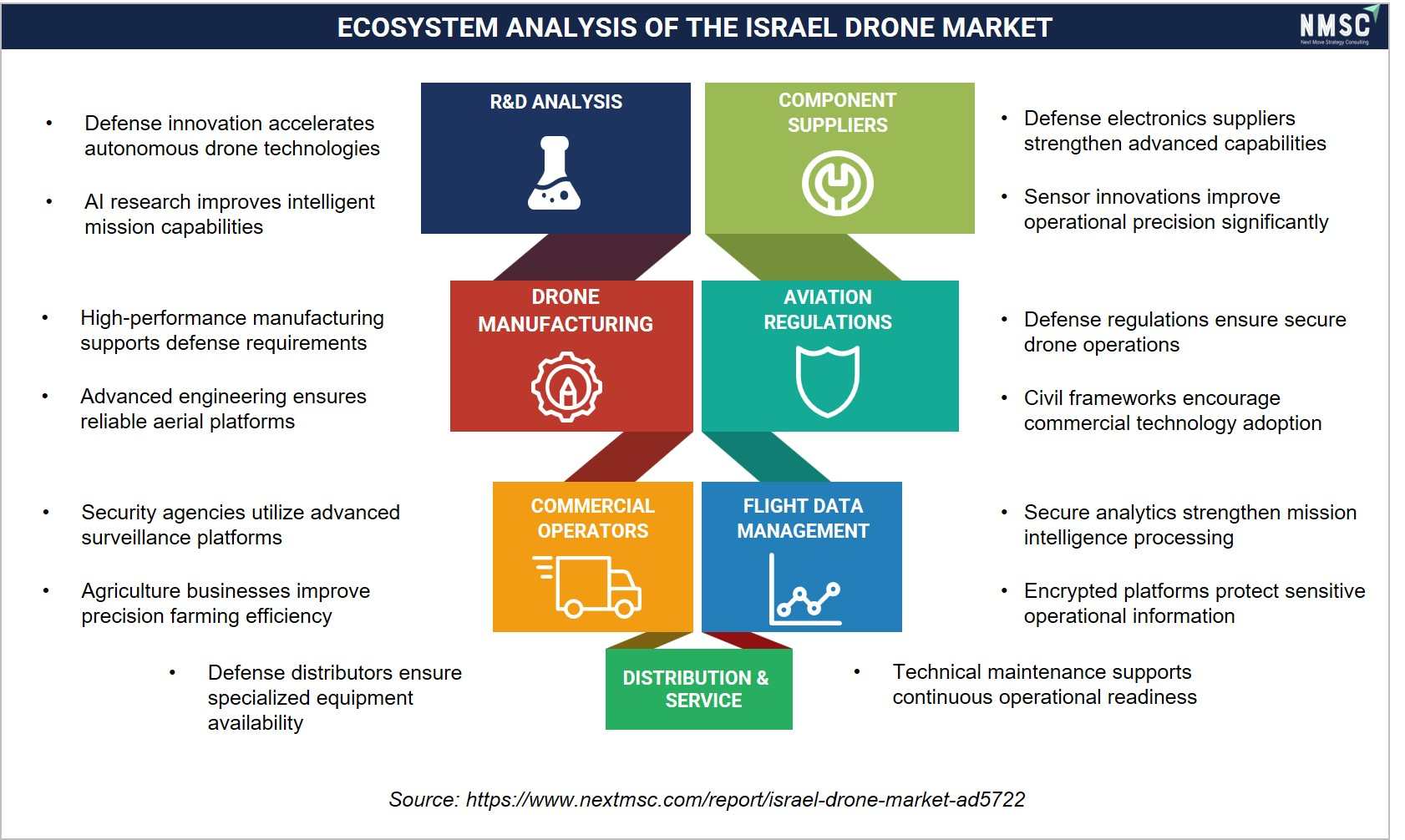
The above ecosystem analysis maps the key operational components, such as R&D analysis, component suppliers, drone manufacturing, aviation regulations, commercial operators, flight data management, and distribution and service, shaping the Israel drone market. From our analysis, we observed that R&D analysis and component suppliers drive technological advancements, while aviation regulations ensure safety and compliance standards. Commercial operators and flight data management optimize operational efficiency, whereas distribution and service networks support market accessibility, reflecting a well-integrated ecosystem across the Israel drone market.
What Are the Key Growth Drivers, Restraints, and Opportunities Shaping the Israel Drone Market Through 2035?
|
DRIVERS / TRENDS / RESTRAINTS |
(+/-) IMPACT ON CAGR FORECAST |
GEOGRAPHIC RELEVANCE |
IMPACT TIMELINE |
|
Domestic IDF procurement and global export programs by IAI and Elbit Systems spanning MALE-class UAVs, loitering munitions, ISR platforms, and counter-drone systems anchoring high-value revenue base |
+1.3% |
National (IDF programmes, Negev test ranges, export contracts) |
Long term (4–7 years) |
|
Progressive ICAA BVLOS regulatory framework and enterprise autonomous drone adoption across industrial inspection, precision agriculture, and smart city surveillance verticals |
+1.0% |
Greater Tel Aviv, Haifa, Be’er Sheva, Nile Delta agricultural zones |
Medium to long term (3–6 years) |
|
Agriculture and infrastructure-dense national grid, desalination network, and highway system creating recurring demand for drone-based precision monitoring and inspection services |
+0.8% |
National (Negev agricultural zones, coastal infrastructure corridors) |
Medium term (2–5 years) |
|
Security-related airspace restrictions over sensitive zones and dominant defence-industrial talent concentration creating barriers for commercial startups and limiting civilian drone geographic scope |
–0.7% |
National (most acute near military zones and border areas) |
Short to medium term (1–4 years) |
|
Growing European defence export demand, NATO-aligned procurement shifts, and smart city UAV integration programs creating long-term expansion opportunities for Israeli drone manufacturers and enterprise operators |
+0.9% |
Europe-focused export markets, Tel Aviv, Haifa |
Long term (4–8 years) |
The Israel Drone Market is uniquely structured as both a major global drone technology exporter and a domestic end-use market in which the same companies that develop and export leading military, ISR, and loitering munition platforms also supply the Israeli Defence Forces under active procurement programs. This dual exporter-consumer dynamic produces a market where the value of domestic drone activity significantly exceeds what its population size would otherwise predict, as world-class R&D infrastructure, government-supported defence procurement budgets, and a commercially mature enterprise drone ecosystem together drive above-average revenue intensity per capita across all end-user segments.
Growth Drivers:
How Are Israel’s World-Class Military Drone Manufacturers Anchoring Domestic Market Revenue Through IDF Procurement and Export Programs?
Israel Aerospace Industries and Elbit Systems are two of the world’s most technologically advanced military drone manufacturers, with export programs spanning MALE-class UAVs, tactical ISR platforms, loitering munitions, and counter-drone systems that are procured by armed forces across Europe, Asia, and Latin America. Domestically, the Israeli Defence Forces maintain active procurement programs for reconnaissance, electronic warfare, and combat drone platforms developed and manufactured within Israel, creating a sustained high-value government procurement base that anchors the Israel Drone Market’s revenue trajectory and supports the R&D investment cycles of Israel’s world-class unmanned systems industrial base.
How Is Israel’s Progressive Commercial Drone Regulatory Framework Enabling Enterprise Autonomous Deployment at Scale?
Israel’s Civil Aviation Authority has established one of the more progressive commercial drone regulatory frameworks in the Middle East, with tiered operator registration, geofencing integration through the official drone portal, and active Beyond Visual Line of Sight pilot programs underway with enterprise operators across agriculture, infrastructure inspection, and logistics verticals. Companies such as Percepto Robotics Ltd are deploying autonomous industrial drone-in-a-box systems at scale across Israeli energy, mining, and telecom infrastructure sites, demonstrating that Israel’s regulatory environment is sufficiently mature to support commercial BVLOS operations that are still under study or restricted in most neighbouring markets.
How Are Agriculture and Infrastructure Inspection Use Cases Driving Commercial Drone Demand Across Israel?
Israel’s agricultural sector, operating under water and labour scarcity that make productivity per unit area a national priority, is adopting precision drone applications including irrigation monitoring, multispectral crop health analysis, and localized aerial spraying at a pace that outstrips many larger agricultural economies. The Volcani Centre and leading agri-tech accelerators are generating drone-specific agronomic research supporting broader commercial adoption. Israel’s infrastructure-dense national grid, desalination network, and highway system create recurring demand for drone-based inspection where UAV cost and safety advantages over manned-helicopter alternatives are well established among enterprise operators.
Growth Inhibitor:
What Security and Structural Factors Are Constraining Faster Commercial Drone Market Growth in Israel?
Israel’s security environment, characterised by active regional conflicts and recurring threat cycles involving adversarial drone systems, introduces operational constraints that periodically restrict civilian drone activity over sensitive zones, near military installations, and across border areas, limiting the geographic scope of commercial and consumer drone operations within a country whose entire territory covers only 22,000 square kilometres. The concentration of Israel’s world-class drone manufacturing capability in a small number of dominant defence-industrial groups also creates barriers for smaller commercial drone startups seeking to attract engineering talent, investment capital, and government procurement attention in competition with globally recognized prime contractors.
Growth Opportunity:
What European Defence Export and Smart City Opportunities Represent the Strongest Growth Vectors for Israel’s Drone Market Through 2035?
Israel’s internationally recognized drone expertise positions its manufacturers to capture growing European and NATO-aligned defence budgets shifting toward loitering munitions, autonomous ISR, and counter-drone capabilities following operational lessons from recent conflicts. Growing European demand for trusted, non-Chinese commercial drone alternatives simultaneously creates export opportunities for Israeli enterprise drone developers whose platforms meet Western certification standards. Domestically, smart city initiatives in Tel Aviv and Haifa are advancing UAV integration for traffic management, emergency response, and environmental monitoring, building an urban drone operations model with strong export-market applicability.
How Is the Israel Drone Market Segmented in This Report, and What Are the Key Insights From the Segmentation Analysis?
By Platform Type Insights
How Does Platform Type Segmentation Reflect Operational Diversity Across the Israel Drone Market?
Based on platform type, the Israel Drone Market is segmented into multi-rotor, fixed-wing, hybrid VTOL, single-rotor, tethered UAV, loitering munition, and MALE/HALE/UCAV.
The market features a diverse portfolio of drone platforms designed to address varying operational requirements across commercial, government, and defense applications. According to our analysis, we found that multi-rotor, fixed-wing, and hybrid VTOL platforms support applications such as precision agriculture, infrastructure inspection, surveying, and environmental monitoring by providing different combinations of maneuverability, endurance, and operational flexibility. Meanwhile, single-rotor helicopters, tethered UAVs, loitering munitions, and MALE/HALE/UCAV platforms enable specialized missions requiring persistent surveillance, tactical capabilities, long-range operations, and advanced defense performance.
By Component Insights
How Does Component Segmentation Reflect Technology Value Distribution Across the Israel Drone Market?
Based on component, the Israel Drone Market is segmented into hardware, software, and services.
The market comprises an advanced ecosystem of hardware, software, and service solutions supporting commercial, government, and defense drone operations. According to our analysis, we found that hardware components provide the structural, sensing, and communication capabilities required for complex missions, while software solutions enhance autonomous flight, mission planning, analytics, and fleet management. Service offerings, including DaaS, training, maintenance, and data processing, are becoming increasingly important as organizations seek to improve operational efficiency, reduce lifecycle costs, and maximize the value of deployed drone fleets.
Key Segments
By Component
-
Hardware
-
Airframe
-
Avionics & Core Systems
-
Payloads & Sensors (Cameras, LiDAR, Multispectral, etc.)
-
Communication Systems (C2 Links)
-
-
Software
-
Flight Control & Autonomy
-
Data Processing & Analytics
-
Fleet Management
-
-
Services
-
Drone-as-a-Service (DaaS)
-
Training & Certification
-
Maintenance, Repair & Overhaul (MRO)
-
Data Processing Services
-
By Platform Type
-
Multi-Rotor
-
Fixed-Wing
-
Hybrid VTOL (Vertical Take-Off and Landing)
-
Single-Rotor (Helicopter)
-
Tethered UAV
-
Loitering Munition
-
MALE/HALE/UCAV
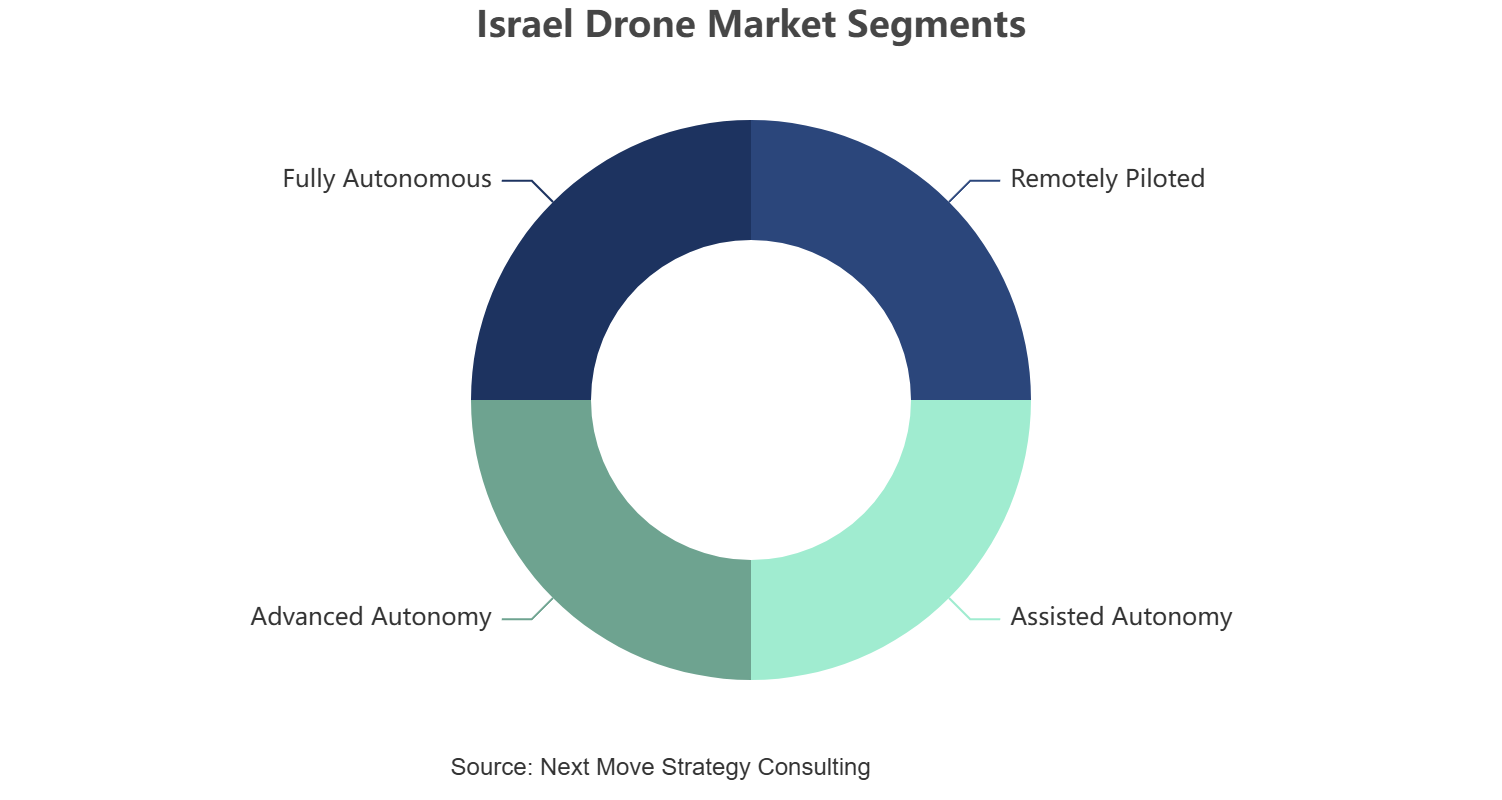
By Autonomy Level
-
Remotely Piloted
-
Assisted Autonomy
-
Advanced Autonomy
-
Fully Autonomous
By Maximum Takeoff Weight (MTOW)
-
Nano: < 250 g
-
Micro: 250 g – 2 kg
-
Small: > 2 kg – 25 kg
-
Medium: > 25 kg – 150 kg
-
Large: > 150 kg – 600 kg
-
Very Large/Tactical: > 600 kg
By Price/Performance Grade
-
Consumer Grade (< $1,000)
-
Prosumer Grade ($1,000 – $10,000)
-
Enterprise Grade ($10,000 – $100,000)
-
Military Grade (> $100,000)
By End-User
-
Consumer Drone
-
Commercial & Industrial Drone
-
Aerial Imaging & Cinematography
-
Surveying & Mapping (Geomatics)
-
Agricultural Applications (spraying, crop monitoring)
-
Infrastructure Inspection (energy, utilities, transport)
-
Logistics & Delivery (package transport)
-
Environmental & Scientific Monitoring
-
-
Government & Public Safety Drone
-
Emergency Response & Disaster Management
-
Law Enforcement & Security
-
Firefighting & Public Safety
-
Smart City Management
-
-
Military Drone
-
Intelligence, Surveillance & Reconnaissance (ISR)
-
Combat Operations
-
Electronic Warfare (EW)
-
Target Acquisition & Designation
-
Logistics & Resupply
-
Decoy & Countermeasure Systems
-
Competitive Landscape
The Israel Drone Market is defined by a competitive landscape that is globally distinctive in its depth of sovereign military drone development capability, with domestically headquartered companies holding meaningful positions across the full spectrum of unmanned platform types, from nano-class tactical reconnaissance systems to MALE-class long-endurance ISR and strike platforms. This indigenous industrial base competes alongside European and North American enterprise drone specialists in the commercial and inspection segments, while government and military procurement remains heavily concentrated among Israeli-headquartered prime contractors whose platforms have been validated through decades of operational deployment in demanding real-world environments.
Key Players
-
Wingtra AG
-
Teledyne FLIR LLC
-
Quantum-Systems GmbH
-
Kratos Defense and Security Solutions Inc.
-
Flyability SA
-
ideaForge Technology Limited
-
Percepto Robotics Ltd
-
UVision Air Ltd
-
Steadicopter Ltd
-
Israel Aerospace Industries Ltd
-
Elbit Systems Ltd
-
Skytech Orion Ltd
-
Company 13
-
Company 14
-
Company 15
The Israel Drone Market is anchored by domestically headquartered prime contractors Israel Aerospace Industries Ltd and Elbit Systems Ltd, whose MALE-class UAVs, loitering munitions, and ISR platforms serve both IDF procurement and significant export programs. Specialist commercial and enterprise operators are addressed by Percepto Robotics Ltd, Steadicopter Ltd, UVision Air Ltd, and Skytech Orion Ltd, while international enterprise drone suppliers Wingtra AG, Teledyne FLIR LLC, Quantum-Systems GmbH, Flyability SA, and others. Technology Limited compete across survey, inspection, and defence-adjacent commercial verticals within Israel’s highly competitive drone technology ecosystem.
Porter's Five Forces Analysis of the Israel Drone Market:
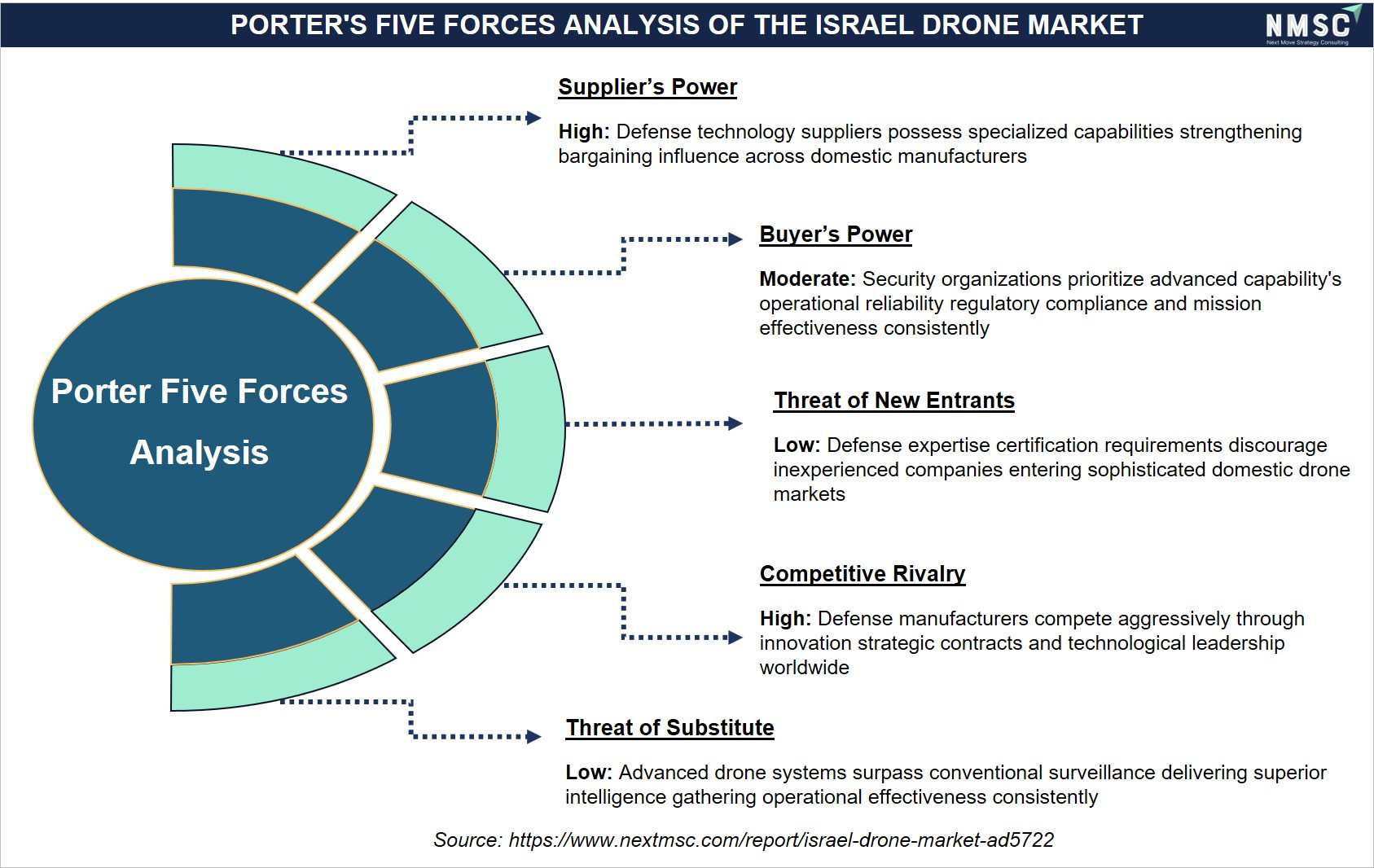
The above Porter's Five Forces analysis maps the key competitive forces, such as threat of new entrants, bargaining power of suppliers, bargaining power of buyers, threat of substitutes, and industry rivalry, shaping the Israel drone market. From our analysis, we observed that industry rivalry remains strong with advanced defense and technology players, while the bargaining power of suppliers is driven by cutting-edge component requirements. The threat of new entrants is limited by security regulations and high R&D investments, whereas the bargaining power of buyers is growing with defense, agriculture, and surveillance applications driving market demand.
Key Benefits for Stakeholders
NMSC’s Israel Drone Market study delivers revenue and volume forecasts through 2035 across all component, platform, autonomy, MTOW, price-performance, and end-user segments. Stakeholders gain actionable intelligence on IDF procurement pipelines, ICAA regulatory evolution, and commercial drone adoption across Israel’s agriculture, infrastructure inspection, autonomous industrial deployment, and smart city drone verticals.
Defence contractors and enterprise drone technology developers gain competitive profiling and export-market opportunity mapping that identifies where Israel’s sovereign drone capabilities align with growing European and NATO procurement priorities. Investors and commercial operators benefit from segment-level data on Israel’s fastest-scaling drone verticals, including autonomous industrial inspection, precision agriculture, and urban public safety applications that are building a replicable domestic deployment model.
|
Parameters |
Details |
|
Customization Scope |
Free customization (equivalent to up to 80 analyst-working hours) after purchase. |
|
Pricing and Purchase Options |
Avail customized purchase options to meet your exact research needs. |
|
Approach |
In-depth primary and secondary research; proprietary databases; rigorous quality control and validation measures. |
|
Analytical Tools |
Porter’s Five Forces, SWOT, value chain, and Harvey ball analysis to assess competitive intensity, stakeholder roles, and relative impact of key factors. |
Conclusion
The Israel Drone Market is projected to grow from USD 604.0 million in 2026 to USD 1,131.9 million by 2035 at a revenue CAGR of 7.23%, with volume expanding from 20 to 52 thousand units at a 10.9% CAGR. Indigenous military drone development, progressive commercial regulation, and precision agricultural adoption are the primary catalysts, while security-related airspace constraints and talent concentration among defence primes act as structural inhibitors. Competitive dynamics are shaped by world-class domestic manufacturers IAI and Elbit Systems alongside growing commercial specialists, creating an export-driven market with strong autonomous inspection and smart city opportunity vectors through 2035.
About the Author
 Mayurima Roy
— Mayurima Roy is Research Analyst at Next Move Strategy Consulting, where she has spent 4 years working across the firm's full industry coverage rather than a single fixed vertical. Her work centers on structured research, ongoing trend tracking, competitive assessment, and insight-led content development, translating complex market data into clear, decision-ready narratives that support informed client decision-making across diverse global industries, market sectors, and world regions every day.
Mayurima Roy
— Mayurima Roy is Research Analyst at Next Move Strategy Consulting, where she has spent 4 years working across the firm's full industry coverage rather than a single fixed vertical. Her work centers on structured research, ongoing trend tracking, competitive assessment, and insight-led content development, translating complex market data into clear, decision-ready narratives that support informed client decision-making across diverse global industries, market sectors, and world regions every day.
About the Reviewer
 Supradip Baul
— Supradip Baul is an accomplished business consultant and strategist with over a decade of rich experience in market intelligence, strategy, technology, and business transformation. His work has included rigorous qualitative and quantitative analysis across multiple industries, helping clients shape investment decisions and long-term roadmaps. Earlier in his career, he was associated with Gartner, where he contributed to industry-leading reports and market share analyses. He has worked with leading global companies and holds an MBA with a dual specialization in Marketing and Finance.
Supradip Baul
— Supradip Baul is an accomplished business consultant and strategist with over a decade of rich experience in market intelligence, strategy, technology, and business transformation. His work has included rigorous qualitative and quantitative analysis across multiple industries, helping clients shape investment decisions and long-term roadmaps. Earlier in his career, he was associated with Gartner, where he contributed to industry-leading reports and market share analyses. He has worked with leading global companies and holds an MBA with a dual specialization in Marketing and Finance.
At Next Move Strategy Consulting, we understand that insightful market research is the cornerstone of successful business decisions. That's why we employ a robust and multifaceted approach, combining various methodologies to deliver the most accurate and actionable data for our clients.

Research Landscape
We navigate the world of research with two primary approaches:
Qualitative Approach
Our qualitative research methodologies involve immersive techniques such as in-depth interviews, focus groups, and observational studies. By engaging directly with individuals and stakeholders, we uncover valuable insights that quantitative data alone may overlook.

Quantitative Research
In tandem with qualitative methodologies, NMSC leverages the power of Quantitative Research to provide a robust foundation of numerical insights. Through systematic data collection and analysis, we quantify patterns, preferences, and market trends, offering a comprehensive view of the business landscape.
Our quantitative research approach employs diverse tools, including surveys, experiments, and statistical modelling. These methodologies enable us to gather data from a large and representative sample, ensuring the statistical significance of our findings. By employing structured questionnaires and standardized data collection methods, we guarantee the reliability and validity of the information we present to our clients.
Quantitative research is particularly effective in measuring the prevalence of trends, assessing market size, and gauging the impact of various factors on consumer behavior. The numerical precision attained through this approach equips our clients with actionable insights, facilitating data-driven decision-making and strategy formulation.


Our Specialized Toolbox for Industry-Specific Market Research
We deploy a specialized arsenal of techniques tailored to meet your unique requirements. Here's a glimpse into our comprehensive toolbox:

Information Procurement
The stage entails acquiring market data or relevant information through various sources and methodologies.


Market Research Approach
We utilize both top-down and bottom-up approaches in market research analysis to achieve a comprehensive understanding of the market dynamics, leveraging the broad perspective of industry trends and macroeconomic factors alongside detailed insights from specific segments and individual companies.

Porters Five Forces Analysis
We conduct Porter's Five Forces analysis to evaluate the competitive landscape of an industry, providing us with insights into factors that affect profitability and strategic positioning.

SWOT Analysis

Forecasting
We utilize a forecasting model to predict future consumption by considering parameters like population, economics, regulations, market competition, drivers, constraints, technology, and pricing. We also employ statistical techniques such as multilinear regression, exponential smoothing, moving average, ARIMA, and Monte Carlo simulations for accurate predictions. In econometric forecasting, we analyzed short-term and long-term event impacts, attributing values based on regulatory frameworks, economic factors, and market events.





 Speak to Our Analyst