Backup Power Systems Market Size, Share, Trends and Growth Analysis, By Core Technology (Generators (Engine-Driven), Uninterruptible Power Supplies (UPS), Battery Energy Storage Systems (BESS), Fuel Cell Systems, and Other Static Conversion), By Power Capacity (Residential/Micro, Small Commercial, Medium Commercial, Large Commercial/Small Industrial, and Industrial/Utility), By Application, By End-User Vertical, and Region – Global Industry Report and Forecast, 2026–2035.
Industry: Energy & Power | Publishing Date: September 8, 2025 | Last Updated: July 28, 2026 | No of Pages: N/A | No. of Tables: N/A | No. of Figures: N/A | Format: PDF | Report Code: EP3020
What Is the Backup Power Systems Market Size?
The global backup power systems market size was valued at USD 35.30 billion in 2025 and is estimated at USD 37.45 billion in 2026, forecast to reach USD 64.25 billion by 2035, expanding at a 6.17% CAGR between 2026 and 2035. North America leads with approximately 36% share, while Generators (Engine-Driven) dominates all core technologies with approximately 44% share.
We observed that growth is broad-based across every segmentation axis, with data center and colocation demand and battery energy storage systems driving the sharpest structural shifts through 2035.
|
Key Takeaways |
|
By Core Technology: Generators (Engine-Driven) held the largest share of approximately 44% (USD 15.53 billion) in 2025; Battery Energy Storage Systems (BESS) is the fastest-growing sub-segment at 11.2% CAGR from 2026–2035. |
|
By Power Capacity: Medium Commercial: 50-500 kW and Large Commercial / Small Industrial: 500 kW-2 MW each held the largest share of approximately 24% (USD 8.47 billion) in 2025; Industrial / Utility: >2 MW is the fastest-growing sub-segment at 11.0% CAGR from 2026–2035. |
|
By Application: Standby / Emergency Backup held the largest share of approximately 46% (USD 16.24 billion) in 2025; Microgrid / Off-Grid Systems is the fastest-growing sub-segment at 11.5% CAGR from 2026–2035. |
|
By End-User Vertical: Data Centers & Colocation held the largest share of approximately 19% (USD 6.71 billion) in 2025; Data Centers & Colocation is also the fastest-growing sub-segment at 11.1% CAGR from 2026–2035. |
|
Dominant Region: North America dominated with approximately 36% revenue share (USD 12.71 billion) in 2025. |
|
Fastest-Growing Region: Asia-Pacific is expected to register the highest CAGR of 7.9% during 2026–2035. |
|
Dominant Country: U.S. led with approximately USD 10.29 billion in 2025. |
|
Fastest-Growing Country: India is the fastest-growing country at approximately 10.6% CAGR from 2026–2035. |
Market Opportunity: The backup power systems market is expected to create an absolute dollar opportunity of USD 26.80 billion between 2026 and 2035, presenting significant investment potential across hyperscale data center generator supply, battery energy storage integration, and utility-scale industrial power capacity.
According to Next Move Strategy Consulting analysis, generator and power equipment manufacturers are increasingly converting from equipment sales into long-term, infrastructure-like supply agreements with hyperscale data center operators, a shift that favors vendors with multi-year manufacturing capacity and financing capability over transactional equipment suppliers as AI-driven power demand strains grid capacity through 2035.
What Does the Backup Power Systems Market Encompass?
The market encompasses engine-driven generators, uninterruptible power supplies, battery energy storage systems, fuel cell systems, and other static conversion technologies that provide standby, prime, or grid-support power across residential, commercial, and industrial facilities. Our assessment indicates that the scope spans power capacities from residential micro-systems under 10 kW to industrial and utility installations exceeding 2 MW, deployed for standby backup, prime continuous power, peak shaving, microgrid, and power conditioning applications. This category sits alongside the broader Data Center Power Solution market while remaining distinct in its focus on backup and resilience rather than primary power distribution infrastructure.
The category has evolved from standalone diesel generators and lead-acid UPS batteries into an increasingly integrated, multi-technology power resilience ecosystem. We observed that Caterpillar formed a strategic alliance with American Intelligence & Power Corporation and Boyd CAT in January 2026 to support the Monarch Compute Campus, an AI-focused hyperscale data center project, while Cummins reported record performance in its Power Systems segment during the first quarter of 2026 driven by sustained data center backup power demand. Next Move Strategy Consulting's analysis indicates that this shift toward long-term, infrastructure-scale supply commitments, combined with rising AI and cloud workload power requirements, is redefining procurement strategy across the backup power systems market.
Regulatory and grid reliability requirements increasingly shape technology adoption across the industry. Data center operators in major markets face growing pressure to secure onsite backup generation as grid capacity constraints intensify alongside AI-driven electricity demand. We observed that technology adoption is shifting toward lithium-ion battery integration and hybrid engine-battery configurations, as Eaton's July 2025 launch of its 93PM G2 series with lithium-ion battery integration and Vertiv's collaboration with NVIDIA on 800VDC power architectures both illustrate the industry's move toward higher-density, more efficient power protection systems.
|
Field |
Details |
|
Market Size in 2025 |
USD 35.30 Billion |
|
Market Size in 2026 |
USD 37.45 Billion |
|
Revenue Forecast in 2035 |
USD 64.25 Billion |
|
Growth Rate |
CAGR of 6.17% from 2026 to 2035 |
|
Analysis Period |
2025–2035 |
|
Base Year Considered |
2025 |
|
Forecast Period |
2026–2035 |
|
Market Size Estimation |
USD Billion |
|
Companies Profiled |
15 |
|
Countries Covered |
33 |
|
Market Share |
Available for Top 10 Companies |
Key Emerging Trends
Based on research conducted by Next Move Strategy Consulting, we found that four structural trends are reshaping equipment demand, technology mix, and vendor strategy across the industry.
How Is AI-Driven Data Center Demand Reshaping Generator Procurement?
Hyperscale data center operators are converting from transactional equipment purchases into multi-year, infrastructure-scale generator supply agreements. We observed that Caterpillar's January 2026 alliance with American Intelligence & Power Corporation and Boyd CAT to support the Monarch Compute Campus, alongside its broader 2 GW natural gas generator and battery system order with deliveries scheduled through August 2027, reflects this shift toward long-term capacity commitments. This trend connects directly to the broader growth of the Generator Sets category, as data center operators lock in multi-year manufacturing capacity ahead of anticipated AI compute buildout.
Why Is Lithium-Ion Battery Integration Displacing Traditional UPS Chemistries?
UPS manufacturers are increasingly integrating lithium-ion batteries in place of traditional valve-regulated lead-acid chemistries to reduce footprint and extend service life. Eaton launched its 93PM G2 series in July 2025 with lithium-ion battery integration, enhancing energy density and reducing maintenance requirements for AI-intensive deployments. Our findings suggest that this shift, closely tied to the broader Lithium-ion Battery market's cost declines, is accelerating adoption across both UPS and battery energy storage system categories within the market.
How Is Natural Gas Generation Gaining Share Against Diesel for Grid-Constrained Sites?
Data center operators facing grid interconnection delays are increasingly deploying natural gas generators as behind-the-meter, prime power solutions rather than relying solely on grid connections backed by diesel standby capacity. Cummins announced an agreement with Circe Energy in June 2026 to supply natural gas generator sets for a scalable, behind-the-meter microgrid solution at a high-performance computing data center in West Texas, with deliveries scheduled from 2026 through 2030. Our analysis shows that this natural gas prime power model is emerging as a distinct application category alongside traditional standby backup.
Why Is Voltage Architecture Evolution Reshaping Power Protection Design?
Power protection vendors are moving toward higher-voltage direct current architectures to reduce copper mass and cooling loads in increasingly dense AI data center deployments. Vertiv's collaboration with NVIDIA to develop 800VDC power architectures illustrates this shift away from traditional 48VDC and 400VAC distribution systems. We found that this architectural transition is compressing the design cycle for next-generation UPS and power conditioning equipment as GPU rack densities continue to rise.
Supply Chain Structure of the Backup Power Systems Market
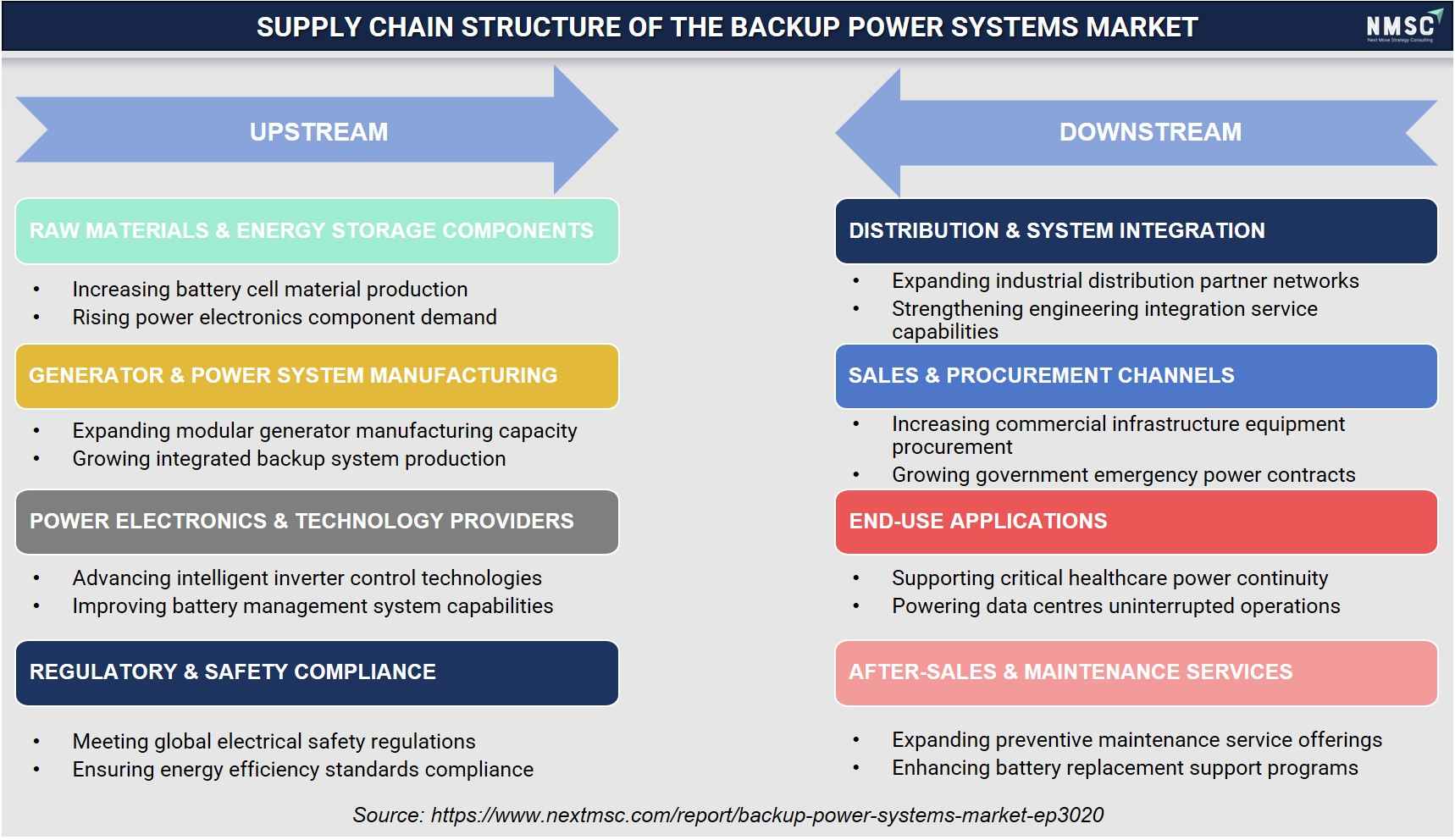
The supply chain of the Market spans upstream activities such as raw material sourcing, battery and power electronics manufacturing, generator production, and regulatory compliance, ensuring reliable and efficient system development. Downstream operations focus on distribution, system integration, procurement, deployment across critical sectors such as healthcare and data centres, and comprehensive after-sales maintenance services. Continuous innovation, expanding manufacturing capacity, and stronger service networks are strengthening supply chain resilience and supporting growing global demand for dependable backup power solutions.
Growth Drivers and Restraints
Growth Catalyst and Risk Assessment Matrix
|
Factors |
Type |
(+/-) % Impact on CAGR |
Geographic Relevance |
Impact Timeline |
|
Surging AI and hyperscale data center power demand |
Driver |
+1.9% |
North America, Asia-Pacific |
2026–2035 |
|
Grid capacity constraints driving behind-the-meter generation |
Driver |
+1.4% |
North America, Europe |
2026–2032 |
|
Lithium-ion battery cost declines improving BESS economics |
Driver |
+1.1% |
Global |
2026–2035 |
|
Rising demand for microgrid and off-grid resilience systems |
Driver |
+0.8% |
Asia-Pacific, Middle East & Africa |
2026–2035 |
|
Expansion of critical infrastructure and healthcare backup mandates |
Driver |
+0.6% |
Global |
2026–2032 |
|
Growth of natural gas prime power for constrained sites |
Driver |
+0.5% |
North America |
2026–2030 |
|
Extended generator and switchgear lead times constraining supply |
Restraint |
-0.7% |
Global |
2026–2028 |
|
High upfront capital cost of industrial-scale battery systems |
Restraint |
-0.4% |
Latin America, Middle East & Africa |
2026–2030 |
|
Emissions regulations restricting diesel generator deployment |
Restraint |
-0.3% |
North America, Europe |
2026–2032 |
What Is the Primary Growth Driver of the Backup Power Systems Market?
Surging AI and hyperscale data center power demand is the primary driver of the market. Caterpillar disclosed a record backlog of USD 51 billion in its Power and Energy segment following its 2 GW natural gas generator and battery system order for the Monarch Compute Campus, while Generac secured a global supply agreement with a major hyperscale data center operator in June 2026. We observed that this order momentum, combined with the Data Centers & Colocation segment's 11.1% CAGR, continues to anchor equipment investment across the industry.
How Is Grid Capacity Constraint Driving Backup Power Systems Market Growth?
Grid capacity constraints are accelerating demand for behind-the-meter generation as data center interconnection queues lengthen across major markets. Cummins Chief Executive Officer Jennifer Rumsey noted continued strong demand for data center backup power during the company's first-quarter 2026 earnings report, which cited record performance in its Power Systems segment with North American revenue increasing 19%. Our assessment indicates that this grid-constraint-driven demand, combined with generator lead times stretching beyond two years for large-megawatt systems, is compressing procurement timelines for data center operators.
What Is Restraining Backup Power Systems Market Expansion?
Extended generator and switchgear lead times restrain the pace at which data center operators and other large-scale buyers can secure equipment. Industry reporting on the sector noted that lead times from major generator manufacturers have stretched to as much as 107 weeks for large-megawatt systems, prompting some buyers to seek alternative engine suppliers. We found that this supply constraint, alongside the high upfront capital cost of industrial-scale battery systems, particularly affects smaller commercial buyers competing with hyperscale operators for limited manufacturing capacity.
Segmentation Analysis
Segment Sizing: By Core Technology
|
Segment |
2025 (USD) |
2035 (USD) |
CAGR% (2026–2035) |
|
Generators (Engine-Driven) |
USD 15.532 Billion |
USD 24.415 Billion |
4.6% |
|
Uninterruptible Power Supplies (UPS) |
USD 10.590 Billion |
USD 16.705 Billion |
4.7% |
|
Battery Energy Storage Systems (BESS) |
USD 6.001 Billion |
USD 17.348 Billion |
11.2% |
|
Fuel Cell Systems |
USD 1.765 Billion |
USD 3.855 Billion |
8.1% |
|
Other Static Conversion |
USD 1.412 Billion |
USD 1.927 Billion |
3.2% |
|
Total |
USD 35.30 Billion |
USD 64.25 Billion |
6.17% |
Which Core Technology Dominates the Backup Power Systems Market?
Generators (Engine-Driven) led the market with USD 15.532 billion in 2025, reflecting their established position as the default choice for standby and prime power across commercial, industrial, and data center applications. We observed that Battery Energy Storage Systems is the fastest-growing core technology, expanding at an 11.2% CAGR from 2026 to 2035, as lithium-ion cost declines and grid services applications such as peak shaving and frequency regulation expand the addressable use cases for battery-based backup power.
Segment Sizing: By End-User Vertical
|
Segment |
2025 (USD) |
2035 (USD) |
CAGR% (2026–2035) |
|
Residential |
USD 4.589 Billion |
USD 6.425 Billion |
3.4% |
|
Commercial (Office, Retail, Hospitality) |
USD 5.648 Billion |
USD 8.995 Billion |
4.8% |
|
Data Centers & Colocation |
USD 6.707 Billion |
USD 19.275 Billion |
11.1% |
|
Telecommunications |
USD 3.530 Billion |
USD 5.782 Billion |
5.1% |
|
Healthcare |
USD 3.883 Billion |
USD 7.067 Billion |
6.2% |
|
Industrial & Manufacturing |
USD 5.648 Billion |
USD 8.995 Billion |
4.8% |
|
Oil & Gas, Mining, and Utilities |
USD 3.177 Billion |
USD 4.498 Billion |
3.5% |
|
Government, Defense, and Critical Infrastructure |
USD 2.118 Billion |
USD 3.213 Billion |
4.3% |
|
Total |
USD 35.30 Billion |
USD 64.25 Billion |
6.17% |
Which End-User Vertical Is Growing Fastest in the Backup Power Systems Market?
Data Centers & Colocation was both the leading and fastest-growing end-user vertical, valued at USD 6.707 billion in 2025 and expanding at an 11.1% CAGR from 2026 to 2035. Based on research conducted by Next Move Strategy Consulting, we found that this dual leadership reflects the vertical's unusually rapid transition from a moderate-share category into the market's largest demand driver, propelled by AI-related compute buildout and the multi-year generator and battery supply agreements signed by Caterpillar, Cummins, and Generac through 2026.
Segment Sizing: By Power Capacity
|
Segment |
2025 (USD) |
2035 (USD) |
CAGR% (2026–2035) |
|
Residential / Micro: <10 kW |
USD 5.295 Billion |
USD 6.425 Billion |
1.9% |
|
Small Commercial: 10-50 kW |
USD 4.942 Billion |
USD 7.067 Billion |
3.6% |
|
Medium Commercial: 50-500 kW |
USD 8.472 Billion |
USD 12.207 Billion |
3.7% |
|
Large Commercial / Small Industrial: 500 kW-2 MW |
USD 8.472 Billion |
USD 15.420 Billion |
6.2% |
|
Industrial / Utility: >2 MW |
USD 8.119 Billion |
USD 23.131 Billion |
11.0% |
|
Total |
USD 35.30 Billion |
USD 64.25 Billion |
6.17% |
Which Power Capacity Segment Leads Backup Power Systems Market Growth?
Medium Commercial and Large Commercial / Small Industrial tiers jointly led the market at USD 8.472 billion each in 2025, reflecting broad demand across mid-sized commercial and light industrial facilities. Our findings suggest that Industrial / Utility systems above 2 MW form the fastest-growing power capacity segment, expanding at an 11.0% CAGR from 2026 to 2035, as hyperscale data center and utility-scale industrial buyers drive demand for the largest available generator and battery configurations.
Growth Opportunities
Our analysis shows that three forward-looking opportunities stand out for stakeholders positioning within the market over the 2026–2035 forecast period.
How Can Multi-Year Supply Agreements Unlock Value for Generator Manufacturers?
Long-term, infrastructure-scale supply agreements with hyperscale data center operators present a whitespace opportunity for manufacturers with sufficient production capacity. Vendors that secure multi-year natural gas and diesel generator commitments, following Caterpillar's and Cummins' 2026 hyperscale agreements, stand to capture recurring revenue as data center operators lock in equipment access years ahead of facility completion amid persistent supply constraints.
Where Does Behind-the-Meter Microgrid Deployment Create New Demand?
Behind-the-meter microgrid systems represent an underpenetrated opportunity as grid interconnection delays push data center and industrial operators toward self-generation. Vendors that deliver integrated natural gas generator and battery microgrid solutions, similar to Cummins' Circe Energy deployment, can secure long-term operating relationships with buyers seeking to bypass grid capacity constraints, an approach closely tied to the broader Energy Storage Infrastructure category's growth.
How Can Lithium-Ion Retrofit Programs Benefit UPS Manufacturers?
Lithium-ion battery retrofit and replacement programs for legacy lead-acid UPS installations create an opportunity for manufacturers offering modular upgrade paths. Early movers that deliver drop-in lithium-ion replacements compatible with existing UPS infrastructure can differentiate with commercial and healthcare buyers seeking reduced maintenance and extended service life without full system replacement, benefiting from the Battery Energy Storage Systems category's 11.2% CAGR through 2035.
Pestel Analysis of the Backup Power Systems Market
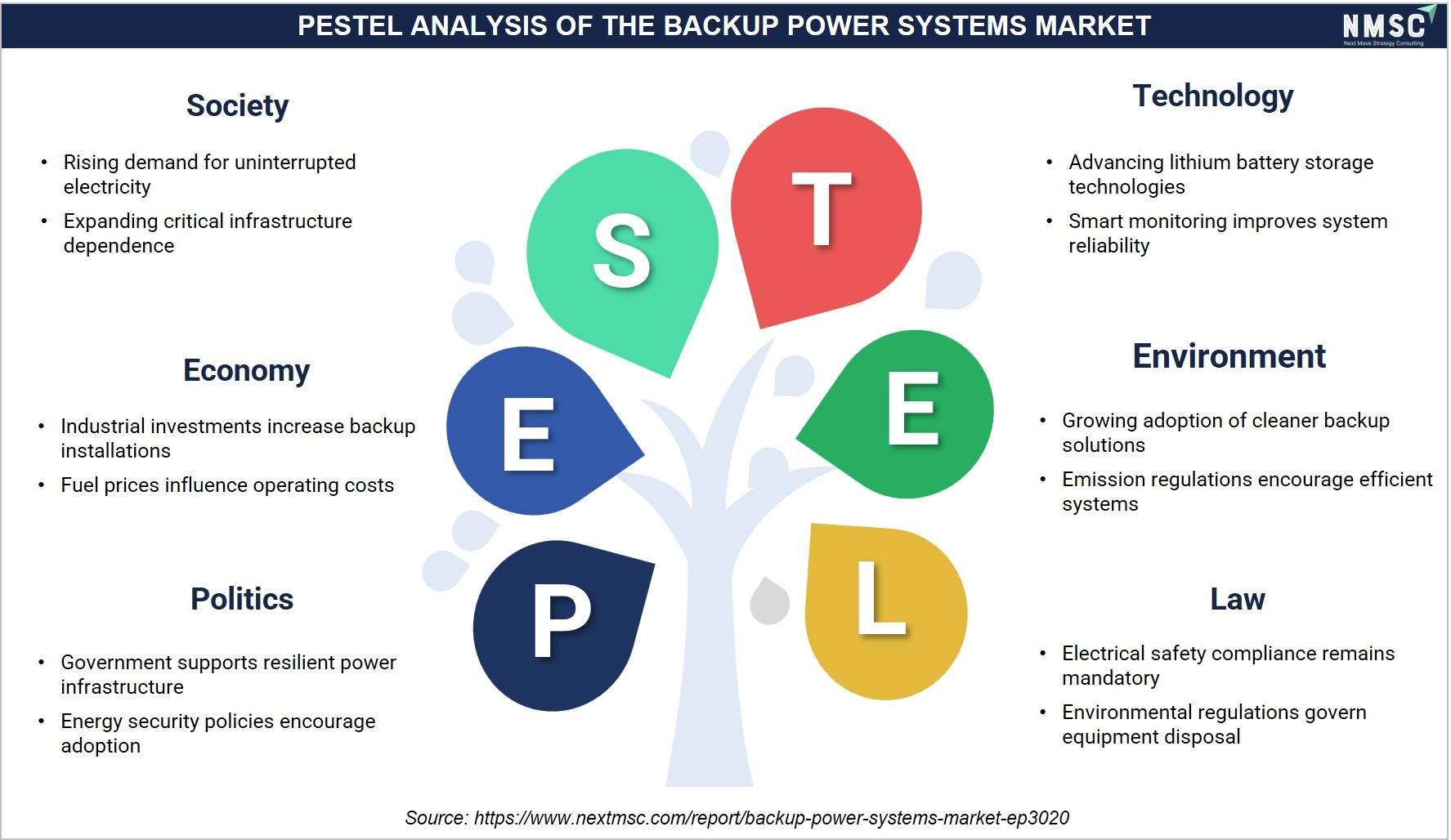
The PESTEL analysis of the Market highlights the external factors influencing industry growth. Political policies and economic investments support infrastructure expansion, while rising demand for uninterrupted power drives market adoption across society. Technological advancements in batteries, fuel cells, and intelligent power management accelerate innovation. Environmental regulations encourage cleaner backup solutions, and evolving legal standards ensure compliance with safety, emissions, and energy efficiency requirements, shaping long-term market development.
Regional Outlook
Geographic Performance Snapshot
|
Region |
2025 (USD) |
2035 (USD) |
CAGR% (2026–2035) |
Key Driver |
|
North America |
USD 12.708 Billion |
USD 21.845 Billion |
5.6% |
Hyperscale data center buildout and record generator manufacturer backlogs |
|
Europe |
USD 7.766 Billion |
USD 12.207 Billion |
4.6% |
Grid resilience investment and emissions-driven technology transition |
|
Asia-Pacific |
USD 10.237 Billion |
USD 21.845 Billion |
7.9% |
Expanding data center construction and industrial power demand growth |
|
Middle East & Africa |
USD 2.824 Billion |
USD 5.140 Billion |
6.2% |
National infrastructure programs and expanding critical facility backup needs |
|
Latin America |
USD 1.765 Billion |
USD 3.213 Billion |
6.2% |
Growing industrial and commercial facility investment |
|
Total |
USD 35.30 Billion |
USD 64.25 Billion |
6.17% |
-- |
North America Backup Power Systems Market Outlook
North America leads the market with the largest concentration of hyperscale data center construction and generator manufacturer backlogs globally. We observed that Caterpillar's record USD 51 billion Power and Energy segment backlog and Cummins' 19% North American revenue growth in its Power Systems segment both reflect sustained regional demand. Technology adoption remains concentrated among data center and industrial buyers, while strategic outlook favors vendors that can demonstrate multi-year manufacturing capacity to increasingly supply-constrained buyers.
Europe Backup Power Systems Market Outlook
Europe's market benefits from strong grid resilience investment and an emissions-driven technology transition toward natural gas and battery-based systems. Our assessment indicates that Rolls-Royce's February 2025 launch of upgraded MTU Series 1600 diesel generators, compatible with HVO fuel for up to 90% CO2 reduction, reflects the region's regulatory emphasis on lower-emissions backup power. Strategic outlook favors vendors offering flexible-fuel and hybrid engine-battery configurations for European commercial and industrial buyers.
Asia-Pacific Backup Power Systems Market Outlook
Asia-Pacific is the fastest-growing region in the market, propelled by expanding data center construction and industrial power demand growth across China, India, and South Korea. We found that Cummins is supplying generator sets and digital master control systems for a major data center in South Korea for technology company Naver, reflecting the region's accelerating hyperscale buildout. Technology adoption is accelerating fastest among data center and telecommunications buyers, with strategic outlook favoring vendors that establish regional manufacturing and service capacity.
Middle East & Africa Backup Power Systems Market Outlook
The Middle East and Africa market is expanding on national infrastructure programs and growing critical facility backup requirements across the Gulf states and broader Africa. Our findings suggest that government-led digital and industrial infrastructure investment is creating sustained demand for both generator and battery-based backup capacity among data center and government buyers. Regulatory influence remains developing, with strategic outlook favoring vendors partnering with regional distributors to support large-scale critical infrastructure deployments.
Latin America Backup Power Systems Market Outlook
Latin America's market is growing alongside expanding industrial and commercial facility investment across Brazil and Argentina. We observed that rising manufacturing and commercial construction activity is driving demand for mid-capacity generator and UPS systems among regional buyers. Technology adoption remains concentrated in engine-driven generators given limited in-region battery manufacturing capacity, with strategic outlook favoring vendors offering flexible financing suited to the region's mid-market industrial and commercial buyers.
United States Backup Power Systems Market Outlook
Based on our estimates, the United States market was valued at approximately USD 10.29 billion in 2025 and is projected to reach USD 17.69 billion by 2035, expanding at a 5.6% CAGR. Demand structure is concentrated among hyperscale data center and industrial buyers securing multi-year generator and battery supply agreements. Competitive intensity is elevated, with the U.S. hosting a majority of the market's leading generator and UPS manufacturers, including Caterpillar, Cummins, Generac, and Vertiv.
Canada Backup Power Systems Market Outlook
The market in Canada was valued at approximately USD 1.62 billion in 2025 and is projected to reach USD 2.78 billion by 2035, expanding at a 5.6% CAGR. Demand structure mirrors the broader North American pattern, with adoption concentrated among industrial and telecommunications buyers. Regulatory influence remains closely aligned with U.S. frameworks, and strategic outlook favors vendors extending U.S. distribution relationships into Canadian data center and industrial capacity expansion.
United Kingdom Backup Power Systems Market Outlook
As per our estimate, the United Kingdom market was valued at approximately USD 2.10 billion in 2025 and is projected to reach USD 3.30 billion by 2035, expanding at a 4.7% CAGR. Demand structure is led by data center and commercial buyers with mature backup power procurement processes. Technology penetration remains strong given London's role as a major European data center hub, and strategic outlook favors vendors with established local service and emissions compliance support.
Germany Backup Power Systems Market Outlook
According to our analysis, the German market was valued at approximately USD 1.71 billion in 2025 and is projected to reach USD 2.69 billion by 2035, expanding at a 4.7% CAGR. Demand structure is concentrated among industrial and manufacturing buyers pursuing hybrid engine-battery backup configurations. Regulatory influence from German and EU emissions requirements shapes vendor selection, and strategic outlook favors platforms supporting HVO-compatible and lower-emissions generator technology.
France Backup Power Systems Market Outlook
Based on our estimates, the French backup power systems market was valued at approximately USD 1.16 billion in 2025 and is projected to reach USD 1.83 billion by 2035, expanding at a 4.7% CAGR. Demand structure spans healthcare and government buyers navigating national critical infrastructure resilience requirements. Technology adoption is growing steadily among commercial buyers, and strategic outlook favors vendors partnering with regional distributors including Socomec for UPS and power conditioning deployments.
China Backup Power Systems Market Outlook
The market in China was valued at approximately USD 2.87 billion in 2025 and is projected to reach USD 6.11 billion by 2035, expanding at a 7.9% CAGR. Demand structure is dominated by data center and industrial buyers operating at hyperscale, supported by strong domestic generator and UPS manufacturing capacity. Competitive intensity features intense domestic competition alongside multinational players, and strategic outlook favors vendors capable of navigating China's distinct industrial policy and grid interconnection environment.
India Backup Power Systems Market Outlook
As per our estimate, the Indian backup power systems market was valued at approximately USD 1.74 billion in 2025 and is projected to reach USD 4.58 billion by 2035, the fastest-growing country in this report at a 10.6% CAGR. Demand structure is led by data center, telecommunications, and industrial buyers as India's digital infrastructure build-out accelerates. Technology adoption is accelerating rapidly as domestic manufacturers including Kirloskar Oil Engines expand generator production capacity to meet rising demand.
Japan Backup Power Systems Market Outlook
According to our analysis, the Japanese backup power systems market was valued at approximately USD 1.64 billion in 2025 and is projected to reach USD 3.07 billion by 2035, expanding at a 6.6% CAGR. Demand structure is concentrated among data center and industrial buyers with established disaster resilience requirements given Japan's exposure to natural disasters. Regulatory influence remains well-established, and strategic outlook favors vendors offering disaster-resilient, multi-technology backup power configurations.
South Korea Backup Power Systems Market Outlook
Based on our estimates, the South Korean backup power systems market was valued at approximately USD 1.13 billion in 2025 and is projected to reach USD 2.49 billion by 2035, expanding at a 8.4% CAGR. Demand structure is led by data center buyers, exemplified by Cummins' generator set and digital master control system supply for Naver's data center campus. Competitive intensity is rising as domestic and international vendors expand presence, and strategic outlook favors platforms supporting large-scale hyperscale deployments.
Australia Backup Power Systems Market Outlook
The market in Australia was valued at approximately USD 0.92 billion in 2025 and is projected to reach USD 1.75 billion by 2035, expanding at a 6.9% CAGR. Demand structure spans mining, utilities, and data center buyers with extensive remote and regional backup power needs. Technology penetration is high relative to other Asia-Pacific markets, and strategic outlook favors vendors with established local distribution and remote industrial site service capability.
UAE Backup Power Systems Market Outlook
As per our estimate, the UAE backup power systems market was valued at approximately USD 0.85 billion in 2025 and is projected to reach USD 1.54 billion by 2035, expanding at a 6.1% CAGR. Demand structure is concentrated among government and data center buyers driving national digital infrastructure initiatives. Competitive intensity is rising as global vendors establish regional distribution partnerships, and strategic outlook favors platforms supporting Arabic-language interfaces and regional compliance requirements.
Saudi Arabia Backup Power Systems Market Outlook
According to our analysis, the Saudi Arabian backup power systems market was valued at approximately USD 0.73 billion in 2025 and is projected to reach USD 1.39 billion by 2035, expanding at a 6.7% CAGR. Demand structure is driven by Vision 2030-linked infrastructure programs across government, oil and gas, and utility sectors. Technology adoption is accelerating as national digital infrastructure expands, and strategic outlook favors vendors partnering with domestic distributors for large-scale government deployments.
South Africa Backup Power Systems Market Outlook
Based on our estimates, the South African backup power systems market was valued at approximately USD 0.37 billion in 2025 and is projected to reach USD 0.67 billion by 2035, expanding at a 6.1% CAGR. Demand structure is led by commercial and industrial buyers responding to persistent grid reliability challenges. Regulatory influence remains developing, and strategic outlook favors vendors extending European distribution relationships to support South African commercial and industrial buyers.
Brazil Backup Power Systems Market Outlook
The market in Brazil was valued at approximately USD 0.85 billion in 2025 and is projected to reach USD 1.54 billion by 2035, expanding at a 6.1% CAGR. Demand structure is concentrated among industrial and commercial buyers scaling manufacturing and data center capacity. Technology penetration continues to rise as domestic infrastructure investment expands, and strategic outlook favors vendors offering Portuguese-language support and flexible equipment financing.
Argentina Backup Power Systems Market Outlook
As per our estimate, the Argentine backup power systems market was valued at approximately USD 0.35 billion in 2025 and is projected to reach USD 0.62 billion by 2035, expanding at a 5.9% CAGR. Demand structure spans industrial and commercial enterprises adopting backup power capacity amid a gradually recovering industrial base. Competitive intensity remains modest relative to Brazil, and strategic outlook favors vendors entering through regional distributor partnerships and multi-country Latin American sales motions.
Competitive Landscape
We observed that the backup power systems market features a moderately consolidated competitive landscape, with diversified engine and power equipment manufacturers competing on manufacturing scale, technology breadth, and hyperscale supply capacity.
|
Dimension |
Description |
|
Market Structure |
Moderately consolidated; the top companies profiled in this report collectively account for a significant share of global backup power systems revenue, while numerous regional generator and UPS specialists serve country-specific commercial and industrial demand. |
|
Innovation Focus |
Lithium-ion battery integration, natural gas prime power systems, and higher-voltage DC power architectures dominate current innovation pipelines across leading vendors. |
|
M&A Activity |
Active capacity expansion and strategic partnership activity, exemplified by Generac's acquisition of Enercon and partnership with EPC Power, alongside Caterpillar's alliance with American Intelligence & Power Corporation and Boyd CAT. |
How Do Companies Compete in the Backup Power Systems Market?
Companies compete primarily on manufacturing capacity, technology breadth, and hyperscale supply agreement scale across the industry. Diversified manufacturers including Caterpillar, Cummins, and Generac leverage large-scale production capacity and multi-year financing capability to serve hyperscale data center operators, while power protection specialists such as Vertiv, Eaton, and Schneider Electric compete on UPS and battery integration depth for mission-critical facility applications.
Which Competitive Archetypes Dominate the Backup Power Systems Market?
Two archetypes dominate the market: large-scale engine and generator manufacturers offering multi-year hyperscale supply capacity, and power protection specialists focused on UPS, battery, and power conditioning technology. Caterpillar, Cummins, and Generac exemplify the generator manufacturing archetype through record order backlogs and expanding production capacity, while Vertiv, Eaton, and ABB exemplify the power protection archetype serving data center and critical facility UPS deployments.
How Are Companies Differentiating Through Innovation in Backup Power Systems?
Innovation and differentiation strategy increasingly center on lithium-ion integration and higher-density power architectures. Eaton's July 2025 93PM G2 series launch and Vertiv's collaboration with NVIDIA on 800VDC architectures both illustrate this shift toward next-generation power protection design. Our analysis shows that vendors unable to demonstrate credible multi-year manufacturing capacity and advanced battery integration risk losing hyperscale contracts as data center operators increasingly favor suppliers capable of infrastructure-scale commitments.
What M&A and Expansion Activity Is Shaping the Backup Power Systems Market?
Strategic partnerships and capacity expansion continue to reshape the industry more than large-scale consolidation. Generac's acquisition of Enercon, a specialist in generator enclosures and switchgear, and its partnership with EPC Power to develop integrated data center energy solutions both extend the company's mission-critical power capabilities. Our findings suggest that this expansion activity reflects growing customer demand for vendors offering complete, integrated power resilience systems rather than standalone generator or battery components.
Key Market Players
Our assessment indicates that the following 15 companies are actively shaping product innovation, manufacturing capacity, and hyperscale supply strategy within the global backup power systems market.
-
Caterpillar Inc.
-
Cummins Inc.
-
Generac Power Systems, Inc.
-
Kohler Co. (Power Systems Division)
-
Schneider Electric SE
-
Eaton Corporation plc
-
Wartsila Corporation
-
Mitsubishi Heavy Industries, Ltd.
-
ABB Ltd.
-
Vertiv Holdings Co.
-
Doosan Enerbility Co., Ltd.
-
Socomec Group
-
Himoinsa S.L. (Yanmar)
Latest Developments
We found that recent contract awards and product launches within the backup power systems market are concentrated on hyperscale data center supply and battery integration, reflecting the industry's broader response to AI-driven power demand.
|
Date |
Event |
|
June 2026 |
Cummins announced an agreement with Circe Energy to supply natural gas generator sets for a scalable, behind-the-meter microgrid solution at a high-performance computing data center in West Texas. |
Investment Opportunities
What Capital Inflows Are Targeting the Backup Power Systems Market?
Capital inflows into the backup power systems market are increasingly directed toward manufacturing capacity expansion and hyperscale supply agreements. Caterpillar's record USD 51 billion Power and Energy segment backlog and Generac's expanding manufacturing capacity across its Wisconsin facilities and international operations illustrate the scale of capital committed to meeting data center demand. We observed that investors favor manufacturers demonstrating durable order backlogs, consistent with Cummins' record first-quarter 2026 Power Systems performance.
How Is Infrastructure Investment Supporting Backup Power Systems Market Scaling?
Infrastructure investment is expanding both generator manufacturing capacity and battery production capability to support growing data center and grid resilience demand. Generac's acquisition of Enercon and partnership with EPC Power extend the company's integrated energy solution capability, while broader industry investment continues to scale Battery Energy Storage System production to meet rising demand for hybrid engine-battery backup configurations across data center and industrial applications.
What ESG Considerations Are Shaping Backup Power Systems Investment Decisions?
Environmental, social, and governance considerations are gaining relevance across the industry as emissions regulations and fuel flexibility become differentiating criteria for backup power buyers. We found that Rolls-Royce's HVO-compatible MTU Series 1600 generators, offering up to 90% CO2 reduction compared with conventional diesel, reflect growing manufacturer investment in lower-emissions fuel compatibility. This shift positions fuel flexibility and battery integration as both an emissions compliance tool and a competitive differentiator aligned with buyers' broader ESG disclosure commitments.
Key Benefits for Stakeholders
How Does This Report Benefit Enterprise and Industry Leaders?
Enterprise and industry leaders gain access to validated segmentation, competitive benchmarking, and regional demand forecasts that support capital equipment procurement decisions across the backup power systems industry. Our analysis shows that detailed core technology, power capacity, and end-user vertical breakdowns help facility and operations leaders align equipment selection with resilience requirements while identifying underserved technology categories, such as battery energy storage systems, for near-term investment.
How Does This Report Benefit Investors and Financial Analysts?
Investors and financial analysts benefit from consistent, single-point market size and CAGR estimates that support valuation and capital-allocation decisions across the backup power systems market's manufacturer landscape. We observed that the report's regional and segment-level growth differentials help identify which technology categories, including battery energy storage systems and data center-focused generator capacity, are best positioned to capture above-market growth through 2035.
How Does This Report Benefit Technology Vendors and Product Teams?
Technology vendors and product teams gain insight into emerging buyer requirements, including lithium-ion battery integration, natural gas prime power capability, and higher-voltage DC architectures, that are reshaping the industry. Our findings suggest that this analysis helps product teams prioritize development roadmaps around hyperscale data center and industrial-scale capability that are increasingly decisive in large-volume procurement processes.
Key Market Segments
By Core Technology
-
Generators (Engine-Driven)
-
Diesel (Stationary, Portable)
-
Natural Gas (NG, Biogas)
-
Gasoline/Propane
-
Hybrid (Engine + Battery)
-
-
Uninterruptible Power Supplies (UPS)
-
Online / Double-Conversion
-
Line-Interactive
-
Offline / Standby
-
Modular / Scalable
-
-
Battery Energy Storage Systems (BESS)
-
Lithium-Ion
-
Lead-Acid
-
Flow Batteries
-
Other Chemistries (NaS, NiCd, etc.)
-
-
Fuel Cell Systems
-
Hydrogen Fuel Cells (PEM, SOFC)
-
Reformer-Based Fuel Cells
-
-
Other Static Conversion
By Power Capacity
-
Residential / Micro: <10 kW
-
Small Commercial: 10-50 kW
-
Medium Commercial: 50-500 kW
-
Large Commercial / Small Industrial: 500 kW-2 MW
-
Industrial / Utility: >2 MW
By Application
-
Standby / Emergency Backup
-
Prime / Continuous Power
-
Peak Shaving / Grid Services
-
Microgrid / Off-Grid Systems
-
Power Conditioning / Ride-Through
By End-User Vertical
-
Residential
-
Commercial (Office, Retail, Hospitality)
-
Data Centers & Colocation
-
Telecommunications
-
Healthcare
-
Industrial & Manufacturing
-
Oil & Gas, Mining, and Utilities
-
Government, Defense, and Critical Infrastructure
By Region
-
North America (U.S., Canada, Mexico)
-
Europe (UK, Germany, France, Italy, Spain, Sweden, Denmark, Finland, Netherlands, Rest of Europe)
-
Asia-Pacific (China, India, Japan, South Korea, Taiwan, Indonesia, Vietnam, Australia, Philippines, Malaysia, Rest of APAC)
-
Middle East & Africa (Saudi Arabia, UAE, Egypt, Israel, Turkey, Nigeria, South Africa, Rest of MEA)
-
Latin America (Brazil, Argentina, Chile, Colombia, Rest of LATAM)
Conclusion & Recommendations
What Is the Long-Term Outlook for the Backup Power Systems Market?
The long-term outlook for the backup power systems market is positive, with the industry forecast to expand from USD 37.45 billion in 2026 to USD 64.25 billion by 2035. Our assessment indicates that this growth will be driven by sustained AI and hyperscale data center demand alongside accelerating battery energy storage adoption. Vendors that scale multi-year manufacturing capacity are best positioned to capture the market's long-term trajectory.
What Strategic Positioning Should Vendors Pursue?
Vendors should pursue strategic positioning around integrated, multi-technology power resilience rather than single-technology equipment sales alone. Next Move Strategy Consulting's analysis indicates that manufacturers combining generator, battery, and power conditioning capability, following Generac's Enercon acquisition and EPC Power partnership model, will differentiate most clearly as hyperscale buyers consolidate vendor relationships. Strategic capacity investment and long-term supply agreements will further strengthen manufacturers' competitive positioning.
How Attractive Is the Backup Power Systems Market for New Investment?
The backup power systems industry presents an attractive investment case, supported by a USD 26.80 billion absolute dollar opportunity between 2026 and 2035 and above-average growth in Asia-Pacific and Data Centers & Colocation categories. We found that investment attractiveness is highest for vendors combining hyperscale generator supply capability with battery energy storage integration, positioning them to serve both established industrial buyers and fast-growing data center operators simultaneously.
What Market Shifts and Key Risks Should Stakeholders Monitor?
Stakeholders should monitor extended generator and switchgear lead times, high upfront battery system costs, and tightening emissions regulations as key risks to the backup power systems market. Our analysis shows that vendors unable to expand manufacturing capacity risk losing hyperscale contracts to competitors with shorter lead times, particularly as buyers increasingly seek alternative engine suppliers to bypass constrained major-manufacturer backlogs.
What Are the Key Growth Pathways for the Backup Power Systems Market?
Key growth pathways include expanding hyperscale data center generator and battery supply capacity, scaling lithium-ion integration across UPS and BESS categories, and deepening natural gas prime power capability for grid-constrained sites. Next Move Strategy Consulting's analysis indicates that vendors pursuing these pathways while maintaining service reliability in core residential and commercial categories will be best positioned to capture the backup power systems market's projected growth through 2035.


About the Author
 Liza Phukan
— Sikha Haritwal is a researcher with more than 5 years of experience. She has been keeping a close eye on several industry verticals, including construction & manufacturing, personal care products, and consumer electronics. She has avid interest in writing news articles and hopes to use blog as a platform to share her knowledge with others.
Liza Phukan
— Sikha Haritwal is a researcher with more than 5 years of experience. She has been keeping a close eye on several industry verticals, including construction & manufacturing, personal care products, and consumer electronics. She has avid interest in writing news articles and hopes to use blog as a platform to share her knowledge with others.
About the Reviewer
 Supradip Baul
— Supradip Baul is an accomplished business consultant and strategist with over a decade of rich experience in market intelligence, strategy, technology and business transformation. His work has included rigorous qualitative and quantitative analysis across multiple industries, helping clients shape investment decisions and long-term roadmaps. Earlier in his career, he was associated with Gartner, where he contributed to industry-leading reports and market share analyses. He has worked with leading global companies and holds an MBA with a dual specialization in Marketing and Finance.
Supradip Baul
— Supradip Baul is an accomplished business consultant and strategist with over a decade of rich experience in market intelligence, strategy, technology and business transformation. His work has included rigorous qualitative and quantitative analysis across multiple industries, helping clients shape investment decisions and long-term roadmaps. Earlier in his career, he was associated with Gartner, where he contributed to industry-leading reports and market share analyses. He has worked with leading global companies and holds an MBA with a dual specialization in Marketing and Finance.
At Next Move Strategy Consulting, we understand that insightful market research is the cornerstone of successful business decisions. That's why we employ a robust and multifaceted approach, combining various methodologies to deliver the most accurate and actionable data for our clients.

Research Landscape
We navigate the world of research with two primary approaches:
Qualitative Approach
Our qualitative research methodologies involve immersive techniques such as in-depth interviews, focus groups, and observational studies. By engaging directly with individuals and stakeholders, we uncover valuable insights that quantitative data alone may overlook.

Quantitative Research
In tandem with qualitative methodologies, NMSC leverages the power of Quantitative Research to provide a robust foundation of numerical insights. Through systematic data collection and analysis, we quantify patterns, preferences, and market trends, offering a comprehensive view of the business landscape.
Our quantitative research approach employs diverse tools, including surveys, experiments, and statistical modelling. These methodologies enable us to gather data from a large and representative sample, ensuring the statistical significance of our findings. By employing structured questionnaires and standardized data collection methods, we guarantee the reliability and validity of the information we present to our clients.
Quantitative research is particularly effective in measuring the prevalence of trends, assessing market size, and gauging the impact of various factors on consumer behavior. The numerical precision attained through this approach equips our clients with actionable insights, facilitating data-driven decision-making and strategy formulation.


Our Specialized Toolbox for Industry-Specific Market Research
We deploy a specialized arsenal of techniques tailored to meet your unique requirements. Here's a glimpse into our comprehensive toolbox:

Information Procurement
The stage entails acquiring market data or relevant information through various sources and methodologies.


Market Research Approach
We utilize both top-down and bottom-up approaches in market research analysis to achieve a comprehensive understanding of the market dynamics, leveraging the broad perspective of industry trends and macroeconomic factors alongside detailed insights from specific segments and individual companies.

Porters Five Forces Analysis
We conduct Porter's Five Forces analysis to evaluate the competitive landscape of an industry, providing us with insights into factors that affect profitability and strategic positioning.

SWOT Analysis

Forecasting
We utilize a forecasting model to predict future consumption by considering parameters like population, economics, regulations, market competition, drivers, constraints, technology, and pricing. We also employ statistical techniques such as multilinear regression, exponential smoothing, moving average, ARIMA, and Monte Carlo simulations for accurate predictions. In econometric forecasting, we analyzed short-term and long-term event impacts, attributing values based on regulatory frameworks, economic factors, and market events.





 Speak to Our Analyst