Battery Supply Chain Traceability Market Analysis and Forecast (2026–2035)

The Battery Supply Chain Traceability Market size was USD 265.00 Million in 2025, projected to reach USD 2,480.00 Million by 2035, growing at a CAGR of 23.9% from 2026 to 2035. Key drivers include battery passport mandates, stricter raw material due diligence, and electric vehicle expansion, with Europe leading the market.

Download Free Sample PDF
Base Year (2025)
$265.0 Million
Forecast (2035)
$2,480.0 Million
CAGR (2026-2035)
23.9%
Top Region
Europe

What Is the Battery Supply Chain Traceability Market Size?

The Battery Supply Chain Traceability Market reached USD 265.00 Million in 2025 and is estimated at USD 360.00 Million in 2026. It is forecast to reach USD 2,480.00 Million by 2035, growing at a 23.9% CAGR from 2026–2035. Europe leads with about 43.9% share, and traceability and passport software holds about 57.5%.

We observed that regulatory deadlines, rather than voluntary sustainability pledges, now set the buying calendar for battery traceability platforms.

Battery Supply Chain Traceability Market Analysis and Forecast (2026–2035) Revenue Forecast

Values in USD Million

2025 $265.0 Million
2025
2026 $360.0 Million
2026
2027 $446.0 Million
2027
2028 $552.6 Million
2028
2029 $684.7 Million
2029
2030 $848.4 Million
2030
2031 $1,051.1 Million
2031
2032 $1,302.4 Million
2032
2033 $1,613.6 Million
2033
2034 $1,999.3 Million
2034
2035 $2,480.0 Million
2035

Key Takeaways

By Offering: Traceability and passport software held the largest share, expanding from USD 148.00 Million in 2025 to USD 1,560.00 Million by 2035, and it is also the fastest growing at 25.2% CAGR from 2026–2035.

By Technology: Cloud and data space platforms held the largest share, expanding from USD 139.00 Million in 2025 to USD 1,590.00 Million by 2035, and it is also the fastest growing at 26.0% CAGR from 2026–2035.

By Application: Digital battery passport and compliance held the largest share, expanding from USD 104.00 Million in 2025 to USD 1,180.00 Million by 2035; Carbon footprint and ESG reporting is the fastest growing at 26.1% CAGR from 2026–2035.

Dominant Region: Europe led with USD 118.00 Million in 2025 and is projected to reach USD 900.00 Million by 2035.

Fastest-Growing Region: Middle East & Africa is the fastest growing at 27.8% CAGR from 2026–2035, rising to USD 100.00 Million by 2035.

Dominant Country: China led with USD 40.00 Million in 2025 and is projected to reach USD 470.00 Million by 2035.

Fastest-Growing Country: India is the fastest growing at 29.2% CAGR from 2026–2035, reaching USD 100.00 Million by 2035.

The market adds roughly USD 2,120.00 Million of absolute opportunity from 2026 to 2035, a compliance led revenue pool rewarding early platform investment.

According to NMSC analysis, passport readiness is shifting buyer budgets from pilot projects to multiyear platform contracts with verified upstream data.

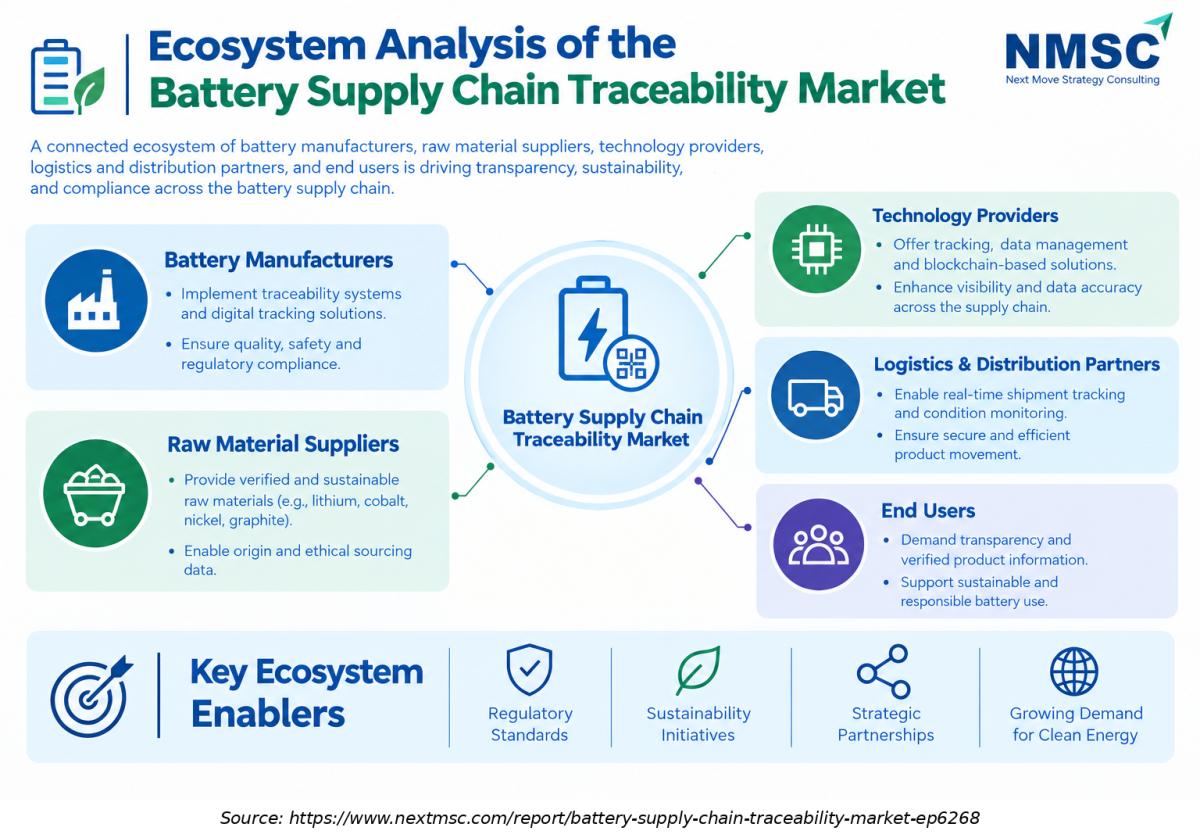
Ecosystem Analysis of the Battery Supply Chain Traceability Market

The infographic outlines the Ecosystem Analysis of the Battery Supply Chain Traceability Market, highlighting key stakeholders such as battery manufacturers, raw material suppliers, technology providers, logistics partners, and end users. It emphasizes how digital tracking technologies, sustainable sourcing, regulatory compliance, and supply chain collaboration improve transparency, product traceability, and responsible battery management

What Does the Battery Supply Chain Traceability Market Encompass?

The Battery Supply Chain Traceability Market covers software platforms, data services and verification services that record where battery materials, cells, packs and recycled content originate and how they move. Scope includes digital battery passports, chain of custody tracking for cobalt, lithium, nickel and natural graphite, carbon footprint data exchange and recycling records. The market excludes batteries, battery management hardware and general logistics software, and it counts only revenue earned from traceability functions.
Regulation shapes demand directly. Under the EU Battery Regulation, each electric vehicle battery, each light means of transport (LMT) battery, and each industrial battery with a capacity greater than 2 kWh placed on the EU market must have a battery passport from 18 February 2027. Relevant battery due-diligence obligations are scheduled to apply from 18 August 2027. China assigned a digital identity to every new energy vehicle power battery from 1 April 2026, and India's Battery Waste Management (Amendment) Rules, 2025 provide for producers, subject to notifying the Central Pollution Control Board, to use a barcode or QR code containing the EPR registration number on applicable batteries, battery packs, equipment containing batteries, or packaging. Verify the exact requirements against the applicable rule before publication.

Market Drivers & Dynamics

Interactive Dataset
EU digital battery passport mandate from 18 February 2027 driver +5.2% Europe and exporters worldwide 2026–2028
China national battery digital identity and traceability platform driver +3.8% Asia-Pacific 2026–2030
Electric vehicle and battery storage volume growth driver +3.1% Global 2026–2035
Raw material due diligence obligations from 18 August 2027 driver +2.6% Europe and North America 2027–2031
Concerns over sharing commercially sensitive data restraint −2.4% Global 2026–2030
Incomplete passport registry and implementing rules restraint −1.9% Europe 2026–2028
Low digital maturity among upstream mining suppliers restraint −1.6% Middle East & Africa, Latin America 2026–2032
Source: Next Move Strategy Consulting

Growth Drivers

What Is the Primary Growth Driver in the Battery Supply Chain Traceability Market?

The EU passport mandate is the primary growth driver because it converts traceability from a voluntary ESG tool into a condition of market access. From 18 February 2027, battery-passport requirements apply to specified battery categories placed on the EU market, including electric vehicle batteries, light means of transport batteries, and industrial batteries with a capacity greater than 2 kWh. Global electric-car sales exceeded 20 million units in 2025, providing a broader demand context for battery traceability solutions. We found that suppliers outside Europe adopt the same platforms to protect their export programs.

How Is Electric Vehicle and Storage Demand Driving Market Growth?

Electric car sales are expected to reach 23 million in 2026, close to 30% of new car sales, while battery energy storage system deployments add further volume. More batteries mean more cells, packs and material lots to document, and China produced over 80% of battery cells in 2025, which pulls Asian suppliers into passport data exchange with European buyers. Each additional production line increases demand for serial level records and automated data capture.

Growth Inhibitors

What Is Restraining the Battery Supply Chain Traceability Market?

Data confidentiality, supplier integration costs and implementation complexity may restrain adoption. The EU Digital Product Passport Registry became operational on 20 July 2026, although suppliers may still face onboarding and interoperability challenges. The extent to which these barriers delay market spending remains uncertain and should be treated as a forecast assumption.

What Are the Growth Opportunities?

How Can Compliance Ready Passport Bundles Capture Mid-Sized Producers?

Mid-sized cell, pack and energy-storage producers may lack dedicated data teams. Bundled passport software, carbon-footprint calculations and verification services can help them meet compliance requirements with fewer internal resources. Vendors that package required data fields, supplier onboarding and third-party verification into one subscription lower switching costs for buyers. Software platform providers and verification bodies can benefit from partnerships that combine digital traceability with independent verification, such as the collaboration between Bureau Veritas and Circulor.

Where Does Upstream Mineral Traceability Create New Demand?

Mining and refining operators in Africa, Latin America and Asia-Pacific must supply origin and audit evidence for cobalt, lithium, nickel and natural graphite before the August 2027 due diligence start. Platforms that connect mine level documents, smelter records and audit results to downstream passports serve miners, traders and refiners, and they benefit due diligence specialists and ledger-based vendors.

How Will Recycling and Second Life Records Open New Revenue Pools?

Retired batteries need verified health, composition and ownership records before reuse or recycling, and China expects retired power batteries to exceed 1 million tonnes by 2030. Passport platforms that hand recyclers trusted feedstock data support battery recycling operators, second life storage integrators and insurers, and they let producers prove recovered content claims.

Segmentation Analysis

2025 (USD Million)
2035 (USD Million)
Traceability and passport software 2025: $148.0 Million | 2035: $1,560.0 Million
Traceability
Due diligence and audit services 2025: $72.0 Million | 2035: $520.0 Million
Due diligenc
Integration and managed services 2025: $45.0 Million | 2035: $400.0 Million
Integration
Traceability and passport software $148.0 Million $1,560.0 Million 25.2%
Due diligence and audit services $72.0 Million $520.0 Million 21.2%
Integration and managed services $45.0 Million $400.0 Million 23.2%

Which Offering Leads and Which Grows Fastest?

Software dominates this axis and also grows quickest, moving from USD 148.00 Million in 2025 to USD 1,560.00 Million by 2035 at a 25.2% CAGR from 2026–2035. Platforms from Siemens, Circulor, Circularise, Minespider and OPTEL provide tools for battery-passport management, material provenance and supply-chain traceability. Due diligence and audit services grow more slowly at 21.2% because auditors scale with headcount rather than software volume.

2025 (USD Million)
2035 (USD Million)
Blockchain a
Cloud and da
Physical mar
Segment Item 2025 (USD Million) 2035 (USD Million) CAGR
Blockchain and distributed ledger $10.0 USD Million $40.0 USD Million 16.0%
Cloud and data space platforms $17.1 USD Million $51.1 USD Million 22.0%
Physical marking and IoT identifiers $24.2 USD Million $62.2 USD Million 16.0%

Segment-wise data is locked

Unlock complete segment-wise numbers for By Technology.

Unlock Full Data
2025 (USD Million)
2035 (USD Million)
Responsible
Digital batt
Carbon footp
Recycling an
Segment Item 2025 (USD Million) 2035 (USD Million) CAGR
Responsible sourcing and due diligence $10.0 USD Million $40.0 USD Million 18.0%
Digital battery passport and compliance $17.1 USD Million $51.1 USD Million 16.0%
Carbon footprint and ESG reporting $24.2 USD Million $62.2 USD Million 22.0%
Recycling and second life tracking $31.3 USD Million $73.3 USD Million 12.0%

Segment-wise data is locked

Unlock complete segment-wise numbers for By Application.

Unlock Full Data

Growth Opportunities

We found that three opportunity areas offer the clearest paths to incremental revenue before and after the February 2027 passport deadline.

How Can Compliance Ready Passport Bundles Capture Mid-Sized Producers?

Mid-sized cell, pack and energy-storage producers may lack dedicated data teams. Bundled passport software, carbon-footprint calculations and verification services can help them meet compliance requirements with fewer internal resources. Vendors that package required data fields, supplier onboarding and third-party verification into one subscription lower switching costs for buyers. Software platform providers and verification bodies can benefit from partnerships that combine digital traceability with independent verification, such as the collaboration between Bureau Veritas and Circulor.

Where Does Upstream Mineral Traceability Create New Demand?

Mining and refining operators in Africa, Latin America and Asia-Pacific must supply origin and audit evidence for cobalt, lithium, nickel and natural graphite before the August 2027 due diligence start. Platforms that connect mine level documents, smelter records and audit results to downstream passports serve miners, traders and refiners, and they benefit due diligence specialists and ledger-based vendors.

How Will Recycling and Second Life Records Open New Revenue Pools?

Retired batteries need verified health, composition and ownership records before reuse or recycling, and China expects retired power batteries to exceed 1 million tonnes by 2030. Passport platforms that hand recyclers trusted feedstock data support battery recycling operators, second life storage integrators and insurers, and they let producers prove recovered content claims.

Regional Outlook

2025 (USD Million)
2035 (USD Million)
North Americ
Europe
Asia-Pacific
Middle East
Latin Americ
Region 2025 (USD Million) 2035 (USD Million) CAGR (%)
North America $10.0 USD Million $40.0 USD Million 9.0%
Europe $17.1 USD Million $51.1 USD Million 27.0%
Asia-Pacific $24.2 USD Million $62.2 USD Million 25.0%
Middle East & Africa $31.3 USD Million $73.3 USD Million 23.0%
Latin America $38.4 USD Million $84.4 USD Million 12.0%

Regional data is locked

Unlock complete regional numbers for this market.

Unlock Full Data

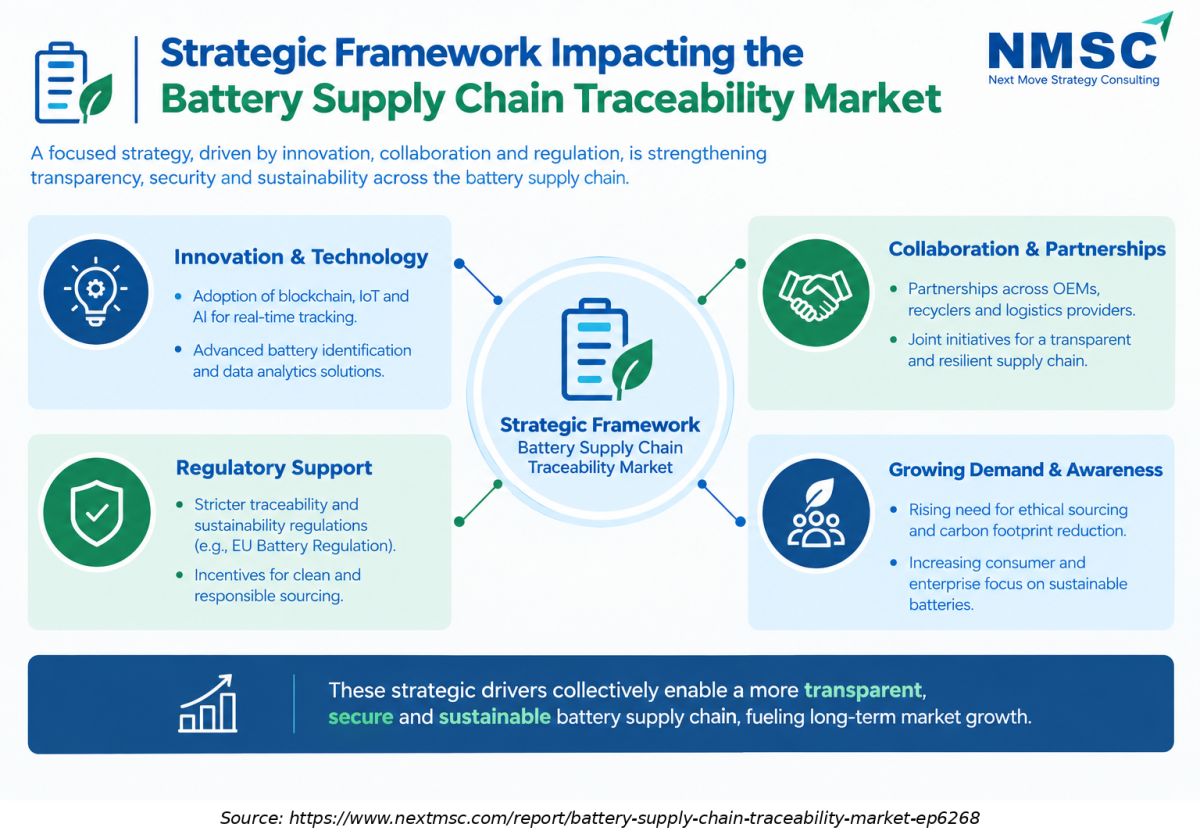
Strategic Framework Impacting the Battery Supply Chain Traceability Market

Strategic Framework Impacting the Battery Supply Chain Traceability Market
The infographic highlights the Strategic Framework Impacting the Battery Supply Chain Traceability Market, focusing on innovation and technology, regulatory support, collaboration and partnerships, and growing demand for sustainable batteries. It illustrates how blockchain, IoT, AI-driven tracking, stricter traceability requirements, and ethical sourcing initiatives strengthen supply chain transparency, improve data security, and support long-term market growth

Competitive Landscape

Our findings suggest that competition in the industry is fragmented, with industrial software groups, specialist traceability vendors and auditors serving overlapping needs.

How Do Companies Compete in the Industry?

Vendors compete on regulatory coverage, depth of upstream integration and ecosystem membership rather than on price alone. Siemens offers its Path.Era battery-passport solution, while Circulor focuses on digital supply-chain traceability and OPTEL offers battery-traceability solutions. Pricing is subscription based, and Minespider offers its open passport free of charge to build adoption. Buyers weigh the number of suppliers already onboarded.

Which Company Archetypes Dominate the Market?

Three archetypes dominate. Industrial software groups such as Siemens and Denso embed passports in broader factory and automotive ecosystems. Specialist traceability vendors, including Circulor, Circularise, Minespider and OPTEL, differentiate through chain of custody evidence and ledger technology. Due diligence specialists such as RCS Global supply audit evidence, while cell makers such as Sunwoda build platforms for their own supply chains and partners.

How Are Companies Differentiating Through Innovation?

Innovation centers on automation of data collection, verification and interoperability. Sunwoda covers 78 indicators across six modules, Siemens offers a software as a service passport, and Minespider supports AI-assisted document extraction. Vendors also pursue certification on shared data spaces, which reduces integration effort for suppliers and strengthens buyer trust in submitted records.

What M&A and Partnership Activity Is Shaping the Industry?

Partnerships currently outnumber acquisitions. Bureau Veritas and Circulor announced a collaboration in June 2026 that pairs verification with platform delivery, and Mine Hub signed a memorandum with Minespider in January 2026 to extend digital product passports into commodity trading. Path.Era links Siemens with BASF, BMW, CATL, Henkel and Volkswagen Group. We expect consolidation as passport deadlines arrive and smaller vendors seek scale in track and trace solutions.

Key Market Players

Based on research conducted by NMSC, we found that eight verified companies anchor the Battery Supply Chain Traceability Market.

Siemens Aktiengesellschaft Circulor RCS Global Group OPTEL Group Spider Labs GmbH Circularise Sunwoda Electronic Co., Ltd. Denso Corporation

Latest Developments

Our findings suggest that 2026 announcements cluster around verification partnerships and national traceability platforms.

Date Event
2025 BASF, BMW, CATL, Henkel, Siemens and Volkswagen Group announced Path.Era, a Catena-X based digital battery passport ecosystem operated through Cofinity-X.
March 2026 MineHub Technologies announced a memorandum with Spider Labs GmbH (Minespider) to deliver digital product and battery passports for commodity markets.
June 2026 Bureau Veritas and Circulor announced a collaboration on battery passport readiness, traceability audits and verification of passport data.

Expert Insights

Inga Petersen

Inga Petersen

Executive Director | Global Battery Alliance

"First, we decided we needed to bring transparency into the value chain. After all, you cannot manage what you cannot measure."

Analyst Interpretation

The statement highlights transparency as a foundation of battery supply chain traceability. Digital battery passports can connect information on lithium, cobalt, and nickel provenance with processing history and sustainability data. This supports the development of traceability platforms that help manufacturers, suppliers, and purchasers assess material origins and compare supply chain information across the battery lifecycle

Investment Opportunities

Where Are Capital Inflows Concentrating?

Capital is flowing toward platform vendors facing near term regulatory deadlines and toward ledger and data space infrastructure for upstream mineral records. European Union funded projects worth more than 32 million euros show public money supporting traceability research, and consortia such as Path.Era commits supplier resources.

How Does Infrastructure Investment Support Market Expansion?

Infrastructure spending covers national platforms, data-space operators and registry systems. China held its national battery traceability platform launch meeting on 31 March 2026. Cofinity-X lists Path.Era as a Siemens battery-passport solution based on Catena-X. The EU Digital Product Passport Registry became operational on 20 July 2026. Vendors that connect enterprise systems to these public and shared networks earn recurring integration revenue and benefit from rising supplier counts.

What ESG Considerations Influence Investment Decisions?

Passports must carry carbon footprint declarations and due diligence evidence, so ESG performance becomes a measurable product attribute. Investors can screen cobalt, lithium, nickel and natural graphite exposure against human rights and environmental risks, and audit vendors such as RCS Global have mapped mines inside automaker supply chains. Better data lowers financing risk for miners and gigafactories, but weak verification can expose backers to reputational loss.

Key Benefits for Stakeholders

How Do Battery Makers and Automakers Benefit?

Producers gain a repeatable route to meet passport and due diligence duties, with fewer manual data requests across tiers. The report segment analysis shows where software spending is concentrating, which helps procurement and supply chain management teams choose platforms that match their regional exposure. Verified records also reduce the risk of blocked shipments after the February 2027 deadline.

How Do Investors and Financial Analysts Benefit?

Investors receive a reconciled view of 2025, 2026 and 2035 revenue across offerings, technologies, applications and regions, with CAGR calculated on a consistent 2026–2035 basis. The matrix of drivers and restraints quantifies how much each regulatory event may add to or remove from growth, and the competitive archetypes help screen vendors by defensibility.

How Do Technology Vendors and Verification Bodies Benefit?

Vendors can use the estimated segment growth rates and regional outlook to identify potential priorities for product development and partnerships. NMSC's regional forecasts suggest that Europe offers an established compliance-driven market, while Asia-Pacific provides substantial projected growth opportunities.

Key Market Segments Evaluated

By Offering

  • Traceability and passport software
  • Due diligence and audit services
  • Integration and managed services

By Technology

  • Blockchain and distributed ledger
  • Cloud and data space platforms
  • Physical marking and IoT identifiers

By Application

  • Responsible sourcing and due diligence
  • Digital battery passport and compliance
  • Carbon footprint and ESG reporting
  • Recycling and second life tracking

By Region

  • North America 
    • U.S.
    • Canada
    • Mexico
  • Europe 
    • UK
    • Germany
    • France
    • Italy
    • Spain
    • Sweden
    • Denmark
    • Finland
    • Netherlands
    • Rest of Europe
  • Asia-Pacific 
    • China
    • India
    • Japan
    • South Korea
    • Taiwan
    • Indonesia
    • Vietnam
    • Australia
    • Philippines
    • Malaysia
    • Rest of APAC
  • Middle East & Africa 
    • Saudi Arabia
    • UAE
    • Egypt
    • Israel
    • Turkey
    • Nigeria
    • South Africa
    • Rest of MEA
  • Latin America 
    • Brazil
    • Argentina
    • Chile
    • Colombia
    • Rest of LATAM

Conclusion & Recommendations

The Battery Supply Chain Traceability Market should grow from USD 360.00 Million in 2026 to USD 2,480.00 Million by 2035, a 23.9% CAGR, as passport rules in Europe and China become routine operating requirements. Our analysis shows growth moderating after the 2027 deadline cluster, with demand shifting from initial implementation to recurring data volume, supplier onboarding and verification. Europe is projected to remain the largest regional market in the 2026 estimates, while Asia-Pacific is projected to become the largest regional market by 2035 and contribute the greatest absolute revenue increase.

Strategic Positioning Recommendations: What Does NMSC Advise Companies to Do?

NMSC's analysis indicates that vendors should secure certification on shared data spaces, pair platforms with independent verifiers and prioritize supplier onboarding in Asia-Pacific. Battery producers should map their upstream tiers now, because evidence gaps in cobalt, lithium, nickel and natural graphite chains take longer to close than software projects. Mid-sized firms should buy bundled offerings rather than build in-house.

Investment Attractiveness: How Attractive Is the Market for Investors?

The market offers an absolute opportunity of about USD 2,120.00 Million between 2026 and 2035 from a fragmented vendor base, which suggests room for platform leaders and consolidators. Attractiveness is highest for cloud and data space platforms and for carbon footprint reporting, which lead segment growth. Investors should weigh regulatory timing risk, because rule delays can move revenue between years without removing demand.

Market Shifts and Key Risks: What Could Change the Forecast?

Key shifts include phased passport implementation, evolving data-access requirements and the two-year postponement of battery due-diligence obligations. Confidentiality concerns could slow supplier participation, and a fragmented standards landscape could raise integration costs. A faster than expected registry rollout or wider national mandates would lift the forecast, while prolonged delays would push growth toward the end of the period.

Growth Pathways: Which Routes Drive Growth Through 2035?

Four routes carry growth through 2035: passport compliance in Europe, national identity systems in Asia-Pacific, raw material due diligence for exporters and recycling records for retired batteries. Each route monetizes a different data layer, so vendors that connect all four can cross sell across the battery life cycle and defend revenue as individual regulations mature.

Delivered Customizations

We have successfully delivered the following deep-dive customizations:

Client Request Customization Delivered Value Adds
Import-Export Trade Flow Analysis
  • Country-wise import and export analysis of battery cells, packs, critical minerals, and black mass using UN Comtrade and WITS data.
  • Identifies sourcing corridors and trade dependencies that shape where traceability systems must be deployed.
Historical Traceability Solution Market Analysis
  • Historical revenue and deployment analysis of traceability offerings (hardware, software, services) across battery applications.
  • Shows which offering categories are scaling fastest and where vendor growth has been concentrated.
Traceability Market Size Assessment

  • TAM, SAM, and VAM sizing of battery supply chain traceability by offering, technology, and application for 2026–2035.
  • Quantifies serviceable and obtainable opportunity to prioritize market entry and investment levels.
Regulatory Compliance Readiness by Application
  • Mapping of battery passport and due-diligence requirements against adoption levels across EV, energy storage, and industrial battery applications.
  • Pinpoints the applications and regions where compliance-driven demand for traceability will arrive first.
Technology Adoption Mapping Across Supply Chain Tiers
  • Assessment of blockchain, RFID/QR, IoT sensing, and AI-based traceability adoption across mining, refining, cell, pack, and recycling stages.
  • Reveals technology gaps by tier to guide product roadmaps and partnership targets.
End-of-Life Battery Recovery and Second-Life Traceability Assessment
  • Analysis of battery recycling volumes, black mass flows, and second-life deployment linked to traceability requirements by application.
  • Highlights recycling-stage traceability needs that create near-term revenue for solution providers and recyclers.

FAQs

Sources & References

1.

International Energy Agency, Global EV Outlook 2026

iea.org
2.

Government of Hunan Province, China to Strengthen Recycling Management of Used Power Batteries from NEVs

enghunan.gov.cn
3.

Ministry of Industry and Information Technology of China, battery traceability platform launch

miit.gov.cn
4.

EUROBAT, Proposed Amendments to the Environmental Omnibus, 6 July 2026

eurobat.org
5.

Tamil Nadu Pollution Control Board, Handbook on EPR Guidelines for Battery Waste Management

tnpcb.gov.in
6.

California State Assembly Committee, SB 615 analysis, June 2025

aesm.assembly.ca.gov/media/854
7.

acatech, Battery Pass project

en.acatech.de
8.

Siemens AG, Siemens joins Global Battery Alliance

news.siemens.com
9.

Siemens AG, Battery Passport

xcelerator.siemens.com
10.

Cofinity-X, Path.Era Battery Passport by Siemens AG

cofinity-x.com
11.

Catena-X, Digital Product Passport

catena-x.net
12.

Circulor, Bureau Veritas partners with Circulor

circulor.com
13.

Bureau Veritas, collaboration with Circulor

group.bureauveritas.com
14.

Circulorise, Battery passports for verifiable traceability

circularise.com/industry/batteries
15.

MineHub Technologies, Minespider memorandum announcement

newsfilecorp.com/release/286259
16.

Sunwoda, Digital Battery Passport Solution finalist release

prnewswire.com
17.

OPTEL Group, Battery traceability

optelgroup.com
18.

Volkswagen Group, transparency in procurement of battery raw materials

volkswagen-group.com
19.

RCS Global Group and Resource, battery passport pilot

re-source.tech

About the Author

Mayurima Roy

Mayurima Roy

Mayurima Roy is Research Analyst at Next Move Strategy Consulting, where she has spent 4 years working across the firm's full industry coverage rather than a single fixed vertical. Her work centers on structured research, ongoing trend tracking, competitive assessment, and insight-led content development, translating complex market data into clear, decision-ready narratives that support informed client decision-making across diverse global industries, market sectors, and world regions every day.

About the Reviewer

Supradip Baul

Supradip Baul

Supradip Baul is an accomplished business consultant and strategist with over a decade of rich experience in market intelligence, strategy, technology, and business transformation. His work has included rigorous qualitative and quantitative analysis across multiple industries, helping clients shape investment decisions and long-term roadmaps. Earlier in his career, he was associated with Gartner, where he contributed to industry-leading reports and market share analyses. He has worked with leading global companies and holds an MBA with a dual specialization in Marketing and Finance.

Download Free Sample

Kevin Coker

KEVIN COKER

Founder, CEO and Board Diector

Proxima Clinical Research

I have been using Next MSC reports for product positioning in a new geography for a long time. They have by far the best reports I have found and the price is reasonable too!

Mohit Agarwal

MOHIT AGARWAL

Chief Manager

DryChem India Pvt. Ltd.

Next Move Strategy Consulting is an amazing team of consultants. We required a market study report for our investors on top priority and the team went above and beyond our expectations to deliver the same with ample supporting data within a short time span enabling us to secure the investments and keep our project timeline maintained. Their professionalism, attention to detail, and timely delivery of actionable recommendations have left a lasting impression on our organization.

Semih Kavaklioglu

SEMIH KAVAKLIOGLU

Co-Founder & Sales Manager

Decortie

I work a lot in the marketing industry and I know that research is an essential part of any campaign. I have used Market research reports for my own products and I found them to be very informative and well-researched. The team here produces insightful reports for a good price

Ross J Mckenzie

ROSS J MCKENZIE

Business Insight Manager

Staysure Group

“Next MSC have been incredibly helpful in providing detailed & robust information on our market, alongside quantifying growth by different segments. The process to procure was simple and easy, with sample reports and regular contact to ensure we had what we needed. Succinct detail on their sources & methodologies is also greatly received, allowing transparency in this respect helps build trust in the detail you pay for. Joseph in particular was fantastic, and helped ensure efficient provision of the insight pack – thank you NMSC!”.

Amos Chang

AMOS CHANG

Strategy Consultant

Kardex Group

I have bought the intralogistics market reports from NMSC two times so far. Joseph and his team are always very helpful and flexible in responding to any customization requirements on the report. Their expertise in market reports really helps us steer the day-to-day business. I will definitely recommend and come back myself whenever there is a need.

Custom Market Research Services

We will customize the research for you if the listed report does not fully match your requirements.

Get 30% Free Customization

Select License

This website uses cookies to ensure you get the best experience on our website. Learn more

✖