Beacon Market Size, Share, Growth & Forecast by Offering (Hardware, Software, Services), Technology Protocol (iBeacon, Eddystone, AltBeacon, Proprietary), Application (Proximity Marketing, Indoor Navigation, Asset Tracking, Workforce Tracking, Customer Engagement, Location Analytics, Safety & Security), End User Industry (Retail, Healthcare, Logistics, Hospitality, Manufacturing), Deployment Environment, Organization Size, and Distribution Channel — Global Analysis & Forecast, 2026–2035.
Industry: Semiconductor & Electronics | Publishing Date: June 19, 2026 | Last Updated: June 19, 2026 | No of Pages: N/A | No. of Tables: N/A | No. of Figures: N/A | Format: PDF | Report Code: SE332
What Is the Beacon Market Size?
The global Beacon Market was valued at USD 1.8 billion in 2025 and is expected to reach USD 2.1 billion in 2026. Accelerating adoption of proximity marketing, indoor navigation, and asset tracking solutions across retail, healthcare, transportation, and smart buildings is projected to propel the market to USD 7.4 billion by 2035, advancing at a CAGR of 15.2% from 2026 to 2035. Key growth drivers include widespread Bluetooth Low Energy (BLE) hardware standardization, rapid expansion of IoT ecosystems, growing enterprise demand for real-time location intelligence, and the integration of Ultra-Wideband beacons in high-precision industrial and logistics applications.
|
Parameters |
Details |
|
Market Size in 2025 |
USD 1.8 Billion |
|
Market Size in 2026 |
USD 2.1 Billion |
|
Revenue Forecast in 2035 |
USD 7.4 Billion |
|
Growth Rate |
CAGR of 15.2% from 2026 to 2035 |
|
Analysis Period |
2025–2035 |
|
Base Year Considered |
2025 |
|
Forecast Period |
2026–2035 |
|
Market Size Estimation |
Billion USD |
|
Companies Profiled |
18 |
|
Countries Covered |
33 |
|
Market Share |
Top 10 |
Beacon Market Overview
What Is the Beacon Market?
The Beacon Market encompasses hardware devices, software platforms, and associated services that leverage short-range wireless communication technologies — primarily Bluetooth Low Energy (BLE), Ultra-Wideband (UWB), and Wi-Fi — to deliver location-aware interactions, proximity marketing, asset tracking, and indoor navigation capabilities. Beacon devices transmit signals to nearby smartphones, tablets, or IoT gateways, enabling organizations to deliver contextually relevant communications and operational intelligence. NMSC's analysis indicates that the market spans a broad ecosystem of hardware manufacturers, software developers, and managed service providers serving retail, healthcare, logistics, hospitality, and smart infrastructure verticals globally.
How Has the Beacon Market Evolved?
The Beacon Market has evolved through three distinct technological eras. The first era began in 2013 with Apple's iBeacon launch, which standardized BLE-based proximity signaling and unlocked retail and hospitality applications. The second era introduced multi-protocol support through Google's Eddystone protocol and open AltBeacon standards, enabling cross-platform deployments. Our assessment indicates that the current era is defined by the integration of Ultra-Wideband for centimeter-level precision tracking, AI-powered location analytics, and the convergence of beacon infrastructure with broader IoT and smart building management platforms, transforming beacons from simple marketing tools into enterprise-grade operational intelligence assets.
How Do Regulations Influence the Beacon Market?
Regulatory dynamics significantly shape the Beacon Market across multiple dimensions. Data privacy regulations including the EU's General Data Protection Regulation (GDPR), the California Consumer Privacy Act (CCPA), and equivalent frameworks across Asia-Pacific and Latin America impose requirements on the collection, storage, and use of location and behavioral data generated by beacon deployments. Healthcare beacon applications are subject to HIPAA in the United States and equivalent patient data protection regulations globally. From our research, we found that regulatory compliance requirements are compelling enterprises to invest in privacy-by-design beacon platforms with consent management, data minimization, and secure data handling capabilities integrated into beacon management software.
How Is Technology Adoption Expanding Across the Beacon Market?
Technology adoption across the Beacon Market is accelerating as organizations recognize location intelligence as a strategic operational asset. BLE hardware costs have declined significantly, enabling large-scale deployments across retail chains, hospitals, and logistics facilities. Ultra-Wideband adoption is expanding from consumer electronics into industrial and enterprise applications following Apple's integration of UWB chips in iPhone and AirTag product lines. Through our market assessment, we observed that cloud-based beacon management platforms, mobile SDK ecosystems, and AI-driven location analytics are lowering deployment complexity and expanding the addressable market to mid-sized enterprises and emerging-economy organizations previously constrained by integration costs.
| Key Takeaways |
|
By Offering, Hardware holds the dominant position in the Beacon Market, valued at USD 1.1 billion in 2025. Bluetooth Low Energy (BLE) Beacons are the leading hardware sub-segment due to low-cost deployment, broad smartphone compatibility, and proven use cases in retail, healthcare, and logistics. Asset Tracking Beacons represent the fastest-growing hardware sub-category, projected to advance at a CAGR of 17.8% from 2026 to 2035, driven by demand for real-time inventory and workforce visibility. |
|
By Offering, Software platforms are the fastest-growing primary offering segment in the Beacon Market at a CAGR of 18.4% from 2026 to 2035, with Beacon Management Platforms and Location Intelligence Software leading adoption as enterprises seek centralized control, analytics, and AI-driven insights from beacon deployments at scale. |
|
By Technology Protocol, iBeacon leads the Beacon Market in 2025 with the largest protocol share, supported by deep Apple ecosystem integration and broad retail adoption. Eddystone is the fastest-growing open-standard protocol, particularly among Android-first enterprise deployments in emerging markets. |
|
By Application, Proximity Marketing holds the dominant application share in the Beacon Market at an estimated USD 0.5 billion in 2025, while Asset Tracking is the fastest-growing application at a CAGR of 18.1% from 2026 to 2035, driven by supply chain digitization and warehouse automation initiatives globally. |
|
By End User Industry, Retail is the largest industry segment in the Beacon Market, representing approximately USD 0.48 billion in 2025. Transportation & Logistics is the fastest-growing industry vertical, advancing at a CAGR of 17.5% from 2026 to 2035 as airports, ports, and distribution centers implement real-time asset and personnel tracking. |
|
By Deployment Environment, Indoor deployments dominate the Beacon Market, accounting for over 68% of total revenue in 2025, driven by retail, healthcare campus, and airport deployments. Mixed Environment deployments are the fastest-growing segment as smart city and campus-wide location services gain momentum. |
|
By Organization Size, Large Enterprises hold the dominant share in the Beacon Market at approximately USD 1.2 billion in 2025, reflecting high deployment scale. Small and Medium Enterprises are the fastest-growing segment as affordable SaaS-based beacon platforms reduce entry barriers. |
|
By Distribution Channel, Direct Sales is the leading channel in the Beacon Market in 2025. System Integrators are the fastest-growing channel as organizations prefer turnkey deployment and ongoing support from specialist integrators. |
|
North America holds the largest regional share in the Beacon Market at approximately USD 0.76 billion in 2025, driven by high retail technology adoption, advanced healthcare infrastructure, and leading IoT ecosystem development. Asia-Pacific is the fastest-growing major region at a CAGR of 17.2% from 2026 to 2035, with China and India as the primary growth engines. |
|
Asia-Pacific emerged as the fastest-growing major region in the Beacon Market, driven by rapid digital transformation initiatives, expanding smart city projects, increasing retail modernization, and growing adoption of connected technologies across China and India. |
|
The United States is the single largest country market in the Beacon Market, accounting for approximately 80% of North American revenue in 2025. India is the fastest-growing national market in Asia-Pacific within the Beacon Market, advancing at a CAGR of 19.5% from 2026 to 2035, propelled by smart retail, digital healthcare, and logistics modernization investments. |
|
India is the fastest-growing national market in Asia-Pacific within the Beacon Market, propelled by smart retail expansion, digital healthcare development, logistics modernization, and increasing investments in location intelligence and mobile-based consumer engagement technologies.
|
Key Emerging Trends in the Beacon Market
How Is Ultra-Wideband Technology Redefining Precision in the Beacon Market?
Ultra-Wideband (UWB) is transforming the Beacon Market by enabling centimeter-level indoor positioning accuracy that BLE technology cannot achieve. Apple's integration of the U1 and U2 chips in iPhone 11 and later models established consumer UWB familiarity, and enterprise adoption has followed in automotive, manufacturing, and high-value asset tracking. NMSC's analysis indicates that UWB beacons are increasingly deployed in automotive plants for tooling and parts tracking, in hospitals for equipment location, and in airports for baggage and ground support equipment management, delivering positioning accuracy below 30 centimeters in complex multipath environments.
How Is AI-Powered Location Analytics Transforming Value Delivery in the Beacon Market?
From our research, we found that artificial intelligence and machine learning integration is fundamentally changing how organizations extract value from beacon deployments. Location analytics platforms now apply AI to beacon-generated dwell time, path analysis, and customer flow data to generate predictive insights, optimize store layouts, and personalize marketing offers in real time. Retailers including major department store chains are using AI-beacon analytics to increase basket size and reduce queue times. This intelligence layer is shifting beacon platforms from hardware commodities toward high-value analytics services, supporting premium pricing and improving customer lifetime value for platform vendors.
How Is the Contactless Interaction Trend Accelerating Beacon Market Adoption?
The accelerated transition to contactless interaction models initially driven by public health considerations — has created durable enterprise demand for proximity-based touchless services across the Beacon Market. Contactless check-in, wayfinding, digital menus, and frictionless payment triggers enabled by beacon infrastructure have become permanent features in hotels, restaurants, healthcare facilities, and entertainment venues. Based on our market evaluation, we noticed that Apple's Core NFC and Background App Refresh capabilities in iOS have enabled persistent proximity interactions without requiring users to open dedicated apps, significantly improving contactless beacon interaction rates and increasing deployment ROI across hospitality and retail environments.
How Is the Integration of Beacons with Digital Twin Platforms Reshaping the Beacon Market?
Our assessment indicates that the integration of beacon location data with digital twin platforms represents an emerging high-value trend in the Beacon Market. Organizations in manufacturing, smart buildings, and logistics are combining real-time beacon-derived positional data with digital twin models to create dynamic, asset-aware virtual representations of physical environments. Siemens, Honeywell, and IBM have developed smart building platforms that ingest beacon data streams alongside IoT sensor feeds to optimize energy consumption, space utilization, and occupant safety. This convergence expands beacon deployment justification beyond proximity marketing toward mission-critical operational intelligence applications.
Ecosystem Analysis of the Beacon Market
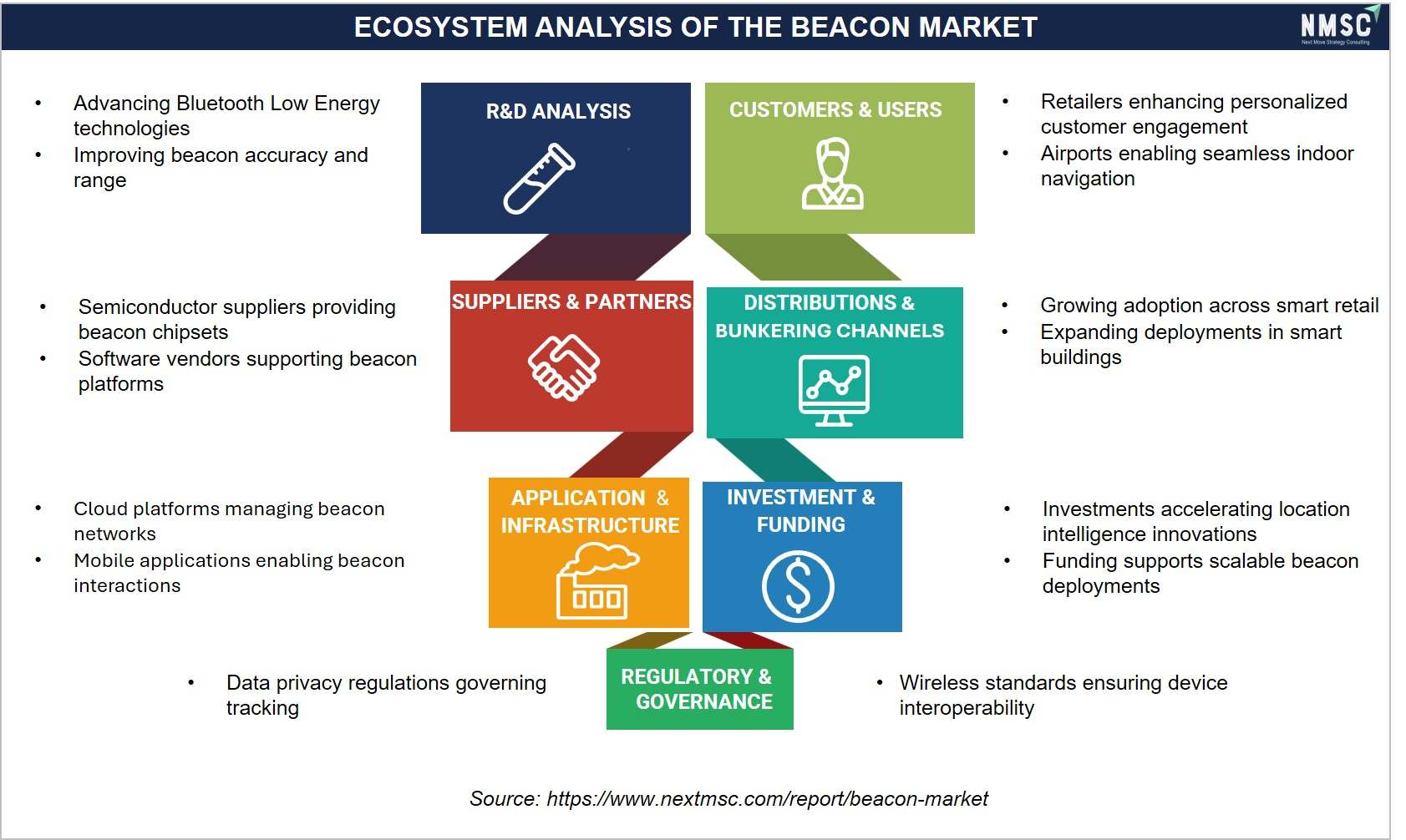
The Beacon Market ecosystem is supported by a network of stakeholders that drive innovation, commercialization, and adoption. Research and development activities focus on enhancing beacon accuracy, battery efficiency, and integration with AI and IoT platforms. Suppliers and technology partners provide hardware, software, and connectivity solutions, while distribution channels facilitate market reach. Applications span retail, healthcare, transportation, smart buildings, and industrial environments. Investment and funding accelerate technological advancements, while regulatory and governance frameworks ensure data privacy, security, and interoperability. End users ultimately drive demand through increasing adoption of location-based and proximity-enabled services.
What Are the Key Market Drivers, Breakthroughs, and Investment Opportunities that Will Shape the Beacon Market Industry in the Next Decade?
|
Drivers / Trends / Restraints |
(+/-) % Impact on CAGR Forecast |
Geographic Relevance |
Impact Timeline |
|
Rapid BLE Hardware Cost Decline |
+2.1% |
Global (led by Asia-Pacific) |
2025–2030 |
|
Ultra-Wideband Adoption in Enterprise |
+1.8% |
North America, Europe, Japan |
2025–2032 |
|
IoT & Smart Building Integration |
+1.6% |
North America, Europe, APAC |
2026–2035 |
|
AI-Powered Location Analytics Growth |
+1.4% |
North America, Europe |
2025–2030 |
|
Retail Proximity Marketing Expansion |
+1.2% |
North America, Asia-Pacific |
2025–2028 |
|
Asset Tracking Demand in Logistics |
+1.5% |
Global (all regions) |
2025–2035 |
|
Data Privacy Regulatory Complexity |
-1.3% |
Europe, North America, APAC |
Ongoing |
|
High Deployment & Maintenance Cost |
-0.9% |
SMB, Emerging Markets |
2025–2028 |
|
Smartphone Battery & Scan Rate Limits |
-0.5% |
All regions |
Ongoing |
|
Healthcare Wearable Beacon Integration |
+1.3% |
North America, Europe |
2026–2035 |
|
Smart City & Government Deployments |
+1.1% |
APAC, MEA |
2026–2035 |
What Are the Growth Drivers of the Beacon Market?
How Is the Rapid Decline in BLE Hardware Costs Fueling Beacon Market Growth?
The significant reduction in Bluetooth Low Energy hardware manufacturing costs has been a primary catalyst for Beacon Market expansion. The global proliferation of BLE chipsets from suppliers including Nordic Semiconductor, Texas Instruments, and Silicon Labs has driven beacon device unit costs to below USD 5 for high-volume commercial deployments. The Bluetooth Special Interest Group reported that Bluetooth device shipments exceeded 4.9 billion units globally in 2022, reflecting the ecosystem scale that drives downstream beacon hardware affordability. From our assessment, this cost democratization enables large-scale deployments in retail chains, hospital networks, and logistics facilities previously limited by hardware capital expenditure constraints.
How is the Expanding IoT Ecosystem and Smart Building Infrastructure Driving Beacon Market Demand?
The rapid expansion of Internet of Things infrastructure and smart building deployments is creating significant structural demand for beacon technology in the Beacon Market. The International Telecommunication Union (ITU) estimates that connected IoT devices exceeded 15 billion globally by 2025, generating demand for location-context data that beacons uniquely provide at indoor resolution. Smart building management systems increasingly incorporate beacon networks as the location data layer for occupancy sensing, space utilization analytics, and energy optimization. Our findings suggest that enterprises investing in LEED-certified or ESG-aligned building upgrades are deploying beacon infrastructure as part of comprehensive sensor networks that deliver measurable energy and operational efficiency returns.
How Is Growing Demand for Real-Time Asset Tracking Expanding the Beacon Market Across Logistics and Healthcare?
Real-time asset tracking represents one of the most commercially compelling and rapidly expanding applications in the Beacon Market. The U.S. Food and Drug Administration (FDA) has emphasized asset tracking and location verification in its guidance on medical device management and pharmaceutical supply chain integrity, driving hospital and clinical adoption of beacon-based tracking systems. In logistics and warehousing, the integration of beacon asset tracking with warehouse management systems reduces equipment search time, prevents asset loss, and improves workforce deployment efficiency. Based on our market evaluation, we noticed that healthcare organizations report 20–30% improvements in equipment utilization when deploying real-time beacon asset tracking systems across hospital campuses.
What Are the Growth Inhibitors of the Beacon Market?
How Is Data Privacy Regulation Complexity Constraining Beacon Market Expansion?
The expanding landscape of data privacy regulations presents a significant structural constraint on the Beacon Market. Proximity marketing and location analytics deployments collect personally identifiable behavioral data that falls squarely within the scope of GDPR in Europe, CCPA in California, and equivalent regulations across 130 jurisdictions globally. The European Data Protection Board has issued guidance specifically addressing location data processing that limits persistent tracking without explicit user consent. Our analysis shows that compliance requirements are increasing deployment costs, extending procurement timelines, and in some cases compelling organizations to abandon planned beacon deployments due to the complexity of building compliant data governance architectures around location intelligence systems.
How Do High Deployment and Ongoing Maintenance Costs Limit Beacon Market Penetration Among Smaller Organizations?
Despite declining hardware unit costs, the total cost of ownership for beacon deployments remains a significant inhibitor for small and medium-sized businesses within the Beacon Market. Beyond hardware acquisition, enterprises must invest in installation infrastructure, network integration, software licensing, mobile app development or SDK integration, and ongoing battery replacement and device maintenance programs for large-scale deployments. The U.S. Small Business Administration has documented that SMBs allocate limited budgets to technology infrastructure upgrades, creating purchasing friction for beacon solutions that require upfront integration investment. Battery replacement cycles for beacon devices average 12–24 months depending on broadcast frequency, adding recurring operational costs that challenge deployment scale justifications for smaller buyers.
What Are the Growth Opportunities in the Beacon Market?
How Is the Integration of Beacons with Contactless Payment and Loyalty Systems Creating New Revenue Opportunities in the Beacon Market?
The convergence of beacon technology with contactless payment infrastructure and digital loyalty platforms is creating a high-value commercial opportunity within the Beacon Market. Retailers and hospitality operators are deploying beacon networks that seamlessly trigger loyalty point credits, personalized discount delivery, and mobile payment confirmations at point-of-sale locations without requiring dedicated app launches. The National Retail Federation has highlighted contactless and mobile payment adoption as a strategic priority for physical retail operators, and beacon-enabled proximity triggers are positioned as a critical bridge between digital engagement and in-store conversion. Our analysis shows that this payment-loyalty integration capability is expanding beacon platform average revenue per deployment significantly.
How Is the Adoption of Beacons in Smart Healthcare Campuses Creating a Structural Growth Opportunity in the Beacon Market?
Smart healthcare campuses represent one of the most structurally compelling growth in the Beacon Market opportunities. Hospital-wide beacon networks enable patient wayfinding, staff tracking, critical equipment location, hand hygiene compliance monitoring, and infant security systems. The Centers for Disease Control and Prevention (CDC) has published frameworks on healthcare facility safety and infection control that increasingly align with technology-enabled monitoring solutions including proximity-based beacon systems. Our assessment indicates that large healthcare systems in the United States, Europe, and Asia are deploying campus-wide beacon networks covering millions of square feet, representing large-scale, long-duration contracts with high switching costs that generate durable recurring revenue for beacon platform providers.
How Are Smart City Initiatives in Emerging Markets Creating Expansionary Demand for the Beacon Market?
Government-led smart city programs across Asia, the Middle East, and Latin America are creating substantial new demand for beacon infrastructure in the Beacon Market. India's Smart Cities Mission, overseen by the Ministry of Housing and Urban Affairs, has allocated investment to digital infrastructure including indoor navigation and location intelligence systems for smart transportation hubs, hospitals, and government facilities. The UAE's Smart Dubai initiative and Saudi Arabia's NEOM project specify indoor location technology requirements for large-scale public facility deployments. Our findings suggest that government-tendered smart city contracts represent a structurally significant new demand category for enterprise beacon platform vendors capable of delivering large-scale, standards-compliant location intelligence infrastructure.
Strategic Framework of the Beacon Market
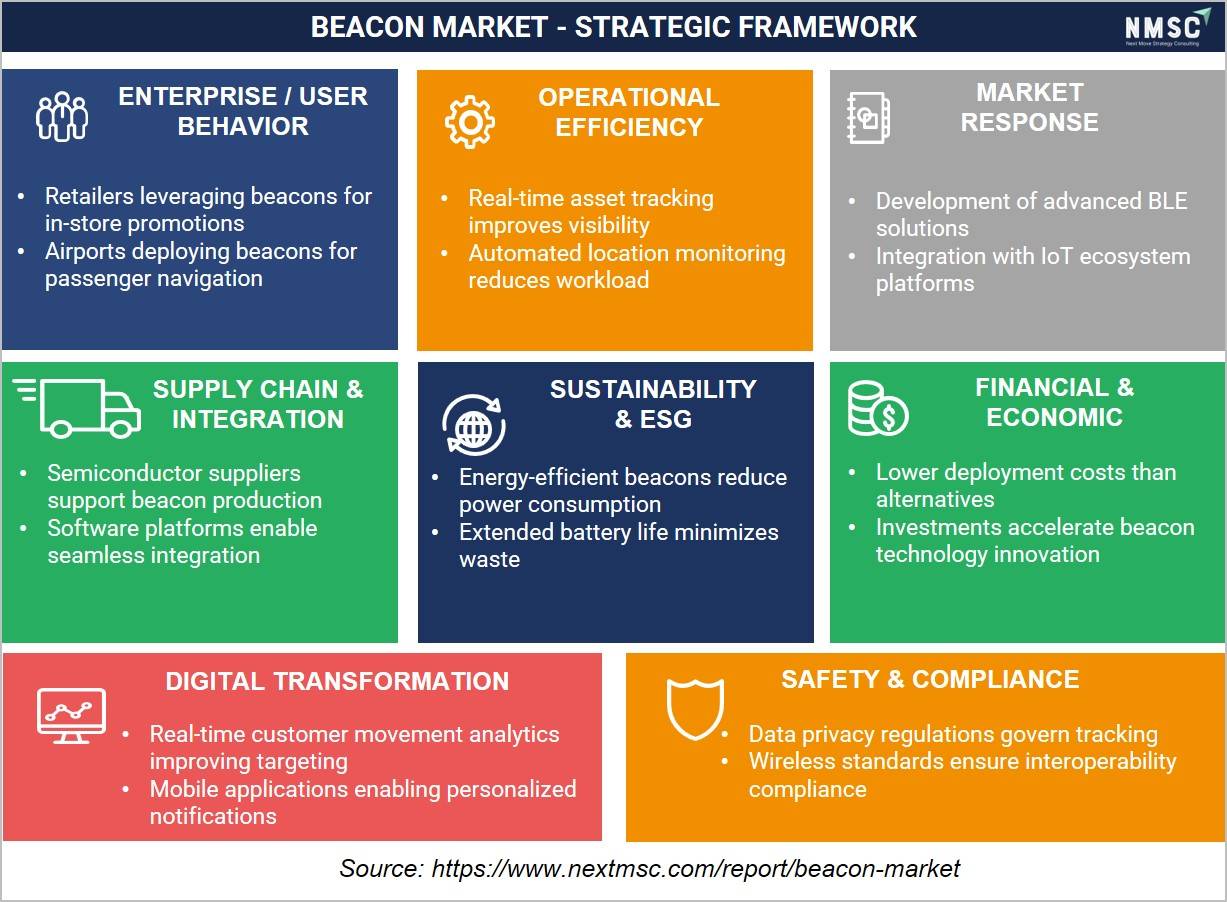
The Beacon Market strategic framework highlights the key factors shaping industry growth and adoption. Enterprise demand for location-based services is driving deployment across retail, transportation, healthcare, and smart infrastructure environments. Organizations benefit from improved operational efficiency through real-time asset tracking, navigation, and automation capabilities. Market expansion is supported by advances in Bluetooth Low Energy (BLE) technology, IoT integration, and digital transformation initiatives. Strong supply chain partnerships, increasing investments, sustainability-focused innovations, and evolving data privacy regulations further influence market development, creating a foundation for scalable, secure, and cost-effective beacon-enabled solutions.
How Is the Beacon Market Segmented in This Report, and What Are the Key Insights from the Segmentation Analysis?
Which Offering Type Is Driving the Most Revenue in the Beacon Market?
|
Offering Segment |
2025 (USD Bn) |
2035 (USD Bn) |
CAGR (%) |
|
Hardware |
1.10 |
3.90 |
13.5% |
|
Software |
0.43 |
2.22 |
17.9% |
|
Services |
0.27 |
1.28 |
16.9% |
Based on NMSC's research, we found that the Beacon Market's Offering segment is structured across Hardware, Software, and Services categories, each serving distinct deployment and value-creation roles. The Hardware segment dominates, encompassing Bluetooth Low Energy Beacons, Asset Tracking Beacons, Proximity Marketing Beacons, Indoor Navigation Beacons, Condition Monitoring Beacons, Ultra-Wideband Beacons, Real-Time Location Beacons, Precision Tracking Beacons, Wi-Fi Beacons, Hybrid Beacons, Tags, and Other Beacon Devices. BLE Beacons hold the largest hardware share given their low cost, proven use-case versatility, and broad compatibility with Android and iOS ecosystems. Asset Tracking Beacons and UWB Beacons are the fastest-growing hardware categories, driven respectively by logistics modernization demand and the need for centimeter-precision positioning in industrial and healthcare settings. The Software segment, encompassing Beacon Management Platforms, Analytics and Reporting Software, Mobile SDKs, Campaign Management Software, and Location Intelligence Software, is the fastest-growing primary offering type as enterprises prioritize managed intelligence over commodity hardware. Beacon Management Platforms hold the largest software sub-segment share, while Location Intelligence Software is growing most rapidly as AI integration expands analytical value. The Services segment, spanning Consulting, System Integration, Deployment, Support and Maintenance, and Managed Services, is expanding steadily as organizations seek turnkey deployment and operational continuity support from specialist providers.
How Does Technology Protocol Selection Shape Deployment Strategies in the Beacon Market?
|
Protocol Segment |
2025 (USD Bn) |
2035 (USD Bn) |
CAGR (%) |
|
iBeacon |
0.72 |
2.80 |
14.6% |
|
Eddystone |
0.46 |
1.96 |
15.6% |
|
AltBeacon |
0.21 |
0.74 |
13.4% |
|
Proprietary Protocols |
0.31 |
1.48 |
16.9% |
|
Other Protocols |
0.10 |
0.42 |
15.4% |
NMSC's analysis indicates that the Beacon Market's Technology Protocol segment is divided across iBeacon, Eddystone, AltBeacon, Proprietary Protocols, and Other Protocols, each reflecting distinct ecosystem preferences and use-case requirements. iBeacon retains the largest protocol share, supported by deep Apple iOS integration, extensive developer tooling, and a mature retail deployment base spanning major global brand networks. Eddystone, Google's open-source BLE protocol, is the fastest-growing standard protocol, particularly within Android-centric enterprise deployments in emerging markets and healthcare settings where device diversity is high. AltBeacon provides a fully open-source alternative that avoids vendor lock-in, commanding adoption among technology-agnostic deployments in manufacturing and government sectors. Proprietary Protocols represent the fastest-growing protocol category overall, as specialized vendors in UWB precision tracking, condition monitoring, and industrial IoT develop proprietary communication frameworks to achieve performance levels beyond standard BLE specifications. From our assessment, multi-protocol beacon hardware capable of broadcasting iBeacon, Eddystone, and proprietary frames simultaneously is emerging as the preferred hardware architecture for enterprise deployments seeking cross-platform compatibility.
Which Applications Are Generating the Most Strategic Value in the Beacon Market?
|
Application Segment |
2025 (USD Bn) |
2035 (USD Bn) |
CAGR (%) |
|
Proximity Marketing |
0.49 |
1.76 |
13.7% |
|
Indoor Navigation |
0.29 |
1.22 |
15.4% |
|
Asset Tracking |
0.32 |
1.48 |
16.6% |
|
Workforce Tracking |
0.18 |
0.84 |
16.7% |
|
Customer Engagement |
0.17 |
0.68 |
14.9% |
|
Contactless Interaction |
0.13 |
0.62 |
16.9% |
|
Location Analytics |
0.11 |
0.56 |
17.6% |
|
Inventory Monitoring |
0.10 |
0.48 |
16.9% |
|
Safety and Security |
0.09 |
0.42 |
16.7% |
|
Other Applications |
0.12 |
0.34 |
11.0% |
Through NMSC's assessment, we found that the Beacon Market's Application segment spans Proximity Marketing, Indoor Navigation, Asset Tracking, Workforce Tracking, Customer Engagement, Contactless Interaction, Location Analytics, Inventory Monitoring, Safety and Security, and Other Applications. Proximity Marketing holds the dominant application position, reflecting its maturity as the original commercial use case for beacon deployments in retail environments since 2014. Asset Tracking and Workforce Tracking are among the fastest-growing applications, driven by supply chain visibility requirements, occupational safety mandates, and the rising economic value of real-time operational awareness. Location Analytics is the fastest-growing individual application segment as organizations recognize that aggregated beacon-generated location data provides a proprietary competitive intelligence layer. Contactless Interaction applications are experiencing durable post-pandemic growth across hospitality, healthcare, and transportation, while Safety and Security applications are gaining momentum in industrial and government deployments. Indoor Navigation is expanding beyond airports and shopping malls into hospital campuses, corporate office complexes, and large entertainment venues as wayfinding becomes an expected digital service.
Which Industries Are the Largest and Fastest-Growing Buyers in the Beacon Market?
|
End User Industry |
2025 (USD Bn) |
2035 (USD Bn) |
CAGR (%) |
|
Retail |
0.48 |
1.68 |
13.4% |
|
Transportation & Logistics |
0.31 |
1.34 |
15.8% |
|
Healthcare |
0.27 |
1.22 |
16.3% |
|
Hospitality |
0.18 |
0.70 |
14.6% |
|
BFSI |
0.16 |
0.66 |
15.3% |
|
Smart Buildings & Real Estate |
0.14 |
0.68 |
17.2% |
|
Manufacturing |
0.12 |
0.56 |
16.7% |
|
Education |
0.07 |
0.28 |
14.9% |
|
Automotive |
0.06 |
0.30 |
17.5% |
|
Sports & Entertainment |
0.05 |
0.22 |
15.9% |
|
Government & Public Sector |
0.08 |
0.38 |
16.9% |
|
Other Industries |
0.08 |
0.38 |
16.9% |
Based on our market evaluation, we noticed that the Beacon Market's End User Industry segment encompasses Retail, Transportation and Logistics, Healthcare, Hospitality, BFSI, Education, Smart Buildings and Real Estate, Manufacturing, Automotive, Sports and Entertainment, Government and Public Sector, and Other Industries. The Retail segment, comprising Specialty Stores, Department Stores, Shopping Malls, and Supermarkets, holds the largest industry share given the maturity of proximity marketing and customer engagement beacon deployments in physical retail environments globally. Transportation and Logistics — covering Airports, Transit Hubs, Warehouses, and Distribution Centers — is among the fastest-growing verticals as organizations invest in real-time asset tracking, indoor navigation, and contactless check-in infrastructure. Healthcare — across Hospitals, Clinics, and Healthcare Campuses — is the fastest-growing major end user industry at a CAGR of 16.3%, driven by equipment tracking, staff safety, patient navigation, and regulatory compliance requirements. Smart Buildings and Real Estate and Automotive represent the highest-growth emerging verticals as connected building management and UWB-based keyless vehicle access applications expand the Beacon Market's enterprise addressable market.
How Does Deployment Environment Influence Beacon Market Revenue Distribution?
|
Deployment Environment |
2025 (USD Bn) |
2035 (USD Bn) |
CAGR (%) |
|
Indoor |
1.22 |
4.70 |
14.5% |
|
Outdoor |
0.28 |
1.18 |
15.5% |
|
Mixed Environment |
0.30 |
1.52 |
17.6% |
Our analysis shows that the Beacon Market's Deployment Environment segment is classified into Indoor, Outdoor, and Mixed Environment categories. Indoor deployments dominate, accounting for approximately 68% of total market revenue in 2025, reflecting the concentration of proximity marketing, indoor navigation, and asset tracking applications within enclosed commercial, healthcare, and industrial facilities. Outdoor beacon deployments serve transit hubs, parking facilities, outdoor event venues, and urban wayfinding applications, requiring enhanced weatherproofing, solar power options, and extended wireless range specifications. Mixed Environment deployments are the fastest-growing category, driven by smart campus, smart city, and large logistics facility deployments that span both indoor and outdoor zones, requiring seamless positioning handoff between BLE indoor networks and GNSS outdoor positioning systems.
How Does Organization Size Determine Beacon Market Adoption and Investment Patterns?
|
Organization Size |
2025 (USD Bn) |
2035 (USD Bn) |
CAGR (%) |
|
Large Enterprises |
1.18 |
4.44 |
14.2% |
|
Medium Enterprises |
0.42 |
1.92 |
16.4% |
|
Small Enterprises |
0.20 |
1.04 |
17.9% |
From our research, we found that the Beacon Market's Organization Size segment reveals differentiated adoption patterns across Large Enterprises, Medium Enterprises, and Small Enterprises. Large Enterprises dominate total market revenue, underpinned by enterprise-scale retail chain deployments, hospital networks, international airports, and global logistics operators that deploy thousands of beacon devices per location. Medium Enterprises are the fastest-growing organization size segment among traditional categories, as cloud-based beacon management SaaS platforms eliminate the need for dedicated IT infrastructure, enabling mid-sized retailers, regional healthcare systems, and mid-market hotel chains to access enterprise-grade location intelligence capabilities. Small Enterprises represent the highest-growth segment, driven by the emergence of affordable, plug-and-play beacon starter kits and marketplace-distributed mobile engagement platforms that require minimal technical integration and offer month-to-month subscription pricing aligned with SMB budget cycles.
How Are Distribution Channels Reshaping Go-to-Market Strategies in the Beacon Market?
|
Distribution Channel |
2025 (USD Bn) |
2035 (USD Bn) |
CAGR (%) |
|
Direct Sales |
0.68 |
2.48 |
13.8% |
|
System Integrators |
0.38 |
1.62 |
15.6% |
|
Value Added Resellers |
0.28 |
1.20 |
15.6% |
|
Distributors |
0.19 |
0.72 |
14.3% |
|
Online Sales |
0.17 |
0.88 |
17.9% |
|
Technology Partners |
0.10 |
0.50 |
17.5% |
NMSC's analysis indicates that the Beacon Market's Distribution Channel segment encompasses Direct Sales, System Integrators, Value Added Resellers, Distributors, Online Sales, and Technology Partners. Direct Sales holds the largest channel share, reflecting the preference of large enterprise buyers for direct vendor engagement on complex, multi-site beacon deployments requiring customized hardware specifications, integration support, and enterprise software licensing. System Integrators are the fastest-growing traditional channel, as organizations across healthcare, transportation, and manufacturing prefer turnkey solution providers capable of managing hardware procurement, software integration, and ongoing maintenance within single-vendor contractual relationships. Online Sales and Technology Partners represent the highest-growth channel categories, driven by the emergence of self-service beacon platforms and API-accessible location intelligence solutions targeting developer communities and technology-forward SMB buyers through marketplaces and partner ecosystems.
Regional Outlook
Geographic Performance Snapshot
|
Region |
2025 (USD Bn) |
2035 (USD Bn) |
CAGR (%) |
Key Driver |
|
North America |
0.76 |
2.80 |
13.9% |
Retail tech adoption, healthcare IoT |
|
Europe |
0.42 |
1.58 |
14.2% |
GDPR compliance, smart building investment |
|
Asia-Pacific |
0.38 |
1.86 |
17.2% |
Smart city programs, retail digitization |
|
Middle East & Africa |
0.12 |
0.60 |
17.4% |
Vision 2030, smart infrastructure |
|
Latin America |
0.12 |
0.56 |
16.7% |
Digital retail, logistics modernization |
North America Beacon Market
North America is the largest regional market in the Beacon Market, valued at USD 0.76 billion in 2025 and projected to reach USD 2.80 billion by 2035 at a CAGR of 13.9%. The region's dominance reflects a highly mature retail technology ecosystem, advanced healthcare infrastructure, and established airport and logistics modernization programs. Regulatory compliance requirements under CCPA and HIPAA are compelling enterprises to invest in privacy-compliant beacon platforms with built-in consent management. Through our market assessment, we observed that North America also leads in UWB adoption, driven by Apple's ecosystem influence and manufacturing facility precision tracking deployments across the automotive and aerospace sectors.
United States Beacon Market
Based on our engagements with enterprise buyers across North America, we found that the United States is the world's single largest national market in the Beacon Market, representing approximately 80% of North American revenue in 2025. U.S. retail chains, hospital networks, and international airports are the primary deployment drivers. The Federal Aviation Administration (FAA) has promoted indoor airport navigation systems that benefit from beacon infrastructure. HIPAA compliance requirements in healthcare are accelerating investment in beacon-enabled patient tracking and asset management. The U.S. market also leads globally in proximity marketing maturity, with major retail brands deploying enterprise-scale beacon networks across thousands of store locations supported by AI-driven campaign management platforms.
Canada Beacon Market
Through our analysis, Canada accounts for approximately 12% of North American Beacon Market revenue in 2025. Canadian retail operators, airport authorities, and healthcare organizations are significant beacon technology adopters. Toronto Pearson International Airport and Montreal-Trudeau International Airport have deployed indoor navigation and wayfinding systems supported by beacon networks. Canada's Personal Information Protection and Electronic Documents Act (PIPEDA) governs the collection of location and behavioral data from beacon deployments, compelling organizations to invest in compliant consent management systems. The Canadian government's Digital Government strategy is also driving public sector adoption of location intelligence and contactless service delivery technologies.
Mexico Beacon Market
From our assessment, Mexico is the fastest-growing market within North America in the Beacon Market. Mexico's rapidly expanding retail sector, growing airport infrastructure modernization, and nearshoring-driven logistics facility investment are creating structured demand for proximity marketing and asset tracking beacon deployments. The Federal Law on Protection of Personal Data Held by Private Parties (LFPDPPP) governs beacon data practices. Mexico City's Benito Juárez International Airport and Monterrey's new airport are incorporating indoor navigation systems. Retail chains including Walmart de México and Coppel are among the key domestic adopters of beacon-based proximity marketing and customer engagement platforms.
Europe Beacon Market
Europe is the second-largest region in the Beacon Market, valued at USD 0.42 billion in 2025 and projected to reach USD 1.58 billion by 2035 at a CAGR of 14.2%. Europe's beacon adoption is shaped significantly by GDPR compliance requirements that mandate explicit user consent for location data processing. Smart building investment across Germany, the United Kingdom, and the Netherlands is a structural driver, while healthcare sector digitization programs in Scandinavia and France support hospital-grade beacon deployments. Our findings suggest that European enterprises are leading globally in privacy-by-design beacon implementations, creating a differentiated compliance capability that international vendors must match to compete effectively in this market.
Germany Beacon Market
Based on our engagements with industry stakeholders in Germany, we found that the German Beacon Market is characterized by strong manufacturing sector adoption of precision asset tracking and workforce management beacon systems. German automotive plants operated by Volkswagen, BMW, and Mercedes-Benz have deployed UWB and BLE beacon networks for tool tracking, parts verification, and safety zone management. The Federal Office for Information Security (BSI) provides cloud and IoT security guidelines that shape enterprise beacon platform requirements. Germany's strong smart building sector and engineering precision culture drive demand for high-accuracy, standards-compliant indoor positioning solutions with verified data governance capabilities.
United Kingdom Beacon Market
Through our analysis, the United Kingdom represents the largest individual country market in Europe for the Beacon Market. UK retail adoption of proximity marketing beacons is mature, with major department store chains and shopping center operators having deployed enterprise-scale networks. Heathrow and Gatwick airports have incorporated indoor wayfinding systems supported by beacon infrastructure. The UK's ICO enforces UK GDPR requirements for location data processing, compelling vendors to deliver GDPR-equivalent compliance. Post-Brexit data adequacy agreements with the EU enable continued cross-border data operations. Healthcare beacon adoption is expanding through NHS digital transformation initiatives focused on patient flow and asset management.
France Beacon Market
From our assessment, France demonstrates strong Beacon Market adoption in retail, transportation, and healthcare verticals. French retail operators including Carrefour and Fnac-Darty have deployed beacon networks for proximity marketing and customer experience applications. Paris Charles de Gaulle airport has integrated indoor navigation systems. The Commission Nationale de l'Informatique et des Libertés (CNIL) is one of Europe's most active GDPR enforcement bodies and has specifically addressed location data in its regulatory guidance, driving investment in compliant consent management architectures within French beacon deployments. France's digital transformation investment programs under France 2030 are supporting broader location intelligence adoption across public sector organizations.
Italy Beacon Market
According to evaluation, Italy's Beacon Market is growing steadily across retail, museums and cultural institutions, and transportation sectors. Italian retailers and luxury brand flagship stores are deploying proximity marketing beacons to enhance high-value customer engagement. Milan Malpensa airport and Rome Fiumicino airport have integrated indoor navigation systems. Italy's Garante per la protezione dei dati personali enforces strict GDPR compliance, with specific attention to location tracking applications. The Piano Nazionale di Ripresa e Resilienza (PNRR) digital transformation funding is supporting modernization of public sector facilities that increasingly incorporate beacon-based visitor services and asset management infrastructure.
Spain Beacon Market
Based on our market evaluation, we noticed that Spain demonstrates growing Beacon Market momentum, driven by a dynamic retail sector, tourism infrastructure investment, and smart building initiatives under the Agenda España Digital 2026. Spanish retail and hospitality operators are deploying proximity marketing and guest experience beacon systems at scale. Madrid Barajas and Barcelona El Prat airports have adopted indoor wayfinding solutions. The Agencia Española de Protección de Datos (AEPD) enforces GDPR requirements governing location data collection from beacon deployments. Spain's strong tourism sector, encompassing major hotel chains and heritage visitor attractions, represents a strategically important end user segment for hospitality-focused beacon platform providers.
Sweden Beacon Market
Through our analysis, Sweden is among the most digitally advanced adopters of beacon technology in Europe. Swedish retailers including IKEA and H&M have integrated proximity marketing and indoor navigation beacon solutions across flagship stores. Stockholm Arlanda airport has deployed comprehensive indoor navigation services. Ericsson and Telia's enterprise IoT programs incorporate beacon infrastructure within smart connectivity solutions. Sweden's Integritetsskyddsmyndigheten (IMY) provides GDPR enforcement that shapes beacon deployment compliance practices. The Swedish government's commitment to digital public services supports beacon adoption in public transportation hubs, museums, and government facilities that prioritize accessible, digital-first visitor experiences.
Denmark Beacon Market
From our assessment, Denmark is one of Europe's most sophisticated beacon adopters relative to market size. Copenhagen Kastrup airport has been recognized for its advanced indoor navigation and passenger wayfinding beacon deployment. Danish healthcare facilities are incorporating beacon systems for patient navigation and asset management aligned with Denmark's digitally advanced healthcare system. The Danish Data Protection Agency (Datatilsynet) is a rigorous GDPR enforcement body, compelling Danish enterprises to implement high-standard consent management in beacon marketing applications. Denmark's concentration of life sciences companies creates specialized demand for clinical facility wayfinding and equipment tracking beacon solutions with healthcare-grade data governance.
Finland Beacon Market
Based on our market evaluation, Finland's Beacon Market reflects the country's advanced IoT infrastructure and open data culture. Nokia's global headquarters and enterprise technology operations generate demand for smart workplace and IoT connectivity solutions incorporating beacon positioning. Finnish airports and retail centers have adopted indoor navigation services. The Finnish government's MyData initiative has positioned Finland as a model for user-centric location data governance, influencing enterprise beacon deployment practices. Finland's expanding data center sector and cold climate energy efficiency advantages also contribute to its position as a host market for beacon platform vendors establishing Nordic operations.
Netherlands Beacon Market
According to evaluation, the Netherlands represents a strategically important Beacon Market within Europe. Amsterdam Schiphol airport, one of Europe's busiest transit hubs, has extensively deployed indoor wayfinding and passenger experience beacon systems. Rotterdam Europoort's logistics operations are integrating beacon asset tracking within warehouse and port management infrastructure. The Dutch Data Protection Authority (Autoriteit Persoonsgegevens) has issued significant GDPR enforcement decisions relating to location data that set compliance standards across European beacon deployments. The Netherlands' dense concentration of logistics and distribution companies makes it a structurally important market for supply chain-focused beacon asset tracking solutions.
Rest of Europe Beacon Market
Through our analysis, the Rest of Europe — comprising Poland, Belgium, Switzerland, Austria, Portugal, the Czech Republic, and other European nations — collectively represents a growing and commercially meaningful portion of the European Beacon Market. Poland and the Czech Republic are emerging adoption leaders in Central and Eastern Europe, driven by expanding retail infrastructure, logistics facility modernization, and growing manufacturing sector digitization. Switzerland's financial sector and luxury retail ecosystem create demand for high-security, privacy-compliant beacon deployments. Belgium, as the EU institutional hub, drives demand for compliant smart building and visitor management beacon applications across government and European institution facilities.
Asia-Pacific Beacon Market
Asia-Pacific is the fastest-growing major region in the Beacon Market, advancing from USD 0.38 billion in 2025 to an estimated USD 1.86 billion by 2035 at a CAGR of 17.2%. The region's growth is powered by China's smart retail and industrial IoT investments, India's smart city and digital retail initiatives, Japan's advanced manufacturing automation sector, South Korea's connected infrastructure programs, and Australia's mature retail and healthcare technology market. Regulatory frameworks including Japan's APPI, South Korea's PIPA, and Australia's Privacy Act are shaping enterprise beacon deployment governance practices across the region.
China Beacon Market
Based on our engagements with market participants in China, we found that China is the largest Beacon Market in Asia-Pacific, driven by a massive retail ecosystem, extensive IoT-enabled manufacturing infrastructure, and government-directed smart city programs. Chinese retail operators including JD.com, Alibaba's Freshippo, and major department store chains are deploying proximity marketing and asset management beacon networks at scale. China's Personal Information Protection Law (PIPL) and Data Security Law (DSL) establish domestic data governance requirements for beacon deployments. The Ministry of Industry and Information Technology (MIIT) oversees industrial IoT platform development, where beacon asset tracking is a key technology component. Domestic beacon hardware manufacturers including Minew Technologies hold significant competitive advantages in this market.
Japan Beacon Market
Through our analysis, Japan is the second-largest Asia-Pacific market for beacon technology, supported by advanced manufacturing, retail, and transportation sector adoption. Japanese manufacturing plants operated by Toyota, Panasonic, and Hitachi integrate beacon asset tracking within precision manufacturing and quality control workflows. Tokyo's extensive urban rail network and major airports have deployed indoor navigation systems. Japan's Act on Protection of Personal Information (APPI), enforced by the Personal Information Protection Commission (PPC), governs enterprise beacon data practices. The Digital Agency's government digitization programs are expanding public sector beacon adoption across government facilities, creating new demand for compliant visitor management and indoor navigation solutions.
India Beacon Market
From our assessment, India is the fastest-growing national market in the Asia-Pacific Beacon Market, advancing at a CAGR of 19.5% from 2026 to 2035. India's Smart Cities Mission, overseen by the Ministry of Housing and Urban Affairs, has allocated investment for location intelligence infrastructure including beacon-based indoor navigation for smart transportation hubs, hospitals, and government facilities. Major Indian retail chains including Reliance Retail and Tata Group's retail operations are deploying proximity marketing beacon systems at scale. The Digital Personal Data Protection Act 2023 (DPDPA), administered by MeitY, establishes data governance requirements for beacon deployments. India's rapidly expanding airport infrastructure under the Airports Authority of India is creating significant demand for indoor navigation and passenger experience solutions.
South Korea Beacon Market
According to evaluation, South Korea demonstrates high beacon technology maturity, supported by one of the world's highest broadband penetration rates, an advanced retail sector, and a proactive government digitization environment. South Korean retail operators and entertainment venues are active beacon proximity marketing adopters. Incheon International Airport has deployed comprehensive indoor navigation infrastructure. Samsung's SmartThings platform and LG's ThinQ IoT ecosystem incorporate beacon positioning as a location data layer within connected home and enterprise environments. South Korea's Personal Information Protection Act (PIPA), enforced by the PIPC, governs location data collection from beacon deployments. The government's K-Cloud initiative supports cloud-based beacon management platform adoption across enterprise and public sector organizations.
Australia Beacon Market
Based on our market evaluation, Australia is the most mature Beacon Market in Asia-Pacific outside Northeast Asia. Australian retail chains, airports, and healthcare networks are established beacon technology users. Sydney Kingsford Smith, Melbourne, and Brisbane airports have deployed indoor wayfinding systems. Australian healthcare networks are adopting beacon asset tracking for medical equipment and patient navigation as part of broader hospital digitization investments. The Privacy Act 1988, amended under the Privacy Legislation Amendment Act 2024, and the Consumer Data Right (CDR) framework shape enterprise data governance requirements for beacon deployments. The Australian Competition and Consumer Commission (ACCC) oversees CDR compliance that increasingly intersects with location data practices.
Rest of Asia-Pacific Beacon Market
Through our analysis, the Rest of Asia-Pacific — comprising Indonesia, Vietnam, the Philippines, Malaysia, Thailand, Singapore, New Zealand, Taiwan, and smaller Pacific markets — collectively represents a fast-growing and strategically significant portion of the regional Beacon Market. Singapore, despite its small geography, is a high-value market hosting Southeast Asian headquarters of major beacon platform vendors and enterprise IoT deployments in Changi Airport and its smart urban infrastructure. Taiwan's semiconductor and electronics manufacturing sector generates demand for precision beacon asset tracking. Indonesia and Vietnam are high-growth emerging markets driven by expanding retail infrastructure and logistics sector modernization investments supported by government digital economy programs.
Latin America Beacon Market
Latin America represents a growing and commercially attractive segment of the Beacon Market, valued at USD 0.12 billion in 2025 and projected to reach USD 0.56 billion by 2035 at a CAGR of 16.7%. Brazil is the dominant market, driven by a large retail sector, rapidly modernizing airport infrastructure, and growing fintech and logistics ecosystem that creates demand for contactless interaction and asset tracking beacon deployments. Brazil's Lei Geral de Proteção de Dados (LGPD), enforced by the Autoridade Nacional de Proteção de Dados (ANPD), governs location data processing. Argentina, Chile, and Colombia are emerging as secondary Latin American beacon markets as retail modernization and smart building investments expand across the region.
Brazil Beacon Market
Based on our analysis, Brazil is the largest Beacon Market in Latin America, supported by extensive retail networks, large shopping malls, and growing adoption of Bluetooth Low Energy (BLE) technologies. Retailers are deploying beacons for proximity marketing, personalized promotions, customer analytics, and indoor navigation. Additionally, logistics operators are implementing beacon-enabled asset tracking and warehouse monitoring solutions, while transportation hubs and commercial facilities are increasingly adopting beacon systems to enhance location-based services and operational efficiency.
Argentina Beacon Market
According to our assessment, Argentina represents a significant Beacon Market in Latin America, driven by increasing demand for location-based customer engagement and indoor positioning solutions. Retailers, shopping centers, and hospitality providers are deploying beacon technologies to deliver personalized promotions, improve visitor experiences, and analyze customer behavior. Enterprises are also utilizing beacon-enabled workforce tracking, asset monitoring, and indoor navigation applications, contributing to growing adoption across commercial, healthcare, and logistics environments.
Chile Beacon Market
From our evaluation, Chile is one of the most advanced Beacon Markets in Latin America, supported by strong technology adoption and widespread smartphone usage. Retail organizations are increasingly implementing beacon solutions for proximity marketing, customer engagement, and in-store analytics. Beacon-enabled location intelligence and asset tracking systems are also gaining traction across transportation and logistics sectors. The growing use of indoor navigation and real-time location services continues to create favorable opportunities for market expansion.
Colombia Beacon Market
Based on our research, Colombia is an emerging Beacon Market experiencing steady growth due to increasing adoption of location-based services and customer engagement technologies. Retailers are deploying BLE beacons to enhance shopping experiences, deliver targeted promotions, and gather consumer insights. Logistics and warehousing operators are implementing beacon-enabled tracking solutions to improve inventory visibility and asset management. Rising demand for indoor positioning and real-time location monitoring is further supporting market growth.
Rest of LATAM Beacon Market
The Rest of LATAM Beacon Market, including Peru, Ecuador, Uruguay, Central America, and the Caribbean, is witnessing increasing adoption across retail, logistics, and commercial sectors. Organizations are implementing beacon technologies to support proximity marketing, indoor navigation, customer analytics, and asset tracking applications. Growing awareness of location-based services and the expanding use of BLE-enabled solutions in transportation hubs, commercial facilities, and retail environments are expected to drive sustained market growth across the region.
Middle East and Africa Beacon Market
The Middle East and Africa Beacon Market is valued at USD 0.12 billion in 2025 and projected to reach USD 0.60 billion by 2035 at a CAGR of 17.4%, making it the fastest-growing regional market globally. Vision-driven national transformation programs in Saudi Arabia and the UAE are the primary demand engines, with NEOM city, smart airport modernization, and smart retail investments creating large-scale beacon infrastructure requirements. South Africa's retail and financial services sector drives Sub-Saharan African adoption. Israel's advanced technology sector contributes both as a beacon vendor ecosystem and as an enterprise adopter. The National Data Management Office (NDMO) in Saudi Arabia and the UAE's data governance framework shape regulatory requirements for beacon deployments across the GCC.
Saudi Arabia Beacon Market
Based on our engagements with stakeholders in Saudi Arabia, the Saudi Beacon Market is the largest in the MEA region, driven by Vision 2030's digital transformation mandate, NEOM smart city infrastructure requirements, and extensive airport and shopping mall modernization programs. Saudi Arabia's King Abdulaziz International Airport in Jeddah and the new Riyadh International Airport are integrating indoor navigation and beacon wayfinding systems. The Saudi Authority for Data and Artificial Intelligence (SDAIA) and the National Data Management Office (NDMO) provide data governance frameworks governing beacon location data practices. Major retail destinations including Mall of Arabia and Kingdom Centre are deploying proximity marketing and visitor analytics beacon networks.
UAE Beacon Market
Through our analysis, the UAE is the second-largest beacon market in MEA and one of the fastest-growing globally. Dubai International Airport, the world's busiest international airport, has deployed advanced indoor navigation and passenger experience systems incorporating beacon infrastructure. Dubai Mall and Mall of the Emirates are recognized global leaders in retail proximity marketing and customer engagement beacon deployment. Abu Dhabi's smart city initiatives and ADGM's financial free zone are driving enterprise-grade beacon adoption. The UAE's data protection law, Federal Decree-Law No. 45 of 2021, governs location data collection and processing from beacon systems deployed within UAE territory.
Egypt Beacon Market
From our assessment, Egypt is an emerging Beacon Market within Africa, supported by a large population, expanding retail infrastructure, and government digitization investments under Egypt Vision 2030. Cairo International Airport modernization programs are incorporating indoor navigation technologies. Egyptian retail operators are beginning to deploy proximity marketing beacon systems in major shopping centers. The Personal Data Protection Law (Law No. 151 of 2020), administered by the National Telecommunication Regulatory Authority (NTRA), establishes data governance requirements for beacon deployments. Egypt's growing fintech and digital retail sector represents a nascent but structurally significant demand category for customer engagement beacon solutions.
Israel Beacon Market
According to evaluation, Israel occupies a unique dual role in the Beacon Market as both a significant vendor origin country and a sophisticated enterprise buyer. Israeli technology startups and established companies are active developers of beacon hardware, indoor positioning software, and location intelligence platforms. Ben Gurion International Airport has deployed indoor navigation systems. Israeli retail, healthcare, and defense sectors are beacon technology adopters. The Privacy Protection Authority (PPA), governing Israel's Protection of Privacy Law, oversees data practices relating to location-based services. Israel's per-capita technology investment and density of innovation ecosystems make it a disproportionately influential market for beacon technology development and early adoption.
Turkey Beacon Market
Based on our market evaluation, Turkey is a growing Beacon Market within the MEA region, characterized by a dynamic retail sector, a large and young digitally-native population, and an expanding logistics industry. Major Turkish shopping centers in Istanbul, Ankara, and Izmir are deploying proximity marketing and visitor analytics beacon networks. Istanbul Airport, among the world's largest, has integrated indoor navigation infrastructure. Turkey's Personal Data Protection Law (KVKK), enforced by the KVKK Board, governs beacon location data collection. The government's National AI Strategy 2021–2025 and Digital Turkey initiative are supporting broader IoT and location technology adoption across enterprise and public sector deployments.
Nigeria Beacon Market
Through our analysis, Nigeria is the largest Beacon Market in Sub-Saharan Africa, driven by a rapidly expanding retail sector, growing fintech ecosystem, and investments in airport and transport hub modernization. Lagos's Eko Atlantic City development and major shopping destinations including Ikeja City Mall are incorporating digital visitor experience technologies including proximity beacons. The Nigeria Data Protection Act 2023 (NDPA), enforced by the Nigeria Data Protection Commission (NDPC), establishes data governance requirements for location data processing. Nigeria's growing middle class and expanding organized retail sector represent a structurally significant long-term demand driver for proximity marketing and customer engagement beacon solutions.
South Africa Beacon Market
From our assessment, South Africa is the most mature Beacon Market in Sub-Saharan Africa, driven by Johannesburg's position as Africa's financial and retail capital. Major shopping centers including Sandton City, Mall of Africa, and Menlyn Maine Shopping Centre have deployed proximity marketing and indoor navigation beacon networks. O.R. Tambo International Airport in Johannesburg has integrated indoor wayfinding systems. The Protection of Personal Information Act (POPIA), enforced by the Information Regulator, governs beacon location data collection and processing. South African retail chains, financial services firms, and healthcare networks are sophisticated beacon technology buyers, creating a commercially advanced sub-Saharan market for enterprise beacon platform providers.
Competitive Landscape
Competitive Dynamics and M&A Landscape
|
Key Takeaways |
Details |
|
Market Structure |
The Beacon Market features competition among hardware providers, location intelligence platform vendors, IoT solution companies, and enterprise software providers. Key participants compete through beacon accuracy, battery life, scalability, real-time location capabilities, analytics integration, and support for indoor positioning and proximity-based engagement solutions. |
|
Innovation Focus |
Innovation in the Beacon Market centers on UWB-enabled precision tracking, AI-powered location analytics, hybrid BLE-Wi-Fi positioning, digital twin integration, asset visibility platforms, and privacy-compliant customer engagement solutions. Vendors are also advancing cloud-based beacon management and real-time location services (RTLS) capabilities. |
|
M&A Activity |
Strategic acquisitions and partnerships are focused on expanding indoor positioning, asset tracking, IoT connectivity, and location intelligence capabilities. Market participants continue to acquire analytics, RTLS, and smart infrastructure technologies to strengthen end-to-end beacon ecosystem offerings across retail, healthcare, logistics, and smart building applications. |
How Do Companies Compete in the Beacon Market?
The Beacon Market is characterized by competition among technology ecosystem providers, beacon hardware manufacturers, indoor positioning platform developers, and Real-Time Location System (RTLS) solution providers. Major technology companies such as Apple and Cisco compete through ecosystem integration, extensive developer support, and enterprise connectivity solutions, while specialized vendors including Kontakt.io, Estimote, Quuppa, Sewio, Minew Technologies, and BlueCats differentiate through positioning accuracy, industry-specific applications, and deployment flexibility. Hardware providers increasingly compete by combining beacon devices with cloud-based management platforms, analytics dashboards, and subscription-based services that create long-term customer retention and recurring revenue opportunities.
Which Kind of Companies Dominate the Beacon Market?
Three distinct categories of companies dominate the Beacon Market. First, technology ecosystem leaders such as Apple and Cisco leverage their broad device ecosystems, networking infrastructure, and enterprise customer bases to drive beacon adoption and location-based service integration. Second, specialized beacon and indoor positioning vendors including Kontakt.io, Estimote, Minew Technologies, BlueCats, Quuppa, and Sewio provide purpose-built hardware, software platforms, and RTLS solutions tailored to healthcare, manufacturing, retail, logistics, and smart building applications. Finally, enterprise IoT and location intelligence platform providers deliver integrated analytics, asset tracking, workforce management, and digital transformation solutions that utilize beacon-generated location data to enhance operational efficiency and customer engagement.
AI-Driven Location Intelligence and UWB Innovation Drive Market Success in the Beacon Market
Innovation across the Beacon Market is increasingly focused on Ultra-Wideband (UWB) precision positioning, AI-powered location intelligence, digital twin integration, and advanced real-time analytics capabilities. Vendors are investing in solutions that provide centimeter-level positioning accuracy, predictive workflow optimization, and automated asset visibility for enterprise environments. Privacy-compliant proximity marketing, smart building occupancy analytics, and the integration of beacon data with broader IoT ecosystems are emerging as key differentiators. Companies that successfully combine beacon infrastructure with AI-enabled analytics and enterprise software platforms are strengthening customer retention, expanding recurring software revenues, and creating differentiated value propositions in the evolving location intelligence landscape.
Market Players to Opt for Merger and Acquisition Strategies to Expand Their Presence in the Beacon Market
Mergers, acquisitions, and strategic partnerships are increasingly reshaping the competitive dynamics of the Beacon Market. Larger IoT, connectivity, and enterprise software providers are acquiring specialized indoor positioning and RTLS companies to enhance their location intelligence capabilities and broaden their smart infrastructure portfolios. We observed that consolidation activity is particularly focused on UWB positioning technologies, healthcare RTLS platforms, industrial asset tracking solutions, and AI-driven location analytics providers. In addition, leading vendors such as Minew Technologies, BlueCats, Kontakt.io, and other regional specialists are expanding their global presence through distributor partnerships, channel alliances, and geographic expansion initiatives across Europe, Asia-Pacific, the Middle East, and Latin America. The market is also witnessing a shift toward software-as-a-service (SaaS) and managed services business models, enabling vendors to supplement hardware revenues with recurring subscription income and long-term enterprise contracts.
Who Are the Key Market Players in the Beacon Market?
-
Apple Inc.
-
Cisco Systems, Inc.
-
HID Global Corporation
-
Kontakt.io
-
BlueCats Australia Pty Ltd.
-
Estimote, Inc.
-
Gimbal, Inc.
-
Sensoro Co., Ltd.
-
Minew Technologies Co., Ltd.
-
infsoft GmbH
-
Accent Advanced Systems SLU
-
BlueUp S.r.l.
-
Onyx Beacon Ltd.
-
Leantegra Inc.
-
Radius Networks, Inc.
-
Quuppa Oy
-
Sewio Networks s.r.o.
-
Beaconinside GmbH
What Are the Latest Developments in the Beacon Market Industry?
|
Date |
Event |
|
February 2026 |
Kontakt.io introduced Supply Chain Agent, an AI-powered healthcare operations solution that combines RTLS location intelligence and hospital workflow data to automate equipment orchestration, improve asset utilization, reduce equipment search times, and enhance operational efficiency across healthcare environments. |
|
February 2025 |
Kontakt.io launched Rapid Room Turnover, a healthcare RTLS solution that uses BLE tags and location intelligence to automate patient discharge workflows, reduce room turnover times, and improve hospital capacity utilization. |
|
August 2024 |
HID Global acquired Sewio Networks to strengthen its Ultra-Wideband (UWB) real-time location services portfolio. The acquisition expands HID’s industrial RTLS capabilities across manufacturing, automotive, warehousing, and asset tracking applications. |
Expert Insights
 “By combining Modo’s app platform with Pointr’s map-driven insights, organizations can deliver an intelligent, AI-powered workplace experience that guides employees through their day, helps teams coordinate, and drives data-informed decisions on space utilization.”
— Ege Akpinar, CEO, Pointr
Statement made in May 2026 during the announcement of a strategic partnership between enterprise app platform Modo and indoor positioning provider Pointr, aimed at transforming enterprise workplaces.
Market Interpretation:
This insight highlights a major shift in the beacon and indoor positioning market: the move from basic “blue dot” location tracking to intelligent space orchestration. In the post-pandemic corporate landscape, enterprise buyers are leveraging Bluetooth beacons and AI mapping to create responsive workplaces, optimize real estate investments ("space as a service"), and enhance employee coordination. The value proposition of beacon technology has matured into comprehensive operational analytics.
What Are the Investment Opportunities in the Beacon Market?
Capital Inflows and Venture Activity
The Beacon Market continues to attract growing investment from venture capital firms, private equity funds, and strategic technology investors due to the expanding adoption of location-based services, indoor navigation, and real-time asset tracking solutions. We observed that capital deployment is increasingly concentrated in Ultra-Wideband (UWB) positioning technology providers, Bluetooth Low Energy (BLE) beacon manufacturers, and AI-powered location intelligence software developers. According to the National Venture Capital Association (NVCA), enterprise IoT and smart infrastructure technologies remain among the most actively funded segments, with beacon-enabled location services benefiting from recurring software revenues, analytics subscriptions, and long-term enterprise contracts. Investors view beacon ecosystems as a critical component of next-generation digital infrastructure supporting smart buildings, healthcare, retail, and industrial automation.
Infrastructure Investment
Infrastructure modernization programs are creating substantial investment opportunities across the Beacon Market. Large-scale deployments in smart airports, healthcare campuses, logistics hubs, manufacturing facilities, and commercial buildings increasingly incorporate beacon networks as core components of digital transformation strategies. We found that investments in indoor positioning infrastructure, real-time location systems (RTLS), and asset tracking platforms are accelerating as organizations seek operational visibility and workflow automation. Public and private infrastructure spending focused on Industry 4.0, connected facilities, and intelligent transportation systems continues to expand the addressable market for beacon hardware, software, and managed services providers globally.
ESG and Sustainable Smart Building Initiatives
Environmental, Social, and Governance (ESG) considerations are becoming increasingly important in Beacon Market investment decisions. Beacon-enabled occupancy monitoring, space utilization analytics, and smart energy management systems help organizations reduce energy consumption and improve building efficiency. The U.S. Department of Energy has identified smart building technologies and sensor-driven energy optimization as important pathways toward achieving sustainability objectives. We further analyzed that beacon-based occupancy intelligence supports green building certifications such as LEED and contributes to corporate carbon-reduction initiatives, making sustainability-focused beacon deployments attractive for both institutional investors and infrastructure funds pursuing ESG-aligned portfolios.
Digital Transformation Enablement
Beacon technology serves as a foundational layer for enterprise digital transformation initiatives across retail, healthcare, manufacturing, hospitality, and transportation sectors. Organizations transitioning toward connected and data-driven operating models are investing in beacon infrastructure to support customer engagement, workforce tracking, predictive maintenance, and location-aware analytics. We observed that omnichannel retail strategies, smart hospital modernization programs, and industrial IoT deployments increasingly rely on beacon-generated location data to enhance operational efficiency and customer experiences. As enterprises continue expanding digital transformation investments, beacon solutions are positioned to benefit from long-term technology modernization budgets and recurring software-service revenue streams.
Private Equity and Strategic M&A Activity
Private equity firms and strategic technology vendors are actively pursuing acquisition opportunities across the Beacon Market to build comprehensive location intelligence ecosystems. Consolidation activity is increasingly focused on indoor positioning software providers, RTLS platform developers, AI-driven analytics companies, and specialized beacon hardware manufacturers. We assessed that larger enterprise software and IoT platform providers are seeking acquisitions that strengthen their end-to-end location intelligence capabilities and recurring revenue portfolios. Investors should closely monitor M&A activity surrounding UWB positioning companies, healthcare RTLS vendors, and AI-powered location analytics platforms, as these segments are expected to represent some of the most attractive acquisition and value-creation opportunities through 2035, supported by projected CAGR growth rates exceeding 16% across several high-growth applications.
Key Benefits for Stakeholders
For Beacon Solution Buyers and Enterprise Users
Enterprise buyers gain comprehensive insights into the Beacon Market across hardware, software, and services segments, enabling informed technology adoption and deployment decisions. The report provides detailed analysis of beacon protocols, indoor positioning technologies, and end-user applications across retail, healthcare, logistics, manufacturing, and transportation sectors. Our assessment helps procurement and IT teams evaluate vendor capabilities, understand implementation best practices, and develop long-term location intelligence strategies that align with operational efficiency and digital transformation objectives.
For Investors and Financial Analysts
Investors and financial analysts receive a structured evaluation of the Beacon Market's growth potential, competitive landscape, investment trends, and regional expansion opportunities through 2035. Detailed CAGR analysis by technology, application, deployment environment, and geography supports investment thesis development, portfolio allocation, and valuation modeling. Competitive benchmarking, M&A activity assessment, and emerging technology analysis provide valuable insights for identifying high-growth investment opportunities, acquisition targets, and market leaders within the global beacon ecosystem.
For Beacon Technology Vendors and Platform Providers
Beacon hardware manufacturers, software platform providers, and managed service vendors gain actionable intelligence regarding market opportunities, competitive positioning, and emerging customer requirements. The report identifies high-growth application areas such as healthcare RTLS, smart retail engagement, industrial asset tracking, and UWB-based precision positioning. Regional market analysis highlights expansion opportunities, while technology trend assessment enables vendors to refine product development roadmaps, optimize go-to-market strategies, and strengthen competitive differentiation in the Beacon Market.
For Government Agencies and Regulatory Authorities
Government organizations, smart city planners, and regulatory authorities gain valuable insights into the adoption and economic impact of indoor positioning and location intelligence technologies. The report provides analysis of market structure, technology deployment trends, privacy considerations, and regional adoption patterns that support evidence-based policymaking and digital infrastructure planning. Findings are particularly relevant for transportation modernization, healthcare digitization, smart building initiatives, and public-sector IoT deployment programs.
For System Integrators and Technology Consultants
System integrators, consulting firms, and digital transformation service providers benefit from detailed market intelligence on technology adoption trends, deployment models, and enterprise implementation requirements. The report enables consultants to identify emerging customer demands, evaluate solution ecosystems, and develop industry-specific deployment strategies. Insights into beacon-enabled automation, customer engagement, workforce optimization, and asset visibility solutions support the development of high-value consulting and integration services across multiple industries.
For Academic and Research Institutions
Academic researchers, technology institutes, and innovation centers gain access to comprehensive market sizing, technology trend analysis, and industry insights related to beacon-based location services and indoor positioning systems. The report serves as a valuable resource for research initiatives focused on IoT ecosystems, wireless communication technologies, smart infrastructure, and location intelligence applications. Expert analysis and industry developments provide a strong foundation for future academic studies and technology innovation programs.
Key Market Segments
By Offering
-
Hardware
-
Bluetooth Low Energy Beacons
-
Asset Tracking Beacons
-
Proximity Marketing Beacons
-
Indoor Navigation Beacons
-
Condition Monitoring Beacons
-
-
Ultra-Wideband Beacons
-
Real-Time Location Beacons
-
Precision Tracking Beacons
-
-
Wi-Fi Beacons
-
Hybrid Beacons
-
Tags
-
Other Beacon Devices
-
-
Software
-
Beacon Management Platforms
-
Analytics And Reporting Software
-
Mobile SDKs
-
Campaign Management Software
-
Location Intelligence Software
-
Other Beacon Software
-
-
Services
-
Consulting Services
-
System Integration Services
-
Deployment Services
-
Support And Maintenance Services
-
Managed Services
-
By Technology Protocol
-
iBeacon
-
Eddystone
-
AltBeacon
-
Proprietary Protocols
-
Other Protocols
By Deployment Environment
-
Indoor
-
Outdoor
-
Mixed Environment
By Organization Size
-
Large Enterprises
-
Medium Enterprises
-
Small Enterprises
By Distribution Channel
-
Direct Sales
-
System Integrators
-
Value Added Resellers
-
Distributors
-
Online Sales
-
Technology Partners
By Application
-
Proximity Marketing
-
Indoor Navigation
-
Asset Tracking
-
Workforce Tracking
-
Customer Engagement
-
Contactless Interaction
-
Location Analytics
-
Inventory Monitoring
-
Safety And Security
-
Other Applications
By End User Industry
-
Retail
-
Specialty Stores
-
Department Stores
-
Shopping Malls
-
Supermarkets
-
-
Transportation And Logistics
-
Airports
-
Transit Hubs
-
Warehouses
-
Distribution Centers
-
-
Healthcare
-
Hospitals
-
Clinics
-
Healthcare Campuses
-
-
Hospitality
-
Hotels
-
Restaurants
-
Resorts
-
-
Banking Financial Services and Insurance
-
Education
-
Smart Buildings and Real Estate
-
Commercial Buildings
-
Residential Buildings
-
-
Manufacturing
-
Automotive
-
Sports And Entertainment
-
Government And Public Sector
-
Other Industries
Conclusion and Recommendations
Long-Term Outlook
The Beacon Market is positioned for sustained and structurally anchored growth throughout the 2025–2035 forecast period, driven by the convergence of IoT infrastructure expansion, AI-powered location intelligence maturation, and the ongoing digital transformation of physical environments across retail, healthcare, transportation, and smart buildings. Our analysis shows that the market is forecast to grow from USD 2.1 billion in 2026 to USD 7.4 billion by 2035 at a CAGR of 15.2%, reflecting both the expanding depth of enterprise deployment within established use cases and the broadening scope of beacon technology into new high-value applications including UWB precision positioning, digital twin integration, and contactless enterprise access management.
Strategic Positioning Recommendations
Platform vendors in the Beacon Market should prioritize the development of AI-native location analytics capabilities that transform raw beacon signal data into actionable operational intelligence, supporting premium pricing and competitive differentiation beyond commodity hardware sales. UWB precision positioning represents the highest-priority technology investment for vendors targeting healthcare, manufacturing, and automotive verticals where centimeter-level accuracy unlocks new safety and operational efficiency use cases. Geographic expansion into Asia-Pacific smart city programs, Middle East Vision-driven infrastructure projects, and Latin American retail modernization initiatives will be critical for vendors seeking to capture the highest-growth regional market opportunities through 2035 in the Beacon Market.
Investment Attractiveness
The Beacon Market represents an attractive investment landscape characterized by diversified demand drivers, recurring revenue potential from software and managed services, and high deployment switching costs that provide revenue durability. The highest-conviction investment themes identified through NMSC's assessment include UWB Precision Tracking Beacons at 17.5% CAGR for Automotive and Manufacturing applications, AI-powered Location Intelligence Software at 17.6% CAGR, Healthcare RTLS platforms at 16.3% CAGR, Small Enterprise segment expansion at 17.9% CAGR, and Asia-Pacific regional adoption at 17.2% CAGR. The convergence of beacon infrastructure with smart building management, enterprise IoT, and digital twin platforms is expanding total addressable market boundaries beyond traditional proximity marketing use cases.
Market Shifts and Key Risks
The most significant market shift underway in the Beacon Market is the transition from standalone proximity marketing tool deployments toward integrated, enterprise-grade location intelligence infrastructure serving multiple simultaneous use cases across a single beacon hardware investment. This shift benefits full-stack platform providers over single-application point solutions. Key risks include escalating data privacy regulation constraining beacon marketing applications in Europe and North America, battery-dependent hardware maintenance costs at deployment scale, smartphone operating system changes affecting background beacon scanning permissions, and potential interference from alternative positioning technologies including 5G indoor positioning and Wi-Fi RTT in specific enterprise environments.
Growth Pathways
Organizations seeking to maximize value from the Beacon Market should pursue a three-horizon strategy. In the near term through 2027, prioritize deployment of BLE beacon infrastructure for proven proximity marketing and asset tracking use cases while establishing cloud-based beacon management platforms to create the data foundation for AI analytics. In the mid-term from 2027 to 2031, invest in UWB precision positioning for high-value industrial and healthcare applications, integrate beacon location data with digital twin and enterprise IoT platforms, and develop AI-powered location analytics capabilities that monetize historical behavioral data. In the long term from 2031 to 2035, position for smart city and autonomous environment applications where beacon infrastructure serves as the real-time location data layer for autonomous vehicle navigation, robotics coordination, and smart public services within the global Beacon Market.
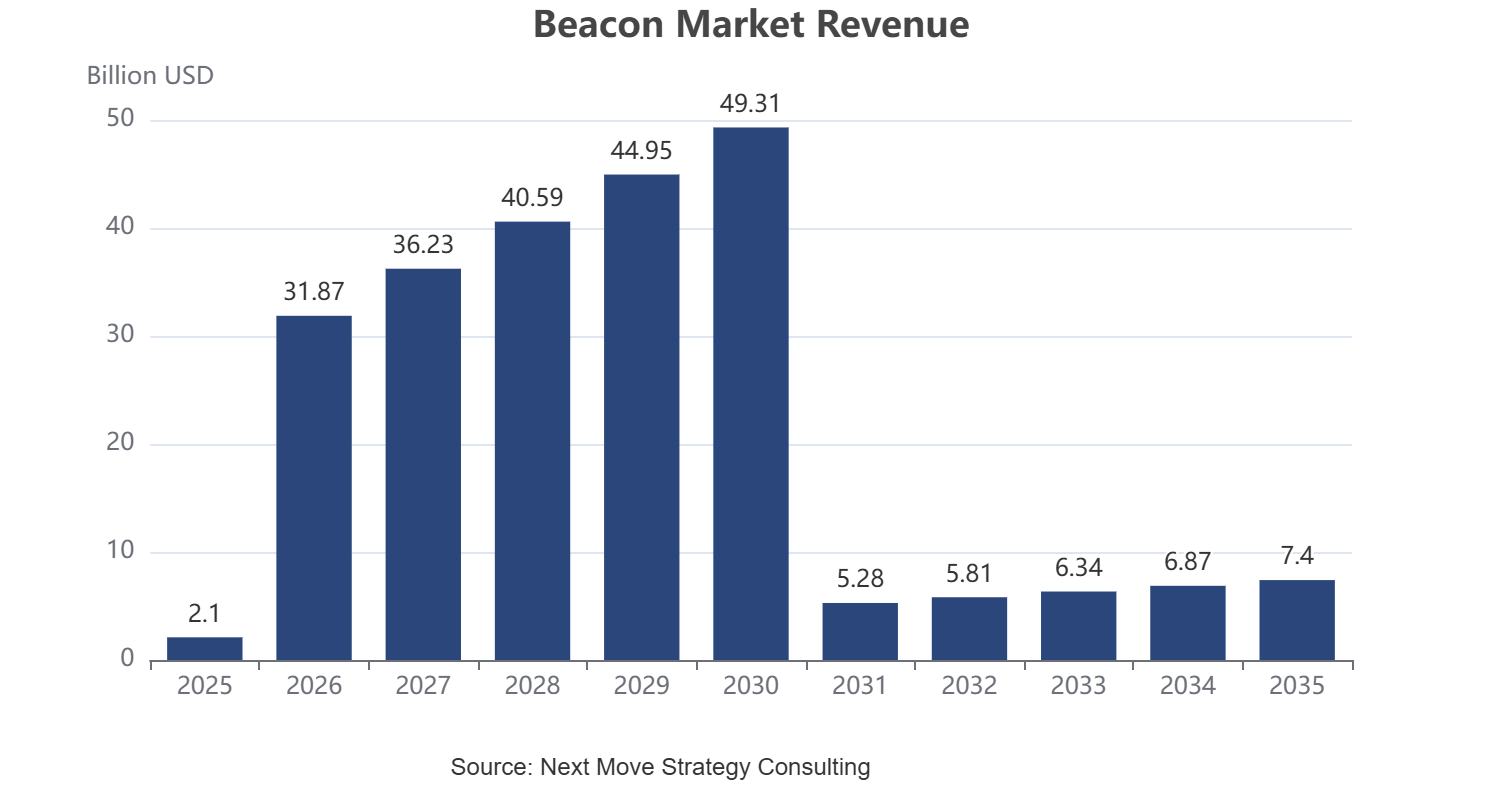
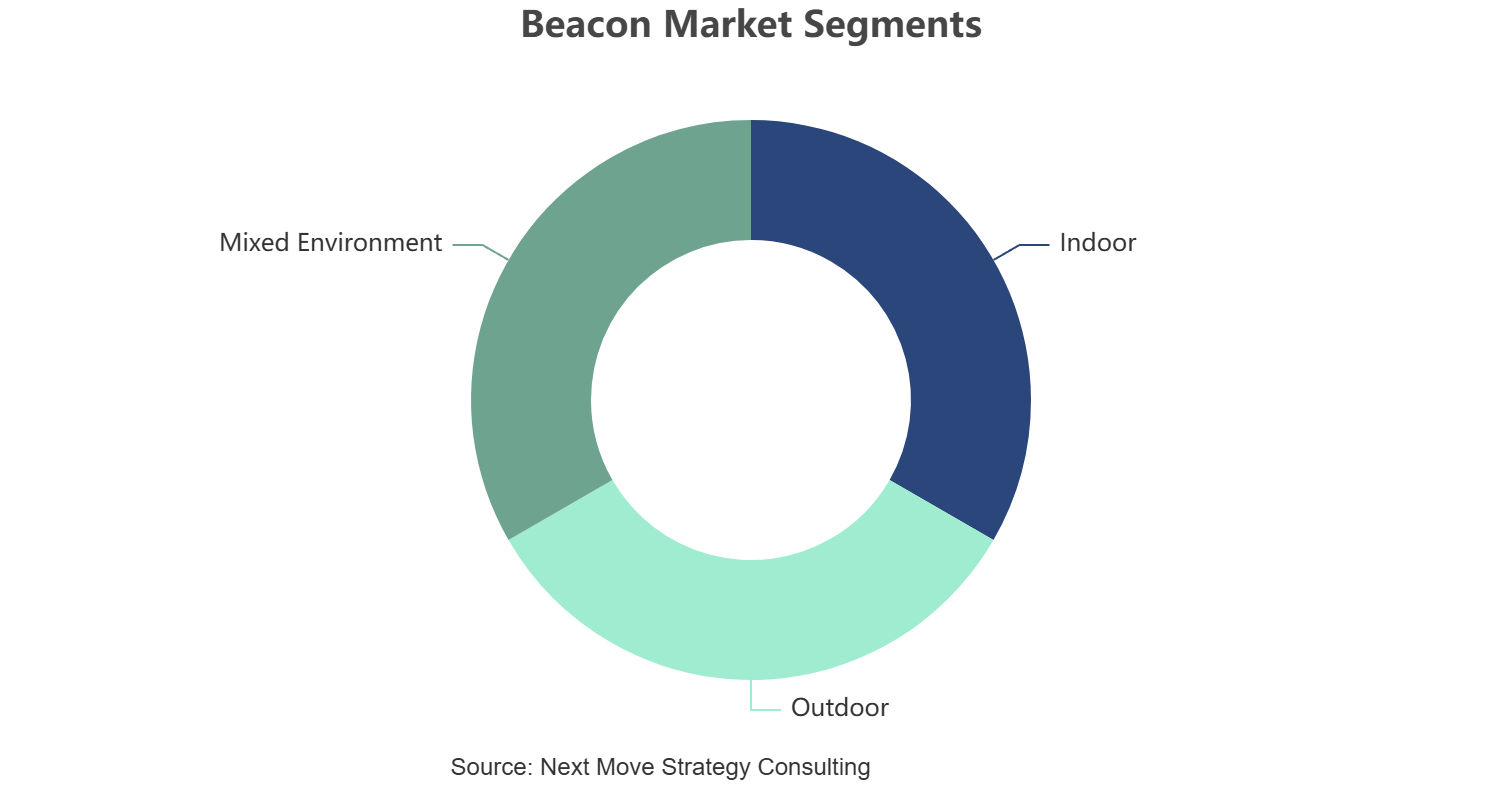
About the Author
 Tushmi Dutta
— Tushmi Dutta is a focused researcher specializing in detailed analysis and insight-driven research across diverse business landscapes. She supports strategic initiatives through structured data interpretation, thorough validation, and clear communication of findings that aid informed decision-making. With a strong interest in writing, she enjoys presenting research insights in an engaging and accessible manner. Beyond work, she enjoys traveling, reading, painting, and continuously learning new skills that contribute to her creative and professional growth.
Tushmi Dutta
— Tushmi Dutta is a focused researcher specializing in detailed analysis and insight-driven research across diverse business landscapes. She supports strategic initiatives through structured data interpretation, thorough validation, and clear communication of findings that aid informed decision-making. With a strong interest in writing, she enjoys presenting research insights in an engaging and accessible manner. Beyond work, she enjoys traveling, reading, painting, and continuously learning new skills that contribute to her creative and professional growth.
About the Reviewer
 Supradip Baul
— Supradip Baul is an accomplished business consultant and strategist with over a decade of rich experience in market intelligence, strategy, technology, and business transformation. His work has included rigorous qualitative and quantitative analysis across multiple industries, helping clients shape investment decisions and long-term roadmaps. Earlier in his career, he was associated with Gartner, where he contributed to industry-leading reports and market share analyses. He has worked with leading global companies and holds an MBA with a dual specialization in Marketing and Finance.
Supradip Baul
— Supradip Baul is an accomplished business consultant and strategist with over a decade of rich experience in market intelligence, strategy, technology, and business transformation. His work has included rigorous qualitative and quantitative analysis across multiple industries, helping clients shape investment decisions and long-term roadmaps. Earlier in his career, he was associated with Gartner, where he contributed to industry-leading reports and market share analyses. He has worked with leading global companies and holds an MBA with a dual specialization in Marketing and Finance.
At Next Move Strategy Consulting, we understand that insightful market research is the cornerstone of successful business decisions. That's why we employ a robust and multifaceted approach, combining various methodologies to deliver the most accurate and actionable data for our clients.

Research Landscape
We navigate the world of research with two primary approaches:
Qualitative Approach
Our qualitative research methodologies involve immersive techniques such as in-depth interviews, focus groups, and observational studies. By engaging directly with individuals and stakeholders, we uncover valuable insights that quantitative data alone may overlook.

Quantitative Research
In tandem with qualitative methodologies, NMSC leverages the power of Quantitative Research to provide a robust foundation of numerical insights. Through systematic data collection and analysis, we quantify patterns, preferences, and market trends, offering a comprehensive view of the business landscape.
Our quantitative research approach employs diverse tools, including surveys, experiments, and statistical modelling. These methodologies enable us to gather data from a large and representative sample, ensuring the statistical significance of our findings. By employing structured questionnaires and standardized data collection methods, we guarantee the reliability and validity of the information we present to our clients.
Quantitative research is particularly effective in measuring the prevalence of trends, assessing market size, and gauging the impact of various factors on consumer behavior. The numerical precision attained through this approach equips our clients with actionable insights, facilitating data-driven decision-making and strategy formulation.


Our Specialized Toolbox for Industry-Specific Market Research
We deploy a specialized arsenal of techniques tailored to meet your unique requirements. Here's a glimpse into our comprehensive toolbox:

Information Procurement
The stage entails acquiring market data or relevant information through various sources and methodologies.


Market Research Approach
We utilize both top-down and bottom-up approaches in market research analysis to achieve a comprehensive understanding of the market dynamics, leveraging the broad perspective of industry trends and macroeconomic factors alongside detailed insights from specific segments and individual companies.

Porters Five Forces Analysis
We conduct Porter's Five Forces analysis to evaluate the competitive landscape of an industry, providing us with insights into factors that affect profitability and strategic positioning.

SWOT Analysis

Forecasting
We utilize a forecasting model to predict future consumption by considering parameters like population, economics, regulations, market competition, drivers, constraints, technology, and pricing. We also employ statistical techniques such as multilinear regression, exponential smoothing, moving average, ARIMA, and Monte Carlo simulations for accurate predictions. In econometric forecasting, we analyzed short-term and long-term event impacts, attributing values based on regulatory frameworks, economic factors, and market events.





 Speak to Our Analyst