AI Piezo Haptics Market Size, Share, Trends and Growth Analysis, By Component (Piezoelectric Actuators, Haptic Driver ICs, Haptic Software and Algorithms, and Sensors and Feedback Modules), By Application (Smartphones and Tablets, Wearables, Automotive HMI, Gaming and VR/AR Controllers, Medical Devices, and Industrial and Robotics), By End User (Consumer Electronics OEMs, Automotive OEMs, and others), and Region — Global Industry Report and Forecast, 2026–2035
Industry: Semiconductor & Electronics | Publishing Date: August 7, 2026 | Last Updated: August 7, 2026 | No of Pages: N/A | No. of Tables: N/A | No. of Figures: N/A | Format: PDF | Report Code: SE5631
What Is the AI Piezo Haptics Market Size?
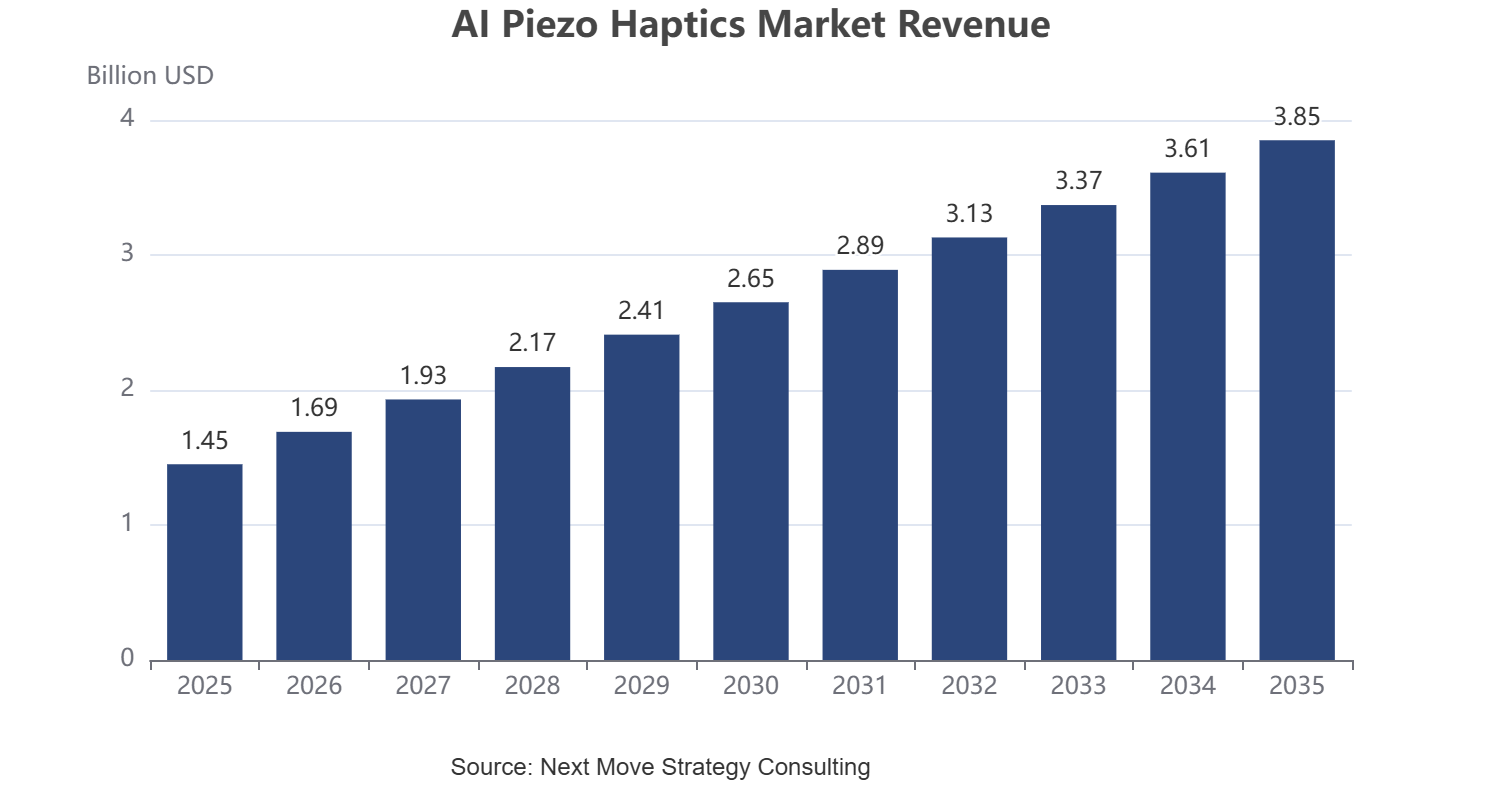
The global AI Piezo Haptics Market size was valued at USD 1.45 billion in 2025 and is estimated at USD 1.60 billion in 2026, forecast to reach USD 3.85 billion by 2035, expanding at a 10.25% CAGR between 2026 and 2035. Asia-Pacific leads with approximately 42% share, while piezoelectric actuators dominate all other components with approximately 38% share.
We observed that growth is anchored in expanding smartphone-integrated haptic engines and rapidly increasing adoption of AI-tuned piezo feedback surfaces within automotive human-machine interfaces through 2035.
|
Key Takeaways |
|
By Component: Piezoelectric Actuators held the largest share of approximately 38% (USD 0.55 Billion) in 2025; Haptic Software and Algorithms is the fastest-growing sub-segment at 13.3% CAGR from 2026–2035. |
|
By Application: Smartphones and Tablets held the largest share of approximately 36% (USD 0.52 Billion) in 2025; Automotive HMI is the fastest-growing sub-segment at 13.0% CAGR from 2026–2035. |
|
By End User: Consumer Electronics OEMs held the largest share of approximately 55% (USD 0.80 Billion) in 2025; Automotive OEMs is the fastest-growing sub-segment at 13.2% CAGR from 2026–2035. |
|
Dominant Region: Asia-Pacific dominated with approximately 42% revenue share (USD 0.61 Billion) in 2025. |
|
Fastest-Growing Region: Middle East and Africa is expected to register the highest CAGR of 12.5% during 2026–2035. |
|
Dominant Country: China led with approximately USD 0.23 billion in 2025. |
|
Fastest-Growing Country: India is the fastest-growing country at approximately 15.8% CAGR from 2026–2035. |
Market Opportunity: The AI piezo haptics market is expected to create an absolute dollar opportunity of USD 2.25 billion between 2026 and 2035, presenting significant investment potential across the automotive HMI, wearable device, and AI-tuned haptic software value chain.
According to Next Move Strategy Consulting analysis, semiconductor and actuator suppliers are increasingly co-developing AI-driven waveform-tuning software with piezo hardware platforms, a shift that favors vertically integrated component-and-software providers over hardware-only actuator manufacturers as OEMs seek differentiated, programmable haptic experiences through 2035.
What Does the AI Piezo Haptics Market Encompass?
The AI piezo haptics market report covers piezoelectric actuators, haptic driver integrated circuits, and AI-tuned software algorithms that generate precise, programmable tactile feedback across smartphones, wearables, automotive interiors, and gaming controllers. Our assessment indicates that the market has evolved from fixed-waveform linear resonant actuator feedback toward AI-optimized piezo actuation that adapts vibration profiles in real time based on user context, application type, and touch-surface characteristics.
Regulatory frameworks such as the U.S. Federal Communications Commission's electromagnetic-compatibility requirements for consumer electronics and the European Union's RoHS and REACH material-compliance directives shape component sourcing and design, while automotive functional-safety standards increasingly influence haptic-surface integration in vehicle cockpits. We observed that technology adoption is shifting toward on-device AI inference for real-time haptic waveform generation, and Based on research conducted by Next Move Strategy Consulting, we found that this structural shift, combined with rising demand for button-free touch surfaces, is redefining sourcing criteria across the market.
|
Parameters |
Details |
|
Market Size in 2025 |
USD 1.45 Billion |
|
Market Size in 2026 |
USD 1.60 Billion |
|
Revenue Forecast in 2035 |
USD 3.85 Billion |
|
Growth Rate |
CAGR of 10.25% from 2026 to 2035 |
|
Analysis Period |
2025–2035 |
|
Base Year Considered |
2025 |
|
Forecast Period |
2026–2035 |
|
Market Size Estimation |
Revenue (USD Billion) |
|
Companies Profiled |
20 |
|
Countries Covered |
33 |
|
Market Share |
Available for Top 10 Companies |
Key Emerging Trends
Based on research conducted by Next Move Strategy Consulting, we found that four structural trends are reshaping product development, sourcing, and stakeholder engagement across the industry.
How Is On-Device AI Transforming Haptic Waveform Generation?
On-device AI inference engines that generate context-aware haptic waveforms in real time are replacing fixed, pre-programmed vibration patterns across premium smartphone and wearable devices. We observed that Cirrus Logic, Inc.'s AI-enabled haptic driver platform, expanded across additional smartphone design wins in 2025, continues to anchor adaptive feedback capability that competitors are replicating across driver-IC catalogs. Device makers are adopting these systems to differentiate touch experiences, while suppliers retool firmware toolchains to support on-device machine-learning waveform optimization.
Why Is Automotive HMI Adoption of Piezo Haptics Accelerating?
Button-free automotive touch surfaces that rely on piezo haptic feedback to simulate physical button clicks are gaining traction as automakers replace mechanical switchgear with capacitive touch panels. Our findings suggest that Tier 1 suppliers increasingly pair piezo actuators with AI-tuned force-sensing algorithms to replicate tactile confirmation without moving parts. Continental AG's piezo-based haptic touch surface platform, expanded across additional vehicle programs in 2025, exemplifies this direction within the automotive HMI application category.
How Is Multi-Actuator Array Design Reshaping Wearable Haptics?
Multi-actuator piezo arrays that deliver spatially distinct feedback patterns across a single wearable device are expanding beyond single-actuator vibration alerts into richer tactile communication. We observed that TDK Corporation's piezo haptic actuator portfolio, broadened through its integrated driver and actuator platform in 2025, continues to anchor multi-zone feedback capability that competitors are replicating across wearable-focused product lines. This trend is elevating demand for compact, low-power actuator arrays among wearable device manufacturers.
What Role Does AI-Tuned Software Licensing Play in Market Differentiation?
Licensable AI haptic-tuning software platforms that allow OEMs to customize feedback profiles without redesigning actuator hardware are emerging as a key differentiation lever for software-capable suppliers. Our analysis shows that companies in the haptic software category are pairing algorithm licensing with reference-hardware bundles to accelerate OEM integration timelines. Immersion Corporation's continued licensing-based haptic software business, sustained through 2025, exemplifies this direction within the haptic software and algorithms component category.
Ecosystem Analysis of the AI Piezo Haptics Market
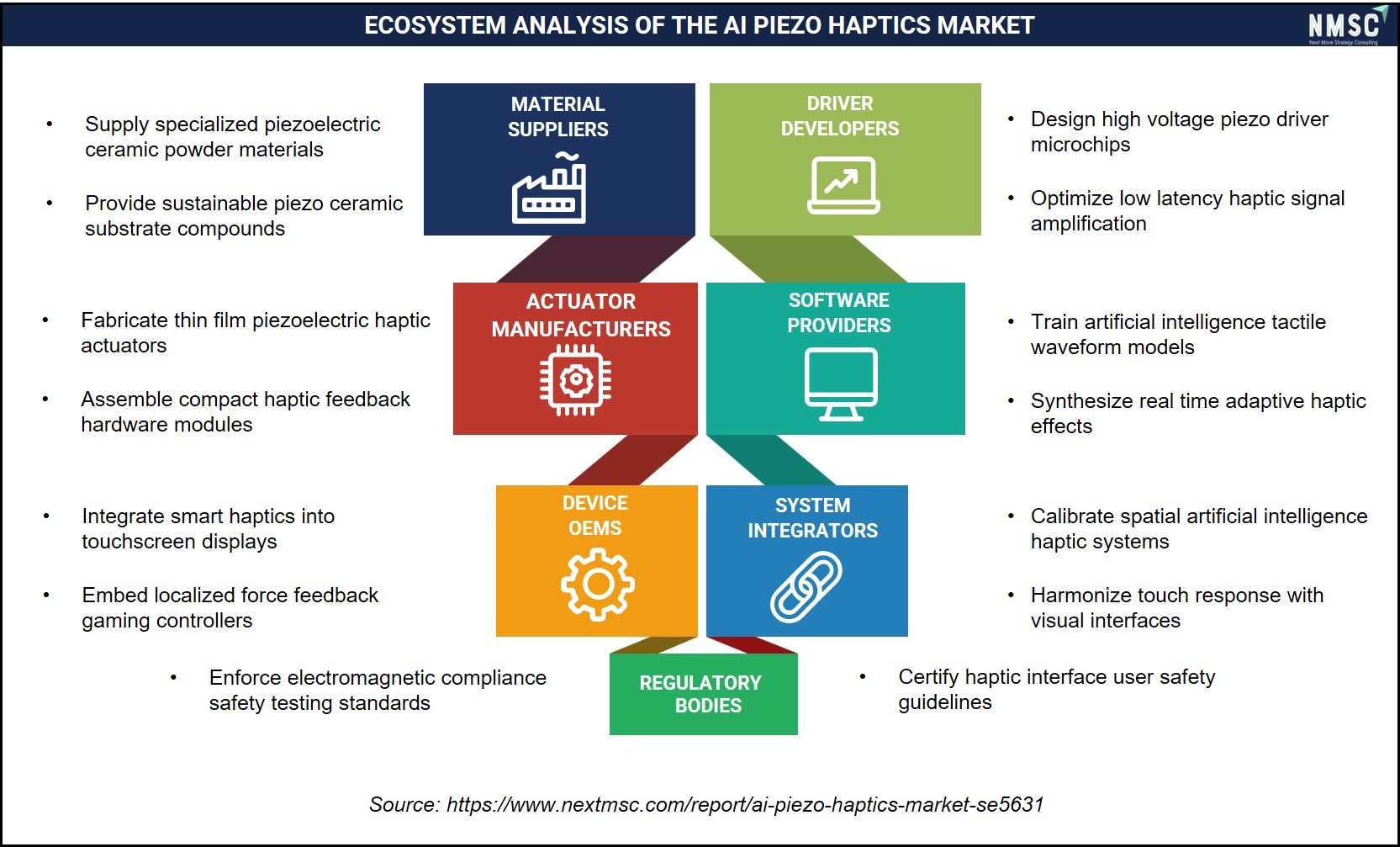
NMSC's analysis indicates that the AI Piezo Haptics Market functions within an ecosystem driven by specialized ceramic material suppliers, driver developers, actuator manufacturers, and AI software providers. System integrators calibrate haptic systems to harmonize touch responses with displays and controllers. Ultimately, regulatory bodies enforce strict electromagnetic compliance safety testing and certify user safety guidelines, ensuring reliable, high-performance haptic integration across consumer electronics and gaming applications.
Growth Drivers and Restraints
Growth Catalyst and Risk Assessment Matrix
|
Factors |
Type |
(+/−) % Impact on CAGR |
Geographic Relevance |
Impact Timeline |
|
Rising adoption of button-free automotive touch surfaces |
Driver |
+2.4% |
North America, Europe, Asia-Pacific |
2026-2035 |
|
Expanding on-device AI inference capability in smartphones |
Driver |
+2.0% |
Global |
2026-2035 |
|
Growth of premium wearable device shipments |
Driver |
+1.5% |
North America, Asia-Pacific |
2026-2035 |
|
Rising demand for immersive gaming and VR/AR feedback |
Driver |
+1.2% |
North America, Europe, Asia-Pacific |
2026-2035 |
|
Expanding smartphone manufacturing base in Asia-Pacific |
Driver |
+1.0% |
Asia-Pacific |
2026-2035 |
|
Growing medical device demand for precise tactile feedback |
Driver |
+0.6% |
North America, Europe |
2026-2032 |
|
High integration cost of piezo actuators versus LRA alternatives |
Restraint |
-1.0% |
Asia-Pacific, Latin America, MEA |
2026-2035 |
|
Limited AI-software development talent for haptic tuning |
Restraint |
-0.7% |
Global |
2026-2032 |
|
Design complexity in multi-actuator array integration |
Restraint |
-0.4% |
Global |
2026-2032 |
What Is the Primary Growth Driver of the AI Piezo Haptics Market?
Rising adoption of button-free automotive touch surfaces is the primary driver of the market. The U.S. National Highway Traffic Safety Administration continues to evaluate driver-distraction implications of touch-based automotive controls, prompting automakers to integrate haptic feedback that replicates tactile button confirmation. We observed that this design shift, reinforced by growing capacitive-touch-panel adoption in vehicle cockpits, continues to anchor baseline demand for piezo haptic surfaces across global automotive HMI programs.
How Is On-Device AI Inference Driving Market Growth?
Expanding on-device AI inference capability in smartphones is accelerating adoption of adaptive, context-aware haptic feedback across premium device tiers. The U.S. Federal Communications Commission continues to authorize increasingly capable mobile-device processors that support on-device machine-learning workloads without cloud dependency. Our assessment indicates that this processing-capability growth, combined with rising consumer expectations for differentiated touch experiences, is compressing development cycles for AI-tuned haptic software integration.
What Is Restraining AI Piezo Haptics Market Expansion?
The high integration cost of piezo actuators relative to linear resonant actuator alternatives restrains adoption among cost-sensitive mid-range device categories. Government electronics-manufacturing data across several Asia-Pacific markets continues to show linear resonant actuators retaining majority share in entry-level and mid-range smartphone segments due to lower bill-of-materials cost. We found that suppliers offering integrated actuator-and-driver modules face lower adoption barriers than discrete-component approaches, particularly across markets with tighter device-cost constraints.
Segmentation Analysis
Segment Sizing: By Component
|
Segment |
2025 (USD) |
2035 (USD) |
CAGR% (2026–2035) |
|
Piezoelectric Actuators |
USD 0.55 Billion |
USD 1.31 Billion |
8.9% |
|
Haptic Driver ICs |
USD 0.42 Billion |
USD 1.19 Billion |
11.1% |
|
Haptic Software and Algorithms |
USD 0.26 Billion |
USD 0.89 Billion |
13.3% |
|
Sensors and Feedback Modules |
USD 0.22 Billion |
USD 0.46 Billion |
7.6% |
|
Total |
USD 1.45 Billion |
USD 3.85 Billion |
10.25% |
Which Component Dominates the AI Piezo Haptics Market?
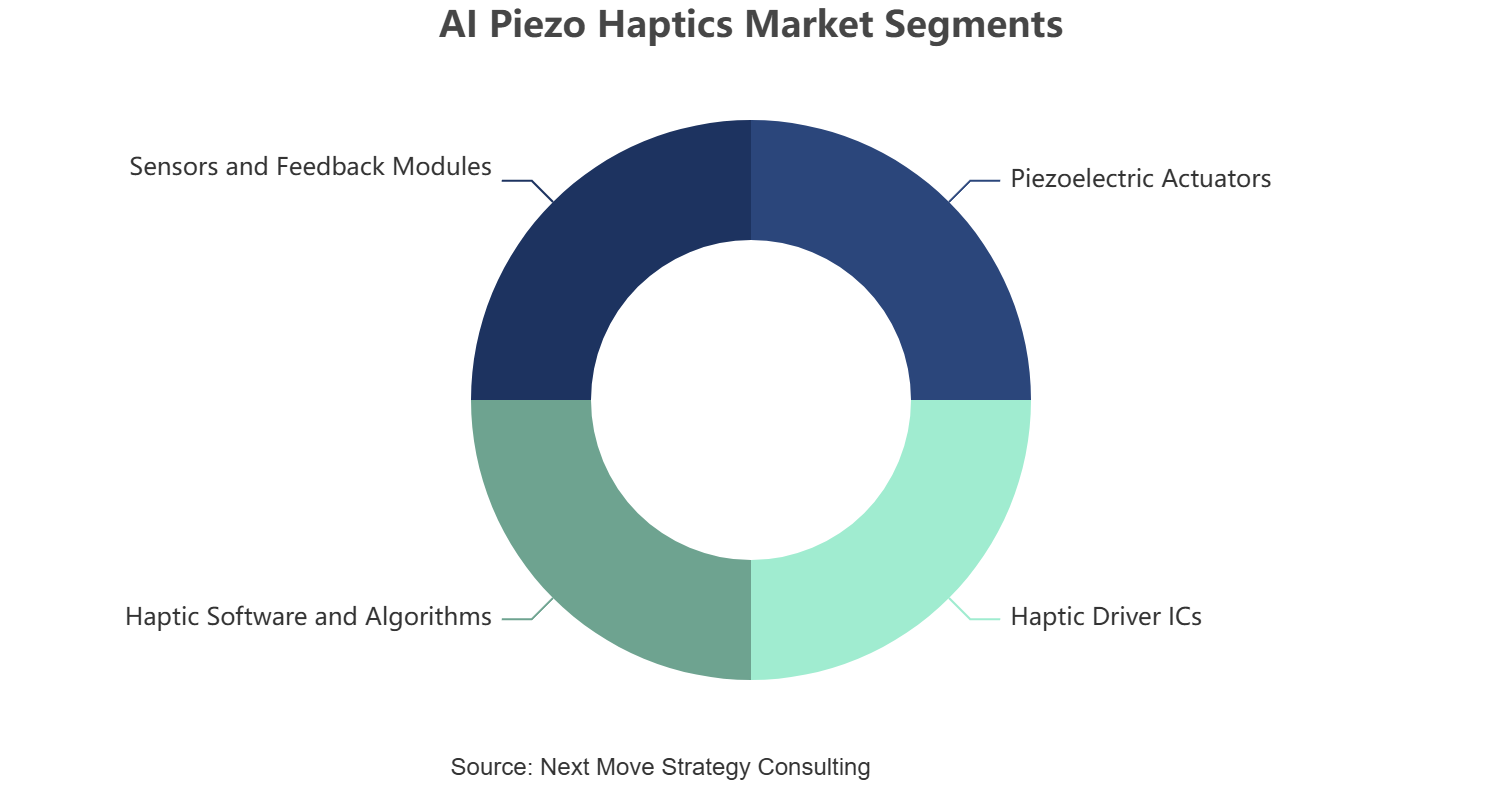
Piezoelectric Actuators led the market with USD 0.55 billion in 2025, supported by their foundational role as the physical hardware layer required across every AI piezo haptics application. We observed that Haptic Software and Algorithms is the fastest-growing component, expanding at a 13.3% CAGR from 2026 to 2035, as OEMs increasingly license AI-tuning platforms to differentiate feedback experiences without redesigning underlying actuator hardware.
Segment Sizing: By Application
|
Segment |
2025 (USD) |
2035 (USD) |
CAGR% (2026–2035) |
|
Smartphones and Tablets |
USD 0.52 Billion |
USD 1.12 Billion |
7.6% |
|
Wearables |
USD 0.28 Billion |
USD 0.85 Billion |
12.1% |
|
Automotive HMI |
USD 0.29 Billion |
USD 0.96 Billion |
13.0% |
|
Gaming and VR/AR Controllers |
USD 0.19 Billion |
USD 0.54 Billion |
11.2% |
|
Medical Devices |
USD 0.10 Billion |
USD 0.23 Billion |
8.4% |
|
Industrial and Robotics |
USD 0.07 Billion |
USD 0.15 Billion |
7.6% |
|
Total |
USD 1.45 Billion |
USD 3.85 Billion |
10.25% |
Which Application Leads AI Piezo Haptics Market Demand?
Smartphones and Tablets remained the leading application within the market, valued at USD 0.52 billion in 2025 on sustained premium-device integration of piezo haptic engines. Our findings suggest that Automotive HMI is the fastest-growing application, registering a 13.0% CAGR from 2026 to 2035, as automakers accelerate adoption of button-free touch surfaces requiring AI-tuned haptic confirmation across vehicle cockpit programs.
Segment Sizing: By End User
|
Segment |
2025 (USD) |
2035 (USD) |
CAGR% (2026–2035) |
|
Consumer Electronics OEMs |
USD 0.80 Billion |
USD 1.81 Billion |
8.3% |
|
Automotive OEMs |
USD 0.32 Billion |
USD 1.08 Billion |
13.2% |
|
Healthcare Device Manufacturers |
USD 0.19 Billion |
USD 0.54 Billion |
11.2% |
|
Industrial Equipment Manufacturers |
USD 0.15 Billion |
USD 0.42 Billion |
11.4% |
|
Total |
USD 1.45 Billion |
USD 3.85 Billion |
10.25% |
Which End User Segment Is Most Significant in the AI Piezo Haptics Market?
Consumer Electronics OEMs remained the largest end user, reaching USD 0.80 billion in 2025 on sustained smartphone and wearable device integration of piezo haptic components. Based on research conducted by Next Move Strategy Consulting, we found that Automotive OEMs is the fastest-growing end user at a 13.2% CAGR from 2026 to 2035, reflecting accelerating adoption of piezo haptic touch surfaces across vehicle cockpit and infotainment programs.
Growth Opportunities
Our analysis shows that three forward-looking opportunities stand out for stakeholders positioning within the AI piezo haptics market over the 2026-2035 forecast period.
How Can Licensable AI Tuning Platforms Unlock Value for Software Suppliers?
Licensable AI haptic-tuning software platforms present a whitespace opportunity for suppliers seeking recurring licensing revenue beyond one-time hardware sales. Companies that build OEM-agnostic tuning software stand to capture cross-platform licensing relationships within the haptic software and algorithms component segment as device makers seek faster integration timelines.
Where Do Automotive Cockpit Redesigns Create New Demand?
Automotive cockpit redesigns replacing mechanical switchgear with capacitive touch panels represent an underpenetrated opportunity for piezo haptic surface suppliers. Companies that secure Tier 1 design-win relationships can capture multi-year vehicle-program revenue, benefiting from expanding button-free interior adoption within the automotive HMI application segment.
How Can Compact Multi-Actuator Modules Benefit Wearable Device Makers?
Wearable device makers seeking richer, spatially distinct tactile communication create an opportunity for compact multi-actuator piezo module developers. Early movers that secure low-power, miniaturized actuator-array designs can differentiate with wearable OEMs pursuing scalable feedback capability within the wearables application segment.
Regional Outlook
Geographic Performance Snapshot
|
Region |
2025 (USD) |
2035 (USD) |
CAGR% (2026–2035) |
Key Driver |
|
Asia-Pacific |
USD 0.61 Billion |
USD 1.73 Billion |
11.1% |
Large smartphone manufacturing base and rising wearable adoption |
|
North America |
USD 0.41 Billion |
USD 0.96 Billion |
8.9% |
Advanced automotive HMI and premium smartphone integration |
|
Europe |
USD 0.28 Billion |
USD 0.69 Billion |
9.6% |
Automotive cockpit redesign and RoHS-compliant component sourcing |
|
Latin America |
USD 0.09 Billion |
USD 0.23 Billion |
10.3% |
Growing smartphone and automotive electronics assembly |
|
Middle East and Africa |
USD 0.07 Billion |
USD 0.23 Billion |
12.5% |
Expanding premium smartphone and automotive imports |
|
Total |
USD 1.45 Billion |
USD 3.85 Billion |
10.25% |
– |
Asia-Pacific AI Piezo Haptics Market Outlook
Asia-Pacific leads the market on its large smartphone manufacturing base and rapidly expanding wearable device adoption across China, Japan, and South Korea. We observed that domestic component suppliers continue to scale piezo actuator and driver-IC production capacity, while smartphone OEMs integrate AI-tuned haptic engines into flagship device tiers. Technology adoption remains advanced, with on-device AI inference continuing to expand across premium and increasingly mid-range device segments.
North America AI Piezo Haptics Market Outlook
North America's market is propelled by advanced automotive HMI development and strong premium smartphone integration across the U.S. and Canada. Our findings suggest that Tier 1 automotive suppliers continue to expand piezo haptic touch-surface programs alongside NHTSA-driven driver-distraction design considerations. Technology adoption favors AI-tuned software integration across the region's technology-forward consumer electronics and automotive design centers.
Europe AI Piezo Haptics Market Outlook
Europe's market reflects steady demand shaped by automotive cockpit redesign programs and RoHS-compliant component sourcing requirements. We observed that manufacturers across Germany, the UK, and France are expanding piezo haptic touch-surface integration for premium vehicle programs. Technology adoption favors automotive HMI applications across the region's established automotive supplier ecosystem.
Latin America AI Piezo Haptics Market Outlook
Latin America's market is expanding on growing smartphone and automotive electronics assembly activity across Brazil and Argentina. We found that regulatory environments remain comparatively accessible for electronic-component imports relative to other emerging regions, while currency volatility continues to concentrate near-term demand within premium device and export-oriented automotive assembly segments.
Middle East and Africa AI Piezo Haptics Market Outlook
The Middle East and Africa market is the fastest-growing region, shaped by expanding premium smartphone and automotive imports across Saudi Arabia and the UAE, alongside emerging consumer electronics demand in South Africa. Our assessment indicates that rising disposable income is expanding premium device adoption, while limited domestic component manufacturing continues to concentrate near-term demand within import-dependent consumer and automotive segments.
U.S. AI Piezo Haptics Market Outlook
Based on our estimates, U.S.'s AI piezo haptics market was valued at approximately USD 0.33 billion in 2025 and is projected to reach approximately USD 0.76 billion by 2035, expanding at approximately a 8.7% CAGR from 2026 to 2035. The U.S. remains the largest single country market, anchored by advanced automotive HMI design activity and strong premium smartphone integration. Demand structure favors haptic driver ICs and software licensing over discrete actuator hardware, with FCC electromagnetic-compatibility standards shaping component design compliance. Technology penetration is advanced across on-device AI inference, and competitive intensity remains high among domestic and international suppliers targeting the country's large premium-device design-win pipeline.
Canada AI Piezo Haptics Market Outlook
Canada's AI piezo haptics market was valued at approximately USD 0.05 billion in 2025 and is projected to reach approximately USD 0.12 billion by 2035, expanding at approximately a 9.9% CAGR from 2026 to 2035. Canada's market benefits from growing automotive electronics design activity and premium smartphone integration in urban technology hubs. Demand structure is weighted toward haptic driver ICs, with moderate regulatory influence from federal electronics-compliance standards. Technology penetration is high among premium device programs, and competitive intensity is moderate, with U.S.-headquartered suppliers holding meaningful share alongside domestic design houses.
UK AI Piezo Haptics Market Outlook
As per our estimate, UK's AI piezo haptics market was valued at approximately USD 0.05 billion in 2025 and is projected to reach approximately USD 0.11 billion by 2035, expanding at approximately a 8.9% CAGR from 2026 to 2035. The UK market reflects steady demand from automotive HMI and premium consumer electronics design centers navigating RoHS and REACH compliance requirements. Demand structure favors piezo actuators and driver ICs, with the UK's Office for Product Safety and Standards shaping component compliance oversight. Technology penetration is advanced, and competitive intensity remains elevated given the concentration of European and multinational suppliers with UK design operations.
Germany AI Piezo Haptics Market Outlook
According to our analysis, Germany's AI piezo haptics market was valued at approximately USD 0.08 billion in 2025 and is projected to reach approximately USD 0.19 billion by 2035, expanding at approximately a 9.6% CAGR from 2026 to 2035. Germany's market is shaped by strong automotive HMI design activity tied to premium vehicle cockpit redesign programs. Demand structure favors piezo actuators and driver ICs for automotive applications, with federal component-compliance authorities enforcing strict RoHS and REACH standards. Technology penetration is high among automotive Tier 1 suppliers, and competitive intensity is elevated given the concentration of major European automotive component manufacturers.
France AI Piezo Haptics Market Outlook
Based on our estimates, France's AI piezo haptics market was valued at approximately USD 0.04 billion in 2025 and is projected to reach approximately USD 0.10 billion by 2035, expanding at approximately a 9.6% CAGR from 2026 to 2035. France's market benefits from growing automotive cockpit redesign activity and rising premium consumer electronics demand. Demand structure is weighted toward automotive HMI applications, with regulatory influence from national electronics-compliance authorities shaping component sourcing standards. Technology penetration is expanding steadily, and competitive intensity is moderate, with domestic and pan-European suppliers both active.
China AI Piezo Haptics Market Outlook
China's AI piezo haptics market was valued at approximately USD 0.23 billion in 2025 and is projected to reach approximately USD 0.66 billion by 2035, expanding at approximately a 11.1% CAGR from 2026 to 2035. China's market is the largest in Asia-Pacific, propelled by its extensive smartphone manufacturing base and rapidly expanding wearable device production. Demand structure favors piezoelectric actuators and driver ICs across domestic smartphone brands, with the Ministry of Industry and Information Technology shaping electronics-manufacturing compliance standards. Technology penetration is extensive across major manufacturing hubs, and competitive intensity is high, with domestic component suppliers gaining share.
India AI Piezo Haptics Market Outlook
As per our estimate, India's AI piezo haptics market was valued at approximately USD 0.07 billion in 2025 and is projected to reach approximately USD 0.28 billion by 2035, expanding at approximately a 15.8% CAGR from 2026 to 2035. India's market is the fastest-growing country market, driven by expanding domestic smartphone assembly and rising premium device adoption. Demand structure spans piezoelectric actuators and haptic software across growing consumer electronics manufacturing, with the Ministry of Electronics and Information Technology shaping component-sourcing and manufacturing-incentive standards. Technology penetration continues to expand through growing electronics-manufacturing investment, and competitive intensity is intense among domestic and international suppliers.
Japan AI Piezo Haptics Market Outlook
According to our analysis, Japan's AI piezo haptics market was valued at approximately USD 0.13 billion in 2025 and is projected to reach approximately USD 0.31 billion by 2035, expanding at approximately a 8.7% CAGR from 2026 to 2035. Japan's market reflects steady demand amid a mature, technology-forward consumer electronics and automotive component manufacturing base. Demand structure favors piezoelectric actuators and driver ICs, with regulatory influence from national electronics-safety authorities shaping component compliance standards. Technology penetration is high among premium device and automotive programs, and competitive intensity is moderate, with domestic manufacturers holding meaningful share.
South Korea AI Piezo Haptics Market Outlook
Based on our estimates, South Korea's AI piezo haptics market was valued at approximately USD 0.10 billion in 2025 and is projected to reach approximately USD 0.26 billion by 2035, expanding at approximately a 10.3% CAGR from 2026 to 2035. South Korea's market benefits from a strong domestic smartphone manufacturing base and advanced consumer electronics design capability. Demand structure favors haptic driver ICs and software for flagship smartphone integration, with regulatory influence from national electronics-standards authorities shaping compliance requirements. Technology penetration is high relative to regional peers, and competitive intensity is moderate among domestic and international suppliers.
Australia AI Piezo Haptics Market Outlook
Australia's AI piezo haptics market was valued at approximately USD 0.02 billion in 2025 and is projected to reach approximately USD 0.07 billion by 2035, expanding at approximately a 11.1% CAGR from 2026 to 2035. Australia's market reflects steady demand from premium consumer electronics import and growing automotive HMI design interest. Demand structure favors piezoelectric actuators for imported premium devices, with regulatory influence from national communications authorities shaping electronics-compliance standards. Technology penetration is advanced among urban premium-device consumers, and competitive intensity is moderate, with international suppliers holding meaningful share.
UAE AI Piezo Haptics Market Outlook
As per our estimate, UAE's AI piezo haptics market was valued at approximately USD 0.02 billion in 2025 and is projected to reach approximately USD 0.06 billion by 2035, expanding at approximately a 12.5% CAGR from 2026 to 2035. The UAE market is propelled by expanding premium smartphone and automotive imports supporting growing consumer electronics demand. Demand structure favors piezoelectric actuators embedded within imported premium devices, with regulatory bodies shaping electronics-import compliance requirements. Technology penetration is expanding from a growing premium-device consumer base, and competitive intensity is moderate, with international suppliers holding meaningful share.
Saudi Arabia AI Piezo Haptics Market Outlook
According to our analysis, Saudi Arabia's AI piezo haptics market was valued at approximately USD 0.02 billion in 2025 and is projected to reach approximately USD 0.06 billion by 2035, expanding at approximately a 12.5% CAGR from 2026 to 2035. Saudi Arabia's market benefits from Vision 2030-linked technology investment supporting expanding premium consumer electronics and automotive imports. Demand structure favors piezoelectric actuators within imported premium devices, with the Saudi Standards, Metrology and Quality Organization shaping electronics-compliance standards. Technology penetration is expanding rapidly, and competitive intensity is moderate, with international suppliers increasingly partnering with domestic distributors.
South Africa AI Piezo Haptics Market Outlook
Based on our estimates, South Africa's AI piezo haptics market was valued at approximately USD 0.01 billion in 2025 and is projected to reach approximately USD 0.04 billion by 2035, expanding at approximately a 12.5% CAGR from 2026 to 2035. South Africa's market reflects growing premium consumer electronics demand amid a smaller domestic manufacturing base. Demand structure favors piezoelectric actuators within imported premium devices, with regulatory influence from national communications authorities shaping electronics-compliance standards. Technology penetration remains concentrated among urban premium-device consumers, and competitive intensity is moderate, with international suppliers holding meaningful share.
Brazil AI Piezo Haptics Market Outlook
Brazil's AI piezo haptics market was valued at approximately USD 0.04 billion in 2025 and is projected to reach approximately USD 0.10 billion by 2035, expanding at approximately a 10.0% CAGR from 2026 to 2035. Brazil's market is the largest in Latin America, driven by growing smartphone and automotive electronics assembly activity. Demand structure favors piezoelectric actuators and driver ICs across domestic assembly operations, with regulatory influence from national telecommunications authorities shaping component-compliance requirements. Technology penetration continues to expand across major assembly hubs, and competitive intensity is moderate, with domestic and international suppliers both active.
Argentina AI Piezo Haptics Market Outlook
As per our estimate, Argentina's AI piezo haptics market was valued at approximately USD 0.02 billion in 2025 and is projected to reach approximately USD 0.04 billion by 2035, expanding at approximately a 10.3% CAGR from 2026 to 2035. Argentina's market reflects steady growth in premium consumer electronics demand amid macroeconomic volatility affecting import-dependent component pricing. Demand structure favors piezoelectric actuators within imported premium devices, with regulatory influence from national standards authorities shaping compliance conditions. Technology penetration is expanding steadily among urban consumers, and competitive intensity is moderate, with regional distributors holding meaningful share.
Porter’s Five Forces Analysis of the AI Piezo Haptics Market
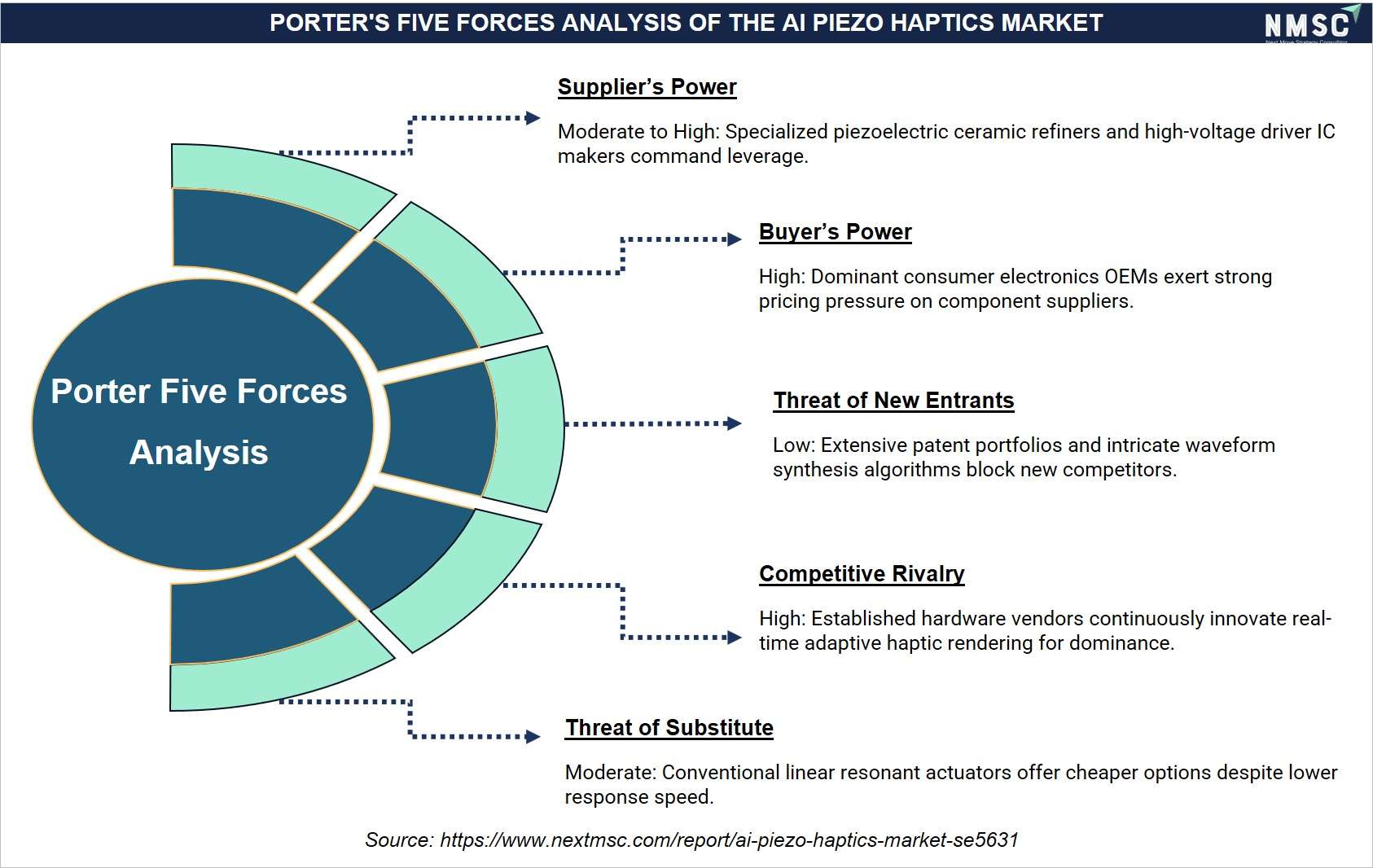
Based on research conducted by NMSC, we found that competitive rivalry in the AI Piezo Haptics Market remains high as vendors continuously innovate real-time adaptive rendering. Meanwhile, dominant consumer electronics OEMs exercise strong buyer power regarding pricing. Furthermore, extensive patent portfolios and complex algorithms keep the threat of new entrants low, while specialized ceramic refiners hold moderate-to-high supplier power, and conventional linear resonant actuators pose a moderate substitute threat.
Competitive Landscape
We observed that the AI piezo haptics market remains moderately consolidated, with large semiconductor and driver-IC suppliers, specialized piezo actuator manufacturers, and automotive Tier 1 suppliers all competing for OEM design-win share.
|
Dimension |
Details |
|
Market Structure |
Moderately consolidated, with the Top 10 companies accounting for a defined share of Industry revenue |
|
Innovation Focus |
AI-tuned waveform software, multi-actuator array design, and integrated actuator-driver modules |
|
M&A Activity |
Consolidation among semiconductor firms acquiring piezo actuator and haptic software specialists |
How Do Companies Compete Within the AI Piezo Haptics Market?
Companies compete primarily on AI-tuning software sophistication, driver-IC integration depth, and OEM design-win relationships across smartphone and automotive programs. Our analysis shows that suppliers increasingly differentiate through combined hardware-and-software platform offerings rather than actuator hardware alone, as OEMs prioritize faster integration timelines and programmable feedback profiles.
Which Competitive Archetypes Dominate the AI Piezo Haptics Market?
Three archetypes dominate: large semiconductor and driver-IC suppliers such as Cirrus Logic, Inc. and Texas Instruments Incorporated; specialized piezo actuator manufacturers such as TDK Corporation and Murata Manufacturing Co., Ltd.; and automotive Tier 1 suppliers such as Continental AG and Johnson Electric Holdings Limited. Each archetype leverages distinct distribution channels, from direct semiconductor design-win relationships to automotive Tier 1 supply agreements.
What Innovation and Differentiation Strategies Are Companies Pursuing?
Companies are pursuing AI-tuned waveform software, multi-actuator array miniaturization, and integrated actuator-driver module design as core differentiation strategies. We found that Industry leaders are also investing in reference-design bundles that pair hardware with licensable tuning software to accelerate OEM adoption across smartphone and automotive design programs.
What M&A Activity Is Shaping the Competitive Landscape?
M&A activity is concentrated on semiconductor firms acquiring specialized piezo actuator and haptic software companies to build integrated hardware-and-software platforms. Our assessment indicates that this consolidation trend is expected to continue as companies seek to reduce OEM integration friction through combined component-and-software offerings.
Key Market Players
Our findings suggest that the following 20 companies represent the leading verified providers active in the AI piezo haptics market as of 2026, ranked by market-specific revenue and scale of operations.
-
Cirrus Logic, Inc.
-
Texas Instruments Incorporated
-
STMicroelectronics N.V.
-
onsemi (ON Semiconductor Corporation)
-
Murata Manufacturing Co., Ltd.
-
Physik Instrumente (PI) GmbH & Co. KG
-
Piezo Motion Corp.
-
Immersion Corporation
-
AAC Technologies Holdings Inc.
-
Yageo Corporation
-
CTS Corporation
-
Alps Alpine Co., Ltd.
-
Actronika SAS
-
Johnson Electric Holdings Limited
-
Continental AG
-
Kyocera Corporation
-
Joyson Safety Systems Acquisition LLC
-
Mide Technology Corporation
-
APC International, Ltd.
Latest Developments
We observed that recent product launches and platform expansions reflect the industry's continued shift toward AI-tuned, integrated haptic hardware-and-software platforms.
|
Date |
Event |
|
December 2025 |
Cirrus Logic launched the CS40L51, CS40L52, and CS40L53 family of AEC-Q100-qualified closed-loop haptic drivers for automotive applications. The new products extend the company's proven consumer haptics expertise into vehicle interfaces, enabling precise tactile feedback for touchscreens, smart surfaces, and next-generation cockpit controls. |
|
May 2025 |
Mouser Electronics began shipping Vishay's AEC-Q200 IHPT-A haptic feedback actuators featuring bundled Immersion Corporation licenses. The solution streamlines implementation of high-definition tactile feedback for automotive center consoles, touchscreens, industrial HMIs, and other touchscreen applications by eliminating the need for a separate haptic software license. |
Expert Insights

"In the robotics industry, multi-sensing (the integration of numerous sensors) is expected to emerge as a key capability. Through our collaboration with TDK, which offers a broad portfolio of sensor technologies, we aim to help shape the ecosystem for core robotic components. We will continue to expand partnerships with technology leaders, further strengthen the core technologies for robots' vision and hands, and accelerate our efforts to secure a leading position in the Physical AI market."
— Moon Hyuksoo, CEO, LG Innotek
Statement made during the announcement of LG Innotek's strategic collaboration with TDK to develop advanced sensor and haptic technologies for next-generation humanoid robots and the Physical AI ecosystem (2026).
Market Interpretation
The statement underscores the growing importance of multi-sensing and haptic technologies as foundational components for AI-powered robotics and Physical AI systems. As humanoid robots increasingly require precise tactile perception, force feedback, and environmental awareness, the integration of piezoelectric haptic sensors with AI-driven sensor fusion is becoming essential for enabling human-like interaction and dexterous manipulation. Consequently, collaborations between component manufacturers and technology leaders are accelerating innovation in AI piezo haptics, expanding opportunities across robotics, industrial automation, healthcare, and intelligent human-machine interfaces.
Investment Opportunities
What Capital Inflows Are Targeting the AI Piezo Haptics Market?
Capital inflows continue to target AI-tuned haptic software development and automotive HMI design capability, with integrated hardware-and-software suppliers attracting sustained investor interest. Our assessment indicatesinvestors favor companies demonstrating measurable OEM design-win growth and licensing-revenue expansion over pure component-volume metrics.
How Is Infrastructure Investment Shaping Market Expansion?
Semiconductor fabrication and piezo ceramic manufacturing capacity investment continues to expand component availability, supporting the 11.1% CAGR projected for Haptic Driver ICs through 2035. We found that companies are prioritizing regional manufacturing expansion to serve growing smartphone and automotive assembly demand across Asia-Pacific and Latin America regions.
What ESG Considerations Are Relevant to AI Piezo Haptics Investment?
Environmental, Social, and Governance considerations increasingly favor suppliers adopting RoHS-compliant, lead-free piezoelectric materials and transparent supply-chain sourcing practices. Our analysis shows that institutional investors are prioritizing companies with disclosed material-compliance and manufacturing-emissions data aligned with electronics-industry sustainability expectations.
Key Benefits for Stakeholders
How Does This Report Benefit Component Supplier and Industry Leaders?
Component supplier and industry leaders gain access to verified segmentation, regional sizing, and competitive benchmarking that inform product-roadmap and design-win investment decisions. Our analysis, data, and forecasts help leaders prioritize AI-software and automotive-HMI investments aligned with projected segment growth.
How Does This Report Benefit Investors and Financial Analysts?
Investors and financial analysts benefit from validated market-sizing, CAGR methodology, and company-level competitive positioning that support capital-allocation and valuation decisions. Our findings suggest that segment-level growth differentials, particularly in Haptic Software and Algorithms and Automotive OEMs, offer actionable signals for portfolio construction.
How Does This Report Benefit OEM and Product Design Teams?
OEM and product design teams gain strategic insight into emerging trends, competitive archetypes, and regional demand patterns that inform component-sourcing and integration-timeline prioritization. We observed that this analysis supports go-to-market planning for AI-tuned haptic software and automotive HMI partnerships across target application segments.
Key Market Segments
By Component
-
Piezoelectric Actuators
-
Haptic Driver ICs
-
Haptic Software and Algorithms
-
Sensors and Feedback Modules
By Application
-
Smartphones and Tablets
-
Wearables
-
Automotive HMI
-
Gaming and VR/AR Controllers
-
Medical Devices
-
Industrial and Robotics
By End User
-
Consumer Electronics OEMs
-
Automotive OEMs
-
Healthcare Device Manufacturers
-
Industrial Equipment Manufacturers
By Region
-
North America: U.S., Canada, Mexico.
-
Europe: UK, Germany, France, Italy, Spain, Sweden, Denmark, Finland, Netherlands, Rest of Europe.
-
Asia-Pacific: China, India, Japan, South Korea, Taiwan, Indonesia, Vietnam, Australia, Philippines, Malaysia, Rest of APAC.
-
Middle East & Africa: Saudi Arabia, UAE, Egypt, Israel, Turkey, Nigeria, South Africa, Rest of MEA.
-
Latin America: Brazil, Argentina, Chile, Colombia, Rest of LATAM.
Conclusion and Recommendations
What Is the Long-Term Outlook for the AI Piezo Haptics Market?
The long-term outlook remains positive, with the market projected to expand from USD 1.60 billion in 2026 to USD 3.85 billion by 2035 at a 10.25% CAGR. Our assessment indicates that sustained smartphone and automotive HMI integration of AI-tuned piezo haptic feedback will anchor growth across both mature and emerging technology markets through the forecast horizon.
What Strategic Positioning Should Companies Pursue?
Companies should prioritize AI-tuned software development and integrated actuator-driver module design to differentiate within an increasingly software-defined haptics landscape. Our findings suggest that companies combining hardware manufacturing scale with licensable software platforms will be best positioned to retain OEM design-win relationships.
How Attractive Is the Market for New Investment?
The market presents an attractive investment case, supported by a USD 2.25 billion absolute dollar opportunity between 2026 and 2035 and above-average growth in the Middle East and Africa and the Haptic Software and Algorithms segment. We found that investment attractiveness is highest for companies combining piezo hardware capability with AI-driven software differentiation.
What Market Shifts and Key Risks Should Stakeholders Monitor?
Stakeholders should monitor high integration costs relative to linear resonant actuator alternatives, limited AI-software development talent, and multi-actuator design complexity as key risks. Our analysis shows that companies unable to demonstrate cost-competitive integrated modules risk losing design wins to lower-cost alternative haptic technologies in price-sensitive device tiers.
What Are the Key Growth Pathways for the Market?
Key growth pathways include expanding licensable AI-tuning software platforms, scaling automotive HMI design-win pipelines, and deepening wearable device integration across Asia-Pacific and North America. Next Move Strategy Consulting's analysis indicates that companies pursuing these pathways while maintaining integrated hardware-software capability will be best positioned to capture the market's projected growth through 2035.
About the Author
 Saista Faiyaz
— Saista Faiyaz is Research Associate at Next Move Strategy Consulting, where she has covered consumer markets and healthcare technologies for 3 years. Her work includes primary interview review, secondary-source validation, market sizing, and structured analysis of company and industry data. She supports research by comparing evidence across sources, organizing findings into market narratives, and documenting assumptions used in analysis. Her scope includes cross-market benchmarking, and reports.
Saista Faiyaz
— Saista Faiyaz is Research Associate at Next Move Strategy Consulting, where she has covered consumer markets and healthcare technologies for 3 years. Her work includes primary interview review, secondary-source validation, market sizing, and structured analysis of company and industry data. She supports research by comparing evidence across sources, organizing findings into market narratives, and documenting assumptions used in analysis. Her scope includes cross-market benchmarking, and reports.
About the Reviewer
 Supradip Baul
— Supradip Baul is an accomplished business consultant and strategist with over a decade of rich experience in market intelligence, strategy, technology, and business transformation. His work has included rigorous qualitative and quantitative analysis across multiple industries, helping clients shape investment decisions and long-term roadmaps. Earlier in his career, he was associated with Gartner, where he contributed to industry-leading reports and market share analyses. He has worked with leading global companies and holds an MBA with a dual specialization in Marketing and Finance.
Supradip Baul
— Supradip Baul is an accomplished business consultant and strategist with over a decade of rich experience in market intelligence, strategy, technology, and business transformation. His work has included rigorous qualitative and quantitative analysis across multiple industries, helping clients shape investment decisions and long-term roadmaps. Earlier in his career, he was associated with Gartner, where he contributed to industry-leading reports and market share analyses. He has worked with leading global companies and holds an MBA with a dual specialization in Marketing and Finance.
At Next Move Strategy Consulting, we understand that insightful market research is the cornerstone of successful business decisions. That's why we employ a robust and multifaceted approach, combining various methodologies to deliver the most accurate and actionable data for our clients.

Research Landscape
We navigate the world of research with two primary approaches:
Qualitative Approach
Our qualitative research methodologies involve immersive techniques such as in-depth interviews, focus groups, and observational studies. By engaging directly with individuals and stakeholders, we uncover valuable insights that quantitative data alone may overlook.

Quantitative Research
In tandem with qualitative methodologies, NMSC leverages the power of Quantitative Research to provide a robust foundation of numerical insights. Through systematic data collection and analysis, we quantify patterns, preferences, and market trends, offering a comprehensive view of the business landscape.
Our quantitative research approach employs diverse tools, including surveys, experiments, and statistical modelling. These methodologies enable us to gather data from a large and representative sample, ensuring the statistical significance of our findings. By employing structured questionnaires and standardized data collection methods, we guarantee the reliability and validity of the information we present to our clients.
Quantitative research is particularly effective in measuring the prevalence of trends, assessing market size, and gauging the impact of various factors on consumer behavior. The numerical precision attained through this approach equips our clients with actionable insights, facilitating data-driven decision-making and strategy formulation.


Our Specialized Toolbox for Industry-Specific Market Research
We deploy a specialized arsenal of techniques tailored to meet your unique requirements. Here's a glimpse into our comprehensive toolbox:

Information Procurement
The stage entails acquiring market data or relevant information through various sources and methodologies.


Market Research Approach
We utilize both top-down and bottom-up approaches in market research analysis to achieve a comprehensive understanding of the market dynamics, leveraging the broad perspective of industry trends and macroeconomic factors alongside detailed insights from specific segments and individual companies.

Porters Five Forces Analysis
We conduct Porter's Five Forces analysis to evaluate the competitive landscape of an industry, providing us with insights into factors that affect profitability and strategic positioning.

SWOT Analysis

Forecasting
We utilize a forecasting model to predict future consumption by considering parameters like population, economics, regulations, market competition, drivers, constraints, technology, and pricing. We also employ statistical techniques such as multilinear regression, exponential smoothing, moving average, ARIMA, and Monte Carlo simulations for accurate predictions. In econometric forecasting, we analyzed short-term and long-term event impacts, attributing values based on regulatory frameworks, economic factors, and market events.





 Speak to Our Analyst